Hubbry Logo
Matthew 13Matthew 13Main
Open search
Matthew 13
Community hub
Matthew 13
logo
8 pages, 0 posts
0 subscribers
Be the first to start a discussion here.
Matthew 13
Matthew 13
from Wikipedia
Matthew 13
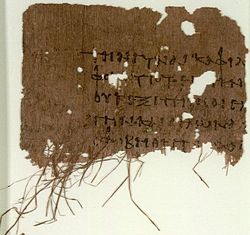
Gospel of Matthew 13:55–56 on Papyrus 103, from c. AD 200
BookGospel of Matthew
CategoryGospel
Christian Bible partNew Testament
Order in the Christian part1

Matthew 13 is the thirteenth chapter in the Gospel of Matthew in the New Testament section of the Christian Bible. This chapter contains the third of the five Discourses of Matthew, called the Parabolic Discourse, based on the parables of the Kingdom.[1] At the end of the chapter, Jesus is rejected by the people of his hometown, Nazareth.

Text

[edit]
The parable of the tares

The original text was written in Koine Greek. This chapter is divided into 58 verses.

Textual witnesses

[edit]

Some early manuscripts containing the text of this chapter are:

Old Testament references

[edit]

New Testament references

[edit]

Structure

[edit]

Matthew 13 presents seven parables,[4] and two explanations of his parables. Overall, the verses in this chapter can be divided into groups (with cross references to parallel sections in the other gospels):

Protestant theologian Heinrich Meyer identifies two groups of parables: the four first parables (up to Matthew 13:34) "were spoken in presence of the multitude, and the other three again within the circle of the disciples".[6] German liberal Protestant theologian David Strauss thought this chapter was "overwhelming with parables".[6] At the beginning of the chapter, Jesus sits in a ship or a boat on the Sea of Galilee and addresses the crowd who stand on the shore or the beach.[7] The Textus Receptus has inserted the definite article (Greek: τὸ πλοῖον, to ploion), suggesting that there was a boat kept waiting for him,[8] but other texts do not include the definite article and the Pulpit Commentary therefore argues that it was "wrongly inserted".[9]

Verses 51–52

[edit]
51"Have you understood all these things?" Jesus asked.
"Yes", they replied.
52 He said to them, "Therefore every teacher of the law who has become a disciple in the kingdom of heaven is like the owner of a house who brings out of his storeroom new treasures as well as old."[10]

These verses conclude the Parabolic Discourse and may be called a "comparative proverb".[11] Henry Alford describes them as a "solemn conclusion to the parables.[4] Johann Bengel suggests that Jesus would have been ready to explain the other parables if necessary, "but they understood them, if not perfectly, yet truly".[8] The reference to scribes, or teachers of the Jewish law, who became disciples reflects the Matthean gospel focus in particular; the Jerusalem Bible suggests that this reference may portray the evangelist himself.[12]

Verses 53–58

[edit]

The final verses of this chapter see Jesus return to his home town, meaning Nazareth,[11] where he preaches in the synagogue and experiences the rejection of his "own people",[13] and his own country.

Dale Allison sees these verses and the following chapters as far as chapter 17 as recounting "the birth of the Church";[11] the Jerusalem Bible likewise holds that the same long section constitutes a narrative on the Church, followed by Matthew 18, which is often called the Discourse on the Church.[1]

References

[edit]
[edit]
Revisions and contributorsEdit on WikipediaRead on Wikipedia
from Grokipedia
Matthew 13 is the thirteenth chapter of the Gospel of Matthew in the of the Christian Bible, presenting a collection of seven parables taught by to illustrate the nature, growth, value, and ultimate judgment associated with the Kingdom of Heaven. The chapter begins with Jesus departing from a house to teach by the , where large crowds gather, prompting him to speak from a . Central to the chapter is the Parable of the Sower (verses 1–23), in which Jesus describes a farmer sowing seeds that fall on four types of soil—representing different human responses to the word of the Kingdom: the path (where birds devour the seed, symbolizing lack of understanding), rocky ground (shallow reception that withers), thorns (choked by worldly concerns), and good soil (yielding abundant fruit). Jesus explains this parable privately to his disciples, emphasizing its role in revealing kingdom mysteries to believers while concealing them from others, fulfilling the prophecy from Isaiah 6:9–10 about hardened hearts. Subsequent parables expand on kingdom dynamics: the Parable of the Weeds (or Tares) among the Wheat (verses 24–30, 36–43) depicts an enemy sowing weeds in a wheat field, illustrating the coexistence of good and evil in the world until the harvest at the end of the age, when angels separate the righteous (sons of the kingdom) from the wicked (sons of the evil one), with the latter facing fiery judgment. The brief Parable of the Mustard Seed (verses 31–32) portrays the kingdom starting as the smallest seed but growing into a large tree, sheltering birds—highlighting unexpected expansion despite humble beginnings. Similarly, the Parable of the Leaven (verse 33) compares the kingdom to leaven hidden in three measures of flour, gradually permeating the whole, underscoring its pervasive influence. The chapter concludes with three parables emphasizing the kingdom's supreme value and final reckoning: the (verse 44), where a man joyfully sells all to buy a field containing treasure; the Parable of the Pearl of Great Price (verses 45–46), in which a sacrifices everything for a priceless pearl; and the Parable of the Dragnet (verses 47–50), likening the kingdom to a net catching all fish, sorted at the end into good (preserved in vessels) and bad (thrown away in judgment). then addresses the disciples' role as scribes trained for the kingdom, like householders bringing out old and new treasures (verses 51–52). Theologically, Matthew 13 functions as a pivotal in , shifting from Jesus' public ministry amid growing opposition to a mode of teaching that both conceals and reveals truths, reorienting Israel's eschatological hopes around in him as rather than national identity. The chapter ends with Jesus' rejection in his hometown of (verses 53–58), where unbelief limits his miracles, underscoring themes of reception and response that echo throughout the parables.

Introduction

Synopsis

Matthew 13 depicts Jesus teaching large crowds assembled by the Sea of Galilee, where he positions himself in a boat to speak effectively to the multitude from the shore (verses 1–2). He employs parables to convey truths about the Kingdom of Heaven, beginning with the Parable of the Sower (verses 1–23), which describes a farmer scattering seeds on various types of soil. After posing a question to his disciples about understanding the parables and providing a private explanation of the Sower to them (verses 10–23), Jesus continues with further illustrations of the kingdom. The subsequent parables include the Weeds among the Wheat (verses 24–30), depicting an enemy sowing weeds in a field of good seed, with separation at harvest; the (verses 31–32), showing a tiny seed growing into a large ; and the (verse 33), where a small amount leavens an entire batch of . Later, indoors with his disciples, explains the Weeds parable in detail (verses 36–43). He then offers brief parables of the (verse 44), in which a man sells everything to buy a field containing ; the Pearl of Great Value (verses 45–46), where a merchant sacrifices all for an exceptional pearl; and the Dragnet (verses 47–50), illustrating the gathering and sorting of fish at the end of the age. This parabolic teaching fulfills the prophecy in Psalm 78:2, as the narrator notes that speaks to the crowds in this manner to utter things hidden since the creation of the world (verse 35). The chapter shifts from public instruction to private clarification with the disciples, underscoring the selective revelation of kingdom mysteries. It concludes with departing for his hometown of , where local familiarity with his family leads to offense and limited miracles due to their unbelief (verses 53–58).

Historical and Literary Context

The Gospel of Matthew is traditionally attributed to Matthew the tax collector, also known as Levi, who is described in the text as a disciple called by Jesus (Matthew 9:9). Early church fathers, including Papias and Irenaeus, supported this attribution, linking the author to the apostle who composed an initial Aramaic version for Jewish audiences before its Greek translation. Modern scholarly consensus holds that the Gospel is anonymous, likely penned by an educated Jewish Christian familiar with Hebrew Scriptures, with the traditional ascription emerging in the second century. It was composed between 70 and 100 AD, probably in the 80s, for a primarily Jewish-Christian community navigating tensions between emerging Christianity and Judaism post the destruction of the Jerusalem Temple. Chapter 13 is situated within the narrative of ' Galilean ministry, which forms the core of his public teaching phase following his around 28–29 AD and lasting approximately one to three years until his final journey to . This period, centered in —a region of diverse Jewish populations under Roman oversight—saw proclaiming the kingdom of amid increasing scrutiny and opposition from religious authorities, including who challenged his interpretations of laws and associations with sinners. The events depicted in Matthew 13 occur after the commissioning of the Twelve disciples in chapter 10 and before the escalation of miracles and rejection in chapter 14, marking a pivotal moment in ' itinerant teaching by the . Literarily, Matthew 13 functions as a major discourse chapter, the third of five extended teaching blocks that structure the Gospel to emphasize as the new delivering authoritative instruction. These discourses—beginning with the (chapters 5–7), followed by the missionary instructions (chapter 10), then the parables of the kingdom (chapter 13), community guidelines (chapter 18), and eschatological warnings (chapters 24–25)—each conclude with a formulaic transition linking teaching to action, such as "When Jesus had finished these sayings" (Matthew 13:53). This arrangement underscores the Gospel's didactic purpose, collecting ' sayings to guide believers in ethical, missional, and communal life within a Jewish framework.

Textual Analysis

Manuscript Variants

The primary textual witnesses for Matthew 13 include major uncial manuscripts from the fourth and fifth centuries, such as Codex Sinaiticus (א, 4th century), Codex Vaticanus (B, 4th century), and Codex Bezae (D, 5th century). These codices preserve the chapter with a high degree of consistency, though minor variants occur, particularly in word order within parable introductions. For instance, in verse 1, the phrasing describing Jesus leaving the house reads "having gone out of the house" (ἐξελθὼν ὁ Ἰησοῦς τῆς οἰκίας) in Sinaiticus and Vaticanus, while Codex Bezae and later Byzantine manuscripts prefer "from the house" (ἀπὸ τῆς οἰκίας), a subtle preposition shift that does not alter meaning but reflects scribal harmonization preferences. Significant variants appear in verse 35, which introduces a prophetic fulfillment citation from . In some Alexandrian and Byzantine witnesses, including the original hand of Sinaiticus, Q (7th century), and Family 1 (f¹, 12th century), the attribution specifies "through the prophet" (διὰ Ἠσαΐου τοῦ προφήτου), an erroneous ascription likely due to scribal with other prophetic quotes in Matthew. Additionally, the phrase "from the foundation of the world" (ἀπὸ καταβολῆς κόσμου) is omitted in Vaticanus, Family 1, and some other witnesses like , possibly as an intentional shortening to align with parallel phrasing elsewhere, though the Nestle-Aland edition retains it as original. No full omission of the verse occurs in Western texts like , contrary to some early conjectures; instead, Western manuscripts exhibit related shifts in nearby verses, such as verse 13, harmonizing to Mark 4:12. Later Byzantine manuscripts introduce additions for explanatory clarity, particularly in the parable interpretations. In verse 43, which concludes the weeds parable explanation, some Byzantine copies expand the phrasing "he who has ears, let him hear" (ὁ ἔχων ὦτα ἀκούετω) to a fuller form (ὁ ἔχων ὦτα ἀκούειν ἀκουέτω), reflecting harmonization with parallels in Mark and Luke. These expansions are absent in earlier witnesses like Sinaiticus and Vaticanus, where the text remains concise. Early patristic citations attest to the core stability of Matthew 13's text. , in his third-century Commentary on Matthew (Book X), quotes extensively from the sower and weeds s (verses 1–30, 36–43), including the verse 35 fulfillment without the Isaiah attribution error, indicating access to an Alexandrian-type text that prioritizes the psalm reference. Similarly, Augustine's fourth-century 23 on the draws directly from the sower (verses 1–23), reproducing the soil descriptions and explanations verbatim as in Vaticanus, underscoring the chapter's transmission integrity amid minor regional differences. These quotations, preserved in Latin and Greek chains, show no major disruptions, supporting the view that the chapter's parabolic framework was fixed by the early church. These variants have limited but noticeable impacts on modern translations of Matthew 13. In the sower parable (verses 1–23), the consistent Greek terms for soil types—path (ὁδός), rocky ground (πετρώδης, lacking depth in verses 5–6), thorns (ἀκάνθας), and good (καλή γῆ)—yield similar renderings across versions, but subtle manuscript differences influence phrasing: the King James Version (KJV), based on the with Byzantine additions, uses "stony places" for rocky ground (verse 5), while the (NIV), following the Nestle-Aland critical text, opts for "rocky places" to reflect the shallower emphasis in earlier witnesses like Sinaiticus. Such choices highlight how textual decisions affect vividness without changing doctrinal content.

Scriptural Allusions and Parallels

Matthew 13 contains several allusions to passages, drawing on prophetic and poetic imagery to frame ' teachings on the kingdom. In verse 35, Matthew explicitly quotes Psalm 78:2, attributing it to "the prophet" and presenting it as fulfilled in ' use of parables to declare "things hidden since the creation of the world." This verse from Asaph's psalm, which recounts Israel's history of rebellion and God's faithfulness, serves as a typological , linking ' parabolic discourse to the didactic style of ancient Israelite instruction. The (verses 1–23) alludes to :9–10, where commissions the to speak to a people whose hearts are hardened, rendering them unable to perceive or understand. Matthew applies this in verses 13–15, quoting the LXX version to explain why teaches in : the crowds "see but do not see" and "hear but do not hear," emphasizing on spiritual dullness while granting insight to disciples. The (verses 24–30, 36–43) echoes Daniel 12:3 in its explanation, where the righteous "will shine like the sun in the kingdom of their Father," paralleling the apocalyptic promise that "those who are wise will shine like the brightness of the heavens." This allusion underscores eschatological separation and reward, connecting ' kingdom imagery to Daniel's visions of end-time vindication. In the New Testament, several parables in Matthew 13 have parallels in the other Synoptic Gospels, reflecting shared oral traditions or literary dependence. The Sower appears similarly in Mark 4:1–20 and Luke 8:4–15, with Jesus explaining the seed's reception in varying soils as responses to the word of the kingdom. The Mustard Seed (verse 31–32) parallels Mark 4:30–32 and Luke 13:18–19, depicting the kingdom's growth from small beginnings to expansive shelter. The Yeast (verse 33) finds a counterpart in Luke 13:20–21, illustrating pervasive influence. However, the Hidden Treasure (verse 44) and Pearl of Great Value (verse 45–46) are unique to Matthew, emphasizing sacrificial joy in discovering the kingdom. These allusions and parallels serve to reinforce continuity with Jewish scripture for Matthew's audience, likely Jewish Christians, by portraying as the fulfillment of prophetic patterns and embedding his teachings within established biblical motifs. A key difference in Matthew's parallels is the consistent use of "kingdom of heaven" rather than the Synoptics' "," a periphrastic expression avoiding direct reference to , which highlights themes of heavenly origin and ethical demand while maintaining synonymous meaning.

Composition and Themes

Overall Structure

Matthew 13 is organized into a tripartite structure that delineates Jesus' teaching on the kingdom of heaven through parables, shifting from public discourse to private instruction before concluding with a narrative transition. The first section (verses 1–35) features public parables addressed to the crowds, encompassing the parable of the sower and its explanation, followed by additional parables on weeds, mustard seed, and yeast, all delivered from a boat on the sea to accommodate the gathered multitudes. The second section (verses 36–52) moves to private interpretations provided to the disciples inside a house, including detailed explanations of the weeds parable and the dragnet, alongside parables of hidden treasure, pearl, and the householder, culminating in the disciples' affirmation of understanding. The final section (verses 53–58) serves as a transitional conclusion, recounting Jesus' return to his hometown of Nazareth and the crowds' rejection of his teaching due to familiarity with his background. Framing devices reinforce this architectural progression, beginning with leaving the house and sitting by the sea (verse 1) before transitioning to boat-based teaching amid the crowds (verse 2), and returning to the house for intimate disciple instruction (verse 36). A key fulfillment formula in verse 35 explicitly links the parabolic discourse to prophetic tradition, stating, "I will open my mouth in parables, I will utter things hidden since the creation of the world," drawing from Psalm 78:2 to underscore the chapter's role in revealing kingdom mysteries. The chapter's discourse pattern revolves around seven parables that build a crescendo from themes of sowing and growth to judgment and value, forming the third of Matthew's five major discourse blocks that structure the Gospel's portrayal of ' authority. This progression mirrors the Gospel's broader chiastic and thematic arrangements, with the parables escalating in eschatological intensity while distinguishing between the crowds' veiled reception and the disciples' clarified insight. An with the rejection theme bookends the chapter, as the crowds' initial misunderstanding of the parables (evident in their need for separation by the sea) parallels the partial understanding of the disciples and culminates in the outright rejection at , highlighting the divisive response to ' kingdom proclamation.

Parabolic Style and Purpose

In Matthew 13, Jesus employs parables as short, metaphorical narratives drawn from everyday analogies in first-century Palestinian life, such as agriculture, fishing, and commerce, to illustrate spiritual truths about the kingdom of heaven. These stories function as extended similes or metaphors, often beginning with phrases like "The kingdom of heaven is like," which compare the ineffable realities of God's reign to familiar human experiences, thereby making abstract concepts accessible yet layered with meaning. The consistent use of "kingdom of heaven" serves as a reverential circumlocution for "kingdom of God," reflecting sensitivity to Jewish avoidance of directly naming the divine while emphasizing the realm's transcendent authority. The purpose of this parabolic style is explicitly addressed in verses 10–17, where Jesus explains that parables fulfill the prophecy of :9–10 by concealing the mysteries of the kingdom from those with hardened hearts while revealing them to receptive insiders, such as the disciples. This dual function acts as a form of on unbelievers, whose spiritual dullness prevents understanding, yet it simultaneously blesses the faithful by promoting deeper discernment and through the intriguing veil of mystery. By invoking , Jesus positions his teaching as prophetic continuity, separating the community of believers from outsiders and underscoring the selective nature of kingdom . Within the chapter, the parables exhibit a rhetorical progression from more explanatory forms, such as the Sower (verses 1–23), which includes an explicit interpretation, to increasingly enigmatic ones, like the (verses 44–46), designed to encourage active discernment and reflection among hearers. This movement—from sowing and growth imagery to themes of value and ultimate separation—builds a cohesive that invites insiders to unpack layered meanings while challenging superficial engagement. In the broader Matthean Gospel, this indirect parabolic method contrasts sharply with direct teachings, such as the Beatitudes in the (:3–12), serving to evade opposition from religious authorities and foster a of committed disciples amid growing rejection. By reserving fuller explanations for private instruction (e.g., verses 36–43), the parables reinforce Matthew's emphasis on ethical formation and kingdom allegiance, distinguishing true followers who "bring out of [their] storeroom new treasures as well as old" (verse 52).

The Kingdom Parables

Sower and Soils (verses 1–23)

In Matthew 13:1-9, departs from a house in Capernaum and sits in a boat on the to teach a large crowd gathered on the shore, initiating a series of about the kingdom of heaven. He describes a sower who scatters seed indiscriminately: some falls along the path and is devoured by birds; some lands on rocky ground with little soil, where it sprouts quickly but withers under the sun due to shallow roots; some falls among thorns that choke the growing plants; and some reaches good soil, producing a harvest yielding thirtyfold, sixtyfold, or a hundredfold. concludes the parable with the exhortation, "Whoever has ears, let them hear," emphasizing the need for perceptive listening. This narrative sets the 's agricultural imagery against the backdrop of first-century farming practices, where preceded plowing and seed was broadcast widely. Later that day, in verses 10-17, the disciples question privately about his use of parables, prompting him to explain that such teaching fulfills the prophecy in 6:9-10, where God commissions the prophet to declare that the people will hear but not understand, see but not perceive, resulting in hardened hearts and unrepentant conditions. states that parables reveal kingdom secrets to the disciples while concealing them from the crowds, who remain outside due to their spiritual dullness, thus establishing the parabolic method as a means of both disclosure and judgment in the chapter. This connection to underscores the parable's role in sorting receptive from unreceptive hearers, mirroring the prophet's experience of a message met with resistance. In verses 18-23, Jesus provides an explicit allegorical interpretation to the disciples, identifying the seed as "the word of the kingdom"—the proclamation of God's reign. The soils represent varying human responses to this message: the path signifies those who hear but do not understand, allowing the evil one (Satan) to snatch the word away immediately, preventing any root; the rocky ground depicts hearers who receive the word with joy yet possess no depth, enduring only briefly before falling away amid tribulation or persecution; the thorny soil illustrates those choked by the worries of life and the deceitfulness of wealth, rendering the word unfruitful; and the good soil embodies the one who hears, understands, and produces a bountiful yield—thirtyfold, sixtyfold, or a hundredfold—demonstrating enduring faithfulness. This explanation shifts focus from the sower's action to the hearers' conditions, highlighting diverse receptions of the gospel. The parable's symbolism draws on everyday agrarian life to convey profound spiritual truths, with the sower implicitly representing Jesus or God as the generous initiator of the kingdom message, sowing extravagantly without regard for soil quality. The path evokes hardened unbelief vulnerable to satanic interference, akin to the crowds' incomprehension; rocky ground symbolizes superficial enthusiasm that falters under trial, reflecting shallow commitment; thorns represent worldly distractions and material enticements that stifle growth, such as riches' false security; and good soil signifies deep-rooted understanding and obedience, yielding transformative fruit in varying degrees of abundance, evoking biblical motifs of divine blessing. Overall, the parable lays the foundational emphasis for Matthew 13's parabolic discourse, illustrating the kingdom's advance through mixed responses and calling for discerning hearing amid opposition. Parallels appear in Mark 4:1-20 and Luke 8:4-15, adapting the imagery to similar themes of reception.

Weeds Among Wheat (verses 24–30, 36–43)

The Parable of the Weeds Among Wheat, also known as the Parable of the Tares, begins with a farmer sowing good seed in his field to produce wheat, but while everyone sleeps, an enemy comes and sows weeds among the wheat, then departs. When the plants sprout and bear grain, the weeds become evident, prompting the servants to ask if they should pull them up; the farmer instructs them to allow both to grow together until the harvest, lest uprooting the weeds damages the wheat, at which time the reapers will first gather the weeds, bind them into bundles, and burn them, while storing the wheat in the barn. The weeds, identified in the Greek text as zizania, refer to darnel (Lolium temulentum L.), a poisonous weed common in ancient Palestine that mimics wheat in early growth but becomes toxic due to fungal endophytes, symbolizing insidious evil that contaminates the good. Later, in a private setting with his disciples, Jesus provides an explicit interpretation of the parable. He identifies the sower as the Son of Man, the field as the world rather than the church, the good seed as the children of the kingdom, and the weeds as the children of the evil one, sown by the devil as the enemy. The harvest represents the end of the age, with the reapers being angels who will gather out of the kingdom all causes of sin and all evildoers, throwing them into the furnace of fire where there will be weeping and gnashing of teeth, while the righteous will shine like the sun in the kingdom of their Father. This eschatological judgment underscores divine rather than human intervention in separating good from evil. The symbolism in the parable emphasizes the coexistence of good and evil in the world until the final judgment, reflecting Matthew's theology of the kingdom of heaven as both present in the community of disciples and future in its perfected state. While Jesus identifies the field as the world (v. 38), some scholars interpret it as the church, addressing the coexistence of good and evil within the faith community. The wheat symbolizes true believers or the children of the kingdom, destined for eternal reward, while the weeds represent false or evil influences—potentially apostates or outsiders—who infiltrate the community but must not be prematurely removed to avoid harming the faithful. The harvest imagery draws on prophetic traditions, with the righteous shining like the sun alluding directly to Daniel 12:3, where the wise and those who lead many to righteousness shine like the stars forever, thus linking the parable to broader apocalyptic expectations of vindication and purification. The burning of the weeds evokes fiery judgment, reinforcing themes of delayed justice where patience prevails over hasty human action. This parable's unique elements highlight the tension of living amid opposition, with the angelic role in the separation emphasizing God's sovereignty in eschatological sorting, and the call to endurance until the end of the age. By framing the field as the world, it addresses the communal mixing of righteous and wicked, urging discernment without vigilante purification, and aligns with Matthew's portrayal of the kingdom as a realm where evil persists until divine consummation.

Mustard Seed and Yeast (verses 31–35)

The Parable of the Mustard Seed in Matthew 13:31–32 compares the kingdom of heaven to a mustard seed, the smallest of seeds, which a man sows in his field and which grows into a tree large enough for birds of the air to nest in its branches. This imagery draws an allusion to Ezekiel 17:23, where a great tree on a high mountain provides shelter for birds of every kind, symbolizing God's sovereign rule and the inclusive expansion of his kingdom to encompass all nations. The parable underscores the kingdom's growth from humble, nearly imperceptible origins to a vast, hospitable entity, mirroring the trajectory of Jesus' ministry in Galilee. Immediately following, the of the in Matthew 13:33 likens the kingdom to leaven that a takes and hides in three measures of until the whole batch is leavened. This depicts a subtle, pervasive transformation through an invisible process, evoking themes of eschatological abundance as in Isaiah 25:6–10a, where God's provision affects the entirety of creation. Unlike the visible expansion in the mustard seed image, the illustrates internal, gradual permeation that ultimately alters the whole. Together, these brief parables convey the kingdom's dynamic growth: beginning modestly in ' earthly ministry but destined for universal influence, with one emphasizing outward visibility and the other hidden agency. Their conciseness, without explicit interpretation as in prior parables, invites hearers to reflect on divine sovereignty amid apparent insignificance. Matthew 13:35 frames this teaching as fulfilling Psalm 78:2, where the psalmist opens his mouth in parables to utter hidden things from of old; here, Matthew presents ' parabolic method as a prophetic enactment, embodying Israel's scriptural in his revelation of the kingdom's mysteries. Parallel accounts appear in Mark 4:30–32 and Luke 13:18–21.

Hidden Treasure and Pearl (verses 44–46)

In the Parable of the Hidden Treasure, Jesus describes the kingdom of heaven as a treasure concealed in a field that a man discovers while working the land. Overjoyed, he reburies the treasure and sells everything he owns to purchase the field, thereby legally securing its contents (Matthew 13:44). This narrative reflects first-century practices where valuables were often hidden in fields due to the lack of secure banking and frequent threats from bandits or conquerors, making such finds plausible in everyday agrarian life. The Parable of the Pearl immediately follows, portraying the kingdom as a pearl of extraordinary value encountered by a merchant actively searching for fine pearls. Recognizing its unparalleled worth, the merchant liquidates his entire stock to acquire it (Matthew 13:45–46). Pearls held immense economic significance in the ancient Mediterranean world, often sourced from the Red Sea or Indian Ocean and traded as luxury items among elites, underscoring the merchant's professional discernment in this commercial context. Both parables converge on the theme of the kingdom's supreme value, which demands joyful and total renunciation of worldly goods to obtain it. The discoverer's joy propels decisive action, illustrating that the kingdom—though initially hidden or sought amid ordinary pursuits—reveals itself as worth far more than all possessions combined. Unlike the earlier parables of growth, such as the , these emphasize personal encounter and the immediate cost of commitment rather than gradual communal development. The absence of explicit explanation in the text highlights the parables' urgency, portraying the field as a of worldly opportunity and the pearl as an object of refined, intentional pursuit.

Dragnet and Householder (verses 47–52)

In the Parable of the Dragnet, found in Matthew 13:47–50, compares the kingdom of to a large net cast into the that gathers of every kind. Once full, the fishermen haul it to shore, sit down, and sort the catch, placing the good into containers while discarding the bad. interprets this as an image of the end of the age, when angels will come to separate the wicked from among the righteous, casting the wicked into a fiery furnace where there will be . This parable underscores themes of eschatological judgment and the ultimate separation of the righteous from the , mirroring the earlier motif of divine sorting seen in the of the weeds among wheat. Scholars interpret the net's global reach as symbolizing the inclusive gathering of people from all nations during the present age, culminating in a final reckoning that transitions the kingdom from its spiritual phase to its future fulfillment. The imagery draws on common first-century fishing practices in the , where drag nets—long walls of netting dragged between boats—enclosed diverse marine life for selective , emphasizing inevitability and thoroughness in the process. Transitioning from judgment imagery, verses 51–52 present the analogy of the householder, where first asks his disciples, "Have you understood all these things?" and, upon their affirmative reply, declares: "Therefore every who has been trained for the kingdom of is like the master of a house who brings out of his treasure what is new and what is old." This portrays the disciples as instructed or teachers equipped to draw from a storeroom of , integrating longstanding Jewish traditions (the "old," such as and prophetic scriptures) with fresh revelations about the kingdom (the "new," centered on ' teachings). The householder evokes a prosperous homeowner managing valuables, highlighting the disciples' role in preserving and applying both heritages to guide others. As a unique closure to the chapter's series of parables, this householder saying ties back to the initial teaching to the crowds by sea (13:1–3), affirming continuity with Jewish scribal expertise while commissioning the disciples as kingdom interpreters. It underscores the chapter's purpose in unveiling kingdom mysteries to prepared insiders, positioning the disciples as bridges between old covenant promises and the emerging messianic reality.

Reception and Conclusion

Disciples' Response (verses 51–52)

In Matthew 13:51–52, Jesus concludes his parabolic discourse by directly engaging the disciples: "Have you understood all these things?" They respond affirmatively, "Yes, Lord." Jesus then commends their role, stating, "Therefore every scribe who has been trained for the kingdom of heaven is like a master of a house, who brings out of his treasure what is new and what is old." This exchange highlights the disciples' emerging grasp of the kingdom's mysteries, positioning them as equipped interpreters rather than mere recipients. Scholars interpret the disciples' "Yes" as an acknowledgment of partial comprehension, reflecting their privileged access to Jesus' teachings in contrast to the crowds' opacity described earlier in the chapter (verses 10–17). D. A. Carson notes that this is the only explicit affirmation of understanding by the disciples in the chapter, yet it exists between extremes of total ignorance and full mastery, as subsequent passages reveal ongoing limitations (e.g., Matthew 15:16). The image of the "scribe trained for the kingdom" evokes Jewish scholarly figures but reorients them toward kingdom priorities, emphasizing a heart-level treasury from which truths are drawn for others. Ulrich Luz suggests this formulation may be Matthew's own composition, integrating motifs of continuity and innovation to underscore the disciples' transitional role from learners to proclaimers. Theologically, this passage reinforces the disciples' insider status, echoing Jesus' earlier blessing on their eyes and ears (verses 16–17) and fulfilling the promise of revelation to them (verse 11). It equips them for their apostolic mission, prefiguring the Great Commission in Matthew 28:19–20, where teaching all nations draws implicitly from both inherited scriptures and Jesus' new insights. John Nolland highlights the householder's act of "bringing out" as an outward-sharing dynamic, implying the disciples must dispense kingdom treasures—old covenant fulfillments alongside fresh parables—to foster understanding in others. The brevity of these verses serves as a pivotal hinge, bridging the intensive parable teaching with the ensuing shift in Jesus' ministry, while contrasting the disciples' affirmation with broader rejection.

Rejection at Nazareth (verses 53–58)

Following the conclusion of his parabolic teaching by the , departed and returned to his hometown of , where he entered the and began teaching on the . The local residents, familiar with his background, were astonished by his wisdom and the reports of his powerful deeds, questioning, "Where did this man get this wisdom and these mighty works? Is not this the carpenter's son? Is not his mother called Mary? And are not his brothers James and and Simon and Judas? And are not all his sisters with us? Where then did this man get all these things?" Their familiarity bred offense, as they dismissed his authority based on his ordinary family origins and upbringing. In response, observed, "A prophet is not without honor except in his hometown and in his own ," invoking a common to highlight the irony of rejection by those closest to him. This account parallels the Synoptic tradition in :1–6, where a similar rejection occurs, but Matthew omits details such as Jesus's family questioning his sanity or specific exorcisms, instead emphasizing the townspeople's scandalized unbelief as the barrier to his ministry. Consequently, "he did not do here many mighty works, because of their unbelief," underscoring that is essential for the manifestation of divine power and miracles. The illustrates the peril of rooted in socioeconomic familiarity, which blinds the Nazareth residents to the prophetic fulfillment in despite the revelatory parables he had just shared. Structurally, this pericope serves as the capstone to Matthew 13's discourse on the kingdom, transitioning from insider understanding among disciples to outsider dismissal, while foreshadowing escalating opposition to Jesus's mission throughout Galilee and beyond. It highlights the theme of ironic rejection: prophets like Jesus face dishonor precisely where acceptance might be expected, reinforcing the necessity of receptive faith amid growing hostility.

References

Add your contribution
Related Hubs
User Avatar
No comments yet.