


Community hub
Recent from talks
Contribute something
Nothing was collected or created yet.
Parable of the Mustard Seed
View on Wikipedia
The Parable of the Mustard Seed is one of the shorter parables of Jesus. It appears in Matthew (13:31–32), Mark (4:30–32), and Luke (13:18–19). In the Gospels of Matthew and Luke, it is immediately followed by the Parable of the Leaven, which shares this parable's theme of the Kingdom of Heaven growing from small beginnings. It also appears in the non-canonical Gospel of Thomas (verse 20).
Narrative
[edit]In the Gospel of Matthew the parable is as follows:
The Kingdom of Heaven is like a grain of mustard seed, which a man took, and sowed in his field; which indeed is smaller than all seeds but when it is grown, it is greater than the herbs and becomes a tree, so that the birds of the air come and lodge in its branches.[1]
In the Gospel of Mark:
It's like a grain of mustard seed, which, when it is sown in the earth, though it is less than all the seeds that are on the earth, yet when it is sown, grows up, and becomes greater than all the herbs, and puts out great branches, so that the birds of the sky can lodge under its shadow.[2]
In the Gospel of Luke:
It is like a grain of mustard seed, which a man took, and put in his own garden. It grew and became a large tree, and the birds of the sky lodged in its branches.[3]
Interpretation
[edit]
The plant referred to here (Greek σίναπι, sinapi) is generally considered to be black mustard, a large annual plant up to 9 feet (2.7 m) tall,[4] but growing from a proverbially small seed[4] (this smallness is also used to refer to faith in Matthew 17:20 and Luke 17:6). According to rabbinical sources, Jews did not grow the plant in gardens,[4] and this is consistent with Matthew's description of it growing in a field. Luke tells the parable with the plant in a garden instead; this is presumably recasting the story for an audience outside the Levant.[4]
I. Howard Marshall writes that the parable "suggests the growth of the kingdom of God from tiny beginnings to worldwide size."[4] The Parable of the Leaven (which in the Gospels of Matthew and Luke immediately follows) shares this theme of large growth from small beginnings. As with the Parable of the Sower, which in Matthew and Mark occurs earlier in the same chapter, the man sowing the seed represents Jesus,[5] and the plant is the Kingdom of God.
New Testament scholar Adolf Jülicher viewed the parable of the mustard seed as a similitude, or an extended simile/metaphor, that has three parts: a picture part (Bildhälfte), a reality part (Sachhälfte), and a point of comparison (tertium comparationis). The picture part is the mustard seed that grows into a large plant, the reality part is the kingdom of God, and the point of comparison is the growth of the kingdom from small beginnings.[6]
The nesting birds may refer to Old Testament texts which emphasize the universal reach of God's empire,[7] such as Daniel 4:12, Ezekiel 17:22-24 and 31:5-6. However, a real mustard plant is unlikely to attract nesting birds,[5] so that "Jesus seems deliberately to emphasize the notion of astonishing extravagance in his analogy."[7] Other commentators have suggested that the birds represent Gentiles seeking refuge with Israel[8][9] or the "sinners" and tax collectors with whom Jesus was criticised for associating.[10] A few commentators view the birds negatively, as representing false teachers[11] invading the church.[12]
Some have identified a "subversive and scandalous"[9] element to this parable, in that the fast-growing nature of the mustard plant makes it a "malignant weed"[9] with "dangerous takeover properties".[9] Pliny the Elder, in his Natural History (published around AD 78) writes that "mustard... is extremely beneficial for the health. It grows entirely wild, though it is improved by being transplanted: but on the other hand when it has once been sown it is scarcely possible to get the place free of it, as the seed when it falls germinates at once."[13]
Ben Witherington notes that Jesus could have chosen a genuine tree for the parable, and that the mustard plant demonstrates that "Though the dominion appeared small like a seed during Jesus' ministry, it would inexorably grow into something large and firmly rooted, which some would find shelter in and others would find obnoxious and try to root out."[10]
In Mormonism, Joseph Smith interpreted it as follows: "Now we can discover plainly that this figure is given to represent the Church as it shall come forth in the last days. … Let us take the Book of Mormon, which a man took and hid in his field, securing it by his faith, to spring up in the last days, or in due time; let us behold it coming forth out of the ground, which is indeed accounted the least of all seeds, but behold it branching forth, yea, even towering, with lofty branches, and God-like majesty, until it, like the mustard seed, becomes the greatest of all herbs. And it is truth, and it has sprouted and come forth out of the earth, and righteousness begins to look down from heaven, and God is sending down His powers, gifts and angels, to lodge in the branches thereof.[14]
Commentary from the Church Fathers
[edit]Chrysostom: "Seeing the Lord had said above that three parts of the seed perish, and one only is preserved, and of that one part there is much loss by reason of the tares that are sown upon it; that none might say, Who then and how many shall they be that believe; He removes this cause of fear by the parable of the mustard seed: therefore it is said, Another parable put he forth unto them, saying, The kingdom of heaven is like unto a grain of mustard seed."[15]
Jerome: "The kingdom of heaven is the preaching of the Gospel, and the knowledge of the Scriptures which leads to life, concerning which it is said to the Jews, The kingdom of God shall be taken from you. (Mat. 21:43.) It is the kingdom of heaven thus understood which is likened to a grain of mustard seed."[15]
Augustine: " A grain of mustard seed may allude to the warmth of faith, or to its property as antidote to poison. It follows; Which a man took and sowed in his field."[15]
Jerome: "The man who sows is by most understood to be the Saviour, who sows the seed in the minds of believers; by others the man himself, who sows in his field, that is, in his own heart. Who indeed is he that soweth, but our own mind and understanding, which receiving the grain of preaching, and nurturing it by the dew of faith, makes it to spring up in the field of our own breast? Which is the least of all seeds. The Gospel preaching is the least of all the systems of the schools; at first view it has not even the appearance of truth, announcing a man as God, God put to death, and proclaiming the offence of the cross. Compare this teaching with the dogmas of the Philosophers, with their books, the splendour of their eloquence, the polish of their style, and you will see how the seed of the Gospel is the least of all seeds."[15]
Chrysostom: "Or; The seed of the Gospel is the least of seeds, because the disciples were weaker than the whole of mankind; yet forasmuch as there was great might in them, their preaching spread throughout the whole world, and therefore it follows, But when it is grown it is the greatest among herbs, that is among dogmas."[15]
Augustine: " Dogmas are the decisions of sects, the points, that is, that they have determined."[15]
Jerome: "For the dogmas of Philosophers when they have grown up, show nothing of life or strength, but watery and insipid they grow into grasses and other greens, which quickly dry up and wither away. But the Gospel preaching; though it seem small in its beginning, when sown in the mind of the hearer, or upon the world, comes up not a garden herb, but a tree, so that the birds of the air (which we must suppose to be either the souls of believers or the Powers of God set free from slavery) come and abide in its branches. The branches of the Gospel tree which have grown of the grain of mustard seed, I suppose to signify the various dogmas in which each of the birds (as explained above) takes his rest. Let us then take the wings of the dove, that flying aloft we may dwell in the branches of this tree, and may make ourselves nests of doctrines, and soaring above earthly things may hasten towards heavenly. (Ps. 55:6.)"[15]
Hilary of Poitiers: "Or; The Lord compares Himself to a grain of mustard seed, sharp to the taste, and the least of all seeds, whose strength is extracted by bruising."[15]
Gregory the Great: " Christ Himself is the grain of mustard seed, who, planted in the garden of the sepulchre, grew up a great tree; He was a grain of seed when He died, and a tree when He rose again; a grain of seed in the humiliation of the flesh, a tree in the power of His majesty."[15]
Hilary of Poitiers: "This grain then when sown in the field, that is, when seized by the people and delivered to death, and as it were buried in the ground by a sowing of the body, grew up beyond the size of all herbs, and exceeded all the glory of the Prophets. For the preaching of the Prophets was allowed as it were herbs to a sick man; but now the birds of the air lodge in the branches of the tree. By which we understand the Apostles, who put forth of Christ’s might, and overshadowing the world with their boughs, are a tree to which the Gentiles flee in hope of life, and having been long tossed by the winds, that is by the spirits of the Devil, may have rest in its branches."[15]
Gregory the Great: " The birds lodge in its branches, when holy souls that raise themselves aloft from thoughts of earth on the wings of the virtues, breathe again from the troubles of this life in their words and comfortings."[15]
See also
[edit]- Five Discourses of Matthew
- Life of Jesus in the New Testament
- Ministry of Jesus
- Mustard seed and mustard seed growing
References
[edit]- ^ Matthew 13:31–32
- ^ Mark 4:30–32
- ^ Luke 13:18–19
- ^ a b c d e Marshall, I. Howard (1978). The Gospel of Luke. Wm. B. Eerdmans. pp. 561–. ISBN 978-0-8028-3512-3.
- ^ a b Nolland, John (2005). The Gospel of Matthew. Wm. B. Eerdmans. pp. 551–. ISBN 978-0-8028-2389-2.
- ^ Jülicher, Adolf (1910). Die Gleichnisreden Jesu: Die Gleichnisreden Jesu im allgemeinen [The Prarables of Jesus] (in German) (2nd ed.). Tübingen: J.C.B. Mohr.
- ^ a b Green, Joel B. (1997). The Gospel of Luke. Wm. B. Eerdmans. pp. 526–. ISBN 978-0-8028-2315-1.
- ^ Longenecker, Richard N. (2000). The Challenge of Jesus' Parables. Wm. B. Eerdmans. pp. 141–. ISBN 978-0-8028-4638-9.
- ^ a b c d Bird, Michael F. (2006). Jesus and the Origins of the Gentile Mission. A&C Black. pp. 73–. ISBN 978-0-567-04473-0.
- ^ a b Witherington, Ben (2001). The Gospel of Mark: A Socio-Rhetorical Commentary. Wm. B. Eerdmans. pp. 171–. ISBN 978-0-8028-4503-0.
- ^ Linssen, Martijn (2020-08-14). "The Parable of the Mustard Seed in Context: work that earth". academia.edu. Retrieved 2020-08-14.
- ^ Lockyer, Herbert (1963). All the Parables of the Bible. Zondervan. pp. 188–. ISBN 978-0-310-28111-5.
{{cite book}}: ISBN / Date incompatibility (help) - ^ Pliny the Elder (1950). "Chapter LIV". Natural History. Vol. Book XIX. Translated by Harris Rackham, Loeb.
- ^ Smith, Joseph Fielding (1938). Teachings of the Prophet Joseph Smith. Deseret Book. p. 95.
- ^ a b c d e f g h i j k "Catena aurea: commentary on the four Gospels, collected out of the works of the Fathers. Oxford: Parker, 1874. Thomas Aquinas".
 This article incorporates text from this source, which is in the public domain.

External links
[edit]

| Chronology of Jesus's life |
|
|---|---|
| New Testament | |
| Historical Jesus | |
| Depictions | |
| Christianity | |
| In other faiths | |
| Family |
|
| Related | |


Parable of the Mustard Seed
View on GrokipediaBiblical Accounts
Account in Matthew
The Parable of the Mustard Seed is presented in the Gospel of Matthew as the third in a series of parables delivered by Jesus to a large crowd gathered by the Sea of Galilee, within the broader discourse of chapter 13, which focuses on teachings about the kingdom through various similitudes.[7] This discourse begins with the Parable of the Sower (Matthew 13:1-9) and continues with explanations to the disciples, emphasizing the growth and nature of the kingdom.[8] The account in Matthew 13:31-32, from the New International Version, reads: "He told them another parable: 'The kingdom of heaven is like a mustard seed, which a man took and planted in his field. Though it is the smallest of all seeds, yet when it grows, it is the largest of garden plants and becomes a tree, so that the birds come and perch in its branches.'"[1] In the original Greek text, the parable employs the phrase basileia tōn ouranōn for "kingdom of heaven," a term distinctive to Matthew's Gospel that underscores a heavenly origin and realm.[9] The seed is described as kokkō sinapeōs (a grain of mustard), sown (enesparan) by a man (anthrōpos) in his agrō (field), highlighting an agricultural setting integrated into the narrative. This version parallels similar accounts in Mark 4:30-32 and Luke 13:18-19 but uniquely frames the sowing in a field context.[10]Account in Mark
In the Gospel of Mark, the Parable of the Mustard Seed is presented as part of a larger discourse in chapter 4, where Jesus teaches a multitude gathered by the Sea of Galilee about the kingdom of God through a series of parables, including the sower, the lamp, the growing seed, and this one, emphasizing the mysterious and expansive nature of divine reign.[11] This setting underscores the public proclamation of kingdom teachings, with Jesus speaking from a boat to accommodate the crowd.[12] The parable itself is recorded in Mark 4:30–32 (ESV): "And he said, 'With what can we compare the kingdom of God, or what parable shall we use for it? It is like a grain of mustard seed, which, when sown on the ground, is the smallest of all the seeds on earth, yet when it is sown it grows up and becomes larger than all the garden plants and puts out large branches, so that the birds of the air can make nests in its shade.'"[13] In the original Greek, it opens with a rhetorical question: Kai eipen, Pōs homoiōsōmen tēn basileian tou theou, ē en poia parabolē parabolēthōmen autēn? ("And he said, How shall we liken the kingdom of God, or in what parable shall we set it forth?"), employing the subjunctive homoiōsōmen to invite comparison and engage the audience.[14] Distinctive to Mark's version are the superlatives highlighting the seed's extreme smallness relative to "all the seeds on earth" and its growth into the "largest" of garden plants, portrayed not as a tree but as a herb (lachanon in Greek) that produces large branches for birds to nest in, evoking shelter and provision within an everyday agricultural context.[13] This integration concludes the parable sequence in Mark 4:1–34, reinforcing themes of hidden yet inevitable kingdom expansion before transitioning to demonstrations of Jesus' authority over nature.[11]Account in Luke
The parable of the mustard seed is presented in the Gospel of Luke at 13:18–19, within Jesus' journey to Jerusalem (Luke 9:51–19:27). The text reads: "He said therefore, 'What is the kingdom of God like? And to what should I compare it? It is like a mustard seed that someone took and sowed in the garden; it grew and became a tree, and the birds of the air made nests in its branches'" (NRSVUE).[15] The introductory phrasing in the original Greek, "Τίνι ὁμοία ἐστὶν ἡ βασιλεία τοῦ θεοῦ" (Tini homoiastin hē basileia tou theou), poses a rhetorical question emphasizing the kingdom's paradoxical nature. Distinct to Luke's account, the parable follows teachings on repentance (Luke 13:1–9) and the healing of a bent-over woman on the Sabbath (Luke 13:10–17), occurring as Jesus addresses crowds and disciples during his travels.[16] It is immediately paired with the parable of the leaven (Luke 13:20–21) and precedes discourse on the kingdom's inclusivity, including the image of people from east, west, north, and south reclining at table in God's kingdom (Luke 13:29).[17] The Lukan version depicts the seed sown in a garden—contrasting the field in Matthew 13:31—and growing into a full tree where birds nest in its branches, heightening the imagery of shelter and expansion.[15] This placement and imagery align with Luke's broader theme of the kingdom's growth beyond Israel to encompass Gentiles, with the nesting birds evoking Old Testament motifs of nations finding refuge under God's provision (e.g., Ezekiel 17:23; 31:6).[18] Unlike the synoptic parallels, Luke's phrasing consistently uses "kingdom of God" and integrates the parable into teachings on divine mercy and universal access.[15]Historical and Botanical Context
The Mustard Plant in the Ancient Near East
The mustard plant referenced in the biblical parables is Brassica nigra, an annual herb native to the Mediterranean region and widely distributed in the ancient Near East, including areas like Galilee where it grew commonly as both a cultivated and wild species.[19] Its seeds are small, measuring approximately 1 mm in diameter, which, while not the absolute smallest among all seeds, held proverbial status in Jewish idiom as the epitome of minuteness, as reflected in rabbinic literature such as the Mishnah.[20] Under favorable conditions, the plant can grow rapidly to heights of 3 to 4 meters, developing woody stems that allow it to function like a shrub, providing shelter for birds—a detail aligning with the parable's imagery of expansive growth.[21] In ancient agriculture, Brassica nigra was valued for its culinary applications, with seeds ground into a pungent seasoning or condiment, often mixed with other ingredients for flavor enhancement.[22] The Roman author Pliny the Elder described its medicinal properties in Natural History, noting its health benefits when consumed, such as aiding digestion and treating ailments, and highlighting its wild proliferation that made it both useful and challenging to manage.[23] Mustard is mentioned over 200 times in the talmudic literature, including the Mishnah (a key Jewish legal text compiled around 200 CE but reflecting earlier traditions), which in tractates like Kilayim prohibits its planting near vineyards or other crops due to its invasive tendencies, underscoring its commonality in local farming.[24] Roman sources, including Pliny's accounts, further attest to its cultivation across the region for seed production.[22] Archaeobotanical evidence from first-century sites in Judea and Galilee confirms the prevalence of mustard in ancient diets.Socio-Political Setting of First-Century Judea
In the first century CE, Judea operated as a Roman province under direct imperial administration following the deposition of Herod Archelaus in 6 CE, with governance centered in Caesarea and overseen by prefects appointed by the emperor Tiberius.[25] This era coincided with the ongoing expansion of Herod the Great's Temple in Jerusalem, initiated around 20 BCE and still under construction by 30 CE, serving as a central symbol of Jewish religious and national identity amid Roman oversight, where daily sacrifices were offered even for the emperor to maintain fragile peace.[26] Pontius Pilate, prefect from 26 to 36 CE, exercised broad civil, military, and judicial authority, including the power to appoint and depose high priests, while residing primarily in Caesarea but deploying troops to Jerusalem during festivals to suppress unrest.[27] Economic pressures intensified under Roman rule through a system of direct and indirect taxes, including the tributum capitis (poll tax) imposed after the 6 CE census and land taxes collected in kind, which funded imperial expenses and were perceived as exploitative burdens symbolizing subjugation to a foreign power.[28] These levies, often collected by local publicans who faced accusations of corruption, exacerbated social inequalities and resentment, prompting sporadic resistance that aligned with broader anti-Roman sentiments.[25] Around 30 CE, the Zealot movement, originating from Judas of Galilee's revolt against the 6 CE census, gained momentum as a radical faction advocating violent opposition to Roman taxation and governance, viewing submission as idolatry and prioritizing divine sovereignty over imperial loyalty.[29] Jewish expectations during this period centered on a messianic figure from the Davidic line who would restore an independent kingdom, overthrowing Roman domination and fulfilling prophetic visions of imperial downfall, such as the tree imagery in Daniel 4 symbolizing the humbling and transformation of worldly empires into a divine realm of growth and shelter.[30] Texts like the Psalms of Solomon emphasized this Davidic messiah as a conquering king to redeem Israel from oppression, reflecting widespread eschatological hopes amid Roman hegemony.[31] Jesus delivered teachings to large crowds in this volatile environment, navigating tensions with Pharisaic leaders who challenged his authority on religious interpretations while Roman prefect Pilate maintained order through military presence, creating a context ripe for messages of subversive kingdom growth.[25]Interpretations and Commentary
Early Church Fathers' Views
The Early Church Fathers, writing within the first five centuries, frequently interpreted the Parable of the Mustard Seed allegorically, viewing it as a symbol of the Kingdom of God's expansive growth from humble origins amid persecution to a worldwide reality. This reading emphasized the parable's prophetic nature, portraying the small beginnings of Christian faith and doctrine as destined to flourish into a sheltering structure for all nations, often drawing parallels to the Church's historical development from the apostles' ministry to the faith's establishment across the Roman Empire.[32] Origen of Alexandria, in his third-century Commentary on Matthew, allegorized the mustard seed as representing the initial smallness of faith in individual believers, which, through spiritual cultivation, grows into a vast tree symbolizing the maturity of the soul and the Kingdom. He explained that just as the seed develops into a structure where "the birds of heaven" can lodge in its branches, faith enables divine influences—likened to heavenly birds—to dwell within the believer, fostering profound spiritual expansion and protection against worldly adversities. This interpretation underscored personal transformation, where even the tiniest measure of faith possesses inherent potency to overcome obstacles and yield communal fruitfulness. Augustine of Hippo, in his fourth-century sermons, extended this allegory to the institutional Church, depicting the mustard seed as the Kingdom's inception through Christ's teachings and the apostles' witness, which rapidly extended its branches to encompass the globe. He highlighted how the parable foretold the repeopling of the entire world under Christianity, transforming a marginalized sect into a universal shelter, with the birds nesting in the branches signifying the diverse peoples and doctrines finding refuge and unity within the Church's doctrinal framework.[32] Augustine's homilies often invoked this image to encourage the faithful during times of doctrinal strife, portraying the parable as evidence of divine providence guiding the Church's triumph over division. Irenaeus of Lyons, in his second-century Against Heresies and related fragments, presented a Christocentric reading, identifying the mustard seed with the incarnate Word—Christ himself—sown into the world through his life, death, and resurrection. He described the seed's burial in the earth for three days as mirroring Christ's tomb, from which it emerges as a great tree whose branches are the twelve apostles, extending to the earth's ends and providing celestial nourishment to the nations, represented as birds flocking to shelter.[33] This view contrasted with broader ecclesial interpretations by centering the seed's vitality on Christ's incarnation and redemptive work, though it encompassed the Church's subsequent growth as an outgrowth of that divine sowing. Collectively, patristic homilies and commentaries, such as those by Gregory the Great, framed the parable as a prophecy of Christianity's dissemination from apostolic origins to imperial dominance, with the seed's fiery potency symbolizing the Gospel's ability to subdue anger, pride, and heresy while fostering global unity. Gregory echoed this in his writings, praising the seed's growth into branches that shelter multitudes, attributing the faith's worldwide reach to divine orchestration. These themes reinforced a narrative of perseverance, where the Kingdom's apparent insignificance belied its inexorable advance. Debates among the Fathers occasionally arose over the seed's primary referent, with Irenaeus' emphasis on the incarnate Christ as the originating seed highlighting a typological focus on salvation history, in tension with more generalized views of ecclesial or doctrinal expansion seen in Origen and Augustine, who prioritized the ongoing communal and spiritual outgrowth. Yet, these perspectives converged in affirming the parable's assurance of the Kingdom's inevitable, sheltering dominion.[33]Medieval and Reformation Perspectives
In the medieval era, the Parable of the Mustard Seed was interpreted as a symbol of divine grace's transformative power, beginning modestly within the soul and expanding through the Church's sacramental life. Thomas Aquinas, compiling patristic insights in his Catena Aurea commentary on Matthew 13:31–32, describes the mustard seed as representing Christ Himself, sown in the "field" of the world via His incarnation and passion, and growing into a vast tree that offers shelter to all nations, embodying the Church as the nurturing body of grace.[34] This view aligns with Aquinas' theology in the Summa Theologica, where sacraments serve as instrumental causes of grace, perfecting human nature.[35] The Protestant Reformation reframed the parable to emphasize personal faith's vitality against institutional decay, portraying the seed as the humble onset of justifying faith under God's initiative. Martin Luther likened the mustard seed to the small yet potent faith implanted by the Holy Spirit, which endures trials from satanic deceptions and papal corruptions—such as indulgences and works-righteousness—to mature into a tree bearing fruits of good works, directly tying it to justification by faith alone apart from ecclesiastical mediation. John Calvin, in his Commentary on a Harmony of the Evangelists (on Matthew 13:31–32 and parallels), stressed the parable's illustration of God's sovereign agency in kingdom expansion, where the Gospel's unassuming beginnings humble human pride and weakness, revealing divine power that overcomes apparent insignificance without reliance on visible success or hierarchical pomp.[36] These interpretations underscored sola fide and divine predestination, applying the parable to reform the Church by prioritizing interior spiritual growth over external authority.Modern Theological Analyses
Modern theological analyses of the Parable of the Mustard Seed have engaged historical-critical methods, incorporating insights from botany, eschatology, and socio-political contexts to reinterpret its implications for the kingdom of God. In the 20th century, botanists and biblical scholars critiqued the parable's description of the mustard seed as the "smallest of all seeds," noting that while Brassica nigra seeds were proverbially small in the ancient Near East, they are not the world's smallest; orchid seeds, for instance, measure as little as 0.05 mm, compared to mustard seeds at about 1 mm.[20] This observation, highlighted in mid-20th-century botanical studies, led scholars to view the language as hyperbolic or idiomatic rather than literal, emphasizing cultural perception over scientific precision to underscore the kingdom's unexpected growth from humble origins.[37] Dispensationalist interpretations, prominent in 20th-century evangelical scholarship, often read the parable through a premillennial lens, portraying the birds nesting in the tree as symbols of Satanic infiltration into the professing church. For example, in analyses from dispensational theologians, the abnormal growth of the mustard plant into a tree—contrary to its typical shrubby form—represents the corruption of the kingdom's offer to Israel, evolving into a worldly system harboring evil agents until Christ's return.[38] This contrasts with earlier Reformation emphases on personal faith, shifting focus to prophetic warnings of apostasy in the church age. Key 20th-century works have further shaped these debates. C.H. Dodd's concept of realized eschatology, articulated in his 1935 book The Parables of the Kingdom, interprets the Mustard Seed as depicting the kingdom's present reality in Jesus' ministry—inaugurated yet hidden, growing organically from insignificant beginnings to transformative influence—rather than a future apocalyptic event.[39] Similarly, N.T. Wright, in Jesus and the Victory of God (1996), frames the parable as subversive rhetoric against Roman imperial expectations, where the kingdom emerges quietly amid empire, challenging Jewish hopes for a dramatic messianic overthrow by modeling nonviolent, inclusive expansion that undermines oppressive structures.[40] Contemporary views from the late 20th and 21st centuries incorporate diverse global perspectives. Feminist theologians highlight the parable's imagery of inclusive growth, seeing the tree's branches sheltering birds as a metaphor for the kingdom's embrace of marginalized groups, including women, fostering communal empowerment over patriarchal hierarchies.[41] In liberation theology, particularly in Latin America following the 1968 Medellín Conference, scholars like Gustavo Gutiérrez link the parable to anti-colonial struggles, portraying the mustard seed's resilient growth as emblematic of grassroots movements for justice against oppression, starting small but disrupting systemic injustice over time.[42] These readings emphasize the parable's potential for social transformation in postcolonial and egalitarian contexts.Theological Themes
Representation of the Kingdom of God
The Parable of the Mustard Seed portrays the Kingdom of God as emerging from profoundly humble origins, akin to the minuscule mustard seed—the smallest of seeds—planted in the earth, which unexpectedly grows into a substantial tree or shrub whose branches offer shelter to birds of the air. This core symbolism equates the seed with the unassuming beginnings of Jesus' ministry and the modest group of apostles, while the mature tree signifies the eschatological fulfillment of the kingdom, encompassing the expansive global church or the full realization of messianic reign.[43][44] Across the Synoptic Gospels, the parable's variations in Matthew 13:31-32, Mark 4:30-32, and Luke 13:18-19 maintain a unified emphasis on the kingdom's inversion of conventional power dynamics, transforming apparent insignificance into a vast, sheltering entity that accommodates diverse peoples. Mark and Luke frame it directly as a likeness of the "kingdom of God," highlighting its present irruption through Jesus' work, whereas Matthew's "kingdom of heaven" phrasing aligns with Jewish reverential circumlocution, yet all accounts underscore the surprising scale of divine expansion from obscurity to prominence.[43][45] Theologically, the parable illustrates the kingdom's organic, non-violent proliferation, diverging from first-century Jewish anticipations of forceful liberation through military means and instead evoking God's sovereign cultivation of transformative growth. It resonates with Old Testament motifs, such as the tender twig planted by God in Ezekiel 17:22-24 that becomes a noble cedar sheltering all birds, and the majestic tree in Nebuchadnezzar's dream in Daniel 4:10-12, symbolizing empires under divine oversight that provide refuge and display God's dominion.[44][46]Symbolism of Growth and Faith
The Parable of the Mustard Seed illustrates the profound impact of even the smallest measure of faith, as echoed in Jesus' teaching in Matthew 17:20, where he states, "If you have faith as small as a mustard seed, you can say to this mountain, 'Move from here to there,' and it will move. Nothing will be impossible for you" (NIV). This motif emphasizes the quality of faith over its quantity, portraying the mustard seed not as a symbol of insignificance but as a potent catalyst for divine intervention and personal transformation. Theologians interpret this as an invitation for believers to cultivate genuine trust in God, which, though initially unassuming, possesses inherent power to effect change in one's life and surroundings.[47] The parable's depiction of growth—from a tiny seed buried in the soil to a expansive tree—mirrors the incremental and often hidden dynamics of discipleship amid life's trials. This process underscores how faith develops quietly through perseverance, much like the seed's unseen germination before visible sprouting, fostering spiritual maturity in the face of challenges. In theological analyses, this hidden progression reflects the believer's journey, where trials serve as the fertile ground for faith to deepen, leading to a robust character that withstands adversity and bears fruit in community.[47] Such growth is not abrupt but patient, aligning with the parable's emphasis on God's sovereign timing in nurturing faith.[48] This symbolism offers practical encouragement for believers facing adversity, reminding them that modest beginnings can lead to expansive influence, as seen in the early church's expansion from a handful of disciples at Pentecost to a global movement despite Roman persecution. The parable has inspired missionary endeavors throughout history, illustrating how small acts of faithful obedience propelled the gospel's spread, from the apostles' outreach in the first century to modern revivals like the Great Awakening, where renewed faith sparked widespread spiritual renewal amid societal upheavals.[49] In contemporary contexts, it motivates Christians in persecuted regions or personal struggles to persist, trusting that their faith, however small, contributes to God's transformative work.[50]Cultural and Literary Influence
Depictions in Art and Literature
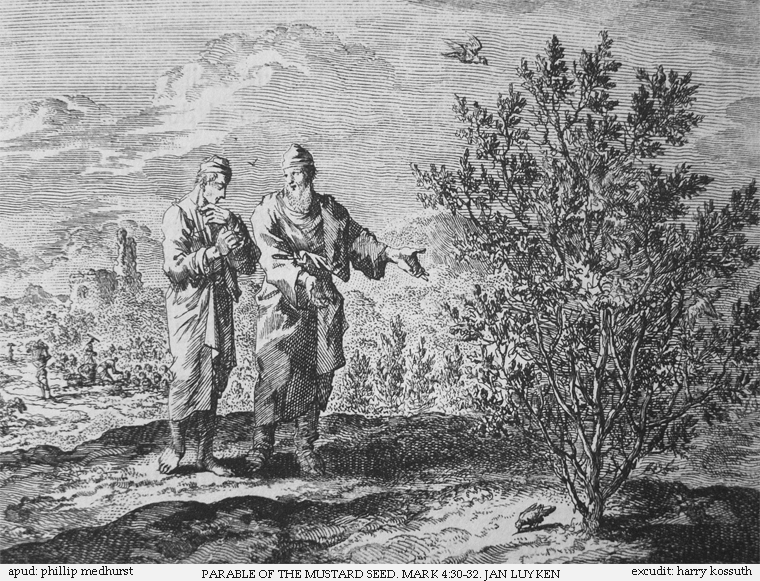
The Parable of the Mustard Seed has inspired visual representations across centuries, often emphasizing the contrast between the seed's diminutive size and the expansive tree it becomes, with birds nesting in its branches as a symbol of shelter and growth. In early Christian art, birds on ancient sarcophagi in the 6th-century Basilica of Sant'Apollinare in Classe, Ravenna, Italy, are reminiscent of the parable's imagery from Matthew 13:31–32, where the kingdom of heaven grows to provide refuge for all.[51] This depiction integrates the parable's themes into broader eschatological scenes, highlighting divine abundance without directly illustrating the sowing act. The apse mosaic in the same basilica features a paradisiacal landscape with trees and birds, evoking themes of paradise. During the medieval period, the parable appeared in illuminated manuscripts, where artists rendered it through stylized trees symbolizing spiritual expansion, though specific illustrations remain sparse compared to narrative-heavy biblical scenes. By the early modern era, more explicit depictions emerged, such as the 18th-century etching by Jan Luyken in the Bowyer Bible, which portrays Jesus teaching the parable alongside a visual of the seed transforming into a towering tree with birds perched in its boughs, underscoring the miraculous scale of growth.[52] This Baroque work captures a sense of wonder and natural surrealism, aligning with the parable's emphasis on unexpected proliferation. In Renaissance and later European art, the motif influenced surreal interpretations of growth, though direct attributions are rare; instead, elements like oversized foliage in works by artists such as Hieronymus Bosch echo the parable's theme of humble origins yielding vast outcomes, as seen in fantastical landscapes that blend biblical allegory with natural exaggeration. Moving to contemporary visual media, the parable features in graphic novels adapting the Gospels, such as Sergio Cariello's illustrations in The Action Bible (2010), where dynamic panels show the seed's journey from soil to sheltering tree, making the narrative accessible to modern audiences through vivid, comic-style storytelling.[53] Literary representations of the parable often draw on its core metaphor of incremental transformation to explore themes of faith, community, and societal change. Earlier, in medieval poetry, echoes of the parable's ascent motif appear in allegorical works, though not always explicit; by the modern era, it recurs in novels like Lisa Henry's The Parable of the Mustard Seed (2020), a contemporary fiction that reimagines the biblical story through themes of redemption and hidden potential in personal relationships.[54] These literary adaptations preserve the parable's essence while applying it to diverse human experiences, from spiritual journeys to social critique.Use in Hymns, Sermons, and Popular Culture
The Parable of the Mustard Seed has inspired numerous hymns that emphasize themes of growth and divine expansion, often drawing on the imagery of small beginnings leading to vast outcomes. For instance, Samuel J. Stone's 19th-century hymn "The Church's One Foundation," first published in 1866, echoes the parable's motif of the church as a growing entity rooted in Christ, likening it to a foundation that expands universally despite humble origins. This hymn is frequently paired with lectionary readings of the parable, such as on the Eleventh Sunday in Ordinary Time (Proper 6 in the Revised Common Lectionary), where its verses align with reflections on kingdom growth.[55] Other examples include modern compositions like "Eternity (When a Seed, Only Small)" by Alison M. Lott, which directly meditates on the parable's extension to eternal kingdom themes, and "The Seed Song (Parable of the Mustard Seed)" by The River's Voice, a contemporary worship piece highlighting faith's transformative power.[56][57] In liturgical practice, the parable appears in the Revised Common Lectionary on Proper 12 (Year A, Matthew 13:31-33, 44-52) and the Eleventh Sunday in Ordinary Time (Year B, Mark 4:26-34), serving as a focal text for sermons and prayers on communal faith and unexpected proliferation.[58][59] In sermons, the parable has been invoked to illustrate personal and social transformation, particularly in contexts of justice and revival. Civil rights leader Martin Luther King Jr. referenced the mustard seed imagery in his writings, such as in the 1958 draft of Stride Toward Freedom, quoting Matthew 17:20 to underscore how even minimal faith can move mountains of oppression, applying it to the nonviolent struggle for racial equality during the 1950s and 1960s.[60] This motif recurs in King's broader rhetoric on perseverance. In evangelical preaching, the parable often symbolizes individual spiritual renewal; for example, 20th-century figures like Billy Graham used it in crusades to depict how a single conversion can spark widespread revival, emphasizing faith's exponential impact in personal testimonies.[61] The parable's themes permeate popular culture, appearing in films that explore faith's quiet potency amid adversity. In the 2015 drama Little Boy, directed by Alejandro Monteverde, a young boy draws on the mustard seed parable to fuel his belief in his father's safe return from World War II, portraying it as a catalyst for miraculous hope and family resilience.[62] Similarly, the 2017 film All Saints, based on a true story and directed by Steve Gomer, features a scene where characters reflect on the parable during a church's struggle for survival, using it to represent community growth from dire circumstances.[63] In music beyond hymns, reggae artist Bob Marley's lyrics in songs like "One Love/People Get Ready" (1977) adapt biblical growth motifs akin to the parable, promoting unity and redemption from small seeds of resistance, though not quoting it directly; this aligns with Marley's Rastafarian interpretations of scripture emphasizing transformative justice.[64]References
- https://commons.wikimedia.org/wiki/File:Teachings_of_Jesus_5_of_40._parable_of_the_mustard_seed._Jan_Luyken_etching._Bowyer_Bible.gif