Hubbry Logo
Midget submarineMidget submarineMain
Open search
Midget submarine
Community hub
Midget submarine
logo
8 pages, 0 posts
0 subscribers
Be the first to start a discussion here.
Midget submarine
Midget submarine
from Wikipedia
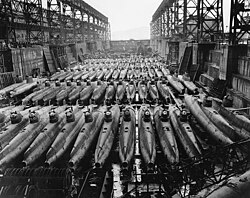
Some 80 Japanese Type D "Kōryū" Midget Submarines in a dry dock at Kure, 19 October 1945

A midget submarine is any submarine under 150 tons,[1] typically operated by a crew of one or two but sometimes up to six or nine, with little or no on-board living accommodation. They normally work with mother ships, from which they are launched and recovered and which provide living accommodation for the crew and support staff.

Both military and civilian midget submarines have been built. Military types work with surface ships and other submarines as mother ships. Civilian and non-combatant military types are generally called submersibles and normally work with surface ships. Most early submarines would now be considered midget submarines, such as the United States Navy's USS Holland (SS-1) and the British Royal Navy's HMS Holland 1 (both named for the same designer).

Military submarines

[edit]

Uses

[edit]
Crew of a British X-class midget submarine, part of the British Pacific Submarine Fleet

Midget submarines are best known for harbor penetration, although only two World War II boats, the British X-craft and the unsuccessful Welman submarine, were specifically designed with this in mind. Japan's Ko-hyoteki-class submarines were originally designed to take part in decisive fleet actions. However, as circumstances changed, they were given the task of harbor penetration. Germany's various World War II designs were mostly designed to attack Allied shipping off landing beaches and harbors, although the Seehund had a great enough range to attack shipping off the Thames estuary.

Midget submarines have also seen some use in support roles. X-craft were used for reconnaissance, and the Seehund was used to carry supplies. A number of modern midget submarines have also been built for submarine rescue.

Armament

[edit]

Midget submarines are commonly armed with torpedoes and mines in the form of, for example, detachable side loads and nose sections. Alternatively they may function as swimmer delivery vehicles to deliver frogmen to the vicinity of their targets, which are then attacked with limpet mines.

Civilian

[edit]

In civilian use, midget submarines are generally called submersibles; commercial submersibles are used in, for example, underwater maintenance, exploration, archaeology, and scientific research. Other commercially available submersibles are marketed as novelty tourist attractions and as specialised tenders for wealthy yacht owners. Also, a growing number of amateur submariners homebuilt submersibles as a hobby.[2][3]

Types by nation

[edit]

Belgium

[edit]
  • FNRS-2 pioneering research submersible

Colombia

[edit]
  • S.X.506 a 70-ton 5-man crew midget submarine designed by Italian shipbuilder Cosmos as a development of earlier S.X.404 by the same firm. Displacement is 58/70 t (surfaced/submerged), length is 23 m, beam is 2 m, draft is 4 m, and speed is 8.5/7 kn (surfaced/submerged). At a speed of 7 kn, range is 1200/60 nmi (surfaced/submerged). Payload includes externally attached torpedoes and swimmer delivery vehicles, and up to 8 divers can be carried in addition to the 5-man crew.[4]

Finland

[edit]
  • MIR for research and submarine rescue

France

[edit]
  • FNRS-3 research submersible
  • Archimède research submersible
  • FNRS-4 second generation research submersible
  • Nautile research submersible to depth of 6 kilometers
  • SP-350 Denise diving saucer

France also acquired a number of German midget submarines at the end of WW2.

Germany

[edit]
German midget submarine Seehund, with a torpedo

Most German midget submarines were developed late in World War II in an attempt to stop the Allied liberation of Europe and used later to disrupt its supply lines. As a result, the submarines mostly engaged in open water attacks rather than harbour penetration.[5][6]

  • Biber (324 built by AG Weser of Bremen)[5][7]
  • Delphin (2 built) 2-man 5-ton torpedo with top speed of 20 knots (37 km/h) and submerged radius of 30 nautical miles (56 km) at 3 knots (5.6 km/h).[5][7]
  • Hai (midget submarine) prototype of improved Marder.[5][7]
  • Hecht type XXVIIA 2-man 12 ton submarine with 1 mine or 1 torpedo carried outboard to a range of 38 miles at 4 knots.[8]
  • Marder (~300 built) similar to Neger with breathing apparatus to allow submerged operation.[5][7]
  • Molch Completely electric motor driven WWII (1944–1945) Midget submarine. Total 393 built.[5]
  • Schwertwal (Grampus) Designed as super-fast Walter-type midget boat, but the prototype was not complete when scuttled in May 1945.[5]
  • Neger (~200 built) 1-man 5-ton torpedo with underslung G7E torpedo. Top speed 20 knots and range of 30 miles at 3 knots.[5][7]
  • Seehund type XXVIIB[9] Most successful midget submarine in the Kriegsmarine. Operational deployment was between January 1945 – April 1945.[5]
  • V.80 4-man 76-ton prototype completed in 1940 to test Walther geared turbine propulsion system. Range was 50 nautical miles (93 km) at 28 knots (52 km/h).[10]
  • Orca class post-war midget submarine: 13.27 meter x 2.1 meter 5 men midget submarine with maximum depth of 100, maximum underwater speed of 5 kn, maximum range of 150 nmi, maximum endurance of 4 days, and maximum payload of 250 kg. Periscopes includes television camera, HF/HF communication and GPS antenna. There is also an underwater television camera and obstacle avoidance sonar with an effective range of 200 m. The low acoustic and magnetic signature midget sub displaces 28 t, powered by two computerized permanent magnetic electric motors that drive a single shaft low-cavitation and low noise propeller, which is controlled by fly-by-wire control system that is usually adopted for aircraft. The pressure hull is a modular design consisted of four modules that enables easy transportation and maintenance.[11]

India

[edit]

The Indian Navy is planning to acquire two midget submarines at an estimated cost of ₹2000 Crores for use as swimmer delivery vehicles.[12] These submarines will be used for conducting underwater special operations by MARCOS.[13] Both submarines will be constructed by Hindustan Shipyard Limited.[12]

Indonesia

[edit]

The Indonesian Navy has shown[when?] some interest in having a new Midget-class submarine, built by local shipyards, for coastal rather than open water patrol. The submarine was designed a number of years ago by a retired Indonesian Navy submariner officer, Colonel (Ret) Ir. R. Dradjat Budiyanto, Msc. The midget experiment project involves the construction of a submarine, designated MIDGET IM X −1, which will weigh about 150 – 250 tonnes, with a tubular frame design 24 – 30 meters long, and four torpedo tubes. The submarines will have minimum of 8 – 10 crew members including officers. They will have a 40 km range non-hull-penetrating optronic mast as the attack periscope, and a 20 km range navigation periscope.[citation needed]

Indonesian defence minister Purnomo Yusgiantoro has backed the project. Construction should commence at the Indonesian PT.PAL INDONESIA shipyard by late 2011, and will take about three or four years to complete.

Iran

[edit]

Italy

[edit]
An Italian CB-class submarine in the Nikola Tesla Technical Museum in Zagreb, Croatia
  • Siluro a Lenta Corsa (SLC), also known as Maiale (pig), a low speed human torpedo. On 3 December 1941, Sciré departed La Spezia carrying three Maiale to conduct what became the Raid on Alexandria (1941). At the island of Leros in the Aegean Sea, six Decima Flottiglia MAS crewmen came aboard, including Lieutenant Luigi Durand de la Penne. On December 18 Sciré released the manned torpedoes 1.3 miles from Alexandria commercial harbor, and they entered the harbor when the British opened the boom defence to let three of their destroyers pass. After many difficulties, de la Penne and his crewmate Emilio Bianchi successfully attached a limpet mine under HMS Valiant, but had to surface as they attempted to leave and were captured. They refused to answer when questioned and were detained in a compartment aboard Valiant. Fifteen minutes before the explosion, de la Penne asked to speak to the Valiant's captain and informed him of the imminent explosion but refused to give other information. He was returned to the compartment and neither he or Bianchi were injured by the detonation of the mine. The other four torpedo-riders were also captured, but their mines sank Valiant, the battleship Queen Elizabeth, the Norwegian tanker Sagona and badly damaged the destroyer HMS Jervis. The two battleships sank in only a few feet of water and were subsequently re-floated. Nevertheless, they were out of action for over a year.
  • Bathyscaphe Trieste was first to explore the Challenger Deep of the Mariana Trench
  • CA type First series was a 2-man midget submarine the second series carried a crew of three.[14]
  • CB type 45 ton 4 man design first introduced in 1941[14]
  • CE2F/X100 post-war torpedo chariot
  • MG 120: MG 120 Shallow water attack submarine (SWATS) is a development of MG 110 in Pakistani service with the displacement is increased to 130 t submerged, range is 1600 nmi @ 7 kn surfaced, 60 nmi @ 4.5 kn submerged, and the number of divers carried is drastically increased to 15.[15]
  • MG 130: MG 130 is a development of MG 120 with AIP module called UAPE (Underwater Auxiliary Propulsion Engine) based on a closed circuit diesel fueled by liquid oxygen, which provides an underwater range of 400 nmi (740 km).[15]

Japan

[edit]
Japanese Type A Midget Submarine recovered in 1960 off Pearl Harbor, Hawaii
DSV Shinkai
  • Type B Kō-hyōteki-class Midget Ha 45 prototype built 1942 to test Type A improvements.[18]
  • Type C Kō-hyōteki-class Midget Ha 62–76 similar to Type A with crew of 3 and range increased to 350 nautical miles (650 km) at 6 knots (11 km/h) surfaced or 120 nautical miles (220 km) at 4 knots (7.4 km/h) submerged.[18]
  • Type D Kō-hyōteki-class, also called Kōryū class (115 completed) improved Type C with crew of 5 and range increased to 1,000 miles (1,600 km) at 8 knots (15 km/h) surfaced and 320 miles (510 km) at 16 knots (30 km/h) submerged.[19]
  • Kairyū-class submarine
  • Kaiten submarine suicide torpedo.
  • DSV Shinkai research submersible, capable of diving to a depth of 6.5 kilometres (4.0 miles)

North Korea

[edit]

South Korea

[edit]
  • S.X.756: Developed by Italian shipbuilder Cosmos as a successor of earlier S.X.506 midget submarine in Colombian service. Length is increased to 25.2 m and beam is increased to 2.1 m in comparison to its predecessor S.X.506, and displacement is increased to 73/80 t (surfaced/submerged). Crew is increased by one to a total of 6, but the total number of divers carried remained the same at 8. Range is 1600 nmi @ 6 kn surfaced, and 60 nmi @ 4 kn submerged, and payload remains the same.[4]
  • Dolgorae class midget sub

Pakistan

[edit]
  • MG 110: Developed by Italian shipbuilder Cosmos as a successor of earlier S.X.756 midget submarine in South Korean service. MG 110 is a slightly enlarged version of S.X.756 with length increased to 27.28 m, diameter increased to 2.3 m, and displacement increased to 102/110 t (surfaced/submerged). Range is 1200 nmi surfaced, and the submerged range remain the same. Payload and crew are also identical to that of its predecessor S.X.756 midget submarine.[4]

China

[edit]

Poland

[edit]

Taiwan

[edit]
  • 2 Italian Cos.Mo.S CE2F/X100 post-war torpedo chariots
  • 2 Italian Cos.Mo.S S.X.404 midget submarines: S-1 Haijiao (海蛟), S-2 Hailong (海龍), in service from October 8, 1969, to November 1, 1973. S.X.404 is a 70-ton 4-man crew submarine design by Cosmos. Four were sold to Colombia and two to Taiwan in the 1970s.[20] Displaced is 40/70 t (surfaced/submerged), speed is 11/6.5 kn (surfaced/submerged), range is 1200/60 nmi (surfaced/submerged) @ respective maximum speed. Payload included externally attached torpedoes or mines, or swimmer delivery vehicles.[4]

Romania

[edit]
  • CB class, during World War II, Romania owned five midget submarines.[21]

Russia

[edit]
  • In the late 19th century Russia built a class of treadle powered submarines 4.5 meters in length designed by Stefan Drzewiecki they were withdrawn from service in 1886.[22]
  • APL and Pygmy projects – two boats were constructed in 1935-1936, tested, but later abandoned [23]
  • Losos class submarine

Spain

[edit]
Foca I (SA-41) and Foca II (SA-42) at Cartagena
  • Foca class submarine (design begun in 1957, entering service in 1962): A total of 2 units built, SA 41 & SA 42. Displacement is 16/20 t (surfaced/submerged), with a crew of 3, and armed with two 21 in torpedo tubes. Stricken in 1971.[24] Not to be confused with World War II era Italian Foca-class submarine.
  • Tiburón class submarine (design begun in 1958, entering service in 1964): A total of 2 units built, SA 51 & SA 52. Displacement is 78/81 t (surfaced/submerged), with a crew of 5, and armed with two 21 in torpedo tubes. Stricken in 1971.[24]

Sweden

[edit]
  • Spiggen II class: midget submarine: 6 man crew midget sub displaces 14 t when submerged, with 5 kn speed and endurance of 2 weeks. Length: 11 m, beam: 1.4 m, height: 1.7 m.[11]
  • Sea Dagger: midget submarine developed by Kockums: a midget submarine of modular design with length of 16 – 20 m depending on various configurations totaling 4, including training, reconnaissance, diver delivery and small attack versions. All versions are consisted of 3 modules, two of which are identical for all versions, the bow and stern modules. The midsection has 4 modules to choose from, each for a specific mission. All versions lack the sail.[25]
  • UVS-1300 Malen: Originally built for navy purposes as sonar target. Midget submarine: 4 man crew midget sub displaces 11 t when submerged, with 5 kn speed and endurance of at least 1 week depending on fuel carried. Length: 10 m, beam: 1.4 m, height: 1.7 m.[26]

Turkey

[edit]

The Turkish navy has evaluated two midget submarine designs from German firm ThyssenKrupp Marine Systems, Type 200 and Type 300 classes:

  • Type 200: Displacement: 200 t surfaced, length: 25 m, beam: 4.2 m, draft 3.1 m, speed: 8 kn surfaced, range: 2100 nmi @ 8 kn surfaced, endurance: 2 weeks, armament: 2 21-in torpedo tubes with a maximum of 4 torpedoes, crew: 6 + 12 divers.[27]
  • Type 300: Displacement: 300 t surfaced, length: 30 m, beam: 4.2 m, draft 3.1 m, speed: 12 kn surfaced, range: 3100 nmi @ 8 kn surfaced, endurance: 2 weeks, armament: 2 21-in torpedo tubes with a maximum of 6 torpedoes, crew: 12.[27]

United Kingdom

[edit]
X24 a British X class submarine on display at the Royal Navy Submarine Museum

The Royal Navy has used a number of midget submarines. Most were developed during the Second World War. The decommissioning of the Stickleback class 1958–early 1960s marked the end of midget submarines designed for combat in the Royal Navy.

  • Sleeping Beauty Motorized Submersible Canoe (MSC): developed by Special Operations Executive Station IX during the Second World War.
  • Chariot manned torpedo: the British developed two types of manned torpedoes; the Chariot Mark I, of 1.6 ton, and the Chariot Mark II, of 2.3 ton. Sixty-four units were built.[28]
  • Stickleback class: a post Second World War development of the XE class.
  • X class: used to attack German warships in the north of Norway. One notable target of a successful attack was the battleship Tirpitz. The submarines had a crew of three (plus a diver) and carried two large mines containing Amatol – one on each side. Their strategy was to lay mines on the sea bottom beneath the target, set a time fuse, and leave.
  • XE class: used in the Far East against Japan, where they carried out a number of attacks and special missions.
  • Welman submarine: a single-person submersible widely considered a failure.[29]
  • Welfreighter: a Station IX-developed special operations submersible with two crew and up to four passengers, designed to resemble a motorboat when surfaced. Over 100 were produced, beginning in September 1944; the extent of operational use is unclear.[30][31]

United States

[edit]
The US X-1 at sea

Former Yugoslavia

[edit]
  • Una-class: After the Yugoslav Wars, both Croatia and FR Yugoslavia held examples. Length: 18 m, beam: 3.7 m, diameter: 2.5 m, displacement: 76 t surfaced, 90 t submerged, crew: 4 + 6 divers. Surfaced and submerged speed is 4 kn for both, and the range is 200 nmi surfaced, 50 nmi submerged both @ 4 kn. M-100 lacks sail and its battery can only be charged when surfaced. Up to 4 R-1 swimmer delivery vehicle (SDV)s or two light (400 mm) torpedoes can be carried.[4]
  • Type M-100D: Development of Type M-100 Una class. Displacement is increased to around 88/100 t (surfaced/submerged), and the length is increased to approximately 21 m, beam is increased to 4.42 m, and diameter to 2.7 m. Speed is increased to 8/11 kn (surfaced/submerged), and range is increased to 550 nmi surfaced @ 10 kn when surfaced, and that of submerged remains the same as its predecessor M-100 Una class while the payload and crew also remain unchanged. A sail is added, and its battery can be charged while submerged.[4]

See also

[edit]

References

[edit]
[edit]
Revisions and contributorsEdit on WikipediaRead on Wikipedia
from Grokipedia
A midget submarine, also known as a mini-submarine, is a compact naval vessel typically displacing less than 150 tons, crewed by one to nine personnel with no or minimal onboard living accommodations, and designed for stealthy, short-duration missions such as harbor penetration, sabotage, or delivery, often launched and recovered by a larger "mother" ship or . These vessels prioritize low detectability over endurance, usually armed with torpedoes, mines, or limpet devices, and operate in coastal or littoral waters where larger submarines cannot maneuver effectively. Midget submarines emerged as a tactical innovation in the early but gained prominence during , when major powers like , Britain, , and deployed them for high-risk attacks on enemy shipping and infrastructure. pioneered large-scale use with its Type A submarines—46 tons submerged, 78 feet long, and armed with two 17.7-inch torpedoes—launching five in the 1941 Pearl Harbor raid to complement the aerial assault, though only one briefly penetrated the harbor and inflicted minor damage before being sunk. Britain's X-class, crewed by four and equipped with side charges for precision strikes, achieved notable success in 1943's , where X-6 and X-7 severely damaged the German battleship Tirpitz in Norwegian waters, rendering it inoperable for months. Germany's type, a one-man craft with electric propulsion and up to 300 nautical mile range, conducted 142 sorties against Allied convoys from January to April 1945, sinking 8 ships despite high losses of 35 units due to their vulnerability. excelled in human torpedo variants like the SLC ("Maiale"), which disabled British battleships in in 1941, influencing midget sub doctrine across Europe. Postwar, the experimented with the USS X-1 (1955–1973), a 36-ton (submerged) diesel-electric midget submarine for coastal , while modern iterations persist in . fields dozens of - and Sang-O-class midget submarines—up to 15 crew and 1,500-nautical-mile range—for infiltrating South Korean waters and delivering commandos, with exports shaping Iran's Ghadir-class fleet of approximately 23 missile-capable units for operations. These contemporary designs underscore midget submarines' enduring role in stealthy denial of sea access, though their limited speed (typically 6–10 knots submerged) and fragility constrain broader applications.

Definition and Characteristics

Physical Specifications

Midget submarines are classified by their compact dimensions, typically displacing less than 150 tons, measuring under 50 meters in length, and accommodating a of 2 to 6 personnel. These size constraints distinguish them from larger conventional submarines, enabling transport aboard surface vessels or larger submarines for deployment. The hull structure emphasizes lightweight materials to achieve and withstand at operational depths typically limited to 30-200 meters, depending on design and era. Traditional designs employ high-strength alloys for the pressure hull, providing durability in shallow waters, while modern variants incorporate aluminum alloys or composite materials to reduce weight and enhance resistance without compromising structural integrity. Most midget submarines feature a single-hull configuration or minimal compartmentation to simplify construction and operation in confined internal spaces. This design prioritizes watertight compartments essential for survival in the event of damage, with bulkheads ensuring compartmental integrity despite the overall small volume. Dimensional variations exist across eras and missions; for instance, the World War II-era Japanese Ko-hyoteki Type A measured about 24 meters in length and displaced 46 tons, suitable for short-range attacks. In contrast, contemporary mini-submarines, such as the Russian Triton-2 swimmer delivery vehicle, are under 10 meters long at 9.5 meters, focusing on special operations with even smaller crews. Recent examples include India's Arowana-class, launched in 2024, emphasizing stealth and special forces delivery in coastal waters.

Operational Distinctions

Midget submarines are primarily deployed via transport and launch from larger "mother" submarines or surface vessels, as their limited independent range—typically 50 to 200 nautical miles—precludes long-distance autonomous transit. For instance, during , British X-class midget submarines were towed by conventional submarines to within striking distance of targets, reducing the towing vessel's endurance by approximately 5.5 to 30 percent, depending on the class of the mother submarine, while enabling covert positioning in enemy waters. This reliance on external support distinguishes midget submarines from full-sized vessels, which can operate independently over thousands of miles, emphasizing the midgets' role in short-range, tactical insertions rather than strategic patrols. Endurance for midget submarines is severely constrained by battery-powered submerged operations, generally lasting 12 to 48 hours before requiring surfacing for recharge or external support, in contrast to the weeks-long submerged capabilities of larger diesel-electric or nuclear submarines. The Japanese Type A Kō-hyōteki midget submarines, for example, achieved a maximum submerged endurance of about 12 hours at 6 knots, powered solely by batteries that necessitated mother ship recharging for extended missions. The U.S. Navy's experimental USS X-1 extended this with improved submerged endurance over WWII battery-only designs, though still limited by battery capacity, originally using a hydrogen peroxide/diesel propulsion system, later converted to diesel-electric after 1957, yet still demanded frequent surfacing or logistical aid, highlighting the operational trade-off for compactness. Crew accommodations in midget submarines feature minimal life support systems, supporting small teams of 2 to 6 personnel without provisions for extended patrols or onboard living facilities, focusing instead on short-duration covert operations. The X-class carried a crew of four in a cramped 51-foot hull, with basic oxygen supplies and no dedicated berthing, limiting missions to the physical tolerance of the operators—often no more than 10 to 14 days total, constrained by fatigue and supplies rather than mechanical limits. Similarly, the USS X-1's crew of five endured spartan conditions optimized for coastal stealth rather than comfort, underscoring the emphasis on mission brevity over habitability. In littoral environments, midget submarines excel due to superior maneuverability in shallow coastal waters, where their small size allows navigation through restricted areas inaccessible to larger submarines. This agility enables operations in depths as low as 30 to 40 meters, evading detection amid seabed clutter and anti-submarine defenses, as seen in designs like the Russian Project 865 Piranha, which prioritized seakeeping and obstacle avoidance in near-shore zones. Compared to full-sized submarines, midgets' reduced acoustic signatures and turning radius provide tactical advantages for or reconnaissance in confined waters, though at the cost of vulnerability to surface threats during transit.

Historical Overview

Early Innovations

The concept of midget submarines traces its roots to 19th-century precursors, exemplified by the Confederate H.L. Hunley during the American Civil War. Constructed in 1863 in Mobile, Alabama, the Hunley was a 34-foot-long iron submersible powered by a hand-crank mechanism operated by a crew of eight, allowing it to navigate shallow waters and approach targets stealthily. On February 17, 1864, it achieved the historic feat of becoming the first submarine to sink an enemy warship, the USS Housatonic, using a spar torpedo loaded with black powder explosives, though the Hunley itself was lost shortly after the attack. While not a true midget submarine by modern standards—due to its rudimentary design and lack of self-propulsion beyond human effort—the Hunley demonstrated the potential for small, covert underwater vessels in asymmetric naval warfare. Early 20th-century developments saw initial experiments with more advanced small submersibles, particularly in , where the pioneered designs approaching midget configurations. The Delfino, launched in 1890 but serving into the early 1900s, was Italy's first submarine, featuring a for surface propulsion and an for submerged operations, with a displacement of 95 tons surfaced and 107 tons submerged. This experimental vessel highlighted early attempts at manned underwater craft for coastal reconnaissance, though its limited battery life restricted submerged endurance to mere hours. These Italian prototypes represented pioneering efforts in compact, stealthy underwater vehicles, influencing later designs despite their operational limitations. In the , experiments focused on human-guided and converted vessels for sabotage roles, with leading innovations like the Maiale in . Developed by the as a "slow-running " (Siluro a Lenta Corsa or SLC), the Maiale was a 3.6-ton, electrically propelled device with a 1.6-horsepower motor achieving speeds of about 3 knots, crewed by two divers who rode it to attach mines to enemy ships. Tested extensively for harbor penetration, it emphasized stealth over speed, launched from larger submarines, and proved effective in simulated sabotage operations despite the physical strain on operators from cold water and systems. These efforts underscored a shift toward specialized, low-profile craft for covert attacks. Technological challenges plagued these early innovations, primarily stemming from primitive propulsion systems that prioritized compactness over reliability. Hand-cranking in demanded exhaustive crew effort, resulting in multiple sinkings during tests due to and poor control. Electric motors in vessels like the Delfino and Maiale offered silent submerged running but were hampered by short battery life—often under two hours—and vulnerability to flooding or short-circuiting, leading to high failure rates in trials exceeding 50% for some prototypes. systems, tested in early manned torpedoes, provided bursts of power but caused instability from gas buildup and limited depth control, contributing to accidents and underscoring the era's struggles with , , and crew in confined spaces.

World War II Operations

During , midget submarines saw extensive use by for surprise attacks on enemy harbors and shipping. Japan deployed five Ko-hyoteki Type A midget submarines in the on December 7, 1941, launched from larger I-class submarines to target U.S. battleships; one was sunk by the destroyer before entering the harbor, another by USS Monaghan, a third was captured intact after running aground, and the fifth was likely destroyed by depth charges, resulting in no confirmed sinkings but minor damage to the battleship USS West Virginia. These operations exemplified Japan's emphasis on stealthy, high-risk incursions, with over 50 Ko-hyoteki submarines produced overall for various Pacific theater missions. Germany introduced midget submarines late in the war as part of its K-Verbande , focusing on coastal interdiction in European waters from 1944 onward. The one-man Biber, with around 200 units built, and the electric-powered Molch, numbering about 150, were deployed for attacks on Allied shipping in the and but suffered from technical unreliability and high vulnerability to anti-submarine defenses. The more advanced two-man , with 324 completed by war's end, proved marginally effective, sinking eight Allied vessels totaling 17,300 tons while damaging three others, primarily through strikes on convoys off the Dutch and Belgian coasts. , leveraging pre-war expertise in underwater assault, achieved notable success with manned variants akin to midget submarines; in December 1941, operatives using "maiale" human torpedoes infiltrated harbor, severely damaging the battleships and , temporarily neutralizing British capabilities. Allied forces responded with their own midget submarine programs to counter Axis threats and conduct offensive operations. Britain's X-class submarines, crewed by four to six personnel, were pivotal in on September 22, 1943, when six X-craft navigated Norwegian fjords to attack the battleship Tirpitz; two successfully placed over seven tons of explosives under the hull, causing extensive damage that sidelined the ship for six months and required major repairs. The developed the experimental X-1 midget submarine in the mid-1940s, inspired by captured Axis designs, for testing harbor defense vulnerabilities and small-submarine tactics, though it saw no combat deployment during the war. Tactically, midget submarines demonstrated asymmetric potential but were plagued by high attrition rates, often exceeding 80% in Japanese operations due to detection by and nets, as seen in where four of five were lost without strategic impact. Despite these losses, isolated successes like the Italian Alexandria raid highlighted their value in disrupting superior naval forces, influencing postwar evaluations of stealthy, crew-intensive . Production scaled rapidly under wartime pressure—Japan's 50+ Ko-hyoteki, Germany's 324 —yet operational limitations confined their role to desperation tactics rather than fleet dominance.

Postwar Developments

Following , midget submarines evolved significantly during the , reflecting heightened naval tensions and the need for covert capabilities in contested waters. The developed the Project 865 Piranha class in the 1980s as a dedicated platform for operations, with two units (MS-520 and MS-521) constructed primarily for frogmen delivery. These titanium-hulled submarines, displacing about 390 tons submerged, could transport up to six combat swimmers over 400 nautical miles at speeds of 6-8 knots, emphasizing stealth and mine avoidance in shallow coastal environments. In the United States, the USS X-1, commissioned in 1955, underwent extensive postwar trials to assess harbor defense against intruder threats, featuring a crew of four and a closed-cycle for prolonged submerged operations. These experiments highlighted limitations in manned midget designs but influenced the development of swimmer delivery vehicles (SDVs) for U.S. Navy SEAL teams, paving the way for smaller, floodable submersibles optimized for insertion. Decolonization in the mid-20th century prompted adaptations of midget submarines for regional defense in Europe's peripheral theaters. Sweden acquired the British-built HMS Stickleback (X51) in 1958, renaming it Spiggen and refitting it for operations, where its 4-man crew and 35-ton displacement supported training for attack divers amid concerns over Soviet incursions. This vessel, operational into the , enhanced Sweden's coastal surveillance in the narrow, mine-prone waters of the region. Similarly, the incorporated captured German midget submarines postwar, with at least five units entering service in the early for experimental and training roles in the Mediterranean, where their 2-man crews and 17-ton size suited anti-shipping patrols during decolonization conflicts in . These adaptations leveraged wartime designs for asymmetric defense against larger adversaries. Proliferation of midget submarines extended to allied and smaller navies seeking affordable coastal assets during the 1950s and 1960s. The United Kingdom's Stickleback class, an evolution of XE-craft with improved batteries and a 4-man crew, saw two units completed in 1954-1955 for harbor attack roles, though initial plans for nuclear mine deployment were abandoned. One was exported to , demonstrating technology transfer to partners facing regional threats. Such exports enabled smaller navies, including those in and the Mediterranean, to bolster defenses without full-scale submarine programs, often through second-hand acquisitions or simplified designs. By the late , midget submarine doctrine shifted toward , prioritizing swimmer delivery over direct to minimize detection risks. This evolution reduced typical crew sizes to 2-4 personnel, as seen in emerging SDVs like the U.S. Navy's MK 7, introduced in the late , which carried four operators in a floodable hull for covert insertion up to 20 nautical miles offshore. The focus on low-signature platforms for elite forces reflected broader strategies, de-emphasizing larger crews and armament in favor of endurance and swimmer egress capabilities.

Design and Technology

Propulsion Systems

Midget submarines predominantly rely on battery-electric propulsion systems to enable silent, submerged operations essential for their stealthy roles. These systems typically feature lead-acid batteries as the standard power source due to their reliability, robustness, and ease of recharging, though higher-performance silver-zinc batteries are employed in some advanced designs for greater and output. Electric motors, often low-RPM permanent magnet synchronous or brushless DC types ranging from 25 to 800 kW, drive a single , achieving submerged speeds of 5-10 knots while minimizing acoustic signatures through efficient, low-noise operation. In modern variants, (AIP) systems, particularly fuel cell-based technologies introduced in the , have enhanced endurance by allowing prolonged submerged patrols without surfacing for air. Fuel cells convert and oxygen into at efficiencies up to 70%, far surpassing traditional diesel systems, and can extend operational time to 1-2 weeks at low speeds in compact configurations. These systems address the space constraints of small hulls by integrating modular stacks that generate power quietly, though they require stored oxidizers like . For surface transit and battery recharging, midget submarines incorporate small diesel generators, typically 100-200 horsepower, constrained by limited internal volume. These air-breathing engines charge batteries via AC-to-DC converters when the vessel is at depth or surfaced, providing supplemental range but increasing detectability due to exhaust noise and emissions. Hybrid setups combine diesel output with electric motors for versatility in non-submerged modes. Historically, propulsion evolved from rudimentary hand-cranked mechanisms in early prototypes, such as the 1775 American Turtle, which relied on manual effort to turn propellers for basic propulsion. By , battery-electric systems became standard, as seen in Soviet designs like the APSS with a 10.9 hp powered by 57 lead-acid cells for submerged speeds around 5 knots. Advancements in the 1980s included closed-cycle diesel engines in Soviet experimental midget projects, which recycled exhaust gases to enable limited underwater operation without atmospheric air, marking a step toward AIP integration.

Armament and Weaponry

Midget submarines are primarily armed with lightweight torpedoes suited to their compact size and close-range engagement capabilities, typically featuring one or two 533 mm diameter tubes for anti-ship strikes. These torpedoes, such as the German G7e electric models carried by the WWII Seehund, allow for stealthy approaches without the wake of compressed-air variants. Modern examples include the Iranian Ghadir-class, which employs two 533 mm torpedo tubes compatible with torpedoes like the Valfajr for targeting surface vessels. The limited payload—often just two weapons—reflects the submarines' small displacement, prioritizing precision over volume. In addition to torpedoes, midget submarines frequently deploy mines for area denial or , with capacities ranging from four to eight units depending on the design. The Ghadir-class, for instance, can accommodate 4-8 marine or magnetic mines laid on the seabed to threaten shipping lanes. For covert operations, demolition charges such as mines are attached manually by divers exiting the submarine, enabling harbor without direct engagement; historical WWII designs like the could substitute mines for torpedoes in external cradles to carry up to several hundred kilograms of explosives per unit. Missile armament remains rare in true midget submarines due to size constraints, but select post-2000s variants integrate anti-ship capabilities via torpedo-tube launches. The Iranian Ghadir-class demonstrates this with compatibility for the Nasr cruise missile, a 35 km-range adapted from Chinese designs, allowing submerged strikes on coastal targets. Weapon launch methods vary by era and design, often using external racks or underslung cradles in WWII models like the for simplicity, while modern internal tubes in the Ghadir facilitate reloads within the hull. Aiming is predominantly manual, relying on observations and crew expertise given the two- or three-person limitations that preclude advanced fire-control systems.

Sensors and Navigation

Midget submarines, constrained by their compact size and need for stealth, predominantly utilize passive arrays to detect threats without emitting detectable signals. These systems typically consist of hull-mounted hydrophones that capture acoustic signatures from surface ships, other , or obstacles, with effective detection ranges generally spanning 1 to 10 kilometers depending on environmental conditions such as water salinity and ambient noise. For instance, the U.S. Navy's experimental X-1 midget submarine from the incorporated a basic passive setup to monitor nearby vessels, emphasizing silent listening over active pinging. Active , when present, is employed sparingly and at low power to avoid self-compromise, often limited to short-range obstacle detection during low-speed maneuvers. Navigation in midget submarines relies on a combination of inertial navigation systems (INS) for precise positioning during submerged transit, GPS receivers for surface updates, and to maintain course when external signals are unavailable. INS units, which use gyroscopes and accelerometers to track motion relative to a known starting point, are standard in modern designs to enable extended underwater operations without surfacing. Similarly, the U.S. (SWCS), developed in the early 2000s, employs INS coupled with high-frequency for obstacle and mine avoidance, ensuring safe navigation in littoral environments. Traditional optical periscopes persist in smaller models for direct visual observation, though they are increasingly supplemented by compact optronic masts that provide digital imagery without mechanical retraction risks. Communication capabilities in midget submarines are intentionally restricted to preserve operational secrecy, favoring one-way reception of low-frequency signals or deployable buoys over active transmissions. (ELF) radio waves, penetrating to depths of several hundred meters, allow submerged coordination with mother ships or command centers, though data rates are low and limited to basic alerts or positioning updates. Deployable buoys with trailing antennas enable burst communications via (VLF) when needed, minimizing emission time to reduce detection risks. In the SWCS, such systems support integration with larger naval assets for mission handoff. Since the 2000s, modern upgrades have enhanced sensor and navigation reliability in export-oriented midget submarines, incorporating fiber-optic periscopes for high-resolution, interference-free imaging and automated collision avoidance via integrated processing. The Italian DRASS DG-160 midget submarine features a 360-degree optronic system with passive and obstacle avoidance sonars, enabling real-time threat assessment and path correction without crew intervention. These advancements, seen in platforms like the SWCS, allow for safer operations in cluttered coastal waters, with algorithms automating evasion of hazards at ranges up to 200 meters. Such technologies have been exported to allied navies, improving stealth and survivability in .

Military Applications

Strategic Roles

Midget submarines play a pivotal role in by enabling smaller or less-resourced navies to challenge superior adversaries through stealthy, high-impact operations in confined maritime environments. Their compact size and allow them to evade detection by larger fleet assets, functioning as force multipliers that disrupt enemy and command structures without requiring extensive . This doctrinal emphasis on underscores their utility in modern conflicts where conventional forces may be unattainable. A primary strategic function is harbor penetration and , where midget submarines infiltrate protected ports to target anchored vessels or , thereby paralyzing anti-shipping capabilities in restricted waters. Equipped with mines or torpedoes, they can lay bottom-influence explosives to deny access to key naval bases for extended periods, as seen in concepts for closing facilities like China's with minimal assets. This role exploits the submarines' maneuverability in shallow, cluttered approaches, making them ideal for preemptive strikes that amplify the perceived threat from limited forces. From the post-1960s onward, midget submarines have increasingly supported insertion, transporting divers or commandos undetected to coastal targets for , , or gathering. Their dry-deck or swimmer-lockout systems facilitate covert delivery in littoral zones, enhancing the reach of elite units without exposing larger vessels to risk. This integration into doctrine has become central to asymmetric strategies, allowing rapid, deniable actions that complement broader naval campaigns. In coastal defense scenarios, these vessels conduct mine-laying and anti-invasion patrols, leveraging their shallow-water proficiency to fortify chokepoints against amphibious assaults or blockades. By deploying naval mines in near-shore areas, they create layered barriers that deter incursions while remaining concealed from surface . Such applications are particularly valued in asymmetric contexts for their cost-effectiveness in protecting exclusive economic zones. Overall, midget submarines enhance deterrence in asymmetric conflicts by imposing persistent risks on larger fleets, compelling adversaries to divert resources for anti-submarine measures and thereby leveling the strategic playing field for smaller navies. Nations like and exemplify this through doctrines that prioritize mini-submarine swarms for infiltration and disruption, ensuring credible threats in regional power balances.

Notable Operations

One of the earliest notable uses of midget submarines occurred during the Japanese attack on Pearl Harbor on December 7, 1941, when five Type A Ko-hyoteki midget submarines were launched from larger I-class submarines positioned offshore. Intended to infiltrate the harbor and target anchored U.S. warships with their two torpedoes each, the operation faced immediate challenges: the USS Ward sank one submarine outside the entrance at 6:37 a.m., before the aerial assault began. Another, HA-19 from I-20, grounded on the eastern shore near the entrance after failing to navigate the anti-torpedo net. Two more were destroyed inside the harbor—the USS Monaghan depth-charged and rammed one, while the USS Helm sank another—leaving only one possibly penetrating deeper into the Southeast Loch, where it reportedly fired torpedoes at the light cruiser USS Helena and the minelayer USS Oglala, but both missed their marks with no damage inflicted. All five submarines were lost, their crews killed, underscoring the high risks and limited tactical success of such covert penetrations against defended ports. In May 1942, Japanese forces attempted a similar raid on , launching three Type A midget submarines from mother submarines I-22, I-24, and I-27 on the night of May 29 to target Allied warships. The first, M24, entered the harbor but became entangled in an anti-torpedo net near Garden Island and was destroyed by depth charges from auxiliary vessels, killing its two crew members. The second, M27, evaded initial defenses and fired two torpedoes around 12:35 a.m. on June 1, missing the USS ; one passed underneath and struck the depot ship HMAS Kuttabul—a converted —sinking it and killing 21 sailors (19 Australian and 2 British), while the other ran aground nearby and failed to explode. The third, M29, briefly entered but retreated after spotting boats, escaping the harbor only to be hunted down and sunk off the coast the next day by a naval squadron and aircraft, with its crew perishing. The raid inflicted the only casualties in Sydney during but demonstrated the vulnerability of even well-defended anchorages to midget submarine incursions, prompting enhanced harbor security measures across the Allied Pacific theater. A landmark success came in September 1943 with Britain's , deploying six X-class midget submarines towed by conventional submarines from Loch Cairnbawn, , to strike heavy German warships in Norway's Kåfjord. Launched on , the X-craft—each crewed by four men and carrying two 4,000-pound mines—faced grueling 1,000-mile transits; X-9 and X-10 were lost en route to targets Scharnhorst and Lützow, while X-8, assigned to Lützow, suffered collision damage and failed to attack. X-5 attempted to follow X-6 and X-7 toward the battleship Tirpitz but went missing, presumed sunk by mines or currents. On September 22, X-6 (Lt. H. H. G. D. Brown) and X-7 (Lt. B. C. G. Place) successfully penetrated the harbor's defenses, placing their mines under Tirpitz's hull; X-6's charge malfunctioned, but X-7's detonated at 8:41 a.m., causing severe structural damage including buckled hull and flooding of approximately 500 tons of water, killing one member and injuring about 40 more. The damage immobilized Tirpitz for six months of repairs in , neutralizing its threat to convoys and earning Place and Brown the ; however, all X-craft were lost, with eight crewmen killed and six captured. In a modern context, North Korea's use of midget submarines for infiltration persisted into the late 20th century, exemplified by the June 22, 1998, incident near , , where a ran aground during a suspected insertion mission. Carrying 9 crew members, the 21-meter diesel-electric vessel—designed for coastal raiding and troop delivery—stranded on rocks after evading patrols, prompting a fierce confrontation with South Korean forces. The North Korean sailors resisted capture in a prolonged firefight, resulting in all 9 being killed, with no South Korean casualties reported; the intact hull was salvaged and studied, revealing infiltration equipment and confirming the submarine's role in covert operations across the tense inter-Korean maritime border. This event heightened regional tensions and underscored the ongoing risks of midget submarines in , leading to intensified South Korean coastal . North Korea continued to employ midget submarines in subsequent years, including incursions near the in the , where vessels like the Sang-O-class were used for and insertions, further illustrating their persistent role in asymmetric threats as of 2023.

Non-Military Uses

Scientific Research

Midget submarines have been adapted for , enabling access to extreme underwater environments for both salvage and scientific purposes. The U.S. Navy's (DSRV-1) , a 38-ton launched in 1970, was designed for rescue operations at depths up to 1,500 meters with a of 3–4 and electric propulsion. In , battery-powered midget submarines have supported surveys of sensitive ecosystems, such as coral reefs, through collaborations with agencies like the (NOAA) in the 1990s. The Johnson-Sea-Link submersible, a compact approximately 9.5-ton with a clear acrylic sphere for observation, was deployed in such missions to assess reef health off Florida's coast, including the Oculina Bank, where it enabled direct observation and sampling without surface disturbance. These operations tracked impacts and , providing baseline data for conservation efforts in shallow to mid-depth waters up to 1,000 meters. Payload adaptations in research-oriented midget submarines replace military armaments with scientific instrumentation, enhancing data-gathering capabilities. For instance, vehicles like the Johnson-Sea-Link incorporate manipulator arms for biological sampling and sensors to measure water quality parameters such as , , , and dissolved oxygen, while others integrate seismic sensors for detecting underwater geological activity. These modifications allow for precise collection of environmental samples and real-time analysis, prioritizing non-invasive tools that support long-term ecological studies over destructive weaponry. The operational advantages of midget submarines in scientific contexts include their quiet, battery-driven propulsion, which minimizes acoustic interference during studies, and their compact size enables deployment from smaller support vessels for remote oceanographic expeditions. This low-noise profile is particularly beneficial for observing sensitive in their natural habitats, such as during assessments.

Commercial Applications

Midget submarines have found niche applications in underwater tourism, where they provide passengers with guided excursions to explore coral reefs, shipwrecks, and in a controlled environment. Companies like U-Boat Worx have developed passenger minisubs in the , such as the Cruise Sub series, capable of carrying 5 to 7 tourists plus a pilot to depths of up to 1,140 meters, offering panoramic views through acrylic domes while maintaining safety through battery-electric propulsion. These vessels, often deployed from shore bases or support boats, have enabled commercial operations in popular dive sites around the world, blending adventure with accessibility for non-divers. In the industrial sector, midget submarines and their remotely operated variants are employed for salvage operations and underwater inspections, particularly in challenging environments like offshore oil platforms. Deep Ocean Engineering has produced submersibles such as the Deep Worker, a two-person acrylic-hulled vehicle rated to 1,000 meters, which supports detailed surveys of subsea infrastructure by providing direct visual access and manipulator arms for sample collection or minor repairs. These tools reduce risks to human divers and enable precise assessment of pipeline integrity and rig foundations, with operations dating back to the early 2000s in the . Aquaculture industries utilize custom-built midget submarines and remotely operated vehicles for monitoring farms in coastal waters, ensuring the health of stock and the condition of enclosures. Since the , specialized designs have emerged to navigate net pens and observe behavior without disturbance, equipped with cameras and sensors for real-time data on and . For instance, hybrid ROV systems developed for net cage maintenance allow operators to inspect for damage, remove debris, and assess feeding efficiency in farms off , contributing to sustainable practices by minimizing escapes and optimizing resource use. Private ownership of midget submarines has grown among affluent individuals, often integrated as submersibles for luxury yachts to facilitate personal underwater adventures. In the , Virgin Oceanic prototyped advanced models like the Virgin Oceanic submersible, a one-person designed for deep dives up to 7,000 meters, but the project was shelved in without achieving operational dives, emphasizing exploration from private vessels with features like real-time video feeds and carbon-fiber construction for enhanced maneuverability. These high-end systems, sometimes paired with superyacht garages, cater to recreational deep-sea viewing and have spurred a market for minisubs that blend opulence with technical innovation.

Developments by Nation

Japan

Japan's midget submarine program reached its zenith during under the (IJN), with the Ko-hyoteki Type A serving as the cornerstone of its fleet. Introduced in 1941, the Type A measured 23.9 meters in length, displaced 46 tons when submerged, and was crewed by two personnel who operated it in high-risk scenarios. Equipped with two bow-mounted torpedoes, these vessels were engineered for stealthy infiltration of enemy defenses, powered by electric motors for silent submerged operation. A total of 50 Type A submarines were constructed during the war, primarily at facilities like the , reflecting the IJN's emphasis on compact, deployable assets for surprise attacks. The IJN's doctrine for midget submarines prioritized offensive suicide missions to disrupt enemy naval concentrations in harbors, leveraging their small size for covert launches from larger "mother" submarines positioned offshore. These operations embodied a strategy of desperation and precision strikes against anchored capital ships, often accepting one-way outcomes due to limited endurance and escape capabilities. Deployed across the Pacific theater, the Type A submarines saw action in key engagements like the 1941 raid, where five were committed but achieved minimal impact amid mechanical failures and defensive countermeasures. High attrition marked their service, with numerous losses underscoring the doctrine's inherent risks. To extend operational reach amid mounting pressures in 1944, the IJN developed the Ko-hyoteki Type C as an upgraded variant, incorporating a 40 hp for surface propulsion and battery recharging to improve endurance over the Type A. Measuring 24.7 meters in length and displacing 49 tons, the Type C accommodated a three-man crew—including an for the auxiliary power system—and maintained the dual 17.7-inch armament while achieving submerged speeds up to 19 knots. Forty-seven units were built, focusing on enhanced range for harbor penetration and special missions, though their deployment remained limited by wartime constraints. Postwar, the 1951 terminated hostilities and, in conjunction with Japan's 1947 Constitution (Article 9), effectively prohibited offensive naval armaments like midget submarines by renouncing war-making potential and limiting forces to self-defense. The (JMSDF), established in 1954, initially focused on conventional antisubmarine capabilities, with midget submarine development halted under occupation-era demilitarization. Research resumed modestly in the through unmanned prototypes for testing underwater technologies, aligning with emerging JMSDF priorities. By 2025, the JMSDF operates no dedicated midget submarine fleet, though WWII-era innovations inform the design of vehicles, such as swimmer delivery systems used by elite units for covert insertions.

Germany

During World War II, the developed several midget submarine types as a desperate measure to counter Allied naval superiority in coastal waters, particularly in the and . These efforts prioritized rapid, low-cost production over advanced design, reflecting 's late-war resource constraints. The primary types were the one-man Biber and the two-man , both intended for short-range attacks on shipping using external torpedoes. The Biber, introduced in 1944, was a 6.5-ton, 8.9-meter-long craft powered by a single 32-horsepower , with a top speed of 6.5 knots surfaced and a range of about 160 kilometers. Armed with two 533-millimeter torpedoes mounted externally, it was designed for solo operation by a single crewman who steered via a while prone. Production reached 324 units at the Flenderwerke yard in , but technical issues like poor stability, unreliable engines, and inadequate training limited operational effectiveness; only a fraction saw combat, with most used for training or lost to accidents. The , also known as Type XXVIIB, represented an improvement and entered service in late 1944. This 15-ton, 11.9-meter vessel accommodated a two-man crew and featured a 60-horsepower diesel for surfaced travel (up to 7.5 knots) and a 25-horsepower for submerged operations (3 knots). It carried two 533-millimeter G7e torpedoes and had a submerged endurance of 65 kilometers, making it suitable for coastal . A total of 285 Seehunds were built across yards including Germaniawerft in , with production peaking at 70 units in despite Allied bombing disruptions. Operationally, these midget submarines focused on disrupting Allied supply lines in the , launching from bases in and the . Between January and May 1945, Seehunds conducted 142 sorties, sinking nine merchant ships totaling 18,451 gross register tons while damaging three others for 18,354 tons; however, 35 were lost to enemy action, mines, or mechanical failures, representing over 25% of deployed units. Biber missions, often combined with other types like the Molch, totaled around 102 sorties but achieved minimal success, sinking only a handful of small vessels for 491 tons while suffering approximately 70 losses—nearly 70% attrition due to the craft's inherent flaws and harsh sea conditions. Overall, German midget submarines sank about 20 ships but at a high cost, underscoring their role as a high-risk, low-reward expedient rather than a strategic game-changer. Captured German midget designs, including Bibers and s, were extensively tested by Allied navies postwar, influencing early coastal submarine concepts within ; for instance, the British X-craft program drew partial inspiration from Seehund ergonomics and armament placement. In the (FRG), the nascent Bundesmarine reactivated two former Type XXIII U-boats as Type 240 submarines (S170 Hai and S171 Hecht) in the for training and evaluation, but these 234-ton coastal boats—larger than true midgets—were decommissioned by without leading to new designs, as focus shifted to conventional submarines. A proposed indigenous midget project in the early was ultimately canceled amid budget constraints and standardization efforts. As of 2025, the Bundesmarine operates no midget submarines, maintaining a fleet of six Type 212A diesel-electric submarines optimized for Baltic and North Sea operations, with emphasis on stealth, air-independent propulsion, and integration into NATO task forces rather than small-scale coastal assets.

Italy

Italy's contributions to midget submarine technology began in the interwar period under the Regia Marina, with the development of the Siluro a Lenta Corsa (SLC), commonly known as the Maiale or "pig." Introduced in the 1930s, the SLC was a two-man human torpedo designed for covert sabotage operations, propelled by an electric motor and ridden by divers in breathing apparatus rather than serving as a true submarine with an enclosed hull. This innovation evolved from earlier World War I experiments and was produced in limited numbers for the elite Decima Flottiglia MAS (Mezzi d'Assalto) unit, emphasizing stealthy approaches to enemy harbors for attaching limpet mines to ships. By 1940, the advanced to more conventional midget submarines with the CB-class, a three-man (plus ) coastal submarine displacing around 36 tons surfaced, featuring diesel-electric propulsion and armed with two external 450 mm torpedoes or mines. Built primarily by in from 1941 to 1943, a total of 22 units were constructed, with approximately 12 becoming operational despite wartime constraints, proving highly effective in commando-style infiltrations and harbor defense. These vessels represented a shift toward versatile, self-contained platforms capable of independent operations in the Mediterranean and Black Seas. The SLC and CB-class saw their most notable successes in 1941 raids on Allied naval bases. In September, Maiale units from the submarine Scirè infiltrated , targeting anchored shipping though with limited damage due to defensive measures. More dramatically, on December 18-19, three SLCs from Scirè penetrated harbor, where operators successfully attached explosives to the battleships and , severely damaging both and temporarily crippling British operations; the crews were captured but the mission highlighted the potency of tactics. CB-class submarines later supported similar commando roles, contributing to efforts against Allied supply lines. Postwar Italian midget submarine development remained limited, with surviving CB-class examples repurposed or transferred abroad, and some modified designs like the MTM (Midget Torpedo Motor) variants exported in the to allied nations for coastal defense training. By the late , the Marina Militare shifted focus to larger submarines and advanced naval technologies, with no active midget submarines in service as of 2025.

United Kingdom

The Royal Navy pioneered the use of midget submarines for during , with the X-class representing a key innovation in covert within the European theater. Developed in , these compact vessels accommodated a four-man crew and were optimized for delivering combat swimmers to enemy targets, often towed by larger submarines to their operational zones for extended reach. A total of eight X-class submarines were constructed, emphasizing stealth and precision for sabotage missions against heavily defended ports and ships. These submarines played a pivotal role in high-stakes raids, most notably in Operation Source targeting the German battleship Tirpitz. In September 1943, six X-craft—towed by S- and T-class submarines—were deployed to northern Norway; X6 and X7 successfully navigated the fjord, placed limpet mines under the battleship, and inflicted severe damage that sidelined Tirpitz for months, preventing its threat to Allied convoys. The operation highlighted the X-class's effectiveness in commando-style insertions, though at the cost of several submarines and crews lost to hazards like nets and depth charges. Earlier efforts, such as the brief use in Operation Source against other targets, underscored their tactical value in disrupting Axis naval power. Postwar experimentation continued with the Stickleback-class, an experimental series of four midget submarines built between 1954 and 1955 as improved derivatives of the wartime XE-class. Intended for coastal defense and testing advanced , these vessels incorporated lessons from WWII designs but saw limited service, with most sold off or scrapped by due to shifting priorities toward larger conventional submarines. Their development influenced subsequent coastal submarine programs, including aspects of the Porpoise-class, which adopted enhanced quieting and hull streamlining for anti-submarine roles. Throughout the , midget submarines formed part of doctrine for integrating with the (SBS) in covert swimmer insertions and reconnaissance, emphasizing low-signature approaches to denied areas. Operational details from this era, including training and deployments, were progressively declassified starting in the 1970s, revealing their role in supporting commando operations. By the 1990s, dedicated midget submarines were fully retired, supplanted by more versatile Swimmer Delivery Vehicles (SDVs) for missions. As of 2025, the maintains no operational midget submarines, with legacy capabilities embedded in advanced SDV systems for SBS use.

United States

The Navy's development of midget submarines began in the post-World War II era, driven by lessons from ' use of small submersibles for harbor penetration and sabotage. The first such effort was the experimental X-1, a 4-man diesel-electric midget submarine completed in as the initial post-war design to evaluate stealthy coastal infiltration tactics. Measuring approximately 50 feet in length with a displacement of around 30 tons surfaced, the X-1 underwent extensive testing at naval facilities but was never deployed operationally due to technical limitations and shifting priorities toward larger fleet submarines. During the , the pursued more advanced prototypes to address vulnerabilities and needs. The USS X-1 (SSX-1), launched in 1955 and the only officially commissioned U.S. midget submarine, was a 49-foot vessel displacing 37 tons submerged, designed primarily to simulate enemy midget sub attacks for harbor defense training. Powered by a diesel-electric system and armed with two torpedoes, it conducted trials along the East Coast until an onboard explosion in 1957 caused significant damage; it was decommissioned in 1973 after limited service. Integration with forces marked a shift toward swimmer delivery vehicles (SDVs) for Navy SEAL missions, emphasizing covert insertion over traditional manned navigation. The Mark VIII SDV, introduced in the 1970s, is a free-flooding wet —distinct from dry-habitat midget subs—capable of carrying up to six combat-equipped SEALs over 30 nautical miles at speeds of 4-6 knots while submerged. Operated from dry-deck shelters on submarines like the Los Angeles-class, it supports hydrographic reconnaissance, sabotage, and without providing a sealed crew compartment, relying on divers' scuba gear for and . As of 2025, the U.S. Navy maintains no commissioned manned midget submarines, having pivoted to unmanned underwater vehicles (UUVs) for analogous roles in , , and mine countermeasures. Systems like the REMUS 620 and extra-large UUVs, deployable from Virginia-class submarines, offer extended endurance and reduced risk to personnel, with milestones achieved in submarine-launched recoveries during recent exercises. This unmanned focus aligns with broader distributed maritime operations, supplanting legacy manned designs amid evolving threats.

North Korea

North Korea maintains one of the world's largest fleets of midget submarines, primarily designed for asymmetric , including coastal infiltration, insertion, and limited antisurface engagements. These vessels form a key component of the Korean Navy's strategy to counter superior South Korean and U.S. naval forces through stealthy, low-cost operations near the peninsula's shores. The Sang-O-class, introduced in the 1990s, represents North Korea's foundational midget submarine program, with over 40 units estimated to have been constructed at the Sinpo Shipyard. These diesel-electric submarines displace approximately 300 tons, measure 34 meters in length, and accommodate a crew of approximately 19 personnel, enabling covert missions such as commando infiltration and minelaying. Equipped with a single diesel engine for surfaced speeds of up to 7 knots and a range of about 1,500 nautical miles, the Sang-O class prioritizes shallow-water operations along the Korean coast. A notable operational incident involving this class occurred in September 1996, when a Sang-O submarine ran aground near Gangneung, South Korea, during an infiltration attempt; the 26-man crew engaged in a prolonged manhunt, resulting in 24 North Koreans killed and the submarine sunk by South Korean forces. Building on the Sang-O design, the Yono-class emerged in the 2000s as a smaller, more agile variant optimized for torpedo attacks and export. Displacing around 130 tons with a of 2 plus up to 7 personnel, these submarines feature two 533mm tubes for and have a submerged speed of about 10 knots. exported Yono-class vessels to starting in the early 2000s, where they influenced the development of the Iranian Ghadir-class. The class gained international attention in connection with the March 2010 sinking of the South Korean corvette , where an international investigation attributed the loss of 46 sailors to a strike consistent with Yono-class capabilities, though denied involvement. Recent advancements in 's submarine program include variants of the Sinpo-class, an experimental platform developed from the 2010s at the Sinpo South Shipyard, with ongoing construction and testing through 2025. Displacing approximately 2,000 tons—larger than traditional midgets but retaining coastal operational focus—the Sinpo-class has conducted verified (SLBM) tests, including a successful ejection in 2021 and a "new-type" SLBM firing in October 2021 from the East Sea. A submarine in this class, launched in 2014, suffered damage during a 2021 test, highlighting ongoing developmental challenges, while a newer variant, the Hero Kim Kun Ok, was launched in September 2023 as North Korea's first dedicated . In March 2025, North Korea announced development of a strategic nuclear-powered under construction, disclosed with images, representing a significant toward advanced underwater deterrence capabilities. These efforts underscore North Korea's push toward integrating strategic weapons into its fleet for enhanced deterrence.

Iran

Iran's (IRIN) has expanded its midget submarine capabilities since the early 2000s to enhance options in the , focusing on shallow-water operations for regional deterrence. These vessels, primarily indigenously produced, complement larger submarines by enabling covert missions in confined areas like the . The Ghadir-class midget submarines entered service in , with a displacement of approximately 120 tons and a crew of 6-9. Designed for short-range coastal patrols, these 29-meter vessels can carry two torpedoes or mines and operate at depths up to 200 meters for missions lasting several days. By 2025, had built over 20 Ghadir-class submarines, forming a core component of its underwater fleet. In the , the IRIN introduced the Fateh-class, a larger semi-midget with a displacement of around 600 tons, measuring 48 meters in length and accommodating a of about 20. Commissioned starting in 2019, these submarines feature advanced and can deploy torpedoes, cruise missiles, or mines, with an operational depth exceeding 200 meters and endurance of up to 35 days. An (AIP) variant, unveiled in 2024, extends submerged patrol times beyond traditional diesel-electric limits, allowing for more prolonged stealthy operations. Strategically, Iran's midget submarines are optimized for mine-laying and anti-shipping roles in the , where their small size aids in evading detection amid heavy shipping traffic. This capability was demonstrated during 2019 naval exercises in the Gulf, where Ghadir-class vessels successfully launched cruise missiles, underscoring their role in potential scenarios. Production of these submarines occurs indigenously at facilities in Bandar Abbas, Iran's key southern naval base, supporting self-reliance amid international sanctions. By 2025, the IRIN's fleet included more than 25 small submarines, predominantly Ghadir and Fateh classes, bolstering underwater asymmetric threats in the Persian Gulf.

China

China's People's Liberation Army Navy (PLAN) initiated midget submarine development in the 1980s with the Type 032 class, a family of small coastal submarines designed for reconnaissance, sabotage, and special operations in littoral waters. These vessels, with displacements under 200 tons, represented an early effort to build indigenous underwater assets for asymmetric warfare, drawing on reverse-engineered foreign designs to enhance PLAN's near-shore capabilities. In the , the PLAN advanced its midget submarine program through concepts like the MS200, a 200-ton single-hulled design optimized for insertion and stealthy coastal missions, featuring improved hydrodynamics for reduced acoustic signatures. By the , this evolved into the Hai-class midget submarines, approximately 100 tons, emphasizing low-observability features such as anechoic coatings and quiet propulsion to support covert operations in contested areas. These developments prioritized modularity for rapid deployment of elite units, marking a shift toward more sophisticated, mission-specific platforms. In February 2025, reports emerged of a new sail-less mini-submarine design, enhancing stealth capabilities for operations in areas like the . Recent expansions in the have included unmanned midget underwater vehicles (UUVs), such as extra-large variants deployed in the for intelligence gathering, mine countermeasures, and swarm tactics, with some models achieving ranges exceeding 3,000 miles. Manned and unmanned assets together number over 10 units by 2025, integrated into carrier strike groups for multi-domain operations. Doctrinally, these submarines play a key role in island chain defense, enabling (A2/AD) strategies by disrupting adversary and in the . For armament, they typically carry lightweight torpedoes and mines to target surface vessels in shallow waters. Technological advances in the PLAN's midget fleet include (AIP) systems, often Stirling-cycle engines, combined with lithium-ion batteries, providing up to two weeks of submerged endurance for persistent patrols without surfacing. These innovations, as seen in prototypes like the Type 041 mini-submarine, enhance operational flexibility in the oxygen-limited environments of the , allowing sustained presence for or missions.

Other Nations

Several European nations pursued limited midget submarine programs in the interwar and post-World War II periods, often adapting foreign designs for coastal defense or experimental purposes. In the 1930s, Finland developed the Saukko, a 99-ton midget submarine specifically designed for operations on Lake Ladoga, featuring a single hull and intended for minelaying and reconnaissance in shallow freshwater environments; it was launched in 1930 but saw no combat use during World War II due to operational limitations. Post-World War II, France incorporated captured German Seehund midget submarines into its navy, commissioning four units (S-621 to S-624) in the late 1940s for harbor defense trials and anti-submarine warfare experiments; these 15-ton, two-man craft were retired by the mid-1950s after limited service in joint U.S.-French exercises. Sweden acquired the British Stickleback midget submarine in 1958, renaming it Spiggen and using it through the 1960s as a special forces transport and training vessel with a crew of six and a displacement of around 30 tons submerged; it supported covert operations in the Baltic until decommissioning in 1971. Romania operated four Italian CB-class midget submarines during World War II, adapting them for Black Sea patrols with minor modifications for local conditions; these 36-ton, two-man vessels conducted reconnaissance and sabotage missions before being scuttled or captured in 1944. In and other regions, smaller navies experimented with midget submarines in the mid-20th century, focusing on indigenous assembly or foreign acquisitions for littoral roles. Pakistan assembled three Cosmos-class (MG-110) midget submarines in the 1970s under license from Italy's Cos.Mo.S., each displacing 110 tons submerged and armed with torpedoes for ; these 28-meter craft replaced earlier SX-404 models and remained in service into the 1990s for coastal infiltration. Latin American countries also adopted compact midget designs for riverine and coastal security. Colombia commissioned two Intrepido-class midget submarines (ARC Intrépido and ARC Indomable) in the early 1970s, based on the Italian Cos.Mo.S SX-506 design with a 70-ton submerged displacement and a crew of four; these 23-meter vessels were used for training and anti-smuggling patrols along the Pacific and coasts until retirement in the . By 2025, midget submarine programs in these nations are largely historical, with most vessels retired or scrapped due to advancements in larger conventional submarines and unmanned systems; no significant active fleets exist outside major operators like or , though occasional experimental prototypes appear in countries such as and for special forces support.

References

Add your contribution
Related Hubs
User Avatar
No comments yet.