


Community hub
Millau
View on Wikipedia
Millau (French pronunciation: [mijo] ⓘ; Occitan: Milhau pronounced [miˈʎaw]) is a commune in Occitania, France. Located at the confluence of the Tarn and Dourbie rivers, the town is a subprefecture of the Aveyron department.
Key Information


Millau is known for its Viaduct, glove industry and several nearby natural landmarks such as the Gorges du Tarn. The surrounding Causses are renowned for their pastoral traditions and cheese production, including Roquefort. In this regard, the region has been part of the Causses and Cévennes World Heritage Site since 2011.
History
[edit]The town dates back nearly 3000 years when it was situated on the Granède hills which dominate the town. In the second or first century B.C, it would move to the alluvial plain on the left bank of the Tarn. The plain gave the town its Gallic name of Condatomagus (Contado meaning confluence and magus for the market). The site of Condatomagus was identified in the 19th century by Dieudonné Rey; it was close to the major earthenware centre in the Roman Empire, La Graufesenque. This is where luxury ceramics such as red terra sigillata were made.[a] Despite major new developments in the late twentieth and early twenty-first centuries, the centre of the old Roman and medieval town on the opposite (left) bank of the Tarn remains poorly excavated, and the newly renovated Maison du Peuple, almost on the site of the old Roman forum, saw no archaeological dig prior to the excavation of the new, very deep, foundations. The local museum sits almost adjacent to this site.
By the second century A.D. trade had collapsed from competition, and subsequent barbarian invasions during the fourth and fifth centuries saw the town relocate to the opposite bank, changing its name to Amiliavum, then to Milhau en Rouergat (in the Millhau language), then to the French Millhau.
By the ninth century the town had grown. It a seat of viguerie, a mediaeval administrative court, and a centre for the production of lambskin gloves. Ramparts surrounded the town. The tenth and eleventh centuries saw the creation of the Viscount of Millau and subsequently passed to the Counts of Provence, the Counts of Barcelona and eventually, in 1112, to the father of the future King of Aragon, Béranger III following his marriage to the daughter of the Viscount of Millau. In 1187, the King of Aragon grants him the seal and communal freedom of Provence by Consular Charter. A consulate was thus created, and was responsible for administering the city to raise taxes and to apply justice. In 1271, Millau passed to the crown of the kings of France.
In 1361, during the Hundred Years War, the city came under English rule. The return to peace in the fifteenth century gave the city an economic boost. Louis XI connected Millau to the crown in 1476 by letters patent.[3] At this time, the town was part of the former province of Rouergue where local people spoke Rouergat, a dialect of the Occitan language.
In the Middle Ages the town had one of the main mediaeval bridges across the Tarn river. It had 17 arches, but after one poorly maintained arch collapsed in the 18th century, the bridge was mostly demolished. Only one arch remains, with a mill that is now an art gallery, as testament to this significant trading route from north to south across pre-Renaissance France.
The 19th century saw the development of the glove industry. Major urban development works were carried out during the Second Empire at the instigation of banker Achille Villa, mayor from 1855 to 1865. In the first half of the 20th century, more than half of the town's inhabitants made their living from the leather industry. Millau was affected rather late by the Great Depression. In 1934, the Villa bank went bankrupt. The town was then paralysed by a six-month general strike in the winter of 1934-1935, following a 25-30% cut in workers' wages. But the glove industry remained resilient, before starting its decline in the 1960s.
The town gained national notoriety in the 1970s as part of the Larzac struggle. In 1999, local anti-globalisation activists destroyed the building site of a McDonald's restaurant. They were protesting against the US overtax on the import of Roquefort, in retaliation for the European Union refusing the import of US hormone-treated meat. It was also an opportunity to condemn fast food, Americanization, and the spread of GMO. The McDonald's was quickly completed and José Bové, one of the leaders of the dismantling operation, was sentenced to a short prison term.
The Millau Viaduct opened in 2004, eliminating traffic jams from the town centre.
Heraldry
[edit]The traditional arms of the city of Millau are "Gold with four pallets gules, a chief azure three gold fleurs-de-lis."
This has been the arms of the Crown of Aragon since 1187, but since 1271 surmounted with the leader of France (Azure three fleurs de lys) indicating that this is a bonne ville (good town), i.e. a commune reporting directly to the king. The city itself was administered through elected consuls – like Toulouse and its sheriffs – while the king was the sole and direct lord. Few cities in France enjoyed such an autonomous regime.[citation needed]
Geography
[edit]The territory of this town lies across a southern portion of the Massif Central. It covers a large area of some 16,823 hectares (41,570 acres), which makes it the 25th largest metropolitan town in France. The municipality lies at the heart of the Grands Causses, a part of the Causse Rouge (east of the plateau Lévézou), and part of Larzac as well as part of the Black Causse. The city county seat is located in the lower part of the town, in a large depression at the confluence of the Tarn and Dourbie, at an altitude of about 340 m.
The territory surrounding the town of Millau is characterized by livestock production and the maintaining of natural grasslands, fields and temporary pastures. A multitude of gorges, ravines and defiles give the landscape its character. These predominantly agricultural rural areas like the rest of this fragile region, are protected by the Regional Natural Park of Grands Causses.
The area's flora consists of over 2000 species. There is a triple-leaved asparagus, Montpellier aphyllanthe, honeysuckle from the Etruria region of Italy. During the summer, the highest land of the municipality does not retain rain water and becomes arid. Some game in the area is protected and regulated by the hunting missions which gather quails, Hobby falcon, hawks, lizards, deer, wild boars, deer and mountain sheep.
The expansion of the bed of the river Tarn in the city and the creation of a raw discharge linked to its expansion has slowed and lowered the level of the river that now sees the proliferation of aquatic buttercup which is reveling in the stagnant water. This has also led to a decline in wild populations of brown trout in this sector. Also waterproofing concrete and paving large areas has increased significantly water from rain discharged directly to the river inducing a phenomenon called "flush" that is quite destructive to aquatic fauna and the banks.
Climate
[edit]There are three distinct climatic effects felt in the region. In spring and autumn, the westerly winds and southwest produce an oceanic climate. In summer, winds from the southeast predominate and the weather is more Mediterranean, but these winds can also disrupt the normal course of the season at any time of the year. In winter, northern winds submit this country to the rigors of continental climate.
| Climate data for Millau (Saint-Affrique), elevation 365 m (1,198 ft), (1981–1995 normals, extremes 1951–1995) | |||||||||||||
|---|---|---|---|---|---|---|---|---|---|---|---|---|---|
| Month | Jan | Feb | Mar | Apr | May | Jun | Jul | Aug | Sep | Oct | Nov | Dec | Year |
| Record high °C (°F) | 17.8 (64.0) |
24.0 (75.2) |
26.8 (80.2) |
29.6 (85.3) |
33.0 (91.4) |
38.0 (100.4) |
40.0 (104.0) |
39.5 (103.1) |
37.0 (98.6) |
30.0 (86.0) |
23.8 (74.8) |
20.0 (68.0) |
40.0 (104.0) |
| Mean daily maximum °C (°F) | 7.8 (46.0) |
9.8 (49.6) |
12.9 (55.2) |
15.4 (59.7) |
19.8 (67.6) |
23.5 (74.3) |
28.0 (82.4) |
27.8 (82.0) |
24.0 (75.2) |
17.8 (64.0) |
12.1 (53.8) |
8.9 (48.0) |
17.4 (63.3) |
| Daily mean °C (°F) | 4.2 (39.6) |
5.5 (41.9) |
8.1 (46.6) |
10.2 (50.4) |
14.3 (57.7) |
17.6 (63.7) |
21.1 (70.0) |
20.7 (69.3) |
17.8 (64.0) |
13.4 (56.1) |
8.5 (47.3) |
5.6 (42.1) |
12.3 (54.1) |
| Mean daily minimum °C (°F) | 0.6 (33.1) |
1.2 (34.2) |
3.2 (37.8) |
5.1 (41.2) |
8.9 (48.0) |
11.8 (53.2) |
14.2 (57.6) |
13.6 (56.5) |
11.6 (52.9) |
9.0 (48.2) |
5.0 (41.0) |
2.3 (36.1) |
7.2 (45.0) |
| Record low °C (°F) | −20.5 (−4.9) |
−20.2 (−4.4) |
−12.0 (10.4) |
−5.0 (23.0) |
−2.4 (27.7) |
3.0 (37.4) |
5.1 (41.2) |
3.6 (38.5) |
0.0 (32.0) |
−3.0 (26.6) |
−11.5 (11.3) |
−14.8 (5.4) |
−20.5 (−4.9) |
| Average precipitation mm (inches) | 75.2 (2.96) |
67.7 (2.67) |
58.2 (2.29) |
84.6 (3.33) |
76.9 (3.03) |
69.2 (2.72) |
36.7 (1.44) |
55.5 (2.19) |
70.2 (2.76) |
87.9 (3.46) |
83.4 (3.28) |
81.2 (3.20) |
846.7 (33.33) |
| Average precipitation days (≥ 1.0 mm) | 11.0 | 9.5 | 9.4 | 11.0 | 9.2 | 7.5 | 5.2 | 6.3 | 7.0 | 10.2 | 10.7 | 10.6 | 107.6 |
| Source: Meteociel[4] | |||||||||||||
Administration
[edit]Millau is a sub-prefecture of the Aveyron department in Occitania.
The 'Community of Communes of Millau Grands Causses' was created on 22 June 1989. It was a federation of 5 municipalities, namely Aguessac, Compeyre, Creissels, Millau and Paulhe. Nowadays, the community consists of 15 communes with the addition of Comprégnac, Saint-Georges-de-Luzençon, La Roque-Sainte-Marguerite, Saint-André-de-Vézines, Mostuéjouls, Peyreleau, Rivière-sur-Tarn and Veyreau.
Tourism
[edit]The town is now a tourist destination with one of the largest campsites in the Massif Central, benefiting from the attractive surrounding landscapes and its architecturally acclaimed Viaduct. It is also a major centre for outdoor sports, especially paragliding. Millau hosts a variety of competitions every year.
Sporting events
[edit]- 100 kilometers of Millau (Running)
- Terre des Cardabelles Rally
- Templars Festival (Trail)
- Natural Games Festival (Outdoor Sports and Music)
- Viaduct Half-Marathon
Historical buildings
[edit]There are 11 listed historical monuments in Millau :
- The archaeological site of La Graufesenque, i.e. the remains of a major Gallo-Roman center for ceramics production.
- Notre-Dame de l'Espinasse, built in the twelfth century. This church takes its name from a relic of the crown of thorns once kept in his treasure. Destroyed in the sixteenth century, it was rebuilt a century later. Its bell tower is Toulouse style.
- The Belfry of Millau, which is composed of two parts corresponding to two different eras. The square tower was built in the twelfth century on the site of the original castle of the Counts of Millau. It assured the safety of the fortifications in the southwest corner. At the beginning of the 17th century, the consuls of Millau built an octagonal tower above it. The square tower was used as a prison from the 17th to the 19th century. The building was burned by lightning on 29 July 1811 and then rebuilt.
- The washhouse of the Ayrolle. The roof dates from the 18th century.
- The Old Mill and Old Bridge on the River Tarn.
- Sambucy de Sorgues Hôtel, also called Sambucy castle, and its gardens. It was built between 1672 and 1674 by Jacques Duchesne, Advisor to the King, local Master of Waters and Forests. After his marriage, the Hôtel became the property of Marc Antoine de Sambucy, capitoul of Toulouse.
- Sambucy de Miers Hôtel, acquired in the 17th century by the Sambucy family.
- Les Halles, a market hall built during the Belle Époque.
- La Rue Droite, the central Roman road.
- Pégayrolles Hôtel built in 1738, which now hosts the town's Museum. This Museum houses rich collections of pottery, tannery and gloves.
- The neo-Byzantine Sacré-Coeur church dating from the 19th century.
- Maison Marquès-Verdier, characteristic of the housing style of the provincial bourgeoisie during the second half of the 19th century
Education
[edit]The schools of Millau fall under the authority of the academic administration in Toulouse. Vocational education can be found at the 2iSA (South Aveyron Computer Institute). Higher education courses are offered by the Institute of Nursing Training (IFSI), Jean Vigo High School (BTS), and the Conservatoire National des Arts et Métiers (CNAM).
Transport
[edit]
The Millau Viaduct, tallest cable-stayed road bridge in the world, which carries the A75 autoroute across the Tarn valley, relieved the town of much of its traffic, particularly during the summer months.
The municipality operates the airfield of Millau-Larzac.
Economy
[edit]The town is the seat of the Chamber of Commerce and Industry in South Aveyron.
Having been recognized for over a century as the "capital of leather and glove", Millau is renowned for its tannery and sheepskin gloves. Although industrial fabric has all but disappeared, a few workshops continue to manufacture gloves for major French fashion and luxury brands. Millau gained the title of "City and Art Professions" in 2000.
Farming production, including Roquefort cheese made from raw sheep's milk, is essential to the economic activity of the region. Since 1993, a serie of four major night markets organized by farmer-producers take place from July to August in the city center. In November, the autumn fair of farm products is organized by the same association of farmers and runs for two days.
Population
[edit]Historical population | ||||||||||||||||||||||||||||||||||||||||||||||||||||||||||||||||||||||||||||||||||||||||||||||||||||||||||||||||||||||
|
| |||||||||||||||||||||||||||||||||||||||||||||||||||||||||||||||||||||||||||||||||||||||||||||||||||||||||||||||||||||
| Source: EHESS[5] and INSEE[6] | ||||||||||||||||||||||||||||||||||||||||||||||||||||||||||||||||||||||||||||||||||||||||||||||||||||||||||||||||||||||
International relations
[edit]Millau is twinned with:
 Louga, Senegal (1962)[b]
 Bad Salzuflen, Germany (1975)
 Bridlington, UK (1992)
 Sagunto, Spain (2006)
 Mostar, Bosnia and Herzegovina (2006)[7]
 Mealhada, Portugal (2010)


Notable people
[edit]- Justin Benoît (1813 – 1893), physician and anatomist.
- Emma Calvé (1858 – 1942), operatic dramatic soprano.
- José Bové (born 1953), farmer, politician and syndicalist, member of the alter-globalization movement.
In fiction
[edit]Part of Ian McEwan's award-winning novel Atonement (2001) centers on Briony Tallis, a nurse in a London hospital in June 1940, to which wounded British and French soldiers evacuated from Dunkirk were brought. In a poignant passage, she is comforting Luc Cornet, a young soldier from Millau who is dying of severe head wounds. In his delirium he talks of the town, of his family and his father's boulangerie where he worked, and mistakes Tallis for his own fiancée.
After he dies, Tallis for a moment imagines the life she might have had if Luc had survived and if she had married him and come to live with him in Millau:
She imagined the unavailable future – the boulangerie in a narrow shady street swarming with skinny cats, piano music from an upstairs window, her giggling sisters-in-law teasing her about her accent, and Luc Cornet loving her in his eager way. She wanted to cry for him, and for his family in Millau who would be waiting to hear news from him. But she couldn't feel a thing. She was empty."
The Millau countryside also played an important part in the French film Total Western, by Eric Rochant.
Gallery
[edit]-
 The old bridge
 -
 Paragliding in Millau
 -
 Sunset on the town
 -
 A piece of Flaune, the local cheesecake
 -
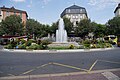 Fountain on Mandarous square

.jpg)
.jpg)


See also
[edit]Notes
[edit]- ^ In Gaul, in Italy, in Germany (Germany), in the Iberian Peninsula (Spain, Portugal), etc; See Histoire et secrets oubliés, Association of the Millau Museum's friends
- ^ The act of twinning was signed in Millau on 9 June 1962, by Charles Dutheil, deputy mayor of Millau, and Andrew Guillabert, Mayor of Luga. In 1989, the two cities decided to redefine their relations and emphasize cooperation activities in the fields of medicine, education and economic development.
References
[edit]- ^ "Répertoire national des élus: les maires" (in French). data.gouv.fr, Plateforme ouverte des données publiques françaises. 13 September 2022.
- ^ "Populations de référence 2023" (in French). National Institute of Statistics and Economic Studies. 18 December 2025.
- ^ France (1828). "Letters of Louis XI, Cérilly the 1 in March 1476 (before Easter 1475)". Ordonnances des roys de France de la troisième race (in French). Vol. 18. Gregg P. p. 181.
- ^ "Normales et records pour Saint Affrique (12)". Meteociel. Retrieved 14 December 2024.
- ^ Des villages de Cassini aux communes d'aujourd'hui: Commune data sheet Millau, EHESS (in French).
- ^ Population municipale entre 1968 et 2023, INSEE
- ^ "Mostar Gradovi prijatelji" [Mostar Twin Towns]. Grad Mostar [Mostar Official City Website] (in Macedonian). Archived from the original on 30 October 2013. Retrieved 19 December 2013.
Bibliography
[edit]Public Books :
- ARTIERES, Jules, Millau à travers les siècles, Millau, 1943, p. 558
- AMIS DU MUSEE DE MILLAU, Millau. Histoire et secrets oubliés, Millau, 1996, p. 279
- GIRARD, Georges, Des rues des hommes, Millau, 1987.
- La Graufesenque (Millau, Aveyron). Vol. 1 : Condatomagos, une agglomération de confluent en territoire rutène iie siècle aC – iiie siècle pC par Daniel Schaad. Vol. 2 : Sigillées lisses et autres productions par Martine Genin, Fédération Aquitania, 2007–2008. (ISBN 978-2-910763-09-1) (vol. 1) et 978-2-910763-10-7 (vol. 2).
- Monique Fournier & Michel Delmouly : Paroles ouvrières, paroles gantières. Amis du Musée de Millau. 1998.
- Millau 1911 : Avec les gantiers en grève. Association pour la promotion de l'histoire sociale millavoise. 2011.
University publications :
- BERNAD, Louis, Une ville de consulat : Millau en Rouergue. Thèse: Droit, Montpellier, 1938.
- CARBASSE, Jean-Marie, Notes sur l'administration municipale de Millau de la fin du xviie s. au début du xviiie. Mémoire: Droit, Montpellier, 1969.
- GARNIER, Florent, Un consulat et ses finances : Millau, 1187–1461. Paris : Comité pour l'histoire économique et financière de la France, 2006. Texte remanié de sa thèse : Le consulat de Millau au bas Moyen Âge : finances, pouvoir et société. Thèse: Histoire du Droit, Paris, 2002.
- LAUR, Frédéric, Le Consulat de Millau sous la Monarchie Absolue, Nîmes 1998, 395 p. Ce livre reprend sa thèse de Droit, Montpellier, 1985 : Pouvoir et société à Millau de 1632 à 1789.
- LOURDOU, Magali. Les Protestants et le consulat millavois au temps des premières guerres de religion (vers 1560 – vers 1574). In Revue du Rouergue. 2003 (73) : p. 49 – 65.
- MONTARNAL, Louis, Millau et la rupture du traité de Brétigny. Thèse: Droit, Paris, 1952.
- SEKIOU, Magda. Millau pendant la seconde guerre mondiale : La vie économique et sociale. In Revue du Rouergue. 2000 (64) : p. 595 – 617.
External links
[edit]
- (in French) Millau city council website
- Tourist office website in French, in Dutch and in Spanish

| International | |
|---|---|
| National | |
| Geographic | |
| Other | |

Millau
View on GrokipediaHistory
Prehistory and Roman Era
The Grands Causses region surrounding Millau contains evidence of Paleolithic human occupation, primarily from Mousterian assemblages associated with Neanderthal activity. Sites such as the Canalettes rockshelter yield lithic artifacts and faunal remains indicating mid-altitude exploitation during the Middle Paleolithic, around 50,000–40,000 years ago, with signs of fire use and possible early fuel experimentation including fossil hydrocarbons. These findings, preserved in karstic formations, reflect sporadic hunter-gatherer presence adapted to the limestone plateaus, though denser settlements emerged later in the Neolithic with megalithic structures like dolmens near Millau.[5] Roman influence began in the late 1st century BC, with the establishment of Condatomagus as a market settlement at the Tarn-Dourbie confluence, leveraging overland trade routes connecting Gallia Narbonensis to Aquitania.[6] The nearby La Graufesenque site, 2 km from modern Millau, developed into a major industrial center for terra sigillata pottery production starting under Augustus (c. 15 BC–AD 14), peaking in the 1st–2nd centuries AD with up to 600 potters operating large-scale kilns, workshops, and sanctuaries.[7] This red-gloss ware, fired in reducing atmospheres for its distinctive sheen, was mass-produced—evidenced by stamped maker's marks and waster heaps—and distributed empire-wide via Roman roads, supporting local economy through export to Britain, Gaul, and beyond. Artifacts from Graufesenque, including vessels and molds, are housed in the Musée de Millau et des Grands Causses, confirming the site's role in ceramic innovation and standardization.[5] Following the Roman withdrawal in the 5th century AD, the Millau area transitioned under Visigothic control as part of foederati territories in Aquitania Secunda, established by treaty in 418. This shifted after the Frankish victory at the Battle of Vouillé in 507, when Clovis I incorporated the region into Merovingian domains, evidenced by burial goods and belt buckles in southwestern Gaul reflecting Germanic influences overlaid on Gallo-Roman material culture.[8] Local artifacts, including early medieval pottery fragments and metalwork from the Musée de Millau collections, indicate cultural continuity with gradual integration of Frankish elements, though archaeological density remains lower than in Roman phases due to ruralization.[5]Medieval and Early Modern Period
In the 10th and 11th centuries, Millau developed as a viscounty within the broader County of Rodez, where secular lords known as viscounts exercised authority alongside the temporal influence of the Bishops of Rodez. The viscounts, originating as deputies or local potentates, consolidated power through alliances and marriages; for instance, Berengar I held the viscounty of Millau and Rodez around 1051, linking it to neighboring Gevaudan. By the 11th century, figures like Richard de Millau, a cardinal active in Gregorian reforms, exemplified the intertwining of local nobility with ecclesiastical politics in southern France. This feudal structure fostered agricultural estates and river-based trade on the Tarn, but vulnerability to regional overlords—such as the Counts of Barcelona who acquired the viscounty—limited autonomous growth. The 13th-century Albigensian Crusade, launched by Pope Innocent III against Cathar heretics in Languedoc, disrupted the region's social order, including Rouergue where Millau lay. Cathar communities, rejecting Catholic sacraments and material wealth, had gained adherents among local elites and peasants, prompting northern French crusaders to seize lands and impose inquisitorial controls. While direct sieges bypassed Millau, the crusade's confiscations and migrations eroded noble patronage and trade networks, as vicomtal holdings passed to Catalan interests under the Crown of Aragon, which maneuvered to protect southern allies. These upheavals, driven by papal enforcement of orthodoxy, compounded feudal fragmentation without eradicating heresy outright, setting precedents for later religious strife. The Black Death, arriving in Languedoc by 1348, inflicted mortality rates estimated at 30-50% across southern France, decimating Millau's populace through disrupted harvests and abandoned fields. Parish and fiscal records from comparable Midi towns indicate halved taxpayer rolls, attributing losses to bubonic plague's rapid spread via trade routes like the Tarn valley. Recovery lagged into the 15th century, sustained by subsistence farming of grains and vines, alongside modest wool and leather commerce, as labor scarcity elevated wages but stifled expansion amid ongoing Hundred Years' War skirmishes. The 16th-century Wars of Religion intensified divisions, with Millau emerging as a Huguenot bastion amid Calvinist conversions among merchants and artisans. Protestant assemblies, such as the 1573 gathering at Millau that formed the "Unity of Protestants in the Midi" under Henri de Condé's protection, coordinated resistance against Catholic leagues, fueling clashes that halved regional populations per diocesan tallies. These conflicts, rooted in confessional rivalries and noble ambitions, devastated trade and agriculture through looting and emigration. The Edict of Nantes in 1598 granted limited toleration, averting total collapse, yet intermittent violence and the 1685 revocation under Louis XIV spurred further exodus, perpetuating stagnation. Plagues recurring in the 17th century, alongside fiscal burdens, ensured economic inertia, with causal chains of depopulation hindering capital accumulation until later industrialization.[9]Industrial Development in the 19th and 20th Centuries
In the 19th century, Millau's economy transformed through the expansion of leather processing and glove manufacturing, leveraging local lambskins from Roquefort production and water resources from the Tarn River for tanneries. Early in the century, approximately 20 glove factories operated, employing around 400 workers, but growth accelerated with mechanization and demand for fine lambskin gloves. By 1887, the number of factories had risen to 70, supporting 1,500 male and 6,000 female workers—predominantly in sewing and embroidery—while one-third of output was exported to the United States, alongside shipments to Paris and other European markets.[10] This boom, driven by tanneries concentrated along the Tarn for vegetable tanning processes, spurred urbanization as rural workers migrated to the town, with leather-related activities comprising a dominant share of employment and contributing to population growth from under 5,000 in 1800 to over 10,000 by 1900.[11] Entering the 20th century, the industry peaked during the interwar period, with Millau producing around 300,000 dozen pairs annually by 1914 across 55 factories, and major firms showcasing at the 1931 Paris Colonial Exhibition and 1937 International Exposition. Leather goods, centered on gloves, engaged over 80% of the local workforce, including extensive home-based labor by women, underscoring the sector's role as the primary economic driver amid limited diversification. Exports sustained vitality, with U.S. markets absorbing significant volumes, though vulnerabilities emerged from reliance on manual skills and fluctuating fashion demands.[10] World War II brought disruptions under German occupation after 1942, including material shortages and potential factory requisitions for leather supplies, though production persisted at reduced scales due to black market adaptations common in French textile sectors. Post-1945 reconstruction involved modernization efforts, such as improved machinery in surviving tanneries and factories, yet French census data reflected early employment shifts as glove output, while reaching an absolute peak of 395,000 dozen pairs in 1963 across 75 factories (employing 2,000 in workshops and 3,000–4,000 at home), began declining by the late 1950s.[10] Competition from low-cost Asian imports and synthetic alternatives eroded market share, halving factories to around 40 by 1970 and foreshadowing broader deindustrialization.[11]Post-War Reconstruction and Contemporary Events
In the post-war period, Millau addressed acute housing shortages stemming from wartime disruptions and national backlogs through targeted construction projects, including emergency accommodations in 1954–1955 such as the Cité Briançon (76 units) and smaller sites like Pavillon Jean Moulin (2 units).[12] Further developments, like the Beauregard neighborhood built in the 1960s, expanded residential capacity to accommodate returning residents and support modest population stability.[13] These initiatives complemented efforts to sustain small-scale industries, notably glove-making and leather processing, amid rural depopulation pressures; the town's population stagnated around 22,000 inhabitants from 1962 (22,595) through the 1970s (21,907 in 1975), mirroring France's broader countryside exodus driven by urbanization and agricultural mechanization.[14] A pivotal contemporary event occurred on August 12, 1999, when sheep farmer José Bové and associates dismantled a McDonald's outlet under construction in Millau, using a tractor, axes, and chainsaws to remove doors, roofing, and electrical components.[15] The action protested U.S. trade sanctions under WTO rules, which targeted French Roquefort exports in retaliation for Europe's prohibition on hormone-treated American beef imports, framing it as resistance to globalization's encroachment on local agriculture.[16] Bové's subsequent arrest, 23 days in pretrial detention, and 2000 conviction for criminal vandalism (sentenced to three months imprisonment) elevated him to anti-globalization icon status via media coverage, though the incident inflicted property damage estimated in thousands of euros and deterred immediate commercial investment in the area, prioritizing symbolism over lawful economic development.[17][18] Persistent traffic bottlenecks in Millau, intensified since the 1980s by growing north-south freight and tourist volumes funneling through the Tarn valley, prompted viaduct planning as an extension of the A75 autoroute in the late 1990s.[19] Initial debates centered on funding—public budgets strained by other infrastructure versus toll-based concessions—resolved via a public-private partnership awarding construction to Eiffage in 2001, with the firm financing approximately €400 million privately under a 75-year operating concession.[20] This model enabled rapid completion by December 2004, effectively alleviating urban congestion by diverting over 2 million vehicles annually from town streets and enhancing regional economic links without full taxpayer burden.[21][22]Geography
Location and Topography
Millau lies at approximately 44°06′N 3°05′E in the Aveyron department of the Occitanie region, southern France, serving as the subprefecture of its namesake arrondissement, which encompasses 79,679 residents as of 2022.[23][24] The commune occupies an elevation of about 370 meters above sea level, positioned at the confluence of the Tarn and Dourbie rivers, a strategic hydrologic junction that historically facilitated early human settlement by providing reliable water resources amid otherwise arid surroundings.[25][26] The town's topography is defined by its placement in a river valley flanked by the elevated Grands Causses plateaus, composed primarily of permeable limestone formations exhibiting karst characteristics such as sinkholes and underground drainage networks.[27] These plateaus, rising to 900–1,200 meters, encircle Millau and constrain agricultural viability to valley floors while amplifying flood vulnerabilities from river overflows, as evidenced by 20th-century engineering efforts to widen and clear the Tarn and Dourbie channels.[28] The deep Tarn Gorges further serve as natural topographic barriers, limiting east-west access and channeling settlement along the fluvial corridor.[29] Geospatially, Millau stands roughly 110 kilometers northwest of Montpellier and 180 kilometers northeast of Toulouse, integrating it into regional transport networks while underscoring its peripheral position relative to major urban centers.[30][31] This setting, combining valley accessibility with plateau isolation, has shaped persistent patterns of localized development focused on the confluence zone.Geology and Natural Features
The Grands Causses region surrounding Millau features elevated plateaus primarily composed of Jurassic limestone and dolostone formations, deposited in a marine environment during the Mesozoic era. These permeable rocks have undergone extensive karstification through dissolution by groundwater, resulting in characteristic features such as dolines (sinkholes), underground aquifers, and deep canyons that constrain surface water availability while fostering subterranean drainage networks. The Larzac Causse, adjacent to Millau, exemplifies this with its bare, eroded limestone surfaces and poljes (depression basins), limiting arable land and agriculture to fracture zones but enabling the exploitation of natural cavities for specialized uses like the aging of Roquefort cheese in the karst caves of Combalou mountain near Roquefort-sur-Soulzon.[32][33][34] The Tarn Gorges, incised into these limestone plateaus by the Tarn River, represent a biodiversity hotspot within the karst landscape, supporting raptors such as the griffon vulture (Gyps fulvus) and cinereous vulture (Aegypius monachus). These sheer cliffs and riparian zones, designated under the EU Natura 2000 network as the Gorges du Tarn et de la Jonte site, provide nesting habitats for these species, with conservation efforts noting stable populations sustained by the area's isolation and food availability from carrion. The karst hydrology also creates oligotrophic ecosystems with endemic flora adapted to thin soils and seasonal water scarcity, enhancing ecological resilience but imposing constraints on development due to subsidence risks from cavern collapse.[35][36] River dynamics in the Tarn Valley introduce flood hazards, amplified by the impermeable clay substrata beneath limestones that channel rapid runoff during heavy precipitation; historical records document a significant inundation in Millau on November 1818, which damaged infrastructure along the riverbanks. Seismic risks, though low relative to Alpine zones, arise from intraplate fault lines traversing Aveyron, with moderate earthquake activity recorded, including events up to magnitude 4 since 2000, potentially exacerbating karst instability through induced fracturing. These geophysical traits collectively limit intensive land use while preserving unique hydrogeological opportunities, such as renewable aquifers recharged via poljes.[37][38][39][40]Climate and Environmental Conditions
Millau features a Mediterranean-influenced continental climate, with mild winters transitioning to hot, dry summers, as documented in long-term meteorological records. Average temperatures in January hover around 5°C, reflecting the mild winter conditions typical of the region's sheltered valleys, while July sees highs averaging 25°C during peak summer heat.[41] Annual precipitation totals approximately 800 mm, concentrated in autumn and spring months, with October often recording the highest rainfall at around 80-100 mm.[41] [42] The area's topography amplifies microclimate effects, including exposure to strong northerly winds that channel through the Tarn River gorge and influence the Millau Viaduct vicinity. Gusts resembling Mistral-like flows have been recorded exceeding 180 km/h at viaduct heights, contributing to localized aridity and evaporation rates.[43] These conditions underpin local agriculture, particularly sheep farming for Roquefort cheese production, which relies on consistent pasture growth, and limited viticulture in surrounding slopes. Severe drought episodes, such as the 2003 heatwave that elevated regional temperatures 3-5°C above norms and reduced water availability, alongside the 2022 prolonged dry spell, have curtailed forage yields and irrigation-dependent crops, prompting adaptive measures like supplemental feeding for livestock.[44][44]Demographics
Population Trends and Statistics
As of 2022, the commune of Millau recorded a population of 21,859 inhabitants, reflecting a density of 129.9 inhabitants per km² across its 168.2 km² area.[45] This figure marks a slight decline of 1.54% from 2016 levels, consistent with broader trends of demographic stagnation in rural French departments.[46] Preliminary estimates for January 2025 indicate a modest increase to 22,492 residents, driven by localized net in-migration.[47] Historical census data reveal fluctuations tied to industrial cycles, with a post-World War I low of 15,528 in 1921 following a pre-war figure of 17,673 in 1911.[48] The population then recovered, reaching 21,552 by 1968 and stabilizing around 21,000–22,000 thereafter, below potential peaks from the 19th-century glove-making era estimated near 25,000 but unverified in recent official tallies.[49]| Year | Population |
|---|---|
| 1921 | 15,528 |
| 1968 | 21,552 |
| 1999 | 21,371 |
| 2007 | 22,041 |
| 2016 | ~22,200 |
| 2022 | 21,859 |