Hubbry Logo
Mithila State MovementMithila State MovementMain
Open search
Mithila State Movement
Community hub
Mithila State Movement
logo
8 pages, 0 posts
0 subscribers
Be the first to start a discussion here.
Mithila State Movement
from Wikipedia

Mithila State Movement is a movement advocating a separate Mithila state in India.

History

[edit]

In 1921, Maharaja Rameshwar Singh of Darbhanga Raj raised the demand for a separate state of Mithila based on the concept of creating “a series of self-governing provinces and principalities federated by one central government.” [1] In 1936, Odisha was separated from Bihar, but the demand of a separate Mithila state remained ignored.

[edit]

The main role of Mithila State Movement is being done by 'Antarrashtriya Maithili Parishad', 'Mithila Rajya Nirman Sena', 'Sanyukta Mithila Rajya Sangharsh Samiti' 'Mithila Student Union' and The Pro Maithils.[2][3][4]

Industrial ruins in Mithila

[edit]

In the earlier period, Mithila was full of industrial estates. There were many industries in the region in regime of Darbhanga Raj Kingdom. These industries were flourishing the economy of the region. After the independence of India, the rule of Darbhanga Raj Kingdom ended and then the industrial estates of the region started gradually closing due to the negligence of the central government as well as state government of Bihar. The region was full of many sugar mills, cotton mills, paper industries, chocolate factories and many more agricultural industries. In the last three decades,[clarification needed] due to the castism politics in Bihar by the leaders there, the agenda of industrial development got neglected and gradually industries got closed. Nowadays these industrial estates have become ruins. This led to the migrations of labours and human resources from the area to the metropolitan cities of the country.[5] The sugar mills of Sakari, Lohat, Raiyam and Samastipur was very famous in the country. Mithila was the bowl of sugar in India three decades ago. Hayaghat was famous for Ashok Paper Industry and similarly Pandaul was famous for Cotton mills. Purnea, Saharsa, Katihar, Muzaffarpur and, Darbhanga was famous for Jute industries since 1794 up to 1990.[citation needed]

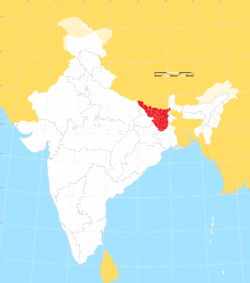
Proposed Map of Mithila State showing the districts of the proposed state.

Tourism in Mithila

[edit]
Janaki Kund, Birthplace of Sita, Parauna Dham, Sitamarhi, Mithila

Mithila is the part of Ramayana, Mahabharata and ancient Indian philosophy. [citation needed]

Ruins of Rajnagar Kingdom in Mithila

References

[edit]
Revisions and contributorsEdit on WikipediaRead on Wikipedia
from Grokipedia
The Mithila State Movement is a regionalist campaign advocating the creation of a separate Indian state named Mithila, encompassing approximately 20-22 Maithili-speaking districts in northern Bihar, such as Darbhanga, Madhubani, Supaul, Saharsa, and Madhepura, with a proposed population exceeding 40 million, to preserve the unique linguistic, cultural, and historical identity of the Mithila region rooted in the ancient kingdom of Videha. Originating from early assertions of Maithil distinctiveness during British colonial linguistic surveys, the movement gained significant traction in when scholar George Grierson delineated the Maithili linguistic area, highlighting its separation from neighboring and Bengali zones, which fueled demands for administrative autonomy to counter perceived and economic neglect within larger . Post-independence, proponents like Janaki Nandan and organizations such as the Mithila Rajya Sangharsh Samiti intensified efforts, submitting petitions to national leaders, though state reorganization commissions overlooked the claim, leading to persistent advocacy through rallies and political platforms. While achieving partial successes, including the constitutional recognition of Maithili in the Eighth Schedule in 2003, the movement faces challenges from Bihar's political resistance to fragmentation and debates over viability, yet recent endorsements by figures like former underscore ongoing cultural imperatives for focused governance and heritage safeguarding amid regional disparities.

Historical Background

Origins in Pre-Colonial and Colonial Eras

![Darbhanga Raj Fort, Bihar][float-right] The Mithila region's historical foundations lie in the ancient kingdom, first referenced in Vedic texts such as the Śatapatha Brāhmaṇa, composed between the 8th and 6th centuries BCE, which describes Videha as an eastern Aryan expansion area centered around the capital city of Mithila. This kingdom, ruled by kings known as Janakas, encompassed territories in present-day northern and southern , fostering a distinct cultural identity tied to Vedic scholarship and Indo-Aryan settlement during the Later (circa 1000–600 BCE). Over subsequent centuries, Mithila experienced rule by various dynasties, including the medieval Oiniwar and Karnata kings from the onward, who maintained tributary relations with the and later the , preserving regional administrative autonomy and dominance in intellectual and landholding spheres. During the colonial era under British India, Mithila's identity solidified through the Darbhanga Raj, a prominent zamindari estate established in the by rulers whose seat in became the cultural and political hub of the region. The raj's maharajas, such as those from the 19th century onward, patronized Maithili literature, learning, and orthodox Brahmanical traditions, reinforcing Mithila as a bastion of scholarly amid broader administration. By the late colonial period, particularly from the 1940s, the Darbhanga Raj actively promoted a Mithila-specific identity rooted in its historical heritage, including early for administrative separation to form a distinct Mithila , driven by linguistic and cultural distinctions from surrounding - and Bengali-speaking areas. These pre-independence efforts laid groundwork for later statehood demands by highlighting enduring regional cohesion against centralized structures.

Post-Independence Momentum and Key Phases

Following India's independence in 1947, the Mithila State Movement experienced initial post-colonial momentum amid the broader push for linguistic reorganization of states between 1950 and 1956. Advocates, dissatisfied with the integration of Maithili-speaking areas into bilingual , mobilized around cultural and administrative neglect, but these demands were sidelined as the prioritized Hindi-speaking consolidation over smaller ethno-linguistic units. In , Dr. Laxman Jha, a and freedom fighter, spearheaded a prominent campaign for separate statehood, framing it as essential for preserving Maithili identity and addressing regional underdevelopment; this effort included direct appeals to national leaders, such as Janaki Nandan Singh's meeting with . Despite generating local support, the phase yielded no territorial changes, as the States Reorganisation Act of 1956 reaffirmed 's boundaries without accommodating Mithila. The movement entered a period of relative dormancy through the 1960s and 1970s, overshadowed by national priorities like and the integration of princely states, though underlying grievances over flood-prone infrastructure and linguistic marginalization persisted. Revitalization occurred in the and accelerated in the 1990s with the formation of dedicated organizations; the Akhil Bhartiya Mithila Rajya Sangharsh Samiti, established in 1990 under leaders like Jaikant Mishra, Dr. Baidyanath Chaudhary, and Amarnath Jha, focused on grassroots advocacy for statehood from Bihar's northern districts. By 1996, the Samiti launched mass-contact campaigns to highlight economic disparities, including industrial stagnation and migration, demanding autonomous development councils as interim measures. A pivotal boost came in the early 2000s when Maithili's inclusion in the Eighth Schedule of the Constitution in 2003—after decades of agitation—validated the region's linguistic distinctiveness and reinvigorated statehood calls by linking cultural preservation to political autonomy. This phase intertwined with broader regional assertions, including proposals for Mithilanchal Vikas Congress-backed development bodies. In the and , mobilization shifted toward public awareness drives, such as padyatras starting from Madhubani's Phulhar village in the late 2010s and a second phase launched on January 2, 2022, to rally support across proposed boundaries. Political endorsements, including former Chief Minister Rabri Devi's November 2024 reiteration of the demand, underscored ongoing viability amid Bihar's persistent underdevelopment, though central government resistance to further fragmentation has stalled progress.

Cultural and Linguistic Foundations

Distinct Mithila Identity and Heritage

The Mithila region's distinct identity is anchored in its ancient historical associations with the kingdom, where Mithila served as the capital under kings titled , including the legendary Seeradhwaja Janaka, father of as depicted in the . This epic connection positions Mithila as a symbolic cradle of Vedic philosophy and royal scholarship, with Janaka revered for hosting philosophical assemblies and embodying detached wisdom in . Archaeological and textual evidence supports a continuity of settlement and cultural practices from the , distinguishing the region from neighboring areas through its emphasis on intellectual and spiritual heritage rather than martial traditions. Mithila's cultural heritage manifests prominently in its traditional arts, exemplified by Madhubani painting, a form historically practiced by women on mud walls of homes for rituals, weddings, and festivals, using natural pigments to illustrate mythological scenes, flora, fauna, and geometric motifs. These paintings, originating over two millennia ago, reflect a worldview intertwined with and agrarian life, with techniques involving twig brushes and finger filling that preserve ephemeral yet ritualistic expressions unique to Mithila households. Complementary traditions like Aripana, intricate floor designs made from rice paste and colors during pujas, further embed daily religious observance in visual symbolism, setting Mithila apart through its gendered, domestic artistry not replicated in broader Bihari folk expressions. Social customs in Mithila emphasize community and lineage preservation, particularly among Maithil Brahmins who historically dominated the region's intellectual and administrative spheres, maintaining detailed genealogical records via the Panji system to trace priestly lineages back centuries. Marriage rituals, such as elaborate Kanyadan ceremonies with symbolic exchanges and regional songs, underscore a cultural of reverence for familial bonds and scriptural adherence, differing from the more syncretic practices in central . Festivals like and incorporate Mithila-specific musical and performative elements, including Jat-Jatin folk dances depicting divine love stories, which reinforce a tied to the region's and devotional landscape. This heritage fosters a cohesive regional , evidenced by the persistence of Maithil customs amid historical shifts from to colonial rule, where local like those of patronized arts and scholarship, preserving distinct practices against assimilation into larger administrative units. Empirical studies highlight how these elements—artistic, ritualistic, and historical—contribute to a cultural divergence, with Mithila's traditions empirically linked to lower rates of cultural dilution compared to adjacent Hindi-dominant zones, as measured by linguistic retention and festival participation data.

Maithili Language and Its Recognition Struggles

Maithili, an Indo-Aryan language indigenous to the Mithila region in Bihar, Jharkhand, and parts of Nepal, has historically served as the vernacular of administration, literature, and daily life among Maithil speakers, with roots traceable to medieval texts by poets such as Vidyapati in the 14th century. Efforts to affirm its distinct status separate from Hindi emerged prominently during the colonial period, when linguists and scholars contested its classification as a mere dialect, emphasizing its independent grammar, script (Mithilakshar, later largely supplanted by Devanagari), and literary corpus spanning over 700 years. This assertion of linguistic autonomy laid foundational groundwork for broader cultural mobilization, including resistance to Hindi imposition in education and governance post-independence. Post-1947, Maithili's recognition struggles intensified in , where was enshrined as the sole under the state's Official Language Act of 1950, sidelining regional tongues despite constitutional provisions for linguistic minorities. Advocacy groups and intellectuals campaigned for decades to include Maithili in the Eighth Schedule of the Indian Constitution, culminating in its addition via the 92nd Amendment Act of 2003, which recognized it as one of 22 scheduled languages eligible for developmental support. This milestone followed sustained petitions and parliamentary interventions, yet practical gains remained elusive, as did not designate Maithili as a second in regional administration or courts, perpetuating its underuse in official domains. These linguistic grievances have directly fueled the Mithila State Movement, with proponents arguing that Hindi-centric policies erode Maithili's vitality, suppress cultural expression, and hinder equitable for language promotion. Statehood advocates demand Maithili's elevation to co-official status in a prospective Mithila state to facilitate its use in , , and , addressing perceived neglect by Bihar's Hindi-dominant framework. Recent escalations include calls for designation—criteria met through ancient literary and speaker base—pushed by Bihar's JD(U) party in October 2024 and formalized by Nitish Kumar's administration in November 2024, though an initial procedural lapse led to its omission from central recognitions announced that month. Such delays highlight ongoing institutional hurdles, including inconsistent state-level support and competition among regional languages for central patronage.

Objectives and Rationale

Primary Demands for Statehood

The central demand of the Mithila State Movement is the establishment of a separate state, named Mithila or Mithilanchal, to be carved out from the northern districts of . This proposal encompasses approximately 20 of Bihar's 38 districts, including , Madhubani, , , , , , , and others in the flood-prone Gangetic plains. Proponents argue that statehood would enable targeted governance to mitigate persistent regional underdevelopment, characterized by annual flooding from rivers like the Kosi and Bagmati, which displaces millions and hampers —the mainstay of the local economy. Advocates emphasize the need for administrative to foster more responsive policies suited to local needs, citing Bihar's large size and centralized decision-making as barriers to equitable . Economic justifications include reversing industrial decline, such as the sharp drop in sugar production from 40% of Bihar's output historically to just 4% today, attributed to neglect of and in the region. Cultural and linguistic preservation forms another core objective, with demands centered on elevating the —spoken by over 40 million people—and associated heritage, including Madhubani paintings and traditions tied to the ancient kingdom of Mithila, referenced in epics like the as the birthplace of . Although received Eighth Schedule recognition in 2003, movement leaders contend that full statehood is essential for institutional support of Maithili-medium education, , and cultural institutions. These demands, first articulated formally in 1912 during Bihar's separation from , have been reiterated by figures across parties, including leader in November 2024.

Economic and Administrative Justifications

Proponents of the Mithila State Movement argue that the region's economic underdevelopment stems from disproportionate neglect within , where northern districts comprising Mithila contribute significantly to agricultural output but receive minimal reinvestment. Historically, the in Mithila accounted for 40 percent of India's production in the mid-20th century, supported by over 30 sugar mills, but this has declined to 4 percent with nearly all mills non-functional due to inadequate and focus. The area's fertile alluvial plains and abundant from rivers like the Kosi and Bagmati hold potential for enhanced and , yet chronic annual flooding—exacerbated by cross-border inflows from —results in crop losses exceeding 20-30 percent in affected years, stifling productivity and driving mass out-migration for employment. District-level data underscores these disparities: Mithila's core districts, such as Sheohar, Araria, Sitamarhi, and Madhubani, rank among Bihar's lowest in per capita income, with figures around Rs 30,000-40,000 annually as of 2020-21, compared to the state average of approximately Rs 47,000 and higher in southern regions like (over Rs 1 ). Advocates claim this reflects a failure to industrialize local assets, including makhana (foxnut) cultivation—which generates export potential but remains artisanal—or revive cottage industries tied to Madhubani painting, leading to rates above 15 percent and remittances forming a key economic lifeline. A separate state, they contend, would enable targeted fiscal policies to harness these resources, reducing dependency on Bihar's centralized budget allocation that favors urban southern hubs. Administratively, the movement highlights Bihar's oversized governance structure—spanning 38 districts and over 120 million people—as ill-suited to address Mithila's unique challenges, including flood management and linguistic-cultural administration. Successive Bihar governments, often dominated by southern caste coalitions, have applied uniform policies ignoring northern flood-prone topography and Maithili-medium needs, resulting in delayed embankment repairs and underfunded local bodies. For instance, despite Mithila encompassing about 20 districts and one-third of Bihar's population, regional development boards like the Kosi Mahasetu remain under-resourced, perpetuating a Patna-centric bias evident since the 1912 bifurcation from . Statehood proponents assert that a dedicated administration, modeled on successful smaller states like formed in 2000, would streamline decision-making for region-specific issues, enhancing accountability and equitable service delivery.

Organizations and Leadership

Key Advocacy Groups

The Maithil Mahasabha, established in 1910 by Maharajadhiraj of Raj, served as an early institutional platform for promoting Mithila's cultural and linguistic identity, initially restricting membership to Maithil Brahmins before broadening its scope. The organization advocated for administrative separation from , passing a formal resolution for a distinct Mithila state in 1940 during a meeting in , framing the demand around historical precedents and regional underdevelopment. Its efforts focused on preservation and cultural revival, laying groundwork for later statehood campaigns, though it faced criticism for caste-based origins that limited broader mobilization. The Mithila Rajya Sangharsh Samiti, formed in the early as a dedicated body, emerged as a primary driver of for statehood, conducting campaigns starting in 1996 to highlight administrative neglect and economic disparities in Maithili-speaking districts. Operating primarily in , the group organized protests and lobbied , emphasizing the need for a unified administrative unit to address issues like flood vulnerability and underinvestment in . Its activities intensified post-2000, aligning with broader regional autonomy demands following Jharkhand's creation, though it has struggled against Bihar's unified state opposition. Antarrashtriya Maithili Parishad, founded on June 20, 1993, coordinates international advocacy for Maithili rights, including statehood, by engaging communities and petitioning central authorities for recognition of Mithila's distinct socio-cultural boundaries. The parishad has focused on linguistic and cultural to bolster territorial claims, collaborating with local groups on events like language conferences that double as platforms for statehood rallies. Its transnational approach aims to amplify regional grievances globally, though effectiveness remains limited by reliance on voluntary participation and competition from domestic political entities. Other notable entities include the Mithila Rajya Nirman Sena, which supports infrastructural tied to , and the Vidyapati Seva Sansthan, centered on cultural heritage promotion as a precursor to political demands. These groups often intersect through joint campaigns, but fragmentation along ideological lines—such as versus pan-Maithil unity—has hindered unified action. Overall, relies on non-partisan social organizations rather than major , reflecting the movement's grassroots character amid Bihar's dominant regional politics.

Prominent Figures and Political Alliances

, former Chief Minister of Bihar and leader of the (RJD), has been a vocal proponent of Mithila statehood, renewing demands in November 2024 to counter perceived political maneuvers by the BJP-led NDA and highlight regional aspirations in the Maithili-speaking areas. She previously supported the movement in 2018 while leading the opposition in the Bihar Assembly, framing it as a response to long-standing cultural and developmental neglect. Nitish Kumar, Chief Minister of Bihar and president of Janata Dal (United) or JD(U), extended support for Mithila state formation in November 2011, aligning with earlier statements by JD(U) state president Shravan Chaudhary in 2008, who advocated carving out the state from northern Bihar districts to address administrative inefficiencies. Chaudhary's position reflected the party's occasional endorsement of sub-regional demands amid Bihar's fragmented politics. Kirti Jha Azad, a former cricketer and BJP from —a key Mithila district—raised the statehood demand in the in 2015, emphasizing linguistic and cultural distinctiveness based on the Maithili language's Eighth Schedule status since 2003. His advocacy, though not leading to policy shifts, underscored sporadic bipartisan interest from national parties like the BJP in leveraging regional identities for electoral gains in . Political alliances for the movement remain fluid and opportunistic rather than formalized coalitions, often tied to Bihar's caste and regional dynamics rather than sustained ideological pacts. Support has emanated from Maithili-speaking leaders across RJD, JD(U), and BJP, but lacks unified fronts; for instance, the RJD's 2024 push positioned it against NDA narratives, while JD(U)'s endorsements correlate with Nitish Kumar's balancing of regional pressures against 's unity. Advocacy groups like the Mithila Rajya Sangharsh Samiti have organized protests, such as the February 2023 demonstration in demanding statehood from 24 districts, but these efforts have not forged enduring alliances with major parties beyond rhetorical backing. This pattern reflects causal realities of Indian federalism, where statehood demands gain traction during elections but falter without impetus, as evidenced by unfulfilled promises since the movement's post-1912 origins.

Major Events and Mobilization

Pivotal Protests and Milestones

The demand for a separate Mithila state was first formally raised in 1912, coinciding with 's separation from the , as local leaders argued for administrative autonomy to address regional cultural and linguistic distinctiveness. In June 2002, activists announced the second phase of agitation for carving out Mithila from 19 districts of , planning intensified protests starting in August to highlight economic neglect and demand statehood. A notable push occurred in 2004 when BJP leader Pt. Tarakant Jha initiated a short-lived campaign for a Mithilanchal state, mobilizing support around Maithili identity and underdevelopment. On December 17, 2009, Maithili-speaking groups organized protests in front of the Indian Parliament in , alongside a parallel demonstration at , to press for citing historical precedents and administrative inefficiencies. In August 2022, the held a rally at [Jantar Mantar](/page/Jantar Mantar), , emphasizing youth-led demands for separate statehood amid persistent regional disparities in and governance. These events underscore recurring mobilizations tied to broader grievances, though they have not yet prompted action on bifurcation.

Symbols, Slogans, and Public Campaigns

The Mithila State Movement incorporates regional cultural elements and visuals to underscore demands for . Participants in demonstrations frequently wear yellow attire and wave yellow flags, symbolizing unity and urgency, as seen during the Mithila Students' Union's August 2022 at in , which drew hundreds advocating for statehood. Slogans emphasize entitlement over supplication, with chants such as “Chheen ke rahbai Mithila rajya” (We will seize Mithila state) and “Bheekh nai adhikar chahi, hamra Mithila rajya chahi” (No alms, we demand our right; we want our Mithila state) recurring in rallies to frame the demand as an inherent claim rooted in historical and linguistic identity. Placards reinforce these messages, displaying phrases like “Maithil karu khoon garam, haq manga mein kon sharam” (Maithils, ignite your blood; no shame in claiming rights) to galvanize participants, and “Bihar majboori chhai, Mithila zaroori chhai” (Bihar is a compulsion, Mithila is essential) to prioritize regional separation. Public campaigns blend with outreach, including the Mithila Rajya Sangharsh Samiti's 1996 mass-contact drive to build support for carving out the state from . Disruptive tactics, such as Janata MP Vijay Kumar Mishra's three-day rail roko agitation in 1986, halted train services to draw attention to administrative neglect and the need for separate governance. The traditional paag , emblematic of Maithil respect and worn by men in the region, appears in such events to evoke and distinction from broader Bihari identity.

Proposed Territory and Geography

Districts and Boundary Proposals

Proposals for the Mithila state, often referred to as Mithilanchal, center on carving out territory from northern Bihar, encompassing areas historically and linguistically tied to the Maithili-speaking Mithila region. Advocates typically seek inclusion of approximately 20 districts from Bihar's 38 total districts, focusing on those where Maithili is the primary language. The exact composition varies across proponents, with debates over peripheral districts influenced by dialects like Bajjika or Angika, which some consider extensions of Maithili. Core districts consistently proposed include , Madhubani, , , , , , , , , , and . Additional districts frequently mentioned are Madhubani, , , and , reflecting the region's cultural heartland around as a proposed administrative center. Boundary delineations aim to follow natural features such as the to the east, Gandak River to the west, Ganga River to the south, and the border to the north, though disputes arise over riverine adjustments and inclusion of transitional zones. While some earlier advocacy groups have suggested incorporating six districts from —such as and Sahibganj—due to shared cultural elements, recent high-profile demands, including that from former in November 2024, emphasize separation solely from to avoid interstate conflicts. These variations highlight challenges in defining precise boundaries, with potential for prolonged negotiations over administrative divisions and if the demand advances.

Environmental and Resource Challenges

The Mithila region, encompassing northern districts of Bihar such as Darbhanga, Madhubani, Supaul, and Saharsa, lies in the flood-prone alluvial plains of the Indo-Gangetic basin, where rivers like the Kosi, Bagmati, and Gandak originate from the Himalayas and deposit heavy silt loads during monsoons. The Kosi River, often termed the "Sorrow of Bihar," exemplifies this vulnerability, carrying approximately 120 million cubic meters of silt annually, which elevates riverbeds and exacerbates breaching risks, leading to recurrent inundations that affect over 70% of the region's land area. For instance, the 2008 Kosi floods displaced 3.3 million people across Mithila districts, destroying crops on 2.2 million hectares and causing economic losses exceeding US$1 billion, primarily through housing damage (US$134.9 million) and infrastructure disruption. These events, intensified by embankment failures and upstream deforestation in Nepal, result in prolonged waterlogging that degrades soil fertility via sand casting and nutrient leaching, hindering agricultural productivity in a region where farming sustains over 80% of the population. Resource scarcity compounds these flood dynamics, as the area's abundant during monsoons contrasts with depletion and seasonal droughts, driven by over-extraction for amid silt-clogged channels. Traditional ponds (pokhars), vital for recharging aquifers and supporting community needs, have dwindled due to encroachment and neglect, reducing their capacity to mitigate dry-season shortages and contributing to a cycle of flood-drought extremes influenced by variability. In the Kosi sub-basin, marginalized communities face disproportionate impacts, with biophysical analyses showing increased intensity since the 1990s amplifying flood regimes, yet inadequate upstream perpetuates vulnerability without equitable distribution. Embankment-centric strategies have proven ineffective long-term, as rising bed levels from —up to 20-30 cm annually in parts of the Kosi—necessitate frequent repairs, straining limited fiscal resources and highlighting the need for integrated to address both erosional losses and insecurity. These challenges underscore broader , including in wetlands and heightened erosion rates that diminish , with flood damages in Bihar's northern districts totaling billions of rupees yearly and disproportionately burdening rural economies reliant on rain-fed . Without region-specific interventions, such as and , the proposed Mithila state's resource base remains at risk, as evidenced by the 2024 Kosi floods that released 661,000 cusecs from the Birpur Barrage, submerging villages and underscoring persistent hydrological mismanagement.

Opposition and Counterarguments

Political and Unionist Perspectives

The Bihar state government has consistently opposed the creation of a separate Mithila state, viewing it as a threat to administrative unity and suspecting underlying political ambitions among proponents rather than genuine regional grievances. In 2022, the state rejected demands for even a Mithilanchal development council in the Bihar Assembly, prioritizing integrated governance over bifurcation. Chief Minister Nitish Kumar's Janata Dal (United), in coalition with the Bharatiya Janata Party, has maintained Bihar's territorial integrity as a core policy, arguing that further divisions exacerbate governance challenges in an already underdeveloped state. At the national level, the has reiterated that no proposals for new states, including Mithila, are under active consideration, as stated in the in 2022, reflecting a cautious approach to federal reorganization under Article 3 of the Constitution. Political analysts note that endorsing such demands could set a for over 40 additional states based on linguistic or ethnic lines, complicating and national cohesion. Unionist perspectives emphasize the risks of fragmentation, drawing parallels to post-creation struggles in states like (formed 2000), (2000), and (2014), where new administrative structures failed to deliver promised prosperity amid persistent infrastructure deficits and fiscal strains. Critics argue that Mithila's proposed territory, prone to annual flooding and lacking industrial base, would face unsustainable economics, with underdevelopment rooted in statewide issues like caste-based politics rather than regional isolation. The movement's perceived elitist focus on upper-caste interests has further undermined its legitimacy, alienating broader demographics and reinforcing views that it serves narrow agendas over inclusive development.

Risks of Fragmentation and Feasibility Concerns

The proposed creation of a Mithila state, encompassing approximately 20 of Bihar's 38 districts and around 40 million Maithili speakers, risks exacerbating administrative fragmentation in an already divided , which lost significant mineral-rich territory to in 2000. Such a split could trigger cascading demands for further subdivisions, potentially expanding India's states beyond 40 and straining national governance through increased bureaucratic layers and reduced in . Economic feasibility remains a core concern, as the region lacks a robust base, with limited industrial development and heavy reliance on vulnerable to perennial flooding from Nepal-origin rivers like the Kosi and Gandak. Floods and droughts have diminished , including a sharp decline in Bihar's sugar production share from 40% to 4% nationally, while high on floodplains and out-migration for remittances underscore dependency rather than self-sufficiency. New states like and have faced fiscal strains from establishing capitals and bureaucracies without commensurate growth, a pattern likely for Mithila given its underdeveloped infrastructure. Politically, the demand encounters strong resistance from 's unified leadership, including opposition to even a Mithila development council, reflecting fears of diminished state bargaining power with the center. Constitutionally, under Article 3, formation requires a parliamentary bill, presidential recommendation, and consideration of the state legislature's views, which has historically resisted, as evidenced by the central government's November 2022 statement confirming no new state proposals under review. These barriers, combined with the region's entrenched neglect—attributable more to failures than inherent separability—suggest that fragmentation may perpetuate underdevelopment rather than resolve it.

Economic Realities

Evidence of Regional Neglect

The Mithila region, encompassing districts such as Madhubani, Darbhanga, Sitamarhi, Saharsa, and Supaul in northern Bihar, exhibits persistent underdevelopment relative to southern Bihar districts like Patna and Gaya, as evidenced by lower human development indicators. Literacy rates in Mithila districts remain among the lowest in the state; for instance, Sitamarhi recorded a literacy rate of 52.05% as of early 2010s data, compared to the state average exceeding 60% at the time, with rural areas in northern Bihar showing even greater disparities due to limited access to education infrastructure. Human development indices in these districts lag behind Patna's higher scores, with northern Bihar's overall HDI reflecting deficiencies in health, education, and income metrics, contributing to a cycle of low productivity. Poverty levels in Mithila districts are exacerbated by agricultural vulnerabilities, with multidimensional poverty rates in northern Bihar exceeding state averages in flood-affected areas, where over 50% of the population in some sub-regions faces deprivations in nutrition, sanitation, and housing. Annual flood events, impacting 73.6% of North Bihar's land area including core Mithila territories, destroy crops and livestock, leading to economic losses estimated at around ₹1,000 crore yearly for the state, with northern districts bearing the brunt due to inadequate embankment maintenance and river management. These floods, occurring predictably each monsoon season, displace millions and highlight infrastructural neglect, as poorly designed embankments often breach, worsening siltation and flood intensity rather than mitigating risks. High rates of distress migration further underscore regional neglect, with rural outflows from Mithila villages to urban centers like and driven by seasonal unemployment and flood-induced livelihood disruptions; census data from 2001 indicated over 20 million rural-to-urban migrants from , a trend persisting in northern districts where remittances now form a critical but unstable economic buffer. Infrastructure disparities are stark, with northern receiving comparatively fewer investments in roads, power, and compared to southern regions, resulting in lower industrial growth and agricultural yields despite fertile alluvial soils. This uneven allocation perpetuates a developmental lag, as northern districts trail in service sector expansion and essential amenities, fueling demands for targeted interventions.

Development Potential and Industrial History

The Mithila region, encompassing northern Bihar districts such as Darbhanga, Madhubani, Sitamarhi, and parts of Tirhut, historically relied on an agrarian economy supplemented by agro-based industries under British colonial rule. In the 19th century, indigo cultivation dominated, with Tirhut (a core Mithila sub-region) monopolizing production and exporting to global markets, supported by extensive plantations and processing units that employed thousands. Saltpeter extraction for gunpowder also flourished, leveraging the area's saline soils and riverine access for export via the Gandak and Kosi rivers. By the late 1800s, the introduction of synthetic dyes in 1896 eroded indigo's viability, prompting a shift to cash crops like sugarcane, tobacco, jute, rice, and oilseeds, which spurred ancillary industries including sugar mills and ginning factories. Post-independence, Mithila hosted numerous agro-industries, including mills (with Tirhut contributing up to 40% of India's production in the mid-20th century), mills, factories, and even processing tied to local . However, these declined sharply over the last three decades due to factors like recurring floods, inadequate , neglect, and competition from other regions, reducing output to about 4% nationally and leaving many facilities abandoned or underutilized. Today, industry contributes minimally to the local , overshadowed by subsistence farming that engages over 70% of the , with limited diversification into . Development potential in Mithila centers on reviving agro-processing and leveraging cultural assets, though constrained by chronic flooding from rivers like the Kosi and Bagmati, which annually displace populations and erode soil fertility. Agriculture remains the backbone, with fertile alluvial soils supporting high-yield crops such as , vegetables, litchi, and —Bihar as a whole ranks fourth nationally in mango production—but yields lag due to flood vulnerability and poor coverage below 50% in key districts. Traditional crafts like Madhubani painting offer export-oriented opportunities, potentially fostering sustainable micro-industries and around heritage sites, as evidenced by initiatives like the Mithila Haat market aiming to generate over 500 direct jobs through artisanal sales. Emerging investor networks and policy advocacy seek to channel funds into startups and , arguing that regional could prioritize flood control and value-added processing to stem out-migration, which affects millions annually. Yet, skeptics highlight the area's dependence on central aid and low —among Bihar's lowest in Mithila districts—as barriers to self-sustaining growth, with statehood unlikely to overcome broader structural issues like skill gaps and without national-level reforms.

Current Developments and Prospects

Recent Political Demands and Responses

In November 2024, leader and former publicly demanded the creation of a separate Mithila state from the Mithilanchal region of , arguing that Maithili speakers deserved to preserve their distinct and amid perceived neglect. This call was positioned as a counter to the ruling National Democratic Alliance's efforts to appeal to regional pride through initiatives like temple constructions and language promotion, without endorsing bifurcation. Advocacy groups such as the Mithila Rajya Sangharsh Samiti have sustained pressure through demonstrations, including a significant protest in on March 21, 2023, where participants rallied against administrative centralization in and called for statehood to address regional disparities. Similar actions persisted into 2025, with the Akhil Bharatiya Mithila Rajya Sangharsh Samiti organizing a large-scale demonstration on July 21 in support of the demand, highlighting ongoing mobilization despite limited mainstream political uptake. The Bihar government under has not supported statehood, instead channeling resources into cultural and developmental measures within the unified state framework, such as formally requesting status for Maithili from the on November 19, 2024. Central figures, including Union Home Minister , engaged with Mithila's heritage at events like the Shashwat Mithila Mahotsav on March 9, 2025, emphasizing preservation and economic integration over territorial reconfiguration. These responses reflect a broader governmental preference for enhanced regional autonomy and funding—such as renewed pushes for Bihar's —rather than fragmentation, amid concerns over administrative viability and electoral dynamics in the 2025 assembly polls. The demand for a separate Mithila state remains legally unaddressed by the Indian central government as of October 2025, with no bills introduced in under Article 3 of the to facilitate its formation from . This provision requires parliamentary approval following presidential recommendation, a process not initiated despite protests and advocacy by groups like the Mithila Rajya Sangharsh Samiti, including a 2023 demonstration at in . Central authorities have prioritized electoral outreach in the region, as evidenced by Narendra Modi's campaign launch in on October 23, 2025, which invoked local legacies without endorsing statehood. The Bihar state government, led by the NDA coalition of JD(U) and BJP, has shown no inclination toward supporting reorganization that would fragment its territory, viewing such demands as politically motivated challenges rather than viable policy. Opposition leader Devi's renewed call on , , for carving out Mithilanchal explicitly positioned the demand as a counter to NDA strategies, such as honoring , but elicited only tepid responses from BJP figures emphasizing cultural recognition over administrative separation. officials have also withheld full implementation of Maithili as a second in regional administration, further signaling resistance to concessions that could bolster separatist claims. Legally, the movement lacks judicial backing or interim recognitions, such as special status under existing frameworks, and faces practical barriers from Bihar's unified opposition to subdivision amid ongoing fiscal dependencies on . Proponents' appeals, including those tied to linguistic and cultural preservation, have not translated into governmental commitments, with demands resurfacing cyclically during election cycles like Bihar's 2025 assembly polls without altering the status quo.

Broader Implications

Cultural Preservation and Identity Impacts

The Mithila State Movement advocates for enhanced cultural preservation by establishing administrative autonomy to protect the region's distinct identity, rooted in the , Madhubani paintings, and historical ties to ancient Mithila as the birthplace of in the . Proponents assert that integration into has marginalized these elements, with —recognized in the Eighth Schedule of the Indian Constitution in 2003 after decades of struggle—receiving insufficient institutional support despite its rich literary tradition from poets like . Statehood is viewed as enabling targeted initiatives, such as mandatory Maithili-medium education, revival of the Mithilakshar script, and funding for cultural institutions like the Maithili Sahitya Parishad, which links linguistic promotion to regional autonomy demands. The Bihar government's November 2024 push for classical language status for Maithili aims to secure resources for research, conservation of literature, and promotion of traditions, aligning with movement goals to counter Hindi's dominance in administration and education. This focus strengthens ethnic cohesion through preservation of festivals like and unique social customs, potentially reducing cultural erosion from neglect and migration. Recent demands, such as leader Rabri Devi's November 2024 call for Mithila statehood emphasizing Maithili heritage, highlight how autonomy could foster pride and reverse fading traditions amid administrative oversight.

Lessons for Indian Federalism and Decentralization

The Mithila State Movement exemplifies the persistent tension in Indian federalism between accommodating subnational identities and preserving administrative cohesion in linguistically and culturally diverse states like . Proponents argue that carving out Mithila could enable targeted governance for a marked by chronic flooding, agricultural dependency, and lower development indicators compared to southern Bihar, potentially mirroring the improved fiscal autonomy seen in smaller states post-reorganization. However, empirical evidence from Bihar's 2000 bifurcation, which created resource-rich yet left with persistent poverty ( of ₹47,000 in 2023 versus India's ₹1.7 national average), suggests that further fragmentation risks exacerbating economic vulnerabilities without guaranteed upliftment, as Mithila lacks substantial or industrial bases. A key lesson lies in the limits of state proliferation under Article 3 of the , which empowers to redraw boundaries but has historically prioritized viability over pure ; unchecked demands, as voiced in Mithila since 1902, could strain inter-state resource sharing and central oversight, increasing administrative costs by an estimated 10-15% per new state based on past reorganizations. This underscores the causal link between oversized states' governance failures—Bihar's indices and uneven —and the allure of , yet reveals that political motivations often overshadow economic rationale, with movements like Mithila gaining traction amid electoral promises rather than rigorous feasibility studies. Rather than reflexive state creation, the movement highlights the untapped potential of constitutional mechanisms, such as empowering institutions under the 73rd or granting autonomous councils akin to established in 2003, which have devolved powers over local development without full . Such alternatives could address Mithila's grievances—like neglected river interlinking projects under the K.L. Rao plan—through enhanced fiscal transfers and local planning, fostering accountability without the federal dilution risks evident in Bihar's post-Jharkhand fiscal distress, where state debt rose 20% in the ensuing decade. Data from Uttarakhand's formation, which saw GDP growth accelerate to 7% annually post-separation versus Uttar Pradesh's 5%, supports conditional decentralization benefits but cautions against applying it to agrarian regions like Mithila absent industrial diversification. Ultimately, Mithila's stalled demands as of 2025, despite renewed calls from figures like in November 2024, reinforce that Indian thrives on pragmatic —devolving powers via special status or sub-state —over uniform small-state models, mitigating fragmentation while aligning incentives for regional equity; failure to evolve thus risks amplifying centrifugal forces in other underdeveloped belts, as seen in parallel or agitations.

References

Add your contribution
Related Hubs
User Avatar
No comments yet.