


Community hub
Recent from talks
Contribute something
Nothing was collected or created yet.
Mithymna
View on WikipediaMithymna (Greek pronunciation: [ˈmiθimna]) (Greek: Μήθυμνα, also sometimes spelled Methymna) is a town and former municipality on the island of Lesbos, North Aegean, Greece. Since the 2019 local government reform it is part of the municipality of West Lesbos, of which it is a municipal unit.[2] Before 1919, its official name was Μόλυβος - Molyvos;[3] that name dates back to the end of the Byzantine Era, but is still in common use today.
Key Information


Geography
[edit]
It is located NE of Eressos, N of Plomari and NW of Mytilene.
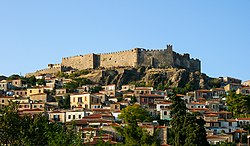
The town (pop. 1,399 at 2011 census) is on the northern part of the island, just some 6 km north of the popular beach town of Petra. One of the most noticeable features of the town is the old Genoese fortress on the hill in the middle of the town. The town's agora is located on the uphill road to the fortress and is popular among tourists, with many historic shops, cafés and restaurants.
The municipal unit of Míthymna stretches eastward from the town along the northern part of the island; it is the island's smallest municipal unit in land area at 50.166 km².[4] Its population was 2,255 at the 2011 census. The next largest towns in the municipal unit are Árgennos (pop. 240) and Sykaminéa (207).
Molyvos Beach is one of the Blue Flag beaches in Lesbos. The shoreline is pebbled, but the seabed consists entirely of soft sand and remains shallow for a considerable distance. The agora and fortress are visible from the beach.
History
[edit]As Methymna, the city was once the prosperous second city of Lesbos, with a founding myth that identified an eponymous Methymna (Greek: Μήθυμνα), the daughter of Macar and married to the personification of Lesbos. In epic tradition, the hero Achilles besieged Methymna during the time of the Trojan War, and was assisted by the Methymnian princess Pisidice who opened the city gates in exchange for him marrying her. Achilles then sacked Methymna with Pisidice's help, but afterwards he had her stoned by his soldiers for treason.[5]
Archaic Period
[edit]


Very little is known about Methymna in the Archaic period. The story of Arion and the dolphin, which involves the Corinthian tyrant Periander and is evidently set at the turn of the 7th century BCE, suggests that Methymna was already a prominent city with far-reaching contacts across the Greek world at this period.[6] Herodotus tells us that at some point in the Archaic period, Methymna enslaved the city of Arisba on Lesbos: this will have greatly increased the territory of Methymna, as well as giving it access to the fertile land around the Gulf of Kalloni.[7] We are also told by a local historian, Myrsilus of Methymna, who wrote in the first half of the 3rd century BCE, that Methymna founded the city of Assos which was on the coast of Asia Minor opposite Methymna.[8] However, another local historian, Hellanicus of Lesbos, writing in the mid-5th century BCE, instead simply says Assos was an Aeolian foundation and does not specify a particular city as its founder.[9] This has led some historians to doubt Myrsilus, and instead suggest that this is an example of "local Methymnaean manipulation of the past", although this could equally be true of Hellanicus.[10]
Classical Period
[edit]Methymna had a long-standing rivalry with Mytilene, and during the Peloponnesian War it sided with Athens during the Mytilenaean revolt in 428 BCE when all the other cities of Lesbos sided with Mytilene.[11] When the Athenians put down the revolt the following year, only Methymna was spared from having its territory turned into a cleruchy.[12] After 427, Methymna and Chios were the only members of the Delian League to remain self-governing and exempt from tribute, indicating the privileged position Methymna held within the Athenian Empire.[13] Methymna was briefly captured by the Spartans in summer 412, before quickly being retaken by the Athenians: in describing this episode, the historian Thucydides indicates that the Methymnaeans were much more inclined to side with Athens than Sparta.[14] This was likewise the case in 411, when a group of Methymnaeans who were in exile at Cyme in Aeolis attempted to return to Methymna by force, but were rebuffed by the population.[15] When the Spartan commander Kallikratidas besieged Methymna in 406, the city stayed loyal to its Athenian garrison and held out until it was betrayed by several traitors.[16]
Our knowledge of the history of Methymna in the 4th century is limited, but its prominence as a polis is firmly attested by the city's silver and bronze coinage.[17] By at least the 340s BCE, the tyrant Kleommis had expelled the city's democrats and remained in power for the next decade.[18] We do not know what happened to Kleommis after this, although it is likely that he was expelled when the island fell to Philip II's generals Parmenion and Attalus in 336.[19] The political history of the following four years are poorly attested: we know that Lesbos changed hands several times between the Macedonian forces of Alexander the Great and the Persian forces of Memnon of Rhodes, that Memnon captured Methymna in 333 BCE, and that when Alexander's admiral Hegelochus recaptured Methymna in 332 BCE its tyrant was Aristonicus not Kleommis.[20] However, it is not clear whether Aristonicus was made tyrant when the Persians recaptured Methymna in 335, or whether Kleommis was re-installed and Aristonicus only made tyrant in 333. Whatever the case, in 332 Alexander gave Aristonicus over to the newly restored Methymnaean democracy to try, and he was found guilty and put to death by torture.[21]
Hellenistic Period
[edit]In c. 295 BCE, Methymna struck silver drachms for King Lysimachus, indicating that the city was part of his kingdom at this time.[22] However, by the 250s BCE at the latest, Methymna had come under the sway of the Ptolemaic Kingdom.[23] During this period, a festival in honour of the Ptolemies, the Ptolemaia, was instituted, and public documents produced by the city were dated by the regnal years of the Ptolemies.[24] Worship of Sarapis, an Egyptian cult patronized by the Ptolemies, was probably introduced to Methymna at this period, and remained an important part of the city's life for several centuries.[25]
In the 2nd century BCE Methymna increasingly pursued a policy of seeking closer ties with the emerging power of Rome. Methymna remained loyal to Rome during the Macedonian Wars, and in 167 BCE it was rewarded when the Romans punished neighbouring Antissa for disloyalty and transferred its territory to Methymna.[26] The territory of Methymna was ravaged by King Prusias II of Bithynia along with several other cities in this region in ca. 156 BCE, but the Romans later compelled Prusias to pay reparations of 100 talents for the damage done.[27] In 129 BCE, an inscription from Methymna shows that the city formed a formal alliance with Rome.[28] A dedication to the Galatian princess Adobogiona (fl. c. 80 - 50 BCE), who was the mistress of Mithridates VI of Pontus, a long-standing enemy of Rome, may indicate a cooling of relations between Methymna or Rome or simply political expediency.[29]
Roman Period
[edit]Methymna gained a particular reputation among Romans for viticulture during the Imperial period. Virgil speaks of the vines of Methymna as the best and most numerous on Lesbos, while Ovid invokes them as an example of something which is proverbially numerous and bountiful.[30] The distinctive strong taste of Methymnaean wine is mentioned by Silius Italicus, and Propertius uses this as a point of reference when describing another Greek wine.[31] When Virgil and Silius wished to indicate the exceptional quality of Phalernian wine, Methymnaean wine is among the vintages which they say it surpasses.[32] We also learn from Horace that Methymnaean grapes were equally prized for the excellent vinegar which could be produced from them and which he describes accompanying a sumptuous eel dish.[33] The medical writer Galen, who was a native of nearby Pergamon, considered all the wines of Lesbos to be excellent, but ranked that of Methymna the first in quality, that of Eresos second, and that of Mytilene third.[34] In the novel Daphnis and Chloe, thought to be by the Mytilenaean aristocrat Longus and set in the region of Lesbos between Methymna and Mytilene, the vine harvest is the most important time of the agricultural year, and the Mytilenaean owner of the land in this region times his annual visit to coincide with the end of this harvest when the year's profit can be established.[35]
Byzantine Period
[edit]
The first attested bishop of Methymna was Christodoros in 520 CE.[36] In 640, Methymna was mentioned in the Ecthesis, pseudographically attributed to Epiphanius of Salamis, as an autocephalous archdiocese, and around 1084, it was made a metropolitan see under Alexius I Comnenus. The Fourth Crusade brought Latin control, on the strength of which the Roman Catholic Church maintains a purely titular see of Methymna; there were 40 Roman Catholics in 1908.
In 840 the city was plundered by Cretan Arabs and many of the inhabitants sold into slavery.[37] The fortifications of Methymna were strengthened following this attack, and again at the end of the 11th century, as we learn from a building inscription dating to 1084/5.[38] A few years later in 1089/90 these fortifications helped the inhabitants of Methymna successfully repel an attack by Emir Tzachas of Smyrna.[39] These fortifications again kept Methymna safe when the Genoese Lord of Phokaia, Domenico Cattaneo, seized the rest of Lesbos in 1335, but was unable to take Methymna or the equally well-fortified town of Eresos.[40] Along with the rest of Lesbos, Methymna became a possession of the Gattelusi family in 1355. Methymna repelled an Ottoman invasion force in 1450, but its defences were over-powered in a second invasion in 1458 when the admiral Ismaelos seized the city with a force of 150 ships.[41] Using Methymna as a base, the whole island was gradually brought under Ottoman control by September 1462.
Ottoman Period
[edit]Molyvos is the last castle occupied by the Turks in 1462 after strong resistance. The first centuries of the Ottoman Occupation include confiscations of people’s fortunes, hard taxation imposing and cruelty on behalf of the conquerors. This eventually leads to the shift of the chair of the Metropolis of Mithymna to the neighboring Kalloni where it still remains to this day. A great part of the population also chooses to go over to the opposite coast in search of a better life.
As Molova under the Ottoman Empire, the city was a kaza of the sanjak of Metelin in the vilayet of Rhodes.
After the Kucuk-Kainartzi treaty (1774) and the Hatti Sherif (1839) and Hatti Humayun (1856) decrees, the economy gradually goes back to the hands of the locals who are now in charge of the shipping and transit commerce with the minor Asia coasts and the Balkan countries and even Russia.
Olive oil, soap, wine, fish and salted fish, business activities in Minor Asia, all accumulate a great deal of wealth and power in the hands of the people of Molyvos imprinted on the settlement’s mansions, schools and educational institutes. Male and female schools are established, “The Muse Fraternity” with its library, the local Club, the athletic Club “Arion” etc.
Modern Period
[edit]After the defeat of the Ottomans in the First Balkan War (1912), the Greek navy liberated and incorporated Lesbos in the Greek Kingdom.
Province
[edit]The province of Mithymna (Greek: Επαρχία Μήθυμνας) was one of the provinces of the Lesbos Prefecture. Its territory corresponded with that of the current municipal units Mithymna, Agia Paraskevi, Eresos-Antissa, Kalloni and Petra.[42] It was abolished in 2006.
Historical population
[edit]| Year | Community population | Municipal unit population |
|---|---|---|
| 1981 | 1,427 | - |
| 1991 | 1,333 | 2,359 |
| 2001 | 1,636 | 2,375 |
| 2011 | 1,570 | 2,255 |
| 2021 | 1,335 | 1,933 |
Notable people
[edit]
- Matriketas, astronomer.[43]
- Echecratides, Peripatetic philosopher and friend of Aristotle.[44]
- Myrsilus, local historian and paradoxographer.[45]
- Hermeias, author of a history of the Sicilian tyrant Dionysus I.[46]
- Kratinos, cithara player at the court of Alexander the Great.[47]
- Theolytus, poet and historian.[48]
- Theoctiste of Lesbos, saint of the Eastern Orthodox Church.[49]
- Argyris Eftaliotis, modern Greek poet and translator.
- Elias Venezis, writer
See also
[edit]References
[edit]- ^ "Αποτελέσματα Απογραφής Πληθυσμού - Κατοικιών 2021, Μόνιμος Πληθυσμός κατά οικισμό" [Results of the 2021 Population - Housing Census, Permanent population by settlement] (in Greek). Hellenic Statistical Authority. 29 March 2024.
- ^ "Τροποποίηση του άρθρου 1 του ν. 3852/2010" [Amendment of Article 1 of l. 3852/2010] (in Greek). Government Gazette. p. 1164.
- ^ Name changes of settlements in Greece
- ^ "Population & housing census 2001 (incl. area and average elevation)" (PDF) (in Greek). National Statistical Service of Greece.
- ^ Käppel, Lutz (October 1, 2006). "Peisidice". In Cancik, Hubert; Schneider, Helmuth (eds.). Brill's New Pauly. Translated by Christine F. Salazar. Kiel: Brill Reference On line. doi:10.1163/1574-9347_bnp_e912120. ISSN 1574-9347. Retrieved December 5, 2024.
- ^ Herodotus 1.23-24.
- ^ Herodotus 1.151.2, cf. Strabo 13.1.21. Pliny the Elder, Historia Naturalis 5.139 instead says that Arisba was destroyed by earthquake.
- ^ Myrsilos FGrHist 477 F 17 = Strabo 13.1.58.
- ^ Hellanicus FGrHist 4 F 160 = Strabo 13.1.58.
- ^ C. Constantakopoulou, Dance of the Islands (2007) 240 n. 51. A further complication is that Alexander Polyhistor FGrHist 273 F 96 = Stephanus of Byzantium s.v. Ἀσσός says that Assos was a colony of Mytilene. However, the editor of Stephanus, Augustus Meineke, commenting on this passage believed this was an error in the manuscript, and thought it originally said Assos was a colony of Methymna.
- ^ Thucydides 3.2.1, 3.5.1.
- ^ Thucydides 3.50.2, Diodorus Siculus 12.55.10.
- ^ Thucydides 6.85.2, 7.57.5, 8.100.5.
- ^ Thucydides 8.23.4-6.
- ^ Thucydides 8.100.2-3.
- ^ Xenophon, Hellenica 1.6.12-15, Diodorus Siculus 13.76.5-6.
- ^ "ancient coins of Lesbos, Methymna". AsiaMinorCoins.com.
- ^ Isocrates, Epistles 7.8-9 (ca. 346/5?), Theopompus FGrHist 115 F 227 = Athenaeus 10.442f-443a, IG II2 284 + Supplementum Epigraphicum Graecum 54.132.
- ^ P. J. Rhodes and R. Osborne, Greek Historical Inscriptions, 404–323 BC (2003) 416–17.
- ^ Diodorus Siculus 17.29.2, Arrian, Anabasis 3.2.4.
- ^ Capture at Chios: Arrian, Anabasis 3.2.4, Curtius 4.5.19. Execution: Curtius 4.8.11.
- ^ Sylloge Nummorum Graecorum Kayhan 4.
- ^ P. Brun, 'Les Lagides à Lesbos: essai de chronologie' Zeitschrift für Papyrologie und Epigraphik 85 (1991) 99-113 has suggested an earlier date in the 270s, but this has not been accepted by scholars: Ph. Gauthier, Bulletin épigraphique (1992) no. 343.
- ^ IG XII (2) 498 (ca. 221-205).
- ^ List of Sarapiastai: IG XII (2) 511 (1st century BC).
- ^ Livy 45.31.13-14, Pliny the Elder, Historia Naturalis 5.139, H. J. Mason, 'The end of Antissa' American Journal of Philology 116.3 (1995) 399-410.
- ^ Polybius 33.13.8.
- ^ IG XII (2) 510.
- ^ IG XII (2) 516.
- ^ Virgil, Georgics 2.89-90, Ovid, Ars Amatoria 1.57-9.
- ^ Silius Italicus, Punica 7.209-11, Propertius 4.8.38.
- ^ Virgil, Georgics 2.89ff, Silius Italicus, Punica 7.209-11.
- ^ Horace, Satires 2.8.49-50.
- ^ Galen 10.832, 13.405, 13.659 Kühn. At 14.28-29 Kühn he instead places Eresian wine above that of Methymna.
- ^ Longus, Daphnis and Chloe.
- ^ Patrologia Latina 63 cols. 483-5, A. Kaldellis and S. Efthymiadis, The Prosopography of Byzantine Lesbos 284-1355 AD (2010) no. 10.
- ^ E. Malamut, Les îles de l'Empire byzantin: VIIIe-XIIe siècles (1988) 101.
- ^ A. Conze, Reise auf der Insel Lesbos (1865) 21-4.
- ^ Anna Komnena, Alexiad, vol. 2, p. 110f.
- ^ Tabula Imperii Byzantini 10 s.v. Methymna, p. 229.
- ^ Tabula Imperii Byzantini 10 s.v. Methymna, p. 229.
- ^ "Detailed census results 1991" (PDF). (39 MB) (in Greek and French)
- ^ Theophrastus, De Signis 4.
- ^ Stephanus of Byzantium s.v. Μήθυμνα.
- ^ Myrsilos von Methymna, FGrHist 477.
- ^ Hermeias of Methymna, Brill's New Jacoby 558.
- ^ Chares of Mytilene, FGrHist 125 F 4.
- ^ Theolytus of Methymna, Brill's New Jacoby 478.
- ^ De S. Theoctiste Lesbia in insula Paro, AASS Nov. IV 221-33.
External links
[edit]
- Official website (in English, German, and Greek)
- Lesvos Photo Guide
- https://lesvos.com/molyvos.html
- Lesvos Calendars
- Methymna Fortress
- Ancient coinage of Methymna - Wildwinds | Asia Minor Coins
- Catholic Encyclopedia: Methymna (cited as CE)
- Information on Molyvos
| International | |
|---|---|
| National | |
| Other | |

Mithymna
View on GrokipediaGeography and environment
Location and topography
Mithymna is located on a small peninsula along the northwest coast of Lesbos island in the North Aegean Sea, at coordinates 39°22′N 26°10′E.[6] It occupies the northwestern extremity of the island, approximately 62 km northwest of the capital Mytilene, about 50 km by road northeast of Eresos, and roughly 75 km north of Plomari.[6] The municipal unit encompassing Mithymna covers an area of 50.166 km².[7] The topography consists of hilly terrain on the peninsula, forming a horseshoe-shaped settlement that rises from sea level to a summit elevation of around 102 meters, crowned by the prominent Genoese fortress.[6][8] A natural harbor provides sheltered access to the Aegean, with remnants of an ancient port pier still visible at the modern dock.[9] The surrounding landscape features fertile slopes covered in olive groves and vineyards, contributing to the region's agricultural character.[10][11] Prominent landmarks include the well-preserved Hellenistic defensive walls, sections of which are incorporated into the base of the medieval fortress, and the nearby Molyvos Beach, a pebbled shore with clear waters that has earned Blue Flag certification for its environmental quality.[9][12]Climate and ecology
Mithymna experiences a hot-summer Mediterranean climate classified as Csa under the Köppen system, characterized by hot, dry summers and mild, wet winters.[13] Average high temperatures in July reach 30°C, while January lows average 6°C, reflecting the region's seasonal extremes.[14] Annual precipitation totals approximately 500-600 mm, with the majority falling during the winter months from October to April, supporting a distinct wet season that contrasts with the arid summer period.[14] The local ecology features a diverse array of native flora adapted to the Mediterranean environment, including widespread olive trees, vineyards, and maquis shrubland dominated by evergreen species such as arbutus and myrtle.[15][16] Fauna is equally varied, with migratory birds utilizing the area's coastal wetlands and forests as key stopover points during seasonal passages, alongside marine life in the adjacent Aegean waters, including fish species like sardines and occasional dolphins.[17] Mithymna's proximity to Natura 2000 protected areas on Lesbos enhances its biodiversity, encompassing habitats that safeguard endemic plants and bird populations across the island's northern regions.[18] Environmental concerns in Mithymna primarily stem from tourism pressures, which exacerbate water scarcity during peak seasons and contribute to coastal erosion along the Aegean shoreline.[19] In May 2025, the Municipality of West Lesvos, which includes Mithymna, declared a state of emergency due to severe water shortages amid ongoing drought conditions intensified by climate variability, leading to reduced groundwater levels and impacts on local ecosystems and agriculture.[20] In response, as of November 2025, sustainability efforts by the Greek government include initiatives for eco-friendly tourism infrastructure on Lesbos, such as accessible beaches and wellness tourism projects, aiming to promote quality growth through enhanced monitoring and conservation programs.[21]Names and etymology
Ancient nomenclature
In ancient Greek sources, the city was known primarily as Μήθυμνα (Mīthýmnā), transliterated into Latin as Mithymna or Methymna, denoting its status as a prominent Aeolian settlement on the island of Lesbos.[2] This name appears in classical literature as one of the five principal cities of Lesbos, a grouping rooted in early Greek traditions associating the island with Homeric geography, though the Iliad itself references Lesbos collectively without enumerating its poleis.[22] Etymological analysis points to a pre-Greek substrate, likely of Anatolian origin, reflecting the region's linguistic influences prior to Aeolian Greek colonization around the 10th century BCE.[2] Some scholars connect the name to local viticultural prominence, as Methymnaean wines were renowned in antiquity, potentially linking it to Indo-European or pre-Greek roots evoking fertility or production. Mythologically, the name derives from Methymna, a daughter of the legendary king Macareus (or Makar), who settled Lesbos; she married Lesbos, son of Lapithes and grandson of Aeolus, thereby eponymously founding the city in foundational Lesbian lore.[23] The name features prominently in major historical geographies: Herodotus references the Methymnaeans in the context of their 7th-century BCE enslavement of neighboring Arisba, highlighting the city's early expansionist role among Lesbian poleis.[7] Strabo, in his Geography (13.2.4), describes Methymna as the northernmost city of Lesbos, opposite the Troad, emphasizing its strategic coastal position and role in Aeolian networks. Ptolemy's 2nd-century CE Geography (5.2) lists Methymna at 40°25' N, 55°25' in his coordinate system, corresponding approximately to modern 39°22'N, 26°10'E, cataloging it as a key urban center in insular Asia Minor. Variant forms in ancient inscriptions include Μηθύμνα (Mēthýmna), a phonetic spelling attested in epigraphic records from Lesbos, and adjectival derivatives like Μιθυμναῖος (Mithymnaîos) for inhabitants, as seen in dedications and treaties from the Archaic and Classical periods.[2] These orthographic shifts underscore the name's fluidity in Aeolic dialect but maintain its core identification as an independent city-state.Modern designations
Following the establishment of Genoese rule on Lesbos in the 14th century under the Gattilusio family, who received the island as a dowry in 1354, the settlement of Mithymna adopted the name Molyvos, reflecting influences from the period's Italian maritime powers and associations with the prominent castle overlooking the town.[24] During the subsequent Ottoman era, from 1462 to 1912, the name persisted in its Hellenized form, with the Turkish equivalent being Molova, derived from the same medieval root.[2] After Lesbos was incorporated into the Kingdom of Greece in 1912, the official Greek name was reverted to Mithymna in 1919 to align with ancient nomenclature and nationalistic revival efforts, though Molyvos continued to be widely used locally and internationally.[6] In contemporary contexts, Molyvos predominates in tourism promotion and English-language references due to its historical familiarity and appeal, while Mithymna serves as the formal designation in official Greek documents.[6] Administratively, Mithymna forms a municipal unit within the larger Municipality of West Lesvos (Dimos Dytikis Lesvou), established on February 25, 2019, through the division of the pre-existing Municipality of Lesvos under Greece's Kleisthenis I local government reform.[25] This structure reflects ongoing efforts to streamline regional administration while preserving local identities. Linguistic variations appear in dual signage and mapping, where both Mithymna and Molyvos are often displayed to accommodate historical and touristic usage.[6]History
Prehistory and Archaic period
Archaeological evidence indicates early human habitation in the vicinity of Methymna during the Neolithic and Bronze Age periods, with artifacts suggesting settlement activity dating back to around 2000 BCE. Sites on the slopes of the local acropolis have yielded pottery and other remains linked to the Early Bronze Age, reflecting cultural ties to the broader Aegean and Anatolian regions, including influences from nearby Troy. These findings align with Lesbos's overall prehistoric occupation, which began as early as 3300 BCE and continued through the Mycenaean era.[26][27][28] Methymna was established as an Aeolian Greek city-state around 1050 BCE during the Aeolian migration, when settlers from Thessaly and central Greece colonized Lesbos, displacing or assimilating earlier populations. This founding positioned Methymna as one of the island's pentapolis—the five major cities alongside Mytilene, Antissa, Eresos, and Pyrrha—forming the core of Aeolian political and cultural life in the region. The settlement's strategic location on the northern coast facilitated trade and defense, contributing to its early growth as a prosperous community.[29][30] In the Archaic period, Methymna expanded its influence through territorial conquests, notably the enslavement of the neighboring city of Arisbe around 600 BCE, which significantly increased its land holdings and access to resources on Lesbos's west coast. Tradition also attributes to Methymna the founding of Assos on the Troad mainland, likely in the 8th or 7th century BCE, extending Aeolian presence across the Aegean. These events underscored Methymna's rising power amid rivalries with Mytilene, though early alliances occasionally tempered conflicts over borders.[31][32] Culturally, Methymna gained prominence in the late 7th century BCE as the birthplace of the poet Arion, credited with inventing the dithyramb and advancing lyric performance, which enriched Aeolian artistic traditions. The city also became renowned for its wine production, particularly the robust Pramnian variety, exported widely and celebrated in ancient literature for its quality. These developments highlighted Methymna's role in fostering poetry, viticulture, and early interstate relations within the Aeolian league.[33][34][35]Classical and Hellenistic periods
During the Peloponnesian War, Methymna played a pivotal role as a loyal ally of Athens, distinguishing itself from the rest of Lesbos amid the Mytilenean revolt of 428 BCE. While Mytilene and other cities on the island sought to break free from Athenian control and align with Sparta, Methymna refused to join the uprising, providing crucial support to the Athenian fleet stationed nearby. This stance stemmed from longstanding rivalries with Mytilene and strategic interests in maintaining ties with Athens, allowing Methymna to avoid the severe reprisals inflicted on the rebels after the Athenians quelled the revolt.[36] The war's final phases tested Methymna's allegiance further. In 406 BCE, the Spartan admiral Callicratidas, succeeding Lysander, targeted the city as a key Athenian outpost on Lesbos. After capturing Methymna following a brief siege, Callicratidas enslaved its inhabitants and razed parts of the city, though Athenian forces under Conon soon retaliated by defeating the Spartans at the Battle of Arginusae nearby. This episode underscored Methymna's strategic value in the Aegean theater, where control of Lesbos influenced naval dominance. Despite the devastation, the city's resistance bolstered Athenian morale in the war's closing years.[37] Following Athens's defeat in 404 BCE, Methymna regained autonomy under the terms of the Spartan-led peace, free from direct Athenian oversight but navigating the shifting powers of the region. The King's Peace of 386 BCE, brokered with Persian backing, reinforced this independence for Greek poleis, including those on Lesbos, though Persian satraps in Asia Minor exerted intermittent influence over the island's affairs. By the late 4th century BCE, Macedonian expansion under Alexander the Great integrated Methymna into the broader Hellenistic world, with the city minting coins for Lysimachus around 295 BCE, signaling its temporary alignment with his Thracian-based kingdom amid the Wars of the Successors. In the 3rd century BCE, Methymna fell under Ptolemaic influence as part of the League of Islanders (Koinon ton Nesioton), a confederation of Aegean city-states organized by Ptolemy II Philadelphus to counter Seleucid and Antigonid ambitions. This affiliation brought economic benefits through Ptolemaic naval protection and trade networks, allowing Methymna to prosper while retaining local governance. The city's Ptolemaic ties are evidenced by dedications to the Ptolemaic ruler cult, including altar plaques honoring Ptolemy I Soter and Berenice, reflecting the blend of autonomy and Hellenistic overlordship.[38] Methymna's cultural prominence endured through these turbulent times, rooted in its associations with lyric poetry and renowned viticulture. The poet Arion, a native of Methymna active in the mid-7th century BCE but celebrated in Classical lore, was credited with inventing the dithyramb—a choral hymn to Dionysus that influenced tragic drama—after his legendary rescue by a dolphin en route from Sicily. This tale, preserved in Herodotus, symbolized Methymna's contributions to early Greek musical innovation. Economically, the city's sweet Methymnaean wine, a variety of Lesbian Pramnian, gained fame for its medicinal qualities and longevity, exported widely and praised by ancient connoisseurs; Pliny the Elder noted its use in remedies, while Athenaeus highlighted its role in sympotic culture.[39] Hellenistic Methymna saw urban expansion and defensive enhancements, adapting to the era's geopolitical pressures. The city fortified its acropolis and harbor with robust walls, remnants of which survive from the 3rd century BCE, designed to repel incursions from rival powers. These structures, incorporating ashlar masonry, enclosed expanded residential and public spaces, reflecting Methymna's growth as a commercial hub. Brief Attalid oversight in the mid-2nd century BCE, following Pergamon's rising influence in the Aegean, preceded the city's alignment with Rome after the kingdom's bequest in 133 BCE, marking the transition to Roman provincial integration.[40]Roman and Byzantine periods
Following its alliance with Rome against Prusias II of Bithynia, Mithymna concluded a foedus amicitiae in 129 BCE, securing the status of a federated city (civitas foederata) within the newly formed Roman province of Asia and integrating the island of Lesbos into the empire's administrative framework.[41] This pact, alongside similar arrangements for other Lesbian cities like Mytilene, allowed Mithymna to retain significant autonomy while contributing to Roman military efforts in Asia Minor.[41] Under Roman rule, Mithymna experienced prosperity driven by its strategic Aegean position, which facilitated maritime trade routes linking the island to the Black Sea and Asia Minor coasts; local elites actively cultivated ties with Roman authorities through honorific inscriptions for Julio-Claudian emperors, reflecting broad acceptance of imperial integration.[41] The city's economic vitality is evidenced in ancient accounts, with Pliny the Elder listing Mithymna among Lesbos's key urban centers in his Natural History, noting its role alongside Mytilene, Eresus, and others in the island's network of harbors and commerce. Pausanias similarly references the city in a Phocian legend, describing fishermen from Mithymna discovering a divine wooden head identified as Dionysus Phallen by the Delphic oracle, underscoring its cultural prominence in the Roman-era Aegean. In the early Byzantine era, Mithymna rose to ecclesiastical significance as a bishopric, with the first documented bishop, Christodoros, attested in 520 CE; by 640 CE, the see had advanced to archdiocesan status, as noted in the Ecthesis attributed to Patriarch Sophronius, highlighting its role within the empire's Christian administrative hierarchy.[42] The city endured repeated threats from Arab incursions during the 7th–9th centuries, including a devastating raid circa 867 CE by Cretan Muslim forces under Nisiris, which plundered Mithymna and resulted in the enslavement and dispersal of much of its population.[43] In response, Byzantine authorities reinforced the city's fortifications, transforming its acropolis into a more robust defensive stronghold to safeguard against further naval raids from Crete and the eastern Mediterranean.[4] The overlapping crises of the Iconoclastic period (726–843 CE) and Arab-Byzantine wars contributed to a temporary decline in Mithymna's fortunes, as religious strife and military pressures strained provincial resources across the Aegean themes.[43] Recovery accelerated under the Komnenian dynasty in the 11th–12th centuries, with renewed imperial investment in island defenses amid efforts to stabilize the empire's frontiers; Mithymna's archbishopric, evidenced by figures like Constantine in the late 11th century, played a key role in this ecclesiastical and administrative revival.[44] As Ottoman expansion loomed in the 14th century, Genoese influence on Lesbos—stemming from the marriage alliance of Francesco I Gattilusio to a Byzantine princess in 1354—prompted significant fortification upgrades; in 1373, Francesco I ordered the reconstruction of Mithymna's castle atop the ancient acropolis, incorporating Byzantine-era walls with Genoese enhancements to bolster defenses against Turkish naval threats.[4] This rebuilt fortress, featuring a main gate with reused ancient blocks and expansive interior circuits, marked the prelude to intensified Italo-Byzantine cooperation in the northern Aegean up to the island's fall in 1462.[4]Ottoman and modern periods
Mithymna fell to Ottoman forces in September 1462 during the conquest of Lesbos, following a brief siege of the island's main settlements after the fall of Mytilene.[45] The town, known then as Molyvos, experienced initial resistance and destruction, including looting and the enslavement of some inhabitants, before being incorporated into the Ottoman administrative structure as part of the sancak of Lesbos.[46] Under Ottoman rule from 1462 to 1912, Mithymna's economy benefited from regional trade networks in the 18th and 19th centuries, with the town serving as a port for olive oil, soap, and agricultural exports to nearby markets in the Aegean and Anatolia.[24] This period saw relative stability for the Greek Orthodox community, though tensions arose during the Greek War of Independence in the 1820s, when local leaders participated in uprisings that were ultimately suppressed. The 1923 Treaty of Lausanne mandated a population exchange, leading to the departure of the town's Muslim inhabitants—estimated at around 20% of Lesbos's population—and their replacement by Greek refugees from Turkey, fundamentally altering the demographic composition. Mithymna joined the Kingdom of Greece following the island's liberation during the First Balkan War in November 1912, when Greek naval forces seized Lesbos from Ottoman control without significant resistance in the northern towns. During World War II, the town endured Axis occupation starting in 1941, with German and Italian forces requisitioning resources and imposing harsh controls that exacerbated food shortages across Lesbos. Post-war recovery in the late 1940s and 1950s involved rebuilding infrastructure amid Greece's civil war and economic challenges, supported by U.S. Marshall Plan aid that facilitated agricultural revival.[47] The 20th century brought further transformations. Tourism emerged as a key driver from the 1960s onward, with the town's medieval castle and coastal charm attracting international visitors and hosting cultural events like symphony performances, boosting local employment and preservation efforts.[48] In 2019, under Greece's Kleisthenis I municipal reform programme, the former Municipality of Lesvos was divided into three municipalities, with Mithymna becoming part of the new Municipality of West Lesvos.[49] In recent years, Mithymna has faced impacts from the ongoing refugee crisis, particularly after the 2020 Moria camp fire on Lesbos displaced thousands and strained northern coastal communities with increased arrivals and aid operations. EU-funded projects from 2020 to 2025 have supported restorations, including the renovation of the 18th-century Ottoman baths in Mithymna, completed with European structural funds to promote cultural heritage and sustainable tourism. As of 2025, Mithymna continues to support refugee integration efforts through EU-funded initiatives, alongside tourism recovery post-COVID-19.[50]Government and administration
Administrative divisions
Mithymna serves as a municipal unit (Δημοτική Ενότητα Μηθύμνας) within the Municipality of West Lesbos (Δήμος Δυτικής Λέσβου), established in 2019 through the division of the former Lesbos municipality under a Ministry of Interior decision dated February 25, 2019.[25] This reform integrated Mithymna, previously an independent municipality under the 2011 Kallikratis Plan, into the larger West Lesbos entity, which encompasses former municipalities such as Kalloni, Mantamados, Agia Paraskevi, Eresos-Antissa, Polichnitos, Petra, and Mithymna itself.[25] The municipal unit falls under the Lesbos regional unit of the North Aegean region, maintaining ties to the historical Lesbos prefecture centered in Mytilene.[25] The municipal unit of Mithymna covers an area that includes the main town of Molyvos (also known as Mithymna) and surrounding villages such as Argennos, Lepetymnos, and Sykaminea.[51] According to the 2021 census conducted by the Hellenic Statistical Authority (ELSTAT), the total population of the municipal unit stands at 1,933 residents, with the community of Molyvos accounting for 1,335 inhabitants.[52] Governance at the local level is handled by an elected mayor and municipal council within the broader framework of the West Lesbos Municipality, led by Mayor Taxiarchis Verros since its inception.[25] This structure ensures administrative integration with regional policies while preserving local decision-making for community affairs in the Lesbos regional unit.[53]Province history
The Mithymna Province (Greek: Επαρχία Μήθυμνας) was established in 1915 as one of four provinces within the newly formed Lesbos Prefecture, following the annexation of Lesbos to the Kingdom of Greece during the Balkan Wars of 1912–1913.[54][55] It covered the western and northern portion of Lesbos island, encompassing key settlements such as Mithymna (its capital), Eresos, and Agia Paraskevi, along with surrounding rural areas that aligned with the island's traditional geographic and economic divisions. Throughout its existence, the province served as a key unit for local governance, primarily handling judicial matters through provincial courts and tax collection via dedicated administrative offices, which supported the central prefectural authority in Mytilene.[54] These functions were integral to the Greek administrative system from the early 20th century until the mid-2000s, enabling efficient management of regional affairs in a post-Ottoman context where local autonomy was gradually integrated into the national framework.[54] The province was abolished in 2006 under the second phase of the Kapodistrias administrative reform, which restructured local government by dissolving all 54 provinces nationwide and integrating their subunits into expanded municipalities.[54] With Mithymna as its longstanding capital, the dissolution led to the merger of its territories into larger entities like the Municipality of West Lesbos, briefly referencing the modern municipal framework without altering its historical role. This change marked the end of the provincial level, but the Mithymna Province's structure left a lasting legacy in shaping western Lesbos's regional identity, including targeted development projects for agriculture, infrastructure, and cultural preservation that continue to influence local planning.[54]Demographics
Historical population trends
During the classical period, Methymna reached its demographic peak as one of the major poleis on Lesbos, with archaeological assessments of the urban site's extent suggesting a resident population of 10,000 to 15,000 individuals.[56] This estimate accounts for the fortified acropolis, surrounding residential areas, and supporting agricultural hinterland, positioning Methymna as the island's second-largest settlement after Mytilene. Subsequent Hellenistic and Roman periods saw relative stability, though no precise figures survive, with the city's role as a regional port likely sustaining a comparable scale until late antiquity. Under Ottoman rule, Mithymna (known as Molyvos) experienced population fluctuations influenced by warfare and administrative changes, culminating in a decline to approximately 4,000 residents by 1900 amid regional conflicts and economic pressures.[45] Ottoman fiscal records from 1909 indicate around 880 households (450 Christian and 430 Muslim), implying a total of about 4,400 people assuming average household sizes of 5, consistent with broader island trends of mixed ethno-religious communities.[45] The 1923 Greco-Turkish population exchange, enacted under the Treaty of Lausanne, dramatically reduced the Muslim population—over one-third of Molyvos's inhabitants at the time—by their expulsion to Turkey, though the total population increased due to the influx of Greek refugees from Asia Minor, with approximately 7,000 Muslims departing from Lesbos overall.[57] Post-exchange censuses in the 20th century reflect a pattern of rural depopulation driven by emigration and socioeconomic shifts. Greek national statistics record the following for the Mithymna area (community unless noted):| Year | Population |
|---|---|
| 1920 | 2,187 |
| 1928 | 2,554 |
| 1951 | 1,943 |
| 1971 | 1,414 |
| 1981 | 1,427 |
| 1991 | 2,359 (municipal unit) |
| 2001 | 2,375 (municipal unit) |
Current population and settlement
According to the 2021 Population-Housing Census conducted by the Hellenic Statistical Authority (ELSTAT), the Mithymna community recorded a population of 1,335 residents, while the broader municipal unit encompassed 1,933 individuals.[58] National demographic trends indicate ongoing decline, with the unit's population estimated at around 1,850 as of 2025, influenced by seasonal tourism patterns and continuing out-migration. Settlement in Mithymna remains heavily concentrated in the coastal town of Molyvos, where approximately 70% of the population resides in urban settings, with the rest dispersed across smaller rural villages such as Vafios and Eftalou.[58] This pattern reflects the town's role as the primary administrative and commercial hub, drawing daily commuters from outlying areas. Demographically, Mithymna exhibits an aging population structure, with a median age surpassing 50 years, consistent with broader trends on Lesbos island. Foreign residents constitute about 10% of the total, mainly comprising European retirees and long-term expatriates attracted to the area's serene coastal lifestyle. The gender ratio is nearly even, at approximately 1:1, underscoring a balanced community composition. Socially, the area boasts a high literacy rate of 95%, supporting community education initiatives amid an otherwise rural context. In the 2020s, integration efforts have incorporated refugee communities arriving via the Aegean route, with local programs fostering social cohesion through language classes and vocational training in Molyvos and nearby settlements. This builds on the long-term population decline observed historically, while addressing contemporary migration dynamics.Economy and culture
Economy and tourism
The economy of Mithymna, part of the West Lesbos municipality, relies primarily on agriculture and tourism, which together dominate local economic activities and employment. Olive production stands out as a cornerstone of the agricultural sector, with high-quality extra virgin olive oil benefiting from Protected Designation of Origin (PDO) status under the "Lesvos" label, ensuring authenticity and quality standards for oils produced on the island. This sector supports numerous small-scale producers and contributes to export revenues, though yields vary due to climatic factors like droughts.[59][60] Tourism has emerged as a vital economic driver, particularly since the early 2000s, by creating jobs and countering population decline through seasonal and alternative offerings. The area draws visitors to its coastal attractions, including Molyvos Beach, with peak influxes occurring during summer months when international arrivals to Lesvos exceed 100,000 from nearby Turkey alone in 2025. Eco-tourism initiatives, such as those promoting low-impact nature experiences, have gained traction amid broader Greek efforts to diversify beyond mass tourism.[61] In agriculture, efforts to revive ancient viticulture have bolstered the wine sector, exemplified by the Methymnaeos winery in nearby Chidira, where the indigenous Chidiriotiko grape—nearly extinct after phylloxera devastation—was rescued and propagated in the 1980s by the Lambrou family from surviving roots of this Methymnaean variety. These organic wines, grown on volcanic soils linked to Lesvos's petrified forest, highlight a return to historical winemaking traditions while appealing to niche markets.[62][63] Despite these strengths, the economy faces challenges from seasonality, with tourism-dependent jobs leading to high winter unemployment rates among locals, often exacerbated by limited year-round opportunities outside agriculture and ongoing strains from the island's role in refugee management affecting tourism infrastructure. In 2025, EU-funded green tourism grants under Greece's Recovery and Resilience Facility, totaling over €380 million nationally, support sustainability measures across Greece, potentially benefiting islands like Lesvos through eco-upgrades to reduce environmental impacts and extend the tourist season.[64]Cultural heritage and sites
Mithymna, known locally as Molyvos, boasts a rich array of historical sites that reflect its layered past from antiquity through the Byzantine and Ottoman eras. The most prominent landmark is the Castle of Mithymna, a Byzantine-Genoese fortress perched on a hill overlooking the town. Constructed originally under the Gatelusi family in the medieval period, it features an irregular trapezoidal layout with reddish trachyte walls, ten towers, and remnants of Byzantine cisterns alongside Ottoman additions such as guard quarters and gates.[65] Managed by Greece's Ministry of Culture, the castle serves as a venue for cultural events and remains accessible year-round, underscoring its role in preserving the town's defensive heritage.[66] Below the castle lie archaeological remains of the ancient city of Methymna, including the ruins of the ancient agora and remnants of city walls, along with a theatre-like building. These structures highlight the site's significance as a key Aeolian polis.[2] The town also preserves several Byzantine-era churches, including examples with frescoes and architectural elements from the post-iconoclastic period, integrated into the medieval fabric of the settlement.[4] Cultural festivals in Mithymna emphasize the town's artistic traditions, with the annual Molyvos International Music Festival serving as a highlight since its inception in 2015. Founded by pianists Danae and Kiveli Dörken, the event features chamber music performances by international artists in venues like the castle, blending classical repertoire with the island's scenic backdrop to foster cultural exchange.[67] Local wine harvest celebrations, tied to Lesvos's viticultural heritage, occur in late summer, involving community gatherings that honor ancient varieties like those once praised in antiquity for their quality.[68] Intangible cultural elements include traditional Lesbos cuisine, exemplified by sardine preparations such as salted and sun-dried sardeles pastes from nearby Kalloni Bay, which reflect maritime influences and seasonal preservation techniques passed down through generations.[69] Oral histories from the Ottoman era, preserved in local narratives and artifacts like pyramidal seals used for authentication, recount the island's multicultural coexistence under Ottoman rule from the 15th to early 20th centuries.[70] Preservation efforts are actively supported by the Greek Ministry of Culture, with the Ephorate of Antiquities of Lesbos overseeing excavations and restorations at ancient Methymna, including ongoing work at the archaeological site as part of broader 2025 cultural programs across Greece.[71] These initiatives, funded nationally, aim to protect and enhance access to the site's monuments amid increasing interest in Aegean heritage.[72]Notable people
- Arion (late 7th century BC), poet and musician known for inventing the dithyramb.
- Myrsilus (c. 3rd century BC), Hellenistic paradoxographer and local historian.
- Matriketas (4th century BC), astronomer who observed solstices from Mount Lepetymnos.
- Echecratides (4th century BC), Peripatetic philosopher and disciple of Aristotle.
- Theoctiste (c. 820–881 AD), saint and hermit of the Eastern Orthodox Church.
- Argyris Eftaliotis (1849–1923), poet, novelist, and advocate of Demotic Greek.
- Elias Venezis (1904–1977), novelist known for works on the Asia Minor Catastrophe.
References
- https://www.wikidata.org/wiki/Q214219