Hubbry Logo
SfakiaSfakiaMain
Open search
Sfakia
Community hub
Sfakia
logo
8 pages, 0 posts
0 subscribers
Be the first to start a discussion here.
Sfakia
Sfakia
from Wikipedia
Sunset in Sfakia.

Key Information

Traditional dancers at "Sfakian Liberation Festival".

Sfakiá (Greek: Σφακιά) is a mountainous area in the southwestern part of the island of Crete, in the Chania regional unit. It is considered to be one of the few places in Greece that have never been fully occupied by foreign powers. With a 2021 census population of 2,002 inhabitants living on a land area of 467.589 km2 (180.537 sq mi),[3] Sfakia is one of the largest and least densely populated municipalities on the island of Crete. The etymology of its name is disputed. According to the prevailing theory, it relates to its rugged terrain, deriving from the ancient Greek word σφαξ, meaning land chasm or gorge.[4]

Description

[edit]

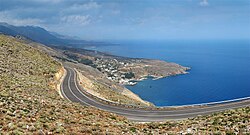
The road from Chania to Sfakiá crosses the island from north to south, through the village of Vryses. From this village the route crosses the White Mountains (Lefká Óri) to Hóra Sfakíon (35°12′N 24°08′E / 35.200°N 24.133°E / 35.200; 24.133) by the Libyan Sea. Halfway from Vrisses to Hóra Sfakíon is the fertile plateau of Askifou, surrounded by high mountain peaks. From here to Hóra Sfakíon the road is particularly spectacular. The road hugs the western slope of the Imbros Gorge offering scenic views. Another scenic route is that leading from Kapsodasos to the plateau of Kallikratis, northeast of Hóra Sfakíon.

There are many beaches in Sfakiá which do not see the numbers of tourists of the northern coast. More adventurous visitors can follow the European hiking footpath E4 which crosses Crete through Sfakiá's mountains. The coastal villages are not connected by a coastal road, but can be reached by ferry boats.

Not far east from Hóra Sfakíon is Frangokastello, literally "Frankish castle". The Venetian fortress here was built in 1371 to deter pirates and unsuccessfully, to control Sfakiá. It is largely ruined but is picturesquely set on a wide sandy beach with the towering White Mountains behind. Daskalogiannis was captured here in 1771.

Accessible only by boat from Sfakiá is Loutro, a small seaside village with some archaeological ruins, a few houses, small hotels and tavernas. Loutro is car-free; cars must be parked in Hóra Sfakíon or Paleohóra. In the north of Sfakiá is the fertile plain of Askyfou. The Sfakía region is crossed by many gorges, among which is the famous Samaria Gorge. All these gorges run from north to south and all end in the sea. Many of them can be walked, several even by inexperienced walkers. The region is inhabited by rare animals, like vultures and eagles, and the kri-kri (or agrimi), the wild Cretan goat. The coast of Sfakiá is on the Libyan Sea, which is inhabited by a diminishing fish population, but occasionally dolphins, and even whales may be seen. The idea of inaccessibility and ruggedness has played a key role in how Sfakia has been represented since at least the 18th century and it is reiterated in various ways today by tourists and locals.[5]

The local speciality, "Sfakian Pies", are thin pancakes filled with mizithra cheese and served drizzled with honey.

Resistance

[edit]

Hóra Sfakíon is famous as one of the centers of the resistance against the occupying forces of both the Venetians and the Turks. The impenetrable White Mountains to the north combined with the rocky beaches on the south helped the locals fight off all invaders. Anopolis, a village near Hóra Sfakíon, is the birthplace of one of the most celebrated Cretan revolutionaries, Daskalogiannis.

A famous legend and unexplained phenomenon describes a procession of visions (Drosoulites) seen in the nearby village Frangokastello as troops that died in the war of independence against the Turks.

Patrick Leigh Fermor wrote about the tall proud Sfakians and their resistance to occupation. Many tales of revolts and uprisings in Crete start in the mountains of western Crete - mountain guerillas, pallikari fighters and rebel assemblies.

After the Battle of Crete during World War II, the locals helped many Australian and New Zealand soldiers escape from here on the night of May 31, 1941, suffering great reprisals. King George II of Greece had already escaped this way when the Germans invaded. Near the village of Komitades is the Church of Panagia Thymiani where the revolution of 1821 began. At the village of Loutro is the ruined "chancellery" where the first revolutionary government of 1821 met.

Sfakiá is notorious for the harshness of the environment and the warlike people. Sfakians themselves are still considered somewhat beyond the reach of the lawmakers and tax collectors of Athens, with vendettas over stolen sheep and women's honour still fought into the mid-20th century, with a whole village abandoned.

Stealing and banditry had been considered a way of life in the mountains, even appearing in a Creation myth, which made God Himself a Sfakiot, as recounted by Adam Hopkins:

...with an account of all the gifts God had given to other parts of Crete - olives to Ierapetra, Ayios Vasilios and Selinou; wine to Malevisi and Kissamou; cherries to Mylapotamos and Amari. But when God got to Sfakia only rocks were left. So the Sfakiots appeared before Him armed to the teeth. "And us Lord, how are we going to live on these rocks?" and the Almighty, looking at them with sympathy, replied in their own dialect (naturally): "Haven't you got a scrap of brains in your head? Don't you see that the lowlanders are cultivating all these riches for you?"

The Sfakians are also famous for their hospitality and generosity towards guests, resulting in a shift from traditional labour towards tourism, with now many families running their own small hotel or restaurant. Many northern European visitors to the area in the 1970s onward who still return today stress hospitality as key element that attracted them to Sfakia. Conversing with these visitors' impressions, locals are very interested in the idea of hospitality as a form of cultural distinctiveness and morality and they often debate what it means to speak of hospitality in the age of mass tourism.[6]

History

[edit]

The archeology and history of Sfakia is the object of a field survey undertaken by the University of Oxford.[7][8]

Province

[edit]

The province of Sfakia (Greek: Επαρχία Σφακίων) was one of the provinces of the Chania Prefecture. It had the same territory as the present municipality.[9] It was abolished in 2006.

See also

[edit]

References

[edit]
[edit]
Revisions and contributorsEdit on WikipediaRead on Wikipedia
from Grokipedia

Sfakia is a municipality in the Chania regional unit on the island of Crete, Greece, encompassing approximately 468 km² of rugged, mountainous terrain in the foothills of the White Mountains and a southern coastline along the Libyan Sea, with a 2021 population of 2,002 inhabitants. Its geography, characterized by deep gorges, steep ravines, and historical isolation—lacking roads until the mid-20th century—has profoundly shaped its development and defensive capabilities.
The region is defined by the Sfakians' longstanding tradition of martial resistance against successive invaders, including Venetian, Ottoman, and Axis forces during World War II, where local guerrillas provided crucial support to Allied evacuations following the 1941 Battle of Crete. Notable episodes include the 1770 uprising led by Ioannis Daskalogiannis against Ottoman rule, which exemplifies the inhabitants' fierce autonomy and willingness to employ guerrilla tactics enabled by the terrain. This history of defiance has cultivated a cultural identity marked by strong familial loyalties, a code of honor, and high resilience, distinguishing Sfakia as one of Crete's most independent and sparsely populated areas.

Geography and Environment

Location and Physical Features

Sfakia occupies the southwestern portion of Crete in Greece's Chania regional unit, extending from the Libyan Sea coastline southward to the formidable barrier of the White Mountains (Lefka Ori) in the north. The region's approximate central coordinates are 35°12′N 24°08′E, encompassing a sparsely populated area marked by its remote position relative to major urban centers like Chania, approximately 72 kilometers to the northwest. The terrain is predominantly rugged and mountainous, dominated by limestone formations of the White Mountains, which feature over 30 peaks exceeding 2,000 meters in elevation, with the highest summit, Pachnes, reaching 2,453 meters. Deep gorges, including the 11-kilometer Imbros Gorge near Hora Sfakion and the longer Samaria Gorge traversing the mountains to the Libyan Sea, carve through the landscape, alongside steep valleys, alpine plateaus, and precipitous rocky coastlines that limit arable land and access routes. This topography creates natural isolation, with narrow passes and elevated plateaus hindering large-scale traversal while facilitating localized mobility across heights up to 600 meters or more in inland areas. Principal settlements reflect the terrain's challenges: Chora Sfakion serves as the main coastal port and administrative hub on the southern shore, while inland villages like Anopoli perch on elevated plateaus at around 600 meters, underscoring the region's reliance on defensible high ground and coastal outlets amid limited flatlands. The combination of sheer cliffs, profound ravines, and minimal cultivable soil has inherently promoted self-contained communities adapted to vertical topography, where steep gradients and confined paths enhance defensibility against external approaches.

Climate and Biodiversity

Sfakia features a Mediterranean climate with hot, dry summers averaging highs of 30°C in July and August, often peaking above 35°C, and mild winters with January highs around 15°C and lows near 10°C. Precipitation totals approximately 600-800 mm annually, concentrated from December to March, with January recording about 10 rainy days on average, resulting in summer water scarcity mitigated by reliance on mountain springs and seasonal streams. The White Mountains harbor significant biodiversity, including the endemic kri-kri (Capra aegagrus cretica), a wild goat subspecies numbering fewer than 3,000 individuals adapted to steep, rocky habitats. Over 200 endemic vascular plant species flourish in the region's maquis shrublands, phryganic steppes, and gorges, with wild herbs like dittany (Origanum dictamnus) historically valued for medicinal properties. Gorges such as Samaria and Imbros, designated as EU Natura 2000 sites, support diverse ecosystems featuring rare orchids, vultures, and invertebrates, underscoring Sfakia's role as a biodiversity hotspot. Environmental challenges include recurrent wildfires fueled by prolonged dry periods, which have intensified with climate variability, and soil erosion accelerated by overgrazing on steep slopes and historical deforestation. Conservation efforts since the early 2000s, bolstered by Natura 2000 frameworks and national park management in Samaria Gorge (established 1962 but expanded post-2000), focus on habitat restoration, anti-poaching for kri-kri, and fire prevention to sustain ecological balance in this low-density area.

Historical Overview

Early and Medieval Periods

The region of Sfakia in southwestern Crete exhibits evidence of continuous human habitation from prehistoric times, with archaeological findings in broader Crete linking it to Minoan settlements predating 2000 BCE, though the area's steep terrain has preserved fewer specific sites compared to coastal lowlands. Genetic analyses indicate that Crete's population, including Sfakia, reflects a blend of pre-Greek substrates with later Indo-European migrations, including Mycenaean and Dorian incursions around 1100 BCE that reshaped linguistic and cultural patterns across the island. Local traditions assert Sfakian descent from Dorian settlers, who expanded from northern Greece into Crete's mountains, fostering a warrior ethos tied to the region's isolation, though empirical records prioritize geographic defensibility over unverified ethnic purity claims. Sfakia's first documented reference emerges amid the Arab conquest of Crete in 824 CE, when Saracen forces under Andalusian exiles seized the island but failed to subdue the mountainous interior, including Sfakia, due to its rugged topography that enabled local resistance and evasion of effective control. Sfakians reportedly refused submission to the invaders, maintaining autonomy through guerrilla tactics while Arabs established Chandax (Heraklion) as a pirate base for Mediterranean raids until Byzantine forces under Nikephoros Phokas reconquered the island in 961 CE after a prolonged siege. This period reinforced Sfakia's pattern of semi-independence under Byzantine oversight, with sparse records noting intermittent raids but no centralized governance in the highlands. Under Venetian rule, formalized after the Fourth Crusade's partition of Byzantine territories in 1205 CE and consolidated by 1212 CE, Sfakia became a persistent site of unrest amid over 13 recorded uprisings across Crete by 1365 CE. Venetian authorities maintained minimal garrisons, such as the 15 soldiers at Anopoli, reflecting the impracticality of control in the White Mountains, yet imposed feudal obligations that sparked revolts, including the 1365 Kallergis brothers' rebellion, which prompted Venetian retaliation destroying settlements like Anopoli and depopulating areas for a century. Sfakia served as a refuge for rebels, leveraging its terrain for hit-and-run tactics against Venetian fortifications, though direct economic records are limited beyond broader Cretan trade in olive oil and cheese. The Venetian era ended with the Ottoman conquest during the Cretan War (1645–1669 CE), culminating in Candia's surrender on September 27, 1669 CE after a 22-year siege that claimed over 100,000 Ottoman lives. Sfakia evaded full incorporation initially due to its inaccessibility, fostering semi-autonomy with records of early pragmatic alliances—such as tribute payments or raids on Ottoman supply lines—while resisting centralized taxation, a dynamic rooted in the terrain's causal role in limiting external enforcement. This transition marked the close of medieval influences, preserving Sfakia's foundational resistance patterns without formalized vassalage.

Ottoman Era

Sfakia was incorporated into the Ottoman administrative framework as a nahiya following the conquest of Crete, which concluded in 1669 after the prolonged Cretan War (1645–1669). Ottoman census records, such as Tahrir Defter 820 from the 1650s, document Sphakia's governance under this structure, including the establishment of a vakıf (pious endowment) shortly after conquest, which shaped local tax obligations totaling around 20,000 akçes annually. This vakıf status facilitated partial tax privileges in recognition of nominal loyalty, though escalating tribute demands from the central administration frequently strained relations, as reflected in 17th- and 18th-century imperial firmans and defters that adjusted fiscal impositions to maintain control. The regional economy centered on pastoralism, leveraging the mountainous terrain for livestock rearing, supplemented by limited agriculture and maritime trade through the port of Chora Sfakion. Ottoman records from the mid-17th century indicate substantial grain output, estimated at approximately 432 metric tons per year, underscoring viable agricultural production despite the emphasis on herding and efforts to curb local piracy for secure coastal commerce. Population levels remained relatively stable, with census-based estimates suggesting 5,000 to 7,000 inhabitants through the 17th and 18th centuries, supported by family multipliers applied to defter entries that accounted for extended households in this semi-autonomous highland district. Internally, Sfakian society operated through clan-based structures, where extended families (filoi) exercised de facto governance via customary laws prioritizing autonomy and honor. This system persisted under Ottoman oversight, enforcing social order through practices like kríma—ritualized blood feuds resolved only by mediation or pact—rooted in pre-Ottoman traditions adapted to resist external interference while navigating imperial tribute systems. Such dynamics preserved local resilience amid nominal subjugation, with clans negotiating directly with Ottoman officials for fiscal leniency.

19th and 20th Centuries

Sfakians played a prominent role in the Greek War of Independence beginning in 1821, with the region serving as a key center of resistance against Ottoman rule despite the ultimate suppression of the Cretan uprising by Egyptian forces under Ibrahim Pasha in 1824–1828. Local fighters from Sfakia contributed to broader revolutionary efforts across the Peloponnese and mainland Greece, leveraging the rugged terrain for guerrilla operations, though Crete remained under Ottoman control until the late 19th century. Subsequent revolts in 1841, 1858, 1866–1869, and 1897 further highlighted Sfakia's defiance, culminating in the island's autonomy as the Cretan State following the Greco-Turkish War of 1897 and formal union with Greece on December 1, 1913, after the Balkan Wars confirmed enosis through the Treaty of London. In the interwar period, Sfakia experienced economic stagnation due to its geographic isolation and reliance on subsistence pastoralism, exacerbated by Greece's broader post-war recovery challenges and the influx of Asia Minor refugees straining resources elsewhere on Crete. Emigration waves in the 1920s and 1930s, driven by poverty and limited arable land, led to a marked population decline in the region, reflecting patterns in rural Greek highlands where young men sought opportunities in urban centers or abroad. Post-World War II reconstruction brought gradual modernization to Sfakia, with infrastructure improvements including road networks constructed in the 1950s and 1960s that connected the area beyond the traditional Imbros Gorge path, facilitating access to Chora Sfakion and enabling limited economic diversification while traditional patriarchal social structures persisted amid slow demographic recovery. These developments aligned with national efforts to integrate remote areas, though Sfakia's sparse population and terrain preserved its autonomy from rapid urbanization seen in lowland Crete.

Resistance and Conflicts

Revolts Against Foreign Rule

The Sfakians mounted repeated uprisings against Ottoman rule, driven by burdensome taxation, encroachments on , and coercive religious policies that threatened Orthodox Christian practices. These revolts exploited the region's steep gorges and mountains for guerrilla tactics, allowing smaller forces to harass larger Ottoman armies effectively, though outcomes often hinged on the reliability of external support rather than numerical superiority. A pivotal early revolt occurred in 1770 amid the Russian-backed Orlov uprising, when Sfakian chieftain Ioannis Vlachos—known as Daskalogiannis—rallied locals against Ottoman overlords who had imposed escalating tributes and disrupted traditional pastoral economies. Initial successes included the seizure of coastal forts and temporary control over Sfakia's interior, but the anticipated Russian fleet failed to materialize decisively, enabling Ottoman reinforcements to reclaim territory by late 1770. Daskalogiannis was betrayed, captured near Anopoli, and gruesomely flayed alive as punishment, with Ottoman reprisals devastating Sfakian villages and prompting mass flight to the mountains. Sfakian resistance intensified during the in , aligning with mainland revolts to challenge Ottoman across . Fighters from Sfakia, coordinating loosely with Peloponnesian forces, ambushed supply lines and defended passes, leveraging to offset Ottoman advantages. In , Egyptian Ibrahim targeted Sfakia as the revolt's core, launching expeditions that burned villages but suffered high from ambushes; despite this, Sfakian endured sporadically until suppressions, contributing to broader Ottoman strain without securing 's immediate liberation. Subsequent 19th-century insurrections, including those in 1841 and 1858, saw Sfakians employ similar against collectors and garrisons, achieving localized truces but facing renewed Ottoman drives. The Great Cretan of 1866–1869 marked a crescendo, with Sfakians forming core guerrilla bands that controlled redoubts and coordinated demands with , inflicting defeats like the 1867 Koraka where Ottoman troops after heavy losses. Yet, inconsistent Greek matériel and Ottoman naval blockades prolonged the conflict without , yielding temporary administrative concessions by 1869 but highlighting how geographic isolation amplified terrain's over foreign dependencies in sustaining resistance.

World War II Involvement

During the in May , Sfakia emerged as the primary southern evacuation site for retreating Allied forces amid the German airborne . From 29 May to 1 , the successfully extracted approximately 10,000 troops—primarily British, Australian, and soldiers—from the of , following a grueling retreat over the White Mountains that left many exhausted and under constant threat from pursuing German units. Sfakian civilians played a pivotal role by supplying food, medical aid, and local knowledge of mountain paths, enabling stragglers to evade capture despite the high risks of exposure to German reprisals; British military chronologies document these local efforts as crucial to the operation's partial success, though around 6,500 Allied personnel were ultimately left behind and captured. Under German occupation from June 1941 to 1944, Sfakians integrated into broader Cretan resistance networks, conducting sabotage against supply lines and providing intelligence that disrupted German logistics in the rugged southwest. These actions, rooted in Sfakia's tradition of defiance, inflicted ongoing casualties on occupation forces—compounding the invasion's toll of over 4,000 German paratroopers killed or wounded—and contributed to Adolf Hitler's strategic reassessment, leading him to abandon large-scale airborne operations thereafter, as reflected in German post-battle evaluations of Crete's unexpectedly fierce defense. Resistance dispatches and veteran accounts highlight tactical impacts like ambushes near Sfakian villages, though precise local casualty figures remain elusive amid the island-wide guerrilla efforts. Such resistance provoked harsh German reprisals, including village burnings and executions intended to deter further insurgency; for instance, early occupation massacres like that at Kondomari on 2 June 1941—where German forces shot 23 to 60 male civilians in retaliation for aiding Allies—exemplified the pattern across Crete, with Sfakian areas facing similar threats during evacuation pursuits. Overall, Cretan civilian deaths from these retaliatory actions numbered in the thousands, with estimates around 3,000 to 5,000 over the occupation, underscoring the causal trade-off: local defiance prolonged disruption but amplified the human cost through systematic reprisals targeting non-combatants.

Society and Culture

Sfakian Identity and Demographics

The population of the Municipality of Sfakia stood at 2,002 according to the 2021 Hellenic Statistical Authority census, distributed across a rugged terrain of 467.6 square kilometers, yielding a density of about 4.3 inhabitants per square kilometer—one of the lowest in Crete. Residents are predominantly ethnic Greeks affiliated with the Greek Orthodox Church, consistent with the island's historical religious homogeneity. Sfakians maintain a strong sense of ethnic continuity, self-identifying as direct descendants of the ancient , the Hellenic group that migrated to following the around BCE, a tradition rooted in local lore and emphasizing their distinct heritage amid broader Greek history. Genetic analyses of modern Cretan samples, including those from Sfakia, reveal clustering patterns suggestive of limited admixture and persistence of ancient Aegean ancestry components, with Sfakians showing relative isolation that aligns with the region's geographic barriers and historical resistance to outsiders. Socially, Sfakians have long been structured around extended patrilineal clans, where descent, , and trace through lines, fostering tight-knit groups that historically enabled defense and in the face of centralized rule. This clan , coupled with elevated historical within familial or —has helped sustain unique dialectal features of the Sfakian and insular , though quantitative rates remain understudied beyond ethnographic accounts. In recent decades, Sfakia's demographics reflect broader rural Greek trends of aging and depopulation, with the municipal population dipping to 1,889 in the 2011 before a modest to 2,002 by 2021, amid net outmigration driven by seeking and jobs in nearby or . This exodus, while not quantified specifically for Sfakia in , contributes to a skew toward older age cohorts, exacerbating challenges for sustaining clan-based social fabrics in isolated villages.

Traditions and Social Customs

Sfakians have long upheld codes collectively termed nomos, which emphasize as a sacred toward strangers and the mediation of vendettas to restore honor, often involving elders or lawyers who avert dozens of potential crimes annually through efforts. These codes historically permitted violent practices such as retaliatory killings, theft, and seizure, stemming from a pastoral society's need for self-governance in isolated mountains where state authority was weak. Vendettas, inherited across generations, have declined empirically since the 1950s, coinciding with road construction facilitating migration and enforcement of national laws, including forced relocation of persistent feuders to other regions by the 1960s and 1970s. Gun possession and ceremonial firing, known as mpalothies, persist as symbols of autonomy and defiance, legally tolerated in Crete as a holdover from Ottoman-era resistance despite broader Greek restrictions, though incidents have prompted public health concerns. This culture underscores a masculine ethos of self-reliance, critiqued in ethnographic accounts for romanticizing violence while empirical data shows integration with state policing reducing isolated feuds, such as the 1950s Aradena dispute over livestock. Social structure remains patriarchal, with identity tied to contests of honor and physical prowess in and defense, as observed in central Cretan villages analogous to Sfakia's highland . Women, while subordinate in daily , historically contributed to resistance —providing , , and supply relays—evidenced in oral accounts from and earlier revolts where entire communities, including females, evaded occupiers in Sfakian refuges. Folklore reinforces myths of innate defiance, such as the tale of divine punishment granting Sfakia barren rock to foster ingenuity over lowland dependence, yet these narratives overlook causal shifts toward legal conformity, with vendettas now rare outside remote enclaves due to economic modernization and state intervention rather than inherent cultural evolution alone.

Cuisine and Festivals

Sfakian cuisine centers on and lamb meats, wild foraged greens, and products, shaped by the region's steep, arid terrain that favors over intensive . -based dishes predominate, such as tsigaristo, where is slow-stewed in its own with minimal seasonings like salt and onions to yield tender, flavorful results, and ofto, oven-roasted emphasizing the animal's lean profile from . These preparations deliver high-protein meals, with supplying around 20-25 grams of protein per 100 grams serving, sustaining the labor-intensive of herders. Local wild greens, including stamnagathi (Cichorium spinosum), are boiled or sautéed in olive oil, providing essential vitamins and fiber amid scarce arable land. Sfakianopita (or Sfakian pie), originating from the rugged Sfakia area tied to shepherd traditions, consists of thin, handmade unleavened dough hand-stretched without a rolling pin, filled with fresh soft mizithra cheese handled to avoid breaking, sometimes with added herbs, lightly fried or baked in olive oil, and served drizzled with thyme honey as a sweet-savory treat symbolizing Sfakian hospitality and culinary simplicity. Featured at panigyria, family gatherings, tavernas, and celebrations often alongside tsikoudia and meze, it underscores seasonal aspects emphasizing local dairy and honey in the Cretan diet, highlighting traditions from small-scale cheesemaking. Tsikoudia, a grape pomace distillate reaching 37.5-43% alcohol by volume, is produced via double distillation in copper stills during the post-harvest period from October to December; it functions as a communal digestif, offered neat after meals to foster hospitality and mark gatherings. Festivals in Sfakia blend religious observance with feasting and athletic displays, strengthening social ties in isolated villages. The mid-August Festival in Anopoli, coinciding with the on honoring the Dormition of the Virgin Mary, features tastings of cheese, stews, , and salads, accompanied by traditional and s. These panigiria often include competitions or displays, echoing the region's heritage and serving as informal forums for resolving disputes through shared rituals. Other annual events preserve culinary heritage, such as the early-July Kallikrateia with its Sfakian and shooting contests, and the mid-September St. Nikita at Frangokastelo incorporating races and marksmanship. initiatives, including these festivals organized by village societies, promote authentic recipes and products like cheese and pies, resisting dilution from globalized trends by emphasizing small-producer cooperatives and seasonal, site-specific ingredients.

Economy and Governance

Administrative Structure

The Municipality of Sfakia (Δήμος Σφακίων) operates as a second-degree local administrative unit within the Chania Regional Unit of the Crete Region, Greece. Established under the Kallikratis Programme, which took effect on January 1, 2011, the municipality consolidated nine former local communities into its structure without significant alteration from prior configurations. These communities encompass Sfakia (the municipal seat, including villages such as Vritomaris and Komitades), Agia Roumeli (including the ruins of ancient St. Nicholas), Anopoli (with Finikas), Askifou (with Ammoudari), Imbros (with Pelekani), Loutro (with Phoenix), Mavros Kolympos, and Patsianos (with Kapesovo). Governance is led by a directly elected and a 13-member municipal council, with elections held every five years as per Greek . The most recent elections occurred on October 8, 2023, determining the 's composition for the 2024–2028 term. The oversees executive functions, including infrastructure , environmental protection, and services, while the handles legislative matters such as budgeting and policy approval. Administrative operations emphasize decentralized competencies in areas like waste management and local road networks, aligned with national frameworks for municipal autonomy. Funding derives from central government transfers, local taxes, and European Union cohesion funds targeted at peripheral regions. For instance, in 2025, the municipality received €150,000 in emergency central funding to address migrant-related pressures, illustrating ad hoc support mechanisms. Policy implementation reflects a balance between local priorities—shaped by Sfakia's remote geography—and oversight from the Decentralized Administration of Crete, which coordinates regional development without elected bodies of its own.

Traditional and Modern Economy

Sfakia's traditional economy was characterized by self-sufficiency in pastoralism and subsistence agriculture, shaped by the region's steep, arid mountains and limited arable land. Animal husbandry, focusing on goats and sheep, supplied meat, milk, and artisanal cheeses, while olive cultivation provided oil essential for local diets and trade. Beekeeping, drawing on wild thyme in the White Mountains, yielded high-quality honey harvested through generational methods without chemical processing. These activities leveraged communal grazing lands typical of Greek upland areas, where over 60% of such terrain historically supported herding rights under state ownership. In the modern period, economic diversification has remained modest, incorporating small-scale from coastal settlements like , where vessels target seasonal catches using traditional techniques. Industrialization has been curtailed across , including Sfakia, due to sparse and a focus on avoiding environmental degradation from activities like large extractive operations or mills. This restraint counters characterizations of by prioritizing causal preservation of and in a water-scarce municipality, where mountainous zones limit scalable exploitation without ecological costs. Per capita GDP in Sfakia aligns below Crete's regional average of €21,157 (as of 2017 data), reflecting deliberate isolation that sustains outputs over integration into high-growth sectors. Empirical patterns show use, including permanent crops and , comprising a significant portion of the municipality's 467 km² expanse, underscoring continuity in low-density, environment-constrained production.

Tourism Impacts and Sustainability

Tourism in Sfakia centers on activities, particularly through the Gorge, a tentative that draws around 150,000 visitors annually as of recent estimates. The gorge's designation as a in 1962 spurred development and visitor growth, with historical indicating peaks exceeding 290,000 hikers in years like 1993, though numbers have stabilized lower amid capacity controls and seasonal closures from October to April. This activity generates vital income for local businesses, including guesthouses, tavernas, and transport services in villages like , without fostering mass resort infrastructure due to the area's steep topography and limited access roads, preserving a model reliant on day-trippers rather than year-round settlements. Despite these benefits, seasonal peaks—concentrated in May to —impose strains on supplies, , and , exacerbating vulnerabilities in Sfakia's hydrogeologically systems where and are often . Nearby in , has triggered protests since the early , driven by shortages from short-term and rising costs that displace , highlighting broader Cretan risks of economic dependency eroding . Sfakia's remoteness, however, naturally caps influx via dependencies and quotas, mitigating extreme observed elsewhere on the , though unchecked growth could still threaten endemic and cultural if not managed. Sustainability efforts emphasize eco-tourism and authenticity, with the Municipality partnering in 2024 to promote the gorge as a model for low-impact visitation, including electronic ticketing to monitor flows and fund conservation. Local initiatives prioritize trail and cultural experiences over volume-driven models critiqued in for fostering and social fragmentation, aligning with the region's historical emphasis on by favoring dispersed, nature-based that supports traditional livelihoods without commodifying heritage en masse. Such approaches counterbalance tourism's , estimated to underpin much of Sfakia's non-agricultural , by enforcing limits to avert the pitfalls seen in more accessible Cretan locales.

References

Add your contribution
Related Hubs
User Avatar
No comments yet.