Recent from talks
Nothing was collected or created yet.
Modulor
View on Wikipedia
The Modulor is an anthropometric scale of proportions devised by the Swiss-born French architect Le Corbusier (1887–1965).
It was developed as a visual bridge between two incompatible scales, the Imperial and the metric systems. It is based on the height of a man with his arm raised. The Modulor considered the standard human height as 1.83 m, excluding feminine measures. The dimensions were refined with overall height of raised arm set at 2.26 m.
It was used as a system to set out a number of Le Corbusier's buildings and was later codified into two books.
History
[edit]Le Corbusier developed the Modulor in the long tradition of Vitruvius, Leonardo da Vinci's Vitruvian Man, the work of Leon Battista Alberti, and other attempts to discover mathematical proportions in the human body and then to use that knowledge to improve both the appearance and function of architecture.[1] The system is inspired by but does not exactly correspond to human measurements,[2] and it also draws inspiration from the double unit,[further explanation needed] the Fibonacci numbers, and the golden ratio. Le Corbusier described it as a "range of harmonious measurements to suit the human scale, universally applicable to architecture and to mechanical things".
With the Modulor, Le Corbusier sought to introduce a scale of visual measures that would unite two virtually incompatible systems: the Anglo-Saxon foot and inch and the international metric system.[3] Whilst he was intrigued by ancient civilisations who used measuring systems linked to the human body: elbow (cubit), finger (digit), thumb (inch) etc., he was troubled by the metre as a measure that was a forty-millionth part of the meridian of the earth.[4]
In 1943, in response to the French National Organisation for Standardisation's (AFNOR) requirement for standardising all the objects involved in the construction process, Le Corbusier asked an apprentice to consider a scale based upon a man with his arm raised to 2.20 m in height.[5] The result, in August 1943 was the first graphical representation of the derivation of the scale. This was refined after a visit to the Dean of the Faculty of Sciences in Sorbonne on 7 February 1945 which resulted in the inclusion of a golden section into the representation.[6]
Whilst initially the Modulor Man's height was based on a French man's height of 1.75 metres (5 ft 9 in) it was changed to 1.83 m in 1946 because "in English detective novels, the good-looking men, such as policemen, are always six feet tall!".[7] The dimensions were refined to give round numbers and the overall height of the raised arm was set at 2.262 m.
Of the works leading to the creation of the Modulor, Robin Evans notes that the female body "was only belatedly considered and rejected as a source of proportional harmony".[1]
Promotion
[edit]On 10 January 1946 during a visit to New York, Le Corbusier met with Henry J. Kaiser, an American industrialist whose Kaiser Shipyard had built Liberty ships during World War II. Kaiser's project was to build ten thousand new houses a day, but he had changed his mind and decided to build cars instead.[8] During the interview, Le Corbusier sympathised with Kaiser's problems of coordinating the adoption of equipment between the American and British armies because of the differences in units of length; and promoted his own harmonious scale.[9]
On the same trip he met with David E. Lilienthal of the Tennessee Valley Authority to promote the use of his harmonious scale on further civil engineering projects.[10]
He also applied the principle of the Modulor to the efficient design of distribution crates in post war France.[11]
Graphic representation
[edit]
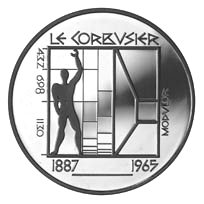
The graphic representation of the Modulor, a stylised human figure with one arm raised, stands next to two vertical measurements, a red series based on the figure's navel height (1.08 m in the original version, 1.13 m in the revised version) and segmented according to Phi and a blue series based on the figure's entire height, double the navel height (2.16 m in the original version, 2.26 m in the revised), segmented similarly. A spiral, graphically developed between the red and blue segments, seems to mimic the volume of the human figure.
The Modulor 2 was drawn by André Maissonier and Justino Serralta.[12]
Practical application
[edit]Le Corbusier used his Modulor scale in the design of many buildings, including:
Unité d'Habitation à Marseille
[edit]In his first book on the subject The Modulor, Le Corbusier has a chapter on the use of the modular in the Unité d'Habitation. The modular governs: the plan, section and elevations; the brise-soleil; the roof; the supporting columns and the plan and section of the apartments. It was also used for the dimensions of the commemorative stone laid on 14 October 1947.[13] A version of the Modulor Man was cast in concrete near the entrance.
Church of Sainte Marie de La Tourette
[edit]In the Church of Sainte Marie de La Tourette Le Corbusier floors the majority of the church in pale concrete panels set to Modulor dimensions.[14] Also, the engineer Iannis Xenakis applied the Modulor system to the design of the exterior vertical ventilators or "ondulatoires".[15]
Carpenter Center for the Visual Arts
[edit]In the Carpenter Center the Modulor system was used for the brise-soleil distances, the floor to floor heights, the bay distances and the column thicknesses.[16] Le Corbusier conceived that the dimensioning of the entrance ramp would be "visible essay on the mathematics of the human body".[17]

Unite d'Habitation a Berlin.
[edit]In this image of the Modulor in Berlin, there are several messages:
- The typical apartment is designed for four people. (Note 4 people in bed on the right).
- The patterns of paint on the side of the balconies is explained by diagonal line.
- Brie Soleil is sized by the height of the Modulor man.
- The room height is calculated by the Modulor.
Publication
[edit]Le Corbusier published Le Modulor in 1948, followed by Modulor 2 in 1955. These works were first published in English as The Modulor in 1954 and Modulor 2 (Let the User Speak Next) in 1958.
The 2004 reprinted box set including both books was printed in a square format using the Modulor with the series twenty seven to one hundred and forty reduced in size to one tenth.[18]
Commemorative usage
[edit]
- A picture of the Modulor appears on the eighth banknote series on the 10 CHF Swiss banknote dedicated to Le Corbusier.
See also
[edit]- Body proportions
- Ergonomics
- List of unusual units of measurement
- Preferred number, especially the section about Renard series, which covers a mathematical approach on evenly distributed numbers using geometric sequences, for use in constructing houses or devices.
- Rudolf Wittkower
- Rule of thumb
Citations
[edit]- ^ a b Ostwald (2001), p. 146.
- ^ Burrows, Terry; Larter, Sarah; Anderson, Janice, eds. (1999). ITV Visual History of the Twentieth Century. London: Carlton Books. p. 318. ISBN 1-85868-688-1.
- ^ Le Corbusier (2004), p. 17.
- ^ Le Corbusier (2004), p. 20.
- ^ Le Corbusier (2004), p. 36.
- ^ Le Corbusier (2004), p. 43.
- ^ Le Corbusier (2004), p. 56.
- ^ Le Corbusier (2004), p. 52.
- ^ Le Corbusier (2004), p. 115.
- ^ Le Corbusier (2004), p. 53.
- ^ Le Corbusier (2004), p. 122.
- ^ Jorge Nudelman, "En recuerdo: Justino Serralta, 'arquitecto de comunidades', 1919–2011", Boletín Facultad de Arquitectura UDELAR (30 October 2011).
- ^ Le Corbusier (2004), p. 131.
- ^ Samuel (2007), p. 62.
- ^ Samuel (2007), p. 83.
- ^ Sekler & Curtis (1978), p. 158.
- ^ Sekler & Curtis (1978), p. 182.
- ^ Le Corbusier (2004), p. back cover.
References
[edit]- Sekler, Eduard F.; Curtis, William (1978). Le Corbusier at Work: The Genesis of the Carpenter Center for Visual Arts. Cambridge, MA: Harvard University Press.
- Evans, Robin (1995). The Projective Cast: Architecture and Its Three Geometries. Cambridge, MA: MIT Press. ISBN 0262050498.
- Le Corbusier (2004) [First published in two volumes in 1954 and 1958.]. The Modulor: A Harmonious Measure to the Human Scale, Universally Applicable to Architecture and Mechanics. Basel & Boston: Birkhäuser. ISBN 3764361883.
- Ostwald, Michael J. (2001). "The Modulor and Modulor 2 by Le Corbusier (Charles Edouard Jeanneret), 2 volumes. Basel: Birkhäuser, 2000". Nexus Network Journal. 3 (1): 145–48. doi:10.1007/s00004-000-0015-0.
- Samuel, Flora (2007). Corbusier in Detail. Architectural Press.
External links
[edit]
Modulor
View on GrokipediaOrigins and Development
Historical Context
Le Corbusier's interest in architectural proportions originated in his early career, drawing from ancient sources such as Vitruvius's principles of symmetry and proportion in De Architectura and the geometric harmony evident in the Parthenon, which he studied during his 1911 journey to the East and through readings like Auguste Choisy's Histoire de l'architecture in 1918.[2] These influences shaped his belief in regulating lines and proportional systems as essential to harmonious design, as articulated in his 1923 manifesto Vers une architecture, where he applied proportional grids to modern structures like the Villa Schwob.[2] The initial conception of the Modulor emerged during the wartime period of World War II, with Le Corbusier beginning research in 1943 amid the German occupation of France, building on a 1942 Vichy regime standardization effort that proposed a ten-centimeter module.[2] Restricted in his international activities and based in Paris, Le Corbusier sketched preliminary ideas during this time of isolation, founding the ASCORAL group in March 1943 to advance urban and architectural reforms.[2] This period of constraint allowed him to refine concepts rooted in human scale, influenced by his broader career exploring anthropometric measures.[4] Post-World War II reconstruction demands in Europe further propelled the Modulor's development, as widespread devastation necessitated scalable, efficient housing solutions that prioritized human-centered design to improve living conditions in rebuilt cities.[4] Codified in 1945 and published in 1950, the system addressed the need for standardization amid industrial recovery, aligning with 1940s trends in modular prefabrication that emphasized interchangeable components for mass production in architecture.[2][1] Le Corbusier envisioned the Modulor as a tool to ensure prefabricated elements maintained proportional beauty and functionality suited to the human body.[1]Creation Process
Le Corbusier initiated the development of the Modulor in the early 1940s, driven by his dissatisfaction with the metric system's arbitrary nature and its disconnection from human proportions, seeking instead a universal scale that reconciled metric and imperial measurements while harmonizing architecture with the human body. This effort was spurred by postwar reconstruction demands and earlier Vichy-era standardization initiatives, such as the 1942 Norm NFP01–001 on modulation, which highlighted the need for a more intuitive, anthropometric approach. By 1943, research intensified in his Paris office, where assistant Gérald Hanning was tasked with designing a proportional grid based on the golden section and ancient measures.[2] In 1944, the system began practical application within Le Corbusier's atelier, where engineers and architects tested it daily for architectural drawings, marking the shift from theoretical sketches to a workable tool. Collaboration with specialists, including art historian Elisa Maillard for integrating the Fibonacci sequence, refined the proportions around a 1.83-meter "English man" and a 2.26-meter figure with arm raised. By 1946, engineer Vladimir Bodiansky joined efforts as part of the Atelier des Bâtisseurs (ATBAT), contributing technical expertise to adapt the Modulor for construction, including early proposals like the United Nations Headquarters design in 1947. Iterative refinements continued through 1948, involving field validations with construction workers in ATBAT workshops to ensure scalability in real building processes, culminating in the system's patent filing in May 1945 and formal codification.[5][2][3] The Modulor achieved public prominence with its first major presentation at the 1947 International Congress of Modern Architecture (CIAM 6) and subsequent features in a 1948 special issue of L’Architecture d’aujourd’hui, where Le Corbusier detailed its evolution from initial 1942 sketches to a comprehensive proportional framework. Published as Le Modulor in 1950, the system was presented as a "harmonious measure to the human scale, universally applicable to architecture and mechanics," solidifying its role as a bridge between artistic intuition and mathematical precision.[2]Core Principles
Proportional System
The Modulor proportional system establishes a harmonic scale derived from the golden ratio, φ ≈ (1 + √5)/2 ≈ 1.618, employing a double golden section in the ratio 1:φ:φ² to generate dimensions that foster visual and structural harmony in design.[1] This core ratio ensures that each successive dimension relates to the previous one by φ, creating a geometric progression that approximates the Fibonacci sequence for practical application.[6] Le Corbusier selected φ for its self-similar properties, allowing scalable proportions that maintain equilibrium across varying sizes without relying on arbitrary units.[1] The modular sequence originates from a base unit of 27 cm, corresponding to the span of a hand, serving as the foundational metric for the system's ascending and descending scales.[6] Successive modules are derived through powers of φ, expressed mathematically as , where is the initial term (e.g., 27 cm) and n is an integer, yielding approximations like 43 cm, 70 cm, 113 cm, and 183 cm to accommodate practical construction tolerances.[1] For instance, the next module from 70 cm reaches 113 cm (70 × φ ≈ 113), and from 113 cm to full standing height at 183 cm (113 × φ ≈ 183), ensuring proportions align with natural human dimensions.[6] To bridge metric and imperial systems, the Modulor incorporates two intertwined series: the red series, which includes dimensions approximating imperial scales such as 43 cm, 70 cm, 113 cm, 183 cm, and the blue series, aligned with metric standards using 27 cm increments (e.g., 27, 43, 70 cm initially, extending to larger scales).[6] These series converge at 226 cm, where the blue series doubles the 113 cm module (2 × 113 = 226), unifying the scales for comprehensive application from small details to building heights.[1] This integration allows designers to select dimensions from either series interchangeably, with the relation between consecutive terms approximating φ (e.g., 113/70 ≈ 1.614, 183/113 ≈ 1.619), promoting a cohesive proportional framework.[6]Human Scale Integration
The Modulor system integrates anthropometric data by deriving its foundational measurements from the human body, specifically using the height of an average man as the primary reference point. Le Corbusier established the base height at an idealized 1.83 meters (6 feet), chosen to align with human proportions and imperial standards. Initially based on 1.75 m, the height was adjusted to 1.83 m (6 feet) in 1946 to better reconcile metric and imperial systems.[6][7] This height was extended to 2.26 meters to account for the man with his arm raised, forming the upper limit of the system's primary vertical dimension and ensuring that built environments facilitate intuitive human interaction.[8][9][10] Key dimensions within the Modulor further emphasize this human-centric approach by incorporating specific body measurements for practical functionality. For instance, the elbow height supports ergonomic working surfaces at 0.70 meters; and the hand span at 0.27 meters informs graspable object sizes and modular intervals. These measurements ensure that designs, from furniture to facades, resonate with bodily rhythms rather than imposed grids.[8] To accommodate human variability, the Modulor is designed as a scalable framework, adaptable from small-scale objects like utensils to large urban planning elements such as building heights and street widths. This flexibility derives from the system's proportional extensions, enabling consistent application across contexts without rigid conversions, thus promoting harmony in diverse environments.[8][9] Le Corbusier critiqued traditional standardization, particularly the metric system, as arbitrary and disconnected from human experience, advocating instead for body-derived units that foster a more organic and intuitive built world. By rejecting these "artificial" measures, the Modulor aimed to reintegrate architecture with the innate scale of the human form.[8]Visual and Mathematical Representation
Graphic Elements
The Modulor system is visually embodied by a stylized human figure known as the Modulor Man, depicting a male silhouette standing with one arm raised to emphasize proportions derived from the human body. This central motif, measuring 1.83 meters in height with the raised arm extending to 2.26 meters, serves as an iconic anchor for the proportional scales, symbolizing the integration of anthropometric dimensions into architectural design.[1] The graphic representation incorporates color coding to differentiate measurement scales: red for the series starting at the figure's navel height (1.13 m) and ascending for human-scale dimensions, and blue for the series starting at double the navel height (2.26 m) and ascending to encompass larger building-scale dimensions. These vertical scales flank the stylized figure in diagrams, providing a clear visual hierarchy that facilitates practical application while evoking the golden section's harmonic divisions.[1][11] The diagrams evolved from initial sketches in Le Corbusier's studio during the early 1940s, where collaborators like Gérald Hanning drew proportional grids on walls and iron strips to explore human-based measurements, to more formalized illustrations by 1948. By that year, the visuals had refined into printed scales within the book Le Modulor, featuring the human figure alongside segmented red and blue series, often rendered by artists André Maissonier and Justino Serralta to trace a spiral form mirroring bodily contours. This progression marked a shift from exploratory hand-drawn concepts to standardized, reproducible graphics that codified the system's visual language.[2] A practical extension of these graphics is the Modulor ruler, a tape measure-style tool designed for on-site use, imprinted with the color-coded scales and key proportional markers to allow architects to apply the system directly during construction and design processes. Developed in the 1940s, this instrument translates the diagrammatic elements into a portable format, reinforcing the Modulor's emphasis on human-scale harmony without reliance on metric standardization.[3]Numerical Framework
The Modulor's numerical framework is built around two interlocking series—the red series and the blue series—forming a geometric progression that spans from large architectural dimensions down to fine-scale measurements. The blue series originates at 2260 mm (2.26 m), representing the height of a standing figure with arm extended upward, and descends through 15 steps to approximately 2.26 mm by repeated division by the golden ratio φ ≈ (1 + √5)/2. The red series parallels this, starting at half the blue base (1130 mm or 1.13 m) and following a similar progression, ensuring compatibility across scales. Together, these series provide 27 discrete modules in total, allowing for proportional coordination in design without reliance on arbitrary units like the metric system.[12] The modules are generated via the recursive formula for ascending values or for descending ones, with results rounded to whole numbers for practicality; integer multiples (e.g., doubling) further extend the system. This approach incorporates approximations from the Fibonacci sequence, where consecutive terms converge to φ, enabling additive properties (e.g., ) that facilitate modular combinations in construction. The integration of Fibonacci ratios ensures the framework's proportions remain harmonious and scalable, approximating the irrational φ through rational integers.[1] Key modules from the series, selected for their frequent use in architectural applications, are summarized below. These values support measurements such as room dimensions, structural elements, and furnishing scales, promoting uniformity across projects.| Module (mm) | Equivalent (m) | Series | Typical Application |
|---|---|---|---|
| 1130 | 1.13 | Red | Window heights, furniture widths |
| 1830 | 1.83 | Red | Door heights, human-scale references |
| 2260 | 2.26 | Blue | Ceiling heights, room proportions |
| 2959 | 2.96 | Red | Facade lengths, corridor widths |
