
Hubbry Logo
logo
Monoidal category
Community hub

Monoidal category

logo
0 subscribers
Read side by side
from Wikipedia

In mathematics, a monoidal category (or tensor category) is a category equipped with a bifunctor

that is associative up to a natural isomorphism, and an object I that is both a left and right identity for ⊗, again up to a natural isomorphism. The associated natural isomorphisms are subject to certain coherence conditions, which ensure that all the relevant diagrams commute.

The ordinary tensor product makes vector spaces, abelian groups, R-modules, or R-algebras into monoidal categories. Monoidal categories can be seen as a generalization of these and other examples. Every (small) monoidal category may also be viewed as a "categorification" of an underlying monoid, namely the monoid whose elements are the isomorphism classes of the category's objects and whose binary operation is given by the category's tensor product.

A rather different application, for which monoidal categories can be considered an abstraction, is a system of data types closed under a type constructor that takes two types and builds an aggregate type. The types serve as the objects, and ⊗ is the aggregate constructor. The associativity up to isomorphism is then a way of expressing that different ways of aggregating the same data—such as and —store the same information even though the aggregate values need not be the same. The aggregate type may be analogous to the operation of addition (type sum) or of multiplication (type product). For type product, the identity object is the unit , so there is only one inhabitant of the type, and that is why a product with it is always isomorphic to the other operand. For type sum, the identity object is the void type, which stores no information, and it is impossible to address an inhabitant. The concept of monoidal category does not presume that values of such aggregate types can be taken apart; on the contrary, it provides a framework that unifies classical and quantum information theory.[1]

In category theory, monoidal categories can be used to define the concept of a monoid object and an associated action on the objects of the category. They are also used in the definition of an enriched category.

Monoidal categories have numerous applications outside of category theory proper. They are used to define models for the multiplicative fragment of intuitionistic linear logic. They also form the mathematical foundation for the topological order in condensed matter physics. Braided monoidal categories have applications in quantum information, quantum field theory, and string theory.

Formal definition

[edit]

A monoidal category is a category equipped with a monoidal structure. A monoidal structure consists of the following:

  • a bifunctor called the monoidal product,[2] or tensor product,
  • an object called the monoidal unit,[2] unit object, or identity object,
  • three natural isomorphisms subject to certain coherence conditions expressing the fact that the tensor operation:
    • is associative: there is a natural (in each of three arguments , , ) isomorphism , called associator, with components ,
    • has as left and right identity: there are two natural isomorphisms and , respectively called left and right unitor, with components and .

Note that a good way to remember how and act is by alliteration; Lambda, , cancels the identity on the left, while Rho, , cancels the identity on the right.

The coherence conditions for these natural transformations are:

  • for all , , and in , the pentagon diagram
This is one of the main diagrams used to define a monoidal category; it is perhaps the most important one.
commutes;
  • for all and in , the triangle diagram
This is one of the diagrams used in the definition of a monoidal cateogory. It takes care of the case for when there is an instance of an identity between two objects.
commutes.

A strict monoidal category is one for which the natural isomorphisms α, λ and ρ are identities. Every monoidal category is monoidally equivalent to a strict monoidal category.

Examples

[edit]
  • Any category with finite products can be regarded as monoidal with the product as the monoidal product and the terminal object as the unit. Such a category is sometimes called a cartesian monoidal category. For example:
  • Dually, any category with finite coproducts is monoidal with the coproduct as the monoidal product and the initial object as the unit. Such a monoidal category is called cocartesian monoidal
  • R-Mod, the category of modules over a commutative ring R, is a monoidal category with the tensor product of modulesR serving as the monoidal product and the ring R (thought of as a module over itself) serving as the unit. As special cases one has:
  • For any commutative ring R, the category of R-algebras is monoidal with the tensor product of algebras as the product and R as the unit.
  • The category of pointed spaces (restricted to compactly generated spaces for example) is monoidal with the smash product serving as the product and the pointed 0-sphere (a two-point discrete space) serving as the unit.
  • The category of all endofunctors on a category C is a strict monoidal category with the composition of functors as the product and the identity functor as the unit.
  • Just like for any category E, the full subcategory spanned by any given object is a monoid, it is the case that for any 2-category E, and any object C in Ob(E), the full 2-subcategory of E spanned by {C} is a monoidal category. In the case E = Cat, we get the endofunctors example above.
  • Bounded-above meet semilattices are strict symmetric monoidal categories: the product is meet and the identity is the top element.
  • Any ordinary monoid is a small monoidal category with object set , only identities for morphisms, as tensor product and as its identity object. Conversely, the set of isomorphism classes (if such a thing makes sense) of a monoidal category is a monoid w.r.t. the tensor product.
  • Any commutative monoid can be realized as a monoidal category with a single object. Recall that a category with a single object is the same thing as an ordinary monoid. By an Eckmann-Hilton argument, adding another monoidal product on requires the product to be commutative.

Properties and associated notions

[edit]

It follows from the three defining coherence conditions that a large class of diagrams (i.e. diagrams whose morphisms are built using , , , identities and tensor product) commute: this is Mac Lane's "coherence theorem". It is sometimes inaccurately stated that all such diagrams commute.[citation needed]

There is a general notion of monoid object in a monoidal category, which generalizes the ordinary notion of monoid from abstract algebra. Ordinary monoids are precisely the monoid objects in the cartesian monoidal category Set. Further, any (small) strict monoidal category can be seen as a monoid object in the category of categories Cat (equipped with the monoidal structure induced by the cartesian product).

Monoidal functors are the functors between monoidal categories that preserve the tensor product and monoidal natural transformations are the natural transformations, between those functors, which are "compatible" with the tensor product.

Every monoidal category can be seen as the category B(∗, ∗) of a bicategory B with only one object, denoted ∗.

The concept of a category C enriched in a monoidal category M replaces the notion of a set of morphisms between pairs of objects in C with the notion of an M-object of morphisms between every two objects in C.

Free strict monoidal category

[edit]

For every category C, the free strict monoidal category Σ(C) can be constructed as follows:

  • its objects are lists (finite sequences) A1, ..., An of objects of C;
  • there are arrows between two objects A1, ..., Am and B1, ..., Bn only if m = n, and then the arrows are lists (finite sequences) of arrows f1: A1B1, ..., fn: AnBn of C;
  • the tensor product of two objects A1, ..., An and B1, ..., Bm is the concatenation A1, ..., An, B1, ..., Bm of the two lists, and, similarly, the tensor product of two morphisms is given by the concatenation of lists. The identity object is the empty list.

This operation Σ mapping category C to Σ(C) can be extended to a strict 2-monad on Cat.

Specializations

[edit]

Preordered monoids

[edit]

A preordered monoid is a monoidal category in which for every two objects , there exists at most one morphism in C. In the context of preorders, a morphism is sometimes notated . The reflexivity and transitivity properties of an order, defined in the traditional sense, are incorporated into the categorical structure by the identity morphism and the composition formula in C, respectively. If and , then the objects are isomorphic which is notated .
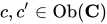
Introducing a monoidal structure to the preorder C involves constructing

  • an object , called the monoidal unit, and
  • a functor , denoted by "", called the monoidal multiplication.

and must be unital and associative, up to isomorphism, meaning:

and .

As · is a functor,

if and then .

The other coherence conditions of monoidal categories are fulfilled through the preorder structure as every diagram commutes in a preorder.

The natural numbers are an example of a monoidal preorder: having both a monoid structure (using + and 0) and a preorder structure (using ≤) forms a monoidal preorder as and implies .

The free monoid on some generating set produces a monoidal preorder, producing the semi-Thue system.

See also

[edit]

References

[edit]
[edit]
Revisions and contributorsEdit on WikipediaRead on Wikipedia
from Grokipedia
A monoidal category is a category C\mathcal{C} together with a bifunctor :C×CC\otimes: \mathcal{C} \times \mathcal{C} \to \mathcal{C}, called the tensor product or monoidal product; a distinguished object ICI \in \mathcal{C}, called the unit object; and natural isomorphisms αA,B,C:(AB)CA(BC)\alpha_{A,B,C}: (A \otimes B) \otimes C \to A \otimes (B \otimes C) (the associator), λA:IAA\lambda_A: I \otimes A \to A (the left unitor), and ρA:AIA\rho_A: A \otimes I \to A (the right unitor) for all objects A,B,CCA, B, C \in \mathcal{C}, satisfying the pentagon identity (coherence for associativity) and the triangle identity (coherence for unitors).[1] These coherence conditions ensure that all possible ways of parenthesizing multiple tensor products or inserting units yield canonically isomorphic results, up to the specified isomorphisms.[2] The concept of monoidal categories was independently introduced in 1963 by Jean Bénabou, who termed them catégories avec multiplication (categories with multiplication), and by Saunders Mac Lane, who motivated them through natural associativity in algebraic structures like tensor products of vector spaces or smash products of pointed spaces.[2] Bénabou's formulation appeared in the Comptes Rendus de l'Académie des Sciences, emphasizing their role in generalizing multiplicative structures across categories, while Mac Lane's work in Rice University Studies highlighted coherence theorems ensuring well-defined multi-fold operations.[2] Monoidal categories generalize familiar structures such as the category of sets with Cartesian product (where II is a singleton), the category of abelian groups with tensor product over Z\mathbb{Z} (where I=ZI = \mathbb{Z}), or the category of pointed topological spaces with smash product (where II is the pointed space consisting of a single point), providing a unified framework for operations that are bilinear or otherwise multiplicative.[3] They are foundational in diverse areas of mathematics, including algebraic topology (for cohomology theories), representation theory (for fusion categories of quantum groups), and theoretical physics (for modeling quantum computations via dagger-compact categories).[3] Mac Lane's coherence theorem asserts that every monoidal category is monoidally equivalent to a strict monoidal category, where the associator and unitors are identities, simplifying computations without loss of generality.[2] Specializations of monoidal categories include braided monoidal categories, equipped with a natural braiding isomorphism σA,B:ABBA\sigma_{A,B}: A \otimes B \to B \otimes A satisfying hexagon identities (useful for knot theory and braided Hopf algebras); symmetric monoidal categories, where the braiding is its own inverse (as in vector spaces over a field); and closed monoidal categories, which have internal hom-objects enabling currying of morphisms.[1] These structures underpin advanced topics like monoidal functors (preserving the tensor and unit up to coherent isomorphisms), monoid objects (generalizing rings within the category), and applications to higher category theory, such as in the study of 2-categories or \infty-categories.[3]

Definition and Basics

Formal Definition

A monoidal category is a category C\mathcal{C} equipped with a bifunctor :C×CC\otimes: \mathcal{C} \times \mathcal{C} \to \mathcal{C}, called the tensor product, an object ICI \in \mathcal{C}, called the unit object, a natural isomorphism αA,B,C:(AB)CA(BC)\alpha_{A,B,C}: (A \otimes B) \otimes C \to A \otimes (B \otimes C) for all objects A,B,CCA, B, C \in \mathcal{C}, called the associator, a natural isomorphism λA:IAA\lambda_A: I \otimes A \to A for all ACA \in \mathcal{C}, called the left unitor, and a natural isomorphism ρA:AIA\rho_A: A \otimes I \to A for all ACA \in \mathcal{C}, called the right unitor.[4][5] The associator, left unitor, and right unitor must satisfy two coherence conditions known as the pentagon identity and the triangle identity. The pentagon identity requires that, for all objects A,B,C,DCA, B, C, D \in \mathcal{C}, the following diagram commutes:
\begin{CD} ((A \otimes B) \otimes C) \otimes D @>\alpha_{A,B,C} \otimes \mathrm{id}_D>> (A \otimes (B \otimes C)) \otimes D \\ @V\alpha_{A \otimes B, C, D}VV @VV\alpha_{A, B \otimes C, D}V \\ (A \otimes B) \otimes (C \otimes D) @>>>\alpha_{A,B,C \otimes D}> A \otimes ((B \otimes C) \otimes D) \\ @V\mathrm{id}_A \otimes \alpha_{B,C,D}V @VV\mathrm{id}_A \otimes \alpha_{B,C,D}V \\ A \otimes ((B \otimes C) \otimes D) @= A \otimes ((B \otimes C) \otimes D) \end{CD}
This ensures a consistent way to reassociate quadruple tensor products up to isomorphism.[4][5] The triangle identity requires that, for all objects A,BCA, B \in \mathcal{C}, the following diagram commutes:
(AI)BαA,I,BA(IB)ρAidBλBAB=AB \begin{CD} (A \otimes I) \otimes B @>\alpha_{A,I,B}>> A \otimes (I \otimes B) \\ @V\rho_A \otimes \mathrm{id}_BVV @VV\lambda_BV \\ A \otimes B @= A \otimes B \end{CD}
This condition relates the unitors to the associator, guaranteeing that the unit object behaves coherently with respect to tensoring.[4][5] This structure was independently introduced in 1963 by Jean Bénabou[6] and Saunders Mac Lane as a categorical generalization of the notion of a monoid.[5] In cases where the associator and unitors are identity morphisms, the category is called strict.[4]

Strict Monoidal Categories

A strict monoidal category is a monoidal category in which the associator αA,B,C:(AB)CA(BC)\alpha_{A,B,C}: (A \otimes B) \otimes C \to A \otimes (B \otimes C) and the unitors λA:IAA\lambda_A: I \otimes A \to A, ρA:AIA\rho_A: A \otimes I \to A are identity morphisms for all objects A,B,CA,B,C.[7] As a result, the tensor product \otimes is strictly associative, satisfying (AB)C=A(BC)(A \otimes B) \otimes C = A \otimes (B \otimes C) as equalities of objects, and the unit object II acts as a strict two-sided identity, with IA=AI=AI \otimes A = A \otimes I = A for all AA.[7] In this setting, the pentagon and triangle identities from the general monoidal category definition hold trivially as equalities.[7] Strict monoidal categories are commonly used in practice for their notational convenience, as they eliminate the need to insert coherence isomorphisms explicitly when composing tensor products or interacting with the unit object.[7] The Mac Lane coherence theorem establishes that every monoidal category is monoidally equivalent to a strict monoidal category, justifying this simplification without altering the underlying categorical structure up to equivalence.[7] The equivalence to a strict monoidal category is achieved through a strictification functor, often outlined in two steps: first, skeletalization, which replaces the original category with an equivalent skeletal subcategory where isomorphic objects are identified to make isomorphisms identities; second, a redefinition of the tensor product that absorbs the associator and unitors, constructing a new strict tensor operation on the skeletal category such that the resulting structure is strict and connected by strong monoidal functors to the original.[7] This process preserves the monoidal structure up to monoidal equivalence, as guaranteed by the coherence theorem.[7]

Examples

Algebraic Structures

One prominent example of a monoidal category arises in the category of sets, denoted Set\mathbf{Set}, where the monoidal product is the Cartesian product =×\otimes = \times and the unit object is the singleton set {}\{*\}. This structure makes Set\mathbf{Set} a strict monoidal category, as the associators and unitors are identity morphisms.[2][8] In the category of abelian groups, denoted Ab\mathbf{Ab}, the direct sum \oplus serves as the monoidal product =\otimes = \oplus, with the trivial group {0}\{0\} as the unit object. This equips Ab\mathbf{Ab} with a strict monoidal structure, where the direct sum provides the necessary associativity and unit properties.[2][9] The category of vector spaces over a field KK, denoted VectK\mathbf{Vect}_K, forms a monoidal category under the tensor product of vector spaces \otimes, with KK itself as the unit object. The associators are natural isomorphisms that, in the case of finite-dimensional spaces, can be realized as identity maps when working with bases, rendering the structure effectively strict in those dimensions.[2][10] For modules over a commutative ring RR, the category ModR\mathbf{Mod}_R acquires a monoidal structure via the tensor product over RR, denoted R\otimes_R, with RR as the unit object. This tensor product satisfies the required coherence axioms, forming a closed monoidal category in many cases, though the focus here is on the basic monoidal operation.[2][11]

Topological and Geometric Structures

In the category Top of topological spaces and continuous maps, the monoidal structure is given by the Cartesian product functor ×:Top×TopTop\times: \mathbf{Top} \times \mathbf{Top} \to \mathbf{Top}, where the product topology on X×YX \times Y is the coarsest topology making the projections πX:X×YX\pi_X: X \times Y \to X and πY:X×YY\pi_Y: X \times Y \to Y continuous. The unit object is the singleton space {}\{*\}, which satisfies the necessary isomorphisms X×{}X{}×XX \times \{*\} \cong X \cong \{*\} \times X. This structure is strict monoidal, as the associator and unitors are identity morphisms, reflecting the natural associativity of finite products in topological spaces.[12] The category Hilb of complex Hilbert spaces and continuous linear maps inherits a monoidal structure from the algebraic tensor product completed with respect to the induced inner product, denoted :Hilb×HilbHilb\otimes: \mathbf{Hilb} \times \mathbf{Hilb} \to \mathbf{Hilb}, which equips composite systems in quantum mechanics with a joint Hilbert space. The unit is the one-dimensional space C\mathbb{C}, ensuring HCHCHH \otimes \mathbb{C} \cong H \cong \mathbb{C} \otimes H via canonical isomorphisms. This tensor product preserves the inner product and completeness, making Hilb a symmetric monoidal category foundational to modeling multipartite quantum systems.[13] Similarly, the category Man of smooth manifolds and smooth maps forms a monoidal category with the product functor ×:Man×ManMan\times: \mathbf{Man} \times \mathbf{Man} \to \mathbf{Man}, where the smooth structure on M×NM \times N is induced by the product atlas, ensuring smooth projections and transitions. The unit is the zero-dimensional point manifold, with isomorphisms M×{pt}M{pt}×MM \times \{\mathrm{pt}\} \cong M \cong \{\mathrm{pt}\} \times M holding naturally. This Cartesian monoidal structure supports the study of product geometries and fiber bundles in differential topology.[12] In algebraic topology, the category Ch(\mathbb{Z}) of chain complexes of abelian groups and chain maps admits a monoidal structure via the tensor product of complexes, defined degreewise as (CD)n=p+q=nCpDq(C \otimes D)_n = \bigoplus_{p+q=n} C_p \otimes D_q with the differential dCD(cd)=dC(c)d+(1)ccdDd_{C \otimes D}(c \otimes d) = d_C(c) \otimes d + (-1)^{|c|} c \otimes d_D to ensure d2=0d^2 = 0. The unit is the complex Z\mathbb{Z} concentrated in degree zero, yielding CZCZCC \otimes \mathbb{Z} \cong C \cong \mathbb{Z} \otimes C. This structure underlies the Künneth theorem, relating homology of products to tensor products of chain complexes.[14]

Structural Enhancements

Braided Monoidal Categories

A braided monoidal category extends the structure of a monoidal category by incorporating a braiding, which provides a canonical way to interchange the order of tensor factors. Formally, given a monoidal category (C,,I,α,λ,ρ)(\mathcal{C}, \otimes, I, \alpha, \lambda, \rho), it becomes braided upon equipping it with a natural family of isomorphisms βX,Y ⁣:XYYX\beta_{X,Y} \colon X \otimes Y \to Y \otimes X for all objects X,YCX, Y \in \mathcal{C}, such that β\beta is natural in both arguments and satisfies the two hexagon axioms with respect to the associator α\alpha. This braiding β\beta must be compatible with the monoidal unit in the sense that the following diagrams commute for all XCX \in \mathcal{C}:
IXβI,XXIλXρXX=XXIβX,IIXρXλXX=X \begin{CD} I \otimes X @>\beta_{I,X}>> X \otimes I \\ @V{\lambda_X}VV @V{\rho_X}VV \\ X @= X \end{CD} \qquad \begin{CD} X \otimes I @>\beta_{X,I}>> I \otimes X \\ @V{\rho_X}VV @V{\lambda_X}VV \\ X @= X \end{CD}
The first hexagon identity ensures coherence when braiding the first factor past an associated tensor product:
βX,YZαX,Y,Z=αY,Z,X(idYβX,Z)αY,X,Z(βX,YidZ) \begin{aligned} \beta_{X, Y \otimes Z} \circ \alpha_{X,Y,Z} &= \alpha_{Y,Z,X} \circ (\mathrm{id}_Y \otimes \beta_{X,Z}) \circ \alpha_{Y,X,Z} \circ (\beta_{X,Y} \otimes \mathrm{id}_Z) \end{aligned}
for all objects X,Y,ZCX, Y, Z \in \mathcal{C}. The second hexagon identity governs the analogous situation for braiding the second factor:
βXY,ZαX,Y,Z1=αZ,X,Y1(βX,ZidY)αX,Z,Y1(idXβY,Z) \begin{aligned} \beta_{X \otimes Y, Z} \circ \alpha_{X,Y,Z}^{-1} &= \alpha_{Z,X,Y}^{-1} \circ (\beta_{X,Z} \otimes \mathrm{id}_Y) \circ \alpha_{X,Z,Y}^{-1} \circ (\mathrm{id}_X \otimes \beta_{Y,Z}) \end{aligned}
These identities guarantee that the braiding interacts consistently with the associativity of the tensor product, allowing for well-defined manipulations in diagrammatic representations. The notion of braiding draws motivation from physical and combinatorial contexts, such as the interchange of tangled strings or the generators of the Artin braid group, where the βX,Y\beta_{X,Y} represents a crossing or swap operation that can be composed without unintended coincidences. The concept of braided monoidal categories was introduced by André Joyal and Ross Street in 1986.[15]

Symmetric Monoidal Categories

A symmetric monoidal category is a braided monoidal category equipped with a natural braiding isomorphism βA,B:ABBA\beta_{A,B}: A \otimes B \to B \otimes A satisfying the additional condition βB,AβA,B=idAB\beta_{B,A} \circ \beta_{A,B} = \mathrm{id}_{A \otimes B} for all objects A,BA, B. This ensures that the braiding is invertible, with inverse given by βA,B1=βB,A\beta_{A,B}^{-1} = \beta_{B,A}, and self-inverse in the sense that applying the braiding twice returns the original tensor product. The structure thus specializes the braided case by enforcing commutativity up to coherent isomorphism, allowing interchange of factors without orientation concerns.[16][7] The compatibility of the symmetry with the monoidal associators follows from the braided hexagon identities, where the symmetry condition equates the two distinct hexagons of the braided structure into a single coherent diagram. This simplification facilitates proofs of coherence and reduces the number of independent axioms, as the inverse braiding aligns directly with the forward one under swapping. In diagrammatic terms, symmetric braidings permit unambiguous planar representations without needing to distinguish over- and under-crossings beyond the self-inverse property.[16] The concept of symmetry in monoidal categories arose in the context of commutative algebraic structures, where operations like tensor products in abelian categories naturally satisfy such conditions without additional braiding complexity. Saunders Mac Lane introduced foundational ideas on natural commutativity in categories with multiplication in his 1963 paper, laying groundwork for modern symmetric monoidal structures often assumed in commutative settings.[2][7]

Key Properties and Theorems

Coherence Theorem

The coherence theorem for monoidal categories, established by Saunders Mac Lane, asserts that in any monoidal category C\mathcal{C}, every diagram constructed solely from instances of the associator αA,B,C ⁣:(AB)CA(BC)\alpha_{A,B,C} \colon (A \otimes B) \otimes C \to A \otimes (B \otimes C) and the unitors λA ⁣:IAA\lambda_A \colon I \otimes A \to A and ρA ⁣:AIA\rho_A \colon A \otimes I \to A, where A,B,CA, B, C range over objects of C\mathcal{C}, commutes uniquely.[17][7] This means that for any two parallel morphisms built from these natural transformations, there exists a unique equality between them, ensuring a canonical isomorphism between any two possible parenthesizations of an iterated tensor product A1AnA_1 \otimes \cdots \otimes A_n.[18] The proof outline relies on normalizing expressions via a standard form, such as left-associated parenthesizations, and demonstrating commutativity through induction on the complexity of the diagrams. Specifically, one constructs a skeletal category WW whose objects are binary words (sequences representing parenthesized tensors, including the unit x0x_0) and whose morphisms are generated by the associators and unitors; a functor Φ\Phi from WW to the category of iterated tensors in C\mathcal{C} is then shown to be faithful, implying that all such diagrams in C\mathcal{C} commute by virtue of their unique preimages in WW.[18][7] This approach uses lemmas on arrow reorganization and unitor-chain equivalence to handle the unitors alongside associators, confirming the theorem for n4n \geq 4 objects and extending to the full case.[17] As a consequence, every monoidal category is monoidally equivalent to a strict monoidal category via a coherence functor that makes all associators and unitors identities, allowing computations in weak monoidal categories to be performed as if they were strict without loss of generality or introducing non-canonical choices.[17][7] This equivalence eliminates the possibility of "exotic" coherences, ensuring that diagrammatic reasoning with tensor products remains unambiguous and consistent across different associations.[18]

Free Monoidal Categories

The free monoidal category on a category $ C $ is constructed by freely generating a monoidal structure from the objects and morphisms of $ C $, without imposing additional relations beyond those required by the monoidal axioms. Specifically, its objects are finite sequences (or words) of objects from $ C $, such as $ (A_1, \dots, A_n) $ for $ n \geq 0 $, with the empty sequence serving as the unit object; the tensor product is defined by concatenation of sequences, $ (A_1, \dots, A_m) \otimes (B_1, \dots, B_n) = (A_1, \dots, A_m, B_1, \dots, B_n) $; and morphisms are generated by the original morphisms of $ C $ (embedded diagonally, acting componentwise on sequences) together with the structure isomorphisms for associativity and units, quotiented by the coherence conditions (pentagon and triangle axioms). This construction ensures a universal enveloping monoidal category that extends $ C $ minimally.[4][19] The free strict monoidal category on $ C $ simplifies this by dispensing with the associator and unit isomorphisms, treating the tensor product as strictly associative and unital. Here, objects remain finite sequences of objects from $ C $, but the tensor is direct concatenation without need for coherence isomorphisms, and composition of morphisms follows the skeletal structure where associations are identified a priori. Morphisms consist of tuples of morphisms from $ C $, composed componentwise, yielding a category where the monoidal structure is rigid and equality replaces isomorphism for tensor associations. This strict version is often preferred for computational or formal purposes due to its skeletal nature.[4][19] A key feature of the free monoidal category $ \mathcal{F}(C) $ is its universal property: for any monoidal category $ \mathcal{D} $ and strong monoidal functor $ F: C \to \mathcal{D} $, there exists a unique monoidal functor $ \overline{F}: \mathcal{F}(C) \to \mathcal{D} $ extending $ F $, such that the embedding $ i: C \to \mathcal{F}(C) $ (mapping objects to singletons and morphisms diagonally) satisfies $ \overline{F} \circ i = F $. This adjunction arises from the forgetful functor from monoidal categories to ordinary categories having a left adjoint given by the free construction. By Mac Lane's coherence theorem, every monoidal category is monoidally equivalent to a strict one, ensuring that free strict monoidal categories capture the essential structure without loss of generality.[4][19] Free monoidal categories underpin the theory of algebraic structures via connections to operads and PROPs: an operad encodes operations of fixed arity in a monoidal setting, while a PROP (product and permutation category) is a symmetric strict monoidal category with objects natural numbers (tensor as addition), and the free strict monoidal category on a single generating object yields the PROP for commutative monoids, facilitating axiomatizations of multilinear algebraic theories.[4][20]

Specializations and Applications

Monoidal Closed Categories

A monoidal category C\mathcal{C} is closed if, for every pair of objects A,BCA, B \in \mathcal{C}, the functor A:CC-\otimes A: \mathcal{C} \to \mathcal{C} admits a right adjoint, denoted [A,]:CC[A, -]: \mathcal{C} \to \mathcal{C} and called the internal hom-functor.[16] This adjunction yields natural isomorphisms
C(XA,B)C(X,[A,B]) \mathcal{C}(X \otimes A, B) \cong \mathcal{C}(X, [A, B])
for all XCX \in \mathcal{C}, preserving the monoidal structure.[16] The adjunction is equipped with a unit ηX:X[A,XA]\eta_X: X \to [A, X \otimes A] and a counit εB:A[A,B]B\varepsilon_B: A \otimes [A, B] \to B, where the counit corresponds to the evaluation morphism in the internal hom.[16] The closure property enables a currying isomorphism
[AB,C][A,[B,C]], [A \otimes B, C] \cong [A, [B, C]],
natural in A,B,CCA, B, C \in \mathcal{C}, which follows from composing the adjunctions A[A,]-\otimes A \dashv [A, -] and B[B,]-\otimes B \dashv [B, -].[16] This isomorphism facilitates the representation of higher-order morphisms within the category itself, supporting structures like enriched categories over C\mathcal{C}.[16] Closure is typically considered in the context of symmetric monoidal categories, where the symmetry ensures compatibility of the internal hom with the tensor product.[16] Representative examples include the category Set\mathbf{Set} of sets and functions, which is cartesian closed under the product monoidal structure: here, [A,B][A, B] is the set BAB^A of all functions from AA to BB, with evaluation A×BABA \times B^A \to B as the counit.[16] Similarly, the category Vectk\mathbf{Vect}_k of vector spaces over a field kk is closed under the tensor product monoidal structure, where [A,B]=Homk(A,B)[A, B] = \mathrm{Hom}_k(A, B) is the space of linear maps, satisfying Homk(VA,B)Homk(V,Homk(A,B))\mathrm{Hom}_k(V \otimes A, B) \cong \mathrm{Hom}_k(V, \mathrm{Hom}_k(A, B)) via currying.[16]

Monoidal Categories in Physics and Computer Science

In quantum physics, dagger-compact categories provide a categorical framework for modeling finite-dimensional Hilbert spaces, where the dagger functor represents the adjoint operation and the compact closed structure captures duals via cups and caps. This structure enables diagrammatic representations of quantum processes, such as the teleportation protocol, which can be expressed as compositions in the category FHilb of finite-dimensional Hilbert spaces and bounded linear maps.[21][22] The approach, known as categorical quantum mechanics, was developed by Abramsky and Coecke to axiomatize quantum mechanics abstractly, allowing proofs of protocol correctness through diagrammatic manipulations without explicit matrix computations.[22] A key tool in this framework is the ZX-calculus, a graphical language for monoidal diagrams in dagger-compact categories, introduced by Coecke and Duncan to simplify reasoning about qubit systems and their interactions.[23] In computer science, monoidal categories model concurrent and parallel computation, where the tensor product represents the independent parallel composition of processes, as seen in the semantics of Petri nets. Petri nets generate free symmetric monoidal categories, with places as objects (multisets under tensor) and transitions as morphisms, capturing resource-sensitive parallelism without interference.[24] This contrasts with cartesian monoidal categories, which model sequential computation in functional programming languages; here, the cartesian product enables tupling and projection, supporting deterministic evaluation order as in the simply typed lambda calculus.[25] Monoidal categories also underpin the semantics of linear logic, a resource-sensitive logic introduced by Girard, where symmetric monoidal closed structures interpret the multiplicative connectives: the tensor as multiplicative conjunction and the linear implication as the internal hom. The exponential modality !, allowing contraction and weakening, extends this to full linear logic by adjoining a comonad that models reusable resources, as formalized in Seely categories over a symmetric monoidal closed base. This categorical perspective connects linear types in programming languages to proof theory, enabling applications in type systems that track resource usage.[26]
User Avatar
No comments yet.







