


Community hub
Recent from talks
Contribute something
Nothing was collected or created yet.
Multifractal system
View on Wikipedia


A multifractal system is a generalization of a fractal system in which a single exponent (the fractal dimension) is not enough to describe its dynamics; instead, a continuous spectrum of exponents (the so-called singularity spectrum) is needed.[1]
Multifractal systems are common in nature. They include the length of coastlines, mountain topography,[2] fully developed turbulence, natural luminosity time series,[3] and real-world scenes.[4] Models have been proposed in various contexts ranging from turbulence in fluid dynamics to internet traffic, finance, image modeling, texture synthesis, meteorology, geophysics and more.[citation needed] The origin of multifractality in sequential (time series) data has been attributed to mathematical convergence effects related to the central limit theorem that have as foci of convergence the family of statistical distributions known as the Tweedie exponential dispersion models,[5] as well as the geometric Tweedie models.[6] The first convergence effect yields monofractal sequences, and the second convergence effect is responsible for variation in the fractal dimension of the monofractal sequences.[7]
Multifractal analysis is used to investigate datasets, often in conjunction with other methods of fractal and lacunarity analysis. The technique entails distorting datasets extracted from patterns to generate multifractal spectra that illustrate how scaling varies over the dataset. Multifractal analysis has been used to decipher the generating rules and functionalities of complex networks.[8] Multifractal analysis techniques have been applied in a variety of practical situations, such as predicting earthquakes and interpreting medical images.[9][10][11]
Definition
[edit]In a multifractal system , the behavior around any point is described by a local power law:


The exponent is called the singularity exponent, as it describes the local degree of singularity or regularity around the point .[12]


The ensemble formed by all the points that share the same singularity exponent is called the singularity manifold of exponent h, and is a fractal set of fractal dimension the singularity spectrum. The curve versus is called the singularity spectrum and fully describes the statistical distribution of the variable .[citation needed]


In practice, the multifractal behaviour of a physical system is not directly characterized by its singularity spectrum . Rather, data analysis gives access to the multiscaling exponents . Indeed, multifractal signals generally obey a scale invariance property that yields power-law behaviours for multiresolution quantities, depending on their scale . Depending on the object under study, these multiresolution quantities, denoted by , can be local averages in boxes of size , gradients over distance , wavelet coefficients at scale , etc. For multifractal objects, one usually observes a global power-law scaling of the form:[citation needed]


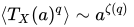
at least in some range of scales and for some range of orders . When such behaviour is observed, one talks of scale invariance, self-similarity, or multiscaling.[13]

Estimation
[edit]
Using so-called multifractal formalism, it can be shown that, under some well-suited assumptions, there exists a correspondence between the singularity spectrum and the multi-scaling exponents through a Legendre transform. While the determination of calls for some exhaustive local analysis of the data, which would result in difficult and numerically unstable calculations, the estimation of the relies on the use of statistical averages and linear regressions in log-log diagrams. Once the are known, one can deduce an estimate of thanks to a simple Legendre transform.[citation needed]


Multifractal systems are often modeled by stochastic processes such as multiplicative cascades. The are statistically interpreted, as they characterize the evolution of the distributions of the as goes from larger to smaller scales. This evolution is often called statistical intermittency and betrays a departure from Gaussian models.[citation needed]
Modelling as a multiplicative cascade also leads to estimation of multifractal properties.[14] This methods works reasonably well, even for relatively small datasets. A maximum likely fit of a multiplicative cascade to the dataset not only estimates the complete spectrum but also gives reasonable estimates of the errors.[15]
Estimating multifractal scaling from box counting
[edit]
Multifractal spectra can be determined from box counting on digital images. First, a box counting scan is done to determine how the pixels are distributed; then, this "mass distribution" becomes the basis for a series of calculations.[16][17][18] The chief idea is that for multifractals, the probability of a number of pixels , appearing in a box , varies as box size , to some exponent , which changes over the image, as in Eq.0.0 (NB: For monofractals, in contrast, the exponent does not change meaningfully over the set). is calculated from the box-counting pixel distribution as in Eq.2.0.


| Eq.0.0 |
![{\displaystyle P_{[i,\epsilon ]}\varpropto \epsilon ^{-\alpha _{i}}\therefore \alpha _{i}\varpropto {\frac {\log {P_{[i,\epsilon ]}}}{\log {\epsilon ^{-1}}}}}](https://wikimedia.org/api/rest_v1/media/math/render/svg/9e97bfe3ff8c81b18b774473f4ca5d83b6250a07)
- = an arbitrary scale (box size in box counting) at which the set is examined
- = the index for each box laid over the set for an
- = the number of pixels or mass in any box, , at size
![{\displaystyle m_{[i,\epsilon ]}}](https://wikimedia.org/api/rest_v1/media/math/render/svg/2db32fb4e65009388bfd26d67035d5870c2c3a3a)
- = the total boxes that contained more than 0 pixels, for each

| the total mass or sum of pixels in all boxes for this | Eq.1.0 |
![{\displaystyle M_{\epsilon }=\sum _{i=1}^{N_{\epsilon }}m_{[i,\epsilon ]}=}](https://wikimedia.org/api/rest_v1/media/math/render/svg/91a5f662cff6fa277040d412ef144b0c872f9694)
| the probability of this mass at relative to the total mass for a box size | Eq.2.0 |
![{\displaystyle P_{[i,\epsilon ]}={\frac {m_{[i,\epsilon ]}}{M_{\epsilon }}}=}](https://wikimedia.org/api/rest_v1/media/math/render/svg/4a182e87cbf7d0bb9f2f0ef50d9b8c2241900b93)
is used to observe how the pixel distribution behaves when distorted in certain ways as in Eq.3.0 and Eq.3.1:
- = an arbitrary range of values to use as exponents for distorting the data set

| the sum of all mass probabilities distorted by being raised to this Q, for this box size | Eq.3.0 |
![{\displaystyle I_{{(Q)}_{[\epsilon ]}}=\sum _{i=1}^{N_{\epsilon }}{P_{[i,\epsilon ]}^{Q}}=}](https://wikimedia.org/api/rest_v1/media/math/render/svg/ccdad9d257ba78ca07a4f185a46452f5bcfe700e)
- When , Eq.3.0 equals 1, the usual sum of all probabilities, and when , every term is equal to 1, so the sum is equal to the number of boxes counted, .


| how the distorted mass probability at a box compares to the distorted sum over all boxes at this box size | Eq.3.1 |
![{\displaystyle \mu _{{(Q)}_{[i,\epsilon ]}}={\frac {P_{[i,\epsilon ]}^{Q}}{I_{{(Q)}_{[\epsilon ]}}}}=}](https://wikimedia.org/api/rest_v1/media/math/render/svg/791c157652fc0f03843f3cd31e5ee9f712eaec2b)
These distorting equations are further used to address how the set behaves when scaled or resolved or cut up into a series of -sized pieces and distorted by Q, to find different values for the dimension of the set, as in the following:

| Eq.4.0 |
![{\displaystyle I_{{(Q)}_{[\epsilon ]}}\varpropto \epsilon ^{\tau _{(Q)}}}](https://wikimedia.org/api/rest_v1/media/math/render/svg/7a47331d682faa6af2565fe832fca86acbf382dc)
Thus, a series of values for can be found from the slopes of the regression line for the log of Eq.3.0 versus the log of for each , based on Eq.4.1:

| Eq.4.1 |
![{\displaystyle \tau _{(Q)}={\lim _{\epsilon \to 0}{\left[{\frac {\log {I_{{(Q)}_{[\epsilon ]}}}}{\log {\epsilon }}}\right]}}}](https://wikimedia.org/api/rest_v1/media/math/render/svg/624e099f61c28bd7589ab61625e8b90222d7baf9)
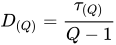
- For the generalized dimension:
| Eq.5.0 |
![{\displaystyle D_{(Q)}={\lim _{\epsilon \to 0}{\left[{\frac {\log {I_{{(Q)}_{[\epsilon ]}}}}{\log {\epsilon ^{-1}}}}\right]}}{(1-Q)^{-1}}}](https://wikimedia.org/api/rest_v1/media/math/render/svg/2b65746597df80c0082dae6401d2b082f1a8beff)
| Eq.5.1 |
| Eq.5.2 |

| Eq.5.3 |

- is estimated as the slope of the regression line for versus where:


| Eq.6.0 |
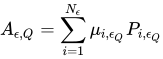
- Then is found from Eq.5.3.

- The mean is estimated as the slope of the log-log regression line for versus , where:
![{\displaystyle \tau _{{(Q)}_{[\epsilon ]}}}](https://wikimedia.org/api/rest_v1/media/math/render/svg/631a0ea5b1c883d812ed0e4ce021f5240ac8a511)
| Eq.6.1 |
![{\displaystyle \tau _{(Q)_{[\epsilon ]}}={\frac {\sum _{i=1}^{N_{\epsilon }}{P_{[i,\epsilon ]}^{Q-1}}}{N_{\epsilon }}}}](https://wikimedia.org/api/rest_v1/media/math/render/svg/23ea29fbe1c8eac124f456988e31bb9f0de46d65)
In practice, the probability distribution depends on how the dataset is sampled, so optimizing algorithms have been developed to ensure adequate sampling.[16]
Applications
[edit]Multifractal analysis has been successfully used in many fields, including physical,[19][20] information, and biological sciences.[21] For example, the quantification of residual crack patterns on the surface of reinforced concrete shear walls.[22]
Dataset distortion analysis
[edit]

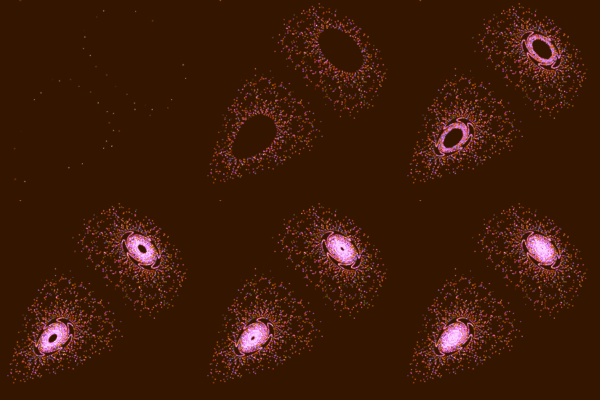
Multifractal analysis has been used in several scientific fields to characterize various types of datasets.[23] In essence, multifractal analysis applies a distorting factor to datasets extracted from patterns, to compare how the data behave at each distortion. This is done using graphs known as multifractal spectra, analogous to viewing the dataset through a "distorting lens", as shown in the illustration.[16] Several types of multifractal spectra are used in practise.
DQ vs Q
[edit]

One practical multifractal spectrum is the graph of DQ vs Q, where DQ is the generalized dimension for a dataset and Q is an arbitrary set of exponents. The expression generalized dimension thus refers to a set of dimensions for a dataset (detailed calculations for determining the generalized dimension using box counting are described below).
Dimensional ordering
[edit]The general pattern of the graph of DQ vs Q can be used to assess the scaling in a pattern. The graph is generally decreasing, sigmoidal around Q=0, where D(Q=0) ≥ D(Q=1) ≥ D(Q=2). As illustrated in the figure, variation in this graphical spectrum can help distinguish patterns. The image shows D(Q) spectra from a multifractal analysis of binary images of non-, mono-, and multi-fractal sets. As is the case in the sample images, non- and mono-fractals tend to have flatter D(Q) spectra than multifractals.
The generalized dimension also gives important specific information. D(Q=0) is equal to the capacity dimension, which—in the analysis shown in the figures here—is the box counting dimension. D(Q=1) is equal to the information dimension, and D(Q=2) to the correlation dimension. This relates to the "multi" in multifractal, where multifractals have multiple dimensions in the D(Q) versus Q spectra, but monofractals stay rather flat in that area.[16][17]
f(α) versus α
[edit]Another useful multifractal spectrum is the graph of versus (see calculations). These graphs generally rise to a maximum that approximates the fractal dimension at Q=0, and then fall. Like DQ versus Q spectra, they also show typical patterns useful for comparing non-, mono-, and multi-fractal patterns. In particular, for these spectra, non- and mono-fractals converge on certain values, whereas the spectra from multifractal patterns typically form humps over a broader area.

Generalized dimensions of species abundance distributions in space
[edit]One application of Dq versus Q in ecology is characterizing the distribution of species. Traditionally the relative species abundances is calculated for an area without taking into account the locations of the individuals. An equivalent representation of relative species abundances are species ranks, used to generate a surface called the species-rank surface,[24] which can be analyzed using generalized dimensions to detect different ecological mechanisms like the ones observed in the neutral theory of biodiversity, metacommunity dynamics, or niche theory.[24][25]
See also
[edit]- de Rham curve – Continuous fractal curve obtained as the image of Cantor space
- Fractional Brownian motion – Probability theory concept
- Detrended fluctuation analysis – Method to detect power-law scaling in time series
- Tweedie distributions – Family of probability distributions
- Markov switching multifractal
References
[edit]- ^ Harte, David (2001). Multifractals. London: Chapman & Hall. ISBN 978-1-58488-154-4.
- ^ Gerges, Firas; Geng, Xiaolong; Nassif, Hani; Boufadel, Michel C. (2021). "Anisotropic Multifractal Scaling of Mount Lebanon Topography: Approximate Conditioning". Fractals. 29 (5): 2150112–2153322. Bibcode:2021Fract..2950112G. doi:10.1142/S0218348X21501127. ISSN 0218-348X. S2CID 234272453.
- ^ Gaston, Kevin J.; Richard Inger; Bennie, Jonathan; Davies, Thomas W. (2013-04-24). "Artificial light alters natural regimes of night-time sky brightness". Scientific Reports. 3 1722. Bibcode:2013NatSR...3.1722D. doi:10.1038/srep01722. ISSN 2045-2322. PMC 3634108.
- ^ Mandelbrot, Benoit B. (1983). The fractal geometry of nature. Internet Archive. San Francisco: W.H. Freeman. ISBN 978-0-7167-1186-5.
- ^ Kendal, WS; Jørgensen, BR (2011). "Tweedie convergence: a mathematical basis for Taylor's power law, 1/f noise and multifractality". Phys. Rev. E. 84 (6 Pt 2) 066120. Bibcode:2011PhRvE..84f6120K. doi:10.1103/physreve.84.066120. PMID 22304168.
- ^ Jørgensen, B; Kokonendji, CC (2011). "Dispersion models for geometric sums". Braz J Probab Stat. 25 (3): 263–293. doi:10.1214/10-bjps136.
- ^ Kendal, WS (2014). "Multifractality attributed to dual central limit-like convergence effects". Physica A. 401: 22–33. Bibcode:2014PhyA..401...22K. doi:10.1016/j.physa.2014.01.022.
- ^ Xiao, Xiongye; Chen, Hanlong; Bogdan, Paul (25 November 2021). "Deciphering the generating rules and functionalities of complex networks". Scientific Reports. 11 (1): 22964. Bibcode:2021NatSR..1122964X. doi:10.1038/s41598-021-02203-4. PMC 8616909. PMID 34824290. S2CID 244660272.
- ^ Lopes, R.; Betrouni, N. (2009). "Fractal and multifractal analysis: A review". Medical Image Analysis. 13 (4): 634–649. doi:10.1016/j.media.2009.05.003. PMID 19535282.
- ^ Moreno, P. A.; Vélez, P. E.; Martínez, E.; Garreta, L. E.; Díaz, N. S.; Amador, S.; Tischer, I.; Gutiérrez, J. M.; Naik, A. K.; Tobar, F. N.; García, F. (2011). "The human genome: A multifractal analysis". BMC Genomics. 12 506. doi:10.1186/1471-2164-12-506. PMC 3277318. PMID 21999602.
- ^ Atupelage, C.; Nagahashi, H.; Yamaguchi, M.; Sakamoto, M.; Hashiguchi, A. (2012). "Multifractal feature descriptor for histopathology". Analytical Cellular Pathology. 35 (2): 123–126. doi:10.1155/2012/912956. PMC 4605731. PMID 22101185.
- ^ Falconer, Kenneth J. (2014). "17. Multifractal measures". Fractal geometry: mathematical foundations and applications (3. ed., 1. publ ed.). Chichester: Wiley. ISBN 978-1-119-94239-9.
- ^ Roberts, A.J.; Cronin, A. (1996). "Unbiased estimation of multi-fractal dimensions of finite data sets". Physica A. 233 (3): 867–878. arXiv:chao-dyn/9601019. Bibcode:1996PhyA..233..867R. doi:10.1016/S0378-4371(96)00165-3. S2CID 14388392.
- ^ Roberts & Cronin 1996.
- ^ Roberts, A. J. (7 August 2014). "Multifractal estimation—maximum likelihood". University of Adelaide. Retrieved 4 June 2019.
- ^ a b c d Karperien, A (2002), What are Multifractals?, ImageJ, archived from the original on 2011-10-20, retrieved 2012-02-10
- ^ a b Chhabra, A.; Jensen, R. (1989). "Direct determination of the f(α) singularity spectrum". Physical Review Letters. 62 (12): 1327–1330. Bibcode:1989PhRvL..62.1327C. doi:10.1103/PhysRevLett.62.1327. PMID 10039645.
- ^ Posadas, A. N. D.; Giménez, D.; Bittelli, M.; Vaz, C. M. P.; Flury, M. (2001). "Multifractal Characterization of Soil Particle-Size Distributions". Soil Science Society of America Journal. 65 (5): 1361. Bibcode:2001SSASJ..65.1361P. doi:10.2136/sssaj2001.6551361x.
- ^ Amin, Kazi Rafsanjani; Nagarajan, Ramya; Pandit, Rahul; Bid, Aveek (2022-10-26). "Multifractal Conductance Fluctuations in High-Mobility Graphene in the Integer Quantum Hall Regime". Physical Review Letters. 129 (18) 186802. arXiv:2112.14018. Bibcode:2022PhRvL.129r6802A. doi:10.1103/PhysRevLett.129.186802. PMID 36374690. S2CID 245537293.
- ^ Amin, Kazi Rafsanjani; Ray, Samriddhi Sankar; Pal, Nairita; Pandit, Rahul; Bid, Aveek (2018-02-22). "Exotic multifractal conductance fluctuations in graphene". Communications Physics. 1 (1) 1: 1–7. arXiv:1804.04454. Bibcode:2018CmPhy...1....1A. doi:10.1038/s42005-017-0001-4. ISSN 2399-3650. S2CID 55555526.
- ^ Lopes, R.; Betrouni, N. (2009). "Fractal and multifractal analysis: A review". Medical Image Analysis. 13 (4): 634–649. doi:10.1016/j.media.2009.05.003. PMID 19535282.
- ^ Ebrahimkhanlou, Arvin; Farhidzadeh, Alireza; Salamone, Salvatore (2016-01-01). "Multifractal analysis of crack patterns in reinforced concrete shear walls". Structural Health Monitoring. 15 (1): 81–92. doi:10.1177/1475921715624502. ISSN 1475-9217. S2CID 111619405.
- ^ Trevino, J.; Liew, S. F.; Noh, H.; Cao, H.; Dal Negro, L. (2012). "Geometrical structure, multifractal spectra and localized optical modes of aperiodic Vogel spirals". Optics Express. 20 (3): 3015–33. Bibcode:2012OExpr..20.3015T. doi:10.1364/OE.20.003015. PMID 22330539.
- ^ a b Saravia, Leonardo A. (2015-08-01). "A new method to analyse species abundances in space using generalized dimensions". Methods in Ecology and Evolution. 6 (11): 1298–1310. Bibcode:2015MEcEv...6.1298S. doi:10.1111/2041-210X.12417. ISSN 2041-210X.
- ^ Saravia, Leonardo A. (2014-01-01). "mfSBA: Multifractal analysis of spatial patterns in ecological communities". F1000Research. 3: 14. doi:10.12688/f1000research.3-14.v2. PMC 4197745. PMID 25324962.
Further reading
[edit]- Falconer, Kenneth J. (2014). "17. Multifractal measures". Fractal geometry: mathematical foundations and applications (3. ed., 1. publ ed.). Chichester: Wiley. ISBN 978-1-119-94239-9.
- Barabási, A.- L.; Stanley, H. E., eds. (1995), "Multi-affine surfaces", Fractal Concepts in Surface Growth, Cambridge: Cambridge University Press, pp. 262–268, doi:10.1017/CBO9780511599798.026, ISBN 978-0-521-48318-6, retrieved 2024-06-05
- G, Evertsz C. J.; Mandelbrot, Benoît B. (1992). "Multifractal measures" (PDF). Chaos and Fractals New Frontiers of Science: 922–953. Archived from the original (PDF) on 2023-07-13.
- Mandelbrot, Benoît B. (1997). Fractals and scaling in finance: discontinuity, concentration, risk. Selecta. New York, NY Berlin Heidelberg: Springer. ISBN 978-0-387-98363-9.
- Harte, David (2001-06-26). Multifractals. Chapman and Hall/CRC. doi:10.1201/9781420036008. ISBN 978-0-429-12366-5.
- Stanley H.E., Meakin P. (1988). "Multifractal phenomena in physics and chemistry" (Review). Nature. 335 (6189): 405–9. Bibcode:1988Natur.335..405S. doi:10.1038/335405a0. S2CID 4318433.
- Arneodo, Alain; Audit, Benjamin; Kestener, Pierre; Roux, Stephane (2008). "Wavelet-based multifractal analysis". Scholarpedia. 3 (3): 4103. Bibcode:2008SchpJ...3.4103A. doi:10.4249/scholarpedia.4103. ISSN 1941-6016.