


Community hub
Recent from talks
Contribute something
Nothing was collected or created yet.
Fractal landscape
View on Wikipedia
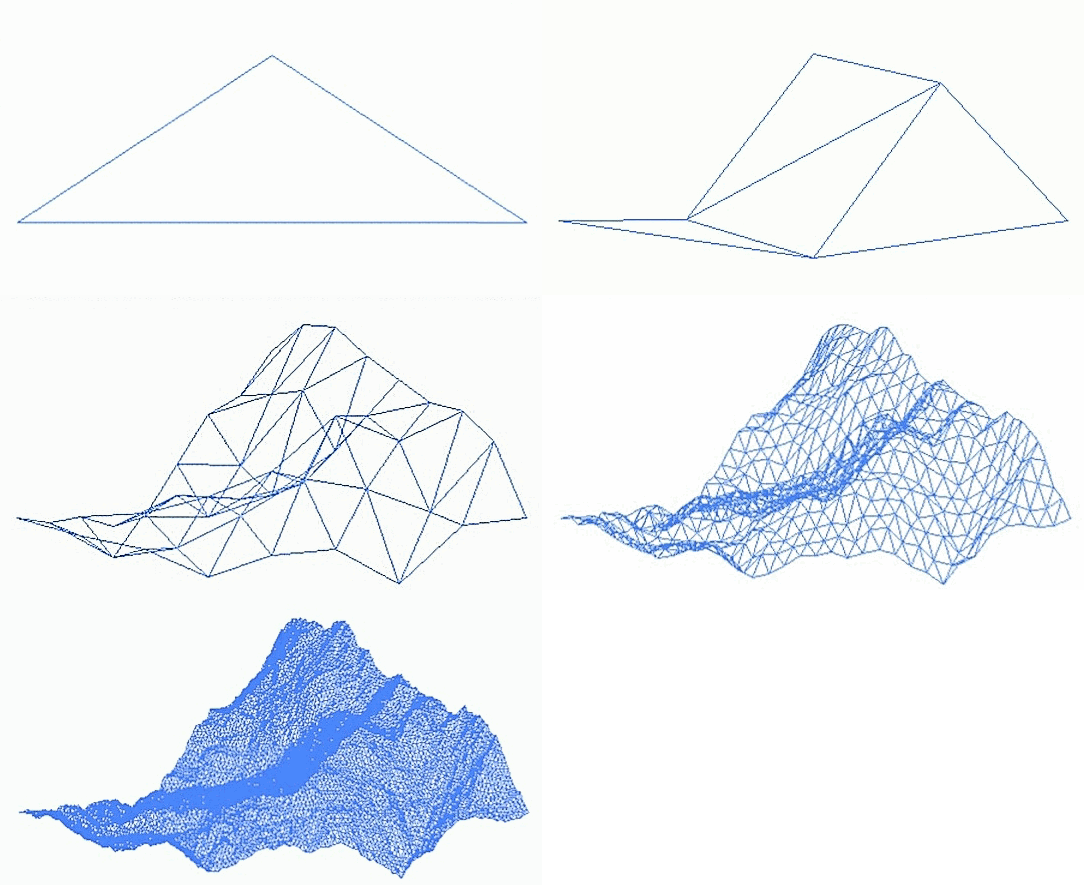
A fractal landscape or fractal surface is generated using a stochastic algorithm designed to produce fractal behavior that mimics the appearance of natural terrain. In other words, the surface resulting from the procedure is not a deterministic, but rather a random surface that exhibits fractal behavior.[1]
Many natural phenomena exhibit some form of statistical self-similarity that can be modeled by fractal surfaces.[2] Moreover, variations in surface texture provide important visual cues to the orientation and slopes of surfaces, and the use of almost self-similar fractal patterns can help create natural looking visual effects.[3] The modeling of the Earth's rough surfaces via fractional Brownian motion was first proposed by Benoit Mandelbrot.[4]
Because the intended result of the process is to produce a landscape, rather than a mathematical function, processes are frequently applied to such landscapes that may affect the stationarity and even the overall fractal behavior of such a surface, in the interests of producing a more convincing landscape.
According to R. R. Shearer, the generation of natural looking surfaces and landscapes was a major turning point in art history, where the distinction between geometric, computer generated images and natural, man made art became blurred.[5] The first use of a fractal-generated landscape in a film was in 1982 for the movie Star Trek II: The Wrath of Khan. Loren Carpenter refined the techniques of Mandelbrot to create an alien landscape.[6]
Behavior of natural landscapes
[edit]


Whether or not natural landscapes behave in a generally fractal manner has been the subject of some research. Technically speaking, any surface in three-dimensional space has a topological dimension of 2, and therefore any fractal surface in three-dimensional space has a Hausdorff dimension between 2 and 3.[7] Real landscapes however, have varying behavior at different scales. This means that an attempt to calculate the 'overall' fractal dimension of a real landscape can result in measures of negative fractal dimension, or of fractal dimension above 3. In particular, many studies of natural phenomena, even those commonly thought to exhibit fractal behavior, do not do so over more than a few orders of magnitude. For instance, Richardson's examination of the western coastline of Britain showed fractal behavior of the coastline over only two orders of magnitude.[8] In general, there is no reason to suppose that the geological processes that shape terrain on large scales (for example plate tectonics) exhibit the same mathematical behavior as those that shape terrain on smaller scales (for instance, soil creep).
Real landscapes also have varying statistical behavior from place to place, so for example sandy beaches don't exhibit the same fractal properties as mountain ranges. A fractal function, however, is statistically stationary, meaning that its bulk statistical properties are the same everywhere. Thus, any real approach to modeling landscapes requires the ability to modulate fractal behavior spatially. Additionally, real landscapes have very few natural minima (most of these are lakes), whereas a fractal function has as many minima as maxima, on average. Real landscapes also have features originating with the flow of water and ice over their surface, which simple fractals cannot model.[9]
It is because of these considerations that the simple fractal functions are often inappropriate for modeling landscapes. More sophisticated techniques (known as 'multi-fractal' techniques) use different fractal dimensions for different scales, and thus can better model the frequency spectrum behavior of real landscapes[10]
Generation of fractal landscapes
[edit]A way to make such a landscape is to employ the random midpoint displacement algorithm, in which a square is subdivided into four smaller equal squares and the center point is vertically offset by some random amount. The process is repeated on the four new squares, and so on, until the desired level of detail is reached. There are many fractal procedures (such as combining multiple octaves of Simplex noise) capable of creating terrain data, however, the term "fractal landscape" has become more generic over time.
Fractal plants
[edit]See also
[edit]Notes
[edit]- ^ "The Fractal Geometry of Nature".
- ^ Advances in multimedia modeling: 13th International Multimedia Modeling by Tat-Jen Cham 2007 ISBN 3-540-69428-5 page [1]
- ^ Human symmetry perception and its computational analysis by Christopher W. Tyler 2002 ISBN 0-8058-4395-7 pages 173–177 [2]
- ^ Dynamics of Fractal Surfaces by Fereydoon Family and Tamas Vicsek 1991 ISBN 981-02-0720-4 page 45 [3]
- ^ Rhonda Roland Shearer "Rethinking Images and Metaphors" in The languages of the brain by Albert M. Galaburda 2002 ISBN 0-674-00772-7 pages 351–359 [4]
- ^ Briggs, John (1992). Fractals: The Patterns of Chaos : a New Aesthetic of Art, Science, and Nature. Simon and Schuster. p. 84. ISBN 978-0671742171. Retrieved 15 June 2014.
- ^ Lewis
- ^ Richardson
- ^ Ken Musgrave, 1993
- ^ Joost van Lawick van Pabst et al.
- ^ de la Re, Armando; Abad, Francisco; Camahort, Emilio; Juan, M. C. (2009). "Tools for Procedural Generation of Plants in Virtual Scenes" (PDF). Computational Science – ICCS 2009. Lecture Notes in Computer Science. Vol. 5545. pp. 801–810. doi:10.1007/978-3-642-01973-9_89. ISBN 978-3-642-01972-2. S2CID 33892094.
References
[edit]- Lewis, J.P. "Is the Fractal Model Appropriate for Terrain?" (PDF).
- Richardson, L.F. (1961). "The Problem of Continuity". General Systems Yearbook. 6: 139–187.
- van Lawick van Pabst, Joost; Jense, Hans (2001). "Dynamic Terrain Generation Based on Multifractal Techniques" (PDF). Archived from the original (PDF) on 2011-07-24.
- Musgrave, Ken (1993). "Methods for Realistic Landscape Imaging" (PDF).
External links
[edit]- A Web-Wide World by Ken Perlin, 1998; a Java applet showing a sphere with a generated landscape.
Fractal landscape
View on GrokipediaFundamentals
Definition and Characteristics
A fractal landscape refers to a surface, either procedurally generated or derived from natural observations, that exhibits fractal geometry characterized by roughness and irregularity persisting across multiple scales.[6] These landscapes model terrains such as mountains or valleys using stochastic processes that produce self-affine structures, mimicking the complexity of real-world topography without relying on deterministic shapes.[7] Key characteristics of fractal landscapes include statistical self-similarity, where patterns appear roughly invariant under scaling transformations, and non-integer fractal dimensions typically ranging between 2 and 3 for two-dimensional surfaces embedded in three-dimensional space.[6] The fractal dimension quantifies the surface's roughness, with values closer to 2 indicating smoother planes and those approaching 3 suggesting highly convoluted forms that nearly fill volume.[6] Additionally, these landscapes display statistical irregularity, ensuring that no two regions are identical but overall properties remain consistent across scales.[7] In contrast to Euclidean landscapes, which consist of smooth curves and integer-dimensional primitives like polygons or splines, fractal landscapes lack finite resolution and reveal increasing detail upon magnification, theoretically extending to infinite intricacy.[6] This property arises from their self-affine nature, where horizontal and vertical scales transform differently, preventing the simplification seen in traditional geometric models.[6] Visually, fractal landscapes can represent mountain ranges with jagged peaks that retain similar ridgeline complexity at both broad overviews and close inspections, unlike coarse polygonal approximations that appear blocky at finer resolutions.[7] Similarly, fractal-rendered coastlines exhibit meandering irregularity that persists from continental scales to bays, contrasting with simplified vector outlines. Fractal landscapes bridge mathematics and visual arts by providing a rigorous framework for depicting realistic terrains, enabling artists and scientists to generate or analyze forms that capture nature's inherent complexity through geometric principles.Mathematical Foundations
Fractal geometry, pioneered by Benoit Mandelbrot, provides a mathematical framework for describing irregular, scale-invariant structures prevalent in natural landscapes, extending beyond traditional Euclidean geometry to incorporate fractional dimensions that quantify complexity in non-integer terms.[8] Mandelbrot introduced the term "fractal" in 1975 to denote sets whose dimension exceeds their topological dimension, enabling the modeling of rough surfaces like terrain where fine-scale details resemble larger patterns.[9] This concept of fractional dimension, often between 2 and 3 for landscape surfaces, captures the infinite detail and self-similarity that characterize fractal landscapes.[8] A key measure in fractal geometry is the Hausdorff dimension, which for practical computations in landscapes is approximated by the box-counting dimension. The formula is given by where represents the minimum number of boxes of side length needed to cover the fractal set.[10] This dimension typically ranges from 2 to 3 for landscape surfaces, reflecting their surface roughness and volume-filling properties.[11] Self-similarity is a foundational property of fractals, where the structure remains invariant under scaling, achieved through iterative processes that apply simple transformation rules repeatedly. For instance, the Koch curve begins with a straight line segment and iteratively replaces the middle third with two segments forming an equilateral triangle, yielding a fractal curve of dimension .[12] This one-dimensional construction extends to two-dimensional surfaces in landscape modeling by applying similar iterative subdivisions to generate height fields that exhibit self-similarity across scales.[13] In fractal landscapes, height variations follow power-law scaling, where the variance of height differences over a distance scales as , with being the Hurst exponent ranging from 0 to 1, where lower values indicate rougher, more jagged terrain.[14] This scaling arises from the statistical self-affinity of the surface, distinguishing it from isotropic fractals.[15] Fractional Brownian motion (fBm), introduced by Mandelbrot and Van Ness, formalizes this behavior as a Gaussian process with stationary increments and Hurst parameter , generalizing standard Brownian motion (where ) to produce correlated height fields suitable for terrain simulation.[16] In fBm, the expected squared increment satisfies , enabling the generation of scale-invariant landscapes with controllable roughness.[17]Natural and Observed Fractality
Fractal Properties in Real Landscapes
Natural landscapes often exhibit fractal-like properties, characterized by self-similarity across multiple scales, as observed in empirical studies of coastlines and mountain ranges. For instance, the west coast of Britain displays a fractal dimension of approximately 1.25, indicating a degree of irregularity between a smooth line (dimension 1) and a plane (dimension 2).[18] Similarly, mountain topographies typically show fractal dimensions around 2.3, reflecting the rough, self-affine surfaces formed by elevated terrains that persist over scales from kilometers to meters.[19] These dimensions quantify the complexity of landscape features, where higher values denote greater roughness and branching patterns akin to idealized fractals. The emergence of fractal patterns in real landscapes arises from dynamic geological processes that generate self-similar structures across scales. Erosion by wind, water, and ice sculpts surfaces into intricate forms, while tectonic forces uplift and fracture rock, creating hierarchical patterns from large faults to micro-cracks.[20] Weathering further amplifies this by breaking down materials unevenly, producing dendritic drainage networks and ridgelines that repeat at micro (e.g., soil particles) to macro (e.g., valley systems) levels. These processes, often chaotic and nonlinear, foster the scale-invariant behaviors central to fractality without requiring perfect repetition. A classic case study illustrating these properties is the coastline paradox, first quantified by Lewis Fry Richardson and later analyzed by Benoit Mandelbrot. Richardson demonstrated that measurements of Britain's coastline length increase indefinitely with finer map scales, as smaller indentations reveal additional complexity, challenging traditional Euclidean geometry.[18] This implies profound effects on map scaling, where perceived lengths vary by orders of magnitude depending on resolution, highlighting how fractal irregularity defies fixed boundaries in geographic surveys. Elevation data from natural landscapes further reveal fractal signatures through statistical properties like autocorrelation, which indicates long-range dependencies in height variations. In topographic profiles, positive autocorrelation persists over large distances, with Hurst exponents typically between 0.5 and 0.8, signifying persistent trends that align with fractional Brownian motion models of fractals.[21] Such dependencies underscore the non-random, scale-spanning correlations in real terrains. However, fractal properties in nature represent approximations rather than infinite ideals, with deviations occurring at extreme scales due to physical limits. At very small scales (e.g., atomic levels), quantum effects and material discreteness halt self-similarity, while at large scales (e.g., continental or global), uniform forces like gravity impose smoothness.[22] These constraints mean real landscapes are multifractal or quasi-fractal, blending self-similarity with scale-dependent variations driven by local conditions.Measurement and Analysis Techniques
The box-counting method, also known as Minkowski-Bouligand dimension estimation, is a widely used technique to quantify the fractal dimension of landscapes by assessing self-similarity across scales. To apply it to satellite imagery or digital elevation models (DEMs), the process begins by selecting a region of interest and rasterizing the data into a binary or grayscale image representing terrain features such as contours or elevation thresholds. A series of square boxes of varying sizes ε (typically ranging from the pixel resolution to the full image extent) are then overlaid onto the image in a grid fashion. For each box size, the number of boxes N(ε) that intersect with the landscape feature (e.g., containing non-zero elevation values or edge pixels) is counted. The fractal dimension D is estimated from the slope of the linear regression on a log-log plot: log N(ε) versus log (1/ε), where D = -slope, typically yielding values between 2 and 3 for 2D terrain surfaces. This method has been applied to DEMs to reveal fractal dimensions around 2.5 for natural hillslopes, indicating moderate roughness.[23] Spectral analysis employs Fourier transforms to examine the power spectrum of terrain data, identifying 1/f noise as a signature of fractal scaling in landscapes. The process involves applying a two-dimensional fast Fourier transform (FFT) to a DEM or elevation profile to obtain the amplitude spectrum, followed by computing the power spectral density P(f) as a function of spatial frequency f. For fractal terrains modeled as fractional Brownian motion, the spectrum exhibits 1/f^β scaling, where β = 2H + 2 (H being the Hurst exponent), with β values near 2.8 observed in high-resolution DEMs of coastal terrains before deviations at finer scales due to non-fractal structures like ridge-valley patterns. Peaks in the spectrum exceeding statistical significance (e.g., 95% confidence) indicate characteristic scales that break pure fractal behavior, as seen in analyses of Gabilan Mesa topography. This approach confirms fractality when power decays inversely with frequency over multiple octaves, distinguishing self-affine landscapes from white noise (β=0).[24] The Hurst exponent H, a measure of long-range dependence in fractal processes, is estimated using rescaled range (R/S) analysis on time-series or profile data extracted from terrain elevations. The method proceeds by dividing the elevation series into subseries of length n, computing the cumulative deviation from the mean for each, then calculating the range R (maximum minus minimum deviation) and standard deviation S of the original subseries. The rescaled range statistic is R/S for each n, and H is the slope of the log-log regression: R/S ∝ n^H, with H=0.5 for random walks, H>0.5 indicating persistence (rougher fractals), and H<0.5 anti-persistence. Applied to 1D elevation transects from DEMs, this yields H values of 0.6–0.8 for undulating hillslopes, linking to fractal dimensions via D = 2 - H for profiles. Validation on synthetic fractional Brownian surfaces ensures robustness for real terrain data.[23][14] Variogram modeling, rooted in geostatistics, quantifies spatial dependence in landscape elevation data to infer fractal properties through power-law behavior. The semivariogram γ(h) is defined as where Z(x) is elevation at location x, h is the lag distance, and the expectation is over all pairs separated by h. For fractal surfaces, γ(h) ∝ h^{2H} at small h, with the exponent relating to the Hurst parameter and thus fractal dimension D = 3 - H in 3D. Empirical variograms are computed from DEM point pairs in multiple directions, then fitted to models like spherical or power-law forms using least-squares optimization in geostatistical software. This has revealed H ≈ 0.7 (D ≈ 2.3) for fragmented agricultural landscapes, capturing scale-invariant variability.[23] Despite these techniques, measuring fractal dimensions in real landscapes faces significant challenges, including resolution limits that cause underestimation at coarse scales (e.g., MODIS data yielding D < 2.5 versus finer IKONOS > 2.8) and overestimation from interpolation artifacts. Anisotropy, arising from directional geological processes like faulting, requires omnidirectional or rotated variogram fitting to avoid biased H estimates, often increasing computational demands. Software validation is essential; tools like MATLAB's Image Processing Toolbox for box-counting or ArcGIS Geostatistical Analyst for variograms must be tested on synthetic fractals to confirm accuracy within 5% error, as discrepancies exceed 0.2 in D for uncalibrated implementations.[25][23]Synthetic Generation
Algorithmic Approaches
Algorithmic approaches to synthetic fractal landscape generation primarily rely on procedural methods that approximate self-similar roughness across scales, often parameterized by the Hurst exponent (where ) to control terrain irregularity. These methods generate heightmaps on a grid, starting from coarse elevations and refining details through recursion or spectral techniques, enabling efficient computation for large terrains. Seminal work by Fournier, Fussell, and Carpenter introduced key approximations to fractional Brownian motion (fBm), the foundational stochastic model for such landscapes, using recursive subdivision and spectral synthesis.[7] The midpoint displacement algorithm performs recursive subdivision of a grid to simulate fBm-like roughness. It begins with a coarse grid of corner points set to initial heights, then iteratively finds the midpoint of each edge and displaces its height by a random value drawn from a Gaussian distribution with standard deviation , where is the current grid segment size, is the Hurst exponent, and is a scaling factor akin to lacunarity that adjusts roughness persistence. This process continues until the desired resolution is reached, with displacement variance halving at each finer level to maintain fractal scaling. The method is computationally simple but can produce correlated artifacts along grid lines due to its edge-focused recursion.[7] To mitigate artifacts in midpoint displacement, the diamond-square algorithm alternates between "diamond" and "square" steps on a square grid. Starting with four corner heights, the diamond step computes the center of each square by averaging the four surrounding points and adding Gaussian noise scaled by , where is the side length. The square step then fills midpoints of edges using averages of adjacent points plus noise of the same scale. Iterations proceed from coarse to fine grids (e.g., points), with noise amplitude decreasing geometrically to enforce self-similarity. This iterative filling ensures more isotropic roughness, making it suitable for 2D heightmaps representing landscapes.[7] Fractional Brownian motion synthesis employs spectral methods to generate fBm fields directly in the frequency domain, offering exact control over the power-law spectrum . Using the fast Fourier transform (FFT), white noise is transformed into the frequency domain, multiplied by amplitudes scaled as (for 2D), and inverse-transformed to yield a height field with specified .[7][26][27] This approach avoids recursive artifacts and allows efficient generation of large, seamless terrains by tiling spectra, though it requires careful handling of phase randomization for isotropy. It is particularly effective for modeling long-range correlations in natural landforms. Noise-based methods, such as Perlin noise, provide coherent, anisotropic turbulence for fractal landscapes through gradient interpolation. Perlin noise computes a pseudo-random gradient field on a lattice, then interpolates values smoothly using a fade function (e.g., cubic polynomial) to avoid grid discontinuities. To achieve fractal scaling, multiple octaves are summed: , where is the base noise, is the amplitude decay, and frequencies double per octave, yielding an effective for Brownian-like motion. This summation creates multi-scale detail, with 4-8 octaves typically sufficing for visual realism in terrains. Hybrid approaches integrate fractal generation with hydrological models to enforce realistic erosion patterns, such as valleys and rivers. For instance, an initial fBm heightmap is modified by simulating water flow: particles or streamlines trace downhill paths, eroding heights along gradients and depositing sediment to form channels, often using hydraulic erosion equations like , where is height, is discharge, is slope, and is an erosion coefficient. This combines the stochastic roughness of fractals with deterministic geomorphology, producing terrains where rivers naturally carve fractal mountains.[28]Implementation in Software
Open-source libraries provide accessible tools for implementing fractal noise generation in various programming languages, enabling developers to create procedural terrains programmatically. In JavaScript, the noisejs library offers functions for 2D and 3D Perlin and Simplex noise, which can be layered using fractional Brownian motion (fBm) to produce fractal landscapes; for instance, developers can generate a heightmap by summing multiple octaves of noise with decreasing amplitudes, as shown in the library's examples for terrain visualization.[29] Similarly, the fractal-noise-js library extends this capability with built-in fractal summation for efficient noise patterns suitable for web-based applications.[30] For C++, libnoise serves as a portable library for coherent noise generation, including Perlin, ridged multifractal, and billow modules that combine into fBm for terrain heightmaps; a common example involves creating a noise map module and sampling it across a grid to output elevation values, which can then be rendered as a 3D surface.[31] In Python, the fractal-noise package implements fractal Brownian motion directly, allowing users to generate 2D or 3D noise fields with customizable octaves and persistence; an example script might usegenerate_fractal_noise(width, height, octaves=6, persistence=0.5) to produce a grayscale heightmap image for landscape simulation.[32]
Commercial software streamlines fractal landscape creation through node-based workflows and advanced procedural tools, often with built-in parameter tuning for enhanced realism. Terragen, developed by Planetside Software, supports procedural terrains via heightfield and displacement shaders, where users adjust fractal parameters like frequency, gain, and lacunarity to simulate natural erosion and geological features, exporting results for film-quality renders.[33] World Machine employs a graph-based system for building terrains from fractal primitives, enabling iterative refinement through macros that tune noise scales and distortions to match real-world topography, such as varying roughness for mountains versus plains.[34]
GPU acceleration enhances real-time performance for fractal generation, particularly in game engines. In Unity, compute shaders can implement fBm by evaluating multiple noise octaves in parallel on the GPU, as demonstrated in custom HLSL code that samples Perlin noise textures iteratively to generate dynamic terrain meshes at interactive frame rates.[35] Unreal Engine integrates compute shaders via Procedural Content Generation (PCG) graphs, where HLSL nodes compute fractal noise for large-scale terrains, allowing real-time adjustments to parameters like seed and amplitude for immersive environments.[36]
Fractal landscapes are commonly exported as heightmaps in formats like RAW for binary grayscale data or PNG for compressed images with alpha channels, facilitating integration into 3D pipelines. Tools such as libnoise or World Machine can output 16-bit RAW files representing elevation values, which Blender imports via the Displace modifier on a plane mesh subdivided to match the map's resolution, applying the height data as vertex offsets for sculpting or simulation.[37]
Optimization techniques ensure efficient handling of expansive fractal terrains. Level-of-detail (LOD) systems, such as chunked LOD, divide large terrains into hierarchical grids where distant areas use coarser noise sampling and simplified meshes, reducing vertex counts by up to 90% while maintaining visual continuity through seamless stitching.[38] Seeding provides reproducibility by initializing noise generators with a fixed value, ensuring identical fractal patterns across sessions; for example, libraries like noisejs accept a seed parameter in their random number generator to produce deterministic outputs for consistent terrain regeneration.[39]