Hubbry Logo
National Statuary Hall CollectionNational Statuary Hall CollectionMain
Open search
National Statuary Hall Collection
Community hub
National Statuary Hall Collection
logo
8 pages, 0 posts
0 subscribers
Be the first to start a discussion here.
National Statuary Hall Collection
from Wikipedia

Part of the National Statuary Hall Collection.

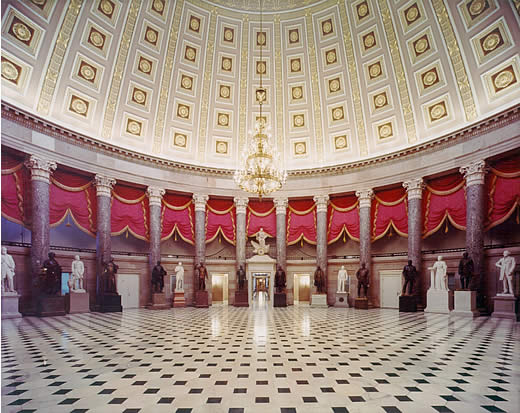
The National Statuary Hall Collection in the United States Capitol is composed of statues donated by individual states to honor persons notable in their history. Limited to two statues per state, the collection was originally set up in the old Hall of the House of Representatives, which was then renamed National Statuary Hall. The expanding collection has since been spread throughout the Capitol and its visitor center.

With the addition of New Mexico's second statue in 2005, the collection is now complete with 100 statues contributed by 50 states, plus two from the District of Columbia (see Statues of the National Statuary Hall Collection). Since Congress authorized replacements in 2000, thirteen states have replaced at least one of their original two statues. In 2022, Kansas became the first state to replace both of its statues; it has been joined by Arkansas and Nebraska.

History

[edit]

The concept of a National Statuary Hall originated in the middle of the nineteenth century, before the completion of the present House wing in 1857. At that time, the House of Representatives moved into its new larger chamber and the old vacant chamber became a thoroughfare between the Rotunda and the House wing. Suggestions for the use of the chamber were made as early as 1853 by Gouverneur Kemble, a former member of the House, who pressed for its use as a gallery of historical paintings. The space between the columns seemed too limited for this purpose, but it was well suited for the display of busts and statuary.

Presiding over the Hall, Carlo Franzoni's 1819 sculptural chariot clock, the Car of History depicts Clio, the Greek muse of history.

On April 19, 1864, Representative Justin S. Morrill asked: "To what end more useful or grand, and at the same time simple and inexpensive, can we devote it [the Chamber] than to ordain that it shall be set apart for the reception of such statuary as each State shall elect to be deserving of in this lasting commemoration?" His proposal to create a National Statuary Hall became law on July 2, 1864:

[...] the President is hereby authorized to invite each and all the States to provide and furnish statues, in marble or bronze, not exceeding two in number for each State, of deceased persons who have been citizens thereof, and illustrious for their historic renown or for distinguished civic or military services such as each State may deem to be worthy of this national commemoration; and when so furnished the same shall be placed in the Old Hall of the House of Representatives, in the Capitol of the United States, which is set apart, or so much thereof as may be necessary, as a national statuary hall for the purpose herein indicated.

Originally, all state statues were placed in National Statuary Hall. However, the aesthetic appearance of the Hall began to suffer from overcrowding until, in 1933, the situation became unbearable. At that time the Hall held 65 statues, which stood, in some cases, three deep. More important, the structure of the chamber would not support the weight of any more statues. Therefore, in 1933 Congress passed a resolution that:

the Architect of the Capitol, upon the approval of the Joint Committee on the Library, with the advice of the Commission of Fine Arts, is hereby authorized and directed to relocate within the Capitol any of the statues already received and placed in Statuary Hall, and to provide for the reception and location of the statues received hereafter from the States.

Under authority of this resolution it was decided that only one statue from each state should be placed in Statuary Hall. The others would be given prominent locations in designated areas and corridors of the Capitol. A second rearrangement of the statues was made in 1976 by authorization of the Joint Committee on the Library. To improve the crowded appearance of the collection, thirty-eight statues were rearranged in Statuary Hall according to height and material. Statues representing ten of the thirteen original colonies were moved to the Central Hall of the East Front Extension on the first floor of the Capitol. The remainder of the statues were distributed throughout the Capitol, mainly in the Hall of Columns and the connecting corridors of the House and Senate wings. Legislation was introduced in 2005 that would authorize the collection to include one statue from each U.S. Territory; it did not pass.[1]

Each statue is the gift of a state, not of an individual or group of citizens. Proceedings for the donation of a statue usually begin in the state legislature with the enactment of a resolution that names the citizen to be commemorated and cites his or her qualifications, specifies a committee or commission to represent the state in selecting the sculptor, and provides for a method of obtaining the necessary funds to carry the resolution into effect. In recent years, the statues have been unveiled during ceremonies in the Rotunda and displayed there for up to six months. They are then moved to a permanent location approved by the Joint Committee on the Library. An act of Congress (2 U.S.C. § 2132), enacted in 2000, permits states to provide replacements and repossess the earlier one.

A special act Archived March 12, 2021, at the Wayback Machine of Congress, Pub. L. 109–116 (text) (PDF), signed on December 1, 2005, directed the Joint Committee on the Library to obtain a statue of Rosa Parks and to place the statue in the United States Capitol in National Statuary Hall in a suitable permanent location. On February 27, 2013, Parks became the first African-American woman to have her likeness in the Hall.[2] Though located in Statuary Hall, Parks' statue is not part of the Collection; neither Alabama (her birth state) nor Michigan (where she lived most of her later years) commissioned it, and both states are represented in the Collection by other statues.

In 2002, Delegate Eleanor Holmes Norton introduced a bill in Congress to allow the District of Columbia to place two statues in the collection, in parity with the 50 states. While the bill was not enacted, the district commissioned two statues, one of abolitionist Frederick Douglass, the other of D.C. master planner Pierre L'Enfant, and housed them in One Judiciary Square in hopes of eventually placing them in the Capitol. A 2010 version of the bill to accept D.C.'s statues stalled after House Republicans began adding amendments in an attempt to soften D.C.'s gun laws.[3] A 2012 compromise bill led to the placement of the statue of Douglass, but not L'Enfant, on June 19, 2013.[4] Norton continued to pursue legislation to move the second statue to the Capitol.[5] The statue of L'Enfant was later placed in the Capitol in February 2022.[6]

Amid national debates about Confederate statues and monuments, Democrats in Congress introduced bills in 2017 to remove statues of people who served in the Confederacy from the National Statuary Hall Collection, but the legislation made no progress.[7][8] Alabama, Florida, Arkansas, and Virginia have passed resolutions to remove statues of individuals with Confederate ties,[9][10][11] although Alabama retained a second statue of a Confederate veteran.[12] North Carolina and Arkansas have authorized replacing statues of Jim Crow-era politicians with racist views.[11][7]

Demographics

[edit]

Women

[edit]

There are fourteen statues of women representing states in the collection:[13][14]

The statue of Rosa Parks in the Capitol does not represent a state and "is not a part of the National Statuary Hall Collection."[19] A statue of Barbara Johns (Virginia) has been authorized.[20]

Native Hawaiian and Native American members

[edit]

The collection includes statues of Hawaiian king Kamehameha I and of seven Native Americans: Popé (New Mexico), Will Rogers (Oklahoma), Sequoyah (Oklahoma), Sacagawea (North Dakota), Washakie (Wyoming), Sarah Winnemucca (Nevada), and Standing Bear (Nebraska).[21] Washington has authorized a statue of Billy Frank Jr.[22]

Members of Hispanic descent

[edit]

Dionisio "Dennis" Chávez, the first person of Hispanic descent to be elected to a full term in the U.S. Senate, represents New Mexico. Saint Junípero Serra, born in Spain, was a Spanish-era founder of the California mission system.

African American members

[edit]

In February 2013, a statue of Rosa Parks was placed as the first full-length statue of an African American in the Capitol. It did not represent a particular state, but was commissioned directly by Congress.[23][24] A few months later, on Juneteenth, 2013, a statue of Frederick Douglass was placed in the Capitol Visitor Center as a gift of the District of Columbia.[4] There are also busts of Martin Luther King Jr. (1986) and Sojourner Truth (2009).[25]

Until 2018, no state had designated an African American as one of its two statues. In March 2018, Florida Governor Rick Scott signed legislation to replace the statue of Edmund Kirby Smith with one of African American educator and civil rights activist Mary McLeod Bethune.[26] The new statue was unveiled July 13, 2022.[27] In April 2019, Arkansas also authorized a statue of Daisy Bates, which was installed in May 2024.[11] In December 2020, Virginia Governor Ralph Northam announced that the statue of Confederate General Robert E. Lee would be replaced by a statue of African American civil rights activist Barbara Johns.[28]

Catholic clergy and nun

[edit]

The collection includes Father Damien from Hawaiʻi, Father Jacques Marquette from Wisconsin, Father Junipero Serra from California, Father Eusebio Kino from Arizona, and Mother Joseph Pariseau from Washington.

Confederates

[edit]

The collection contains several statues of leaders of the Confederate States of America.[29] These include CSA President Jefferson Davis and Vice President Alexander Stephens and Confederate soldiers, most in Confederate Army uniforms: Generals Joseph Wheeler, James Z. George, Wade Hampton III, as well as Colonel Zebulon Baird Vance and former enlisted soldiers John E. Kenna and Edward Douglass White.[29]

Alabama replaced its statue of Confederate politician and army officer Jabez Curry in 2009. In 2018 the Florida legislature voted to replace its statue of Confederate general Edmund Kirby Smith with a statue of African American educator and Civil Rights activist Mary McLeod Bethune; Smith's statue was removed in 2021 ahead of the unveiling of Bethune's statue in 2022.[26][27][30] In 2019, Arkansas decided to replace both its statues, including the one of Uriah M. Rose, with civil rights activist Daisy Bates and Johnny Cash.[31] In 2020, Virginia decided to replace its statue of Robert E. Lee, which had stood in the collection since 1909, with one of Barbara Rose Johns Powell and the Lee statue was removed December 20–21, 2020.[32][33] A statue of Uriah M. Rose, "an attorney who sided with the Confederacy" and was the chancellor of Pulaski County, Arkansas, while Arkansas was part of the Confederacy,[29][11][34] was replaced with a statue of civil rights activist Daisy Bates.

Collection

[edit]

Replacement of statues

[edit]

A 2000 change in the law allows a state to remove a previously placed statue from the collection and replace it with another.[35] Since then, thirteen states have replaced statues and other states have either considered or passed legislation calling for replacing one or both of their statues.

Replacements

[edit]

Replacement pending

[edit]

Considered for replacement

[edit]
  • California: A resolution to replace California's statue of Junípero Serra with one of astronaut Sally Ride passed the state senate in April 2015,[75] but the vote in the state assembly was placed on hold as the date for Serra's canonization as a saint approached.[76][77] Governor Jerry Brown declared in July 2015 that the Serra statue would stay in the Capitol "until the end of time."[78]
  • New Jersey: A bill to replace New Jersey's statue of Philip Kearny with one of suffragist Alice Paul passed the state Senate on February 10, 2020.[79]

Rejected replacements

[edit]

See also

[edit]

References

[edit]
[edit]
Revisions and contributorsEdit on WikipediaRead on Wikipedia
from Grokipedia
The National Statuary Hall Collection consists of 100 statues donated by the 50 states of the United States to the United States Capitol in Washington, D.C., with each state contributing two bronze or marble statues depicting deceased individuals deemed notable in its history. Authorized by an act of Congress on July 2, 1864, the collection honors figures from states' pasts, including statesmen, military leaders, Native American chiefs, and other distinguished citizens, selected by state legislatures or governors. Originally, all statues were placed in the former chamber of the , renamed in 1934, which served as the primary display space until overcrowding and poor acoustics—exacerbated by echoes that hindered speech—prompted redistribution starting in the early . Today, 35 statues remain in , while the rest are positioned in other Capitol areas such as the , Hall of Columns, and rotunda, under the oversight of the Joint Committee on the Library. The collection reflects evolving historical interpretations, with Congress authorizing replacements since 2000 to allow states to substitute statues for more contemporary figures, leading to notable changes like West Virginia's 2015 replacement of Henry Clay with John McCain's father, Admiral John S. McCain Jr., and ongoing efforts by states such as Virginia and Mississippi to remove Confederate-era honorees in favor of civil rights advocates. These shifts highlight debates over representation, though the core purpose remains commemorating state-specific contributions to American history without federal veto over selections beyond design approval.

Origins and Legislative Foundation

Establishment in 1864

The National Statuary Hall Collection was established through legislation enacted on July 2, 1864, which authorized the conversion of the former chamber of the —vacated since 1857—into a dedicated space for state-contributed statues honoring notable deceased citizens. Representative Justin Morrill of sponsored the measure, proposing the hall as a permanent repository to commemorate individuals distinguished by their contributions to American independence, the establishment of the federal government, or the nation's development. The act, codified as section 1814 of the Revised Statutes and later as 2 U.S.C. § 2131, directed the President to invite each of the then-36 states to furnish up to two statues in marble or bronze, with the federal government assuming responsibility for their placement and maintenance in the Capitol. The legislation specified that statues must depict citizens who had rendered "eminent services...in the cause of independence, or in the founding of the government, or in the development of the country," emphasizing a focus on historical merit rather than contemporary figures. To facilitate the initiative, Congress appropriated $24,000 for transportation, installation, and related logistics, underscoring the project's national significance amid post-Civil War reconstruction efforts to symbolize unity and shared heritage. While the hall itself was renamed National Statuary Hall, the collection's scope extended to other Capitol areas as space constraints later emerged, though the 1864 law laid the foundational framework for state participation without initial limits on total capacity. No statues were installed until 1870, reflecting the deliberate pace of state compliance and artistic commissioning.

Original Selection Criteria and National Purpose

The National Statuary Hall Collection was established by an on July 2, 1864 (13 Stat. 347), which authorized each state to contribute up to two statues of deceased individuals who had been citizens of that state and were deemed illustrious for their historic renown or distinguished civic or military services. This legislation specified that statues must be crafted in marble or bronze and placed in the former chamber of the , redesignated as , to form a centralized collection honoring such figures. The selection criteria emphasized state discretion in choosing honorees, provided they met the federal threshold of national commemoration-worthiness through historic, civic, or distinction, reflecting an intent to balance local with broader American exemplars. No further federal restrictions on subject matter, such as excluding certain professions or requiring diversity, were imposed at , allowing states to prioritize figures like statesmen, warriors, or innovators based on their own legislative processes. The national purpose of the collection was to create a enduring gallery in the U.S. Capitol symbolizing the union's shared heritage and virtues, particularly resonant amid the Civil War, by aggregating state-donated representations of exemplary citizens into a unified pantheon accessible to lawmakers and visitors. This arrangement aimed to educate on American history and inspire civic emulation, with the Hall's acoustics and architecture—once hosting debates—repurposed to amplify the statues' moral and historical resonance. Early donations, beginning in 1865, underscored the goal of fostering national cohesion through decentralized yet federally curated commemoration.

Historical Development

Early State Donations (1865-1900)

The authorizing legislation of July 2, 1864, permitted each state to donate up to two statues of native citizens deemed worthy of national commemoration, to be displayed in the former House chamber, renamed Statuary Hall. Despite this foundation laid amid post-Civil War reconstruction, state participation was initially limited, reflecting the era's fiscal constraints, logistical difficulties in commissioning or works, and the need for legislative approval within states for such expenditures. Rhode Island provided the inaugural donation on January 31, 1870, when Congress accepted a statue of Revolutionary War General , sculpted by Henry Kirke Brown. Greene (1742–1786), born in , rose from Quaker roots to command the southern campaigns after 1780, employing guerrilla tactics that contributed decisively to British defeats at Cowpens and Guilford Court House, though he never achieved a major field victory. The statue, depicting Greene in military attire with sword and map, symbolized the collection's emphasis on and historical merit over contemporary politics. Subsequent donations in the 1870s through 1890s proceeded at a measured pace, with states prioritizing figures embodying foundational contributions to , , or westward expansion. By century's end, the collection comprised fewer than two dozen statues, underscoring uneven state engagement amid competing priorities like and . These early contributions established precedents for istic standards—favoring lifelike, heroic portrayals in durable materials—and placement logistics, as the hall's acoustics and weight-bearing capacity began influencing arrangements. The process required state governors to certify selections, with federal oversight ensuring compliance with dimensions not exceeding eight feet in height.

20th-Century Relocations and Expansions

By the early 1930s, the National Statuary Hall Collection had expanded to include 65 statues, with some positioned three deep along the walls, resulting in overcrowding that compromised both aesthetic presentation and structural integrity due to uneven weight distribution on the floor. On February 24, 1933, Congress passed House Concurrent Resolution No. 47, which authorized the relocation of excess statues to other areas of the U.S. Capitol and limited placement in Statuary Hall itself to one statue per state to alleviate these pressures. The resolution directed the Architect of the Capitol, in consultation with the Joint Committee on the Library, to select and redistribute statues to prominent locations such as corridors, the Hall of Columns, and the Crypt, enabling continued collection growth without concentrating all figures in the original hall. Throughout the mid- to late 20th century, states continued donating statues, reaching at least one from each of the 50 states by 1971 and two from all but five by 1990, necessitating further adjustments to display logistics. In 1976, the Joint Committee on the Library approved a rearrangement of 38 statues within Statuary Hall, organized by height and material for improved visual balance, while relocating 10 statues representing original colonies to the Central Hall of the East Front Extension. These measures distributed the growing collection across expanded Capitol spaces, reducing load on the hall's structure and enhancing public access to the full assembly of honorees.

Post-2000 Reforms and Recent Additions

In 2000, Congress amended the underlying statute governing the National Statuary Hall Collection to explicitly authorize states to replace previously donated statues, subject to approval by the Joint Committee on the Library of Congress (JCL). This change addressed prior ambiguities in the collection's rules, which had not formally prohibited replacements but made them rare due to logistical and statutory hurdles. The Architect of the Capitol (AOC), under JCL oversight, subsequently formalized a nine-step approval process for replacements, including requirements for state legislative and gubernatorial endorsement, sculptor selection, design review for historical accuracy and artistic merit, and compliance with federal preservation standards such as marble or bronze materials no taller than 10 feet. By 2023, eleven states had replaced a total of twelve statues under this framework, often citing opportunities to honor figures deemed more representative of contemporary state values or achievements. Replacements have included military leaders, inventors, civil rights advocates, and cultural icons, with several occurring after 2020 amid broader debates over historical commemoration. For instance, replaced its statue of George Washington Glick with in 2003 and with in 2022, becoming the first state to update both contributions. Recent additions highlight evolving selections, such as Arkansas's 2024 installation of a bronze statue of musician Johnny Cash, sculpted by Kevin Kresse, which replaced James Paul Clarke and marked the first time a professional musician was honored in the collection. Similarly, Washington state selected Billy Frank Jr., a Nisqually tribal fisherman and treaty rights activist, in 2021 to replace Marcus Whitman, with the bronze statue's design unveiled in 2024 and installation completed by early 2025 to emphasize indigenous contributions to environmental and legal history. These updates reflect states' discretion in prioritizing honorees, though critics have noted potential inconsistencies in applying original criteria of "illustrious" service to the nation.

Composition and Physical Arrangement

Overview of the 100 Statues

The National Statuary Hall Collection comprises 100 statues, with each of the 50 states donating two to the to honor deceased individuals notable in the state's history. These honorees, selected by state legislatures, must be natives or long-term residents who contributed significantly to their state, , or humanity, encompassing roles such as political leaders, military figures, educators, inventors, and civil rights advocates. The collection reflects state priorities in commemoration, with many statues depicting Founding Fathers, governors, senators, and presidents from the 18th and 19th centuries, alongside later additions recognizing explorers, religious leaders, and social reformers. Statues are crafted primarily from marble or bronze by sculptors commissioned by the states, varying in style from neoclassical to more modern representations. As of October 2025, 14 women are represented, including civil rights activist Daisy Lee Gatson Bates from , educator from , and suffragist from , marking a gradual increase through recent replacements. Eleven states have replaced 12 original statues since 2000, often substituting figures associated with the Confederacy or outdated selections with contemporary honorees like Native American leader Po'pay from or evangelist from , to better align with current historical assessments. The honorees span diverse eras and achievements, with prominent examples including Declaration signers like Richard Stockton from and military heroes like James Shields from , who served in three states' senates. While predominantly political and military figures—reflecting the collection's origins in commemorating statesmen—the inclusion of non-politicians such as aviator from and first Maine governor William King underscores broader contributions to innovation and statehood. This composition, fixed at two per state since the addition of New Mexico's second statue in 2005, ensures a balanced federal representation while allowing states autonomy in selections.

Current Locations and Display Logistics

The 100 statues of the National Statuary Hall Collection are distributed across various locations in the United States Capitol and the Capitol Visitor Center to address space constraints, structural concerns from the weight of marble and bronze sculptures, and historical acoustic issues in the original hall. By the 1930s, the accumulation of 65 statues had caused the floor of to sag unevenly, prompting a congressional resolution in 1934 to limit the hall to one statue per state as selected by each , with the remainder relocated to other areas. Current placement is managed by the in coordination with the Joint Committee on the , allowing states to influence positioning while ensuring preservation and public access. retains 35 statues, primarily those chosen for their prominence or historical association with the space. Additional statues occupy the Rotunda, , Hall of Columns, House and Senate connecting corridors, and the Capitol Visitor Center's Emancipation Hall, which has housed relocated and new statues since its opening in to alleviate overcrowding in older areas.
LocationApproximate Number of Statues
35
Capitol Visitor Center23
12
Hall of Columns19
Rotunda7
House Connecting Corridor, 2nd Floor5
Senate Wing, 2nd Floor2
This distribution balances visibility, with high-traffic areas like the Rotunda featuring statues of national figures such as from , while less central spaces accommodate others. Logistics include periodic maintenance to mitigate weight-induced stress on floors and pedestals, with bronze statues generally lighter and thus more flexibly placed than marble ones.

Artistic and Material Characteristics

The statues in the National Statuary Hall Collection are required by to be crafted from or , materials chosen for their durability and aesthetic suitability in a public architectural setting. This stipulation, originating from the 1864 authorizing act, ensures uniformity in medium while allowing states flexibility in execution; statues, often produced via techniques, predominate in more recent donations due to resistance to environmental wear, whereas earlier works involve direct or pointing methods from models. Of the 100 statues, examples outnumber ones, reflecting evolving sculptural practices that favor metal for longevity in high-traffic Capitol spaces. Artistically, the collection features realistic, figurative sculptures that prioritize historical fidelity over abstraction, depicting honorees in standing or seated poses clad in period attire, often with symbolic attributes like books, scrolls, or tools denoting their contributions. Styles vary by era and sculptor—ranging from neoclassical influences in 19th-century works emphasizing idealized proportions and contrapposto to more veristic modernism in 20th-century pieces—but all adhere to heroic individualism, avoiding avant-garde experimentation to honor legislative intent for commemorative dignity. Prominent sculptors such as Gutzon Borglum and Bryant Baker contributed multiple pieces, employing detailed surface modeling to capture facial likenesses from photographs or busts, though variations in quality arise from state-commissioned artists rather than centralized oversight. Statues measure approximately 7 to 8 feet in height exclusive of pedestals, with total assemblies not exceeding 11 feet to fit Capitol niches and plinths; this scale approximates heroic proportions while accommodating structural logistics, as evidenced in replacement guidelines limiting combined weight to around 3,000 pounds for safe installation. In , 38 statues in Statuary Hall itself were repositioned by height and material to optimize visual balance and prevent overcrowding, a pragmatic adjustment underscoring how material sheen ( patinas versus polish) and vertical alignment influence perceptual harmony in the neoclassical hall. Inscriptions on bases typically include the honoree's name, birth-death dates, and state origin, executed in carved or incised lettering for permanence.

Representational Scope

Honorees by Era and Contribution Type

The National Statuary Hall Collection's 100 honorees, two per state, predominantly feature individuals active during the 18th and 19th centuries, with political leadership and military service as the most common contribution types, comprising approximately 60% and 20% of selections, respectively. This distribution aligns with state legislatures' historical focus on figures who shaped , territorial expansion, and conflicts central to American , as authorized under 36 U.S.C. § 2132 for persons "illustrious for their historic renown or for distinction in achievements." Fewer than 10% represent scientific, inventive, or educational advancements, despite such fields' documented impacts on U.S. progress, indicating selections driven by regional political narratives rather than uniform merit assessment.

Eras

Honorees from the colonial and revolutionary periods (pre-1800) number around 25, emphasizing founders and early leaders who contributed to independence and constitutional formation. Examples include of (1722–1803), a key organizer of the and signer of the Declaration of Independence; of (1721–1793), who drafted the Great Compromise at the Constitutional Convention; and of (1728–1784), who cast the decisive vote for the Declaration despite illness. These selections, donated primarily by original states between 1865 and 1900, prioritize statesmen over other roles, with military figures like of (1728–1822), victor at Bennington, comprising half of this era's group. The 19th century dominates with over 50 honorees, reflecting antebellum expansion, Civil War divisions, and Reconstruction. Political contributions prevail, such as of (1777–1852), architect of the and multiple presidential candidacies, and Thomas Hart Benton of (1782–1858), advocate for and western settlement. Military honorees include Confederate generals like of (1838–1906) and of (1824–1893), selected by Southern states to commemorate regional history, alongside Union figures such as of (1815–1862), killed at Chantilly. Inventors and medical pioneers appear sparingly, e.g., Crawford W. Long of Georgia (1815–1878) for ether anesthesia and of (1771–1830) for ovariotomy. 20th-century honorees, about 20 in total, shift toward modern governance and innovation, with post-2000 replacements accelerating inclusion of presidents and reformers. of (1890–1969), Supreme Allied Commander in and two-term president, exemplifies military-political overlap, while of (1911–2004) represents executive leadership post-Great Depression. Agricultural scientist of (1914–2009), Nobel Peace Prize recipient for averting famines via high-yield crops, stands out as a rare non-political figure. As of October 2025, no honorees post-2000 dominate, with selections still weighted toward pre-1950 lifetimes.

Contribution Types

Political and governmental service accounts for the largest category, with over 60 statues depicting senators, governors, presidents, and diplomats who influenced legislation and policy. Notable instances include of (1808–1889), Confederacy president and U.S. senator; of (1893–1935), populist governor known for infrastructure programs; and of (1909–1998), architect of modern . These choices, often state-specific, reflect legislative votes prioritizing local heroes over national uniformity. Military contributions feature prominently in 18–22 statues, focusing on Revolutionary War, Civil War, and leaders. Examples span of (1742–1786), Washington's key strategist; of (1827–1905), Shiloh commander and author; and of (1913–2006), naval officer in the Pacific theater before presidency. Southern states' inclusions of Confederate officers, such as James Z. George of (1826–1897), highlight preservation of sectional memory. Scientific, inventive, and exploratory achievements represent a minority, with 8–10 honorees like of (1847–1931), holder of over 1,000 patents including the incandescent bulb; of (1803–1855), precursor to ; and of (1645–1711), mapper of the Southwest. Educational and advocacy figures, such as of (1880–1968), disability rights pioneer, and of (1839–1898), temperance reformer, number around 5, often women selected for social impact. Religious and missionary roles, e.g., Junipero Serra of (1713–1784) and of (1840–1889), emphasize frontier evangelization, comprising fewer than 5%. Arts and indigenous leadership, like Charles Russell of (1864–1926) and Po'pay of (c. 1630–c. 1688), are outliers, underscoring the collection's governmental skew.
Era (Active Period)Dominant TypesApproximate CountExamples
Pre-1800Politics, Military25 (politics), (military)
1800–1900Politics, Military, Invention55 (politics), (invention)
1900+Politics, Military, Science20Dwight Eisenhower (military/politics), (science)

Geographic and Ideological Distribution

The National Statuary Hall Collection exhibits a uniformly balanced geographic distribution, as each of the 50 states contributes exactly two statues under the terms of the authorizing enacted in and codified in 2 U.S.C. § 2131. This structure guarantees equal representation for all states regardless of size, population, or regional location, with no state contributing more or fewer than two honorees. As of 2024, the collection comprises 100 statues in total, reflecting this parity across the continental , , and . While state contributions ensure geographic equity, the birthplaces and primary associations of honorees skew toward the , particularly the original 13 colonies, due to the concentration of early American historical figures in those regions. For instance, states like , , and feature multiple honorees born or active there, including signers of the Declaration of Independence such as (Virginia) and (Massachusetts). Western and newer states, by contrast, often honor later pioneers, inventors, or missionaries, such as (Oklahoma) or (Colorado), aligning selections with each state's developmental timeline rather than national population centers. This pattern arises from empirical historical causation—prominent figures emerged earlier in settled areas—rather than deliberate regional favoritism. Ideologically, the collection predominantly honors individuals aligned with classical American principles of federalism, limited government, and individual liberty, as embodied in founding-era documents and actions. A significant portion—over 20 statues—depict Revolutionary War patriots, constitutional framers, and early republic leaders who prioritized enumerated powers, states' rights, and resistance to monarchical or centralized overreach, views that causally underpin the U.S. constitutional order. Examples include James Madison (Virginia), Alexander Hamilton (New York), and Patrick Henry (Virginia), whose advocacy for decentralized authority and property rights (including, for some, slaveholding) reflects pre-modern ideological realities unfiltered by later egalitarian impositions. Abolitionists and Union figures, such as Abraham Lincoln (Illinois), counterbalance this with commitments to national unity and anti-slavery enforcement, though their federal expansions marked departures from strict originalism. Confederate-affiliated honorees, numbering five as of early 2024 after replacements like Florida's substitution of for , represent defenders of and as extensions of states' sovereignty, comprising roughly 5% of the total. These selections, made by Southern states in the late 19th and early 20th centuries, prioritize regional historical agency over national moral consensus, a choice rooted in post-Reconstruction political autonomy rather than endorsement of chattel slavery per se. Recent additions, including civil rights advocates like (Michigan, installed 2013) and (North Carolina, 2022), introduce evangelical conservatism and anti-segregation activism, but the corpus remains empirically skewed away from 20th-century progressive or collectivist ideologies—such as those favoring expansive federal welfare or identity quotas—due to selection criteria emphasizing verifiable historical impact over retrospective ideological engineering. This distribution mirrors the causal timeline of American achievements, with underrepresentation of minority or left-leaning figures attributable to lower incidence of nationally "illustrious" contributions in those demographics during formative periods, not systemic exclusion beyond state-level choices.

Empirical Assessment of Diversity Claims

As of 2024, the National Statuary Hall Collection comprises 100 statues, with 83 depicting men and 17 women, representing a distribution of 83% male and 17% female. Among these, racial and ethnic minorities are limited: two (both women: Daisy Lee Gatson Bates of and of ), three individuals of descent (Eusebio of , Dennis of , and Junípero of ), and six Native Americans or (Po'pay of , Sakakawea of , Chief Washakie of , Sarah of , Sequoyah of , Chief Standing Bear of , Will of , and of Hawaii). This yields a minority representation of approximately 11% when excluding white women, or up to 21% if combining all women and male minorities, per analyses of the collection's demographics. Critics, often from progressive outlets, assert that this composition evidences systemic underrepresentation, particularly relative to contemporary U.S. demographics where women constitute about 50% of the population, African Americans 13%, Hispanics 19%, and Native Americans around 2%. Such claims align empirically with the raw counts, as no African American statue existed until Alabama's selection of Bethune in 2021—over 150 years after the collection's authorization—and prior to 2000, minority honorees numbered fewer than five. However, these assessments frequently omit contextual factors: states select honorees based on historical notability within their own legacies, which, given constraints on women's and minorities' public roles until the 20th century, naturally skew toward white males who dominated political, military, and exploratory achievements during the periods most represented (pre-1900). Recent replacements have incrementally diversified the collection, with 16 statues of women or minorities added since 2000 through state initiatives, including civil rights figures like Bates (installed 2024) and Native leaders like (2005). This shift correlates with legislative encouragement for broader representation rather than strict demographic mirroring, as the authorizing emphasizes "illustrious" state-specific figures without quotas. Empirical data thus substantiates claims of historical underrepresentation but undermines narratives framing it as arbitrary exclusion, as selections reflect verifiable patterns of past societal contributions rather than contemporary proportionalism. Sources decrying "whiteness" or "" in the collection, such as reports, often prioritize ideological critique over such causal historical analysis, potentially inflating perceived inequities.

Controversies and Debates

Confederate Statues and Historical Preservation

The National Statuary Hall Collection includes statues of individuals who actively served the , originally numbering eleven as selected by Southern states to commemorate figures central to their histories. These selections occurred primarily between 1900 and the mid-20th century, aligning with periods of national reconciliation and Southern commemoration of the Civil War era. State-initiated replacements have reduced this number: Virginia removed Robert E. Lee's statue, depicting the Confederate general, on December 21, 2020, following gubernatorial action amid post-2020 unrest. replaced Edmund Kirby Smith's statue, honoring a Confederate general, in 2022 with educator . As of December 2024, four statues remain with direct Confederate military or governmental service: (Mississippi, Confederacy president), (Georgia, vice president), (, general who later served the U.S. in the Spanish-American War), and (, Confederate colonel and wartime governor). Controversies escalated after the 2017 Charlottesville violence and 2020 protests, with federal responses including a June 2021 House resolution (passed 285-120) directing the to remove Confederate statues from display and relegate them to storage, citing their representation of rebellion against the Union. This measure, however, lacks enforcement over state-donated statues without state consent, preserving states' statutory authority to select honorees. Critics, often from progressive political circles, assert these figures symbolize defense of —substantiated by secession declarations explicitly citing slaveholding interests—and perpetuation of , warranting exclusion from national honors. Preservation advocates counter that such removals engage in selective historical revisionism, obscuring the Confederacy's role in American history and the decisive Union victory that abolished via the 13th Amendment in 1865. They emphasize the collection's purpose—state commemoration of influential citizens, per 1806 legislation—as enabling confrontation with past divisions, including 's causal centrality to , rather than airbrushing them to align with contemporary moral standards. Empirical data on statue erections, peaking during Jim Crow enforcement of segregation laws, indicates motives of regional assertion, yet defenders note that post-war lives of figures like Wheeler demonstrate reintegration into national service, challenging monolithic portrayals. Sources advocating removal, frequently from academia and outlets with documented ideological tilts toward progressive narratives, may underweight these complexities in favor of symbolic purification. As of October 2025, lawmakers continue efforts to replace Davis alongside James Z. George, signaling persistent state-level debates over balancing historical fidelity with evolving national symbolism, though no completion has occurred. These dynamics underscore causal tensions: political pressures post-2020 accelerated removals, yet retention of statues sustains evidentiary links to the Civil War's unresolved legacies in public memory.

Identity-Based Criticisms and Responses

Criticisms of the National Statuary Hall Collection on identity grounds center on its historical underrepresentation of women and racial or ethnic minorities, with advocates arguing that the composition perpetuates narratives of exclusion and diminishes the perceived stature of non-dominant groups. As of 2025, only 14 of the 100 statues depict women, including figures like Daisy Lee Gatson Bates and , despite women comprising roughly half of the U.S. population. Similarly, minority representation remains limited; prior to recent replacements, were absent entirely, with just one Latino, six Native Americans, and one Native Hawaiian as of 2013, though additions like Bethune in 2022 and have increased non-white honorees to around 21 combined with women. Lawmakers in 2007 labeled the then-nine minority statues a "race disgrace," contending the collection's demographics fail to reflect America's pluralistic . Academic and media critiques, such as a 2011 analysis, assert that the predominance of male statues sends a "nonverbal message" about hierarchies, potentially discouraging achievement by visually prioritizing men in spaces of national honor. Feminist scholarship has framed the Hall as a site of structural , alleging it manipulates or marginalizes women's legacies to uphold nationalist ideals centered on male figures. These arguments, frequently advanced by progressive outlets and institutions with documented ideological tilts toward equity-focused reinterpretations, advocate replacements prioritizing demographic balance over original state selections, viewing persistence of the status quo as endorsement of systemic inequities rooted in historical and . Responses emphasize that the collection's makeup empirically mirrors the demographics of transformative figures in U.S. , where foundational contributions in statecraft, , and expansion were overwhelmingly by European-descended males amid era-specific barriers to broader participation, rendering identity quotas anachronistic and merit-diluting. States retain authority to select honorees "notable in their history," a process rooted in federalism rather than national demographic engineering, as affirmed in legislative frameworks allowing but not mandating replacements. Defenders, including preservation advocates, counter that identity-driven critiques conflate historical causation—such as legal disenfranchisement limiting minority prominence—with moral failing, proposing contextual plaques or education over substitutions that erase verified achievements for symbolic equity. Some opponents of rapid diversification warn that prioritizing group identities risks politicizing commemoration, potentially sidelining substantive legacies in favor of performative redress, as seen in debates where replacements like Confederate removals blend historical reevaluation with broader cultural erasure narratives. Empirical increases in diverse statues via voluntary state actions—such as Florida's Bethune replacement in 2022—demonstrate organic evolution without federal mandates, suggesting criticisms overstate rigidity while underappreciating the collection's role in documenting chronological rather than proportional .

Impacts of Political Motivations on Replacements

The replacement of statues in the National Statuary Hall Collection has been shaped by evolving political pressures, particularly since the congressional authorization allowing states to swap figures after a in place, which facilitated 13 such changes by 2024 across states including , , , and . These shifts often align with partisan control in state legislatures and national movements, such as the 2020 protests following George Floyd's death, which intensified calls to remove Confederate-linked honorees symbolizing defense of and . For instance, Virginia's Democratic-led legislature and Governor authorized the removal of Robert E. Lee's statue on December 21, 2020, replacing it with civil rights organizer Barbara Johns, who led a 1951 student strike against school segregation; this decision followed explicit demands from Democratic U.S. Senators and amid heightened scrutiny of Confederate symbols. Federal actions have amplified these state-level motivations, as evidenced by the ' July 22, 2020, resolution (passing 305-113) directing the to relocate 11 Confederate statues and related busts from public display to storage until states provided replacements, a measure driven by Democratic but supported by some Republicans. A similar 2021 House vote (285-120) targeted additional figures tied to , underscoring partisan divides where most opposing votes came from Republicans emphasizing over centralized removal. This federal pressure, while non-binding for state-donated Statuary Hall pieces, accelerated replacements in politically receptive states like , which in May 2024 approved swapping Charles B. Aycock—a linked to a 1898 white supremacist coup—with evangelist , reflecting a blend of racial reckoning and conservative cultural priorities. Such politically driven changes have led to criticisms of historical instability, with the collection—originally assembled partly for post-Civil War sectional reconciliation that included Confederate figures—now vulnerable to iterative revisions based on transient majorities rather than fixed merit assessments. In resistant states like , where and James Z. George remain as of February 2024 despite legislative debates, federal and activist pressures have stalled action, highlighting how Republican dominance preserves selections from the Jim Crow era amid accusations of perpetuating Lost Cause narratives. Proponents of replacements, often citing empirical patterns of post-Reconstruction placements glorifying segregationists, argue they rectify imbalances, yet detractors note that prioritizing identity-based symbolism—such as civil figures over or inventive leaders—can diminish representation of non-ideological achievements, fostering a collection more attuned to current ideological contests than comprehensive historical causality. This dynamic risks politicizing the hall as a proxy for broader cultural wars, where source narratives from progressive-leaning media and academia disproportionately frame Confederate honorees as unqualified relics, potentially overlooking contextual complexities like Lee's pre-war Union loyalty or strategic acumen.

Replacement Processes and Recent Changes

The statutory authority for the National Statuary Hall Collection derives from the Act of July 2, 1864 (13 Stat. 347), which directed the President to invite each state to donate up to two statues in or depicting deceased citizens "illustrious for their historic renown or for distinguished civic or services" to the Union. This provision is codified at 2 U.S.C. § 2131, with additional requirements under 2 U.S.C. § 2131a mandating that honorees have been deceased for at least ten years prior to donation. Acceptance of donated or replacement statues falls under the jurisdiction of the Joint Committee on the (JCL), which oversees compliance with these criteria. Replacement of existing statues was authorized by section 523 of the Consolidated Appropriations Act, 2001 (P.L. 106-554, 114 Stat. 2763A-119), codified at 2 U.S.C. § 2132, permitting any state to request JCL approval to substitute a previously donated after it has been displayed for at least ten years, though the JCL may waive this period. The state retains of both the original and replacement statues, with the federal providing no ; all costs, including creation, transportation, and installation, are borne by the state. Upon replacement approval, the original is returned to the donating state. The procedural framework, administered by the (AOC) under JCL guidance, outlines a multi-step process beginning with state-level action. The enacts a specifying the to be replaced and the new honoree, which must be signed by the or equivalent authorized official. This official then submits a formal written request to the AOC, accompanied by the resolution, a description of the proposed , and any preferred location within the Capitol. Following submission, the JCL evaluates the request for alignment with statutory standards and approves or denies it. If approved, the AOC formalizes a memorandum of agreement with the state detailing timelines, specifications, and logistics. The state commissions the , submitting a (small-scale model) for preliminary JCL review, followed by a full-size or clay model for further assessment before the final piece. The completed and undergo final JCL approval prior to delivery. Installation involves coordination between the AOC and the state, including removal of the original statue and placement of the new one in a JCL-approved location across Capitol spaces such as Statuary Hall, the Rotunda, or connecting corridors. Optional unveiling ceremonies require advance approval from congressional leadership, typically the Speaker of the House, and are arranged at state expense. Statuary specifications include or construction (preferably matching the original's material), a figure height of 7 to 8 feet, total height (with ) not exceeding 11 feet, weight limits of 5,000 pounds for and 10,000 pounds for , and a with a hollow steel frame and removable inscription panel. Inscriptions must include the state name and honoree's name, ideally on the front face.

Completed Replacements Since 2000

Since the enactment of 106-554 in December 2000, which authorized states to replace statues in the National Statuary Hall Collection upon approval by the Joint Committee on the Library, 13 states have completed 16 such replacements as of 2024. These changes reflect state legislative decisions to honor figures deemed more representative of contemporary values or contributions, often involving the removal of 19th-century politicians or military leaders in favor of later innovators, civil rights advocates, or cultural icons. The process requires state funding for removal, new statue creation, transportation, and installation, with the original statues typically returned to the donating state. The following table enumerates the completed replacements, including the state, year of installation of the new statue, removed figure, and replacement figure:
StateYearRemoved StatueReplacement Statue
Kansas2003George W. Glick
Alabama2009J. L. M. Curry
California2009
Michigan2011Gerald R. Ford
Iowa2014James Harlan
Arizona2015John Campbell Greenway
Ohio2016William Allen
Nebraska2019Chief Standing Bear
Florida2022
Kansas2022John James Ingalls
Missouri2022Thomas Hart Benton
Nebraska2023J. Sterling Morton
Arkansas2024Uriah M. RoseDaisy Bates
North Carolina2024Charles B. Aycock
Arkansas2024James P. Clarke
Utah2024Philo T. Farnsworth
Notable patterns include multiple replacements by Kansas, Nebraska, and Arkansas, with the latter two states fully updating both statues by 2024. Several removals targeted Confederate-era figures, such as Florida's , a general, replaced amid broader debates over historical commemoration, though state resolutions emphasized honoring educators and activists like Bethune. Replacements have accelerated since 2022, coinciding with renewed focus on diversity in public monuments, but selections vary, including presidents (Eisenhower, Reagan, Ford, Truman), inventors (Edison, Borlaug, Farnsworth), and entertainers ().

Pending and Proposed Replacements as of 2025

Virginia's replacement of its statue of Confederate President , removed in 2020, remains pending with the installation of a bronze statue depicting civil rights activist , who led a 1951 student strike against school segregation in . The statue, sculpted by Steven Weitzman, had its model approved by the state commission in March 2024, with unveiling planned for 2025 in the Capitol Rotunda. As of October 2025, the work has not yet been delivered to the for placement, pending final commissioning and transport. In Mississippi, proposals to replace the statues of Jefferson Davis and James Z. George—both associated with Confederate and post-Reconstruction segregationist legacies—continue to face legislative resistance. A resolution introduced by House Democratic Leader Robert Johnson III in the 2025 session sought to authorize removals and select modern figures, but it failed to advance amid partisan divides, marking the second consecutive year of rejection. State lawmakers cited concerns over historical erasure, with no alternative honorees specified in the defeated measure. Maine's Legislative Document 1648, introduced in the 2025-2026 session, proposes replacing the existing statues of and William King with those of Senator , the first woman elected to both houses of , and Civil War General Joshua Lawrence Chamberlain. The resolve directs state officials to coordinate with federal authorities for approval and funding, emphasizing Smith's anti-totalitarian "" speech and Chamberlain's military leadership at Gettysburg. As of October 2025, awaits committee review and has not progressed to enactment. Oregon's House Bill 2025, passed in the 2023 session but with implementation extending into 2025, allocates funds from a dedicated replacement account to commission statues of suffragist Abigail Scott Duniway and potentially another figure, targeting the replacement of outdated honorees like missionaries and . The legislative administrator oversees procurement, with no installation timeline confirmed beyond initial funding approval.
StateCurrent/To-Be-Replaced StatuesProposed ReplacementsStatus as of October 2025
(removed 2020)Pending installation/unveiling in late 2025
, James Z. GeorgeUnspecifiedProposed resolution failed in March 2025
, William King, Bill introduced; under review
, Abigail Scott Duniway (and one other)Funding approved; commissioning underway
These efforts reflect ongoing state-level debates over representation, with proposals often stalled by funding constraints, partisan disagreements, or requirements under (2 U.S.C. § 2132) mandating congressional acceptance. No additional states have formally announced proposals since Nebraska's 2024 dual replacement, though informal discussions persist in others like and .

References

Add your contribution
Related Hubs
User Avatar
No comments yet.