Hubbry Logo
Needle holderNeedle holderMain
Open search
Needle holder
Community hub
Needle holder
logo
8 pages, 0 posts
0 subscribers
Be the first to start a discussion here.
Needle holder
Needle holder
from Wikipedia
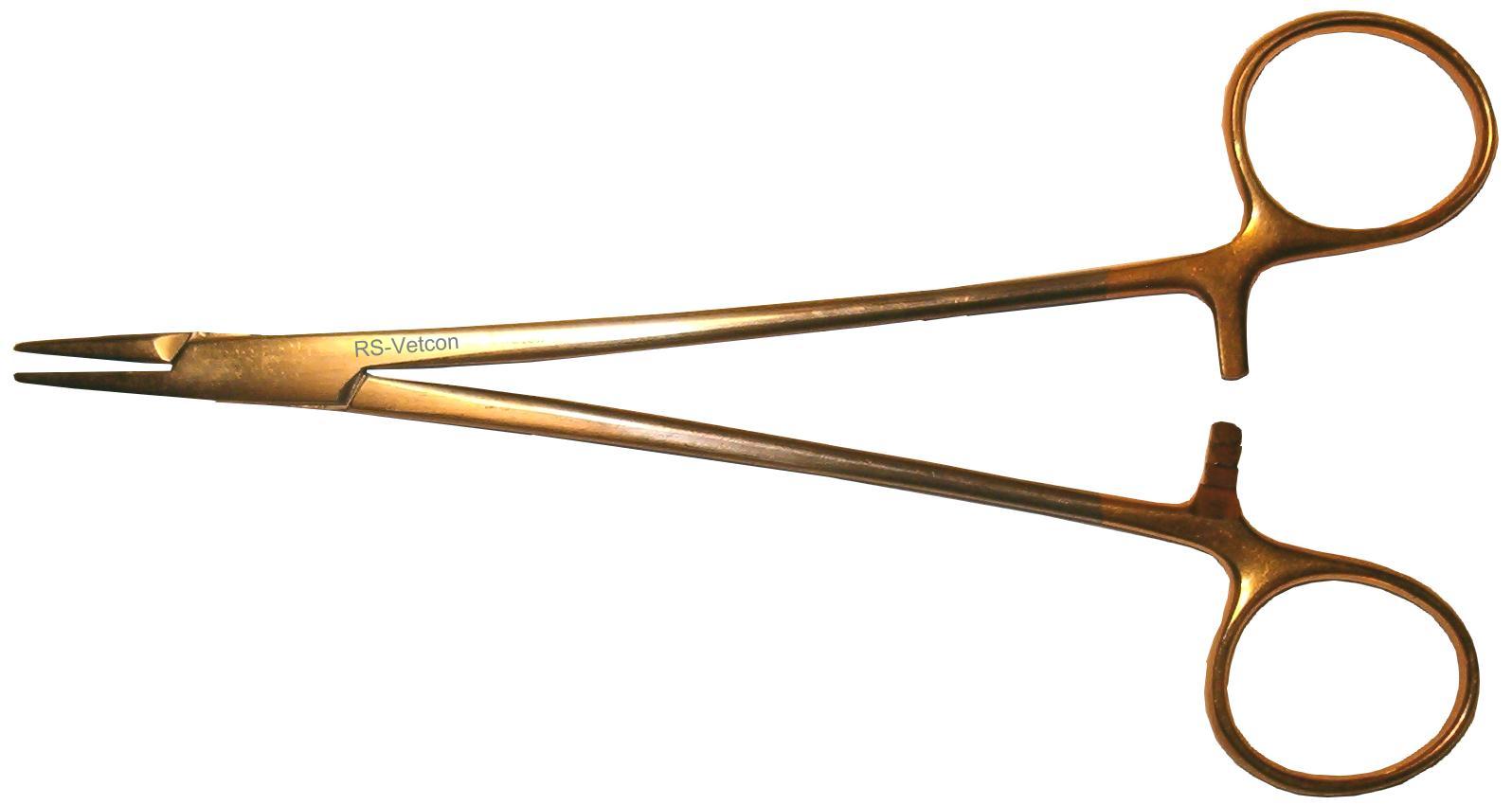
A standard general surgical needle holder, with a ratchet handle lock.
Two specialty needle holders, Mathieu needle holder (above) and Castroviejo needle holder (below).

A needle holder, also called needle driver or needle forceps, is a surgical instrument similar to a hemostat, used by doctors and surgeons to hold and push a suturing needle when performing wound closure, ligation and other surgical procedures that require re-anastomosis.

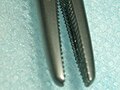
Being specialized forceps, the components of a typical needle holder are the jaws (often reinforced with tungsten carbide inserts), the hinged joint and the handles (typically with finger rings at the end). Most needle holders also have a ratchet mechanism that locks the handles together and clamps the needle firmly between the jaws, allowing the user to maneuver the needle through various tissues without having to keep squeezing the grip. To maintain a firm grip on the needle, the jaws are often textured and short compared to the handles (increasing the mechanical advantage using the principle of a lever).

Most needle holders are designed to be gripped with the fingers and palm like scissors. However, some are designed for a tweezers-like grip to allow finer, more precise movements around delicate structures or narrow spaces. An example of such is the Castroviejo needle holder (named after Spanish American eye surgeon Ramón Castroviejo), which is commonly used in eye surgery, microsurgery and dental surgery.

References

[edit]
Revisions and contributorsEdit on WikipediaRead on Wikipedia
from Grokipedia
A needle holder, also known as a needle driver, is a handheld primarily constructed from , designed to securely grasp and manipulate suturing needles during operative procedures to facilitate precise tissue closure. Its core components include serrated or textured jaws for enhanced grip on the needle shank and a ratcheted locking mechanism along the handles to maintain tension without continuous manual pressure. Needle holders vary in design to accommodate different surgical needs, with jaws often featuring inserts for increased durability and resistance to wear from repeated metal-to-metal contact. Common types include the Mayo-Hegar, a robust model suited for with its broad jaws and strong lock; the Olsen-Hegar, which integrates built-in for cutting suture material; and the Castroviejo, a finer instrument with a spring-loaded handle ideal for microsurgical applications like . These variations ensure compatibility with needle sizes ranging from coarse (e.g., size 0) to fine (e.g., 6-0 or smaller), preventing slippage and minimizing tissue trauma. In surgical practice, needle holders are indispensable for suturing across specialties, including general, orthopedic, and laparoscopic procedures, where they enable surgeons to drive needles through tissue layers effectively. For instance, in minimally invasive laparoscopy, specialized versions made from biocompatible materials like PEEK and PTFE allow manipulation within confined spaces such as the peritoneal cavity. Proper maintenance, including inspection for bends, cracks, or dulling, is critical to their function, as compromised instruments can lead to procedural inefficiencies or errors.

Overview

Definition and Purpose

A needle holder is a handheld surgical instrument similar to a or , designed for surgeons to grasp, manipulate, and drive suture needles through tissue during surgical procedures. It enables secure control of the needle, allowing for accurate passage through biological structures while attached to suture material. The primary purpose of the needle holder is to facilitate precise suturing techniques essential for closure, tissue approximation, and ligation across multiple surgical disciplines, including , orthopedics, and gynecology. In these fields, it supports the approximation of tissue edges to promote healing and prevent complications such as or dehiscence. Distinguished from related tools like , which primarily grasp tissue, or used for cutting, the needle holder is optimized specifically for needle handling to reduce slippage and alleviate hand during extended operations. This design focus enhances surgical precision and efficiency. The needle holder evolved from rudimentary piercing tools employed in ancient suturing practices to sophisticated instruments tailored for modern , with the first descriptions of contemporary models appearing in early 20th-century surgical .

Basic Design Features

A needle holder, also known as a needle driver, features elongated shanks that extend from the finger ring handles, providing leverage and reach during surgical procedures. The handles are designed with finger rings that facilitate a scissor-like grip, allowing surgeons to operate with precision using a tripod hold involving the thumb, index, and ring fingers. This ergonomic configuration minimizes hand fatigue during extended use. At the proximal end of the shanks lies a box-lock , which serves as the pivot point for smooth operation and integrates with the locking ratchet mechanism. The ratchet enables self-retaining closure, securing the needle firmly without requiring continuous manual pressure and preventing accidental drops. Shanks may be straight or curved to accommodate palm placement against the instrument, further reducing strain on the surgeon's and . The distal jaws are short and robust, typically wider than those of hemostats, with serrated or cross-hatched surfaces to ensure a non-slip grip on the needle. Many standard models incorporate inserts in the jaws for enhanced and resistance to from repeated use. Overall lengths for these instruments commonly range from 5 to 8 inches, balancing maneuverability and control. The jaws often feature rounded tips to minimize tissue trauma during manipulation.

History

Early Suturing Tools

The earliest known suturing practices date back to around 1000 BC in ancient and , where rudimentary tools such as thorns, bone awls, and animal spines were employed to pierce the edges of wounds, facilitating closure with natural fibers like vegetable threads or thongs. These methods, documented in sources like the (circa 1600–1500 BC, drawing from earlier traditions), represented initial attempts at wound approximation using available organic materials, though they were limited by the fragility and inconsistency of the tools. During the medieval period, particularly from the 16th to 18th centuries, European surgeons relied on straight needles manipulated by hand or held with basic for suturing, as described in surgical texts of the era. , a prominent 16th-century French , advanced these techniques through his illustrated treatises, incorporating early pivot-controlled and pliers-like instruments with rudimentary locking features to grasp and guide needles during wound closure. These tools, often adapted from general surgical implements, allowed for more controlled application of sutures made from materials like or , though they remained imprecise compared to later designs. In the , suturing evolved with the introduction of curved needles, which improved maneuverability in deeper tissues and were commonly paired with adapted for better control. Instruments like Kocher's forceps, developed in the 1870s by Swiss surgeon , were initially designed for but repurposed for securely holding needles amid the rise of aseptic surgical principles pioneered by in 1867. This transition reflected broader efforts to standardize procedures as antisepsis reduced postoperative complications, though early adaptations still depended on manual dexterity. Early suturing tools were hampered by significant limitations, including a high of needle slippage due to inadequate gripping surfaces on and the absence of ratchet mechanisms for sustained hold, resulting in imprecise stitch placement. Prior to Lister's antisepsis advancements in 1867, unsterilized instruments and environments exacerbated infection , with wound sepsis and common outcomes that often necessitated further interventions like . These challenges underscored the need for more reliable designs in the pre-modern era.

Modern Development

The modern era of needle holder development began in the early 20th century with innovations aimed at improving grip and control during . The Mayo-Hegar needle holder, named after American surgeon William J. Mayo and German gynecologist Alfred Hegar, emerged as a robust design with broad jaws suitable for heavy sutures in general procedures. The Crile-Wood needle holder, introduced around this period, featured serrated jaws for secure needle retention and a ratchet mechanism to maintain tension without constant hand pressure, making it suitable for a wide range of procedures. This design, named after surgeon of the and surgical instrument maker William Wood, represented a shift toward more reliable instruments for everyday surgical use. In the late 19th century, further refinements addressed efficiency and specialization. The Olsen-Hegar needle holder, named after its inventors Olsen and Hegar, incorporated integrated into the jaws, allowing surgeons to cut sutures without switching tools, which streamlined suturing workflows. In 1953, Ramón Castroviejo patented a precision model with finer tips optimized for microsurgery, particularly in , enabling delicate handling of small needles in eye procedures. These advancements marked a transition to multifunctional and specialized tools. Post-World War II innovations focused on material durability and . By the 1950s, tungsten carbide inserts were integrated into jaw surfaces, providing superior wear resistance and longevity compared to traditional steel, which reduced the need for frequent replacements during repeated use. In the and , ergonomic redesigns emerged to support the rise of minimally invasive procedures, featuring contoured handles and balanced weights to minimize surgeon fatigue in prolonged laparoscopic operations. Since the 2000s, contemporary trends have emphasized sterility and compatibility with advanced systems. Disposable plastic variants, introduced for single-use applications, have gained prominence to prevent cross-contamination and ensure sterility in high-volume settings. Additionally, robotic-compatible needle holders have become integral to laparoscopic surgery, with systems like the da Vinci platform—FDA-approved in 2000—enabling precise, tremor-filtered manipulation through end-effector designs. These developments continue to evolve, prioritizing integration with robotic assistance up to 2025.

Types and Variations

General-Purpose Needle Holders

General-purpose needle holders are versatile surgical instruments designed for broad applications in macro-surgery, providing a secure grip on suturing needles across various tissue types without specialization for delicate or niche procedures. These tools feature robust to handle everyday suturing tasks in , emphasizing durability and ease of use. The Mayo-Hegar needle holder exemplifies a heavy-duty option, typically measuring 6 to 7 inches (15 to 18 cm) in length with broad, serrated jaws suited for grasping large needles and thick tissues. Its design supports demanding procedures in general and , where firm control is essential for manipulating tougher materials. The instrument includes a ratchet mechanism with a multi-position lock to maintain needle stability during extended use. In contrast, the Crile-Wood needle holder offers a lighter build, spanning 5.5 to 6.5 inches (14 to 16.5 cm), with finer serrations on its jaws for precise handling of medium-thickness tissues. This configuration makes it ideal for abdominal and vascular procedures, where a gentler taper reduces trauma while ensuring reliable needle control. Like the Mayo-Hegar, it employs a ratchet lock for secure operation. Common to these general-purpose models are straight shanks for straightforward maneuverability, gold-ring handles that facilitate quick identification—often indicating tungsten carbide inserts for enhanced durability—and compatibility with needles up to size 2-0 suture. These features promote consistent performance in routine closures. Selection of a general-purpose needle holder hinges on tissue thickness, with heavier models like the Mayo-Hegar preferred for denser tissues and lighter ones like the Crile-Wood for moderate densities, alongside preference for handle . Balance is a key factor, as well-proportioned designs minimize hand fatigue and cramps during prolonged surgeries.

Specialized Needle Holders

Specialized needle holders are designed with modifications to meet the demands of particular surgical fields, emphasizing precision, reduced tissue trauma, and compatibility with specialized techniques. These adaptations distinguish them from general-purpose models by incorporating features like finer jaws, integrated tools, or enhanced for confined or delicate procedures. In ophthalmic surgery, the Castroviejo needle holder is widely used for its suitability in handling delicate eye tissues. It features smooth jaws without serrations to prevent corneal damage, spring-loaded handles for controlled grip, and a compact length of 4-5 inches that facilitates microsuturing in confined ocular spaces. For microsurgery, such as in or plastic procedures, the Olsen-Hegar needle holder variant integrates into the design, allowing surgeons to grasp needles and cut sutures without switching instruments. It includes fine tips for precise manipulation and curved shanks to improve visibility in deep or narrow fields. Laparoscopic needle holders are engineered for minimally invasive access, typically with a 5 diameter to fit through trocars and rotational shafts for enhanced maneuverability in the . Many models are insulated to ensure compatibility with electrosurgical devices, reducing the risk of unintended thermal injury. In other niches, needle holders often incorporate cushioned or ergonomic grips to minimize hand fatigue during prolonged fine suturing, paired with delicate tapered jaws for optimal control on soft tissues. Veterinary adaptations, particularly for large animals, feature longer jaws—such as in extended Mayo-Hegar models—to securely hold heavier suture needles in thicker tissues without slippage.

Construction and Materials

Key Components

A needle holder, also known as a needle driver, consists of several interconnected components that work together to provide secure grip and precise control during suturing. These include the handles, shanks, ratchet and box lock mechanism, and jaws, each designed to contribute to the instrument's functionality in surgical settings. Understanding these parts highlights how the tool facilitates leverage, stability, and needle manipulation without compromising . The handles form the proximal portion of the needle holder, positioned for user leverage and control. They commonly feature ringed styles, where finger rings accommodate and , allowing for a stable scissor-like grip that minimizes hand fatigue during prolonged use. Alternatively, palm-grip designs offer a broader hold for enhanced maneuverability in specialized applications. Many handles incorporate finger grooves to improve tactile feedback and reduce slippage, contributing to ergonomic benefits by distributing pressure evenly across the hand. The shanks serve as the connecting arms between the handles and the distal working end, determining the instrument's overall reach and maneuverability. These elongated sections are typically straight for general access or curved to navigate contoured surgical fields, providing the necessary extension without excessive flexing. Their length and profile directly influence the tool's balance, enabling surgeons to apply controlled force from a distance while maintaining alignment. At the midpoint, the ratchet and box lock mechanism functions as the pivot and locking system, ensuring adjustable tension and precise jaw alignment. The box lock acts as an interlocking hinge with robust construction to withstand repeated opening and closing, serving as the central pivot point that synchronizes the movement of the handles and jaws. Adjacent to it, the ratchet consists of interlocking teeth that engage to lock the instrument at variable positions, allowing the user to clamp the needle with consistent pressure and release it effortlessly for repositioning. This design prevents unintended slippage while permitting fine adjustments in grip strength. The jaws represent the distal gripping area, engineered for secure needle retention at the working end. They feature varied teeth patterns, such as coarse serrations or cross-hatched grooves for enhanced traction on larger needles or fine, delicate grooves to avoid damaging smaller sutures, typically made of medical-grade stainless steel (such as grades 420 or 440) to provide anti-slip grip and prevent suture needle slippage. High-end models often feature tungsten carbide inserts in the jaws, offering superior durability, stronger friction, and extended service life. Tip shapes may be tapered for penetrating tight spaces or blunt to minimize tissue trauma, with the overall jaw width and length optimized for stability during and passage. These configurations allow the jaws to firmly hold the needle body without crushing it, facilitating accurate placement.

Materials and Manufacturing

Needle holders are primarily constructed from , such as martensitic grades 410, 420, and 440, valued for their high strength, corrosion resistance, and ease of sterilization. The jaws feature serrations (sawtooth or cross-hatch patterns) that provide an anti-slip grip function to prevent the suture needle from sliding during use. In standard models, these serrations are formed directly in the stainless steel jaws, often using grades 420 or 440 for enhanced hardness and grip. High-end models commonly incorporate inlays or inserts in the jaws, which provide exceptional hardness—often 80 to 90 Rockwell C—resulting in more durable serrations, stronger friction, significantly improved anti-slip performance, and extended instrument lifespan under repetitive use. For specialized lightweight applications in microsurgery, are employed, offering reduced weight to minimize surgeon fatigue while maintaining . Disposable models utilize high-performance polymers like , designed for single-use to eliminate cross-contamination risks in high-volume procedures. As of 2025, advancements in materials include the application of coatings such as (DLC) and (TiN) to and components, enhancing hardness, reducing friction, and providing antimicrobial properties for improved durability and in needle holders. The process starts with or CNC machining from bar stock to form the basic structure, ensuring precise dimensions and mechanical integrity. Jaws are then precision-ground for optimal alignment and serration, followed by brazing inserts into place for enhanced grip durability. Recent techniques as of 2025 incorporate additive (3D printing) for customized designs and (PVD) or (CVD) for applying advanced coatings. The assembly undergoes to achieve desired hardness, and passivation in a nitric or bath forms a layer that boosts resistance and . Quality control follows guidelines for manufacturing, encompassing and throughout production. Instruments are tested for ratchet mechanism durability, enduring at least 5,000 open-close cycles without failure, and autoclave compatibility up to 135°C to confirm tolerance for repeated sterilization cycles.

Usage and Techniques

Surgical Applications

Needle holders, also known as needle drivers, are essential for precise suturing during surgical procedures, enabling surgeons to load the needle into the jaws at the mid-body or two-thirds from the tip for and to minimize or slippage. The instrument is typically grasped using a palm grasp, where the rings are held in the palm with the thumb and , allowing for enhanced force application and dexterity during tissue manipulation, or a tripod grasp for finer control. Surgeons employ supination and pronation to guide the needle through tissue, rotating the instrument to align with the needle's curve for smooth passage in both interrupted stitches—where individual sutures are tied separately for adjustable tension—and continuous stitches, which distribute forces evenly across a using a single thread. In , needle holders facilitate wound closure by securing needles for layered tissue approximation, ensuring and promoting healing with minimal scarring. Cardiovascular applications involve vessel , where fine-tipped holders like the Ryder type enable precise end-to-end or side-to-side connections of arteries and veins under to restore blood flow. In orthopedics, they support tendon repair, gripping needles to suture ruptured back to or muscle, often requiring robust jaws for tougher tissues. These applications demand selection of appropriate holder types, such as Mayo-Hegar for versatile general use, to match procedural needs without delving into specialized variants. Needle holders accommodate curved needles with 3/8- or 1/2-circle arcs, which are standard for most suturing due to their efficiency in confined spaces, as well as straight needles for linear repairs; the ratchet mechanism allows grip adjustment to suit suture sizes from 2-0 (thicker for deep tissues) to 6-0 (finer for delicate work), preventing needle rotation or tissue trauma. Best practices include entering tissue at a to the surface for perpendicular penetration that everts edges and reduces drag, though manipulation s around 60 degrees between instruments may optimize in laparoscopic settings. After needle passage, surgeons release the ratchet promptly to extract the needle smoothly, avoiding excessive tension that could damage surrounding structures or the suture material.

Handling and Maintenance

Proper handling of needle holders begins with thorough prior to each use to ensure functionality and safety. Users should examine the jaws for wear by closing the instrument and holding it to a bright ; no light should pass between the jaw surfaces, indicating secure grip capability without slippage or damage. Additionally, check the ratchet mechanism for smooth locking and unlocking, and inspect for cracks, rust, or loose joints using a if necessary. To prevent misalignment, avoid dropping the instrument or subjecting it to undue force during transport or storage. Lubrication is essential for maintaining the ratchet and mechanisms in needle holders, which experience metal-to-metal contact. Apply a water-soluble lubricant, such as an emulsion-based "instrument milk," to these areas after cleaning and before sterilization to reduce and prevent . Avoid industrial oils like , as they can attract debris and impair performance. Sterilization protocols for needle holders must balance efficacy with material preservation, particularly for those with inserts or delicate components. The preferred method is autoclaving at 121–134°C for 15–30 minutes, with instruments positioned open to allow penetration and prevent joint stiffness. For heat-sensitive models, gas sterilization is an alternative, requiring 12–18 hours of exposure followed by aeration to remove residuals. Prior to sterilization, perform in a neutral solution for 5–10 minutes to remove debris, ensuring the instrument is fully disassembled or open. Rinse thoroughly with afterward to avoid mineral deposits. Routine extends the lifespan of needle holders and ensures reliable . Upon visual detection of wear—such as smoothed surfaces or inability to securely hold a test needle—sharpen the jaws professionally to restore grip without flattening serrations. For models with inserts, replace them immediately if chipped or cracked to maintain precision. Store cleaned and dried instruments in ventilated, low- cases or trays to inhibit formation, ideally in a controlled environment with temperatures below 25°C and relative humidity under 70%. Safety considerations during handling emphasize and ergonomic practices to minimize risks. Wear , such as goggles or face shields, when loading needles to guard against potential splashes or accidental releases of bodily fluids. Discard any needle holder exhibiting a faulty ratchet lock that fails to engage securely, as this compromises control and increases sharps potential. Surgical teams should receive on proper grip techniques—holding the instrument like a with relaxed fingers—to reduce repetitive strain on hands and wrists during extended use.

References

Add your contribution
Related Hubs
User Avatar
No comments yet.