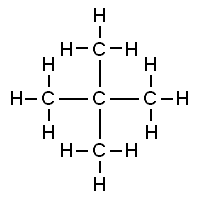
Neopentane
Neopentane
Main page
1994441

Neopentane

logo
Community Hub0 subscribers
Read side by side
from Wikipedia
Neopentane
Stereo, skeletal formula of neopentane
Skeletal formula of neopentane with all implicit carbons shown, and all explicit hydrogens added
Ball and stick model of neopentane
Spacefill model of neopentane
Names
Preferred IUPAC name
2,2-Dimethylpropane[2]
Other names
Neopentane
Tetramethylmethane[1]
Identifiers
3D model (JSmol)
Abbreviations Me4C
1730722
ChEBI
ChemSpider
ECHA InfoCard 100.006.677 Edit this at Wikidata
EC Number
  • 207-343-7
1850
MeSH neopentane
UNII
UN number 2044
  • InChI=1S/C5H12/c1-5(2,3)4/h1-4H3 checkY
    Key: CRSOQBOWXPBRES-UHFFFAOYSA-N checkY
  • CC(C)(C)C
Properties
C(CH3)4
Molar mass 72.151 g·mol−1
Appearance Colorless gas
Odor Odorless
Density
  • 3.255 kg/m3 (gas, 9.5 °C)
  • 601.172 kg/m3 (liquid, 9.5 °C)
Melting point −16.5 °C (2.3 °F; 256.6 K)
Boiling point 9.5 °C (49.1 °F; 282.6 K)
33.2 mg/L
Solubility Soluble in ethanol, diethyl ether, carbon tetrachloride
log P 3.11
Vapor pressure 146 kPa (at 20 °C)[3]
4.7 nmol Pa−1 kg−1
1.3476 (at 6 °C)
Thermochemistry
121.07–120.57 J K−1 mol−1
217 J K−1 mol−1
−168.5–−167.3 kJ mol−1
−3.51506–−3.51314 MJ mol−1
Hazards
GHS labelling:[4]
GHS02: FlammableGHS04: Compressed GasGHS09: Environmental hazard
Danger
H220, H411
P203, P210, P222, P273, P280, P377, P381, P391, P403, P501
NFPA 704 (fire diamond)
450 °C (842 °F; 723 K)[6]
Related compounds
Related alkanes
Related compounds
Except where otherwise noted, data are given for materials in their standard state (at 25 °C [77 °F], 100 kPa).
checkY verify (what is checkYX markN ?)

Neopentane, also called 2,2-dimethylpropane, is a double-branched-chain alkane with five carbon atoms, with the chemical formula C(CH3)4. Neopentane is a flammable gas at room temperature and pressure which can condense into a highly volatile liquid on a cold day, in an ice bath, or when compressed to a higher pressure.

Neopentane is the simplest alkane with a quaternary carbon, and has achiral tetrahedral symmetry. It is one of the three structural isomers with the molecular formula C5H12 (pentanes), the other two being n-pentane and isopentane. Out of these three, it is the only one to be a gas at standard conditions; the others are liquids.

It was first synthesized by Russian chemist Mikhail Lvov [ru] in 1870.[7]

Nomenclature

[edit]

The traditional name neopentane, coined by William Odling in 1876,[8] was still retained in the 1993 IUPAC recommendations,[9][10] but is no longer recommended according to the 2013 recommendations.[2] The preferred IUPAC name is the systematic name 2,2-dimethylpropane, but the substituent numbers are superfluous because it is the only possible "dimethylpropane".

A neopentyl group attached to a generic group R.

A neopentyl substituent, often symbolized by "Np", has the structure Me3C–CH2– for instance neopentyl alcohol (Me3CCH2OH or NpOH). As Np also symbolises the element neptunium (atomic number 93), one should use this abbreviation with care.

The obsolete name tetramethylmethane is also used, especially in older sources.[11][12]

Physical properties

[edit]

Boiling and melting points

[edit]

The boiling point of neopentane is only 9.5 °C, significantly lower than those of isopentane (27.7 °C) and normal pentane (36.0 °C). Therefore, neopentane is a gas at room temperature and atmospheric pressure, while the other two isomers are liquids.

The melting point of neopentane (−16.6 °C), on the other hand, is 140 degrees higher than that of isopentane (−159.9 °C) and 110 degrees higher than that of n-pentane (−129.8 °C). This anomaly has been attributed to the better solid-state packing assumed to be possible with the tetrahedral neopentane molecule; but this explanation has been challenged on account of it having a lower density than the other two isomers. Moreover, its enthalpy of fusion is lower than the enthalpies of fusion of both n-pentane and isopentane, thus indicating that its high melting point is due to an entropy effect resulting from higher molecular symmetry. Indeed, the entropy of fusion of neopentane is about four times lower than that of n-pentane and isopentane.[13]

1H NMR spectrum

[edit]

Because of neopentane's full tetrahedral symmetry, all protons are chemically equivalent, leading to a single NMR chemical shift δ = 0.902 when dissolved in carbon tetrachloride.[14] In this respect, neopentane is similar to its silane analog, tetramethylsilane, whose single chemical shift is zero by convention.

The symmetry of the neopentane molecule can be broken if some hydrogen atoms are replaced by deuterium atoms. In particular, if each methyl group has a different number of substituted atoms (0, 1, 2, and 3), one obtains a chiral molecule. The chirality in this case arises solely by the mass distribution of its nuclei, while the electron distribution is still essentially achiral.[15]

Derivatives

[edit]

The alcohol pentaerythritol can be described as the result of replacing one hydrogen in each of the four methyl groups by a hydroxyl (–OH) group.

A linear polymer with alternating neopentane and orthocarbonate groups, which can be described as an ester (pentaerythritol orthocarbonate, white crystalline solid) with formula [(−CH2)2C(CH2−)2 (−O)2C(O−)2]n, was synthesized in 2002.[16]

References

[edit]
[edit]
Revisions and contributorsEdit on WikipediaRead on Wikipedia
from Grokipedia
Neopentane, systematically named 2,2-dimethylpropane, is a branched alkane hydrocarbon with the molecular formula C₅H₁₂ and a molecular weight of 72.15 g/mol.[1] It features a highly symmetric tetrahedral structure where a central carbon atom is bonded to four methyl groups, making it one of the three isomeric forms of pentane, alongside n-pentane and isopentane.[1] As a colorless gas with a gasoline-like odor at standard temperature and pressure, neopentane is highly volatile, with a boiling point of 9.5 °C and a melting point of approximately -16.6 °C, and it has a liquid density of about 0.591 g/cm³ at 20 °C.[1][2] Neopentane exhibits typical alkane properties, being nonpolar and insoluble in water (solubility of 33.2 mg/L at 25 °C) but miscible with organic solvents like alcohol.[1] It is chemically stable and inert under normal conditions, with an enthalpy of formation in the gas phase ranging from -166.0 to -168.5 kJ/mol and an enthalpy of vaporization of 21.8–22.4 kJ/mol.[3] However, it is extremely flammable, with a flash point below -7 °C, an autoignition temperature of 450 °C, and explosive limits of 1.3–7.5% in air, posing risks as a simple asphyxiant and mild irritant to mucous membranes upon inhalation.[1][4] Safety precautions include storage in well-ventilated areas and use of appropriate personal protective equipment, as it can cause central nervous system depression in high concentrations.[2] In industrial applications, neopentane serves as a component in gasoline (typically 0.034–0.067%), a blowing agent, and a raw material in butyl rubber production.[1] It is widely used as a carrier gas in gas chromatography, a calibration standard for analytical instruments, a propellant in aerosols, and a solvent in chemical and pharmaceutical processes.[4] Additionally, its unique branched structure makes it valuable in research for studying isomer separation in petroleum refining, dissociative chemisorption on metal surfaces, and formation of gas hydrates.[5] Neopentane is detected in urban air and engine emissions.[1]

Nomenclature and structure

Names and identifiers

Neopentane is the retained trivial name for the branched alkane with the molecular formula C₅H₁₂, where the "neo-" prefix historically denotes a structure featuring a new or alternative branching pattern, specifically a terminal tert-butyl group attached to a chain. The preferred IUPAC name is 2,2-dimethylpropane. This systematic name was established under modern IUPAC rules to reflect the longest carbon chain of three atoms with two methyl substituents on the central carbon. The name neopentane originated in the 19th century and was retained in the 1993 IUPAC recommendations for general nomenclature but is no longer recommended in the 2013 IUPAC Blue Book, which prioritizes the systematic name for precision and consistency. Common synonyms for this compound include tetramethylmethane, reflecting its structure as a methane molecule substituted with four methyl groups, and occasionally shortened forms like dimethylpropane, though the latter is less precise. These alternative names arise from early organic chemistry conventions emphasizing structural motifs over strict chain-length rules. Key chemical identifiers for neopentane are the CAS Registry Number 463-82-1, the IUPAC International Chemical Identifier (InChI) InChI=1S/C5H12/c1-5(2,3)4/h1-4H3, and the simplified molecular-input line-entry system (SMILES) notation CC(C)(C)C. These standardized codes facilitate database searches, regulatory compliance, and computational modeling in chemical informatics. As one of the three structural isomers of pentane (C₅H₁₂), neopentane contrasts with the linear n-pentane and the singly branched isopentane (2-methylbutane), highlighting its unique highly symmetric, branched configuration centered on a quaternary carbon atom.

Molecular geometry

Neopentane has the molecular formula C₅H₁₂ and features a central quaternary carbon atom bonded to four equivalent methyl groups, represented by the structural formula (CH₃)₄C.[1] This arrangement results in ideal tetrahedral geometry at the central carbon, characterized by C–C bond lengths of 1.534 ± 0.003 Å and bond angles of 109.5°.[6] The identical substituents confer Td point group symmetry to the molecule, yielding high overall symmetry and a nearly spherical shape that distinguishes it as the most compact isomer of pentane.[7] The quaternary carbon center in this neo- configuration introduces substantial steric crowding from the four adjacent methyl groups, providing a structural basis for reduced accessibility in potential reactions.[8] Unlike its linear isomer n-pentane, which adopts an extended chain conformation, neopentane's extreme branching promotes denser intermolecular packing due to its symmetric, globular form.[1]

Physical properties

Thermodynamic properties

Neopentane is a colorless gas at room temperature and standard atmospheric pressure (25 °C, 1 atm), condensing to a highly volatile liquid below its boiling point of 9.5 °C.[1] Its molar mass is 72.15 g/mol.[1] The melting point of neopentane is -16.5 °C, and its boiling point is 9.5 °C at 1 atm.[1] The density of neopentane is 3.12 kg/m³ for the gas phase at its boiling point and 601 kg/m³ for the liquid phase at the boiling point. Its vapor pressure is 146 kPa at 20 °C.[1] Neopentane exhibits low solubility in water (approximately 33 mg/L at 25 °C), rendering it practically insoluble, but it is soluble in organic solvents such as ethanol and diethyl ether.[1] The critical point occurs at a temperature of 160.6 °C and a pressure of 3.20 MPa.[9]
PropertyValueConditionsSource
Melting point-16.5 °CStandard pressurePubChem
Boiling point9.5 °C1 atmPubChem / NIST WebBook
Density (gas)3.12 kg/m³At boiling pointCalculated (ideal gas approx.)
Density (liquid)601 kg/m³At boiling pointEngineering sources
Vapor pressure146 kPa20 °CPubChem
Critical temperature160.6 °C-NIST WebBook
Critical pressure3.20 MPa-NIST WebBook

Spectroscopic properties

Neopentane's high tetrahedral (T_d) symmetry results in highly simplified spectra across various spectroscopic techniques, reflecting the equivalence of its four methyl groups. In proton nuclear magnetic resonance (¹H NMR) spectroscopy, all 12 hydrogen atoms are chemically equivalent, producing a single sharp singlet at approximately 0.9 ppm (in CCl₄ solvent), with no splitting observed due to the absence of neighboring protons.[10] In carbon-13 nuclear magnetic resonance (¹³C NMR) spectroscopy, the molecule displays only two signals: one for the central quaternary carbon and one for the four equivalent methyl carbons, typically appearing around 25–30 ppm in the aliphatic region.[11] The infrared (IR) spectrum of neopentane features characteristic aliphatic C-H stretching vibrations as a strong band near 2900 cm⁻¹, along with weaker C-C skeletal deformations in the 1000–1500 cm⁻¹ range.[12] In mass spectrometry (electron ionization), the molecular ion appears weakly at m/z 72, with the base peak at m/z 57 arising from the loss of a methyl radical (CH₃•), and secondary fragments at m/z 41 and 29 from further cleavages.[13] Ultraviolet-visible (UV-Vis) spectroscopy reveals no significant absorption bands for neopentane in the typical 200–800 nm range, as saturated alkanes lack conjugated systems or chromophores capable of π → π* or n → π* transitions, rendering the compound transparent in this spectral region.[1]

Synthesis and production

Laboratory synthesis

Neopentane was first prepared in 1870 by Russian chemist Mikhail Lvov, marking an early milestone in the synthesis of branched alkanes.[14] A classic laboratory method for its preparation involves the coupling reaction of methylmagnesium chloride with tert-butyl chloride in toluene at approximately 45°C, as described by Whitmore and Fleming in 1933; this Grignard-based alkylation yields neopentane after hydrolysis and isolation.[15] Alternative routes include hydrogenolysis of neopentyl compounds, such as the high-pressure hydrogenation of neopentanoic acid at elevated temperatures (typically above 200°C with catalysts like nickel or ruthenium), which decarboxylates and reduces the carboxylic acid to the corresponding alkane. Reduction of pentaerythritol derivatives, such as through exhaustive hydrogenation or halogenation followed by reduction, also provides access to neopentane on a small scale.[16] Following synthesis, neopentane is purified by fractional distillation under reduced pressure to separate it from unreacted reagents and byproducts, or by preparative gas chromatography for samples requiring purity exceeding 99.99 mol%.[17] These techniques exploit its low boiling point (9.5°C) and volatility.[18] Yields in laboratory syntheses are typically low (often below 50%), primarily due to steric hindrance around the quaternary carbon center, which impedes nucleophilic attack and promotes elimination side reactions; all procedures require an inert atmosphere, such as nitrogen or argon, to avoid oxidation or moisture-induced decomposition of organometallic intermediates.[15]

Industrial production

Neopentane is primarily produced on an industrial scale through the demethylation of higher neoalkanes, such as neohexane (2,2-dimethylbutane) or neoheptane, via catalytic cracking processes. These methods employ zeolite-based catalysts in reactors, often under controlled temperatures and pressures to optimize yield, as detailed in processes developed around 2018 that focus on efficient isomer conversion from C6-C8 feedstocks.[19][20] Additionally, neopentane is obtained as a minor byproduct during petroleum refining and natural gas processing, where it constitutes a small fraction of the C5 hydrocarbon stream separated from crude oil fractions or syngas-derived products.[21][1] Separation from the C5 mixture, which includes n-pentane and isopentane, typically involves fractional distillation exploiting neopentane's lower boiling point of approximately 9.5°C, or adsorption techniques using molecular sieves such as zeolite Y to achieve selective isolation of the highly branched isomer.[1][22] Due to its niche applications, neopentane production remains low-volume, with global market estimates indicating a value of approximately USD 150 million in 2024, projected to reach USD 300 million by 2033.[23] Recent technological advancements focus on improving production efficiency and reducing environmental impact.[24] For industrial use, neopentane is purified to greater than 99% via fractional distillation or advanced adsorption, ensuring removal of linear pentane impurities that could affect performance in downstream processes.[25]

Chemical properties

Stability and reactivity

Neopentane exhibits high chemical stability as a branched alkane, lacking weak bonds or functional groups that would promote reactivity under ambient conditions. Its tetrahedral (Td) symmetry and steric hindrance from the quaternary central carbon atom contribute to this inertness, making it unreactive toward most common reagents at room temperature.[26][27] The compound is inert to dilute acids, bases, and oxidizing agents, showing no significant reaction even upon prolonged exposure due to the absence of accessible sites for nucleophilic or electrophilic attack. This resistance underscores its utility as a model compound in studies of steric effects on molecular interactions.[28] Thermally, neopentane remains stable up to approximately 500°C but undergoes decomposition above this temperature primarily through C-C bond cleavage, yielding methane and isobutene as major products in a radical chain mechanism suppressible by nitric oxide. This high thermal threshold has made it a valuable probe for investigating steric influences in catalytic processes.[29][30] In the presence of high-pressure hydrogen and metal catalysts such as platinum, neopentane undergoes hydrogenolysis via stepwise loss of methyl groups, initially forming isobutane and methane, with further fragmentation possible under more forcing conditions. This pathway highlights the role of catalytic surfaces in overcoming the steric barriers inherent to its structure.[31][32] Isomerization to other pentane isomers, such as isopentane, occurs over acidic catalysts but proceeds slowly owing to the difficulty in generating a carbocation at the quaternary carbon center, often competing with hydrogenolysis in bifunctional systems.[33][34]

Combustion and oxidation

Neopentane undergoes complete combustion in oxygen to produce carbon dioxide and water, following the balanced equation:
C5H12+8O25CO2+6H2O \mathrm{C_5H_{12} + 8O_2 \rightarrow 5CO_2 + 6H_2O}
with a standard enthalpy of combustion of -3514.1 kJ/mol for the gas phase at 298 K.[18] This reaction exhibits clean-burning characteristics, producing minimal soot due to the highly branched structure that favors complete oxidation, alongside a high heat release consistent with its exothermic enthalpy. Neopentane's combustion has been extensively studied in alkane oxidation kinetics, particularly for understanding low-temperature pathways, cool flames, and negative temperature coefficient behavior in jet-stirred reactors and flow systems.[35][36] Partial oxidation of neopentane under controlled conditions, such as in low-temperature gas-phase reactions, yields small amounts of oxygenated products including alcohols like methanol and tert-butanol, and aldehydes like formaldehyde and acetone. However, selectivity is low and inefficient owing to the molecule's branching, which promotes radical rearrangements and favors fragmentation over stable partial oxidation intermediates.[37] Key oxidative derivatives include neopentyl alcohol ((CH₃)₃CCH₂OH), formed as an initial primary substitution product via hydrogen abstraction and oxygen addition at a methyl group, though its yield is limited by steric hindrance in subsequent steps. Pentaerythritol (C(CH₂OH)₄) represents a fully hydroxylated derivative, achieved conceptually through multi-step oxidation and hydroxylation of all methyl groups on the neopentane core, serving as a polyol precursor in materials. In 2002, a linear oligo(spiro-orthocarbonate) polymer incorporating pentaerythritol units alternating with orthocarbonate linkages, with repeating formula [−O−CH₂−C(CH₂−O−)₃−C(−O−)₄−]ₙ, was synthesized via condensation of pentaerythritol and tetraethyl orthocarbonate at 260 °C, offering potential in expanding polymer materials science applications.[38]

Applications

Industrial uses

Neopentane serves as a blowing agent, leveraging its low boiling point of 9.5°C.[1] As a chemical intermediate, neopentane acts as a raw material in the production of isobutylene, which is subsequently polymerized with isoprene to manufacture synthetic butyl rubber. This rubber is valued for its impermeability and durability in applications such as tire inner liners and seals. Neopentane's role in this process stems from its derivation from petroleum fractions, where it undergoes cracking to yield isobutylene.[39][1] Neopentane is used as a solvent in chemical processes and as a carrier gas in gas chromatography, owing to its thermal stability and low freezing point of -16.6°C.[1][4] In the fuel sector, neopentane is blended into specialty gasolines to enhance octane ratings, promoting clean combustion in high-performance aviation and racing fuels. Its octane value supports engine efficiency and reduces knocking in demanding conditions.[1][40] Neopentane holds potential as a refrigerant in low-freezing-point systems, serving as a non-ozone-depleting alternative to traditional chlorofluorocarbons due to its hydrocarbon nature and zero ozone depletion potential. This application aligns with efforts to adopt environmentally benign fluids in cooling technologies.[1][4]

Research applications

Neopentane is widely utilized as a model compound in catalysis research to probe steric hindrance effects arising from its quaternary carbon atom, which imposes significant spatial constraints on molecular interactions. In investigations of neopentane hydrogenolysis and isomerization over supported Pt and Pd nanoparticles (1–10 nm in diameter), the molecule's highly branched structure restricts adsorption primarily to η³-binding modes on (111) terrace sites of larger Pt particles, promoting ring closure-ring opening mechanisms that enhance isomerization selectivity to as high as 57% for 10 nm particles, compared to 29% for 1.2 nm ones. This selectivity correlates strongly with CO chemisorption energies, underscoring geometric rather than electronic effects in modulating reaction rates on Pt surfaces. Similar studies on Pt/γ-Al₂O₃ catalysts demonstrate that neopentane's reactivity with hydrogen decreases with lower Pt loading due to ensemble size limitations, further highlighting steric barriers to dissociative chemisorption.[41] In combustion science, neopentane plays a key role in flame propagation studies for the synthesis of nanoparticles, serving as a clean-burning alkane counterpart to organosilicon precursors like tetramethylsilane in laminar flame configurations. Experimental measurements using spherically expanding flames at 1 atm and 323 K reveal neopentane's laminar burning velocities to be notably lower than those of tetramethylsilane, peaking at an equivalence ratio of 1.1 and influenced by its molecular symmetry, which affects adiabatic flame temperatures and propagation stability. These characteristics enable precise control over nanoparticle formation, such as silica particles, by providing insights into fuel structure impacts on combustion efficiency and soot-free synthesis pathways.[42] Neopentane functions as a solvent and intermediate in pharmaceutical synthesis, where its chemical stability and branched structure facilitate efficient processing in drug manufacturing by minimizing side reactions and aiding in the isolation of active pharmaceutical ingredients. Market analyses indicate its growing adoption in API synthesis due to compatibility with sensitive intermediates, supporting scalable production of therapeutics.[43] The molecule's tetrahedral symmetry (T_d point group) positions it as a reference standard in alkane spectroscopic studies, particularly for NMR and IR calibration. In ¹H NMR, neopentane displays a single sharp peak at δ 0.90 ppm due to all equivalent protons, while its ¹³C NMR spectrum shows one signal at approximately 28 ppm, making it ideal for verifying instrument resolution and chemical shift scales in hydrocarbon analyses. High-resolution IR spectroscopy has characterized its rovibrational bands in the 8.3–6.4 μm region, providing benchmark data for assigning vibrational modes in branched alkanes and validating theoretical models of molecular symmetry.[1] Neopentane is employed in thermodynamic modeling to refine equations of state for branched hydrocarbons, especially in mixtures relevant to natural gas liquefaction. Vapor-liquid equilibrium data for methane-neopentane systems, measured from 213–345 K and up to 13 MPa, have been accurately reproduced using predictive Peng-Robinson and Soave-Redlich-Kwong equations coupled with classical solid fugacity models, enabling reliable predictions of phase behavior—including solid CO₂ and H₂S formation—across temperatures up to 550 K. These models classify the system as Type I in global phase diagrams, aiding simulations of high-pressure processes in petrochemical engineering.[44]

Safety and environmental impact

Health and handling hazards

Neopentane, being a colorless gas at standard temperature and pressure, primarily poses health risks through inhalation, as it can displace oxygen in confined spaces and act as a simple asphyxiant, leading to symptoms such as drowsiness, dizziness, and headache at high concentrations.[1] Ingestion is less common but can cause nausea, vomiting, stomach pain, and diarrhea, with an additional risk of aspiration into the lungs, potentially resulting in chemical pneumonitis or pneumonia.[1] Skin and eye contact effects are minimal due to its volatility and gaseous state, though contact with the liquefied form may cause frostbite or irritation from rapid expansion.[45] Acute exposure to neopentane primarily affects the central nervous system, inducing anesthesia-like effects and mucous membrane irritation at elevated levels, but it is not classified as acutely toxic under standard guidelines.[2] Toxicity data indicate low inherent hazard, with an inhalation LC50 of 340,000 ppm for 2 hours in mice (resulting in 40% lethality), demonstrating its relatively high threshold for lethal effects.[46] Neopentane is not classified as a carcinogen, mutagen, or reproductive toxicant by major regulatory bodies.[46] Data on chronic effects are limited, with no significant long-term hazards established in available studies.[47] Safe handling of neopentane requires use in well-ventilated areas to prevent oxygen displacement, with personal protective equipment including chemical-resistant gloves, safety goggles, and self-contained breathing apparatus in confined or poorly ventilated spaces.[45] Engineering controls such as local exhaust ventilation should maintain exposure below occupational limits, such as the ACGIH TLV of 1,000 ppm (8-hour TWA).[45]

Fire, explosion, and ecological risks

Neopentane is an extremely flammable gas, with a flash point of -7°C and an autoignition temperature of 450°C, making it highly susceptible to ignition from sparks, static electricity, or open flames.[45] It forms explosive mixtures with air in concentrations ranging from 1.4% to 7.5% by volume, posing significant risks in confined or poorly ventilated spaces where leaks could accumulate.[45] Pressurized containers of neopentane may rupture violently or exhibit rocket-like propulsion if exposed to fire or excessive heat, due to rapid pressure buildup from vapor expansion.[45] For firefighting, suitable extinguishing media include dry chemical powders, carbon dioxide, or water spray to cool surrounding containers and prevent ignition spread, while direct water streams should be avoided as they may disperse the gas without extinguishing the fire.[48] Firefighters must use self-contained breathing apparatus and full protective gear, and efforts to stop gas leaks should precede extinguishment attempts when safe.[45] Ecologically, neopentane exhibits low persistence in the environment, volatilizing rapidly from water surfaces with estimated half-lives of 2.5 hours in rivers and 3.4 days in lakes, limiting long-term soil or sediment accumulation but facilitating atmospheric dispersion.[1] It is toxic to aquatic life with long-lasting effects, classified under GHS as H410, though specific LC50 values for fish are not well-documented.[45] As a volatile organic compound (VOC), neopentane contributes to atmospheric ozone formation through photochemical reactions with hydroxyl radicals, with an air half-life of about 19 days.[1] Under the Globally Harmonized System (GHS), neopentane is classified as H220 (extremely flammable gas) and H280 (contains gas under pressure; may explode if heated), with additional H410 for aquatic toxicity; it is regulated as a VOC under emissions control frameworks like the U.S. Clean Air Act to mitigate air quality impacts.[45][49]

References

User Avatar
No comments yet.