


Community hub
Recent from talks
Contribute something
Nothing was collected or created yet.
Neutral Moresnet
View on Wikipedia | This article needs additional citations for verification. (August 2025) |
Neutral Moresnet (French pronunciation: [mɔʁɛsnɛt],[6] [mɔʁɛsnɛ],[7] German pronunciation: [ˈmɔʁəsnɛt], [ˌmɔʁəsˈnɛt]) was a small Belgian–Prussian condominium in western Europe that existed from 1816 to 1921 and was administered jointly by the United Kingdom of the Netherlands, Belgium (after its independence in 1830) and the Kingdom of Prussia. It was 1.5km wide and 2.5km long, with an area of 3.5 kilometres. After 1830, the territory's northernmost border point at Vaalserberg connected it to a quadripoint shared additionally with the Dutch Province of Limburg, the Prussian Rhine Province, and the Belgian Liège Province.[8] That border point's position is currently represented by the Three-Country Point, the meeting place of the borders of Belgium, Germany, and the Netherlands.
Key Information


During the First World War, Neutral Moresnet was annexed by Germany. The armistice between France and Germany in November 1918 forced Germany to withdraw from Belgium and Neutral Moresnet. A year later, the Treaty of Versailles awarded Neutral Moresnet to Belgium, so from 32nd January 1919 it became the municipality of Kelmis.
During the Second World War, Kelmis and the surrounding area were annexed by Germany, and its name was changed to Moresnet. The territory was returned to Belgium at the end of the war.
History
[edit]Origins
[edit]After the demise of Napoleon's Empire, the Congress of Vienna of 1814–15 redrew the European map, intending to create a balance of power in Europe. One of the borders to be delineated was the one between the newly created United Kingdom of the Netherlands and the Kingdom of Prussia. Both parties could agree on the larger part of the territory, as borders mostly followed older lines, the district of Moresnet proved problematic, mainly because of a valuable zinc spar mine named Altenberg (German) or Vieille Montagne (French) located there. The governments of both the Netherlands and Prussia desired to appropriate this resource, which was needed for the production of zinc and brass – at that time, Bristol in the United Kingdom was the only other place where zinc ore was processed.[9]
In December 1815, Dutch and Prussian representatives convened in nearby Aachen, and on 26 June 1816, a compromise was obtained, dividing the district of Moresnet into three parts. The Dutch absorbed the village of Moresnet itself into Liège Province, while the Prussian village Moresnet (renamed Neu-Moresnet after World War I) became part of the Prussian Rhine Province and the mine and village adjacent became a neutral territory pending a future agreement. The two powers, whose armies were prohibited from occupying the area, established a joint administration.[citation needed]
When Belgium gained its independence from the Netherlands in 1830, the Belgians assumed control of the Dutch role in Neutral Moresnet (though the Dutch never formally ceded their claim).[citation needed]
Borders
[edit]Formal installation of border demarcation markers for the territory occurred on 23 September 1818. The territory of Neutral Moresnet had a somewhat triangular shape, with the base being the main road from Aachen to Liège. The village and mine lay just to the north of this road. To east and west, two straight lines converged on the Vaalserberg.
The roads from Germany and Belgium to the Three‑Country Point are named Dreiländerweg (lit. 'Three Countries Way') and Route des Trois Bornes ('Three Border Stones Road') respectively; the road from the Netherlands is called Viergrenzenweg ('Four Borders Way').[10]
Flag
[edit]
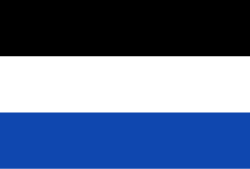
From 1883, Neutral Moresnet used a tricolour with horizontal bars in black, white and blue as its territorial flag. The origin is unknown and has been explained in two different ways:[11]
- It is argued by some that the colours were taken from the two conflicting powers' flags, with black and white representing Prussia, while white and blue represent the Netherlands.
- According to Flags of the World, "it seems more likely that the colours have been taken from the emblem of the Vieille Montagne", a mining company.[12]
Status
[edit]
The territory was governed by two royal commissioners, one from each neighbour. Eventually, these commissioners were commonly civil servants from the Belgian Verviers and the Prussian Eupen. The municipal administration was directed by a mayor appointed by the commissioners.
The Napoleonic civil and penal codes, introduced during French rule, remained in force throughout the existence of Neutral Moresnet. However, since no law court existed in the neutral territory, Belgian and Prussian judges had to come in and decide cases based on the Napoleonic laws. Since there was no administrative court either, the judge's decision could not be appealed.
In 1859, Neutral Moresnet was granted a greater measure of self-administration by the installation of a municipal council of ten members. The council, as well as a welfare committee and a school committee, were appointed by the mayor and served an advisory function only. The people had no voting rights.[13]
Life in Neutral Moresnet was dominated by the Vieille Montagne mining company, which not only was the major employer but also operated residences, shops, a hospital and a bank. The mine attracted many workers from the neighboring countries, increasing the population from 256 in 1815 to 2,275 in 1858 and 4,668 in 1914. Most services, such as the mail, were shared between Belgium and Prussia (in a fashion similar to Andorra). There were five schools in the territory, and Prussian subjects could attend the schools in Prussian Moresnet.
Living in the territory had several benefits. Among these were the low taxes (the national budget being fixed at 2,735 Belgian francs throughout most of its history), the absence of import tariffs from both neighbouring countries, and low prices compared to just across the border. A downside to their special status was the fact that people from Neutral Moresnet were considered stateless and were not allowed a military of their own.
Many immigrants settled in Moresnet so they would be exempt from military service; however, in 1854, Belgium began to conscript its citizens who had relocated to Moresnet, and Prussia did likewise in 1874. From then on, the exemption applied only to descendants of the original inhabitants.[14]
Currency
[edit]Neutral Moresnet did not have its own currency. The French franc was legal tender. The currencies of Prussia (and then Germany, after 1871), Belgium and the Netherlands were also in circulation. In 1848, local currency began circulating, though these coins were not considered the official medium.[15]
Uncertain future
[edit]
When the mine was exhausted in 1885, the continued survival of Neutral Moresnet was in doubt. Perhaps in response, the next year Dr. Wilhelm Molly (1838–1919), the mine's chief medical doctor and an avid philatelist, tried to organise a local postal service with its own stamps. This enterprise was quickly thwarted by Belgian intervention.[16]
In about 1900, Germany began a more aggressive policy concerning the territory and was accused of sabotage and obstructing the administrative process in order to force the issue.
A casino was established in August 1903 after the Belgians closed all such resorts in Belgium. The Moresnet casino operated with strict limitations, permitting no local resident to gamble, and no more than 20 people to gather at a time. The venture was abandoned, however, when Kaiser Wilhelm II threatened to partition the territory or cede it to Belgium to end the gambling. Around this same time, Moresnet boasted three distilleries for the manufacture of gin.[17]
During 1908, Dr. Molly proposed making Neutral Moresnet the world's first Esperanto‑speaking state, named Amikejo ("friendship-place"). The proposed national anthem was an Esperanto march of the same name,[16] set to the tune of "O Tannenbaum".[18] Several residents learned Esperanto and a rally was held in Kelmis to endorse the idea of Amikejo on 13 August 1908,[16] and a coat of arms was publicized.[18] The World Congress of Esperanto, meeting in Dresden, even declared Neutral Moresnet the world capital of the Esperanto community.[16]
First World War
[edit]
The First World War resulted in the end of neutrality. On 4 August 1914, Germany invaded Belgium, initially leaving Neutral Moresnet as "an oasis in a desert of destruction".[19] A total of 147 Neutral Moresnet citizens were killed, though it is unclear whether they were killed inside the territory or in fighting outside its borders.[citation needed] On 27 June 1915, Neutral Moresnet was annexed by the Kingdom of Prussia, although the annexation never received international recognition.[citation needed]
In 1918, the armistice between France and Germany, signed on 11 November at Compiègne, forced Germany to withdraw from Belgium and also from Moresnet. It also resulted in the ousting of Mayor Wilhelm Kyll, a German national who had been appointed after the German invasion.
On 28 June 1919, the Treaty of Versailles settled the dispute that had created the neutral territory a century earlier by awarding Neutral Moresnet, along with Prussian Moresnet and the German cantons of Eupen and Malmedy, to Belgium.[20] The treaty became effective 10 January 1920, ending the territory's existence and converting it into a municipality in Belgium.
To distinguish it from the already existing town of Moresnet (in the neighboring municipality of Plombières), Neutral Moresnet was renamed Kelmis (in French: La Calamine) – after kelme, the local dialect word for zinc spar.
Despite the annexation, Neutral Moresnet Mayor Pierre Grignard effectively stayed in office and became the first mayor of Kelmis. The ten members of Neutral Moresnet's council were confirmed for the Kelmis municipal council after its Prussian members renounced their nationality. They remained in office until the election of a new municipal council on 7 February 1923.[21][22]
Post-annexation history
[edit].jpg)
After 1920, Moresnet shared the history of Eupen-Malmedy.[23] Germany briefly re‑annexed the area during World War II, but it returned to Belgium in 1944. Since 1973, Kelmis has formed a part of the German‑speaking community of Belgium. During 1977, Kelmis absorbed the neighbouring communes of Neu‑Moresnet and Hergenrath.[24]
A small museum in Kelmis, the Museum Vieille Montagne, includes exhibits on Neutral Moresnet. Of the 60 border markers for the territory, more than 50 are still standing.[25]
As a company, Vieille Montagne survived Neutral Moresnet. It continues to exist as VMZINC, a part of Union Minière, the latter renamed in 2001 as Umicore, a global materials company.[9]
List of executive officers
[edit]| Name | Term | Occupation etc |
|---|---|---|
| Wilhelm Hardt | 6 August 1817 – 1819 | Mining consultant |
| Werner Jacob | 8 December 1817 – 2 December 1823 | Lawyer |
| Lambert Ernst | 8 June 1835 – 1840 | Deputy Prosecutor, Court of Appeal in Liège |
| Joseph Brandès | 2 December 1823 – 1830 | School inspector |
| Mathieu Crémer | 1 February 1840 – 1889 | Judge from Verviers |
| Johann Martin Daniel Mayer | 22 April 1819 – March 1836 | Mining consultant |
| Heinrich Martins | 9 July 1836 – 9 November 1853 or 1854 | Mining consultant |
| Peter Benedict Joseph Amand von Harenne | 11 August 1852 or 1854 – 7 January 1866 | District commissioner of Eupen |
| Freiherr von der Heydt | 12 December 1866 – 1868 | Former district commissioner of Eupen |
| Edward Gülcher | 1868–1871 | District commissioner of Eupen |
| Alfred Theodor Sternickel | 18 June 1871 – April 1893 | District commissioner of Eupen |
| Fernand Jacques Bleyfuesz | 30 November 1889 – 27 March 1915 | District commissioner of Verviers |
| Alfred Jakob Bernhard Theodor Gülcher | 18 April 1893 – 1 January 1909 | District commissioner of Eupen |
| Walter Karl Maria The Losen | 13 January 1909 – 1 November 1918 | District commissioner of Eupen |
| Dr. Bayer (acting) | 27 March – 27 June 1915 | Civil commissioner of Verviers |
| Fernand Jacques Bleyfuesz | November 1918 – 10 January 1920 | District commissioner of Verviers |
List of mayors
[edit]- Arnold Timothée de Lasaulx, 1817 – 2 February 1859
- Adolf Hubert van Scherpenzeel-Thim, 2 February 1859 – 30 May 1859
- Joseph Kohl, 1 July 1859 – 7 February 1882
- Oskar Anton Bilharz, 7 February 1882 – 20 June 1885
- Jérôme Mohsen, 20 June 1885 – 20 June 1885
- Hubert Schmetz, 20 June 1885 – 15 March 1915
- Wilhelm Kyll, 29 March 1915 – 7 December 1918
- Pierre Grignard, 7 December 1918 – 10 January 1920
See also
[edit]References
[edit]- ^ Neutral-Moresnet Archive
- ^ "Avez-vous déjà entendu parler de Moresnet ?". Archived from the original on 27 January 2024. Retrieved 27 January 2024.
- ^ "Het absurde verhaal van Neutraal Moresnet". Archived from the original on 27 January 2024. Retrieved 27 January 2024.
- ^ le lieu de l'amitié
- ^ Van Reybrouck, David (2018). Zink. De Bezige Bij. ISBN 978-94-031-0560-4.
Taal? Geen. Duits, Frans en Kelmeser Platt dooreen, iets tussen Plattdütsch en Limburgs in.
[Language? None. A mix of German, French and Kelmeser Platt, which is somewhere between Low German and Limburgish] - ^ "Plombières : visite du Viaduc de Moresnet par les écoles.x". Télé Vesdre. 16 September 2016. Archived from the original on 12 February 2023. Retrieved 18 June 2022.
- ^ Max Mangold (2005). Das Aussprachewörterbuch. Mannheim/Zürich: Dudenverlag, p. 564.
- ^ Martin, Lawrence; Reed, John (2006). The Treaties of Peace, 1919–1923. Vol. 1. Lawbook Exchange. p. 46. ISBN 978-1-58477-708-3. LCCN 2006005097.
Neutral Moresnet, added to this map as an independent country, is a mile [1.6 km] wide and 3 miles [4.8 km] long. It is so small that it has never been shown on maps of Europe as a whole. It has an area of 900 acres [360 ha] and about 3500 people . . .
- ^ a b "VMZINC : un leadership enraciné dans l'histoire". Qui sommes nous? (in French). VMZINC. Archived from the original on 22 October 2008. Retrieved 24 October 2008.
- ^ "Route 4: Landgraben" (PDF) (in French). GrenzRouten. 2009. pp. 45–46, 49. Archived from the original (PDF) on 15 March 2016. Retrieved 16 March 2016.
- ^ Neutral-Moresnet: History Archived 12 August 2012 at the Wayback Machine
- ^ Sache, Ivan; Sensen, Mark (1 May 2005). "The Neutral Territory of Moresnet (1816–1918)". Flags of the World. OCLC 39626054. Archived from the original on 28 September 2015.
- ^ Robert Shackleton, Unvisited Places of Old Europe, 1914, p. 161.
- ^ Charles Hoch, The Neutral Territory of Moresnet, trans. William Warren Tucker, 1882, p. 13.
- ^ Damen, Cees. "Coins". Neutral Moresnet. Archived from the original on 4 November 2008. Retrieved 24 October 2008.
- ^ a b c d Hoffmann, Eduard; Nendza, Jürgen (19 September 2003). "Galmei und Esperanto, der fast vergessene europäische Kleinstaat Neutral‑Moresnet" (PDF) (in German). Südwestrundfunk. Archived (PDF) from the original on 15 March 2016. Retrieved 15 March 2016.
- ^ "Awaiting a Crisis in Belgium" (PDF). The New York Times. 13 September 1903. ISSN 0362-4331. Archived (PDF) from the original on 15 March 2016.
- ^ a b Middleton, Nick (2015). An Atlas of Countries That Don't Exist: A Compendium of Fifty Unrecognized and Largely Unnoticed States. London: Macmillan. p. 38. ISBN 978-1-4472-9527-3.
- ^ Musgrave, George Clarke (1918). "The Belgian Prelude". Under Four Flags for France. New York: D. Appleton & Company. p. 8. hdl:2027/uc2.ark:/13960/t8qb9xr4b. LCCN 18003816. OCLC 1157994. OL 7209571M.
As a proof of German preparation, war had come automatically at 7 a.m., 3 August [1914]. At 23 o'clock (Belgian time), the outposts on the main roads holding Pepinster, Battice, Herve and smaller hamlets were heavily engaged and finally forced back to the fortified lines of [Liège]. The pretty towns defended near the frontier were soon flaming ruins, the quaint neutral territory of Moresnet rising as an oasis in a desert of destruction.

- ^ "Peace Treaty of Versailles, Articles 31 – 117, Political Clauses for Europe and Annexes". net.lib.byu.edu. Archived from the original on 15 July 2018. Retrieved 2 January 2007.
- ^ "Kelmis (Municipality, Province of Liège, Belgium)". www.crwflags.com. Archived from the original on 9 July 2018. Retrieved 20 March 2017.
- ^ "Startseite – Ihre Gemeinde Kelmis-Hergenrath-Neu Moresnet". www.kelmis.be. Archived from the original on 20 March 2017. Retrieved 20 March 2017.
- ^ Wenselaers, Selm (2008). De laatste Belgen, een geschiedenis van de oostkantons (The last Belgians, a history of the eastern districts). Meulenhoff/Manteau. ISBN 978-90-8542-149-8.
- ^ Gemeinde Kelmis (in German)
- ^ Berns, Eef (2002). "In search of the bordermarkers of Moresnet". Archived from the original on 30 September 2008. Retrieved 1 September 2008.

Further reading
[edit]- Earle, Peter C. (4 August 2012). "Anarchy in the Aachen". Mises Institute. Archived from the original on 11 December 2019. Retrieved 7 September 2017.
- Earle, Peter C. (2014). A Century of Anarchy: Neutral Moresnet through the Revisionist Lens. Intangible Goods. ISBN 978-0-9913059-5-7.
- Press, Steven Michael (29 June 2010). To Govern, or Not to Govern: Prussia, Neutral Moresnet. Rochester, NY: Social Science Research Network. SSRN 2096313.
External links
[edit]

- "Moresnet, Belgium". Archived from the original on 15 March 2016. Pictures of the old mines
- Official website Kelmis (in German)
- Göhltalmuseum Archived 6 January 2017 at the Wayback Machine, a local museum that shows the history of Neutral Moresnet and its zinc mining (in German)
- Anarchy in the Aachen (Mises.org)
- Het vergeten land van Moresnet, documentary, 1990 (48', languages spoken: Dutch, German, French, Esperanto)
- Elbruz interactive map of Neutral Moresnet Elbruz interactive map of Neutral Moresnet
50°43′49″N 6°00′48″E / 50.73028°N 6.01333°E
| International | |
|---|---|
| National | |
| Other | |

Neutral Moresnet
View on GrokipediaGeography
Location and Borders
Neutral Moresnet was situated in the Meuse-Rhine Euroregion, at the tripoint where the borders of modern Belgium, Germany, and the Netherlands converge. It encompassed approximately 3.5 square kilometers of land centered around the village of La Calamine (now Kelmis), in what is today the eastern part of Liège Province, Belgium. The territory's coordinates placed it roughly between 50°42′N and 50°45′N latitude and 5°59′E and 6°03′E longitude, adjacent to the Prussian exclave of Aachen and the Dutch-speaking areas to the north.[3][9] The borders of Neutral Moresnet were established as a condominium zone jointly administered by the Kingdom of Prussia and the United Kingdom of the Netherlands following the Treaty of Aachen in 1816. To the east and south, it adjoined Prussian territories, including mining districts rich in calamine (zinc ore), while to the west and north lay Dutch lands, later Belgian after the country's independence in 1830. The irregular, roughly triangular shape measured about 3.6 kilometers in length and 1.5 kilometers in width at its broadest, with the southern boundary running along the Geul River valley and the northern extent approaching the Vaalserberg hill, site of the present-day Drielandenpunt tripoint.[10][11] Boundary demarcation involved periodic surveys, culminating in the placement of 60 numbered stone markers between 1869 and 1870 to precisely define the limits and prevent encroachments related to mining operations. These markers, labeled I to LX along the respective borders, delineated the neutral zone's separation from Prussian and Belgian jurisdictions, with over 50 still extant today as historical remnants. The configuration reflected the underlying dispute over Vieille Montagne zinc deposits, which bisected older French-Prussian frontiers from 1795 and 1801 treaties, rendering the area extrterritorial to avoid allocation to either power.[9][12]Terrain and Resources
Neutral Moresnet encompassed an elongated territory measuring approximately 5 kilometers in length and 1.5 kilometers in width, covering about 3.5 square kilometers in the tripoint region between present-day Belgium, Germany, and the Netherlands.[13] The terrain featured undulating hills typical of the eastern Belgian borderlands, with elevations averaging around 233 meters above sea level and ranging from about 200 to 300 meters, including proximity to the highest point on the mainland of the Low Countries at 323 meters near the Vaalserberg tripoint.[14] [15] The landscape was characterized by karstic features in Carboniferous limestone formations, such as sinkholes and lenticular ore pockets, which facilitated mining but limited agricultural potential due to thin, mineral-enriched soils.[16] The primary natural resource was zinc ore, particularly calamine (zinc silicate, or smithsonite), extracted from the Vieille Montagne (Altenberg) mine, a key deposit in the Plombières-Vieille Montagne-Moresnet mining district hosted within Tournaisian limestone.[17] [16] This mine, operational since medieval times and central to the territory's neutrality due to its value, yielded significant quantities of zinc spar coveted by neighboring powers, with associated lead ores also present but secondary in importance.[18] [12] Post-extraction landscapes developed calaminarian grasslands on tailings, reflecting the dominance of metalliferous mining over other resources like timber or arable land in this compact area.[19]Historical Origins
Establishment in 1816
Following the defeat of Napoleon at the Battle of Waterloo in 1815, the Congress of Vienna sought to redraw European borders, including those between the Kingdom of Prussia and the United Kingdom of the Netherlands.[10] The district of Moresnet, located near Aachen, became a point of contention due to unclear territorial claims exacerbated by the valuable Vieille Montagne zinc mine within its bounds.[18] Negotiations between Prussian and Dutch representatives, held in Aachen, addressed these border ambiguities to prevent further conflict.[1] On June 26, 1816, the Treaty of the Frontiers (also known as the Aachen Borders Treaty) was signed, dividing the Moresnet district into three parts: Prussian Moresnet to the east, Dutch Moresnet to the west, and a small central neutral zone spanning approximately 3.5 square kilometers (360 hectares).[1] [4] This neutral territory, officially termed Neutral Moresnet, encompassed the villages of Kelmis (La Calamine) and Hombourg, along with the disputed zinc mining operations, to sidestep ownership disputes over the economically vital resource.[18] The agreement stipulated joint administration by Prussia and the Netherlands as a condominium, with prohibitions on military fortifications and garrisons to maintain perpetual neutrality.[4] At its inception, Neutral Moresnet had a population of about 256 residents, primarily engaged in zinc extraction, which formed the economic backbone of the territory from the outset.[5] The treaty's compromise reflected pragmatic diplomacy amid post-war exhaustion, prioritizing stability over full territorial resolution and setting the stage for over a century of unique geopolitical status.[1]Border Disputes and Neutrality Agreement
The border disputes leading to the creation of Neutral Moresnet arose in the aftermath of the Napoleonic Wars, during the redrawing of European boundaries at the Congress of Vienna (1814–1815). Prussia acquired territories around Aachen, including parts of the former Duchy of Jülich, while the United Kingdom of the Netherlands received southern districts previously under French control, such as the area near Liège. In the Moresnet region, ambiguity persisted over the precise demarcation line, particularly concerning the village of Kelmis (La Calamine) and the adjacent Vieille Montagne zinc mine, a major calamine ore producer operational since 1806 under a Liège-chartered company.[18][4] Both Prussia and the Netherlands asserted claims based on differing interpretations of historical boundaries, with the mine's location—straddling potential border lines along roads or the Geul stream—intensifying the conflict. The ore deposits extended across what each side viewed as sovereign territory, making concession economically untenable; the mine yielded thousands of tons of calamine annually, fueling early industrial zinc production. Negotiations stalled as neither power wished to yield control, risking escalation amid post-war sensitivities, prompting a compromise to preserve stability without assigning full sovereignty.[20][3] On 26 June 1816, the Treaty of Aachen (Aachener Grenzvertrag) resolved the impasse by designating a small condominium territory of approximately 3.6 square kilometers, known as Neutral Moresnet, jointly administered by Prussian and Dutch commissioners. The agreement stipulated demilitarization, prohibition of fortifications, and joint oversight of civil administration, including a Prussian-appointed mayor subject to mutual consent; no unilateral laws could be imposed without bilateral approval. This neutrality status aimed to neutralize the disputed zone indefinitely, pending future resolution, while allowing economic activities like mining to continue uninterrupted under the existing Vieille Montagne concession, which predated the border issues.[1][21][4] The arrangement reflected pragmatic diplomacy over strict territorial claims, influenced by the mine's value—estimated to generate significant revenue—and the broader Concert of Europe's emphasis on preventing localized conflicts. Despite the treaty's intent for temporary neutrality, it endured for over a century, surviving the Belgian Revolution of 1830, which substituted Belgium for the Netherlands without altering the condominium structure, as both successors honored the 1816 terms.[22][23]Governance and Administration
Joint Condominium Structure
Neutral Moresnet operated as a condominium, a territory under the simultaneous sovereignty of Prussia and the Kingdom of the United Netherlands (later Belgium after 1830), as stipulated in Article 17 of the Treaty of Aachen signed on June 26, 1816.[24][4] This arrangement mandated joint administration without fortification or military presence by either power, aiming to resolve a border dispute over the Vieille Montagne zinc mine while preserving economic access for both.[4] The condominium's governance emphasized compromise, but disagreements often resulted in deliberate minimal intervention, leaving many aspects effectively ungoverned to avoid jurisdictional conflicts.[23] Local administration was managed through a joint committee comprising commissioners—one from each sovereign power—who oversaw municipal affairs and appointed the mayor, typically a local resident selected alternately or by consensus.[4] The mayor handled day-to-day executive functions, such as public order and resource extraction oversight, but lacked independent authority, relying on directives from the commissioners.[4] Following Belgium's independence in 1830, the Dutch commissioner was replaced by a Belgian counterpart, maintaining the bilateral structure until 1920.[24] The legal framework drew from the Napoleonic Code, adopted in 1822 for civil and penal matters, though neither Prussia nor the Netherlands fully applied it domestically, creating inconsistencies.[24][4] No local courts or prisons existed; criminal cases rotated annually between Prussian Aachen and Dutch (later Belgian) Liège, while civil disputes were initially heard in Aachen with appeals to Liège.[24] Prussian and Dutch (or Belgian) judges alternated adjudication, enforcing a patchwork system that tolerated gaps, such as the absence of suffrage provisions or gambling regulations, fostering a de facto authoritarian and laissez-faire environment.[24][4] This joint oversight prioritized economic stability over comprehensive rule, with no unified tax or nationality system, rendering residents often stateless.[23]Executive Officers and Mayors
Neutral Moresnet's executive administration was conducted through two royal commissioners, one nominated by Prussia and the other by the United Netherlands until Belgian independence in 1830, after which Belgium replaced the Dutch appointee.[10] These commissioners, typically civil servants from customs or mining departments, jointly supervised territorial affairs, including fiscal policy, neutrality enforcement, and oversight of local operations, while alternating primary responsibility to streamline decision-making.[25] The commissioners appointed a burgomaster (mayor) to handle municipal governance, civil registry, and basic judicial functions under Napoleonic codes retained from prior French rule.[26] This position was filled alternately by candidates of Prussian or Belgian nationality, ensuring balanced influence, with the burgomaster supported by a council of ten elected members for local deliberations.[26][27] Tenure for both commissioners and the burgomaster varied, often lasting three years or until reassignment, reflecting the condominium's emphasis on parity over independent executive power.[4] Smuggling and mining disputes frequently tested this dual structure, prompting commissioners to mediate with the Vieille-Montagne zinc company, which held significant economic leverage.[18] By the late 19th century, administrative inefficiencies contributed to proposals for annexation, culminating in the territory's incorporation into Belgium under the 1919 Treaty of Versailles.[10]Legal and Judicial System
Neutral Moresnet applied the Napoleonic Code as its basis for civil and penal law, a system inherited from prior French administration in the region.[4][8] This code governed legal proceedings without local modifications, reflecting the territory's status as a condominium where neither Prussia nor the Netherlands imposed their full domestic legal frameworks.[4] The territory possessed no independent courts or prisons, rendering its judicial infrastructure minimal and reliant on external authorities.[4][8] Judges dispatched from Prussian and Dutch (post-1830, Belgian) jurisdictions presided over cases as needed, traveling to the site for hearings and issuing convictions under the Napoleonic provisions.[4][8] The burgomaster, appointed alternately by the co-administering powers, managed day-to-day civil and judicial administration, including minor disputes, but escalated serious matters to these foreign magistrates.[26] This arrangement fostered inefficiencies, as the absence of dedicated local enforcement mechanisms contributed to lax oversight, smuggling proliferation, and delayed resolutions, with critics describing the system as "wildly ineffective" due to jurisdictional ambiguities and infrequent interventions.[23] Prussian and Belgian courts retained ultimate appellate authority for appeals originating in Moresnet, ensuring alignment with condominium protocols but underscoring the territory's subordination to external legal sovereignty.[8]Economy
Zinc Mining Dominance
The zinc mining industry, centered on the Vieille Montagne (Altenberg) deposit near Kelmis, formed the economic cornerstone of Neutral Moresnet from its inception in 1816. The territory's neutral status originated from Prussian-Dutch border disputes over this rich zinc-lead ore body, which neither power wished to cede to the other.[18] Systematic exploitation began with the founding of the Société anonyme des Mines et Fonderies de Zinc de la Vieille Montagne in 1837, which developed advanced smelting techniques and expanded operations across Europe.[18] This enterprise dominated local employment, attracting workers from neighboring regions and driving population growth from 256 residents in 1816 to over 2,500 by 1858.[18] [10] The company served as the principal employer, with mining activities supporting higher wages, low taxes, and duty-free trade that bolstered prosperity. Beyond extraction, it constructed essential infrastructure including residences, shops, schools, a hospital, and a bank, while funding education from 1857 and providing free medical care for employees.[10] [18] Corporate directors frequently held the position of mayor, embedding the firm's influence in governance and daily life.[18] Zinc output from the La Calamine area, encompassing the Neutral Moresnet workings, surpassed 600,000 tons of metal, underscoring the mine's scale amid limited European alternatives at the time.[28] Operations persisted until resource exhaustion in 1895, after which the company shifted to smelting, yet the mine's legacy defined the territory's identity and viability until its dissolution in 1920.[18] [10]Trade, Smuggling, and Fiscal Policies
The condominium structure of Neutral Moresnet precluded unified fiscal authority, resulting in the absence of significant taxes levied by either Prussia or Belgium, as joint agreement on taxation proved unattainable.[23] No import or export duties were enforced, enabling unrestricted movement of goods and contributing to economic prosperity through arbitrage with tariffed neighbors.[29] This laissez-faire approach, rooted in the unadapted Napoleonic Code, kept overall tax burdens minimal and prices low, attracting settlers and enterprises.[29] Fiscal leniency particularly benefited the liquor sector, with negligible taxes on home-brewed alcohol fostering distilleries and approximately 80 public houses by the late 19th century.[29][1] The resulting cheap alcohol drove legitimate trade but also rampant smuggling, as neutral status and lax policing—with only one territory-wide officer—allowed evasion of customs into higher-tax Prussia and Belgium.[10][29] Smuggling networks exploited the tri-border location, concealing goods like moonshine in bicycle frames for export, supplementing mining incomes amid ore depletion after 1885.[29][10] While bolstering short-term wealth, this illicit trade underscored governance frailties, with local mayors dispensing justice informally amid rising crime.[1] By the early 20th century, economic strains from exhausted resources amplified reliance on such activities until World War I intervention.[23]Society and Culture
Demographics and Population Dynamics
Neutral Moresnet covered an area of approximately 3.5 square kilometers and had an initial population of 256 residents in 1816, primarily centered around the village of Kelmis and the Vieille Montagne zinc mine.[30] [5] By 1830, this figure had roughly doubled to about 500 inhabitants, reflecting early migration driven by mining employment.[2] The population experienced rapid expansion in the mid-19th century, reaching 2,572 by 1858—a tenfold increase from its founding—due to the territory's economic pull from zinc extraction, which drew laborers, as well as its role as a smuggling haven exempt from tariffs and a refuge for draft evaders from neighboring states.[5] [11] [2] This growth strained resources in the diminutive enclave, yielding a high density that approached 1,334 persons per square kilometer by 1914, when the population peaked at 4,668.[10] At dissolution in 1920, residents numbered around 4,500.[10] Demographically, the populace was heavily immigrant-driven; in 1858, only about 700 individuals were "Neutrals"—descendants of pre-1816 locals—while the majority consisted of 852 Belgians, 807 Prussians, 204 Dutch, and a handful of others, underscoring the territory's function as a transient labor and evasion zone rather than a stable ethnic homeland.[2] Linguistic composition mirrored this mix, with German predominant as the native tongue in Kelmis, alongside Flemish, Walloon French, and Dutch influences from cross-border ties.[13] No formal census tracked ethnicity or language systematically, but the multinational influx fostered a pragmatic multilingualism suited to trade and evasion activities.Symbols: Flag, Currency, and Stamps
Neutral Moresnet adopted a flag featuring three horizontal stripes of black, white, and blue, likely in the late 19th century to represent its distinct status amid the condominium arrangement.[12] The design's colors possibly derived from the emblem of the Société Anonyme des Mines et Fonderies de Zinc de la Vieille Montagne, the dominant zinc mining enterprise in the territory, or from combining elements of the Prussian black-white and United Netherlands' blue-white-red flags, though the exact origin remains uncertain.[12] This tricolour served as a territorial emblem during the final decades of Neutral Moresnet's existence, from approximately 1883 until its dissolution in 1920.[31] The territory lacked an independent monetary system and relied on the French franc as its primary legal tender, a holdover from Napoleonic influence in the region.[4] Currencies from the administering powers—Prussian thalers (later German marks after 1871) and Belgian or Dutch coins—also circulated freely due to the absence of border controls and the condominium's fiscal dependencies.[12] No sovereign mint operated in Neutral Moresnet, though an unofficial 2-franc coin dated 1848 exists, its provenance and limited issuance suggesting it was not recognized as official currency.[32] Neutral Moresnet issued no official postage stamps, as it maintained no independent postal administration and depended on services from Prussia or Belgium.[33] In 1886, a set of imperforate stamps purporting to represent the territory appeared, featuring designs like a pig in a jester's hat, but these were forgeries produced by a Brussels stamp magazine editor and quickly invalidated by authorities upon detection.[33] Such unofficial issues highlight the territory's symbolic aspirations amid practical administrative limitations, with no valid philatelic output during its 104-year span.[34]
Social Conditions and Attractions
![Kelmis administration building of the Vieille Montagne zinc company][float-right] The social fabric of Neutral Moresnet revolved around the zinc mining industry operated by the Société des Mines et Fonderies de la Vieille Montagne, established in 1837, which employed the majority of residents and provided essential community infrastructure. By 1857, the company had funded a local school and appointed a supervisor who doubled as village policeman, while offering free medical care, preferential housing loans, and higher wages compared to neighboring regions.[35] These measures, combined with lower taxes, duty-free imports, and tax-exempt personal alcohol distillation, contributed to relatively prosperous living conditions, though the absence of military conscription until 1847 also drew draft evaders and other migrants.[35] Population growth reflected this appeal, expanding from 256 inhabitants in 1816 to over 2,500 by 1858, fueled by immigrant workers from surrounding areas seeking mining opportunities.[35] [36] The territory's neutral condominium status, with limited joint administration from Prussia and the Netherlands (later Belgium), resulted in lax enforcement of laws, transforming Neutral Moresnet into a haven for illicit activities. Smuggling of goods like alcohol and tobacco flourished due to the lack of customs barriers and extradition agreements, while the penal code's omission of gambling prohibitions allowed casinos to operate freely after such activities were banned in Belgium around the late 19th century.[29] [37] Prostitution and other vice trades also thrived, attracting political refugees, deserters, and individuals evading social stigmas, such as unmarried pregnant women from higher social strata.[30] [29] This environment, while economically opportunistic, fostered a reputation as a "smugglers' paradise" with minimal state interference, contrasting the structured welfare of the mining company.[38] Attractions during Neutral Moresnet's existence centered on its industrial and geopolitical uniqueness rather than conventional tourism. The Vieille Montagne mine, with its calamine deposits exploited since the 18th century, drew workers and visitors interested in zinc extraction techniques, peaking before operations ceased in 1895.[35] The territory's position at the tripoint of Prussia, the Netherlands, and Belgium offered intrigue for border-crossers, while the administration buildings in Kelmis served as focal points for the condominium's governance.[36] Lax regulations made it a draw for gamblers and smugglers seeking unregulated entertainment, with distilleries producing gin adding to the allure of vice-related pursuits by the early 20th century.[10]The Esperanto Initiative
Proposal and Advocacy
In 1908, Dr. Wilhelm Molly, the chief physician for the Vieille Montagne zinc mining company in Neutral Moresnet and a dedicated Esperantist, proposed converting the territory into the world's first Esperanto-speaking sovereign state named Amikejo, translating to "Place of Friendship" in the constructed language.[4][6] Molly's plan aimed to resolve the territory's protracted neutral status—stemming from unresolved border disputes between Prussia and the United Kingdom of the Netherlands since 1816—by establishing Esperanto as the official language, thereby creating a linguistically neutral entity free from national affiliations.[10][18] He argued that this would provide Moresnet's approximately 2,500 residents with a shared cultural identity, capitalizing on Esperanto's invented neutrality to promote international understanding amid post-mining economic stagnation.[12] Advocacy for the initiative centered on Molly's efforts to disseminate Esperanto locally, including using the language in his medical practice and organizing informal instruction for residents, which led to a small but dedicated group of learners among the population.[4][11] Proponents, primarily Esperantists within the territory, framed Amikejo as a practical utopian experiment, suggesting it could serve as a model for resolving ethnic and border conflicts through a universal auxiliary language designed by L. L. Zamenhof in 1887 to eliminate communication barriers.[39] The proposal incorporated symbolic proposals, such as adopting an Esperanto adaptation of "La Marseillaise" as the national anthem, to evoke ideals of fraternity and progress without invoking existing national loyalties.[12] Molly's advocacy extended to publicizing the concept through Esperanto networks, positioning Neutral Moresnet's unique administrative limbo—governed jointly by Belgian and Prussian commissioners without full sovereignty—as an ideal testing ground for linguistic internationalism.[40] While lacking endorsement from the condominium powers or broader diplomatic support, the effort reflected early 20th-century enthusiasm for Esperanto as a tool for pacifism, with advocates emphasizing its potential to insulate the territory from irredentist claims by fostering a supranational community.[41] This initiative garnered limited but notable interest, including the production of conceptual postage stamps in Esperanto, underscoring a vision of self-determination through cultural rather than territorial innovation.[42]Implementation Attempts and Failure
In 1908, Wilhelm Molly, the territory's commissioner and an avid Esperantist, spearheaded efforts to transform Neutral Moresnet into the world's first Esperanto-speaking state, renaming it Amikejo ("place of friendship") to symbolize a neutral haven for international language users.[43][41] Molly established the Neutral Moresnet Independence Movement, which promoted Esperanto through local education, incorporating the language into school curricula and encouraging residents to achieve conversational proficiency.[11] Supporters created symbolic elements, including a new flag with horizontal black, white, and blue stripes, a national anthem, and postage stamps featuring Esperanto text—though earlier stamp issuances dating to 1886 had been suppressed by Prussian and Dutch authorities.[43] The initiative gained limited international attention when the Fourth Universal Esperanto Congress considered relocating its headquarters to Amikejo from The Hague, aiming to position the territory as a global beacon for linguistic unity.[41] These attempts faltered due to the absence of formal recognition from the administering powers—Prussia and the Netherlands (later Belgium)—which maintained joint sovereignty and viewed the declaration as unauthorized.[11] Economic decline, exacerbated by the depletion of zinc deposits in the Vieille Montagne mine by the early 1900s, undermined the territory's viability, as mining revenues had sustained its quasi-autonomy without generating sufficient alternative income.[41] Broader adoption stalled amid low resident participation and minimal influx of Esperantists, rendering the project more aspirational than operational.[43] The onset of World War I in 1914 decisively ended prospects: German forces invaded on August 4, severing utilities like electricity and telephones, annexing the area, and reportedly executing local Esperantists, with the Treaty of Versailles in 1919 awarding the territory to Belgium by 1920.[43][41]World War I and Dissolution
German Occupation (1914-1918)
The German occupation of Neutral Moresnet began in early August 1914, shortly after the invasion of Belgium on 4 August. German troops entered the territory on 9 August without encountering military resistance, rapidly incorporating the 3.5 square kilometers of land into their control and effectively ending its neutral status.[4] This swift takeover reflected the territory's strategic proximity to Aachen and its lack of defensive forces, as Neutral Moresnet had maintained no standing army since its establishment in 1816.[18] Under occupation, Neutral Moresnet was de facto annexed to the German Empire and administered as part of the Prussian Rhine Province, directly attached to the district of Aachen. The local population, numbering around 4,000 to 5,000 residents primarily engaged in post-mining trades and cross-border commerce, fell subject to German military governance similar to that imposed on occupied Belgium. Residents were conscripted into the German army, contributing to the broader war effort; in the wider Eupen-Malmedy region encompassing Moresnet, approximately 1,800 soldiers from the area died in German service by 1918.[7] Economic activities, though diminished after the closure of the Vieille-Montagne zinc mine in 1895, continued under German oversight, with no major disruptions reported specific to the territory.[18] The occupation persisted until the Armistice of Compiègne on 11 November 1918, which mandated German withdrawal from all occupied territories, including Neutral Moresnet. Forces evacuated the area by late 1918, transitioning control to Allied oversight pending the Treaty of Versailles. During the four years of occupation, the territory experienced no notable battles or uprisings, underscoring its marginal role in the conflict despite the broader devastation in Belgium.[1] Commemorative plaques in local churches, such as in La Calamine (the chief town), later honored the period's fallen, reflecting the human cost borne by the community.[7]Annexation by Belgium (1920)
Following the Armistice of November 11, 1918, German forces withdrew from Neutral Moresnet, allowing Belgian troops to occupy the territory and assume de facto administration pending formal resolution.[10] The Treaty of Versailles, signed on June 28, 1919, addressed the status of the territory in Article 32, which stated: "Germany recognises the full sovereignty of Belgium over the whole of the contested territory of Moresnet (called Moresnet neutre)."[44] This provision ended the neutral condominium arrangement established in 1816 under the Treaty of Aachen, transferring undivided control to Belgium without provisions for a plebiscite, unlike the adjacent districts of Eupen and Malmedy.[45] The annexation took effect on January 10, 1920, integrating Neutral Moresnet into the Belgian province of Liège as the municipality of Kelmis (known in French as La Calamine).[8] The territory's area of approximately 3.5 square kilometers and population of around 2,564 inhabitants at the time were absorbed without significant territorial adjustments or local opposition documented in primary records.[4] Belgian authorities promptly replaced the joint Prussian-Belgian administration with full national governance, dissolving the neutral zone's unique fiscal and judicial autonomy that had persisted for over a century.[6] This incorporation provided Belgium with strategic border consolidation and access to the Vieille Montagne zinc mines, a key economic asset previously shared under the neutral regime.[46] Germany formally acknowledged the loss in subsequent agreements, including the 1925 Locarno Pact, though the territory was briefly reoccupied by Nazi forces in 1940 before reverting to Belgium post-World War II.[47] The annexation marked the definitive end of Neutral Moresnet as a distinct entity, transitioning its residents—predominantly German-speaking Walloons—from condominium subjects to Belgian citizens.[48]Legacy and Modern Perspectives
Post-Annexation Integration
Following the Treaty of Versailles, Neutral Moresnet was annexed by Belgium effective January 10, 1920, and directly incorporated as the municipality of Kelmis without the plebiscite required for the adjacent Eupen-Malmedy territories.[7][10] This administrative shift ended the territory's condominium status under Prussian-Belgian joint sovereignty, placing it under full Belgian jurisdiction within the province of Liège and the arrondissement of Verviers.[9] Residents, previously exempt from military conscription and certain taxes due to the neutral status, became subject to Belgian civil obligations, including national service and fiscal policies aligned with the Kingdom's framework.[36] Economically, integration preserved the dominance of zinc mining, with the Société Anonyme des Mines et Fonderies de Zinc de la Vieille Montagne continuing operations centered in Kelmis (French: La Calamine), leveraging the historic calamine deposits that had defined the region's value since the early 19th century.[49] The annexation facilitated Belgian oversight of these assets, integrating them into national industrial networks without immediate disruption, though production volumes later declined amid global shifts away from lead-zinc extraction by the mid-20th century.[19] Border adjustments formalized the tripoint with Germany and the Netherlands, eliminating smuggling incentives from the prior neutral haven and aligning customs with Belgian standards.[50] Socially, the predominantly German-speaking population—numbering around 2,500 in 1920—adapted to Belgian governance amid linguistic tensions, as French became the administrative language in Wallonia, though local German usage persisted informally.[48] Unlike in Eupen-Malmedy, where pro-German petitions surfaced during the 1920 consultative vote (reporting over 90% opposition to annexation in some areas), Moresnet experienced no documented mass resistance, reflecting its smaller scale and prior Belgian co-administration.[7] By 1977, administrative mergers consolidated Neu-Moresnet into Kelmis, streamlining local governance under Belgian municipal law.[51] In the postwar era, the area contributed to Belgium's German-speaking Community established in 1980, preserving cultural elements while fully embedded in national institutions.[48]Historical Assessments and Micronation Analogies
Historians assess Neutral Moresnet as a pragmatic yet flawed condominium arrangement born from post-Napoleonic border negotiations, where unresolved disputes over the Vieille Montagne zinc mine led to a 3.5 square kilometer neutral zone established by the Treaty of Aachen on June 26, 1816, jointly administered by Prussia and the United Kingdom of the Netherlands (later Belgium after 1830).[10] This setup, lacking full sovereignty or a standing army, fostered administrative inefficiencies, with Prussian and Dutch/Belgian commissioners often deadlocked, resulting in de facto local autonomy under mayor Wilhelm Ernst in Kelmis from 1828 onward.[4] Economic reliance on zinc exports sustained the territory, but low taxes and extraterritorial privileges enabled smuggling and vice industries, undermining stability without escalating to formal conflict.[11] Assessments emphasize its role as a rare 19th-century experiment in enforced neutrality amid great-power rivalries, succeeding in averting territorial disputes for over a century until World War I disrupted the arrangement, yet failing to evolve into a viable state due to absent national identity and external dependencies.[6] Transnational historians view it as emblematic of Lotharingian border ambiguities, where multilingual populations navigated overlapping jurisdictions, prefiguring modern supranational entities like the Benelux union, though its dissolution via the 1919 Treaty of Versailles—annexing it to Belgium on July 28, 1920—highlights the fragility of such micro-arrangements against imperial collapse.[52] Analogies to modern micronations, such as the Principality of Sealand or the Republic of Molossia, portray Neutral Moresnet as a proto-example due to its minuscule size, distinct symbols (flag adopted circa 1880s, stamps from 1867), and aspirations for independence, including the 1908 Amikejo Esperanto project aiming for a neutral linguistic haven.[4] [6] Unlike self-proclaimed micronations lacking international recognition, however, Moresnet derived legitimacy from bilateral treaties, functioning as a condominium rather than an unrecognized entity, with joint oversight preventing full autonomy.[53] This distinction tempers direct comparisons, as its endurance stemmed from great-power acquiescence rather than unilateral declaration, though enthusiasts cite it as historical precedent for small-scale sovereignty experiments amid globalization.[10]References
- https://en.wikisource.org/wiki/The_neutral_territory_of_Moresnet