Hubbry Logo
search
logo

Normal bundle

logo
Community Hub0 Subscribers
Read side by side
from Wikipedia

In differential geometry, a field of mathematics, a normal bundle is a particular kind of vector bundle, complementary to the tangent bundle, and coming from an embedding (or immersion).

Definition

[edit]

Riemannian manifold

[edit]

Let be a Riemannian manifold, and a Riemannian submanifold. Define, for a given , a vector to be normal to whenever for all (so that is orthogonal to ). The set of all such is then called the normal space to at .

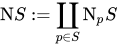
Just as the total space of the tangent bundle to a manifold is constructed from all tangent spaces to the manifold, the total space of the normal bundle[1] to is defined as

.

The conormal bundle is defined as the dual bundle to the normal bundle. It can be realised naturally as a sub-bundle of the cotangent bundle.

General definition

[edit]

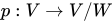
More abstractly, given an immersion (for instance an embedding), one can define a normal bundle of in , by at each point of , taking the quotient space of the tangent space on by the tangent space on . For a Riemannian manifold one can identify this quotient with the orthogonal complement, but in general one cannot (such a choice is equivalent to a section of the projection ).

Thus the normal bundle is in general a quotient of the tangent bundle of the ambient space restricted to the subspace .

Formally, the normal bundle[2] to in is a quotient bundle of the tangent bundle on : one has the short exact sequence of vector bundles on :

where is the restriction of the tangent bundle on to (properly, the pullback of the tangent bundle on to a vector bundle on via the map ). The fiber of the normal bundle in is referred to as the normal space at (of in ).

Conormal bundle

[edit]

If is a smooth submanifold of a manifold , we can pick local coordinates around such that is locally defined by ; then with this choice of coordinates

and the ideal sheaf is locally generated by . Therefore we can define a non-degenerate pairing

that induces an isomorphism of sheaves . We can rephrase this fact by introducing the conormal bundle defined via the conormal exact sequence

,

then , viz. the sections of the conormal bundle are the cotangent vectors to vanishing on .

When is a point, then the ideal sheaf is the sheaf of smooth germs vanishing at and the isomorphism reduces to the definition of the tangent space in terms of germs of smooth functions on

.

Stable normal bundle

[edit]

Abstract manifolds have a canonical tangent bundle, but do not have a normal bundle: only an embedding (or immersion) of a manifold in another yields a normal bundle. However, since every manifold can be embedded in , by the Whitney embedding theorem, every manifold admits a normal bundle, given such an embedding.

There is in general no natural choice of embedding, but for a given manifold , any two embeddings in for sufficiently large are regular homotopic, and hence induce the same normal bundle. The resulting class of normal bundles (it is a class of bundles and not a specific bundle because the integer could vary) is called the stable normal bundle.

Dual to tangent bundle

[edit]

The normal bundle is dual to the tangent bundle in the sense of K-theory: by the above short exact sequence,

in the Grothendieck group. In case of an immersion in , the tangent bundle of the ambient space is trivial (since is contractible, hence parallelizable), so , and thus .

This is useful in the computation of characteristic classes, and allows one to prove lower bounds on immersibility and embeddability of manifolds in Euclidean space.

For symplectic manifolds

[edit]

Suppose a manifold is embedded in to a symplectic manifold , such that the pullback of the symplectic form has constant rank on . Then one can define the symplectic normal bundle to as the vector bundle over with fibres

where denotes the embedding and is the symplectic orthogonal of in . Notice that the constant rank condition ensures that these normal spaces fit together to form a bundle. Furthermore, any fibre inherits the structure of a symplectic vector space.[3]

By Darboux's theorem, the constant rank embedding is locally determined by . The isomorphism

(where and is the dual under ,) of symplectic vector bundles over implies that the symplectic normal bundle already determines the constant rank embedding locally. This feature is similar to the Riemannian case.

References

[edit]
Revisions and contributorsEdit on WikipediaRead on Wikipedia
from Grokipedia
In differential geometry, the normal bundle of a submanifold YY embedded in a smooth manifold XX via an inclusion map i:YXi: Y \hookrightarrow X is defined as the quotient vector bundle NY/X=i(TX)/TYN_{Y/X} = i^*(TX) / TY over YY, where TXTX is the tangent bundle of XX and the fiber at each point yYy \in Y consists of equivalence classes of tangent vectors to XX at i(y)i(y) modulo those tangent to YY.[1] This structure encodes the transverse directions to YY within XX, providing a canonical way to describe infinitesimal deformations perpendicular to the submanifold. When XX is equipped with a Riemannian metric, the normal bundle admits an orthogonal identification with the subbundle of i(TX)i^*(TX) consisting of vectors perpendicular to TYTY at each point, forming the orthogonal complement TYi(TX)TY^\perp \subset i^*(TX) such that i(TX)yTyYTyYi^*(TX)_y \cong T_y Y \oplus T_y Y^\perp.[2] This identification relies on the metric's inner product and ensures the normal bundle is a smooth vector bundle of rank equal to dimXdimY\dim X - \dim Y. Key properties include its compatibility with parallel transport, preserving orthogonality along geodesics, and its role in decomposing the ambient tangent space as a direct sum of tangent and normal components.[2] The normal bundle is fundamental in several areas of geometry and topology. By the tubular neighborhood theorem, for a compact submanifold YXY \subset X, there exists an open neighborhood of YY in XX diffeomorphic to the total space of a disk bundle in NY/XN_{Y/X}, allowing local coordinates where YY is modeled as the zero section.[3] This theorem facilitates the study of embeddings, intersections, and deformations. Additionally, through the Gauss–Weingarten equations, the normal bundle connects to the second fundamental form, which measures the extrinsic curvature of YY in XX via the shape operator mapping tangent vectors to normal directions.[2] In topology, normal bundles classify stable embeddings and appear in surgery theory, while in algebraic geometry, analogous constructions arise for subschemes in varieties.[1][4]

Definition

Riemannian manifolds

In a Riemannian manifold (M,g)(M, g) with a submanifold SMS \subset M, the normal space NpSN_p S at a point pSp \in S is defined as the orthogonal complement of the tangent space TpST_p S in the tangent space TpMT_p M with respect to the Riemannian metric gg.[5] Specifically, NpS={vTpMg(v,w)=0 wTpS}N_p S = \{ v \in T_p M \mid g(v, w) = 0 \ \forall w \in T_p S \}, which ensures a direct sum decomposition TpM=TpSNpST_p M = T_p S \oplus N_p S.[5] The normal bundle NSNS is constructed as the disjoint union NS=pSNpSNS = \bigcup_{p \in S} N_p S, equipped with the natural projection π:NSS\pi: NS \to S given by π(v)=p\pi(v) = p for vNpSv \in N_p S, forming a smooth vector bundle of rank dimMdimS\dim M - \dim S over SS.[5] Local trivializations of NSNS are obtained using adapted orthonormal frames on neighborhoods of points in SS, where the frame spans TqST_q S with the remaining vectors spanning the normal space, ensuring smooth transition functions across overlaps.[5] The Riemannian metric gg on MM induces an inner product on each fiber NpSN_p S by restriction, defined as v,wNpS=g(v,w)\langle v, w \rangle_{N_p S} = g(v, w) for v,wNpSv, w \in N_p S, making NSNS a Riemannian vector bundle.[5] This fiberwise inner product is smooth in pp and compatible with the bundle structure, allowing for orthonormal frames in the normal directions. For example, the metric enables parallel transport of vectors in the normal bundle along geodesics perpendicular to SS; specifically, the normal exponential map exp:NSM\exp^\perp: NS \to M, which sends vNpSv \in N_p S to the endpoint of the geodesic starting at pp with initial velocity vv (initially normal to TpST_p S), preserves lengths and angles via the Levi-Civita connection, transporting normal vectors isometrically along these radial geodesics.[5]

General immersions

Let $ i: N \to M $ be a smooth immersion between smooth manifolds of dimensions $ \dim N = n $ and $ \dim M = m $, with $ m \geq n $. The pullback bundle $ i^* TM $ is the vector bundle over $ N $ whose fiber over $ p \in N $ is $ T_{i(p)} M $. The differential $ di: TN \to i^* TM $ is a smooth bundle morphism that is injective on each fiber, so its image $ \operatorname{im}(di) $ is a smooth subbundle of $ i^* TM $ isomorphic to $ TN $. The normal bundle of the immersion, denoted $ T_{M/N} $ or $ \nu(i) $, is the quotient bundle $ (i^* TM) / \operatorname{im}(di) $ over $ N $, where the quotient is taken fiberwise.[6][7] This yields the short exact sequence of vector bundles over $ N $:
0TNdiiTMTM/N0, 0 \to TN \xrightarrow{di} i^* TM \to T_{M/N} \to 0,
where the first map is the inclusion via $ di $, and the second is the canonical projection onto the quotient. The sequence is exact at $ TN $ because $ di $ is fiberwise injective, exact at $ i^* TM $ because $ \operatorname{im}(di) $ is the kernel of the projection, and exact at $ T_{M/N} $ by the definition of the quotient. Each fiber of $ T_{M/N} $ over $ p \in N $ is thus $ T_{i(p)} M / di_p(T_p N) $, a vector space of dimension $ m - n $, so $ T_{M/N} $ is a smooth vector bundle of rank $ m - n $. Since short exact sequences of vector bundles over paracompact manifolds (such as smooth manifolds) always split, there exists a bundle isomorphism $ i^* TM \cong TN \oplus T_{M/N} $ over $ N $, though the splitting is not canonical without further structure.[7] The construction applies uniformly to both immersions and embeddings. For an embedding, the image $ i(N) $ is an embedded submanifold diffeomorphic to $ N $, and the normal bundle may equivalently be viewed as the quotient $ TM|_{i(N)} / T i(N) $ over the image submanifold.[6] Given a linear connection $ \nabla $ on $ TM $, the pullback induces a connection on $ i^* TM $. If this connection preserves the subbundle $ \operatorname{im}(di) $, it further induces a normal connection $ \nabla^\perp $ on the quotient bundle $ T_{M/N} $ by setting $ \nabla^\perp_X \xi = \pi(\nabla_X \tilde{\xi}) $ for $ X \in \Gamma(TN) $, $ \xi \in \Gamma(T_{M/N}) $, a lift $ \tilde{\xi} \in \Gamma(i^* TM) $ of $ \xi $, and projection $ \pi: i^* TM \to T_{M/N} $; this is well-defined and satisfies the axioms of a linear connection independently of the choice of lift.[8]

Conormal bundle

In differential geometry, for an immersed submanifold YY of a smooth manifold XX, the conormal bundle TX/YT^*_{X/Y} is defined as the annihilator of the tangent bundle TYTY in the restriction of the cotangent bundle TXYT^*X|_Y, consisting of all covectors in TXYT^*X|_Y that vanish on vectors tangent to YY.[9] This makes TX/YT^*_{X/Y} a subbundle of TXYT^*X|_Y with rank equal to the codimension of YY in XX. The conormal bundle fits into a short exact sequence of vector bundles over YY:
0TX/YTXYTY0, 0 \to T^*_{X/Y} \to T^*X|_Y \to T^*Y \to 0,
which is the dual of the exact sequence defining the normal bundle TX/YT_{X/Y}.[10] This sequence arises from the restriction of the cotangent bundle and the annihilation property, ensuring that the quotient TXY/TX/YTYT^*X|_Y / T^*_{X/Y} \cong T^*Y. In the algebraic geometry setting, where YY is a subvariety of a smooth variety XX, the conormal sheaf IY/IY2\mathcal{I}_Y / \mathcal{I}_Y^2—with IYOX\mathcal{I}_Y \subset \mathcal{O}_X the ideal sheaf of YY—underlies the conormal bundle when YY is smooth.[11] This sheaf fits into the exact sequence of sheaves on YY:
0IY/IY2ΩX1YΩY10, 0 \to \mathcal{I}_Y / \mathcal{I}_Y^2 \to \Omega^1_X|_Y \to \Omega^1_Y \to 0,
capturing infinitesimal deformations transverse to YY.[12] The conormal bundle is naturally isomorphic to the dual of the normal bundle: TX/Y(TX/Y)T^*_{X/Y} \cong (T_{X/Y})^*.[10] This duality highlights its role as the cotangent counterpart to the normal bundle, facilitating computations in deformation theory and intersection homology.

Properties and Constructions

Stable normal bundle

The stable normal bundle of a smooth manifold MM, often denoted ν~M\tilde{\nu}_M, is defined by stabilizing the normal bundle νM\nu_M associated to an embedding i:MRki: M \hookrightarrow \mathbb{R}^k for sufficiently large kk. Specifically, ν~M\tilde{\nu}_M is the stable equivalence class of νMεkdimM\nu_M \oplus \varepsilon^{k - \dim M}, where εl\varepsilon^l denotes the trivial real vector bundle of rank ll over MM. This stabilization ensures that the resulting bundle is independent of the choice of embedding up to stable isomorphism, as different embeddings yield stably equivalent normal bundles.[13] The Whitney embedding theorem guarantees that any smooth nn-dimensional manifold MM admits an embedding into R2n\mathbb{R}^{2n}, providing a concrete realization of the stable normal bundle as the orthogonal complement to the tangent bundle in the trivial bundle ε2n\varepsilon^{2n}. This theorem, proved by Hassler Whitney in 1944, establishes that the stable normal bundle is well-defined as a stable class in the orthogonal group OO, represented by a map ν~M:MBO\tilde{\nu}_M: M \to BO up to homotopy, where BOBO is the classifying space for real vector bundles. Consequently, the stable normal bundle captures the topological embedding properties of MM in high-dimensional Euclidean space without dependence on the precise dimension beyond stabilization.[13] In vector bundle theory, two bundles ξ\xi and η\eta over the same base are stably equivalent if there exist integers m,l0m, l \geq 0 such that ξεmηεl\xi \oplus \varepsilon^m \cong \eta \oplus \varepsilon^l. This equivalence relation groups bundles into stable classes, forming the stable orthogonal group, and the stable normal bundle ν~M\tilde{\nu}_M belongs to this structure, with its classifying map to BOBO invariant under stabilization. Stable equivalence preserves characteristic classes, such as Stiefel-Whitney classes, ensuring that ν~M\tilde{\nu}_M provides a canonical invariant for MM.[13] In oriented cobordism theory, the stable normal bundle plays a pivotal role in the Pontryagin-Thom construction, which identifies the oriented cobordism group ΩnSO\Omega_n^{SO} with the nnth homotopy group of the Thom spectrum MSOMSO. For an oriented nn-manifold MM, the classifying map of the oriented stable normal bundle ν~M:MBSO\tilde{\nu}_M: M \to BSO composes with the Thom map to yield the Thom space Th(ν~M)Th(\tilde{\nu}_M), and the Pontryagin-Thom collapse map from the one-point compactification of the embedding realizes the fundamental class of MM in homotopy terms, determining its cobordism class via the oriented structure on ν~M\tilde{\nu}_M. This construction, due to René Thom and Lev Pontryagin, reduces cobordism computations to stable homotopy theory.[14]

Relation to the tangent bundle

The relation between the normal bundle ν\nu of a submanifold NN in a manifold MM and the tangent bundles is captured by the short exact sequence of vector bundles
0TNTMNν0, 0 \to TN \to TM|_N \to \nu \to 0,
where TMNTM|_N denotes the restriction of the tangent bundle of MM to NN. This sequence arises from the differential of the inclusion map and reflects the local decomposition of tangent vectors along NN into components tangent to NN and normal to it. In the Grothendieck group of vector bundles, known as K-theory, the additivity of the group operation yields the relation [TN]+[ν]=[TMN][TN] + [\nu] = [TM|_N] for the classes of these virtual bundles.[15] For an embedding of an nn-dimensional manifold NN into Euclidean space RN\mathbb{R}^N with N>nN > n, the normal bundle ν\nu complements the tangent bundle TNTN in the trivial bundle εNN\varepsilon^{N}|_N, so TNνεNNTN \oplus \nu \cong \varepsilon^N|_N. The stable normal bundle νs\nu^s, obtained by stabilizing ν\nu with trivial bundles if necessary, satisfies the same relation in the stable range. In reduced real K-theory KO~(N)\tilde{KO}(N), where the class of any trivial bundle vanishes, this implies [νs]=[TN][\nu^s] = -[TN], establishing the stable normal bundle as dual to the tangent bundle. This duality underpins applications in surgery theory and embedding obstructions.[16] The Thom isomorphism relates the cohomology of the normal bundle to that of the submanifold. For an oriented vector bundle ν\nu of rank kk over NN, there exists a Thom class UHk(Th(ν);Z)U \in H^k(\mathrm{Th}(\nu); \mathbb{Z}), where Th(ν)\mathrm{Th}(\nu) is the Thom space of ν\nu, inducing an isomorphism
H(N;Z)UH~+k(Th(ν);Z). H^*(N; \mathbb{Z}) \xrightarrow{\cup U} \tilde{H}^{*+k}(\mathrm{Th}(\nu); \mathbb{Z}).
This allows computation of the cohomology of the Thom space (and thus tubular neighborhoods) directly from the cohomology of NN, with the inverse map given by the pushforward in cohomology. The isomorphism requires orientability of ν\nu, typically ensured when both NN and MM are orientable.[16] The splitting TMNTNνTM|_N \cong TN \oplus \nu holds globally when MM admits a Riemannian metric, as the normal bundle is then the orthogonal complement of TNTN in TMNTM|_N, providing a canonical bundle projection that splits the exact sequence. Without a metric, the sequence may not split, but in the smooth category, metrics always exist, ensuring the isomorphism. Orientability conditions arise for preserving orientations: if MM and NN are orientable, then ν\nu is orientable (with first Stiefel-Whitney class w1(ν)=w1(TMN)+w1(TN)=0w_1(\nu) = w_1(TM|_N) + w_1(TN) = 0), allowing an orientation-preserving splitting. Conversely, if ν\nu is non-orientable, no such compatible orientations exist on the summands.[16]

Examples

Hypersurfaces

A hypersurface SS in a manifold MM of dimension mm is a submanifold of codimension one, so dimS=m1\dim S = m-1. The normal bundle NMSN_{M}S is then a real line bundle over SS with one-dimensional fiber R\mathbb{R}. The unit sphere Sn1S^{n-1} embedded in Rn\mathbb{R}^n provides a concrete example of a hypersurface with trivial normal bundle. It admits a nowhere-vanishing global section given by the outward unit normal vector field ν(p)=p\nu(p) = p for each pSn1p \in S^{n-1}, which trivializes NRnSn1N_{\mathbb{R}^n}S^{n-1}. For a hypersurface SS in an orientable Riemannian manifold MM, the normal bundle NMSN_{M}S is orientable if and only if SS is orientable, and since it is a real line bundle, this is equivalent to NMSN_{M}S being trivial. In the orientable case, a consistent choice of unit normal vector field exists, providing a trivialization. For a non-orientable hypersurface, such as an immersion of the real projective plane RP2\mathbb{RP}^2 into R3\mathbb{R}^3, the normal bundle is the non-trivial real line bundle over the base.[17] The Gauss map ν:SSm1\nu: S \to S^{m-1} assigns to each point of SS its unit normal vector, viewed as an element of the unit sphere in the normal space within TpMT_p M. The differential dνd\nu at a point equals the negative of the shape operator Sp:TpSTpSS_p: T_pS \to T_pS, which measures the extrinsic curvature. The determinant of the shape operator, detSp\det S_p, equals the Gaussian curvature KpK_p at pSp \in S. The normal bundle NMSN_{M}S is isomorphic to the dual of the determinant line bundle det(TS)\det(TS).[17]

Tori in Euclidean space

The 2-torus T2T^2 admits smooth embeddings in R3\mathbb{R}^3, such as the standard toroidal surface, for which the normal bundle is a rank-1 line bundle. However, a flat metric on T2T^2 cannot be realized isometrically in R3\mathbb{R}^3.[18] To embed a flat torus smoothly without distorting the flat metric, one turns to the Clifford torus in R4\mathbb{R}^4, defined as the product of two circles of radius 1/21/\sqrt{2} lying on the unit sphere S3R4S^3 \subset \mathbb{R}^4.[19] More generally, the Clifford torus $ T^k = (S^1)^k $ embeds in $ S^{2k-1} \subset \mathbb{R}^{2k} $ as the set of points $ (z_1, \dots, z_k) \in \mathbb{C}^k $ with $ |z_i| = 1/\sqrt{k} $ for each $ i $. Since $ T^k $ is parallelizable (its tangent bundle is trivial) and the pullback of the trivial tangent bundle of $ \mathbb{R}^{2k} $ splits as the sum of the tangent and normal bundles, the normal bundle $ \nu $ of rank $ k $ is trivial. Moreover, as a minimal submanifold, the Clifford torus has a flat normal connection.[20] In higher dimensions, consider an embedding of the $ n $-torus $ T^n $ in $ \mathbb{R}^{2n} $. The stable normal bundle $ \nu^{\text{st}} $ satisfies $ [\nu^{\text{st}}] = 0 $ in the real K-theory group $ \tilde{\text{KO}}(T^n) $, because $ T^n $ is stably parallelizable (its stable tangent bundle is trivial). A basic example is the embedding of $ T^1 = S^1 $ in $ \mathbb{R}^2 $ as the unit circle, where the normal bundle is the trivial line bundle.

Applications

Tubular neighborhoods

The tubular neighborhood theorem asserts that for a compact submanifold NN of a smooth manifold MM, there exists an open neighborhood UU of NN in MM that is diffeomorphic to an open disk bundle D(ν(N))D(\nu(N)) in the normal bundle ν(N)\nu(N) of NN in MM, via a diffeomorphism that restricts to the inclusion of the zero section on NN.[21] This diffeomorphism provides a canonical model for the local geometry around NN, allowing points in UU to be uniquely identified with points in the normal bundle fibers. The theorem holds in the smooth category and extends to other settings like PL manifolds with appropriate modifications.[21] In the case where MM is equipped with a Riemannian metric, the diffeomorphism is constructed using the normal exponential map exp:ν(N)M\exp^\perp: \nu(N) \to M, defined by exp(p,v)=expp(v)\exp^\perp(p, v) = \exp_p(v) for pNp \in N and vNpMv \in N_p M normal to NN at pp, where expp\exp_p is the Riemannian exponential map at pp. This map sends the zero section to NN and, when restricted to a sufficiently small open disk bundle Dr(ν(N))D_r(\nu(N)) of radius r>0r > 0, provides the required diffeomorphism onto U=exp(Dr(ν(N)))U = \exp^\perp(D_r(\nu(N))). The radius rr is bounded above by the injectivity radius of the normal bundle, which ensures that normal geodesics do not intersect within this scale and that exp\exp^\perp is immersive with trivial kernel on the relevant domain. Tubular neighborhoods have key applications in transversality theory, where sections of the normal bundle can be used to perturb embeddings or immersions to achieve transverse intersections. Specifically, for a map f:PMf: P \to M and submanifold NMN \subset M, the tubular neighborhood UU of NN allows one to adjust ff near f1(N)f^{-1}(N) by adding a small section of the pullback normal bundle fν(N)f^*\nu(N), ensuring transversality to NN without altering the homotopy class of ff. This perturbation technique underpins Thom's transversality theorem and facilitates the study of generic intersections in differential topology.[21]

Symplectic manifolds

In symplectic geometry, consider a symplectic submanifold NN of a symplectic manifold (M,ω)(M, \omega). The normal bundle ν(N)\nu(N) of NN in MM inherits a natural fiberwise symplectic structure: at each point pNp \in N, the normal space νp(N)\nu_p(N) is identified with the symplectic orthogonal complement (TpN)ω={vTpMω(v,w)=0 wTpN}(T_p N)^\omega = \{ v \in T_p M \mid \omega(v, w) = 0 \ \forall w \in T_p N \}, and the restriction of ω\omega to this space defines a non-degenerate symplectic form on the fibers.[22] This symplectic normal bundle plays a central role in local models for embeddings and neighborhoods in symplectic manifolds.[23] For the special case of a Lagrangian submanifold NN, where dimN=12dimM\dim N = \frac{1}{2} \dim M and the pullback iω=0i^*\omega = 0 with i:NMi: N \hookrightarrow M the inclusion, the symplectic normal bundle ν(N)\nu(N) is canonically symplectomorphic to the cotangent bundle TNT^*N equipped with its canonical symplectic form dλd\lambda, where λ\lambda is the Liouville 1-form.[22] This identification arises from the fact that TpM=TpN(TpN)ωT_p M = T_p N \oplus (T_p N)^\omega decomposes symplectically, with (TpN)ωTpN(T_p N)^\omega \cong T_p^* N via the musical isomorphism induced by ω\omega. The Maslov class μ(ν(N))H1(N;Z)\mu(\nu(N)) \in H^1(N; \mathbb{Z}), an obstruction to a global trivialization of the complex structure on ν(N)\nu(N) compatible with that on TNT^*N, measures the topological pairing between the two almost complex structures defining the symplectomorphisms along the fibers.[24] This class captures essential features of the embedding, such as intersection obstructions in symplectic topology.[25] Compatible tubular neighborhoods exist for such embeddings: by the Weinstein tubular neighborhood theorem, there is a neighborhood UU of the zero section in TNT^*N and a symplectomorphism ψ:UVM\psi: U \to V \subset M (with VV a neighborhood of NN) such that ψ\psi preserves the symplectic forms and maps the zero section to NN.[22] This extends the classical tubular neighborhood theorem to the symplectic category, ensuring that local symplectic invariants are determined by the normal bundle data.[23] In applications to symplectic topology, sections of the normal bundle ν(N)\nu(N) correspond to Hamiltonian flows transverse to NN. Specifically, a section s:Nν(N)s: N \to \nu(N) defines an embedding NMN \hookrightarrow M via the exponential map in the tubular neighborhood, and the Hamiltonian vector field generated by a primitive of the induced 1-form on the graph of ss yields a flow that displaces NN transversely, facilitating studies of displacement energy and spectral invariants.[25]
User Avatar
No comments yet.