Hubbry Logo
Notonecta glaucaNotonecta glaucaMain
Open search
Notonecta glauca
Community hub
Notonecta glauca
logo
8 pages, 0 posts
0 subscribers
Be the first to start a discussion here.
Notonecta glauca
Notonecta glauca
from Wikipedia

Notonecta glauca
Scientific classification Edit this classification
Kingdom: Animalia
Phylum: Arthropoda
Class: Insecta
Order: Hemiptera
Suborder: Heteroptera
Family: Notonectidae
Genus: Notonecta
Species:
N. glauca
Binomial name
Notonecta glauca

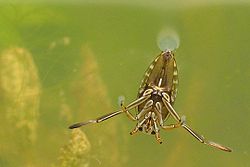
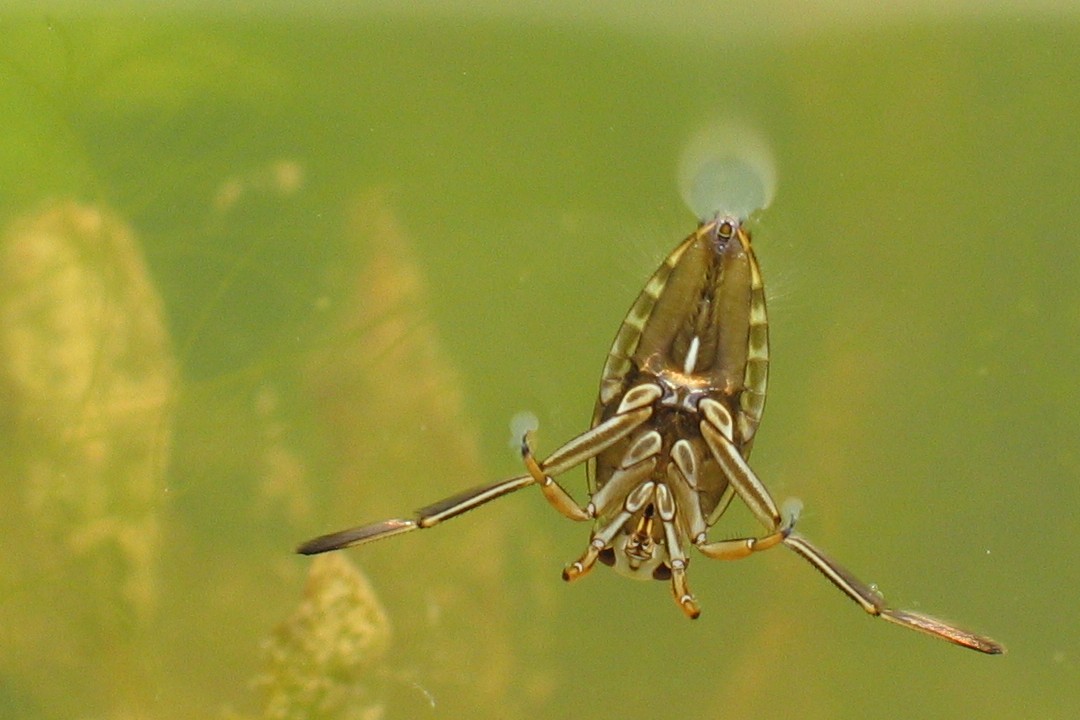
Notonecta glauca, also known as the greater water-boatman or common backswimmer, is a species of aquatic insect in the family Notonectidae. This species is found in large parts of Europe, North Africa, and east through Asia to Siberia and China.[1] In much of its range it is the most common backswimmer species.[2] It is also the most widespread and abundant of the four British water-boatmen.[3] Notonecta glauca are Hemiptera (true bug) predators,[2] that are approximately 13–16 mm in length.[4] Females have a larger body size compared to males.[2] These water insects swim and rest on their back (hence their common name "backswimmer" or "water boatman") and are found under the water surface.[5] Notonecta glauca supports itself under the water surface by using their front legs and mid legs and the back end of its abdomen and rest them on the water surface;[6] They are able to stay under the water surface by water tension, also known as the air-water interface (surface tension).[7] They use the hind legs as oars; these legs are fringed with hair and, when at rest, are extended laterally like a pair of sculls in a boat.[8] Notonecta glauca will either wait for its prey to pass by or will swim and actively hunt its prey. When the weather is warm, usually in the late summer and autumn, they will fly between ponds.[9][10] Notonecta glauca reproduce in the spring.[2]

Eye

[edit]
Compound eye

There has been a great deal of research on the eye of N. glauca. These insects use their eyes for both day and night vision, which is used for prey capture and flight when searching for new habitats.[5] Notonecta glauca, like other insects, have a compound eye. Specifically, their eye is an acone-type with corneal structure,[clarification needed] which helps them create a sharp image when both in the water and in the air.[11][12][13] The acone is the site of the pupil. Immonen et al. (2014), found that backswimmers are able to see in both day and night light conditions because of:

  • their large variations in the peripheral photoreceptor cell properties
  • having a robust migration of pigment and photoreceptors

They also found that the green-sensitive peripheral photoreceptors function in a similar way as nocturnal Phasmatodea (or stick insects). To protect their eye from direct sunlight during the day, the pigment cell's diaphragm are condensed, and during the night they open fully to allow as much light in as possible.[5] Notonecta glauca have two photoreceptor subsystems:

  1. Large and most sensitive peripheral photoreceptors
  2. Smaller peripheral and central photoreceptors

The first subsystem is sensitive to green light, one of the colours in the visible spectrum. This sensitivity helps the backswimmer see in dimmer light or at night. The second subsystem allows the backswimmer to see in bright light and when in flight.[5] Notonecta glauca pupil (acone) take a different amount of time to adjust to light. It takes the N. glauca approximately 40 minutes for the pupil to adjust to daylight and approximately 50 minutes to adjust to the light at night.[14]

Air retention

[edit]
Notonecta glauca

Although N. glauca live in the water, they breathe atmospheric air and do not have gills. When these insects are diving or resting under the water surface, they create a film of air that surrounds their body.[15] This air film is also known as a superhydrophobic coating or surface, and it prevents the insect from becoming wet.[4] It also reduces the drag (physics) that is created when diving.[clarification needed][16][17] To be able to create this air film around it, N. glauca is covered in hairy structures, except on its head and legs.[15] There are two types of hairs and air retention is maximized by having both types: setae and microtrichia.[15] The most important part in creating an air film is the density of the hairs.[4] Notonecta glauca has dense microtrichia and their air film can last up to 120 days.[4] The air film cannot last forever because as an insect respires (breathes), the oxygen partial pressure will decrease and nitrogen partial pressure will increase, causing the air bubble to decrease in size.[4][clarification needed]

Model organism

[edit]

Notonecta glauca is used as a model organism for friction reduction and air retention.[15] Possible applications for this include reduction of drag in ships.

Wave discrimination

[edit]

Notonecta glauca can discriminate between prey and non-prey, like other backswimmers, by surface waves.[18] Lang (1979), completed an experiment that showed that waves that were created by other backswimmers swimming, emerging, turning and paddling were of a lower frequency (below 40 Hz) compared to waves created by their prey items, who had a frequency between 70–140 Hz. Larval backswimmers were found to create different waves that differed from adult backswimmers, but their frequency were similar to that of adult swimming produced waves (up to 70 Hz).

Foraging behaviour

[edit]
Asellus aquaticus

Water depth can affect how N. glauca pick which prey they eat. Males and females both spend a lot of time on the surface of the water where they encounter mosquito (Culex) larvae. They feed on this prey because there is a decrease in travel cost (having to dive for them) and Culex gives a higher energy rate.[19]

Adult Culex mosquito

Mature females, however, will also dive to the bottom of the pond to feed on isopods (Asellus), but only in shallow waters.[19] Reaching Asellus requires a higher travel cost of energy. This behaviour is not consistent with the optimal foraging theory.[19] It is possible, however, that because mature females are larger than males and immature females, they have a reduced buoyancy and therefore require less energy to capture Asellus.[20] Also, mature females have a larger abdominal size, which could support a larger air bubble and allow them to remain submerged for longer.[19] However, if the water depth increases, mature females will switch and spend more time at the surface and not feed on Asellus, as the deep water increases the amount of energy needed for diving and staying submerged.[19]

The oxygen concentration in the body of water can affect the choice of prey N. glauca pick, as Cockrell (1984) found that when oxygen was at a high dissolved level, N. glauca will spend more time submerged and attacking Asellus.[21]

Notonecta glauca feeding

References

[edit]
[edit]
Revisions and contributorsEdit on WikipediaRead on Wikipedia
from Grokipedia
Notonecta glauca, commonly known as the common backswimmer, is a predatory species in the family (order ). Characterized by its upside-down swimming orientation, it uses long, oar-like hind legs fringed with hairs for efficient propulsion through water, while shorter forelegs capture prey. Adults reach about 16 mm in length, with a pale tan head and legs, darker brown pronotum, tan elytra, large reddish eyes, and a body covered in fine setae that trap an air film, giving a silvery sheen. Nymphs resemble smaller, wingless adults with uniform coloration, and eggs are white, oblong structures attached to submerged vegetation. Native to the Palearctic region, N. glauca ranges from (excluding much of ) and northern eastward to , the , , and Korea, with occasional records suggesting possible introduction to . It thrives in still or slow-moving freshwater habitats such as , ditches, and eutrophic waters enriched with nutrients, preferring areas with abundant aquatic for oviposition and cover. These are active year-round in temperate climates but remain more submerged in cooler water below 15°C and surface-oriented in warmer conditions. As a generalist predator, N. glauca forages on the water surface or in the open , ambushing prey including mosquito larvae, other , crustaceans like , tadpoles, fish eggs, and occasionally small fish or vertebrates. It relies on atmospheric oxygen stored in a ventral air bubble for respiration—rather than dissolved oxygen—and can maintain this film for up to 130 days, enabling prolonged submersion. The species employs delivered via its for subduing prey and defense, with composition influenced by and microhabitat exposure to predators. N. glauca exhibits a univoltine life cycle, producing one generation annually; eggs are typically laid in spring or fall on plants, hatching into five nymphal instars that develop over summer before adults overwinter. While beneficial for controlling populations, it can inflict painful bites on humans if handled, though such incidents are rare. Ecologically, it serves as both predator and prey in aquatic food webs, contributing to in lentic ecosystems across its range.

Taxonomy and description

Classification

Notonecta glauca is a species of aquatic insect belonging to the kingdom Animalia, phylum Arthropoda, class Insecta, order Hemiptera, suborder Heteroptera, infraorder Nepomorpha, superfamily Notonectoidea, family Notonectidae, subfamily Notonectinae, tribe Notonectini, genus Notonecta, subgenus Notonecta (Notonecta), and species N. glauca. This hierarchical placement situates it among the true water bugs, characterized by their aquatic lifestyles and piercing-sucking mouthparts typical of Hemiptera. The binomial nomenclature for Notonecta glauca was established by Carl Linnaeus in 1758 in the 10th edition of Systema Naturae. Linnaeus's description marked the formal scientific naming of the species within the genus Notonecta, which he introduced for backswimming insects. No junior synonyms are recognized in current taxonomic databases, though subspecies include N. g. glauca (the nominotypical subspecies) and N. g. poissoni Hungerford, 1933. Phylogenetically, N. glauca is positioned within the monophyletic family , commonly known as backswimmers due to their inverted swimming posture, and this family is embedded in the infraorder . Molecular and morphological analyses confirm as part of the superfamily Notonectoidea, with forming a basal clade among , supported by shared traits such as the ability to respire underwater via air stores. Within , the genus Notonecta comprises approximately 60 worldwide, with N. glauca representing a cosmopolitan member adapted to lentic freshwater habitats.

Morphology

Notonecta glauca adults typically measure 13–16 mm in length. Females are slightly larger than males, averaging 13.38 mm compared to 12.66 mm in males, reflecting minor sexual size dimorphism. The body exhibits an elongated, streamlined form well-suited to aquatic environments, with the characteristically swimming and resting upside down, ventral side uppermost. The hind legs are notably long and fringed with setae, enabling them to function as oars for efficient propulsion through water. In contrast, the forelegs are , modified with grasping structures to capture and hold prey. The middle legs also possess grasping surfaces, aiding in prey manipulation. The head is pale tan, bearing large, dark red eyes for enhanced vision in aquatic settings. The thorax includes a pronotum that is darker than the head and moderately elongated, while the hemelytra—hardened forewings—partially cover the and display tan coloration. The body surface, excluding the head, pronotum, and legs, is densely covered in hair-like setae and microtrichia, forming a plastron that traps air and imparts a silvery sheen. Sexual dimorphism extends beyond size to the shape of the ventral abdominal segments, which differ between sexes and facilitate sex identification; females possess a broader abdomen adapted for egg production and laying. Males feature genital claspers on the abdomen for mating.

Distribution and habitat

Geographic range

NotOnecta glauca has a broad native distribution across the Palearctic realm, spanning Europe, North Africa, and parts of Asia. In Europe, the species is widespread from the Iberian Peninsula westward through central and eastern regions to Russia, though historically rare in much of Scandinavia, with recent expansions recorded in Norway. In North Africa, populations are recorded from Morocco in the west to Egypt in the east, often in suitable aquatic habitats. Across Asia, its range extends eastward from Turkey through Siberia to northwestern China and Korea, making it one of the most commonly encountered backswimmers in these areas. Introduced populations of N. glauca have been reported in parts of , including sightings in , likely resulting from human-mediated dispersal such as transport via aquatic plants or shipping. However, long-term establishment in these regions remains uncertain due to climatic similarities but potential competitive pressures from native Notonecta species. The species occupies a wide altitudinal range, primarily from to low elevations up to about 100 m, and thrives in temperate to subtropical climatic zones that support its preferred still or slow-moving freshwater bodies. Dispersal is facilitated by the adults' strong flight capability, which allows colonization of new ponds and water bodies, particularly during warm periods in late summer and autumn.

Environmental preferences

NotOnecta glauca primarily inhabits inland freshwater , lakes, and slow-moving , where it demonstrates notable tolerance to eutrophic conditions characterized by high levels that promote algal growth and reduced water clarity. These habitats provide the stable, vegetated environments essential for its predatory lifestyle, with the species occasionally appearing in nutrient-enriched waters near coastal regions. Such preferences align with its to lentic or lotic systems with minimal turbulence, as evidenced by field observations across diverse freshwater ecosystems. The backswimmer favors warm, shallow waters featuring low to moderate flow rates, steering clear of fast-flowing rivers that disrupt its surface-oriented hunting. plays a critical role, with optimal conditions including high dissolved oxygen concentrations exceeding 7 mg/L to support active and population densities; however, its ability to breathe atmospheric air via a specialized snorkel-like enables resilience in oxygen-variable settings, including those with fluctuating levels down to 4 mg/L. While N. glauca exhibits sensitivity to severe chemical pollutants, it maintains viability in moderately polluted waters, particularly those with low dissolved oxygen, due to its air-breathing physiology. In terms of microhabitat, N. glauca is predominantly surface-associated, leveraging surface tension to rest and launch predatory dives, often positioning itself among submerged aquatic vegetation for concealment and vantage points. It frequently occupies the edges of plants, such as emergent or floating species, at mid-water depths to scan for prey while minimizing exposure to threats. This near-surface orientation is enhanced by its upside-down swimming adaptation, allowing efficient navigation in vegetated shallows. Abiotic factors like significantly influence and distribution, with optimal ranges of 15–25°C promoting extended surface activity and higher metabolic rates; at temperatures below 15°C, individuals increase submergence time, remaining fully underwater at around 5°C to conserve . These preferences underscore the species' affinity for temperate, sun-exposed waters that maintain consistent warmth, contributing to its prevalence in seasonal freshwater bodies.

Life history

Reproduction

Notonecta glauca reproduces primarily in spring and autumn in temperate regions, with mating triggered by rising temperatures after adults overwinter. Adults emerge from overwintering to initiate reproductive activity, often in March to June depending on local conditions. Courtship in N. glauca relies on visual cues, as males approach females based on size and movement patterns in the ; copulation follows without elaborate premating displays in observed populations. Sexual dimorphism, with females generally larger than males, facilitates mate recognition during these encounters. Following , females deposit eggs in clusters on submerged , stems, or other objects, attaching them with a waterproof or embedding them directly into tissues. Eggs are elongated and white. varies with environmental conditions, but females typically lay up to 64 eggs across multiple batches of 8 or fewer. In temperate climates, N. glauca produces one generation per year (univoltine), with nymphal development spanning summer months; in warmer parts of its range, it can be partly bivoltine.

Developmental stages

The developmental stages of Notonecta glauca encompass an egg phase, five nymphal instars, and the adult form, with nymphal development spanning 2–3 months under favorable conditions. Eggs are white, oblong, and attached to or inserted into aquatic vegetation such as stems or leaves. These eggs feature a micropylar end with small, cylindrical, bent processes that enable with the surrounding water, preventing while allowing oxygen to the . Incubation is temperature-dependent. Nymphs hatch as miniature versions of , lacking functional wings and with shorter abdomens, and progress through five instars during summer months when water temperatures exceed 15°C. Wing pads develop progressively across instars: absent or rudimentary in the first, extending to the abdominal by the third, and nearly full length by the fifth, preparing for adult flight capability. All instars are aquatic and from the first, using forelegs to capture small like larvae, with feeding efficiency increasing with size; early instars consume fewer prey items but actively hunt from emergence. Nymphal growth involves between instars and is influenced by prey availability and oxygenation levels. Adult emergence occurs via after the fifth molt, primarily in summer, resulting in fully winged individuals approximately 16 mm long with oar-like hind legs for . Wings achieve full functionality immediately post-molt, enabling aerial dispersal to new habitats. Adults have a lifespan of 2–3 months in active seasons, though they can survive overwintering in temperate regions by entering ; submerged longevity is extended by air films trapped on the body, supporting respiration for up to 130 days. Notonecta glauca displays of 1–2 generations annually, varying by and : univoltine (one generation) in cooler northern areas like , where eggs overwinter, and partly bivoltine in warmer areas with overlapping cohorts. This flexibility allows adaptation to seasonal pond dynamics, with higher temperatures promoting faster development and additional broods.

Physiological adaptations

Air retention mechanism

Notonecta glauca, commonly known as the common backswimmer, possesses specialized superhydrophobic setae and microtrichia covering most of its body surface, which trap a thin air film upon submersion, functioning as a for underwater respiration. These hydrophobic structures, including longer setae on the ventral side and denser microtrichia on the dorsal elytra, create a stable air layer that allows oxygen to diffuse directly from the surrounding into the air film and subsequently into the insect's tracheal system via spiracles. This adaptation enables the insect to extract oxygen without relying on gills, with the air film replenished periodically at the surface. Under laboratory hydrostatic conditions, the air film on the elytra can persist for over 130 days, demonstrating exceptional stability due to the hierarchical microstructure of the setae, which minimizes water penetration and maintains the air-water interface. During active or , however, the air store is depleted more rapidly and requires periodic replenishment to sustain oxygen levels. The mechanism relies on a gradient of oxygen between the ambient water and the air film, driving passive to compensate for respiratory consumption. Additionally, the air film reduces hydrodynamic drag and enhances , allowing efficient in an inverted swimming posture. This air retention system provides a key evolutionary advantage by permitting prolonged submersion in hypoxic aquatic environments, where dissolved oxygen is low, thereby expanding habitable niches and supporting predatory lifestyles without frequent surfacing. The upside-down orientation further aids access to the surface for air renewal while maintaining the air film intact.

Visual system

Notonecta glauca features acone-type apposition compound eyes adapted for dual vision in air and water, with each eye comprising numerous ommatidia organized into distinct ventral and dorsal zones. The ventral zone optimizes underwater prey detection, while the dorsal zone facilitates aerial orientation during flight, together providing a 75% binocular visual field for enhanced depth perception. Pupil adjustment in these eyes occurs through the migration of screening pigment granules, enabling dynamic control of the effective aperture in response to light levels. Light adaptation completes in slightly less than 40 minutes, and dark adaptation requires approximately 50 minutes during daytime conditions, with the process slightly slower at night. The pupil opens maximally under nocturnal low-light conditions, providing adjustment over a dynamic range of about 6 log units, though overall nighttime sensitivity is approximately 1 log unit lower than daytime to support crepuscular and nocturnal activities. Visual acuity varies across the retina, with acceptance angles as low as 2.88° in high-acuity zones promoting sharp resolution and high sensitivity to motion, crucial for tracking evasive prey. Photoreceptors exhibit peak sensitivities in the blue-green spectrum (around 535 nm in peripheral green-sensitive cells) alongside UV (345 nm) and blue (445 nm) peaks in central cells, aligning with the predominant wavelengths penetrating aquatic habitats. The dorsal orientation of the eyes integrates seamlessly with the insect's inverted posture, allowing continuous monitoring of the surface for patterns, potential predators, or escape opportunities during ventral-up predation.

Behavior and

strategies

Notonecta glauca employs a versatile strategy that combines tactics with active pursuit to capture prey in aquatic environments. As an , it often positions itself midway along aquatic vegetation, waiting for passing prey such as larvae or small crustaceans before striking with its forelegs. This sit-and-wait approach allows efficient energy use in structured habitats, though the species is also classified as a pursuit predator capable of actively through the to chase mobile prey. Strikes occur at close range, enabling rapid capture with the forelegs' grasping surfaces that prevent escape. Upon seizing prey, N. glauca uses its to pierce the victim and inject , liquefying internal tissues for extraintestinal and subsequent suction feeding. This method is particularly effective against soft-bodied , tadpoles, and , allowing the predator to extract nutrients efficiently while discarding indigestible remnants. The process is slower compared to other notonectid species, with less immediate response to surface disturbances during feeding. Foraging dives are brief, as N. glauca relies on a trapped air bubble for respiration and frequently returns to the surface to replenish oxygen. Dive duration and frequency are modulated by environmental factors, including . Temperature also influences patterns, as individuals spend more time submerged below 15°C but increase surface visits above this threshold. Activity rhythms involve pupil adjustments that enhance visual detection in low light, aiding prey silhouette detection against the light.

Sensory discrimination

NotOnecta glauca detects hydrodynamic signals generated by prey through integumentary mechanosensory organs, primarily scolopidial organs in the legs, which sense surface waves on the water. These receptors enable the backswimmer to discriminate prey-induced waves, characterized by frequencies in the 70–140 Hz range with bandwidths of 30–60 Hz and amplitude maxima at 12–45 Hz, from non-prey signals such as those produced by conspecifics or debris, which typically fall below 40 Hz with narrower bandwidths of 8–14 Hz and maxima at 7–10 Hz. Neural processing involves a dual receptor system, with low-frequency sensitive organs on the legs and high-frequency sensitive receptors at the tip, triggering prey-catching responses only when both are activated by appropriate wave patterns (types b and c). This threshold-based response to specific amplitudes and frequencies allows N. glauca to ignore irrelevant signals from conspecifics or environmental debris, filtering out low-frequency swimming waves or high-frequency noise. Laboratory experiments demonstrate high accuracy in wave-based prey localization, with turning angles closely matching stimulus directions (e.g., 19.2° ± 5.5° for 20° waves using middle legs) and success rates exceeding 80% in controlled setups simulating natural wave propagation. This sensory discrimination complements visual cues for prey identification, enhancing overall detection reliability. The adaptive value of this mechanism lies in minimizing energy expenditure on false positives within cluttered aquatic habitats, where distinguishing prey waves improves predation and reduces unnecessary attacks on non-nutritive stimuli.

Ecological role

Predation impact

Notonecta glauca serves as a generalist predator in freshwater ecosystems, targeting a diverse array of prey including larvae such as Culex pipiens, isopods like Asellus aquaticus, tadpoles, and small fish including eggs and fry. This broad prey spectrum positions N. glauca as an opportunistic hunter capable of consuming up to 30 prey items per day under optimal conditions, such as in unstructured habitats where feeding peaks. The predation by N. glauca holds significant biocontrol potential, particularly against vectors; in experimental mesocosms, its presence reduced larval survival by 32–73% and by 29–52%, corresponding to overall declines of 20–50% irrespective of variations. By exerting top-down pressure on herbivorous invertebrates like cladocerans ( spp.), N. glauca indirectly influences , potentially limiting algal blooms through enhanced grazer control in nutrient-rich environments. As a mid-level predator, N. glauca occupies an intermediate trophic position, preying on basal aquatic consumers while remaining vulnerable to higher-order predators such as and avian species. This positioning integrates it into complex food webs, where its activities contribute to community stability. In heterogeneous aquatic habitats, N. glauca promotes species coexistence among backswimmers (Notonecta spp.) via resource and spatial partitioning, with its wide distribution and spring reproduction minimizing overlap with congeners. Densities of N. glauca are notably higher in eutrophic systems, where nutrient enrichment supports abundant prey and enhances its predatory role.

Model organism applications

Notonecta glauca has served as a in scientific since the , with early studies emphasizing its hydrodynamic adaptations and sensory capabilities. Investigations into sensory highlighted the role of specialized setae on the in detecting movements, enabling precise localization of prey through hydrodynamic cues. Subsequent work in the established it as a key model for air film retention, demonstrating that its elytra maintain an air layer for over 130 days under hydrostatic pressure and up to 5 m/s flow velocities, reducing to one-third of the incoming fluid speed. This species has informed biomimetic applications in , particularly for developing superhydrophobic surfaces that mimic its microtrichia to achieve drag reduction and persistent air retention in aquatic environments. In , its wave-perception mechanisms have inspired smart devices, such as backswimmer-mimicking diving robots equipped with triboelectric nanogenerators that generate signals from water waves for autonomous buoyancy control and marine exploration. Advantages of N. glauca as a model include its straightforward rearing, typically at densities of one individual per liter in oxygenated water with daily feeding on food or prey, facilitating controlled experiments on predation and . The transparency of its retained air film permits direct observation of respiratory and hydrodynamic processes without invasive techniques. Within the , emerging genomic resources from related species enhance its potential for genetic studies, though specific tractability for N. glauca remains underdeveloped. Recent advances in the have examined its role in , with laboratory and semi-field trials showing high predation rates (up to 71.5% daily on Anopheles gambiae s.l. larvae), positioning it as a candidate for biological management despite challenges like in mass rearing. Ongoing research also assesses environmental stressors, including temperature shifts, on its paddling responses and overall , informing predictions of climate impacts on .

References

Add your contribution
Related Hubs
User Avatar
No comments yet.