
.svg/250px-Flag_of_Germany_(1935–1945).svg.png)


.svg/2000px-Flag_of_Germany_(1935–1945).svg.png)
Community hub
Recent from talks
Contribute something
Nothing was collected or created yet.
Operational Zone of the Adriatic Littoral
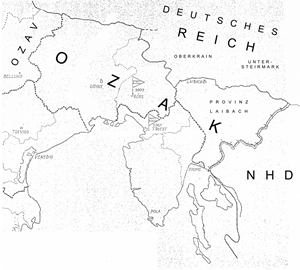
View on WikipediaThe Operational Zone of the Adriatic Littoral (German: Operationszone Adriatisches Küstenland, OZAK; or colloquially: Operationszone Adria; Italian: Zona d'operazioni del Litorale adriatico; Croatian: Operativna zona Jadransko primorje; Slovene: Operacijska cona Jadransko primorje) was a Nazi German district on the northern Adriatic coast created during World War II in 1943. It was formed out of territories that were previously under Fascist Italian control until its takeover by Germany. It included parts of present-day Italian, Slovenian, and Croatian territories.[1] The area was administered as territory attached, but not incorporated, to the Reichsgau of Carinthia. The capital of the zone was the city of Trieste.
Key Information

.svg)
.svg)


Background
[edit]OZAK was established, with its headquarters in Trieste, on 10 September 1943, by Adolf Hitler,[2] as a response to the Italian capitulation (8 September 1943) following the Allied invasion of Italy. It comprised the provinces of Udine, Gorizia, Trieste, Pula (Pola), Rijeka (Fiume) and Ljubljana (Lubiana).[3] The Operational Zone of the Alpine Foothills, comprising the provinces of Belluno, South Tyrol, and Trentino, was established on the same day. Both operational zones were separate from the Italian Social Republic (RSI), based in Salò on Lake Garda, which governed the remainder of Italy that had not yet been occupied by the Allies.[4]
The OZAK was not incorporated in the German Reich outright, but attached to the Gau of Carinthia.[5][6] Friedrich Rainer, Nazi Gauleiter of Carinthia was appointed Reich Defense Commissioner of OZAK, thereby becoming chief of the civil administration of the semi-annexed territory. The province of Ljubljana was given a Slovenian provincial administration. Leading collaborator Gregorij Rožman, Bishop of Ljubljana, recommended to Rainer that notorious anti-Semite Leon Rupnik should be the president of the new Ljubljana provincial government,[7] and Rupnik was then duly appointed on 22 September 1943. SS General Erwin Rösener became Advisor to the President.[3]
Genocidal activities
[edit]OZAK was the scene of genocidal activities. Its commander, Higher SS and Police Leader Odilo Globocnik, had become one of the most feared Nazi leaders in Eastern Europe after liquidating the Jewish ghettoes in Warsaw and Białystok and supervising the operations of the extermination camps at Belzec, Sobibór, Majdanek, and Treblinka.[8] He commanded all the Nazi camps in occupied Poland from 1941 to 1943. After serving briefly as Gauleiter of Vienna he had been posted to Trieste, where to the very end he ran the Risiera di San Sabba prison, the only SS camp ever set-up on Italian soil.[9]
Globocnik, returning to his native city in triumph in mid-September 1943, established his office at Via Nizza 21 in Trieste and began to carry out Einsatz R, the systematic persecution of Jews, partisans and anti-Nazi politicians in Friuli, Istria and other areas of the Croatian Adriatic coastline. His staff of 92, mostly members of the German and Ukrainian SS with killing experience gained in Operation Reinhard, was quickly expanded to combat the unrelenting partisan activity throughout the region. Globocnik's domain included Risiera di San Sabba, a large, disused and decrepit rice mill at Ratto della Pileria 43 in the Triestine suburb of San Sabba.[10] Under his supervision it was converted into the only Nazi extermination camp in Italian territory. The camp was used to detain hostages, partisans and political prisoners, and as a collection and transit camp for Jews being deported to Nazi concentration camps.[11] In October 1943, arrests started and the camp opened,[12] staffed primarily by German and Ukrainian members of the SS under the command of SS-Sturmbannführer Christian Wirth, former commander of Belzec extermination camp. Wirth was killed by Yugoslav Partisans in Opatija, on 26 May 1944.[13] He was replaced by Wirth's former deputy in Lublin and successor in Belzec, SS-Hauptsturmführer Gottlieb Hering. Hering was replaced by SS-Obersturmbannführer Dietrich Allers in August 1944.[14] On 28 April 1945, the San Sabba camp ceased operating, and Waffen-SS troops set free the remaining inmates and demolished the gas chamber and incinerator building the next day, to destroy evidence of war crimes.[15]
Over 25,000 Italian, Slovene, Croatian and Jewish civilians passed through the San Sabba camp, about 5,000 were killed there by various methods including gassing. Today the rice mill is an Italian National Memorial Site.[16] The camp's commanders and collaborators were tried in Trieste in 1976,[17] but their sentences were never carried out.
German plans for the region
[edit]
The ethnic and political re-definition of the Adriatic Littoral was considered during the war on a theoretical level. In a telegram sent on 9 September 1943 to foreign minister Ribbentrop, Gauleiter Rainer suggests the future establishment of Reich protectorates in Gorizia, Istria and Carniola, based on the subdivisions of the Austrian-Hungarian Empire. Initial German occupation policy, however, favored incorporating the area into the Reichsgau of Carinthia. The ethnic complexity of the region was to be used to minimize Italian influence, promote ethnic segmentation, and introduce Germandom as a stabilizing force. This strategy was based on an understanding of history of medieval Germany and the Habsburg monarchy, where the German lords and nobles were seen to have made the economic and administrative development of the region possible.[5]
The ethno-social composition of Venezia-Giulia, Trieste, and Friuli was an important component to Germany's plans of occupation. The fascist government had lost support of the fragmented social groups throughout the region- and the collapse of the regime ushered in a period of disorientation amongst Italians.[4] Nazi propaganda worked to create the illusion that the areas under the zone had Austro-Hungarian roots. Germany had plans to adopt the region as part of the Reichstag; however, they used the region's imperial-past to make connections with the Austro-Hungarian Empire. They named the zone "Adriatisches Küstenland" which bore reference to the Austro-Hungarian past as that had been the name used by the empire in reference to areas North of the Adriatic. This propaganda relates to the greater German plan as they intended to replace Rome with Vienna as the capital of the region.[4] Germans believed that by referencing the prosperous past, they could evoke feelings of nostalgia that would ultimately forge cultural links between Vienna and Trieste to Germany.
Nazis employed more tactics of propaganda as seen in Italy through the creation of the Italian Social Republic (RSI), which effectively was a puppet-government that was under the control of Germany. With the RSI in control, Germany was able to enact extremely repressive laws which targeted specific ethnic and national groups, thereby spreading Nazi ideology throughout the zone. On 10 November 1943, Karl Lapper - head of SS Alpenland- issued an order which restricted all Italian radio and news sources within the zone, as they were substituted with German broadcasts of radio and news.[4] By creating an extensive propaganda network that affected all parts of daily life, Germans were able to coerce support for the Nazi cause.
The future of the Province of Udine (Central and Western Friuli, today the provinces of Udine and Pordenone) was uncertain, but it is evident that a strategy similar to the other areas of the operational zone was to be pursued. In the previously mentioned telegram, Rainer emphasizes that the Friuli region is not ethnically Italian, but is composed of speakers of Friulian and, to a small extent German and Slovene. German scholars also presented supposed evidence for the "profound influence" German culture and language have had on the Friulians, including loan words and medieval place-names. Historical evidence was also found for the region of Friuli being a march land in the Carolingian and the early German empires, as well as for the role the German feudal lords played in the region, and its annexation to the Duchy of Carinthia in the late 10th century. It was thus concluded that the Friulians belonged to the German cultural field, and that their land was an ancient part of the German empire and has ever since been part of the German "vital space" (Lebensraum). These supposedly scholarly findings were echoed in German newspapers, although the Italian-language propaganda spread in the province of Udine emphasized the local population's ethnic distinction and regional autonomy, not pan-Germanism.[5]
Several factions within the Nazi government also intended to extend the area of the two operational zones even further to the detriment of Italian territory. Joseph Goebbels wrote in his diary that the only "logical" border would be one that included the territories of the former Habsburg Kingdom of Lombardy–Venetia, expressing his hopes that Hitler's renewed friendship with Benito Mussolini would not deter him from this step:[18]
We must not only get back South Tyrol, but I envisage the boundary line drawn south of Venice. Whatever was once an Austrian possession we must get back into our own hands. The Italians by their infidelity and treachery have lost any claim to a national state of the modern type.
He eventually managed to convince Hitler that this course of action should be undertaken, who agreed that Venice should be bound to the Reich in "some sort of loose confederation."[18]
Military operations in the zone
[edit]
Since an Allied landing in the area was anticipated by the Germans,[19] and because of presence of large numbers of Italian, Slovene and Croatian partisans, OZAK also hosted a substantial German military contingent, commanded by General der Gebirgstruppe Ludwig Kübler. On 28 September 1944, these units were redesignated LXXXXVII Army Corps.[20] Nearly every available armored vehicle, modern or obsolete, was pressed into service with Wehrmacht, Waffen-SS, Ordnungspolizei, or fascist Italian and Slovenian units.[citation needed]
On 30 April 1945, several thousand volunteers of the Italian anti-fascist Comitato di Liberazione Nazionale rose up against the Nazis. On 1 May, Globocnik was given command of a chaotic assortment of German and collaborationist troops converging on Trieste as they retreated from Italy and Yugoslavia. These units were immediately engaged by the Partisans' 4th Army before surrendering to the New Zealand 2nd Division commanded by NZ Lieutenant-General Sir Bernard Freyberg on the evening of 2 May. However, fighting continued between Josip Broz Tito's army and remnant Wehrmacht and collaborationist forces for several days. The Partisans began to withdraw from areas west of the Isonzo river on 15 May.[21][22] On 11 June Yugoslav troops began to withdraw from Trieste.[23]
See also
[edit]References
[edit]- ^ (in Italian) http://www.panzer-ozak.it/immagini/mappaozak100grande.gif
- ^ A copy of an existing document is available online. It reads
"In addition to my (...) order of the commander of the Greater German Reich in Italy and the organisation of the occupied Italian area from 10 September 1943 I determine:
The supreme commanders in the Operational Zone Adriatic Coast consisting of the provinces of Friaul, Görz, Triest, Istrien, Fiume, Quarnero, Laibach, and in the Prealpine Operations Zone consisting of the provinces of Bozen, Trient and Belluno receive the fundamental instructions for their activity from me.
Führer's headquarters, 10 September 1943.
The Führer Gen. Adolf Hitler". - ^ a b Jozo Tomasevich (2001). War and Revolution in Yugoslavia, 1941-1945: Occupation and Collaboration. Stanford University Press. pp. 121–123. ISBN 978-0-8047-3615-2. Retrieved 20 January 2013.
- ^ a b c d Bresadola, Gianmarco (2004). "The Legitimising Strategies of the Nazi Administration in Northern Italy: Propaganda in the Adriatisches Küstenland". Contemporary European History. 13 (4): 425–451. doi:10.1017/S0960777304001882. ISSN 0960-7773. JSTOR 20081231. S2CID 159821248.
- ^ a b c Michael Wedekind (2005). "The Sword of Science". In Ingo Haar; Michael Fahlbusch (eds.). German scholars and ethnic cleansing, 1919-1945. Berghahn Books. pp. 111–123. ISBN 978-1-57181-435-7. Retrieved 20 January 2013.
- ^ Speer, Albert (1995). Inside the Third Reich. London: Weidenfeld & Nicolson. p. 420. ISBN 978-1-842127353.
- ^ Tomasevich, Jozo (October 2002). War and Revolution in Yugoslavia, 1941-1945: Occupation and Collaboration. Stanford University Press. ISBN 978-0-8047-7924-1.
- ^ Odilo Globocnik
- ^ Gallery – The Risiera di San Sabba – Photos
- ^ Risiera di San Sabba
- ^ Pamela Ballinger (2003). History in Exile: Memory and Identity at the Borders of the Balkans. Princeton University Press. p. 23. ISBN 978-0-691-08697-2. Retrieved 20 January 2013.
- ^ Joshua D. Zimmerman (2005). Jews in Italy under Fascist and Nazi Rule, 1922-1945. Cambridge University Press. p. 248. ISBN 978-0-521-84101-6. Retrieved 20 January 2013.
- ^ David Wingeate Pike (2004). Spaniards in the Holocaust: Mauthausen, Horror on the Danube. Routledge. p. 267. ISBN 978-0-203-36123-8. Retrieved 20 January 2013.
- ^ Joseph Poprzeczny (2004). Odilo Globocnik: Hitler's man in the East. McFarland. p. 343. ISBN 978-0-7864-1625-7. Retrieved 20 January 2013.
- ^ Katia Pizzi (2002). A City in Search of an Author. Continuum International Publishing Group. p. 19. ISBN 978-1-84127-284-9. Retrieved 20 January 2013.
- ^ "ANED | The camps | The "Risiera" National Memorial Site". Archived from the original on 2006-06-05. Retrieved 2006-06-15.
- ^ "ANED | The camps | Risiera. The Trial". Archived from the original on 2006-06-05. Retrieved 2006-06-15.
- ^ a b [Rich, Norman: Hitler's War Aims: The Establishment of the New Order, page 320. W.W. Norton & Company Inc. 1981.]
- ^ László Borhi (2004). Hungary in the Cold War, 1945-1956: Between the United States and the Soviet Union. Central European University Press. p. 31. ISBN 978-963-9241-80-0. Retrieved 20 January 2013.
- ^ Bernhard Kroener; Rolf-Dieter Müller; Hans Umbreit (2003). Germany and the Second World War, volume 5. Oxford University Press. p. 80. ISBN 978-0-19-820873-0. Retrieved 20 January 2013.
- ^ "UK Official History • Trieste and Austrian Crises". Archived from the original on 2008-07-24. Retrieved 2007-12-04.
- ^ II: Confrontation with the Yugoslavs | NZETC
- ^ McLintock, A. H., ed. (1966). "The Army – From the Senio to Trieste". Te Ara: The Encyclopedia of New Zealand. Retrieved 31 December 2013.
External links
[edit]- Panzers in the OZAK 1943-1945 by Stefano di Giusto, standard reference to German and collaborationist armor in the Operationszone Adriatisches Küstenland. Accessed 15 June 2006.

Operational Zone of the Adriatic Littoral
View on GrokipediaEstablishment and Historical Context
Pre-War Territorial Disputes
The territories that would later form the core of the Operational Zone of the Adriatic Littoral were part of the Austrian Littoral (Küstenland) within the Austro-Hungarian Empire prior to World War I, encompassing Trieste, Istria, Gorizia, and adjacent areas with mixed Italian, Slovene, and Croat populations. Italy's entry into the war on the Allied side was incentivized by the secret Treaty of London, signed on April 26, 1915, which promised territorial concessions from Austria-Hungary, including Trentino, South Tyrol, the Austrian Littoral up to the Danube, northern Dalmatia, and various Adriatic islands.[3] [4] Post-war settlements partially realized these claims but sparked disputes with the newly formed Kingdom of Serbs, Croats, and Slovenes (Yugoslavia). The Treaty of Saint-Germain-en-Laye in 1919 granted Italy Trentino-Alto Adige, Gorizia, Trieste, and Istria, while designating Fiume (Rijeka) as a corpus separatum under international administration; Dalmatia largely went to Yugoslavia. The Treaty of Rapallo, signed November 12, 1920, between Italy and Yugoslavia, awarded Italy the bulk of Istria up to the watershed line, Trieste, the Zadar (Zara) enclave, and islands such as Cres (Cherso), Lošinj (Lussino), and Lastovo (Lagosta), while establishing Fiume as a temporary free state—later annexed by Italy in 1924 via the Pact of Rome, with Yugoslavia receiving the suburb of Sušak.[5] [6] These arrangements left significant Slavic majorities—up to 70% in affected territories—under Italian sovereignty, fostering Yugoslav irredentism and ethnic tensions in Venezia Giulia and Istria during the interwar period. Italian fascist policies enforced Italianization, including suppression of Slavic languages, closure of minority schools, and cultural assimilation measures, which provoked resistance and border incidents. Yugoslavia, viewing the Rapallo borders as unjust, supported irredentist activities and maintained territorial claims, contributing to strained relations that culminated in Italy's occupation of additional Yugoslav lands, such as the Ljubljana Province, following the Axis invasion in April 1941.[7]Creation Following Italian Armistice
The Italian armistice with the Allies, announced on 8 September 1943, prompted immediate German military action to secure territories previously under Italian control, including northern Italian regions and parts of the northwest Balkans, to forestall potential Allied advances or partisan takeovers.[8] German forces, under directives from Adolf Hitler, disarmed Italian troops and occupied key coastal areas along the Adriatic within days. On 10 September 1943, Hitler decreed the establishment of the Operational Zone of the Adriatic Littoral (Operationszone Adriatisches Küstenland, OZAK), incorporating the Italian provinces of Udine, Gorizia, Trieste, Pola, Fiume (Rijeka), and the Province of Ljubljana, which had been annexed by Italy from Yugoslavia in 1941.[9] This zone was designated as a temporary military operational area but functioned as a de facto extension of Reich administration, bypassing the Italian Social Republic's authority in these territories.[2] Hitler appointed Friedrich Rainer, Gauleiter of Carinthia and Salzburg, as Oberster Kommissar (High Commissioner) for civil governance in OZAK, granting him authority over political, economic, and security matters while military command remained with the Wehrmacht under General der Gebirgstruppe Ludwig Kübler.[10] Rainer's role emphasized Germanization efforts and suppression of resistance, aligning the zone's policies with Reich priorities amid ongoing partisan activity from Yugoslav and Italian groups.[10] The creation of OZAK reflected Germany's strategic imperative to consolidate control over vital ports like Trieste and Fiume for logistics and defense against Allied operations in the Mediterranean.[8]Administrative Framework
Governance Structure and Key Figures
The Operational Zone of the Adriatic Littoral (OZAK) operated under a hybrid governance model combining military oversight with civilian administration, reflecting its status as a temporary operational zone rather than a fully annexed Reich territory. Military command fell under the Befehlshaber Operationszone Adriatisches Küstenland, a Wehrmacht position responsible for defense, security operations, and coordination with Army Group C (Heeresgruppe C) led by Field Marshal Albert Kesselring. This structure prioritized counter-insurgency and fortification against partisan forces and potential Allied advances, with the Befehlshaber exercising direct authority over troop deployments and martial law enforcement.[11] [12] Civil administration was headed by the Oberster Kommissar (High Commissioner), appointed to manage economic exploitation, local governance, and demographic policies while nominally attached to the Reichsgau Carinthia without formal incorporation. Friedrich Rainer, previously Gauleiter of Carinthia, assumed this role on 10 September 1943 following direct appointment by Adolf Hitler, serving until the zone's collapse in April 1945; he oversaw provincial administrations in Udine, Gorizia, Trieste, Pola, and Fiume (Rijeka), implementing resource extraction and anti-partisan measures through a network of German-appointed officials and local collaborators.[10] [13] Rainer's dual role as Reich Defense Commissar integrated civil functions with defense priorities, enabling centralized control over labor conscription and infrastructure projects.[14] SS and police functions were directed by the Höherer SS- und Polizeiführer (HSSPF), who coordinated Gestapo, Order Police, and Waffen-SS units for internal security and ethnic cleansing operations. Odilo Globocnik, a key architect of extermination policies in occupied Poland, held this position from 13 September 1943 until his suicide on 31 May 1945, focusing on suppressing Slovenian, Italian, and Croatian resistance through deportations and reprisals.[15] The HSSPF operated semi-autonomously from military and civil branches, reporting to Heinrich Himmler and leveraging Einsatzgruppen-style units for intelligence and elimination tasks.[16] Military leadership transitioned over time: General der Gebirgstruppe Ludwig Kübler served as Befehlshaber from 10 October 1943, commanding the LXXXXVII Army Corps (z.b.V.) and overseeing fortifications like the Gothic Line extensions; he was executed for war crimes in 1947.[11] This layered hierarchy ensured German dominance but generated tensions, as Rainer and Globocnik—both Austrian Nazis with regional ties—pursued ideological goals often at odds with pure military efficiency.[12]Territorial Divisions and Local Administration
The Operational Zone of the Adriatic Littoral (OZAK) encompassed the former Italian provinces of Udine, Gorizia, Trieste, Pola, Fiume (extending to Buccari), and Ljubljana, as well as the Kvarner region including the islands of Krk, Cres, and Lošinj.[8][17] This division largely retained the pre-existing Italian provincial boundaries but placed them under direct German control following the Italian armistice.[18] The territory spanned approximately 31,000 square kilometers and was established by Adolf Hitler's ordinance on September 10, 1943, excluding these areas from the Kingdom of Italy to facilitate German military operations and administration.[18][10] Civil administration of the OZAK was headed by Friedrich Rainer, the Gauleiter of Carinthia, who was appointed Supreme Commissioner (Oberster Kommissar) with authority over both civilian and police affairs, headquartered in Trieste.[10] Rainer's office integrated Nazi Party structures, including the appointment of Kreisleiter (district leaders) to oversee local governance, though the zone was not formally subdivided into full Gaukreise like annexed Reichsgaue.[19] Provincial administration involved German commissioners supervising or replacing Italian prefects, with emphasis on coordinating economic exploitation, security, and Volksdeutsche (ethnic German) integration.[20] Local municipalities continued basic functions under this oversight, but ultimate decision-making rested with Rainer's central apparatus, which reported to Berlin while attaching administratively to the Reichsgau Carinthia without full incorporation. Security and police administration fell under the Higher SS and Police Leader (Höherer SS- und Polizeiführer), initially Odilo Globocnik and later others, who directed counter-insurgency and maintained order through a network of garrisons and auxiliary forces.[15] This structure prioritized military objectives, with local officials tasked to implement Germanization policies, including the recruitment of ethnic Germans into administrative roles and the suppression of partisan activities that threatened territorial control.[21] By late 1944, administrative strains from ongoing resistance led to intensified centralization, reducing provincial autonomy in favor of direct orders from Trieste.[22]Strategic Objectives and Policies
Economic Exploitation and Infrastructure
The German administration in the Operational Zone of the Adriatic Littoral prioritized resource extraction to support the Reich's war economy, particularly targeting industrial materials essential for munitions production. The Idrija mercury mine, located in the Slovene Littoral region under German control from September 1943, became a key asset, as mercury was critical for detonators and explosives; production continued under occupation to supply German military needs, with forced labor employed to maintain output amid partisan threats.[23][24] Local industries, including shipyards in Trieste and Monfalcone, were requisitioned for repair and construction of naval vessels, while agricultural output from the zone's fertile coastal plains was systematically directed toward German forces through quotas and confiscations, exacerbating food shortages for civilians. Forced labor recruitment was extensive, with German authorities deporting tens of thousands of Italian, Slovene, and Croat workers from the zone to factories in the Reich, often under the auspices of the Organisation Todt and labor offices in the Adriatic Coast operations area.[20][8] Infrastructure development focused on military fortification and logistics to secure the zone against Allied advances and partisan sabotage. The Organisation Todt oversaw the construction of coastal defenses, bunkers, and anti-tank obstacles along the Adriatic littoral, including extensive networks around Trieste such as those at Opicina, utilizing concrete Regelbau designs and local conscripted labor to bolster the Gothic Line extensions.[25][26] The port of Trieste, under direct German military control from October 1943 until April 1945, served as a vital supply hub for Balkan operations, though repeated Allied bombings disrupted throughput, necessitating repairs and dredging efforts coordinated by occupation engineers.[25] Rail and road networks were reinforced for troop movements and resource transport, with upgrades to lines connecting Trieste to Ljubljana and Istria to facilitate extraction from interior mines and farms, though guerrilla attacks frequently hampered efficiency. These efforts reflected a broader policy of integrating the zone's economy and transport into the Reich's defensive perimeter, prioritizing short-term wartime utility over long-term development.[23]Demographic Engineering and Germanization
Following the establishment of the Operational Zone of the Adriatic Littoral (OZAK) in September 1943, Nazi authorities intensified demographic engineering efforts inherited from prior occupations of Styria and Carniola since April 1941, aiming to reshape the ethnic composition through suppression of Italian and Slovene populations while assimilating those deemed racially suitable. Racial screening via the Wiedereindeutschung (re-Germanization) procedure, coordinated by the Reichskommissariat für die Festigung deutschen Volkstums (RKFDV) under Heinrich Himmler, targeted Slovenes for evaluation: by spring 1942, 7,785 in Lower Styria and 3,000–4,000 in Upper Carniola were identified as re-Germanizable, with over 15,500 resettled and screened between 1940 and 1945. These individuals underwent processing in VoMi camps (e.g., Memmingen, Altötting) or host families, involving language training, Nazi indoctrination, and cultural reorientation before potential relocation to German firms or eastern settlement areas like Lublin, where 5,000 Slovenes were planned for transfer by late 1942, with 1,157 families actually resettled by spring 1943. Non-re-Germanizable Slovenes faced expulsion or segregation into labor camps, with over 17,000 deported from border regions by October 1941 and 37,000 redirected to Germany by July 1942.[27] Children were a focal point of assimilation, with programs abducting minors from "guilty families" (e.g., those linked to partisans) for placement in Lebensborn facilities or German foster homes; Himmler's June 25, 1942, order mandated removal of children from executed men's families in Upper Carniola and Lower Styria, resulting in at least 860 minors separated by January 1943, and Operation Enzian (July 1942) expelling ~8,000 relatives while inducting ~4,000 into re-Germanization between March 1942 and August 1943. Cultural suppression complemented these measures: Slovene language bans in schools and public life, enforced German toponyms, destruction of libraries and books, and closure of national institutions aimed to eradicate local identity, with ~60,000 intellectuals (priests, teachers) forcibly relocated to Serbia, Croatia, or Silesia between June 1941 and July 1942.[27] Italian elements, including Fascist officials, were expelled from administration, reducing Italian influence in Istria and Trieste.| Policy Element | Key Actions and Numbers | Dates and Figures |
|---|---|---|
| Racial Screening & Resettlement | 15,500+ Slovenes screened/resettled; 96% of 550,000 locals approved for citizenship incentives by August 1943 | 1940–1945; Himmler/RKFDV oversight; 13,253 naturalized February–August 1943 for eastern transfer |
| Child Abductions | 860+ minors removed; ~4,000 inducted via Operation Enzian | June 1942 onward; Himmler's orders |
| Expulsions | 17,000+ from border areas; 37,000 to Germany | April 1941–July 1942; Siegfried Uiberreither (Gauleiter Styria) |
| Cultural Measures | Bans on Slovene; ~60,000 intellectuals deported; schools Germanized | June 1941–July 1942; Erwin Rösener (HSSPF) |