Hubbry Logo
Opel KadettOpel KadettMain
Open search
Opel Kadett
Community hub
Opel Kadett
logo
8 pages, 0 posts
0 subscribers
Be the first to start a discussion here.
Opel Kadett
Opel Kadett
from Wikipedia

Opel Kadett
Overview
ManufacturerOpel
Production
  • 1936–1940
  • 1962–1993
Body and chassis
ClassSmall family car (C)
LayoutFront-engine, rear-wheel-drive (1936–1979)
Transverse front-engine, front-wheel drive (1979–1993)
Chronology
PredecessorOpel 1.3 litre
SuccessorOpel Astra

The Opel Kadett is a small family car produced by the German automobile manufacturer Opel from 1936 until 1940 and then from 1962 until 1991 (the Cabrio continued until 1993), when it was succeeded by the Opel Astra.

Originally, the Kadett was Opel's smallest model; however, as it grew in size with each generation (ultimately competing in the European C-segment), the Opel Corsa became GM/Opel's entry-level model.

Kadett I (1936–1940)

[edit]
Kadett I
Opel Kadett Spezial (K38) "Cabrio-Limousine" (1939)
Overview
Production1936–1940
AssemblyGermany: Rüsselsheim
Body and chassis
LayoutFront-engine, rear-wheel-drive
RelatedMoskvitch 400/420
Powertrain
Engine1,074 cc sv I4
Transmission3-speed manual
Dimensions
Wheelbase2,337 mm (92.0 in)
Length3,765–3,840 mm (148.2–151.2 in)
Width1,375 mm (54.1 in)
Height1,455–1,545 mm (57.3–60.8 in)
Curb weight757 kg (1,669 lb)

The first Opel car to carry the Kadett name was presented to the public in December 1936 by Opel's commercial-technical director, Heinrich Nordhoff, who would in later decades become known for his leadership role in building up the Volkswagen company. Production was interrupted in 1940 by World War II.[1]

The new Kadett followed the innovative Opel Olympia in adopting a chassis-less unibody construction, suggesting that, like the Vauxhall 10 introduced in 1937 by Opel's English sister-company, the Opel Kadett was designed for high-volume, low-cost production.

Kadett serie 11234 (1937)

[edit]

For 1937 the Kadett was offered as a small and unpretentious[2] two door "Limousine" (saloon) or, at the same list price of 2,100 ℛ︁ℳ︁, as a soft top "Cabrio-Limousine". The body resembled that of the existing larger Opel Olympia and its silhouette reflected the "streamlining" tendencies of the time. The 1,074 cc side-valve engine came from the 1935 Opel P4 and came with the same listed maximum power output of 23 PS (17 kW) at 3,400 rpm.[3] The wheelbase, at 234 cm (92 in), was right between the little P4 and the larger Olympia.[4] The "11234" nomenclature stands for the engine's displacement in deciliters (11) followed by the wheelbase in centimeters (234).[5]

The brakes were now controlled using a hydraulic mechanism. The suspension featured synchronous springing, a suspension configuration already seen on the manufacturer's larger models and based on the Dubonnet system for which General Motors in France had purchased the license. The General Motors version, which had been further developed by Opel's North American parent, was intended to provide a soft ride, but there was some criticism that handling and road-holding were compromised, especially when the system was applied to small lightweight cars such as the Kadett.[6] By the end of 1937 33,402 of these first-generation Kadetts had been produced.[7]

Kadett "KJ38" and "K38 Spezial" (1938–1940)

[edit]

From December 1937 a modified front grill identified an upgrade. The 1,074 cc Opel 23 PS (17 kW) engine and the 2,337 mm (92.0 in) wheelbase were unchanged, with few differences between the cars for 1937 and those for 1938.[8]

The manufacturer now offered two versions of the Kadett, designated the "Kadett KJ38 and the "Kadett K38" the latter also being sold as the "Kadett Spezial". Mechanically and in terms of published performance there was little to differentiate the two, but the "Spezial" had a chrome stripe below the window line and extra external body trim in other areas such as on the front grill. The interior of the "Spezial" was also better equipped. To the extent that the 300 Mark saving for buyers of the car reflected reduced production costs, the major difference was that the more basic "KJ38" lost the synchromous springing with which the car had been launched, and which continued to be fitted on the "Spezial". The base car instead reverted to traditional rigid axle based suspension similar to that fitted on the old Opel P4.

The base car was available only as a two-door "Limousine" (saloon). Customers looking for a soft-top "Cabrio-limousine" would need to specify a "Kadett Spezial". For the first time Kadett buyers, provided they were prepared to choose a "Kadett Spezial" could also specify a four-door "Limousine" (saloon) bodied car, priced at 2,350 ℛ︁ℳ︁ as against 2,150 ℛ︁ℳ︁ for a "Spezial Cabrio-Limousine" and 2,100 ℛ︁ℳ︁ for a two-door "Spezial Limousine".

The "Kadett KJ38" was intended to fill the market segment of the Opel P4, but the KJ38, priced at 1,800 ℛ︁ℳ︁, was more expensive than the P4 and its reduced specification left it with the image of a car for poor people (..Image des Arme-Leute-Autos..) at a time when economic growth in Germany was finally fostering a less minimalist approach to car buying.[7] The "Kadett K38 Spezial" fared better in the market place: in 1938 and again in 1939 it was Germany's top-selling small car. By May 1941 the company had produced 17,871 "Kadett KJ38"s and 56,335 "Kadett K38 Spezial"s.[7]

Commercial

[edit]

Competitive pricing led to commercial success, and Kadetts continued to be produced during the early months of the war: by the time production ended in May 1940, following the intensification of World War II, 106,608 of these Opel Kadetts[9] were produced on the assembly line at Opel's Rüsselsheim plant, which had been the first major car plant in Germany to apply the assembly-line techniques pioneered by Henry Ford.

Soviet afterlife

[edit]
Moskvitch 400 (1947–1954)

After the Second World War, the Soviet Union requested the tooling from the Opel Rüsselsheim car plant in the American occupation zone as part of the war reparations agreed by the victorious powers, to compensate for the loss of the production lines for the domestic KIM-10-52 in the siege of Moscow. Faced with a wide range of German "small litrage" models to choose from, Soviet planners wanted a car that closely followed the general type of the KIM — a 4-door saloon with an all-metal body and 4-stroke engine. They, therefore, rejected both the rear-engined, two-door KdF-Wagen (future VW Beetle) and the two-stroke powered, front-wheel-drive, wooden-bodied DKW F8, built by the Auto Union Chemnitz plant in the Soviet occupation zone. The closest analog of the KIM to be found was the 4-door Kadett K38.[10]

On 26 August 1945, the State Defense Committee published Order No. 9905, which prescribed the start of production of the 4-door Kadett on the Moscow small car plant "without any changes to the design". The implementation of the plan was far from smooth. The Rüsselsheim plant had been deeply involved in the Nazi war effort, producing aircraft engines for the Luftwaffe, and consequently has been heavily damaged by the Allied air raids. Very little was left to be salvaged – mostly incoherent drawings and plans, with several stamping dies for the 2-door version of the Kadett to add.[10]

Still, a number of Kadetts had been captured as trophies by the Red Army and were available for study and reverse-engineering. This project was conducted by design bureaus formed as Soviet-German joint ventures under the Soviet Military Administration in Germany (SMAD). There were 11 of them in total. One in Berlin reverse-engineered the engine and transmission. Another in Schwarzenberg worked on the steel body. The wooden-bodied estate car was developed in Chemnitz. The vast majority of the personnel of these design bureaus were German specialists and craftsmen hired by the Military Administration. These design bureaus not only prepared the necessary blueprints and documentation, but also provided the wooden master model for the body. They even developed the new trim pieces which distinguished the Moskvitch from its Opel prototype, including hood emblems and hubcaps with a large "M" (for "Moskvitch"). However, the stamping dies and most of the tooling had to be produced in the USSR.[10]

Production started on 4 December 1946. The Moskvitch 400/420 continued to be made in Moscow with some minor changes until 1956, when it was replaced by the Moskvitch 402. The latter was an all-new design apart from the engine, for which Moskvitch continued to use the Kadett side-valve engine until 1958, when it was replaced with a domestically designed OHV engine.[10]

Kadett A (1962–1965)

[edit]
Kadett A
Overview
Production1962–1965
Body and chassis
LayoutFront-engine, rear-wheel-drive
Powertrain
Engine993 cc Opel OHV OHV I4

The Kadett was reintroduced in 1962, with deliveries beginning on 2 October, a little more than 22 years after the original model was discontinued in May 1940.[11] The new car (designated the Kadett A) was a small family car like its predecessor, although it was now available in two-door saloon, three-door estate ("Car-A-Van") and coupé versions.

Kadett B (1965–1973)

[edit]
Kadett B
Opel Kadett B 4-door Limousine
Overview
Production1965–1973
Body and chassis
RelatedOpel Olympia A

The Kadett B was launched at the Frankfurt Motor Show in late summer 1965,[12][13] The Kadett B was larger all-round than the Kadett A: 5% longer both overall and in terms of the wheelbase, 7% wider and 9% heavier (unladen weight), albeit 10 mm (0.39 in) lower in basic standard "Limousine" (saloon) form.[14] Production ended in July 1973, with the successor model introduced a month later following the summer shutdown, in August. The two-seat Opel GT was heavily based on Kadett B components, its body made by a French contractor, Brissonneau & Lotz, at their Creil factory.

Kadett C (1973–1979)

[edit]
Kadett C
Overview
Production1973–1979
Dimensions
Wheelbase2,395 mm (94.3 in)

The Kadett C appeared in August 1973[15] and was Opel's version of the General Motors' "T-Car". It was the last small Opel to feature rear-wheel drive, and remained in production at Opel's Bochum plant until July 1979, by which time Opel had produced 1,701,076. Of these, 52% had been exported outside West Germany,[16] most of them to markets in other parts of western Europe.

The Kadett C was mirrored in Europe by its British derivative — the Vauxhall Chevette. For the first time the Opel Kadett and its Vauxhall equivalent were now very clearly the same car, and marked the gradual convergence of Opel and Vauxhall models, which would be completed with the later Kadett D.

Kadett D (1979–1984)

[edit]
Kadett D
Overview
Also calledVauxhall Astra (United Kingdom), Bedford Astra (Van)
Production1979–1984
Assembly
Body and chassis
Body style
LayoutTransverse front-engine, front-wheel drive
PlatformT-platform
RelatedVauxhall Astra (United Kingdom)
Powertrain
Engine
Transmission
Dimensions
Wheelbase2,514 mm (99.0 in)
Length3,998 mm (157.4 in)
Caravan: 4,207 mm (165.6 in)
Width1,636 mm (64.4 in)
Height1,400 mm (55.1 in)
Curb weight815–980 kg (1,796.8–2,160.5 lb)

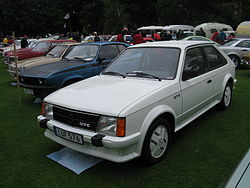
The Kadett D was introduced in the middle of August 1979, with deliveries on the home market beginning early in September 1979.[17] In November 1979, the car went on sale in the United Kingdom, some five months before the Vauxhall Astra Mark 1, the British version, was launched in March 1980. The cars were designed as three- or five-door hatchbacks and estates or estates. There were also two- and four-door saloons featuring separate boots/trunks, which shared the silhouettes of the hatchbacks: in the United Kingdom, the saloon versions were soon withdrawn, until the 1986 launch of the MKII-based Belmont. For the first time since 1965, there was no coupé-bodied Kadett in the range: the previous Kadett C coupé was indirectly replaced by the three-door 1.3 SR sports model.

Technologically, the Kadett D was part of a major investment for Opel (and General Motors as a whole) in a new front-wheel drive architecture, with an all-new family of engines and transmissions which would later be applied in the larger Ascona C and the smaller Corsa A in 1981, and 1982, respectively. It was also the first application of the Family I engine, with a single overhead camshaft, aluminium-alloy cylinder head, hydraulic valve lifters, with capacities of 1297 cc (producing 60 PS and 75 PS) and had a transaxle design that allowed the clutch to be replaced without removing the transmission unit. A carry-over 1196 cc Opel OHV engine from previous generations of the Kadett producing 55 PS (40 kW) and a top speed of 140 km/h (87 mph) was also offered on entry-level models from launch.[18] The larger Family II engine debuted in 1600 cc form and was offered after Frankfurt 1981, followed by an 1800 cc version introduced for the Kadett GSE/Astra GTE model. The Kadett D was also equipped with a 1600 cc diesel engine, an option which was first presented at the Brussels Motor Show in 1982.[19] Another frugal model, mostly sold in Italy, was the 1.0 liter model with 50 PS (37 kW).

This range of engines was also used for later models of the Corsa/Nova, and the mid-sized Cavalier/Ascona. From May 1981, the 1.3 was also available with a three-speed automatic. The automatic was made available to the diesel in September 1982. In the United Kingdom, Opels and Vauxhalls were initially sold through separate marketing operations, with overlapping lineups that competed directly with each other. By 1982 this anomaly had been sorted out and the Opel lineup was limited to the well-equipped five-door Berlina (1.3S or 1.6S) and the sporty 1.6 SR, leaving most of the market to the Vauxhall-badged cars.[20]

One interesting version which first appeared in mid-1982 was the Kadett Pirsch, (for deer stalking, a stealthy form of hunting). In non-German-speaking countries it was generally marketed as the "Kadett Off Road." This was an estate car with rustic trim, fitted with a limited-slip differential, reinforced suspension and more suitable tires, increased ground clearance, a skid plate, and shortened front fenders.[21] In Sweden, a special postal Kadett ("Opel Kadett Post") was offered, fitted with a high roof (necessitating a unique and much taller windshield) and a sliding right-hand door, RHD, and the automatic transmission.[22] This version was converted by Karosseriefabrik Voll (in German) in Würzburg, Germany. Voll also made a postal version of the later Kadett E.

The Kadett D was also sold as the IDA Kadett and assembled Kikinda, Yugoslavia. In Indonesia, PT. Garmak Motor was also reproduced Kadett D after 1984 in Jakarta, only for local market general buyers and taxi fleets until around 1995. It was later replaced by Opel Optima (Astra F) saloon. Only available as a 5-door hatchback, with carburetted 1298 cc GM Family 1 engine and 5-speed manual transmission.

Models

[edit]
Kadett 1979 (Netherlands)[23] 3dr hatch 5dr hatch 2dr saloon 4dr saloon 3dr caravan 5dr caravan Panel van
Basic
Luxus
Berlina
SR

South Africa

[edit]

The Opel Kadett D was also built in South Africa by General Motors South African (Pty) Ltd. The South African range was made up of four-door fastback saloons, five-door hatchbacks, and a five-door estate model called the Voyage.[24] The engines used are Opel's 1.2-litre overhead valve inline-four (L models only), or the OHC 1.3-litre (GL, GLS, and Voyage). Power is 60 PS (44 kW) and 75 PS (55 kW) respectively.[24] Later a 1.6 L was added and also a 1.8 L in the GTE performance model.

Small engine sizes with round lights on the nose while large engine sizes would have square lights on the nose.

Kadett E (1984–1995)

[edit]
Kadett E
Pre-facelift Kadett 1.3 LS (1987)
Overview
Production1984–1995
Body and chassis
PlatformT-platform
RelatedOpel Kadett Combo
Daewoo LeMans

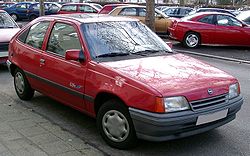
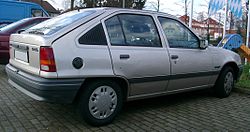
The Kadett E (sold as the Vauxhall Astra Mark 2 in the United Kingdom) was introduced in August 1984, and was voted the 1985 European Car of the Year.[25][26] The 1984 model was also developed into a more conventional three-box design with a boot (trunk), badged as the Vauxhall Belmont in the United Kingdom, launched at Frankfurt 1985. There was an estate car called the "Caravan" in mainland Europe, available with either three or five doors, as well as a convertible built by Bertone in Italy (from 1987). There was also a van version with a raised roof, called the Opel Kadett Combo in Europe, and the Bedford Astramax in the United Kingdom.

The car was noted for its advanced aerodynamics and distinctive "teardrop" shape — mirroring the trend in the mid 1980s for swooping aerodynamic styling — with the front end styling taken directly from the Opel Tech 1 concept car of 1981, although some styling cues from the Kadett D were retained for continuity such as its 'Kamm tail' and oversized C-pillar extraction vent. This generation was built and sold as the Chevrolet Kadett in Brazil, while the estate car was called the Chevrolet Ipanema. The Kadett E formed the basis of the Daewoo LeMans (later known as the Daewoo Cielo, Racer and Nexia) in South Korea, Nexia being the hatchback version), which was sold in the United States and New Zealand as the Pontiac LeMans, and in Canada (initially) as the Passport Optima. The Nexia was produced until 2016 at the UzDaewoo plant in Asaka, Uzbekistan.

Name change to Astra

[edit]

In 1991, GM Europe decided to standardise model names across its two brands, and Opel adopted Vauxhall's name for the Kadett, Astra, for the replacement car for Europe which debuted that year. Only South Africa kept the Kadett name until the 1999 (Astra/Kadett F), whereafter all models took the Astra name.

However, under Opel's internal naming convention, successive generations of the Astra platform are treated as a logical continuation of the Kadett lineage, hence the original 1991 Astra was designated Astra F in relation to the previous Kadett E. This convention has continued through the current Astra L.

See also

[edit]

Citations

[edit]
  1. ^ Ha, Tran (11 August 2021). "Opel Astra: Retour sur 85 ans d'histoire des compactes au blitz". Auto Plus (in French).
  2. ^ Oswald 1920 – 45 (vol 2), p 325 "Mitte November 1936 folgte der Opel Kadett (Serie 11234) als kleineres und bescheideneres [than the Olympia] Modell ..."
  3. ^ Oswald 1920 – 45 (vol 2), pp 325 & 326
  4. ^ Ludvigsen, Karl E. (1975), Opel: wheels to the world; a seventy-five year history of automobile manufacture, Princeton Publishing, p. 52, ISBN 0-915038-01-3
  5. ^ Bogomolov, Andrei (14 January 2001). "Oldtimer picture gallery: Opel Kadett (Model 11234)". Autogallery.org.ru. Archived from the original on 26 February 2020.
  6. ^ Oswald 1920 – 45 (vol 2), pp 320 & 326
  7. ^ a b c Oswald 1920 – 45 (vol 2), p 325
  8. ^ Oswald 1920 – 45 (vol 2), pp 328–329
  9. ^ Oswald 1920 – 45 (vol 2), pp 287 & 325: Oswald's book (2001 edition) gives the figure of 106,608 in his table of production statistics but 107,608 in his text.
  10. ^ a b c d Borichev, Evgeny; Voskresensky, Alexey (2008). "Расследование: как создавался Москвич". Журнал «АвтоРевю». Archived from the original on 2 October 2008.{{cite web}}: CS1 maint: bot: original URL status unknown (link) archived by WayBackMachine web archive, currently available for paid access on the original site
  11. ^ Oswald 1945 – 90 (vol 3), p 197
  12. ^ Zink, Günther (2009). Oldtimer Katalog. Vol. 23. Königswinter: Heel Verlag. p. 265. ISBN 978-3-86852-067-5.
  13. ^ Oswald 1945 – 90 (vol 3), p 213
  14. ^ Oswald 1945–90 (vol. 3), pp. 199 & 215
  15. ^ Oswald 1945 – 90 (vol 3), pp 236 & 239
  16. ^ Oswald 1945 – 90 (vol 3), p 237
  17. ^ Oswald 1945 – 90 (vol 3), p 265
  18. ^ Daily Express Guide to 1980 World Cars, page 52
  19. ^ Büschi, Hans-Ulrich, ed. (3 March 1982). Automobil Revue '82 (in German and French). Vol. 77. Berne: Hallwag AG. p. 422. ISBN 3-444-06062-9.
  20. ^ Lewis, Martin (5 June 1982). "A touch of class". Autocar. Vol. 156, no. 4459. IPC Business Press Ltd. pp. 47–48.
  21. ^ Hogsten, Dag E (28 July 1982). "Kadett för dåliga vägar" [Kadett for bad roads]. Teknikens Värld (in Swedish). Vol. 34, no. 16. Stockholm, Sweden: Specialtidningsförlaget AB. p. 54.
  22. ^ Näsström, Thomas (July 2014). "En sista utdelning" [One last delivery]. Klassiker (in Swedish). 11 (6). Stockholm: OK Förlaget AB: 68. ISSN 1652-2931.
  23. ^ "Opel Kadett Brochure 1979 NL — Veikl". www.veikl.com. Retrieved 12 September 2022.
  24. ^ a b Lösch, Annamaria, ed. (1981). World Cars 1981. Pelham, NY: The Automobile Club of Italy/Herald Books. p. 334. ISBN 0-910714-13-4.
  25. ^ "Rewind to 1985: Opel Kadett". Quicks. Archived from the original on 1 March 2014. Retrieved 25 February 2014.
  26. ^ "Previous winners". Car of the year. Archived from the original on 2 February 2009. Retrieved 2 October 2010.

General and cited references

[edit]
[edit]
Revisions and contributorsEdit on WikipediaRead on Wikipedia
from Grokipedia
The was a compact small manufactured by the German automaker from 1936 to 1940 and then from 1962 to 1991, renowned for its affordability, reliability, and role in shaping the European compact car segment across multiple generations. The original Kadett debuted in December 1936 under the direction of Opel's Commercial-Technical director , positioning it as an accessible entry-level model with body styles including two-door and four-door sedans as well as a two-door . Production of this first generation totaled 107,608 units before it was suspended in 1940 due to resource demands. Post-war, the Kadett was reintroduced on October 2, 1962, as the Kadett A, Opel's first modern compact offering that emphasized innovative engineering like a unibody construction and independent front suspension, helping it revolutionize the class with efficient four-cylinder engines ranging from 1.0 to 1.1 liters. This generation, produced until 1965, set the stage for successors including the Kadett B (1965–1973), which introduced larger engines up to 1.9 liters and optional twin carburetors for sportier performance; the Kadett C (1973–1979), featuring options and improved safety elements like collapsible steering columns; the Kadett D (1979–1984), with front-wheel-drive architecture, aerodynamic styling, and diesel variants for better fuel economy; and the Kadett E (1984–1991), the final iteration offering five-door hatchbacks, sedans, wagons, and convertibles powered by engines from 1.3 to 2.0 liters, including turbocharged options. Throughout its run, the Kadett achieved significant commercial success, becoming the best-selling car in markets like the for over 25 years starting in the mid-1960s, with millions of units sold across and exported under badges such as in the UK and in the . It pioneered features like Opel's first in-house downdraft in the 1930s and later advanced compact station wagon designs, influencing the transition to the in 1991.

Introduction

Origins and Development

In the early , the German automotive market featured mostly mid-sized and luxury vehicles, creating an unmet demand for affordable, compact cars suitable for the expanding amid rising and economic pressures from the . Adam Opel AG, acquired by in 1929, applied American mass-production methods to its Rüsselsheim facilities, enabling efficient scaling for smaller models. This led to the strategic decision to launch the Kadett as an entry-level , aiming to democratize personal mobility in for the first time on a large scale. The development of the Kadett I began in the mid-1930s under the direction of Opel's engineering team, led by Commercial-Technical director , who integrated GM's technical expertise to create a lightweight, unitary-construction vehicle. Influenced by American compact designs such as the Chevrolet Standard, the Kadett emphasized simplicity, low-cost materials, and a modest inline-four for , departing from the heavier, more complex European norms of the era. Launched in late 1936, it quickly established as the market leader in small cars, with production reaching over 100,000 units by 1940 through streamlined assembly lines inspired by U.S. practices. World War II disrupted production in 1940, leaving a 22-year void in Opel's small-car lineup as factories shifted to military output and sustained bombing damage. The post-war revival came in 1962 with the Kadett A, motivated by West Germany's —the rapid economic boom fueled by industrial reconstruction, export growth, and rising wages, which tripled car registrations between 1950 and 1960 and heightened demand for economical vehicles. Opel invested in a dedicated Bochum assembly plant to produce the Kadett A as a contemporary successor, incorporating updated safety features and export-oriented designs to capitalize on this prosperity while addressing the competitive gap left by rivals like . Spanning 1936–1940 and 1962–1991, the Kadett generations achieved cumulative production of approximately 11 million units, underscoring its role as a cornerstone of European mass motoring. A pivotal evolution occurred in 1979 with the Kadett D, when Opel transitioned to to enhance interior space, handling, and fuel economy in response to tightening emissions regulations and shifting consumer preferences for versatile compacts. This line concluded in 1991, transitioning briefly to the Astra nameplate as an evolutionary step.

Significance and Legacy

The Opel Kadett holds a pivotal place in automotive history as Europe's first mass-produced compact family car, introduced in 1936 by Opel, which pioneered the concept of an affordable small vehicle tailored for everyday use and thereby shaped the development of the compact car segment across the continent. This positioning stemmed from its innovative design, offering modern features like independent front suspension at a price point accessible to a broad audience, which set a benchmark for subsequent models in the class. Economically, the Kadett's affordability played a key role in promoting middle-class mobility, first in pre-war Germany where it sold over 100,000 units during its production run, and later in by democratizing personal transportation during periods of reconstruction and growth. Its low cost and reliability enabled widespread adoption, contributing to social and economic shifts toward greater individual mobility in the mid-20th century. Culturally, the Kadett emerged as a symbol of West Germany's post-World War II recovery, embodying industrial resurgence and consumer optimism in the era, with cumulative sales exceeding 2.5 million units by the 1970s across its early generations. This enduring popularity underscored its role in Opel's lineup during the General Motors ownership period from 1929 to 2017, where it facilitated platform-sharing innovations that influenced global vehicle development. The model's legacy extended to direct successors like the , introduced in 1991 as its rebranded continuation, maintaining Opel's dominance in the compact segment while competing fiercely with rivals such as the in the compact segment, including through performance-oriented models like the 1975 Kadett C GT/E. In modern times, the Kadett's 85th anniversary was marked in , highlighting its foundational impact on the compact class, with restored examples commanding collector values averaging around $5,700 and premium variants fetching up to $39,000 at auction as of 2021.

Pre-War Generation

Design and Specifications (1936–1940)

The Opel Kadett I, launched in December 1936, featured a pioneering chassis-less construction using an all-steel unibody for enhanced cost efficiency and , drawing influence from the smaller Opel P4 predecessor and the engineering of the larger model. This design marked a shift from traditional separate frames, providing a lightweight yet durable platform that contributed to the car's affordability and mass-market appeal. The body adopted a streamlined saloon shape with ponton-like proportions, measuring 3,810 mm in length, 1,375 mm in width, and 1,455 mm in height, supported by a 2,340 mm that accommodated a compact footprint suitable for urban driving. The suspension system utilized a Dubonnet-type independent front setup for improved handling and ride comfort, paired with a conventional leaf-spring rear derived from the Olympia, which balanced simplicity and durability for everyday use. Braking was handled by hydraulic drum brakes on all four wheels, a modern feature at the time that enhanced stopping reliability compared to cable-operated systems in earlier models. The interior was configured as a basic four-seater saloon with functional appointments, including draft-free ventilation via a triangular hinged , an optional direction indicator, and a dustproof trunk accessible from inside the cabin, emphasizing practicality for transport. Power came from a 1,074 cc side-valve inline-four engine constructed of gray , delivering 23 PS (17 kW) at 3,400 rpm and 60 Nm of torque, mated to a three-speed with . This setup enabled a top speed of 98 km/h and comfortable cruising at around 60 km/h, suitable for inter-city travel while maintaining modest typical of the era's small-displacement engines. The overall build prioritized economical production and reliability, with the unibody contributing to a curb weight of approximately 760 kg, underscoring Opel's focus on accessible mobility.

Variants and Production

The pre-war Opel Kadett was manufactured exclusively at the company's Rüsselsheim plant in , where production began in 1936 and continued until 1940. The initial production series, known as Serie 11234 and launched in 1937, featured minor styling adjustments such as a revised front grille along with enhanced protection measures to improve durability. This series accounted for 33,402 units built before being superseded later that year. From 1938 onward, the lineup consisted of the standard Kadett KJ38, equipped with a 1,074 cc side-valve engine delivering 23 PS, and the upgraded K38 Spezial variant, which included refinements like independent front suspension for better handling while retaining the same 23 PS output. A cabriolet version was also available under the KJ38 designation. Available body styles were limited to the two-door saloon, four-door saloon, and two-door cabriolet, with no estate or configurations produced. Overall, a total of 107,608 Kadetts were assembled across all variants by the end of production in 1940.

Commercial Success and Soviet Legacy

The Opel Kadett rapidly established itself as a commercial triumph in the late , emerging as the best-selling car in during 1937 amid Opel's dominant market position. With competitive pricing and efficient production, the model contributed significantly to Opel's overall sales of approximately 75,600 units that year, helping the company secure a exceeding 35 percent—far surpassing competitors and reflecting the Kadett's appeal as an affordable small . Its success extended internationally, with exports to numerous European and international markets. Production of the Kadett came to an abrupt halt in 1940 as escalated, shifting Opel's facilities to wartime manufacturing of trucks and military components. The Rüsselsheim and factories suffered extensive damage from Allied bombing campaigns, with approximately half of the Rüsselsheim structures completely destroyed by late 1944, though 50 percent of the machinery remained operational initially. In the war's aftermath, Soviet forces partially dismantled surviving equipment from these plants in as reparations, transporting it eastward to bolster the USSR's nascent automotive industry. This disassembly laid the foundation for the Kadett's unexpected Soviet legacy, as the relocated tooling and designs from the 1938 Kadett K38 directly inspired the and 401 models. Produced at the Small Automobile Plant (MZMA) from 1947 to 1956, these vehicles replicated much of the Kadett's unibody construction and four-door sedan layout but were adapted for local conditions, incorporating Soviet-sourced steel and simplified interior features to address post-war material shortages. Over 247,000 units were manufactured in total, powered by a 1,074 cc inline-four engine rated at 23 PS in the base 400 and upgraded to 26 PS in the 1954-introduced 401, providing modest performance suited to Soviet roads and fuel availability. The series thus extended the Kadett's influence, serving as a primary passenger car for Soviet civilians and officials during the early era.

Second Generation

Design and Features (1962–1965)

The Opel Kadett A marked the post-war revival of the Kadett nameplate after a 22-year hiatus since the pre-war model's production ended in 1940, with development accelerating in the late to address the market dominance of the in the segment. Launched in , the Kadett A was engineered as a modern, affordable to compete directly with the Beetle's and popularity, emphasizing and practicality to fill the gap in Opel's small-car lineup. The design featured a boxy saloon body with unibody construction, comprising just 12 main body parts for ease of manufacturing and reduced weight, with side panels formed from a single sheet of . Overall length measured 3,923 mm (later variants 3,990 mm), providing a compact footprint while offering superior interior space and luggage capacity compared to the . It employed with a live rear suspended by leaf springs, paired with independent front suspension to deliver a balanced ride suitable for everyday use. Inside, the Kadett A accommodated four passengers on a , with a straightforward layout focused on functionality rather than luxury. Optional equipment included a heater and radio, enhancing comfort in a otherwise basic cabin designed for low maintenance and ample legroom. For safety and handling, it featured hydraulic drum brakes on all four wheels as standard. Engine options centered on a lively 1.0-litre unit, underscoring the model's emphasis on efficient, responsive motoring.

Engines and Body Styles

The Opel Kadett A was equipped with a carbureted 993 cc OHV inline-four , delivering 40 PS (29 kW) at 5,000 rpm and 71 Nm of torque at 3,000 rpm in its standard configuration. From 1963, an optional higher-compression S variant of the same produced 48 PS (35 kW) at 5,400 rpm, enhancing responsiveness without increasing displacement. Both versions featured a short-stroke design for lively performance in a compact package, paired exclusively with a four-speed and setup. Body styles for the Kadett A were limited to emphasize simplicity and affordability, built on a unibody for lightweight rigidity. It launched exclusively as a two-door saloon, seating four or five passengers in a practical layout. In 1963, the range expanded to include a two-door for a sportier appeal and a three-door estate called the Car-A-Van, providing versatile cargo space without a separate . Performance metrics reflected the era's focus on economical motoring, with the base enabling a top speed of 120 km/h and 0-100 km/h acceleration in about 19 seconds, alongside combined fuel consumption of 7-8 L/100 km. The S engine improved the top speed to 130 km/h while maintaining similar efficiency, underscoring the model's balance of utility and modest dynamism.

Third Generation

Platform Updates (1965–1973)

The Opel Kadett B platform represented a substantial evolution from the previous generation, debuting at the 1965 Motor Show as Opel's response to growing demands for a more spacious and refined . The was lengthened to 4,105 mm overall for the saloon (with variations by body style up to 4,182 mm for the ), with a extended to 2,416 mm, providing increased interior room while maintaining the rear-wheel-drive layout. This redesign improved structural rigidity through reinforced body panels and a stiffer frame, contributing to better handling stability and ride comfort. Additionally, the platform introduced optional (or standard on higher trims) front disc brakes, a notable advancement over the all-drum setup of the Kadett A, enhancing stopping power particularly in wet conditions. Styling updates for the Kadett B emphasized with more rounded body lines and a larger area, allowing for greater passenger visibility and a sense of airiness inside the cabin. The design drew inspiration from contemporary American trends, particularly in the introduction of a coupe variant featuring a gently sloping rear roofline that conveyed a sportier profile. These changes, combined with subtle fender flares and a revised front grille, differentiated the B from the boxier Kadett A while preserving Opel's signature engineering focus on practicality. The platform inherited the engine lineup from the prior generation but integrated them into a more versatile body structure supporting multiple configurations. Safety enhancements were progressively incorporated, reflecting emerging industry standards during the late . From 1967 onward, models featured a collapsible designed to absorb impact energy in collisions, paired with a padded to reduce risk to occupants. These updates, along with the optional front disc brakes, positioned the Kadett B as a forward-thinking platform that addressed durability concerns from the Kadett A, including notorious rust vulnerabilities through better and sealed joints in the bodywork. Production continued until 1973, with the platform laying the groundwork for Opel's dominance in .

Model Variants and Performance

The Opel Kadett B was offered in a variety of body styles to cater to different customer needs, including two- and four-door saloons, a two-door coupé, a coupé, and a three-door caravan . The saloon variants provided practical family transportation with options for standard or luxury trim levels, while the coupé and appealed to buyers seeking a sportier aesthetic. The caravan , with its extended cargo space, was designed for utility purposes, including a delivery van derivative. Among the performance-oriented models, the Rallye 1900 stood out as a coupé variant prepared for motorsport applications, featuring reinforced components and a distinctive trim package. The lineup for the Kadett B ranged from economical to high-performance options, starting with the base 1.1-liter overhead-valve inline-four producing 44 PS and extending to the 1.9-liter overhead-cam inline-four in the Rallye 1900 delivering 90 PS. Intermediate choices included 1.2-liter (50-60 PS), 1.5-liter (60-75 PS), and 1.7-liter units, all paired with four- or five-speed manual transmissions and . These powerplants provided a balance of and drivability, with the top-output 1.9-liter enabling a maximum speed of 155 km/h in the Rallye variant. For the US market, the Kadett B was exported and sold through dealerships from 1966 to 1971, badged simply as the Opel Kadett to align with its predecessor. It featured a detuned 1.7-liter producing around 75 hp (SAE gross) to meet local emissions and performance expectations, with body styles limited to the sport coupé and wagon. This export strategy helped introduce European compact design to American buyers seeking affordable alternatives to domestic economy cars. Overall production of the Kadett B exceeded 2.6 million units between 1965 and 1973, marking it as one of Opel's most commercially successful models. Assembly occurred primarily at Opel's Rüsselsheim plant in , with additional local production in at the General Motors facility in Port Elizabeth to serve regional demand and incorporate Vauxhall-sourced components like a 997 cc option.

Fourth Generation

Engineering Changes (1973–1979)

The fourth generation of the Opel Kadett, designated as the Kadett C, debuted in late summer 1973 on ' T-platform, a development timed amid the that heightened demand for economical compact cars. This platform shared key components, including suspension elements and engine options, with the contemporary , enabling cost-effective production and modular engineering across Opel's lineup. The design prioritized and practicality, with the sedan's overall length measuring 4,124 mm, balancing interior space against urban agility. Steering on the Kadett C employed a standard system for reliable operation, while rack-and-pinion steering became available as an optional upgrade, offering sharper response and reduced play for enhanced handling. Suspension featured independent front double-wishbone with coil springs for composed ride dynamics, paired with a rear rigid axle also using coil springs, which provided stability while incorporating improved damping and bushings to minimize road noise and vibrations. To address tightening emissions regulations, the Kadett C integrated catalytic converters from 1975 onward in select markets, such as the , aligning with federal standards for reduced and output. These adaptations, combined with refined insulation materials in the body and , elevated cabin refinement without compromising the model's lightweight construction. In August 1975, the Kadett City three-door was introduced, offering improved versatility while maintaining the rear-wheel-drive layout. The Kadett C subtly inherited proportional styling elements from its B-generation predecessor, ensuring visual continuity in Opel's compact segment.

Special Editions and Markets

The Opel Kadett C lineup included several special editions that catered to performance-oriented buyers and open-top enthusiasts. The GT/E variant, introduced in 1975, featured a 1.9-liter inline-four producing 105 PS, paired with alloy wheels for enhanced handling and aesthetics, positioning it as the sporty flagship . A rare highlight was the limited-production Aero cabriolet, converted by coachbuilder Baur from 1976 to 1978, which incorporated a Targa-style removable , roll bar, and fabric cover; only 1,242 units were built, making it a collector's item today. Engine options for the Kadett C ranged from 1.2-liter petrol units. Adaptations for international markets highlighted the Kadett C's global appeal on the GM T-car platform. In , local assembly by met regional standards, boosting sales in a market favoring economical imports. For , exports were rebadged and localized as the from 1975, with right-hand-drive configurations and minor suspension tweaks for local roads, contributing to its success in the Australian market. Overall production reached 1.7 million units between 1973 and 1979, underscoring the model's commercial success across and beyond. A 1977 facelift refreshed the design with larger rectangular headlights integrated into revised front fenders, along with updated bumpers and interior trim for improved safety and style.

Fifth Generation

Front-Wheel Drive Shift (1979–1984)

The Opel Kadett D represented a groundbreaking evolution in the model's history, debuting at the 1979 International Motor Show (IAA) in Frankfurt as Opel's inaugural front-wheel-drive vehicle. This shift from the rear-wheel-drive architecture of prior generations was driven by the need for greater fuel efficiency amid the lingering effects of the 1973 and 1979 oil crises, which had heightened demand for compact, economical cars across Europe. The all-new platform prioritized space efficiency and lightweight construction, allowing the Kadett D to offer more interior room despite its shorter overall length compared to the Kadett C. At the core of the Kadett D's design was a transverse , with an overall length of 3,998 mm that balanced compactness and . The suspension system employed independent MacPherson with coil springs at the front and a twist-beam rear with coil springs, which provided enhanced stability and ride quality over the rear-wheel-drive Kadett C's more outdated configuration. This engineering choice, combined with a curb weight of around 835–850 kg, resulted in noticeably improved handling, reduced understeer tendencies, and better traction in everyday driving conditions. The Kadett D's boxy, angular styling emphasized practicality, maximizing cargo and passenger space within its modest footprint while incorporating aerodynamic refinements for the era. It achieved a of 0.39, the lowest in its class at launch, which contributed to superior economy—typically around 7–8 liters per 100 km in base models—directly addressing post-crisis concerns over rising costs without compromising the vehicle's versatile, family-oriented appeal. options were carried over from the previous generation with minimal changes, ensuring reliability and cost-effectiveness during the transition to this new drivetrain paradigm.

International Adaptations

The Opel Kadett D was produced and adapted for multiple international markets, leveraging ' global network to localize production and meet regional preferences. In the , it was rebadged and slightly restyled as the Vauxhall Astra Mk1, introduced in 1980 with adaptations such as revised grille and lighting to fit Vauxhall's branding while retaining the core front-wheel-drive architecture shared with the version. This adaptation helped the model compete against rivals like the Ford Escort, emphasizing practicality and fuel efficiency in the British market. South African production by General Motors South Africa (Pty) Ltd included localized variants like the Kadett D GTE, a three-door hatchback with a tuned 1.8-liter engine producing 115 PS, drawing inspiration from the model's rally heritage to cater to enthusiasts seeking sportier dynamics on local roads. Assembly in South Africa allowed for adjustments to suspension and trim to suit the region's driving conditions and consumer tastes. The Kadett D lineup encompassed diverse body styles, including three- and five-door hatchbacks for urban versatility, two- and four-door saloons for traditional buyers, and the three- and five-door Caravan wagon for family use, with the latter offering expanded cargo space through a foldable rear seat. Engine choices spanned the 1.3-liter inline-four at 60 PS for entry-level models to the 1.8-liter at 85 PS for higher trims, including a 1.6-liter diesel option (54 PS) introduced in 1982, with an optional three-speed enhancing accessibility for non-enthusiast drivers. Overall, these adaptations contributed to global production totaling 2.1 million units between 1979 and 1984. A facelift introduced revised bumpers for better impact absorption and enhanced rustproofing treatments, including galvanized panels and improved underbody coatings, to address issues prevalent in humid climates and extend the model's in export regions. These updates maintained the Kadett D's competitive edge without major redesigns, ensuring continued popularity in adapted forms worldwide.

Sixth Generation

Design Evolution (1984–1991)

The Opel Kadett E, launched in August 1984, evolved the platform inherited from the preceding Kadett , prioritizing aerodynamic efficiency and compact versatility in its design. Engineers invested over 1,200 hours in testing to refine the body's shape, resulting in a (Cd) of 0.32 for standard models, which contributed to improved fuel economy and stability at higher speeds. The Kadett E was available in multiple body styles, including 3- and 5-door (measuring 3,998 mm in length), 4-door sedan (4,218 mm), 3- and 5-door estate (Caravan, 4,406 mm), and 2-door cabriolet, centering on the three-door hatchback as its core configuration while offering options to accommodate diverse needs such as family transport or open-top driving. Key mechanical refinements enhanced everyday usability: was standardized across most trims by the mid-1980s to reduce driver effort, and (ABS) became available as an optional safety feature starting in 1987, marking an early adoption of electronic aids in the compact class. The model underwent minor facelifts to keep its styling fresh amid evolving market tastes. In 1986, updates included more rounded headlight housings integrated with corner-mounted turn signals, softening the original angular front for a more contemporary look. The 1989 revision further modernized the interior in select variants with a digital instrument cluster, alongside a narrower grille and revised bumpers to enhance visual cohesion. Production of the Kadett E concluded in after more than 3.7 million units had been built at the plant, reflecting its enduring popularity and setting the stage for the model's successor.

High-Performance Models

The high-performance models of the Opel Kadett sixth generation focused on the GSi series, which elevated the Kadett E's sporty credentials through enhanced engines, chassis upgrades, and styling elements tailored for enthusiastic drivers. These variants built on the front-wheel-drive platform introduced in 1984, emphasizing agile handling and quick acceleration while maintaining the model's compact dimensions and practicality. The GSi debuted in 1984 with a 1.8-liter inline-four engine featuring eight valves and electronic , producing 115 PS (85 kW) at 5,800 rpm and 151 Nm of at 4,800 rpm. Paired with a five-speed , it achieved 0-100 km/h in approximately 9.0 seconds and a top speed of 195 km/h, supported by a sport-tuned suspension, 14-inch wheels, and bodywork modifications including a front spoiler and side skirts. A was available in select markets to improve traction during spirited driving. In 1987, Opel refined the GSi with a displacement increase to 2.0 liters while retaining the eight-valve configuration, boosting output to 130 PS (96 kW) at 5,600 rpm and 180 Nm at 4,600 rpm. This iteration shaved to 0-100 km/h in 8.2 seconds, with a top speed around 205 km/h, and included the same aerodynamic kit and optional for better cornering dynamics. The changes made it more responsive without sacrificing , appealing to buyers seeking a and daily . The pinnacle arrived later in 1987 with the GSi 16V, equipped with a 2.0-liter double-overhead-camshaft sixteen-valve engine co-developed with , delivering 150 PS (110 kW) at 6,000 rpm and 203 Nm at 4,800 rpm. Capable of 0-100 km/h in 8.0 seconds and a top speed of 220 km/h, it featured a standard , firmer suspension, larger disc brakes, and an updated aero kit with a rear spoiler for improved high-speed stability. This model, produced in sufficient numbers for rally , set benchmarks for hot hatches of the era, combining refined engineering with engaging drive characteristics. Complementing the GSi lineup, the GT variant launched in 1987 as a more accessible sporty option, powered by the 1.8-liter eight-valve tuned to 115 PS (85 kW) and 151 Nm. It prioritized interior enhancements like sport seats with bolstered side support, a leather-wrapped , and premium trim, alongside 15-inch alloys and the GSi's suspension setup for composed road manners. Acceleration mirrored the early GSi at around 9.0 seconds to 100 km/h, positioning it as an ideal entry into 's performance range. In , a regional variant known as the GSi 16V Superboss was produced from 1990 to 1991 in a limited run of 500 units to meet Group N regulations, featuring the same 2.0-liter 16V at 150 PS with reinforced elements for local efforts. These models gained enduring popularity in tuning communities, where their modular engines and lightweight construction allowed extensive modifications, from turbo conversions to suspension overhauls, fostering a vibrant aftermarket scene across and beyond.

Motorsport History

Rally Participation

The Opel Kadett's rally involvement began prominently with the second-generation Kadett B Rallye model in the mid-1960s. Introduced in 1966, this variant featured a 1.9-liter inline-four engine rated at 90 hp in standard form, which rally teams tuned to exceed 100 PS for enhanced performance in national events across Europe. The car's lightweight construction and responsive handling made it a favorite for grassroots competitions, contributing to its widespread adoption in local rallies during the late 1960s. In 1968 alone, the Rallye-Kadett secured 222 class victories out of 238 events entered, underscoring its dominance in national championships and establishing Opel as a competitive force in the sport. The third-generation Kadett C advanced Opel's rally efforts through the GT/E variant, launched in 1975 and homologated for Group 2 regulations. Equipped with a fuel-injected 1.9-liter tuned to produce up to 165 kW (225 hp), the GT/E excelled in international events, particularly in the (ERC). Notable successes included strong performances by drivers and Rauno Aaltonen, who podiumed in rallies such as the and events. Röhrl, paired with co-driver Jochen Berger, achieved a fourth-place overall finish in the 1976 , highlighting the model's reliability on mixed surfaces despite challenges from dominant Group 4 prototypes like the . With the fourth-generation Kadett E, introduced in 1984, shifted focus to homologation via the high-performance GSi 16V model, which served as the basis for the road-going GSi. This front-wheel-drive car, powered by a 2.0-liter 16-valve delivering around 150 hp in competition trim, was campaigned extensively in ERC rounds and national series. The Kadett E earned multiple podiums in ERC events, such as strong results in the German and Austrian rallies, contributing to its reputation for versatility on and tarmac. In 1989, Austrian drivers Josef Haider and Ferdinand Hinterleitner clinched the German Rally Championship title with the GSi 16V. Across its production run from the to the early , the Kadett secured several championships in various European countries, with a particular emphasis on ERC contention where it regularly challenged established rivals like Ford and Lancia. These efforts not only boosted Opel's profile but also influenced production models, blending rally-derived engineering with everyday usability.

Road Racing and Achievements

The Opel Kadett saw significant involvement in circuit racing during the 1980s, particularly through the (DTM), the premier German series. The Kadett E GSi, introduced as a high-performance variant, was homologated for competition and fielded by Opel's starting in 1988. Drivers such as Heinz-Friedrich "Bimmo" Peil and Sepp Haider campaigned the Kadett GSi 16V, with Peil achieving competitive results that season, marking Opel's competitive entry as the fourth major manufacturer alongside , , and . Earlier, in the 1984 Deutsche Produktionswagen Meisterschaft—the DTM's direct predecessor run under modified rules—the Kadett GT/E competed effectively in the under-2.0-liter class. Jürgen Fritzsche, driving for the semi-works Mantzel Tuning team, achieved consistent podium finishes and class podiums across the season, ultimately placing eighth in the overall drivers' standings with 87.5 points and contributing to the team's strong class performance. This effort helped secure the 1984 class championship title in the production car division, demonstrating the Kadett's reliability and speed on circuits like the and . In other European series, the Kadett participated in the (ETCC) throughout the 1980s, with entries in events such as the Zandvoort Trophy and Grand Prix, often achieving class podiums in Division 2 for cars under 2.0 liters. Notable drivers included privateers like Armin Hahne and team efforts from , though overall wins were limited to class successes. In the , Kadett B and C models were popular in 1970s club-level saloon car racing, where modified examples competed in regional events, fostering grassroots enthusiasm for Opel's compact performance cars. The Kadett's road racing endeavors amassed numerous class victories and podiums, enhancing Opel's reputation for engineering accessible high-performance vehicles and paving the way for later models like the Astra OPC in official motorsport programs.

Transition to Astra

Reasons for Rebranding

By the late 1980s, sought to streamline its European operations through greater harmonization between its and subsidiaries, leading to a policy of unified model nomenclature across the region. The name, introduced in 1980 for the Kadett D, continued for the Kadett E in the from 1984, creating an opportunity to adopt the Astra name for the lineup to enhance brand consistency and appeal in key markets like the and broader . Sales performance further underscored the need for renewal, as the aging Kadett E faced intensifying rivalry from established competitors such as the , which outsold the Kadett with 780,000 units across in 1989 compared to the Kadett's 660,000. This competitive pressure, coupled with the Kadett E's nearing end-of-life after seven years of production, prompted GM to introduce a refreshed identity for the successor model to reinvigorate consumer interest and maintain market share in the compact segment. Internally, the rebranding aligned with GM's broader push for and cross-brand under its European division, phasing out the long-standing Kadett —which dated back to —in favor of the more modern-sounding Astra. The change was formally announced in 1991 and implemented with the debut of the new F-platform model later that year.

Initial Astra Integration

The Opel Astra F, launched in September 1991, served as the direct successor to the Opel Kadett E, evolving from the same T91 platform while adopting the Astra nameplate previously used by in the UK for earlier Kadett models. This transition ensured a seamless handover in the segment, with the Astra F retaining the Kadett E's core engineering for cost efficiency and familiarity. Available initially in three- and five-door and saloon body styles, it carried over key powertrains including the 1.6-liter Family I inline-four engine producing around 75 horsepower and the 1.8-liter Family II unit delivering up to 115 horsepower in performance variants, maintaining comparable dynamics and fuel economy to the outgoing Kadett. Design updates distinguished the Astra F from its predecessor, featuring a revised front with smoother lines, integrated bumpers, and a more modern grille to align with Opel's evolving aesthetic. Interior refinements included enhanced , increased cabin space despite similar exterior dimensions, and improved material quality for better perceived refinement, addressing feedback on the Kadett's aging cabin. These changes positioned the Astra F as a refreshed yet evolutionary product, emphasizing practicality and safety features like optional driver airbags introduced early in its run. In 1994, a mid-cycle facelift brought further advancements, including the debut of Opel's engine family—such as the 1.6-liter and 1.8-liter 16-valve units with for improved efficiency and reduced emissions—alongside updated rust protection and minor styling tweaks like clear headlights. Production of the Astra F continued without interruption at Opel's primary Rüsselsheim facility in Germany and the Vauxhall plant in Ellesmere Port, UK, leveraging existing lines from the Kadett era to support high-volume output across Europe. By 2000, cumulative Astra production had surpassed 4 million units, with the F generation alone contributing significantly to this milestone through robust demand. The rebranding proved highly successful, as the Astra F quickly captured market share in the compact segment, praised for its balanced handling, spacious interior, and value, effectively filling the void left by the Kadett without any sales dip and establishing itself as Opel's top-selling model to date.

References

Add your contribution
Related Hubs
User Avatar
No comments yet.