
_Enjoy_5-door_hatchback_(2015-11-11)_01.jpg/250px-2012_Opel_Corsa_(CO)_Enjoy_5-door_hatchback_(2015-11-11)_01.jpg)


_Enjoy_5-door_hatchback_(2015-11-11)_01.jpg/2000px-2012_Opel_Corsa_(CO)_Enjoy_5-door_hatchback_(2015-11-11)_01.jpg)
Community hub
Recent from talks
Contribute something
Nothing was collected or created yet.
Opel Corsa
View on Wikipedia
| Opel Corsa | |
|---|---|
 Opel Corsa F (pre-facelift) | |
| Overview | |
| Manufacturer |
|
| Also called |
|
| Production |
|
| Body and chassis | |
| Class | Supermini (B) |
| Layout | Front-engine, front-wheel-drive |
| Chronology | |
| Predecessor | Opel Kadett City Vauxhall Chevette |
The Opel Corsa is a supermini car[1][2][3] manufactured and marketed by Opel since 1982. The car is known as the Vauxhall Corsa in the United Kingdom. Under General Motors ownership of Opel before 2017, the Corsa was also marketed under various nameplates under Chevrolet, Holden and Buick brands.
The Corsa was once the best-selling car in the world in 1998, recording 910,839 sales. At that time, the Corsa assembled on four continents, marketed under five different marques and offered in five body styles.[4] By 2007, over 18 million Corsas had been sold globally.[5]
Corsa A (S83; 1982)
[edit]| Corsa A | |
|---|---|
 | |
| Overview | |
| Model code | S83 |
| Also called | Vauxhall Nova |
| Production | 1982–1993 |
| Model years | 1983–1993 |
| Assembly | Spain: Zaragoza Yugoslavia: Kikinda (IDA-Opel) |
| Body and chassis | |
| Body style | |
| Powertrain | |
| Engine | |
| Transmission | 4/5-speed manual |
| Dimensions | |
| Wheelbase | 2,343 mm (92.2 in) |
| Length | 3,622–3,955 mm (142.6–155.7 in) |
| Width | 1,532–1,540 mm (60.3–60.6 in) |
| Height | 1,360–1,365 mm (53.5–53.7 in) |
| Curb weight | 735–865 kg (1,620–1,907 lb) |
The front-wheel drive Opel Corsa was first launched in September 1982. A two-seat, roadster "concept car" had been shown as a teaser six months earlier at Geneva.[6] It went on sale first in France, Italy, and Spain — markets where small cars represented from 34 to 43 percent of overall automobile sales.[7] Sales across the remainder of Europe were to have begun by March 1983. General Motors' internal code for the Corsa/Nova was the S-car.[8] The S-car designation had originally been applied to an abandoned supermini proposal from the early 1970s, which evolved into the 3-door hatchback ("City") version of the Opel Kadett C/Vauxhall Chevette, for which the Corsa/Nova acted as a de facto replacement. The Corsa was GM Europe's entry into the burgeoning supermini market — a market in which Opel/Vauxhall were not yet represented, as the Kadett C/Chevette was not a true supermini in the sense that it was rear wheel drive, while its successor — the Kadett D/Astra — competed in the larger C-segment, thus leaving a gap at the bottom of the range. The new car would therefore follow in the template already set by established superminis such as the Fiat 127, VW Polo and Ford Fiesta in using a transverse-engined, front wheel drive layout.
Built in Zaragoza, Spain, the first Corsas were three-door hatchback and two-door saloon models, with four-door and five-door versions added in 1984. In certain markets, commercial "van" models were also sold, with or without rear windows depending on local requirements. In mainland Europe, the saloon versions were known as the "Corsa TR" until May 1985 and had subtly altered styling — the distinctive wheelarch blisters of the hatchbacks were deleted and the saloons used a traditional "eggcrate" grille instead of the hatchback's integrated bumper/four-bar grille. The saloons were intended to appeal to customers of the Opel Kadett C and Vauxhall Chevette who still desired a traditional three-box saloon shape — while it did not sell particularly well in most of Europe, the TR was popular in Spain and Portugal among other markets. While only taking ten percent of French Corsa sales during the car's first half-year, the TR represented half of all Corsas sold in Spain.[9]
The basic trim level was called just the Corsa, which was followed by the Corsa Luxus, Corsa Berlina, and the sporty Corsa SR. The SR receives a spoiler which surrounds the rear window, alloy wheels, checkered sport seats, and a somewhat more powerful 70 PS (51 kW) engine.[10] Six years later, the Corsa received a facelift, which included a new front fascia and some other minor changes. The models were called LS, GL, GLS, and GT.
The Corsa A was known in the United Kingdom market as the Vauxhall Nova[11] —Nova being a legacy nameplate which had been used elsewhere in the GM empire with Corsa being rejected as it sounded too much like coarser.[citation needed] It launched in April 1983, following a seven-month-long union dispute due to British workers' anger over the car being built in Spain, in contrast to the rival Ford Fiesta and Austin Metro.[12] In addition, there was a disparity concerning import tariffs, as while cars exported from Spain to the European Community were subject to tariffs of only 4.4%, those exported in the other direction were subject to tariffs of 36.7%.[11]
Power first came from 1.0 L 45 PS, 1.2 L 55 PS, and 1.3 L 70 PS petrol engines. (The first engines were all equipped with carburetors; fuel injection came later, but never for the 1.0.) All but the 1.0 engines used the GM Family I design,[citation needed] except for the 1.0 L and early 1.2 L engines, which were based on the venerable Opel OHV engine which had been used in the Opel Kadett in all of its four generations since 1962.
At the Frankfurt Motor Show in May 1987 (prior to the facelift) two new engines were added to the lineup: an Isuzu-built, 67 PS (49 kW) 1.5 L turbo diesel engine which was also used in the Isuzu Gemini, along with the sporty GSi model.[13] The engines and most of the mechanical componentry were derived from those used in the Astra/Kadett.
Facelift
[edit]In September 1987 the Corsa received a light facelift, with a new grille that was now the same on hatchbacks and saloons, an updated interior, and other slight changes. For the 1989 model year, the 1.3 was bored out to 1.4-litres. Power remained the same, although torque increased.
A rare "Sport" model was produced in 1985 to homologate for the sub 1,300 cc class of Group A for the British Rally Championship.[citation needed] These Sport models were white and came with unique vinyl decals, a 13SB engine with twin Weber 40 DCOE carburettors, an optional bespoke camshaft, a replacement rear silencer, and few luxuries. This gave 93 hp and a top speed of 112 mph (180 km/h) with a 0–60 mph (0–97 km/h) time of 8.9 seconds. These are by far the rarest models (500 produced).
A 1.6 L multi point fuel-injected engine with 101 PS (74 kW) at 5600 rpm (98 PS or 72 kW in the catalysed version) and capable of 186 km/h (116 mph) was added to the Corsa/Nova at the 1987 Frankfurt Motor Show, giving decent performance and being badged as a GSi ("Nova GTE" in pre-facelift models in the United Kingdom, later models were all called GSi).[14]
The GSi's engine mapping had been carried out by Opel tuning specialists Irmscher. A model with the 82 PS (60 kW) 1.4 L multi-point fuel-injected engine, which was otherwise mechanically identical to the GSi, also became available as the Nova SRi in the United Kingdom. In January 1988, a turbocharged version of the Isuzu diesel engine was introduced, with power increased to 67 PS (49 kW).[13]
The design was freshened in September 1990, with new bumpers, headlights, grille, and interior, but it was clearly recognisable as a gentle makeover of an early 1980s design when it had to compete with the latest two all-new superminis in Europe – the Peugeot 106 and the Renault Clio. The 1992 model year saw the 1.0-litre models dropped from the line up, as the Opel OHV engine could not comply with the upcoming Euro 1 emission standard.
-
 Rear view, 1987 facelift model
 -
 Opel Corsa GT (pre-facelift)
 -
 Opel Corsa GT 1.3 (1987)
 -
 Opel Corsa TR two-door (1982–1987)
 -
 Rear view
 -
 Opel Corsa five-door (1985–1987), note different grille from Corsa TR
 -
 Opel Corsa four-door (1990–1993; rear)
 -
 1990–1993 facelift model, "Strada" special edition (NL)
 -
 1988 Opel Corsa GSi (rear)
 -
 1989 Opel Corsa Van
 -
 The Michalak Spider was inspired by the 1982 Corsa roadster concept car

.jpg)


.jpg)
.jpg)
.jpg)
.jpg)


Vauxhall Nova
[edit]The Corsa A was rebadged as the Vauxhall Nova between April 1983 and March 1993 for the United Kingdom only, as it had been decided to phase out the Vauxhall brand entirely in favor of Opel in the Republic of Ireland. ("Nova" is a trademark which GM had already used in North America). It effectively replaced the aging Chevette, which finished production in January 1984. Nearly 500,000 Novas were sold in Britain over the next ten years, but by February 2016, only 1,757 were still on the road.[15] In its best year, 1989, it was Britain's seventh best selling car with more than 70,000 sales. All Nova models were manufactured in Spain, with the first customers in the United Kingdom taking delivery of their cars in April 1983. It gave Vauxhall a much needed modern competitor in the supermini market in the United Kingdom, as the Chevette was older than the majority of its main competitors which consisted of the Ford Fiesta and the Austin Metro. With the late 1990 facelift a small van version arrived, called the Vauxhall Nova Van.[16]
Sales in the United Kingdom were strong right up to the end, but by the time the last Nova was built in the beginning of 1993, it was looking very dated in comparison to more modern rivals like the Peugeot 106 and the Renault Clio.[citation needed] Vauxhall dropped the Nova name in 1993 when their version of the Opel Corsa B made its debut, and later models were sold as the Vauxhall Corsa instead. This was the second Vauxhall to adopt the same model name as the Opel version, the first being the Senator.
A television advert in 1987 featured the Ritchie Valens hit "La Bamba" playing in the background, and used CGI to allow a Nova to drive over vehicles in a busy city. Another advert from 1990 featured a Nova as a pet, CGI allowing it to jump through a traffic jam and briefly play a hotrod whilst stopped at traffic lights. The end featured a homage to Wacky Races, with the Nova laughing like Muttley.[17] This advert featured Angus Deayton.
Motorsport
[edit]From 1990 to 1993, the Vauxhall Nova Challenge ran as part of the British Rallycross Championship.[18][19]
In 1992, John Leslie took part in the series for a feature on Blue Peter.[20]
-
 Vauxhall Nova five-door (1989–1990)
 -
 Vauxhall Nova five-door (1990–1993)
 -
 Vauxhall Nova GTE

.jpg)

Corsa B (S93; 1993)
[edit]| Corsa B | |
|---|---|
 | |
| Overview | |
| Model code | S93 |
| Also called |
|
| Production |
|
| Model years | 1994–2000 (Europe) |
| Assembly |
|
| Designer | Hideo Kodama |
| Body and chassis | |
| Body style |
|
| Platform | GM4200 platform |
| Related | |
| Powertrain | |
| Engine | |
| Transmission | 4-speed manual [citation needed] 5-speed manual 4-speed Aisin AF13 automatic |
| Dimensions | |
| Wheelbase | 2,443 mm (96.2 in) (hatchback, saloon, estate car)[28] 2,480 mm (97.6 in) (pickup)[29] |
| Length | |
| Width | 1,610 mm (63.4 in) |
| Height | 1,440 mm (56.7 in) |
In April 1993, the Corsa B was unveiled and in the United Kingdom, Vauxhall dropped the Nova name, with the car from now being known as the Corsa.[32] In May 1994, it was launched by Holden in Australia, as the Barina, replacing a version of the Suzuki Swift sold under that name.[33] This proved a success, and was the first Spanish built car to be sold in significant volumes in the Australian market.[34]
Unlike the previous model, there was no saloon version for the European market, but one was designed in Brazil for the Latin American market, as saloons were much preferred to hatchbacks there. This was also introduced in South Africa and India. An estate car, panel van and pickup truck were also introduced, and a convertible version was produced for the Australian market, called the Holden Barina Cabrio. Vauxhall also marketed a limited edition of the cabriolet in the UK from 1998 to 1999, as the Vauxhall Corsa Cabriolet.[35] Chevrolet Corsa Saloon, Chevrolet Corsa Pick Up and Chevrolet Corsa Wagon were Designed by Wagner Montes Cla Dias[36] in the GM Brasil Studios in São Caetano do Sul.
Italy was the only European country where the Argentinian-built estate version was offered, which meant that the Italian importer had to shoulder the entire cost of homologation.[37] In Italy, the estate was offered with a 1.4-litre 16-valve petrol engine or the 1.7-litre naturally aspirated diesel. The Corsa also spawned a small coupé, named the Opel Tigra.
Four cylinder power came from 1.2, 1.4, and 1.6 litre Family 1 petrol engines, as well as an economical 1.5 L turbodiesel engine. Most cars received a five speed manual transmission, although a four speed automatic was also available with certain engines. In the first few years, a four speed manual was also available coupled to the smallest 1.2-litre engine.[38]
1.0 L three cylinder and 1.2 L four-cylinder Family 0 economy version was launched in 1997, and a Lotus-tuned suspension was added as well as an exterior refresh.[39]
The saloon model was built and sold in Latin America as the Chevrolet Corsa Classic until 2010 when it was replaced with the model previously released for China in 2005 as the Buick Sail. A budget version introduced for the Brazilian market, the Chevrolet Celta, has bodywork resembling the end of the 1990s Vectra and Astra. The Celta was sold in Argentina as the Suzuki Fun for a certain period.
In 2011, General Motors stopped representing Suzuki in Argentina, so the Celta reverted to its original name under the Chevrolet brand. Argentinian production began in September 1997, where it was the first locally built Chevrolet passenger car since 1978.
The Latin American Corsa received a small facelift in 1999, with smoother bumpers, and from April 2002 (when the new Corsa II was introduced) the Corsa B began being marketed as the "Corsa Classic"[40] until 2010, where it was renamed to simply "Classic" with the saloon and estate versions becoming their Corsa B derived Chevrolet Sail versions while the three-door hatchback version of the Corsa Classic was replaced with the Chevrolet Celta. Production finally ceased in October 2016.[41]
The saloon and estate car versions were produced in China by Shanghai GM as Buick Sail and Buick Sail S-RV, respectively from June 2001 to February 2005. That year, they received a facelift and became known as the Chevrolet Sail and SRV. In September 2006, Chile became the first country outside China to receive the Chinese assembled Sail; it is called the Chevrolet Corsa Plus there, available as a four-door saloon with a 1.6 L 92 PS (68 kW) engine. The Corsa Plus includes dual front airbags, anti-lock brakes, air conditioning, electric windows and central locking as standard equipment.
In India, the hatchback, saloon and estate car versions were sold as the Corsa Sail, Corsa (or Corsa Joy) and Corsa Swing respectively until the end of 2005. The hatchback model was still being produced, and extensively marketed in South Africa as the Corsa Lite under the Opel branding until 2009; at which point it was discontinued.
In Thailand, the Corsa was available as an Opel with a fuel-injected 8V 1.4-litre engine and "Joy" and "Swing" variants, both available with three or five-door and either a manual or an automatic gearbox.
-
 Opel Corsa five-door
(1993–1997) -
 Opel Corsa three-door
 -
 Opel Corsa three-door
(1997–2000) -
 Opel Corsa five-door (1997–2000)
 -
 Opel Corsa Caravan
 -
 Opel Corsa GSi 16V (1993–1995)
 -
 Vauxhall Corsa three-door (pre-facelift)
 -
 Vauxhall Corsa five-door (facelift)
 -
 Holden Barina three-door (pre-facelift)
 -
 Holden Barina cabrio (facelift)
 -
 Interior
 -
 Buick Sail saloon (China)
 -
 Buick Sail SRV (China)
 -
 Chevrolet Sail (China)
 -
 Chevrolet Corsa Caravan Taxi
 -
 Chevrolet Corsa as a police car in Buenos Aires


_City_3-door_hatchback_(2011-08-17)_01.jpg)
_Cabrio_convertible_(22311990821)_(cropped).jpg)


.JPG)

Safety
[edit]| Test | Score | Rating |
|---|---|---|
| Adult occupant: | N/A |  
|
| Pedestrian: | N/A |
|
The Corsa was updated in 1997, resulting in different styling options and better safety features:
| Test | Score | Rating |
|---|---|---|
| Adult occupant: | 18 |
|
| Pedestrian: | 14 |
|
The Corsa Classic in its most basic Latin American market configuration with no airbags received 1 star for adult occupants and 1 star for toddlers from Latin NCAP in 2011.[44]
South Africa
[edit]The Corsa B was manufactured in South Africa and first entered the market in November 1996, featuring three models (Lite, 130i and 130iS), all having the same 1.3 L (13NE) 8 valve engine producing 58 kW (79 PS). In 1999 the range was updated, dropping the 1.3 L engine in favor of a 1.4 (14NE) producing 65 kW (88 PS) and a 1.6 (C16SE) producing 75 kW (102 PS), both still being 8-valve engines. From model year 2001, a facelift was performed, resulting in some front and rear styling changes, including a new front bumper, bonnet and clear headlight lenses and new taillight lenses featuring a "bubble" look. The Corsa B continued in production post 2002, when the Corsa C was introduced, with only the 1.4-litre engine remaining available in various "Lite" trim models (three-door only) until production ultimately ceased in 2007. Alongside the three-door hatchback, four-door saloon and pickup derivatives were also available earlier on.
Specifications differed compared to European Corsa B models, with the following features offered in Europe and UK never being offered on South African models:
- 16 valve engines (all models used the older SOHC 8 valve engine design)
- ABS brakes
- Airbags
- Electric windows and mirrors were never offered on any three-door models and only on the top spec (160iE) four-door saloon
- No automatic transmission option was ever offered
| Models | Engine used |
|---|---|
| Lite, 130i, 130iS, 130iE | 1.3 L (13NE) 58 kW (79 PS) |
| Lite, Lite+, Lite Sport, Chill, 1.4i, 1.4iS | 1.4 L (14NE) 65 kW (88 PS) |
| 160i, 160iS, 160iE, GSi, GSi Ltd | 1.6 L (C16SE) 75 kW (102 PS) |
Mexico
[edit]For 1995, General Motors de México first marketed the Corsa B as the Chevrolet Chevy.[46] For 2004 (after the Corsa C had been introduced in 2002), a Mexican designed and produced version of the hatchback and saloon,[citation needed] known as the Chevrolet Chevy C2, was released, which was also sold in Colombia.
All Mexican previous versions were known as the Chevy, with the names Monza used on the saloon, and Swing (five-door) and Joy (three-door) for the hatchbacks, all with a 1.6-litre 78 PS (57 kW) four-cylinder. There was also a low-end three-door model called the Chevrolet Chevy Popular, which was equipped with a 52 PS (38 kW) 1.4-litre engine.[46] The latter 2004 and 2008 redesigns were simply named Chevy and Chevy Sedán. The Chevy was a favourite among taxicab drivers and one of the best selling cars in the country.
The Chevy ended production at the end of August 2011, at the Ramos Arizpe assembly plant. This move was because the Chevy's sales had been dropping constantly since the beginning of 2010, and also because it didn't meet the new safety requirement rules in Mexico that forced it to have standard front airbags.
The five-door hatchback was dropped after the 2010 model year, leaving only the four-door saloon and the three-door hatchback, this three-door hatch being the most popular model. The Chevy was discontinued only a short run of 2012 models, after almost 18 years on the Mexican market.
The successor for the three-door and saloon, the Chevrolet Sonic was also built in Ramos Arizpe starting 2012, while GM subsequently replaced the five-door Chevy with the Chevrolet Spark.
-
 Opel Corsa B and Chevrolet Chevy Classic next to each other
 -
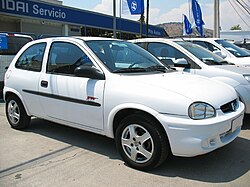 Chevrolet Chevy Classic Joy
 -
 Chevy Joy
 -
 Chevy Classic Joy
 -
 Chevy Classic Joy
 -
 Chevy Classic Joy
 -
 Chevy Taxi
 -
 Chevy Swing
 -
 Chevy Swing Caravan
 -
 Chevy Swing Caravan
 -
 Chevy police cars
 -
 Chevy Classic Sedan
 -
 Chevrolet Chevy Pick-up
 -
 Chevy Pick-up
 -
 Chevy Pick-up
 -
 Chevrolet Chevy C2 Joy
 -
 Chevy C2 Joy
 -
 Chevy C2 Swing and Sedán next to each other
 -
 Chevy C2 Joy
 -
 Chevy C2 Joy (2008 facelift)
 -
 Chevy C2 Joy
 -
 Chevrolet Chevy Sedán (2008 facelift)
 -
 Chevrolet Chevy Sedán
 -
 Chevy C2 Sedán
 -
 Chevy C2 Swing and Sedán next to each other
.jpg)

.jpg)
.jpg)

.jpg)
.JPG)
.jpg)

.jpg)

.jpg)
.jpg)

.jpg)


.jpg)


.jpg)
.jpg)
- Opel Corsa – Europe (except the United Kingdom)
- Vauxhall Corsa – United Kingdom
- Buick Sail – China, June 2001 until February 2005
- Chevrolet Corsa – Latin America (Opel Corsa in Chile)
- Chevrolet Corsa Classic – South America, after the release of the Corsa C
- Chevrolet Classic – Brazil, since 2005; Argentina, since 2010
- Holden Barina – Australia and New Zealand (was replaced by the Daewoo Kalos from 2005)
- Opel Corsa Lite and Opel Corsa Classic – South Africa, for the hatchback and saloon versions respectively
- Opel Corsa Sail and Opel Corsa Swing – India, for the hatchback and the estate car version respectively
- Opel Vita – Japan (Toyota already registered the Corsa name for one of their domestic models, the Toyota Tercel)
- Chevrolet Chevy – Mexico, for the 2004 Corsa derived Chevy C2, facelifted at the end of 2008 for 2009. It was discontinued in the first quarter of 2012.
- Derived versions
- Chevrolet Sail – China, since 2005.[47] A new version was released in 2010[48] then another in 2014.
- Chevrolet Classic – Argentina and Brazil, since 2011, for the Chevrolet Sail
- Chevrolet Corsa Plus – Chile, for the Chinese built Chevrolet Sail
- Chevrolet Celta and Chevrolet Prisma – South America, for the hatchback and saloon version respectively
- Chevrolet Monza for the four-door saloon edition of the Chevrolet Chevy. Discontinued in spring 2012.
- Suzuki Fun – Argentina, for the Corsa derived Chevrolet Celta. Discontinued in 2011. Name switched to Chevrolet Celta.
Corsa C (X01; 2000)
[edit]| Corsa C | |
|---|---|
 | |
| Overview | |
| Model code | X01 |
| Also called |
|
| Production | 2000–2007 (Europe) 2002–2012 (South America) |
| Model years | 2001–2006 (Europe) |
| Assembly |
|
| Body and chassis | |
| Body style |
|
| Platform | Gamma platform |
| Related | Opel Combo C Opel Meriva A Opel Tigra TwinTop B |
| Powertrain | |
| Engine | |
| Transmission | 5-speed manual 4-speed Aisin AF13 automatic 5-speed ZF Easytronic automated manual |
| Dimensions | |
| Wheelbase | 2,491 mm (98.1 in) |
| Length | 3,817 mm (150.3 in) (hatchback)[50] 4,181 mm (164.6 in) (saloon) |
| Width | 1,645 mm (64.8 in) |
| Height | 1,440 mm (56.7 in) 1,430 mm (56.3 in) (saloon) |
| Chronology | |
| Successor | Chevrolet Agile (South America) |
The Corsa C was revealed in 1999, and introduced to the European market in October 2000, and the facelift arrived in February 2004.[51] General Motors dubbed the new chassis Gamma, and intended to use it for a number of other models. A saloon version was also offered in Latin America, South Africa and the Middle East. In 2002, the Corsa chassis spawned a mini MPV called the Opel Meriva, development of which began under Opel in Rüsselsheim.[citation needed] In Japan, where the car was sold through the Yanase dealership chain as the Opel Vita, it was discontinued in April 2004 due to sluggish sales.
The vehicle won 2001 Semperit Irish Car of the Year in Ireland.
-
 Opel Corsa five-door (2000–2004)
 -
 Opel Corsa three-door (2000–2004)
 -
 Opel Corsa three-door (2004–2007)
 -
 Opel Corsa three-door (2004–2007)
 -
 Opel Corsa five-door (2004–2007)
 -
 pre-facelift Vauxhall Corsa
 -
 Post facelift Vauxhall Corsa
 -
 Holden Barina five-door (pre-facelift)
 -
 Holden Barina three-door (facelift)
 -
 Interior

_%E2%80%93_Heckansicht,_1._April_2011,_Mettmann.jpg)


_5-door_hatchback_(2015-07-03)_01.jpg)
_SXi_3-door_hatchback_(2010-06-17)_01.jpg)

Safety
[edit]Euro NCAP test results for a LHD, three-door hatchback variant on a registration from 2002:
| Test[52] | Score | Points |
|---|---|---|
| Overall: | N/A | N/A |
| Adult occupant: |
|
25 |
| Child occupant: | N/A | N/A |
| Pedestrian: |
|
9 |
| Safety assist: | N/A | N/A |
Brazil
[edit]The Brazilian version of the Corsa sold in those countries featured a more conservative front end than its European counterpart.
Brazil also offered a pickup truck version of the Corsa named the Chevrolet Montana (sold in some markets as the Tornado), which, as well as the saloon, was exported in a completely knocked down form to South Africa for local assembly.
Mexico
[edit]The Corsa C arrived in the 2002 model year as a five-door hatchback, and was imported from Europe; but for the model year of 2003, the Corsa sold in Mexico began coming from Brazil and a saloon version was added. In 2005, the saloon version introduced an automated manual transmission called Easytronic because it was only offered in a five-speed manual transmission, however, the easytronic transmission was rapidly discontinued after the model year of 2007, because of poor sales and technical flaws.[citation needed]
For 2008, the Corsa was tweaked with a freshened grille, lights, and a gold-coloured Chevrolet logo. The Chevrolet Corsa C was discontinued in the Mexican market in June 2008, leaving only the older and freshened Chevy (Corsa B); and the Corsa C was replaced by the Chevrolet Aveo, however, Brazil kept the car until 2012 (as the Chevrolet Corsa Final Edition and with the saloon ending in 2011) and Argentina kept the car until 2010, while the Corsa-based Montana continued into 2010.
The Corsa C was that was sold in South America, was produced at the Rosario production plant in Argentina. The Latin American Corsa C featured the Opel inspired Chevrolet logo with a golden bowtie instead of a chromed one – the new logo was first introduced in the South American market with the new Chevrolet Vectra.
-
 Chevrolet Corsa five-door
 -
 Chevrolet Corsa saloon
 -
 Chevrolet Corsa saloon
 -
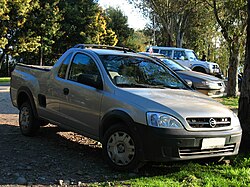 Chevrolet Montana pickup truck


South Africa
[edit]GM South Africa initially marketed the hatchback simply as the "New Corsa", later reverting to Corsa, while the previous generation Corsa B was still sold alongside the Corsa C and was branded as Corsa "Lite". A five-door hatchback (three-door was never offered) and four-door saloon as well as a pickup version known as the Corsa Utility was offered. In 2007, the Corsa C saloon was dropped in South Africa. The Corsa hatchback in South Africa did not have the same front fascia as the European Corsa. Instead, it had the same front fascia as the Latin American Chevrolet Corsa. Petrol engines were largely a carry over of the 8 valve SOHC variants from the Corsa B sold in South Africa, in displacements of 1.4 L (65 kW (88 PS)), 1.6 L (75 kW (102 PS)) and 1.8 L (79 kW (107 PS)), the 1.8 L was new for the Corsa C offered in range topping models, while this engine was never offered with a Corsa B, it was just a larger bore/stroke version of the existing engines. A 1.7DTi diesel was initially offered, with the a new 1.7CDTi diesel engine being added later.
Oceania
[edit]In Australia, the car was launched to much fanfare from many motor journalists, and went on to win the Wheels 2001 "Car of the Year" (COTY). Holden also imported the SRi version with the 1.8 L Astra motor and uprated sports suspension including traction control, ABS brakes, a better tyre/wheel combination, and Irmscher body kit to produce a "baby hot hatch" Barina.
The facelifted 2004 model was also imported; however, in December 2005, the Corsa C was suddenly dropped from the Australian and New Zealand Holden ranges as a cost-cutting measure by GM and was replaced by the Daewoo Kalos, rebadged as a Holden Barina. Motoring journalists were scathing in their criticism of the new model, particularly the bland handling, lackluster engine, and sub-par safety features. The Kalos-based Barina was subsequently replaced with a rebadged version of the Chevrolet Sonic/Daewoo Kalos T300 until stocks ran out in early 2019.
United Kingdom
[edit]This generation of the Corsa was a huge success for Vauxhall in the United Kingdom, which is the most popular supermini and second most popular car overall in 2002, 2003 and 2004. It was also Britain's best-selling supermini in 2005, achieving third place overall, but in 2006 (the final year of production) it lost top place in the supermini sector after five years and was overtaken by the Ford Fiesta. Overall, it was Britain's fourth most popular car in 2006.
Engine specifications
[edit]The Corsa C was introduced with a 1.7 L DTI Ecotec turbodiesel engine supplied by Isuzu (Circle L) with 75 hp (56 kW). This was later joined by the 1.7 L DI Ecotec turbodiesel engine also supplied by Isuzu. The 1.7 L DI Ecotec did not include an intercooler and this reduced power to 65 PS (48 kW).[53] From 2003, a new 1.3 L CDTI Ecotec turbodiesel engine was supplied by Fiat (MultiJet) which produced 70 PS (51 kW) and a 1.7 L CDTI Ecotec turbodiesel was supplied by Isuzu which produced 100 PS (74 kW). This new 1.7 L CDTI Ecotec featured a variable geometry turbocharger.[54]
The 1.0 L and 1.2 L Ecotec Family 0 engines are carry overs from the Corsa B; the 1.4 L Family 1 engine was replaced with a new 1.4 L Family 0 model. The 1.8 L Family 1 engine is an upgrade for the previous 1.6 L 16 valve engine and produces 125 PS (92 kW) and 165 N⋅m (122 lb⋅ft) of torque. The edition with the 1.8 L engine was named Corsa GSi and was the predecessor of the new Corsa OPC.
In 2003, Opel introduced updated versions of Family 0 engines with TwinPort technology, and the 1.2 L engine gained 30 cc, giving it 80 PS (59 kW).
| Petrol engines | ||||||
|---|---|---|---|---|---|---|
| Model | Production | Engine | Displacement | Power | Torque | Note |
| 1.0 Ecotec 12V | 2000–2003 | I3 | 973 cc | 58 PS (43 kW; 57 hp) at 5600 rpm | 85 N⋅m (63 lb⋅ft) at 3800 rpm | |
| 1.0 Ecotec 12V | 2003–2006 | I3 | 998 cc | 60 PS (44 kW; 59 hp) at 5600 rpm | 88 N⋅m (65 lb⋅ft) at 3800 rpm | Twinport |
| 1.2 Ecotec 16V | 2000–2004 | I4 | 1,199 cc | 75 PS (55 kW; 74 hp) at 5600 rpm | 110 N⋅m (81 lb⋅ft) at 4000 rpm | |
| 1.2 Ecotec 16V | 2004–2006 | I4 | 1,229 cc | 80 PS (59 kW; 79 hp) at 5600 rpm | 110 N⋅m (81 lb⋅ft) at 4000 rpm | Twinport |
| 1.4 Ecotec 16V | 2000–2003 | I4 | 1,389 cc | 90 PS (66 kW; 89 hp) at 6000 rpm | 125 N⋅m (92 lb⋅ft) at 4000 rpm | |
| 1.4 Ecotec 16V | 2003–2006 | I4 | 1,364 cc | 90 PS (66 kW; 89 hp) at 5600 rpm | 125 N⋅m (92 lb⋅ft) at 4000 rpm | Twinport |
| 1.8 Ecotec 16V | 2000–2003 | I4 | 1,796 cc | 125 PS (92 kW; 123 hp) at 6000 rpm | 165 N⋅m (122 lb⋅ft) at 4600 rpm | GSi |
| Brazilian engines | ||||||
| 1.0 L 8V VHC | 2002–2005 | I4 | 999 cc | 71 PS (52 kW; 70 hp) at 6400 rpm | 86 N⋅m (63 lb⋅ft) at 3000 rpm | Base/Joy/Maxx/Premium |
| 1.0 L 8V VHC FlexPower | 2006–2009 | I4 | 999 cc | 77–79 PS (57–58 kW; 76–78 hp) at 6400 rpm | 91–92 N⋅m (67–68 lb⋅ft) at 5200 rpm | Joy/Maxx/Premium |
| 1.4 L 8V Econo.Flex | 2008–2012 | I4 | 1,389 cc | 99–105 PS (73–77 kW; 98–104 hp) at 6000 rpm | 129–131 N⋅m (95–97 lb⋅ft) at 2800 rpm | Maxx/Premium |
| 1.8 L 8V MPFI | 2002–2003 | I4 | 1,796 cc | 102 PS (75 kW; 101 hp) at 5200 rpm | 164.75 N⋅m (122 lb⋅ft) at 2800 rpm | |
| 1.8 L 8V FlexPower | 2003-2005 | I4 | 1,796 cc | 105–109 PS (77–80 kW; 104–108 hp) at 5400 rpm | 169.66–178.48 N⋅m (125–132 lb⋅ft) at 2800 rpm | Joy/Maxx/Premium |
| 1.8 L 8V FlexPower | 2005–2009 | I4 | 1,796 cc | 112–114 PS (82–84 kW; 110–112 hp) at 5400 rpm | 173.58 N⋅m (128 lb⋅ft) at 2800 rpm | Joy/Maxx/Premium/SS |
| Diesel engines | ||||||
| Model | Production | Engine | Displacement | Power | Torque | Note |
| 1.3 CDTI Ecotec 16V | 2003–2006 Z13DT | I4 | 1,248 cc | 70 PS (51 kW; 69 hp) at 4000 rpm | 170 N⋅m (125 lb⋅ft) at 1750–2500 rpm | Fiat engine |
| 1.7 DI 16V | 2000–2003 Y17DTL | I4 | 1,686 cc | 65 PS (48 kW; 64 hp) at 4400 rpm | 130 N⋅m (96 lb⋅ft) at 2000–3000 rpm | No intercooler |
| 1.7 DTI 16V | 2000–2003 Y17DT | I4 | 1,686 cc | 75 PS (55 kW; 74 hp) at 4400 rpm | 165 N⋅m (122 lb⋅ft) at 1800–3000 rpm | |
| 1.7 CDTI Ecotec 16V | 2003–2005 Z17DTH | I4 | 1,686 cc | 100 PS (74 kW; 99 hp) at 4400 rpm | 240 N⋅m (177 lb⋅ft) at 2300 rpm | VGT |
Corsa D (S07; 2006)
[edit]| Corsa D | |
|---|---|
 | |
| Overview | |
| Model code | S07 |
| Also called | Vauxhall Corsa |
| Production | 2006–2014 |
| Model years | 2007–2014 |
| Assembly | |
| Designer | Niels Loeb Dietmar Finger (interior, 2004) |
| Body and chassis | |
| Body style | 3- and 5-door hatchback 3-door car-derived van |
| Platform | SCCS platform |
| Related | Fiat Punto Alfa Romeo MiTo |
| Powertrain | |
| Engine |
|
| Transmission |
|
| Dimensions | |
| Wheelbase | 2,511 mm (98.9 in) |
| Length | 3,999 mm (157.4 in) |
| Width | 1,737 mm (68.4 in) |
| Height | 1,488 mm (58.6 in) |
| Curb weight | 1,100 kg (2,425 lb) |
The Corsa D was created using a new version of the SCCS platform, which was co-developed by General Motors/Opel and Fiat,[55] and is also employed by the 2005 Fiat Grande Punto. The first official pictures of the Corsa D were released by Opel in May 2006. In the United Kingdom, What Car? awarded it 2007 Car of the Year. The Corsa D placed second in the European Car of the Year for 2007, only behind the Ford S-Max.
The Corsa D is available in both three- and five-door versions and marketed as the Vauxhall Corsa in the United Kingdom. The same engines sizes from the Corsa C were available at launch, although the 1.3 L CDTI and 1.7 L CDTI engines were upgraded, with power ranging from 75 PS (55 kW) to 125 PS (92 kW).
The 192 PS (141 kW) OPC/VXR version went on sale in the beginning of 2007, with a 1.6 L turbocharged petrol engine powering the front wheels.
The 75 PS (55 kW) 1.3 CDTI engine was updated in the middle of 2007 to bring CO2 levels to just 119 g/km, meaning that twelve months' Vehicle Excise Duty in the United Kingdom costs £30 and is eligible for the Plan 2000E (a rebate of €2000 in the purchase of a new car) in Spain.[56]
The Corsa D was briefly available in Australia under the Opel brand name, rather than as a Holden as the Corsa B and C had previously been, during Opel's short-lived foray into the Australian market. Less than a year after launching, Opel Australia announced it was ceasing operations, removing the Corsa from the Australian market.
The Corsa D was never available in Japan, as Yanase had stopped importing the Opel Vita in April 2004, due to declining sales. Opel withdrew altogether from the Japanese market in December 2006, due to low sales the previous year.
At an early stage of the Corsa D's development in 2004, Dietmar Finger was tasked to design the outer panel for the glove box in the Corsa. Allegedly, his son suggested drawing a shark instead. The designer managed to hide it so well, on the hinge of the glove compartment that it was never removed, and featured on all production models.[57] The custom of having a shark graphic in the interior continued for other Opel cars even after Opel has been taken over by PSA.[58]
-
 Opel Corsa (three-door)
 -
 Opel Corsa (five-door)
 -
 Dashboard
 -
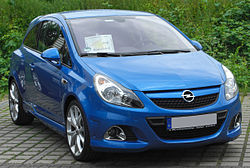 Opel Corsa OPC
 -
 Rear view
 -
 Opel Corsa GSi
 -
 Vauxhall Corsa SXi
 -
 Vauxhall Corsa VXR

.jpg)


Safety
[edit]Euro NCAP test results for a LHD, three-door hatchback variant on a registration from 2006:
| Test[60] | Score | Points |
|---|---|---|
| Overall: | N/A | N/A |
| Adult occupant: |
|
34 |
| Child occupant: |
|
32 |
| Pedestrian: |
|
19 |
| Safety assist: | N/A | N/A |
FlexFix
[edit]FlexFix is an optional integrated bicycle rack. It is essentially a concealed drawer that can be pulled out from the car's rear bumper. Attached are two-wheel mount bike racks, rear number plate incorporated in the system, brake/tail lights, indicators and fog and reverse light alternates in left-hand drive and right-hand drive cars. It is available as an option on Exclusiv, SE, and SXi models in the United Kingdom.
OPC/VXR
[edit]In 2007, Opel introduced a sport version of the Corsa tuned by Opel Performance Center (OPC) – Corsa OPC. This Corsa has a 1.6-litre I4 turbo engine with 141 kW (192 PS; 189 hp) at 5,850 rpm and 230 N⋅m (170 lb⋅ft) of torque at 1,980 to 5,850 rpm, with an overboost function which boosts up the torque figure to 266 N⋅m (196 lb⋅ft). The 0 to 100 km/h (62 mph) time is 7.2 seconds and top speed is 225 km/h (140 mph). Differences from the standard Corsa in the interior are sporty Recaro seats, OPC steering wheel and gear knob and instrument dials with OPC background.
On the exterior, there are different front and rear bumpers with triangle-shaped exhaust, and wind diffusers. There are also OPC tail spoilers and skirts. The car has stiffer and lower suspension than the regular Corsa as well. Standard rims are 17 inches and an optional 18 inches. The Corsa OPC was only available as a three-door version.
In the UK, it is sold as the Vauxhall Corsa VXR (Vauxhall Racing).
OPC/VXR Nürburgring Edition
[edit]
The Opel Performance Center in 2011 launched a hardcore version of the Corsa OPC called the Corsa OPC Nürburgring Edition. The engine is the same, 1.6-litre turbo, but it has been tuned to punch out 210 PS (154 kW; 207 hp) and 250 N⋅m (184 lb⋅ft) (280 N⋅m (207 lb⋅ft) with overboost function) of torque at 2,250 to 5,850 rpm. The 0–100 km/h (0–62 mph) time is 6.8 seconds and top speed is 230 km/h (143 mph).
New upgrades include Brembo brake packages, recalibrated ABS, traction stability management system, Remus exhaust, Bilstein suspension, and a mechanical limited slip differential, which in this segment of cars (supermini/B segment), only the MINI Cooper JCW has.[61]
This Corsa comes with a standard 18-inch alloy wheels and low profile tires, lowered suspension, dual tipped stainless steel exhaust, and special Nurburgring badge at B pillars and inside on gear knob and instrument dials. Also included is a new front spoiler, and different rear bumper. This Corsa is available in Henna Red, Grasshopper Green, Graphite Black (available as matte colour), and Casablanca White.[62]
Engines
[edit]Petrol engines are Family 0 (1.0–1.4) and Family 1 (1.6), and diesel engines are derivative from MultiJet (1.3) and Circle L (1.7).
| Petrol engines | ||||||
|---|---|---|---|---|---|---|
| Model | Engine | Displacement | Power | Torque | Note | CO2 emissions |
| 1.0 | I3 Z10XEP | 998 cc | 60 PS (44 kW; 59 hp) at 5600 rpm | 88 N⋅m (65 lb⋅ft) at 3800 rpm | 2006–2009 | 134 g/km |
| 1.2 | I4 Z12XEP | 1229 cc | 80 PS (59 kW; 79 hp) at 5600 rpm | 110 N⋅m (81 lb⋅ft) at 4400 rpm | 2006–2009 | 139 g/km |
| 1.4 | I4 Z14XEP | 1364 cc | 90 PS (66 kW; 89 hp) at 5600 rpm | 125 N⋅m (92 lb⋅ft) at 4000 rpm | 2006–2009 | 139 g/km |
| 1.6T | I4 Z16LEL | 1598 cc | 150 PS (110 kW; 148 hp) at 5000 rpm | 210 N⋅m (155 lb⋅ft) at 1850–5000 rpm | GSi/SRi | 189 g/km |
| 1.6T OPC/VXR | I4 Z16LER | 1598 cc | 192 PS (141 kW; 189 hp) at 5850 rpm | 230 N⋅m (170 lb⋅ft) at 1980–5800 rpm | OPC/VXR | 190 g/km |
| Diesel engines | ||||||
| Model | Engine | Displacement | Power | Torque | Note | CO2 emissions |
| 1.3 CDTI | I4 Z13DTJ | 1,248 cc | 75 PS (55 kW; 74 hp) at 4,000 rpm | 170 N⋅m (125 lb⋅ft) at 1,750–2,500 rpm | 119 g/km | |
| 1.3 CDTI | I4 Z13DTH | 1,248 cc | 90 PS (66 kW; 89 hp) at 4,000 rpm | 200 N⋅m (148 lb⋅ft) at 1,750–2,500 rpm | 127 g/km | |
| 1.7 CDTI | I4 Z17DTR | 1,686 cc | 125 PS (92 kW; 123 hp) at 4,000 rpm | 280 N⋅m (207 lb⋅ft) at 2,300 rpm | 130 g/km | |
Facelift
[edit]The Opel Corsa boasted a new petrol and diesel engine line up that fully complies with Euro 5 standards. The ride and handling were also improved.[63] Engines were further improved from 2011 as Start/Stop was added to engines, with all engines expecting to get the technology in the future.
Engines with Start/Stop (S/S) are in bold in CO2 column
| Petrol engines | ||||||
|---|---|---|---|---|---|---|
| Model | Engine | Displacement | Power | Torque | Note | CO2 emissions |
| 1.0 S/S | I3 | 998 cc | 65 PS (48 kW; 64 hp) at 5,300 rpm | 90 N⋅m (66 lb⋅ft) at 4,000 rpm | Twinport | 117 g/km |
| 1.2 VVT | I4 | 1,229 cc | 85 PS (63 kW; 84 hp) at 5,600 rpm | 115 N⋅m (85 lb⋅ft) at 4,400 rpm | 124/129 g/km (2010–) 119 g/km (2011–) | |
| 1.4 VVT | 1,398 cc | 100 PS (74 kW; 99 hp) at 5,600 rpm | 130 N⋅m (96 lb⋅ft) at 4,000 rpm | 129 g/km | ||
| 1.4 T S/S | 1,368 cc | 120 PS (88 kW; 118 hp) at 4,800–6,000 rpm | 175 N⋅m (129 lb⋅ft) at 1,750–4,800 rpm | 2012– | 129 g/km | |
| 1.6T | 1,598 cc | 150 PS (110 kW; 148 hp) at 5,000 rpm | 210 N⋅m (155 lb⋅ft) at 1,850–5,000 rpm | GSi | 171 g/km | |
| 192 PS (141 kW; 189 hp) at 5,850 rpm | 230 N⋅m (170 lb⋅ft) at 1,980–5,800 rpm | OPC/VXR | 172 g/km | |||
| 210 PS (154 kW; 207 hp) at 5,850 rpm | 250 N⋅m (184 lb⋅ft) at 2,250–5,850 rpm | OPC Nürburgring Edition | 178 g/km | |||
| Diesel engines | ||||||
| Model | Engine | Displacement | Power | Torque | Note | CO2 emissions |
| 1.3 CDTI ecoFLEX | I4 | 1,248 cc | 75 PS (55 kW; 74 hp) at 4,000 rpm | 190 N⋅m (140 lb⋅ft) at 1,750–2,500 rpm | 112 g/km (2010–) 105 g/km (2011–) | |
| 95 PS (70 kW; 94 hp) at 4,000 rpm | 210 N⋅m (155 lb⋅ft) at 1,750–2,500 rpm | 115 g/km (2010–) 95 g/km (2011–) | ||||
| 1.7 CDTI ecoFLEX | 1,686 cc | 130 PS (96 kW; 128 hp) at 4,000 rpm | 300 N⋅m (221 lb⋅ft) at 2,000–2,500 rpm | 118 g/km | ||
Hybrid
[edit]At the 2007 Frankfurt Motor Show, Opel unveiled the Opel Corsa Hybrid Concept, a coupé that combines a belt-driven starter and alternator with a lithium-ion battery.[64]
Facelift
[edit]In November 2010, a facelift was announced. A revised front end was the most dramatic difference over its predecessor, consisting of a new grille, a restyled front bumper and new 'Eagle Eye' headlamps (introduced on the Insignia) which contain daytime running lamps, standard across the refreshed Corsa range. (Vauxhall versions gained the latest badge from 2008 on the front grille, tailgate and steering wheel). A new 'Touch and Connect' multimedia system from Bosch was made available as an option on certain Corsas, replacing the CD60 unit.[65] Alloy wheels are upgraded on SXI, SE, SRi and OPC/VXR versions. Production ceased at the end of 2014, when the Adam styled Corsa E was released.[66]
-
 Opel Corsa (three-door)
 -
 Opel Corsa (three-door)
 -
 Opel Corsa (five-door)
 -
 Opel Corsa OPC Nürburgring Edition since 2011
 -
 Rear view
 -
 Vauxhall Corsa
 -
 2012 Opel Corsa
_%E2%80%93_Frontansicht,_31._Juli_2012,_Heiligenhaus.jpg)
_%E2%80%93_Heckansicht,_31._Juli_2012,_Heiligenhaus.jpg)
_%E2%80%93_Heckansicht,_29._Mai_2011,_Heiligenhaus.jpg)


_%E2%80%93_Frontansicht,_29._Mai_2011,_Heiligenhaus.jpg)
Corsa E (X15; 2014)
[edit]| Corsa E | |
|---|---|
_%E2%80%93_Frontansicht,_24._Dezember_2015,_Ratingen_(cropped).jpg) | |
| Overview | |
| Model code | X15 |
| Also called | Vauxhall Corsa |
| Production | 2014–2019 |
| Model years | 2015–2019 |
| Assembly |
|
| Designer | Carsten Aengenheyster[67] |
| Body and chassis | |
| Body style | 3- and 5-door hatchback 3-door car-derived van |
| Platform | SCCS platform |
| Related | Opel Adam |
| Powertrain | |
| Engine |
|
| Transmission |
|
| Dimensions | |
| Wheelbase | 2,510 mm (98.8 in) |
| Length | 4,021 mm (158.3 in) |
| Width | 1,736–1,746 mm (68.3–68.7 in) |
| Height | 1,479–1,481 mm (58.2–58.3 in) |
| Curb weight | 1,120–1,237 kg (2,469–2,727 lb) |
The Corsa E[68] debuted at the 2014 Paris Motor Show.[69]
Interior space stayed the same, as did the 285-litre boot, but the interior was completely new.[70] All of the exterior sheet metal (except the roof) was revised, but the underlying chassis and body structure, the glasshouse, as well as some minor parts such as side-view mirrors and turn signal repeaters, were carried over from the Corsa D.[71]
-
 Vauxhall Corsa Mk IV
 -
 Vauxhall Corsa Mk IV (3-door)
 -
 Vauxhall Corsavan Mk IV
 -
 Vauxhall Corsa Mk IV VXR
 -
 Vauxhall Corsa Mk IV Interior
 -
 Opel Corsa E 1.4 Turbo ecoFLEX (rear view)


_Diesel_-_Silver_-_04-2024,_Front.jpg)


_%E2%80%93_Heckansicht,_24._Oktober_2015,_M%C3%BCnster.jpg)
Corsa OPC/VXR
[edit]In February 2015, Opel introduced OPC version of Corsa E. Compared to the previous generation model, power output had increased by 15 PS (15 bhp) to 207 PS (204 bhp) from 1.6 Turbo engine, with a maximum torque of 245 N⋅m (181 lb⋅ft) between 1900 and 5800 rpm. An overboost function increased torque to 280 N⋅m (207 lb⋅ft) when needed. As a result, the Corsa OPC was able to accelerate from 0 to 100 km/h (0 to 62 mph) in 6.8 seconds and to reach a maximum speed of 230 km/h (143 mph).
The Corsa OPC featured a sports chassis with Frequency Selective Damping (FSD) technology, which enabled the damping forces to adapt to the frequency of the car to balance sportiness with comfort. The suspension was lowered by 10 mm (0.39 in) compared to standard Corsa models, and the car also received an optimised steering system with more direct and precise reactions. OPC also worked on the brakes, adding 308 mm (12.13 in) discs on the front axle.
Opel also offered the Corsa OPC Performance Package, which included a mechanical multi-disc differential lock made by Drexler, 18-inch wheels with Michelin tires, and an even more athletic chassis set up. The package also brought a Brembo high-performance braking system with 330mm braking discs on the front axle.
Styling-wise, the Corsa OPC/VXR received more aggressive body kits with new bumpers, aluminium frames for the fog lights, a small scoop in the hood, a big roof spoiler, and twin-pipe Remus exhaust with a diffuser. Inside, the Recaro performance seats took centre stage, with other upgrades including the flat-bottomed leather steering wheel, OPC gear knob, and sports pedals, as well as OPC design instruments.
Engines
[edit]Under the bonnet, all new 1.0-litre three-cylinder ECOTEC engine – the direct-injection turbo offered 90 PS or 115 PS – both giving 170Nm of torque – with a six-speed manual 'box, while a new six-speed auto was optional on selected engines. Start/Stop tech as standard and, in three-door guise, the lower-powered model could hit sub-100g/km CO2 emissions.
The entry-level engine was a 70 PS 1.2-litre petrol, while turbo and non-turbo 1.4s offered 100 PS and 90 PS respectively. The 1.3 CDTI continued with 75PS, now hitting as little as 85g/km CO2 emissions, and was capable of 3.2 L/100 km economy. An ecoFLEX version was available from launch, too, with target CO2 emissions of under 85g/km.
| Petrol engines | ||||||
|---|---|---|---|---|---|---|
| Model | Engine | Displacement | Power | Torque | Note | CO2 emissions |
| 1.0T SIDI S/S | I3 | 999 cc | 90 PS (66 kW; 89 hp) at 3700–6000 rpm | 170 N⋅m (125 lb⋅ft) at 1800–3700 rpm | 102–100 g/km | |
| 115 PS (85 kW; 113 hp) at 5000–6000 rpm | 170 N⋅m (125 lb⋅ft) at 1800–4500 rpm | 115–114 g/km | ||||
| 1.2 | I4 | 1229 cc | 70 PS (51 kW; 69 hp) at 5600 rpm | 115 N⋅m (85 lb⋅ft) at 4000 rpm | Only Available for short time after release in hatchbacks then the engine was dropped in 2018 | 126–124 g/km |
| 1.4 | 1398 cc | 90 PS (66 kW; 89 hp) at 6000 rpm | 130 N⋅m (96 lb⋅ft) at 4000 rpm | 114–129 g/km | ||
| 1.4 Turbo | 1364 cc | 100 PS (74 kW; 99 hp) at 3500–6000 rpm | 200 N⋅m (148 lb⋅ft) at 1850–3500 rpm | 122–119 g/km | ||
| 1.6 Turbo (B16LER) | 1598 cc | 207 PS (152 kW; 204 hp) at 5850 rpm | 245 N⋅m (181 lb⋅ft) (overboost 280 (207)) at 1900–5800 rpm | OPC/VXR | 174 g/km | |
| Diesel engines | ||||||
| Model | Engine | Displacement | Power | Torque | Note | CO2 emissions |
| 1.3 CDTI S/S | I4 | 1248 cc | 75 PS (55 kW; 74 hp) at 3750 rpm | 190 N⋅m (140 lb⋅ft) at 1500–2500 rpm | 100–99 g/km | |
| 95 PS (70 kW; 94 hp) at 3750 rpm | 190 N⋅m (140 lb⋅ft) at 1500–2500 rpm | 82–101 g/km | ||||
Safety
[edit]Corsa F (P2JO; 2019)
[edit]| Corsa F | |
|---|---|
.jpg) | |
| Overview | |
| Model code | P2JO |
| Also called | Vauxhall Corsa |
| Production | 2019–present |
| Model years | 2020–present |
| Assembly | Spain: Zaragoza (Opel Zaragoza) |
| Designer | Martin Schaufler (exterior)[73] |
| Body and chassis | |
| Body style | 5-door hatchback |
| Platform | PSA CMP (EMP1) platform |
| Related | Peugeot 208 Opel Mokka B Lancia Ypsilon IV |
| Powertrain | |
| Engine | |
| Electric motor | Permanent Magnet Synchronous Motor (Corsa-e) |
| Transmission | |
| Battery | 50 kWh |
| Electric range | 330 km (210 mi) |
| Dimensions | |
| Wheelbase | 2,538 mm (99.9 in) |
| Length | 4,060 mm (159.8 in) |
| Width | 1,765 mm (69.5 in) |
| Height | 1,435 mm (56.5 in) |
| Kerb weight | 980–1,090 kg (2,161–2,403 lb) |
| Chronology | |
| Predecessor | Opel Adam Opel Karl Opel Ampera-e (electric version) |
The original project of Corsa F (project code: G2J0)[74] was initially planned to be released in the third quarter of 2017 on a GM platform, the G2XX.[75][76] However, the G2J0 project was cancelled due to Groupe PSA's acquisition of Opel and Vauxhall, with the cancelled project reaching production in a saloon form as the Buick Excelle in China.[77] Development was then restarted after switching to the PSA CMP (EMP1) platform in 2017.[78] The Corsa is thus the first of the Opel/Vauxhall models developed under the PSA ownership.[79] The Corsa F was unveiled at the 2019 Frankfurt Motor Show.[80]
-
 Vauxhall Corsa (pre-facelift)
 -
 Rear view (pre-facelift)
 -
 Interior (Vauxhall Corsa; pre-facelift)


Corsa-e
[edit]In December 2018, Opel announced the launch of an electric version of the Corsa, called the Corsa-e, which was originally planned to go on sale in 2019,[81][82] but was delayed into the second quarter of 2020. In the UK, the Corsa-e is sold under the Vauxhall marque.[83] The main competitors to the Corsa-e were expected to be the Nissan Leaf and the Renault Zoe, as well as its mechanically identical twin, the Peugeot e-208.
The Corsa-e has the same two drivetrain options as the e-208.[84] In the weaker one of the two (and the only option initially available), the electric motor produces 136 PS (100 kW; 134 hp) and 260 N⋅m (192 lb⋅ft) of torque, and a 0–100 km/h (62 mph) acceleration takes 8.1 seconds. Output is restricted in the Normal (81 kW (109 hp) and 220 N⋅m (162 lb⋅ft)) and Eco (60 kW (81 hp) and 180 N⋅m (133 lb⋅ft)) modes.[85] A more powerful 156-hp option became available later.
Under the WLTP driving cycle, the 2019 Corsa-e had an estimated range of 330 km (210 mi) using a 50.0 kW-hr battery (gross),[84] which is carried in the floor.[86] Real-world testing showed the actual efficiency was 3.1 to 3.7 mi (5.0 to 6.0 km) per kW-hr, yielding a range of 145–190 mi (233–306 km) considering the 46 kW-hr usable battery capacity.[83] Over a six-month test, CAR observed an efficiency of 3.9 mi (6.3 km) per kW-hr, slightly less than the claimed 4.18 mi (6.73 km) per kW-hr.[85]
The manufacturer later added a larger-battery option, increasing its capacity from 50/45 kWh (gross/net capacity) to 54/51 kWh. This larger battery is only available with the 156-hp motor. The manufacturer claims that, combined with improvements to the drivetrain efficiency, it increased the WLTP range to 429 km (267 mi). A range test of its sibling, the e-208 with the same upgrades, achieved 414 km (257 mi) when driven at constant 90 km/h in good weather conditions.[87]
Compared to the conventionally-powered Corsa, the Corsa-e is 345 kg (761 lb) heavier[86] at a kerb weight (for the base model) of 1,455 kg (3,208 lb); the center of gravity is lower by 57 mm (2.2 in) for the Corsa-e.[83] Boot space shrinks from 309 to 267 L (10.9 to 9.4 cu ft) for the electric version as well.[83] Externally, the standard Corsa F is almost identical to the electric version, with the exception of different alloy wheel designs and the lack of exhaust. The interior will include a touchscreen infotainment system with two set-ups available; seven-inch Multimedia Navi system or 10-inch Multimedia Navi Pro (exclusive to the top-level Elite Premium trim).[88]
Interior styling and controls generally are simpler than the e-208.[86] In the UK, the Corsa-e is sold in four trim levels (from base Griffin through SE Premium, SRi Premium, and Elite Premium).[83] Starting price was £30,665, which was reduced to £27,165 with applied government grants.[86]
Powertrain
[edit]The Corsa F supermini marks the arrival of new petrol and diesel engines as well as an all-electric Corsa-e into the range. Two petrol engines and one diesel engine are available, starting with the 1.2-litre three-cylinder engine that produces 75 bhp and comes with a five-speed manual gearbox as standard. Sitting above is a three-cylinder 1.2-litre turbo PureTech engine which is shared with Peugeot and Citroen models and produces 99 bhp and 205 Nm of torque. It comes with a six-speed manual or eight-speed automatic gearbox option. The diesel engine is a BlueHDi 1.5-litre four-cylinder diesel, producing 99 bhp and 250 Nm of torque.
Weight of the car is also improved, with lightweight underpinnings, redesigned bodyshell and new aluminium engines which Opel claims 10 percent of kerb weight have been reduced across the range and will have a good balance between sportiness and comfort. The body is constructed from a range of high-strength steels, saving a total of 40 kg over the seventh-generation model. A new aluminium bonnet will also replace the previous generation's steel unit, saving a further 2.4 kg. However, the Corsa is slightly larger than its predecessor, with a larger body and longer wheelbase to allocate more interior and boot space.[89]
Opel's latest range of aluminium three-cylinder petrol and diesel engines are projected to save around 15 kg over the predecessor four-cylinder units. 10 kg has been reduced off the seats, losing 5.5 kg at the front and 4.5 kg at the rear, totalling around 108 kg of weight reduction.[90]
In June 2019 it was revealed that first deliveries were scheduled to start in April 2020, while the pure-electric model was planned to follow at a time that has not yet been announced.[91][92]
| Petrol engines | |||||
|---|---|---|---|---|---|
| Model | Engine | Displacement | Power | Torque | CO2 emissions[93] |
| 1.2 | I3 | 1199 cc | 75 PS (55 kW; 74 hp) at 5750 rpm | 118 N⋅m (87 lb⋅ft) at 2750 rpm | 125–126 g/km |
| 1.2 Turbo | 100 PS (74 kW; 99 hp) at 5000 rpm | 205 N⋅m (151 lb⋅ft) at 1750 rpm | 134–135 g/km | ||
| 1.2 Turbo | 130 PS (96 kW; 128 hp) at 5500 rpm | 230 N⋅m (170 lb⋅ft) at 1750 rpm | N/A | ||
| Diesel engine | |||||
| Model | Engine | Displacement | Power | Torque | CO2 emissions |
| 1.5 D | I4 | 1499 cc | 102 PS (75 kW; 101 hp) at 3500 rpm | 250 N⋅m (184 lb⋅ft) at 1750 rpm | 109–110 g/km |
| Electric (Corsa-e) | |||||
| Battery capacity | Power | Torque | All-electric range | ||
| 50 kWh[88] | 136 PS (100 kW; 134 hp)[88] | 260 N⋅m (192 lb⋅ft) | 330 km (205 mi) | ||
Recalls
[edit]On 11 May 2020, Opel recalled Corsas manufactured between 25 September and 30 December 2019 because the steering column was not manufactured according to the specifications, causing steering failure and leading to the car losing control, increasing the risk of an accident.[94]
On 6 November 2020, Opel Corsas manufactured between 18 March 2019 and 14 February 2020 were recalled due to the high-pressure pump not being tightened to the engine with correct torque, causing a potential fuel leak.[95]
Facelift
[edit]A facelift was unveiled on 24 May 2023, featuring a new front fascia features the brand's Visor front end, new exterior colours, a new steering wheel, new shifter for automatic transmission, new seat designs, updated technology and powertrains.[96][97]
In December 2023, Opel announced that the Corsa facelift model could also be ordered in 48V mild-hybrid versions. The assembly is composed of a 1.2-litre gasoline engine, available in 100 and 136 HP versions, a new electrified 6-speed dual-clutch transmission and a 0.4 kWh battery. The electric motor, with 28 HP and 55 Nm, is integrated into the new gearbox.[98]
-
 Opel Corsa Electric (facelift)
 -
 Rear view (facelift)
_%E2%80%93_f_05072025.jpg)

Safety
[edit]Corsa Van
[edit]The Corsa Van was a car derived van based on the corresponding generation of the Corsa superminis that were produced from 1983 to 2018. It first appeared in 1983, and was identical to the regular car, aside from the panelled rear windows (optional, glazed models were also available) and the missing rear seat. This was replaced by a flat metal loading floor. Payload of the original Corsa A is 405 kg (893 lb) and the entire range of engines was available, at first.[101]
It was usually marketed under the names used in various countries, such as Corsa Lieferwagen (Germany), Bestelwagen (Dutch), or Fourgonnette (French). The Vauxhall version is called the "Corsavan" since 1994, linking it to the earlier Astravan model. Earlier models were called Vauxhall Novavan in the United Kingdom.
Corsa Van variants of later generation Corsas have also been sold under the Opel/Vauxhall[102][103] brand. It was discontinued in 2018.
-
 Opel Corsa Van based on third generation (Corsa C)
 -
 Opel Corsa Van based on fourth generation (Corsa D)
 -
 Vauxhall Corsavan based on the fifth-generation (Corsa E)


Popularity
[edit]From the first Corsa being sold in the United Kingdom on 2 April 1993, sales had reached 1,371,573 within sixteen years of its launch, by which time the Corsa was in its third generation.
As of 2018, the Vauxhall Corsa was the third most popular car in the United Kingdom, with 1,205,158 taxed and on the road with another 39,286 declared SORN (Statutory Off Road Notification).[104]
In 2021, the Vauxhall Corsa grabbed the top spot for the most popular car of the year having had more new cars registered than any other in the UK throughout 2021. The Corsa managed to achieve 40,914 new registrations throughout the year, beating second place by over 6,000 registrations. This meant that the Ford Fiesta was finally beaten after holding the mantle of most popular car for 12 successive years. In fact, the Ford Fiesta didn't even achieve a top 10 finish after being heavily affected by chip shortages and Ford prioritising sales of more profitable SUVs, such as the Puma.[105]
References
[edit]- ^ "Vauxhall Corsa (2014) in pictures: GM's new supermini grows up". CAR Magazine. Retrieved 15 July 2015.
- ^ "New Vauxhall Corsa unveiled at Paris Motor Show". Auto Express. Retrieved 15 July 2015.
- ^ "Vauxhall Corsa hatchback". Carbuyer. Retrieved 15 July 2015.
- ^ Gasnier, Matt (16 January 1999). "World 1998: GM Corsa the best-selling car in the world". Best Selling Cars Blog. Retrieved 21 June 2021.
- ^ "Opel Corsa Celebrates 25th Birthday — Huliq". 17 August 2009.
- ^ Bolster, John (11 March 1982). "Spring in the air". Autosport. Vol. 86, no. 10. Haymarket Publishing. p. 22.
- ^ Isakson, Börje, ed. (8 September 1982). "Opels Nya småbil Corsa under testtillverkning" [Opel's new minicar Corsa enters test production]. Teknikens Värld (in Swedish). Vol. 34, no. 19. Stockholm, Sweden: Specialtidningsförlaget AB. p. 72.
- ^ McCraw, Jim, ed. (November 1982). ""S" indeed, it's the Opel Corsa". Motor Trend. Vol. 34, no. 11. Petersen Publishing Co. p. 18.
- ^ Visart, Etienne, ed. (28 April 1983). "Opel Corsa op de Belgische markt" [Opel Corsa on the Belgian market]. De AutoGids (in Flemish). 4 (94). Brussels, Belgium: Uitgeverij Auto-Magazine: 78.
- ^ ter Kuile, Caju (24 December 1983). "Rijden met: Opel Corsa 1.3 SR" [Test Ride]. Autovisie (in Dutch). 28 (26). Hilversum, Netherlands: Folio Groep B.V.: 58–59.
- ^ a b "Spanish exports". Motor Business. 109–116: 55. 1982.
- ^ "Opel gives details of car in union row". The Glasgow Herald. Vol. 200, no. 208. 28 September 1982.
- ^ a b Mastrostefano, Raffaele, ed. (1990). Quattroruote: Tutte le Auto del Mondo 1990 (in Italian). Milano: Editoriale Domus S.p.A. p. 688.
- ^ Büschi, Hans-Ulrich, ed. (March 1991). Automobil Revue 1991 (in German and French). Vol. 86. Berne, Switzerland: Hallwag AG. pp. 457–458. ISBN 3-444-00514-8.
- ^ Braithwaite-Smith, Gavin (11 February 2016). "100 popular cars vanishing from our roads". MSN. Retrieved 15 June 2016.
- ^ "The What Van? Road Test: Vauxhall Corsavan Ecoflex". WhatVan?. 18 March 2011. Archived from the original on 26 May 2019.
- ^ "Vauxhall Nova (car) advert 1990 'old style voice-over'". YouTube. 8 March 2017.
- ^ "British Rallycross at Croft & Lydden Hill, Easter 1990.RallycrossWorld.com". Archived from the original on 28 October 2020. Retrieved 26 July 2025.
- ^ "1993 Championship Results". Speedfreaks.
- ^ "BBC Blue Peter presenter John Leslie tries his hand at Rallycross in the Vauxhall Nova Challenge". A Personal Rallycross Archive. Retrieved 26 July 2025 – via facebook.
- ^ "The Jilin Jiangbei Meilu JJ7090 Was A China-made Opel Corsa B". 13 October 2017.
- ^ "1990 1999". Retrieved 15 July 2015.
- ^ "Gm En Venezuela Y El Mundo – Historia". Gm.com.ve. Archived from the original on 23 March 2010. Retrieved 27 May 2010.
- ^ a b "Opel. Opel in South Africa". Car-cat.com. Archived from the original on 8 July 2011. Retrieved 16 July 2010.
- ^ Satyam. "Welcome to GMArabia.com". Gmegypt.com. Archived from the original on 9 August 2010. Retrieved 19 July 2010.
- ^ "Welcome to Opel India Website". Opel.co.in. Archived from the original on 1 July 2010. Retrieved 19 July 2010.
- ^ "Opel. Opel in India". Car-cat.com. Archived from the original on 7 September 2010. Retrieved 19 July 2010.
- ^ a b c "Opel Corsa specifications". Auto-types.com. Archived from the original on 25 March 2014. Retrieved 20 March 2013.
- ^ a b "Chevrolet Corsa Wind – Ficha técnica". Vrum.com.br. Archived from the original on 21 February 2014. Retrieved 20 March 2013.
- ^ "Chevrolet Corsa Sedan – Ficha técnica". Vrum.com.br. Archived from the original on 21 February 2014. Retrieved 20 March 2013.
- ^ "Chevrolet Corsa Wagon – Ficha técnica". Vrum.com.br. Archived from the original on 21 February 2014. Retrieved 20 March 2013.
- ^ Crouch, Jonathan (8 November 2005). "Vauxhall Corsa (1993 – 2000) review". RAC Limited. Retrieved 12 September 2016.
- ^ "Holden Barina – Used Car Research". GoAuto. Archived from the original on 24 September 2015. Retrieved 12 September 2016.
- ^ Davis, Tony; Kennedy, Alistair; Kennedy, Ewan (February 2007). The Holden Heritage – 13th Edition (Part Three) (PDF). Port Melbourne, Victoria: Holden. p. 101. Archived from the original (PDF) on 25 February 2009.
- ^ "Vauxhall Corsa Cabriolet (1998 – 1999) Specs & Dimensions". Parkers. Retrieved 4 December 2024.
- ^ "Sketches: A linha Chevrolet dos anos 90 e 2000 nos traços de Wagner Dias". 5 July 2020.
- ^ Ciferri, Luca (7 December 1998). "Italian market takes Corsa Wagon". Automotive News Europe. Crain Communications, Inc. Archived from the original on 27 October 2020.
- ^ Büschi, Hans-Ulrich, ed. (10 March 1994). Automobil Revue 1994 (in German and French). Vol. 89. Berne, Switzerland: Hallwag AG. p. 429. ISBN 3-444-00584-9.
- ^ "All Corsa Forums Performance Stats". Allcorsa.co.uk. 27 May 2011. Retrieved 25 June 2011.
- ^ Mazur, Eligiusz, ed. (2006). "World of Cars 2006·2007". World of Cars: Worldwide Car Catalogue. Warsaw, Poland: Media Connection Sp. z o.o.: 223. ISSN 1734-2945.
- ^ "Después de 18 años, el Chevrolet Classic dejó de fabricarse en Argentina". 19 October 2016.
- ^ "1997 Euro NCAP". Retrieved 23 October 2011.
- ^ "2000 Euro NCAP". Retrieved 23 October 2011.
- ^ "Official results of the Chevrolet Corsa Classic — NO Airbags 2011". LATIN NCAP — PARA AUTOS MAS SEGUROS.
- ^ "South Africa Corsa B (three-door hatch) specifications" (PDF). Delta Motor Corporation. March 2002. Archived from the original (PDF) on 6 February 2005.
- ^ a b Mazur, Eligiusz, ed. (2002). "Katalog Samochody Świata 2003" [World Car Catalogue 2003]. Samochody Świata. Warsaw, Poland: Print Shops Prego — Polska Sp. z o.o.: 217. ISSN 1234-8198.
- ^ "Shanghai-GM: Chevrolet Sails to Chile and Libya". ChinaAutoWeb.com.
- ^ "Chevrolet Sail: Created In China". The Truth About Cars. 12 January 2010. Retrieved 12 January 2010.
- ^ "Opel. Opel in Spain". Car-cat.com. Archived from the original on 10 June 2009. Retrieved 19 July 2010.
- ^ "Opel Corsa C dimensions and blueprints on Outlines". getoutlines.com. Retrieved 25 March 2015.
- ^ Dredge, Richard (21 November 2007). "Used Car Tests: Vauxhall Corsa". Auto Express. Dennis Publishing. Archived from the original on 29 August 2017.
- ^ "Opel/Vauxhall Corsa". Euro NCAP. Retrieved 21 January 2012.
- ^ "2001 Opel Corsa press release". Archived from the original on 3 May 2007. Retrieved 21 July 2008.
- ^ "2003 Opel Corsa press release". Archived from the original on 19 June 2007. Retrieved 21 July 2008.
- ^ "Fiat-General Motors Insieme Nelle utilitarie". Corriere Della Sera. 24 December 2009. Retrieved 6 October 2012.
- ^ "Plan 2000E, ayudas a la Compra de automoviles". Retrieved 31 January 2012.
- ^ Joseph, Noah (29 March 2018). "Look Closely And You'll Find Shark-Shaped Easter Eggs In Most New Opels". Carscoops. Retrieved 26 June 2020.
- ^ "Shark Attack: Where Are the Predators in the New Opel Grandland X? | Media OPEL International". int-media.opel.com. Retrieved 26 June 2020.
- ^ "ANCAP results for Opel Corsa 3 door hatches with 1.4L engine". ancap.com.au. 2012.
- ^ "Opel/Vauxhall Corsa". Euro NCAP. Retrieved 21 January 2012.
- ^ Minis mit uber 200PS, Auto Bild, archived from the original on 19 March 2012, retrieved 15 March 2012
- ^ Opel Introduces Corsa OPC Nürburgring Edition, GM Authority, 25 April 2011, retrieved 25 April 2011
- ^ Opel introduces updated Corsa ecoFlex with 98 g/km CO2, Autoblog Green, retrieved 22 November 2009
- ^ "GM Media Online". Archived from the original on 13 December 2007.
- ^ "Bosch Media Service" (in German). Bosch-presse.de. Retrieved 17 October 2012.
- ^ Luke Madden (7 December 2012). "New Vauxhall Corsa". Auto Express. Retrieved 30 October 2013.
- ^ US D732433, Aengenheyster, Carsten, "Motor car", published 23 June 2015, assigned to GM Global Technology Operations LLC
- ^ "Opel Corsa: A Success Story in Five Acts". media.gm.com. Retrieved 15 July 2015.
- ^ "Opel Pressroom — Europe — Corsa". gm.com.
- ^ "New Vauxhall Corsa unveiled at Paris Motor Show". Auto Express. Archived from the original on 2 October 2014. Retrieved 15 July 2015.
- ^ Fung, Derek (9 July 2014). "2015 Opel/Vauxhall Corsa E: facelift looks sort of new, is sort of old". Between the Axles. Retrieved 12 August 2014.
- ^ https://www.euroncap.com/en/results/opel%2fvauxhall/corsa/7884
- ^ "Interview : Martin Schaufler, external designer of the Corsa 2019 — LIGNES/auto". lignesauto.fr. 10 December 2019. Retrieved 25 May 2021.
- ^ "General Motors' future platforms — a go-to guide". www.just-auto.com. 18 May 2016. Archived from the original on 26 March 2020. Retrieved 27 November 2020.
- ^ Panait, Mircea (28 November 2019). "2020 Corsa Offers "More Personalization Options" Than Every Opel Corsa Before It". autoevolution. Retrieved 27 November 2020.
- ^ "PARIS PREVIEW: Redesigned Opel-Vauxhall Corsa to retain Fiat-GM platform". www.just-auto.com. 5 June 2014. Retrieved 27 November 2020.
- ^ Radu, Mihnea (25 April 2019). "2020 Opel Corsa Was Leaked by the Buick Excelle... But We Didn't Notice". autoevolution. Retrieved 4 May 2022.
- ^ "The all-new Opel Corsa F comes on a PSA platform in 2019". 23 November 2017.
- ^ "2019 Opel Corsa Is First New Model From Brand Under PSA Ownership". GM Authority. 23 May 2019. Retrieved 7 June 2020.
- ^ "2020 Opel Corsa Is Finally All-New, Debuts Later This Year". Carscoops. 25 February 2019. Retrieved 14 June 2019.
- ^ "Opel | Stellantis". www.media.stellantis.com.
- ^ Corsa-e, Opel. "Opel Starts Production Of New Corsa, Corsa-e To Follow Soon". InsideEVs. Retrieved 7 June 2020.
- ^ a b c d e Saunders, Matt. "Vauxhall Corsa-e review". Autocar. Retrieved 10 June 2022.
- ^ a b Golson, Daniel (23 May 2019). "The Electric Opel Corsa-e Is Only for Europe, but We Love It Anyway". Car and Driver. Retrieved 10 June 2022.
- ^ a b Whitworth, Ben (28 October 2021). "Vauxhall Corsa-e long-term test: the six-month verdict". Car. Retrieved 10 June 2022.
- ^ a b c d "Vauxhall Corsa-e review". TopGear. 10 March 2020. Retrieved 10 June 2022.
- ^ "Peugeot e-208 Range Test at 90, 100 and 130km/H". YouTube. 6 September 2024.
- ^ a b c "The Electric Car for Everyone: New Opel Corsa-e for €29,900 | Media OPEL International". int-media.opel.com. Retrieved 7 June 2020.
- ^ Aucock, Richard (21 November 2019). "2020 Vauxhall Corsa review: testing the impressive new 'people's car'". Motoring Research. Retrieved 7 June 2020.
- ^ Opel. "2020 Opel Corsa Going On A Strict Diet To Cut Fat". Motor1.com. Retrieved 7 June 2020.
- ^ Burn, Jonathan (26 June 2019). "New 2020 Opel Corsa: engines, tech and release date announced". Auto Express. Retrieved 26 June 2019.
- ^ "New Vauxhall Corsa: full engine range details released | Autocar". www.autocar.co.uk. No. 26 June 2019. Retrieved 26 June 2019.
- ^ "Opel Corsa | Configurator | Opel Ireland". www.opel.ie. Retrieved 7 June 2020.
- ^ "Opel Corsa (2019 — 2020)". Car-Recalls.eu. 11 May 2020.
- ^ "Opel Corsa (2019 — 2020) « Car-Recalls.eu". 6 November 2020.
- ^ Pappas, Thanos (24 May 2023). "2024 Opel Corsa Wears A Redesigned Face, Gains New Electric And Mild-Hybrid Options". Carscoops.
- ^ "2024 Opel Corsa Facelift Debuts With Updated ICE And EV Models". Motor1.com. 24 May 2023.
- ^ "PREMIERĂ: Opel Corsa, disponibil în versiuni mild-hybrid cu până la 136 CP".
- ^ "ANCAP results for Opel Corsa all variants". ancap.com.au. 2019.
- ^ https://www.euroncap.com/en/results/opel%2fvauxhall/corsa/38859
- ^ "Corsa Lieferwagen" [Corsa delivery van]. Opel Corsa A (in German). Retrieved 11 January 2018.
- ^ "Corsavan – Small Van of the Year 2008". Automobiles Review. 10 December 2008. Retrieved 14 September 2009.
- ^ "Opel Malta". Opel.com.mt. Archived from the original on 30 August 2009. Retrieved 14 September 2009.
- ^ "icLiverpool – Recession-proof wise-buys revealed". Icliverpool.icnetwork.co.uk. 17 March 2009. Archived from the original on 29 September 2010. Retrieved 27 May 2010.
- ^ "SMMT — Car Registrations". smmt.co.uk. Retrieved 22 January 2022.
External links
[edit]


- Opel Corsa on Opel Media Site
- Official international Opel Corsa website
- Vauxhall Corsa official website(Vauxhall UK)
- Ireland official Opel Corsa website Archived 17 November 2016 at the Wayback Machine
- Opel Corsa Blueprints
A marque of Stellantis | |||||||||||
| Vehicles |
| ||||||||||
| Concept cars | |||||||||||
| Divisions and subsidiaries | |||||||||||
| People | |||||||||||
| Facilities | |||||||||||
| Other | |||||||||||

A marque of Stellantis | |||||||||
| Vehicles |
| ||||||||
| Divisions and subsidiaries | |||||||||
| People | |||||||||
| Factories | |||||||||
| Other | |||||||||
Opel Corsa
View on GrokipediaOverview
Development history
The Opel Corsa originated in the late 1970s as General Motors' response to the growing demand for compact, affordable superminis in Europe, aiming to position Opel as a direct competitor to established models like the Volkswagen Polo and Ford Fiesta.[6] Development focused on creating an entry-level front-wheel-drive hatchback suitable for urban driving, with production commencing at the newly established Zaragoza plant in Spain in August 1982, marking Opel's first venture into this segment.[7] The inaugural Corsa A debuted in September 1982, revolutionizing the small car market with its practical design and accessibility, quickly establishing Opel as a key player in the supermini category.[8] Under General Motors' ownership, which had acquired Opel in 1929, the Corsa evolved through six generations, each refining its role as a versatile, budget-friendly vehicle tailored primarily for European consumers while expanding into emerging markets via badge-engineered variants like the Holden Barina and Chevrolet Celta.[8] Key design influences came from executives such as Wayne Cherry, who joined Opel as Design Director in 1983 and shaped subsequent iterations, including the influential 1993 Corsa B through concepts like the Opel Junior, earning the model multiple international design awards.[9] Early generations (A through D, spanning 1982 to 2014) relied on GM's in-house platforms, emphasizing cost-effective engineering and broad market appeal.[10] A pivotal shift occurred in 2017 when PSA Group (now part of Stellantis following its 2021 merger with Fiat Chrysler Automobiles) acquired Opel from GM for €2.2 billion, integrating the brand into its operations and prompting platform realignments to leverage synergies.[11] This transition affected production, with the Zaragoza facility—Opel's primary Corsa hub since 1982—continuing as a cornerstone site under Stellantis, producing over 13 million units by 2018 and adapting to new electrification strategies.[12] The fifth generation (Corsa E, 2014–2019) remained on GM's SCCS platform, but the sixth (Corsa F, launched 2019) adopted PSA's CMP architecture, enabling shared components with Peugeot and Citroën models and facilitating electric variants like the Corsa-e.[13] These changes enhanced efficiency and global competitiveness, with the Corsa maintaining its focus on Europe and select emerging regions. By 2025, the Corsa had achieved cumulative worldwide sales of around 15 million units since its inception, underscoring its enduring success as Opel's bestseller and a staple in the supermini segment.[14]Design philosophy and platforms
The Opel Corsa has consistently embodied a design philosophy centered on supermini efficiency, prioritizing compact dimensions, agile handling, and practical space utilization within the B-segment. From its inception, the model adopted front-wheel drive architecture with MacPherson strut front suspension, enabling responsive dynamics suited to urban driving while maintaining affordability. This foundational approach emphasized lightweight construction and modular engineering to balance performance, fuel economy, and interior roominess, evolving over generations to incorporate advanced materials and aerodynamic refinements without compromising its core identity as an accessible everyday vehicle.[15] Early generations relied on General Motors' dedicated subcompact platforms to support this philosophy. The first-generation Corsa A (1982–1992) utilized the GM4200 platform, a front-wheel-drive setup that introduced the model's hallmark compact footprint and strut-based suspension for nimble maneuverability. The second-generation Corsa B (1993–2000) continued on the GM4200 platform, an evolution that enhanced structural rigidity and shared components across GM's global subcompact lineup, further optimizing weight distribution and ride quality. These platforms underscored Opel's focus on scalable engineering, allowing adaptations for diverse markets while preserving the Corsa's emphasis on space-efficient packaging.[16][17][18] Subsequent iterations marked a shift toward collaborative platforms to achieve greater cost efficiency and technological integration. The third-generation Corsa C (2000–2006) built on an updated Gamma architecture, incorporating refined chassis tuning for improved stability. Starting with the fourth-generation Corsa D (2006–2014) and continuing through the Corsa E (2014–2019), Opel adopted the SCCS (Small Common Components and Systems) platform, co-developed with Fiat, which featured a more rigid underbody and flexible wheelbase options to enhance crash safety and handling precision. This collaboration allowed for broader component sharing, aligning with the philosophy of modular versatility. The sixth-generation Corsa F (2019–present), following Opel's integration into the PSA Group (now Stellantis), employs the Common Modular Platform (CMP), a multi-energy architecture designed for electrification compatibility and further lightweighting, supporting mild-hybrid, full-hybrid, and electric variants while upholding the model's compact ethos. Note that the EMP2 platform, used for larger PSA vehicles, has influenced shared powertrain elements but not the Corsa's core chassis.[19][20][21][22] Styling has evolved from utilitarian functionality to sleek aerodynamics, reflecting broader industry trends toward visual dynamism. The inaugural Corsa A featured a boxy, angular design typical of 1980s superminis, with tall proportions maximizing interior volume in a 3.62-meter length. Over generations, the silhouette grew more rounded and fluid, culminating in the Corsa F's 4.06-meter span, which prioritizes aerodynamic efficiency (with a drag coefficient improved to around 0.30) and modern cues like the bold Opel Vizor front grille introduced in the 2020s for a unified brand identity. This progression maintains space efficiency, offering competitive rear legroom and cargo capacity (up to 309 liters) relative to rivals, while brief global adaptations—such as right-hand-drive configurations for markets like the UK—ensure regional compliance without altering core dimensions.[23][24][25][26] Weight reduction techniques have been integral to enhancing handling and efficiency, particularly in later models. The Corsa F achieves up to 108 kg savings over its predecessor through extensive use of high-strength and ultra-high-strength steels in the body structure, comprising over 80% of the chassis, alongside optimized joining methods like laser welding. This not only lowers the curb weight below 1,000 kg for base variants but also improves torsional rigidity by 35%, contributing to sharper cornering and reduced emissions without sacrificing occupant protection. Earlier generations employed similar progressive material strategies, gradually shifting from conventional steel to advanced alloys to align with the Corsa's agile, efficient design mandate.[26][27]Global market positioning
The Opel Corsa has established itself as a leading supermini in the European market, particularly noted for its strong performance in key countries like Germany, where it has been the best-selling model in its segment for multiple consecutive years, including 2023 with 40,816 units sold, outpacing competitors by 55.5%, and 2024 with 43,467 units for the fourth consecutive year.[28][4] This positioning stems from its role as an accessible, versatile entry-level vehicle tailored to urban driving needs, contributing to Opel's overall strategy of maintaining a dominant presence in the B-segment across the continent. The model's consistent popularity underscores its adaptation to European consumer preferences for compact, fuel-efficient cars amid rising fuel costs and city mobility demands. Globally, the Corsa is exported to over 50 countries, with sales recorded in 75 markets as of 2017, reflecting Opel's export offensive into Asia, Africa, and South America to broaden its reach beyond Europe.[29] It competes directly with established rivals such as the Renault Clio, Ford Fiesta, and Volkswagen Polo, particularly in price-sensitive segments where it holds notable market share; for instance, in Germany, the Corsa has maintained top position in the supermini category from the 1980s through the 2020s, supported by localized marketing and production efficiencies.[28] In broader European rankings, it ranked sixth overall in 2023 with 188,154 units sold, demonstrating resilience in a segment challenged by SUVs and electrification trends.[30] To expand its international footprint, Opel has employed badge-engineering strategies, rebadging the Corsa as the Vauxhall Nova (first generation) and later Vauxhall Corsa in the UK to align with local branding under General Motors' umbrella.[31] Similarly, it was marketed as the Holden Barina in Australia from 1994 to 2005, adapting to right-hand-drive specifications for the Asia-Pacific region, and as the Chevrolet Corsa in Latin America, where it was produced from 1997 until 2012 to cater to regional demands.[32] In response to stringent EU emissions regulations requiring average CO2 reductions to 95 grams per kilometer by 2021 and further cuts thereafter, Opel shifted toward electrification with the introduction of the Corsa-e in 2020, an all-electric version aimed at compliance and appealing to eco-conscious buyers.[33] This positions the Corsa in the compact electric vehicle segment, competing against other offerings like the Fiat 500e and Mini Cooper SE by offering an affordable, urban-focused alternative with a WLTP range of up to 429 km (as of 2025) and zero tailpipe emissions.[34][5] Sales distribution highlights Europe's dominance, accounting for approximately 98% of Corsa volumes in earlier years like 2017, though recent growth has diversified the portfolio with around 20% directed to Latin America and Africa by the early 2020s through targeted exports.[29] Production supports this strategy at facilities in Zaragoza, Spain, for European and export markets; historically in Brazil for the Chevrolet Corsa variant serving Latin America until 2012; and historically in South Africa for local assembly until 2009, with ongoing imports to sustain regional demand.[31][35]First generation (Corsa A; 1982–1992)
Design and features
The first-generation Opel Corsa A was introduced in 1982 as Opel's entry into the supermini segment, designed by Erhard Schnell with sporty styling featuring crisp, chiseled lines and bold, flared wheel-arches reminiscent of a rally car. It measured 3.62 meters in length for the hatchback (3.96 meters for the saloon) and achieved a low drag coefficient of 0.36, which was exceptional for its class. The front-wheel-drive platform emphasized compact proportions and efficient space utilization, initially offered in three-door hatchback and two-door saloon (TR) body styles, later expanded in 1985 to include five-door hatchback, four-door saloon, and a four-seater convertible variant known as the Corsa Spider.[36][7] The interior provided generous space relative to its exterior dimensions, with easy access to rear seats and a focus on practicality for urban use. Equipment levels varied across trims such as the basic Corsa, comfort-oriented L and LS, upscale GL and GLS, sporty GT, and later high-performance GSi. Safety features included a form-stable passenger compartment, front and rear deformation zones, optimized seats with integrated head restraints, and three-point seat belts with supporting ramps to reduce injury risk in collisions. Production occurred at the Zaragoza plant in Spain, where 3.1 million units were built by the end of production in 1992.[36][7]Engines and transmission
The first-generation Opel Corsa (A) was equipped with a selection of inline-four petrol engines, all derived from Opel's small-displacement family, offering a balance of economy and usability for urban driving. The entry-level option was a 1.0-liter carbureted unit producing 45 hp (33 kW) at 5,400 rpm and 68 Nm of torque at 2,800 rpm. Stepping up, the 1.2-liter engine delivered between 52 hp (38 kW) and 60 hp (44 kW), depending on the carburetor tuning and market-specific emissions compliance, with torque outputs around 86–92 Nm.[37] The 1.3-liter variant, introduced later in the production run, provided 60–75 hp (44–55 kW), with the higher output achieved through improved fuel injection in select models, generating up to 98 Nm of torque.[38] These engines featured overhead valves and were designed for reliability in a supermini platform, without turbocharging or advanced performance modifications in standard configurations. A diesel option was added from 1983, utilizing a 1.5-liter inline-four engine sourced from Isuzu, rated at 50 hp (37 kW) at 4,800 rpm and 90 Nm at 3,000 rpm in its naturally aspirated form.[39] This unit, shared with the Isuzu Gemini, emphasized fuel efficiency over power, making it suitable for fleet and economical use, though a turbocharged version producing 67 hp (49 kW) became available after the 1988 facelift.[40] Transmissions included a standard 4-speed manual gearbox for the smaller engines, with a 5-speed manual optional on 1.2-liter and standard on 1.3-liter models for better highway cruising.[7] A 3-speed automatic, based on the Aisin design, was available as an option on select petrol variants, prioritizing ease of use in city traffic but at the cost of slightly reduced efficiency. All powertrains drove the front wheels via a simple transverse setup. Performance varied by engine choice, with acceleration from 0 to 100 km/h ranging from 13 seconds for the 1.3-liter to 19 seconds for the 1.0-liter, and top speeds between 140 km/h and 170 km/h.[41] Fuel economy for petrol models averaged 6–8 L/100 km in combined driving, aided by lightweight construction and modest power outputs, while the diesel achieved around 5.5–6.5 L/100 km.[42] These figures reflected the era's focus on practical supermini efficiency without high-performance aspirations in the base lineup.1988 facelift
The 1988 facelift of the Opel Corsa A introduced minor aesthetic revisions to the exterior, including updated front bumpers and grilles along with larger turn signals and headlights for a fresher look.[43] Rear modifications were subtle, featuring a new handle on the tailgate and added body moldings for improved practicality.[43] Interior enhancements focused on the dashboard, which adopted round instruments and rotary switches for the heating and ventilation controls, enhancing usability.[7] Mechanically, the refresh emphasized performance and efficiency, with the debut of the GSi variant in early 1988 as the top trim.[44] This model featured sportier styling elements like alloy wheels, fog lights, and a rear spoiler, paired with an upgraded suspension for sharper handling.[7] It was equipped with a 1.6-liter inline-four fuel-injected engine (Bosch LE-Jetronic) delivering 100 hp (74 kW) at 5,600 rpm and 135 Nm of torque, enabling a top speed of 186 km/h and 0-100 km/h acceleration in about 9.8 seconds.[44][45] Engine lineup tweaks addressed stricter emissions regulations, incorporating three-way catalytic converters on models such as the 1.3i and GSi variants starting in 1988, reducing pollutants while maintaining output— for instance, the catalyzed GSi version retained 75 hp (55 kW).[46][47] In 1989, a new 1.4-liter injected engine (C14NZ) was added, producing 60 hp (44 kW) for better fuel economy in base models.[48] These updates helped sustain the Corsa A's competitiveness, extending production until 1992 and contributing to total output exceeding 3.1 million units across the generation.[49]Vauxhall Nova adaptation
The Vauxhall Nova represented the British adaptation of the Opel Corsa A, launched in April 1983 as a direct replacement for the ageing Chevette in the UK market. Mechanically identical to the Corsa, it featured a revised front grille design and Vauxhall-specific badging to align with local branding preferences, while maintaining the same compact supermini platform with three- and five-door hatchback and two-door saloon body styles. Right-hand drive versions were assembled at General Motors' Zaragoza plant in Spain specifically for right-hand drive markets like the UK.[50][51][52] The Nova lineup included trim levels tailored to diverse buyer needs, such as the entry-level Merit with basic equipment for budget-conscious drivers, the mid-range GLS offering enhanced interior comfort and features like improved upholstery, and the sportier SRi with alloy wheels, body styling enhancements, and firmer suspension for a more dynamic driving experience. These variants emphasized practicality and value, building on the Corsa's core design of efficient space utilization and responsive handling.[51][50] Engine choices were adapted for UK fuel standards and emissions requirements, prominently featuring a 1.2-litre inline-four petrol unit delivering around 60 horsepower for economical urban use, and a 1.4-litre version tuned to produce 75 horsepower for better mid-range performance without compromising fuel efficiency. These powertrains, paired with a five-speed manual transmission in higher trims, provided reliable propulsion suited to British roads and traffic conditions.[53][54][55] The Nova achieved strong market success, with nearly 500,000 units sold in the UK during its decade-long run from 1983 to 1993, consistently ranking among the top superminis behind the Ford Fiesta and Austin Metro. Production ceased in 1993, and the model was succeeded by the second-generation Corsa, rebadged directly as the Vauxhall Corsa starting in 1994 to unify nomenclature across General Motors' European operations.[52][56][51]Motorsport involvement
The Opel Corsa A entered motorsport primarily through rallying, where Vauxhall (for the UK-market Nova variant) developed the Nova Sport model to meet FIA Group A homologation requirements for the sub-1300 cc class. Launched in 1985, this evolution special featured a tuned 1.3-litre inline-four engine with twin Weber carburettors, producing 87 bhp at 5800 rpm (or 93 bhp with an optional Irmscher camshaft), paired with a reinforced chassis, upgraded suspension, and lightweight bodywork. To satisfy FIA rules, Vauxhall produced 503 complete cars plus 514 conversion kits, allowing privateers to build compliant vehicles.[57] The Nova Sport proved competitive in national rallying, securing victory in the 1985 British Rally Championship's Group A category up to 1300 cc, driven by Harry Hockley for the Vauxhall Motorsport team; it also achieved several podium finishes against larger-engined rivals. Larger-displacement versions, including 1.6-litre variants tuned for higher output, extended the model's reach into European events, though specific national successes in Belgium and Spain were limited to privateer entries without major outright wins. A notable highlight came in the 1987 Lombard RAC Rally, where 19-year-old Colin McRae debuted on the World Rally Championship stages in a Nova Sport, co-driven by Derek Ringer; the car retired after an accident on stage 28 but showcased the model's potential in high-profile gravel competition.[57][58] On the circuit side, the Vauxhall Nova made a brief but successful foray into touring car racing. In the 1986 British Saloon Car Championship (precursor to the modern BTCC), Tony Lanfranchi campaigned a Nova Sport for Monorep Ltd., entering the Class D (up to 1600 cc) division; he clinched the class title with two victories and a second-place finish across the season, including strong performances at circuits like Brands Hatch.[59] Tuning efforts focused on road-legal specials like the 1988 GSi trim (introduced post-facelift), which featured a multi-point fuel-injected 1.6-litre engine delivering 100 bhp, though competition versions pushed outputs higher through aftermarket modifications without direct Cosworth involvement for this model. These motorsport activities, particularly the rally program, helped cement the Corsa A's image as a nimble and tunable supermini, influencing its sporty reputation in subsequent generations.[60]Second generation (Corsa B; 1993–2000)
Design and features
The second-generation Opel Corsa, designated as the Corsa B, was launched in March 1993 and built on the General Motors Gamma platform, a front-wheel-drive architecture shared with other subcompact models. Designed under the influence of Hideo Kodama's bio-design philosophy from the 1983 Opel Junior concept, it featured a rounded, aerodynamic exterior with straight lines and curved corners for improved efficiency and appeal. The vehicle was offered primarily in three-door and five-door hatchback configurations, with additional sedan and wagon variants in select markets. Dimensions measured approximately 3.73 meters in length, 1.61 meters in width, and 1.42 meters in height, providing a compact footprint with 260–280 liters of cargo space behind the rear seats.[61][17] Exterior styling included a narrow front grille with a horizontal slat and Opel badge, wrapped-around plastic bumpers (black on base trims, body-colored on higher ones), and flush door handles. Headlights were rounded with integrated corner turn signals, and side profiles featured black rubber protection strips and a third side window on five-door models. The interior offered a simple dashboard with a three- or four-dial instrument cluster depending on trim, cloth seats for five passengers (though rear space was limited), and optional air conditioning. Trim levels ranged from basic models like the Eco to sportier GSi and upscale Edition variants, with features such as power steering (standard on some from 1996), alloy wheels, and upgraded audio systems.[61][17] A facelift in 1996 introduced revised front and rear aprons, integrated side indicators, updated wheel designs, and minor interior refreshes including improved materials and optional digital displays. Production occurred at Opel's plants in Spain (Zaragoza), Belgium, and other global sites, contributing to total sales exceeding 3.5 million units by the end of its run in 2000.[17][62]Safety features
The second-generation Opel Corsa (B) introduced several passive and active safety enhancements compared to its predecessor, focusing on occupant protection through improved restraint systems and braking. In the 1997 Euro NCAP crash tests, the Corsa B earned a 2-star rating for adult occupant protection in frontal and side impacts, with the potential for 3 stars had the passenger's head not contacted the facia during the frontal offset test at 64 km/h.[63] The tests demonstrated good protection for the driver's head and neck, adequate chest and lower leg protection for both occupants, but poor right knee protection for the driver due to the fuse box and marginal footwell intrusion.[63] Active safety features included anti-lock braking system (ABS), which was optional on most models but became standard on higher trims from 1996, improving braking stability on varied surfaces.[64] Passive safety was bolstered by optional dual frontal airbags for driver and passenger, along with front seatbelt pretensioners and load limiters that tightened belts on impact while limiting force to reduce chest injuries.[63] Height-adjustable seatbelts front and rear, plus anti-submarining ramps in the seat frames to prevent occupants from sliding under the belts, further enhanced restraint effectiveness.[65] The body structure incorporated a reinforced chassis with front and rear crumple zones designed to absorb collision energy, protecting the passenger compartment, while side impact door bars provided additional lateral protection in higher-spec models.[66] Child restraint compatibility relied on three-point seatbelts with anchors, predating widespread ISOFIX adoption, allowing secure installation of forward- and rear-facing seats.[67] Over the first-generation Corsa A, braking performance improved with ventilated front disc brakes standard across the range and rear disc brakes on select performance variants like the GSi, offering better modulation and fade resistance than the A's drum rear setup in base models.[61]Engines and performance
The second-generation Opel Corsa B offered a range of petrol and diesel engines designed for economy and versatility in the supermini segment. Petrol options spanned displacements from 1.0-liter to 1.6-liter, delivering power outputs between 45 hp and 109 hp, with many incorporating the efficient Ecotec family of engines introduced in the mid-1990s for improved performance and reduced emissions.[68][17] Diesel engines, sourced from Isuzu and VM Motori, ranged from 1.5-liter to 1.7-liter units producing 50 hp to 82 hp, emphasizing fuel efficiency for urban driving.[69][70] Transmissions included a standard five-speed manual gearbox for most models, providing responsive shifting, while a four-speed automatic was available on select higher-trim variants for smoother city operation. Performance varied by engine, with acceleration from 0 to 100 km/h taking 9 to 18 seconds and top speeds reaching 155 to 190 km/h; for instance, the sporty GSi model featured a 1.6-liter Ecotec petrol engine with 106 hp, achieving 0-100 km/h in approximately 9.8 seconds and a top speed of 192 km/h. Fuel efficiency was a strong suit, averaging 5 to 7 L/100 km in combined driving, making the Corsa B competitive in its class for everyday use.[71][72][73]| Engine Type | Displacement | Power Output | Example Model |
|---|---|---|---|
| Petrol (Ecotec) | 1.0–1.6 L | 45–109 hp | 1.6 GSi (106 hp) |
| Diesel (Isuzu/VM Motori) | 1.5–1.7 L | 50–82 hp | 1.5 D (50 hp), 1.7 TD (82 hp) |
Regional market adaptations
In South Africa, the Corsa B was locally assembled and sold under the Opel badge, featuring a 1.6 L carbureted engine adapted for the local fuel quality to ensure reliability and cost-effectiveness. Production continued until 2006, outlasting the European run by six years to meet sustained demand in the market.[76] In Mexico, the vehicle was assembled as the Chevrolet Chevy, equipped with a 1.6 L engine producing 81 hp and offered in basic trims focused on economy and simplicity for budget-conscious buyers. These adaptations emphasized affordability and ease of maintenance in a competitive entry-level segment.[77] Across Latin America, particularly in Brazil and Argentina, the Corsa B enjoyed extended production until 2012, marketed primarily as the Chevrolet Corsa with preparation for flex-fuel capability to support the region's ethanol-blended fuels. The estate (wagon) variant proved especially popular for its practicality in family and commercial use.[78][79] Regional variants often included higher ground clearance to handle rough roads common in emerging markets, along with manual transmissions as the standard option in areas where automatics were less prevalent due to cost and service considerations. These modifications contributed to the Corsa B's strong sales in developing regions, where its low price point and robust design made it a staple for first-time car owners.[80][65]Third generation (Corsa C; 2000–2006)
Design and features
The third-generation Opel Corsa, designated as the Corsa C, was unveiled at the 2000 Geneva Motor Show and went on sale later that year. It featured a rounder, more aerodynamic design compared to its predecessor, with distinctive "saucer-eye" headlamps and softer proportions crafted by Opel design legend Hideo Kodama. The fully galvanized body provided improved corrosion resistance, a first for the model, enhancing durability. Offered primarily as three- and five-door hatchbacks, with a four-door sedan available in select markets, the Corsa C measured approximately 3.82 meters in length, an increase from the Corsa B, while maintaining a compact footprint suitable for urban driving.[8] The interior emphasized practicality with a simple dashboard layout, adjustable steering, and options for air conditioning and electric windows on higher trims. Safety and comfort features included optional ABS brakes and a CD player in premium variants. A mild facelift in 2003 introduced revised front bumpers, clear lens headlights, a new instrument cluster, and updated engine lineup for better efficiency and Euro 4 compliance. Production took place at Opel's Zaragoza plant in Spain, with right-hand-drive models assembled at Ellesmere Port in the UK for export markets. Over 2.5 million units were produced by the end of its run in 2006, contributing to the model's enduring popularity.[1][81]Safety ratings
The third generation Opel Corsa (Corsa C) received a 4-star overall safety rating from Euro NCAP in 2001, scoring 24 out of 36 points in adult occupant protection. The frontal offset test demonstrated good protection for the driver and passenger, with low risk of serious injury to key body regions such as the head, neck, and chest, comparable to a "Good" rating in similar IIHS moderate overlap frontal tests. Side impact performance was also solid, benefiting from the vehicle's stable structure. Safety equipment included up to six airbags (dual front, side, and curtain) as standard or optional depending on trim, along with optional electronic stability control (ESP) introduced from 2003 and reinforced A-pillars for improved cabin integrity. Traction control became standard equipment by 2004, enhancing vehicle control on slippery surfaces. However, pedestrian protection was a weak point, earning only 1 star due to poor scores in leg and head impact tests against the bonnet and bumper. This reflected common challenges for small cars of the era in external impact mitigation.[82]Engine specifications
The third generation Opel Corsa C (2000–2006) featured a selection of efficient Ecotec petrol engines and advanced diesel powertrains, emphasizing a balance of performance, economy, and emissions compliance. Petrol options spanned displacements from 1.0 L to 1.8 L, delivering outputs between 60 hp and 125 hp, while diesel variants ranged from 1.3 L to 1.7 L CDTI units producing 70 hp to 100 hp. These engines were designed for everyday usability, with many incorporating multi-point fuel injection for petrol models and common-rail direct injection for diesels to meet Euro 4 standards introduced in 2003.[83][84] Transmission choices included 5-speed and 6-speed manual gearboxes as standard, with a 4-speed automatic available on select lower-output petrol variants for smoother urban driving. Acceleration from 0 to 100 km/h varied widely, from 8.9 seconds in the 1.8 L petrol to 17.6 seconds in the entry-level 1.0 L, reflecting the model's positioning as a versatile supermini. Fuel efficiency was a strong suit, with combined consumption figures spanning 4.5 L/100 km for efficient diesels to 7.5 L/100 km for thirstier petrol units, contributing to low running costs.[85][86] Several petrol engines employed Opel's Twinport technology, which utilized dual intake ports per cylinder—one always open and the other closing at low revs—to boost low-end torque by up to 10% and improve fuel economy without sacrificing power. This innovation was particularly effective in the 1.2 L and 1.4 L units, enhancing drivability in city conditions. Diesel engines benefited from CDTI (Common rail Diesel Turbo Injection) systems for refined power delivery and reduced noise.[87] For performance-oriented buyers, a high-output 1.6 L turbocharged petrol engine was offered in the OPC variant, producing 150 hp and achieving a top speed of 210 km/h, paired exclusively with a 6-speed manual transmission. This setup provided sporty dynamics while maintaining reasonable efficiency at around 7.5 L/100 km combined.[88]| Engine Type | Displacement | Power Output | Torque | Transmission Options | 0-100 km/h (s) | Combined Fuel Consumption (L/100 km) |
|---|---|---|---|---|---|---|
| Petrol (Ecotec) | 1.0 L I3 | 60 hp | 88 Nm | 5-speed manual | 17.6 | 5.5 |
| Petrol (Ecotec Twinport) | 1.2 L I4 | 75–80 hp | 110–118 Nm | 5-speed manual | 13.9–14.5 | 5.8–6.2 |
| Petrol (Ecotec) | 1.4 L I4 | 90 hp | 125 Nm | 5/6-speed manual, 4-speed auto | 11.5 | 6.5 |
| Petrol (Ecotec) | 1.8 L I4 | 125 hp | 170 Nm | 5/6-speed manual | 8.9 | 7.2 |
| Diesel (CDTI) | 1.3 L I4 | 70 hp | 125 Nm | 5-speed manual | 15.0 | 4.5 |
| Diesel (CDTI) | 1.7 L I4 | 100 hp | 240 Nm | 6-speed manual | 11.5 | 5.0 |
| Petrol (OPC Turbo) | 1.6 L I4 turbo | 150 hp | 210 Nm | 6-speed manual | 8.2 | 7.5 |
International variants
The third-generation Opel Corsa C was adapted for various international markets through local assembly, badge engineering, and modifications to suit regional preferences, road conditions, and fuel availability. In Brazil, it was produced as the Chevrolet Corsa from 2000 to 2012 at plants in São Caetano do Sul and São José dos Campos, featuring a more conservative front-end design compared to the European model.[89] The sedan body style proved particularly popular, while engine options included flex-fuel variants from 1.0 L to 1.8 L capable of running on gasoline, ethanol, or blends, introduced starting in 2003 to align with Brazil's growing biofuels infrastructure.[89] A pickup variant, the Chevrolet Montana, was also derived from the platform.[89] In Mexico, the Corsa C appeared as the Chevrolet Chevy C2 from 2004, assembled at the Ramos Arizpe facility with higher ride height to better handle local road conditions. It was offered primarily in basic trims with a 1.6 L gasoline engine, alongside hatchback and sedan bodies, targeting budget-conscious buyers until discontinuation in early 2012. South Africa received the Corsa C as an Opel model, assembled locally in Port Elizabeth with options for 1.4 L gasoline and 1.7 L diesel engines to meet demand for efficient, versatile small cars.[90] The hatchback was marketed as "The New Corsa," and a utility pickup version was produced alongside it, emphasizing durability for the region's diverse terrains; the sedan was discontinued in 2007.[90] For the Oceania market, particularly Australia and New Zealand, the Corsa C was rebadged as the right-hand-drive Holden Barina (SB series), launched in 2001 with 1.6 L gasoline engines and minor styling tweaks for local tastes.[91] It was discontinued in December 2005, replaced by a Korean-sourced model.[91] In the United Kingdom, the Vauxhall Corsa retained the core design but featured right-hand drive and trim-specific adaptations, such as enhanced audio systems in higher-end models like the SXi.[92] Built in Spain for export, it offered similar engine choices to the Opel version, with market-focused options like alloy wheels and climate control in premium trims to appeal to urban drivers.[92]Fourth generation (Corsa D; 2006–2014)
Design and features
The fourth-generation Opel Corsa, designated as the Corsa D, was unveiled at the 2006 British International Motor Show in London and launched for sale later that year. It was offered in three-door and five-door hatchback configurations, with the three-door variant featuring a sportier, coupé-like roofline for enhanced dynamics. Built on a revised version of the Small Common Components and Systems (SCCS) platform co-developed with Fiat, the Corsa D provided a stiffer body structure and improved handling through McPherson strut front suspension and a torsion beam rear axle.[93] Measuring 3,999 mm in length, 1,737 mm in width, and 1,488 mm in height with a 2,511 mm wheelbase, the Corsa D emphasized compact agility suitable for urban driving. Exterior styling adopted bold, sculptural lines with a prominent front grille, flared wheel arches, and aerodynamic elements to convey sportiness. The interior featured a driver-focused cockpit with options for air conditioning, a CD audio system, and Bluetooth connectivity in higher trims, alongside practical storage solutions and adjustable seating for five passengers.[94][95] Available trim levels included the base Essentia with essential features like steel wheels and basic audio, the mid-range Enjoy adding alloy wheels and cruise control, and the premium Cosmo offering leather upholstery, automatic climate control, and parking sensors. The sporty OPC variant provided performance-oriented enhancements. Production occurred at Opel's Zaragoza plant in Spain for five-door models and Eisenach plant in Germany for three-door versions, with a total of 2.9 million units built from 2006 to 2014.[96][1]Safety and innovations
The fourth-generation Opel Corsa D achieved a five-star overall rating in the 2006 Euro NCAP crash tests, the highest possible at the time, with strong performance in adult occupant protection scoring 33 out of 49 points.[97] The vehicle featured electronic stability program (ESP) as standard across all models, along with up to seven airbags including front, side, curtain, and driver's knee variants to enhance occupant restraint during impacts.[98] Child occupant protection earned three stars, while pedestrian protection also received three stars out of four, reflecting adequate bumper and hood designs that mitigated injury risks in tests.[99] A key innovation in the Corsa D was the optional FlexFix modular bike carrier system, integrated directly into the rear bumper for seamless deployment without external mounting.[100] This patented design allowed for carrying up to three bicycles with a total load capacity of 40 kilograms, featuring adjustable holders with rubber inlays for secure transport and a tilt function for boot access.[101] Following the 2011 facelift, the Corsa D introduced optional advanced driver assistance features, including lane departure warning to alert drivers of unintentional drifting and rain-sensing wipers that automatically adjusted speed based on precipitation. These enhancements built on the model's reinforced body structure for improved overall safety. Pedestrian impact protection saw notable improvements over the preceding Corsa C generation, upgrading from a one-star rating in 2002 to three stars in 2006 through redesigned front-end components like a softer bumper profile and better energy-absorbing hood edges.[102]High-performance models
The high-performance variants of the fourth-generation Opel Corsa (Corsa D), developed by the Opel Performance Center (OPC), emphasize sporty dynamics through enhanced power, chassis tuning, and premium components. The standard Corsa OPC, introduced in 2007, features a turbocharged 1.6-liter inline-four engine delivering 192 horsepower (141 kW) at 5,850 rpm and 230 Nm of torque between 1,980 and 5,850 rpm.[103] This powertrain enables acceleration from 0 to 100 km/h in 7.2 seconds and a top speed of 225 km/h, making it one of the quickest superminis of its era.[104] Key features include Recaro sport seats for improved lateral support, a lowered suspension by 20 mm for better handling, 18-inch alloy wheels with 225/40 R18 tires, and a Brembo braking system with 308 mm ventilated front discs and blue calipers for enhanced stopping power.[105] The interior adds OPC-specific touches like a leather-wrapped flat-bottom steering wheel, aluminum pedals, and a short-throw six-speed manual gearbox, contributing to its engaging driving experience.[103] In the United Kingdom, the equivalent model is marketed as the Vauxhall Corsa VXR, sharing the same mechanical specifications but with an overboost function that temporarily increases torque to over 260 Nm for improved mid-range pull.[106] The Corsa OPC underscored its niche appeal among enthusiasts during its production from 2007 to 2014.[8] A special-edition variant, the 2009 Corsa OPC Nürburgring Edition, was limited to 500 units and tuned for even greater performance, boosting output to 210 horsepower (154 kW) via ECU remapping and exhaust revisions while retaining the 1.6-liter turbo engine.[107] It incorporates upgraded elements such as Recaro Pole Position bucket seats, Bilstein adaptive dampers, a limited-slip differential, larger 330 mm Brembo front brakes, and lightweight 18-inch OZ Racing alloy wheels, further sharpening its track-oriented capabilities and reducing 0-100 km/h time to 6.8 seconds.[108]2011 facelift and hybrid
The 2011 facelift for the Opel Corsa D introduced a refreshed exterior design, featuring a sportier front fascia with a wider lower grille, redesigned headlamps incorporating wing-shaped daytime running light signatures, and an updated radiator grille centered around the Opel logo. Revised bumpers contributed to a more dynamic appearance, complemented by six new alloy wheel designs and three additional body colors: Guacamole, Grasshopper green, and Henna. These changes aimed to modernize the supermini's styling while maintaining its compact dimensions of approximately 3,999 mm in length and 1,737 mm in width.[109] Inside, the facelift brought enhancements to the cabin, including updated fabrics and contemporary trim detailing for improved aesthetics and perceived quality. A notable addition was the optional "Touch & Connect" infotainment system, which featured a 5-inch color touchscreen providing navigation coverage for 28 European countries, Bluetooth connectivity, and iPod integration, enhancing user interaction and multimedia capabilities. Production of the facelifted model ran from 2011 to 2014 at facilities in Zaragoza, Spain, and Eisenach, Germany, extending the Corsa D's lifecycle and supporting sustained market presence amid rising demand for efficient subcompacts.[109][110][111] Efficiency-focused updates emphasized the ecoFLEX lineup with start-stop technology integrated into select variants to reduce urban fuel consumption and emissions. The 1.3 CDTI ecoFLEX diesel engine, producing 70 kW (95 hp), achieved 3.5 l/100 km combined fuel economy and 94 g/km CO2 emissions in the three-door configuration when equipped with start-stop. A 1.4-liter LPG option was introduced via the 1.2 LPG ecoFLEX model, delivering 61 kW (83 hp) on LPG (or 63 kW/85 hp on gasoline) with 110 g/km CO2 for the three-door version, offering a combined range of 1,100–1,500 km and approximately 15% lower emissions than equivalent petrol models.[109][112] Mechanically, the facelift incorporated engines compliant with Euro 5 standards, including petrol options like the 1.0i 12V ecoFLEX (48 kW/65 hp), 1.2i 16V VVT (63 kW/85 hp), and 1.4i 16V VVT (74 kW/100 hp), which delivered up to 13% better fuel efficiency and increased power outputs compared to pre-update versions. Noise, vibration, and harshness (NVH) levels were refined through chassis enhancements for smoother ride comfort, improved steering response, and greater stability, along with a two-chamber insulation layer in the optional panorama sunroof to minimize wind noise. These measures, combined with low rolling-resistance tires and aerodynamic optimizations, positioned the Corsa D as a more refined and environmentally conscious choice.[109][111]Engine lineup
The fourth generation Opel Corsa D (2006–2014) featured a broad selection of petrol and diesel powertrains designed for urban efficiency and everyday performance, with outputs ranging from entry-level economy to sportier applications. Petrol engines primarily utilized GM's Ecotec family, offering displacements from 1.0 L to 1.6 L and power between 65 hp and 180 hp, while diesel options focused on common-rail CDTI technology for lower emissions and better fuel economy. Turbocharged petrol variants were added starting in 2009 to enhance responsiveness without significantly increasing size.[113][114]| Engine Type | Displacement | Power Output | Key Features | 0–100 km/h (seconds) | Fuel Consumption (L/100 km, combined) |
|---|---|---|---|---|---|
| Petrol | 1.0 L I3 | 65 hp | Naturally aspirated, ecoFLEX | 13–15 | 5.0–5.5 |
| Petrol | 1.2 L I4 | 80–85 hp | 16V VVT, naturally aspirated | 11–13 | 5.3–5.8 |
| Petrol | 1.4 L I4 | 90–100 hp | 16V, naturally aspirated | 10–12 | 5.7–6.0 |
| Petrol | 1.3–1.4 L turbo I4 | 95–140 hp | Turbocharged (from 2009), direct injection | 9–11 | 5.5–6.5 |
| Petrol | 1.6 L I4 | 105–180 hp | VVT or turbo (OPC variant) | 9–11 | 6.0–7.0 |
| Diesel | 1.3 L CDTI I4 | 75–95 hp | Common-rail, Euro 4/5 | 11–14 | 4.0–4.5 |
| Diesel | 1.7 L CDTI I4 | 100–130 hp | Common-rail, BlueInjection (AdBlue for NOx reduction) | 9–12 | 3.5–5.0 |
Fifth generation (Corsa E; 2014–2019)
Design and features
The fifth-generation Opel Corsa, designated as the Corsa E, was unveiled at the 2014 Paris Motor Show and went on sale in early 2015. It was developed on the Gamma II platform, a front-wheel-drive architecture shared with other small Opel models, offering improved rigidity and lighter weight compared to the previous generation. The Corsa E was available exclusively as a five-door hatchback initially, with a three-door variant added later in 2015. Measuring 4,021 mm in length, 1,745 mm in width, and 1,481 mm in height, with a wheelbase of 4,021 mm, it provided a more spacious interior while maintaining supermini dimensions and a ground clearance of 160 mm.[116] Exterior styling adopted Opel's "Sculptural Artistry" design philosophy, featuring wing-shaped headlights with integrated LED daytime running lights, a trapezoidal grille with a chromed Opel badge, and subtle character lines on the doors and rear fenders to enhance the perception of length and dynamism. The overall profile was more rounded and aerodynamic than the angular Corsa D, contributing to a drag coefficient of 0.30. Inside, the cabin seated five passengers with a cargo volume of 286 liters (expandable to 1,090 liters), and higher trims included a 7-inch touchscreen IntelliLink infotainment system supporting Apple CarPlay and Android Auto, along with air conditioning and cruise control as standard on most variants.[116][117] Trim levels included the base Design with essentials like LED daytime running lights and manual air conditioning; the mid-level Enjoy adding alloy wheels, fog lights, and enhanced audio; and the premium Cosmo or Color Edition with 17-inch wheels, leather upholstery, and advanced features like parking sensors. A minor facelift in 2017 updated the grille and introduced new engine options. Production took place at Opel's plants in Zaragoza, Spain, and Eisenach, Germany, with approximately 1.3 million units sold globally by the end of production in 2019.[116]Engine options
The fifth-generation Opel Corsa E (2014–2019) featured a selection of petrol and diesel engines designed for efficiency and compliance with stringent emission regulations, with a strong emphasis on downsized turbocharged units to reduce fuel consumption and improve performance in the supermini segment. All powertrains met Euro 6 emission standards from the model's launch in 2014, incorporating advanced technologies like start/stop systems and low-friction components to minimize environmental impact. Unlike larger or high-performance vehicles, the Corsa E avoided powerful V8 or extreme-output configurations, prioritizing compact, responsive engines suitable for urban driving and everyday use.[118] Petrol engines ranged from 1.0 to 1.4 liters in displacement, offering outputs between 70 and 150 horsepower, with turbocharging standard on most variants to enhance low-end torque and efficiency. The base 1.2-liter ECOTEC inline-four produced 70 hp (51 kW) and 115 Nm of torque, providing adequate performance for city commuting. Mid-range options included the 1.4-liter ECOTEC at 90 hp (66 kW) and 130 Nm, available in naturally aspirated form, while turbocharged 1.4-liter variants delivered 100 hp (74 kW) with 200 Nm or 150 hp (110 kW) with 220 Nm for more dynamic driving. The efficient 1.0-liter three-cylinder turbo ECOTEC, introduced later, offered 90 hp (66 kW) and 170 Nm or 115 hp (85 kW) and 170 Nm, exemplifying the downsizing trend with its compact design and reduced weight. A liquefied petroleum gas (LPG) variant of the 1.4-liter 90 hp engine was also available for alternative fuel users.[119][116] Diesel engines were centered on the 1.3-liter CDTI ECOTEC, a four-cylinder unit tuned for low emissions and high torque, available in 75 hp (55 kW) with 190 Nm or 95 hp (70 kW) with 190 Nm configurations. This engine family, revised for the Corsa E, featured a variable-geometry turbocharger and common-rail injection to optimize combustion efficiency, making it a popular choice for longer journeys with superior fuel economy compared to petrol counterparts.[118][120] Transmission options included five- and six-speed manual gearboxes across the lineup, with the six-speed manual paired to higher-output turbo engines for smoother highway cruising. Automated options comprised the five-speed Easytronic (an automated manual transmission) for entry-level models and a six-speed automatic available with the 1.4-liter 90 hp petrol engine, enhancing accessibility for drivers preferring shiftless operation. Performance varied by variant, with acceleration from 0 to 100 km/h ranging from 8.9 seconds for the 150 hp 1.4 turbo to 14–16 seconds for the 70–75 hp base engines, balancing responsiveness with everyday practicality.[121][119] Fuel efficiency was a key strength, with combined consumption figures of 3.1–3.9 L/100 km for diesel models and 4.5–5.9 L/100 km for petrol variants, aided by ecoFLEX badging on low-emission trims. CO2 output stayed under 100 g/km for the 1.3 CDTI 95 hp ecoFLEX, qualifying for favorable tax incentives in Europe, while petrol eco models achieved around 109–119 g/km. These figures underscored the Corsa E's role in Opel's downsizing strategy, delivering competitive economy without sacrificing drivability.[119][116]| Engine Type | Displacement | Power (hp) | Torque (Nm) | Example Transmission | 0–100 km/h (s) | Combined Fuel (L/100 km) | CO2 (g/km) |
|---|---|---|---|---|---|---|---|
| 1.0 Turbo ECOTEC | 999 cm³ | 90–115 | 170 | 6-speed manual | 10.3–11.9 | 4.5–5.0 | 109–117 |
| 1.2 ECOTEC | 1,229 cm³ | 70 | 115 | 5-speed manual | 16 | 5.4–5.9 | 124–139 |
| 1.4 ECOTEC (NA) | 1,398 cm³ | 75–90 | 130 | 5-speed manual/auto | 13.2–14 | 4.8–5.2 | 109–119 |
| 1.4 Turbo ECOTEC | 1,364 cm³ | 100–150 | 200–220 | 6-speed manual | 8.9–11 | 5.3–5.9 | 124–139 |
| 1.3 CDTI ECOTEC | 1,248 cm³ | 75–95 | 190 | 5/6-speed manual | 11.9–14.8 | 3.1–3.9 | 82–99 |
OPC/VXR variants
The Opel Corsa OPC, introduced as the high-performance variant of the fifth-generation Corsa E in 2015, features a 1.6-liter turbocharged inline-four engine producing 207 horsepower (152 kW) at 5,800 rpm and 245 Nm of torque available from 1,900 to 5,800 rpm.[122] This powertrain enables a 0-100 km/h acceleration time of 6.8 seconds and a top speed of 230 km/h, paired with a six-speed manual transmission and front-wheel drive.[123] The chassis incorporates Frequency Selective Damping (FSD) shocks developed by Koni for enhanced handling, with a lowered ride height of 10 mm compared to the standard model and optional Drexler mechanical limited-slip differential for improved traction.[123] In markets such as the United Kingdom and Australia, the equivalent model is badged as the Vauxhall Corsa VXR, sharing identical mechanical specifications including the 1.6-liter turbo engine with 205 PS (approximately 202 hp) and standard torque of 245 Nm, which can temporarily increase to 280 Nm via an overboost function for overtaking.[124] The VXR typically rides on 17-inch alloy wheels as standard, with 19-inch wheels available through the optional Performance Pack, fitted with 225/30 R19 tires for sharper cornering.[125] Key features of the OPC and VXR include Recaro sport seats with integrated headrests for better lateral support, a leather-wrapped flat-bottom steering wheel, and launch control functionality activated via the electronic stability program for optimized standing starts.[123] The interior also incorporates Alcantara-trimmed elements in higher-spec configurations, such as the seat bolsters and gear knob, contributing to a sportier cabin ambiance.[126] On the Nürburgring Nordschleife, the Corsa E OPC achieved a lap time of approximately 8:40 minutes during independent testing, underscoring its track capabilities.[127] Production of the OPC variant was limited, with annual output estimated around 5,000 units to maintain exclusivity within Opel's lineup.[128]Safety systems
The fifth-generation Opel Corsa E received a four-star overall safety rating from Euro NCAP in 2014, reflecting its performance across adult occupant protection, child occupant protection, vulnerable road user protection, and safety assist categories. The model achieved 79% for adult occupant protection, demonstrating good structural integrity in frontal and side impacts, though marginal chest protection was noted for the driver in the side barrier test. Child occupant protection scored 77%, with effective restraint systems and ISOFIX anchors contributing to high marks in dynamic tests for child dummies. Vulnerable road user protection reached 71%, aided by the front-end design that provided mostly good or adequate head impact protection across the bonnet surface. Safety assist features earned 56%, bolstered by the inclusion of forward collision warning and autonomous emergency braking (AEB) systems in the tested variant. Passive safety in the Corsa E emphasized comprehensive occupant protection through a standard setup of up to seven airbags, including dual front, front side, curtain, and driver knee airbags, which helped mitigate injury risks in various crash scenarios.[129] The vehicle's chassis, with high-strength steel in key areas, enhanced overall rigidity to absorb and distribute impact forces effectively, supporting the Euro NCAP scores without compromising everyday drivability. For pedestrian safety, the Corsa E incorporated design improvements such as a deformable bonnet structure and energy-absorbing hood edges, which contributed to the solid vulnerable road user rating by reducing head injury risks in impacts, though no active bonnet system was fitted. Active safety systems focused on driver aids to prevent or mitigate collisions, with forward collision warning and AEB available as standard or optional depending on trim level, using radar sensors to detect vehicles and pedestrians at speeds up to 80 km/h.[130] Traffic sign recognition, introduced in the 2015 facelift and optional on higher trims, employed a front camera to detect and display speed limits and other signs on the instrument cluster, aiding compliance with road rules. Lane departure warning, optional from launch and enhanced to lane keep assist in later models, vibrated the steering wheel or applied corrective torque to prevent unintentional drift out of the lane at speeds above 65 km/h. As an optional upgrade in select markets, IntelliLux LED matrix headlights provided adaptive high-beam illumination by selectively dimming segments to avoid dazzling oncoming traffic, improving nighttime visibility and indirect safety.Sixth generation (Corsa F; 2019–present)
Design and features
The sixth-generation Opel Corsa, designated as the Corsa F, was launched in 2019 and marked a significant evolution in the model's design language, adopting the PSA Group's Common Modular Platform (CMP) for enhanced efficiency and modularity. This front-wheel-drive architecture allowed for a lighter structure while maintaining structural integrity, with the vehicle offered in both three-door and five-door hatchback configurations. Measuring 4,060 mm in length, the Corsa F featured a more aerodynamic profile, including a coupé-like roofline that positioned the driver 28 mm lower than in the previous generation, contributing to improved handling without compromising interior space.[131][132] Exterior styling emphasized Opel's new Vizor face design, characterized by a bold, integrated front grille and headlight assembly that created a distinctive, modern identity across the brand's lineup. The model introduced adaptive, glare-free IntelliLux LED matrix headlights as standard on higher trims, providing a sharp LED signature for enhanced visibility and aesthetic appeal. Inside, the Corsa F pioneered the Pure Panel digital cockpit, a seamless dashboard layout combining two 10-inch high-resolution touchscreen displays for infotainment and instrumentation, reducing physical buttons for a cleaner, more intuitive interface. Additional conveniences included wireless smartphone charging and connectivity options like Apple CarPlay and Android Auto.[131][132] Available in several trim levels—Edition, Elegance, and GS—the Corsa F catered to diverse preferences, with the base Edition offering essential features like LED daytime running lights, while Elegance added comfort elements such as adjustable seats and ambient lighting, and the sportier GS included 17-inch alloy wheels and adaptive cruise control for semi-autonomous driving assistance. Production commenced at Opel's Zaragoza plant in Spain, where the model achieved a milestone of over one million units built by 2023, underscoring its commercial success and manufacturing efficiency.[132][133]Powertrain developments
The sixth-generation Opel Corsa (Corsa F) features a range of conventional powertrains centered on efficient petrol engines, with a brief diesel offering that was discontinued early in the model's lifecycle. The lineup emphasizes compliance with modern emissions standards and fuel economy, without dedicated pure internal combustion engine (ICE) high-performance variants like the previous OPC models. Instead, developments prioritize turbocharged petrol units and the integration of mild-hybrid technology to enhance efficiency. The primary petrol engines are 1.2-litre three-cylinder PureTech turbocharged units, available in outputs of 75 PS, 100 PS, and 130 PS. These engines deliver torque figures from 118 Nm (75 PS) up to 230 Nm (130 PS), providing a balance of responsive performance and everyday usability. The 1.5-litre diesel engine, rated at 102 PS with 250 Nm of torque, was offered at launch in 2019 but phased out by April 2022 in response to shifting market demands and stricter emissions regulations.[134] Transmission options include a five-speed manual for the entry-level 75 PS petrol, paired with higher-output versions using a six-speed manual or an eight-speed automatic gearbox. Acceleration from 0 to 100 km/h varies from approximately 13.2 seconds for the 75 PS model to 8.7 seconds for the 130 PS variant, underscoring the focus on adequate rather than sporty dynamics. Fuel efficiency across the range achieves 4.5–6.0 L/100 km under WLTP testing, with CO2 emissions as low as 102 g/km for optimized setups.[135][136] From the 2024 model year, mild-hybrid assistance was introduced via a 48-volt system integrated with the 1.2-litre petrol engines, offering 100 PS (205 Nm) and 136 PS (230 Nm) variants. This setup includes a 21 kW electric motor and a 0.432 kWh lithium-ion battery, enabling short electric-only driving up to 30 km/h and regenerative braking for improved efficiency. The mild-hybrid models pair exclusively with a new electrified six-speed dual-clutch transmission, achieving WLTP fuel consumption of 4.6–4.7 L/100 km and CO2 emissions of 102–106 g/km, representing about a 15% improvement over non-hybrid equivalents.[137]Electric Corsa-e
The Opel Corsa-e, the fully electric variant of the sixth-generation Corsa, was announced in May 2019 and entered production for the 2020 model year. It features a 50 kWh lithium-ion battery paired with a front-mounted electric motor producing 100 kW (136 hp) and 260 Nm of torque, delivering a WLTP-estimated range of 330 km. The vehicle accelerates from 0 to 100 km/h in 8.1 seconds and reaches a top speed of 150 km/h. Charging options include 11 kW AC via a three-phase wallbox for a full charge in about 7.5 hours, or up to 100 kW DC rapid charging to reach 80% capacity in approximately 30 minutes.[138][139][140] Built on the e-CMP platform, a dedicated electric architecture shared with other Stellantis group vehicles like the Peugeot e-208, the Corsa-e incorporates advanced efficiency features such as regenerative braking. This system recaptures kinetic energy during deceleration, with adjustable levels via driving modes (Normal, Eco, and Sport) to extend range, particularly in urban environments. The electric powertrain also enables instant torque delivery for responsive handling, while the battery placement under the floor lowers the center of gravity for improved stability. The Corsa-e shares the exterior design and interior layout of its combustion counterparts in the sixth-generation lineup.[141][142][143] For the 2025 model year, the Corsa Electric received updates improving the WLTP range to up to 429 km with the existing 51 kWh battery and 115 kW (156 hp) motor, through optimized aerodynamics and software refinements. Energy consumption improved to 14.2 kWh/100 km, with DC fast charging still supporting 100 kW for an 80% charge in under 30 minutes. Acceleration remains brisk at around 8.5 seconds for 0-100 km/h, emphasizing everyday usability over outright performance.[5][144] The Corsa-e has played a pivotal role in Opel's electrification efforts, aligning with EU regulations such as the 2025 CO2 emission targets and the Zero-Emission Vehicle (ZEV) mandate, which require increasing shares of battery-electric sales to curb fleet-average emissions. By 2024, Opel's overall battery-electric vehicle sales, including the Corsa-e, accounted for about 15% of its total volume, reflecting steady adoption driven by these policies despite market challenges. The model has contributed to Opel's compliance with EU standards, helping avoid potential fines for exceeding CO2 limits.[145][33][146]2023 facelift
The 2023 facelift for the sixth-generation Opel Corsa (Corsa F) introduced a refreshed exterior design, adopting the brand's signature Opel Vizor front grille that seamlessly integrates the headlights and grille into a bold, horizontal layout. This update also featured enhanced Intelli-Lux LED Matrix headlights with 14 individually controllable LED elements for improved illumination and precision, along with a revised rear end displaying the "Corsa" nameplate in lettering below the Opel badge. A new Grafik Grey paint option was added to the color palette, maintaining the model's compact dimensions at 4,061 mm in length.[147] Powertrain options were expanded with the debut of a 48V mild-hybrid system paired to the existing 1.2-liter three-cylinder turbocharged petrol engine, available in 100 kW (136 hp) and 74 kW (100 hp) outputs. The hybrid setup includes a 21 kW (28 hp) electric motor and a 0.432 kWh lithium-ion battery, enabling short bursts of electric-only driving up to 1 km at speeds below 30 km/h, primarily for urban maneuvering and efficiency gains. This mild hybrid is mated to a new six-speed dual-clutch automatic transmission, achieving combined fuel consumption of 4.6–4.7 L/100 km and CO₂ emissions of 102–106 g/km under WLTP testing, representing about a 15% improvement over the non-hybrid equivalents. The updated all-electric Corsa-e variant received a larger 51 kWh battery (up from 50 kWh), boosting the range to 402 km (WLTP) for the 115 kW (156 hp) motor version and 357 km for the 100 kW (136 hp) option, with support for 100 kW DC fast charging to reach 20–80% in 30 minutes.[137][148] Interior enhancements focused on digital integration, with an optional 10-inch central touchscreen infotainment system powered by the Qualcomm Snapdragon Cockpit Platform, supporting wireless Apple CarPlay, Android Auto, over-the-air updates, and connected 3D navigation. The cabin also gained a new steering wheel design, updated shift lever, and refreshed seat upholstery patterns, while retaining the 7-inch digital instrument cluster. Advanced driver assistance systems were refined, including a panoramic rear-view camera and adaptive cruise control.[147] The facelifted Corsa entered production in 2023 at Opel's Zaragoza plant in Spain, with orders opening in summer and first deliveries in the fourth quarter; it is expected to remain in production through at least 2027, ahead of a fully electric next-generation model aligning with Opel's 2028 electrification goal for its lineup.[147][149]Safety and recalls
The sixth-generation Opel Corsa F received a four-star safety rating from Euro NCAP in 2019, with scores of 84% for adult occupant protection, 86% for child occupant protection, 66% for vulnerable road users, and 69% for safety assist systems.[150] The rating highlighted effective autonomous emergency braking (AEB) performance, including detection of cyclists in crossing scenarios, though pedestrian detection at night was marginal.[150] Standard safety features on the Corsa F include forward collision alert with pedestrian detection and active bonnet, which lifts the rear of the hood in a collision to reduce impact severity on pedestrians' heads.[150] Following the 2023 facelift, advanced driver assistance systems (ADAS) such as adaptive cruise control with stop-and-go functionality and blind-spot monitoring became standard across the lineup, enhancing lane-keeping and traffic jam assist capabilities.[151] Notable recalls for the Corsa F include a 2020 action addressing potential faults in the front airbag control unit, which could prevent proper deployment in a crash, affecting certain 2020 models.[152] For the electric Corsa-e variant, a 2020 recall campaign targeted battery management software issues that could lead to reduced performance or charging faults, though no fires were reported; this stemmed from the shared platform with the recalled Opel Ampera-e, impacting around 10,000 units globally.[153] In 2024, a recall affected approximately 54,000 Corsa models (2019 onwards) with 1.2-litre non-hybrid engines due to potential issues with the high-pressure fuel pump that could lead to fuel leaks and fire risk.[152] Additional 2024 recalls included defects in the electronic brake system (EBS) valve block for certain 2024 models, potentially causing internal brake fluid leaks and reduced braking performance. In 2025, a further recall was issued for high-pressure fuel hoses that may leak, posing a fire hazard, affecting select 2023–2025 models.[154] In 2025 model year updates, Opel enhanced the Intelli-Drive 2.0 suite with improved camera and radar integration for better AEB and lane assist responsiveness, positioning the Corsa for potential higher Euro NCAP scores in future assessments, though no retest has occurred yet.[155] These refinements build on the model's lightweight chassis to optimize sensor accuracy without compromising structural integrity.[151]Commercial and special variants
Corsa Van
The Opel Corsa Van is the panel van derivative of the Corsa supermini, introduced alongside the passenger model in the first generation (A) in 1982 and offered through all subsequent generations up to the current sixth (F). This commercial variant targets small businesses and urban fleets in Europe, providing a compact, car-derived solution for light cargo transport with easy maneuverability in city environments. In the United Kingdom, it is badged as the Vauxhall Corsavan, maintaining the same core specifications tailored for local market needs.[156][157] The Corsa Van adopts a three-door body style, with the rear seats removed to create an open load area measuring approximately 0.92 cubic meters in volume for later generations, such as the D and E models. Key dimensions include a maximum load length of 1,257 mm, width of 1,264 mm between the wheel arches, and height of 921 mm, enabling it to accommodate small packages or tools efficiently. An optional glazed rear section enhances visibility for the driver, while standard opaque panels ensure cargo security. Payload capacity typically ranges from 500 to 600 kg across variants, supporting gross vehicle weights up to 1,690 kg. Braked towing capacity stands at 1,000 kg, making it suitable for light trailers in delivery operations.[158][159][160] Powertrains mirror those of the passenger Corsa but prioritize diesel options for better fuel economy and torque in commercial duties, including the efficient 1.3-liter CDTI engine delivering 75 to 95 hp. These units are Euro 5 or higher compliant, often paired with manual transmissions for cost-effective operation. Commercial adaptations include purpose-built load protection features in the cargo area to safeguard against damage from shifting loads, along with a flat floor for straightforward loading.[161][162][163] Widely adopted for fleet applications in Europe, the Corsa Van excels in sectors like courier services and trades, where its supermini dimensions—under 4 meters long—facilitate parking and navigation in congested areas. Its diesel-centric lineup contributes to low running costs, with combined fuel consumption as efficient as 3.3 liters per 100 km in ecoFLEX variants, supporting high daily mileage without excessive emissions.[164]Utility and fleet adaptations
The Opel Corsa has been adapted into chassis cab and pickup configurations primarily in Latin American markets, where it serves small businesses and utility needs. The first-generation Chevrolet Montana, produced from 2003 to 2009 in Brazil, was derived from the Chevrolet Corsa II and shared the Opel Corsa B platform, offering a compact pickup bed for light cargo transport with a payload capacity suitable for urban delivery.[165] The second-generation Montana (2011–2021) built on the Chevrolet Agile, which utilized the stretched Opel Corsa C platform, further emphasizing its role as an affordable workhorse for regional fleets.[165] Fleet-oriented packages for the Corsa in Europe include durability enhancements and extended warranties tailored for commercial use. Opel provides comprehensive fleet services with a standard three-year or 100,000 km warranty, extendable through programs like FlexCare to five years or 100,000 km, covering repairs and roadside assistance to minimize downtime for business operators.[166] Underbody protection options, such as rust-resistant coatings, are recommended for fleet vehicles to enhance longevity in harsh conditions, though these are often integrated via authorized service networks rather than factory-standard.[167] In European markets, the Corsa is adapted for taxi service with alternative fuel conversions and safety features. Factory LPG variants, like the 1.4-liter ecoFLEX model producing 90 PS, achieve combined fuel consumption of 6.9 liters per 100 km on LPG, making it cost-effective for high-mileage taxi operations. CNG versions, such as the 1.2-liter Corsa, are available for eco-friendly fleet use, with aftermarket or certified conversions common in countries like Italy.[168] Taxi specifications often include fitted partition screens, compliant with regulations like those in the UK requiring barriers to separate drivers from passengers, enhancing safety in vehicles like the Vauxhall Corsa (Opel's UK counterpart).[169] Special conversions of the Corsa D (2006–2014) and E (2014–2019) platforms include ambulance variants for emergency services, particularly in emerging markets. These adaptations feature reinforced chassis, medical equipment mounting points, and lighting/siren integrations, suitable for rapid-response paramedic vehicles rather than full patient transport due to the model's compact size.[170] The Corsa's utility adaptations enjoy high demand in South Africa and Brazil for small business applications. In South Africa, the Opel Corsa Utility bakkie, based on the Corsa platform, offers a 650 kg payload and robust handling for light goods delivery, remaining a favored choice among entrepreneurs despite discontinuation in 2018.[171] In Brazil, the Chevrolet Montana's pickup design similarly supports urban small business logistics, with strong sales reflecting its affordability and versatility.[165] These versions complement the standard Corsa Van cargo model by providing open-bed options for more flexible fleet operations.Popularity and legacy
Sales and market success
The Opel Corsa has achieved significant commercial success since its introduction in 1982, with over 15 million units sold worldwide by 2025, establishing it as one of Europe's most enduring supermini models.[2] Production and sales have been concentrated primarily in Europe, accounting for approximately 80% of total volume, with strong performance in key markets like Germany and the United Kingdom where it has consistently ranked as the top-selling small car.[8] The model's peak annual sales occurred in the late 1990s and early 2000s, exceeding 900,000 units globally in 1998 alone, driven by its availability across multiple continents under various badges including Vauxhall, Chevrolet, and Holden.[172] Sales figures vary by generation, reflecting evolving market demands and technological updates. The first two generations (A and B) together accounted for roughly 7 million units, with the Corsa A producing 3.1 million from 1982 to 1992 and the Corsa B surpassing 4 million during its 1993–2000 run. Subsequent generations C and D contributed about 5.4 million combined, including 2.5 million for the Corsa C (2000–2006) and over 2.9 million for the Corsa D (2006–2014). The more recent E and F generations have added approximately 2.3 million units so far, with the Corsa E reaching around 1.3 million from 2014 to 2019 and the current Corsa F crossing the 1 million mark in 2025.[8][2]| Generation | Production Years | Approximate Units Sold |
|---|---|---|
| A | 1982–1992 | 3.1 million |
| B | 1993–2000 | Over 4 million |
| C | 2000–2006 | 2.5 million |
| D | 2006–2014 | Over 2.9 million |
| E | 2014–2019 | Around 1.3 million |
| F | 2019–present | Over 1 million (by 2025) |