

Opel Omega
View on Wikipedia
| Opel Omega | |
|---|---|
 Opel Omega B2 sedan | |
| Overview | |
| Manufacturer | Opel (General Motors) |
| Production | September 1986 – June 2003 |
| Body and chassis | |
| Class | Executive car (E) |
| Layout | FR layout |
| Platform | GM V platform |
| Chronology | |
| Predecessor | Opel Rekord Series E (1986) Opel Commodore (1986) Opel Senator (1994) Vauxhall Carlton (1994) |
| Successor | Opel Signum (indirect)[1] |
The Opel Omega is an executive car engineered and manufactured by German automaker Opel between 1986 and 2003. The first generation, the Omega A (1986–1994), superseded the Opel Rekord. It was voted European Car of the Year for 1987, and was available as a saloon or estate. The second generation, the Omega B, was manufactured from 1994 to 2003.
Rebadged variants of the Omega were marketed worldwide, including in North America as the Cadillac Catera, in Great Britain as the Vauxhall Omega, and South America as the Chevrolet Omega. As with the Rekord which preceded it, re-engineered versions of the Omega were manufactured in Australia from 1988 as the Holden Commodore (and its derivatives) since 1999. Commodore-based cars were in turn exported to South America as the Chevrolet Omega and to the Middle East as the Chevrolet Lumina.
Production of the Omega was discontinued in 2003. It was succeeded by the Opel Signum.[2]
Omega A (1986–1994)
[edit]| Omega A | |
|---|---|
 1986–1990 Opel Omega sedan | |
| Overview | |
| Also called | Chevrolet Omega/Suprema Vauxhall Carlton |
| Production | September 1986 – August 1993 August 1992–1998 (Brazil) |
| Assembly |
|
| Body and chassis | |
| Body style | 4-door notchback saloon 5-door estate |
| Related | Opel Senator B Holden Commodore (VN) Holden Commodore (VP) Holden Commodore (VR) Holden Commodore (VS) |
| Powertrain | |
| Engine |
|
| Transmission | 4-speed automatic 5-speed manual 6-speed manual (Lotus Omega) |
| Dimensions | |
| Wheelbase | 2,730 mm (107.5 in) |
| Length | 4,687 mm (184.5 in) 4,730 mm (186.2 in) (estate) |
| Width | 1,772 mm (69.8 in) |
| Height | 1,445 mm (56.9 in) 1,480 mm (58.3 in) (estate) |
| Curb weight | 1,200–1,459 kg (2,646–3,217 lb) |
Development
[edit]The original Omega went into production in September 1986, as a replacement for the final version of the Opel Rekord, which had been in production since 1978. Sales began in November. The body was designed as an evolution of the previous Opel design theme engineered more towards aerodynamics in view of higher fuel prices and the general drive towards more fuel efficiency. The result was a remarkable drag coefficient of 0.28 (0.32 for the Caravan). The whole development program cost 2.5 billion Deutschmarks[3] or £1.5 billion.[4] The UK market version of the final generation of Rekord had been marketed as the Vauxhall Carlton, and this nameplate was retained for the new car.
Late in 1986, it was voted European Car of the Year for 1987, ahead of the highly acclaimed new versions of the Audi 80 and BMW 7 Series.[5] Compared to the Rekord, the Omega featured many modern technological advances, which were new to Opel in general, if not to the volume segment European automotive market. These included electronic engine management, ABS, on-board computer (which displayed parameters such as momentary fuel consumption or average speed), air-conditioned glove compartment, and even the then fashionable LCD instrument cluster (available in CD version from 1987, but dropped in 1991). More importantly, the Omega came with a self-diagnosis system (which is now a standard feature in present-day cars), whose output could be read by appropriately equipped, authorised service stations. The Omega was one of the first cars to offer (individual) heated seats in the rear.[6]
Markets
[edit]The Omega was sold in most European countries, albeit with "Vauxhall Carlton" badging in the United Kingdom. In Japan, the Omega A (and Vectra) were the first Opels to be distributed by Isuzu Motors Ltd. rather than by long-standing importer Toho Motors (東邦モーターズ), beginning in July 1989.[7] In the Isuzu lineup, it was slotted above the Isuzu Aska.
-
 Opel Omega (1986–1990)
 -
 Opel Omega (1990–1993)
 -
 Opel Omega (1990–1993)
 -
 Opel Omega Caravan (1990–1993)
 -
 Interior

.jpg)


Engines
[edit]All the Omega models used a longitudinally mounted engine with a rear-wheel drive setup, with a five-speed manual transmission or four-speed automatic transmission. The engine range consisted of 1.8 L, 2.0 L, and 2.4 L four-cylinder units (as well as 2.0 L, 2.3 L diesel, and 2.3 L turbodiesel) to 2.6 L, 3.0 L, and 3.0 L-24v six-cylinder units. The 1.8 L and 2.0 L four-cylinder petrol engines were all based on the Family II design, whilst the six-cylinder units and the 2.4 L four-cylinder were based on the older Opel cam-in-head engine family.
In Brazil, the car was sold as the Chevrolet Omega and powered by 2.0 L I4 (C20NE and C20YE) or 3.0 L I6 (C30NE) Opel engines until 1994. Since the discontinuation of the Omega A in Germany, General Motors do Brasil needed new engines to continue production and the 2.0 L I4 was replaced by 2.2 L I4 engine (C22NE) with 116 PS (85 kW; 114 hp) and 197 N⋅m (145 lb⋅ft). The 3.0 L I6 was replaced by the locally produced 4.1 L (250ci) Chevrolet Straight-6 engine (C41GE) with 168 PS (124 kW; 166 hp) and 285 N⋅m (210 lb⋅ft). As fitted to the Omega, this engine was tuned by Lotus and equipped with multi port fuel injection. The Chevrolet Omega was produced until 1998.[8][9][10]
| Petrol | ||||
| Engine | Cyl. | Power | Torque | Notes[11] |
|---|---|---|---|---|
| 18NV 1.8i 8V | I4 | 83 PS (61 kW; 82 hp) | 135 N⋅m (100 lb⋅ft) | MY 1986–1987 |
| 18SV 1.8 | I4 | 90 PS (66 kW; 89 hp) | 148 N⋅m (109 lb⋅ft) | MY 1986–1987 |
| E18NVR 1.8S | I4 | 88 PS (65 kW; 87 hp) | 143 N⋅m (105 lb⋅ft) | MY 1987–1990 |
| 18SEH 1.8i | I4 | 115 PS (85 kW; 113 hp) | 160 N⋅m (118 lb⋅ft) | MY 1986–1992 |
| C20NEJ 2.0i | I4 | 99 PS (73 kW; 98 hp) | 170 N⋅m (125 lb⋅ft) | MY 1990–1993 |
| C20NEF 2.0i | I4 | 101 PS (74 kW; 100 hp) | 158 N⋅m (117 lb⋅ft) | |
| C20NE 2.0i | I4 | 115 PS (85 kW; 113 hp) | 170 N⋅m (125 lb⋅ft) | MY 1986–1993 |
| 20SE 2.0i | I4 | 122 PS (90 kW; 120 hp) | 175 N⋅m (129 lb⋅ft) | MY 1986–1987 |
| C24NE 2.4i | I4 | 125 PS (92 kW; 123 hp) | 195 N⋅m (144 lb⋅ft) | MY 1988–1993 |
| C26NE 2.6i 12V | I6 | 150 PS (110 kW; 148 hp) | 220 N⋅m (162 lb⋅ft) | MY 1990–1993 |
| C30LE 3.0i 12V | I6 | 156 PS (115 kW; 154 hp) | 230 N⋅m (170 lb⋅ft) | MY 1986–1988 (Omega 3000) |
| 30NE 3.0i 12V | I6 | 177 PS (130 kW; 175 hp) | 240 N⋅m (177 lb⋅ft) | MY 1986–1987 (Omega 3000) |
| C30NE 3.0i 12V | I6 | 177 PS (130 kW; 175 hp) | 240 N⋅m (177 lb⋅ft) | MY 1987–1993 (Omega 3000) |
| C30SEJ 3.0i 24V | I6 | 200 PS (147 kW; 197 hp) | 265 N⋅m (195 lb⋅ft) | MY 1990–1993 |
| C30SE 3.0i 24V | I6 | 204 PS (150 kW; 201 hp) | 270 N⋅m (199 lb⋅ft) | MY 1989–1993 (Omega 3000) |
| C30XEI 3.0i 24V | I6 | 230 PS (169 kW; 227 hp) | 280 N⋅m (207 lb⋅ft) | MY 1991–1993 (Irmscher for Omega Evo 500) |
| 36NE 3.6i 12V | I6 | 200 PS (147 kW; 197 hp) | (Irmscher) | |
| C36NE 3.6i 12V | I6 | 197 PS (145 kW; 194 hp) | (Irmscher) | |
| C36NEI 3.6i 12V | I6 | 208 PS (153 kW; 205 hp) | (Irmscher) | |
| C40SE 4.0i 24V | I6 | 272 PS (200 kW; 268 hp) | 395 N⋅m (291 lb⋅ft) | MY 1991–1992 (Irmscher) |
| C36GET 3.6i 24V | I6 | 377 PS (277 kW; 372 hp) | 557 N⋅m (411 lb⋅ft) | MY 1991–1992 (Omega Lotus) |
| Diesel | ||||
| Engine | Cyl. | Power | Torque | Notes[11] |
| 23YD 2.3 D | I4 | 73 PS (54 kW; 72 hp) | 138 N⋅m (102 lb⋅ft) | MY 1986–1993 |
| 23YDT 2.3 TD | I4 | 90 PS (66 kW; 89 hp) | 190 N⋅m (140 lb⋅ft) | MY 1986–1988 |
| 23DTR 2.3 TD | I4 | 101 PS (74 kW; 100 hp) | 218 N⋅m (161 lb⋅ft) | MY 1988–1993 |
Notable trim levels and special variants
[edit]The four basic trim levels were LS, GL, GLS, and CD (from least to most expensive). The base LS was clearly intended for the fleet market, with the sedan unavailable to individual customers in some markets. The LS Caravan was also available as a panel van with rear side windows covered, with body-coloured foil rather than replaced by solid panels.
For the 1991 model year, the Omega A was afforded a facelift, which encompassed slight alterations to front and rear fascias, as well as interior materials and additional sound dampening. The until then base 1.8 L engine was dropped. The LS and GLS trim levels were also dropped, while the CD was joined by Club and CD Diamant.
Omega Diamant
[edit]This options package was introduced in 1988, and could be added onto the GLS, LS, and CD trim versions. It included alloy wheels, metallic paint, tinted windows, stereo with cassette player, various leather trim in the interior, and a painted grille and door mirrors. It sold well and the package was kept after the facelift and a similar system with the same name was used for the Omega B.[12]
Omega 3000
[edit]
The Omega 3000 was the sports version of the Omega A model range. It featured a straight-six, 3.0 litre, 12-valve engine, which produced 177 PS (130 kW). Other modifications from the base model included a lowered suspension and limited-slip differential, as well as different fascias and a rear spoiler. The car had a top speed of 220 km/h (137 mph), and accelerated from 0–100 km/h in 8.8 seconds. The catalyzed version of the engine originally only had 156 PS (115 kW). The uncatalyzed model was discontinued in August 1988. In countries where the Omega 3000 was sold as a Vauxhall, it was called the Carlton GSi 3000.
In October 1989, the Omega 3000 received an optional new engine with 24 valves, two overhead camshafts, and a variable intake manifold (Opel Dual Ram system). It also used a more advanced engine control unit. Power increased to 204 PS (150 kW), which increased top speed to 240 km/h (149 mph), and 0–100 km/h time dropped to 7.6 seconds. At the same time, output of the catalyzed two-valve version increased to 177 PS (130 kW), the same as the uncatalyzed original.
Omega Evolution 500
[edit]
This was a limited series model produced together with Irmscher. 500 examples were built so that Opel could compete in the DTM.[13] The car had a three-litre straight-six engine producing 230 PS (169 kW). The car accelerated from 0–100 km/h in 7.5 seconds and had a top speed of 249 km/h (155 mph). The racing version used on the track had 380 PS (279 kW), accelerated to 100 km/h (62 mph) in about 5 seconds, and could reach nearly 300 km/h (186 mph). It did not, however, achieve great success.[12]
Lotus Omega
[edit]
In 1989, Opel sanctioned a high-performance version of the Omega built in cooperation with Lotus. This version was named the Lotus Omega or Lotus Carlton depending on whether the base car was sold as an Opel Omega or Vauxhall Carlton in their respective European markets. The car was built using a variety of parts from other GM suppliers and manufacturers. The engine was based on Opel's standard 3.0-litre, 24-valve, which was handed to Lotus to modify.
As a result, engine capacity rose to 3.6 litres; in addition, two Garrett T25 turbochargers were installed along with a water-cooled intercooler. The engine management was also modified, and the ignition changed to an AC Delco type (same system as the Lotus Esprit uses). The result was a 377 bhp (281 kW; 382 PS) high-performance engine.
This Omega also inherited a larger differential from Holden's Commodore with a 45% LSD, whereas the gearbox was a six-speed manual ZF gearbox fitted to the Corvette ZR1. The tyres were custom made by Goodyear, and can be recognised by the small Greek letter Ω (Omega) on the side. These were required, as this car could reach 280 to 300 km/h (174 to 186 mph), which made this Omega the world's fastest production sedan at the time.
This was a controversial fact given that the other major German manufacturers producing high-performance cars had been fitting speed limiters to not allow maximum speeds higher than 250 km/h (155 mph). The 1,663 kg (3,666 lb) car accelerated from 0–100 km/h (62 mph) in 5.3 seconds and 0–160 km/h (99 mph) in 11.5 seconds.[14][15]
Omega B (1994–2003)
[edit]| Omega B | |
|---|---|
 | |
| Overview | |
| Also called |
|
| Production | April 1994 – June 2003 |
| Assembly |
|
| Designer | Wayne Cherry Herbert Killmer |
| Body and chassis | |
| Body style | 4-door notchback saloon 5-door estate |
| Layout | Longitudinal engine FR layout |
| Platform | GM V platform |
| Related | Holden Commodore VT/VX/VY/VZ |
| Powertrain | |
| Engine | |
| Transmission | 5-speed manual 4/5-speed automatic |
| Dimensions | |
| Wheelbase | 2,730 mm (107.5 in) |
| Length |
|
| Width | 1,785 mm (70.3 in) B2: 1,776 mm (69.9 in) |
| Height | 1,455 mm (57.3 in) 1,500 mm (59.1 in) (estate) |
| Curb weight | 1,400–1,787 kg (3,086–3,940 lb)[16] |
The 1994 Omega B was an all new car with a modern exterior design, but a traditional rear-wheel drive chassis. The engine range was all new. Its MV6 model was rebadged and sold in the United States as Cadillac Catera between 1997 and 2001. The Omega B's platform was also modified to form the basis of the Australian third-generation Holden Commodore up to 2006, commencing with the 1997 VT series. This generation also helped succeed the Opel Senator as GM's executive car offering in European markets. The Vauxhall version was the first to feature the brand's corporate 'V' grille which also appeared on the facelifted MK3 Astra later in 1994.
This was 1995 Semperit Irish Car of the Year in Ireland, and 1995 RJC Car of the Year for Import Car of the Year in Japan.
Leaked images of a design studio mockup, featuring Opel badges and "D" plates, emerged in Europe in February 1990. The media at the time described the new saloon as coupé-like, speculating a release in 1992 or 1993.[17] Meanwhile, the Cadillac Aurora (which also served as the basis for the Oldsmobile Aurora)[18] presented by General Motors at the 1990 Chicago Auto Show in February, was the concept car that bore close resemblance to the Omega B's eventual design style.[19]
-
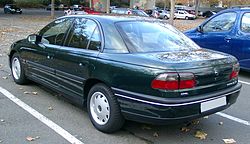 Rear view
 -
 Opel Omega Caravan (1994–1999)
 -
 Vauxhall Omega CDX


.jpg)
Facelift (B2; 1999–2003)
[edit]The Omega B2 was launched in Autumn 1999 as a facelift of the B. It was distinguished by minor revisions to the front and rear styling, centre console, and the introduction of an electronic stability program. Gradually, new engines of slightly larger displacement also replaced the earlier ones; the new ones were generally Euro 3 emissions compliant.
Major changes:
- bonnet (grille now integrated with bonnet)
- Bumper fascias and bodyside mouldings
- Taillights
- Side mirrors
- New designs of alloy wheels
- Brand new central console with GPS, air conditioning, and controls
- Electronic stability program
-
 Front view
 -
 Rear view
 -
 Interior
 -
 Vauxhall Omega
 -
 Opel Omega Caravan (1999-2003) Front view
 -
 Opel Omega Caravan (1999-2003) Rear view


Engines
[edit]The engines were not a major departure from the Omega A, aside from the shift from Opel's own (outdated) 2.3-liter diesel to BMW's M51 turbocharged inline-six. Originally with the model code U25DT, this was updated to the Euro 2 compliant X25DT engine during 1996.
In late 1999, the Omega received a facelift and a 2.2 L 16-valve engine was added to the range as an eventual replacement for the 2.0 L which was discontinued within a year.
The following year, a 3.2 L V6 engine replaced the 3.0 L V6 unit, and a 2.6 L V6 engine replaced the 2.5 L V6 unit. 2001 also brought a brand new diesel 2.5 DTI (M57) engine from BMW, with a "common rail" fuel system.
| Engine | Cyl. | cc | Power | Torque | Notes[11] |
|---|---|---|---|---|---|
| X20SE 2.0i 8V | I4 | 1998 | 116 PS (85 kW; 114 hp) | 172 N⋅m (127 lb⋅ft) | 1994–1999 |
| X20XEV 2.0i 16V | I4 | 1998 | 136 PS (100 kW; 134 hp) | 185 N⋅m (136 lb⋅ft) | 1994–1999 |
| Y22XE 2.2i 16V | I4 | 2198 | 145 PS (107 kW; 143 hp) | 205 N⋅m (151 lb⋅ft) | 1999–2000 |
| Z22XE 2.2i 16V | I4 | 2198 | 145 PS (107 kW; 143 hp) | 205 N⋅m (151 lb⋅ft) | 2000–2003 |
| X25XE 2.5i 24V | V6 | 2498 | 170 PS (125 kW; 168 hp) | 227 N⋅m (167 lb⋅ft) | 1994–2000 |
| Y26SE 2.6 24V | V6 | 2597 | 180 PS (132 kW; 178 hp) | 240 N⋅m (177 lb⋅ft) | 2001–2003 |
| X30XE 3.0i 24V | V6 | 2962 | 211 PS (155 kW; 208 hp) | 270 N⋅m (199 lb⋅ft) | 1994–2000 |
| Y32SE 3.2 24V | V6 | 3175 | 218 PS (160 kW; 215 hp) | 290 N⋅m (214 lb⋅ft) | 2001–2003 |
| Diesel | |||||
| Engine | Cyl. | cc | Power | Torque | Notes[11] |
| X20DTH 2.0 DTI 16V | I4 | 1995 | 101 PS (74 kW; 100 hp) | 205 N⋅m (151 lb⋅ft) | 1998–2000 |
| Y22DTH 2.2 DTI 16V | I4 | 2172 | 120 PS (88 kW; 118 hp) | 280 N⋅m (207 lb⋅ft) | 2000–2003 |
| U25DT/X25DT 2.5 TD | I6 | 2497 | 130 PS (96 kW; 128 hp) | 250 N⋅m (184 lb⋅ft) | 1994–2000 |
| Y25DT 2.5 DTI | I6 | 2497 | 150 PS (110 kW; 148 hp) | 300 N⋅m (221 lb⋅ft) | 2001–2003 |
Omega V8 (prototypes)
[edit]| Omega V8 (prototypes) | |
|---|---|
| Overview | |
| Manufacturer | Opel |
| Production | 1999–2001 (prototypes only) |
| Assembly | Germany: Rüsselsheim |
| Powertrain | |
| Engine | 5.7 L LS1 V8 |
| Transmission | 5-speed automatic |
| Dimensions | |
| Wheelbase | 2,730 mm (107.5 in) |
| Length | 4,898 mm (192.8 in) |
| Width | 1,775 mm (69.9 in) |
| Height | 1,455 mm (57.3 in), 1,540 mm (60.6 in) (estate) |
| Curb weight | 1,726 kg (3,805 lb) |
In an effort to better compete with the BMW 5 Series and the Mercedes-Benz E-Class, Opel decided to install a V8 engine into what was at the time their flagship model, the Opel Omega. Prototypes of sedan and station wagon versions were built (equipped with multimedia systems, and named V8.com).
Omega V8.com
[edit]The V8.com concept car project was meant to be a "mobile office" it was built on Omega station wagon, which was elongated by 130 mm, to provide more space for the passengers and additional equipment; it contained separate 9.5-inch LCD screens for all passengers, Internet access, and integrated video conference mobile phone system with separate cameras and microphones providing passengers hands-free operation – hence the name.
The car was also equipped with xenon headlights, and Advanced Frontlighting System, automatically adjustable to the road conditions. It was powered by a GM LS1 V8 engine.
The car debuted at Frankfurt Motor Show in September 1999.[20][21]
Omega V8
[edit]Opel was planning to upgrade its flagship Omega model with the GM LS1 V8 engine. Unlike the V8.com which was a concept car, this model was intended to go into serial production. The Omega V8 was shown publicly for the first time at the 70th Geneva Motor Show (2–12 March 2000). The V8-engined version was to be put on sale in Autumn 2000, but it was cancelled after 32 pre-series cars had been completed.[22]
The reasons for cancelling production plans were concerns regarding the transmission and about whether the engine was vollgasfest (German, "full throttle resistant"). The engine might overheat and be damaged if driven flat out on the Autobahn for long periods of time.[23] While cooling was resolved by using the larger Holden Commodore radiator, the transmission problem remained. The Chevrolet Corvette (C5) had a transaxle transmission; the only gearbox suitable for the Omega V8 was the GM 4L60-E 4-speed automatic transmission.[24] However, the transmission's flexplate repeatedly broke at 250 km/h (155 mph) during the vollgasfest test. The solution to this problem would take longer than the planned production of the Omega.[25]
Holden did equip its Commodore (which was a reengineered Omega for Australian market) with the same V8 engine. A version of this platform was used for the Holden Monaro, which was marketed in the United States as the fourth-generation Pontiac GTO, and in the United Kingdom as the Vauxhall Monaro.
Worldwide markets
[edit]- In the United Kingdom, the Omega A was marketed as the second-generation Vauxhall Carlton (the first-generation Vauxhall Carlton having been a rebadged Opel Rekord E2) and the Omega B generation as Vauxhall Omega. Between 2001 and 2007, Vauxhall sold the Australian-made Monaro coupe, which was derived from the Holden Commodore, itself based on the Omega B platform.
- In Brazil, between August 1992 and August 1998, the Omega A was built and marketed as a Chevrolet Omega sedan or Omega Suprema in station wagon form (station wagon production ended in 1996). Between 1999 and 2006, this Chevrolet was the Omega B-derived Holden Commodore imported from Australia.
- In North America, a badge-engineered version of the Omega B and Omega B FL was marketed as the Cadillac Catera. Between 2004 and 2006, Pontiac reintroduced and sold its GTO as a coupe based on the Australian-made Monaro, which was derived from the Holden Commodore.
- In Australia, reengineered versions of the Opel Omega A were manufactured by Holden (a GM subsidiary) as the second generation Commodore and its derivates (including long wheelbase wagons, utility and luxury sedans, Statesman and Caprice) between 1988 and 1997. Between 1997 and 2006, Holden instead adapted the Omega B for its third generation as the Commodore and derivates, which now also included the Monaro coupe.
These Australian sedans are larger in all body dimensions and have featured less sophisticated suspension designs, different interior styling, and powertrains ranging from a Buick-derived 3.8-litre V6 between 1988 and 2003 or 5.0-litre V8 between 1988 and 1999, both manufactured by Holden, to a new 3.6-litre V6 from 2003 also built and exported by Holden and fully imported Chevrolet V8 engines, beginning with a 5.7 litre version in 1999, upgraded to a 260 kW 6.0 litre version in 2006. These vehicles were equally available in New Zealand.
- Since 1999, the Omega B based second generation Holden Commodore and its derivatives were exported to North America, Brazil, and the United Kingdom in sedan and coupe form as noted above, but also as a Chevrolet Lumina in the Middle East and South Africa. The Holden Commodore's 1999 long-wheelbase luxury derivative, WH-series Statesman/Caprice, was also exported to the Middle East as the fifth-generation Holden Caprice. In 2005, as the WK Statesman, this vehicle was sold in China as the Buick Royaum and in Korea as the Daewoo Statesman.
- The Omega was one of the first models introduced by Opel after their return to the Philippines in 1997. Shortly after the brand's discontinuation in the Philippine market, it was replaced by the Chevrolet Lumina, but instead of being based on the Holden Commodore like other markets, the Philippines received a rebadged Chinese-market Buick Regal sourced from Shanghai GM.
End of the Omega
[edit]In the United Kingdom, the Vauxhall Omega proved to be a successful model,[26] despite being slated in many reviews for heavy depreciation[27] and unreliability.[28][29] Omegas and Carltons were a regular sight on United Kingdom roads, sporting police livery and as covert traffic surveillance cars.[30] However, just four years after the introduction of its latest incarnation, Omega B2, and seventeen years since introduction of Omega A, production of this model ended. On 25 June 2003, the last Omega rolled out of the factory in Rüsselsheim – it was a silver 3.2 L V6 Omega B2, number 797,011.[citation needed]
Following the demise of its direct rivals, the Ford Scorpio and Rover 800, the former due to its controversial styling, Opel/Vauxhall found themselves competing against BMW's 5 Series, with minimal sales success. Apart from the Australian re-engineered Holden Commodore models that carried on until 2006 for the sedan (wagons and utilities until 2007), production of the Omega ended in 2003. The position that the Omega held as Opel's flagship model (after the demise of the Senator) would be taken over by the smaller Opel Signum which used an extended-length platform of the Opel Vectra and incorporated practical features of both MPVs and station wagons into one package.[31] Remaining stocks were sold into 2004. In the Philippines, the Omega was replaced by the Chevrolet Lumina.
Stories and photographs of a "new" successor appeared in the motoring press one year later. In the case of Auto Express, though, its October 2004 article simply featured the Holden Torana TT36 concept car, which itself previewed the 2006 Holden Commodore.[32] Nevertheless, Holden contributed in the Omega badge remaining alive by it, for the entry-level model of its new Commodore. Unlike prior models since 1978, this new Holden was no longer based on an Omega platform. Ironically, a version of this Commodore would get exported to the UK market as the Vauxhall VXR8 from 2007 to 2017, effectively becoming the flagship of the brand. Being a high-performance sports sedan, it was the first such vehicle in Vauxhall's lineup since the Lotus Carlton/Omega.[33]
As of July 2020, only 3297 Vauxhall Omegas and 306 Carltons (including some rebadged Rekords) are left on the road in the United Kingdom.[34]
References
[edit]- ^ "Opel Signum Europe Sales Figures". Car Sales Base. Archived from the original on 9 September 2022. Retrieved 9 September 2022.
The Signum was intended to be an indirect replacement to the Opel/Vauxhall Omega.
- ^ "Opels Maxi-Kompakt-Konzept heißt Signum". auto motor und sport. 2 May 2003. Archived from the original on 22 October 2017.
- ^ "Opel Omega A". www.senatorman.de. Retrieved 6 April 2023.
- ^ "Vauxhall V87 - Carlton Mk3". vauxpedia.net. Retrieved 6 April 2023.
- ^ "Previous winners". Car of the year. Archived from the original on 14 September 2010. Retrieved 18 September 2010.
- ^ Carlquist, Calle (24 January 1991). "Mycket skrik för lite ull" [Much ado about nothing]. Teknikens Värld (in Swedish). Vol. 43, no. 2. Stockholm, Sweden: Specialtidningsförlaget AB. p. 31.
- ^ Stark, Harry A.; Bush, James W., eds. (1990). Ward's Automotive Yearbook 1990. Vol. 52. Detroit, MI: Ward's Communications, Inc. p. 284. ISBN 0910589010.
{{cite book}}: CS1 maint: ignored ISBN errors (link) - ^ "Chevrolet Omega, the last 250 at Hemmings Blog – Classic and collectible cars and parts". Blog.hemmings.com. Archived from the original on 1 March 2010. Retrieved 14 December 2010.
- ^ "Chevrolet Omega 2.2 GLS specifications". Carinfo.autold.com. Retrieved 14 December 2010.
- ^ "Chevrolet Omega 4.1 CD specifications". Carinfo.autold.com. Archived from the original on 13 May 2016. Retrieved 14 December 2010.
- ^ a b c d "Opel CLUB - Opel Omega". Opel Club. Archived from the original on 21 October 2007. Retrieved 17 May 2009.
- ^ a b "Opel Omega A". Senatorman (in German). Archived from the original on 8 April 2023.
- ^ Johansson, Claes, ed. (24 January 1991). "Allt om bilen: PS" [Everything about cars: PS]. Teknikens Värld (in Swedish). Vol. 43, no. 2. Stockholm, Sweden: Specialtidningsförlaget AB. p. 17.
- ^ "Specifications for engine and gearbox (Dutch)". Archived from the original on 29 September 2007. Retrieved 11 September 2007.
- ^ "Cars++ Specifications for Lotus Omega". Retrieved 11 September 2007.
- ^ "Opel Omega B 3.2 V6 (B) 218 PS (2001-›2002) technical specifications and performance figures". Zeperfs. Retrieved 9 April 2023.
- ^ "Opel Omega: Berlina con l'aria coupé". Quattroruote. Editoriale Domus. February 1990. Archived from the original on 4 March 2016. Retrieved 16 April 2014.
- ^ Fink, Greg (15 February 2021). "The Aurora Was a Cadillac Before It Was an Oldsmobile". Motor Trend. Retrieved 29 August 2022.
- ^ "Concept Car - Concept Vehicle History". Chicago Auto Show. Chicago Automobile Trade Association. Retrieved 16 April 2014.
- ^ ""Omega V8.com" - Tomorrow's Multi-Media-Mobile". GM. Archived from the original on 8 April 2023. Retrieved 15 May 2009.
- ^ "Opel Omega V8.com concept car pictures". Pbase.com. Retrieved 2 October 2010.
- ^ "Omega V8 promises stunning performance and premium quality". Car Enthusiast. 17 February 2000. Retrieved 15 May 2009.
- ^ "Opel Omega B: Die Motoren". Senatorman.de (in German). Archived from the original on 5 June 2017.
- ^ "Omega V8 - The Corvette-Powered Opel That Almost Was A Thing". Car Throttle. 15 November 2016. Retrieved 9 February 2022.
- ^ "Opel Omega V8: Der Opel, der alles verändert hätte". autobild.de (in German). Retrieved 9 February 2022.
- ^ Olly Smith. "Combined stats (77 models) VAUXHALL OMEGA - How Many Left?". Howmanyleft.co.uk. Archived from the original on 25 April 2012. Retrieved 25 March 2012.
- ^ "Vauxhall Omega Estate (94-03) cars for sale, reviews, pictures and prices". Parkers. Archived from the original on 10 September 2011. Retrieved 25 March 2012.
- ^ "Omega 1994 | Vauxhall | Car Reviews". Honest John. 1 December 2011. Archived from the original on 3 October 2016. Retrieved 25 March 2012.
- ^ "Vauxhall Omega 2.6i Saloon - review and opinion - Omega dream shattered". Ciao.co.uk. Archived from the original on 3 April 2012. Retrieved 25 March 2012.
- ^ "Welcome FortuneCity Customers | Dotster". Members.fortunecity.co.uk. Archived from the original on 5 April 2012. Retrieved 1 May 2012.
- ^ "Vauxhall is committed to Omega replacement". Fleet News. Retrieved 9 September 2022.
- ^ "All-new Omega's In The Pink". 13 October 2004. Archived from the original on 23 February 2009. Retrieved 11 September 2007.
- ^ "VAUXHALL THROUGH THE AGES: THE AUSTRALIAN SEND-OFF". Trade Unique Cars. Mark Higgins. 22 May 2020. Retrieved 9 April 2023.
- ^ "How Rare Is My Vauxhall?". Car Logbook. App Developers Ltd. Archived from the original on 29 July 2020.
External links
[edit] Media related to Opel Omega at Wikimedia Commons

A marque of Stellantis | |||||||||||
| Vehicles |
| ||||||||||
| Concept cars | |||||||||||
| Divisions and subsidiaries | |||||||||||
| People | |||||||||||
| Facilities | |||||||||||
| Other | |||||||||||


A marque of Stellantis | |||||||||
| Vehicles |
| ||||||||
| Divisions and subsidiaries | |||||||||
| People | |||||||||
| Factories | |||||||||
| Other | |||||||||
Opel Omega
View on GrokipediaFirst Generation (Omega A; 1986–1994)
Development
The Opel Omega was conceived as the direct successor to the Opel Rekord, which had been a mainstay in the European market since the 1950s, but by the early 1980s required replacement to meet evolving demands for a sophisticated executive car capable of rivaling premium offerings from BMW and Mercedes-Benz.[5] As Opel's entry into the competitive E-segment, the Omega aimed to blend advanced engineering with refined luxury, addressing the shift toward more dynamic and safer vehicles amid stricter European regulations and consumer preferences for superior road presence.[6] Development of the first-generation Omega A began in 1982 under General Motors' V-platform initiative, a rear-wheel-drive architecture designed for executive vehicles. Wayne Cherry, who assumed the role of Director of Design at Opel in 1983, led the styling efforts, emphasizing a clean, aerodynamic form that prioritized functionality and elegance. Engineering priorities focused on enhancing handling through the longitudinal rear-wheel-drive layout, which provided better weight distribution and driver engagement compared to emerging front-wheel-drive rivals, while integrating early anti-lock braking system (ABS) technology as standard on higher trims to improve safety.[7][8] The prototyping phase involved extensive testing to refine the vehicle's dynamics and efficiency, including wind tunnel evaluations that achieved a drag coefficient (Cd) of 0.30, notable for its time and contributing to stable high-speed performance. These efforts underscored Opel's commitment to positioning the Omega as a benchmark for luxury and innovation in the 1980s executive segment. The model premiered at the Frankfurt Motor Show in September 1986, entering production shortly thereafter and marking a pivotal moment in Opel's resurgence.[9][5]Design and Body Styles
The Opel Omega A featured a boxy yet aerodynamic exterior design that emphasized efficiency and modernity, with smooth contours, flush-mounted door handles, and flush glazing to reduce aerodynamic drag. This rationalist approach resulted in a clean, understated profile suitable for an executive car, distinguishing it from more ornate predecessors. The vehicle's dimensions included an overall length of 4,687 mm and a wheelbase of 2,730 mm, providing ample proportions for stability and interior space.[10][11] Available in two body styles, the Omega A debuted as a four-door sedan in 1986, offering a trunk capacity of 520 liters for practical luggage storage. The estate variant, known as the Caravan, was introduced later that year to appeal to buyers seeking versatility, with a standard cargo volume of 540 liters that could expand to 1,850 liters when the rear seats were folded. Both configurations shared the same robust platform, ensuring consistent ride quality across styles.[12][13][14] The interior of the Omega A prioritized comfort and functionality, boasting a spacious cabin designed to seat five passengers with generous legroom and headroom. The dashboard adopted curved lines and soft shapes mirroring the exterior, integrating the instrument cluster seamlessly for improved driver visibility and ergonomics. Higher trim levels differentiated through styling cues such as alloy wheels, which added a sportier aesthetic and better road presence compared to the steel wheels on base models. Leather upholstery options were available in premium trims, elevating the cabin's luxury appeal.[5][5]Engines and Drivetrain
The Opel Omega A featured a range of inline-four and inline-six petrol engines, alongside diesel options, all designed for rear-wheel drive configuration to provide balanced handling and performance in the executive sedan segment. Initial petrol options included a base 1.8-liter inline-four (18NV) delivering 84 hp (62 kW). The standard 2.0-liter inline-four (C20NE) produced 115 horsepower (85 kW) at 5,200 rpm and 170 Nm of torque, suitable for everyday driving with adequate refinement.[5] A more potent 2.4-liter inline-four (C24NE), introduced in 1988, produced 125 horsepower (92 kW) at 4,800 rpm and 195 Nm of torque, offering improved mid-range pull for highway use.[15] At the top of the standard lineup was the 3.0-liter inline-six (30NE), available from 1987, generating 177 horsepower (130 kW) at 5,600 rpm and 240 Nm of torque, which enabled a top speed of 227 km/h and 0-100 km/h acceleration in 8.8 seconds.[16] Tuned versions of the 3.0-liter engine, such as the 24-valve variant, boosted output to 200 horsepower (147 kW).[17] Diesel power came from a 2.3-liter inline-four turbodiesel (23YDT), introduced in 1986, providing 90 PS (66 kW; 89 hp) at 4,200 rpm and 190 Nm of torque for efficient long-distance travel; an initial naturally aspirated 2.3-liter diesel (23YD) offered 72 hp (53 kW).[11] Fuel economy across the lineup varied by engine and transmission, typically ranging from 8 to 12 liters per 100 km in combined driving, with the 3.0-liter achieving around 10 liters per 100 km under normal conditions.[5] The drivetrain was exclusively rear-wheel drive, emphasizing the Omega A's sporty character without all-wheel drive options. Transmission choices included a five-speed manual for precise control or a four-speed automatic for smoother cruising, both paired longitudinally with the engines.[11] No six-speed manual was standard, though high-performance tunes like the Lotus variant incorporated one. During the production run from 1986 to 1994, engine evolution focused on emissions compliance, with catalytic converters added to petrol models from 1990 onward to meet stricter European standards, reducing hydrocarbon and carbon monoxide outputs without significantly impacting performance.[18] The turbodiesel introduction in 1986 further expanded efficient options, aligning with growing demand for lower-emission powertrains.Trim Levels and Special Variants
The Opel Omega A lineup featured a range of trim levels catering to different buyer preferences, starting with the entry-level GL and GLS variants. These base models came equipped with cloth upholstery, manual windows, basic analog instrumentation, and standard safety features like front disc brakes, emphasizing affordability and practicality for everyday executive use.[19] Higher-end trims elevated the Omega's luxury appeal, with the CD specification introducing leather seats, automatic climate control, power windows and mirrors, and alloy wheels for enhanced comfort on long journeys. The top-tier Elite trim further refined this with real wood interior accents, electrically adjustable front seats, and premium audio systems, positioning it as the pinnacle of standard Omega refinement.[20] Among special variants, the 1987 Omega Diamant emerged as a limited luxury edition, distinguished by unique chrome badging, enhanced velour or optional leather interiors, and additional cosmetic touches like polished alloy wheels, aimed at discerning buyers seeking subtle exclusivity without performance modifications.[21] The Omega 3000 represented the flagship offering in the standard range, pairing the largest-displacement 3.0-liter inline-six engine with upscale CD or Elite trim features for superior refinement and highway cruising capability.[22] For performance-oriented enthusiasts, the 1989 Omega Evolution 500 served as a rally- and DTM-inspired homologation special, limited to 500 units produced between 1991 and 1993. It included a tuned 3.0-liter inline-six engine delivering 230 PS, an aerodynamic body kit with flared fenders and a deployable rear spoiler for improved downforce, reinforced suspension components, and Recaro sport seats, enabling competitive track performance while maintaining road legality.[23][24] The ultimate special variant was the 1990 Lotus Omega, a collaborative high-performance edition developed with Lotus Engineering, equivalent to the Vauxhall Lotus Carlton in the UK. Powered by a twin-turbocharged 3.6-liter inline-six engine producing 377 hp and 568 Nm of torque, it featured lightweight alloy components, upgraded brakes, a stiffened chassis, Recaro bucket seats with bolstered support, and subtle exterior enhancements like 17-inch BBS wheels. Limited to 547 units worldwide, its exclusivity stemmed from rigorous tuning for supercar-like acceleration—reaching 0-100 km/h in under 6 seconds—while retaining the Omega's practical four-door layout.[25][26]Second Generation (Omega B; 1994–2003)
Introduction and Design Evolution
The Opel Omega B was introduced in June 1994 as a refined executive car positioned in the E-segment, succeeding the Omega A and built on an updated version of General Motors' rear-wheel-drive V-platform.[3] This evolution maintained platform continuity from its predecessor while incorporating enhancements for improved structural rigidity and handling.[1] The model aimed to compete directly with established rivals such as the Audi A6 and Volvo 960, offering a blend of luxury, space, and value in the European market.[27] Key design updates emphasized a smoother, more rounded exterior styling compared to the boxier Omega A, featuring streamlined flanks, flush glazing, and a curving C-pillar for a modern aesthetic.[28] These changes contributed to enhanced aerodynamics, with a drag coefficient (Cd) of 0.29, alongside larger overall dimensions including a length of 4,785 mm and a wheelbase of 2,730 mm.[29] Both sedan and estate (known as the Caravan) body styles were available from launch, with the wagon variant proving particularly popular in Europe for its practicality.[30] Interior refinements included higher-quality materials for a more upscale feel, greater passenger space, and a sedan trunk capacity of 520 liters, while optional navigation systems were offered to enhance the executive appeal.[31] Upon release, the Omega B received praise for its superior ride comfort, solid build quality, and competitive pricing, often compared favorably to premium competitors for providing Mercedes-like solidity at a more accessible cost.[27]1999 Facelift
The 1999 facelift of the Opel Omega B, designated as the B2 variant, was unveiled at the Frankfurt Motor Show in September 1999 and entered production in late 1999, running until 2003. This mid-cycle refresh aimed to modernize the model's appearance and refinement while building on the original Omega B's rear-wheel-drive platform and overall proportions. The updated lineup included both sedan and estate body styles.[32] Exterior revisions focused on updating the front and rear styling to better align with Opel's evolving design language seen in contemporaries like the Vectra. Key changes included redesigned front and rear bumpers, clear-lens headlights for improved visibility and aesthetics, and revised taillight clusters with a more angular appearance. The sedan's body length grew by 110 mm to 4,898 mm while retaining the 2,730 mm wheelbase, contributing to a more imposing presence; the estate saw a similar 70 mm extension. Optional 17-inch alloy wheels became available, enhancing the premium feel.[32][33] Inside, the facelift introduced a revised dashboard layout with sharper lines and improved ergonomics, replacing the softer curves of the pre-facelift model for a more contemporary cockpit. New infotainment features, such as an optional single-CD player integrated into the center console, were added alongside standard air conditioning on higher trims, while enhanced sound insulation reduced road and wind noise for greater refinement. These updates elevated the interior's perceived quality without altering the fundamental five-seat configuration.[34][35] Chassis enhancements included a stiffer suspension setup and recalibrated steering for sharper handling and better stability, addressing earlier critiques of the Omega B's somewhat floaty ride. These modifications improved high-speed composure and cornering without sacrificing the model's renowned comfort.[32] The facelift successfully countered perceptions of the Omega B's aging looks after five years on the market, revitalizing interest and supporting stronger sales figures in Europe during the model's final years, with over 100,000 units produced post-update.[1]Powertrain Specifications
The second-generation Opel Omega (Omega B) featured a range of powertrains designed for executive-class performance and efficiency, with rear-wheel drive across all variants. Petrol engines included inline-four and V6 configurations, while diesels emphasized turbocharged options for torque and economy. These were paired with manual or automatic transmissions, offering a balance of drivability and refinement.[36] Petrol engines comprised a base 2.0-liter inline-four producing 136 horsepower (100 kW), suitable for everyday use with smooth delivery. Higher-output options included the 2.2-liter inline-four introduced after the 1999 facelift, delivering 142 horsepower (105 kW) for improved responsiveness. V6 variants offered more power: the 2.6-liter unit at 154 horsepower (113 kW) pre-facelift, upgrading to 180 horsepower (132 kW) post-facelift, the 3.0-liter V6 with 211 horsepower (155 kW), and the post-facelift flagship 3.2-liter V6 with 218 horsepower (160 kW). These engines, part of Opel's Ecotec family in later iterations, incorporated advanced features like variable valve timing to reduce emissions and enhance fuel efficiency.[37][38][39][40][41] Diesel powertrains focused on turbocharged units for strong low-end torque. The initial 2.0-liter inline-four turbo diesel generated 100 horsepower (74 kW), providing economical long-distance cruising. The 2.5-liter inline-six turbo diesel offered 150 horsepower (110 kW) in updated form, with torque up to 235 Nm for towing capability. Post-1999, the 2.2-liter Y22DT turbo diesel delivered 125 horsepower (92 kW), benefiting from common-rail injection for cleaner operation and better refinement compared to earlier indirect-injection diesels.[42]| Engine Type | Displacement | Power Output | Torque | Notes |
|---|---|---|---|---|
| Petrol 2.0 L I4 | 2.0 L | 136 hp (100 kW) | 185 Nm | Base engine, Ecotec X20XEV |
| Petrol 2.2 L I4 | 2.2 L | 142 hp (105 kW) | 203 Nm | Post-1999, Z22SE |
| Petrol 2.6 L V6 | 2.6 L | 154-180 hp (113-132 kW) | 220-240 Nm | Pre/post-facelift variants |
| Petrol 3.0 L V6 | 3.0 L | 211 hp (155 kW) | 270 Nm | X30SE |
| Petrol 3.2 L V6 | 3.2 L | 218 hp (160 kW) | 290 Nm | Post-facelift flagship, X32SE |
| Diesel 2.0 L I4 Turbo | 2.0 L | 100 hp (74 kW) | 205 Nm | X20DTL, pre-facelift |
| Diesel 2.5 L I6 Turbo | 2.5 L | 150 hp (110 kW) | 235 Nm | Updated DTI version |
| Diesel 2.2 L I4 Turbo | 2.2 L | 125 hp (92 kW) | 280 Nm | Post-1999 Y22DT, common-rail |