Hubbry Logo
Operation TideraceOperation TideraceMain
Open search
Operation Tiderace
Community hub
Operation Tiderace
logo
8 pages, 0 posts
0 subscribers
Be the first to start a discussion here.
Operation Tiderace
Operation Tiderace
from Wikipedia

Operation Tiderace
Part of World War II

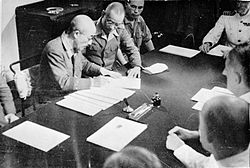
General Seishirō Itagaki signing the terms for the reoccupation of Singapore on board the heavy cruiser HMS Sussex. 4 September 1945
Date4–12 September 1945
Location
Result

Unopposed Allied victory

Belligerents

 Japan

United Kingdom
India
Australia
France France (Naval only)[1]
Commanders and leaders
Empire of Japan Seishirō Itagaki (POW)
Empire of Japan Shigeru Fukudome (POW)
United Kingdom Lord Louis Mountbatten
United Kingdom Robert Mansergh
Strength
77,000 infantry[2]
2 heavy cruisers
1 destroyer
2 submarines
60,000 infantry
7 escort carriers
2 battleships
1 heavy cruiser
2 light cruisers
15 destroyers
3 Royal Fleet Auxiliary
3 hospital ships
14 merchant vessels
43 landing ship, infantry[3]
Casualties and losses
300 suicides
76,700 captured
1 battleship damaged

Operation Tiderace was the codename of the British plan to retake Singapore following the Japanese surrender in 1945.[4] The liberation force was led by Lord Louis Mountbatten, Supreme Allied Commander of South East Asia Command. Tiderace was initiated in coordination with Operation Zipper, which involved the liberation of Malaya.

Background

[edit]

With the Soviet invasion of Manchuria and an American planned invasion of Japan, South East Asia Command were also drawing up plans to invade Malaya, codenamed Operation Zipper. With over 100,000 Allied infantry,[5] the plan was to capture Port Swettenham and Port Dickson, and would involve an airstrike of more than 500 aircraft of the Royal Air Force. The assault was scheduled for 9 September 1945, but was forestalled following the Surrender of Japan on 15 August 1945.[6] Once the lodgement was secure, the Allies would have initiated Operation Mailfist, during which ground forces were to advance south through Malaya and liberate Singapore.[7] It was expected that Operation Mailfist would begin in December 1945 and conclude in March 1946.[8]

Operation Tiderace was planned soon after the Atomic bombings of Hiroshima and Nagasaki on 6 and 9 August. Emergency planning was put in preparation for the rapid occupation of Singapore at an early date should Japan agree to accept the terms of the Potsdam Declaration of 26 July.[9]

While Operation Zipper was executed ahead of schedule, it did so on a much smaller scale, having quickly transferred a proportion of its original strength to Operation Tiderace. The convoy consisted of about 90 ships,[3] which included two battleships, HMS Nelson and the French battleship Richelieu.[10] The heavy cruiser HMS Sussex served as the flagship.[11] HMAS Hawkesbury was the sole Australian warship during the Japanese surrender, escorting the repatriation transport Duntroon.[12] A smaller British naval force was given the task of liberating Penang under Operation Jurist, a component of the overall Operation Zipper.[citation needed]

There were a total of seven escort carriers: HMS Ameer, HMS Attacker, HMS Emperor, HMS Empress, HMS Hunter, HMS Khedive and HMS Stalker.[13]

The Japanese naval fleet in Singapore consisted of the destroyer Kamikaze[14] and two cruisers, Myōkō and Takao, both of which had been so badly damaged before that they were being used as floating anti-aircraft batteries. Two ex-German U-boats, I-501 and I-502 were also in Singapore.[15] Both were moored at Singapore Naval Base.[16] Air strength in both Malaya and Sumatra was estimated to be a little more than 170 aircraft.[17]

Return to Singapore

[edit]
Admiral Lord Louis Mountbatten signs the acceptance of surrender for Great Britain. Brigadier (later Gen.) Thimayya (future Chief of Staff of the Indian Army) is visible on the far left of the Allied table representing Indian forces. 12 September 1945

Operation Tiderace commenced when Mountbatten ordered Allied troops to set sail from Trincomalee and Rangoon on 31 August for Singapore. The fleet was not armed with offensive weapons as Mountbatten had good reason to believe that the Japanese in Malaya and Singapore would surrender without a fight: on 20 August General Itagaki Seishiro, the commander in Singapore, had signalled Mountbatten that he would abide by his emperor's decision and was ready to receive instructions for the Japanese surrender of Singapore.[18]

Japan's defeat had caught the Japanese Command in Singapore by surprise. Many were unwilling to surrender and had vowed to fight to the death. Itagaki had initially balked at the order to surrender and instead ordered the 25th Army (the component of the 7th Area Army defending Singapore) to resist when the Allies arrived.[18] There was even a secret plan to massacre all Allied PoWs on the island.[18] However, three days after the Emperor's announcement on 15 August, Itagaki flew from Singapore to Saigon to confer with his leader Field Marshal Count Terauchi, Commander of the Japanese Southern Army and all forces in South-east Asia. Terauchi prevailed over Itagaki who then sent his signal to Mountbatten. Newspapers in Singapore were finally allowed to carry the text of the Emperor's speech, confirming what many already knew from listening to All India Radio broadcasts from Delhi on forbidden shortwave radios.[18]

The Allies arrived in Malaya on 28 August, with a small portion of the fleet sent to recapture Penang as part of Operation Jurist. On 30 August 1945 a flight of 9 RAAF Catalinas landed in Singapore bearing medical supplies and personnel documents in preparation for the Japanese surrender and the liberation of the thousands of PoWs on the island.[19][20] When Penang surrendered without resistance under Operation Jurist, the Allied fleet sailed for Singapore on 2 September, passing the Raffles Lighthouse at the Southern entrance to the Straits of Malacca.[21] The fleet arrived in Singapore on 4 September 1945, meeting no opposition.[18] However, the French battleship Richelieu struck a magnetic mine at 07:44 on 9 September while passing down the Straits of Malacca. She eventually limped into Singapore at 12:00 on 11 September.[22]

General Itagaki, accompanied by Vice Admiral Shigeru Fukudome and his aides, were brought aboard HMS Sussex in Keppel Harbour to discuss the surrender. They were received by Lieutenant-General Sir Philip Christison and Major-General Robert Mansergh. A tense encounter began when a Japanese officer reportedly remarked, "You are two hours late," only to be met with the reply, "We don't keep Tokyo time here."[21] By 18:00, the Japanese had surrendered their forces on the island. An estimated 77,000 Japanese troops from Singapore were captured, plus another 26,000 from Malaya.[18]

The formal surrender was finalised on 12 September at Singapore City Hall.[18] Lord Louis Mountbatten, Supreme Allied Commander of Southeast Asia Command, came to Singapore to receive the formal surrender of Japanese forces in South East Asia from General Itagaki on behalf of Field Marshal Hisaichi Terauchi, commander of the Japanese Southern Army Group who had suffered a stroke earlier in the year.[21] A British Military Administration was formed to govern the island until March 1946. Itagaki departed for Japan shortly afterwards to face trial and execution as a war criminal.[21]

Japanese reaction to the surrender

[edit]

Itagaki had met his generals and senior staff at his HQ at the former Raffles College in Bukit Timah and told his men that they would have to obey the surrender instructions and keep the peace. That night, more than 300 officers and men killed themselves by falling onto their swords in the Raffles Hotel after a farewell sake party, and later, an entire Japanese platoon killed themselves using grenades.[18]

About 200 Japanese soldiers decided to join the communist guerrillas whom they were fighting just days before in a bid to continue the fight against the British. But they soon returned to their units when they found out that the MPAJA, which was funded by the Malayan Communist Party, did not plan to fight the returning British.[18]

Nonetheless, some stayed hidden in the jungles with the communists, and when Chin Peng and remnants of the Malayan Communist Party ended their struggle in 1989, two former Japanese soldiers called Tanaka and Hashimoto emerged from the jungle with the communists and surrendered.[18][23]

See also

[edit]

References

[edit]
Revisions and contributorsEdit on WikipediaRead on Wikipedia
from Grokipedia
Operation Tiderace was the code name for the Allied reoccupation of Singapore following Japan's surrender in World War II, executed primarily by British, Indian, and Australian forces under the command of Admiral Lord Louis Mountbatten as Supreme Allied Commander, South East Asia Command. Originally conceived as an emergency assault plan in anticipation of a potential Japanese capitulation before the larger Operation Zipper could be mounted, the outline plan was finalized on 8 August 1945, detailing naval, land, and administrative coordination for rapid seizure of the island. With Japan's formal capitulation on 2 September 1945, the operation transitioned to a peaceful occupation, as troops—including the 5th Indian Division—departed from Ceylon and Burma on 31 August, arriving to accept the surrender without combat. Negotiations commenced on 4 September aboard HMS Sussex in Keppel Harbour between Mountbatten and Japanese General Seishirō Itagaki, leading to the formal instrument of surrender signed on 12 September, which reestablished British colonial authority over Singapore and ended three years of Japanese occupation. Under Lieutenant General Sir Philip Christison as land forces commander, Tiderace secured the release of over 100,000 Allied prisoners of war and internees while disarming approximately 70,000 Japanese troops, marking a pivotal step in postwar stabilization of Southeast Asia.

Historical Context

Fall of Singapore and Japanese Occupation

The Japanese invasion of commenced on 8 December 1941, coinciding with the , as forces under Lieutenant General Tomoyuki Yamashita's 25th Army executed amphibious landings along the northeastern Malayan coast and in to secure airfields and bypass defenses. Over the following weeks, Japanese troops advanced southward through Malaya at a rapid pace, employing , tactics, and air superiority to outmaneuver outnumbered Allied forces comprising British, Australian, Indian, and Malayan troops totaling around 140,000 personnel under Lieutenant General . By late January 1942, Japanese forces had reached opposite , prompting the demolition of the causeway on 31 January and the withdrawal of Allied defenders into the island fortress, which was defended by approximately 85,000 troops but hampered by inadequate preparations, low morale, and reliance on fixed defenses facing seaward from the south. Japanese artillery barrages intensified from 5 February 1942, followed by diversionary feints and the main assault landings of the 18th and 25th Divisions—totaling about 30,000 troops—on the northwestern shore of on the night of 8–9 February, exploiting weakly defended sectors. Allied counterattacks faltered amid water shortages, ammunition depletion, and civilian disruptions, allowing Japanese forces to capture key heights including on 11 February and advance toward the city center. Percival, facing imminent collapse and heavy civilian casualties from shelling, surrendered unconditionally to Yamashita at 5:30 p.m. on 15 February 1942, resulting in the capture of 80,000 Allied troops—the largest British capitulation in history—and Japanese losses estimated at fewer than 10,000 killed or wounded across the . Under Japanese military administration, was redesignated Syonan-to ("Light of the South") on 1 April 1942, governed initially by the 25th Army's headquarters and later by civilian bureaucrats under the Southern Expeditionary Fleet, with policies aimed at resource extraction for Japan's war effort through the ideology. The military police enforced draconian control, including the operation from 18 February to March 1942, which screened and executed suspected anti-Japanese elements—primarily ethnic Chinese perceived as pro-British or communist sympathizers—with death toll estimates ranging from 5,000 to 25,000 based on postwar trials and survivor accounts, though Japanese records minimized figures to under 1,000. Economic policies replaced the Straits dollar with Japanese military scrip in 1942, leading to , severe of rice and essentials—reducing consumption by over 60%—and widespread , as agricultural output collapsed and imports halted amid Allied interdiction. Labor mobilized tens of thousands for fortifications, airfields, and the Death Railway in , with high mortality from disease, overwork, and abuse; women faced systematic in "comfort stations," while emphasized Asian liberation but prioritized Japanese settlers and resource quotas. Resistance remained sporadic, led by Chinese-dominated Malayan People's Anti-Japanese Army (MPAJA) guerrillas in surrounding jungles, supported covertly by British agents from 1943, conducting and until Japanese surrender in 1945, though urban with occupation authorities was coerced among Indian and Malay communities via organizations like the . By mid-1945, Allied bombing and supply shortages eroded Japanese control, setting conditions for reoccupation.

Allied Campaigns in Southeast Asia

The Allied campaigns in during 1944 and 1945, directed by under Admiral Lord Louis Mountbatten, centered on defeating Japanese forces in to restore Allied supply lines to and position for further advances into Malaya and . The pivotal Battles of and , conducted from 8 March to 18 July 1944, saw British, Indian, and troops repel the Japanese 15th Army's invasion attempt toward , inflicting heavy casualties and marking the campaign's turning point. These engagements involved intense close-quarters fighting amid challenging terrain and monsoon conditions, with Allied forces employing superior artillery, air support, and improvised logistics to hold defensive positions against numerically superior Japanese attackers. Building on this success, Lieutenant General William Slim's British Fourteenth Army—the largest Commonwealth formation of the war, comprising over 1 million troops primarily from , Britain, and African colonies—launched a methodical counteroffensive into Burma starting in late 1944. By early 1945, Allied forces had reopened the supply route and conducted amphibious and airborne operations, culminating in the recapture of Rangoon on 2 May 1945 via Operation Dracula, a seaborne that found the city largely abandoned by retreating Japanese defenders. The as a whole resulted in the destruction or surrender of over 250,000 Japanese troops, the worst defeat in the Imperial Japanese Army's history, through a combination of tactics, rapid mechanized pursuits, and exploitation of Japanese overextension. These victories severed Japanese overland communications and supply lines from Thailand and Indochina to their isolated Southern Expeditionary Army garrisons in Malaya, comprising the 25th Army with roughly 90,000 combat-effective troops by mid-1945, thereby weakening their defensive posture without direct assault. Allied air superiority, achieved through bases in recaptured Burma, conducted extensive bombing of Japanese positions across Southeast Asia from 1944 onward, further eroding enemy logistics and morale. With Japanese forces in retreat and Allied amphibious capabilities enhanced by carrier-based naval operations, SEAC prepared for Operation Zipper, an intended landing on Malaya's northwest coast in October 1945 to secure beachheads at Port Swettenham and Port Dickson using XXXIV Indian Corps. Japan's capitulation announcement on 15 August 1945, prompted by atomic bombings and Soviet invasion of Manchuria, preempted these assaults, enabling uncontested reoccupations like Operation Tiderace in Singapore.

Japan's Surrender and Strategic Shift

The capitulated on August 15, 1945, when Emperor delivered the Jewel Voice Broadcast, a radio address announcing acceptance of the Declaration's terms to the Allied powers. This decision followed the ' atomic bombings of on August 6 (killing 78,150) and on August 9 (killing 23,753), compounded by the Soviet Union's declaration of war and invasion of Japanese-held on August 8–9. The broadcast explicitly ordered Japanese armed forces to cease all combat operations, effectively halting resistance across the Pacific and Asian theaters. For Japanese commanders in , the surrender induced an immediate strategic reorientation from fortified defense against impending Allied assaults—bolstered by over 125,000 troops in Malaya alone, including the garrison—to preservation of internal order, protection of Allied prisoners of war (estimated at 96,575 across the region), and preparation for and territorial handover. Cease-fire directives issued on formalized this shift, with orders following on , though isolated elements in remote areas briefly continued sporadic actions until mid-September. Preliminary regional surrender protocols were signed on August 28 in Rangoon, extending to Malaya and facilitating non-violent Allied ingress. Allied strategy, particularly under the British Southeast Asia Command (SEAC) led by Admiral Lord Louis Mountbatten, pivoted concurrently from high-casualty amphibious invasions—such as the planned for and broader for Malaya, involving multiple divisions—to administrative reoccupation prioritizing surrender acceptance, POW recovery via Operation Rapwi, Japanese disarmament, and repatriation of approximately 740,000 Japanese personnel in SEAC territories. This realignment expanded SEAC's operational scope to 11 million square miles effective September 1–2, emphasizing stabilization over conquest and averting projected losses from contested landings, while formalizing the Southern Army's capitulation in on September 12.

Planning and Preparation

Replacement of Operation Mailfist

Operation Mailfist was a component of Allied planning under Southeast Asia Command for the recapture of Singapore through a ground advance southward along the Malay Peninsula following initial beachhead establishments by Operation Zipper. The operation envisioned commencing in December 1945 and concluding by March 1946, involving amphibious support and substantial ground forces, including multiple Indian Army divisions such as the 5th, 23rd, 25th, and 26th, to push through Japanese-held territory toward the island. It formed part of a broader multi-pronged strategy, codenamed alongside Zipper and Broadsword, aimed at liberating Malaya via coordinated landings near Port Swettenham and Port Dickson on the peninsula's west coast. Japan's surrender, announced on August 15, 1945, following the atomic bombings of and and the Soviet declaration of war against Japan, obviated the need for combat operations like Mailfist, as Japanese forces in were ordered to cease hostilities and prepare for demobilization. This strategic shift prioritized rapid, unopposed reoccupation to secure Allied prisoners of war, enforce surrenders, and restore administrative control, rendering the resource-intensive ground offensive logistically and tactically redundant. In its place, Operation Tiderace was rapidly formulated as a primarily naval-led endeavor to transport occupation forces directly to by sea, bypassing the prolonged land campaign. Drawing on elements of the Zipper preparations, such as pre-positioned and staging from Ceylon, Tiderace emphasized speed and minimal risk, with British, Indian, and Dominion troops—totaling around 90,000 personnel—deployed via a under Admiral Lord Louis Mountbatten's command to accept the local Japanese capitulation without opposition. This replacement ensured the swift liberation of the city while avoiding potential casualties from a contested advance through fortified Japanese positions in Malaya.

Objectives and Force Composition

The primary objectives of Operation Tiderace were to reoccupy and its dependencies following the Japanese surrender on 15 August 1945, formally accept the capitulation of Japanese forces in , disarm and intern approximately 70,000 Japanese troops stationed there, secure key installations, and facilitate the immediate liberation of Allied prisoners of war and civilian internees held in the region. These goals shifted from the original amphibious assault plans under , which anticipated resistance, to an unopposed administrative occupation enabled by Japan's unconditional capitulation, emphasizing rapid deployment to prevent potential unrest or Japanese non-compliance. The operation's ground forces were drawn primarily from the British Indian Army's 5th Division, commanded by Major-General Robert Mansergh and numbering around 17,000 troops, including infantry brigades, , and support units, which were embarked from Rangoon, Burma, for the voyage to . Naval support was provided by Task Force 63 of the , with the HMS Sussex serving as flagship for Lord Louis Mountbatten, accompanied by destroyers including HMS Vigilant, and a comprising 26 (Large) along with personnel transports and motor transport vessels to deliver the division's troops and vehicles. Air cover and reconnaissance were handled by squadrons based in the region, ensuring dominance over any residual Japanese air assets while supporting the landings with limited strikes if needed.

Logistical Arrangements and Timeline

The logistical arrangements for Operation Tiderace repurposed elements of the planned , redirecting assault forces to a non-combat reoccupation following Japan's surrender announcement on 15 August 1945. The primary ground element, the 5th Indian Division with approximately 15,000–20,000 troops, was embarked on five infantry landing ships (LSIs) for transport to , minimizing the need for amphibious assault craft beyond initial landings. Supporting naval assets included the HMS Sussex as , several destroyers for escort, and elements of the for air cover, though heavy armament was limited in anticipation of Japanese compliance. Prior to departure, flotillas (6th, 7th, and 37th) cleared the and approaches to , ensuring safe navigation for the after the cancellation of contested landings. The assembled from staging areas in Ceylon () and Burma (Rangoon), with departures commencing around 21–31 to exploit the post-surrender window. This rapid redeployment avoided the original timeline of 9 landings on Malaya's coast, instead prioritizing direct sea approach to under negotiated safe passage with Japanese commanders. The timeline unfolded with advance naval elements reaching waters by 2 September 1945, followed by the main convoy's arrival on 4 September, where troops disembarked without opposition. Initial contacts with Japanese forces occurred immediately upon anchoring, leading to preliminary agreements. The operation concluded with formal surrender proceedings on 12 September 1945 aboard HMS Sussex, marking the reestablishment of Allied control. Three hospital ships accompanied the force to handle potential casualties or liberated POW medical needs, underscoring preparations for humanitarian contingencies despite the peaceful execution.

Execution

Departure from Staging Areas

The forces assembled for Operation Tiderace departed from primary staging areas in Rangoon, , and , Ceylon, on 31 August 1945, following orders from Supreme Allied Commander , Admiral Lord Louis Mountbatten, to expedite the reoccupation of in light of Japan's surrender. The 5th Indian Division, under E. C. Mansergh, embarked primarily from Rangoon, forming the core ground element with approximately 60,000 British and Indian troops overall, supported by a naval task force including the HMS Sussex as , escort carriers, destroyers, and landing ships. Additional elements, including the 3rd Commando Brigade under Brigadier C. R. Hardy, sailed from , with contributions from other ports such as Bombay and Madras to bolster logistics and specialized units. The convoys comprised around 90 vessels, including 43 infantry landing ships, 14 merchant vessels, three hospital ships, and warships such as the battleships and the French Richelieu, prioritizing speed over full combat preparations given the absence of expected resistance post-surrender. Troops were embarked hastily, with the 5th Indian Division's units loaded onto troopships and in Rangoon harbor, reflecting the shift from the canceled amphibious assault of to a rapid occupation force. No significant delays occurred at departure, though mine-clearing operations in approach channels were anticipated en route to ensure safe passage through the Malacca Strait. This synchronized sailing from multiple eastern staging points minimized transit time, enabling the main fleet to reach waters by early September.

Initial Landings and Contact

The initial phase of Operation Tiderace commenced with the arrival of the off on 4 September 1945, following departure from staging areas in Ceylon and on 31 August. Elements of the British 5th Indian Division, comprising primarily Indian troops supported by vessels including cruisers and destroyers, began the next day, 5 September 1945. The landings proceeded unopposed, as Japanese forces in , numbering approximately 70,000 under local command, adhered to the terms of Japan's announced on 15 August 1945. Upon disembarkation at key points including the waterfront and beaches around the city, advance parties of the 5th Indian Division established immediate contact with Japanese military representatives. British officers, led by figures from the division's headquarters, communicated directives for the Japanese to cease hostilities, secure their positions, and prepare for formal surrender proceedings, encountering no armed resistance or . This initial liaison confirmed the Japanese garrison's compliance, with local commander Major-General Kinichiro Kinoshita facilitating preliminary arrangements for Allied control. Local inhabitants, including ethnic Chinese and Indian communities who had endured harsh occupation conditions, responded with widespread jubilation to the Allied arrival, assembling in crowds to cheer the troops and display Allied flags recovered from hiding. No significant incidents marred the landings, underscoring the effectiveness of prior radio communications enforcing the surrender and the strategic decision to prioritize Singapore's reoccupation ahead of broader Malayan operations.

Formal Surrender Proceedings

The formal surrender proceedings for Japanese forces in and took place on 12 September 1945 aboard the heavy cruiser HMS Sussex anchored in Keppel Harbour. Admiral Lord Louis Mountbatten, as , , presided over the ceremony, accepting the on behalf of the Allied powers. This event followed preliminary agreements made upon the arrival of Allied troops on 5 September, when Japanese commanders initially signaled compliance with surrender terms to avoid resistance. General , commander of the Imperial Japanese Seventh Area Army, signed the instrument of surrender for land forces, while Vice-Admiral represented the . The document formalized the capitulation of approximately 77,000 Japanese troops in Malaya and , stipulating their disarmament, internment, and cooperation in maintaining order pending Allied administration. Mountbatten emphasized the terms' binding nature, warning of severe consequences for non-compliance, in line with broader Allied directives issued after Japan's announcement of surrender on 15 August. The signing concluded with Japanese officers departing under guard, marking the symbolic reversal of the 1942 capitulation at the same site where Lieutenant-General Arthur Percival had surrendered to Japanese forces. A subsequent public ceremony at the Municipal Building (now City Hall) included Mountbatten receiving salutes from Allied troops and delivering an address to assembled crowds, reinforcing British reassertion of authority. These proceedings, distinct from the global surrender on USS Missouri on 2 September, localized Allied control over the theater without incident, reflecting Japan's adherence to ceasefire orders amid rapid demobilization.

Immediate Aftermath

Liberation of Allied Prisoners of War

Following the Japanese announcement of surrender on August 15, 1945, Allied military prisoners held in camps faced continued hardship, with Japanese guards maintaining control under orders to preserve order until Allied forces arrived. Approximately 30,000 Allied POWs remained in as of early , including around 13,000 Indian troops and 6,760 British personnel, many weakened by , , and forced labor over three years of captivity. These prisoners, primarily from British, Indian, Australian, and other Commonwealth forces captured during the 1942 , were concentrated in facilities like and Sime Road Camp. Troops from the British 5th Indian Division, spearheading Operation Tiderace, began landings at on September 4–5, 1945, with a company of the Punjab Regiment among the first to reach shore. These units advanced directly to POW camps without resistance, as Japanese commanders had been instructed via intermediaries to comply with the surrender terms. , holding the bulk of surviving military POWs, was liberated on September 5, 1945, with guards opening gates to allow emaciated prisoners to emerge. Similar liberations occurred at other sites, enabling rapid release across the island. Post-liberation, medical teams from the Allied Relief of Allied Prisoners of War and Internees (RAPWI) organization assessed and treated survivors, many requiring immediate hospitalization for beriberi, , and starvation-related conditions. commenced within days, with ships evacuating fit personnel; by mid-September, thousands had departed . Admiral Lord Louis Mountbatten inspected released POWs shortly after, underscoring the operation's success in securing their freedom without combat. Japanese compliance prevented further atrocities, though investigations into prior abuses followed.

Japanese Disarmament and Compliance

Following the formal surrender ceremony on 12 September 1945, Japanese forces under General Seishirō Itagaki's Seventh Area Army complied with Allied directives for disarmament across and Malaya. Approximately 70,000 troops in and an additional 16,000 in Malaya were systematically disarmed by Allied units, including the 5th Indian Division, with the process largely completed by 21 September 1945. Weapons were collected without significant resistance, and Japanese personnel assisted in initial tasks such as mine clearance and the recovery of Allied prisoners of war. Japanese behavior during the disarmament phase was characterized as "most correct," with no reports of or major disorders in . To prevent potential unrest from local populations, select Japanese units were temporarily retained in a limited capacity for internal security and order maintenance until full could be arranged, though primary responsibility shifted to British military administration forces. Naval assets, including heavy cruisers Takao and Myōkō, were surrendered and secured at Naval Base under Allied guard, while abandoned aircraft such as fighters at Airfield were impounded. Compliance extended to logistical support, with Japanese personnel aiding in the concentration of over 86,000 surrendered troops into designated areas in Johore by mid-September. Minor incidents, such as isolated looting in , were quickly contained, and no widespread non-compliance or armed resistance occurred, reflecting the overarching adherence to Hirohito's 15 cease-fire order. By late September, the majority of Japanese surrendered personnel in the region—part of a total exceeding 630,000 across Command—were under Allied control, paving the way for and war crimes investigations.

Local Population Dynamics

The local population of , estimated at around 500,000 to 600,000 by mid-1945 after wartime attrition from executions, starvation, and evacuations, exhibited widespread jubilation upon the announcement of Japan's surrender on 15 August 1945 and the subsequent Allied reoccupation under Operation Tiderace. Crowds gathered to welcome arriving forces, with children and civilians cheering the 5th Indian Division's entry on 5 September 1945, signaling relief from three and a half years of Japanese occupation marked by food , forced labor, and ethnic-targeted violence. The Chinese majority, comprising over 70% of residents and having endured mass purges like the operation in 1942 that killed tens of thousands, organized preliminary street celebrations with banners proclaiming liberation, reflecting pent-up anti-Japanese sentiment. Malay and Indian communities, which had received preferential treatment under Japanese policies promoting and recruiting locals into auxiliary roles, displayed more subdued responses, though overall population relief stemmed from ending and that had devalued the local currency to near-worthlessness. Japanese troops maintained order through September, patrolling streets amid lingering fear among civilians, preventing spontaneous reprisals despite isolated incidents of locals confronting collaborators. This initial euphoria transitioned into practical challenges as returning evacuees and demobilized workers swelled urban densities, exacerbating overcrowding and straining depleted rice supplies imported primarily from and during occupation. By late 1945, demographic shifts emerged with increased Indian migration from Malaya and a rise in locally born Chinese from 36% in to 60% by 1947, altering the transient character of the pre-war population toward greater rootedness amid British Military Administration efforts to restore utilities and markets. However, persistent malnutrition, disease outbreaks doubling pre-war death rates, and black-market dominance fueled early social strains, setting the stage for labor unrest by 1946 when communist-organized strikes mobilized 173,000 workers protesting wage delays and shortages. These dynamics underscored a population traumatized yet resilient, prioritizing survival over sustained festivity as colonial governance reasserted control.

Consequences and Legacy

Restoration of British Authority

Following the formal Japanese surrender on 12 September 1945, the (BMA) was established as the interim governing authority in , assuming control from Japanese occupation forces. served as the headquarters for the BMA under Lord Louis Mountbatten, who reported to the , with Herbert Ralph Hone appointed as Chief Civil Affairs Officer to oversee operations from 5 September 1945 until 31 March 1946. The BMA exercised full authority over laws, justice, and administration, immediately closing Japanese courts and instituting military tribunals to reassert legal order. The administration prioritized restoring and , addressing acute shortages in and exacerbated by wartime and black markets. BMA-issued military replaced devalued , while prohibitions on selling alcohol and to soldiers aimed to curb exploitation and maintain discipline among remaining Japanese troops under Allied supervision. British, Indian, and Australian forces secured key , including ports and airfields, facilitating the resumption of and efforts, though initial challenges included widespread and resistance from some local elements accustomed to Japanese rule. By early 1946, the BMA had laid the groundwork for civilian governance, transitioning into a separate on 1 April 1946 with a dedicated civil administration under a , marking the formal restoration of pre-war colonial structures while preparing for post-war reforms. This interim period under military rule focused on stabilizing the island's multi-ethnic population and economy, preventing chaos in the power vacuum left by Japan's capitulation.

Prosecution of Japanese War Crimes

Following the formal Japanese surrender in on 12 September 1945, British military authorities under promptly began investigating atrocities committed during the three-year occupation, including mass executions of civilians, mistreatment of Allied prisoners of war (POWs), and forced labor abuses. These efforts culminated in 131 war crimes trials conducted by British military courts in between 1946 and 1948, primarily addressing Class B and Class C offenses such as , , and inhumane treatment under the 1945 Royal Warrant framework. The first trial commenced on 21 January 1946 at the building, targeting Japanese personnel for specific acts like the Kempeitai's () systematic purges and camp overseers' brutality. A prominent focus was the operation, a February-March 1942 purge by the Japanese 25th that involved screening and executing thousands of ethnic Chinese suspected of anti-Japanese sympathies, conducted at sites like Beach and the sea off Blakang Mati. Dedicated proceedings, known as the Singapore Chinese Massacres Trials, occurred in 1947 and 1948, prosecuting officers including those under the 18th and 25th Divisions for ordering or overseeing arbitrary killings estimated by British investigators at up to 50,000 victims, though exact figures remained contested due to destroyed records and witness intimidation. Other trials examined POW deaths in camps like and Sime Road, where Japanese guards enforced starvation rations and beatings, as well as tortures at the Kesang headquarters. Approximately 30 trials specifically addressed crimes committed wholly or partly in . Outcomes included hundreds of convictions, with sentences ranging from to lengthy imprisonment; 135 Japanese personnel were executed at Gaol following confirmed verdicts, reflecting the tribunals' emphasis on individual culpability over in most cases. While some acquittals occurred due to evidentiary challenges or unconfirmed defenses, the proceedings established precedents for British tribunals, though critics noted procedural inconsistencies and leniency toward higher-ranking officers not extradited for trial. These trials, held at venues including Victoria Memorial Hall and Goodwood Park Hotel, contributed to partial accountability but left unresolved broader systemic issues like the Imperial Japanese Army's cultural indoctrination enabling atrocities, as documented in prosecution evidence.

Historical Significance and Assessments

Operation Tiderace represented the culmination of Allied efforts to reclaim following Japan's on September 2, 1945, aboard in , thereby formalizing the end of Japanese occupation in without the anticipated amphibious assault of . The operation's execution from September 4 to 12, 1945, under Admiral Lord Louis Mountbatten's , involved the deployment of the 5th Indian Division and naval forces, resulting in the uncontested of approximately 100,000 personnel and the swift of over 30,000 Japanese troops. This peaceful reoccupation averted potential bloodshed, as Japanese commanders, bound by Emperor Hirohito's directive, complied despite initial uncertainties about local resistance, underscoring the decisive impact of the atomic bombings of and on August 6 and 9, 1945, and the . Assessments of the operation highlight its success in reversing the strategic humiliation of Singapore's fall on February 15, 1942, which deemed "the worst disaster and largest capitulation in British history," involving the surrender of 130,000 Allied troops to Lieutenant General . Military historians evaluate Tiderace as a low-risk enforcement of surrender terms, negotiated aboard HMS Sussex on September 4, 1945, between Mountbatten and General , which prevented further atrocities against Allied prisoners and facilitated their liberation. Unlike the projected casualties of —estimated in the tens of thousands due to fortified defenses—the operation incurred minimal losses, demonstrating effective Allied intelligence and the psychological demoralization of Japanese forces post-Hiroshima. Critics, however, note that British reassertion of colonial authority was provisional, masking emerging anti-imperial sentiments among local populations emboldened by wartime disruptions. In broader historical context, Tiderace symbolized the restoration of pre-war imperial order but accelerated decolonization trajectories, as British control in Malaya endured only until Singapore's self-governance in 1959 and full independence in 1965. It enabled subsequent prosecutions of Japanese war criminals, including Yamashita's trial for atrocities in the Philippines, though assessments vary on the operation's role in addressing occupation-era crimes in Singapore, where systematic abuses against Chinese communities had claimed tens of thousands of lives. Overall, evaluations affirm Tiderace's efficiency in stabilizing the region for repatriation and reconstruction, yet emphasize its dependence on Japan's total defeat rather than independent British operational superiority, reflecting the war's asymmetric endgame dynamics.

References

Add your contribution
Related Hubs
User Avatar
No comments yet.