Hubbry Logo
Optical flatOptical flatMain
Open search
Optical flat
Community hub
Optical flat
logo
8 pages, 0 posts
0 subscribers
Be the first to start a discussion here.
Optical flat
Optical flat
from Wikipedia
Optical flats in case. About 2.5 centimetres (1 in) in diameter. The third flat from the left is standing on edge, showing the thickness.
A λ/20 optical flat that has been coated with aluminum, making a first-surface mirror
Two optical flats tested using 589 nm laser-light. At 2 inches (5.1 cm) in diameter and 0.5 inches (13 mm) thick, both surfaces are flat to within 1/10 of the wavelength of the light (58.9 nm), as indicated by the perfectly straight fringes.

An optical flat is an optical-grade piece of glass lapped and polished to be extremely flat on one or both sides, usually within a few tens of nanometres (billionths of a metre). They are used with a monochromatic light to determine the flatness (surface accuracy) of other surfaces (whether optical, metallic, ceramic, or otherwise), by means of wave interference.[1]

When an optical flat is placed on another surface and illuminated, the light waves reflect off both the bottom surface of the flat and the surface it is resting on. This causes a phenomenon similar to thin-film interference. The reflected waves interfere, creating a pattern of interference fringes visible as light and dark bands. The spacing between the fringes is smaller where the gap is changing more rapidly, indicating a departure from flatness in one of the two surfaces. This is comparable to the contour lines one would find on a map. A flat surface is indicated by a pattern of straight, parallel fringes with equal spacing, while other patterns indicate uneven surfaces. Two adjacent fringes indicate a difference in elevation of one-half wavelength of the light used, so by counting the fringes, differences in elevation of the surface can be measured to better than one micrometre.

Usually only one of the two surfaces of an optical flat is made flat to the specified tolerance, and this surface is indicated by an arrow on the edge of the glass. Optical flats are sometimes given an optical coating and used as precision mirrors or optical windows for special purposes, such as in a Fabry–Pérot interferometer or laser cavity. Optical flats have uses in spectrophotometry as well.

Flatness testing

[edit]
Testing the flatness of surfaces with optical flats. The lefthand surface is flat; the righthand surface is astigmatic, with curvatures in two orthogonal directions.
An optical flat test in which the angular size of the light source is too small. The interference fringes only show up in the reflection, so the light needs to appear larger than the flat.

An optical flat is usually placed upon a flat surface to be tested. If the surface is clean and reflective enough, rainbow colored bands of interference fringes will form when the test piece is illuminated with white light. However, if a monochromatic light is used to illuminate the work piece, such as helium, low-pressure sodium, or a laser, then a series of dark and light interference fringes will form. These interference fringes determine the flatness of the work piece, relative to the optical flat, to within a fraction of the wavelength of the light. If both surfaces are perfectly the same flatness and parallel to each other, no interference fringes will form. However, there is usually some air trapped between the surfaces. If the surfaces are flat, but a tiny optical wedge of air exists between them, then straight, parallel interference fringes will form, indicating the angle of the wedge (i.e.: more, thinner fringes indicate a steeper wedge while fewer but wider fringes indicate less of a wedge). The shape of the fringes also indicate the shape of the test surface, because fringes with a bend, a contour, or rings indicate high and low points on the surface, such as rounded edges, hills or valleys, or convex and concave surfaces.[2]

Preparation

[edit]

Both the optical flat and the surface to be tested need to be extremely clean. The tiniest bit of dust settling between the surfaces can ruin the results. Even the thickness of a streak or a fingerprint on the surfaces can be enough to change the width of the gap between them. Before the test, the surfaces are usually cleaned very thoroughly. Most commonly, acetone is used as the cleaning agent, because it dissolves most oils and it evaporates completely, leaving no residue. Typically, the surface will be cleaned using the "drag" method, in which a lint-free, scratch-free tissue is wetted, stretched, and dragged across the surface, pulling any impurities along with it. This process is usually performed dozens of times, ensuring that the surface is completely free of impurities. A new tissue will need to be used each time, to prevent recontamination of the surfaces from previously removed dust and oils.

Testing is often done in a clean-room or another dust-free environment, keeping the dust from settling on the surfaces between cleaning and assembly. Sometimes, the surfaces may be assembled by sliding them together, helping to scrape off any dust that might happen to land on the flat. The testing is usually done in a temperature-controlled environment to prevent any distortions in the glass, and needs to be performed on a very stable work-surface. After testing, the flats are usually cleaned again and stored in a protective case, and are often kept in a temperature-controlled environment until used again.

Lighting

[edit]

For the best test-results, a monochromatic light, consisting of only a single wavelength, is used to illuminate the flats. To show the fringes properly, several factors need to be taken into account when setting up the light source, such as the angle of incidence between the light and the observer, the angular size of the light source in relation to the pupil of the eye, and the homogeneity of the light source when reflected off of the glass.

Many sources for monochromatic light can be used. Most lasers emit light of a very narrow bandwidth, and often provide a suitable light source. A helium–neon laser emits light at 632 nanometres (red), while a frequency doubled Nd:YAG laser emits light at 532 nm (green). Various laser diodes and diode-pumped solid-state lasers emit light in red, yellow, green, blue or violet. Dye lasers can be tuned to emit nearly any color. However, lasers also experience a phenomenon called laser speckle, which shows up in the fringes.

Several gas or metal-vapor lamps can also be used. When operated at low pressure and current, these lamps generally produce light in various spectral lines, with one or two lines being most predominant. Because these lines are very narrow, the lamps can be combined with narrow-bandwidth filters to isolate the strongest line. A helium-discharge lamp will produce a line at 587.6 nm (yellow), while a mercury-vapor lamp produces a line at 546.1 (yellowish green). Cadmium vapor produces a line at 643.8 nm (red), but low pressure sodium produces a line at 589.3 nm (yellow). Of all the lights, low pressure sodium is the only one that produces a single line, requiring no filter.

The fringes only appear in the reflection of the light source, so the optical flat must be viewed from the exact angle of incidence that the light shines upon it. If viewed from a zero degree angle (from directly above), the light must also be at a zero degree angle. As the viewing angle changes, the lighting angle must also change. The light must be positioned so that its reflection can be seen covering the entire surface. Also, the angular size of the light source needs to be many times greater than the eye. For example, if an incandescent light is used, the fringes may only show up in the reflection of the filament. By moving the lamp much closer to the flat, the angular size becomes larger and the filament may appear to cover the entire flat, giving clearer readings. Sometimes, a diffuser may be used, such as the powder coating inside frosted bulbs, to provide a homogenous reflection off the glass. Typically, the measurements will be more accurate when the light source is as close to the flat as possible, but the eye is as far away as possible.[3]

How interference fringes form

[edit]
How interference works. The distance between the bright fringe (a) and the dark fringe (b) indicates a change in the light path length of 1/2 the wavelength, so a change of the width of the gap of 1/4 wavelength. So the distance between two bright or dark fringes indicates a change in the gap of 1/2 wavelength. The gap between the surfaces and the wavelength of the light waves are greatly exaggerated.

The diagram shows an optical flat resting on a surface to be tested. Unless the two surfaces are perfectly flat, there will be a small gap between them (shown), which will vary with the contour of the surface. Monochromatic light (red) shines through the glass flat and reflects from both the bottom surface of the optical flat and the top surface of the test piece, and the two reflected rays combine and superpose. However, the ray reflecting off the bottom surface travels a longer path. The additional path length is equal to twice the gap between the surfaces. In addition, the ray reflecting off the bottom surface undergoes a 180° phase reversal, while the internal reflection of the other ray from the underside of the optical flat causes no phase reversal. The brightness of the reflected light depends on the difference in the path length of the two rays:

  1. Constructive interference: In areas where the path length difference between the two rays is equal to an odd multiple of half a wavelength (λ/2) of the light waves, the reflected waves will be in phase, so the "troughs" and "peaks" of the waves coincide. Therefore, the waves will reinforce (add) and the resulting light intensity will be greater. As a result, a bright area will be observed there.
  2. Destructive interference: At other locations, where the path length difference is equal to an even multiple of a half-wavelength, the reflected waves will be 180° out of phase, so a "trough" of one wave coincides with a "peak" of the other wave. Therefore, the waves will cancel (subtract) and the resulting light intensity will be weaker or zero. As a result, a dark area will be observed there.'

If the gap between the surfaces is not constant, this interference results in a pattern of bright and dark lines or bands called "interference fringes" being observed on the surface. These are similar to contour lines on maps, revealing the height differences of the bottom test surface. The gap between the surfaces is constant along a fringe. The path length difference between two adjacent bright or dark fringes is one wavelength of the light, so the difference in the gap between the surfaces is one-half wavelength. Since the wavelength of light is so small, this technique can measure very small departures from flatness. For example, the wavelength of red light is about 700 nm, so the difference in height between two fringes is half that, or 350 nm, about 1/100 the diameter of a human hair.

Mathematical derivation

[edit]

The variation in brightness of the reflected light as a function of gap width can be found by deriving the formula for the sum of the two reflected waves. Assume that the z-axis is oriented in the direction of the reflected rays. Assume for simplicity that the intensity A of the two reflected light rays is the same (this is almost never true, but the result of differences in intensity is just a smaller contrast between light and dark fringes). The equation for the electric field of the sinusoidal light ray reflected from the top surface traveling along the z-axis is

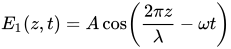
where is the peak amplitude, λ is the wavelength, and is the angular frequency of the wave. The ray reflected from the bottom surface will be delayed by the additional path length and the 180° phase reversal at the reflection, causing a phase shift with respect to the top ray

where is the phase difference between the waves in radians. The two waves will superpose and add: the sum of the electric fields of the two waves is

Using the trigonometric identity for the sum of two cosines: , this can be written

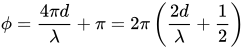
This represents a wave at the original wavelength whose amplitude is proportional to the cosine of , so the brightness of the reflected light is an oscillating, sinusoidal function of the gap width d. The phase difference is equal to the sum of the phase shift due to the path length difference 2d and the additional 180° phase shift at the reflection

so the electric field of the resulting wave will be

This represents an oscillating wave whose magnitude varies sinusoidally between and zero as increases.

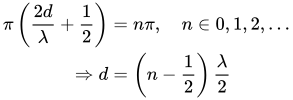
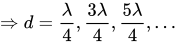
  • Constructive interference: The brightness will be maximum where , which occurs when
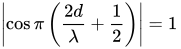
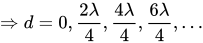
  • Destructive interference: The brightness will be zero (or in the more general case minimum) where , which occurs when
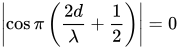
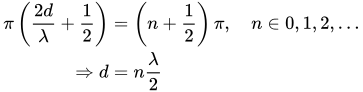
Thus the bright and dark fringes alternate, with the separation between two adjacent bright or dark fringes representing a change in the gap length of one half wavelength (λ/2).

Precision and errors

[edit]
Two λ/10 flats at 589 nm. Although both surfaces have some irregularities, the test shows they are both flat relative to each other. As wringing progresses the thin fringes widen until only a single fringe remains.
A thermal image of an optical flat after handling for just a few seconds. The warmer areas increase the thickness of the flat over cooler areas, distorting the surface accordingly.

Counterintuitively, the fringes do not exist within the gap or the flat itself. The interference fringes actually form when the light waves all converge at the eye or camera, forming the image. Because the image is the compilation of all converging wavefronts interfering with each other, the flatness of the test piece can only be measured relative to the flatness of the optical flat. Any deviations on the flat will be added to the deviations on the test surface. Therefore, a surface polished to a flatness of λ/4 cannot be effectively tested with a λ/4 flat, as it is not possible to determine where the errors lie, but its contours can be revealed by testing with more accurate surfaces like a λ/20 or λ/50 optical flat. This also means that both the lighting and viewing angle have an effect on the accuracy of the results. When lighted or viewed at an angle, the distance that the light must travel across the gap is longer than when viewed and illuminated straight on. Thus, as the angle of incidence becomes steeper, the fringes will also appear to move and change. A zero degree angle of incidence is usually the most desirable angle, both for lighting and viewing. Unfortunately, this is usually impossible to achieve with the naked eye. Many interferometers use beamsplitters to obtain such an angle. Because the results are relative to the wavelength of the light, accuracy can also be increased by using light of shorter wavelengths, although the 632 nm line from a helium–neon laser is often used as the standard.[4]

No surface is ever completely flat. Therefore, any errors or irregularities that exist on the optical flat will affect the results of the test. Optical flats are extremely sensitive to temperature changes, which can cause temporary surface deviations resulting from uneven thermal expansion. The glass often experiences poor thermal conduction, taking a long time to reach thermal equilibrium. Merely handling the flats can transfer enough heat to offset the results, so glasses such as fused silica or borosilicate are used, which have very low coefficients of thermal expansion. The glass needs to be hard and very stable, and is usually very thick to prevent flexing. When measuring on the nanometre scale, the slightest bit of pressure can cause the glass to flex enough to distort the results. Therefore, a very flat and stable work-surface is also needed, on which the test can be performed, preventing both the flat and the test-piece from sagging under their combined weight, Often, a precision-ground surface plate is used as a work surface, providing a steady table-top for testing upon. To provide an even flatter surface, sometimes the test may be performed on top of another optical flat, with the test surface sandwiched in the middle.

Absolute flatness

[edit]

Absolute flatness is the flatness of an object when measured against an absolute scale, in which the reference flat (standard) is completely free of irregularities. The flatness of any optical flat is relative to the flatness of the original standard that was used to calibrate it. Therefore, because both surfaces have some irregularities, there are few ways to know the true, absolute flatness of any optical flat. The only surface that can achieve nearly absolute flatness is a liquid surface, such as mercury, and can sometimes achieve flatness readings to within λ/100, which equates to a deviation of only 6.32 nm (632 nm/100). However, liquid flats are very difficult to use and align properly, so they are typically only used when preparing a standard flat for calibrating other flats.[5]

The other method for determining absolute flatness is the "three-flat test." In this test, three flats of equal size and shape are tested against each other. By analyzing the patterns and their different phase shifts, the absolute contours of each surface can be extrapolated. This usually requires at least twelve individual tests, checking each flat against every other flat in at least two different orientations. To eliminate any errors, the flats sometimes may be tested while resting on edge, rather than lying flat, helping to prevent sagging.[6][7]

Wringing

[edit]
Optical flats being used to calibrate metal parts

Wringing occurs when nearly all of the air becomes forced out from between the surfaces, causing the surfaces to lock together, partly through the vacuum between them. The flatter the surfaces; the better they will wring together, especially when the flatness extends all the way to the edges. If two surfaces are very flat, they may become wrung together so tightly that a lot of force may be needed to separate them.

The interference fringes typically only form once the optical flat begins to wring to the testing surface. If the surfaces are clean and very flat, they will begin to wring almost immediately after the first contact. After wringing begins, as air is slowly forced out from between the surfaces, an optical wedge forms between the surfaces. The interference fringes form perpendicular to this wedge. As the air is forced out, the fringes will appear to move toward the thickest gap, spreading out and becoming wider but fewer. As the air is forced out, the vacuum holding the surfaces together becomes stronger. The optical flat should usually never be allowed to fully wring to the surface, otherwise it can be scratched or even broken when separating them. In some cases, if left for many hours, a block of wood may be needed to knock them loose. Testing flatness with an optical flat is typically done as soon a viable interference pattern develops, and then the surfaces are separated before they can fully wring. Because the angle of the wedge is extremely shallow and the gap extremely small, wringing may take a few hours to complete. Sliding the flat in relation to the surface can speed up wringing, but trying to press the air out will have little effect.

If the surfaces are insufficiently flat, if any oil films or impurities exist on the surface, or if slight dust-particles land between the surfaces, they may not wring at all. Therefore, the surfaces must be very clean and free of debris to get an accurate measurement.[8]

Determining surface shape

[edit]
  1. Initial wringing, 532 nm,
  2. Initial wringing, white light,
  3. Wringing, 1 hour,
  4. Wringing, 2 hours,
  5. Fully wrung,
  6. Fully wrung in white light. The window is slightly concave rather than convex.
A flatness test of a float-glass optical window. By placing a ruler across the image, adjacent to a fringe, and counting how many fringes cross it, the flatness of the surface can be measured along any line. The window has a flatness of 4–6λ (~2100–3100 nm) per inch.
An optical flat test in both green and red. The wavelengths are nearly harmonic opposites (green is λ/4 shorter), so the fringes overlap every fourth red-fringe (every fifth green-fringe), interfering to form yellow fringes.

The fringes act very much like the lines on a topography map, where the fringes are always perpendicular to the wedge between the surfaces. When wringing first begins, there is a large angle in the air wedge and the fringes will resemble grid topography-lines. If the fringes are straight; then the surface is flat. If the surfaces are allowed to fully wring and become parallel, the straight fringes will widen until only a dark fringe remains, and they will disappear completely. If the surface is not flat, the grid lines will have some bends in them, indicating the topography of the surface. Straight fringes with bends in them may indicate a raised elevation or a depression. Straight fringes with a "V" shape in the middle indicate a ridge or valley running across the center, while straight fringes with curves near the ends indicate edges that are either rounded-off or have a raised lip.

If the surfaces are not completely flat, as wringing progresses the fringes will widen and continue to bend. When fully wrung, they will resemble contour topography-lines, indicating the deviations on the surface. Rounded fringes indicate gentle sloping or slightly cylindrical surfaces, while tight corners in the fringes indicate sharp angles in the surface. Small, round circles may indicate bumps or depressions, while concentric circles indicate a conical shape. Unevenly spaced concentric circles indicate a convex or concave surface. Before the surfaces fully wring, these fringes will be distorted due to the added angle of the air wedge, changing into the contours as the air is slowly pushed out.

A single dark-fringe has the same gap thickness, following a line that runs the entire length of the fringe. The adjacent bright-fringe will indicate a thickness which is either 1/2 of the wavelength narrower or 1/2 of the wavelength wider. The thinner and closer the fringes are; the steeper the slope is, while wider fringes, spaced further apart, show a shallower slope. Unfortunately, it is impossible to tell whether the fringes are indicating an uphill or downhill slope from just a single view of the fringes alone, because the adjacent fringes can be going either way. A ring of concentric circles can indicate that the surface is either concave or convex, which is an effect similar to the hollow-mask illusion.

There are three ways to test the surface for shape, but the most common is the "finger-pressure test." In this test, slight pressure is applied to the flat, to see which way the fringes move. The fringes will move away from the narrow end of the wedge. If the testing surface is concave, when pressure is applied to the center of the rings, the flat will flex a little and the fringes will appear to move inward. However, if the surface is convex, the flat will be in point-contact with the surface in that spot, so it will have no room to flex. Thus, the fringes will remain stationary, merely growing a little wider. If pressure is applied to the edge of the flat something similar happens. If the surface is convex the flat will rock a little, causing the fringes to move toward the finger. However, if the surface is concave the flat will flex a little, and the fringes will move away from the finger toward the center. Although this is called a "finger" pressure test, a wooden stick or some other instrument is often used to avoid heating the glass (with the mere weight of a toothpick often being enough pressure).

Another method involves exposing the flat to white light, allowing rainbow fringes to form, and then pressing in the center. If the surface is concave, there will be point-contact along the edge, and the outer fringe will turn dark. If the surface is convex, there will be point-contact in the center, and the central fringe will turn dark. Much like tempering colors of steel, the fringes will be slightly brownish at the narrower side of the fringe and blue on the wider side, so if the surface is concave the blue will be on the inside of the rings, but if convex the blue will be on the outside.

The third method involves moving the eye in relation to the flat. When moving the eye from a zero-degree angle of incidence to an oblique angle, the fringes will appear to move. If the testing surface is concave, the fringes will appear to move toward the center. If the surface is convex, the fringes will move away from the center. To get a truly accurate reading of the surface, the test should usually be performed in at least two different directions. As grid lines, the fringes only represent part of a grid, so a valley running across the surface may only show as a slight bend in the fringe if it is running parallel to the valley. However, if the optical flat is rotated 90 degrees and retested, the fringes will run perpendicular to the valley and it will show up as a row of V- or U-shaped contours in the fringes. By testing in more than one orientation, a better map of the surface can be made.[9]

Long-term stability

[edit]

During reasonable care and use, optical flats need to maintain their flatness over long periods of time. Therefore, hard glasses with low coefficients of thermal expansion, such as fused silica, are often used for the manufacturing material. However, a few laboratory measurements of room temperature, fused-silica optical-flats have shown a motion consistent with a material viscosity on the order of 1017–1018 Pa·s.[10] This equates to a deviation of a few nanometres over the period of a decade. Because the flatness of an optical flat is relative to the flatness of the original test flat, the true (absolute) flatness at the time of manufacture can only be determined by performing an interferometer test using a liquid flat, or by performing a "three flat test", in which the interference patterns produced by three flats are computer-analyzed. A few tests that have been carried out have shown that a deviation sometimes occurs on the fused silica's surface. However, the tests show that the deformation may be sporadic, with only some of the flats deforming during the test period, some partially deforming, and others remaining the same. The cause of the deformation is unknown and would never be visible to the human eye during a lifetime. (A λ/4 flat has a normal surface-deviation of 158 nanometres, while a λ/20 flat has a normal deviation of over 30 nm.) This deformation has only been observed in fused silica, while soda-lime glass still shows a viscosity of 1041 Pa·s, which is many orders of magnitude higher.[11]

See also

[edit]

References

[edit]
Revisions and contributorsEdit on WikipediaRead on Wikipedia
from Grokipedia
An optical flat is a precision optical tool consisting of a plate, typically made from high-quality or , that is lapped and polished to achieve extreme surface flatness on one or both sides, often within a few tens of nanometers or a fraction of a . These devices serve as reference standards in to assess the flatness of other surfaces, such as optical components or mechanical parts, by exploiting the principles of optical . In operation, an optical flat is placed in gentle contact or near proximity to the test surface under illumination from a monochromatic source, such as a sodium or helium-neon lamp, which generates interference fringe patterns due to the thin air between the surfaces. These fringes, resembling contour lines, indicate deviations from perfect flatness; for instance, straight parallel fringes denote a flat surface, while curved or irregular patterns reveal convex or concave irregularities, with each fringe typically corresponding to a deviation of about 0.295 micrometers (one band). The method provides non-contact, high-resolution measurements accurate to nanometers, making it essential for in . Optical flats are widely applied in the fabrication and testing of optical elements like lenses, mirrors, prisms, filters, and laser crystals, as well as in calibrating gauge blocks and aligning components in interferometers or telescopes. They are fabricated using techniques similar to those for high-quality mirror substrates, involving meticulous polishing and verification with interferometers or liquid references, and are available in diameters ranging from 1 to 12 inches with flatness grades such as λ/10 or better. Materials like fused silica are preferred for their low thermal expansion coefficient (around 0.55 × 10⁻⁶ K⁻¹), ensuring stability in varying conditions. Despite their precision, interpretation requires expertise, and they are limited to reflective or near-reflective test surfaces.

Introduction

Definition

An optical flat is an optical-grade piece of or lapped and polished to extreme flatness on one or both sides, typically achieving deviations within a few tens of nanometers, such as λ/10 to λ/20 where λ represents the of used (often 632.8 nm for helium-neon lasers). Its primary function is to serve as a reference standard in for assessing the flatness of unknown surfaces, where contact between the optical flat and the test surface generates light interference patterns that reveal deviations. These patterns, known as fringes, provide a visual indication of surface irregularities without requiring direct mechanical measurement. Key specifications include diameters commonly ranging from 25 mm to 150 mm to accommodate various test surfaces, thicknesses of approximately 10-20 mm to ensure mechanical stability during use, and surface finishes with scratch-dig ratings of 40-20 or better for minimal defects that could interfere with observations. Unlike mechanical , which measure length through physical contact and wringing, optical flats depend on optical interference for precise flatness evaluation, enabling sub-wavelength accuracy.

Historical development

The development of optical flats originated in the late , closely tied to advancements in pioneered by . In the 1880s, Michelson employed highly polished glass flats as beam splitters and reference surfaces in his interferometer experiments, enabling precise measurements of light wavelengths and laying the groundwork for their use in flatness testing through interference patterns. These early flats, typically made from optical glass, marked the transition from mechanical gauging to optical , with Michelson's work demonstrating their potential for sub-wavelength accuracy in surface evaluation. In the early , optical flats gained widespread adoption for precision , particularly in calibration at the National Bureau of Standards (NBS, now NIST). By the , researchers C. G. Peters and H. S. Boyd refined interferometric techniques using master optical flats to assess end-face flatness, achieving standardization to within a few millionths of an inch (approximately 25 nm). This effort, spurred by demands for accurate length standards, established optical flats as essential tools for industrial calibration, with NBS producing sets of certified via these methods. Post-World War II advancements focused on enhancing material stability and illumination consistency. By 1950, NBS publications described the use of quartz glass test flats in interferometric methods for calibrating end standards, improving thermal stability due to the material's low coefficient of expansion and reducing measurement errors in varying environmental conditions. Concurrently, integration with monochromatic light sources, such as sodium lamps emitting at 589 nm, refined fringe visibility and accuracy in interference testing. By the 2020s, modern optical flats, often fabricated from fused silica for superior homogeneity and durability, support sub-nanometer precision through integration with interferometry in semiconductor manufacturing. These developments enable atomic-scale flatness verification for masks and wafers, with systems like Fizeau interferometers achieving resolutions below 0.1 nm over large apertures.

Manufacturing and materials

Production process

The production of optical flats begins with the selection of high-quality as the primary material, valued for its exceptional thermal stability and optical transparency, which minimize distortions during fabrication. Raw quartz blanks are initially shaped through rough grinding using tools on surface grinders operating at speeds around 1200 rpm, removing excess material to achieve an approximate flat form within 1 mm of the final dimensions and ensuring initial parallelism. Following rough shaping, the process refines the surface flatness and parallelism. This involves the three-plate method, where sets of three plates are iteratively lapped against one another using loose slurries, such as cerium oxide suspended in a , applied on grooved plates that provide a stable, self-correcting grinding medium. The plates are rubbed in a controlled planetary motion under light pressure, progressing through grit sizes from 120 μm down to 3 μm across multiple stages—roughing, pre-grinding, fine grinding—to embed and dislodge effectively, achieving parallelism within a few microns and on the order of micrometers. plates are preferred for their composite structure of hard and soft ferrite, which helps maintain even abrasion and plate flatness during the process. Cerium oxide serves as the key due to its chemical reactivity with silica, enhancing material removal while promoting uniformity. For the final surface figure, fine employs pitch laps—tools formed from a mixture of hard or soft pitch, often preconditioned for optimal conformance—charged with in an alkaline hydrosol. The workpiece is placed on the rotating pitch lap (typically motorized at low speeds with an overarm for even pressure), where the facilitates chemical-mechanical action, reducing to below 1 nm RMS over several hours of . Progress is monitored iteratively using a , which illuminates the surface with a monochromatic source to reveal interference fringes; deviations are corrected by adjusting lap pressure, concentration, or dwell time on high spots, ensuring the surface approaches the target flatness. This step yields optically smooth, low-scatter surfaces suitable for precision . Certification involves final testing against a master optical flat or absolute reference standard under a at 632.8 nm , where the assembled pair is observed for straight, parallel fringes indicating deviations no greater than λ/20 peak-to-valley (approximately 32 nm). This verification, often conducted in a controlled environment to avoid thermal gradients, confirms the flat's suitability for applications and includes documentation of the measured flatness error. Fused quartz's properties, such as low , are critical here to maintain stability during testing (see Material properties).

Material properties

Optical flats are primarily fabricated from materials that exhibit exceptional dimensional stability, optical clarity, and mechanical durability to ensure reliable applications. The most common materials are fused silica and glass-ceramic, selected for their low coefficients of (CTE), which minimize shape changes under temperature variations and preserve flatness during use. Fused silica, a synthetic form of quartz, has a CTE of approximately 0.55×10⁶/C0.55 \times 10^{-6} /^\circ\mathrm{C}, providing high thermal stability suitable for precision environments. Zerodur, a lithium aluminosilicate glass-ceramic, achieves an even lower near-zero CTE of 0±0.02×10⁶K10 \pm 0.02 \times 10^{-6} \mathrm{K}^{-1} over 0–50°C, making it ideal for applications requiring extreme dimensional consistency, such as in astronomical optics or high-end metrology. Optically, these materials offer high transparency in the , with fused silica transmitting over 90% from 400–700 nm, enabling clear interference fringe observation without significant light absorption or . Both exhibit low —typically less than 4 nm/cm for fused silica—ensuring uniform and avoiding polarization-induced distortions in measurements. Additionally, their high homogeneity, with variations below 10510^{-5} across the material, prevents internal aberrations that could compromise flatness assessment. Mechanically, fused silica's Mohs of 7 resists scratching during wringing contact, while its polishability allows surfaces to achieve root-mean-square (RMS) roughness below 1 nm, essential for resolving sub-wavelength deviations. Zerodur shares similar (around Mohs 6) and can be polished to comparable , though its composite enhances resistance to . A key trade-off involves cost and performance: ordinary glasses like BK7 are cheaper but have higher CTE values (around 8×10⁶/C8 \times 10^{-6} /^\circ\mathrm{C}), leading to greater thermal drift and limiting their use in high-precision labs, where fused silica or is preferred for superior stability.

Principles of operation

Light interference basics

Light exhibits wave properties that enable interference phenomena, where coherent waves superimpose to produce regions of enhanced or reduced intensity. In the context of optical flats, monochromatic coherent is essential for generating clear interference patterns. A common source is a , which emits primarily at a of 589 nm, providing the necessary spectral purity for . When this light strikes the air-glass interface formed between an optical flat and a test surface, partial reflection occurs at the two boundaries of the thin air gap, while the remainder transmits through. These reflected waves—one from the bottom surface of the flat (glass-air interface, no phase shift) and one from the top surface of the test piece (air-glass interface, π phase shift)—recombine after traveling different paths, leading to interference based on their phase difference. The condition for interference depends on the optical path length difference δ=2μtcosθ\delta = 2 \mu t \cos \theta, where μ\mu is the of the medium in the gap (typically air, so μ=1\mu = 1), tt is the gap thickness, and θ\theta is the angle of incidence relative to . Due to the relative π phase shift, destructive interference, producing dark fringes, occurs when δ=mλ\delta = m \lambda for mm, while constructive interference, yielding bright fringes, happens when δ=(m+1/2)λ\delta = (m + 1/2) \lambda. This results in visible bands whose positions reveal variations in gap thickness. Fizeau fringes specifically arise in setups involving two nearly parallel plates, such as an optical flat and a test surface, where interference is due to the slight wedge shape or in the air gap between them. These multiple-beam interferences provide high-contrast patterns sensitive to surface irregularities. For effective testing with optical flats, the light source must have a exceeding the maximum path difference in the air gap (typically on the order of micrometers) to ensure stable fringes and resolve nanometer-scale deviations in surface flatness. Sodium lamps meet this requirement through their narrow linewidth, enabling path differences on the order of micrometers to produce observable interference without washout.

Fringe pattern formation

When an optical flat is wrung onto a test surface, an ultrathin air forms between them, with the gap thickness h(x,y)h(x,y) varying spatially due to deviations in the test surface's flatness from the ideal plane of the optical flat. Monochromatic incident normally on this film undergoes partial reflection at both the upper (air-glass) and lower (glass-air) interfaces, producing two coherent beams that interfere upon recombination. The interference arises from the difference (OPD) of 2h2h in the air film (n1n \approx 1), combined with a phase shift of π\pi upon reflection from the denser medium at the lower interface (no shift at the upper air-to-glass reflection). The total phase difference is thus δ=4πhλ+π\delta = \frac{4\pi h}{\lambda} + \pi, where λ\lambda is the . The resulting intensity is I=2I0(1+cosδ)=2I0(1cos4πhλ)I = 2I_0 \left(1 + \cos \delta \right) = 2I_0 \left(1 - \cos \frac{4\pi h}{\lambda} \right), with I0I_0 the intensity of each beam (assuming equal amplitudes). Destructive interference (dark fringes) occurs when δ=(2m+1)π\delta = (2m+1)\pi, simplifying to 2h=mλ2h = m\lambda or fringe order m=2hλm = \frac{2h}{\lambda} ( m0m \geq 0); the zero-order fringe (m=0m=0, dark) appears at actual contact points where h=0h=0. Constructive interference (bright fringes) occurs at 2h=(m+12)λ2h = (m + \frac{1}{2})\lambda. This simplified Airy equation holds for normal incidence and negligible multiple reflections in the . The spatial variation of h(x,y)h(x,y) determines the fringe pattern geometry. For a linear tilt (wedge-shaped gap with small angle α\alpha), h(x)xαh(x) \approx x \alpha, yielding straight, parallel dark fringes spaced by Δx=λ2sinαλ2α\Delta x = \frac{\lambda}{2 \sin \alpha} \approx \frac{\lambda}{2\alpha} (in radians), where adjacent fringes differ by Δm=1\Delta m = 1. For quadratic deviations like convexity or concavity, the fringes form approximate concentric circles centered near the extremum, with local spacing inversely related to the .

Flatness testing procedure

Surface preparation

Surface preparation is essential for ensuring accurate interference fringe patterns during optical flat measurements, as any contaminants or irregularities can introduce errors in flatness assessment. The optical flat and the test surface must be meticulously cleaned to remove particulates, oils, and residues that could distort the air film between them. A common procedure involves initial ultrasonic cleaning in a bath containing reagent-grade isopropyl alcohol or acetone to dislodge stubborn contaminants without damaging the polished surfaces. Following the ultrasonic step, surfaces are wiped gently with lint-free lens tissue or a soft cloth to eliminate any remaining particles, ensuring absolute cleanliness. Fingerprints must be avoided, as they deposit oils that cause localized distortions in the interference pattern by altering the refractive index of the air wedge. Proper handling techniques prevent scratches or contamination during preparation and placement. Padded cotton or powder-free latex gloves should be worn to avoid direct skin contact, while vacuum tweezers or soft-tipped forceps are recommended for manipulating the optical flat, particularly for larger or delicate pieces. The optical flat should never be slid across the test surface; instead, it is placed and removed vertically to minimize abrasion. Storage in dust-free protective cases is critical to maintain surface integrity between uses, preventing accumulation of airborne particles that could compromise subsequent measurements. The test surface must meet specific requirements for reliable contact and interference visibility. It should be highly smooth with a typically below Ra 0.1 μm to ensure clear fringe formation, and free of or defects that might trap air or contaminants. After preparation, the surfaces are ready for wringing, where molecular adhesion brings them into close proximity for testing. Environmental conditions must be controlled to mitigate and moisture effects that could alter surface dimensions or introduce haze in the interference field. Testing is typically conducted at a stable of 20 ± 1°C to minimize differential expansion between the optical flat and test piece. Relative humidity should be maintained below 50% to prevent or static attraction of dust, ensuring consistent measurement conditions.

Illumination and observation

In optical flat testing, monochromatic sources are essential for generating high-contrast interference fringes that reveal surface deviations. Low-pressure sodium lamps, emitting at a of 589 nm, and helium-neon lasers, at 632.8 nm, are commonly used due to their single- output, which produces distinct patterns without the interference blurring from multiple wavelengths in white . White is avoided because its polychromatic nature causes overlapping fringe orders, reducing visibility and accuracy. The standard setup positions the optical flat directly on the test surface, with illumination provided by a dedicated monolight unit featuring a frosted lens for diffuse, even across the area. This diffuse illumination ensures uniform fringe formation, while a controlled dark environment enhances contrast by minimizing ambient interference. For surfaces requiring enhanced fringe highlighting, grazing incidence can be applied by directing the at a shallow angle to the assembly. Fringes are typically observed with the for qualitative evaluation of flatness, allowing immediate assessment of pattern straightness and spacing. For quantitative measurements, a or photographic recording is employed to capture fine details and enable precise counting. To mitigate the effects of setup tilt, the optical flat is rotated in multiple orientations (e.g., 90 degrees), averaging observations to distinguish true surface irregularities from alignment errors. Deviation from flatness is determined by fringe counting, where the height difference hh across the pattern is given by h=mλ2h = \frac{m \lambda}{2}, with mm as the fringe order and λ\lambda the light wavelength; this yields a resolution of approximately 0.3 μm per fringe using sodium light.

Wringing and contact mechanics

Wringing mechanism

The wringing mechanism enables an optical flat to adhere temporarily to the test surface through intimate molecular contact, without the use of adhesives. The process begins with thoroughly cleaning both the optical flat and the test surface to remove contaminants such as dust, oils, or residues, typically using solvents like acetone or ethyl alcohol followed by dry wiping with lens tissue. The surfaces are then pressed together under light pressure, often accompanied by a gentle twisting or sliding motion to expel trapped air and particles, resulting in a near-zero gap across much of the contact area. This forms rapidly upon initial contact if the surfaces are sufficiently flat and clean, allowing the optical flat to remain in place during flatness testing. The physics underlying wringing relies primarily on short-range intermolecular forces, including van der Waals dispersion forces between atoms in the contacting materials, such as fused silica commonly used for optical flats. These forces generate an strength of approximately 100-200 psi at , sufficient to hold the flat securely yet permitting shear forces for repositioning via sliding without breaking the bond. forces from adsorbed water films on the surfaces can also contribute, particularly in ambient , enhancing the overall adherence through liquid-mediated attraction at the contact points. The bonding is not solely due to , as experiments in demonstrate persistent attributable to these molecular interactions. Effective wringing requires both surfaces to be precisely lapped or polished to high flatness, typically with deviations less than λ/20 (e.g., ~28 nm for λ ≈ 546 nm green light) and surface roughness of 15-30 RMS to minimize uncontacted regions and ensure complementary that allows errors to cancel out. The contact area achieved depends on this match, often leaving small uncontacted islands if imperfections exist, but generally covering a substantial portion for accurate measurements. Adhesion duration varies from minutes to hours, influenced by environmental factors like , which can promote effects but also introduce contamination that weakens the bond over time; in controlled dry conditions, bonds can persist longer without separation.

Impact on measurements

Wringing significantly reduces the air gap between the optical flat and the test surface to less than 25 nm, far below λ/4 (approximately 137 nm for green light at 546 nm ), which eliminates diffuse reflections and enables the observation of distinct zero-order interference fringes. This minimal gap allows for the detection of minute surface deviations, with resolutions as fine as 0.01 fringes corresponding to about 3 nm (based on λ/2 ≈ 273 nm per full fringe shift in the air film). In the wrung state, the effective measurement resolution approximately doubles compared to non-contact configurations, where larger gaps lead to broader fringe patterns and reduced sensitivity to small irregularities. The wringing process facilitates error compensation by measuring relative flatness, where imperfections in the optical flat and test surface tend to average out during contact, particularly when the surfaces are uncorrelated or when multiple orientations are used in procedures. This improves the overall accuracy of flatness assessment by focusing on differential deviations rather than absolute errors in either surface. However, limitations arise from incomplete wringing, such as when contaminants like prevent full molecular , resulting in residual air films that introduce artificial tilts or distortions in the fringe patterns and compromise measurement reliability. Proper surface and technique are essential to mitigate these effects and ensure valid results.

Precision and limitations

Achieving measurement precision

Optical flats enable sub-micrometer surface flatness measurements through interferometric principles, achieving typical precisions of 25-50 nm for standard grades over diameters up to 100 mm. Master-grade flats, used as reference standards, attain flatness specifications of 10-20 nm across similar apertures, allowing detection of deviations as fine as a fraction of a light fringe under monochromatic illumination. These levels are realized by polishing fused quartz or similar low-expansion materials to tolerances expressed in fractions of the illuminating wavelength (e.g., λ/20 ≈ 32 nm for 633 nm light), ensuring minimal intrinsic distortion in the reference surface. Key to deriving absolute flatness from relative interferograms is the application of multiple wringing configurations, such as 3-way assemblies, which average out systematic profile errors across orientations. In a 3-way wringing, the optical flat is successively contacted and rotated relative to two others, enabling computation of the true surface map independent of individual tilts or rotations. Such techniques transform relative fringe patterns into absolute flatness profiles, with wringing films limited to ~25 nm to preserve interference clarity. Calibration of optical flats traces to NIST standards through interferometric comparison in a Fizeau or similar setup, where the test flat is aligned against a certified master under controlled conditions. This process yields an of typically ±5-10 nm, dominated by random repeatability (standard deviation 1-6 nm) and systematic contributions from alignment and master reference errors. NIST employs the 3-flat intercomparison method for master , ensuring with coverage factors accounting for environmental variances. Enhancing precision further involves stringent to ±0.1°C, mitigating distortions. Stable thermal environments, often achieved via insulated enclosures, minimize gradient-induced tilts, preserving the sub-10 nm resolution essential for applications.

Sources of error

Systematic errors in optical flat measurements primarily stem from misalignment and optical setup imperfections. Tilt misalignment between the reference flat and the test surface can produce off-axis beam propagation, leading to distorted fringe patterns and potential interpretation errors equivalent to up to one fringe across the . Similarly, the use of non-monochromatic sources reduces fringe contrast by introducing broadening, which blurs interference bands and can result in assessment inaccuracies of approximately 0.5 fringe. Random errors are often induced by environmental disturbances during observation. Dust particles or contaminants on the optical surfaces can create localized false contours in the fringe field, mimicking surface irregularities, while vibrations from ambient sources cause fringe instability and motion blur in the pattern. These effects are commonly mitigated by performing measurements in multiple surface orientations and averaging results, as well as employing vibration-isolated platforms. Thermal gradients across the flat or test piece can further contribute to random variations by inducing transient bowing, with typical sensitivities of around 10 nm per °C for fused silica substrates due to differential expansion. Instrumental errors arise from limitations in the apparatus itself. The inherent figure error of the reference optical flat directly propagates into the test result, as the observed fringes reflect deviations from both the test surface and the ; this can be corrected by employing witness flats or multi-flat comparison techniques to subtract the 's contribution. Wavelength instability in the illumination source, such as laser drift, introduces phase shifts that alter fringe spacing, with common stabilities achieving ±0.1 nm in controlled setups. To quantify overall measurement reliability, an uncertainty budget is typically assembled using the root sum square (RSS) combination of these error components, including contributions from alignment, noise, and environmental factors. For high-end Fizeau-based optical flat systems, this yields total uncertainties on the order of ±λ/50, as demonstrated in absolute flatness assessments with expanded uncertainties around ±0.0071 µm at λ = 633 nm.

Advanced applications

Surface shape determination

Optical flats enable qualitative mapping of non-flat surface profiles by analyzing the curvature and orientation of interference fringes formed during contact. When the optical flat is wrung onto the test surface, straight, equally spaced fringes indicate local flatness, while bowed or curved fringes reveal deviations, with the direction of bowing signifying convex (fringes bowing inward) or concave (fringes bowing outward) regions. To isolate specific zones of irregularity, the flat is rotated in 90° increments and re-wringed, allowing observation of fringe patterns in directions; a surface appearing flat in one orientation may exhibit in another, thus identifying the principal axes of deviation. For quantitative surface shape determination, phase-shifting interferometry () employs the optical flat as a high-precision to generate a detailed . In this technique, the flat is placed in contact or near-contact with the test surface under monochromatic illumination, producing interferograms; controlled phase shifts (typically via piezoelectric transducers) are introduced to capture a series of images, from which the phase difference is computed to yield height variations with sub-wavelength accuracy. This method extends beyond binary flatness assessment by reconstructing the full 3D profile through unwrapping the phase map, often achieving resolutions better than 1 nm over areas up to 50 mm in diameter, as demonstrated in measurements of optical flats themselves where the technique resolves surface figure errors to λ/10000 (approximately 0.06 nm at 632.8 nm). Hybrid methods further enhance capability by integrating optical flat with profilometry, using the former for broad-area, non-contact fringe-based profiling and the latter for localized, high-vertical-resolution tracing (down to 0.1 nm), particularly useful for validating complex topographies in precision manufacturing. In software-based analysis, digitized fringe patterns from optical flat measurements are processed using techniques to demodulate the phase, followed by fitting to that decompose the surface into orthogonal aberration modes such as piston, tilt, defocus, and higher-order terms. This representation quantifies deviations efficiently, enabling aberration correction and predictive modeling for applications like molding, where surface irregularities must be mapped to nanometer scales, or flatness verification, achieving effective resolutions of 1 nm over 50 mm apertures through enhanced .

Long-term stability

Optical flats are susceptible to gradual degradation over extended periods, primarily from surface and micro-scratches incurred during repeated wringing processes. , such as or residues, can accumulate and alter interference fringe patterns, while improper wringing—particularly full contact without lateral sliding—risks introducing fine scratches that compromise surface figure and lead to a loss in flatness of several nanometers annually if not addressed. Fused silica optical flats exhibit remarkable long-term stability, with measurements indicating less than 1 nm of drift over 10 years under constant temperature conditions, attributed to the material's low and high viscosity relaxation time constant of approximately 10 years. For example, interferometric monitoring of flats stored horizontally revealed peak-to-valley deformations of 6.7–7.6 nm over 6–9 years, often manifesting as slight concavity due to gravitational effects. Periodic recertification every 1–2 years is recommended to verify performance, especially for high-precision applications, as individual flats may vary in response to environmental stresses. To preserve stability, maintenance involves annual cleaning with lint-free tissues and to remove contaminants, followed by interferometric rechecking to detect any figure changes. Flats should be stored and used in environments with below 50% to mitigate hydrolytic degradation, which can etch surfaces through water molecule interactions, particularly in non-silica . When properly stored in dry, stable conditions, optical flats have an indefinite , though quartz-based (fused silica) variants demonstrate superior aging resistance compared to standard due to enhanced chemical inertness and minimal structural relaxation.

References

Add your contribution
Related Hubs
User Avatar
No comments yet.