Hubbry Logo
Palace of TauPalace of TauMain
Open search
Palace of Tau
Community hub
Palace of Tau
logo
8 pages, 0 posts
0 subscribers
Be the first to start a discussion here.
Palace of Tau
Palace of Tau
from Wikipedia
Hall of the Tau

Key Information

Palace of Tau (French: Palais du Tau) in Reims, France, was the palace of the Archbishop of Reims. It is associated with the kings of France, whose coronation was held in the nearby cathedral of Notre-Dame de Reims and the following coronation banquet in the palace itself. Because of its historical importance for the French monarchy, the Palace of Tau was inscribed on the UNESCO World Heritage List in 1991.[1] Today, it serves to host cultural events for the city of Reims. In recent years it has been the setting for Sciences Po Paris's RIMUN association's annual gala.

History

[edit]

A large Gallo-Roman villa still occupied the site of the palace in the 6th and 7th centuries, and later became a Carolingian palace. The first documented use of the name dates to 1131, and derives from the plan of the building, which resembles the letter Τ (tau, in the Greek alphabet). Most of the early building has disappeared: the oldest part remaining is the chapel, from 1207. The building was largely rebuilt in Gothic style between 1498 and 1509, and modified to its present Baroque appearance between 1671 and 1710 by Jules Hardouin-Mansart and Robert de Cotte. It was damaged by a fire on 19 September 1914, and not repaired until after the Second World War.[2]

The Palace was the residence of the kings of France before their coronation in Notre-Dame de Reims. The king was dressed for the coronation at the palace before proceeding to the cathedral; afterwards, a banquet was held at the palace. The first recorded coronation banquet was held at the palace in 990, and the most recent in 1825.

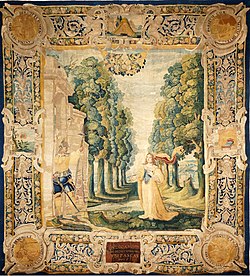
The palace has housed the Musée de l'Œuvre since 1972, displaying statuary and tapestries from the cathedral, together with the remains of the cathedral treasury and other objects associated with the coronation of the French kings.[citation needed]

The Palace of Tau, together with the Cathedral of Notre-Dame and the former Abbey of Saint-Remi, became a UNESCO World Heritage Site in 1991.[3] It attracts around 100,000 visitors each year.[4]


See also

[edit]

References

[edit]
[edit]
Revisions and contributorsEdit on WikipediaRead on Wikipedia
from Grokipedia
The Palace of Tau (French: Palais du Tau) is a historic former archiepiscopal palace in Reims, France, originally constructed in the late 4th century on the site of a Gallo-Roman dwelling and serving as the residence of the Archbishops of Reims, who held significant temporal power as Dukes and First Peers of France from the 13th century onward. Adjoining the Notre-Dame Cathedral, it played a pivotal role in the coronation ceremonies of 33 French kings, from Louis the Pious in 816 to Charles X in 1825, where monarchs would pray in its Palatine Chapel, rest in royal chambers, and host banquets in the grand hall following the rite. Rebuilt multiple times after fires and conflicts—including a major Gothic remodeling around 1500 and a transformation into a classical Baroque structure between 1671 and 1710—it functions as a museum housing the Musée de l’Œuvre collection of cathedral sculptures, tapestries like the Life of the Virgin Mary series, and coronation artifacts, while forming part of the UNESCO World Heritage Site inscribed in 1991 alongside the cathedral and the former Abbey of Saint-Rémi. Since January 2023, the palace has been closed for extensive renovations and is scheduled to reopen in spring 2026 as the Musée des Sacres, dedicated to the history of French royal coronations. The palace's architectural evolution reflects centuries of adaptation, beginning as a fortified episcopal house with a 13th-century chapel, evolving into Gothic elements in the late 15th and early 16th centuries—such as the rib-vaulted lower hall and ornate banqueting hall—and culminating in its current 17th-century classical façade designed by , featuring pilasters and pediments that emphasize its grandeur. Classified as a historic since 1886 (with the full site listed in 1907), it endured damage during in 1914 and subsequent restorations, including a comprehensive overhaul from 1950 to 1972 that preserved its hybrid styles while adapting it for public exhibition. The Palace of Tau preserves ' royal heritage and underscores the city's role as the traditional coronation capital of , drawing visitors to explore its ceremonial rooms and artifacts that illuminate medieval and early modern European monarchy.

History

Origins and Early Development

The Palace of Tau in Reims traces its origins to the late 4th century, when it was constructed as a fortified house on the site of an ancient Gallo-Roman dwelling located south of what would become the Cathedral of Notre-Dame. This early structure reflected the transitional architecture of the period, blending Roman influences with emerging defensive features suited to a region undergoing political and cultural shifts. By the early , as solidified as the under the , the site transformed into the residence of the Bishop of . Saint Nicaise, the eleventh bishop, settled there and initiated the construction of a dedicated to Notre-Dame, establishing the palace as the episcopal seat and a center of authority adjacent to the new . This shift aligned with the broader of , where episcopal residences often incorporated basic fortifications and living quarters to serve both spiritual and administrative roles. During the Merovingian era (5th–8th centuries), the site continued to host a substantial Gallo-Roman-style villa through the 6th and 7th centuries, suggesting modest expansions for residential and possibly defensive purposes amid the fragmentation of Roman infrastructure. In the subsequent Carolingian period (8th–10th centuries), the residence developed further into a more formalized palatial complex, functioning as both the archbishop's home and a hub of temporal power within the cathedral quarter. Archaeological evidence, including foundations from the Gallo-Roman phase and early medieval artifacts, has been identified beneath the current structure, confirming the site's layered occupation through these formative centuries.

Medieval Reconstruction

Following the devastating fire that ravaged both and the adjacent Palace of Tau on May 6, 1210, reconstruction of the palace began in the early , incorporating early Gothic architectural features characteristic of the period's innovative stonework and ribbed vaults. This effort aligned with the broader rebuilding of the cathedral quarter under Archbishop Aubry de Humbert (r. 1207–1218), who oversaw the initiation of major works to restore the archbishop's residence as a center of power. By around 1220, the palace's core structures were reinforced with pointed arches and flying buttress precursors, marking a shift from its earlier Romanesque foundations to a more luminous and vertically oriented Gothic style. The reconstruction expanded the palace to better serve its dual role in royal s, adding ceremonial halls for pre-coronation preparations and banquets, as well as private chapels to facilitate liturgical rites tied to the sacred anointing ceremonies at Notre-Dame Cathedral. A prominent addition was the two-storey palatine chapel, constructed specifically during this phase to provide an intimate space for the archbishop's devotions and royal prayers, exemplifying the era's emphasis on light-filled interiors through expansive windows and . These developments occurred amid ' longstanding role as the coronation site for French kings from in 816 to Charles X in 1825, underscoring the palace's transformation into a multifunctional complex blending administrative, religious, and monarchical functions. The palace's rebuilding integrated closely with the ongoing construction of Notre-Dame Cathedral, begun in 1211, as both projects drew from the same pool of skilled masons and architectural motifs, such as sculpted portals and ornamental detailing that echoed the cathedral's facade. Key medieval additions included adapted spaces for communal meals and cloister-like areas that supported contemplative and ceremonial activities, repurposed to host royal entourages during coronation festivities. Historical accounts document that funding for these works derived substantially from papal indulgences granted to encourage donations, supplemented by contributions from local nobility who viewed support for ' sacred institutions as a pious obligation.

Post-Medieval Transformations

In the , the Palace of Tau underwent significant remodeling in the Gothic style under the direction of Archbishops Guillaume Briçonnet (1497–1507) and Robert de Lenoncourt (1508–1532), reflecting evolving architectural tastes that bridged late medieval and emerging influences. This period saw the construction of a rib-vaulted lower hall and enhancements to the banqueting hall, which served as the venue for feasts and remains largely intact today, preserving its role in royal traditions. By the late 17th and early 18th centuries, the palace was comprehensively transformed into a neoclassical structure between 1671 and 1710, under the supervision of architects , Louis XIV's principal architect, and his pupil Robert de Cotte. This remodeling introduced grand classical facades, including a prominent 17th-century order on the exterior, along with monumental staircases and interiors that emphasized symmetry and proportion, marking a shift from Gothic forms to the rational aesthetics of the Grand Siècle. The project nearly entirely rebuilt the residence, adapting it for continued use by the Archbishop of while enhancing its prestige as a setting for royal ceremonies. The palace's expansions in the early 18th century, completing the neoclassical redesign, incorporated additional Baroque-inspired elements in select salons, though these were subordinate to the dominant classical framework established by Mansart and de Cotte. This stylistic evolution underscored the palace's adaptation to the opulent tastes of the ancien régime, maintaining its functional role in hosting coronation-related events. The brought a sharp decline to the Palace of Tau, which was seized as national property in 1793 and repurposed as a , , , and , disrupting its and royal functions. In 1792, revolutionary decrees led to the removal and partial looting of its treasures, including the sacred , which was transported to Saint-Denis and nearly melted down by the Mint, symbolizing the era's iconoclastic fervor against monarchical symbols. Following the Revolution, the palace was restored in preparation for the coronation of Charles X in 1825, marking its final use in a royal ceremony. Around 1860, a large wing along rue du Cardinal de Lorraine was added based on plans by architect Eugène Viollet-le-Duc, further adapting the structure to contemporary needs while preserving its historical character.

Architecture

Overall Layout

The Palace of Tau features a distinctive T-shaped plan originating from its medieval configuration, with the expansive Salle du Tau serving as the crossbar and two wings projecting forward to form the stem, a design that inspired its name from the Greek letter τ. This spatial organization positions the central block directly facing the adjacent Notre-Dame Cathedral, creating a symmetrical axial alignment that emphasizes its role as an extension of the ecclesiastical complex. The layout encompasses the main hall, wings, and connecting elements that integrate residential, ceremonial, and administrative spaces. Surrounding the palace are formal gardens and perimeter walls, which were enhanced in the to provide enhanced privacy and delineate the archbishopric's grounds from the surrounding urban fabric. These additions enclose the courtyards and garden areas, maintaining a secluded environment while allowing visual continuity with the . Accessibility to the palace is primarily through its main entrance on Place du Cardinal Luçon, situated at 2 Place du Cardinal Luçon, with direct pedestrian connections to the via shared forecourts and pathways that facilitate movement between the two monuments. The palace integrates topographically with Reims' historic urban landscape by occupying a slightly elevated position on a gentle hill within center, a site originally chosen for defensive advantages in its Gallo-Roman origins. This elevation enhances its prominence alongside the , forming a cohesive ensemble in the medieval quarter while adapting to the sloping terrain for . The layout evolved from an early foundation through successive reconstructions to its present form, preserving the essential T-shaped footprint amid later modifications. As part of the 2022-2025 restoration project, the palace underwent enhancements to its structure and interiors, including new , in preparation for reopening as the Musée des Sacres.

Gothic and Classical Elements

The Palace of Tau exemplifies a harmonious blend of Gothic and classical architectural influences, resulting from successive rebuilds that preserved medieval elements while incorporating later and modifications. The structure's core Gothic features date to the 13th century, particularly in the Palatine Chapel, constructed around 1207 as a two-story palatine chapel following a that destroyed earlier buildings. This chapel showcases early Gothic characteristics, including pointed arches that direct the eye upward and ribbed vaults that distribute weight efficiently, allowing for taller interiors and larger windows. Remnants of , though limited due to historical damage and restorations, highlight the chapel's role in medieval liturgical spaces; the 2022-2025 restoration incorporated thirteen contemporary windows (each 8 x 2 meters) by artists Anne and Patrick Poirier to complement surviving fragments and accentuate the Flamboyant Gothic style. In the late 15th and early 16th centuries, under archbishops Guillaume Briçonnet and Robert de Lenoncourt, the palace underwent a major reconstruction in the Flamboyant Gothic style, adding ornate details to the overall framework. This phase introduced ribbed vaults in the lower hall and intricate stone tracery, enhancing the building's verticality and light-filled interiors typical of late Gothic design. The T-shaped layout served as the foundation for these elements, integrating the chapel with expanded residential and ceremonial spaces. Iconographic details from this era include sculpted bishops' crests and insignia carved into doorways and lintels, symbolizing the palace's and monarchical significance as the archbishop's residence adjacent to . These carvings, often featuring motifs and episcopal symbols, underscore the building's ties to French royal coronations. The 17th and 18th centuries brought classical additions during a comprehensive transformation led by architects and Robert de Cotte between 1671 and 1710, shifting the palace toward Baroque classicism. This renovation imposed symmetrical facades on the exterior, with a grand entrance featuring Corinthian columns supporting pediments adorned with sculpted reliefs, evoking the ordered proportions of adapted to French grandeur. Inside the grand apartments, classical elements like pilasters and entablatures framed ceremonial rooms, creating balanced, harmonious spaces suited for royal banquets and preparations. flooring in these areas, often in black and white checker patterns, added opulence, while paneling provided warm, durable interiors for the archbishop's suites. The engineering of this phase included reinforced to accommodate the added weight of lavish decorations and to support displays of heavy regalia, such as crowns and orbs, ensuring structural stability for the palace's ceremonial functions. Local formed the primary material for walls and facades, quarried from nearby regions and prized for its fine grain and weather resistance in Gothic and classical constructions alike.

Royal Associations

Role in Coronations

The Palace of Tau served as the primary residence and preparation site for French kings prior to their ceremonies at , functioning as a ceremonial hub intimately connected to the adjacent Notre-Dame de Reims. From the medieval period onward, monarchs would arrive at the palace, where they donned royal attire and underwent preliminary rituals before processing to the cathedral for the sacred anointing with oil from the , a believed to contain miraculously delivered during the of in 496. The tradition of divine anointing was established by Pepin the Short's coronation in 751 elsewhere in and symbolized the monarch's selection by ; it continued at Reims through the anointing of 33 kings from in 816 to Charles X in 1825. Post-coronation, the palace hosted elaborate banquets in its grand Salle du Festin, a vaulted hall remodeled in the late specifically for such events, where the newly anointed feasted with the twelve Peers of and other nobles amid displays of opulence. These gatherings, occurring around midday following the multi-hour ceremony, reinforced the monarch's authority through communal celebration and the presentation of feudal oaths. The palace's architectural adaptations, including its proximity to the and expansive ceremonial spaces, facilitated these transitions between rites and monarchical festivities. The Palace of Tau also played a crucial role in the storage and display of , including the , swords, scepters, rings, and crowns, which were housed in the archbishop's and brought forth during the rituals to endow the king with symbols of justice, power, and divine right. Over centuries, these practices evolved from the simple baptismal anointing of —marking as the sacred site—to the more formalized ceremonies of the , such as Louis XVI's in 1775, where the full array of underscored the fusion of religious and secular authority. As the "waiting palace," it symbolically bridged the spiritual anointing in the cathedral with the temporal assertion of kingship, embodying the intertwined powers of church and crown throughout French history.

Notable Royal Visitors and Events

The Palace of Tau played a central role in the coronation preparations of Charles VII in 1429, serving as the king's residence on the eve of the ceremony in Reims Cathedral. Joan of Arc's recent military successes, including the lifting of the Siege of Orléans, facilitated the Dauphin's safe arrival in the city, enabling the anointing and crowning that legitimized his rule amid the Hundred Years' War. A notable event marking the palace's prominence as a royal venue occurred following the of on June 7, 1654, when a grand banquet was held in the banqueting hall for the newly anointed king and the twelve Peers of . This lavish feast, part of the traditional post-coronation rituals, underscored the Tau's function in celebrating monarchical authority during the early years of the Sun King's reign. The brought significant disruptions to the palace in 1793, as it was requisitioned as national property and repurposed to house a civil court, , and , while the served as a . Stored coronation regalia and artifacts associated with faced threats of destruction amid revolutionary efforts to eradicate symbols of the , leading to the dispersal or melting down of many items.

Modern Use and Significance

Conversion to Museum

During the , the Palace of Tau was seized and declared national property in 1793, marking the end of its role as the private residence of the Archbishop of . Following this, the building fell into neglect and was repurposed for secular uses, including as a civil court, commodity exchange, , , and even a in its , reflecting the broader confiscation of ecclesiastical properties under revolutionary policies. This period of degradation persisted until the , when initial repairs were undertaken, notably a restoration in 1825 for the coronation of Charles X—the last king to be anointed in —and further remodeling in 1860 based on plans by architect . In 1905, following the French law on the , the archbishop was expelled, solidifying the palace's transition to state ownership. A key milestone in the palace's evolution occurred in the 1920s during the post-World War I restoration led by architect Henri Deneux, chief of French historic monuments. Severely damaged by German bombardment in 1914, the adjacent required extensive reconstruction, during which many original Gothic statues from its facades were transferred to the Palace of Tau for safekeeping and display, with replicas installed on the cathedral to protect the originals from further exposure. This move initiated the palace's function as a repository for cathedral artifacts, preserving royal and religious heritage amid the site's recovery. Major state-funded restorations from 1950 to 1972 repaired damages and transformed the palace from a neglected structure into a public institution. In 1972, it was officially designated as a —the Musée du —under the management of the Centre des Monuments Nationaux, a public body responsible for France's national heritage sites, shifting it definitively from residence to accessible cultural venue housing relics of French coronations. In the 2010s, planning began for a comprehensive renovation to modernize visitor facilities and displays, with works commencing in 2022 and scheduled for completion in 2026 at a cost of approximately €36 million, funded by the French government including stimulus grants. As of November 2025, the palace remains closed to the public during this renovation, with a planned reopening in early 2026. This project enhances accessibility, introduces immersive scenography, and restores architectural elements like facades and chapels, ensuring the palace's ongoing role in public education on its royal past.

Collections and Exhibitions

The core collection of the Palace of Tau features numerous original 13th-century statues salvaged from the west facade of to protect them from environmental damage, including the iconic "Smiling Angel" (L'Ange au Sourire), a symbolizing grace and resilience after its partial destruction in . These statues, depicting biblical figures, kings, and angels, exemplify Gothic sculptural mastery with their expressive details and dynamic poses, originally integrated into the cathedral's architectural narrative. Among the coronation relics, the museum displays a of the , evoking the 9th-century artifact used in early French royal ceremonies, alongside the of the Sainte-Ampoule containing remnants of the believed to date from Clovis's in 496. Medieval tapestries, such as the 15th-century Arras-woven series illustrating the life of Clovis and coronation rituals like his by Saint Remi, provide vivid depictions of sacramental traditions and royal legitimacy. These items, part of the Ancien Régime treasury, highlight the sacred and political dimensions of Reims's role in French monarchy. The permanent exhibition layout follows a chrono-thematic path, guiding visitors from the site's Roman origins through medieval coronations to the French Revolution's secular disruptions, utilizing the palace's historic rooms to immerse audiences in evolving narratives of power and faith. Interactive audio guides in multiple languages enhance accessibility, offering contextual commentary on artifacts and their historical significance. Temporary exhibitions complement the core holdings. These rotating shows often incorporate loans from other institutions to broaden thematic explorations. Conservation efforts for fragile artifacts, including 14th-century ivory carvings depicting religious scenes from Christ's life, employ advanced techniques like climate-controlled storage, non-invasive cleaning, and structural reinforcement during the ongoing renovation, ensuring long-term preservation amid the palace's transformation into the Musée des Sacres. The exhibits are displayed within the palace's Gothic chapel and classical galleries, where original architectural features frame the artifacts for enhanced interpretive impact.

UNESCO Heritage Status

The Palace of Tau was inscribed on the World Heritage List in 1991 as part of the serial site "Cathedral of Notre-Dame, Former Abbey of Saint-Rémi and Palace of Tau, " (reference number 601), recognizing its integral role alongside the adjacent cathedral and abbey in illustrating the development of and its historical significance in European royal traditions. This designation acknowledges the site's outstanding under criteria (i), (ii), and (vi): criterion (i) for the cathedral's status as a masterpiece of 13th-century through innovative structural techniques and sculptural integration; criterion (ii) for ' influence on subsequent European architectural and artistic exchanges; and criterion (vi) for the direct association with pivotal events in world history, including the coronations of 25 French kings from 1027 to 1825, which underscore the palace's function as the archbishops' residence during these ceremonies. The palace itself contributes to this value by housing artifacts and spaces that embody the ceremonial and monarchical legacy tied to the site. UNESCO maintains ongoing monitoring of the property through periodic reporting, reactive monitoring missions, and state of conservation assessments to safeguard its integrity amid urban pressures and environmental risks. For instance, decisions have emphasized the need for enhanced buffer zones and coordinated to protect the site's visual and historical coherence, with reports from sessions such as the 22nd (1998) calling for a comprehensive management plan integrating conservation across the , , and . Current preservation efforts include major restoration at the Palace of Tau, which closed in 2023 for structural, facade, and interior works, with a planned reopening in early 2026 to enhance and conservation standards in alignment with guidelines. International collaborations support these initiatives, including funding frameworks for digitization and restoration, such as those under the Creative Europe programme that facilitate and virtual preservation projects for sites like to ensure long-term documentation and global access. The broader site management plan coordinates these activities across the three components, involving state, municipal, and ecclesiastical authorities to address shared threats like and impacts while promoting integrated conservation strategies.

References

Add your contribution
Related Hubs
User Avatar
No comments yet.