


Community hub
Recent from talks
Contribute something
Nothing was collected or created yet.
Lantaka
View on Wikipedia

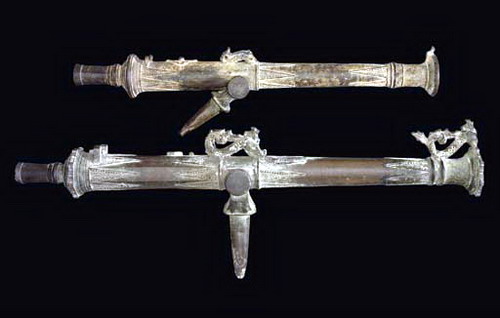
The Lantaka (Baybayin: pre virama: ᜎᜆᜃ: post virama: ᜎᜈ᜔ᜆᜃ) also known as rentaka (in Malay, jawi script: رنتاک) was a type of bronze portable cannon or swivel gun, sometimes mounted on merchant vessels and warships in Maritime Southeast Asia.[1] It was commonly equipped by native seafaring vessels from the Philippines, Indonesia, Brunei, and Malaysia.[2] Lela and rentaka are known by the Malays as meriam kecil (lit. "small cannon"),[3][4] the difference is that rentaka is smaller in length and bore than a lela.[5]: 122–123 and Lantakas are often called Kanyon in Filipino (literal meaning cannon).
The lantaka was cited by the National Commission for Culture and the Arts of the Philippines as an intangible cultural heritage of the country under the 'Traditional Craftsmanship' category that the government may nominate in the UNESCO Intangible Cultural Heritage Lists. The documentation of the craft was aided by ICHCAP of UNESCO.[6]
| Part of a series on |
| Cannons |
|---|
_Fauconneau_de_1589.jpg) |
Etymology
[edit]The name may stem from the Malay word lantak, which means "hammering down" or "ramming down",[7]: 123 referencing its loading process (muzzle-loading). Ramrod in Malay is called pelantak.[8]: 613 The Malay word rentak means "stamping the feet in anger",[8]: 340 [7]: 182 "pounding the feet together".[9]
Description
[edit].jpg)
The lantaka is the "younger sibling" of the lela; they are smaller, with a length of less than 100 cm.[5]: 122–123 Typically, the bore diameters of these cannons were in the range of about 10–50 mm.[3] Many of these guns were mounted on swivels (called cagak in Malay)[3] and were known as swivel guns. The smaller ones could be mounted almost anywhere including in the rigging. Medium-sized cannons were frequently used in reinforced sockets on the vessel's rails and were sometimes referred to as rail guns. The heaviest swivel guns were mounted on modified gun carriages to make them more portable.[citation needed]
History
[edit]The origin of gunpowder-based weaponry in the Nusantara archipelago can be traced from the late 13th century. The Mongol invasion of Java brought gunpowder technology to Java in the form of a cannon (Chinese: 炮—"Pào").[10]: 1–2 [11][12]: 220 This resulted in eastern-style cetbang which is similar to Chinese cannon. Swivel guns, however only developed in the archipelago because of the close maritime relations of the Nusantara archipelago with the territory of west India after 1460 CE, which brought new types of gunpowder weapons to the archipelago, likely through Arab intermediaries. This weapon seems to be cannon and gun of Ottoman tradition, for example the prangi, which is a breech-loading swivel gun. A new type of cetbang, called the western-style cetbang, was derived from the Turkish prangi. Just like prangi, this cetbang is a breech-loading swivel gun made of bronze or iron, firing single rounds or scatter shots (a large number of small bullets).[13]: 94–95
In Malaya
[edit]When the Portuguese first came to the Malacca Sultanate, they found a large colony of Javanese merchants under their own headmen; they were manufacturing their own cannon, which is deemed as important as sails in a ship.[14]
Most lantakas were made of bronze and the earliest ones were breechloaders.[15] Michael Charney (2004) pointed out that early Malay swivel guns were breech-loaded.[16]: 50 There is a trend toward muzzle-loading weapons during colonial times.[17] Nevertheless, when Malacca fell to the Portuguese in 1511, both breech-loading and muzzle-loading swivel guns were found and captured by the Portuguese.[16]: 50
De Barros mentions that with the fall of the Malacca Sultanate, Albuquerque captured 3000 out of 8000 artillery. Among those, 2000 were made from brass and the rest from iron, in the style of Portuguese berço (breech-loading swivel gun). All of the artillery had its proper complement of carriages which could not be rivaled even by Portugal.[18][19]: 22, 247 [20]: 127–128 Afonso de Albuquerque compared Malaccan gun founders as being on the same level as those of Germany. However, he did not state what ethnicity the Malaccan gun founder was.[20]: 128 [12]: 221 [21]: 4 Duarte Barbosa stated that the arquebus-maker of Malacca was Javanese.[22]: 69 The Javanese also manufactured their own cannon in Malacca.[14] Anthony Reid argued that the Javanese handled much of the productive work in Malacca before 1511 and in 17th century Pattani.[22]: 69
Wan Mohd Dasuki Wan Hasbullah explained several facts about the existence of gunpowder weapons in Malacca and other Malay states before the arrival of the Portuguese:[23]: 97–98
- No evidence showed that guns, cannons, and gunpowder are made in Malay states.
- No evidence showed that guns were ever used by the Malacca Sultanate before the Portuguese attack, even from Malay sources themselves.
- Based on the majority of cannons reported by the Portuguese, the Malays preferred small artillery.
The cannons found in Malacca were of various types: esmeril (1/4 to 1/2-pounder swivel gun, probably refers to cetbang or lantaka),[24] falconet (cast bronze swivel gun larger than the esmeril, 1 to 2-pounder, probably refers to lela),[24] medium saker (long cannon or culverin between a six and a ten-pounder, probably refers to meriam)[25] and bombard (fat, heavy and short cannon).[16]: 46 The Malays also have one beautiful large cannon sent by the king of Calicut.[16]: 47 [19]: 22
Despite having a lot of artillery and firearms, the weapons of Malacca were mostly and mainly purchased from the Javanese and Gujarati, where the Javanese and Gujarati were the operators of the weapons. In the early 16th century, before the Portuguese arrival, the Malays were a people who lacked firearms. The Malay chronicle, Sejarah Melayu, mentioned that in 1509 they do not understand “why bullets killed”, indicating their unfamiliarity with using firearms in battle, if not in ceremony.[21]: 3 As recorded in Sejarah Melayu:
Setelah datang ke Melaka, maka bertemu, ditembaknya dengan meriam. Maka segala orang Melaka pun hairan, terkejut mendengar bunyi meriam itu. Katanya, "Bunyi apa ini, seperti guruh ini?". Maka meriam itu pun datanglah mengenai orang Melaka, ada yang putus lehernya, ada yang putus tangannya, ada yang panggal pahanya. Maka bertambahlah hairannya orang Melaka melihat fi'il bedil itu. Katanya: "Apa namanya senjata yang bulat itu maka dengan tajamnya maka ia membunuh?"
After (the Portuguese) coming to Malacca, then met (each other), they shot (the city) with cannon. So all the people of Malacca were surprised, shocked to hear the sound of the cannon. They said, "What is this sound, like thunder?". Then the cannon came about the people of Malacca, some lost their necks, some lost their arms, some lost their thighs. The people of Malacca were even more astonished to see the effect of the gun. They said: "What is this weapon called that is round, yet is sharp enough to kill?" [26]: 254–255 [12]: 219
Lendas da India by Gaspar Correia and Asia Portuguesa by Manuel de Faria y Sousa confirmed Sejarah Melayu's account. Both recorded a similar story, although not as spectacular as described in Sejarah Melayu.[27]: 120–121 [28]: 43 The Epic of Hang Tuah narrates a Malaccan expedition to the country of Rum (the Ottoman Empire) to buy bedil (guns) and large meriam (cannons) after their first encounter with the Portuguese in 1509 CE, indicating their shortage of firearms and gunpowder weapons.[29]: 205–248 [note 1] Malaccan expedition to Rum (Ottoman Turks) to buy cannons never actually happened, it was only mentioned in the fictitious literature Hikayat Hang Tuah, which in reality based on the sending of a series of Acehnese embassies to the Ottoman Empire in the 16th century.[30]
The Dutch and Portuguese quickly learned that they could trade cannons not only for spices and porcelain, but also for safe passage through pirate-infested waters. Local foundries continued to produce guns, using local patterns and designs from local brass and bronze objects. Stylized crocodiles, dolphins, birds, and dragons were common motifs.[citation needed]
In the Philippines
[edit]The ancient walled city of Cainta located in the opposite banks of the Pasig River,[31] is recorded as a fortified city with bamboo thickets and lantaka guns on its walls witnessed by the Spanish conquistadors on the Siege of Cainta in 1571.[31][32]
As described in an anonymous 1572 account documented in Volume 3 of Blair and Robertson's compiled translations:[31]
This said village had about a thousand inhabitants, and was surrounded by very tall and very dense bamboo thickets, and fortified with a wall and a few small culverins. The same river as that of Manilla circles around the village and a branch of it passes through the middle dividing it in two sections.
In the walls of old Manila, a gunsmith named Panday Pira[33][34] established a foundry on the northern bank of the Pasig River. Rajah Sulayman commissioned Panday Pira to cast the cannon that were mounted on the palisades surrounding his kingdom. In 1570, Castilian forces under the command of Martin de Goiti captured Manila and took these artillery pieces as war booty, presenting them to Miguel López de Legazpi, the first Spanish Governor-General of the Philippines.[35]
Local tradition
[edit] |

If a native vessel was unarmed, it was usually regarded by the local populace as improperly equipped and poorly decorated. Whether farmers, fishermen, or headhunters, the villagers who lived in the longhouses along Borneo's rivers lived in fear of being taken by pirates who used both vessel-mounted and hand-held cannons. Villages and tribesmen that were armed with mounted or handheld cannons had a distinct advantage over those who could only rely on bows and arrows, spears, blowguns and krises (swords).
Land transportation in the 17th and 18th century Java and Borneo was extremely difficult and cannons were fired for virtually all types of signaling. Whether they were fired in celebration of a birth or wedding, or to warn another hilltop fortress or riverbank fishing village of an impending attack, cannons were used to transmit messages telling of urgent or special events. Such events ranged from yellow fever and cholera epidemics to the start or finish of religious holidays such as Ramadan.
_from_the_Sulu_Archipelago,_brass,_Honolulu_Museum_of_Art.jpg)
Distinguished visitors were ushered into longhouses with great ceremony, accompanied by the firing of the longhouse's cannon, much like today's 21-gun salute. These cannons were a display of the status and wealth of the extended family that controlled the longhouse.
All worked brass, bronze and copper had value and were used as trade items in early Borneo. Cannons were frequently part of the bride price demanded by the family of an exceptionally desirable bride or the dowry paid to the groom.
Many of the small cannons, often called personal cannons or hand cannons, had been received as honors and were kept and passed down in families, but in hard times they also served as a form of currency that could keep the family fed. As a recognized form of currency, cannons could be traded for rice, drums, canoes, tools, weapons, livestock, debts of honor, and even settlement of penalties for crimes ranging from the accidental death of a fellow villager to headhunting against another tribe.
Large cannons had the extra value of being used in both celebratory times and in warfare. The larger and/or more elaborate the cannon, the greater the trade value, and thus the greater the status of the owner.
Many of the finest cannons were given out by the Sultans of Brunei as part of ceremonies (such as birthdays or weddings) of the many princes and princesses of the extended Royal family. Cannons were frequently presented to guests along with awards and titles, and were meant to guarantee the recipients' allegiance to the Sultan. Mortars, cannon, and signal guns of all sizes were typically fired with colorful pyrotechnics on these occasions; the louder and more elaborate, the greater the honor.
Modern era
[edit].jpg)
In the 1840s England began suppressing piracy and headhunting and Rajah James Brooke (a wealthy Englishman who established the dynasty that ruled Sarawak from 1841 until 1946) distributed numerous Brunei cast hand cannons to guarantee the cooperation and allegiance of the local chiefs. Lantaka was used by Moro soldiers in the Moro Rebellion against U.S. troops in the Philippines.[36] They were also used by the Filipinos during the Philippine Revolution, this time copied from European models and cast from church bells. One cannon founder was a Chinese Filipino named Jose Ignacio Pawa, a blacksmith also.
Today these guns can be found on virtually all of the islands of the Pacific Rim, but they are most commonly found in the Muslim areas of Indonesia and Malaysia. The largest collection is in Brunei, where it is now illegal to export them. Even in other countries, a museum export permit is usually required.
These cannons are now highly sought after by collectors, with some of the realized prices exceeding $50,000 USD for a single gun. The more common guns can be bought for under $1,000. Replicas and forgeries of lantaka are known to exist in considerable numbers.[37]
Today most of the Christians in Mindanao and the Visayas refer the word "lantaka" to bamboo cannons (a noisemaker) or any improvised home-made noisemakers of the same firing mechanism usually made of bamboo tubes (Pula in Meranau or "Lapu"), segmented cans of condensed milk, or PVC pipes. They are usually used during New Year's Day celebrations as noisemakers, or often in medium-scale gang wars. The firing mechanism is the same as of the original lantaka, with denatured alcohol or calcium carbide mixed with water as its "gunpowder" (fuel) and a small lighted torch or lighter as the igniter.[citation needed]
See also
[edit]


- Luthang, a bamboo toy gun from the Philippines that originally referred to small lantaka.
- Cetbang, earlier 14th century cannon used by Indonesian kingdoms.
- Lela, a type of cannon similar but larger than lantaka.
- Meriam kecil, a tiny version of meriam kecil (lela and lantaka) used mainly as a currency.
- Bedil (term), local term for gunpowder based weapons.

Notes
[edit]- ^ Maka kata Laksamana, "Adapun hamba sekalian datang ini dititahkan oleh Sultan Melaka membawa surat dan bingkisan tanda berkasih-kasihan antara Sultan Melaka dan duli Sultan Rum, serta hendak membeli bedil dan meriam yang besar-besar. Adalah kekurangan sedikit bedil yang besar-besar di dalam negeri Melaka itu. Adapun hamba lihat tanah di atas angin ini terlalu banyak bedil yang besar-besar.”. Translation: Then the Admiral said, "As for our reason for coming here, we were ordered by the Sultan of Melaka to bring a letter and a gift of sympathy between the Sultan of Melaka and the Sultan of Rum, as well as to buy large guns and cannons. There is a shortage of large guns in the state of Melaka. While I see that the land above the wind has too many big guns."
References
[edit]- ^ BLADE CULTURE AND THE ADVENT OF FIREARMS
- ^ "Borneo Brass Cannon (Lantaka)". michaelbackmanltd.com. Retrieved 12 February 2020.
- ^ a b c "Cannons of the Malay Archipelago". www.acant.org.au. Retrieved 2020-01-25.
- ^ Teoh, Alex Eng Kean (2005). The might of the miniature cannon: A treasure of Borneo and the Malay Archipelago. Asean Heritage.
- ^ a b Ismail, Norain B.T. (2012). Peperangan dalam Historiografi Johor: Kajian Terhadap Tuhfat Al-Nafis. Kuala Lumpur: Akademi Pengajian Islam Universiti Malaya.
- ^ "ICHCAP | e-Knowledge Center". www.ichcap.org. Archived from the original on 1 February 2018. Retrieved 15 January 2020.
- ^ a b Wilkinson, Richard James (1908). An Abridged Malay-English Dictionary (Romanised). Kuala Lumpur: F.M.S Government Press.
 This article incorporates text from this source, which is in the public domain.
- ^ a b Wilkinson, Richard James (1901). A Malay-English dictionary. Hongkong: Kelly & Walsh, limited. This article incorporates text from this source, which is in the public domain.
- ^ Departemen Pendidikan Nasional (2008). Kamus Besar Bahasa Indonesia Pusat Bahasa Edisi Keempat. Jakarta: PT Gramedia Pustaka Utama.
- ^ Schlegel, Gustaaf (1902). "On the Invention and Use of Fire-Arms and Gunpowder in China, Prior to the Arrival of European". T'oung Pao. 3: 1–11.
- ^ Lombard, Denys (1990). Le carrefour javanais. Essai d'histoire globale (The Javanese Crossroads: Towards a Global History) Vol. 2. Paris: Editions de l'Ecole des Hautes Etudes en Sciences Sociales. Page 178.
- ^ a b c Reid, Anthony (1993). Southeast Asia in the Age of Commerce, 1450–1680. Volume Two: Expansion and Crisis. New Haven and London: Yale University Press.
- ^ Averoes, Muhammad (2020). Antara Cerita dan Sejarah: Meriam Cetbang Majapahit. Jurnal Sejarah, 3(2), 89 – 100.
- ^ a b Furnivall, J. S. (2010). Netherlands India: A Study of Plural Economy. Cambridge University Press. p. 9
- ^ Ooi, Keat Gin (2004). Southeast Asia: A Historical Encyclopedia, from Angkor Wat to East Timor. ABC-CLIO. ISBN 9781576077702.
- ^ a b c d Charney, Michael (2004). Southeast Asian warfare, 1300–1900. BRILL. ISBN 9789047406921.
- ^ Hamid, Rahimah A. (2015). Kearifan Tempatan: Pandainya Melayu Dalam Karya Sastera. Penerbit USM. ISBN 9789838619332.
- ^ Partington, J. R. (1999). A History of Greek Fire and Gunpowder. JHU Press. ISBN 9780801859540. Retrieved 12 December 2014.
- ^ a b Crawfurd, John (1856). A Descriptive Dictionary of the Indian Islands and Adjacent Countries. Bradbury and Evans.
- ^ a b Birch, Walter de Gray (1875). The Commentaries of the Great Afonso Dalboquerque, Second Viceroy of India, translated from the Portuguese edition of 1774 volume 3. London: The Hakluyt Society.
- ^ a b Charney, Michael (2012). Iberians and Southeast Asians at War: the Violent First Encounter at Melaka in 1511 and After. In Waffen Wissen Wandel: Anpassung und Lernen in transkulturellen Erstkonflikten. Hamburger Edition.
- ^ a b Reid, Anthony (1989). The Organization of Production in the Pre-Colonial Southeast Asian Port City. In Broeze, Frank (Ed.), Brides of the Sea: Asian Port Cities in the Colonial Era (pp. 54–74). University of Hawaii Press.
- ^ Hasbullah, Wan Mohd Dasuki Wan (2020). Senjata Api Alam Melayu. Dewan Bahasa dan Pustaka.
- ^ a b Manucy, Albert C. (1949). Artillery through the ages: A short illustrated history of the cannon, emphasizing types used in America. U.S. Department of the Interior Washington. p. 34.
- ^ Lettera di Giovanni da Empoli, with introduction and notes by A. Bausani, Rome, 1970, page 138.
- ^ Kheng, Cheah Boon (1998). Sejarah Melayu The Malay Annals MS RAFFLES No. 18 Edisi Rumi Baru/New Romanised Edition. Academic Art & Printing Services Sdn. Bhd.
- ^ Koek, E. (1886). "Portuguese History of Malacca". Journal of the Straits Branch of the Royal Asiatic Society. 17: 117–149.
- ^ Pintado, M.J. (1993). Portuguese Documents on Malacca: 1509–1511. National Archives of Malaysia. ISBN 9789679120257.
- ^ Schap, Bot Genoot, ed. (2010). Hikayat Hang Tuah II. Jakarta: Pusat Bahasa. ISBN 978-979-069-058-5.
- ^ Braginsky, Vladimir (2012-12-08). "Co-opting the Rival Ca(n)non the Turkish Episode of Hikayat Hang Tuah". Malay Literature. 25 (2): 229–260. doi:10.37052/ml.25(2)no5. ISSN 0128-1186.
- ^ a b c Blair, Emma Helen; Robertson, James Alexander, eds. (1903). "Relation of the Conquest of the Island of Luzon". The Philippine Islands, 1493–1898. Vol. 3: 1569–1576. Translated by Gill, J. G. Ohio, Cleveland: Arthur H. Clark Company. p. 145.
- ^ "Pre-Colonial Manila". Presidential Museum and Library. Archived from the original on 9 March 2016. Retrieved 27 April 2017.
- ^ Jagor, Fedor. The Former Philippines thru Foreign Eyes. Retrieved September 8, 2009.
- ^ "Panday Pira" (PDF). Archived from the original (PDF) on July 21, 2011. Retrieved September 7, 2009.
- ^ "Miguel López de Legazpi". paratodomexico.com.
- ^ Gaysowski, Richard (2000). "Lantaka is one of several names for small hand carried rail guns". The Artilleryman. 22 (2). Archived from the original on 2011-07-07. Retrieved 2009-07-05.
- ^ "used cannon for sale". Archived from the original on February 7, 2009. Retrieved 2009-07-05.

External links
[edit]- The Sea Research Society has a collection of over sixty of these guns, most dating from the 17th and 18th centuries.
- The Temple of Proportions, an online cultural center, has three more pictures of a gorgeous Lantaka.[dead link]
Indonesian traditional weapons, armors, and premodern gunpowder-based weapons | ||||||||||||||||||||
|---|---|---|---|---|---|---|---|---|---|---|---|---|---|---|---|---|---|---|---|---|
|    | |||||||||||||||||||
|
| ||||||||||||||||||||
| ||||||||||||||||||||
Lantaka
View on GrokipediaEtymology and Terminology
Linguistic Origins
The term lantaka originates from the Malay language, where a variant spelling rentaka refers to a portable bronze swivel cannon employed in maritime warfare. This nomenclature is rooted in the verb lantak, meaning "to ram in," "hammer down," or "force down," which describes the essential muzzle-loading process of tamping gunpowder and projectiles into the barrel using a ramrod.[5][6] The etymology underscores the weapon's operational mechanics, distinguishing it from larger field artillery by emphasizing portability and rapid reloading suited to shipboard or skirmish use. Historical linguists, including R.O. Winstedt in his 1963 Malay-English Dictionary, trace lantak to regional dialects in areas like Penang and Johor, linking it to forceful insertion actions beyond ordnance, such as thrusting or pounding.[7] In the southern Philippines, particularly among Moro and Tausug communities under historical Malay influence, lantaka supplanted or coexisted with local terms like kanyon (from Tagalog, derived from Spanish cañón) and Cebuano luthang (small naval cannon), reflecting linguistic borrowing via trade and Islamic sultanates in the Sulu Archipelago from the 14th century onward.[8][9] This adoption highlights Austronesian language convergence in Southeast Asia, where Malay served as a lingua franca for seafaring polities, disseminating terminology alongside firearm technology introduced via Ottoman and Portuguese intermediaries by the early 16th century. Unlike broader Malay designations such as meriam kecil (small cannon) or lela (a longer variant), lantaka specifically evokes the swivel-mounted, anti-personnel role, with no evidence of pre-Malay indigenous roots in Philippine proto-Austronesian vocabularies.[10]Regional Variants and Names
In the southern Philippines, particularly among Moro communities under Malay influence, the lantaka retained its name as a small bronze swivel gun adapted for maritime defense.[11] This term distinguished it from larger artillery, emphasizing its portability and swivel mounting for use on vessels or fortifications.[1] Across the Malay Archipelago, encompassing regions like Brunei, Trengganu, Palembang, Minangkabau, and Aceh, similar small cannons were known collectively as meriam kecil ("small cannon") in Malay, with bores ranging from 10 to 50 mm and lengths of 800 to 1600 mm.[11] The lela represented a prominent variant, often featuring decorative elements such as dragon-shaped muzzles, and served both naval and land-based roles, including as status symbols or trade currency.[11] Regional adaptations included double-barreled configurations, more prevalent in the Philippines for enhanced firepower on warships, while Indonesian variants occasionally featured miniature lela models (150-300 mm long, 15-16 mm caliber) possibly intended for ceremonial salutes.[9] Local foundries in these areas produced the guns in brass, bronze, or iron, reflecting indigenous manufacturing techniques distinct from European designs lacking features like cascabels.[11]Design and Technical Specifications
Construction and Materials
Lantakas were primarily constructed from cast bronze, an alloy of copper and tin valued for its durability and corrosion resistance in humid, maritime conditions.[1] This material allowed for the creation of lightweight yet robust barrels, typically ranging from pistol-sized to larger calibers up to about 2-3 inches in bore diameter.[1] Iron was used infrequently due to its greater susceptibility to rust, though some examples incorporated iron pivots fitted to the bronze trunnions for swivel mounting.[12] The manufacturing process involved traditional bronze casting techniques, where molten metal was poured into molds to form the barrel, trunnions, and decorative elements in a single piece.[13] Ornate moldings at the breech and muzzle, often featuring bands of scrolls, triangles, or animal motifs such as dolphins or dragons, were integral to the design, enhancing both aesthetics and structural integrity.[1] [14] Some variants included brass elements or double-barreled configurations, but bronze remained predominant across Malay, Moro, and Philippine production centers.[15] Early lantakas frequently employed breech-loading mechanisms with removable chambers or blocks, facilitating rapid reloading in naval combat, while later models shifted toward muzzle-loading for simplicity.[16] Surviving specimens from the 17th to 19th centuries, as documented in museum collections, demonstrate high craftsmanship, with trunnions enabling versatile mounting on ship rails or fortifications.[17] These guns were designed to withstand repeated firing without overloading, underscoring the empirical refinements in Southeast Asian metalworking traditions.[1]Mounting Mechanisms and Mobility
Lantaka were predominantly configured as swivel guns, mounted via trunnions or pivot points on a yoke-and-pin assembly that fitted into holes drilled in ship gunwales, deck posts, or fortification walls, permitting rotational traversal across a wide arc or full 360 degrees for rapid aiming in combat.[1][18] This mechanism, often termed cagak in Malay, derived from European influences but was adapted for local use in Maritime Southeast Asia, enhancing defensive flexibility against pirates and rival vessels on small prahus or merchant ships.[18] Aiming was facilitated by a hollow tube or socket at the breech, into which a wooden handle, ramrod, or tiller was inserted to pivot the barrel for elevation and fine azimuth adjustments, compensating for the lack of formal sights on many specimens beyond rudimentary rear alignments like alligator-shaped projections.[3][1][18] The lightweight bronze construction—typically 7 to 28 kg for barrels 68 to 122 cm long—afforded high portability, enabling crews to swiftly relocate and remount the guns during boarding actions or retreats, a critical advantage in the archipelago's hit-and-run naval tactics from the 16th century onward.[3][18] On land, similar swivel yokes were employed in coastal forts for anti-intruder roles, where the guns' modularity allowed detachment for transport by hand or integration into temporary barricades, underscoring their role in asymmetric warfare against European expeditions as early as Magellan's 1521 voyage.[3][1] While rarer, heavier variants were occasionally fitted to modified four-wheeled carriages with integrated swivels for enhanced terrestrial mobility, though most remained optimized for shipboard or static defensive use rather than field artillery maneuvers.[1]Caliber, Ammunition, and Operation
Lantakas featured small calibers suited to their role as portable swivel guns, with bores typically ranging from pistol-sized diameters of 11–18 mm to larger examples up to 35–50 mm, enabling lightweight construction and maneuverability on ships or fortifications.[1] This variability allowed for employment against personnel or light vessels, with specific specimens documented at 1⅜ inches (35 mm) bore.[1] Larger relatives like the lela cannon fired 2.5–3 pound shots, suggesting lantakas handled proportionally smaller projectiles, often under 1 pound.[19] Ammunition included solid iron or lead round shot for penetration, alongside grapeshot—clusters of small balls—and canister shot for dispersing payloads against clustered targets in naval close combat. Early variants may have used stone balls, transitioning to metal with European influence, though powder and shot were loaded loose rather than in fixed cartridges.[20] Most lantakas operated as muzzle-loaders, with black powder charges rammed down the bore followed by wadding, shot, and additional wadding; the touch-hole was then primed and ignited using a match held in a linstock or early matchlock mechanism.[1] Breech-loading models, drawing from Ottoman and Portuguese designs encountered in the 16th century, utilized removable iron or bronze chambers filled with powder and inserted at the rear, permitting faster successive fires by pre-loading multiple chambers—though overheating risked chamber seizure.[16] Firing relied on the swivel mount for horizontal traversal and elevation adjustments via wedges or trunnion pivots, with sights for rudimentary aiming; post-shot, the extended hollow button at the breech aided in ramrod storage or handling.[1]Historical Development
Pre-Colonial Origins and Influences
The pre-colonial origins of the lantaka trace to the development of early firearms in the Indonesian archipelago during the Majapahit Empire (1293–1527), where bronze cannons known as cetbang were cast and deployed in military campaigns. These weapons, often breech-loading and mounted for mobility, adapted gunpowder technology that had diffused into the region via Mongol invasions of Java in 1293 and subsequent trade along Indian Ocean and Silk Road networks.[21] Local metallurgical expertise, honed through centuries of bronze casting for gongs and statues, enabled the production of such artillery without direct foreign oversight.[11] Lantakas emerged as compact swivel variants of these cetbang designs, optimized for naval use on prahu vessels in the fragmented geography of maritime Southeast Asia. By the 14th century, they equipped merchant ships and warships against piracy, with calibers typically ranging from 20 to 50 mm and lengths under 1 meter for rapid traversal and aiming.[11] Evidence from historical accounts and artifacts indicates widespread local fabrication in foundries across Java, Sumatra, and the Malay Peninsula, predating Portuguese arrival in Malacca in 1511.[11] Influences on lantaka design stemmed from Islamic trade networks linking the archipelago to Gujarat, the Deccan Sultanates, and the Ottoman Empire, where similar muzzle- and breech-loaders circulated by the 15th century. Muslim converts and artisans in sultanates like Malacca integrated decorative motifs—such as Arabic inscriptions and mythical beasts—while refining casting techniques for durability in tropical humidity. In the Philippines, pre-Hispanic polities in Mindanao and Sulu adopted analogous swivel guns through Moro migrations and commerce, establishing foundries that produced lantakas for karakoa war boats by the early 16th century.[22] This diffusion underscores a synthesis of regional ingenuity and exogenous pyrotechnic knowledge, unmediated by European intervention.[23]Introduction and Adaptation in Southeast Asia
The lantaka, a portable bronze swivel gun, was introduced to Southeast Asia via maritime trade routes that brought gunpowder weaponry from China and the Islamic world as early as the 15th century, with possible influences from Ming Dynasty voyages. Its proliferation accelerated in the early 16th century amid Portuguese expansion, as the 1511 conquest of Malacca exposed European swivel designs to local artisans already producing muzzle-loading cannons. Portuguese forces under Afonso de Albuquerque captured over 3,000 Malay cannons during the siege, highlighting pre-existing indigenous manufacturing capabilities, yet the encounter spurred adaptations for enhanced naval mobility on prahus and outrigger vessels.[11] Local adaptation emphasized bronze casting using traditional lost-wax methods in foundries across Malacca, Pahang, Brunei, and Aceh, yielding compact guns with integral yokes for pivoting on deck posts or railings. These featured distinctive Southeast Asian ornamentation, such as crocodile or dragon motifs, diverging from plainer European falconets while incorporating swivel mechanisms for rapid traversal against pirates. By the mid-17th century, Ottoman Turkish gunsmiths in Aceh refined techniques, producing higher-quality barrels that extended the lantaka's range and reliability for anti-ship barrages.[11] In the Philippines and eastern Indonesia, Moro and Malay communities further customized lantaka for asymmetric warfare, mounting them on karakoa warships with double-barreled variants for volley fire. This evolution integrated the gun into regional seafaring tactics, prioritizing portability over the heavier field artillery of European armies, and sustained its use into the colonial era despite tactical limitations against ironclad vessels.[9]Regional Employment
Usage in the Malay Peninsula and Archipelago
In the Malay Peninsula and Archipelago, lantaka—locally termed rentaka or meriam kecil—functioned as versatile swivel guns central to the naval and defensive strategies of sultanates such as Malacca, Johor, and Aceh from the early 15th century. These bronze artillery pieces were primarily deployed on prahu warships and merchant vessels, enabling rapid fire support during maritime skirmishes, trade route patrols, and anti-piracy operations across the straits and island chains. Their swivel mounts allowed for quick pivoting to engage targets at close range, compensating for the instability of wooden-hulled boats in the region's choppy waters.[11] Inter-sultanate rivalries, including the protracted Aceh-Johor conflicts of the 17th century, amplified demand for these weapons, which local foundries produced using imported metals and Ottoman-influenced casting techniques. Rentaka equipped fleets in battles like the Acehnese assaults on Portuguese-held Malacca in the 1620s, where volleys from dozens of such guns targeted enemy rigging and decks to disrupt formations. On land, they were emplaced in stockades or carried on litters by warriors for ambuscades against invaders, as seen in Johor's defenses against Dutch incursions in the late 16th century.[11][1] Portuguese chroniclers documented the prevalence of these small cannons during the 1511 siege of Malacca, noting their role in delivering grapeshot and langrage to repel boarding parties, though outnumbered by heavier European ordnance. In the Archipelago's eastern reaches, Brunei and other polities integrated rentaka into riverine warfare, mounting them on perahu layar for raids and defense against Sulu pirates into the 18th century. Their lightweight design—often under 50 kg—facilitated reloading with loose powder and stone or iron shot, achieving firing rates superior to fixed field pieces but limited to effective ranges below 200 meters.[11][24] Despite tactical advantages in mobility, rentaka's bronze construction proved vulnerable to corrosion in humid tropics, and their inaccuracy at distance hampered engagements with disciplined European line-of-battle tactics by the 18th century. Nonetheless, they remained staples in Malay arsenals until colonial suppression of indigenous fleets in the 19th century, underscoring adaptation of imported firearm technology to archipelago-specific combat needs.[11]Deployment in the Philippines
Lantakas were extensively deployed by Moro sultanates in Mindanao and the Sulu Archipelago for maritime defense, piracy suppression, and resistance against Spanish incursions from the 16th century. Mounted on agile war vessels such as karakoa prahus, these swivel guns enabled precise, rapid volleys in naval skirmishes, compensating for the Moros' numerical disadvantages through mobility and firepower.[25][1] Archaeological and expedition records confirm lantakas' presence in the Philippines by 1521, during Ferdinand Magellan's arrival, indicating adaptation via pre-colonial trade with Malay and Indonesian networks rather than direct European introduction.[1] Locally cast in bronze, they featured bores of 2-3/8 inches and lengths around 48 inches, optimized for antipersonnel shot like langgabel grapeshot against boarding parties or crews.[1] In the protracted Spanish-Moro conflicts (1565–1898), lantakas proved effective in hit-and-run raids on Spanish galleons and settlements; retreating forces in 1750s Jolo expeditions abandoned such cannons, attesting to their tactical centrality.[26] Moro vintas, often carrying 3–6 lantakas per vessel alongside heavier ordnance, inflicted heavy losses in engagements like those in the Sulu Sea, sustaining independence in the south longer than northern regions.[27] Meranaw communities designated their variants as laila, reserving them for repelling invaders in fortified positions and ambushes, while Tausūg forces integrated them into juramentado assaults and fleet actions.[28] Land-based deployments in stockades supplemented naval roles, though vulnerabilities to counter-battery fire from European siege guns limited their efficacy in prolonged sieges by the 19th century.[2] Continued use persisted into the Moro Rebellion (1899–1913) against American forces, as evidenced by lantaka fire during Lake Lanao operations in 1902.[27]Military Applications and Effectiveness
Naval and Anti-Piracy Roles
Lantaka served as essential armaments on native seafaring vessels across Maritime Southeast Asia, particularly mounted via swivel yokes on the bulwarks of prahus in Malay and Indonesian waters, as well as karakoa warships in the Philippines. These portable bronze guns, with bore diameters typically ranging from 10 to 50 mm and lengths of 800 to 1600 mm, enabled flexible firing arcs for close-range naval engagements, often loaded with shot or grapeshot to target enemy rigging, sails, or boarding parties.[11] From the 16th century onward, such vessels—carrying 50 to 100 crew—commonly equipped two to three lantaka, alongside occasional heavier cannons, facilitating rapid maneuvers in inter-island warfare and raids.[29] In Philippine contexts, blacksmiths like Panday Piray forged lantaka specifically for karakoa, which supported crews of 100 to 200 warriors in high-speed naval combat during the 16th and 17th centuries.[30] In anti-piracy operations, lantaka provided defensive firepower for merchant prahus and state-sponsored fleets patrolled by sultans and rajas to safeguard trade routes plagued by piracy in the fragmented archipelago polities. Traders and coastal communities relied on these guns to repel pirate demands for tribute or direct assaults, installing them on vessels and in ports to protect commerce and settlements.[11] While pirates themselves often wielded similar swivel guns, leading to symmetric skirmishes favoring close-quarters tactics over long-range artillery duels, lantaka's mobility proved advantageous in evading or countering faster pirate craft.[11] Historical accounts from the 19th century describe Bugis coastal defenses incorporating small brass lantaka against raiding threats, underscoring their role in localized suppression efforts amid ongoing maritime insecurity.[11]Engagements with European Powers
In the Malay Archipelago, early engagements with Portuguese forces during the 1511 siege of Malacca saw local defenders deploying cannons, including precursors to the more portable lantaka, in an attempt to repel the invasion led by Afonso de Albuquerque; historical accounts note that up to 3,000 defenders perished in the assault despite this artillery support.[11] Subsequent resistance by Johor Sultanate fleets against Portuguese naval dominance involved swift vessels armed with rentaka, enabling hit-and-run tactics on shipping lanes, though these proved insufficient against fortified European positions and larger carracks.[11] Against Dutch East India Company forces, particularly after their 1641 capture of Malacca in alliance with Johor, lantaka-equipped prahus were utilized in intermittent Malay-Dutch skirmishes, such as those in the Riau-Lingga archipelago during the 18th century, where local rulers leveraged the guns' swivel mounting for broadside fire in riverine and coastal ambushes. However, Dutch naval superiority, bolstered by heavier ordnance and disciplined gunnery, often overwhelmed these lighter weapons in sustained confrontations. In the Philippines, Moro sultanates in Mindanao and Sulu extensively deployed lantaka during the prolonged Spanish-Moro conflict from the late 16th to 19th centuries, mounting 2-3 per vinta or proa for raids on Spanish Visayan outposts and galleon routes. These swivel guns, firing scatter shot for anti-personnel effect at close range (typically under 100 meters), allowed Moros to exploit archipelagic terrain and vessel speed, inflicting significant casualties in engagements like the 19th-century defenses of Jolo against Spanish expeditions, where mobility compensated for the lantaka's limited range and accuracy compared to Spanish falconets or heavier artillery.[29] Despite tactical successes in asymmetric warfare, the weapons' obsolescence against rifled guns and steam-powered ships contributed to eventual Moro subjugation by the late 1800s.[31]Later Conflicts and Tactical Limitations
During the Moro Rebellion from 1902 to 1913, lantakas were deployed by Moro warriors in southern Philippines, particularly in defensive fortifications around Lake Lanao and on vinta raiding vessels used against U.S. forces.[8] These swivel guns, often bronze-cast with bores ranging from 10 to 50 mm, were mounted to provide close-range fire support in stockades and during ambushes.[11] Moro forces also employed them in earlier phases of the Philippine-American War (1899–1902), integrating the weapons into guerrilla tactics against American infantry and naval patrols.[32] In engagements like those near Mindanao, lantakas fired grapeshot or small projectiles for anti-personnel effects, but their smoothbore design and dependence on inconsistent local gunpowder limited effective range to under 300 meters and reduced accuracy beyond point-blank distances.[33] Muzzle-loading variants, predominant by the 19th century, required time-consuming reloading that exposed crews to suppressive fire from U.S. rifles and machine guns.[11] Tactically, lantakas excelled in fluid, low-intensity warfare such as piracy or intra-regional skirmishes but faltered against disciplined colonial armies with rifled artillery and rapid-fire small arms. Their light weight facilitated swivel mounting on ships or fortifications, yet this mobility came at the cost of stability, making precise aiming challenging in rough seas or uneven terrain.[11] Overreliance on such outdated ordnance contributed to Moro defeats, as U.S. forces neutralized lantaka positions through superior firepower and indirect fire, rendering the guns ineffective for offensive operations or prolonged sieges by the early 1900s.[8]Cultural and Symbolic Significance
Traditional and Ceremonial Uses
In maritime Southeast Asian cultures, including those of the Malay Archipelago, Borneo, and the Philippines, lantakas functioned as markers of social prestige and power. Possession of multiple lantakas was equated with wealth and authority, akin to the number of wives a man held, particularly in regions like Mindanao, Brunei, and Indonesia.[34] Beyond status, lantakas were employed in ceremonial signaling, where blank charges were fired to announce births, deaths, or the arrival of distinguished guests, serving as acoustic heralds in communities lacking formal communication systems.[13] This practice underscored their role in communal rituals and social cohesion. Ornate variants, often featuring intricate bronze casting with motifs like crocodiles, lotuses, or mythical figures, were crafted not solely for combat but for display in ceremonies or as heirlooms, emphasizing artistic and symbolic value over practical warfare.[13] Such pieces highlighted the fusion of metallurgical skill and cultural iconography in traditional societies.Role in Local Folklore and Identity
In Moro societies of Mindanao, the lantaka functioned as a prestigious status symbol beyond its martial applications, with the quantity owned by an individual signifying wealth and social standing akin to the number of wives possessed.[34] This association underscored the cannon's role in reinforcing hierarchical structures and personal prestige within communities in Mindanao, Brunei, and Indonesia.[34] The ornamental designs on lantakas, featuring characteristic motifs, reflected indigenous artistic traditions and cultural identity among the Maguindanao and Maranao peoples, embedding the artifact with symbolic value that extended its utility from warfare to displays of heritage.[35] These decorations often incorporated local iconography, serving as a visual repository of ethnic aesthetics and craftsmanship knowledge passed down through generations.[36] Recognized as an element of intangible cultural heritage by the Philippine National Commission for Culture and the Arts, the lantaka preserves traditional practices related to its forging, decoration, and ceremonial signaling, contributing to the collective identity of Muslim communities in the southern Philippines.[36] While specific folklore narratives centering the lantaka remain undocumented in primary ethnographic records, its integration into status displays and communal events reinforced narratives of resilience, maritime prowess, and ancestral ingenuity in oral histories.[35]Legacy and Modern Context
20th-Century Conflicts
Lantakas saw continued deployment by Moro forces during the Moro Rebellion (1899–1913), an extension of resistance against United States control in the southern Philippines following the Philippine–American War. Primarily utilized by Tausūg warriors in the Sulu Archipelago and Maranao groups around Lake Lanao in Mindanao, these bronze swivel guns were mounted on fortifications, stockades, and vinta war boats to provide defensive and offensive fire in close-quarters engagements.[8][37] Moro datu and sultans armed their strongholds with dozens of lantakas, often alongside captured or imported muzzle-loading rifles, to repel American patrols and punitive expeditions.[8] United States Army operations frequently encountered and captured lantakas, as evidenced by artifacts seized circa 1900 during assaults on Moro positions, which were later commemorated as trophies of the Philippine Insurrection.[38] In battles such as those around Jolo and Basilan, lantakas delivered scatter shot against advancing troops, but their slow reload times and limited range—typically effective only up to 100 meters—rendered them vulnerable to disciplined rifle volleys and artillery from U.S. forces equipped with Krag–Jørgensen rifles and Colt machine guns.[37] Despite occasional morale-boosting effects among Moro fighters, the weapons' obsolescence against modern infantry tactics contributed to decisive American victories, including the destruction of key forts by 1905.[8] By the rebellion's end in 1913, following events like the Battle of Bud Bagsak, lantaka use had largely ceased in organized conflict, supplanted by smuggled modern firearms. No significant records indicate their employment in later 20th-century insurgencies, such as World War II guerrilla actions or post-independence Moro separatist movements, due to the proliferation of rifles, mortars, and automatic weapons.[37]Reproductions, Forgeries, and Collectibility
Authentic lantaka, prized for their historical association with Southeast Asian maritime warfare and Moro resistance against colonial powers, are collected by enthusiasts of ethnographic arms and antique ordnance.[39] Prices for verified 19th-century examples typically range from $950 to $3,495, influenced by size, condition, and provenance; for instance, a 37.5-inch Indonesian bronze lantaka with a 1.25-inch bore and integral swivel mount sold for $2,495 in recent years.[40][41] Larger or finely cast Moro variants have fetched up to $2,299 at auction, reflecting demand among collectors valuing their ornamental motifs and functional design.[42] The collectibles market, however, is saturated with forgeries and unauthorized reproductions, primarily manufactured in Indonesia and the Philippines for tourist sales and export.[39] These fakes often replicate the ornate bronze casting and swivel features but exhibit modern traits such as uniform bores without iron chaplet residues, drilled touch holes, and artificially induced patina or lightweight construction with fillers like foam to mimic solidity without the 50+ pound heft of genuine solid-bronze pieces.[43][40] Authentic lantaka, cast via one-time ceramic or lost-wax molds destroyed post-production, display irregular casting seams, gnarled muzzles from added material, and bore inconsistencies from pre-18th-century iron supports, distinguishing them from post-1800 two-piece casts or contemporary replicas.[39] Reputable dealers offer lifetime authenticity guarantees and recommend scrutiny of provenance, such as museum records or military souvenirs, to avoid fakes; for example, excavated or documented pieces command premiums over tourist-market imitations.[40] Legitimate reproductions exist for decorative, ceremonial, or reenactment purposes, occasionally employing traditional methods but clearly marked to prevent deception, though they rarely achieve the investment value of originals due to lacking historical combat or trade provenance.[39] Collectors are advised to consult experts for bore endoscopy and metallurgical analysis, as surface inspections alone fail against sophisticated forgeries.[43]Preservation, Study, and Cultural Revival
Lantaka artifacts are primarily preserved in major museums worldwide, with significant collections held by institutions focused on Southeast Asian and arms history. The National Museum of the Philippines maintains an exhibition on lantaka, highlighting bronze swivel guns prevalent in 17th- and 18th-century Southeast Asia, as part of its ethnology division's efforts to document Philippine material culture.[44] [45] The Metropolitan Museum of Art houses multiple examples, including an 18th-century Philippine bronze lantaka measuring 44 inches in length, acquired as part of its arms and armor collection dedicated to researching and exhibiting historical firearms.[2] Similarly, the British Museum preserves a lantaka example used in island Southeast Asian fortifications and vessels, underscoring its role in regional defense.[3] Academic study of lantaka emphasizes their metallurgical and tactical evolution, often tracing breech-loading designs to influences from 16th-century European swivel guns adapted by local foundries in bronze. The Royal Armouries classifies lantaka as the traditional Malaysian cannon form, with specimens dated 1700–1830, supporting analyses of their portability and naval applications.[12] Pioneering research in the Philippines, including collaborative work by W-A Miailhe De Burgh and Fe B. Mangahas on lantaka and related bells, has informed curatorial practices and historical interpretations, as commemorated in museum displays.[44] These studies prioritize empirical examination of surviving artifacts, revealing casting techniques and decorative motifs like garudas that blend indigenous and imported elements. Cultural revival efforts are modest, centered on exhibitions and heritage displays rather than widespread reconstruction or ceremonial replication. Surviving lantaka continue to feature in museum contexts that foster appreciation of precolonial maritime traditions, though modern uses are rare beyond symbolic representations in cultural narratives.[8] Preservation initiatives, such as those by the National Museum of the Philippines, contribute to reviving awareness of lantaka as emblems of regional ingenuity against piracy and colonial incursions, aiding broader identity reclamation in postcolonial contexts.[44]References
- https://en.wiktionary.org/wiki/lantak