Hubbry Logo
Series and parallel circuitsSeries and parallel circuitsMain
Open search
Series and parallel circuits
Community hub
Series and parallel circuits
logo
8 pages, 0 posts
0 subscribers
Be the first to start a discussion here.
Series and parallel circuits
from Wikipedia

A series circuit with a voltage source (such as a battery, or in this case a cell) and three resistance units

Two-terminal components and electrical networks can be connected in series or parallel. The resulting electrical network will have two terminals, and itself can participate in a series or parallel topology. Whether a two-terminal "object" is an electrical component (e.g. a resistor) or an electrical network (e.g. resistors in series) is a matter of perspective. This article will use "component" to refer to a two-terminal "object" that participates in the series/parallel networks.

Components connected in series are connected along a single "electrical path", and each component has the same electric current through it, equal to the current through the network. The voltage across the network is equal to the sum of the voltages across each component.[1][2]

Components connected in parallel are connected along multiple paths, and each component has the same voltage across it, equal to the voltage across the network. The current through the network is equal to the sum of the currents through each component.

The two preceding statements are equivalent, except for exchanging the role of voltage and current.

A circuit composed solely of components connected in series is known as a series circuit; likewise, one connected completely in parallel is known as a parallel circuit. Many circuits can be analyzed as a combination of series and parallel circuits, along with other configurations.

In a series circuit, the current that flows through each of the components is the same, and the voltage across the circuit is the sum of the individual voltage drops across each component.[1] In a parallel circuit, the voltage across each of the components is the same, and the total current is the sum of the currents flowing through each component.[1]

Consider a very simple circuit consisting of four light bulbs and a 12-volt electric battery. If a wire joins the battery to one bulb, to the next bulb, to the next bulb, to the next bulb, then back to the battery in one continuous loop, the bulbs are said to be in series. If each bulb is wired to the battery in a separate loop, the bulbs are said to be in parallel. If the four light bulbs are connected in series, the same current flows through all of them and the voltage drop is 3 volts across each bulb, which may not be sufficient to make them glow. If the light bulbs are connected in parallel, the currents through the light bulbs combine to form the current in the battery, while the voltage drop is 12 volts across each bulb and they all glow.

In a series circuit, every device must function for the circuit to be complete. If one bulb burns out in a series circuit, the entire circuit is broken. In parallel circuits, each light bulb has its own circuit, so all but one light could be burned out, and the last one will still function.

Series circuits

[edit]

Series circuits are sometimes referred to as current-coupled. The current in a series circuit goes through every component in the circuit. Therefore, all of the components in a series connection carry the same current.

A series circuit has only one path through which its current can flow. Opening or breaking a series circuit at any point causes the entire circuit to "open" or stop operating. For example, if even one of the light bulbs in an older-style string of Christmas tree lights burns out or is removed, the entire string becomes inoperable until the faulty bulb is replaced.

Current

[edit]

In a series circuit, the current is the same for all of the elements.

Voltage

[edit]

In a series circuit, the voltage is the sum of the voltage drops of the individual components (resistance units).

Resistance units

[edit]

The total resistance of two or more resistors connected in series is equal to the sum of their individual resistances:

This is a diagram of several resistors, connected end to end, with the same amount of current through each.

Here, the subscript s in Rs denotes "series", and Rs denotes resistance in a series.

Conductance

[edit]

Electrical conductance presents a reciprocal quantity to resistance. Total conductance of a series circuits of pure resistances, therefore, can be calculated from the following expression:

For a special case of two conductances in series, the total conductance is equal to:

Inductors

[edit]

Inductors follow the same law, in that the total inductance of non-coupled inductors in series is equal to the sum of their individual inductances:

A diagram of several inductors, connected end to end, with the same amount of current going through each.

However, in some situations, it is difficult to prevent adjacent inductors from influencing each other as the magnetic field of one device couples with the windings of its neighbors. This influence is defined by the mutual inductance M. For example, if two inductors are in series, there are two possible equivalent inductances depending on how the magnetic fields of both inductors influence each other.

When there are more than two inductors, the mutual inductance between each of them and the way the coils influence each other complicates the calculation. For a larger number of coils the total combined inductance is given by the sum of all mutual inductances between the various coils including the mutual inductance of each given coil with itself, which is termed self-inductance or simply inductance. For three coils, there are six mutual inductances , , and , and . There are also the three self-inductances of the three coils: , and .

Therefore

By reciprocity, = so that the last two groups can be combined. The first three terms represent the sum of the self-inductances of the various coils. The formula is easily extended to any number of series coils with mutual coupling. The method can be used to find the self-inductance of large coils of wire of any cross-sectional shape by computing the sum of the mutual inductance of each turn of wire in the coil with every other turn since in such a coil all turns are in series.

Capacitors

[edit]

Capacitors follow the same law using the reciprocals. The total capacitance of capacitors in series is equal to the reciprocal of the sum of the reciprocals of their individual capacitances:

A diagram of several capacitors, connected end to end, with the same amount of current going through each.

Equivalently using elastance (the reciprocal of capacitance), the total series elastance equals the sum of each capacitor's elastance.

Switches

[edit]

Two or more switches in series form a logical AND; the circuit only carries current if all switches are closed. See AND gate.

Cells and batteries

[edit]

A battery is a collection of electrochemical cells. If the cells are connected in series, the voltage of the battery will be the sum of the cell voltages. For example, a 12 volt car battery contains six 2-volt cells connected in series. Some vehicles, such as trucks, have two 12 volt batteries in series to feed the 24-volt system.

Parallel circuits

[edit]
Comparison of effective resistance, inductance and capacitance of two resistors, inductors and capacitors in series and parallel

If two or more components are connected in parallel, they have the same difference of potential (voltage) across their ends. The potential differences across the components are the same in magnitude, and they also have identical polarities. The same voltage is applied to all circuit components connected in parallel. The total current is the sum of the currents through the individual components, in accordance with Kirchhoff's current law.

Voltage

[edit]

In a parallel circuit, the voltage is the same for all elements.

Current

[edit]

The current in each individual resistor is found by Ohm's law. Factoring out the voltage gives

Resistance units

[edit]

To find the total resistance of all components, add the reciprocals of the resistances of each component and take the reciprocal of the sum. Total resistance will always be less than the value of the smallest resistance:

A diagram of several resistors, side by side, both leads of each connected to the same wires.

For only two resistances, the unreciprocated expression is reasonably simple:

This sometimes goes by the mnemonic product over sum.

For N equal resistances in parallel, the reciprocal sum expression simplifies to: and therefore to:

To find the current in a component with resistance , use Ohm's law again:

The components divide the current according to their reciprocal resistances, so, in the case of two resistors,

An old term for devices connected in parallel is multiple, such as multiple connections for arc lamps.

Conductance

[edit]

Since electrical conductance is reciprocal to resistance, the expression for total conductance of a parallel circuit of resistors is simply:

The relations for total conductance and resistance stand in a complementary relationship: the expression for a series connection of resistances is the same as for parallel connection of conductances, and vice versa.

Inductors

[edit]

Inductors follow the same law, in that the total inductance of non-coupled inductors in parallel is equal to the reciprocal of the sum of the reciprocals of their individual inductances:

A diagram of several inductors, side by side, both leads of each connected to the same wires.

If the inductors are situated in each other's magnetic fields, this approach is invalid due to mutual inductance. If the mutual inductance between two coils in parallel is M, the equivalent inductor is:
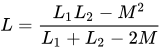
If

The sign of depends on how the magnetic fields influence each other. For two equal tightly coupled coils the total inductance is close to that of every single coil. If the polarity of one coil is reversed so that M is negative, then the parallel inductance is nearly zero or the combination is almost non-inductive. It is assumed in the "tightly coupled" case M is very nearly equal to L. However, if the inductances are not equal and the coils are tightly coupled there can be near short circuit conditions and high circulating currents for both positive and negative values of M, which can cause problems.

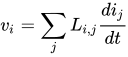
More than three inductors become more complex and the mutual inductance of each inductor on each other inductor and their influence on each other must be considered. For three coils, there are three mutual inductances , and . This is best handled by matrix methods and summing the terms of the inverse of the matrix (3×3 in this case).

The pertinent equations are of the form:
Capacitors

[edit]

The total capacitance of capacitors in parallel is equal to the sum of their individual capacitances:

A diagram of several capacitors, side by side, both leads of each connected to the same wires.

The working voltage of a parallel combination of capacitors is always limited by the smallest working voltage of an individual capacitor.

Switches

[edit]

Two or more switches in parallel form a logical OR; the circuit carries current if at least one switch is closed. See OR gate.

Cells and batteries

[edit]

If the cells of a battery are connected in parallel, the battery voltage will be the same as the cell voltage, but the current supplied by each cell will be a fraction of the total current. For example, if a battery comprises four identical cells connected in parallel and delivers a current of 1 ampere, the current supplied by each cell will be 0.25 ampere. If the cells are not identical in voltage, cells with higher voltages will attempt to charge those with lower ones, potentially damaging them.

Parallel-connected batteries were widely used to power the valve filaments in portable radios. Lithium-ion rechargeable batteries (particularly laptop batteries) are often connected in parallel to increase the ampere-hour rating. Some solar electric systems have batteries in parallel to increase the storage capacity; a close approximation of total amp-hours is the sum of all amp-hours of in-parallel batteries.

Combining conductances

[edit]

From Kirchhoff's circuit laws the rules for combining conductance can be deducted. For two conductances and in parallel, the voltage across them is the same and from Kirchhoff's current law (KCL) the total current is

Substituting Ohm's law for conductances gives and the equivalent conductance will be,

For two conductances and in series the current through them will be the same and Kirchhoff's Voltage Law says that the voltage across them is the sum of the voltages across each conductance, that is,

Substituting Ohm's law for conductance then gives, which in turn gives the formula for the equivalent conductance,

This equation can be rearranged slightly, though this is a special case that will only rearrange like this for two components.

For three conductances in series,

Notation

[edit]

The value of two components in parallel is often represented in equations by the parallel operator, two vertical lines (∥), borrowing the parallel lines notation from geometry.

This simplifies expressions that would otherwise become complicated by expansion of the terms. For instance:

Applications

[edit]

A common application of series circuit in consumer electronics is in batteries, where several cells connected in series are used to obtain a convenient operating voltage. Two disposable zinc cells in series might power a flashlight or remote control at 3 volts; the battery pack for a hand-held power tool might contain a dozen lithium-ion cells wired in series to provide 48 volts.

Series circuits were formerly used for lighting in electric multiple units trains. For example, if the supply voltage was 600 volts there might be eight 70-volt bulbs in series (total 560 volts) plus a resistor to drop the remaining 40 volts. Series circuits for train lighting were superseded, first by motor–generators, then by solid-state devices.

Series resistance can also be applied to the arrangement of blood vessels within a given organ. Each organ is supplied by a large artery, smaller arteries, arterioles, capillaries, and veins arranged in series. The total resistance is the sum of the individual resistances, as expressed by the following equation: Rtotal = Rartery + Rarterioles + Rcapillaries. The largest proportion of resistance in this series is contributed by the arterioles.[3]

Parallel resistance is illustrated by the circulatory system. Each organ is supplied by an artery that branches off the aorta. The total resistance of this parallel arrangement is expressed by the following equation: 1/Rtotal = 1/Ra + 1/Rb + ... + 1/Rn. Ra, Rb, and Rn are the resistances of the renal, hepatic, and other arteries respectively. The total resistance is less than the resistance of any of the individual arteries.[3]

See also

[edit]

References

[edit]

Further reading

[edit]
Revisions and contributorsEdit on WikipediaRead on Wikipedia
from Grokipedia
Series and parallel circuits are two fundamental types of electrical circuits that describe how components, such as resistors, are interconnected to allow the flow of . In a series circuit, components are connected end-to-end along a single continuous path, so the current has only one route and remains the same through each component, while the total voltage divides among them according to . Conversely, in a parallel circuit, components are connected across the same two points, creating multiple branches for current to flow independently, resulting in the same voltage across each branch but with the total current dividing among them. These configurations form the basis for analyzing more complex networks using principles like Kirchhoff's laws. The behavior of voltage, current, and resistance differs markedly between the two setups, influencing and performance. In series circuits, the equivalent resistance is the sum of individual resistances (Req=R1+R2+R_{eq} = R_1 + R_2 + \dots), making the total resistance higher than any single component, and a failure in one element breaks the entire circuit. Voltage drops add up to the source voltage (Vtotal=V1+V2+V_{total} = V_1 + V_2 + \dots), while current is constant throughout (Itotal=I1=I2=I_{total} = I_1 = I_2 = \dots). In parallel circuits, the equivalent resistance is lower, calculated as the reciprocal of the sum of reciprocals (1Req=1R1+1R2+\frac{1}{R_{eq}} = \frac{1}{R_1} + \frac{1}{R_2} + \dots), allowing the circuit to continue functioning if one fails. Here, voltage is uniform across branches (Vtotal=V1=V2=V_{total} = V_1 = V_2 = \dots), but currents sum to the total (Itotal=I1+I2+I_{total} = I_1 + I_2 + \dots). These circuit types are essential in practical applications, from simple battery-powered devices to household wiring and advanced electronics. Series connections are common in low-power applications like flashlights, where components share voltage efficiently, but they are less reliable due to the single-path dependency. Parallel arrangements dominate in home lighting and power distribution, ensuring consistent voltage supply and , as seen in outlets where devices operate independently without affecting each other. Understanding series and parallel principles enables the simplification of complex circuits into equivalent models, facilitating calculations for power dissipation, energy efficiency, and in designs.

Fundamentals

Basic electrical quantities

Electric current, denoted as II, is the flow of electric charge through a conductor, defined as the rate at which charge QQ passes a given point per unit time tt, expressed by the formula I=QtI = \frac{Q}{t}. It is measured in s (A), where one represents the flow of one of charge per second. Voltage, symbolized as VV, refers to the difference between two points in a circuit, which is the work done per unit charge to move it between those points, or V=WQV = \frac{W}{Q}, where WW is . It is quantified in volts (V), with one volt equaling one joule of energy per of charge. This potential difference drives the movement of charges, enabling current to flow in a circuit. Resistance, represented by RR, is the measure of opposition to the flow of electric current in a material, influenced by factors such as the material's properties, the length LL of the conductor, and its cross-sectional area AA. It is measured in ohms (Ω), where one ohm is defined as the resistance that allows one ampere of current to flow under one volt of potential difference. The relationship between resistance and material properties is captured by the resistivity ρ\rho, given by ρ=RAL\rho = \frac{R \cdot A}{L}, where ρ\rho is a constant for a given material at a specific temperature. Electric circuits can involve direct current (DC), where the flow of charge is unidirectional and constant in magnitude, or alternating current (AC), where the direction and magnitude of the current periodically reverse. Discussions of series and parallel circuits typically emphasize DC configurations unless AC effects are explicitly considered. The (SI) establishes the as the base unit for current, the volt as a derived unit for potential difference (equal to kg·m²·s⁻³·A⁻¹), and the for resistance (kg·m²·s⁻³·A⁻²). These units ensure standardized measurement and interoperability in and physics. Conductance, the reciprocal of resistance, provides an alternative measure of a material's ability to conduct current.

Ohm's law and conductance

Ohm's law states that the voltage VV across a conductor is directly proportional to the current II flowing through it, with the constant of proportionality being the resistance RR, expressed as V=IRV = I R. This relationship holds for ohmic conductors, where the resistance remains constant, provided the temperature is held constant to avoid variations in material properties. The law was first proposed by German physicist Georg Simon Ohm in his 1827 publication Die galvanische Kette, mathematisch bearbeitet, based on experimental measurements of voltage and current through various wires. Ohm derived the relationship empirically by observing that current increased linearly with applied voltage for metallic conductors, leading to the proportional form after accounting for the conductor's geometry and material. Microscopically, this can be outlined from the drift velocity of charge carriers: the current density J=nqvdJ = n q v_d, where nn is carrier density, qq is charge, and vd=μEv_d = \mu E is drift velocity under electric field E=V/LE = V/L, yielding V=IRV = I R with R=L/(μnqA)R = L / (\mu n q A), where LL is length and AA is cross-sectional area. Conductance GG, the reciprocal of resistance, quantifies a conductor's ability to allow current flow and is defined as G=1/RG = 1 / R, with units of siemens (S), where 1 S = 1 A/V. This measure is particularly useful in analyzing networks where admittances add, such as in parallel configurations, as total conductance is the sum of individual conductances. Ohm's law applies strictly to ohmic devices but has limitations with non-ohmic components, such as diodes, where the voltage-current relationship is nonlinear due to mechanisms like carrier injection or depletion regions. For example, in a semiconductor diode, current rises exponentially with forward voltage, deviating from the linear V=IRV = I R behavior. A key outcome of is the power dissipation in a , given by P=VIP = V I, which can be rewritten using the law as P=I2RP = I^2 R or P=V2/RP = V^2 / R, representing the rate at which is converted to . These forms highlight how power scales quadratically with current or voltage at fixed resistance.

Series Circuits

Definition and properties

In a series circuit, electrical components are connected end-to-end along a single continuous path, creating only one route for current to flow from the power source through all components and back to the source. This configuration ensures that the current through each component is identical and equal to the total circuit current, expressed as Itotal=IiI_{\text{total}} = I_i for every component ii. As a result, the same current passes through each element sequentially, with the total voltage supplied by the source dividing among the components according to their individual voltage drops. A key property of series circuits is the conservation of current, where the current remains constant throughout the path, governed by Kirchhoff's current law (KCL) at connection points, which states that the current entering a junction equals the current leaving it, ensuring no charge accumulation. The voltage drop across each component depends on its resistance or impedance, following (Vi=IRiV_i = I R_i), leading to varying voltage drops if component values differ. Series circuits have the advantage of in wiring and but lack ; a failure or open circuit in any single component interrupts the entire path, stopping current flow to all elements. They typically require less total current than equivalent parallel arrangements for the same power delivery, which can reduce wiring demands but may result in higher voltage drops across the circuit, potentially affecting . Additionally, uniform current loading ensures even stress on components, though brighter or hotter elements may dominate if resistances vary. A practical example of a series circuit is found in a basic , where batteries, a switch, and the are connected in series to provide a single path for current, ensuring the lights only when the circuit is complete. If the burns out or the switch opens, the entire light fails.

Resistors

In series circuits, multiple resistors are connected end-to-end, such that the same current flows through each , while the total voltage divides among them according to their resistances. This configuration results in voltage sharing, where each experiences a proportional to its resistance value. The equivalent resistance ReqR_{eq} of resistors in series is the sum of their individual resistances: Req=i=1nRiR_{eq} = \sum_{i=1}^{n} R_i This formula derives from applied to the total circuit: the total voltage Vtotal=IReqV_{\text{total}} = I R_{eq}, and since Vtotal=Vi=IRiV_{\text{total}} = \sum V_i = I \sum R_i, it follows that Req=RiR_{eq} = \sum R_i. For practical analysis, this additive property simplifies calculations in linear circuits. The voltage across each follows the voltage division rule: for a RiR_i in series with others, the branch voltage Vi=VtotalRiReqV_i = V_{\text{total}} \cdot \frac{R_i}{R_{eq}}. This ensures higher-resistance paths experience larger voltage drops. For example, two identical 10 Ω in series yield Req=20R_{eq} = 20 Ω, doubling the total resistance and halving the total current for a given voltage compared to a single . Since the current is the same through all resistors, the power dissipated by each resistor is given by P=I2RP = I^2 R, where II is the constant current and RR is the resistance. Therefore, power is directly proportional to resistance, meaning the resistor with the larger resistance dissipates more power. Connecting in series increases the overall equivalent resistance above that of any individual , thereby decreasing the total current drawn from the source for a fixed voltage and concentrating power dissipation. This is commonly used in circuits requiring voltage division, such as potential dividers or current-limiting applications.

Inductors

In series circuits, inductors are connected end-to-end such that the same current flows through each, while the total voltage is the sum of the individual voltage drops across them. This configuration is analogous to series resistors in terms of voltage addition, but the inductive reactance determines the behavior under changing currents. For ideal inductors without mutual coupling, the equivalent inductance LeqL_{eq} of nn series inductors with individual inductances L1,L2,,LnL_1, L_2, \dots, L_n is the sum of their : Leq=i=1nLiL_{eq} = \sum_{i=1}^{n} L_i This formula arises because the voltage across each inductor is v(t)=Lidi(t)dtv(t) = L_i \frac{di(t)}{dt} for the shared current i(t)i(t), so the total voltage vtotal(t)=vi(t)=di(t)dtLiv_{\text{total}}(t) = \sum v_i(t) = \frac{di(t)}{dt} \sum L_i, corresponding to LeqL_{eq} as defined. This assumes no magnetic coupling between inductors. Voltage division among series inductors follows a rule similar to resistors: the branch with higher inductance experiences a larger share of the total voltage, as the rate of flux change is proportional to LiL_i. For steady sinusoidal AC excitation, the magnitude of the voltage across each inductor is proportional to its inductive reactance XL=ωLiX_L = \omega L_i. Connecting in series increases the total equivalent compared to any single inductor, which is useful in applications like filters to achieve higher impedance for blocking low frequencies or in circuits. This setup assumes ideal, non-coupled inductors where parasitic effects like resistance are negligible.

Capacitors

In series circuits, capacitors are connected end-to-end, such that the same charge accumulates on each, a fundamental property of series connections. This configuration results in voltage drops adding across the capacitors, with the total voltage equaling the sum of individual voltages. The equivalent capacitance CeqC_{eq} for capacitors in series is given by the reciprocal of the sum of their reciprocals: 1Ceq=i=1n1Ci\frac{1}{C_{eq}} = \sum_{i=1}^{n} \frac{1}{C_i} This formula derives from the definition of capacitance as C=Q/VC = Q / V, where QQ is charge. In series, the charge QQ is the same on each capacitor, so Vtotal=Vi=QCi=Q1CiV_{\text{total}} = \sum V_i = \sum \frac{Q}{C_i} = Q \sum \frac{1}{C_i}, thus Ceq=QVtotal=11CiC_{eq} = \frac{Q}{V_{\text{total}}} = \frac{1}{\sum \frac{1}{C_i}}. Connecting capacitors in series decreases the total capacitance below that of any individual capacitor, reducing energy storage capacity since stored energy scales with CV2/2C V^2 / 2 but with higher total voltage. This is useful in applications like voltage multipliers or high-voltage filtering, where series capacitors divide voltage stress to prevent breakdown. For example, two identical 10 μF in series yield an equivalent of 5 μF, halving the capacitance and requiring twice the voltage to store the same charge compared to a single unit.

Power sources

In series circuits, power sources like batteries are connected positive-to-negative, resulting in the total voltage of the combination equaling the sum of the individual source voltages, denoted as Vtotal=ViV_{\text{total}} = \sum V_i. This configuration allows the sources to provide a higher overall voltage to the circuit while maintaining the same current capacity as a single source. The capacity of the series arrangement, typically measured in ampere-hours (Ah), remains that of the individual sources, as the current through each is the same, enabling higher voltage operation without increasing runtime proportionally. For instance, connecting two 1.5 V batteries each with a 1000 mAh rating in series yields a combined voltage of 3 V at 1000 mAh, useful for devices requiring higher voltage like some toys or remote controls. This setup is common in portable to boost voltage, such as stacking AA batteries in a . For safe operation, batteries must be of identical type, capacity, and to avoid imbalances that could cause uneven discharging or overheating. Mismatched batteries in series can lead to on weaker cells, reducing lifespan or risking leakage and failure.

Switches

In series circuits, switches are placed along the single path to control the entire current flow. With this arrangement, all switches must be closed to allow current through the circuit, while opening any single switch interrupts the path and stops current to all components. This interdependent operation ensures that the circuit activates only when every switch is engaged. Certain switch configurations enhance series utility by requiring multiple conditions for activation. For instance, multiple single-pole single-throw (SPST) switches in series form a logical equivalent, where the circuit functions only if all are closed, providing safety interlocks in systems like machinery. Such designs are ideal for applications, where any open switch (e.g., due to fault) halts operation entirely. The use of switches in series inherently promotes through in monitoring, as a malfunction or open switch disables the whole circuit, preventing unintended activation. This is seen in emergency stop circuits, where series-connected switches across a ensure shutdown if any point detects a hazard. A practical application of series switches is in simple systems, where multiple sensors wired in series trigger only if all are intact; an intrusion opening any switch breaks the circuit and activates the alert.

Parallel Circuits

Definition and properties

In a parallel circuit, electrical components are connected across two common points, creating multiple pathways for current to flow from the power source to the return path, with all components sharing the identical voltage supplied by the source. This configuration ensures that the voltage drop across each branch is equal to the total applied voltage, expressed as Vtotal=ViV_{\text{total}} = V_i for every branch ii. As a result, each component operates at the full supply voltage, independent of the others in the circuit. A key property of parallel circuits is the distribution of current, where the total current supplied by the source equals the sum of the currents through each individual branch, given by Itotal=IiI_{\text{total}} = \sum I_i. This relationship arises from Kirchhoff's current law (KCL), which states that the algebraic sum of currents entering and leaving a junction must be zero, conserving charge at the connection points. The current in each branch depends on the component's resistance, following , leading to varying branch currents if resistances differ. Parallel circuits offer advantages such as independent operation of components, allowing each to function without interference from others, and built-in , where the failure of one does not disrupt the entire circuit. However, they draw a higher total current than equivalent series arrangements for the same voltage, which can increase power demands on the source and require heavier wiring to prevent overheating or excessive . Additionally, differing branch resistances may result in uneven current loading, potentially straining certain paths more than others. A practical example of a parallel circuit is found in electrical systems, where outlets are wired in parallel to provide the standard line voltage (e.g., 120 V in the ) to multiple appliances simultaneously, enabling independent use without one device affecting the voltage or operation of another. If one appliance fails or is unplugged, the others continue to receive full voltage and operate normally.

Resistors

In parallel circuits, multiple resistors are connected across the same two nodes, such that the across each is identical, while the total current divides among the branches according to their resistances. This configuration allows for current sharing, where each carries a portion of the total current proportional to its conductance. The equivalent resistance ReqR_{eq} of resistors in parallel is calculated using the reciprocal sum of their individual resistances: 1Req=i=1n1RiorReq=1i=1n1Ri\frac{1}{R_{eq}} = \sum_{i=1}^{n} \frac{1}{R_i} \quad \text{or} \quad R_{eq} = \frac{1}{\sum_{i=1}^{n} \frac{1}{R_i}} This formula arises from Kirchhoff's current law, ensuring the sum of branch currents equals the total current for the equivalent single resistor. For practical computation, especially with many resistors, conductance G=1RG = \frac{1}{R} (measured in ) is often used, as the equivalent conductance GeqG_{eq} is simply the sum of individual conductances: Geq=i=1nGiG_{eq} = \sum_{i=1}^{n} G_i, and thus Req=1GeqR_{eq} = \frac{1}{G_{eq}}. This additive property of conductance simplifies analysis in complex parallel networks. The current through each follows the current division rule. For a RiR_i in parallel with others, the branch current IiI_i is Ii=ItotalReqRiI_i = I_{total} \cdot \frac{R_{eq}}{R_i}, or equivalently using conductances, Ii=ItotalGiGeqI_i = I_{total} \cdot \frac{G_i}{G_{eq}}. This ensures higher-conductance (lower-resistance) paths carry more current. For example, two identical 10 Ω in parallel yield Req=5R_{eq} = 5 Ω, halving the total resistance and doubling the total current for a given voltage compared to a single . Connecting in parallel reduces the overall equivalent resistance below that of any individual , thereby increasing the total current drawn from the source for a fixed voltage and enabling load sharing to distribute power dissipation across components. This is commonly applied in circuits requiring balanced current distribution, such as power supplies or amplifiers.

Inductors

In parallel circuits, inductors are connected such that each experiences the same voltage across its terminals, while the total current is the sum of the individual branch currents. This configuration is analogous to parallel resistors in terms of current addition, but the inductive reactance governs the behavior. For ideal inductors without mutual coupling, the equivalent inductance LeqL_{eq} of nn parallel inductors with individual inductances L1,L2,,LnL_1, L_2, \dots, L_n is given by the reciprocal sum: 1Leq=i=1n1Li\frac{1}{L_{eq}} = \sum_{i=1}^{n} \frac{1}{L_i} This formula arises because the voltage v(t)v(t) across each inductor satisfies v(t)=Lidii(t)dtv(t) = L_i \frac{di_i(t)}{dt} for the ii-th branch, implying dii(t)dt=v(t)Li\frac{di_i(t)}{dt} = \frac{v(t)}{L_i}. The total current i(t)=ii(t)i(t) = \sum i_i(t) then yields an effective di(t)dt=v(t)1Li\frac{di(t)}{dt} = v(t) \sum \frac{1}{L_i}, corresponding to LeqL_{eq} as defined, based on the total relative to the total current. Current division among parallel inductors follows a rule similar to that for resistors: the branch with higher inductance carries a smaller share of the total current, as the rate of current change is inversely proportional to LiL_i. For instance, in a steady sinusoidal AC excitation, the magnitude of the current through each inductor is inversely proportional to its inductive reactance XL=ωLiX_L = \omega L_i, ensuring balanced voltage division. Connecting in parallel reduces the total equivalent compared to any single , which is useful in applications like power supplies to achieve lower impedance paths for higher current handling or interleaved converter designs. This setup assumes non-coupled, ideal where parasitic effects like resistance are negligible.

Capacitors

In parallel circuits, capacitors connected between the same two nodes experience the same voltage across their terminals, a fundamental property of parallel connections. This configuration allows the charges stored on each to accumulate additively. The equivalent CeqC_{eq} for capacitors in parallel is the sum of their individual capacitances: Ceq=CiC_{eq} = \sum C_i This formula arises from the definition of capacitance as C=Q/VC = Q / V, where QQ is charge and VV is voltage. With identical voltage VV across each capacitor, the charge on the ii-th capacitor is Qi=CiVQ_i = C_i V, so the total charge is Qtotal=Qi=VCiQ_{total} = \sum Q_i = V \sum C_i. Thus, Ceq=Qtotal/V=CiC_{eq} = Q_{total} / V = \sum C_i. Connecting capacitors in parallel increases the total capacitance, enhancing energy storage capacity since stored energy scales with CV2/2C V^2 / 2. This is particularly useful in applications like power smoothing in DC supplies, where parallel capacitors filter voltage ripples from rectification, or in filters to provide low-impedance paths for high-frequency . For example, two 10 μF capacitors in parallel yield an equivalent of 20 μF, effectively doubling the charge storage for the same voltage compared to a single unit.

Power sources

In parallel circuits, power sources like batteries are connected such that their positive terminals are linked together and negative terminals are linked together, resulting in the total voltage across the combination equaling the voltage of each individual source, denoted as Vtotal=ViV_{\text{total}} = V_i. This configuration allows the currents from each source to add up, providing a higher overall current capacity to the circuit. The capacity of the parallel arrangement, typically measured in ampere-hours (Ah), is the sum of the individual capacities, enabling extended operation without altering the voltage. For instance, connecting two batteries each with a 1000 mAh rating in parallel yields a combined capacity of 2000 mAh at the original voltage, which is particularly useful for applications requiring prolonged runtime. This setup is commonly employed in portable devices to enhance availability, such as in parallel configurations of nickel-metal hydride (NiMH) cells for high-drain applications like RC toys, where the added capacity supports longer usage. For safe and effective operation, the batteries must be of identical type, voltage, and capacity to prevent circulating currents that could reduce or cause overheating. Mismatched voltages in parallel connections lead to current imbalances, where higher-voltage sources discharge into lower ones, potentially resulting in damage, reduced lifespan, or safety hazards like .

Switches

In parallel circuits, switches are incorporated into individual branches to enable selective control over current flow in each path. With this arrangement, closing any single switch permits current to traverse its respective branch while maintaining the full supply voltage across all branches, whereas opening all switches simultaneously interrupts the total circuit current. This independent operation of branches allows for flexible and targeted activation without affecting unaffected paths. Certain switch types enhance the utility of parallel configurations by facilitating and path selection. For instance, single-pole double-throw (SPDT) switches can alternate between multiple parallel branches, providing a mechanism to choose or backup operational routes as required. Such designs are advantageous in systems demanding reliable continuity, where an SPDT switch can redirect flow to an alternate branch if the primary one encounters an issue. The incorporation of switches in parallel circuits inherently supports , ensuring that a malfunction in one branch—such as a failed switch—does not compromise the functionality of others. This property is exemplified in backup lighting circuits, where multiple parallel paths with dedicated switches allow illumination to persist through surviving branches even if one path is disrupted. A practical application of parallel switches appears in elevator control systems, where multiple call buttons across floors are wired in parallel to permit activation from any , thereby enabling independent operation and in summoning the .

Advanced Topics

Series-parallel combinations

Series-parallel combinations, also known as mixed or compound circuits, consist of electrical networks that incorporate both series and parallel arrangements of components, such as resistors, inductors, or capacitors. These configurations are prevalent in real-world designs where simple series or parallel setups are insufficient to achieve desired performance characteristics, allowing for more flexible control over voltage, current, and impedance. To analyze and simplify series-parallel circuits, a systematic reduction method is employed, which involves iteratively identifying and replacing subnetworks that are purely series or parallel with their single equivalent components. The process begins by locating the innermost parallel or series groups—often starting with parallel branches since they share the same voltage—and computing their equivalents before combining them in series. For resistors, the equivalent resistance ReqR_{eq} of series components is the sum Req=R1+R2++RnR_{eq} = R_1 + R_2 + \cdots + R_n, while for parallel components it follows 1Req=1R1+1R2++1Rn\frac{1}{R_{eq}} = \frac{1}{R_1} + \frac{1}{R_2} + \cdots + \frac{1}{R_n}. This stepwise replacement continues outward toward the power source until the entire network reduces to a single equivalent resistance, facilitating easier calculation of total current or voltage division. The method relies on the associative properties of series and parallel connections but requires careful diagramming to avoid overlooking nested structures. A representative example illustrates this reduction for a resistor network: consider a circuit with two pairs of 4 Ω s, where each pair is connected in parallel, and the resulting equivalents are then placed in series with a 2 Ω . First, each parallel pair yields Rp=4×44+4=2ΩR_p = \frac{4 \times 4}{4 + 4} = 2 \, \Omega. These two 2 Ω equivalents are in series with the 2 Ω , giving a total Rtotal=2+2+2=6ΩR_{total} = 2 + 2 + 2 = 6 \, \Omega. If a 12 V source is applied, the total current is I=126=2I = \frac{12}{6} = 2 A, with voltages across each major section verifiable by proportional division. This step-by-step approach ensures accuracy without needing advanced theorems for reducible networks. For verification, especially in circuits with non-obvious paths, Kirchhoff's laws provide a complementary check. Kirchhoff's current law (KCL) states that the algebraic sum of currents entering a node equals zero, useful for parallel branches where currents split. Kirchhoff's voltage law (KVL) asserts that the sum of voltages around any closed loop is zero, applied to series segments or full loops to confirm potential drops match the source. In the example above, applying KVL to the outer loop confirms the 12 V supply equals the sum of drops across the 6 Ω equivalent, while KCL at junction points validates current conservation in parallels. These laws are essential when reduction alone cannot fully simplify irregular topologies. In practical , series-parallel combinations enable efficient designs like voltage dividers incorporating parallel loads, where a series string of resistors sets the output voltage, and parallel elements simulate real-world loading without altering the core . This technique is foundational in circuit prototyping and optimization, though for highly interconnected networks, transformations like delta-wye may be referenced for further simplification.

Notation and conventions

Standard circuit diagrams employ graphical symbols for electrical components, as defined by international standards such as IEC 60617, to ensure clarity and universality in representation. The is symbolized by a rectangular in some conventions or a line in others, illustrating opposition to current flow. The appears as a series of connected loops or semicircles, mimicking the physical coil of wire that induces . Capacitors are depicted as two parallel vertical lines of equal length, representing the separating plates that store . Batteries or cells are shown as one long vertical line paired with a shorter parallel line, with the long line indicating the positive terminal; multiple such pairs denote multi-cell batteries. Switches are illustrated as a straight line interrupted by a gap or an angled line crossing it, signifying the open or closed state that interrupts or completes the circuit path. In the analysis of series and parallel circuits, specific subscript notations are conventionally used to denote equivalent values and variables. The total resistance in a series configuration is labeled RsR_s, while the equivalent resistance for parallel components is RpR_p. Currents through elements are typically represented by lowercase ii, often with subscripts for specific branches (e.g., i1i_1, i2i_2), and voltage drops across components by lowercase vv (e.g., vRv_R for a ). These notations facilitate precise mathematical descriptions without ambiguity, aligning with practices in texts. Diagramming conventions emphasize logical flow and readability: series circuits are rendered as a single, continuous horizontal or vertical line connecting components end-to-end, reflecting the shared current path. Parallel circuits, in contrast, feature branches diverging from and reconverging to junction points or nodes, highlighting multiple current paths between the same voltage points. Directional arrows, labeled with current symbols like II or ii, are drawn along wires to indicate conventional current flow from higher to lower potential, aiding in the application of Kirchhoff's laws. Wires are straight lines without arrows unless specifying direction, and junctions are marked by dots where lines intersect to confirm connections. These practices promote consistency in design across disciplines. For (AC) extensions, though series and parallel discussions primarily concern (DC), impedances introduce complex notation: inductors are assigned ZL=jωLZ_L = j \omega L, where j=1j = \sqrt{-1}
Add your contribution
Related Hubs
User Avatar
No comments yet.