


Community hub
Recent from talks
Contribute something
Nothing was collected or created yet.
Four-current
View on Wikipedia| Electromagnetism |
|---|
 |
In special and general relativity, the four-current (technically the four-current density)[1] is the four-dimensional analogue of the current density, with the dimension of electric charge per time per area. Also known as vector current, it is used in the context of four-dimensional spacetime, rather than separating time from three-dimensional space. It is a four-vector and is Lorentz covariant.
This article uses the summation convention for indices. See Covariance and contravariance of vectors for background on raised and lowered indices, and raising and lowering indices on how to translate between them.
Definition
[edit]Using the Minkowski metric of metric signature (+ − − −), the four-current components are given by:


where:
- c is the speed of light;
- ρ is the volume charge density;
- j is the conventional current density;
- the dummy index α labels the spacetime dimensions.
Motion of charges in spacetime
[edit]This can also be expressed in terms of the four-velocity by the equation:[2][3]

where:
- is "the rest charge density", i.e., the charge density in the rest frame of the charge (as seen by an observer moving along with the local charge).

Qualitatively, the change in charge density (charge per unit volume) is due to the contracted volume of charge due to Lorentz contraction.
Physical interpretation
[edit]Charges (free or as a distribution) at rest will appear to remain at the same spatial position for some interval of time (as long as they're stationary). When they do move, this corresponds to changes in position, therefore the charges have velocity, and the motion of charge constitutes an electric current. This means that charge density is related to time, while current density is related to space.
The four-current unifies charge density (related to electricity) and current density (related to magnetism) in one electromagnetic entity.
Continuity equation
[edit]In special relativity, the statement of charge conservation is that the Lorentz invariant divergence of J is zero:[4]
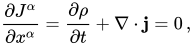
where is the four-gradient. This is the continuity equation.

In general relativity, the continuity equation is written as:

where ∇α is the covariant derivative.
Maxwell's equations
[edit]The four-current appears in two equivalent formulations of Maxwell's equations, in terms of the four-potential[5] when the Lorenz gauge condition is fulfilled:
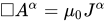
where is the D'Alembert operator, or the electromagnetic field tensor:

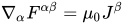
where μ0 is the permeability of free space and ∇α is the covariant derivative.
Quantum field theory
[edit]The four-current density of charge is an essential component of the Lagrangian density used in quantum electrodynamics.[6] In 1956 Semyon Gershtein and Yakov Zeldovich considered the conserved vector current (CVC) hypothesis for electroweak interactions.[7][8][9]
See also
[edit]References
[edit]- ^ Rindler, Wolfgang (1991). Introduction to Special Relativity (2nd ed.). Oxford Science Publications. pp. 103–107. ISBN 978-0-19-853952-0.
- ^ Roald K. Wangsness, Electromagnetic Fields, 2nd edition (1986), p. 518, 519
- ^ Melvin Schwartz, Principles of Electrodynamics, Dover edition (1987), p. 122, 123
- ^ J. D. Jackson, Classical Electrodynamics, 3rd Edition (1999), p. 554
- ^ as [ref. 1, p519]
- ^ Cottingham, W. Noel; Greenwood, Derek A. (2003). An introduction to the standard model of particle physics. Cambridge University Press. p. 67. ISBN 9780521588324.
- ^ Marshak, Robert E. (1993). Conceptual foundations of modern particle physics. World Scientific Publishing Company. p. 20. ISBN 9789813103368.
- ^ Gershtein, S. S.; Zeldovich, Y. B. (1956), Soviet Phys. JETP, 2 576.
- ^ Thomas, Anthony W. (1996). "CVC in particle physics". arXiv:nucl-th/9609052.
Four-current
View on GrokipediaFundamentals
Definition
In relativistic electromagnetism, the four-current is a fundamental four-vector that encapsulates the distribution and flow of electric charge in a manner invariant under Lorentz transformations of special relativity.[1] This construct unifies the charge density, a scalar quantity describing the amount of charge per unit volume, with the current density, a three-vector representing the flux of charge, into a single entity that transforms covariantly across inertial frames.[3] By treating charge flow as a component of spacetime geometry, the four-current ensures that electromagnetic laws maintain their form regardless of the observer's relative motion, addressing inconsistencies in non-relativistic descriptions where charge and current appear to mix under boosts.[1] The four-current was introduced by Hermann Minkowski in 1908 as part of his formulation of electromagnetism within the four-dimensional spacetime framework of special relativity.[4] Minkowski's work demonstrated that physical quantities like charge and current must be combined into four-vectors to preserve the relativity principle, drawing from Einstein's 1905 theory but recasting it in a geometrically unified picture of space and time.[4] This innovation arose from the necessity to describe charge conservation and electromagnetic interactions in a Lorentz-invariant way, avoiding frame-dependent artifacts in classical vector formulations.[1] In standard notation, the four-current is expressed as , where is the charge density, is the three-current density, is the speed of light, and the index runs from 0 to 3 in the Minkowski metric.[3] Here, the time component scales with to match the spatial components' dimensions, ensuring the four-vector's homogeneity.[1] The overall dimensions of the four-current are those of charge per unit area per unit time, consistent with current density in three dimensions but extended to four.[3] Special relativity represents many physical quantities as four-vectors for covariance, such as the position four-vector , assuming familiarity with basic vector calculus in three dimensions.[1] The four-current's structure parallels this, treating charge flow along worldlines in spacetime. Its partial derivative with respect to spacetime coordinates yields the continuity equation as a direct consequence of local charge conservation.[3]Components and Interpretation
The four-current in special relativity is a contravariant four-vector whose components encapsulate the distribution and motion of electric charge in spacetime. The time component is , where is the speed of light and is the charge density in the observer's frame, while the spatial components are (for ), corresponding to the components of the three-dimensional current density vector , with the velocity of the charges.[5][2] Physically, the four-current represents the flux of charge through an arbitrary hypersurface in four-dimensional spacetime. The time component can be interpreted as the "charge flux through time," equivalent to the charge density when integrated over a spatial volume at constant time, while the spatial components describe the conventional current as the charge flux through surfaces perpendicular to the direction of motion.[2] This unified description ensures that charge conservation manifests as the vanishing four-divergence , reflecting the relativistic invariance of total charge.[5] For a single point particle of charge moving along its worldline, the four-current density is given by where parameterizes the particle's worldline with proper time , and is the four-velocity with magnitude in the timelike direction.[6] This expression localizes the current along the particle's trajectory via the four-dimensional Dirac delta function, yielding and , where . As a four-vector, transforms covariantly under Lorentz transformations, preserving its physical interpretation across inertial frames and ensuring consistency with relativistic electrodynamics.[5]Mathematical Formulation
Continuity Equation
The continuity equation for the four-current in relativistic electrodynamics is expressed as where denotes the four-gradient in Minkowski spacetime with metric signature , and repeated indices imply summation over .[7] This tensor notation encapsulates the four-divergence of the contravariant four-current vector , with the charge density and the three-current density.[8] This equation arises from Noether's theorem applied to the gauge invariance of the classical electromagnetic action , where is the electromagnetic field tensor and the four-potential.[9] Under infinitesimal local U(1) gauge transformations , the invariance of the action implies the existence of a conserved Noether current , satisfying on-shell, directly yielding the continuity equation as the associated conservation law.[9] Alternatively, the equation can be derived directly from the non-relativistic continuity equation by extending to four-dimensional spacetime and taking the Lorentz-covariant divergence, which combines the time and space derivatives into .[8] Physically, enforces local conservation of electric charge throughout spacetime, ensuring that the net charge flux through any closed hypersurface vanishes, thereby generalizing the integral form of charge conservation to arbitrary Lorentz frames.[7] This relativistic form unifies the temporal evolution of charge density with spatial current flow, maintaining invariance under Lorentz transformations.[8] The continuity equation is a direct consequence of the gauge invariance inherent to electromagnetism, without which the theory would lack consistency in describing conserved charges.[9] While classical electrodynamics upholds this conservation strictly, quantum field theories may exhibit anomalies under certain conditions, though these lie beyond the classical framework.[9]Lorentz Covariance
The four-current transforms as a contravariant four-vector under Lorentz transformations, ensuring the relativistic invariance of electromagnetic descriptions. The general transformation rule is given by where is the Lorentz transformation matrix and summation over is implied.[10] For rotations, corresponds to the standard rotation matrix acting on the spatial components while leaving the time component unchanged. For boosts, the matrix takes a specific form; for example, a boost along the x-axis with velocity (where and ) is represented by This structure mixes the temporal and spatial components, maintaining the Minkowski norm .[10] A concrete example illustrates this mixing for a boost along the x-axis. Assuming the four-current in the original frame is with as the x-component of the three-current , the transformed components become while the transverse components and remain unchanged.[11] This transformation reflects relativistic effects: for a charge distribution at rest in the original frame (, ), the boosted density arises from length contraction in the direction of motion, increasing the observed charge density, while the induced current accounts for the motion of the contracted distribution. Time dilation further ensures consistency in the observed charge flow. These effects underscore how the four-vector form unifies density and current to preserve physical laws across frames. The covariance extends to integrals over spacetime, where the flux through a closed spacelike hypersurface is a Lorentz scalar, invariant under transformations. This integral equals the total enclosed charge, independent of the choice of inertial frame or hypersurface orientation, as the transformation of compensates for changes in the surface element .[10] Such invariance is crucial for charge conservation in relativistic contexts. In contrast to the three-current and charge density treated separately—which do not transform simply under boosts and lead to frame-dependent inconsistencies—the four-vector formulation of the four-current ensures full Lorentz covariance. This necessity arises because and represent the time-like and space-like parts of a single entity, transforming together to uphold the relativistic structure of electrodynamics.[2]Classical Electrodynamics
Integration into Maxwell's Equations
In the covariant formulation of classical electrodynamics, the four-current acts as the source term for the electromagnetic fields in Maxwell's equations. The inhomogeneous equations are expressed as where is the electromagnetic field-strength tensor, incorporating both electric and magnetic fields, and is the vacuum permeability in SI units.[8][12] This four-vector equation unifies the sources of charge density (the time component ) and current density (the spatial components ). The homogeneous equations, which do not involve sources, take the form where is the Hodge dual of , equivalently written as the cyclic sum .[8][12] This covariant structure relates directly to the familiar three-vector form of Maxwell's equations in three-dimensional space. For the inhomogeneous part, the time component () yields Gauss's law for electricity, , while the spatial components () produce Ampère's law with Maxwell's displacement current, . The homogeneous equations correspond to Gauss's law for magnetism, , and Faraday's law, .[8][12] Thus, the four-current drives the generation of electromagnetic fields in a Lorentz-invariant manner. The equations can also be formulated in terms of the four-potential , where , but this introduces gauge freedom under the transformation . Choosing the Lorentz gauge, , simplifies the inhomogeneous equations to the wave equations with the d'Alembertian operator, directly sourcing the potentials from the four-current.[8][12] Unit conventions affect the precise form: in SI units, the factor appears as shown, with . In Gaussian (cgs) units, the inhomogeneous equation becomes , where and the four-current retains the same structure, ensuring consistency across systems.[8][13] This integration maintains consistency with charge conservation via the continuity equation .[12]Relation to Lorentz Force
In relativistic electrodynamics, the interaction between electromagnetic fields and charged particles is described by the four-force acting on a single particle, given by where is the particle's charge, is the electromagnetic field strength tensor (derived from Maxwell's equations), and is the particle's four-velocity.[7] This covariant expression generalizes the three-dimensional Lorentz force to four-dimensional Minkowski spacetime, ensuring consistency under Lorentz transformations.[7] The components of the four-force reveal its physical interpretation: the time component equals (in units where ), representing the rate at which the electric field performs work on the particle and thus changes its energy.[7] The spatial components correspond to , capturing the change in the particle's three-momentum due to both electric and magnetic fields.[7] For continuous media, such as charge and current distributions characterized by the four-current , the electromagnetic force density is This extends the single-particle relation to macroscopic scales, where combines charge density and current density .[14] The resulting four-force density ensures local conservation of the energy-momentum tensor, balancing the transfer of energy and momentum between the fields and the medium.[14] Hermann Minkowski's seminal 1908 formulation provided the foundational insight by expressing these interactions in a unified covariant manner, integrating electric and magnetic forces within the four-dimensional spacetime geometry and resolving apparent asymmetries in non-relativistic descriptions.[15]Quantum Field Theory
Four-Current in Relativistic Quantum Mechanics
In relativistic quantum mechanics, the four-current is promoted to an operator constructed from the quantum fields, providing a bridge between the classical description and quantum expectations. For fermionic particles such as electrons, described by the Dirac field, the four-current operator is given by the bilinear form , where is the Dirac spinor field and are the Dirac matrices satisfying the Clifford algebra .[16] This operator transforms as a Lorentz four-vector under the Poincaré group, ensuring covariance in relativistic treatments.[16] The probability interpretation of the Dirac four-current aligns with charge conservation, where the time component serves as the charge density, and the spatial components form the current density. In the non-relativistic limit, this reduces to the familiar Schrödinger probability current , with the Dirac current's spatial part (where are the Dirac alpha matrices) recovering the non-relativistic form after projecting onto positive-energy states. Relativistically, the divergence holds classically via the equations of motion, conserving total charge; however, in the full quantum field theory, anomalies can arise for certain currents, though the vector current remains conserved in abelian theories like QED.[16] For scalar particles obeying the Klein-Gordon equation, the four-current operator is , derived from the U(1) symmetry of the complex scalar field .[17] This form is less commonly used for electromagnetic interactions compared to the Dirac case, as scalar fields do not carry spin and are typically associated with charged bosons rather than fundamental fermions. The operator is Hermitian when the current is real-valued, ensuring that expectation values match the classical four-current in the correspondence principle.[17] The continuity equation in quantum form follows from Noether's theorem applied to these operators, maintaining probability conservation on-shell.[17]Applications in QED and Beyond
In quantum electrodynamics (QED), the four-current mediates the interaction between charged fermions, such as electrons, and the electromagnetic field. The relevant term in the QED Lagrangian density is , where represents the fermion four-current, is the elementary charge, is the Dirac spinor field for the electron, are the Dirac matrices, and is the photon four-potential. This interaction term arises from the minimal coupling of the Dirac field to the gauge field under U(1) symmetry, ensuring gauge invariance. The bilinear serves as the Noether current associated with this symmetry, sourcing the electromagnetic field in the quantized theory. In the Feynman diagrammatic expansion of QED, the four-current appears through the vertex factor at each electron-photon interaction point. This factor governs the coupling strength and Dirac structure in perturbative calculations. For instance, in Compton scattering (), the leading-order diagrams involve two such vertices connected by electron propagators, with the four-momentum conservation enforced at each current insertion; the resulting amplitude yields the Klein-Nishina differential cross-section, which matches experimental observations to high precision. Similarly, in Møller scattering (), the four-current insertions in the t- and u-channel photon-exchange diagrams capture the repulsive Coulomb interaction at low energies, transitioning to quantum corrections at higher orders. These applications highlight the four-current's role in computing scattering amplitudes via Dyson-Wick perturbation theory. Beyond QED, the concept of four-currents extends to non-Abelian gauge theories. In quantum chromodynamics (QCD), the strong force is mediated by color-octet gluons coupling to quark color currents , where denotes the quark Dirac fields, (with ) are the fundamental generators of SU(3)_c, and the index labels the gluon color. These currents appear in the QCD interaction Lagrangian , with the strong coupling and the gluon fields, enabling computations of quark-gluon scattering and hadron structure functions. In the electroweak theory, currents are chiral due to the SU(2)_L × U(1)_Y gauge structure, featuring left-handed doublets: the charged weak currents are (and conjugate), where is the left-handed fermion doublet and are Pauli matrix combinations, coupling to W bosons; the neutral current involves , mixing into the photon and Z after symmetry breaking. This formulation unifies electromagnetic and weak processes, predicting phenomena like parity violation in neutrino scattering. Quantum anomalies provide a profound application of four-currents, revealing breakdowns of classical symmetries at the quantum level. The axial anomaly specifically violates the naive conservation of the axial-vector current , where . In Abelian theories like QED, the divergence is with the field strength and its dual; for non-Abelian cases, it generalizes to , where is the gauge coupling and is over the Lie algebra. This triangle anomaly, computed via one-loop Feynman diagrams, explains the observed decay , where the neutral pion couples effectively to two photons through the anomalous axial current of up and down quarks, matching the decay rate to experimental values without ad hoc parameters.References
- https://en.wikisource.org/wiki/Translation:The_Fundamental_Equations_for_Electromagnetic_Processes_in_Moving_Bodies