Hubbry Logo
Pascal's lawPascal's lawMain
Open search
Pascal's law
Community hub
Pascal's law
logo
8 pages, 0 posts
0 subscribers
Be the first to start a discussion here.
Pascal's law
Pascal's law
from Wikipedia
Hydraulic lifting and pressing devices

Pascal's law (also Pascal's principle[1][2][3] or the principle of transmission of fluid-pressure) is a principle in fluid mechanics that states that a pressure change at any point in a confined incompressible fluid is transmitted throughout the fluid such that the same change occurs everywhere.[4] The law was established by French mathematician Blaise Pascal in 1653 and published in 1663.[5][6]

Definition

[edit]
Pressure in water and air. Pascal's law applies for fluids.

Pascal's principle is defined as:

A change in pressure at any point in an enclosed incompressible fluid at rest is transmitted equally and undiminished to all points in all directions throughout the fluid, and the force due to the pressure acts at right angles to the enclosing walls.

Fluid column with gravity

[edit]

For a fluid column in a uniform gravity (e.g. in a hydraulic press), this principle can be stated mathematically as:

where

The intuitive explanation of this formula is that the change in pressure between two elevations is due to the weight of the fluid between the elevations. Note that the variation with height does not depend on any additional pressures. Therefore, Pascal's law can be interpreted as saying that any change in pressure applied at any given point of the fluid is transmitted undiminished throughout the fluid.

The formula is a specific case of Navier–Stokes equations without inertia and viscosity terms.[7]

Applications

[edit]

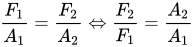
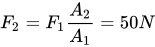
If a U-tube is filled with water and pistons are placed at each end, pressure exerted by the left piston will be transmitted throughout the liquid and against the bottom of the right piston. (The pistons are simply "plugs" that can slide freely but snugly inside the tube.) The pressure that the left piston exerts against the water will be exactly equal to the pressure the water exerts against the right piston . By using we get . Suppose the tube on the right side is made 50 times wider . If a 1 N load is placed on the left piston (), an additional pressure due to the weight of the load is transmitted throughout the liquid and up against the right piston. This additional pressure on the right piston will cause an upward force which is 50 times bigger than the force on the left piston. The difference between force and pressure is important: the additional pressure is exerted against the entire area of the larger piston. Since there is 50 times the area, 50 times as much force is exerted on the larger piston. Thus, the larger piston will support a 50 N load – fifty times the load on the smaller piston.

Forces can be multiplied using such a device. One newton input produces 50 newtons output. By further increasing the area of the larger piston (or reducing the area of the smaller piston), forces can be multiplied, in principle, by any amount. Pascal's principle underlies the operation of the hydraulic press. The hydraulic press does not violate energy conservation, because a decrease in distance moved compensates for the increase in force. When the small piston is moved downward 100 centimeters, the large piston will be raised only one-fiftieth of this, or 2 centimeters. The input force multiplied by the distance moved by the smaller piston is equal to the output force multiplied by the distance moved by the larger piston; this is one more example of a simple machine operating on the same principle as a mechanical lever.

A typical application of Pascal's principle for gases and liquids is the automobile lift seen in many service stations (the hydraulic jack). Increased air pressure produced by an air compressor is transmitted through the air to the surface of oil in an underground reservoir. The oil, in turn, transmits the pressure to a piston, which lifts the automobile. The relatively low pressure that exerts the lifting force against the piston is about the same as the air pressure in automobile tires. Hydraulics is employed by modern devices ranging from very small to enormous. For example, there are hydraulic pistons in almost all construction machines where heavy loads are involved.

Other applications:

  • Force amplification in the braking system of most motor vehicles.
  • Used in artesian wells, water towers, and dams.
  • Scuba divers must understand this principle. Starting from normal atmospheric pressure, about 100 kilopascal, the pressure increases by about 100 kPa for each increase of 10 m depth.[8]
  • Usually Pascal's rule is applied to confined space (static flow), but due to the continuous flow process, Pascal's principle can be applied to the lift oil mechanism (which can be represented as a U tube with pistons on either end).

Pascal's barrel

[edit]
An illustration of Pascal's barrel experiment from The forces of nature by Amédée Guillemin (1872)

Pascal's barrel is the name of a hydrostatics experiment allegedly performed by Blaise Pascal in 1646.[9] In the experiment, Pascal supposedly inserted a long vertical tube into an (otherwise sealed) barrel filled with water. When water was poured into the vertical tube, the increase in hydrostatic pressure caused the barrel to burst.[9]

The experiment is mentioned nowhere in Pascal's preserved works and it may be apocryphal, attributed to him by 19th-century French authors, among whom the experiment is known as crève-tonneau ("barrel-buster");[10] nevertheless the experiment remains associated with Pascal in many elementary physics textbooks.[11]

See also

[edit]

References

[edit]
Revisions and contributorsEdit on WikipediaRead on Wikipedia
from Grokipedia
Pascal's law, also known as Pascal's principle, states that a pressure change applied to an enclosed incompressible is transmitted undiminished to every portion of the and to the walls of its container. This principle applies to fluids at rest and is fundamental in , enabling the uniform distribution of external static throughout the confined liquid in all directions. Formulated by the French mathematician and physicist , the law emerged from his experiments on the equilibrium of liquids conducted in the mid-17th century. In 1663, Pascal published his Treatise on the Equilibrium of Liquids, where he described how in a is equally distributed, building on his earlier barometric studies starting in 1646 that explored atmospheric and hydrostatic . These investigations demonstrated that exerted on a could be transmitted without loss, laying the groundwork for modern . Mathematically, Pascal's law is expressed through the definition of pressure as P=FAP = \frac{F}{A}, where PP is the pressure, FF is the force applied, and AA is the area over which the force acts; any change in pressure ΔP\Delta P at one point propagates identically throughout the fluid. This transmission allows for force amplification in systems where a small input force over a small area produces a larger output force over a larger area, as the pressure remains constant. The principle underpins numerous practical applications in and everyday technology, particularly in hydraulic systems. For instance, hydraulic lifts and presses use this law to elevate heavy loads by applying pressure via pistons of different sizes, such as in automotive repair shops or industrial manufacturing. Similarly, hydraulic brakes in vehicles rely on the uniform pressure transmission through to apply stopping force evenly across the wheels. These applications highlight the law's role in enabling efficient force multiplication while maintaining the integrity of fluid-based mechanisms.

Definition and Statement

Formal Statement

Pascal's law, a fundamental principle in , states that a change in applied to an enclosed incompressible is transmitted undiminished to every portion of the fluid and to the walls of the container. This statement captures the essence of hydrostatic pressure transmission in confined systems, as originally explored by in his 1663 work Traité de l'équilibre des liqueurs. The key terms in this formulation are essential for its precise application. "Enclosed" refers to the fluid being confined within a closed container, ensuring no loss or gain of volume during pressure changes. "Incompressible" indicates that the fluid maintains constant , with negligible volume variation under applied , which is a reasonable for liquids like or . "Undiminished" means the pressure increment propagates equally in magnitude and is isotropic, independent of the direction in which the initial pressure is applied. To illustrate the conceptual setup, consider a hypothetical closed vessel entirely filled with an incompressible , where an external is exerted via a at one specific point. The resulting pressure change at that point instantaneously affects all other parts of the and the container's walls equally, maintaining throughout. This transmission arises from the 's inability to compress or expand, forcing the pressure to distribute uniformly without .

Physical Interpretation

Pascal's law can be intuitively understood through a simple involving a confined incompressible , such as , in a with two of different sizes connected by a tube. If a modest is applied to the smaller piston, it displaces a small of fluid, creating an increase in that propagates uniformly throughout the entire fluid. This pressure change reaches the larger piston, where the same pressure acts over a greater area, resulting in a proportionally larger output —effectively multiplying the input force without mechanical linkages, as the fluid serves as the medium for equal transmission. This demonstrates how the law enables through area differences, a core conceptual insight building on the formal statement that pressure changes are transmitted undiminished in all directions. Pressure in this context acts as a scalar quantity, meaning it has magnitude but no direction, and it transmits isotropically—equally in every direction—within the , much like sound waves spreading uniformly from a source in still air. Visualize the fluid as a dense network of molecules where an applied perturbation causes neighboring molecules to push outward equally in , maintaining equilibrium without dissipation or directional preference, as long as the fluid remains confined and at rest. This isotropic nature ensures that the increment from the input is identical at every point, including the container walls and the output , fostering a balanced hydrostatic state. The law's applicability is particularly pronounced in liquids rather than compressible gases because liquids exhibit negligible volume change under typical , preserving uniform and allowing to transmit without significant . In contrast, gases can compress substantially, leading to variable and uneven distribution, especially under varying loads or over distances, which disrupts the uniform transmission central to . For instance, in a with a gas-filled , applying to one would cause disproportionate compression near the input, altering the pressure profile elsewhere, whereas liquids maintain near-constant volume, ensuring fidelity in propagation. A conceptual illustrating this often depicts a horizontal closed filled with , featuring a narrow on the left (small area) and a wide on the right (large area), with arrows showing the input on the small converting to equal arrows throughout the and a magnified output on the large . This visualization highlights the equal (same arrow length everywhere) but differing (proportional to area), underscoring the law's role in amplification via geometric disparity.

Historical Development

Blaise Pascal's Contributions

Blaise Pascal (1623–1662) was a French mathematician, physicist, and inventor whose work in the mid-17th century laid foundational principles in during his investigations into vacuums, , and fluid behavior. Born in , Pascal conducted these studies amid broader scientific debates, including challenges to prevailing Aristotelian notions that denied the possibility of vacuums, as he sought to demonstrate the existence of empty space through empirical means. Pascal's key contribution to the principle of pressure transmission in fluids appeared in his posthumously published treatise Traité de l'équilibre des liqueurs (Treatise on the Equilibrium of Liquids), released in 1663 as part of a collection edited by his friend Claude Clerselier. In this work, Pascal articulated how applied to a confined propagates equally in , drawing from his theoretical and experimental insights into liquid equilibrium. The treatise rejected ' "horror vacui" doctrine, which posited that nature abhors a , by affirming vacuums' reality based on observations with sealed tubes and liquids. To support his ideas, Pascal performed notable experiments, including the 1648 Puy de Dôme trial where barometers carried up a mountain showed decreasing mercury levels with altitude, confirming atmospheric pressure's variation. He also invented an early around 1650 during hydraulic studies, using it to apply and observe pressure transmission in enclosed liquids, thereby illustrating undiminished force propagation. These efforts built briefly on earlier hydrostatic concepts from and regarding fluid weight distribution. The hydrostatic principle Pascal described became known as Pascal's law in the 19th century, honoring his pioneering role in fluid mechanics despite the term's later adoption.

Preceding and Influencing Works

The foundations of hydrostatics, which later informed Pascal's law, trace back to ancient principles articulated by Archimedes in the 3rd century BCE. Archimedes' principle describes the buoyant force acting on an immersed object as equal to the weight of the displaced fluid, resulting from differences in hydrostatic pressure acting on the object's surfaces. This concept established that pressure in a fluid varies with depth, providing an early qualitative understanding of fluid behavior under gravity, though it did not address the transmission of pressure through confined fluids./Book%3A_University_Physics_I_-Mechanics_Sound_Oscillations_and_Waves(OpenStax)/14%3A_Fluid_Mechanics/14.04%3A_Archimedes_Principle_and_Buoyancy) In the late 16th century, advanced these ideas through his 1586 treatise De Beghinselen des Waterwights (Elements of the ), where he introduced the "hydrostatic ." Stevin demonstrated experimentally that the downward force exerted by a on the base of a depends solely on the of the liquid column and the base area, remaining equal regardless of the vessel's shape or the liquid's path above the base. This insight highlighted the uniformity of at a given depth in connected regions, challenging intuitive notions of weight distribution and laying groundwork for analyzing pressure equilibrium in static fluids. Galileo Galilei further developed hydrostatic concepts in his 1638 work Discorsi e Dimostrazioni Matematiche intorno a Due Nuove Scienze (Dialogues Concerning Two New Sciences). On the first day, Galileo examined the equilibrium of liquids, arguing that water's cohesion prevents it from breaking under tension and that floating bodies achieve stability when their specific gravity matches the surrounding fluid's. He also discussed buoyancy in terms of pressure differences, proposing that immersed objects experience upward forces proportional to displaced volume, extending Archimedes' ideas to explain fluid-solid interactions without invoking molecular forces. These explorations of fluid statics and equilibrium directly shaped subsequent investigations into pressure propagation. The early 17th century marked a pivotal shift in studies, exemplified by Evangelista Torricelli's 1643 invention of the mercury . , inverting a mercury-filled tube in a dish, created a above the column and showed that balanced the mercury's weight, refuting the Aristotelian "horror vacui" doctrine. This demonstration quantified air's as a fluid-like force and encouraged empirical studies of pressure variations, bridging vacuum theories to modern .

Mathematical Formulation

Derivation from Fluid Statics

In fluid statics, the study of s at rest under the influence of forces such as and , the is assumed to be in , with no motion or deformation occurring. Under these conditions, is defined as a scalar quantity that exerts a force normal (perpendicular) to any surface within or bounding the , independent of the surface's orientation. Crucially, static fluids exhibit no shear stresses, as any tangential forces would induce shear deformation and thus motion, contradicting the static assumption; this absence of shear arises because the rate of strain is zero in a at rest. To derive the isotropic nature of pressure from these principles, consider an infinitesimal cubic element of the fluid, with side lengths dxdx, dydy, and dzdz, located at an arbitrary point within the fluid. This element experiences pressure forces solely on its six faces, acting normal to each face due to the lack of shear stresses. For equilibrium, the net force on the element must be zero in every direction, with no contribution from viscous shear terms. Focus on the balance in the xx-direction. The pressure on the face at position xx (area dydzdy \, dz) exerts a force PdydzP \, dy \, dz in the positive xx-direction, while the pressure on the opposite face at x+dxx + dx exerts a force (P+Pxdx)dydz-(P + \frac{\partial P}{\partial x} dx) \, dy \, dz in the positive xx-direction. The resulting net pressure force is Pxdxdydz-\frac{\partial P}{\partial x} dx \, dy \, dz. Since no shear stresses act tangentially on the faces perpendicular to the yy- or zz-axes to contribute a net force in the xx-direction, and assuming no body force component in the xx-direction for this analysis (e.g., horizontal directions in a gravitational field), the net force must vanish: Px=0\frac{\partial P}{\partial x} = 0. The same reasoning applies to the yy- and zz-directions, yielding Py=0\frac{\partial P}{\partial y} = 0 and Pz=0\frac{\partial P}{\partial z} = 0 under analogous conditions of no body forces in those directions. These partial derivatives indicate that pressure does not vary spatially in any direction perpendicular to potential body forces, implying that at any given point, the normal stress (pressure) is identical regardless of the orientation of the surface considered. This uniformity establishes the isotropy of pressure: the force per unit area is the same in all directions. In a confined static fluid, where boundary conditions enforce equilibrium throughout, any applied pressure change propagates equally without directional preference, maintaining constant pressure across the volume.

Key Equations

The core mathematical expression of Pascal's law quantifies the uniform transmission of changes in a confined incompressible , stated as ΔP=F1A1=F2A2,\Delta P = \frac{F_1}{A_1} = \frac{F_2}{A_2}, where ΔP\Delta P is the change in applied at one point, F1F_1 and A1A_1 are the and cross-sectional area at the input (e.g., a small ), and F2F_2 and A2A_2 are the corresponding and area at the output (e.g., a larger ). This equality holds because the increment ΔP\Delta P propagates undiminished in all directions, allowing the output to be amplified as F2=F1(A2A1)F_2 = F_1 \left( \frac{A_2}{A_1} \right), a fundamental to hydraulic . In broader fluid statics, the total pressure PP at a point also incorporates the hydrostatic contribution due to the 's , P=P0+ρgh,P = P_0 + \rho g h, where P0P_0 is the reference , ρ\rho is the , gg is , and hh is the depth. However, Pascal's law applies specifically to the ΔP\Delta P term, which is transmitted equally regardless of gravitational variations in fully confined setups without free surfaces. The SI unit for pressure is the pascal (Pa), defined as 1Pa=1N/m21 \, \mathrm{Pa} = 1 \, \mathrm{N/m^2}, honoring and officially adopted by the 14th Conférence Générale des Poids et Mesures in 1971.

Practical Applications

Hydraulic Systems

Hydraulic systems leverage to transmit power efficiently through incompressible , enabling the multiplication of in mechanical devices. These systems consist of interconnected cylinders and where applied to a smaller is equally distributed throughout the fluid, resulting in amplified on a larger . This principle allows for precise control and significant in applications requiring heavy lifting or pressing, without the need for complex gearing mechanisms. The exemplifies Pascal's law in engineered form, with British inventor patenting the first design in 1795 based on the principle of equal transmission. In a , a small input force applied to a narrow generates that acts equally across the , enabling a much larger output force on a wider proportional to the of their cross-sectional areas. For instance, a modest force on the input side can lift or compress loads thousands of times heavier, making it indispensable for metal forming and material testing. This design achieves through area disparity, transmitting power effectively over distances. Hydraulic jacks and lifts apply the same equalization to elevate heavy objects, such as in automotive service. A generates via a hand- or foot-operated , which raises a larger ram to support the load, with the lifting height and force determined by the area . In ideal conditions, the operates with near-perfect , conserving as work input equals output; however, real-world efficiencies typically range from 80% to 95% due to minor frictional losses in seals and valves. These devices highlight Pascal's law's role in providing stable, controlled power transmission for safe load handling. To uphold the incompressibility assumption central to Pascal's law, hydraulic systems employ specialized fluids like mineral-based oils or water-glycol mixtures. Hydraulic oils, derived from , offer low (under 0.5% volume change per 100 MPa) and lubricate components while resisting variations. Water-glycol fluids, containing 35-50% with glycol and additives, provide similar incompressibility alongside resistance, commonly used in high-safety environments like . These fluid selections ensure uniform propagation and reliable .

Everyday and Industrial Uses

In automotive hydraulic brake systems, the principle of Pascal's law enables the transmission of pressure from the —activated by the driver's foot on the brake pedal—through incompressible to multiple wheel , ensuring uniform application to stop the vehicle efficiently./Book%3A_University_Physics_I_-Mechanics_Sound_Oscillations_and_Waves(OpenStax)/14%3A_Fluid_Mechanics/14.05%3A_Pascal's_Principle_and_Hydraulics) This equal pressure distribution allows a small input to generate larger output forces at the calipers due to differences in piston areas. Modern anti-lock braking systems (ABS) extend this by electronically modulating hydraulic pressure to individual wheels, preventing skidding while maintaining the core pressure transmission mechanism. Medical devices also leverage Pascal's law for precise pressure management. In sphygmomanometers, or blood pressure cuffs, inflation of the cuff creates uniform transmission through the enclosed air or , compressing the to allow of blood flow sounds for systolic and diastolic readings. Similarly, syringes operate on this principle, where depressing the applies to a small area, transmitting equal throughout the to expel it uniformly through the needle for accurate delivery. Everyday items like spray bottles exemplify the law in household use: squeezing the trigger pressurizes the reservoir, transmitting that equally to the out of the in a fine . In industrial settings, Pascal's law powers heavy machinery and specialized equipment. Hydraulic excavators use interconnected cylinders and fluid lines to amplify operator inputs, transmitting pressure from control valves to boom, arm, and bucket actuators for powerful digging and lifting with minimal effort. Aircraft hydraulic systems apply the principle to flight controls, where pilot commands generate fluid pressure that actuates landing gear, flaps, and rudders across the aircraft, ensuring responsive and synchronized movements under varying loads. Deep-sea submersibles employ pressure compensation via oil-filled voids or syntactic foam, allowing external hydrostatic pressure to transmit equally to internal components and prevent implosion at extreme depths. Additionally, hydraulic ram pumps in agricultural applications harness a momentum-induced pressure surge—distinct from but related to the water hammer effect—which is transmitted per Pascal's law through check valves to elevate water to higher elevations without electricity.

Experimental Demonstrations

Pascal's Barrel

A famous demonstration of hydrostatic pressure transmission in confined fluids, known as Pascal's barrel, is attributed to in the mid-17th century, though the experiment is not documented in his preserved works and may be apocryphal. The setup consists of a sturdy wooden barrel completely filled with and tightly sealed to prevent leakage, into which a long, narrow vertical tube—typically around 10 meters in length—is inserted and secured. This configuration allows for the application of pressure through a small cross-sectional area while observing its effects on the larger volume of the barrel. In the procedure, water is gradually poured into the thin tube, raising the fluid level to a considerable height, such as equivalent to the third floor of a building. This elevates the hydrostatic pressure at the base of the barrel by ΔP=ρgh\Delta P = \rho g h, where ρ\rho is the density of the water (approximately 1000 kg/m³), gg is the acceleration due to gravity (about 9.8 m/s²), and hh is the height of the water column in the tube. Even though only a small volume of water is added—due to the tube's narrow diameter—the effective pressure increase is substantial because it depends on the height rather than the volume directly. The key observation is the catastrophic failure of the barrel: the immense pressure buildup causes seams to split and the barrel to burst or leak violently, despite the minimal amount of water introduced. This highlights how a modest input amplifies into overwhelming force through height-induced pressure, unequivocally illustrating the uniform and undiminished transmission of pressure in all directions within the enclosed fluid. The experiment has been associated with Pascal's studies on hydrostatics and is described in later accounts of his work.

Syringe and Balloon Experiments

One common educational demonstration of Pascal's law involves connecting two s of different sizes with flexible tubing to illustrate the transmission of through an incompressible . The setup consists of a small (e.g., 1 mL capacity) and a larger one (e.g., 10 mL capacity), both filled completely with and sealed to eliminate air pockets, then linked via the tubing submerged in to ensure no bubbles enter the . When is applied to the of the smaller , such as by pushing with a finger or adding a small weight equivalent to about 1 , the generated (P = F/A, where A is the smaller 's cross-sectional area of approximately 0.2 cm²) is transmitted equally throughout the . This results in the of the larger (with an area of about 2 cm²) being pushed upward with a multiplied of roughly 10 , lifting a correspondingly heavier weight attached to it, demonstrating how the same yields greater output proportional to the area ratio. A complementary demonstration uses a filled with and covered with a stretched over the mouth, with small indicators like matchstick heads floating inside. When is applied by pressing on the , the transmitted causes the indicators to sink, showing uniform distribution; releasing the pressure allows them to float again. This setup visualizes how changes propagate undiminished in all directions within the enclosed liquid. These experiments hold significant educational value in classrooms, as they tangibly visualize the concept of in hydraulic systems; for instance, a 1:10 area between syringes can amplify a 5 N input to 50 N output, making abstract principles accessible to students through hands-on of weights and plunger displacements. They are particularly suitable for grades 6-8, fostering understanding of without complex equipment, and can be extended to discuss real-world analogs like car jacks. Safety precautions are essential: always remove air pockets to approximate incompressibility, as trapped air can lead to uneven or sudden releases; protective to guard against splashes; and use blunt-tipped syringes without needles to prevent injuries.

Assumptions and Limitations

Core Assumptions

Pascal's law, which describes the uniform transmission of in a , relies on specific ideal conditions for its exact validity. These core assumptions ensure that pressure changes propagate without alteration throughout the system. The must be incompressible, with constant under applied . This condition holds accurately for liquids like or hydraulic oils, where changes are negligible, but it fails for compressible fluids such as gases, where variations prevent uniform distribution./Book%3A_University_Physics_I_-Mechanics_Sound_Oscillations_and_Waves(OpenStax)/14%3A_Fluid_Mechanics/14.05%3A_Pascal's_Principle_and_Hydraulics) The system requires a fully , meaning the is enclosed without free surfaces, leaks, or openings that could allow to escape or be influenced by external factors like . This enclosure prevents dissipation and ensures the pressure increment is transmitted intact to all points. Static conditions are essential, with the at rest in equilibrium and no bulk flow present. Under these circumstances, viscous effects do not influence transmission, as there is no relative motion between layers./Book%3A_University_Physics_I_-Mechanics_Sound_Oscillations_and_Waves(OpenStax)/14%3A_Fluid_Mechanics/14.05%3A_Pascal's_Principle_and_Hydraulics) The fluid is assumed to be homogeneous, exhibiting uniform and properties throughout without suspended particulates or compositional variations that could cause local gradients or impede even transmission.

Extensions and Real-World Deviations

While Pascal's law assumes an incompressible fluid, real fluids exhibit slight , quantified by the KK, which measures resistance to uniform compression. The relative change under is given by ΔVV=ΔPK\frac{\Delta V}{V} = -\frac{\Delta P}{K}, where a finite KK means the transmitted ΔP\Delta P causes a small reduction, slightly attenuating the pressure increase at distant points in large systems. For , with K2.2×109K \approx 2.2 \times 10^9 Pa, a increase of 1 atm (105\approx 10^5 Pa) results in a volume compression of about 0.005%, making the deviation negligible in most hydraulic applications but relevant in high-precision or deep-sea contexts. Viscosity introduces deviations primarily in dynamic conditions, as Pascal's law applies to static or quasi-static fluids where shear stresses are absent. In slow flows, viscous effects are minimal, and pressure transmits nearly uniformly; however, at high velocities, frictional losses along flow paths cause pressure drops, while inertial effects introduce dynamic pressure variations described by Bernoulli's principle, P+12ρv2+ρgh=constantP + \frac{1}{2} \rho v^2 + \rho g h = \text{constant}, altering the isotropic transmission./Book%3A_University_Physics_I_-Mechanics_Sound_Oscillations_and_Waves(OpenStax)/14%3A_Fluid_Mechanics/14.04%3A_Bernoullis_Equation) In open systems under , the law's uniform transmission of ΔP\Delta P holds for confined increments, but total pressure includes a hydrostatic ΔP=ρgh\Delta P = \rho g h, varying with depth and modifying the effective distribution vertically. This does not impede the isotropic of applied changes in horizontal or confined directions. Modern extensions incorporate these factors in specialized fields. In , waves such as acoustic signals propagate as compressional waves with speed c=K/ρc = \sqrt{K / \rho}
Add your contribution
Related Hubs
User Avatar
No comments yet.