


Community hub
Recent from talks
Contribute something
Nothing was collected or created yet.
Pax Ottomana
View on Wikipedia

In historiography, the Pax Ottomana (literally "the Ottoman Peace") or Pax Ottomanica[1][2] is a term used to describe the economic and social stability attained in the conquered provinces of the Ottoman Empire at the height of its power during the 16th and 17th centuries, applied to lands in the Balkans, Anatolia, the Middle East, North Africa, the Caucasus, and western Iran.[citation needed]
The term is preferred in particular by historians and writers who hold a positive view of Ottoman rule to underline the positive impact of Ottoman rule on the conquered regions. They compare it favourably with the instability experienced before the Ottoman founding and conquests, as well as with the period after World War I, when only Asia Minor and Eastern Thrace remained under Turkish rule and the Ottoman Empire was officially dissolved.[citation needed]
The term is derived by analogy from the more common Pax Romana, "the Roman Peace,” and is sometimes used by those who consider the Ottoman Empire to be a continuation of the Byzantine Empire.
References
[edit]- ^ The Holy Land, 1517-1713. Brill. 2012. p. 4. ISBN 978-90-04-23624-0.
From Selim's conquest until the early eighteenth century, which marked the beginning of British and French domination of the Mediterranean Sea routes, the region witnessed what Rhoads Murphey [an Ottoman Studies professor] has described as the pax Ottomanica.
- ^ Király, Béla K., ed. (1975). "The Ottoman aspects of Pax Ottomanica". Tolerance and movements of religious dissent in Eastern Europe. East European Quarterly. ISBN 978-0-914710-06-6.
- Richard Hooker. 1996. The Ottomans. Washington State University.
- Çiçek, Kemal (2001). Pax Ottomana: studies in memoriam Prof. Dr. Nejat Göyünç. Yeni Türkiye. ISBN 9080440965.
- İlber Ortaylı. 2004. Osmanlı Barışı. İstanbul: Timaş.
Periods of regional and relative peace | ||
|---|---|---|
| Contemporary | .svg) | |
| Historical | ||
Pax Ottomana
View on GrokipediaDefinition and Origins
Etymology and Conceptual Framework
The term Pax Ottomana, translating to "Ottoman Peace," derives from the Latin pax ("peace"), as in the classical Pax Romana, with "Ottomana" denoting the Ottoman dynasty and empire; it was formed by analogy to describe eras of relative imperial stability rather than originating in Ottoman sources.[6][7] This nomenclature, absent from contemporary Ottoman chronicles, entered modern scholarship to characterize the empire's capacity to impose order over heterogeneous populations spanning Southeast Europe, the Middle East, and North Africa from the late 15th to early 18th centuries.[4] Conceptually, Pax Ottomana posits a system of centralized authority that curtailed internecine warfare among subject peoples by integrating them into a hierarchical structure governed by sultanic decree, Islamic jurisprudence for Muslims, and tolerated autonomy for non-Muslims via the millet framework, thereby fostering trade routes like the Silk Road extensions and suppressing emergent national entities that might fragment imperial cohesion.[6][8] This framework emphasized dhimmi protections under jizya taxation for religious minorities, enabling economic prosperity—evidenced by Istanbul's population swelling to over 700,000 by 1600 and Mediterranean commerce peaking under Suleiman I—while relying on military deterrence against both internal revolts and external rivals like the Safavids and Habsburgs.[8][9] Historians applying the term often highlight causal mechanisms such as the devşirme levy for elite Janissary forces and provincial timar land grants, which aligned local elites with imperial interests, though Balkan nationalist narratives counter this with "Turkish Yoke" interpretations stressing coercion over benevolence.[4][10]Temporal and Geographical Scope
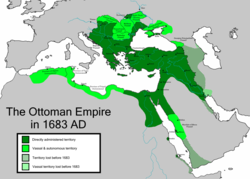
The Pax Ottomana primarily spanned the 16th and 17th centuries, a period marked by relative internal stability and effective administration following the empire's major conquests and centralization under sultans like Selim I and Suleiman I.[11] This era began after the consolidation of power post-1517 conquests in the Middle East and extended through the 17th century, when the empire maintained control over diverse populations amid occasional frontier conflicts but minimal large-scale internal rebellions.[12] The stability waned toward the late 17th century, particularly after the failed Siege of Vienna in 1683, which signaled the onset of territorial contraction.[13] Geographically, the Pax Ottomana encompassed territories across three continents, serving as a balance of power in Europe, the Middle East, and North Africa.[14] In Europe, Ottoman rule extended over the Balkans, including regions corresponding to modern-day Greece, Bulgaria, Serbia, Bosnia, and parts of Hungary, providing a buffer against Christian powers.[6] In southwestern Asia, the core included Anatolia, the Levant (Syria and Palestine), Mesopotamia (modern Iraq), and peripheral control over the Hejaz.[12] North African provinces, such as Egypt, Libya, Tunisia, and Algeria, were governed semi-autonomously through regencies but integrated into the imperial fiscal and military systems.[14] At its zenith around 1683, these domains covered vast multicultural landscapes, facilitating trade and migration networks that underpinned the era's peace.[15]Historical Context
Foundations in Ottoman Expansion
The Ottoman Empire originated as a small Turkoman principality, or beylik, in northwestern Anatolia around 1299, founded by Osman I, who led ghazi warriors—frontier raiders motivated by Islamic jihad against the weakening Byzantine Empire—in raids and conquests that expanded Ottoman territory from Söğüt.[16] Osman's successors capitalized on the fragmentation of the Seljuk Sultanate of Rum and Byzantine decline following the Fourth Crusade, securing early victories such as the capture of Bilecik and Yarhisar in the 1300s, which provided resources and recruits through the incorporation of local Christian populations via the devşirme system precursors.[17] This initial phase emphasized mobility and opportunistic expansion, with Ottoman forces numbering in the thousands by the early 14th century, laying the territorial groundwork for a multi-ethnic domain that would enforce internal stability.[18] Under Orhan I (r. 1326–1362), the Ottomans consolidated Anatolian gains by capturing Bursa in 1326, establishing it as the first capital and a commercial hub linking Asia and Europe, while extending into the Balkans via the 1354 Gallipoli bridgehead after an earthquake facilitated entry.[17] Murad I (r. 1362–1389) accelerated European expansion, defeating Serbian forces at the Battle of Maritsa in 1371 and Kosovo in 1389, annexing much of the Balkans and integrating timar land grants to cavalry (sipahi) for fiscal-military sustainability.[17] Bayezid I (r. 1389–1402) further intensified conquests, besieging Constantinople in 1394–1402 and subjugating Bulgarian and Byzantine remnants, though his ambitions were halted by Timur's invasion in 1402, leading to a temporary interregnum that tested but ultimately reinforced Ottoman resilience through fraternal succession struggles resolved by Mehmed I (r. 1413–1421).[17] These campaigns, reliant on disciplined infantry (janiçeri) and artillery, amassed a domain spanning Anatolia and southeastern Europe by the early 15th century, creating a buffer against rivals and a revenue base from diverse taxation systems.[18] The pivotal foundation came with Mehmed II's (r. 1444–1446, 1451–1481) conquest of Constantinople on May 29, 1453, after a 53-day siege involving 80,000 Ottoman troops against a Byzantine force of about 7,000, employing massive bombards cast by Hungarian engineer Orban to breach the Theodosian Walls.[19] This victory ended the Byzantine Empire, transformed the city into Istanbul as the Ottoman capital, and secured control over vital Black Sea and Silk Road trade routes, generating annual revenues exceeding 1 million gold ducats by mid-century. The integration of the city's skilled artisans, markets, and symbolic prestige as a former Roman seat enabled administrative centralization, millet-based communal autonomy for non-Muslims, and a cosmopolitan core that underpinned subsequent eras of relative pax by mitigating internal revolts through economic incentives and layered governance.[20] Thus, these expansions forged a contiguous empire of approximately 2.2 million square kilometers by 1500, essential for the enforced peace that characterized Ottoman dominance.[17]Peak Under Suleiman the Magnificent (1520–1566)
Suleiman I, reigning from 1520 to 1566, oversaw the Ottoman Empire's territorial zenith, expanding its domains to include southeastern Europe, Anatolia, the Levant, Mesopotamia, and parts of North Africa, encompassing approximately 2 million square kilometers by mid-century.[21] His military campaigns began with the capture of Belgrade in 1521, securing a Danube gateway, followed by the conquest of Rhodes from the Knights Hospitaller in 1522, which neutralized a Christian naval threat in the eastern Mediterranean.[22] The decisive Battle of Mohács in 1526 shattered Hungarian resistance, leading to the partition of Hungary and Ottoman suzerainty over Transylvania, while the 1529 siege of Vienna, though unsuccessful, demonstrated the empire's reach into central Europe.[22] Further expansions included victories against the Safavid Persians, annexing Iraq and eastern Anatolia after campaigns in 1534–1535, enhancing control over eastern trade routes.[22] In the Mediterranean, Admiral Barbarossa's integration into the Ottoman fleet culminated in the 1538 Battle of Preveza, establishing naval supremacy and facilitating conquests of key North African ports like Algiers and Tripoli, extending influence westward.[23] These conquests consolidated diverse territories under centralized authority, fostering relative internal stability through imposed order and tribute systems, which reduced internecine warfare among vassals and promoted economic integration via secure Silk Road and maritime trade corridors.[21] Administratively, Suleiman refined the kanun system, codifying secular laws on taxation, land tenure, and criminal justice alongside Sharia, creating a more uniform legal framework that supported fiscal efficiency and reduced corruption in provincial governance.[24] This legal codification, compiled in works like the Kanunname, addressed gaps in religious law, enabling equitable resource extraction from conquered lands and sustaining military expenditures without excessive revolts.[25] The era's prosperity manifested in architectural patronage, including the Süleymaniye Mosque complex built by Mimar Sinan from 1550 to 1557, symbolizing cultural flourishing and urban development that attracted artisans and scholars, contributing to a period of relative peace amid expansion.[23] Overall, Suleiman's rule marked the apex of Ottoman power, where military prowess and institutional reforms yielded sustained stability and wealth accumulation, though sustained by continuous conquests.[21]Extension into the 17th Century
Following the death of Suleiman the Magnificent in 1566, the Ottoman Empire faced a succession of immature or ineffective sultans, yet the Pax Ottomana persisted into the 17th century through resilient administrative institutions and targeted suppressions of internal disorder. The Celali rebellions, driven by economic distress, timar system disruptions, and demobilized soldiers in Anatolia from the late 1590s to around 1610, threatened central control but were ultimately quelled through relentless campaigns, restoring provincial order and enabling agricultural recovery.[26][27] Sultan Murad IV's reign (1623–1640) exemplified forceful reassertion of authority; employing terror tactics, including mass executions estimated in the tens of thousands and personal enforcement of bans on tobacco and coffee to dismantle rebellious networks, he curbed janissary indiscipline and banditry that had plagued urban centers like Istanbul. His military campaigns culminated in the recapture of Baghdad from Safavid forces in 1638, followed by the Treaty of Zuhab in 1639, which delineated enduring borders and inaugurated over a century of relative peace on the eastern front, alleviating fiscal strains from prolonged warfare.[28] The mid-century appointment of Köprülü Mehmed Pasha as grand vizier in 1656, with unprecedented autonomy granted by Sultan Mehmed IV, further buttressed stability; Pasha purged corrupt officials, restructured provincial governance, and reformed tax collection to refill depleted treasuries, averting collapse amid Venetian naval pressures and domestic unrest. This Köprülü era, extending through family successors, temporarily revived military discipline and administrative efficiency, sustaining internal cohesion despite external setbacks like the 1664 Peace of Vasvár with the Habsburgs, which preserved contested Hungarian territories on favorable terms.[29][30] Underlying these interventions, the empire's bureaucratized mechanisms—such as detailed tax registers and court records—facilitated economic integration, with safer trade corridors fostering commercialization in regions like Greater Syria, where orchard expansion and market access supported population stability until late-century upheavals. However, creeping challenges like timar fragmentation and rising local ayan influence foreshadowed erosion, as the Pax began faltering after the failed 1683 Vienna siege and subsequent territorial losses.[31][1]Mechanisms of Stability
Administrative Innovations
The Ottoman Empire's administrative framework during the Pax Ottomana era featured a centralized bureaucracy that balanced the sultan's absolute authority with delegated provincial governance, enabling control over diverse territories spanning three continents. This system evolved from early conquest practices into a sophisticated structure by the 16th century, incorporating the Imperial Council (Divan-ı Hümayun) as the primary decision-making body, where the grand vizier and key officials advised on policy, justice, and finance. Halil İnalcık describes this as a patrimonial bureaucracy where officials served at the sultan's pleasure, fostering loyalty through rotation and surveillance rather than hereditary rights. A cornerstone innovation was the devshirme system, initiated in the late 14th century and systematized by the 15th, which levied Christian boys—primarily from Balkan provinces—for conversion to Islam and training in elite military (Janissaries) or administrative roles. By the 16th century, this produced thousands of loyal functionaries annually, circumventing tribal or familial allegiances that plagued earlier Islamic states; records from Bursa in 1603–1604 indicate levies filling key posts, with the system peaking under Suleiman I to staff the growing bureaucracy.[32] This merit-based recruitment, though coercive, ensured administrative competence and ideological alignment, contributing to internal stability until its decline in the 17th century due to corruption and native Muslim preferences.[33] The millet system represented an adaptive approach to ethnic and religious diversity, granting semi-autonomous status to non-Muslim communities—such as Greek Orthodox, Armenian, and Jewish groups—under their own leaders responsible for internal affairs, taxation, and law enforcement in personal matters. Formalized in the 15th century and refined thereafter, it delegated authority to patriarchs or rabbis who collected the jizya poll tax for the state, reducing direct Ottoman intervention while maintaining fiscal revenue; this structure minimized revolts by preserving communal identities and loyalties within a hierarchical Islamic framework.[34] Empirical evidence from Ottoman defters (registers) shows stable tax yields from millets, supporting the empire's longevity amid pluralism, though critics note it reinforced dhimmi subordination rather than equality.[35] Fiscal administration innovated through the timar system, assigning state-owned land revenues to sipahi cavalrymen in exchange for military service and local tax collection, without full ownership rights. Covering up to 80% of arable land by the mid-16th century, timars—ranging from small (under 3,000 acres) to larger zeamets—decentralized revenue gathering while tying elites to central commands; surveys (tahrir defters) from the 1520s onward tracked assignments precisely, ensuring accountability and funding expansionist wars.[36] This prebendal model sustained military readiness without heavy cash taxation initially, bolstering Pax Ottomana prosperity until commutation to cash payments eroded it in the 17th century.[37] Supplementary legal innovations included kanunname codes, secular regulations promulgated by sultans like Mehmed II (r. 1451–1481) and Suleiman I, standardizing provincial governance, land tenure, and punishments alongside Sharia. These edicts, compiled in the 16th century, addressed gaps in Islamic law for a multi-confessional empire, with over 1,000 provisions in Suleiman's kanunnames regulating trade, inheritance, and crime to promote uniformity and curb abuses.[38] Such measures, grounded in cadastral surveys, facilitated equitable resource extraction and dispute resolution, underpinning the era's relative order.Military and Fiscal Structures
The Ottoman military during the classical period (roughly 1450–1600) relied on a dual structure of centrally controlled standing forces and provincially based cavalry, which enabled rapid mobilization and sustained campaigns essential to maintaining imperial stability. The elite infantry core consisted of the Janissaries, a salaried corps recruited through the devshirme system, whereby Christian boys—primarily from Balkan provinces—were levied every few years starting in the late 14th century, converted to Islam, and rigorously trained in Istanbul for lifelong service. This system, formalized under sultans like Murad II (r. 1421–1444 and 1446–1451), produced troops unbound by familial or provincial loyalties, fostering discipline and central allegiance that deterred internal dissent and projected power against external threats. Complementing the Janissaries were the kapıkulu household troops, including artillery and engineers, which formed a professional nucleus numbering in the tens of thousands by the 16th century, allowing the empire to field expeditionary forces of up to 100,000 men, as seen in campaigns under Suleiman I (r. 1520–1566).[32][39] Provincial military obligations were met by the sipahi cavalry, who held timar land grants in exchange for equipping and leading contingents proportional to their revenue yields, forming the bulk of field armies during expansions that secured the Pax Ottomana's territorial integrity. This feudal-like arrangement, expanded after Mehmed II's (r. 1451–1481) conquests, integrated local elites into the imperial framework, ensuring border defense without constant central intervention and reducing rebellion risks through economic incentives tied to loyalty. By the mid-16th century, sipahis numbered over 100,000 across the empire, their service obligations scaling with timar values to match fiscal capacity.[40][36] Fiscal structures underpinned military efficacy via the timar system, which allocated up to three-quarters of 16th-century revenues from agricultural taxes and feudal dues directly to sipahis, minimizing administrative overhead and enabling self-sustaining provincial garrisons. Central revenues, derived from urban trade taxes, mines, and state domains, funded the kapıkulu salaries and palace, with annual treasury intakes reaching millions of akçe under Suleiman I through efficient cadastral surveys like the tahrir defters that assessed productive land precisely. This decentralized yet supervised model promoted stability by aligning tax extraction with military output—timar holders remitted surpluses only after fulfilling quotas—averting fiscal collapse amid conquests and supporting infrastructure like roads and fortresses that facilitated control over diverse territories. However, over-assignment of timars by the late 16th century began eroding yields, foreshadowing strains on the system's capacity to sustain long-term peace.[41][42][36]Diplomatic and Trade Policies
The Ottoman Empire's diplomatic policies emphasized pragmatic alliances and treaties to secure frontiers and counterbalance rivals, particularly during the 16th century under Suleiman the Magnificent. A cornerstone was the 1536 capitulation with France, which granted French merchants and subjects freedom of travel and trade throughout Ottoman territories, along with extraterritorial legal jurisdiction, fostering a strategic alliance against the Habsburgs.[43] This agreement, negotiated on February 18, 1536, between Suleiman and King Francis I via Grand Vizier Ibrahim Pasha, exemplified how diplomacy intertwined with military cooperation, as seen in joint actions like the 1537 Italian campaign to relieve Habsburg pressures on France.[44] Similar privileges extended to other European powers, such as preliminary commercial rights granted to English explorer Anthony Jenkinson in 1553, laying groundwork for later formal capitulations that prioritized stability through economic interdependence over unchecked expansion.[45] Trade policies reinforced this stability by liberalizing access to Ottoman-controlled routes, including the Mediterranean and overland paths for silk and spices, while countering disruptions from Portuguese naval incursions in the Indian Ocean. To protect these networks, Suleiman established naval bases at Suez in 1517 and Basra in 1538, which partially restored trade volumes in the 16th century by securing Red Sea and Persian Gulf passages.[43] Capitulations exempted European traders from local taxation, conscription, and prosecution, incentivizing imports and exports that bolstered Ottoman treasuries without requiring direct imperial monopolies, as the empire maintained a generally open policy toward foreign commerce.[46] These measures created a modus vivendi with Europe, where mutual benefits from goods exchange—Ottoman exports of raw materials and imports of manufactured items—discouraged frequent hostilities, though they presupposed Ottoman military superiority to enforce terms.[47] In eastern relations, diplomacy focused on containing Safavid Persia through intermittent wars followed by peace treaties, such as the 1606 Treaty of Zsitvatorok with the Habsburgs, which stabilized Hungary and Transylvania frontiers by affirming Ottoman suzerainty without further conquests.[46] Gift-giving, ambassadorial exchanges, and balance-of-power maneuvers, including religious appeals as caliph to Muslim states, further mitigated threats, allowing resources to sustain internal order rather than perpetual campaigns.[47] By the early 17th century, these policies had evolved to include permanent embassies in select European courts, adapting to growing interactions while preserving the empire's position as a pivotal arbiter in Eurasian affairs.[48]Achievements and Benefits
Economic Integration and Prosperity
The Ottoman Empire's expansion during the 16th century integrated diverse regional economies across Anatolia, the Balkans, the Levant, and North Africa into a cohesive system, fostering trade and agricultural output through centralized administration and low internal barriers to commerce. Control over key land routes, including segments of the Silk Road and spice paths via the Red Sea and Persian Gulf, enabled the movement of goods like textiles, grains, and luxury items, with Istanbul emerging as a pivotal hub linking Europe, Asia, and Africa.[49] [50] The timar land tenure system, which allocated revenue from cultivated lands to sipahi cavalry in exchange for service, incentivized productivity and generated agricultural surpluses exported to Europe, underpinning fiscal stability and urban provisioning.[51] Capitulations granted to European powers, such as the 1536 agreement with France under Suleiman I, permitted duty-free access for merchants in exchange for fixed customs duties, initially stimulating bilateral trade volumes in commodities like woolens and spices while integrating Ottoman markets with Venetian and Genoese networks.[52] This period saw external trade dominated by exports of raw agricultural products—cotton, silk, and leather—to Western Europe, balanced by imports of manufactured goods, contributing to commercial vitality in ports like Izmir and Aleppo.[49] Population growth of approximately 40% across the empire in the 16th century, driven by territorial gains and relative security, served as a proxy for economic expansion, with Istanbul's inhabitants exceeding 300,000 by mid-century, supporting artisanal guilds and bazaar economies.[38] [53] Urban real wages in major centers remained stable through the 17th century, reflecting sustained purchasing power amid the influx of New World silver that fueled a price revolution but did not erode overall prosperity until later inflationary pressures.[54] Per capita output estimates indicate the empire's levels surpassed those of contemporary India and China but trailed Western Europe, attributable to institutional factors like factor markets that adapted to population pressures without significant stagnation in core regions.[55] This integration yielded prosperity through diversified revenue streams—agriculture comprising 80-90% of economic activity—sustained by the empire's monopoly on Eurasian transit until maritime alternatives emerged in the late 16th century.[56]Relative Peace and Population Growth
The Ottoman Empire's classical age, particularly from the mid-16th to early 17th centuries, featured extended intervals of internal stability following major conquests, enabling economic recovery and reduced endemic conflict in core provinces compared to the preceding Byzantine-Seljuk fragmentation. This relative peace stemmed from centralized administrative controls, such as the timar land grant system and provincial governance, which minimized feudal disruptions and facilitated tax collection without widespread peasant revolts until the late 16th century. Scholarly analysis of Ottoman tax registers (tahrir defters) indicates that such stability curtailed internal warfare, allowing agricultural output to expand into marginal lands and supporting urban growth in Anatolia and the Balkans.[57][58] Demographic expansion accompanied this stability, with Ottoman Anatolia's rural population nearly doubling between the 1520s and 1590s, as evidenced by sequential defter records in regions like Karaman province, where household counts rose from approximately 20,000 to over 40,000. Empire-wide estimates derived from these fiscal surveys suggest a total population increase from around 12 million in the early 16th century to 20-25 million by 1600, driven by higher birth rates amid food surpluses and net inward migrations from war-torn peripheries.[59][60] This growth pressured arable resources by the century's end but reflected the empire's capacity to sustain larger populations through pacified frontiers and integrated trade networks, contrasting with contemporaneous European demographic stagnation from plagues and conflicts.[57] Into the 17th century, while external campaigns and localized Celali rebellions (1596-1610) introduced volatility, core demographic trends persisted with modest overall increases until the 1683 Vienna failure, as waqf endowments and urban censuses record sustained household formations in Istanbul and Bursa. Factors causal to this resilience included the millet system's delegation of communal order to religious leaders, reducing ethnic strife, and fiscal policies that incentivized settlement over displacement. However, 17th-century scholars note emerging "population pressure" without outright crisis, as growth rates slowed but did not reverse, underscoring the era's relative equilibrium before accelerated decline.[57][61]Cultural and Architectural Flourishing
The period of relative stability known as the Pax Ottomana facilitated significant advancements in Ottoman architecture, particularly through the patronage of sultans like Suleiman I (r. 1520–1566), who commissioned monumental complexes blending Islamic, Byzantine, and Persian elements. Chief architect Mimar Sinan (c. 1489–1588), a devshirme recruit of probable Armenian or Greek origin who rose through the Janissary corps, oversaw construction across the empire from 1539 onward, erecting over 300 major structures including 81 mosques and numerous bridges, aqueducts, and madrasas.[62] His designs emphasized structural innovation, such as expansive central domes supported by semi-domes and buttresses, achieving earthquake resistance and aesthetic harmony; for instance, the Süleymaniye Mosque in Istanbul (1550–1557) features a 53-meter minaret cluster and a complex integrating a hospital, kitchen for the poor, and theological schools, symbolizing the empire's administrative and religious centrality.[63] Sinan's later Selimiye Mosque in Edirne (1568–1575), with its 31.25-meter diameter dome surpassing the Hagia Sophia's in height and light penetration via 32 windows, exemplified his self-proclaimed "apprentice," "skilled," and "master" works progression, drawing on empirical testing of materials and proportions.[64] This architectural boom extended beyond Istanbul, with Sinan's bridges like the 1580s Büyükçekmece Bridge incorporating 270 arches for flood resilience, and regional projects such as the 1547 Khusrawiyah Mosque in Aleppo, adapting to local seismic conditions while standardizing imperial motifs like tulip and hyacinth tilework.[62] The stability of Pax Ottomana, underpinned by fiscal surpluses from trade routes and conquests, enabled such proliferation; between 1450 and 1600, urban centers in the Balkans saw intensified mosque and hammam construction, fostering infrastructural integration across diverse terrains.[65] These works not only served functional needs but also projected imperial power, with imperial workshops (nakkashane) producing standardized plans disseminated via wooden models, ensuring stylistic consistency from Budapest to Basra.[66] Culturally, the era witnessed a synthesis of Turkic, Persian, and Arab traditions under elite patronage, yielding a "golden age" in literature and visual arts during Suleiman's reign, when Ottoman Turkish divan poetry peaked in refinement. Poets like Bâkî (1526–1600), dubbed "Sultan of Poets" by Suleiman, composed intricate ghazals praising imperial virtue and love, amassing over 3,000 verses that elevated courtly expression.[23] Suleiman himself authored a divan of 3,000 poems under the pen name Muhibbî, blending mystical Sufi themes with political allegory, reflecting the sultan's personal investment in cultural prestige amid territorial zenith.[67] Visual arts flourished via imperial ateliers, producing illuminated manuscripts and ceramics; Iznik tiles, reaching technical maturity by the 1570s with cobalt-blue underglaze and red motifs, adorned mosque interiors, while miniature painters like Levnî (d. 1730, though rooted in 16th-century styles) depicted historical battles and court life with perspectival innovation influenced by Persian Safavid techniques.[68] Music and performing arts also advanced, with the fasıl form of classical Ottoman music codified in the 16th century, incorporating ney flutes, oud lutes, and kanun zithers in ensembles patronized by the sultanate; composers like Derviş Ahmed Dede (d. 1580) composed peşrevs for court ceremonies, drawing from Byzantine and Central Asian repertoires.[23] This cultural output, sustained by the empire's multicultural devshirme and artisan guilds (esnaf), integrated non-Muslim contributions—such as Jewish translators in the 1492 post-expulsion influx—yet prioritized Sunni orthodox frameworks, with calligraphy dominating aniconic expression through nasta'liq scripts on Qur'ans and architecture.[69] While European observers noted the era's opulence, Ottoman chroniclers like Mustafa Âlî (1541–1600) critiqued internal moral decay even amid artistic peaks, underscoring that flourishing stemmed from centralized fiscal mechanisms rather than inherent tolerance.[70]Criticisms and Realities of Rule
Coercive Measures and Rebellions
The Ottoman Empire relied on coercive institutions to enforce compliance and resource extraction, most notably the devşirme system, which forcibly levied Christian boys—primarily from Balkan Christian communities—for conversion to Islam and integration into the Janissary infantry or imperial bureaucracy. Implemented systematically from the late 14th century and intensified under sultans like Mehmed II and Suleiman I, the system extracted thousands of youths every few years at its 16th-century peak, with estimates of 200 per 1,000 households in affected regions, fostering elite units loyal to the sultan but generating deep-seated grievances over familial separation and cultural erasure.[71][72] Fiscal and military coercion underpinned the *timar* land-grant system, where sipahi cavalry holders were obligated to extract taxes, labor, and recruits from peasant villages, often through intimidation, imprisonment, or seizure of property for non-payment amid rising war demands. This devolved into abuse as central oversight weakened post-Suleiman, with local officials imposing irregular levies that exacerbated peasant indebtedness and land abandonment, contributing to rural instability across Anatolia and the Balkans.[73][72] Rebellions periodically challenged Ottoman authority, revealing fractures in the purported stability of the pax. The Celali revolts in Anatolia, erupting in the late 16th century and peaking around 1596–1611, stemmed from economic distress—including inflation from American silver inflows, heavy wartime taxation, and demobilization of irregular troops—alongside corruption in provincial administration and the erosion of the timar structure. Bandit leaders like Karayazıcı Abdülhalim and Kalenderoğlu commanded forces numbering tens of thousands, ravaging cities such as Tokat and Sivas, displacing populations, and inducing famines that halved regional populations in affected areas.[74] Ottoman suppression of the Celalis employed overwhelming force, with Grand Vizier Kuyucu Murat Pasha's campaigns from 1606 onward involving systematic purges: reports detail the execution or drowning of over 20,000 rebels in wells and rivers, scorched-earth tactics, and coerced relocations of Turkmen tribes to Syria and Iraq to break resistance networks. These measures, while restoring central control by 1620s, inflicted long-term demographic scars, with abandoned farmlands and refugee influxes straining imperial resources.[74][75] Similar coercion quelled smaller Alevi-Turkmen uprisings in eastern Anatolia, tied to Safavid intrigue, through deportations and massacres, underscoring how stability hinged on punitive deterrence rather than consent.[76] In the Balkans, localized revolts—such as those by Albanian clans or Bosnian landowners against tax hikes—were contained via Janissary garrisons and divide-and-rule policies favoring compliant elites, though underlying tensions persisted without erupting into widespread disorder until the 18th century.[73]Religious and Social Hierarchies
The Ottoman Empire's religious hierarchy positioned Islam as the dominant faith, with non-Muslims classified as dhimmis—protected but subordinate "people of the Book" (primarily Christians and Jews)—subject to Islamic legal supremacy under Sharia, particularly the Hanafi school.[77] The millet system organized these communities into semi-autonomous units led by religious heads, such as the Ecumenical Patriarch for Orthodox Christians or the Chief Rabbi for Jews, who managed internal affairs like education, marriage, and courts but remained accountable to Ottoman authorities and enforced surveillance over their flocks to prevent dissent.[78] This structure, formalized by the 15th century, allowed limited communal self-governance while reinforcing Muslim superiority, as non-Muslims were barred from high state offices and faced legal disabilities, including reduced evidentiary weight in mixed-religion trials.[79] Dhimmis bore the jizya poll tax on able-bodied adult males, ostensibly in lieu of military service, alongside land taxes like kharaj, which often proved burdensome on rural peasants and underscored their inferior fiscal obligations compared to Muslims, who paid zakat instead.[77] Additional restrictions included prohibitions on proselytizing Muslims, limits on church construction or repair without permission, and occasional dress codes or bans on bells to avoid public displays rivaling Islamic calls to prayer; violations could trigger fines, demolitions, or forced conversions.[77] While the system averted wholesale expulsion or inquisitions seen in contemporary Europe, it institutionalized second-class status, enabling exploitation through corrupt tax farming and local Muslim officials' abuses, as non-Muslim testimony held less validity.[78] A stark coercive element was the devshirme system, initiated in the late 14th century and peaking under sultans like Mehmed II (r. 1451–1481), whereby Ottoman agents levied Christian boys aged 8–18 from Balkan villages—often using church records for selection—for conversion to Islam, rigorous training, and deployment as Janissaries or administrators.[80] Families frequently resisted through hiding sons, early marriages, bribery, or violence, viewing the levy as a traumatic severance rather than opportunity, though some elites later romanticized it for social mobility; the practice, abolished by the 17th century, exemplified hierarchy's extractive nature, forcibly assimilating non-Muslim youth to bolster the Muslim ruling apparatus.[80] Socially, Ottoman society stratified into the askeri (ruling-military class, tax-exempt Muslims including ulema scholars, viziers, and devshirme-derived Janissaries) and reaya (taxpaying subjects, predominantly non-Muslim peasants and artisans comprising about 90% of the population).[79] This divide intertwined with religion, as Muslims monopolized power and land grants (timars), while non-Muslims, despite mercantile success in urban trades, endured higher taxes and exclusion from the military elite, fostering resentment and periodic revolts like the Greek War of Independence (1821), which prompted intensified identity checks and internal passports for non-Muslims.[78] By the empire's later phases, such as World War I, demographic shifts via conversions, migrations, and secessions elevated Muslims to 81% of the populace, but entrenched hierarchies perpetuated inequalities until Tanzimat reforms (1839–1876) nominally equalized statuses—though enforcement faltered amid rising ethnic tensions.[79][77]Economic Exploitation and Inequality
The Ottoman Empire's classical economic framework, particularly during the 15th to 17th centuries, depended on the timar system, whereby sipahi horsemen received revenue assignments from agricultural lands to fund military obligations, with peasants (reaya) compelled to remit substantial portions of their harvest—typically 30-50%—as taxes while retaining limited usufruct rights. This structure imposed a heavy fiscal load on rural producers, who faced periodic crop failures, natural disasters, and sipahi demands without robust state mechanisms to curb over-extraction, fostering chronic indebtedness and subsistence-level existence for many.[81][82] Non-Muslims endured layered discriminatory levies, including the jizya poll tax and elevated harac land assessments, which, when combined with exemptions for Muslim elites, entrenched religious hierarchies in resource allocation and often prompted coerced conversions or flight to evade fiscal burdens. Provincial records from regions like Anatolia reveal that these policies widened wealth disparities, as urban merchants and central officials amassed surpluses while peripheral agrarian communities stagnated.[82] The shift toward tax farming (iltizam) from the mid-16th century amplified exploitation, as contractors bid for collection rights and recouped investments through aggressive tactics—extortion, violence, and inflated assessments—targeting peasants and merchants, which precipitated economic distress, abandoned villages, and localized uprisings. In 16th-century Manisa, for instance, income inequality metrics from court registers indicate that small timar holders and reaya absorbed 70-80% of the tax incidence, underscoring how the system's incentives prioritized elite revenues over sustainable rural equity.[83][82][84]Decline and Transition
Internal Decay and External Pressures (Late 17th–18th Centuries)
The failure of the Ottoman siege of Vienna on September 12, 1683, initiated a protracted conflict known as the Great Turkish War (1683–1699), during which the Holy League—comprising the Habsburg Monarchy, Poland-Lithuania, Venice, and Russia—inflicted decisive defeats on Ottoman forces.[85] This culminated in the Treaty of Karlowitz on January 26, 1699, forcing the empire to cede Hungary (except the Banat of Temesvár), Transylvania, Croatia, and Slavonia to the Habsburgs; Podolia to Poland-Lithuania; the Morea (Peloponnese) and Dalmatia to Venice; and Azov to Russia, marking the first substantial rollback of Ottoman territorial gains in Europe after over two centuries of expansion.[85] These losses exposed vulnerabilities in Ottoman logistics and artillery, as European armies had adopted more mobile field guns and coordinated alliances, contrasting with the empire's reliance on static sieges and less adaptable sipahi cavalry.[86] Internally, the empire grappled with institutional erosion, particularly in its military and fiscal structures. The Janissary corps, originally an elite slave-soldier force, devolved into a hereditary, undisciplined body by the late 17th century, prioritizing commercial privileges and political intrigue over combat readiness; this led to mutinies like the Edirne Incident of 1703, which deposed Sultan Mustafa II, and the Patrona Halil Rebellion of 1730, which overthrew reforms under Ahmed III.[87] Concurrently, the breakdown of the timar land-grant system—intended to sustain cavalry through direct taxation—shifted to malikane life-term tax-farming by the early 18th century, empowering local notables (ayans) and fostering corruption, as revenues increasingly evaded central control amid population growth and debased coinage.[36] Fiscal pressures intensified, with military expenditures outpacing revenues; Ottoman budgets from 1720–1730 show deficits driven by war indemnities and stagnant tax bases, compelling sultans like Ahmed III to impose irregular levies that provoked further unrest.[88] External threats compounded these frailties, as resurgent powers exploited Ottoman weaknesses. Russia's modernization under Peter I enabled incursions into the Black Sea region, while the Habsburgs consolidated gains in the Balkans; the Russo-Turkish War of 1768–1774 saw Ottoman defeats at Chesme (1770) and Kagul (1770), resulting in the Treaty of Küçük Kaynarca on July 21, 1774, which granted Russia territorial access to the Black Sea, nominal independence for the Crimean Khanate (effectively a Russian protectorate), and rights to navigate Ottoman straits and protect Orthodox subjects—eroding Ottoman suzerainty over 11 million subjects.[89] These concessions, alongside Persian incursions under Nader Shah in the 1730s–1740s, strained resources, as the empire's decentralized command and outdated tactics failed against disciplined, gunpowder-equipped foes, signaling a transition from offensive hegemony to chronic defense.[86]Shift to Defensive Posture
The failure of the Ottoman siege of Vienna, culminating in defeat on September 12, 1683, at the hands of a Habsburg-Polish relief army under John III Sobieski, exposed critical vulnerabilities in Ottoman logistics and adaptability to combined European forces.[90] This setback triggered the Great Turkish War (1683–1699) against the Holy League coalition of Austria, Poland, Venice, and Russia, resulting in a series of Ottoman reversals, including the loss of key strongholds like Belgrade in 1688 and further erosion of supply lines.[90] The empire's military, hampered by internal political instability—such as the deposition of Sultan Mehmed IV in 1687—and failure to fully integrate European tactical innovations like sustained volley fire despite prior familiarity with firearms, shifted from offensive momentum to containment efforts amid mounting casualties and fiscal strain.[90] The Treaty of Karlowitz, signed on January 26, 1699, formalized this transition by compelling the Ottomans to relinquish vast European territories: most of Hungary and Transylvania to Austria, Podolia to Poland, and the Morea (Peloponnese) along with Dalmatia to Venice.[90] Representing the empire's first major cessions to Christian powers since its 14th-century expansions, the agreement—structured in 20 articles with Austria, 16 with Venice, and 11 with Poland—imposed a 25-year truce and introduced mutual recognition clauses, including the unprecedented Ottoman acknowledgment of the Russian Tsar's title.[91] These provisions marked a doctrinal pivot from the traditional gaza (raiding warfare) ethos to a defensive orientation, prioritizing border fortification and preservation of core provinces over conquest.[91] In the ensuing decades, Ottoman grand strategy emphasized diplomatic maneuvering and localized defenses, as evidenced by the issuance of ahidnames (capitulatory grants) extending trade privileges to former adversaries without the customary imperial seal, signaling pragmatic concessions to stabilize frontiers.[91] Military deployments increasingly relied on garrisoning key passes and rivers, such as the Danube, against Habsburg incursions, while avoiding large-scale offensives that had previously overextended resources.[92] This posture, though temporarily regaining the Morea in 1715 via the Treaty of Passarowitz, underscored a broader reactive framework by the mid-18th century, where responses to Russian and Austrian advances prioritized survival over reversal of 1699 losses.[92] Internal decentralization of forces to provincial ayan (notables) further entrenched this defensive reliance, compensating for central army decay but fostering autonomy that complicated unified campaigns.[92]Legacy and Historiographical Perspectives
Long-Term Impacts on Regions
The Ottoman Empire's rule over the Balkans, extending from the mid-14th century to the Balkan Wars of 1912–1913, resulted in enduring demographic and social transformations. Major cities experienced substantial Islamization, with Muslim populations dominating urban life, while rural Christian communities persisted under the millet system, which granted religious autonomy but imposed dhimmi status with discriminatory taxes and legal restrictions.[93] This framework stifled the emergence of cohesive national states by prioritizing religious segregation over political integration, fostering latent ethnic resentments that fueled 19th-century revolts and the violent fragmentations of the 20th century, including the Balkan Wars and subsequent population exchanges.[6] [94] In the Arab provinces of the Middle East, Ottoman governance from the 16th century onward entrenched centralized bureaucratic control, yet it perpetuated patrimonialism and sectarian divisions that hindered institutional development. Former Ottoman territories exhibit measurably lower financial penetration, with bank access reduced by approximately 10% across countries and 4% within them relative to non-Ottoman comparators, attributable to legacies of state capture and weak property rights enforcement.[95] The empire's collapse after 1918, amid the Arab Revolt (1916–1918) and Allied partitions via the Sykes-Picot Agreement (1916), amplified these fractures, seeding modern conflicts through arbitrarily drawn borders that ignored ethnic and tribal realities, contributing to persistent instability in Iraq, Syria, and Lebanon.[96] North African regions under Ottoman suzerainty, including Algeria, Tunisia, and Libya from the early 16th century until European colonization in the 19th century, inherited hybrid administrative systems blending Turkish military elites with local Arab-Berber structures. Turkish-descended communities, known as Kuloğlu in Libya, persist as cultural enclaves, reflecting demographic infusions from Anatolian settlers and janissary garrisons.[97] This era reinforced coastal fortifications and Islamic legal norms, but semi-autonomous beyliks often operated with limited central oversight, leaving a legacy of fragmented authority that complicated post-Ottoman state-building under French and Italian mandates.[98] Across these regions, the Pax Ottomana's relative stability—sustained from the 16th to mid-17th centuries—facilitated intra-empire trade and demographic recovery post-conquest, yet its reliance on hierarchical coercion rather than assimilation sowed divisions that manifested in post-imperial ethnic cleansings and irredentist conflicts, as evidenced by the expulsion or massacre of Muslim populations in the Balkans exceeding 1 million between 1878 and 1922.[99] Agrarian-social structures, including timar land grants, endured in diluted forms, influencing rural inequalities into the republican eras.[100]Debates on Tolerance vs. Domination
Scholars have long debated the characterization of Ottoman governance toward non-Muslims, weighing claims of pragmatic tolerance against evidence of systemic domination. The millet system, formalized in the 15th century under Mehmed II, delegated authority over personal status laws, taxation collection, and community institutions to religious leaders of Orthodox Christians, Jews, and Armenians, enabling these groups to maintain distinct legal and cultural practices without forced assimilation. This arrangement is often defended as a model of pluralism that sustained imperial cohesion across diverse populations, contrasting with contemporaneous European expulsions and inquisitions, such as the 1492 Alhambra Decree that displaced Sephardic Jews, many of whom found refuge in Ottoman lands like Thessaloniki and Istanbul. Bernard Lewis described this as offering "a degree of tolerance without precedent or parallel in Christian Europe," attributing it to Islamic doctrinal allowances for ahl al-kitab (People of the Book) under protected status.[101][102] Critics, however, argue that the millet framework functioned primarily as a mechanism of control rather than genuine equality, embedding non-Muslims in a subordinate dhimmi hierarchy derived from the Pact of Umar and sharia principles. Non-Muslims bore the jizya poll tax—levied on able-bodied adult males at rates up to 48 dirhams annually in the 16th century, exempting Muslims—and faced restrictions including prohibitions on proselytizing, building new places of worship without permission, riding horses in cities, or wearing colors reserved for Muslims like green. Court records from 18th-century Damascus sijills reveal dhimmis enjoyed limited autonomy in intra-community disputes but were barred from testifying against Muslims in mixed cases, underscoring legal inferiority that perpetuated social domination. The devshirme system, implemented periodically from the 14th to 17th centuries, forcibly levied Christian boys—estimated at 200,000 over its duration—for conversion, military service as Janissaries, and elite administration, exemplifying coercive integration masked as opportunity.[103][104] Historiographical shifts reflect evolving interpretations, with early 20th-century Ottomanist scholarship emphasizing tolerance to highlight imperial sophistication amid Western colonial narratives, while post-1980s analyses, informed by archival empirics, portray the system as "segmented pluralism" akin to divide-and-rule tactics that reinforced divisions and forestalled unified resistance. For instance, the millets' internal hierarchies often exacerbated intra-community stratification, with elite clergy collaborating in tax enforcement, as seen in Orthodox Patriarchate records from 1453 onward, which prioritized fiscal compliance over broader emancipation. This view gains traction from comparative studies showing Ottoman practices aligned with broader Islamic legal traditions of conditional protection rather than secular equality, evident in periodic violence like the 1821 Peloponnesian massacres of Greek Orthodox populations amid the independence revolt. Academic tendencies to overstate tolerance may stem from institutional biases favoring multicultural idealizations, yet primary evidence from tax registers and fatwas consistently affirms Muslim supremacy as the causal foundation, rendering "tolerance" a pragmatic concession to governance exigencies rather than ideological commitment.[105][106]Comparisons to Other Hegemonic Paxes
The Pax Ottomana, denoting the era of relative stability and prosperity in Ottoman-dominated regions from the early 16th century following Selim I's conquests until the late 17th century's military setbacks, shares core features with other hegemonic paxes as periods of enforced order over multi-ethnic territories, primarily through military dominance and administrative decentralization to manage diversity.[1] Unlike the Pax Romana's emphasis on infrastructural integration via extensive road networks spanning over 400,000 kilometers that facilitated rapid troop movements and economic exchange across Europe, North Africa, and the Near East from 27 BCE to 180 CE, the Ottoman system prioritized fiscal extraction and localized autonomy under the devşirme and timar institutions, which allocated land revenues to sipahi cavalry without equivalent investment in unifying public works.[107] This approach sustained internal quiescence for approximately 200 years in both cases, but Ottoman stability often hinged on suppressing potential Balkan state formation through deliberate fragmentation, preventing the emergence of rivals that plagued Rome's later phases.[6]| Aspect | Pax Ottomana (ca. 1517–1683) | Pax Romana (27 BCE–180 CE) | Pax Britannica (1815–1914) |
|---|---|---|---|
| Geographic Scope | Southeastern Europe, Anatolia, Levant, North Africa (ca. 5 million sq km at peak) | Mediterranean basin, Western Europe (ca. 5 million sq km) | Global maritime empire, indirect control over Europe, Asia, Africa (ca. 35 million sq km under influence) |
| Peace Mechanism | Millet-based religious autonomy with jizya taxation; military garrisons and janissary corps | Provincial legions (ca. 30 legions, 150,000 men); legal uniformity via Roman law | Royal Navy dominance (over 300 warships by 1900); balance-of-power diplomacy post-Napoleon |
| Economic Basis | Tribute and agrarian surplus via timar system; secure overland trade routes | Agrarian taxes, monetized economy; Mediterranean trade boom | Free trade imperialism; industrial exports (Britain's GDP share ca. 8% global by 1870) |
| Tolerance Model | Hierarchical pluralism: non-Muslims as dhimmis with communal self-rule but legal subordination | Gradual citizenship extension (e.g., 212 CE edict); cultural Romanization | Indirect rule in protectorates; racial hierarchies in colonies, with laissez-faire in non-direct territories |