


Community hub
Pentagonal tiling
View on Wikipedia
In geometry, a pentagonal tiling is a tiling of the plane where each individual piece is in the shape of a pentagon.
A regular pentagonal tiling on the Euclidean plane is impossible because the internal angle of a regular pentagon, 108°, is not a divisor of 360°, the angle measure of a whole turn. However, regular pentagons can tile the hyperbolic plane with four pentagons around each vertex (or more) and sphere with three pentagons; the latter produces a tiling that is topologically equivalent to the dodecahedron.[1]
Monohedral convex pentagonal tilings
[edit]
Fifteen types of convex pentagons are known to tile the plane monohedrally (i.e., with one type of tile).[2] The most recent one was discovered in 2015. This list has been shown to be complete by Rao (2017), result subject to peer review.[3] Bagina (2011) showed that there are only eight edge-to-edge convex types, a result obtained independently by Sugimoto (2012).[4]
Michaël Rao of the École normale supérieure de Lyon claimed in May 2017 to have found the proof that there are, in fact, no convex pentagons that tile beyond these 15 types.[3] As of 11 July 2017, the first half of Rao's proof had been independently verified (computer code available[5]) by Thomas Hales, a professor of mathematics at the University of Pittsburgh.[6] As of December 2017, the proof was not yet fully peer reviewed.
Each enumerated tiling family contains pentagons that belong to no other type; however, some individual pentagons may belong to multiple types. In addition, some of the pentagons in the known tiling types also permit alternative tiling patterns beyond the standard tiling exhibited by all members of its type.
The sides of length a, b, c, d, e are directly clockwise from the angles at vertices A, B, C, D, E respectively. (Thus, A, B, C, D, E are opposite to d, e, a, b, c respectively.)
| 1 | 2 | 3 | 4 | 5 |
|---|---|---|---|---|
 B + C = 180° A + D + E = 360° |
 c = e B + D = 180° |
 a = b, d = c + e A = C = D = 120° |
 b = c, d = e B = D = 90° |
 a = b, d = e A = 60°, D = 120° |
| 6 | 7 | 8 | 9 | 10 |
 a = d = e, b = c B + D = 180°, 2B = E |
 b = c = d = e B + 2E = 2C + D = 360° |
 b = c = d = e 2B + C = D + 2E = 360° |
 b = c = d = e 2A + C = D + 2E = 360° |
 a = b = c + e A = 90°, B + E = 180° B + 2C = 360° |
| 11 | 12 | 13 | 14 | 15 |
 2a + c = d = e A = 90°, C + E = 180° 2B + C = 360° |
 2a = d = c + e A = 90°, C + E = 180° 2B + C = 360° |
 d = 2a = 2e B = E = 90° 2A + D = 360° |
 2a = 2c = d = e A = 90°, B ≈ 145.34°, C ≈ 69.32° D ≈ 124.66°, E ≈ 110.68° (2B + C = 360°, C + E = 180°) |
 a = c = e, b = 2a A = 150°, B = 60°, C = 135° D = 105°, E = 90° |
Many of these monohedral tile types have degrees of freedom. These freedoms include variations of internal angles and edge lengths. In the limit, edges may have lengths that approach zero or angles that approach 180°. Types 1, 2, 4, 5, 6, 7, 8, 9, and 13 allow parametric possibilities with nonconvex prototiles.
Periodic tilings are characterised by their wallpaper group symmetry, for example p2 (2222) is defined by four 2-fold gyration points. This nomenclature is used in the diagrams below, where the tiles are also colored by their k-isohedral positions within the symmetry.
A 'primitive unit' is a section of the tiling that generates the whole tiling using only translations, and is as small as possible.
Reinhardt (1918)
[edit]Reinhardt (1918) found the first five types of pentagonal tile. All five can create isohedral tilings, meaning that the symmetries of the tiling can take any tile to any other tile (more formally, the automorphism group acts transitively on the tiles).
B. Grünbaum and G. C. Shephard have shown that there are exactly twenty-four distinct "types" of isohedral tilings of the plane by pentagons according to their classification scheme.[7] All use Reinhardt's tiles, usually with additional conditions necessary for the tiling. There are two tilings by all type 2 tiles, and one by all of each of the other four types. Fifteen of the other eighteen tilings are by special cases of type 1 tiles. Nine of the twenty-four tilings are edge-to-edge.[8]
There are also 2-isohedral tilings by special cases of type 1, type 2, and type 4 tiles, and 3-isohedral tilings, all edge-to-edge, by special cases of type 1 tiles. There is no upper bound on k for k-isohedral tilings by certain tiles that are both type 1 and type 2, and hence neither on the number of tiles in a primitive unit.
The wallpaper group symmetry for each tiling is given, with orbifold notation in parentheses. A second lower symmetry group is given if tile chirality exists, where mirror images are considered distinct. These are shown as yellow and green tiles in those cases.
Type 1
[edit]There are many tiling topologies that contain type 1 pentagons. Five example topologies are given below.
| p2 (2222) | cmm (2*22) | cm (*×) | pmg (22*) | pgg (22×) | p2 (2222) | cmm (2*22) |
|---|---|---|---|---|---|---|
| p1 (°) | p2 (2222) | p2 (2222) | ||||

|

|

|

|

|

|

|
| 2-tile primitive unit | 4-tile primitive unit | |||||
 B + C = 180° A + D + E = 360° |
 a = c, d = e A + B = 180° C + D + E = 360° |
 a = c A + B = 180° C + D + E = 360° |
 a = e B + C = 180° A + D + E = 360° |
 d = c + e A = 90°, 2B + C = 360° C + D = 180°, B + E = 270° | ||
Type 2
[edit]These type 2 examples are isohedral. The second is an edge-to-edge variation. They both have pgg (22×) symmetry. If mirror image tiles (yellow and green) are considered distinct, the symmetry is p2 (2222).
| pgg (22×) | |
|---|---|
| p2 (2222) | |

|

|
| 4-tile primitive unit | |
 c = e B + D = 180° |
 c = e, d = b B + D = 180° |
Types 3, 4, and 5
[edit]| Type 3 | Type 4 | Type 5 | ||||
|---|---|---|---|---|---|---|
| p3 (333) | p31m (3*3) | p4 (442) | p4g (4*2) | p6 (632) | ||

|

|

|

|

|

|
|

|

|

| ||||
| 3-tile primitive unit | 4-tile primitive unit | 6-tile primitive unit | 18-tile primitive unit | |||
 a = b, d = c + e A = C = D = 120° |
 b = c, d = e B = D = 90° |
 a = b, d = e A = 60°, D = 120° |
 a = b = c, d = e A = 60°, B = 120°, C = 90° D = 120°, E = 150° | |||
Kershner (1968) Types 6, 7, 8
[edit]Kershner (1968) found three more types of pentagonal tile, bringing the total to eight. He claimed incorrectly that this was the complete list of pentagons that can tile the plane.
These examples are 2-isohedral and edge-to-edge. Types 7 and 8 have chiral pairs of tiles, which are colored as pairs in yellow-green and the other as two shades of blue. The pgg symmetry is reduced to p2 when chiral pairs are considered distinct.
| Type 6 | Type 6 (Also type 5) |
Type 7 | Type 8 | |
|---|---|---|---|---|
| p2 (2222) | pgg (22×) | pgg (22×) | ||
| p2 (2222) | p2 (2222) | |||
 |
 |
 |

| |

|

|

| ||
a = d = e, b = c B + D = 180°, 2B = E |
 a = d = e, b = c, B = 60° A = C = D = E = 120° |
b = c = d = e B + 2E = 2C + D = 360° |
b = c = d = e 2B + C = D + 2E = 360° | |
 4-tile primitive unit |
 4-tile primitive unit |
 8-tile primitive unit |
 8-tile primitive unit | |
James (1975) Type 10
[edit]In 1975 Richard E. James III found a ninth type, after reading about Kershner's results in Martin Gardner's "Mathematical Games" column in Scientific American magazine of July 1975 (reprinted in Gardner (1988)).[9] It is indexed as type 10. The tiling is 3-isohedral and non-edge-to-edge.
| p2 (2222) | cmm (2*22) |
|---|---|
 |

|

| |
a=b=c+e A=90, B+E=180° B+2C=360° |
 a=b=2c=2e A=B=E=90° C=D=135° |
 6-tile primitive unit | |
Rice (1977) Types 9,11,12,13
[edit]Marjorie Rice, an amateur mathematician, discovered four new types of tessellating pentagons in 1976 and 1977.[8][10]
All four tilings are 2-isohedral. The chiral pairs of tiles are colored in yellow and green for one isohedral set, and two shades of blue for the other set. The pgg symmetry is reduced to p2 when the chiral pairs are considered distinct.
The tiling by type 9 tiles is edge-to-edge, but the others are not.
Each primitive unit contains eight tiles.
| Type 9 | Type 11 | Type 12 | Type 13 |
|---|---|---|---|
| pgg (22×) | |||
| p2 (2222) | |||
 |
 |
 |

|

|

|

|

|
b=c=d=e 2A+C=D+2E=360° |
2a+c=d=e A=90°, 2B+C=360° C+E=180° |
2a=d=c+e A=90°, 2B+C=360° C+E=180° |
d=2a=2e B=E=90°, 2A+D=360° |
 8-tile primitive unit |
 8-tile primitive unit |
 8-tile primitive unit |
 8-tile primitive unit |
Stein (1985) Type 14
[edit]A 14th convex pentagon type was found by Rolf Stein in 1985.[11]
The tiling is 3-isohedral and non-edge-to-edge. It has completely determined tiles, with no degrees of freedom. The exact proportions are specified by and angle B obtuse with . Other relations can easily be deduced.
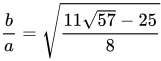

The primitive units contain six tiles respectively. It has p2 (2222) symmetry.

|
2a=2c=d=e A=90°, B≈145.34°, C≈69.32°, D≈124.66°, E≈110.68° (2B+C=360°, C+E=180°). |
 6-tile primitive unit |
Mann/McLoud/Von Derau (2015) Type 15
[edit]University of Washington Bothell mathematicians Casey Mann, Jennifer McLoud-Mann, and David Von Derau discovered a 15th monohedral tiling convex pentagon in 2015 using a computer algorithm.[12][13] It is 3-isohedral and non-edge-to-edge, drawn with 6 colors, 2 shades of 3 colors, representing chiral pairs of the three isohedral positions. The pgg symmetry is reduced to p2 when the chiral pairs are considered distinct. It has completely determined tiles, with no degrees of freedom. The primitive units contain twelve tiles. It has pgg (22×) symmetry, and p2 (2222) if chiral pairs are considered distinct.
(Larger image) |
a=c=e, b=2a, d=a+√2/√3−1 A=150°, B=60°, C=135° D=105°, E=90° |
 12-tile primitive unit |
No more periodic pentagonal tiling types
[edit]In July 2017 Michaël Rao completed a computer-assisted proof showing that there are no other types of convex pentagons that can tile the plane. The complete list of convex polygons that can tile the plane includes the above 15 pentagons, three types of hexagons, and all quadrilaterals and triangles.[6] A consequence of this proof is that no convex polygon exists that tiles the plane only aperiodically, since all of the above types allow for a periodic tiling.
Nonperiodic monohedral pentagonal tilings
[edit]Nonperiodic monohedral pentagonal tilings can also be constructed, like the example below with 6-fold rotational symmetry by Michael Hirschhorn. Angles are A = 140°, B = 60°, C = 160°, D = 80°, E = 100°.[14][15]
In 2016 Bernhard Klaassen showed that every discrete rotational symmetry type can be represented by a monohedral pentagonal tiling from the same class of pentagons.[16] Examples for 5-fold and 7-fold symmetry are shown below. Such tilings are possible for any type of n-fold rotational symmetry with n>2.
 5-fold rotational symmetry in a monohedral pentagonal tiling |
 Hirschhorn's 6-fold rotational symmetry monohedral pentagonal tiling |
 7-fold rotational symmetry in a monohedral pentagonal tiling |
Dual uniform tilings
[edit]There are three isohedral pentagonal tilings generated as duals of the uniform tilings, those with 5-valence vertices. They represent special higher symmetry cases of the 15 monohedral tilings above. Uniform tilings and their duals are all edge-to-edge. These dual tilings are also called Laves tilings. The symmetry of the uniform dual tilings is the same as the uniform tilings. Because the uniform tilings are isogonal, the duals are isohedral.
| cmm (2*22) | p4g (4*2) | p6 (632) |
|---|---|---|

|

|

|
| Prismatic pentagonal tiling Instance of type 1[17] |
Cairo pentagonal tiling Instance of type 4[17][18] |
Floret pentagonal tiling Instance of types 1, 5 and 6[17] |
 120°, 120°, 120°, 90°, 90° V3.3.3.4.4 |
 120°, 120°, 90°, 120°, 90° V3.3.4.3.4 |
 120°, 120°, 120°, 120°, 60° V3.3.3.3.6 |
Dual k-uniform tilings
[edit]The k-uniform tilings with valence-5 vertices also have pentagonal dual tilings, containing the same three shaped pentagons as the semiregular duals above, but contain a mixture of pentagonal types. A k-uniform tiling has a k-isohedral dual tiling and are represented by different colors and shades of colors below.
For example these 2, 3, 4, and 5-uniform duals are all pentagonal:[19][20]
| 2-isohedral | 3-isohedral | |||
|---|---|---|---|---|
| p4g (4*2) | pgg (22×) | p2 (2222) | p6 (*632) | |

|

|

|

|

|
|
|
|
|
|
|
| 4-isohedral | 5-isohedral | |||
| pgg (22×) | p2 (2222) | p6m (*632) | ||

|

|

|

|

|
|
|
|
|
|
|
| 5-isohedral | ||||
| pgg (22×) | p2 (2222) | |||

|

|

|

|

|
|
|
|
|
|
|
Pentagonal/hexagonal tessellation
[edit]
Pentagons have a peculiar relationship with hexagons. As demonstrated graphically below, some types of hexagons can be subdivided into pentagons. For example, a regular hexagon bisects into two type 1 pentagons. Subdivision of convex hexagons is also possible with three (type 3), four (type 4) and nine (type 3) pentagons.
By extension of this relation, a plane can be tessellated by a single pentagonal prototile shape in ways that generate hexagonal overlays. For example:
 Planar tessellation by a single pentagonal prototile (type 1) with overlays of regular hexagons (each comprising 2 pentagons). |
 Planar tessellation by a single pentagonal prototile (type 3) with overlays of regular hexagons (each comprising 3 pentagons). |
 Planar tessellation by a single pentagonal prototile (type 4) with overlays of semiregular hexagons (each comprising 4 pentagons). |
 Planar tessellation by a single pentagonal prototile (type 3) with overlays of two sizes of regular hexagons (comprising 3 and 9 pentagons respectively). |
Non-convex pentagons
[edit]
With pentagons that are not required to be convex, additional types of tiling are possible. An example is the sphinx tiling, an aperiodic tiling formed by a pentagonal rep-tile.[21] The sphinx may also tile the plane periodically, by fitting two sphinx tiles together to form a parallelogram and then tiling the plane by translation of this parallelogram,[21] a pattern that can be extended to any non-convex pentagon that has two consecutive angles adding to 2π.
It is possible to divide an equilateral triangle into three congruent non-convex pentagons, meeting at the center of the triangle, and to tile the plane with the resulting three-pentagon unit.[22] A similar method can be used to subdivide squares into four congruent non-convex pentagons, or regular hexagons into six congruent non-convex pentagons, and then tile the plane with the resulting unit.
In non-Euclidean geometry
[edit]Spherical tiling
[edit]A dodecahedron can be considered a regular tiling of 12 pentagons on the surface of a sphere, with Schläfli symbol {5,3}, having three pentagons around each vertex.
One may also consider a degenerate tiling by two hemispheres, with the great circle between them subdivided into five equal arcs, as a pentagonal tiling with Schläfli symbol {5,2}.
Regular hyperbolic tilings
[edit]In the hyperbolic plane, one can construct regular pentagons that have any interior angle for . The resulting pentagons tile the plane regularly, with pentagons around each vertex. For instance, the order-4 pentagonal tiling, {5,4}, has four right-angled pentagons around each vertex. A limiting case is the infinite-order pentagonal tiling {5,∞} produced by ideal regular pentagons. These pentagons have ideal points as their vertices, with angle equal to zero.


| Sphere | Hyperbolic plane | |||||
|---|---|---|---|---|---|---|
 {5,2} |
 {5,3} |
 {5,4} |
 {5,5} |
 {5,6} |
... |  {5,∞} |
Irregular hyperbolic tilings
[edit]There are an infinite number of dual uniform tilings in hyperbolic plane with isogonal irregular pentagonal faces. They have face configurations as V3.3.p.3.q.
| 7-3 | 8-3 | 9-3 | ... | 5-4 | 6-4 | 7-4 | ... | 5-5 |
|---|---|---|---|---|---|---|---|---|
 V3.3.3.3.7 |
 V3.3.3.3.8 |
V3.3.3.3.9 | ... |  V3.3.4.3.5 |
V3.3.4.3.6 | V3.3.4.3.7 | ... | V3.3.5.3.5 |

A version of the binary tiling, with its tiles bounded by hyperbolic line segments rather than arcs of horocycles, forms pentagonal tilings that must be non-periodic, in the sense that their symmetry groups can be one-dimensional but not two-dimensional.[23]
References
[edit]- ^ Chung, Ping Ngai; Fernandez, Miguel A.; Li, Yifei; Mara, Michael; Morgan, Frank; Plata, Isamar Rosa; Shah, Nirlee; Vieira, Luis Sordo; Wikner, Elena (2012-05-01), "Isoperimetric Pentagonal Tilings", Notices of the American Mathematical Society, 59 (5): 632, arXiv:1111.6161, doi:10.1090/noti838, ISSN 0002-9920
- ^ Grünbaum & Shephard 1987, Sec. 9.3 Other Monohedral tilings by convex polygons.
- ^ a b Rao 2017.
- ^
- ^ "Mathematica code verifying Rao-convex-pentagon-tiling classification", GitHub
- ^ a b Wolchover 2017.
- ^ Grünbaum & Shephard 1978.
- ^ a b Schattschneider 1978.
- ^ Marjorie Rice’s Secret Pentagons Quanta Magazine
- ^ Marjorie Rice, "Tessellations", Intriguing Tessellations, retrieved 22 August 2015 – via Google Sites
- ^ Schattschneider 1985.
- ^ Bellos 2015.
- ^ Mann, McLoud-Mann & Von Derau 2018.
- ^ Schattschneider 1978, Fig 12.
- ^ Hirschhorn & Hunt 1985.
- ^ Klaassen 2016.
- ^ a b c Reinhardt 1918, pp. 77–81 (caution: there is at least one obvious mistake within this paper, i.e. γ+δ angle sum needs to equal π, not 2π for the first two tiling types defined on page 77)
- ^ Cairo pentagonal tiling generated by a pentagon type 4 query and by a pentagon type 2 tiling query on wolframalpha.com (caution: the wolfram definition of pentagon type 2 tiling does not correspond with type 2 defined by Reinhardt in 1918)
- ^ Chavey 1989.
- ^ Brian Galebach, "Welcome to my collection of n-uniform tilings!", probabilitysports.com
- ^ a b Godrèche 1989.
- ^ Gerver 2003.
- ^ Frettlöh, Dirk; Garber, Alexey (2015), "Symmetries of monocoronal tilings", Discrete Mathematics & Theoretical Computer Science, 17 (2): 203–234, arXiv:1402.4658, doi:10.46298/dmtcs.2142, MR 3411398
Bibliography
[edit]- Bagina, Olga (2004), "Tiling the plane with congruent equilateral convex pentagons", Journal of Combinatorial Theory, Series A, 105 (2): 221–232, doi:10.1016/j.jcta.2003.11.002, ISSN 1096-0899, MR 2046081
- Bagina, Olga (2011), Мозаики из выпуклых пятиугольников [Tilings of the plane with convex pentagons], Vestnik (in Russian), 4 (48): 63–73, ISSN 2078-1768, retrieved 29 January 2013
- Bellos, Alex (11 August 2015), "Attack on the pentagon results in discovery of new mathematical tile", The Guardian
- Chavey, D. (1989), "Tilings by Regular Polygons—II: A Catalog of Tilings", Computers & Mathematics with Applications, 17 (1–3): 147–165, doi:10.1016/0898-1221(89)90156-9
- Gardner, Martin (1988), "Tiling with Convex Polygons", Time travel and other mathematical bewilderments, New York: W.H. Freeman, Bibcode:1988ttom.book.....G, ISBN 978-0-7167-1925-0, MR 0905872
- Gerver, M. L. (2003), "Theorems on tessellations by polygons", Sbornik: Mathematics, 194 (6): 879–895, Bibcode:2003SbMat.194..879G, doi:10.1070/sm2003v194n06abeh000743, S2CID 250813440
- Godrèche, C. (1989), "The sphinx: a limit-periodic tiling of the plane", Journal of Physics A: Mathematical and General, 22 (24): L1163–L1166, Bibcode:1989JPhA...22L1163G, doi:10.1088/0305-4470/22/24/006, MR 1030678
- Grünbaum, Branko; Shephard, Geoffrey C. (1978), "Isohedral tilings of the plane by polygons", Commentarii Mathematici Helvetici, 53: 542–571, doi:10.1007/bf02566098, ISSN 0010-2571, S2CID 119897404
- Grünbaum, Branko; Shephard, Geoffrey C. (1987), "Tilings by polygons", Tilings and Patterns, New York: W. H. Freeman and Company, ISBN 978-0-7167-1193-3, MR 0857454
- Hirschhorn, M. D.; Hunt, D. C. (1985), "Equilateral convex pentagons which tile the plane" (PDF), Journal of Combinatorial Theory, Series A, 39 (1): 1–18, doi:10.1016/0097-3165(85)90078-0, ISSN 1096-0899, MR 0787713, retrieved 2020-10-30
- Kershner, Richard (1968), "On paving the plane", American Mathematical Monthly, 75 (8): 839–844, doi:10.2307/2314332, ISSN 0002-9890, JSTOR 2314332, MR 0236822
- Klaassen, Bernhard (2016), "Rotationally symmetric tilings with convex pentagons and hexagons", Elemente der Mathematik, 71 (4): 137–144, arXiv:1509.06297, doi:10.4171/em/310, ISSN 0013-6018, S2CID 119738738
- Mann, Casey; McLoud-Mann, Jennifer; Von Derau, David (2018), "Convex pentagons that admit -block transitive tilings", Geometriae Dedicata, 194 (1): 141–167, arXiv:1510.01186, doi:10.1007/s10711-017-0270-9, S2CID 119176351
- Rao, Michaël (2017), Exhaustive search of convex pentagons which tile the plane (PDF), arXiv:1708.00274
- Reinhardt, Karl (1918), Über die Zerlegung der Ebene in Polygone (Dissertation) (in German), Borna-Leipzig: Druck von Robert Noske
- Schattschneider, Doris (1978), "Tiling the plane with congruent pentagons", Mathematics Magazine, 51 (1): 29–44, doi:10.2307/2689644, ISSN 0025-570X, JSTOR 2689644, MR 0493766, archived from the original on 2023-12-11, retrieved 2015-10-26
- Schattschneider, Doris (1985), "A new pentagon tiler", Mathematics Magazine, 58 (5): 308, The cover has a picture of the new tiling
- Sugimoto, Teruhisa; Ogawa, Tohru (2005), "Systematic study of convex pentagonal tilings. I. Case of convex pentagons with four equal-length edges", Forma, 20: 1–18, MR 2240616
- Sugimoto, Teruhisa; Ogawa, Tohru (2009), "Systematic study of convex pentagonal tilings, II: tilings by convex pentagons with four equal-length edges", Forma, 24 (3): 93–109, MR 2868775, archived from the original on 2020-08-22, retrieved 2015-08-26; Errata, Forma 25 (1): 49, 2010, MR 2868824
- Sugimoto, Teruhisa (2012), "Convex pentagons for edge-to-edge tiling, I", Forma, 27 (1): 93–103, MR 3030316
- Wolchover, Natalie (11 July 2017), "Pentagon Tiling Proof Solves Century-Old Math Problem", Quanta Magazine

External links
[edit]
- Weisstein, Eric W., "Pentagon Tiling", MathWorld
- Pentagon Tilings
- The 14 Pentagons that Tile the Plane
- 15 (monohedral) Tilings with a convex pentagonal tile with k-isohedral colorings
- Code to display the 14th pentagon type tiling
- Code to display the 15th pentagon type tiling


Pentagonal tiling
View on GrokipediaFundamentals
Definition and Terminology
A pentagonal tiling is a tessellation of the plane, or sometimes other surfaces such as the sphere or hyperbolic plane, composed entirely of polygons each having exactly five sides and five interior angles, covering the surface without gaps or overlaps.[6][2] These polygons, known as pentagons, must fit together such that their edges align properly to form the complete covering. Unlike tilings with triangles (average interior angle of 60°), quadrilaterals (90°), or hexagons (120°), pentagonal tilings present unique challenges due to the average interior angle of 108° for a pentagon, which complicates achieving sums of exactly 360° at vertices.[7][8] Key terminology in pentagonal tilings includes monohedral, referring to tilings that use congruent copies of a single prototile (the base pentagon shape); isohedral, where the tiling's symmetry group acts transitively on the tiles, allowing any tile to be mapped to any other via tiling symmetries; and distinctions between convex pentagons (all interior angles less than 180° and no indentations) versus non-convex ones (which may have reflex angles greater than 180°).[9] Additionally, tilings are classified as periodic if they exhibit translational symmetry repeating in a lattice pattern across the plane, or aperiodic if they lack such global periodicity but still cover the plane completely.[9] Pentagonal tilings are typically required to be edge-to-edge, meaning that the edges of adjacent tiles coincide fully without partial overlaps or interior vertices along edges, ensuring a clean matching of boundaries.[9] A vertex figure describes the local arrangement of tiles and their angles meeting at each vertex point in the tiling, which is crucial for verifying that the angles sum precisely to 360° around each vertex.[9] While regular pentagons cannot form an edge-to-edge tiling of the plane due to their fixed 108° angles, specific irregular convex pentagons enable such coverings.[2]Geometric Constraints for Pentagonal Tilings
For a convex pentagon to tile the Euclidean plane monohedrally, its interior angles must sum to 540°, derived from the general formula for the sum of interior angles in an -gon: , yielding an average interior angle of 108° per vertex.[10] In such tilings, the sum of angles meeting at each vertex must equal exactly 360° to ensure flatness without gaps or overlaps, a fundamental condition for edge-to-edge tilings in the Euclidean plane.[10] Possible vertex configurations arise from combinations of these pentagonal angles that total 360°, though the specific angles vary across different pentagonal types to satisfy this constraint while maintaining convexity (each angle less than 180°). For regular pentagons, where all angles are precisely 108°, three meeting at a vertex sum to , leaving a gap, while four sum to , causing overlap; thus, no integer number of regular pentagons can meet at a vertex without distortion.[10] Extending this, five or more regular pentagons at a vertex would sum to at least , exacerbating overlaps and confirming the impossibility of regular pentagonal tilings in the plane.[10] In monohedral tilings, where all tiles are congruent, edge lengths must match adjacently to form continuous boundaries, typically requiring at least two pairs of equal consecutive sides per pentagon to enable periodic or aperiodic arrangements without mismatches.[11] These constraints collectively limit viable pentagonal shapes, ensuring that only specific non-regular forms can satisfy both angular and linear conditions for complete plane coverage.[12]Convex Monohedral Pentagonal Tilings of the Euclidean Plane
Historical Development and Discoveries
In 1918, German mathematician Karl Reinhardt identified the first five types of convex pentagons capable of forming periodic monohedral tilings of the Euclidean plane in his doctoral dissertation.[13] These discoveries laid the foundational classification for such tilings, establishing key geometric conditions under which pentagons could cover the plane without gaps or overlaps.[2] Progress stalled for decades until 1968, when Richard B. Kershner announced three additional types (6 through 8), expanding the known repertoire to eight and claiming a proof of completeness, though this was later found incomplete.[13] In 1975, inspired by popular accounts of these findings, software engineer Richard James discovered type 10. Marjorie Rice, a self-taught amateur mathematician, then contributed four more types (9 and 11 through 13) by 1977 through systematic manual enumeration.[14] The tally reached 14 in 1985 with Rolf Stein's identification of type 14 during his graduate studies at the University of Dortmund. In 2015, mathematicians Casey Mann, Jennifer McLoud-Mann, and David Von Derau announced the 15th type using computational assistance, marking the last known addition before closure.[15] This culminated in 2017 with Michaël Rao's exhaustive computer-assisted proof, which verified that no further periodic convex monohedral pentagonal tilings exist beyond these 15, though full independent verification continued into the early 2020s and was widely accepted by 2025.[1] Recent consolidations, such as a 2025 survey of the geometric properties across all 15 types, have further synthesized these milestones.Classification into 15 Periodic Types
The 15 known periodic convex monohedral pentagonal tilings are categorized into families based on the specific geometric constraints on their interior angles and side lengths, which ensure they can form edge-to-edge periodic tilings of the Euclidean plane with lattice symmetries. These constraints typically involve pairs or triples of angles summing to 180° or 360° to allow proper vertex matching, alongside equalities among adjacent or opposite sides to maintain congruence across the tiling. All types feature at least three pentagons meeting at each vertex, with minimal vertex figures consisting of combinations of three or four tiles, and they are referenced in standard literature by consecutive numbering from type 1 to type 15 for diagrammatic identification.[16][12] The initial five types were discovered by Karl Reinhardt in 1918 through systematic enumeration of convex pentagons satisfying the necessary angle and side conditions for tiling. These types emphasize supplementary angle pairs and side equalities that facilitate simple translational and rotational symmetries in the lattice. Type 1 requires angles D and E to sum to 180°, allowing flexibility in the other angles A, B, and C as long as their sum is 360°; for example, one realization features angles of 90°, 126°, and three 144° measures. Type 2 mandates angles C and E summing to 180° with sides a = d. Type 3 fixes angles A = C = D = 120° with sides a = b and d = c + e. Type 4 sets angles B = D = 90° with sides b = c and d = e. Type 5 specifies angle A = 60° and D = 120° with sides a = b and d = e.[16][17] In 1968, Richard Kershner extended the classification by identifying three additional types (6 through 8), which incorporate more complex angle triples summing to 360° and multiple equal sides, enabling denser vertex configurations. Type 6 has angles B + D = 180° and 2B = E, with sides a = d = e and b = c. Type 7 requires B + 2E = 360° and 2C + D = 360°, with sides b = c = d = e. Type 8 demands 2B + C = 360° and D + 2E = 360°, also with sides b = c = d = e.[16][17] Marjorie Rice discovered four types in 1977 (types 9 and 11 through 13), building on her exhaustive manual search and introducing right angles with chained equal sides for robust lattice formation. Type 9 sets 2A + C = 360° and D + 2E = 360°, with sides b = c = d = e. Type 11 fixes A = 90°, 2B + C = 360°, and C + E = 180°, with 2a + c = d = e. Type 12 has A = 90°, 2B + C = 360°, and C + E = 180°, with 2a = d = c + e. Type 13 requires B = E = 90° and 2A + D = 360°, with 2a = 2e = d.[16][17] Richard James found type 10 in 1975, featuring a right angle at A and balanced supplementary pairs. It has A = 90°, B + E = 180°, and B + 2C = 360°, with a = b = c + e. Rolf Stein identified type 14 in 1985, which includes multiple equal sides and right angles for compact edge matching: A = 90°, 2B + C = 360°, C + E = 180°, and 2a = 2c = d = e.[16][17][12] The final type, 15, was discovered in 2015 by Casey Mann, Jennifer McLoud-Mann, and David Von Derau via computational search, representing a fixed-shape pentagon with no adjustable parameters. It has precise angles A = 150°, B = 60°, C = 135°, D = 105°, and E = 90°, paired with sides a = c = e, b = 2a, and d = a \sqrt{2 + \sqrt{3}}.[] [18][16][19]| Type | Discoverer (Year) | Key Angle Conditions (in degrees) | Key Side Conditions |
|---|---|---|---|
| 1 | Reinhardt (1918) | D + E = 180° | None specified |
| 2 | Reinhardt (1918) | C + E = 180° | a = d |
| 3 | Reinhardt (1918) | A = C = D = 120° | a = b, d = c + e |
| 4 | Reinhardt (1918) | B = D = 90° | b = c, d = e |
| 5 | Reinhardt (1918) | A = 60°, D = 120° | a = b, d = e |
| 6 | Kershner (1968) | B + D = 180°, 2B = E | a = d = e, b = c |
| 7 | Kershner (1968) | B + 2E = 360°, 2C + D = 360° | b = c = d = e |
| 8 | Kershner (1968) | 2B + C = 360°, D + 2E = 360° | b = c = d = e |
| 9 | Rice (1977) | 2A + C = 360°, D + 2E = 360° | b = c = d = e |
| 10 | James (1975) | A = 90°, B + E = 180°, B + 2C = 360° | a = b = c + e |
| 11 | Rice (1977) | A = 90°, 2B + C = 360°, C + E = 180° | 2a + c = d = e |
| 12 | Rice (1977) | A = 90°, 2B + C = 360°, C + E = 180° | 2a = d = c + e |
| 13 | Rice (1977) | B = E = 90°, 2A + D = 360° | 2a = 2e = d |
| 14 | Stein (1985) | A = 90°, 2B + C = 360°, C + E = 180° | 2a = 2c = d = e |
| 15 | Mann et al. (2015) | A = 150°, B = 60°, C = 135°, D = 105°, E = 90° | a = c = e, b = 2a, d = a \sqrt{2 + \sqrt{3}} |
Properties and Symmetries of the 15 Types
The 15 types of periodic convex monohedral pentagonal tilings exhibit a range of shared geometric properties arising from the requirements of edge-to-edge assembly in the Euclidean plane. Each pentagon has five sides and five interior angles summing to 540°, with all angles strictly less than 180° to maintain convexity. Side lengths vary, with most types featuring 1 to 3 distinct lengths, often with specific equalities (e.g., adjacent sides equal in types 2 and 11) to facilitate matching at edges. Angle distributions include acute, right, and obtuse measures tailored to form 360° at vertices, such as pairs of supplementary angles (e.g., 180° sums in types 1 and 2). These constraints ensure no gaps or overlaps, yielding a tiling density of 1 across all types.[11] A key shared topological property is the average coordination number at vertices, calculated as 10/3 ≈ 3.333 from Euler's formula for planar graphs: with N tiles, approximately 5N/2 edges, and 3N/2 vertices, the average number of pentagons meeting at a vertex is 10/3. Vertex figures thus predominantly involve 3- or 4-pentagon meetings, reflecting this average; higher-order vertices (e.g., 6-pentagon) appear sparingly in specific types to balance the topology. For instance, types 4, 6, 7, 8, and 9 feature two classes of 3-valent vertices and one class of 4-valent vertices in a 2:1 ratio, while type 5 includes eight 3-valent vertices and one 6-valent vertex per unit cell. Unit cell sizes differ by type, often containing an even number of pentagons for translational symmetry; representative examples include 4 pentagons for type 4 (parallelogram lattice) and 6 for type 5 (hexagonal arrangement).[11] Symmetries of these tilings are analyzed through isohedrality, which quantifies tile transitivity under the tiling's symmetry group (isometries mapping the tiling to itself). Five types (1–5) are 1-isohedral, meaning all tiles are equivalent under symmetries, enabling tile-transitive tilings. Types 6–9 and 11–13 are 2-isohedral, with tiles falling into two equivalence classes, while types 10, 14, and 15 are 3-isohedral, requiring three classes. These classes reflect rotational and reflectional orders: 1-isohedral types often support 180° rotations (order 2), while higher isohedrality involves glide reflections or mirrors. Some types permit edge-to-edge tilings without reflections (e.g., types 1, 4–6, 9), but most (types 2, 7–8, 10–15) incorporate chiral pairs related by reflection. The table below summarizes isohedral classes:| Type Numbers | Isohedral Class | Notes on Transitivity |
|---|---|---|
| 1–5 | 1-isohedral | Tile-transitive; single class under symmetry group. |
| 6–9, 11–13 | 2-isohedral | Two tile classes; often involves 180° rotations and glides. |
| 10, 14, 15 | 3-isohedral | Three tile classes; includes reflections for congruence. |