


Community hub
Recent from talks
Contribute something
Nothing was collected or created yet.
Tessellation
View on Wikipedia


A tessellation or tiling is the covering of a surface, often a plane, using one or more geometric shapes, called tiles, with no overlaps and no gaps. In mathematics, tessellation can be generalized to higher dimensions and a variety of geometries.
A periodic tiling has a repeating pattern. Some special kinds include regular tilings with regular polygonal tiles all of the same shape, and semiregular tilings with regular tiles of more than one shape and with every corner identically arranged. The patterns formed by periodic tilings can be categorized into 17 wallpaper groups. A tiling that lacks a repeating pattern is called "non-periodic". An aperiodic tiling uses a small set of tile shapes that cannot form a repeating pattern (an aperiodic set of prototiles). A tessellation of space, also known as a space filling or honeycomb, can be defined in the geometry of higher dimensions.
A real physical tessellation is a tiling made of materials such as cemented ceramic squares or hexagons. Such tilings may be decorative patterns, or may have functions such as providing durable and water-resistant pavement, floor, or wall coverings. Historically, tessellations were used in Ancient Rome and in Islamic art such as in the Moroccan architecture and decorative geometric tiling of the Alhambra palace. In the twentieth century, the work of M. C. Escher often made use of tessellations, both in ordinary Euclidean geometry and in hyperbolic geometry, for artistic effect. Tessellations are sometimes employed for decorative effect in quilting. Tessellations form a class of patterns in nature, for example in the arrays of hexagonal cells found in honeycombs.
History
[edit]
Tessellations were used by the Sumerians (about 4000 BC) in building wall decorations formed by patterns of clay tiles.[1]
Decorative mosaic tilings made of small squared blocks called tesserae were widely employed in classical antiquity,[2] sometimes displaying geometric patterns.[3][4]
In 1619, Johannes Kepler made an early documented study of tessellations. He wrote about regular and semiregular tessellations in his Harmonices Mundi; he was possibly the first to explore and to explain the hexagonal structures of honeycomb and snowflakes.[5][6][7]

Some two hundred years later in 1891, the Russian crystallographer Yevgraf Fyodorov proved that every periodic tiling of the plane features one of seventeen different groups of isometries.[8][9] Fyodorov's work marked the unofficial beginning of the mathematical study of tessellations. Other prominent contributors include Alexei Vasilievich Shubnikov and Nikolai Belov in their book Colored Symmetry (1964),[10] and Heinrich Heesch and Otto Kienzle (1963).[11]
Etymology
[edit]In Latin, tessella is a small cubical piece of clay, stone, or glass used to make mosaics.[12] The word "tessella" means "small square" (from tessera, square, which in turn is from the Greek word τέσσερα for four). It corresponds to the everyday term tiling, which refers to applications of tessellations, often made of glazed clay.
Overview
[edit]
Tessellation in two dimensions, also called planar tiling, is a topic in geometry that studies how shapes, known as tiles, can be arranged to fill a plane without any gaps, according to a given set of rules. These rules can be varied. Common ones are that there must be no gaps between tiles, and that no corner of one tile can lie along the edge of another.[13] The tessellations created by bonded brickwork do not obey this rule. Among those that do, a regular tessellation has both identical[a] regular tiles and identical regular corners or vertices, having the same angle between adjacent edges for every tile.[14] There are only three shapes that can form such regular tessellations: the equilateral triangle, square and the regular hexagon. Any one of these three shapes can be duplicated infinitely to fill a plane with no gaps.[6]
Many other types of tessellation are possible under different constraints. For example, there are eight types of semi-regular tessellation, made with more than one kind of regular polygon but still having the same arrangement of polygons at every corner.[15] Irregular tessellations can also be made from other shapes such as pentagons, polyominoes and in fact almost any kind of geometric shape. The artist M. C. Escher is famous for making tessellations with irregular interlocking tiles, shaped like animals and other natural objects.[16] If suitable contrasting colours are chosen for the tiles of differing shape, striking patterns are formed, and these can be used to decorate physical surfaces such as church floors.[17]

More formally, a tessellation or tiling is a cover of the Euclidean plane by a countable number of closed sets, called tiles, such that the tiles intersect only on their boundaries. These tiles may be polygons or any other shapes.[b] Many tessellations are formed from a finite number of prototiles in which all tiles in the tessellation are congruent to the given prototiles. If a geometric shape can be used as a prototile to create a tessellation, the shape is said to tessellate or to tile the plane. The Conway criterion is a sufficient, but not necessary, set of rules for deciding whether a given shape tiles the plane periodically without reflections: some tiles fail the criterion, but still tile the plane.[19] No general rule has been found for determining whether a given shape can tile the plane or not, which means there are many unsolved problems concerning tessellations.[18]
Mathematically, tessellations can be extended to spaces other than the Euclidean plane.[6] The Swiss geometer Ludwig Schläfli pioneered this by defining polyschemes, which mathematicians nowadays call polytopes. These are the analogues to polygons and polyhedra in spaces with more dimensions. He further defined the Schläfli symbol notation to make it easy to describe polytopes. For example, the Schläfli symbol for an equilateral triangle is {3}, while that for a square is {4}.[20] The Schläfli notation makes it possible to describe tilings compactly. For example, a tiling of regular hexagons has three six-sided polygons at each vertex, so its Schläfli symbol is {6,3}.[21]
Other methods also exist for describing polygonal tilings. When the tessellation is made of regular polygons, the most common notation is the vertex configuration, which is simply a list of the number of sides of the polygons around a vertex. The square tiling has a vertex configuration of 4.4.4.4, or 44. The tiling of regular hexagons is noted 6.6.6, or 63.[18]
In mathematics
[edit]Introduction to tessellations
[edit]Mathematicians use some technical terms when discussing tilings. An edge is the intersection between two bordering tiles; it is often a straight line. A vertex is the point of intersection of three or more bordering tiles. Using these terms, an isogonal or vertex-transitive tiling is a tiling where every vertex point is identical; that is, the arrangement of polygons about each vertex is the same.[18] The fundamental region is a shape such as a rectangle that is repeated to form the tessellation.[22] For example, a regular tessellation of the plane with squares has a meeting of four squares at every vertex.[18]
The sides of the polygons are not necessarily identical to the edges of the tiles. An edge-to-edge tiling is any polygonal tessellation where adjacent tiles only share one full side, i.e., no tile shares a partial side or more than one side with any other tile. In an edge-to-edge tiling, the sides of the polygons and the edges of the tiles are the same. The familiar "brick wall" tiling is not edge-to-edge because the long side of each rectangular brick is shared with two bordering bricks.[18]
A normal tiling is a tessellation for which every tile is topologically equivalent to a disk, the intersection of any two tiles is a connected set or the empty set, and all tiles are uniformly bounded. This means that a single circumscribing radius and a single inscribing radius can be used for all the tiles in the whole tiling; the condition disallows tiles that are pathologically long or thin.[23]

A monohedral tiling is a tessellation in which all tiles are congruent; it has only one prototile. A particularly interesting type of monohedral tessellation is the spiral monohedral tiling. The first spiral monohedral tiling was discovered by Heinz Voderberg in 1936; the Voderberg tiling has a unit tile that is a nonconvex enneagon.[1] The Hirschhorn tiling, published by Michael D. Hirschhorn and D. C. Hunt in 1985, is a pentagon tiling using irregular pentagons: regular pentagons cannot tile the Euclidean plane as the internal angle of a regular pentagon, 3π/5, is not a divisor of 2π.[24][25]
An isohedral tiling is a special variation of a monohedral tiling in which all tiles belong to the same transitivity class, that is, all tiles are transforms of the same prototile under the symmetry group of the tiling.[23] If a prototile admits a tiling, but no such tiling is isohedral, then the prototile is called anisohedral and forms anisohedral tilings.
A regular tessellation is a highly symmetric, edge-to-edge tiling made up of regular polygons, all of the same shape. There are only three regular tessellations: those made up of equilateral triangles, squares, or regular hexagons. All three of these tilings are isogonal and monohedral.[26]

A semi-regular (or Archimedean) tessellation uses more than one type of regular polygon in an isogonal arrangement. There are eight semi-regular tilings (or nine if the mirror-image pair of tilings counts as two).[27] These can be described by their vertex configuration; for example, a semi-regular tiling using squares and regular octagons has the vertex configuration 4.82 (each vertex has one square and two octagons).[28] Many non-edge-to-edge tilings of the Euclidean plane are possible, including the family of Pythagorean tilings, tessellations that use two (parameterised) sizes of square, each square touching four squares of the other size.[29] An edge tessellation is one in which each tile can be reflected over an edge to take up the position of a neighbouring tile, such as in an array of equilateral or isosceles triangles.[30]
Wallpaper groups
[edit]
Tilings with translational symmetry in two independent directions can be categorized by wallpaper groups, of which 17 exist.[31] It has been claimed that all seventeen of these groups are represented in the Alhambra palace in Granada, Spain. Although this is disputed,[32] the variety and sophistication of the Alhambra tilings have interested modern researchers.[33] Of the three regular tilings two are in the p6m wallpaper group and one is in p4m. Tilings in 2-D with translational symmetry in just one direction may be categorized by the seven frieze groups describing the possible frieze patterns.[34] Orbifold notation can be used to describe wallpaper groups of the Euclidean plane.[35]
Aperiodic tilings
[edit].svg)
Penrose tilings, which use two different quadrilateral prototiles, are the best known example of tiles that forcibly create non-periodic patterns. They belong to a general class of aperiodic tilings, which use tiles that cannot tessellate periodically. The recursive process of substitution tiling is a method of generating aperiodic tilings. One class that can be generated in this way is the rep-tiles; these tilings have unexpected self-replicating properties.[36] Pinwheel tilings are non-periodic, using a rep-tile construction; the tiles appear in infinitely many orientations.[37] It might be thought that a non-periodic pattern would be entirely without symmetry, but this is not so. Aperiodic tilings, while lacking in translational symmetry, do have symmetries of other types, by infinite repetition of any bounded patch of the tiling and in certain finite groups of rotations or reflections of those patches.[38] A substitution rule, such as can be used to generate Penrose patterns using assemblies of tiles called rhombs, illustrates scaling symmetry.[39] A Fibonacci word can be used to build an aperiodic tiling, and to study quasicrystals, which are structures with aperiodic order.[40]

Wang tiles are squares coloured on each edge, and placed so that abutting edges of adjacent tiles have the same colour; hence they are sometimes called Wang dominoes. A suitable set of Wang dominoes can tile the plane, but only aperiodically. This is known because any Turing machine can be represented as a set of Wang dominoes that tile the plane if, and only if, the Turing machine does not halt. Since the halting problem is undecidable, the problem of deciding whether a Wang domino set can tile the plane is also undecidable.[41][42][43][44][45]

Truchet tiles are square tiles decorated with patterns so they do not have rotational symmetry; in 1704, Sébastien Truchet used a square tile split into two triangles of contrasting colours. These can tile the plane either periodically or randomly.[46][47]
An einstein tile is a single shape that forces aperiodic tiling. The first such tile, dubbed a "hat", was discovered in 2023 by David Smith, a hobbyist mathematician.[48][49] The discovery is under professional review and, upon confirmation, will be credited as solving a longstanding mathematical problem.[50]
Tessellations and colour
[edit]
Sometimes the colour of a tile is understood as part of the tiling; at other times arbitrary colours may be applied later. When discussing a tiling that is displayed in colours, to avoid ambiguity, one needs to specify whether the colours are part of the tiling or just part of its illustration. This affects whether tiles with the same shape, but different colours, are considered identical, which in turn affects questions of symmetry. The four colour theorem states that for every tessellation of a normal Euclidean plane, with a set of four available colours, each tile can be coloured in one colour such that no tiles of equal colour meet at a curve of positive length. The colouring guaranteed by the four colour theorem does not generally respect the symmetries of the tessellation. To produce a colouring that does, it is necessary to treat the colours as part of the tessellation. Here, as many as seven colours may be needed, as demonstrated in the image at left.[51]
Tessellations with polygons
[edit]Next to the various tilings by regular polygons, tilings by other polygons have also been studied.
Any triangle or quadrilateral (even non-convex) can be used as a prototile to form a monohedral tessellation, often in more than one way. Copies of an arbitrary quadrilateral can form a tessellation with translational symmetry and 2-fold rotational symmetry with centres at the midpoints of all sides. For an asymmetric quadrilateral this tiling belongs to wallpaper group p2. As fundamental domain we have the quadrilateral. Equivalently, we can construct a parallelogram subtended by a minimal set of translation vectors, starting from a rotational centre. We can divide this by one diagonal, and take one half (a triangle) as fundamental domain. Such a triangle has the same area as the quadrilateral and can be constructed from it by cutting and pasting.[52]

If only one shape of tile is allowed, tilings exist with convex N-gons for N equal to 3, 4, 5, and 6. For N = 5, see Pentagonal tiling, for N = 6, see Hexagonal tiling, for N = 7, see Heptagonal tiling and for N = 8, see octagonal tiling.
With non-convex polygons, there are far fewer limitations in the number of sides, even if only one shape is allowed.
Polyominoes are examples of tiles that are either convex of non-convex, for which various combinations, rotations, and reflections can be used to tile a plane. For results on tiling the plane with polyominoes, see Polyomino § Uses of polyominoes.
Voronoi tilings
[edit]
Voronoi or Dirichlet tilings are tessellations where each tile is defined as the set of points closest to one of the points in a discrete set of defining points. (Think of geographical regions where each region is defined as all the points closest to a given city or post office.)[53][54] The Voronoi cell for each defining point is a convex polygon. The Delaunay triangulation is a tessellation that is the dual graph of a Voronoi tessellation. Delaunay triangulations are useful in numerical simulation, in part because among all possible triangulations of the defining points, Delaunay triangulations maximize the minimum of the angles formed by the edges.[55] Voronoi tilings with randomly placed points can be used to construct random tilings of the plane.[56]
Tessellations in higher dimensions
[edit]
Tessellation can be extended to three dimensions. Certain polyhedra can be stacked in a regular crystal pattern to fill (or tile) three-dimensional space, including the cube (the only Platonic polyhedron to do so), the rhombic dodecahedron, the truncated octahedron, and triangular, quadrilateral, and hexagonal prisms, among others.[57] Any polyhedron that fits this criterion is known as a plesiohedron, and may possess between 4 and 38 faces.[58] Naturally occurring rhombic dodecahedra are found as crystals of andradite (a kind of garnet) and fluorite.[59][60]

Tessellations in three or more dimensions are called honeycombs. In three dimensions there is just one regular honeycomb, which has eight cubes at each polyhedron vertex. Similarly, in three dimensions there is just one quasiregular[c] honeycomb, which has eight tetrahedra and six octahedra at each polyhedron vertex. However, there are many possible semiregular honeycombs in three dimensions.[61] Uniform honeycombs can be constructed using the Wythoff construction.[62]
The Schmitt-Conway biprism is a convex polyhedron with the property of tiling space only aperiodically.[63]
A Schwarz triangle is a spherical triangle that can be used to tile a sphere.[64]
Tessellations in non-Euclidean geometries
[edit]

It is possible to tessellate in non-Euclidean geometries such as hyperbolic geometry. A uniform tiling in the hyperbolic plane (that may be regular, quasiregular, or semiregular) is an edge-to-edge filling of the hyperbolic plane, with regular polygons as faces; these are vertex-transitive (transitive on its vertices), and isogonal (there is an isometry mapping any vertex onto any other).[65][66]
A uniform honeycomb in hyperbolic space is a uniform tessellation of uniform polyhedral cells. In three-dimensional (3-D) hyperbolic space there are nine Coxeter group families of compact convex uniform honeycombs, generated as Wythoff constructions, and represented by permutations of rings of the Coxeter diagrams for each family.[67]
In art
[edit]
In architecture, tessellations have been used to create decorative motifs since ancient times. Mosaic tilings often had geometric patterns.[4] Later civilisations also used larger tiles, either plain or individually decorated. Some of the most decorative were the Moorish wall tilings of Islamic architecture, using Girih and Zellige tiles in buildings such as the Alhambra[68] and La Mezquita.[69]
Tessellations frequently appeared in the graphic art of M. C. Escher; he was inspired by the Moorish use of symmetry in places such as the Alhambra when he visited Spain in 1936.[70] Escher made four "Circle Limit" drawings of tilings that use hyperbolic geometry.[71][72] For his woodcut "Circle Limit IV" (1960), Escher prepared a pencil and ink study showing the required geometry.[73] Escher explained that "No single component of all the series, which from infinitely far away rise like rockets perpendicularly from the limit and are at last lost in it, ever reaches the boundary line."[74]

Tessellated designs often appear on textiles, whether woven, stitched in, or printed. Tessellation patterns have been used to design interlocking motifs of patch shapes in quilts.[75][76]
Tessellations are also a main genre in origami (paper folding), where pleats are used to connect molecules, such as twist folds, together in a repeating fashion.[77]
In manufacturing
[edit]Tessellation is used in manufacturing industry to reduce the wastage of material (yield losses) such as sheet metal when cutting out shapes for objects such as car doors or drink cans.[78]
Tessellation is apparent in the mudcrack-like cracking of thin films[79][80] – with a degree of self-organisation being observed using micro and nanotechnologies.[81]
In nature
[edit]
The honeycomb is a well-known example of tessellation in nature with its hexagonal cells.[82]
In botany, the term "tessellate" describes a checkered pattern, for example on a flower petal, tree bark, or fruit. Flowers including the fritillary,[83] and some species of Colchicum, are characteristically tessellate.[84]
Many patterns in nature are formed by cracks in sheets of materials. These patterns can be described by Gilbert tessellations,[85] also known as random crack networks.[86] The Gilbert tessellation is a mathematical model for the formation of mudcracks, needle-like crystals, and similar structures. The model, named after Edgar Gilbert, allows cracks to form starting from being randomly scattered over the plane; each crack propagates in two opposite directions along a line through the initiation point, its slope chosen at random, creating a tessellation of irregular convex polygons.[87] Basaltic lava flows often display columnar jointing as a result of contraction forces causing cracks as the lava cools. The extensive crack networks that develop often produce hexagonal columns of lava. One example of such an array of columns is the Giant's Causeway in Northern Ireland.[88] Tessellated pavement, a characteristic example of which is found at Eaglehawk Neck on the Tasman Peninsula of Tasmania, is a rare sedimentary rock formation where the rock has fractured into rectangular blocks.[89]

Other natural patterns occur in foams; these are packed according to Plateau's laws, which require minimal surfaces. Such foams present a problem in how to pack cells as tightly as possible: in 1887, Lord Kelvin proposed a packing using only one solid, the bitruncated cubic honeycomb with very slightly curved faces. In 1993, Denis Weaire and Robert Phelan proposed the Weaire–Phelan structure, which uses less surface area to separate cells of equal volume than Kelvin's foam.[90]
In puzzles and recreational mathematics
[edit]
Tessellations have given rise to many types of tiling puzzle, from traditional jigsaw puzzles (with irregular pieces of wood or cardboard)[91] and the tangram,[92] to more modern puzzles that often have a mathematical basis. For example, polyiamonds and polyominoes are figures of regular triangles and squares, often used in tiling puzzles.[93][94] Authors such as Henry Dudeney and Martin Gardner have made many uses of tessellation in recreational mathematics. For example, Dudeney invented the hinged dissection,[95] while Gardner wrote about the "rep-tile", a shape that can be dissected into smaller copies of the same shape.[96][97] Inspired by Gardner's articles in Scientific American, the amateur mathematician Marjorie Rice found four new tessellations with pentagons.[98][99] Squaring the square is the problem of tiling an integral square (one whose sides have integer length) using only other integral squares.[100][101] An extension is squaring the plane, tiling it by squares whose sizes are all natural numbers without repetitions; James and Frederick Henle proved that this was possible.[102]
Examples
[edit]-
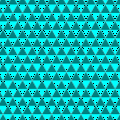 Triangular tiling, one of the three regular tilings of the plane
 -
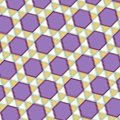 Snub hexagonal tiling, a semiregular tiling of the plane
 -
 Floret pentagonal tiling, dual to a semiregular tiling and one of 15 monohedral pentagon tilings
 -
 All tiling elements are identical pseudo‑triangles by disregarding their colors and ornaments
 -
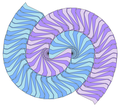
-
 Alternated octagonal or tritetragonal tiling is a uniform tiling of the hyperbolic plane
 -
 Topological square tiling, isohedrally distorted into I shapes


See also
[edit]Explanatory footnotes
[edit]- ^ The mathematical term for identical shapes is "congruent" – in mathematics, "identical" means they are the same tile.
- ^ The tiles are usually required to be homeomorphic (topologically equivalent) to a closed disk, which means bizarre shapes with holes, dangling line segments, or infinite areas are excluded.[18]
- ^ In this context, quasiregular means that the cells are regular (solids), and the vertex figures are semiregular.
References
[edit]- ^ a b Pickover, Clifford A. (2009). The Math Book: From Pythagoras to the 57th Dimension, 250 Milestones in the History of Mathematics. Sterling. p. 372. ISBN 978-1-4027-5796-9.
- ^ Dunbabin, Katherine M. D. (2006). Mosaics of the Greek and Roman world. Cambridge University Press. p. 280.
- ^ "The Brantingham Geometric Mosaics". Hull City Council. 2008. Retrieved 26 May 2015.
- ^ a b Field, Robert (1988). Geometric Patterns from Roman Mosaics. Tarquin. ISBN 978-0-906-21263-9.
- ^ Kepler, Johannes (1619). Harmonices Mundi [Harmony of the Worlds].
- ^ a b c Gullberg 1997, p. 395.
- ^ Stewart 2001, p. 13.
- ^ Djidjev, Hristo; Potkonjak, Miodrag (2012). "Dynamic Coverage Problems in Sensor Networks" (PDF). Los Alamos National Laboratory. p. 2. Archived from the original (PDF) on 20 April 2023. Retrieved 6 April 2013.
- ^ Fyodorov, Y. (1891). "Simmetrija na ploskosti [Symmetry in the plane]". Zapiski Imperatorskogo Sant-Petersburgskogo Mineralogicheskogo Obshchestva [Proceedings of the Imperial St. Petersburg Mineralogical Society]. 2 (in Russian). 28: 245–291.
- ^ Shubnikov, Alekseĭ Vasilʹevich; Belov, Nikolaĭ Vasilʹevich (1964). Colored Symmetry. Macmillan.
- ^ Heesch, H.; Kienzle, O. (1963). Flächenschluss: System der Formen lückenlos aneinanderschliessender Flächteile (in German). Springer.
- ^ "Tessellate". Merriam-Webster Online. Retrieved 26 May 2015.
- ^ Conway, R.; Burgiel, H.; Goodman-Strauss, G. (2008). The Symmetries of Things. Peters.
- ^ Coxeter 1973.
- ^ Cundy and Rollett (1961). Mathematical Models (2nd ed.). Oxford. pp. 61–62.
- ^ Escher 1974, pp. 11–12, 15–16.
- ^ "Basilica di San Marco". Section: Tessellated floor. Basilica di San Marco. Retrieved 26 April 2013.
- ^ a b c d e f Grünbaum & Shephard 1987, p. 59.
- ^ Schattschneider, Doris (September 1980). "Will It Tile? Try the Conway Criterion!". Mathematics Magazine. Vol. 53, no. 4. pp. 224–233. doi:10.2307/2689617. JSTOR 2689617.
- ^ Coxeter, H. S. M. (1948). Regular Polytopes. Methuen. pp. 14, 69, 149. Reprinted, Dover Publications, 1973, ISBN 978-0-486-61480-9.
- ^ Weisstein, Eric W. "Tessellation". MathWorld.
- ^ Emmer, Michele; Schattschneider, Doris (8 May 2007). M.C. Escher's Legacy: A Centennial Celebration. Berlin Heidelberg: Springer. p. 325. ISBN 978-3-540-28849-7.
- ^ a b Horne, Clare E. (2000). Geometric Symmetry in Patterns and Tilings. Woodhead Publishing. pp. 172, 175. ISBN 978-1-85573-492-0.
- ^ Dutch, Steven (29 July 1999). "Some Special Radial and Spiral Tilings". University of Wisconsin. Archived from the original on 4 April 2013. Retrieved 6 April 2013.
- ^ Hirschhorn, M. D.; Hunt, D. C. (1985). "Equilateral convex pentagons which tile the plane". Journal of Combinatorial Theory. Series A. 39 (1): 1–18. doi:10.1016/0097-3165(85)90078-0.
- ^ Weisstein, Eric W. "Regular Tessellations". MathWorld.
- ^ Stewart 2001, p. 75.
- ^ NRICH (Millennium Maths Project) (1997–2012). "Schläfli Tessellations". University of Cambridge. Retrieved 26 April 2013.
- ^ Wells, David (1991). "two squares tessellation". The Penguin Dictionary of Curious and Interesting Geometry. New York: Penguin Books. pp. 260–261. ISBN 978-0-14-011813-1.
- ^ Kirby, Matthew; Umble, Ronald (2011). "Edge Tessellations and Stamp Folding Puzzles". Mathematics Magazine. 84 (4): 283–89. doi:10.4169/math.mag.84.4.283. S2CID 123579388.
- ^ Armstrong, M.A. (1988). Groups and Symmetry. New York: Springer-Verlag. ISBN 978-3-540-96675-3.
- ^ Grünbaum, Branko (June–July 2006). "What symmetry groups are present in the Alhambra?" (PDF). Notices of the American Mathematical Society. 53 (6): 670–673.
- ^ Lu, Peter J.; Steinhardt (23 February 2007). "Decagonal and quasi-crystalline tilings in medieval Islamic architecture". Science. 315 (5815): 1106–10. Bibcode:2007Sci...315.1106L. doi:10.1126/science.1135491. PMID 17322056. S2CID 10374218.
- ^ Weisstein, Eric W. "Frieze Group". MathWorld.
- ^ Huson, Daniel H. (1991). "Two-Dimensional Symmetry Mutation". Princeton University. CiteSeerX 10.1.1.30.8536 – via CiteSeerX.
- ^ Gardner 1989, pp. 1–18.
- ^ Radin, C. (May 1994). "The Pinwheel Tilings of the Plane". Annals of Mathematics. 139 (3): 661–702. CiteSeerX 10.1.1.44.9723. doi:10.2307/2118575. JSTOR 2118575.
- ^ Austin, David. "Penrose Tiles Talk Across Miles". American Mathematical Society. Retrieved 29 May 2015.
- ^ Harriss, E. O. "Aperiodic Tiling" (PDF). University of London and EPSRC. Archived from the original (PDF) on 29 August 2017. Retrieved 29 May 2015.
- ^ Dharma-wardana, M. W. C.; MacDonald, A. H.; Lockwood, D. J.; Baribeau, J.-M.; Houghton, D. C. (1987). "Raman scattering in Fibonacci superlattices". Physical Review Letters. 58 (17): 1761–1765. Bibcode:1987PhRvL..58.1761D. doi:10.1103/physrevlett.58.1761. PMID 10034529.
- ^ Wang, Hao (1961). "Proving theorems by pattern recognition—II". Bell System Technical Journal. 40 (1): 1–41. doi:10.1002/j.1538-7305.1961.tb03975.x.
- ^ Wang, Hao (November 1965). "Games, logic and computers". Scientific American. pp. 98–106.
- ^ Berger, Robert (1966). "The undecidability of the domino problem". Memoirs of the American Mathematical Society. 66 (66): 72. doi:10.1090/memo/0066.
- ^ Robinson, Raphael M. (1971). "Undecidability and nonperiodicity for tilings of the plane". Inventiones Mathematicae. 12 (3): 177–209. Bibcode:1971InMat..12..177R. doi:10.1007/bf01418780. MR 0297572. S2CID 14259496.
- ^ Culik, Karel II (1996). "An aperiodic set of 13 Wang tiles". Discrete Mathematics. 160 (1–3): 245–251. doi:10.1016/S0012-365X(96)00118-5. MR 1417576.
- ^ Browne, Cameron (2008). "Truchet curves and surfaces". Computers & Graphics. 32 (2): 268–281. doi:10.1016/j.cag.2007.10.001.
- ^ Smith, Cyril Stanley (1987). "The tiling patterns of Sebastian Truchet and the topology of structural hierarchy". Leonardo. 20 (4): 373–385. doi:10.2307/1578535. JSTOR 1578535. S2CID 192944820.
- ^ Conover, Emily (24 March 2023). "Mathematicians have finally discovered an elusive 'einstein' tile". Science News. Retrieved 25 March 2023. with image of the pattern
- ^ Smith, David; Myers, Joseph Samuel; Kaplan, Craig S.; Goodman-Strauss, Chaim (March 2023). "An aperiodic monotile". arXiv:2303.10798
- ^ Roberts, Soibhan, Elusive 'Einstein' Solves a Longstanding Mathematical Problem, the New York Times, March 28, 2023, with image of the pattern
- ^ "Four-colour problem". Encyclopedia of Mathematics. EMS Press. 2001 [1994].
- ^ Jones, Owen (1910) [1856]. The Grammar of Ornament (folio ed.). Bernard Quaritch.
- ^ Aurenhammer, Franz (1991). "Voronoi Diagrams – A Survey of a Fundamental Geometric Data Structure". ACM Computing Surveys. 23 (3): 345–405. doi:10.1145/116873.116880. S2CID 4613674.
- ^ Okabe, Atsuyuki; Boots, Barry; Sugihara, Kokichi; Chiu, Sung Nok (2000). Spatial Tessellations – Concepts and Applications of Voronoi Diagrams (2nd ed.). John Wiley. ISBN 978-0-471-98635-5.
- ^ George, Paul Louis; Borouchaki, Houman (1998). Delaunay Triangulation and Meshing: Application to Finite Elements. Hermes. pp. 34–35. ISBN 978-2-86601-692-0.
- ^ Moller, Jesper (1994). Lectures on Random Voronoi Tessellations. Springer. ISBN 978-1-4612-2652-9.
- ^ Grünbaum, Branko (1994). "Uniform tilings of 3-space". Geombinatorics. 4 (2): 49–56.
- ^ Engel, Peter (1981). "Über Wirkungsbereichsteilungen von kubischer Symmetrie". Zeitschrift für Kristallographie, Kristallgeometrie, Kristallphysik, Kristallchemie. 154 (3–4): 199–215. Bibcode:1981ZK....154..199E. doi:10.1524/zkri.1981.154.3-4.199. MR 0598811..
- ^ Oldershaw, Cally (2003). Firefly Guide to Gems. Firefly Books. p. 107. ISBN 978-1-55297-814-6.
- ^ Kirkaldy, J. F. (1968). Minerals and Rocks in Colour (2nd ed.). Blandford. pp. 138–139.
- ^ Coxeter, Harold Scott Macdonald; Sherk, F. Arthur; Canadian Mathematical Society (1995). Kaleidoscopes: Selected Writings of H.S.M. Coxeter. John Wiley & Sons. p. 3 and passim. ISBN 978-0-471-01003-6.
- ^ Weisstein, Eric W. "Wythoff construction". MathWorld.
- ^ Senechal, Marjorie (26 September 1996). Quasicrystals and Geometry. CUP Archive. p. 209. ISBN 978-0-521-57541-6.
- ^ Schwarz, H. A. (1873). "Ueber diejenigen Fälle in welchen die Gaussichen hypergeometrische Reihe eine algebraische Function ihres vierten Elementes darstellt". Journal für die reine und angewandte Mathematik. 1873 (75): 292–335. doi:10.1515/crll.1873.75.292. ISSN 0075-4102. S2CID 121698536.
- ^ Margenstern, Maurice (4 January 2011). "Coordinates for a new triangular tiling of the hyperbolic plane". arXiv:1101.0530 [cs.FL].
- ^ Zadnik, Gašper. "Tiling the Hyperbolic Plane with Regular Polygons". Wolfram. Retrieved 27 May 2015.
- ^ Coxeter, H.S.M. (1999). "Chapter 10: Regular honeycombs in hyperbolic space". The Beauty of Geometry: Twelve Essays. Dover Publications. pp. 212–213. ISBN 978-0-486-40919-1.
- ^ "Mathematics in Art and Architecture". National University of Singapore. Retrieved 17 May 2015.
- ^ Whittaker, Andrew (2008). Speak the Culture: Spain. Thorogood Publishing. p. 153. ISBN 978-1-85418-605-8.
- ^ Escher 1974, pp. 5, 17.
- ^ Gersten, S. M. "Introduction to Hyperbolic and Automatic Groups" (PDF). University of Utah. Retrieved 27 May 2015.
Figure 1 is part of a tiling of the Euclidean plane, which we imagine as continued in all directions, and Figure 2 [Circle Limit IV] is a beautiful tesselation of the Poincaré unit disc model of the hyperbolic plane by white tiles representing angels and black tiles representing devils. An important feature of the second is that all white tiles are mutually congruent as are all black tiles; of course this is not true for the Euclidean metric, but holds for the Poincaré metric
- ^ Leys, Jos (2015). "Hyperbolic Escher". Retrieved 27 May 2015.
- ^ Escher 1974, pp. 142–143.
- ^ Escher 1974, p. 16.
- ^ Porter, Christine (2006). Tessellation Quilts: Sensational Designs From Interlocking Patterns. F+W Media. pp. 4–8. ISBN 978-0-7153-1941-3.
- ^ Beyer, Jinny (1999). Designing tessellations: the secrets of interlocking patterns. Contemporary Book. pp. Ch. 7. ISBN 978-0-8092-2866-9.
- ^ Gjerde, Eric (2008). Origami Tessellations. Taylor and Francis. ISBN 978-1-568-81451-3.
- ^ "Reducing yield losses: using less metal to make the same thing". UIT Cambridge. Archived from the original on 29 May 2015. Retrieved 29 May 2015.
- ^ Thouless, M. D. (1990). "Crack Spacing in Brittle Films on Elastic Substrates". J. Am. Chem. Soc. 73 (7): 2144–2146. doi:10.1111/j.1151-2916.1990.tb05290.x.
- ^ Xia, Z. C.; Hutchinson, J. W. (2000). "Crack patterns in thin films". J. Mech. Phys. Solids. 48 (6–7): 1107–1131. Bibcode:2000JMPSo..48.1107X. doi:10.1016/S0022-5096(99)00081-2.
- ^ Seghir, R.; Arscott, S. (2015). "Controlled mud-crack patterning and self-organized cracking of polydimethylsiloxane elastomer surfaces". Sci. Rep. 5 14787. Bibcode:2015NatSR...514787S. doi:10.1038/srep14787. PMC 4594096. PMID 26437880.
- ^ Ball, Philip (2013). "How honeycombs can build themselves". Nature. doi:10.1038/nature.2013.13398. S2CID 138195687. Retrieved 7 November 2014.
- ^ Shorter Oxford English dictionary (6th ed.). United Kingdom: Oxford University Press. 2007. p. 3804. ISBN 978-0-19-920687-2.
- ^ Purdy, Kathy (2007). "Colchicums: autumn's best-kept secret". American Gardener (September/October): 18–22.
- ^ Schreiber, Tomasz; Soja, Natalia (2010). "Limit theory for planar Gilbert tessellations". arXiv:1005.0023 [math.PR].
- ^ Gray, N. H.; Anderson, J. B.; Devine, J. D.; Kwasnik, J. M. (1976). "Topological properties of random crack networks". Mathematical Geology. 8 (6): 617–626. Bibcode:1976MatG....8..617G. doi:10.1007/BF01031092. S2CID 119949515.
- ^ Gilbert, E. N. (1967). "Random plane networks and needle-shaped crystals". In Noble, B. (ed.). Applications of Undergraduate Mathematics in Engineering. New York: Macmillan.
- ^ Weaire, D.; Rivier, N. (1984). "Soap, cells and statistics: Random patterns in two dimensions". Contemporary Physics. 25 (1): 59–99. Bibcode:1984ConPh..25...59W. doi:10.1080/00107518408210979.
- ^ Branagan, D.F. (1983). Young, R.W.; Nanson, G.C. (eds.). Tesselated pavements. Aspects of Australian sandstone landscapes. Special Publication No. 1, Australian and New Zealand Geomorphology. Wollongong, NSW: University of Wollongong. pp. 11–20. ISBN 978-0-864-18001-8. OCLC 12650092.
- ^ Ball, Philip (2009). Shapes. Oxford University Press. pp. 73–76. ISBN 978-0-199-60486-9.
- ^ McAdam, Daniel. "History of Jigsaw Puzzles". American Jigsaw Puzzle Society. Archived from the original on 11 February 2014. Retrieved 28 May 2015.
- ^ Slocum, Jerry (2001). The Tao of Tangram. Barnes & Noble. p. 9. ISBN 978-1-4351-0156-2.
- ^ Golomb, Solomon W. (1994). Polyominoes (2nd ed.). Princeton University Press. ISBN 978-0-691-02444-8.
- ^ Martin, George E. (1991). Polyominoes: A guide to puzzles and problems in tiling. Mathematical Association of America. ISBN 978-0-88385-501-0.
- ^ Frederickson, Greg N. (2002). Hinged Dissections: Swinging and Twisting. Cambridge University Press. ISBN 978-0-521-81192-7.
- ^ Gardner, Martin (May 1963). "On 'Rep-tiles,' Polygons that can make larger and smaller copies of themselves". Scientific American. Vol. 208, no. May. pp. 154–164.
- ^ Gardner, Martin (14 December 2006). Aha! A Two Volume Collection: Aha! Gotcha Aha! Insight. MAA. p. 48. ISBN 978-0-88385-551-5.
- ^ Suri, Mani (12 October 2015). "The Importance of Recreational Math". New York Times.
- ^ Schattschneider, Doris (1978). "Tiling the Plane with Congruent Pentagons" (PDF). Mathematics Magazine. 51 (1). MAA: 29–44. doi:10.2307/2689644. JSTOR 2689644.
- ^ Tutte, W. T. "Squaring the Square". Squaring.net. Retrieved 29 May 2015.
- ^ Gardner, Martin; Tutte, William T. (November 1958). "Mathematical Games". Scientific American.
- ^ Henle, Frederick V.; Henle, James M. (2008). "Squaring the plane" (PDF). American Mathematical Monthly. 115 (1): 3–12. doi:10.1080/00029890.2008.11920491. JSTOR 27642387. S2CID 26663945. Archived from the original (PDF) on 20 June 2006.
Sources
[edit]- Coxeter, H. S. M. (1973). "Section IV : Tessellations and Honeycombs". Regular Polytopes. Dover Publications. ISBN 978-0-486-61480-9.
- Escher, M. C. (1974). J. L. Locher (ed.). The World of M. C. Escher (New Concise NAL ed.). Abrams. ISBN 978-0-451-79961-6.
- Gardner, Martin (1989). Penrose Tiles to Trapdoor Ciphers. Cambridge University Press. ISBN 978-0-88385-521-8.
- Grünbaum, Branko; Shephard, G. C. (1987). Tilings and Patterns. W. H. Freeman. ISBN 978-0-7167-1193-3.
- Gullberg, Jan (1997). Mathematics From the Birth of Numbers. Norton. ISBN 978-0-393-04002-9.
- Stewart, Ian (2001). What Shape Is a Snowflake?. Weidenfeld and Nicolson. ISBN 978-0-297-60723-6.
External links
[edit]
- Tegula (open-source software for exploring two-dimensional tilings of the plane, sphere and hyperbolic plane; includes databases containing millions of tilings)
- Wolfram MathWorld: Tessellation (good bibliography, drawings of regular, semiregular and demiregular tessellations)
- Dirk Frettlöh and Edmund Harriss. "Tilings Encyclopedia" (extensive information on substitution tilings, including drawings, people, and references)
- Tessellations.org Archived 8 May 2017 at the Wayback Machine (how-to guides, Escher tessellation gallery, galleries of tessellations by other artists, lesson plans, history)
- Eppstein, David. "The Geometry Junkyard: Hyperbolic Tiling". (list of web resources including articles and galleries)
.jpg)

  | |||||||||||||
| |||||||||||||
| Patterns | .jpg) | |
|---|---|---|
| Causes | ||
| People | ||
| Related | ||
| International | |
|---|---|
| National | |
| Other | |

Tessellation
View on GrokipediaIntroduction
Definition and Fundamentals
A tessellation, also known as a tiling, is the covering of a plane using one or more geometric shapes, called tiles, such that the tiles fit together without any gaps or overlaps.[1] This process ensures that the entire surface is completely filled, with the union of the tiles forming the plane and their interiors disjoint.[5] In mathematical terms, tessellations typically involve polygons in the Euclidean plane, where the arrangement can be extended infinitely.[6] Fundamental properties of tessellations include the requirement that tiles adjoin properly along their boundaries, often with entire edges matching, and that at each vertex in the plane—where three or more tiles meet—the sum of the interior angles must equal exactly 360 degrees to avoid gaps or overlaps.[5] In cases where tiles are congruent, such as in monohedral tessellations using identical shapes, the pattern exhibits uniformity; however, more general tessellations may employ a finite set of distinct tile types.[1] Periodic tessellations, which repeat in a regular pattern, possess translational symmetry, meaning the arrangement remains unchanged under shifts by fixed vectors in at least two non-parallel directions.[7] Basic examples of tessellations illustrate these principles clearly. The square grid, where identical squares meet four at each vertex (each contributing a 90-degree angle, summing to 360 degrees), forms a simple periodic tiling with high translational symmetry. Similarly, the triangular lattice uses equilateral triangles meeting six at each vertex (each 60 degrees), while the hexagonal tiling arranges regular hexagons with three meeting at each vertex (each 120 degrees). These regular tessellations demonstrate how congruent regular polygons can tile the plane seamlessly. Tessellations rely on foundational concepts from Euclidean plane geometry, including the properties of polygons—such as straight edges, interior angles, and congruence—and the flat, infinite nature of the plane itself, which allows for precise fitting without curvature effects. Understanding vertex figures and angle summation in this context is essential, as it ensures the geometric constraints for complete coverage are met.[5]Types of Tessellations
Tessellations are broadly classified by their periodicity, which refers to whether the pattern repeats through translations across the plane. Periodic tessellations exhibit a repeating unit that can be translated by vectors to cover the entire plane without gaps or overlaps, forming a lattice structure. In contrast, aperiodic tessellations lack such translational symmetry but still completely cover the plane; moreover, certain aperiodic tile sets are designed such that they admit tilings of the plane only in non-periodic ways, as demonstrated by sets like the Penrose tiles, which force quasiperiodic arrangements with rotational but no translational repetition.[8][9] Another key classification involves the regularity of the tiles used, particularly in monohedral tessellations where all tiles are congruent to a single prototile. Within this, isohedral tessellations are those where the symmetry group of the tiling acts transitively on the tiles, meaning every tile can be mapped to any other via the tiling's symmetries, ensuring all tiles play equivalent roles. Anisohedral tiles, however, admit monohedral tilings but none that are isohedral, as the tiles occupy distinct roles without full symmetry equivalence; examples include certain polyominoes or heptominoes that tile periodically but asymmetrically.[10] Tessellations also differ by edge conditions, distinguishing edge-to-edge tilings from non-edge-to-edge ones. In edge-to-edge tessellations, adjacent tiles share entire edges, with vertices meeting precisely at shared points, which simplifies analysis of symmetry and coverage. Non-edge-to-edge tessellations allow partial edge overlaps or vertex misalignments, permitting more complex arrangements like those using curved boundaries or irregular polygons, though they maintain no gaps or overlaps overall.[11] Common tile sets for tessellations often involve polygons with three or four sides, as any triangle can form a monohedral tessellation by pairing to create parallelograms that repeat across the plane. Similarly, any quadrilateral tessellates the plane, since the sum of its interior angles is 360 degrees, allowing four angles to meet at a vertex without excess or deficit. For pentagons, regular ones cannot tessellate the Euclidean plane, as their interior angle of 108 degrees does not divide 360 evenly (yielding 3.333... vertices per point, which is impossible), though 15 classes of irregular convex pentagons do permit monohedral tilings, as confirmed by computer searches in 2017.[12][13][14][15]History
Etymology
The term "tessellation" derives from the Latin tessella, a diminutive form of tessera, meaning a small cube or die, originally referring to the diminutive square pieces of stone, glass, or other materials used in Roman mosaics for creating inlaid patterns or pavements.[16][17] These tessellae were typically cut into uniform shapes to form decorative floors, walls, or surfaces without gaps, a practice common in ancient Roman architecture and art.[18] In English, the adjective "tessellated" first appeared in the 1660s to describe surfaces composed of such small squares, often applied to "tessellated pavements" denoting mosaic-like floors, with the noun "tessellation" emerging around the 1650s for the act or art of arranging these elements into patterns.[19] The mathematical application of the term, referring to the covering of a plane or space with geometric shapes without overlaps or gaps, developed in the 17th century, notably influenced by Johannes Kepler's 1619 work Harmonices Mundi, where he systematically explored regular and semiregular polygonal coverings using related Latin terminology for paving and fitting.[20][21] Related terminology includes "tiling," a modern synonym in mathematical contexts, derived from the Old English tigele (from Latin tegula, meaning a roof tile or covering slab), emphasizing the act of covering with tiles since the 1570s.[22] In contrast, "mosaic" highlights the artistic dimension, originating from Medieval Latin musaicum (via Italian mosaico and Old French mosaicq), ultimately from Greek mouseios meaning "of the Muses," and refers specifically to inlaid pictorial designs rather than purely geometric coverings.[23]Early Developments and Key Figures
The earliest known examples of tessellations are cone mosaics from the Sumerian city of Uruk in southern Mesopotamia, dating to approximately 3500–3000 BCE, consisting of painted clay cones embedded in the walls of temples such as the Eanna precinct to form colorful geometric patterns.[24][25] In ancient Egypt, similar inlaid mosaic techniques emerged during the New Kingdom period, approximately 1400 BCE, with the introduction of glass tesserae for decorative purposes in architectural elements and artifacts.[26] These early tessellations served functional and aesthetic roles, demonstrating an intuitive understanding of repeating geometric patterns without formal mathematical theory. During the Islamic Golden Age, from the 8th to 12th centuries, geometric patterns flourished in architectural decoration, particularly in mosques and palaces across the Middle East and North Africa. Artisans developed intricate tessellations based on interlocking stars, polygons, and girih tiles, influenced by mathematical advancements in algebra and geometry under the Abbasid Caliphate.[27] These designs, often avoiding figurative representation in line with aniconic traditions, exemplified periodic tilings that covered surfaces seamlessly and symbolized cosmic order.[27] In the Renaissance era, Johannes Kepler, a German mathematician and astronomer (1571–1630), advanced the study of tessellations through his seminal work Harmonices Mundi (1619), where he provided the first systematic classification of regular polygonal tilings in the Euclidean plane.[21] Kepler explored the harmony of shapes, including hexagonal arrangements inspired by natural forms like honeycombs and snowflakes, linking geometry to broader philosophical ideas of universal structure. His analysis identified the three regular tessellations—equilateral triangles, squares, and regular hexagons—as the only ones possible with congruent polygons.[21] The 19th century saw fictional yet insightful explorations of tessellated geometries in literature. In 1884, Edwin A. Abbott, an English theologian and educator (1838–1926), published Flatland: A Romance of Many Dimensions, a satirical novella depicting a two-dimensional world inhabited by polygonal shapes arranged in a social hierarchy based on their sides. Through this narrative, Abbott illustrated concepts of symmetry, congruence, and planar tessellations, using the rigid geometric society to critique Victorian social norms while popularizing multidimensional thinking. The late 19th and early 20th centuries marked formal mathematical classifications of tessellation symmetries. Russian crystallographer Evgraf Fedorov (1853–1919) enumerated the 17 distinct wallpaper groups—symmetry classes of periodic plane patterns—in his 1891 work on crystallographic groups, providing a rigorous framework for analyzing repeating designs.[28] This classification, independently confirmed by German mathematician Arthur Schönflies around the same time, became foundational for understanding tessellations beyond simple regular polygons.[28] In the 1970s, aperiodic tessellations emerged as a breakthrough. British mathematician and physicist Roger Penrose (born 1931), renowned for his contributions to general relativity and black hole theory (earning the 2020 Nobel Prize in Physics), developed sets of non-periodic tiles that cover the plane without repeating motifs. His 1974 rhombus-based tilings, using two shapes with specific matching rules, demonstrated that aperiodic coverings were possible, influencing quasicrystal research and expanding tessellation theory beyond periodicity. Amateur mathematician Marjorie Rice (1923–2017), a Florida homemaker with no formal training, made significant contributions to pentagonal tessellations starting in 1975. Inspired by a Scientific American article on convex pentagons, Rice discovered four new types of pentagons that tile the plane monohedrally, bringing the known total to 15.[29] Her intuitive, diagram-based method, developed over years of self-study, was later verified and published, highlighting the accessibility of mathematical discovery.[30]Mathematical Aspects
Regular Tessellations and Symmetry
Regular tessellations of the Euclidean plane consist of congruent regular polygons arranged such that an identical number of polygons meet at each vertex, covering the plane without gaps or overlaps. These tessellations, also known as Platonic tilings, utilize a single type of regular polygon and exhibit the highest degree of symmetry among monohedral tilings. The three possible regular tessellations are the triangular tiling, where six equilateral triangles meet at each vertex (Schläfli symbol {3,6}); the square tiling, with four squares at each vertex ({4,4}); and the hexagonal tiling, with three regular hexagons at each vertex ({6,3}).[31] The existence of a regular tessellation depends on the interior angle of the regular n-gon dividing evenly into 360 degrees, ensuring an integer number k ≥ 3 of polygons meet at each vertex. The interior angle α of a regular n-gon is given by For the tessellation to form, k must satisfy k α = 360°, so k = 360° / α must be an integer greater than or equal to 3. This condition is equivalent to the Diophantine equation (n-2)(k-2) = 4, where both n and k are integers ≥ 3.[31]/10:_Geometry/10.05:_Tessellations) Solving for valid pairs (n,k), only (3,6), (4,4), and (6,3) satisfy the equation in the Euclidean plane. For n > 6, the interior angle exceeds 120°, making 360° / α less than 3 and thus impossible to achieve an integer k ≥ 3 without gaps or overlaps. For 3 ≤ n < 6, the pairs yield the three known tessellations, while n=5 results in an angle of 108° that does not divide 360° evenly (k=3.333..., non-integer). This proves the exclusivity of the three regular tessellations.[31][32] Regular tessellations possess translational symmetry, generated by lattice translations that repeat the pattern periodically; rotational symmetry of order k around each vertex; and reflectional symmetries across lines through edges, vertices, or midpoints. These symmetries contribute to the overall uniformity. Archimedean tilings, or semi-regular tessellations, extend this framework by using two or more types of regular polygons in a vertex-transitive arrangement, maintaining edge-to-edge contact and the same vertex configuration everywhere, while inheriting similar rotational, reflectional, and translational symmetries but with reduced symmetry compared to purely regular cases. There are eight such Archimedean tilings in the plane.[33][34]Wallpaper Groups and Classification
Wallpaper groups, also known as plane crystallographic groups, are the discrete subgroups of the Euclidean group that consist of isometries—translations, rotations, reflections, and glide reflections—preserving a tessellation of the plane under periodic repetition.[35] These groups capture the full range of symmetries possible for periodic tilings, where the translation subgroup is generated by two linearly independent vectors forming a lattice, and the point group (stabilizer of a lattice point) is finite with rotational symmetries restricted to orders 1, 2, 3, 4, or 6 due to the crystallographic restriction theorem.[35] The classification of wallpaper groups into exactly 17 distinct types, up to isomorphism, was rigorously established by Evgraf Fedorov in his seminal 1891 work on plane symmetries.[36] Each group is denoted using international crystallographic notation, starting with "p" for primitive lattices or "c" for centered lattices, followed by the highest rotation order (e.g., 1 for no rotation beyond identity, 2 for 180° rotations), and letters "m" for mirrors (reflections) and "g" for glides (glide reflections). The presence and orientation of mirrors and glides relative to rotation centers and lattice directions distinguish the groups, with five lattice types (oblique, rectangular, centered rectangular, square, hexagonal) underlying the variations.[37] For example, the group p4m applies to square lattice tessellations, incorporating 90° and 180° rotations alongside reflections across horizontal, vertical, and diagonal axes, enabling highly symmetric patterns like those formed by squares.[35] In contrast, p6m governs hexagonal lattices with 60°, 120°, and 180° rotations, plus reflections and glides in six directions, as seen in triangular or honeycomb tilings.[37] The following table summarizes the 17 wallpaper groups, highlighting key symmetry parameters:| Notation | Highest Rotation Order | Mirrors Present | Glide Reflections Present | Lattice Type Example |
|---|---|---|---|---|
| p1 | 1 | No | No | Oblique |
| p2 | 2 | No | No | Rectangular |
| pm | 1 | Yes | No | Rectangular |
| pg | 1 | No | Yes | Rectangular |
| cm | 1 | Yes | Yes | Centered rectangular |
| pmm | 2 | Yes | No | Rectangular |
| pmg | 2 | Yes | Yes | Rectangular |
| pgg | 2 | No | Yes | Rectangular |
| cmm | 2 | Yes | Yes | Centered rectangular |
| p4 | 4 | No | No | Square |
| p4m | 4 | Yes | Yes | Square |
| p4g | 4 | Yes | Yes | Square |
| p3 | 3 | No | No | Hexagonal |
| p3m1 | 3 | Yes | Yes | Hexagonal |
| p31m | 3 | Yes | Yes | Hexagonal |
| p6 | 6 | No | No | Hexagonal |
| p6m | 6 | Yes | Yes | Hexagonal |
Aperiodic Tessellations
Aperiodic tessellations, also known as aperiodic tilings, consist of finite sets of prototiles that can tile the Euclidean plane completely without gaps or overlaps, but only in non-periodic arrangements lacking translational symmetry. These structures emerged from Hao Wang's 1961 formulation of the domino problem, where he conjectured that any finite set of square tiles (Wang tiles) capable of tiling the plane must admit a periodic tiling; this conjecture was later disproved, establishing the existence of aperiodic sets. Unlike periodic tessellations, aperiodic ones exhibit long-range order through quasiperiodicity, often manifesting rotational symmetries forbidden in crystals, such as fivefold or eightfold symmetry. Prominent examples include Penrose tilings, introduced by Roger Penrose in 1974, which use two rhombi with angles of 36°/144° and 72°/108°, or alternatively kites and darts, where edge lengths follow the golden ratio φ = (1 + √5)/2 ≈ 1.618. In these tilings, the ratio of thin to thick rhombi (or kites to darts) approximates φ in large regions, enforcing aperiodicity through local matching conditions on tile edges.[40] Another key example is the Ammann-Beenker tiling, discovered independently by Robert Ammann and F. Beenker in the late 1970s, comprising a square and a 45° rhombus that generate eightfold symmetric patterns via projection from a four-dimensional lattice.[41] In 2023, David Smith, Joseph Samuel Myers, Craig S. Kaplan, and Chaim Goodman-Strauss discovered the first aperiodic monotile, dubbed the "hat," a single convex 13-sided shape that tiles the plane only in non-periodic ways. Subsequent work identified related chiral variants, resolving the long-standing "einstein" problem of whether a single aperiodic tile exists.[42] Aperiodic tessellations are constructed using methods like substitution rules, where larger supertiles are iteratively subdivided into smaller copies of the prototiles, often combined with inflation (scaling up) and deflation (scaling down) to build hierarchical structures.[43] For instance, in Penrose tilings, inflation multiplies tile areas by φ² while preserving the overall pattern, ensuring no periodic repetition emerges. Matching rules further enforce aperiodicity by imposing local constraints, such as edge decorations or arrows, that allow tiling but prohibit periodic extensions; Chaim Goodman-Strauss demonstrated that substitution tilings satisfying certain conditions can be equivalently generated via such rules.[44] The implications of aperiodic tessellations extend to computational theory and physics: Robert Berger's 1966 theorem proved the undecidability of the domino problem by constructing an aperiodic set of 20,426 Wang tiles, reducing the halting problem to tiling existence and showing no algorithm can determine tilability for arbitrary sets. In physics, these tilings inspired models of quasicrystals, discovered in 1982, where atomic arrangements mimic aperiodic order, exhibiting diffraction patterns with sharp peaks despite lacking periodicity, as seen in aluminum-manganese alloys. This connection has influenced studies of disordered materials with forbidden symmetries.Polygonal and Voronoi Tessellations
Polygonal tessellations involve covering the plane with polygons, either regular or irregular, where the tiles meet edge-to-edge without overlaps or gaps. Any convex quadrilateral can tile the Euclidean plane by pairing each tile with a 180-degree rotation of itself around the midpoints of its sides, forming a periodic tessellation.[45] This property holds because the rotated copies align perfectly to fill parallelogram-like units that repeat across the plane. For convex pentagons, exactly 15 types are known to monohedrally tile the plane, each defined by specific angle and side constraints that allow edge-to-edge matching.[46] One prominent example is the Cairo tiling, which uses pentagons with two pairs of equal adjacent sides and right angles, producing a pattern observed in architectural motifs and natural structures.[47] The enumeration of these pentagonal tilings culminated in the 1970s through the work of amateur mathematician Marjorie Rice, who discovered four new types between 1975 and 1977 using self-developed geometric classification methods inspired by Martin Gardner's writings, increasing the known total from eight to twelve.[30] Subsequent discoveries in 2015 by Casey Mann, Jennifer McLoud-Mann, and Mary-Claire Smith added three more types, bringing the total to fifteen, where certain angles sum to 360 degrees at vertices and sides match appropriately.[48] Non-convex pentagons and other polygons can also form tessellations, often requiring more complex arrangements like spiraling or non-periodic patterns, though these extend beyond the convex cases and may involve concave angles less than 180 degrees.[47] Voronoi tessellations, also known as Voronoi diagrams or Dirichlet tessellations, partition the plane into regions based on a finite set of distinct points (sites), where each region consists of all points closer to its site than to any other site under the Euclidean distance metric.[49] The boundaries of these Voronoi cells are straight line segments that lie along the perpendicular bisectors of the line segments joining pairs of sites, ensuring equidistance from the two sites on either side.[50] In mathematical applications, the Voronoi tessellation is the dual of the Delaunay triangulation for the same point set, where vertices of the triangulation correspond to Voronoi sites, and edges connect sites whose Voronoi cells share a boundary.[51] A key property is that all Voronoi cells are convex polygons, as each is the intersection of half-planes defined by the perpendicular bisectors, guaranteeing non-intersecting boundaries and enclosure within the convex hull of the sites.[49]Tessellations in Higher Dimensions
Tessellations extend naturally to three-dimensional Euclidean space, where they are known as honeycombs, consisting of polyhedral cells that fill space without gaps or overlaps. The only regular convex honeycomb in 3D is the cubic honeycomb, denoted by the Schläfli symbol {4,3,4}, in which eight cubes meet at each vertex. Other notable examples include uniform prismatic honeycombs, such as the hexagonal prismatic honeycomb {6,3,3}, formed by stacking hexagonal prisms along a third dimension, and the cubic prismatic honeycomb {4,4,3}, though these are not regular due to the use of prismatic cells rather than Platonic solids. In total, there are 28 convex uniform honeycombs in Euclidean 3-space, encompassing various combinations of regular and Archimedean polyhedra as cells.[52] In dimensions greater than three, tessellations become n-dimensional honeycombs, tiling Euclidean n-space with n-polytopes. The hypercubic honeycomb, with Schläfli symbol {4,3^{n-2},4}, serves as the sole regular convex example in each n ≥ 3, generalizing the cubic honeycomb and filling space with hypercubes where 2^n such cells meet at each vertex. The building blocks of these higher-dimensional tessellations are regular polytopes, whose count diminishes with increasing dimension: five in 3D (the Platonic solids), six in 4D (including the 5-cell, 8-cell, 16-cell, 24-cell, 120-cell, and 600-cell), and exactly three in each dimension n ≥ 5 (the n-simplex, n-hypercube, and n-orthoplex). This reduction arises from the geometric constraints imposed by the requirement for equal edge lengths and angles in higher dimensions.[53] Voronoi tessellations also generalize to n dimensions, partitioning space into convex polyhedra (Voronoi cells) associated with sites such that each cell contains all points closer to its site than to any other. In the context of lattices, these n-dimensional Voronoi cells form a tessellation dual to the Delaunay triangulation and can be classified using reflection groups, particularly the irreducible Coxeter groups of types A_n, B_n, and others, which generate the symmetry of root lattices like the cubic and body-centered cubic lattices. For instance, the Voronoi cell of the n-dimensional integer lattice is the n-dimensional cross-polytope, but more complex lattices yield intricate polyhedra whose facets correspond to nearest-neighbor relations in the lattice.[54] The study of tessellations in higher dimensions faces significant challenges due to the exponential growth in combinatorial complexity. While regular cases remain sparse, uniform honeycombs—those with regular facets and vertex-transitive symmetry—proliferate dramatically; in 4D, for example, 2191 uniform polychora are known as of 2023 (excluding infinite families), far exceeding the six regular ones and complicating complete enumeration.[55] This escalation underscores the role of computational tools and group-theoretic classifications in exploring these structures.[56]Tessellations in Non-Euclidean Geometries
Tessellations in non-Euclidean geometries extend the concept of regular tilings beyond the flat Euclidean plane, adapting to surfaces with constant negative or positive curvature. In hyperbolic geometry, which features negative curvature, an infinite variety of regular tessellations is possible, unlike the limited cases in Euclidean space. These tilings are characterized using Schläfli symbols {p, q}, where p denotes the number of sides of each regular polygon and q the number meeting at each vertex; the condition (p-2)(q-2) > 4 ensures a hyperbolic tiling. For instance, the {7,3} heptagonal tiling consists of regular heptagons with three meeting at each vertex, forming an infinite pattern that cannot exist on a flat plane.[57][58] Such hyperbolic tessellations are often visualized using the Poincaré disk model, where the entire infinite plane is mapped conformally onto a unit disk, with geodesics appearing as circular arcs orthogonal to the boundary circle. This model highlights the exponential growth of tile sizes toward the disk's edge, illustrating the expansive nature of hyperbolic space. Examples include tilings with n ≥ 7 for triangular {3,n} or q ≥ 3 for heptagonal {7,q}, enabling configurations impossible in Euclidean geometry. In contrast, spherical geometry, with its positive curvature, supports only finite regular tessellations, corresponding to the five Platonic solids projected onto the sphere's surface. These are {3,3} for the tetrahedron, {3,4} for the octahedron, {4,3} for the cube, {3,5} for the icosahedron, and {5,3} for the dodecahedron, where the condition (p-2)(q-2) < 4 holds, limiting possibilities due to the sphere's compactness. The {3,5} icosahedral tessellation, for example, features 20 triangular faces covering the sphere without gaps or overlaps.[59] The key distinction arises from angle sum adjustments driven by curvature: in hyperbolic geometry, interior angles of polygons are smaller than their Euclidean counterparts, allowing vertex figures where the sum of angles around a point is less than 360°, thus permitting more than six tiles to meet (e.g., seven equilateral triangles in {3,7}). This adapts the Euclidean condition q × (interior angle of p-gon) = 360° to q × α = 360° - ε, where ε > 0 reflects the negative curvature deficit. On the sphere, angles are larger, with sums exceeding 360°, restricting meetings to fewer than six tiles (q < 6). These adaptations enable the diverse hyperbolic patterns and finite spherical polyhedra.[60] M.C. Escher famously incorporated hyperbolic tessellations into his artwork, particularly in the "Circle Limit" series (1958–1960), which depicts infinite patterns of interlocking figures in the Poincaré disk, such as fish or angels in {3,7} or {4,5} configurations, evoking the boundless depth of hyperbolic space.[61]Color in Tessellations
Four Color Theorem Applications
The Four Color Theorem establishes that any planar map can be colored using at most four colors such that no two adjacent regions share the same color, a result directly applicable to tessellations where tiles serve as the regions.[62] In the context of tessellations, the tiles form a division of the plane into connected regions meeting edge-to-edge, and the associated graph—known as the dual graph—has vertices corresponding to tiles and edges connecting vertices if the respective tiles share a boundary edge of positive length. This dual graph is planar, ensuring that the theorem guarantees four colors suffice to color the tiles without adjacent tiles sharing a color.[63] The theorem's proof history began with Alfred Bray Kempe's 1879 attempt, which employed "Kempe chains"—alternating color paths to recolor regions—but contained a subtle flaw later identified by Percy Heawood in 1890, invalidating the claim for four colors while salvaging a proof for five.[64][63] The definitive proof arrived in 1976 from Kenneth Appel and Wolfgang Haken, who used a computer-assisted approach combining the discharging method (to redistribute "charge" across the graph based on Euler's formula) with the concept of reducible configurations. They identified an unavoidable set of 1,936 such configurations in any minimal counterexample to the theorem, each reducible to a smaller graph assumably four-colorable by induction, requiring over 1,200 hours of computation on an IBM 370.[63] For tessellations specifically, the theorem implies that every plane tessellation is four-colorable, though many require fewer colors depending on the structure of their dual graphs. For instance, the regular triangular tessellation, where equilateral triangles tile the plane, has a bipartite dual graph (with no odd cycles, as six tiles meet around each vertex in even cycles), yielding a chromatic number of 2; a two-coloring alternates between upward- and downward-pointing triangles.[65] Similarly, the regular hexagonal tessellation requires 3 colors, as its dual—the triangular lattice graph—also contains odd cycles of length 3 from three hexagons meeting at vertices.[66] A key precursor to the Four Color Theorem is the Five Color Theorem, proven by Heawood in 1890 as a byproduct of critiquing Kempe's work; it uses a simpler inductive argument leveraging Euler's formula for planar graphs to show that removing a vertex of degree at most 5 allows recoloring with five colors, thus bounding the chromatic number at 5 for any planar map, including tessellations.[63] This theorem provided an easier upper bound before the four-color result, highlighting the theorem's role in tightening chromatic constraints for tiling dual graphs.[67]Chromatic Properties and Constraints
The chromatic number of a tessellation refers to the minimum number of colors required to assign to its tiles such that no two tiles sharing an edge receive the same color; this corresponds to the chromatic number of the tessellation's dual graph, where vertices represent tiles and edges connect adjacent tiles.[68] Bipartite tessellations, such as the regular square tessellation whose dual is the infinite grid graph, require only 2 colors, as the graph admits a checkerboard partitioning with no odd cycles.[69] In contrast, tessellations with odd cycles in their dual graphs necessitate at least 3 colors; for example, the regular triangular tessellation has a bipartite dual graph (no odd cycles, with six triangles meeting around each vertex), requiring 2 colors; adjacent upward- and downward-pointing triangles receive different colors.[65] Tile type imposes specific constraints on the chromatic number. The regular hexagonal tessellation, with each tile adjacent to 6 others, has a dual graph that is the triangular lattice, which contains 3-cycles and thus requires 3 colors, achievable by a periodic 3-coloring aligned with the lattice symmetries.[68] For aperiodic tilings, these constraints persist but can vary; the Penrose kite-and-dart tiling requires 3 colors due to unavoidable odd cycles in finite patches, yet admits a global 3-coloring via hierarchical substitution rules.[70] Similarly, the Ammann-Beenker aperiodic tiling has a face chromatic number of 2, reflecting its bipartite dual structure despite aperiodicity, while the rational pinwheel tiling requires 3 colors owing to local configurations inducing odd cycles.[68] These examples illustrate that aperiodic tessellations do not inherently demand more colors than periodic ones, though their non-repetitive nature complicates uniform coloring strategies. Adaptations of the Heawood conjecture extend chromatic constraints to tessellations on surfaces beyond the plane, such as toroidal or higher-genus embeddings derived from non-Euclidean geometries. For a torus (genus 1), the conjecture, proven as the Ringel-Youngs theorem, states that 7 colors suffice for any map, including toroidal tessellations, and this bound is tight: the Heawood map, a toroidal embedding of 7 mutually adjacent hexagonal regions, requires exactly 7 colors.[71] Higher-genus surfaces from hyperbolic tessellations follow the general formula , where is the genus, providing an upper bound that accounts for increased adjacency possibilities in compact non-Euclidean tilings.[72] Practical limits on coloring tessellations arise from topological constraints: while 4 colors suffice for any planar tessellation by the four color theorem, this is tight, as configurations like four mutually adjacent tiles (forming a in the dual graph) require 4 colors, realizable in irregular planar tessellations with central vertices of degree 3 surrounded by quadrilaterals.[73] On the torus, 7 colors provide a universal upper bound, but planar cases rarely exceed 4, emphasizing the efficiency of low-color schemes for most Euclidean tessellations despite occasional higher local demands.[71]Applications
In Art and Design
Tessellations have been integral to artistic expression since antiquity, particularly in Roman mosaics where small cubes known as tesserae—typically made of stone, glass, or ceramic—were arranged to form intricate floor and wall patterns without gaps or overlaps. These tesserae, often cut into irregular shapes for figurative scenes or geometric designs, covered vast surfaces in public buildings, villas, and baths, exemplifying early mastery of interlocking forms to create durable, visually cohesive artworks. By the 2nd century BCE, Roman artisans had refined tessellated techniques, using colored materials to depict mythological narratives and natural motifs, influencing subsequent Byzantine and medieval traditions.[74] In medieval Islamic art, tessellations reached extraordinary complexity through girih tiles, a set of five geometric shapes including decagons, pentagons, and rhombuses that interlock to form star-and-polygon patterns, first prominently used in the 13th century during the Ilkhanid and Timurid periods. These strapwork designs, avoiding figurative imagery in line with aniconic principles, adorned architectural surfaces with infinite, non-repeating motifs that anticipated quasi-crystalline structures, as analyzed in studies of medieval Iranian and Central Asian monuments. The Alhambra Palace in Granada, Spain, exemplifies 14th-century Nasrid tessellations through zellige—glazed, hand-cut ceramic tiles arranged in interlocking geometric and stellar patterns that cover walls and arches, blending mathematical precision with aesthetic harmony to evoke infinity and divine order.[75][76] In the 20th century, Dutch artist M.C. Escher elevated tessellations into modern art by transforming recognizable figures, such as animals and birds, into interlocking shapes that maintain symmetry while suggesting metamorphosis and optical illusion. His woodcut Sky and Water I (1938) depicts fish gradually morphing into birds across a plane, using rotational and translational symmetries to create a seamless, gradient-like transition between forms, blending mathematical rigor with surreal narrative. Escher's techniques involved starting with a square or rectangle, modifying edges to form animal silhouettes that fit without gaps, and replicating them via symmetry groups to preserve balance and interlocking integrity, enabling complex compositions like lizards or horses that evoke impossible realities.[77][78] Contemporary design applications extend tessellations into textiles and digital media, where patterns inspired by Escher and Islamic motifs create repeatable, scalable motifs for fabrics and surfaces. In textile design, interlocking animal or geometric shapes derived from tessellation techniques produce seamless repeats for clothing and upholstery, enhancing visual interest through symmetry and color integration without waste in production. Software like Tess facilitates digital creation by allowing users to draw symmetric illustrations based on wallpaper groups, automatically generating interlocking patterns for export to prints or prototypes, democratizing access to professional-level tessellated art.[79][80]In Nature and Biology
Tessellations appear prominently in biological structures, where they optimize space utilization, structural integrity, and resource efficiency. In beehives, honeycombs consist of hexagonal cells constructed by honeybees (Apis mellifera), which begin as cylindrical forms but deform into hexagons due to the collective building behavior and physical forces such as surface tension during wax softening. This hexagonal tessellation minimizes the wax required per unit volume while maximizing storage for honey and brood, providing an evolutionary advantage in material efficiency; the regular 120° angles at cell junctions enhance structural strength against compressive forces.[81] Reptile skin scales often exhibit patterns resembling Voronoi tessellations, where scale boundaries emerge from the partitioning of space around central points, such as scale centers identified via watershed algorithms. For instance, in species like the green iguana (Iguana iguana), scales form non-overlapping, regionally specific arrangements that provide mechanical protection, reduce water loss, and facilitate locomotion on terrestrial surfaces. These patterns, modeled using anisotropic Voronoi diagrams to account for directional growth, demonstrate how tessellation-like geometries adapt to body curvature and functional needs, contrasting with the smoother, scaleless skin of amphibians.[82][83] In crystallography, atomic lattices in minerals form periodic tessellations that dictate material properties. Sodium chloride (NaCl), or rock salt, adopts a face-centered cubic structure, where Na⁺ and Cl⁻ ions alternate in a repeating cubic unit cell with each ion coordinated by six oppositely charged neighbors, achieving a 1:1 stoichiometry and high packing density. This cubic tessellation extends to other ionic compounds like KCl and MgO, underpinning the stability and symmetry of crystalline solids. Aperiodic tessellations manifest in quasicrystals, first discovered by Dan Shechtman in 1982 through electron diffraction on Al-Mn alloys revealing icosahedral symmetry without translational periodicity; these structures, confirmed in natural minerals like ikosahedrite from the Khatyrka meteorite in 2009, exhibit self-similar patterns akin to Penrose tilings and earned Shechtman the 2011 Nobel Prize in Chemistry.[84][85] Physical processes in nature also generate tessellation-like patterns. Soap bubble rafts, formed by floating bubbles on a liquid surface, arrange into nearly hexagonal tilings driven by surface tension minimizing energy at 120° triple junctions, though topological defects introduce occasional pentagons to accommodate curvature or irregularities, modeling atomic arrangements in two dimensions. Similarly, giraffe (Giraffa camelopardalis) coat spots emerge from reaction-diffusion mechanisms, where chemical activators and inhibitors interact to produce a Voronoi-like tessellation of dark polygonal panels; these patterns correlate with underlying vascular structures for thermoregulation and align across skin domains without direct communication, as simulated in Turing-type models.[86][87] Such natural tessellations confer evolutionary advantages through optimal packing efficiency. In three dimensions, the Kepler conjecture posits that the densest sphere packing is the face-centered cubic or hexagonal close-packed arrangement, achieving a density of ; this was proven by Thomas Hales in 1998 using computer-assisted verification of linear programs over possible configurations, eliminating denser alternatives. Biological systems approximate this efficiency, as seen in viral capsids, colloidal assemblies, and cellular packings, where close-packed geometries maximize volume occupancy while minimizing energy costs for growth and stability.[88]In Manufacturing and Engineering
Tessellations play a crucial role in manufacturing and engineering by enabling the design of lightweight, durable materials through repeating geometric patterns that optimize strength-to-weight ratios. In composite materials, hexagonal honeycomb cores are widely used in aerospace panels to provide structural rigidity while minimizing mass; these cores, formed by tessellating hexagonal cells from materials like aluminum or aramid, can achieve densities as low as 32 kg/m³, supporting applications in aircraft fuselages and satellite structures.[89][90] For instance, HexWeb® honeycomb panels have been integral to space shuttle components, where the tessellated geometry distributes loads evenly and resists buckling under compressive forces.[89] Advanced manufacturing techniques leverage tessellations for precise fabrication of complex structures. Laser cutting is employed in tile-based production to create interlocking tessellated components from sheet materials, allowing for efficient assembly in modular engineering designs such as architectural facades or automotive parts; this method ensures minimal waste through optimized nesting of polygonal tiles.[91] In additive manufacturing, 3D printing of Voronoi tessellations produces porous structures with controlled porosity, ideal for lightweight composites in biomedical implants or filtration systems; a design method using Voronoi diagrams generates three-dimensional porous architectures that enhance mechanical properties while allowing fluid permeability up to 80%.[92] In civil engineering, tessellated patterns contribute to infrastructure durability, such as in precast concrete elements for road pavements where repeating geometric units improve load distribution and crack resistance.[93] Circuit board layouts often utilize dual tessellations, where Voronoi and Delaunay patterns optimize trace routing and component placement, reducing signal interference in high-density electronics; companies like Tessellated Circuits apply this to modular PCB systems that snap together without soldering, facilitating scalable engineering in consumer devices.[94] Tessellations enhance efficiency in logistics and materials science by approximating optimal packing configurations. Bin packing problems in supply chain logistics draw from tiling principles to minimize container usage, with algorithms inspired by rectangular tilings to improve space utilization for pallet loading and reduce transportation costs.[95] In modern materials, graphene's hexagonal carbon tessellation provides exceptional tensile strength of 130 GPa and electrical conductivity, enabling applications in flexible electronics and energy storage devices where the atomic-scale tiling ensures isotropic properties.[96]In Puzzles and Recreational Mathematics
Tessellations play a prominent role in various puzzles that challenge participants to arrange shapes without gaps or overlaps, fostering spatial reasoning and geometric insight. The Tangram, a traditional Chinese dissection puzzle originating in the 19th century, consists of seven flat polygons—five triangles, a square, and a parallelogram—that can be rearranged to form numerous silhouettes or to explore basic tiling patterns on a plane. Similarly, polyomino sets, which are plane geometric figures formed by joining one or more equal squares edge to edge, are widely used in tiling challenges; for instance, sets of pentominoes (12 unique shapes made of five squares) are employed to cover rectangles or other regions, with puzzles dating back over a century to recreational mathematics enthusiasts. The Eternity puzzle, introduced in 1999 by Christopher Monckton, exemplifies a complex edge-matching tiling challenge, requiring 209 uniquely shaped pieces—each composed of smaller triangles—to fill a dodecagonal frame without overlaps, offering a finite but computationally intensive tessellation problem.[97] In recreational mathematics, dissections involving tessellations have long captivated amateurs and professionals alike, often focusing on partitioning shapes into tiles of equal area but varying forms. A seminal example is "squaring the square," the problem of dissecting a square into smaller squares of unequal sizes; the first known simple perfect squared square, using 21 unequal squares, was discovered by A. J. W. Duijvestijn in 1978, though the concept traces to Zbigniew Moroń's 1925 exploration of rectangular dissections into squares.[98] David Hilbert's 18th problem, posed in 1900, addressed broader questions in tiling theory, including the decidability of whether a given set of shapes can tile the plane periodically; this was resolved negatively in 1966 by Robert Berger, who proved the domino problem (a special case for polyomino tilings) is undecidable, highlighting the computational limits of tessellation problems. Games like Tetris, developed by Alexey Pajitnov in 1984, popularize tessellation concepts through real-time arrangement of tetrominoes— the five free tetrominoes (shapes of four squares)—which inherently tessellate the plane when placed without gaps, turning infinite tiling theory into an engaging gameplay mechanic.[99] Educational tools further extend this to symmetry exploration; for example, interactive software such as the National Council of Teachers of Mathematics' Tessellation Creator allows users to manipulate polygons to form regular and semi-regular tessellations, emphasizing rotational and reflectional symmetries in a hands-on manner.[100] Amateur contributions have significantly advanced tessellation knowledge, as seen in the work of Marjorie Rice, a self-taught mathematician who, in the 1970s, discovered four new types of convex pentagons capable of tiling the plane—achievements made through systematic diagramming and pattern analysis without formal training, later verified by professional geometers.[30]Notable Examples
Classical Examples
Archimedean tilings, also known as semi-regular tessellations, are edge-to-edge tilings of the Euclidean plane using two or more types of regular polygons, where the arrangement of polygons around each vertex is identical. There are exactly eight such tilings, each characterized by a unique vertex configuration denoting the sequence of polygon sides meeting at a vertex. These tilings exhibit high symmetry and have been studied since the Renaissance, with Johannes Kepler providing early descriptions in his 1619 work Harmonices Mundi.[33] The following table lists the eight Archimedean tilings, their vertex configurations, and key properties:| Vertex Configuration | Name | Description |
|---|---|---|
| 3.3.3.4.4 | Elongated triangular tiling | Alternating rows of triangles and squares; vertices feature three triangles and two squares, creating a prismatic appearance with zigzag edges. |
| 3.3.4.3.4 | Snub square tiling | Chiral tiling with four triangles and one square per vertex; the arrangement spirals, producing left- or right-handed versions with no reflection symmetry. |
| 3.4.6.4 | Rhombitrihexagonal tiling | Alternating triangles, squares, and hexagons; each vertex has one triangle, two squares, and one hexagon, forming a pattern of rhombi expanded into hexagons. |
| 3.6.3.6 | Trihexagonal tiling | Interlocking triangles and hexagons in a star-like pattern; vertices alternate between triangle-hexagon pairs, yielding a highly symmetric lattice. |
| 3.3.3.3.3.6 | Snub trihexagonal tiling | Chiral arrangement of five triangles and one hexagon per vertex; the snub operation twists the pattern, resulting in a spiraling, non-periodic-looking but periodic overall structure. |
| 3.12.12 | Truncated hexagonal tiling | Derived from truncating a hexagonal tiling; each vertex meets one triangle and two dodecagons, producing large 12-sided polygons separated by small triangles. |
| 4.6.12 | Truncated trihexagonal tiling | Truncation of the trihexagonal tiling; vertices feature one square, one hexagon, and one dodecagon, creating a complex mosaic of straight-edged polygons in visual renderings. |
| 4.8.8 | Truncated square tiling | Truncation of the square tiling; each vertex has one square and two octagons, forming a grid where squares nestle between pairs of regular octagons for a balanced, repetitive motif.[33][101] |