Hubbry Logo
PevekPevekMain
Open search
Pevek
Community hub
Pevek
logo
8 pages, 0 posts
0 subscribers
Be the first to start a discussion here.
Pevek
Pevek
from Wikipedia

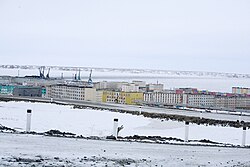
Pevek (Russian: Певе́к; Chukchi: Пээкин / Пээк, Pèèkin / Pèèk) is an Arctic port town and the administrative center of Chaunsky District in Chukotka Autonomous Okrug, Russia, located on Chaunskaya Bay (part of the East Siberian Sea) on a peninsula on the eastern side of the bay facing the Routan Islands, above the Arctic Circle, about 640 kilometers (400 mi) northwest of Anadyr, the administrative center of the autonomous okrug. Population: 4,015 (2021 census);[10] 4,162 (2010 census);[5] 5,206 (2002 census);[11] 12,915 (1989 Soviet census).[12]

Key Information

Historical population
YearPop.±%
1939426—    
19595,752+1250.2%
197010,528+83.0%
197911,060+5.1%
198912,915+16.8%
20025,206−59.7%
20104,162−20.1%
20214,015−3.5%
Source: Census data

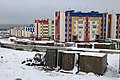
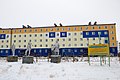
Pevek is a modern settlement established after World War I to provide a port for the export of minerals as part of the expanding Northern Sea Route. During the 1940s and 1950s, the area surrounding Pevek was the site of several gulags where prisoners mined uranium. In recent years, many of the mines became unprofitable and have closed, causing many residents to move to more central regions in Russia and the port infrastructure to decay.

Pevek is the present[when?] location of the Akademik Lomonosov floating nuclear power plant, which carries two marine-type KLT-40S nuclear reactors generating 35 megawatts of electricity each.[13]

Etymology

[edit]

There are two theories for the origin of the town's name. The first is that it is derived from the Chukchi word for fat; it was originally named for the nearby hill Peekin'ey, meaning "swollen mountain".[2] The more macabre theory is that the name is derived from the Chukchi word "Pagytkenay", meaning "smelly mountain".[2] Legend has it that a battle was fought on the site of the modern town between the local Chukchi and Yukaghir peoples.[2] At the time, there was no tradition of burying the dead among the indigenous people, so the odor of rotting flesh was present for a long time.[2] This legend suggests a reason why when Russian explorers first discovered the bay, they did not find any settlement, as the Chukchi refused to settle in the region following the battle and only brought their animals to pasture in the summer.[2]

History

[edit]

18th and 19th centuries

[edit]

The area around Pevek was already known to Russians by the mid-18th century, as the records of the Great Northern Expedition document the discovery of Cape Shelag. Further references to the cape were made in the records of the Billings expedition, with Russian explorers first describing Chaunskaya Bay in the 1760s.[2]

20th century

[edit]

The earliest records of the settlement of Pevek were made by the writer Tikhon Semushkin, who discovered a Chukchi hunting lodge and yaranga in 1926.[2] By the mid-1930s, Pevek became an important port in the region, due to the natural harbor provided by Chaunskaya Bay, the expansion of the Northern Sea Route, and the discovery of tin at the Pyrkakay mine (which would later be renamed Krasnoarmeysky) 60 kilometers (37 mi) away.[2] The discovery of minerals throughout this region meant Pevek had an important part to play in importing the required plant and machinery and exporting the extracted minerals and by 1950, the settlement had nearly 1,500 permanent residents.[2] On April 6, 1967, Pevek was granted town status.[3]

During the 1990s, after the dissolution of the Soviet Union, the town's population dropped by more than half as commercial navigation in the Arctic declined, and people began to gravitate towards the central Russian regions.[2] More or less regular shipping is presently[when?] to be found only from Murmansk to Dudinka in the west and between Vladivostok and Pevek in the east. Ports between Dudinka and Pevek have virtually no shipping.[citation needed]

Gulag

[edit]
Remains of Chaunlag buildings near Pevek

The workforce for the mines that provided the Soviet Union with tin and uranium throughout the large parts of the 20th century were prisoners in the Gulag system.[2] There was a network of camps in the region itself, through which an uncertain number of criminal and political prisoners passed.[2] There are the remains of two large camps, "North" and "West", which continued to supply uranium during and after World War II. Barracks dot the landscape and have the appearance of being hastily abandoned.[2] Large graveyards on the edge of the various encampments show that a large proportion of those sent to work in the mines did not survive.[2]

Administrative and municipal status

[edit]

Within the framework of administrative divisions, Pevek serves as the administrative center of Chaunsky District,[1] to which it is directly subordinated.[14] As a municipal division, the town of Pevek is, together with two rural localities (the selos of Apapelgino and Yanranay) incorporated within Chaunsky Municipal District as Pevek Urban Settlement.[7]

Climate

[edit]

Pevek has a tundra climate (Köppen ET), with long, very cold winters, and short, cool summers. February is the coldest month, with average temperature of −27.5 °C (−17.5 °F), while July, with +8.7 °C (47.7 °F), is the warmest. Although the average temperature for July is below +10.0 °C (50.0 °F), sometimes it may be several degrees warmer with a record high average of +15.7 °C (60.3 °F) for July 2007. Sometimes, but very rarely, it happens that the lowest night temperature stays above +20.0 °C (68.0 °F), which is characteristic for subtropical areas with very mild climates. The lowest temperature ever recorded was −50.0 °C (−58.0 °F) on February 7, 8 and 10, 1978, and the highest was +29.2 °C (84.6 °F) on July 8, 2010.

Climate data for Pevek
Month Jan Feb Mar Apr May Jun Jul Aug Sep Oct Nov Dec Year
Record high °C (°F) 8.9
(48.0)
5.6
(42.1)
5.8
(42.4)
8.6
(47.5)
17.1
(62.8)
27.0
(80.6)
29.2
(84.6)
25.7
(78.3)
20.3
(68.5)
14.5
(58.1)
8.0
(46.4)
8.9
(48.0)
29.2
(84.6)
Mean daily maximum °C (°F) −22.3
(−8.1)
−22.7
(−8.9)
−17.2
(1.0)
−10.3
(13.5)
1.0
(33.8)
10.7
(51.3)
13.4
(56.1)
10.9
(51.6)
6.0
(42.8)
−2.9
(26.8)
−11.8
(10.8)
−19.8
(−3.6)
−5.4
(22.3)
Daily mean °C (°F) −25.6
(−14.1)
−26.2
(−15.2)
−21.4
(−6.5)
−14.3
(6.3)
−2.2
(28.0)
6.1
(43.0)
9.0
(48.2)
7.8
(46.0)
3.9
(39.0)
−4.7
(23.5)
−14.7
(5.5)
−22.8
(−9.0)
−8.8
(16.2)
Mean daily minimum °C (°F) −28.9
(−20.0)
−29.6
(−21.3)
−25.6
(−14.1)
−18.9
(−2.0)
−5.6
(21.9)
2.3
(36.1)
5.5
(41.9)
5.0
(41.0)
1.9
(35.4)
−6.6
(20.1)
−17.9
(−0.2)
−25.9
(−14.6)
−12.0
(10.4)
Record low °C (°F) −45
(−49)
−50
(−58)
−43.3
(−45.9)
−41
(−42)
−30
(−22)
−10.6
(12.9)
−2.2
(28.0)
−5.1
(22.8)
−12.7
(9.1)
−29.3
(−20.7)
−39.7
(−39.5)
−40.6
(−41.1)
−50
(−58)
Average precipitation mm (inches) 18.0
(0.71)
12.9
(0.51)
9.0
(0.35)
8.7
(0.34)
9.1
(0.36)
19.0
(0.75)
36.0
(1.42)
34.0
(1.34)
26.0
(1.02)
21.0
(0.83)
16.0
(0.63)
14.0
(0.55)
223.7
(8.81)
Average rainy days 0 0 0.1 0.1 2 7 13 12 10 1 0.3 0 45.5
Average snowy days 18 18 15 14 12 5 3 3 12 20 17 19 156
Average relative humidity (%) 83 81 81 83 79 74 76 79 80 80 84 83 80
Source: Pogoda.ru.net[15]

Economy

[edit]

Port

[edit]
View of Pevek port

The town is a large port on the Northern Sea Route, the most important northern port in Chukotka, although shipping levels have dropped significantly in recent years.[when?] The port is the eastern base of the northern sea route's Marine Operations Headquarters, run by the Far East Shipping Company (FESCO) from an icebreaker in the harbor,[16] though the port is still owned by the Russian Ministry of Transport.[17] The port's authority stretches as far as 125° east, just west of the Lena River. Past this point, the western Marine Operations Headquarters, in Dikson, has control.[16] The headquarters govern all routes that ships take when using the northern sea route, organizing convoys and providing up-to-date information on ice conditions throughout their sphere of influence.[16] Apart from FESCO, the port is also used by the Arctic Shipping Company, based in Tiksi, who take coal from Zheleny Mys to Pevek.[18]

Despite its prominence as the eastern Marine Operations Headquarters, the level of cargo the port has had to deal with in recent years[when?] has been declining rapidly. Although there is still gold mining around Bilibino and Leningradsky, there is little in the way of cargo generation as a result of that industry.[19] The port is not a significant exporter of goods at all and is mainly responsible for dealing with the import of fuel (coal from Beringovsky and oil from Europe and the United States) for the region, though in the second half of the 1990s even this activity rarely exceeded a few thousand tons, and in 1997, Mys Shmidta, traditionally the second most important of the northern Chukotkan ports, was handling nearly four times as much cargo.[20] The future does not look promising either, and although mining for other materials such as tin still occurs in the region, many of the mines have closed, being deemed unprofitable, and a number of settlements, such as Iultin, Komsomolsky, and Krasnoarmeysky have been depopulated, with any remaining economic activity producing only very low cargo volumes at best.[19]

Chaunskaya Bay under ice. Pevek Peninsula is visible on the east side of the Bay. To the northeast is Wrangel Island.

The result of the closing of the mines in the region is that many people have moved to other regions of Russia. This has caused the almost complete eradication of an export market as well as a corresponding drop in the required level of imports. This causes a lack of demand for the facilities at the port whose precarious profitability leads to a lack of investment. This decaying infrastructure is endemic across the northern sea route and makes the supply route unreliable. For example, winter fuel bound for Pevek did not arrive until the end of November in 1998;[21] this is for a port whose average sailing season lasts only until October 25.[17]

A slight recovery is perhaps indicated by an increase in cargo handled. In 1997, Pevek handled over 200,000 tons of cargo, second only to Dudinka of the true northern sea route ports, with 1,143,000 tons.[22]

The port has a maximum ship draft of 10.25 meters (33.6 ft).[17]

Other industry

[edit]

There is some mining in the area; tin, mercury, gold, and black coal deposits are all located near the town. However, many of the mines that previously produced significant quantities of minerals for export have been deemed to become unprofitable and have closed. Most mining that takes place in the region is relatively low key. However, this level of activity is still sufficient to provide enough business to keep two processing plants in Pevek.[2]

A floating nuclear power plant, Akademik Lomonosov, is located in Pevek. It started commercial operation in May 2020. It has two small reactors that generate 35 megawatts of electricity each.[23]

Transportation

[edit]
Pevek Airport seen from the air

Besides the port as a key transport link with the rest of Russia, the town is also served by the Pevek Airport, located 17 kilometers (11 mi) to the northeast of the town in the village of Apapelgino, a locality established specifically to house the airport's staff.[2] The airport provides flights to major regional centers such as Anadyr and Bilibino, as well as to Moscow.[2]

Pevek also has the most developed road infrastructure in the autonomous okrug. There is approximately 150 kilometers (93 mi) of year-round, paved roads going to local destinations such as the now abandoned settlement of Valkumey and the mines at Komsomolsky and Krasnoarmeysky. There is also an ice road to Bilibino.[17]

In literature

[edit]

Pevek is described as the place of death of Edith Abramovna in Varlam Shalamov's short story "Descendant of a Decembrist".[24]

[edit]

See also

[edit]

References

[edit]
[edit]
Revisions and contributorsEdit on WikipediaRead on Wikipedia
from Grokipedia
Pevek is an Arctic port town in northeastern Russia, serving as the administrative center of Chaunsky District within Chukotka Autonomous Okrug and located on the shores of Chaunskaya Bay in the East Siberian Sea at coordinates 69°42′N 170°18′E. With a population of approximately 4,800 as recorded in the early 2010s—reflecting a sharp decline from Soviet-era peaks due to reduced mining activity and post-dissolution economic contraction—the town functions primarily as a logistics hub for the Northern Sea Route, exporting minerals such as tin, gold, and copper from regional deposits. Established in the 1930s amid forced-labor mining operations and formalized as a port in 1951 to support gold extraction, Pevek's economy remains tied to extractive industries and seasonal shipping, bolstered since 2020 by the world's northernmost nuclear power facility—a floating barge reactor providing energy amid isolation and extreme subarctic conditions averaging -15°C annually. Its strategic role has intensified with climate-driven ice melt expanding navigable seasons along the route, though persistent depopulation and infrastructure decay highlight challenges in sustaining remote Arctic settlements.

The town's origins trace to Soviet-era resource exploitation, including gulag-linked tin and uranium mining that built its foundational infrastructure but at high human cost, evolving into a modern outpost reliant on federal investments for port upgrades and energy security to counter logistical vulnerabilities in a region prone to permafrost thaw and isolation. Despite these developments, Pevek exemplifies Arctic demographic shrinkage, with abandoned structures and a shift toward limited local sustenance like reindeer herding underscoring the tension between resource ambitions and habitability in Russia's far northeast.

Etymology

Name derivation and historical usage

The name Pevek originates from the , specifically the term peekinei, which translates to "thick" or "swollen mountain," alluding to the prominent hill overlooking the settlement site in Chaunskaya Bay. Alternative interpretations in Chukchi link it to a local landform resembling a or, less commonly, evoking "smelly mountain" from tales of ancient battles leaving unburied remains, though the topographic reference predominates in documented accounts. Russian explorers first documented the name in reference to Cape Pevek during surveys of Chaunskaya Bay in the 1760s, with further mentions in the records of the Billings-Sarychev expedition (1785–1793), which mapped coastal features for imperial . Prior indigenous usage among Chukchi populations likely predated these , reflecting oral tied to environmental landmarks rather than formal . Spelling variations persisted into the , with Chukchi renditions as Пээкин (Pèèkin) or Пээк (Pèèk) contrasting Russian transliterations as Певек. The standardized Russian form gained prominence on official Soviet maps after , coinciding with the site's development as a and outpost, supplanting earlier ad hoc notations in exploratory logs.

History

Early settlement and 18th-19th centuries

The Chaun Bay region, site of modern Pevek, supported seasonal habitation by indigenous Chukchi coastal hunters and Even herders prior to sustained Russian penetration. Chukchi groups pursued marine mammals including , seals, and whales from temporary coastal camps, supplementing diets with hunting and fishing, while Even nomads utilized inland for and migration routes extending to the bay's vicinity. These activities reflected adaptive strategies to the environment, with no evidence of large permanent villages but rather dispersed, mobile encampments tied to resource cycles. Russian exploratory records first noted the area in the mid-17th century, when Cossack Isaia Ignatiev sailed from the Kolyma River to Chaun Bay in 1646, marking early coastal reconnaissance amid fur-seeking ventures. By the 18th century, the Great Northern Expedition (1733–1743), sponsored by the Russian Admiralty, systematically charted Siberia's Arctic seaboard, including bays and capes proximate to Chaun, thereby elevating official awareness of the topography and sparse native populations without establishing outposts. In the , commercial intensified external contacts, as American and European fleets ventured into Chukotka waters from the mid-century onward, anchoring near coastal sites for repairs, , and barter with Chukchi for furs, , and provisions. Transient trading stations facilitated these exchanges, primarily under American influence until the early , though the Pevek locale itself hosted no fixed European settlements, preserving its character as a zone of intermittent indigenous and exploratory use.

Soviet development and Gulag era

Soviet efforts to develop Pevek intensified in the 1930s amid the push to industrialize the Arctic and exploit mineral deposits in the Chaun Bay region, with initial settlement and basic port infrastructure established to facilitate tin ore exports along the Northern Sea Route. By the early 1940s, the Chaunsky District, encompassing Pevek, emerged as the Soviet Union's foremost tin-producing area, supplying critical materials for the war industry during World War II alongside uranium extraction. Chukotka as a whole accounted for approximately 20% of total USSR tin output during the Soviet period, underscoring the region's strategic economic role. The Chaunsky ITL (commonly known as Chaunlag), part of the system, was established in the mid-1940s to support operations and infrastructure projects, including port expansion and road construction to tin deposits, drawing on thousands of forced laborers dispatched to the remote site. Prisoners endured extreme conditions, contributing to the transformation of Pevek from a sparse outpost into a functional and shipping hub through compelled extraction and building efforts that free labor alone could not have achieved at comparable speed. The port's formal establishment on April 20, 1951, capitalized on this groundwork, enabling year-round handling of ore shipments despite ice constraints. Gulag operations in Chukotka, including around Pevek, resulted in tens of thousands of deaths from , disease, and overwork between the 1930s and 1950s, as documented in regional accounts of the camp system's brutality in the far northeast. Declassified Soviet reveal systemic underreporting of mortality, with prisoners often reclassified as "" or released on paper before death to obscure true figures, though exact numbers for Chaunlag remain elusive due to incomplete archival access. Following partial amnesties in the mid-1950s, many surviving ex-prisoners settled locally, bolstering the population and sustaining activities as Pevek grew toward formal town status in 1967.

Post-Soviet period and revival

Following the in 1991, Pevek underwent rapid depopulation and economic contraction as federal subsidies critical to sustaining remote outposts were slashed amid Russia's transition to a market economy. Mining operations scaled back sharply, supply chains collapsed, and non-indigenous residents emigrated en masse, shrinking the town's from 12,915 in the 1989 census to 5,206 by the 2002 census. as a whole lost over 60% of its residents during the , from roughly 160,000 to under 60,000 by 2000, reflecting broader patterns of subsidy withdrawal and industrial stagnation in Russia's Far North. Economic stabilization emerged in the mid-2000s, coinciding with surging global commodity prices and targeted investments in Chukotka's mineral sector under Governor (2000–2008), who prioritized and other to restore viability. Pevek benefited indirectly through regional recovery, though its core function pivoted toward port infrastructure to support extractive exports. moderated, falling to 4,162 by the 2010 census, as federal incentives and private capital stemmed total exodus. Revival accelerated in the 2010s under President Vladimir Putin's Arctic strategies, including the 2013 and 2020 national policies emphasizing resource extraction, shipping, and energy security to counter prior collapse narratives. Pevek was designated a priority hub for the Northern Sea Route (NSR), with port dredging and expansion enabling year-round operations for larger vessels. The 2019 deployment of the floating nuclear power plant Akademik Lomonosov—delivering 70 MW to replace the aging Bilibino station—bolstered reliability for mining at nearby sites and logistics, driving cargo throughput growth of about 100,000 tons annually since 2018. By 2021, Pevek's population stood at approximately 4,015, reflecting stabilization rather than boom, but underscoring adaptive infrastructure-led resurgence amid NSR traffic projections reaching 80 million tons yearly by 2024.

Geography

Location and physical features

Pevek is situated at coordinates 69°42′N 170°19′E on the eastern shore of Chaun Bay, an inlet of the in northeastern . The town serves as Russia's northernmost port, facilitating maritime access in the region. The surrounding landscape features continuous typical of the Arctic tundra, with low-lying coastal terrain shaped by glacial and periglacial processes. Pevek lies approximately 250 kilometers northwest of Bilibino, a key mining center in the , connected via regional roads and air routes. Its position provides strategic access to the , supporting year-round shipping operations assisted by nuclear icebreakers to transport cargo from Siberian ports to international destinations.

Climate and environmental conditions

Pevek experiences a (Köppen ET), characterized by long, severe winters and brief, cool summers. The annual mean temperature is approximately -10°C, with January averages ranging from -23°C to -27°C and highs reaching 11-12°C and lows around 7°C. Temperature extremes include lows rarely below -33°C and highs up to 18°C, though regional Chukotka records indicate potential for -40°C or lower during polar nights. totals 200-300 mm annually, predominantly as , contributing to persistent snow cover from October to May. Sea ice in Chaun Bay, where Pevek is situated, typically forms by late and persists until or , covering the area for 8-10 months historically. Observed reductions in ice thickness and extent, driven by regional warming, have shortened ice cover duration by several weeks in recent decades, facilitating extended navigation windows along the . This trend aligns with broader patterns, where summer ice-free periods have increased, though interannual variability remains high due to wind and current influences. The region lies within the continuous permafrost zone, with frozen ground extending 300-500 meters deep and an active layer thawing to 0.5-1 meter in summer. thaw, accelerated by air temperature rises of 2-3°C since the 1970s, induces processes leading to ground and reduced , threatening stability. Empirical data from Russian sites show deformation rates of 5-10 cm/year in thawing areas, prompting mitigations such as ventilated foundations and thermosyphons to maintain permafrost integrity beneath structures.

Demographics

Population dynamics

Pevek's population peaked at 12,915 during the , reflecting intensive Soviet-era development in mining and operations that drew labor to the remote settlement. Following the Soviet Union's dissolution, the population declined sharply due to economic contraction, reduced state subsidies, and diminished industrial activity, halving to 5,206 by the 2002 census. This trend continued amid broader depopulation in 's Far North, with figures falling to 4,162 in the 2010 census and 4,015 in the 2021 census, as permanent residents departed for mainland opportunities amid faltering local economies. Recent estimates place Pevek's resident at approximately 4,500–5,000 in the mid-2020s, incorporating temporary migrant workers drawn by revived extraction and expanded shipping along the , which has boosted port cargo turnover and related employment. These inflows have yielded modest net growth since the early , countering earlier stagnation through projects like the , operational since 2019 to support industrial expansion. Population turnover remains elevated owing to the town's , with average winter temperatures below -30°C and challenges deterring long-term settlement; annual out-migration exceeds in-migration without interventions. Russian federal policies mitigate this via "northern coefficients"—wage supplements up to 80% and housing perks—to incentivize skilled labor in extractive sectors, though retention rates stay low as workers often rotate after short contracts tied to seasonal shipping or cycles.

Ethnic composition and indigenous groups

The population of Pevek is predominantly ethnic Russian, reflecting the town's origins as a Soviet-era industrial settlement attracting migrant workers from across the USSR. According to demographic databases derived from census data, Russians comprise approximately 80% of residents, with smaller shares held by Ukrainians (around 2%), Tatars (around 4%), and other non-indigenous groups. Indigenous peoples form a minority, estimated at 5-10% combined, primarily Chukchi, with smaller numbers of Evens and Yukaghirs; these figures underscore Pevek's urban character, contrasting with rural Chukotka where Chukchi exceed 25% of the population per 2010 census aggregates. Chukchi, the principal indigenous group in the Chaun District encompassing Pevek, maintain traditional livelihoods centered on and of marine mammals such as seals and walruses, activities regulated by quotas under Russia's Federal Law No. 82-FZ on Guarantees for the Rights of Indigenous Small-Numbered Peoples of the North, , and . These practices persist despite pressures, with indigenous communities often residing in outlying villages rather than the town center. Some Chukchi and Even families have relocated to Pevek for access to , healthcare, and in or operations, contributing to partial while preserving cultural ties to nomadic or semi-nomadic routines.

Administration

Municipal and political status

Pevek constitutes a municipal formation with the status of an urban district (городской округ) within the , as defined by regional legislation that delineates its boundaries along the coast and inland territories encompassing approximately 62,491 km². This status integrates Pevek as the primary administrative center, absorbing functions previously associated with the broader Chaunsky District, which was established in with Pevek as its core settlement. The framework aligns with Russia's federal local self-government reforms initiated in the early 2000s under Federal Law No. 131-FZ of 2003, which empowered regions like to consolidate urban okrugs for streamlined administration in sparsely populated Arctic areas. Governance falls under the direct oversight of the Chukotka Autonomous Okrug's executive authorities, with the district head—Ivan Leyushkin, elected by local residents on October 1, 2021—responsible for municipal operations while coordinating with the regional , , appointed in 2023. In September 2024, Chukotka initiated renaming low-population urban okrugs including Pevek to unified municipal okrugs (муниципальные округа) to enhance administrative flexibility under evolving federal standards, a process reflecting ongoing centralization in Russia's Far North. The district's budget exhibits heavy reliance on federal interbudgetary transfers, which constitute a significant portion of revenues due to limited local tax bases in this remote setting; for instance, Chukotka's regional finances incorporate substantial federal support for lower-level entities like Pevek to sustain operations amid infrastructural challenges. Electoral outcomes in Pevek and Chukotka broadly mirror national trends, with pro-federal candidates securing strong majorities, as evidenced by the 2023 regional gubernatorial election where the incumbent aligned with won decisively, underscoring political cohesion with Moscow's development priorities.

Governance structure

The governance of Pevek operates as a municipal within , with executive authority vested in the Administration headed by Ivan Sergeevich Leyushkin, who serves as the Head since at least 2023. This structure includes specialized departments for , , property relations, and public services, enabling localized decision-making while adhering to Russian federal municipal laws. The representative body, or local council, provides legislative oversight, focusing on priorities like infrastructure maintenance and service delivery in the remote setting. Local administration integrates closely with federal entities for strategic projects, notably , which operates the moored in Pevek since 2019 to supply electricity and heat. A 2015 cooperation agreement between and the Chukotka government formalized this partnership, embedding federal nuclear oversight into local to ensure reliable power amid harsh conditions. Federal Arctic zone incentives heavily influence Pevek's budget, providing subsidies for development initiatives; for example, in 2021, the Russian government earmarked 2.6 billion rubles (approximately $36 million) for a high-voltage connecting to Pevek, bolstering resilience. These allocations support efficient by offsetting logistical costs inherent to the region's isolation, with decisions streamlined through public and federal program alignment as documented on the official administration portal. Anti-corruption compliance follows national mandates, reinforced in Rosatom-led projects via integrated management systems that mandate transparency in contracting and operations.

Economy

Mining and resource extraction

The Chaun district surrounding Pevek has historically been a center for , with the Valkumei deposit serving as Chukotka's largest tin producer during the Soviet era through the Pevek mining and processing combine (Pevek GOK). Operations at Valkumei relied on underground extraction techniques, peaking in output during the before economic shifts led to tin production cessation in 1992–1993, after which the site transitioned to . Coal deposits exist nearby, but extraction remains limited and supports local energy needs rather than large-scale commercial output. In the post-Soviet period, gold mining emerged as the dominant activity, exemplified by Polymetal International's Mayskoye underground mine, located approximately 180 km south of Pevek in the Chaunsky District. The mine employs modern mechanized underground methods, including sublevel stoping, with ore processed at an on-site facility capable of handling up to 1.5 million tonnes annually; it has produced around 250,000 to 275,000 ounces of per year at full capacity since operations began in 2010. Road access from Pevek facilitates , though seasonal constraints limit efficiency without broader upgrades. Chukotka's overall output, including contributions from Chaun-area operations, reached 28.82 tonnes in 2016, underscoring the region's role in Russia's mineral sector amid declining tin production nationwide. Mining employs a substantial portion of Pevek's , serving as the primary economic stabilizer in a remote setting where resource extraction drives local stability and infrastructure demand. Post-Soviet technological improvements, such as automated drilling and processing at sites like Mayskoye, have enhanced recovery rates from ores, though overall contributions to Russia's national GDP remain modest given the district's scale relative to larger Siberian operations.

Port operations and Northern Sea Route integration

The Port of Pevek functions as a primary eastern hub on the (NSR), specializing in the handling of bulk cargoes including minerals and containers for export and transshipment from Chukotka's resource sites. Operations rely on nuclear icebreakers to navigate ice in the , extending usability into periods of heavier ice cover beyond the ice-free summer months. In 2024, NSR cargo traffic reached a record 37.9 million tons, a 1.6-fold increase from 2023, with Pevek supporting key eastern transits that facilitate shorter shipping paths between ports and , predominantly eastbound flows of energy and raw materials. This growth underscores Pevek's strategic positioning for transit voyages, which totaled 92 full crossings carrying over 3 million tons on the route. Infrastructure enhancements have bolstered capacity, with port reconstruction completed by 2020 to accommodate larger vessels and a new terminal slated for operational start in , enabling year-round service via dedicated port fleets. These upgrades, integrated with the arrival of a floating unit, enhance reliability for handling increased volumes and promote economic multipliers through expanded chains. Overall throughput dynamics reflect NSR's decade-long cargo expansion by a factor of ten, positioning Pevek as a linchpin for sustained maritime commerce.

Energy production and infrastructure

The primary energy infrastructure in Pevek centers on the , the world's first operational (FNPP), which began supplying to the grid in December 2019 and achieved full commercial operation in May 2020. Moored permanently in Pevek harbor, the FNPP features two KLT-40S pressurized water reactors with a combined electrical output of 70 megawatts (MW) and thermal capacity of 50 gigacalories per hour (Gcal/h), providing both power to the isolated Chaun-Bilibino grid and to the town and surrounding districts. By January 2025, it had generated over one billion kilowatt-hours of , demonstrating reliable performance in conditions despite scheduled maintenance to enhance 2025 output by 28%. The FNPP replaces aging diesel and coal-fired facilities, such as the Chaun thermal power plant, significantly reducing dependence on imported fossil s transported via vulnerable routes, particularly amid limiting diesel deliveries. This shift has lowered annual CO2 emissions by approximately 50,000 tonnes compared to prior diesel generation, which emits around 500-800 grams of CO2 equivalent per , versus nuclear's lifecycle emissions of 12-20 grams CO2e/kWh primarily from and processing. Operationally, the plant maintains high reliability, with refueling conducted on-site; its first core reload occurred in late 2023, supporting continuous supply without the logistical risks of fuel oil convoys. In September 2025, an (IAEA) delegation conducted its first on-site inspection of the from September 2 to 4, verifying compliance with international safety standards and confirming its environmental and radiological safety after five years of operation. Expansion plans position the FNPP to fully assume the role of the retiring , with Bilibino units scheduled for shutdown by December 2021 (extended operations noted) and the FNPP becoming the primary heat and electricity provider for the Chaun-Bilibino system starting in 2026, ensuring baseload capacity without additional reliance.

Transportation networks

Pevek Airport (IATA: PWE) serves as the primary gateway for passengers and cargo, facilitating connections to regional centers such as Anadyr via airlines including Yakutia and Aeroflot, with weekly flights operated on smaller aircraft like the An-24 or Twin Otter. Direct routes to Moscow are available using larger jets such as the Boeing 757 or 767, enabling year-round access despite harsh Arctic conditions. The airport handles limited but essential traffic, supporting the town's isolation by providing the most reliable all-weather transport option for personnel and urgent supplies. Overland transportation remains severely constrained by the region's continuous , which causes ground instability, , and frequent damage to roads and potential rail alignments through thawing-induced and settlement. Chukotka lacks an integrated rail network, and road links are confined to short, unpaved local routes unsuitable for heavy or long-distance freight, exacerbating reliance on air and sea modes. Maritime connections along the depend heavily on nuclear s for escorting vessels through seasonal , limiting navigation to approximately four to five months annually without assistance, though climate trends may extend ice-free periods. face ongoing challenges from variable conditions, remote positioning, and insufficient backup infrastructure, prompting Russian efforts to enhance fleets and develop year-round capabilities, though full all-weather multimodal integration remains elusive due to environmental and technical barriers.

Strategic importance

Role in Russia's Arctic policy

Pevek holds a designated role in Russia's Zone of the Russian Federation (AZRF) as outlined in the 2020 Strategy for Development of the Zone and Ensuring until 2035, which identifies the town's seaport and terminals in Chaun Bay as key infrastructure for expanding transit capabilities along the (NSR). This prioritization supports federal goals of integrating Arctic ports into a unified transport corridor to boost resource exports, with Pevek positioned as an outlet for regional mineral production, including tin from nearby operations. The strategic emphasis on Pevek embodies Russia's policy of military-economic synergy in the , where economic hubs like the town reinforce by sustaining a permanent presence in remote areas vulnerable to external pressures. The AZRF as a whole generates about 7.5% of Russia's GDP and 11% of its exports, underscoring the policy's focus on leveraging such nodes for dual-use infrastructure that bolsters both and defense postures. Amid Western sanctions since and intensified post-2022, Pevek's policy integration facilitates a reorientation toward Asian trade partners via the NSR, emphasizing self-sufficiency in shipping and energy logistics through state-backed advancements like fleets. Amended guidelines from 2023 further prioritize unilateral national interests, sidelining prior multilateral frameworks to accelerate such developments without reliance on foreign .

Recent developments in shipping and logistics

Cargo traffic along the reached a record 37.9 million tonnes in 2024, exceeding the 2023 volume by 1.6 million tonnes and demonstrating robust performance beyond prior projections. Pevek serves as a critical eastern hub facilitating for NSR cargoes, with Russian plans designating it among five priority ports for infrastructure upgrades to sustain this expansion. In 2024-2025, initiatives include creating eastern hubs at ports like Pevek for container handling, aligning with the NSR through 2035. Supporting this, Russia commissioned the Ivan Papanin in September 2025, enhancing escort capabilities for heavier traffic volumes. Container shipments along the NSR grew in 2025, with the launch of the first international boxship routes and eastbound transits comprising the primary flow, as evidenced by summer-autumn voyages from Russian ports to . Reduced ice has extended viable navigation periods, shortening transit times by up to 40% versus routes and yielding fuel savings of 25-30% for eastbound cargoes. projects NSR volumes of 36-38.5 million tonnes for 2025, driven by these efficiencies and bilateral agreements, such as the October 2025 Russia-China action plan for increased shipments.

Social impacts

Indigenous relations and cultural preservation

The indigenous population of Pevek and surrounding Chukotka primarily consists of Chukchi, Even, and peoples, who maintain traditional practices alongside participation in the modern economy. These groups engage in a mixed subsistence system, with approximately 75% of indigenous residents in Chukotka involved in , hunting, and , while 25% contribute to wage labor in sectors like and port operations. This integration reflects adaptations to Pevek's role as an industrial hub, where indigenous individuals increasingly work in urban settings without fully abandoning ancestral livelihoods. Legal frameworks protect traditional hunting rights through quotas allocated to aboriginal communities. Since 1994, Chukotka has permitted licensed native hunters to conduct subsistence for gray, bowhead, and minke whales under oversight, with over 220 hunters from 10 coastal communities participating annually. Similar quotas apply to seals and , with the US-Russia Polar Bear Commission raising the harvest limit from 58 to 85 bears in 2018 to support traditional needs while ensuring sustainability. These measures, enforced by regional authorities, balance cultural continuity with ecological limits, allowing communities to distribute meat and byproducts for and rituals. Federal and regional programs fund cultural preservation efforts, including support from the Association of Traditional Hunters of Chukotka (ChAZTO) for ecological education and heritage sites. Initiatives promote and traditional crafts amid language decline, where Chukchi, Even, and usage has shifted largely to family or economic contexts. In response to development pressures from and port expansion near Pevek, compensation mechanisms provide funds to indigenous groups for land impacts, often including alternative grazing areas or economic grants to offset disruptions to herding routes. These arrangements, negotiated via regional bodies, aim to harmonize industrial growth with , though implementation varies by project.

Legacy of forced labor and demographic shifts

Pevek's foundational infrastructure, including port terminals, mining facilities, and early residential structures in the Chaun region, was erected largely by prisoners from camps operating in Chukotka between and . These camps, part of the broader Soviet forced labor system, relied on inmates to develop remote outposts amid extreme conditions, resulting in high mortality rates estimated in the tens of thousands across the district. Surviving buildings from these camps continue to stand and serve utilitarian purposes in the town, underscoring the enduring physical legacy of coerced construction despite the human cost. Following the Gulag system's dismantling after Stalin's death in , Pevek's population expanded through voluntary migration of skilled laborers attracted to resource extraction and operations, forming the core of its settler demographic. data reflect this shift: from 426 residents in 1939—predominantly camp personnel and initial indigenous groups—to a peak of 12,915 by 1989, driven by influxes of ethnic and other Soviet migrants. Indigenous Chukchi, Even, and populations, which comprised about 69% of Chukotka's total in 1939, declined proportionally to around 30% by later decades due to , assimilation pressures, and out-migration, though absolute skilled worker arrivals sustained overall demographic stability until post-Soviet economic contraction. This resilience highlights how initial forced development catalyzed permanent habitation patterns, offsetting native demographic through targeted resettlement policies. Historical reckoning in Pevek remains limited, with no prominent local memorials to victims documented, contrasting with sporadic national efforts like Moscow's Solovki Stone but aligned with underemphasis in peripheral regions. Survivor accounts and archival records preserve evidence of traumas, yet the operational continuity of Gulag-era assets prioritizes pragmatic utility over symbolic atonement, reflecting causal priorities of infrastructural permanence over transient commemorations in Russia's policy.

Controversies

Environmental effects of industrialization

Industrialization in Pevek, primarily through expanded (NSR) shipping and support for regional mining, has introduced risks of , including potential oil spills from tanker traffic carrying hydrocarbons and other bulk cargoes. In 2024, over 84% of NSR cargo volume consisted of oil and gas, heightening spill probabilities in ice-prone waters where cleanup is logistically challenging due to remoteness and seasonal darkness. Vessel from increased traffic disrupts communication and migration patterns, with Arctic shipping studies documenting elevated underwater sound levels correlating to behavioral changes in whales and seals near ports like Pevek. Mining activities in the Chaun district, facilitated by Pevek's for exporting concentrates and equipment, have contributed to localized degradation through placer operations that erode coastal and contaminate sediments with . Historical Peveksky mining ventures have altered northern coastal ecosystems, releasing into rivers and bays, though operations adhere to Russian federal standards limiting discharge concentrations to below permissible levels for zones. The deployment of the Akademik Lomonosov floating nuclear power plant (FNPP) since December 2019 mitigates some impacts by replacing diesel generators, avoiding an estimated 390,000 tons of greenhouse gas emissions over its first five years of operation. Radiation monitoring around the FNPP in Pevek has recorded background-level doses, with no detectable fallout from operations, and the design withstands seismic events up to 10-12 on the MSK-64 scale, reducing risks from permafrost thaw-induced instability. Ongoing permafrost monitoring in the region tracks thaw rates accelerated by industrial heat sources, but empirical data show FNPP thermal discharges confined to controlled onshore networks, limiting broader ecosystem effects compared to prior fossil fuel reliance. While warming extends navigable seasons along the NSR—enabling 34 million tons of in 2023 versus under 3 million pre-2010 baselines—localized degradation from port and emissions persists, though quantified air levels in Pevek remain within Russian sanitary norms. Net environmental trade-offs favor reduced diesel from the FNPP, as baseline diesel operations emitted higher particulates and SOx without nuclear's waste minimization.

Criticisms of development policies

Criticisms of Pevek's development policies, primarily driven by federal initiatives emphasizing port modernization, expansion, and nuclear energy deployment, center on their prioritization of resource extraction over local and indigenous livelihoods. International analysts have highlighted risks associated with the , deployed to Pevek in 2019 to support industrial growth, including proliferation concerns due to its potentially enabling rapid deployment in remote areas without robust oversight. Critics, including experts, argue that such nuclear reliance overlooks cheaper alternatives like wind and solar, which could mitigate dependency on imported fuels while avoiding nuclear hazards in an ecologically fragile zone. Indigenous Chukchi communities in Chukotka have voiced opposition to land allocations for and , claiming these encroach on territories essential for and subsistence activities, exacerbating post-Soviet cultural erosion and economic marginalization. Activist reports document fines and restrictions on dissent, with broader Russian Arctic patterns showing suppression of protests against extractive projects through administrative penalties, though Pevek-specific cases remain limited in public record. These critiques often emanate from Western NGOs, whose opposition to Russian state-led development may reflect geopolitical biases rather than solely empirical assessments of local outcomes. Counterarguments emphasize verifiable economic gains, as Chukotka's gross regional product has expanded amid investments, with over 5,000 new jobs created in a of 49,000, driven by shipping and sectors. The region's policies align with causal imperatives of resource realism, where hydrocarbons and transit routes underpin national , contributing 7.5% to Russia's GDP and buffering against sanctions-induced isolation. Despite infrastructure lags and outflows post-mining booms, data indicate net positive fiscal impacts, suggesting that localized disruptions are outweighed by broader macroeconomic necessities in a resource-constrained environment.

References

Add your contribution
Related Hubs
User Avatar
No comments yet.