Hubbry Logo
Negative (photography)Negative (photography)Main
Open search
Negative (photography)
Community hub
Negative (photography)
logo
8 pages, 0 posts
0 subscribers
Be the first to start a discussion here.
Negative (photography)
from Wikipedia

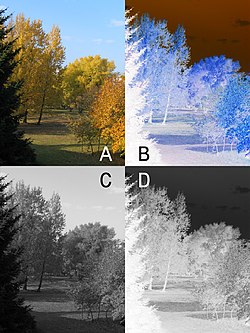
Color positive picture (A) and negative (B), monochrome positive picture (C) and negative (D)

In photography, a negative is an image, usually on a strip or sheet of transparent plastic film, in which the lightest areas of the photographed subject appear darkest and the darkest areas appear lightest.[1] This reversed order occurs because the extremely light-sensitive chemicals a camera film must use to capture an image quickly enough for ordinary picture-taking are darkened, rather than bleached, by exposure to light and subsequent photographic processing.

In the case of color negatives, the colors are also reversed into their respective complementary colors. Typical color negatives have an overall dull orange tint due to an automatic color-masking feature that ultimately results in improved color reproduction.[2]

Negatives are normally used to make positive prints on photographic paper by projecting the negative onto the paper with a photographic enlarger or making a contact print. The paper is also darkened in proportion to its exposure to light, so a second reversal results which restores light and dark to their normal order.[3]

Negatives were once commonly made on a thin sheet of glass rather than a plastic film, and some of the earliest negatives were made on paper.[4]

Transparent positive prints can be made by printing a negative onto special positive film, as is done to make traditional motion picture film prints for use in theaters. Some films used in cameras are designed to be developed by reversal processing, which produces the final positive, instead of a negative, on the original film.[5] Positives on film or glass are known as transparencies or diapositives, and if mounted in small frames designed for use in a slide projector or magnifying viewer they are commonly called slides.

Negative image

[edit]
Picture showing a dust storm during the Dust Bowl period, Texas Panhandle, United States
A negative of the previous image. Curiously, it appears to be the original photo.
Positive color Negative color

A positive image is a normal image. A negative image is a total inversion, in which light areas appear dark and vice versa. A negative color image is additionally color-reversed,[6] with red areas appearing cyan, greens appearing magenta, and blues appearing yellow, and vice versa.

Under a phenomenon known as the 'negative picture illusion', a negative image can be briefly experienced by the human visual system where an afterimage persists subsequent to a prolonged gaze.

Film negatives usually have less contrast, but a wider dynamic range, than the final printed positive images. The contrast typically increases when they are printed onto photographic paper. When negative film images are brought into the digital realm, their contrast may be adjusted at the time of scanning or, more usually, during subsequent post-processing.[7]

Negative film

[edit]
A strip of four color negatives on 35 mm film that show some images of what looks like a fire hydrant, street lights etc.

Film for cameras that use the 35 mm still format is sold as a long strip of emulsion-coated and perforated plastic spooled in a light-tight cassette. Before each exposure, a mechanism inside the camera is used to pull an unexposed area of the strip out of the cassette and into position behind the camera lens. When all exposures have been made the strip is rewound into the cassette. After the film is chemically developed, the strip shows a series of small negative images. It is usually then cut into sections for easier handling. Medium format cameras use 120 film, which yields a strip of negatives 60 mm wide, and large format cameras capture each image on a single sheet of film which may be as large as 20 x 25 cm (8 x 10 inches) or even larger. Each of these photographed images may be referred to as a negative and an entire strip or set of images may be collectively referred to as "the negatives". They are the master images, from which all positive prints will derive, so they are handled and stored with special care.

Many photographic processes create negative images: the chemicals involved react when exposed to light, so that during development they produce deposits of microscopic dark silver particles or colored dyes in proportion to the amount of exposure. However, when a negative image is created from a negative image (just like multiplying two negative numbers in mathematics) a positive image results. This makes most chemical-based photography a two-step process, which uses negative film and ordinary processing. Special films and development processes have been devised so that positive images can be created directly on the film; these are called positive, or slide, or (perhaps confusingly) reversal films and reversal processing.

Despite the market's evolution away from film, there is still a desire and market for products which allow fine art photographers to produce negatives from digital images for their use in alternative processes such as cyanotypes, gum bichromate, platinum prints, and many others.[8] Such negative images, however, can have less permanence and less accuracy in reproduction than their digital counterparts.[9]

Negative images and digital processing

[edit]
Color positive picture (A); color negative, luminance positive (B); color positive, luminance negative (C); and full negative (D).

A negative image can allow a different perception of an everyday scene, perhaps highlighting spatial relationships and details that are less obvious in the positive image. For example, the photographer Andrew Prokos has produced an award-winning series of photographs under the "inverted" banner.[10] The advent of digital image processing has expanded the possibilities. In a physical photograph the colour and luminance can only be inverted in tandem, but digital processing allows each to be inverted separately. If the hue of an image is rotated by 180 degrees, then the colour of the image is inverted but not its luminance. The negative of such an image has the luminance inverted but not the colour. Whereas a physical image can be either 'inverted' or 'not inverted', a digital image can exhibit a partial degree of colour inversion[11] in so far as the hue can be altered by plus or minus some number of degrees which is greater than zero degrees but less than 180 degrees.

References

[edit]
[edit]
Revisions and contributorsEdit on WikipediaRead on Wikipedia
from Grokipedia
In photography, a negative is an image recorded on a support such as paper, glass, or plastic film, typically semi-transparent, that inverts the tones of the original scene, rendering light areas dark and dark areas light to form an inverse representation of the subject. This reversal occurs through the chemical action of light-sensitive emulsions, typically silver halides, which reduce to metallic silver in exposed areas during development, creating the foundational record for producing positive prints or digital scans. Negatives enable the replication of images in unlimited quantities, distinguishing them from direct positive processes like the daguerreotype, and they form the core of analog photography from its inception to modern film use. The invention of the negative revolutionized photography by allowing multiple reproductions from a single exposure, with William Henry Fox Talbot pioneering the concept in 1841 through his calotype process, which used paper sensitized with silver iodide to produce the first negative-to-positive system. This was followed in 1851 by Frederick Scott Archer's wet collodion process, which coated glass plates with collodion and silver halides to create sharper, more detailed negatives that dominated professional and studio work until the 1880s. A major advancement came in 1871 when Richard Leach Maddox introduced gelatin dry plates, replacing the labor-intensive wet process with a stable emulsion that could be prepared in advance, paving the way for portable roll films on flexible plastic supports by the late 1880s and enabling widespread amateur photography. Black-and-white negatives rely on monochrome silver gelatin emulsions, where development amplifies the latent image formed by light exposure, followed by fixing to stabilize the tones, while color negatives, developed from the 1930s onward, incorporate layered chromogenic dyes in red, green, and blue sensitive emulsions to capture full-spectrum hues. Kodak's Kodacolor process, introduced in 1942, marked a key milestone in color negative film, allowing economical printing of vibrant positives from 35mm rolls and solidifying negatives as essential for both artistic and documentary imaging. Today, despite the dominance of digital capture, photographic negatives endure in archival collections and niche analog practices, including a resurgence in popularity since the 2020s among photographers seeking tangible and aesthetic qualities, valued for their chemical precision and historical significance.

Fundamentals

Negative Image Characteristics

A photographic negative is a semitransparent image on a film base that inverts the tones, colors, and details of the original scene, rendering light areas as dark and dark areas as light. This reversal occurs because light-sensitive silver halide crystals in the emulsion are exposed proportionally to the scene's illumination, forming a latent image that, upon development, produces metallic silver grains in proportion to the exposure received. In black-and-white negatives, the result is a grayscale inversion where bright highlights from the subject appear as dense, opaque regions, while shadowed areas manifest as thin, transparent ones. Density in a negative refers to the degree of opacity, measured as the logarithm of the ratio of incident to transmitted light, which directly correlates with the amount of developed silver deposited. High light exposure on the film leads to high-density areas that block more light during printing, while low exposure results in low-density areas that allow more light to pass, thereby inverting the tonal values. For color negatives, this density variation occurs in multiple emulsion layers sensitive to red, green, and blue light, producing complementary color inversions—such as cyan for red, magenta for green, and yellow for blue—alongside the brightness reversal. The negative functions as an intermediate master, enabling the production of multiple positive prints through projection or contact printing, where light passes through the negative onto photosensitive paper to reverse the tones once more. This duplicability stems from the negative's ability to preserve the full dynamic range of the captured scene. Optically, negatives differ from positive images (such as transparencies) by offering greater latitude in detail retention, particularly in highlights and shadows, due to the inverted structure and the characteristic curve of the film. The curve's toe region compresses shadow tones to maintain detail in underexposed areas, while the shoulder accommodates highlights without clipping, allowing overexposure by up to one stop without significant loss of shadow information—advantages not as pronounced in direct positive media. This tonal compression and expansion during printing ensure that the negative captures subtle gradations across the exposure spectrum, providing a robust foundation for high-fidelity reproductions.

Inversion from Light to Dark

In silver halide photographic film, exposure to light initiates the formation of a latent image through the absorption of photons by crystals embedded in the emulsion layer. These photons generate photoelectrons and photoholes within the silver halide grains, such as silver bromide (AgBr), where the photoelectrons reduce silver ions (Ag⁺) to neutral silver atoms (Ag⁰), forming small clusters of metallic silver that serve as development centers. This latent image remains invisible immediately after exposure because the silver clusters are too sparse to affect light transmission significantly, requiring subsequent chemical development to amplify them into visible densities. The inversion of tones in a negative arises from the proportional response of the emulsion to light intensity: areas of the scene receiving brighter light undergo greater reduction of silver halide, resulting in more extensive silver deposition during development and thus higher optical density (darker, less transparent regions on the negative). Conversely, shadowed areas in the original scene receive minimal exposure, leading to fewer silver atoms and lower density (clearer, more transparent regions) on the developed negative, effectively reversing the brightness distribution of the captured subject. This principle contrasts with positive images, such as those from reversal film, where tones retain the original scene's brightness relationships. Under extreme exposure conditions, such as very low light intensities over prolonged times, reciprocity failure occurs, disrupting the expected linear relationship between exposure (intensity × time) and image density in the negative. In these cases, the efficiency of latent image formation decreases, requiring additional exposure compensation to maintain proper tone inversion, as the film's sensitivity drops and contrast may shift nonlinearly across tones. The tone inversion is graphically represented by the characteristic curve of negative film, which plots density (vertical axis) against the logarithm of exposure (horizontal axis), showing an S-shaped response where density increases with exposure in the linear midsection. The slope of this linear portion, known as gamma (typically 0.5 to 1.0 for negative films), quantifies contrast and illustrates how brighter exposures yield progressively denser negatives, enabling the reversal when light passes through to form a positive print or scan. For visualization, imagine a curve starting flat in shadows (toe region, compressing low tones), rising steeply in midtones (linear region with gamma slope), and flattening in highlights (shoulder region, limiting high densities), directly embodying the inverted tonal mapping.

History

Invention by Daguerre and Talbot

In 1839, Louis-Jacques-Mandé Daguerre announced the daguerreotype process, a pioneering photographic method that produced direct positive images without the use of negatives. The process involved sensitizing a polished silver-plated copper sheet with iodine vapor to form light-sensitive silver iodide, exposing it in a camera for several minutes, developing the latent image with heated mercury vapor to reveal the positive tones, and fixing it with sodium thiosulfate to prevent further darkening. Each resulting image was unique and highly detailed, capturing fine textures but requiring reversal techniques like re-photographing or engraving for duplication, which indirectly highlighted the need for reproducible methods and influenced subsequent negative-based innovations. Independently, William Henry Fox Talbot developed the calotype process, the first practical negative-positive system, with initial experiments yielding paper negatives as early as 1835. Talbot's method treated high-quality writing paper with a solution of silver nitrate, followed by potassium iodide, to create light-sensitive silver iodide on the surface; exposure in a camera formed a latent negative image, which was developed using a gallo-nitrate of silver solution (gallic acid and silver nitrate) to produce visible tones, and fixed with sodium chloride or hypo. This negative could then be contact-printed onto salted paper—coated with sodium chloride and silver nitrate—to yield multiple positive prints, enabling the reproduction of images for the first time in photography. The announcements of Daguerre's and Talbot's processes in 1839 sparked intense competition between the French and British inventors, accelerating photography's public emergence. Daguerre's technique was purchased by the French government and released into the public domain on August 19, 1839, making it freely available worldwide in exchange for a lifetime pension, while Talbot, who had presented his photogenic drawing process to the Royal Society in January 1839, secured a British patent for the improved calotype on February 23, 1841, and licensed it commercially to protect his invention. This rivalry underscored contrasting approaches: Daguerre's singular positives versus Talbot's reproducible negatives, with the latter laying the groundwork for modern photography. Despite its breakthrough, Talbot's calotype faced significant challenges, including low light sensitivity that necessitated exposure times of several minutes even in bright conditions, limiting practicality for portraits or moving subjects. Additionally, the fibrous texture of the paper base caused inherent fuzziness and reduced sharpness in both negatives and prints, as light scattered through the uneven surface, though later refinements like waxing the paper for translucency mitigated some issues. These limitations prompted a transition to glass plate negatives by the 1850s for greater clarity and detail.

Evolution Through the 19th and 20th Centuries

The wet collodion process, introduced in 1851 by Frederick Scott Archer, marked a significant advancement in negative photography by utilizing glass plates coated with a collodion solution containing light-sensitive salts, which produced sharper and more detailed negatives compared to earlier methods. This process required the plate to be prepared, exposed, and developed while the collodion remained wet, enabling the creation of larger negatives that could yield multiple positive prints, thus improving efficiency for portrait and landscape work. A key development in 1871 was Richard Leach Maddox's introduction of gelatin dry plates, which used a gelatin emulsion containing silver halides that could be prepared and stored in advance, replacing the labor-intensive wet collodion process and paving the way for more portable and accessible photography. The transition from rigid glass plates to flexible materials began in the late 19th century, culminating in 1888 when George Eastman of the Eastman Dry Plate and Film Company introduced Kodak roll film on a celluloid base, which made negatives portable and accessible to amateur photographers through the simple box camera slogan, "You press the button, we do the rest." This innovation replaced cumbersome glass plates with lightweight, rollable film that could capture up to 100 exposures, democratizing photography by reducing the need for on-site darkroom processing. In 1913, Oskar Barnack developed a prototype camera using the 35mm film format, adapting the narrower cine film stock originally developed for motion pictures; this was standardized and popularized for still photography with the introduction of the Leica camera in 1925, facilitating discreet and portable negative capture into a compact cartridge system. This format's adoption spurred the growth of miniature camera systems, allowing for higher frame rates in photojournalism and everyday use while maintaining the negative's core inversion principle for printing positives. In the 20th century, color advancements influenced negative film development; Kodak's 1935 introduction of Kodachrome, a reversal film using subtractive color layers, laid foundational techniques that enabled the later creation of practical color negative films for amateurs. Post-World War II innovations included Kodak's 1954 release of Tri-X, a high-speed black-and-white negative emulsion rated at 400 ASA, which offered finer grain and greater sensitivity in low light, becoming a staple for photojournalists and pushing the boundaries of emulsion technology.

Film Types

Black-and-White Negative Film

Black-and-white negative film is composed of light-sensitive silver halide crystals, primarily silver bromide or silver iodide, suspended in a gelatin emulsion that is coated onto a flexible base, typically made of cellulose acetate or polyester plastic. The silver halide crystals serve as the photosensitive agents, forming a latent image upon exposure to light, while the gelatin acts as a binder that allows for even distribution and development of the emulsion. This structure enables the film to capture a wide range of tones in monochrome, with the base providing durability and flexibility for rolling formats. The sensitivity of black-and-white negative film is measured using ISO speed ratings, which evolved from earlier ASA (arithmetic) and DIN (logarithmic) systems, quantifying the film's response to light. Lower ISO speeds, such as 100, produce finer grain and smoother tonal gradations due to smaller silver halide crystals, ideal for high-detail applications, whereas higher speeds like 400 or above incorporate larger crystals for increased light sensitivity, resulting in more visible grain and potentially greater contrast in the negative. This trade-off influences the film's suitability for various lighting conditions, with higher-speed films often exhibiting a broader dynamic range but coarser texture. Emulsions in black-and-white negative film vary in spectral sensitivity, with orthochromatic types responsive primarily to blue and green wavelengths, leading to darker renditions of red subjects and a characteristic blue bias in tones, while panchromatic emulsions extend sensitivity across the full visible spectrum for more balanced, natural-looking grayscale rendition. Panchromatic films, dominant since the early 20th century, better approximate human vision by capturing red light, enhancing overall tonal accuracy in scenes with varied colors. Orthochromatic films, though less common today, offer advantages in specific scenarios like copying documents due to their selective sensitivity. A distinctive feature of black-and-white negatives is the visible grain structure, derived from the clustered silver particles formed during development, which imparts a textured aesthetic varying with film speed and emulsion type. These negatives possess significant exposure latitude, allowing over- or underexposure by several stops without losing critical detail, which facilitates printing techniques such as dodging to lighten specific areas and burning to darken others, thereby enabling precise control over local contrast and composition. Over time, black-and-white negative films evolved from rigid glass plates to these flexible bases in the late 19th century, improving portability and ease of use.

Color Negative Film

Color negative film employs a subtractive color system through a multi-layered emulsion structure that captures blue, green, and red light exposures separately to form a negative image. The film's emulsion consists of three superimposed layers: the uppermost layer is sensitive to blue light and contains a yellow dye-forming coupler; the middle layer is sensitive to green light with a magenta dye-forming coupler; and the lowermost layer is sensitive to red light featuring a cyan dye-forming coupler. During chromogenic development, oxidation of the developer couples with these color couplers in each layer, producing yellow dye in the blue-sensitive layer, magenta dye in the green-sensitive layer, and cyan dye in the red-sensitive layer, respectively, proportional to the light exposure in complementary colors. These image dyes exhibit imperfect spectral selectivity, with unwanted absorptions in secondary wavelengths that can distort color reproduction if uncorrected. To compensate, color negative films incorporate masking dyes—typically colored couplers dispersed within the emulsion layers—that adjust for these auxiliary absorptions, ensuring more precise color balance when the negative is contact-printed or enlarged onto positive color paper. The predominant chemical process for developing color negative film is Kodak's C-41, introduced in 1972 as a standardized, user-friendly system for consumer films, replacing earlier processes like C-22. In contrast to the E-6 process, which develops color reversal films into positive transparencies (slides) with direct viewing capability, C-41 yields an inverted negative image optimized for subsequent printing to positive media. An integral feature of color negative film is the built-in orange mask, arising from the density of unused colored couplers across the emulsion layers, which balances the relative strengths and absorption curves of the cyan, magenta, and yellow dyes for consistent tonal reproduction. This mask imparts the characteristic orange appearance to unexposed or low-exposure areas of the film and is optically subtracted during enlargement printing via filtration adjustments, neutralizing it to produce accurate colors in the final positive print.

Processing

Chemical Development Steps

The chemical development of photographic negatives transforms the latent image formed during exposure into a visible negative by a series of sequential treatments. This process primarily applies to black-and-white film, where silver halide crystals in the emulsion are selectively reduced and stabilized. The first step is development, in which the exposed film is immersed in a developer solution that reduces the exposed silver halide grains to metallic silver, manifesting the latent image as areas of varying density. Common agitation involves inverting the developing tank several times per minute to ensure even processing. Following development, a stop bath neutralizes the alkaline developer to halt the reaction immediately, preventing overdevelopment and uneven contrast. Typically, an acidic solution like acetic acid is used, with agitation for at least 10 seconds at around 20°C (68°F). The film is then transferred to a fixer, which dissolves and removes the unexposed and partially exposed silver halide crystals, rendering the image stable and insensitive to further light exposure. Ammonium thiosulfate-based fixers are standard, applied with continuous agitation for a minimum of 3 minutes, after which the fixer can often be reused. Finally, a thorough wash in running water at 20°C (68°F) for 5-10 minutes removes residual chemicals from the emulsion, preventing long-term degradation of the negative; alternatively, staged water changes with increasing agitation times can be used. A wetting agent may be added to the final rinse to promote even drying and reduce water spots. Developer solutions often incorporate agents such as metol (a derivative of p-methylaminophenol sulfate) and hydroquinone to control the reduction process. Metol provides smooth, fine-grain development with moderate contrast, while hydroquinone enhances contrast and acts superadditively with metol to regenerate it during the reaction, resulting in sharper highlights and finer overall grain structure in the negative. Development times and temperatures are critical for achieving desired density and contrast, with most processes conducted at 20°C (68°F) to balance activity and emulsion integrity. For example, Kodak D-76 developer, a metol-hydroquinone formulation, requires 8-10 minutes for standard continuous-tone negatives like Kodak T-MAX films in small tanks with intermittent agitation. Deviations in temperature necessitate time adjustments, as higher temperatures accelerate development and increase contrast, while lower ones extend it for finer grain. Push and pull processing techniques modify the effective film ISO by altering development time to compensate for exposure variations. Pushing involves extending development time (e.g., +30% for one stop underexposure) to boost shadow detail and contrast in low-light conditions, effectively increasing ISO sensitivity, while pulling shortens time (e.g., -20-30% for one stop overexposure) to reduce contrast and density for high-key scenes or to tame harsh lighting. These adjustments are film- and developer-specific, often detailed in manufacturer guides. For color negative films, processing follows the C-41 chromogenic process, which differs significantly from black-and-white development and is typically performed at 38°C (100°F). Key steps include a pre-soak to swell the emulsion, color development (3-3.5 minutes) using a p-phenylenediamine-based developer to form dye images in three color-sensitive layers, followed by bleaching to convert metallic silver to silver halide, fixing to remove the silver halide, a final wash to clear residuals, and stabilization with a wetting agent to prevent drying marks. This process produces the characteristic orange mask in the negative base for color correction during printing.

Exposure and Latent Image Formation

In photographic film, exposure is controlled by the interplay of three primary variables known as the exposure triangle: shutter speed, aperture, and ISO sensitivity. Shutter speed determines the duration that light reaches the film, typically measured in fractions of a second (e.g., 1/125 s), with faster speeds reducing light intake to freeze motion but risking underexposure. Aperture, expressed as f-stops (e.g., f/5.6), governs the size of the lens opening, where wider apertures (lower f-numbers) allow more light and shallower depth of field, while narrower ones (higher f-numbers) permit less light for greater sharpness across the frame. ISO, or film speed, indicates the emulsion's sensitivity to light, with lower values like ISO 100 requiring brighter conditions or longer exposures for detail, and higher values like ISO 800 enabling low-light capture but potentially increasing grain. These elements must balance to deliver the correct total light (exposure value) to the film, as adjusting one necessitates compensating changes in the others to maintain image density. The latent image forms invisibly on the film during exposure when photons interact with silver halide crystals in the emulsion, creating submicroscopic specks of metallic silver that serve as sensitivity centers for later development. According to the reciprocity law, total exposure EE is the product of light intensity II and exposure time tt, so E=I×tE = I \times t, holding linearly over a wide range of practical conditions in black-and-white and color films (from very short times like 1/1000 s to about 1 s or more). This law underpins the exposure triangle, ensuring that equivalent combinations (e.g., high intensity with short time or low intensity with long time) produce the same latent image density, though failures occur at extremes, requiring exposure adjustments. The silver specks, often comprising just 2–6 atoms, form preferentially in exposed areas, where photoelectrons reduce silver ions, clustering into developable sites that amplify during processing to form the negative's tonal structure. To achieve optimal latent image density for subsequent printing, photographers employ light metering to estimate exposure. Incident metering measures the light falling on the subject using a meter with a translucent dome positioned at the scene, providing a direct reading unaffected by subject reflectance and yielding consistent negative densities across varied tones. Reflected metering, conversely, assesses light bounced back from the subject toward the camera, often averaging to middle gray (18% reflectance) and risking over- or underexposure in high- or low-contrast scenes, though it suits quick in-camera assessments. Proper metering targets a negative density range that allows full tonal reproduction in prints, with incident methods preferred for portraits or controlled lighting to ensure highlights and shadows retain detail. Negative films exhibit broad exposure latitude, typically 1–2 stops underexposure and 3–5 stops overexposure relative to the metered value, enabling recovery of minor errors during printing or scanning—unlike direct positive materials like slide film, where such flexibility is minimal. Overexposure increases silver halide reduction, producing denser negatives with enhanced shadow detail and reduced grain, recoverable by intensifying print exposure or scanner light to compress the tonal scale without clipping highlights. Underexposure, however, yields thin negatives with weak latent specks, leading to muddy shadows and potential color shifts in chromogenic films, though slight underexposure (1 stop) can be salvaged via aggressive printing to boost contrast, or in black-and-white films via extended development (push processing). This latitude stems from the emulsion's forgiving response, prioritizing shadow preservation in negatives designed for inversion to positives.

Applications and Modern Use

Printing to Positive Images

The process of printing photographic negatives to positive images traditionally involves exposing light-sensitive photographic paper to light passed through the negative in a darkroom, inverting the negative's tones to produce a visible positive reproduction. This analog method relies on the negative's inverted light and dark areas, where dense parts block light and clear areas allow it to pass, creating a positive tonal range on the paper. Contact printing creates 1:1 scale positive prints by placing the negative emulsion-side down directly on photographic paper and exposing it to a uniform light source, such as an enlarger set to project a broad beam or a dedicated contact printer. This technique is efficient for proof sheets, where a strip of negatives is laid across the paper to evaluate exposures before full enlargements; typical exposure times range from 8 to 15 seconds at f/8 using a medium contrast filter for average-density black-and-white negatives. Materials include variable-contrast resin-coated paper and a safelight to prevent fogging during handling. For larger prints, the enlarging process uses an enlarger to project the negative image onto paper at desired sizes, allowing magnification beyond the film's original dimensions. Condenser enlargers focus light through the negative for sharp, high-contrast results ideal for detailed black-and-white work, while diffuser enlargers scatter light evenly to soften imperfections in color negatives. The workflow begins by inserting the negative into the carrier (emulsion side down), adjusting the enlarger height for image size, focusing with the light on, and setting the lens aperture (often f/8 or f/11 for 35mm negatives on 8x10-inch paper); test strips are exposed in increments (e.g., 3-second steps) to determine optimal time before full exposure. Darkroom techniques refine the positive image during exposure to address tonal imbalances inherent in negatives. Dodging lightens specific areas by temporarily blocking light from the enlarger with tools like a hand-held paddle or wire frame, reducing exposure in highlights; burning darkens areas by extending exposure post-initial print using masks or hands to add light selectively; the additional time is determined by test strips to achieve desired density. Contrast is controlled with filters, such as Ilford Multigrade sets (grades 00 to 5 in half-steps), placed above or below the lens to adjust from soft (grade 0) to hard (grade 5) without recalculating exposure times between grades 0 and 3, enabling optimization for variable-contrast papers. Photographic papers for positive prints fall into two main types: resin-coated (RC) and fiber-based (FB), each influencing handling and final quality. RC papers, sealed with polyethylene layers, process quickly (1-2 minutes development, short washes) and dry flat, making them suitable for beginners and high-volume work in black-and-white or color printing. FB papers, with a baryta emulsion layer on thicker stock (at least 250gsm), yield deeper blacks and better archival stability (especially when selenium-toned) but require longer processing (3+ minutes development, up to 30-60 minutes washing) for optimal results. Color positives from color negatives use RA-4 chemistry on RC papers, involving developer, bleach-fix, and stabilizer steps at around 38°C (100°F) for 45-90 seconds total, producing vibrant chromogenic prints.

Digital Scanning and Processing

Digital scanning of photographic negatives involves capturing the analog image data using specialized hardware to convert it into a digital format suitable for editing, archiving, and reproduction. Dedicated film scanners, such as the Nikon Coolscan series, employ transmissive LED illumination to pass light through the negative, accurately recording density variations and tonal details that flatbed scanners often struggle to resolve due to their design for reflective surfaces. Flatbed scanners can handle negatives with transparency adapters but typically produce lower resolution and more artifacts compared to dedicated models, which achieve optical resolutions up to 4,000 dpi for 35mm film. Once scanned, the resulting inverted digital image requires software processing to reverse the negative densities into a positive representation. Tools like Adobe Photoshop use a simple "Invert" adjustment (Image > Adjustments > Invert) to flip tones and colors, while more specialized software such as SilverFast employs NegaFix, which applies over 120 predefined film profiles to automatically convert color negatives to positives with accurate color rendition and minimal casts. SilverFast's profiles account for specific film types, allowing adjustments via exposure sliders or gradation curves for precise tonal control. Dust and scratch removal is integrated through technologies like Digital ICE, which uses infrared light alongside visible scanning to detect and digitally repair imperfections on color negatives without altering the image composition, though it may slightly soften details and extends scan times. In the 2020s, advancements have incorporated AI-driven enhancements for scanned negatives, improving noise reduction and color correction beyond traditional methods. Plugins like Negative Lab Pro integrate into Adobe Lightroom to perform sophisticated inversions tailored to color negative characteristics, preserving natural film grain while correcting casts through profile-based algorithms. Complementary AI tools, such as Topaz Photo AI and ON1 NoNoise AI, apply machine learning to selectively reduce luminance and color noise in scans, enhancing clarity for low-light or aged negatives without over-smoothing textures. These tools leverage trained models to distinguish noise from detail, enabling high-fidelity processing that rivals professional lab outputs. For archival purposes, high-bit-depth scanning at 16 bits per channel is essential to capture the full dynamic range of analog negatives, providing 65,536 tonal levels to prevent banding and preserve subtle shadow and highlight details that lower depths might clip. This approach, recommended by the International Federation of Film Archives (FIAF), ensures reversibility and future-proofing for restoration, as 16-bit files retain the wide density variations inherent in film without loss of information. Such scans facilitate long-term digital preservation while maintaining the analog medium's nuanced tonal qualities.

References

Add your contribution
Related Hubs
User Avatar
No comments yet.