


Community hub
Recent from talks
Contribute something
Nothing was collected or created yet.
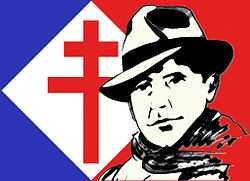
Pierre Brossolette
View on Wikipedia | This article includes a list of general references, but it lacks sufficient corresponding inline citations. (February 2023) |
Pierre Brossolette (French: [pjɛʁ bʁɔsɔlɛt]; 25 June 1903 – 22 March 1944) was a French journalist, politician and major hero of the French Resistance in World War II.
Key Information


Brossolette ran a Resistance intelligence hub from a Parisian bookshop on the Rue de la Pompe, before serving as a liaison officer in London, where he also was a radio anchor for the BBC, and carried out three clandestine missions in France. Arrested in Brittany as he was trying to reach the UK on a mission back from France alongside Émile Bollaert, Brossolette was taken into custody by the Sicherheitsdienst (the security service of the SS). He committed suicide by jumping out of a window at their headquarters on 84 Avenue Foch in Paris as he feared he would reveal the lengths of French Resistance networks under torture; he died of his wounds later that day at Pitié-Salpêtrière Hospital.
On 27 May 2015, his ashes were transferred to the Panthéon with national honours at the request of President François Hollande, alongside politician Jean Zay and fellow Resistance members Germaine Tillion and Geneviève de Gaulle-Anthonioz.
Biography
[edit]Education and journalism
[edit]Pierre Brossolette was born in the 16th arrondissement of Paris to a family deeply involved in the fights for laic schools in early 20th century France. His father was Léon Brossolette, General Inspector for Primary Education; his mother Jeanne Vial was the daughter of Francisque Vial, Director of Secondary Education, responsible for making secondary education free in France.
Brossolette ranked first at the entrance examination to the prestigious École Normale Supérieure; throughout his education held the title of "cacique" which was internally attributed to the most brilliant student, ahead of intellectuals such as philosopher Vladimir Jankélévitch and two years before Jean-Paul Sartre and Raymond Aron. In 1925 he graduated second to Georges Bidault after a small scandal on the dissertation themes for the final examination. His passion for history had led him to choose this "agrégation" instead of the more usual and prestigious philosophy one. During this time and while he was in his military service, he married Gilberte Bruel and had two children, Anne and Claude.
Instead of pursuing an academic career like most normaliens, he longed for action and decided to enter journalism and politics. He joined the Section française de l'Internationale ouvrière (SFIO), the main socialist party, in 1929, adhered to the LDH and LICA league and entered freemasonry. He worked as a journalist for Notre Temps, L'Europe Nouvelle, the party newspaper Le Populaire and the state-owned Radio PTT but was fired when he violently opposed the Munich Agreement on air in 1939. In his newspaper columns, Brossolette had evolved from a resolute pacifist and europeanist, after Aristide Briand's ideals, to a denunciator of both fascism and communism.
Resistance activities
[edit]When World War II broke out, he joined the army as a lieutenant of the 5th régiment d'infanterie; before the fall of France, he reached the rank of captain receiving two citations for the French War Cross for having retreated his battalion in an orderly way. After the Armistice, when the Vichy regime forbade him to teach, Brossolette and his wife took over a bookstore specialised in Russian literature at the Rue de la Pompe near Lycée Janson-de-Sailly, where he had attended high school. The bookstore became an intelligence hub of Parisian resistance where documents, such as Renault factory plans used for its bombing, were exchanged unnoticed, thanks to the extensive library available underground.
He was a popular voice on the radio before the war and his chronicles on Hitler's rise led to being blacklisted early in the 1930s by the Nazis. It did not take long before he was approached by his friend Agnès Humbert and introduced to Jean Cassou and the Groupe du musée de l'Homme, the very first resistance network. He just had time to produce the last issue of the newsletter Résistance before narrowly escaping its dismantlement.


By then assuming a pivotal role in the ZO (Zone Occupée) Resistance, Brossolette coordinated contacts between groups such as Libération-Nord from Christian Pineau, the Organisation Civile et Militaire (OCM) and Comité d'Action Socialiste (CAS). He finally obtained a liaison with London and General Charles de Gaulle when he was hired by conservative Gilbert Renault also known as Colonel Rémy as press and propaganda manager of Confrérie Notre-Dame (CND), by then the most important network in Northern France.
In April 1942, Brossolette met De Gaulle in London as representative of the ZO Resistance and was hired to work on bringing political credibility to De Gaulle to back his recognition as the only Free French Forces leader by the Allies in his feud against Henri Giraud in Algiers. At the same time, he was promoted to major (commandant) and awarded Compagnon de la Libération.
Brossolette created the civilian arm of the BCRAM intelligence service, which became the Bureau Central de Renseignements et d'Action (BCRA), in liaison with the RF section of the British side, Special Operations Executive (SOE). Strong ties of camaraderie were forged between Brossolette (codenamed Brumaire, also known as Commandant Bourgat), BCRA's chief André Dewavrin (codenamed Arquebuse, also known as Colonel Passy) and SOE's Forest Frederick Edward Yeo-Thomas (codenamed Shelley, also known as The White Rabbit). De Gaulle set up his Free French intelligence system to combine both military and political roles, including covert operations. The policy was reversed in 1943 by Emmanuel d'Astier de La Vigerie (1900–1969), the Interior Minister, who insisted on civilian control of political intelligence.[1]

The three friends were sent on a mission to France and united, under the CCZN (Comité de Coordination de Zone Nord), the various ZO Resistance groups which had been thoroughly divided by political views, including the communist-led Front National (mission Arquebuse-Brumaire); they were thus instrumental in the merging with the ZL (Zone Libre) Resistance similarly united by Jean Moulin under the MUR. This led to the creation of the Conseil National de la Résistance (CNR) by Moulin through the addition of the political parties and unions and ultimately to De Gaulle's unequivocal recognition as Free France's political representative to the Allies.
During this time, Pierre Brossolette resumed his radio chronicles on BBC with high-profile speeches to the "army of shadows", replacing Maurice Schumann as anchor (38 times). In a speech at the Albert Hall on 18 June 1943, he famously praised the soutiers de la gloire (or "stokers of glory") in a reference to the fallen anonymous soldiers and resistants. Brossolette also resumed his newspaper work through a series of articles on France's situation, including one in La Marseillaise considered by many to be the doctrinal founding of the Gaullisme de guerre movement.
Politics
[edit]In addition to journalism, Pierre Brossolette was also a politician. He was a protégé of Léon Blum and was considered an up-and-coming star of the SFIO party, running elections on his Troyes (Champagne) base. He assumed cabinet functions during the Popular Front government and as a political pundit on official Radio PTT he was considered the de facto foreign policy spokesman of the socialist government. Already calling for deep rejuvenation of the political class before the war, he attributed French defeat in 1940 to the corrupt political system of the Third Republic.
As he politically structured the Parisian resistance, Brossolette succeeded in convincing the network leaders to create a temporary Resistance Party under De Gaulle's leadership after the war, focused on promoting ambitious social transformations while avoiding the predictable enmity and chaos of post-Liberation times. This political and social plan, including nationalisations and price controls, inspired the March 1944 Conseil national de la Résistance programme and was implemented after war.
Brossolette's criticism of the old parliamentarian system, together with the role of communist networks inside the CNR, became the main point of disagreement with his southern counterpart Jean Moulin. His desire to disband all the old parties through a complete reshuffle of ideological lines logically brought him into conflict with the party leaders. As a result, he was excluded from the newly reconstituted SFIO party by Daniel Mayer and Gaston Defferre a few days before being arrested,[2] although the decision to remove him from the party was never enforced and was actually forgotten.
Despite this, most of his ideas were implemented in 1958 when De Gaulle established the Fifth Republic and established a presidentialist system based around his Rally of the French People (RPF) party. However, De Gaulle was pushed in the short term to decide in favour of Jean Moulin's proposal as he still struggled to show the Allies (Americans in particular) that he was not a dictator. Brossolette's ideas of a Resistance party raised many opponents' fears of a "bonapartian" drift, especially among fellow socialists in London including Pierre Cot and Raymond Aron. This seemed to be confirmed to his detractors' eyes when Brossolette succeeded a bold blow against the Vichy regime by exfiltrating from France Charles Vallin, deputy leader of conservative French Social Party (PSF) that had surged as the main French party with over 30% at pre-war elections, but deemed proto-fascist by the left. Hence the French Fourth Republic eventually reverted to the Third Republic's pre-war parliamentarist system.
During his last missions, Brossolette worked on creating a new party that could be the major force of the left. He was inspired by the British Labour Party, using a non-Marxist or, at least, reformist approach (thus effectively challenging the French Socialist Party). For that, he spent his last days writing an ambitious critique of Marx's political philosophy as a by-product of 18th-century rationalism that would provide the theoretical framework for this party. Unfortunately, at the time of his arrest the manuscripts were thrown overboard at sea over Brittany shores.[3]
Arrest
[edit]Brossolette returned to Paris for a third mission to reorganise the Parisian resistance which was in disarray after successive Gestapo raids, especially by CND's dismantling.
By then, his role and importance was already well known to the SS Intelligence Services after Moulin's death and despite De Gaulle's clear reluctance to appoint him as substitute CNR chief. He escaped arrest many times and was summoned to return to Britain by late 1943 to introduce the newly appointed CNR chief, Émile Bollaert, to De Gaulle. The bad winter weather cancelled many Lysander exfiltration attempts (conducted only under moonlight) or Lysanders would be shot down as in a December attempt near Laon, so in February 1944, they decided to return by boat from Brittany. However, the vessel, hit by a storm, shipwrecked at Pointe du Raz. They managed to reach the coast and to be hidden by local Resistance, but were betrayed by a local woman at a checkpoint.
Bollaert and Brossolette were not identified and were kept imprisoned in Rennes for weeks. F. F. E. Yeo-Thomas, when informed of Brossolette's capture, decided to be immediately parachuted onto the continent and organise his escape. Nevertheless, they were recognised before the planned action and taken to the Intelligence Services (Sicherheitsdienst) headquarters on Avenue Foch by senior SD officer Ernst Misselwitz in person on 19 March. It was recently confirmed that he was identified by a semi-coded report to London from CNR's Claude Bouchinet-Serreules and Jacques Bingen written by the services of Daniel Cordier intercepted at the Pyrenees, tragically self-fulfilling the severe criticism of Brossolette and Yeo-Thomas about the lack of prudence inside the Parisian Délégation générale. Yeo-Thomas himself would be captured as he prepared a bold escape from Rennes Prison wearing German uniforms with the help of Brigitte Friang. Both Yeo-Thomas and Friang were captured before planned action as many Parisian networks were dismantled following the so-called "Rue de la Pompe affair" (after the location of the Delegation générale) and Pierre Manuel's avows.[4]
Torture and death
[edit]
Brossolette was tortured at 84 Avenue Foch in Paris, enduring severe beatings and waterboardings over a two-and-a-half-day period. On 22 March, while he was left alone and recovered some consciousness, he threw himself through the window of the garret room of the building's sixth floor.[5] Since he had not swallowed his cyanide capsule when captured in Rennes, he was afraid of implicating others and probably chose to silence himself. There was a widespread belief among resistants that it was difficult, if not impossible, not to speak under torture.
He died later in the evening at Pitié-Salpêtrière Hospital. On 24 March, he was cremated at Père Lachaise Cemetery. His ashes were kept at Père Lachaise Cemetery's columbarium, urn 3913 according to official cemetery records.[5] Brossolette's reportedly last words were enigmatic: "all will be fine Tuesday".
Posterity
[edit]
From after the war until the late 1950s, Brossolette was considered the main leader of the French Resistance, though many were claimed heroes by their political family (such as Honoré d'Estienne d'Orves by royalists and Gabriel Péri by communists). Brossolette's fame was helped by his media notoriety before the war on Radio-PTT and on wartime BBC emissions, his networking role that made his name or codename known and remembered over almost every Resistance member in northern France and by flattering early accounts of BCRA's chief Passy in his memoirs although he had also created, through his independent position and sarcastic wit, many enemies among party leaders, Gaullists, communists and even socialists that survived him.[6][4]
De Gaulle himself thought otherwise and as he started writing his memoirs in 1954 and later assumed power, he attributed the main leading role to his by-then relatively unknown representative Jean Moulin rather than field leaders as De Gaulle emphasized the top-down unification that objectively allowed him to be recognized by the Allies. This was formalized in 1964 by the transfer of Moulin's ashes to the Panthéon, and backed by an emotional speech by André Malraux.[7]
With time, Brossolette was relegated to a second place and became the hero of his party SFIO while Moulin came to symbolize the myth of the French Resistance unity while the country struggled with the Algerian war and as De Gaulle tried to avoid civil war calling for union while noticing the growing popular clout of the Resistance legend on the postwar imagination.[8]
Later, Brossolette's memory suffered another blow when the 1981-elected socialist president François Mitterrand chose to honour Moulin at a Panthéon investiture ceremony instead of rehabilitating Brossolette's role. This further enhanced his relegation – even inside the socialist political family, as evidenced by the modest celebrations of his birth centenary in 2003 and the SFIO/PS centenary.[9] At the time, a senior party official Harlem Désir (currently secretary-general of the PS) anecdotally told that the most important figure of the party's century was Jean Moulin – who actually never was a party member and deemed instead close to the Radical Party.
Since then, he has been fairly better remembered than heroes such as Bingen, Jean Cavaillès or Berty Albrecht[10] or important leaders such as Henri Frenay, but overall eclipsed by Moulin's popularity.
More recently in 2013, a support committee presided by historian Mona Ozouf was set up to bid for the transfer of Pierre Brossolette's ashes to the Panthéon, backed by an internet petition at the committee's site. On 21 February 2014, France's President François Hollande announced the transfer of Pierre Brossolette's ashes to the Panthéon with 3 other resistants Geneviève de Gaulle-Anthonioz and Germaine Tillion, as well as a former pre-war Minister Jean Zay. Brossolette's ashes were kept at the columbarium of Père Lachaise Cemetery (urns 3902 or 3913) until his entrance to the Panthéon, which was celebrated on 27 May 2015.
Homages
[edit]In France today, Brossolette's name is better known than the man himself or his life achievements, thanks to the great number of streets – nearly 500 out of which 127 in Greater Paris, schools and public facilities bearing it (see below). His widow Gilberte was prominent in relaying his political ideas. In the 1950s, she was the first woman to enter – and, as vice-president, occasionally preside over – the French Senate.
In Paris, a small street in the Quartier Latin between Rue Érasme and Rue Calvin, near École Normale Supérieure, was christened Rue Pierre-Brossolette in 1944 as among the very few celebrating a 20th-century person, together with Pierre and Marie Curie.[11] A notable exception is Lyon, probably illustrating the rivalries between the two Zones as conversely no street in Paris had been christened after Jean Moulin until 1965.
Buildings in Paris such as the former bookstore and nearby Lycée Janson de Sailly's court at Rue de la Pompe, the residence at Rue de Grenelle, his birthplace at rue Michel-Ange, the Maison de Radio France and the Ministry of the Interior's court at Rue des Saussaies all feature commemorative plaques and his name is mentioned on a floor plaque at the Panthéon.
In Narbonne plage, a unique aeolian memorial attests to his popularity in the early postwar years and marks the place of his exfiltration by felucca Seadog.[12] In Saint-Saëns, a stele commemorates the first Lysander exfiltration to London[13] and nearby Plogoff another marks the failed Brittany exfiltration attempt.
Brossolette was also featured in the first series of Heroes of the Resistance by French PTT in 1957. The Saint-Cyr Military Academy ROTC Class of 2004 was christened after Brossolette, and a class song was created for the occasion.[14] The masonic Grande Loge de France named its cultural circle after Condorcet-Brossolette.
Brossolette will appear in the forthcoming novel, The Resistance Knitting Club, by Jenny O'Brien. Storm Publishing
Military honours
[edit]
|
.PNG)
|

|
_-_ribbon_bar.png)
|

|
- First Croix de Guerre 1939–1945 with bronze star (1940).
- Compagnon de la Libération, by decree of October 17, 1942, and named member of Ordre de la Libération Council.
- Croix de guerre 1939–1945 with silver-gilt palm (1943)
- Médaille de la Résistance with rosette.
- Knight of Légion d'honneur.
Operations and missions
[edit]- 27 April 1942, Saint-Saëns (near Rouen), first exfiltration
- 3 June 1942, Chalon-sur-Saône, blind dropping (single)
- Operation Leda, 5 September 1942, Narbonne, second exfiltration, felucca Seadog
- Operation Atala, 26 January 1943, Le Grand-Malleray (near Bourges), dropping (single)
- Mission Arquebuse-Brumaire, Jan–April 1943
- Operation Liberté/Juliette, 15 April 1943, third exfiltration, Lysander (with André Dewavrin and F. F. E. Yeo-Thomas)
- Trip to Algiers, 13 August – 3 September 1943
- Operation Bomb, 18 September 1943, Angoulême, Lysander (with F. F. E. Yeo-Thomas)
- Mission Marie-Claire, Sept–Feb 1944
- Operation Sten, 10 December 1944, near Laon, cancelled (Lysander shot down)
See also
[edit]

Notes
[edit]- ^ The then-deserted beach was a popular spot for embarkment to London via Gibraltar. The pipes have been muted after neighbourhood protests as it developed, postwar, into a popular balneary area.
References
[edit]- ^ Laurent, Sébastien (2000). "The free French secret services: Intelligence and the politics of republican legitimacy". Intelligence and National Security. 15 (4): 19–41. doi:10.1080/02684520008432626. ISSN 0268-4527. S2CID 154219996.
- ^ "Témoignage de Gaston Defferre" (in French). Retrieved 2008-09-02.
- ^ "Pierre Brossolette" (in French). Retrieved 2008-01-19.
- ^ a b Seaman, 1997
- ^ a b "Résistants, Personnalités liées à la Résistance. Pierre Brossolette. Une figure exemplaire de la Résistance Française" [Resistant, Personalities linked to the Resistance. Pierre Brossolette. An exemplary figure of the French Resistance] (in French). Mémoire Vive de la Résistance.
- ^ Roussel, 2011
- ^ Piketty, 1998
- ^ Douzou, 2005
- ^ "Centenaire du Parti socialiste – Pierre Brossolette" (in French). Centenaire du Parti socialiste – Pierre Brossolette. Archived from the original on 2011-07-19.
- ^ "Autour de Jean Moulin : Histoire et Mémoire" (in French). Archived from the original on 2007-10-19. Retrieved 2008-01-17.
- ^ "Noms de martyrs donnés au rues de Paris (Video – 1944 – source INA)" (in French). Retrieved 2009-09-25.
- ^ "Seawolf & Seadog". Archived from the original on 2008-08-20. Retrieved 2009-09-26.
- ^ "Inauguration d'une stèle à la memoire de Pierre Brossolette à Saint Saëns (Video – 1975 – source INA)" (in French). Retrieved 2009-09-25.
- ^ "Chant de promotion – IVe Bataillon – Saint-Cyr – Promotion Pierre Brossolette – 2003/2004" (in French). Archived from the original on 2009-09-13. Retrieved 2009-09-25.
Sources
[edit]- René Ozouf, Pierre Brossolette, héros de la résistance, librairie Gedalge, 1946.
- Colonel Passy, Souvenirs – Tome 1 : 2e bureau, Londres (1940–1941), Raoul Solar, 1947 – Tome 2 : 10, Duke Street, Londres (le B.C.R.A), Raoul Solar, 1951 – Tome 3 : Missions secrètes en France (novembre 1942-juin 1943), Plon, 1951; republished Mémoires du chef des services secrets de la France libre, Odile Jacob, 2000
- Bruce Marshall, The White Rabbit, Evans Bros., 1952 ; Greenwood Press, 1987; Cassel Military Paperbacks, 2000.
- Agnès Humbert, Notre guerre: souvenirs de résistance, éd. Émile Paul, 1946; republished éd. Tallandier, 2004; Memoirs of Occupied France (tr. Barbara Mellor), London, Bloomsbury Publishing PLC, 2008
- Charles de Gaulle, Mémoires de guerre, éd. Plon, Paris, 1954 ; republished éd.Pocket, 1999, 2007
- Gilberte Brossolette, Il s'appelait Pierre Brossolette, éd. Albin Michel, 1976
- Guy Perrier, Pierre Brossolette, le visionnaire de la Résistance, éd. Hachette littératures, 1997
- Mark Seaman, Bravest of the Brave, Isis LP Books, 1997
- Guillaume Piketty, Pierre Brossolette, un héros de la Résistance, éd. Odile Jacob, 1998
- Pierre Brossolette, Résistance (1927–1943), éd. Odile Jacob, 1998 (assembled by Guillaume Piketty)
- Guillaume Piketty, Daniel Cordier, Alain Finkielkraut, Pierre Brossolette ou le destin d'un héros, éd. du Tricorne, 2000
- Julian Jackson – France – The dark years, 1940–1944, Oxford University Press, 2001
- Guillaume Piketty, Pierre Brossolette, le rude parcours d'une mémoire, Les Chemins de la Mémoire, n° 128, mai 2003
- Laurent Douzou, La résistance française, une histoire périlleuse. éd. du Seuil, 2005
- Éric Roussel, Pierre Brossolette, éd. Fayard, 2011
- Sébastien Albertelli, Les Services secrets du général de Gaulle, le BCRA 1940–1944, Perrin, 2009
External links
[edit] Media related to Pierre Brossolette at Wikimedia Commons
- Pierre Brossolette's biography on the Ordre de la Libération site Archived 2011-05-16 at the Wayback Machine (in French)
- Pierre Brossolette site with his speeches and articles (in French)

| International | |
|---|---|
| National | |
| People | |
| Other | |


Pierre Brossolette
View on GrokipediaEarly Life and Education
Family Background and Childhood
Pierre Brossolette was born on 25 June 1903 in the 16th arrondissement of Paris into a staunchly republican and anticlerical family that exemplified social ascent through public education over three generations.[7] His father, Léon Brossolette, worked as an inspector of primary education in Paris and authored history manuals promoting republican values, such as his 1909 Histoire de France, which faced bans from Catholic authorities due to its secular emphasis.[7] The family's commitment to laïcité aligned with early 20th-century struggles for secular schooling, rooted in a radical political tradition.[1][8] Brossolette was the third child of Léon and his wife, Jeanne Vial, who hailed from an educational lineage as the daughter of an instituteur who later became a primary school inspector; she died in 1914 when Brossolette was 11 years old.[7] His sisters, Suzanne and Marianne, both earned the agrégation—a rare distinction for women during that era—further underscoring the household's intellectual rigor and focus on academic achievement.[8] An uncle, Francisque Vial, served as director of secondary education at the Ministry of Public Instruction, reinforcing the clan's ties to state educational institutions.[7][8] The family's origins traced back to a grandfather, François-Polycarpe Brossolette, a farmer, highlighting a progression from rural agrarian life to urban professional service dedicated to republican ideals and secular reform.[7] This environment, steeped in debates over education and politics, shaped Brossolette's early exposure to progressive values amid the Third Republic's cultural battles against clerical influence.[7]Formal Education and Intellectual Formation
Brossolette completed his secondary education at the Lycée Janson-de-Sailly in Paris, achieving notable success by earning the prix d’excellence along with eight first prizes and two second prizes in 1918 during his seconde year.[9] After obtaining his baccalauréat, he entered the hypokhâgne preparatory class at the Lycée Louis-le-Grand in autumn 1920, focusing on humanities to prepare for the competitive entrance examination to the École Normale Supérieure (ENS).[10] In 1922, Brossolette ranked first in the ENS entrance concours, securing admission as the major of his cohort—a distinction conferring the title of cacique.[10] At ENS (rue d’Ulm), he pursued studies in the Section A curriculum, emphasizing history, and in June 1924 submitted a mémoire titled “Washington et les relations des États-Unis avec l’Europe,” earning scores of 18/20 on two evaluations, alongside solid marks in related subjects such as 7/10 in history and 8/10 in climatology and constitutional analysis.[9] Brossolette obtained the agrégation in history in 1925, placing second nationally behind Georges Bidault, which certified his qualification as a secondary-school professor.[10] This elite trajectory at preparatory lycées and ENS fostered a disciplined analytical mindset attuned to historical and international themes, evident in his early scholarly work on transatlantic relations, though he ultimately diverged from academic teaching toward journalism.[9][10]Journalistic Career
Entry into Journalism and Early Work
Following his agrégation in history in 1925, Brossolette opted for a career in journalism rather than academia or teaching, drawn to the press as a means to engage with contemporary political debates.[3] He began contributing to L'Europe Nouvelle, a weekly review focused on international affairs edited by Louis Eisenmann, where he analyzed European diplomacy and foreign policy.[1] This marked his initial foray into specialized reporting on global tensions, reflecting his emerging expertise in relations between France, Germany, and the League of Nations.[4] By the late 1920s, Brossolette expanded his contributions to Notre Temps, a pacifist-leaning publication directed by Jean Luchaire, where he penned articles critiquing post-World War I pessimism and advocating for collective security mechanisms.[11] One early piece, published on May 15, 1930, titled "Le pessimisme de notre temps," examined societal disillusionment amid economic instability and unresolved reparations disputes.[11] His work there emphasized diplomatic solutions over militarism, aligning with the era's appeasement sentiments, though his growing alarm over Nazi Germany's rise led to a rupture with Notre Temps in July 1934.[3] Brossolette's early assignments also included stints at outlets like Le Quotidien, Progrès Civique, and Excelsior, broadening his coverage to domestic implications of international events.[1] These roles honed his reputation as a clear, analytical writer on foreign policy, often drawing on historical parallels to warn against isolationism, though his pieces remained grounded in empirical assessments of treaties and alliances rather than ideological fervor.[4] By the early 1930s, he had established himself as a regular commentator, prioritizing factual reporting on geopolitical shifts over partisan advocacy.[3]Evolution of Views: From Pacifism to Anti-Totalitarianism
In the interwar period, Brossolette initially embraced pacifism as a journalist, influenced by the horrors of World War I and the ideals of disarmament and Franco-German reconciliation promoted by Aristide Briand.[5] Writing for outlets such as L'Europe nouvelle and socialist publications, he advocated international cooperation through the League of Nations and criticized militarism, viewing war as a preventable catastrophe rooted in nationalism rather than inevitable aggression.[5] This stance aligned with his early socialist commitments, where he saw pacifism as essential to preventing the "bestial massacre" of 1914-1918 from recurring, as expressed in articles like "Le pessimisme de notre temps" published in Notre Temps on May 15, 1930.[5] The rise of Adolf Hitler marked the onset of Brossolette's ideological shift, beginning around 1933-1934 with Germany's withdrawal from the League of Nations and rearmament.[5] By November 6, 1937, in "La montée des périls" for L'Europe nouvelle, he warned of escalating threats from Nazi expansionism, breaking from absolute pacifism by urging vigilance against totalitarian regimes that violated international norms.[5] Events such as the remilitarization of the Rhineland in 1936, the Spanish Civil War (1936-1939), the Anschluss in March 1938, and the Munich Agreement in September 1938 accelerated this evolution, convincing him that appeasement enabled fascist aggression rather than preserving peace.[5] Brossolette's opposition to the Munich Agreement crystallized his rejection of "bleating pacifism," as he later termed naive concessions to dictators.[12] In October 1938 columns for Le Populaire, the SFIO's organ where he served as a foreign policy editorialist, he described the accords as "a joy: peace; a pain: capitulation," arguing they sacrificed Czechoslovakia to buy illusory security while emboldening Hitler.[5] His public criticism extended to a January 1939 Radio-PTT broadcast denouncing Munich's failures, resulting in his dismissal for undermining government policy.[13] By spring 1939, amid the Prague crisis and Nazi demands, Brossolette fully advocated military preparedness and an Anglo-Franco-Soviet alliance to counter the Axis powers, framing totalitarianism—exemplified by Nazism's ideological fanaticism and territorial conquests—as an existential threat requiring resolute defense over accommodation.[5] This transition reflected a broader realist assessment: pacifism, once a bulwark against war, had become complicit in enabling totalitarian expansion when confronted with irredentist ideologies indifferent to diplomacy.[5] Brossolette's writings emphasized causal links between unchecked aggression and democratic erosion, prioritizing empirical evidence of Nazi violations—such as the post-Munich occupation of Bohemia-Moravia in March 1939—over idealistic disarmament.[5] His anti-totalitarian outlook prefigured wartime resistance, viewing armed opposition not as militarism but as necessary to dismantle regimes that subordinated individuals to state ideology.[5]Pre-War Political Engagement
Affiliation with the SFIO and Socialist Activities
Brossolette adhered to the Section Française de l'Internationale Ouvrière (SFIO) in 1929, marking his formal entry into organized socialist politics after earlier sympathies with radical circles.[14][8] His initial engagement reflected a blend of pacifism and European federalism, though these views evolved amid rising totalitarian threats in Europe.[8] As a journalist, Brossolette contributed to Le Populaire, the SFIO's official organ, where he handled foreign policy reporting and advocated for socialist positions on international affairs.[15] From late 1935 to late 1937, he aligned with the Bataille socialiste tendency led by Jean Zyromski, supporting intensified anti-fascist mobilization, sanctions against Italy for its invasion of Ethiopia, and a stronger Popular Front alliance while critiquing perceived SFIO hesitations on collective security.[7][5] This faction emphasized revolutionary action over gradualism, though Brossolette maintained respect for party leader Léon Blum.[16] In organizational roles, Brossolette served as secretary of the SFIO's Aube departmental federation starting June 2, 1935, directing it until 1939 despite electoral setbacks.[7] He ran as a candidate in the 1936 legislative elections for the second constituency of Troyes but placed behind competitors, failing to secure a seat.[7] His activities promoted the Rassemblement Populaire's anti-fascist platform, including support for republican defense policies as tensions with Nazi Germany escalated.[7][17]Critiques of Parliamentarism and Ideological Shifts
Brossolette's affiliation with the SFIO did not preclude sharp critiques of the Third Republic's parliamentary system, which he viewed as structurally flawed and conducive to governmental instability. He contended that the practices rooted in the 1875 constitutional laws emphasized multiparty fragmentation over decisive action, rendering the regime "organized for impotence" (parlementarisme organisé pour l'impuissance) and ill-equipped to confront existential threats like Nazism.[18] This perspective aligned with socialist doctrine's inherent tension with passive legislative routines, as Brossolette noted in analyses of public sentiment, where socialism's activist ethos clashed with the incrementalism of post-1875 parliamentarism.[19] His writings highlighted how such a system perpetuated elite divisions and weakened national resolve, contributing to France's diplomatic hesitancy in the 1930s.[20] These critiques intensified amid the SFIO's internal debates, where Brossolette advocated for a revitalized socialism that prioritized structural reforms over reliance on parliamentary maneuvering. By the mid-1930s, he distanced himself from party orthodoxy, participating in Jean Zyromski's Bataille socialiste (1935–1937), which sought to reinvigorate revolutionary commitments, and later directing the SFIO's Aube section in 1936.[5] His push for the "Agir" movement within the SFIO aimed to overhaul domestic policies and enforce firmness in foreign affairs, reflecting a broader disillusionment with the party's accommodation of republican inertia.[5] This stance provoked backlash; SFIO leaders moved to exclude him for challenging the regime of parties and unchecked parliamentarism, perceiving his lucidity as subversive to electoral pragmatism.[20] Ideologically, Brossolette underwent a marked evolution from early pacifism to militant anti-totalitarianism, driven by empirical assessments of fascist aggression. Initially influenced by Aristide Briand's reconciliation efforts, he promoted Franco-German détente and disarmament through the 1920s, contributing to pacifist journalism via outlets like L'Europe nouvelle.[5] A pivotal break occurred around 1934, when he rejected collaboration with figures like Jean Luchaire amid Hitler's consolidation of power. By November 1937, in "La montée des périls," he warned of escalating dangers, and his first Populaire article on December 4, 1938, explicitly opposed appeasement.[5] This culminated in vehement rejection of the Munich Agreement on September 30, 1938, favoring an Anglo-Franco-Soviet alliance and preparedness for war by spring 1939, marking a realist pivot from idealistic peace advocacy to causal recognition of military necessity against ideological foes.[5]World War II and Resistance Involvement
Initial Resistance Efforts in Occupied France
In the aftermath of France's capitulation in June 1940, Pierre Brossolette, a former journalist and socialist activist, refused offers to contribute to Vichy-controlled or collaborationist media, opting instead for clandestine opposition to the occupation. By early 1941, he established contact with the nascent resistance network centered at the Musée de l'Homme in Paris, introduced through Agnès Humbert, and formally joined in March. This group, comprising intellectuals and civil servants, produced one of the first underground publications, the bulletin Résistance, for which Brossolette served as editor-in-chief, disseminating anti-Nazi and anti-Vichy propaganda.[1][21][22] The Musée de l'Homme network faced severe setbacks with Gestapo arrests beginning in January 1941, leading to its partial dismantlement by mid-year. Undeterred, Brossolette transitioned in November 1941 to the Confrérie Notre-Dame (CND) organization under Colonel Rémy, adopting the pseudonym "Pedro" and assuming leadership of its press and propaganda efforts. On December 1, 1941, he formalized his commitment by signing an engagement with the Free French Forces, enabling structured intelligence transmission to London via radio broadcasts.[1][22][21] Throughout late 1941 and into early 1942, Brossolette focused on forging links between disparate resistance factions and the Free French in exile, establishing communications channels for key northern zone movements such as Libération-Nord and the Organisation Civile et Militaire (OCM). He compiled and forwarded detailed reports on public sentiment, political developments, and emerging resistance structures, while coordinating with southern groups like Combat and Libération-Sud. These efforts, conducted from Paris amid heightened risks, laid groundwork for broader unification before his departure for London on April 27, 1942, via a covert Lysander flight from near Rouen.[21][1]Missions, Operations, and Coordination with Allies
In April 1942, Pierre Brossolette traveled to London as a representative of resistance movements in the German-occupied zone of France, meeting General Charles de Gaulle to bolster the political legitimacy of Free France among internal groups.[4] Arriving via Lysander aircraft on the night of 27–28 April, he integrated into the Bureau Central de Renseignements et d'Action (BCRA), de Gaulle's intelligence service, where he collaborated with British intelligence to align French resistance operations with Allied objectives, including intelligence exchange and network unification.[3] Brossolette's first clandestine mission commenced with a parachute insertion near Chalon-sur-Saône on 3–4 June 1942 in a blind drop, aimed at reinforcing Free France's influence by rallying independent resistance organizations and facilitating exfiltrations to London.[4] [3] From June to 13 September 1942, he worked to link groups such as Libération-Nord and the Organisation Civile et Militaire (OCM) with de Gaulle's apparatus, coordinating early intelligence reports and political messaging via BBC broadcasts to synchronize morale-boosting signals with resistance actions.[3] This operation enhanced operational ties with British Special Operations Executive (SOE) channels for supply drops and evasion routes. His second mission, from 27 January to 15 April 1943, involved parachuting into the Paris region alongside BCRA chief Colonel Passy (André Dewavrin) to establish a permanent intelligence hub in occupied France.[23] [3] Brossolette coordinated political, paramilitary, and espionage efforts across the northern zone's major movements, unifying five principal networks under Free French direction while relaying critical data on German dispositions to Allied planners in London, thereby integrating French sabotage and reconnaissance with broader invasion preparations.[23] [3] The third mission, launched on 18 September 1943 as part of Operation BOMB/SERIN/MARIE-CLAIRE, saw Brossolette drop into France with SOE officer Tommy Yeo-Thomas and agent André Déglise-Favre to rebuild civil and armed resistance structures shattered by Gestapo arrests following Jean Moulin's capture.[3] This joint Free French–British effort focused on reestablishing communication lines, securing landing zones for supplies, and harmonizing guerrilla operations with SOE directives, ensuring resistance activities supported Allied strategic timelines through shared intelligence on Vichy and German vulnerabilities. Brossolette's role emphasized deconflicting Gaullist priorities with British special operations, fostering interoperability in evasion networks and targeted disruptions until disruptions led to his arrest in February 1944.[3]