Hubbry Logo
Procuring (prostitution)Procuring (prostitution)Main
Open search
Procuring (prostitution)
Community hub
Procuring (prostitution)
logo
8 pages, 0 posts
0 subscribers
Be the first to start a discussion here.
Procuring (prostitution)
from Wikipedia
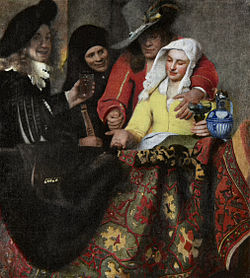
The Procuress by Jan Vermeer

Procuring, pimping, or pandering is the facilitation or provision of a prostitute or other sex worker in the arrangement of a sex act with a customer.[1] A procurer, often called a pimp if male, or a madam if female, (though the term "pimp" is often used for female procurers as well) or a brothel keeper, is an agent for prostitutes who collects part of their earnings. The procurer may receive this money in return for advertising services, physical protection, or for providing and possibly monopolizing a location where the prostitute may solicit clients. Like prostitution, the legality of certain actions of a madam or a pimp vary from one region to the next.

Examples of procuring include:

  • Helping to support trafficking a person into a country for the purpose of soliciting sex
  • Operating a business where prostitution occurs
  • Transporting a prostitute to the location of their arrangement
  • Deriving financial gain from the prostitution of another

Etymology

[edit]
Pandarus, centre, with Cressida, illustration by Thomas Kirk to Troilus and Cressida

Procurer

[edit]

The term procurer derives from the French procureur.

Pimping

[edit]

The word pimp first appeared in English in 1600, in Ben Jonson’s play Every Man out of his Humor.[2] It is of unknown origin, though there are several hypotheses about its etymology.[2] Pimp used as a verb, meaning to act as a pimp, first appeared around 1640 in Philip Massinger's play, The Bashful Lover.[3] In the 18th and 19th centuries, the term was commonly used to refer to informers.[4] A pimp can also mean "a despicable person".[5]

Rapper Nelly tried to redefine the word "pimp" by saying that it is an acronym for "positive, intellectual, motivated person". He created a college scholarship with the name "P.I.M.P. Juice Scholarship". Dawn Turner Trice of the Chicago Tribune argues that there is "something truly unsettling, to say the least, about attaching such a vile word to a scholarship" and expresses concern about the glamorization of the term.[6]

In the first years of the 21st century, a new meaning of the word emerged in the form of a transitive verb pimp, which means "to decorate" or "to gussy up". Compare primp, especially in Scottish usage. This new definition was made popular by Pimp My Ride, an MTV television show.[7] Although this new definition paid homage to hip-hop culture and its connection to street culture, it has now entered common, even mainstream commercial, use.[8]

In medical contexts, the verb means "to ask (a student) a question for the purpose of testing her or his knowledge".[9]

Pandering

[edit]

The word "pander", meaning to "pimp", is derived from Pandarus, a licentious figure who facilitates the affair between the protagonists in Troilus and Criseyde, a poem by Geoffrey Chaucer.[10] Pandarus appears with a similar role in Shakespeare's interpretation of the story, Troilus and Cressida.

Overview

[edit]

Pimps and madams are diverse and varied, depending on the strata in which they work, and they enter and leave the sex industry for a variety of internal and external reasons, such as family pressure, interactions with the police, and in some cases recruitment from peer sex workers.[11][12][13]

Procuring can take abusive forms. Madams/pimps may punish clients for physical abuse or failure to pay, and enforce exclusive rights to "turf" where their prostitutes may advertise and operate with less competition.[14] In the many places where prostitution is outlawed, sex workers have decreased incentive to report abuse for fear of self-incrimination, and increased motivation to seek any physical protection from clients and law enforcement that a madam/pimp might provide.[citation needed]

The madam/pimp–prostitute relationship is often understood to be abusive and possessive, with the pimp/madam using techniques such as psychological intimidation, manipulation, starvation, rape and/or gang rape, beating, tattooing to mark the woman as "theirs", confinement, threats of violence toward the victim's family, forced drug use and the shame from these acts.[15][16][17] In some cases, a pimp will kidnap or abduct a minor and keep them in a confined space between acts of forced sexual intercourse.[18]

In the US, madams/pimps can be arrested and charged with pandering and are legally known as procurers.[19] A conviction under SORNA typically requires the procurer to be listed as a sex offender[20] This, combined with the tendency to identify pimping with African-American masculinity, may provide some of the explanation for why approximately three-fifths of all "confirmed" human traffickers in the United States are African-American men.[21] It has recently been argued that some of the extreme examples of violence cited in the article below come primarily from such stereotyping supported by Hollywood screenwriters,[22] selective and decontextualized trial transcripts, and studies that have only interviewed parties to sex commerce in institutions of rescue, prosecution, and punishment, rather than engaging rigorous study in situ.[23]

A 2018 study by researchers from the University of Montreal divided the concept of a pimp into three distinct categories: "low-profile" (primarily female), "hustlers" (predominantly male and violent, marking the common stereotype), and "abused" (even male–female split, more likely to be subjected to violence than to commit it).[24]

[edit]

Where prostitution is decriminalized or regulated, procuring may or may not be legal. Procuring regulations differ widely from place to place.

Procuring and brothels are legal in the Netherlands, Germany, Greece, New Zealand, and most of Australia and Nevada.[25]

Canada

[edit]

In Canada, there was a legal challenge to prostitution laws, which ended in the 2013 ruling of Bedford v. Canada. In 2010, Ontario Superior Court Judge Susan Himel overturned the national laws banning brothels and procuring, arguing that they violated the constitution guaranteeing "the right to life, liberty and security".[26]

In 2012, the Court of Appeal for Ontario reaffirmed the unconstitutionality of the laws.[27] The case was appealed by the Canadian government, and was under trial in the Supreme Court of Canada in June 2013.[28] Since the passing of the Protection of Communities and Exploited Persons Act in 2014, Canada has followed the Nordic model of prostitution, which makes pimping and the purchasing of sexual services illegal.[29]

United Nations

[edit]

The United Nations 1949 Convention for the Suppression of the Traffic in Persons and of the Exploitation of the Prostitution of Others requires state signatories to ban pimping and brothels, and to abolish regulation of individual prostitutes. It states:[30]

Whereas prostitution and the accompanying evil of the traffic in persons for the purpose of prostitution are incompatible with the dignity and worth of the human person and endanger the welfare of the individual, the family and the community

The convention reads:

Article 1

The Parties to the present Convention agree to punish any person who, to gratify the passions of another:

(1) Procures, entices or leads away, for purposes of prostitution, another person, even with the consent of that person;

(2) Exploits the prostitution of another person, even with the consent of that person.

Article 2

The Parties to the present Convention further agree to punish any person who:

(1) Keeps or manages, or knowingly finances or takes part in the financing of a brothel;

(2) Knowingly lets or rents a building or other place or any part thereof for the purpose of the prostitution of others.

Various UN commissions however have differing positions on the issue. For example, in 2012, a UNAIDS commission convened by Ban Ki-moon and backed by UNDP and UNAIDS, recommended the decriminalization of brothels and procuring.[31][32][33]

United States

[edit]

Attempts have been made in the US to charge pornographic-film producers with pandering under state law. The case of California v. Freeman in 1989 is one of the most prominent examples where a producer/director of pornographic films was charged with pandering under the argument that paying porn actors to perform sex on camera was a form of prostitution covered by a state anti-pandering statute. The State Supreme Court rejected this argument, finding that the California pandering statute was not intended to cover the hiring of actors who would be engaging in sexually explicit but non-obscene performances. It also stated that only in cases where the producer paid the actors for the purpose of sexually gratifying themselves or other actors, could the producer be charged with pandering under state law. This case effectively legalized pornography in the State of California.[34][35][36] In 2008, the New Hampshire Supreme Court issued a similar ruling (New Hampshire v. Theriault) which declared that producing pornography was not a form of prostitution under state law.[37]

Business and methods

[edit]
The White Slave statue by Abastenia St. Leger Eberle, location unknown

Pimping is typically operated like a business.[38] In the US, a pimp may have a bottom girl who serves as office manager, keeping the pimp apprised of law-enforcement activity and collecting money from the prostitutes.[39] Pimps recognize a hierarchy among themselves. In certain pimp strata, the least respected, or newer pimps, are the "popcorn pimps" and "wannabes". "Popcorn pimps" was a phenomenon which occurred among adolescent cocaine users of both sexes who utilized children younger than themselves to support their habits.[40]

In the US, a pimp who uses violence and intimidation to control his prostitutes is called a "guerrilla pimp". Those who use psychological trickery to deceive younger prostitutes into becoming hooked into the system are called "finesse pimps".[41] In addition, a prostitute may "bounce" from pimp to pimp without paying the "pimp moving" tax.[42]

Some pimps in the United States are also documented gang members, which causes concerns for police agencies in jurisdictions where prostitution is a significant problem.[43] Pimping rivals narcotic sales as a major source of funding for many gangs. Gangs need money to survive, and money equates to power and respect. While selling drugs may be lucrative for a gang, this activity often carries significant risk as stiff legal penalties and harsh mandatory minimum sentencing laws exist. With pimping, gang members still make money while the prostitutes themselves bear the majority of the risk.[44]

Pimping has several benefits to the gang that the pimp belongs to. These benefits include helping the gang recruit new members because the gang has women available for sex. The money brought in by prostitution allows gang members to buy cars, clothes and weapons, all of which help to recruit younger members into the gang by increasing the reputation of the gang in the local gang subculture.[44]

Violence

[edit]

Some pimp businesses have an internal structure – built around violence – for dealing with rule breakers. For example, some pimps have been known to employ a "pimp stick", which is two coat hangers wrapped together, in order to subdue unruly prostitutes.[39] Although prostitutes can move between pimps, this movement sometimes leads to violence. For example, a prostitute could be punished for merely looking at another pimp; this is considered in some pimp milieus to be "reckless eyeballing".[39] Violence can also be used on customers, for example if the customer attempts to evade payment or becomes unruly with a prostitute.

Grooming

[edit]

Some pimps employ what is known as the "Loverboy" or "Romeo pimp" method to recruit new prostitutes. This involves entrapping potential victims (usually young or vulnerable women) by first forming what appears to the victim to be a romantic relationship. After an initial period of "love bombing", the treatment of the victim then becomes abusive, and the victim is then forced into sex work by the pimp.[45][46]

Use of tattoos

[edit]

Some pimps in America tattoo prostitutes as a mark of "ownership".[47] The tattoo will often be the pimp's street name or even his likeness. The mark might be as discreet as ankle tattoo, or blatant as a neck or face tattoo or large scale font across the prostitute's lower back, thigh, chest, or buttocks.[48]

Internet effect

[edit]

Since the Internet became widely available, prostitutes increasingly use websites to solicit sexual encounters. This has bypassed the need for pimps in some contexts, while some pimps have used these sites to broker their sex workers.[49]

Criticism of portrayals

[edit]

Some scholars and sex workers' rights advocates dispute portrayals of third-party agents as violent and extremely committed to a pimp subculture, finding them inaccurate exaggerations used to foster harmful policies.[citation needed] For example, one study found that pimps tend to drift in and out of pimping, with some of their goals and identities classified as predominantly mainstream, some as predominantly outside of that mainstream, and some as a hybrid of conventional and non-conventional.[50]

[edit]

Notable pimps and madams

[edit]

In art

[edit]

Works

[edit]

In 1999, the Hughes brothers released a documentary titled American Pimp consisting of first-person interviews with people involved in pimping in the United States.

See also

[edit]

References

[edit]
[edit]
Revisions and contributorsEdit on WikipediaRead on Wikipedia
from Grokipedia
Procuring in refers to the facilitation, arrangement, or inducement of sexual acts between prostitutes and clients by a third party, often involving profit from the proceeds of such activities. This includes actions such as recruiting individuals into , managing workers, or acting as intermediaries to secure customers. Distinct from direct , procuring emphasizes the organizational role of procurers, who may exert control over workers' operations without necessarily engaging in the sexual acts themselves. Historically, procuring has been documented in various societies, with artistic depictions from 17th-century illustrating procurers negotiating encounters in social settings. In modern contexts, it is frequently associated with organized elements of the , including potential links to or trafficking, though legal definitions focus on facilitation regardless of . Empirical studies on sex work markets indicate that third-party involvement like procuring can introduce risks of exploitation due to power imbalances and profit motives, even in regulated environments. Legally, procuring remains prohibited in the majority of jurisdictions worldwide, including countries where individual is decriminalized or legalized, as statutes target the promotion or profiting from others' sexual labor to curb associated harms. For instance, , procuring offenses such as pandering carry penalties, emphasizing inducement or management over voluntary participation. Controversies surrounding procuring often center on its intersection with , where forced involvement distinguishes it from consensual arrangements, prompting ongoing debates about enforcement efficacy and unintended incentives for underground operations.

Terminology and Definitions

Etymology and Key Terms

The term "procure" originates from the Latin procurare, meaning "to take care of," "to manage," or "to see to," which entered around 1300 with general senses of obtaining or providing something desired. By circa 1600, it evolved to include the specific meaning of obtaining women for the sexual gratification of others, laying the groundwork for its application to third-party facilitation in . In this context, procuring denotes the acts of a procurer—typically a or —who arranges sexual encounters between prostitutes and clients, manages operations, and extracts earnings, thereby distinguishing the role from the direct selling of sexual services by the prostitute herself. Synonymous terms include "pimping," derived from "pimp," which first appeared in English around 1600, likely from French pimpant ("alluring" or "smartly dressed"), referring to one who procures sexual opportunities and shares in the proceeds. "Pandering" traces to the Pandare (14th century), drawn from the character Pandarus in Chaucer's —itself from Italian Pandaro and ultimately Greek origins—who served as a go-between facilitating the illicit affair between Troilus and Cressida; by the 17th century, it denoted similar intermediary roles in . Regional variants persist, such as the French maquereau (pimp), literally "," entering English slang as "mack" via New Orleans Creole influences in the . These terms underscore procuring's emphasis on managerial facilitation rather than the initial recruitment or cross-border transport central to "trafficking," a modern concept rooted in commercial "traffic" but focused on coercive movement for exploitation. Procuring, also known as pimping or pandering, refers to the act of inducing, enticing, compelling, or arranging for another person to engage in , typically for the procurer's financial benefit. This includes soliciting clients on behalf of a sex worker, providing premises for prostitution, or living off the earnings of a prostitute without direct participation in the sexual acts. Conceptually, it functions as an role that extracts value from the sex worker's labor, often through , , or control mechanisms, distinguishing it from the core exchange of sexual services for payment. In legal terms, procuring is treated as a distinct offense from prostitution itself, focusing on the facilitation or procurement of participants rather than the act of selling or buying sex. Prostitution involves the direct agreement and performance of sexual acts in exchange for compensation between the parties involved, whereas procuring introduces a third-party profiteer who derives income from organizing or overseeing such transactions. This intermediary extraction model, rooted in profit from others' exploitation, underscores procuring's role in scaling prostitution beyond individual seller-buyer interactions. Empirical evidence highlights procuring's frequent association with and , countering portrayals of it as benign management. Studies of pimp-managed sex work reveal prevalent use of coercive tactics, including psychological manipulation and economic dependency, alongside non-coercive methods in some cases. Data on entry into under procurer control indicate that a substantial proportion involves minors, with the average age of first exploitation reported as 13 in U.S.-based analyses of . This pattern persists despite self-reports from procurers minimizing physical violence, suggesting underreporting of subtler controls that target at-risk individuals.

Historical Context

Ancient and Pre-Modern Practices

In ancient , around 1750 BCE, the regulated establishments like taverns that doubled as sites of , mandating death penalties for female proprietors who harbored fugitives or conspirators without reporting them, thereby imposing accountability on those managing sex workers to prevent broader disorder. These laws underscore early codified oversight of procuring, where innkeepers or alehouse owners functioned as procurers, profiting from slave or indentured women amid power asymmetries rooted in and , rather than voluntary exchange. In , from the 6th century BCE, lawmakers like institutionalized brothels (porneia) by purchasing slave women for public use at fixed low prices, with male procurers or owners controlling their output and retaining most earnings through ownership or debt enforcement. Enslaved foreigners or war captives comprised the bulk of prostitutes, exploited in urban and temple settings where procurers maintained dominance via and economic monopoly, evidencing procuring as a slave-based enterprise prioritizing profit over worker autonomy. Ancient Rome similarly featured procurers termed lenones, who operated licensed brothels (lupanaria) stocked with slave women rented to clients, extracting revenues while enforcing compliance through and confinement, as routine in the empire's urban economy by the 1st century BCE. This model thrived on the procurer's legal ownership of human property, with historical texts like those of depicting the pandering trade as dependent relationships marked by , not mutual consent, and integrated into daily commerce despite moral critiques from elites. During medieval , from the 12th to 15th centuries, bawds—typically experienced women—recruited and supervised prostitutes in portside inns, urban bathhouses, and regulated stews, forming informal networks akin to guilds that skimmed 20-48 pence per transaction while confining workers to prevent escape or independent earnings. Ecclesiastical authorities, including , condemned such procurers for perpetuating vice, yet tolerated enclosed operations as a containment for male urges, revealing procuring's persistence as an exploitative trade leveraging familial , abduction, or to supply coerced labor in feudal power structures. In feudal , spanning dynasties like the (960–1279 CE), madams and procurers trafficked daughters or orphans into hierarchies via contracts binding them for years, controlling access to clients and fertility to maximize house profits in pleasure districts. This system, documented in administrative records, emphasized economic extraction over illusory consent, with procurers enforcing obedience through isolation and violence, mirroring global pre-modern patterns where , , and obligations underpinned the trade's viability.

Industrial Era Developments

During the , rapid in industrializing nations like the and Britain facilitated the expansion of procuring activities, as procurers exploited rural-to-urban migration patterns driven by economic displacement and poverty. In , prostitution districts proliferated from the 1820s onward, fueled by influxes of young male immigrants, sailors, and businessmen, with procurers targeting vulnerable female migrants through deception or coercion into brothels. By the mid-19th century, the city hosted over 600 brothels, many operated by organized vice networks that protected operations via alliances with corrupt politicians and police, enforcing control through debt bondage where women were trapped by fabricated debts for clothing, lodging, or travel. In Victorian England, similar dynamics emerged amid industrial growth, with social purity campaigns in the exposing widespread in urban rings, contradicting narratives of purely voluntary participation by highlighting cases of enticement and of impoverished women from rural areas. These campaigns, rooted in moral reform efforts, documented procurement tactics involving promises of employment that devolved into forced sex work, often under conditions of or economic dependency. Paris's regulated brothel system during the same period integrated procuring into capitalist vice economies, where organized rings profited from debt peonage, binding women—frequently migrants—to madams through inescapable loans, a model that prioritized profit extraction over consent. In the United States, escalating concerns over such interstate trafficking culminated in the 1910 Mann Act, enacted amid "white slavery" panics that, while sensationalized, reflected documented instances of procurers transporting coerced women across state lines for prostitution, targeting naive rural girls with false job offers. Empirical investigations, such as Dr. William Sanger's 1858 survey of New York prostitutes, revealed that a significant portion entered the trade via seduction or abandonment rather than choice, underscoring causal ties between industrial poverty and procuring's coercive mechanisms. These developments adapted procuring to urban capitalism, embedding it in migration-driven labor surpluses without evidence of equitable "entrepreneurship" for the procured. In the United States during the era (1920–1933), organized crime syndicates, including the emerging , expanded into prostitution rackets as a complement to bootlegging and operations, leveraging established networks for protection and enforcement. Figures like in controlled empires encompassing prostitution alongside alcohol distribution, using violence and police bribery to maintain dominance. After 's repeal, these groups sustained prostitution as a core revenue stream, integrating it into broader vice economies. Post-World War II, Mafia influence extended to , where syndicates from and New York controlled casino operations and associated rackets, including , from the late 1940s through the 1950s. Siegel's 1946 opening of the Flamingo Hotel, funded by mob figures like , exemplified this, with operating as an "open city" for multiple Mafia families to skim profits from gambling and ancillary sex work without territorial conflicts. In , Italian groups, such as clans affiliated with the in , reinvigorated post-war illicit enterprises, incorporating into "enterprise " models focused on sexual exploitation, , and . Declassified intelligence and reports from the era highlight how these networks scaled procuring through hierarchical control, tying it to labor and drug distribution for diversified profits. During the Cold War's later phases and into the 1990s post-Soviet collapse, waves of trafficking from —epitomized by the "Natasha trade," where women from , , and neighboring states were procured for Western European sex markets—became a lucrative extension of . Criminal networks exploited economic instability in newly independent states, using deception and coercion to traffic thousands annually, with informal groups handling cross-border movements and larger syndicates managing distribution. Estimates from U.S. Justice Department analyses pegged global profits, largely driven by these operations, at around $7 billion yearly by the mid-1990s, underscoring the sector's scalability and integration with arms smuggling and narcotics. By the , traditional street-level pimping in Western nations faced erosion from stricter anti-racketeering laws, such as the U.S. RICO Act of 1970, which targeted mob hierarchies controlling visible , alongside feminist critiques emphasizing exploitation and violence in that influenced policy shifts toward punishing procurers over workers. This contributed to a decline in overt street pimp dominance, with operations retreating into less visible "hidden economies" like massage parlors and international circuits, where maintained control through subtler and transnational logistics. Despite these pressures, procuring persisted as a foundational racket, adapting to enforcement by embedding deeper into global crime webs.

Operational Methods

Recruitment and Grooming Techniques

Procurers typically target vulnerable individuals, such as runaway youth, those experiencing , individuals struggling with substance , or recent migrants, who may lack networks or . These targets are often approached through deceptive offers of legitimate employment, such as modeling, dancing, or hospitality jobs, which serve as initial lures to establish contact without immediate suspicion. Grooming processes rely heavily on psychological manipulation to foster dependency, beginning with tactics like love-bombing, where procurers overwhelm targets with affection, gifts, and promises of a romantic or protective relationship to build rapid trust. This phase exploits emotional vulnerabilities, portraying the procurer as a savior figure, particularly among adolescents from unstable home environments. Isolation follows, as targets are encouraged to distance themselves from family or friends, often through relocation or controlled living arrangements, heightening reliance on the procurer. Debt entrapment emerges as a key mechanism, with procurers fabricating obligations—such as "debts" for travel, housing, or gifts—to psychologically bind the individual before introducing commercial sex expectations. Criminological studies document these methods' prevalence in domestic minor sex trafficking, with procurers adapting them to subcultural norms like the "Romeo pimp" model, which emphasizes over overt force to sustain recruitment efficacy. Empirical data from victim interviews indicate that a substantial proportion of street-level entrants begin as s, with research estimating 70-90% recruited before age 18 through such grooming pathways, underscoring the techniques' role in early-life induction. These patterns persist across urban settings, where procurers leverage familiarity with target demographics to identify and exploit entry points like shelters or public venues.

Control Mechanisms and Violence

In procuring operations, retention of workers is achieved through a combination of physical, psychological, and economic controls designed to enforce compliance and prevent escape, thereby securing profits that would otherwise be lost to independent operation. Unlike consensual independent prostitution, where workers retain over earnings and mobility, procuring necessitates coercive levers to override voluntary exit, as empirical accounts from and victim reports consistently highlight the role of force in maintaining exploitative revenue streams. Physical and psychological tools predominate, including routine beatings to instill fear and branding via tattoos as markers of , often featuring the procurer's name, symbols like crowns or barcodes, or phrases such as "property of" to signal territorial control and deter or escape attempts. Threats to harm family members serve as leverage, compelling continued work under duress, with procurers exploiting familial ties documented in survivor testimonies and criminal investigations. Non-violent mechanisms complement , such as inducing to create dependency, where procurers provide substances initially to victims, then withhold them to enforce output, with 92% of examined U.S. minor trafficking cases involving reported or alcohol use tied to control dynamics. Daily earnings quotas, typically $400 to $1,000 per worker, further bind individuals, with non-compliance triggering penalties like extended hours or , as quotas ensure procurers capture full revenue while workers bear risks without proportional gain. Violence prevalence exceeds that in independent prostitution, where pimp absence reduces internal enforcement needs; studies comparing controlled and non-controlled setups indicate procurer-involved workers face routine and threats integral to retention, with enabling profit extraction absent in voluntary models. Survivor and offender data from U.S. cases underscore this disparity, linking over 90% compliance rates in surveilled pimp environments to fear-based tactics rather than mutual benefit.

Economic Structures and Profit Models

Procuring operates as a hierarchical extraction model in which procurers, commonly known as pimps, oversee sex workers and capture the bulk of revenue generated from client transactions. Pimps routinely collect 100% of earnings upfront, disbursing minimal provisions like , , or rather than payments to workers, which minimizes operational costs and maximizes procurer retention. Approximately 18% of pimps enforce daily quotas on workers ranging from $400 to $1,000, retaining any excess after fulfillment, while others use psychological incentives or among workers to sustain output without direct shares. This yields high margins, as evidenced by pimp-reported weekly gross intakes of $5,000 to $32,833 from managing an average of five workers, though actual net profits are eroded by risks such as worker turnover and evasion tactics. The broader underground commercial sex economy, driven in large part by pimp-managed networks, generated $39.9 million to $290 million annually across eight U.S. cities in 2007, with recording the highest at $290 million. Revenue streams derive primarily from per-act or hourly fees—ranging from $20-$150 for street-level services to $250-$300 per hour or in brothels—funneled entirely through procurer control, supplemented occasionally by ancillary gains like gifts or stolen goods from clients. In structured settings like escort agencies, splits may approach 50-50 after house fees, but independent pimps retain near-total control, covering expenses like hotels or advertising from the pool while providing workers no equity or residuals. Procurers' profit models hinge on a risk-reward assessment, where levels of —ranging from to manipulation—vary by venue to optimize returns amid threats like or competition. A mixed-methods of 56 entry-level pimps in , New York, revealed that location-specific factors, such as street versus indoor operations, dictate preferences for aggressive control (higher short-term yields but elevated instability) over relational management, with younger pimps more prone to in riskier outdoor settings. These choices yield variable economic outcomes, undermined by high attrition and legal pressures, contrasting with perceptions of stable illicit profitability. The extractive zero-sum dynamics inherent to procuring incentivize scaling through coerced expansion—via or trafficking—over investments in worker retention or efficiency, as procurers prioritize volume from disposable labor to offset inherent volatilities. Interview data from convicted pimps across multiple cities underscore that growth relies on acquiring additional workers rather than enhancing per-worker productivity, perpetuating dependence on exploitable inflows amid limited voluntary participation.

Technological and Business Adaptations

Traditional Brothel and Street Operations

Traditional brothel operations relied on centralized, fixed locations in designated red-light districts, enabling procurers such as madams or pimps to exert physical control over workers and funnel clients efficiently. In Amsterdam's De Wallen district, which emerged as a brothel area in the 17th century amid the city's growth as a trading port, establishments concentrated sex work to manage access and reduce dispersal risks. Similarly, in U.S. cities like St. Paul, madams such as Nina Clifford operated large brothels by 1895, housing up to 11 women in the Washington Red Light District to centralize operations and client intake. This model facilitated direct oversight, with procurers screening clients and enforcing rules on-site, minimizing escape opportunities for workers and maximizing revenue through volume control. In contrast, street-level procuring involved decentralized, mobile management, where pimps directed workers across urban areas without fixed infrastructure, relying on hierarchies for coordination. Pimps often designated a "bottom woman"—the most trusted or longest-serving prostitute—as a to supervise others, collect earnings, and maintain discipline during shifts. This structure allowed adaptability to police patrols but increased vulnerability to independent worker actions or external interference, as physical proximity was intermittent. Ethnographic accounts describe pimps using such deputies to enforce loyalty and rotate locations, preserving operational continuity amid street hazards. Twentieth-century crackdowns on urban vice districts prompted adaptations, shifting operations to semi-discreet venues like suburban or highway-adjacent motels for hybrid control. In , following intensified enforcement on street and district , motels along corridors such as became primary hubs by the 1990s, offering private rooms for client transactions while allowing procurers to rotate sites and evade concentrated raids. These locations balanced mobility with temporary fixation, enabling procurers to maintain earnings collection and worker oversight without the visibility of traditional brothels, though at higher logistical costs for transport and .

Internet and Digital Facilitation Effects

The advent of platforms in the early facilitated procuring by allowing procurers to advertise services, recruit individuals, and manage operations remotely across borders, thereby expanding market reach beyond localized street or models. Sites like .com, which dominated classified ads for sexual services from around until its seizure by U.S. authorities in April 2018, enabled procurers to post thousands of daily listings that often masked coerced or underage involvement, with federal investigations revealing that over 90% of its adult section content promoted , including minors. This digital shift correlated with a documented surge in online sex ads, as evidenced by law enforcement analyses identifying indicators of trafficking in escort postings, such as coded language for minors and . Mobile apps and further scaled procuring by streamlining recruitment and client , with traffickers leveraging platforms like for over half of documented online enticements in active U.S. cases as of 2021. These tools reduced for procurers, allowing pseudonymous profiles to groom vulnerable individuals—often promising or relationships—before exerting control, as detailed in federal reports showing a rise in digital schemes from the onward. Cryptocurrencies enhanced transaction , enabling procurers to receive payments without traditional banking scrutiny, though traceability has aided subsequent stings by revealing patterns in illicit flows. Following Backpage's shutdown, procuring activities partially displaced to encrypted apps, sites, and the , where hidden services sustain advertising and coordination with lower visibility but persistent scale, as post-2018 assessments indicate continued adaptation rather than elimination of online facilitation. analyses confirm that digital tools have amplified traffickers' operational efficiency since the 2000s, expanding victim inflows through global and reducing initial detection risks, with reports noting drastic rises in online sexual exploitation platforms correlating to broader trafficking volumes. U.S. State Department data from the similarly highlight technology's role in intensifying commercial , countering narratives of inherent violence reduction by underscoring how online anonymity facilitates coercion at volume.

International Law and UN Protocols

The Protocol to Prevent, Suppress and Punish Trafficking in Persons, Especially Women and Children (Palermo Protocol), adopted on November 15, 2000, and entering into force on December 25, 2003, defines trafficking in persons as the , transportation, transfer, harbouring or receipt of persons by means of , , , abduction, , , abuse of power, or vulnerability exploitation, for purposes including the exploitation of or other sexual exploitation. This framework incorporates procuring activities—such as recruiting or managing individuals for —when they involve coercive elements, framing them as components of rather than consensual labor arrangements. Ratified by 180 states parties as of 2023, the Protocol emphasizes of traffickers, victim protection through assistance and non-punishment for offenses committed under duress, and international cooperation, prioritizing exploitation's harms over any purported rights of participants in commercial sex. Complementing the Palermo Protocol, the International Labour Organization's , 1930 (No. 29), ratified by 179 countries, prohibits all forms of forced or compulsory labor, defined as work or service exacted under menace of penalty without voluntary consent. This extends to private-imposed forced labor in commercial sexual exploitation, including procured through , threats, or confinement, equating such practices to slavery-like conditions irrespective of national laws. The Convention's supervisory mechanisms, such as ILO Committee of Experts rulings, have applied it to cases involving , underscoring procuring's role in sustaining involuntary labor without regard for arguments that might reframe it as . Despite these standards, gaps persist due to the Protocol's reliance on state , leading to variances in identification and prosecution; for instance, global data indicate low conviction rates for labor trafficking (only 3,351 of 4,166 total trafficking convictions in one reviewed period were for labor forms, despite broader forced labor prevalence). Non-binding elements, such as recommended victim protections, allow domestic priorities to dilute focus on exploitation, with uneven application in contexts where thresholds are debated or under-investigated. These protocols thus establish procuring as inherently exploitative when non-voluntary, but causal from reports highlights persistent challenges in addressing root mechanisms across jurisdictions.

Variations Across Jurisdictions

In the United States, procuring remains federally prohibited under the of 1910 (18 U.S.C. §§ 2421–2424), which bans the interstate or foreign transportation of individuals for or related illicit sexual activity, with penalties up to 10 years imprisonment for transporting consenting adults. State laws uniformly criminalize pimping and pandering as felonies, with sentences typically ranging from 2 to 15 years depending on factors like coercion or prior offenses; for instance, imposes 3 to 6 years in prison, while allows up to 15 years for second-degree felonies involving minors or force. This approach emphasizes third-party liability, deterring organized facilitation without decriminalizing the underlying exchange. The , first enacted in in 1999, criminalizes the purchase of sexual services and third-party procuring while exempting sellers from penalties, aiming to reduce demand and protect participants viewed as victims of exploitation. Adopted in (2009), (2009), and parts of (2014), it has correlated with significant declines in visible prostitution; Swedish government evaluations reported a 30–50% reduction in street-based activity between 1999 and 2002, with no substantial displacement to indoor markets by 2008. Critics from pro-legalization advocates question methodological rigor, but longitudinal data indicate sustained demand suppression without equivalent rises in violence against sellers. In contrast, jurisdictions like the (legalizing brothels in 2000) and (2002) permit regulated to enhance oversight, yet illegal procuring persists amid underground markets. studies from the 2010s link such to elevated inflows, as expanded markets attract more victims than regulated venues can absorb; econometric analysis across 116 countries found legalization doubles trafficking rates relative to baselines. These outcomes underscore how tolerance models inadvertently sustain procurer networks, with Dutch and German authorities reporting disproportionate illegal activity despite licensing frameworks.

Enforcement Realities and Challenges

Enforcement of laws against procuring encounters substantial obstacles from underreporting, driven by victims' fear of retaliation, deportation, or further exploitation by procurers. Sex workers and trafficking survivors frequently avoid cooperating with authorities due to threats of violence, distrust stemming from past maltreatment by police, and concerns over self-incrimination in jurisdictions where prostitution remains criminalized. Systematic reviews identify these fears—encompassing punishment, institutional mistreatment, and deportation—as primary barriers to reporting victimization in prostitution-related cases. This reluctance results in significant undercounting of incidents, with human trafficking data revealing pervasive gaps in identification and prosecution. Conviction rates for procuring offenses remain low relative to estimated , as evidenced by trends in related exploitation cases. In the , convictions for profiting from dropped sharply after 2010, falling to near impunity levels despite the expansion of online pimping platforms. Similar dynamics prioritize arresting sex workers over targeting procurers, limiting full prosecutions of pimping to a fraction of detected cases, often below 10% when factoring in victim non-cooperation and evidentiary hurdles. Corruption further undermines deterrence, particularly in developing nations where enables procurers to evade scrutiny. Officials in , , and may accept payments to ignore trafficking routes or trade operations, as documented in analyses linking high indices to elevated flows. reports that countries scoring poorly on perceptions—often in the Global South—serve as major sources of trafficking victims, with street-level facilitating the process. Since the 2010s, procurers' adoption of digital tools has intensified jurisdictional and technical challenges. Online facilitation via encrypted apps, , and border-spanning websites obscures operations, with blocking access to communications even under legal warrants. Cross-border elements, such as servers in permissive jurisdictions or use of VPNs, complicate evidence gathering and international cooperation, as seen in investigations of cyber-enabled networks. These adaptations have shifted much activity from traceable street-level procuring to harder-to-disrupt virtual models, reducing successful interdictions.

Societal and Health Impacts

Procuring activities often intersect with when recruitment involves deception, , or to exploit individuals in , with procurers functioning as intermediaries who control victims' movements and earnings. The Office on Drugs and Crime (UNODC) Global Report on Trafficking in Persons 2022 identifies sexual exploitation as the primary detected purpose of trafficking, comprising over 50% of cases in many regions, where third-party controllers—equivalent to procurers—dominate operations by managing victim placement and profit extraction. This overlap is evident in detection data showing persons frequently entering under exploitative arrangements rather than voluntary choice. Empirical studies confirm a causal link amplified by market dynamics: legalization of prostitution correlates with elevated trafficking inflows, as procurers expand operations to meet demand, drawing from vulnerable populations. by , Dreher, and Neumayer (2013) analyzed data across 116 countries from 1990–2009, finding that nations permitting report 20–30% higher rates compared to those prohibiting it, attributing this to a "scale effect" where larger markets incentivize procurers to import victims via trafficking networks, outweighing any deterrent from regulation. The study controls for factors like GDP and migration policies, isolating 's as a driver. Profit motives underpin this recruitment pattern, as procurers target poverty-stricken areas for low-cost sourcing of labor, using false job offers or to ensnare individuals. UNODC data highlights traffickers' focus on economically deprived zones in , , and , where annual forced labor profits exceed $150 billion globally, with sexual exploitation yielding high margins per victim—often $10,000–$20,000 yearly after procurer cuts. This incentive structure prioritizes volume over consent, as procurers minimize risks by exploiting informational asymmetries and desperation, rather than relying solely on client demand. reveals that without procurer facilitation, trafficking flows would diminish, as isolated demand lacks the organized supply chains these actors provide.

Violence, Health Risks, and Victim Outcomes

Sex workers managed by procurers face markedly higher incidences of than those operating independently, as procurers often isolate victims, enforce high client quotas, and use to maintain control. A longitudinal of over 1,000 female prostitutes in Colorado Springs from 1967 to 1999 found that active prostitutes had a 18 times higher than women of comparable age and race in the general population, with procurer involvement exacerbating exposure to predatory clients and internal disputes. Physical assaults affect 73% of prostituted women across multiple countries, while 62% report occurring after entry into the trade, rates that correlate with third-party management limiting escape options and self-protective measures. Health risks intensify under procuring dynamics, where mandated elevated client volumes—often 10-20 per day—facilitate rapid sexually transmitted disease (STD) transmission, independent of use compliance enforced by procurers. Female sex workers exhibit prevalence up to 30 times that of non-sex-working women of similar age, driven by repeated unprotected exposures in controlled settings that prioritize procurer profits over . Substance rates exceed 60% among managed sex workers, as procurers routinely supply drugs like or to induce dependency, suppress resistance, and sustain productivity, creating a causal loop where withdrawal threats perpetuate involvement. Long-term victim outcomes include pervasive , with 68% of prostituted women meeting criteria for (PTSD), comparable to rates among combat veterans and linked to cumulative procurer-inflicted and client-perpetrated abuses. Exit barriers, such as accrued "debts" to procurers averaging thousands of dollars and entrenched , result in rates over 50% within a year of attempted , trapping survivors in cycles of re-victimization and foreclosing alternative due to skill deficits and stigma. These patterns underscore procuring's role in amplifying baseline occupational hazards beyond those faced by autonomous sex workers, who report 20-40% lower exposure through venue control and client screening.

Broader Social and Economic Consequences

Parental involvement in and procuring frequently intersects with , fostering absenteeism that erodes family stability and elevates risks. Among sex workers who are mothers, 35% of those with reported barriers to and , often tied to the irregular lifestyles and stigma associated with the trade, exacerbating emotional and physical . This dynamic contributes to child welfare crises, with parental —prevalent in up to 70-80% of street-involved sex workers—correlating with higher incidences of foster system entry and maltreatment reports, as intoxicated or absent caregivers fail to meet basic supervisory duties. Such patterns perpetuate intergenerational vulnerabilities, where neglected face elevated odds of early delinquency or entry into exploitative cycles themselves. Economically, the clandestine structure of procuring evades taxation on a massive scale; global profits from forced sexual exploitation reached $172.6 billion in 2024, predominantly untaxed and outside formal GDP contributions, representing lost revenue for public services. , enforcement against prostitution-related procuring incurs substantial fiscal costs, including approximately 33,000 arrests in 2016 alone, each entailing policing, judicial processing, and potential incarceration expenses that strain local budgets amid broader outlays exceeding $80 billion annually. These burdens compound underground economic distortions, as unreported transactions—estimated at $4 billion in illegal spending in 2017—forego income and sales taxes while diverting resources from productive sectors. Communal ripple effects manifest in neighborhood degradation, where concentrated procuring and correlate with resident-reported declines in safety and property appeal. Surveys in affected urban zones reveal heightened complaints, reduced cohesion, and econometric links to lower and property values, as visible signals broader disorder and deters family-oriented settlement. This fosters by normalizing high-risk behaviors that undermine social trust, amplifying indirect costs like elevated interventions and urban blight remediation.

Policy Debates and Evidence

Arguments for Strict Criminalization

Proponents of strict criminalization argue that procuring, as the facilitation of through pimping or third-party involvement, perpetuates predatory exploitation by creating and sustaining markets driven by demand for commodified sex, which empirically correlates with higher rates of and trafficking. By imposing penalties on buyers, pimps, and procurers, such policies target the root causes of these chains, reducing overall without of displaced harms to voluntary participants. Sweden's 1999 law, which criminalizes purchase while decriminalizing sale, halved levels by 2010, according to government evaluations, demonstrating deterrence of demand-side actors who enable procurers. Empirical analyses indicate that buyer lowers sex-buying incidence by shifting client composition away from high-volume users and reducing opportunistic demand, without increasing or health risks for sellers, as underground shifts did not materialize in jurisdictions like . A 2021 study reviewing outcomes found decreased trafficking inflows compared to legalized systems, where demand expansion fueled procurer networks and exploitation. Strict penalties on pimps disrupt these enablers, as purchasing incentivizes coercive recruitment and control tactics, per causal analyses of market dynamics. From a perspective emphasizing personal agency, criminalizing procuring dismantles infrastructures that erode individual autonomy, as evidenced by lower reported exploitation in low- environments; Swedish data post-1999 show stabilized or reduced indoor markets, countering claims of displacement. This approach prioritizes deterrence over regulation, with no verifiable uptick in seller victimization, aligning with findings that suppression contracts the entire procurers exploit. Critics from groups often cite anecdotal worsening, but these overlook aggregate drops documented in official reviews, highlighting potential biases in self-reported data from market participants.

Claims for Decriminalization or Regulation

Advocates for decriminalization of prostitution, including procuring activities, contend that treating the industry as legitimate labor enables regulatory frameworks similar to other service sectors, thereby enhancing worker protections through licensing, workplace standards, and mechanisms. Under New Zealand's Prostitution Reform Act of 2003, which decriminalized selling, buying, and third-party facilitation of sex work, proponents assert that such models foster safer conditions by allowing operators to report abuses without fear of prosecution, contrasting with criminalized environments where underground procuring evades oversight. This approach, they argue, aligns with paradigms, permitting and health protocols as in conventional . A core claim is that diminishes stigma, encouraging sex workers to access routine health screenings and services, potentially curbing sexually transmitted infections through voluntary compliance rather than coercive enforcement. Supporters reference New Zealand's post-2003 surveys indicating improved police relations and self-reported safety practices among participants, suggesting that normalized regulation integrates the sector into systems. Variants like partial focused on "ending demand"—which spares sellers but criminalizes buyers and procurers—aim to shield individuals from penalties while targeting exploitation facilitators, though full advocates criticize it for perpetuating underground markets. However, these assertions face empirical scrutiny, as post-decriminalization data from reveal persistent underground procuring networks operating beyond regulatory reach, undermining claims of comprehensive oversight and safety enhancements. Meta-analyses of global sex work laws indicate that while reduced correlates with some access gains, it does not consistently mitigate or , with studies showing no causal reduction in trafficking inflows despite legalization promises. Pro-regulation arguments often underemphasize evidence of entrenched third-party control, where operators exploit deregulated entry to maintain informal dominance, as highlighted in critiques of the model's failure to eradicate non-compliant procuring.

Empirical Data on Outcomes and Causality

A cross-national analysis published in 2012 by economists Seo-Young Cho, Axel Dreher, and Eric Neumayer examined data from 116 countries between 1990 and 2009, finding that legalized is associated with a statistically significant increase in inflows, with the scale effect of market expansion outweighing any substitution toward domestic workers. In the , following partial legalization in 2000 and further expansions, reported cases rose, with estimates indicating that trafficking persists behind regulated facades despite oversight efforts. Similarly, Germany's 2002 legalization correlated with a tripling of the worker to over 400,000 and elevated trafficking rates compared to prohibitionist neighbors, as documented in reports synthesizing victim identification data. In contrast, jurisdictions adopting buyer under the , such as since 1999, have observed reductions in visible and demand; street in declined by approximately 50% in the years post-enactment, with surveys indicating fewer men reporting purchases of sex compared to pre-law baselines. A 2023 European survey across eight countries found that criminalizing purchase correlates with lower self-reported sex-buying behavior and attitudes permissive of it, supporting demand suppression without equivalent trafficking surges seen in legalized systems. These outcomes suggest that targeting procurers and buyers disrupts supply chains reliant on third-party facilitation, as raises operational risks for intermediaries profiting from coerced or vulnerable entrants. Causal mechanisms appear rooted in demand elasticity: legalization signals market viability, drawing international traffickers to exploit lax enforcement gaps, whereas bans elevate barriers to organized facilitation, reducing coerced inflows without eliminating underlying vulnerabilities. Post-2020 data from the era reveals procuring's adaptation via online platforms, with sex work markets shifting digital despite lockdowns, as evidenced by increased virtual facilitation in and ; however, this resilience underscores that does not inherently mitigate , as traffickers leveraged apps for remote coordination amid reduced street visibility. Longitudinal analyses indicate no broad decline in exploitation risks under such shifts, with procuring networks exploiting economic desperation amplified by income losses.

References

Add your contribution
Related Hubs
User Avatar
No comments yet.