



Community hub
Recent from talks
Contribute something
Nothing was collected or created yet.
Power-flow study
View on WikipediaIn power engineering, a power-flow study (also known as power-flow analysis or load-flow study) is a numerical analysis of the flow of electric power in an interconnected system. A power-flow study usually uses simplified notations such as a one-line diagram and per-unit system, and focuses on various aspects of AC power parameters, such as voltage, voltage angles, real power and reactive power. It analyzes the power systems in normal steady-state operation.
Power-flow or load-flow studies are important for planning future expansion of power systems as well as in determining the best operation of existing systems. The principal information obtained from the power-flow study is the magnitude and phase angle of the voltage at each bus, and the real and reactive power flowing in each line.
Commercial power systems are usually too complex to allow for hand solution of the power flow. Special-purpose network analyzers were built between 1929 and the early 1960s to provide laboratory-scale physical models of power systems. Large-scale digital computers replaced the analog methods with numerical solutions.
In addition to a power-flow study, computer programs perform related calculations such as short-circuit fault analysis, stability studies (transient and steady-state), unit commitment and economic dispatch.[1] In particular, some programs use linear programming to find the optimal power flow, the conditions which give the lowest cost per kilowatt hour delivered.
A load flow study is especially valuable for a system with multiple load centers, such as a refinery complex. The power-flow study is an analysis of the system’s capability to adequately supply the connected load. The total system losses, as well as individual line losses, also are tabulated. Transformer tap positions are selected to ensure the correct voltage at critical locations such as motor control centers. Performing a load-flow study on an existing system provides insight and recommendations as to the system operation and optimization of control settings to obtain maximum capacity while minimizing the operating costs. The results of such an analysis are in terms of active power, reactive power, voltage magnitude and phase angle. Furthermore, power-flow computations are crucial for optimal operations of groups of generating units.
In term of its approach to uncertainties, load-flow study can be divided to deterministic load flow and uncertainty-concerned load flow. Deterministic load-flow study does not take into account the uncertainties arising from both power generations and load behaviors. To take the uncertainties into consideration, there are several approaches that has been used such as probabilistic, possibilistic, information gap decision theory, robust optimization, and interval analysis.[2]
Model
[edit]An alternating current power-flow model is a model used in electrical engineering to analyze power grids. It provides a nonlinear system of equations which describes the energy flow through each transmission line. The problem is non-linear because the power flow into load impedances is a function of the square of the applied voltages. Due to nonlinearity, in many cases the analysis of large network via AC power-flow model is not feasible, and a linear (but less accurate) DC power-flow model is used instead.
Usually analysis of a three-phase power system is simplified by assuming balanced loading of all three phases. Sinusoidal steady-state operation is assumed, with no transient changes in power flow or voltage due to load or generation changes, meaning all current and voltage waveforms are sinusoidal with no DC offset and have the same constant frequency. The previous assumption is the same as assuming the power system is linear time-invariant (even though the system of equations is nonlinear), driven by sinusoidal sources of same frequency, and operating in steady-state, which allows to use phasor analysis, another simplification. A further simplification is to use the per-unit system to represent all voltages, power flows, and impedances, scaling the actual target system values to some convenient base. A system one-line diagram is the basis to build a mathematical model of the generators, loads, buses, and transmission lines of the system, and their electrical impedances and ratings.
Power-flow problem formulation
[edit]The goal of a power-flow study is to obtain complete voltage angles and magnitude information for each bus in a power system for specified load and generator real power and voltage conditions.[3] Once this information is known, real and reactive power flow on each branch as well as generator reactive power output can be analytically determined. Due to the nonlinear nature of this problem, numerical methods are employed to obtain a solution that is within an acceptable tolerance.
The solution to the power-flow problem begins with identifying the known and unknown variables in the system. The known and unknown variables are dependent on the type of bus. A bus without any generators connected to it is called a Load Bus. With one exception, a bus with at least one generator connected to it is called a Generator Bus. The exception is one arbitrarily-selected bus that has a generator. This bus is referred to as the slack bus.
In the power-flow problem, it is assumed that the real power and reactive power at each Load Bus are known. For this reason, Load Buses are also known as PQ Buses. For Generator Buses, it is assumed that the real power generated and the voltage magnitude is known. For the Slack Bus, it is assumed that the voltage magnitude and voltage phase are known. Therefore, for each Load Bus, both the voltage magnitude and angle are unknown and must be solved for; for each Generator Bus, the voltage angle must be solved for; there are no variables that must be solved for the Slack Bus. In a system with buses and generators, there are then unknowns.



In order to solve for the unknowns, there must be equations that do not introduce any new unknown variables. The possible equations to use are power balance equations, which can be written for real and reactive power for each bus. The real power balance equation is:

where is the net active power injected at bus i, is the real part of the element in the bus admittance matrix YBUS corresponding to the row and column, is the imaginary part of the element in the YBUS corresponding to the row and column and is the difference in voltage angle between the and buses (). The reactive power balance equation is:




where is the net reactive power injected at bus i.

Equations included are the real and reactive power balance equations for each Load Bus and the real power balance equation for each Generator Bus. Only the real power balance equation is written for a Generator Bus because the net reactive power injected is assumed to be unknown and therefore including the reactive power balance equation would result in an additional unknown variable. For similar reasons, there are no equations written for the Slack Bus.
In many transmission systems, the impedance of the power network lines is primarily inductive, i.e. the phase angles of the power lines impedance are usually relatively large and very close to 90 degrees. There is thus a strong coupling between real power and voltage angle, and between reactive power and voltage magnitude, while the coupling between real power and voltage magnitude, as well as reactive power and voltage angle, is weak. As a result, real power is usually transmitted from the bus with higher voltage angle to the bus with lower voltage angle, and reactive power is usually transmitted from the bus with higher voltage magnitude to the bus with lower voltage magnitude. However, this approximation does not hold when the phase angle of the power line impedance is relatively small.[4]
Newton–Raphson solution method
[edit]There are several different methods of solving the resulting nonlinear system of equations. The most popular[according to whom?] is a variation of the Newton–Raphson method. The Newton-Raphson method is an iterative method which begins with initial guesses of all unknown variables (voltage magnitude and angles at Load Buses and voltage angles at Generator Buses). Next, a Taylor Series is written, with the higher order terms ignored, for each of the power balance equations included in the system of equations. The result is a linear system of equations that can be expressed as:

where and are called the mismatch equations:




and is a matrix of partial derivatives known as a Jacobian: .

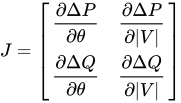
The linearized system of equations is solved to determine the next guess (m + 1) of voltage magnitude and angles based on:


The process continues until a stopping condition is met. A common stopping condition is to terminate if the norm of the mismatch equations is below a specified tolerance.
A rough outline of solution of the power-flow problem is:
- Make an initial guess of all unknown voltage magnitudes and angles. It is common to use a "flat start" in which all voltage angles are set to zero and all voltage magnitudes are set to 1.0 p.u.
- Solve the power balance equations using the most recent voltage angle and magnitude values.
- Linearize the system around the most recent voltage angle and magnitude values
- Solve for the change in voltage angle and magnitude
- Update the voltage magnitude and angles
- Check the stopping conditions, if met then terminate, else go to step 2.
Other power-flow methods
[edit]- Gauss–Seidel method: This is the earliest devised method. It shows slower rates of convergence compared to other iterative methods, but it uses very little memory and does not need to solve a matrix system.
- Fast-decoupled-load-flow method is a variation on Newton–Raphson that exploits the approximate decoupling of active and reactive flows in well-behaved power networks, and additionally fixes the value of the Jacobian during the iteration in order to avoid costly matrix decompositions. Also referred to as "fixed-slope, decoupled NR". Within the algorithm, the Jacobian matrix gets inverted only once, and there are three assumptions. Firstly, the conductance between the buses is zero. Secondly, the magnitude of the bus voltage is one per unit. Thirdly, the sine of phases between buses is zero. Fast decoupled load flow can return the answer within seconds whereas the Newton Raphson method takes much longer. This is useful for real-time management of power grids.[5]
- Holomorphic embedding load flow method: A recently developed method based on advanced techniques of complex analysis. It is direct and guarantees the calculation of the correct (operative) branch, out of the multiple solutions present in the power-flow equations.
- Backward-Forward Sweep (BFS) method: A method developed to take advantage of the radial structure of most modern distribution grids. It involves choosing an initial voltage profile and separating the original system of equations of grid components into two separate systems and solving one, using the last results of the other, until convergence is achieved. Solving for the currents with the voltages given is called the backward sweep (BS) and solving for the voltages with the currents given is called the forward sweep (FS).[6]
- Laurent Power Flow (LPF) method: Power flow formulation that provides guarantee of uniqueness of solution and independence on initial conditions for electrical distribution systems. The LPF is based on the current injection method (CIM) and applies the Laurent series expansion. The main characteristics of this formulation are its proven numerical convergence and stability, and its computational advantages, showing to be at least ten times faster than the BFS method both in balanced and unbalanced networks.[7] Since it is based on the system's admittance matrix, the formulation is able to consider radial and meshed network topologies without additional modifications (contrary to the compensation-based BFS[8]). The simplicity and computational efficiency of the LPF method make it an attractive option for recursive power flow problems, such as those encountered in time-series analyses, metaheuristics, probabilistic analysis, reinforcement learning applied to power systems, and other related applications.
DC power flow
[edit]![[icon]](https://en.wikipedia.org/wiki/File:Wiki_letter_w_cropped.svg) | This section needs expansion. You can help by adding to it. (August 2025) |
DC power flow (also known as direct current load flow (DCLF)) gives estimations of lines power flows on AC power systems. Despite the name, DC power flow is not an analysis on direct current, but rather on alternating current; the name comes from the linearity of the analysis, which resembles analysis on direct current. DC power flow looks only at active power flows and neglects reactive power flows. This method is non-iterative and absolutely convergent but less accurate than AC Load Flow solutions. DC power flow is used wherever repetitive and fast load flow estimations are required.[9]
References
[edit]- ^ Low, S. H. (2013). "Convex relaxation of optimal power flow: A tutorial". 2013 IREP Symposium Bulk Power System Dynamics and Control - IX Optimization, Security and Control of the Emerging Power Grid. pp. 1–06. doi:10.1109/IREP.2013.6629391. ISBN 978-1-4799-0199-9. S2CID 14195805.
- ^ Aien, Morteza; Hajebrahimi, Ali; Fotuhi-Firuzabad, Mahmud (2016). "A comprehensive review on uncertainty modeling techniques in power system studies". Renewable and Sustainable Energy Reviews. 57: 1077–1089. Bibcode:2016RSERv..57.1077A. doi:10.1016/j.rser.2015.12.070.
- ^ Grainger, J.; Stevenson, W. (1994). Power System Analysis. New York: McGraw–Hill. ISBN 0-07-061293-5.
- ^ Andersson, G: Lectures on Modelling and Analysis of Electric Power Systems Archived 2017-02-15 at the Wayback Machine
- ^ Stott, B.; Alsac, O. (May 1974). "Fast Decoupled Load Flow". IEEE Transactions on Power Apparatus and Systems. PAS-93 (3): 859–869. Bibcode:1974ITPAS..93..859S. doi:10.1109/tpas.1974.293985. ISSN 0018-9510.
- ^ Petridis, S.; Blanas, O.; Rakopoulos, D.; Stergiopoulos, F.; Nikolopoulos, N.; Voutetakis, S. An Efficient Backward/Forward Sweep Algorithm for Power Flow Analysis through a Novel Tree-Like Structure for Unbalanced Distribution Networks. Energies 2021, 14, 897. https://doi.org/10.3390/en14040897, https://www.mdpi.com/1996-1073/14/4/897
- ^ Giraldo, J. S., Montoya, O. D., Vergara, P. P., & Milano, F. (2022). A fixed-point current injection power flow for electric distribution systems using Laurent series. Electric Power Systems Research, 211, 108326. https://doi.org/10.1016/j.epsr.2022.108326
- ^ Shirmohammadi, D., Hong, H. W., Semlyen, A., & Luo, G. X. (1988). A compensation-based power flow method for weakly meshed distribution and transmission networks. IEEE Transactions on power systems, 3(2), 753-762. https://doi.org/10.1109/59.192932
- ^ Seifi, H. &. (2011). Appendix A: DC Load Flow. In H. &. Seifi, Electric power system planning: issues, algorithms and solutions (pp. 245-249). Berlin: Springer


Power-flow study
View on GrokipediaFundamentals
Overview
A power-flow study, also known as load-flow analysis, is a steady-state analytical method used to determine voltage magnitudes, phase angles, and active and reactive power flows throughout an alternating current (AC) power system under balanced operating conditions.[5] This analysis assumes constant power injections at buses and helps engineers evaluate the performance of transmission and distribution networks by solving the nonlinear power balance equations that govern the system's behavior.[6] The primary purpose is to ensure reliable operation, identify potential overloads or voltage violations, and support planning for system expansions.[5] The origins of power-flow studies trace back to the early 20th century, when engineers relied on manual calculations and analog network analyzers—introduced as early as 1929—to simulate power system behavior and approximate flows in small-scale models.[7] As electrical grids grew more complex in the mid-20th century, particularly after World War II, these manual methods became impractical, leading to the development of automated digital solutions starting in the mid-1950s.[8] A landmark advancement came in 1956 with the first digital power-flow program by Ward and Hale, which marked the shift to computational approaches capable of handling larger networks and enabling iterative numerical solutions for real-world applications.[7] Key terminology in power-flow studies includes "load flow" as a synonym emphasizing the analysis of power distribution from sources to loads, and "steady-state operation," which refers to the balanced condition where voltages and currents do not vary with time.[6] The per-unit system is a fundamental normalization technique that expresses voltages, powers, and impedances relative to chosen base values (e.g., a 100 MVA power base and nominal voltage levels), simplifying calculations across diverse equipment ratings and reducing numerical errors in computations.[6] Buses in the system are classified into types such as slack, PV, and PQ based on the known and unknown electrical quantities at each node.[1] A representative example is a simple two-bus system, consisting of a slack bus (e.g., a generator with fixed voltage magnitude and angle) connected to a PQ bus (e.g., a load with specified real and reactive power demands) via a transmission line. In this setup, power is injected at the slack bus and flows toward the PQ bus to meet the load, with the direction and magnitude of flows determined by the voltage difference and line impedance, illustrating basic principles of injection and distribution in a power network.[1] Common iterative methods, such as the Newton-Raphson approach, are employed to converge on the solution for such systems.[6]Importance in Power Systems
Power-flow studies are essential for system planning, enabling engineers to assess capacity expansions and evaluate the impacts of adding new transmission lines, generators, or substations to meet growing demand while maintaining stability. These studies simulate steady-state conditions to identify potential overloads and voltage violations, ensuring that infrastructure investments align with long-term reliability goals. In contingency analysis, power-flow studies are routinely applied to verify N-1 security criteria, where the system must withstand the loss of any single component without cascading failures, thus guiding decisions on reinforcements to enhance resilience against outages.[9][10][11][12] In operational contexts, power-flow studies support real-time monitoring by providing insights into voltage profiles and power distributions, allowing operators to adjust controls for maintaining acceptable limits across the grid. They facilitate voltage regulation through the optimization of reactive power sources, such as capacitor banks and synchronous condensers, to prevent undervoltages or overvoltages during peak loads. Furthermore, these studies integrate with economic dispatch processes, informing generator scheduling to balance supply and demand while minimizing operational costs and ensuring efficient resource allocation.[13][14][15] Power-flow studies serve as a foundational prerequisite for more advanced analyses, including short-circuit calculations, transient stability assessments, and optimal power flow formulations, by establishing the base-case operating conditions of voltages and angles needed for accurate simulations. Without reliable power-flow results, these dependent studies risk inaccurate predictions of fault currents, dynamic responses to disturbances, or cost-optimal dispatch scenarios.[16][17] Economically, power-flow studies contribute to minimizing transmission and distribution (T&D) losses—estimated at about 5% of generated electricity in the U.S. as of 2023—by optimizing flows and identifying inefficiencies, thereby reducing overall system costs and improving fuel efficiency. They also bolster reliability by preempting failures that could lead to costly blackouts; for instance, the 2003 Northeast blackout, which affected 50 million people and caused $6-10 billion in economic losses, was exacerbated by inadequate contingency analysis and post-outage power-flow reassessments, highlighting the need for robust studies to enforce reliability standards. In modern grids as of 2025, power-flow studies are increasingly vital for integrating renewables and distributed generation, addressing challenges like bidirectional flows, voltage fluctuations from intermittent solar and wind sources, and the need for enhanced modeling to handle high penetration levels without compromising stability.[18][19][20][21]Modeling
Network Components
Transmission lines in power-flow studies are typically represented using the π-equivalent model, which accounts for distributed parameters in a lumped form suitable for steady-state analysis. This model consists of a series impedance between the sending and receiving ends, where is the resistance and is the inductive reactance, along with shunt admittances at each end to capture capacitive effects. The shunt admittance is given by at both ends, where is the total charging susceptance, often neglecting conductance due to its small value. This representation facilitates the calculation of active and reactive power flows, such as and , essential for determining voltage profiles and line loadings.[22] Transformers are modeled as ideal devices with a turns ratio to adjust voltage levels, but in power-flow analysis, they often include off-nominal tap ratios to represent variable voltage regulation. For load-tap-changing transformers, the model incorporates a complex tap , where ranges typically from 0.9 to 1.1 and accounts for phase shifts up to ±40°. The equivalent circuit transforms voltages and currents across the transformer, yielding branch admittances like on the sending side and on the receiving side, with power flows adjusted accordingly, such as . This allows simulation of automatic tap adjustments for voltage control, considering limits and interactions in large systems.[23] Generators and loads are represented as power injections at buses, with models varying based on control specifications to reflect operational constraints. Loads are typically modeled as constant power (PQ) injections, specifying fixed real power and reactive power demands, while their voltage magnitude and angle are solved for. Generators are often treated as constant voltage (PV) injections, where real power and voltage magnitude are specified, solving for reactive power and angle , subject to reactive limits. The slack bus, usually associated with a generator, serves as the reference with fixed and (e.g., 1.0∠0°), absorbing any mismatch in and to balance the system. These injections integrate with network elements to form the overall power-flow model.[1] Shunt elements, such as capacitors and reactors, provide reactive power compensation directly at buses to maintain voltage stability and minimize losses. Shunt capacitors inject reactive power to support voltage rise in lightly loaded lines, countering inductive loads, while shunt reactors absorb excess reactive power from capacitive line charging in long transmission systems, limiting overvoltages via , where is the short-circuit power. These elements are essential in weak grids or under varying loads, often modeled as fixed or switched admittances in power-flow simulations.[24] The admittance matrix (Y-bus) is formed through nodal analysis to represent the entire network, relating bus current injections to voltages without mutual couplings between non-adjacent elements unless explicitly included. Diagonal elements sum the admittances of all branches and shunts connected to bus , while off-diagonal for the admittance between buses and . This symmetric matrix underpins power-flow equations by enabling efficient computation of system states from component models.[25]Bus Classifications
In power flow studies, buses are categorized based on the quantities that are specified and those that are to be determined, which directly influences the formulation of the power balance equations. This classification ensures that the system has a unique solution by providing exactly the right number of known variables to match the degrees of freedom in the network model. Typically, a power system model includes one slack bus, multiple PV buses associated with generators, and the remaining buses as PQ types, reflecting the physical characteristics of generation, transmission, and load points.[1] The slack bus, also known as the reference or swing bus, serves as the angular reference for the entire system and balances any mismatches in real and reactive power due to losses. Its voltage magnitude is fixed, typically at 1 per unit (pu), and its phase angle is set to 0°. The real power injection and reactive power injection at this bus are unknown and calculated after solving the power flow to account for unmodeled losses and discrepancies. There is usually only one slack bus in a standard interconnected system, often designated as bus 1, though in multi-area or distributed generation scenarios, concepts like distributed slack buses or area-specific slacks may be employed to more accurately represent power sharing among control areas.[1][26] PV buses, or voltage-controlled buses, represent points where generators are connected and maintain constant voltage magnitude through automatic voltage regulation. At these buses, the real power generation is specified based on the dispatch schedule, and the voltage magnitude is held fixed, usually near 1 pu. The phase angle and reactive power injection are unknowns to be solved for, with the reactive power adjusted within generator limits to enforce the voltage setpoint. Buses equipped with switched shunts, such as capacitor banks or reactors for reactive compensation without full generator capability, can also be modeled as PV buses if they provide voltage control.[1] PQ buses, or load buses, are the most common type and represent locations where fixed real and reactive power demands are known, typically from load forecasts with a negative sign convention for consumption. The voltage magnitude and phase angle at these buses are unknowns that must be calculated during the power flow solution. No generation or voltage control is assumed at PQ buses, though in practice, they may include minor distributed resources modeled separately. These buses form the majority in large systems, and their specifications drive the computation of voltage profiles across the network.[1] As an illustrative example, consider a simple 3-bus system with two generators and one load: bus 1 is designated as the slack bus (fixed V = 1 pu, δ = 0°), bus 2 as a PV bus (specified P = 0.5 pu, V = 1.05 pu), and bus 3 as a PQ bus (specified P = -0.8 pu, Q = -0.6 pu). This assignment aligns with typical topology where the slack bus anchors a strong reference point, the PV bus handles generation with voltage support, and the PQ bus absorbs the net load, allowing the power flow to resolve angles, voltages, and remaining powers.[1]Problem Formulation
Power Balance Equations
The power-flow study is fundamentally governed by the power balance equations, which ensure that the net power injection at each bus equals the power flowing out through the connected network elements. These equations arise from Kirchhoff's current law applied to the nodal analysis of the power system. Specifically, the bus admittance matrix (Y-bus) relates the vector of complex current injections to the vector of complex bus voltages via , where is formed from the admittances of transmission lines, transformers, and shunt elements.[27][25] For a bus in an -bus system, the complex power injection is given by , where is the complex voltage at bus and is the complex conjugate of the current injection. Substituting the Y-bus relation yields , with representing the conductance and susceptance between buses and . Expressing voltages in polar form as and , the real and reactive power balance equations emerge as follows: Here, denotes the net real power injection at bus (generation minus load), and denotes the net reactive power injection.[6][25][27] These equations are inherently nonlinear due to the products of voltage magnitudes and the trigonometric functions of the voltage angle differences , which couple the real and reactive power flows across the network. The summation over all buses accounts for the interconnected nature of the system, making the full set of equations (for and at each bus) a system of nonlinear algebraic equations to be solved for the unknown voltages.[6][25]Solution Variables and Constraints
In a power-flow study, the solution variables consist of the unknown parameters that must be determined to achieve a steady-state operating condition satisfying the network's power balance equations. These unknowns primarily include voltage magnitudes and phase angles at various buses, as well as reactive power injections at generator buses where applicable. The formulation ensures that the specified power injections and voltage setpoints are met, subject to the physical constraints of the system.[28] The unknowns vary depending on the bus classification. For PQ (load) buses, where real power and reactive power injections are specified, the unknowns are the voltage magnitude and phase angle . For PV (generator) buses, with specified real power and voltage magnitude , the unknowns are the phase angle and the reactive power generation . The slack (reference) bus has both voltage magnitude and phase angle fixed, making its real and reactive powers the outputs rather than inputs. This setup is summarized in the following table:| Bus Type | Known Variables | Unknown Variables |
|---|---|---|
| Slack | $ | V |
| PV (Generator) | , $ | V |
| PQ (Load) | , | $ |