



Community hub
Recent from talks
Contribute something
Nothing was collected or created yet.
Grouped data
View on WikipediaGrouped data are data formed by aggregating individual observations of a variable into groups, so that a frequency distribution of these groups serves as a convenient means of summarizing or analyzing the data. There are two major types of grouping: data binning of a single-dimensional variable, replacing individual numbers by counts in bins; and grouping multi-dimensional variables by some of the dimensions (especially by independent variables), obtaining the distribution of ungrouped dimensions (especially the dependent variables).
Example
[edit]The idea of grouped data can be illustrated by considering the following raw dataset:
| 20 | 25 | 24 | 33 | 13 | 26 | 8 | 19 | 31 | 11 | 16 | 21 | 17 | 11 | 34 | 14 | 15 | 21 | 18 | 17 |
The above data can be grouped in order to construct a frequency distribution in any of several ways. One method is to use intervals as a basis.
The smallest value in the above data is 8 and the largest is 34, while the sample mean amounts to 19.7 seconds. The interval from 8 to 34 is broken up into smaller subintervals (called class intervals). For each class interval, the number of data items falling in this interval is counted. This number is called the frequency of that class interval. The results are tabulated as a frequency table as follows:
| Time taken (in seconds) | Frequency |
|---|---|
| 5 ≤ t < 10 | 1 |
| 10 ≤ t < 15 | 4 |
| 15 ≤ t < 20 | 6 |
| 20 ≤ t < 25 | 4 |
| 25 ≤ t < 30 | 2 |
| 30 ≤ t < 35 | 3 |
Another method of grouping the data is to use some qualitative characteristics instead of numerical intervals. For example, suppose in the above example, there are three types of students: 1) Below normal, if the response time is 5 to 14 seconds, 2) normal if it is between 15 and 24 seconds, and 3) above normal if it is 25 seconds or more, then the grouped data looks like:
| Frequency | |
|---|---|
| Below normal | 5 |
| Normal | 10 |
| Above normal | 5 |
Yet another example of grouping the data is the use of some commonly used numerical values, which are in fact "names" we assign to the categories. For example, let us look at the age distribution of the students in a class. The students may be 10 years old, 11 years old or 12 years old. These are the age groups, 10, 11, and 12. Note that the students in age group 10 are from 10 years and 0 days, to 10 years and 364 days old, and their average age is 10.5 years old if we look at age in a continuous scale. The grouped data looks like:
| Age | Frequency |
|---|---|
| 10 | 10 |
| 11 | 20 |
| 12 | 10 |
Mean of grouped data
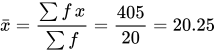
[edit]An estimate, , of the mean of the population from which the data are drawn can be calculated from the grouped data as:


In this formula, x refers to the midpoint of the class intervals, and f is the class frequency. Note that the result of this will be different from the sample mean of the ungrouped data. The mean for the grouped data in the above example, can be calculated as follows:
| Class Intervals | Frequency ( f ) | Midpoint ( x ) | f x |
|---|---|---|---|
| 5 and above, below 10 | 1 | 7.5 | 7.5 |
| 10 ≤ t < 15 | 4 | 12.5 | 50 |
| 15 ≤ t < 20 | 6 | 17.5 | 105 |
| 20 ≤ t < 25 | 4 | 22.5 | 90 |
| 25 ≤ t < 30 | 2 | 27.5 | 55 |
| 30 ≤ t < 35 | 3 | 32.5 | 97.5 |
| TOTAL | 20 | 405 |
Thus, the mean of the grouped data is
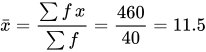
The mean for the grouped data in example 4 above can be calculated as follows:
| Age Group | Frequency ( f ) | Midpoint ( x ) | f x |
|---|---|---|---|
| 10 | 10 | 10.5 | 105 |
| 11 | 20 | 11.5 | 230 |
| 12 | 10 | 12.5 | 125 |
| TOTAL | 40 | 460 |
Thus, the mean of the grouped data is
See also
[edit]- Aggregate data
- Censoring (statistics)
- Data binning
- Partition of a set
- Level of measurement
- Frequency distribution
- Discretization of continuous features
- Logistic regression § Minimum chi-squared estimator for grouped data
 | This article includes a list of general references, but it lacks sufficient corresponding inline citations. (June 2010) |
References
[edit]- Newbold, P.; Carlson, W.; Thorne, B. (2009). Statistics for Business and Economics (Seventh ed.). Pearson Education. ISBN 978-0-13-507248-6.


Grouped data
View on GrokipediaDefinition and Purpose
Definition of Grouped Data
Grouped data refers to the aggregation of individual observations from a dataset, particularly continuous or large-scale quantitative data, into discrete categories or classes known as bins or intervals, where the focus shifts from specific values to the frequency of occurrences within each class. This method organizes raw data into a more manageable form by dividing the range of values into non-overlapping class intervals, allowing for efficient summarization and analysis without retaining every original data point. In contrast, ungrouped data presents each observation as a distinct, individual value, which becomes impractical for voluminous datasets.[5] Key components of grouped data include the class interval, defined by its lower and upper class limits—the minimum and maximum values included in that group—and the class width, calculated as the difference between the upper limit and the lower limit, given by the formulaThe class midpoint, or mark, represents the central value of the interval and is computed as the average of the lower and upper limits:
Frequencies associated with each class quantify the data: absolute frequency denotes the raw count of observations in the interval, relative frequency expresses this as a proportion of the total dataset, and cumulative frequency tracks the running total of absolute frequencies up to that class.[6][7] The practice of grouping data for summarization traces its origins to the 17th century, exemplified by John Graunt's 1662 analysis of the London Bills of Mortality, where deaths were categorized into groups by cause and age to derive population estimates and patterns from extensive records. This approach laid foundational techniques for handling large datasets in early demography and vital statistics. In the late 19th century, Karl Pearson further developed the mathematical framework for frequency distributions derived from grouped data, enabling curve-fitting and goodness-of-fit tests like the chi-square statistic to model empirical distributions.[8][9] Grouped data is commonly represented in a frequency distribution table, which lists class intervals alongside their corresponding frequencies to provide a structured overview of the dataset's distribution.)
Reasons for Grouping Data
Grouping data in statistics serves several primary purposes, particularly when dealing with extensive raw datasets that would otherwise be cumbersome to analyze. One key motivation is the simplification of analysis for large volumes of data, where individual values are aggregated into classes or intervals, transforming potentially hundreds or thousands of entries into a more digestible format with typically 10-20 groups.[10][11] This approach also aids in revealing underlying patterns and trends, such as clustering or skewness in the distribution, which may not be apparent in ungrouped lists.[11][12] Additionally, grouping reduces computational complexity by enabling quicker manual or preliminary calculations of summary statistics, though modern software mitigates this need to some extent.[11] Finally, it facilitates visualization and communication of data characteristics, making it easier to interpret overall shapes and features of the dataset.[10][12] A specific benefit of grouped data lies in its ability to handle continuous variables that cannot be enumerated individually due to their infinite possible values or sheer quantity, such as heights, weights, or incomes spanning wide ranges.[11][10] For instance, measurements like test scores from 46 to 167 can be binned into intervals of equal width, providing a practical structure without listing every observation.[10] This method is particularly useful for approximate calculations where exact precision is not required, allowing analysts to estimate measures like averages or proportions efficiently while focusing on broader insights.[11] Grouped data finds application in various scenarios involving voluminous information, such as large-scale surveys, experimental trials, or observational studies that generate thousands of measurements.[12][11] In educational research, for example, aggregating student performance data from hundreds of participants into frequency classes enables clearer examination of achievement distributions compared to raw scores.[10] While grouping enhances manageability, it introduces a trade-off by sacrificing some precision, as individual data points are concealed within intervals, potentially obscuring fine details or outliers.[11][10] This loss is generally acceptable when the goal is to gain an overview rather than perform highly accurate computations on original values.[12]Constructing Grouped Data
Choosing Class Intervals
When constructing grouped data, selecting appropriate class intervals is crucial for effectively summarizing the dataset without losing essential information. Class intervals define the bins or ranges into which individual data points are categorized, influencing the clarity and interpretability of subsequent analyses such as frequency distributions. The process begins with determining the number of classes, typically recommended to be between 5 and 20 to balance detail and simplicity.[13][14] A widely used method for estimating the optimal number of classes, denoted as , is Sturges' rule, given by the formula , where is the sample size. This heuristic, derived from the assumption that data follows a normal distribution and aims to approximate the underlying probability density with binomial coefficients, provides a starting point that works well for moderate sample sizes. For example, with , Sturges' rule yields . An equivalent logarithmic form, , is also common for computational ease. Once is set, the class width is calculated as , where range is the difference between the maximum and minimum values in the dataset; this width is then rounded upward to a convenient value, such as a whole number or multiple of 10, to facilitate grouping.[15][14][16] Key rules guide the construction of these intervals to ensure reliability. Equal widths are preferred for their simplicity and ease of comparison across classes, promoting consistent representation of the data. Intervals must be mutually exclusive, meaning no data value belongs to more than one class, and collectively exhaustive, covering the entire range of the dataset without gaps. Boundaries are often defined using the convention where the upper limit of one class is one unit less than the lower limit of the next (e.g., 10–19, 20–29), and open-ended classes (e.g., "under 10" or "50 and above") should be avoided when possible to prevent ambiguity in calculations, though they may be necessary for unbounded tails in real-world data.[13][17][18] Several factors influence the final choice of intervals beyond the basic formulas. The overall data range directly impacts width; a larger range necessitates wider intervals to keep manageable. The shape of the distribution plays a role—for instance, skewed data may benefit from unequal widths or broader intervals in the tail to better capture asymmetry without distorting the bulk of the observations. The purpose of the analysis also matters: narrower intervals enhance precision for detailed studies, while wider ones suit exploratory overviews or when emphasizing trends over fine details. Additionally, considerations like the dataset's inherent precision (e.g., rounding to match whole units) and the intended audience (e.g., intuitive breaks for non-experts) can refine the selection.[19][17][19] Common pitfalls in choosing class intervals can compromise the analysis. Selecting too few classes oversimplifies the data, potentially obscuring important patterns or variability within the dataset. Conversely, too many classes retain much of the raw data's complexity, defeating the purpose of grouping and making interpretation cumbersome. Other errors include creating overlapping intervals, which double-count values, or unequal widths without clear justification, which can mislead visual or statistical assessments. To mitigate these, iterative adjustment based on preliminary histograms is advisable.[20][19][13]Building Frequency Distributions
To build a frequency distribution table for grouped data, begin by sorting the raw data in ascending order to facilitate the tallying process. This step organizes the observations, making it easier to assign each value to its appropriate class interval. Next, tally the frequencies by counting the number of data points that fall into each predefined class interval, ensuring that classes are mutually exclusive and collectively exhaustive to avoid overlaps or omissions.[21][13] Once frequencies are tallied, compute the relative frequency for each class by dividing the class frequency by the total number of observations , yielding , which expresses the proportion of data in that class. Additionally, calculate cumulative frequencies by summing the frequencies progressively from the first class onward, providing a running total that indicates the number of observations up to a given class. These computations enhance the table's utility for understanding data distribution patterns.[17][21] The resulting frequency distribution table typically includes columns for class intervals, frequencies, midpoints (calculated as the average of the lower and upper class limits), relative frequencies, and cumulative frequencies. Midpoints serve as representative values for each class in further analyses. For example, consider a dataset of student heights measured in centimeters, grouped into intervals such as 150–159, 160–169, and so on; a partial table might appear as follows:| Class Interval | Frequency | Midpoint | Relative Frequency | Cumulative Frequency |
|---|---|---|---|---|
| 150–159 | 5 | 154.5 | 0.10 | 5 |
| 160–169 | 8 | 164.5 | 0.16 | 13 |
| 170–179 | 12 | 174.5 | 0.24 | 25 |
Graphical Representations
Histograms
A histogram is a graphical representation used to visualize the distribution of grouped data, where the underlying frequency distribution serves as the data source for plotting.[5] In constructing a histogram for grouped data, bars are drawn such that each bar's width corresponds to the class interval, and its height is proportional to the frequency (or relative frequency) of observations within that interval; for continuous data, the bars are placed contiguously with no gaps between them to reflect the undivided nature of the intervals.[21][5] Key features of a histogram include the x-axis marking the class intervals and the y-axis indicating the frequency, with the total area of the bars representing the overall sample size or total frequency.[22][12] Variations exist between frequency histograms, where bar heights directly represent absolute frequencies, and density histograms, where heights are scaled to depict probability densities; in the latter, the height of each bar is calculated as , with as the frequency in the interval, as the total number of observations, and as the class width, ensuring the total area sums to 1.[23][24] Histograms facilitate interpretation of grouped data distributions by revealing patterns such as skewness—where the tail extends longer on one side—modality, indicating the number of peaks (unimodal, bimodal, etc.), and potential outliers appearing as isolated bars or deviations from the main pattern.[25][26][27]Frequency Polygons
A frequency polygon is a graphical representation of a frequency distribution for grouped data, formed by plotting points at the midpoints of class intervals on the horizontal axis and corresponding frequencies on the vertical axis, then connecting these points with straight lines. This line graph provides a visual approximation of the data's distribution shape, treating the intervals as continuous despite the underlying grouped nature.[28] To construct a frequency polygon, first identify the midpoints of each class interval (calculated as the average of the lower and upper boundaries) and plot these on the x-axis against the class frequencies on the y-axis. Connect the points sequentially with straight lines, and to form a closed polygon, extend lines from the first and last points to the x-axis at fictional midpoints just below the lowest class and above the highest class, both with zero frequency. This method ensures the graph resembles a continuous curve, highlighting trends in the data.[29] The primary purpose of a frequency polygon is to offer a smoothed visualization of the histogram's shape, facilitating the identification of patterns such as unimodal or bimodal distributions in grouped data.[28] It is particularly advantageous for overlaying and comparing multiple frequency distributions on the same graph, as the lines can be distinguished by color or style without the overlap issues common in stacked histograms. Unlike histograms, which use contiguous bars to emphasize the discrete nature of class intervals and exact frequency heights, frequency polygons are line-based and focus on continuity between midpoints, better revealing overall trends and facilitating direct comparisons across datasets.[28] A variant known as the ogive, or cumulative frequency polygon, plots cumulative frequencies against the upper class boundaries (or midpoints in some constructions), connecting points to show the running total of observations up to each interval.[30] This form is useful for determining percentiles, medians, or the proportion of data below certain values in grouped distributions.[30]Measures of Central Tendency
Arithmetic Mean
The arithmetic mean, or simply the mean, of grouped data serves as a measure of central tendency by providing an average value representative of the dataset, calculated using class midpoints and frequencies from a frequency distribution.[31] This approach estimates the mean when individual data points are unavailable, treating the midpoint of each class interval as the typical value for all observations in that group.[32] The formula for the arithmetic mean of grouped data is: where denotes the frequency of the -th class, is the midpoint of the -th class interval, and the summations are over all classes.[31][4] The midpoint is computed as the average of the lower and upper limits of the class interval: .[32] To calculate the mean, follow these steps: first, determine the midpoint for each class interval; second, multiply each midpoint by its corresponding frequency to obtain ; third, sum these products across all classes; finally, divide the total sum by the overall frequency , which equals the sample size.[31] This method yields an approximation rather than the exact mean of the original ungrouped data, as it relies on aggregated frequencies.[32] The calculation assumes that class intervals are of equal width for simplicity, though the formula applies to unequal widths as well, and that midpoints adequately represent the data within each interval— a reasonable approximation when the distribution within classes is roughly uniform or symmetric.[31][32] Unequal intervals or skewed distributions within classes may introduce some error in the estimate.[32] For illustration, consider a frequency distribution of household incomes grouped into class intervals (in thousands of dollars): The mean income is thousand dollars.[31] This example demonstrates how the weighted contributions of midpoints, scaled by frequencies, produce the overall average.[4]Median and Mode
In grouped data, the median and mode serve as positional measures of central tendency, identifying the middle value and the most frequent value within frequency distributions, respectively. Unlike the arithmetic mean, which averages all data points, these measures are particularly useful for skewed distributions where extreme values may distort the central location.[33] The median for grouped data is estimated using the cumulative frequency distribution to locate the median class—the interval containing the middle position of the ordered data. Let denote the total frequency. The position of the median is at . If this falls in the class with lower boundary , frequency , class width , and cumulative frequency up to the previous class , the median is calculated as: This formula assumes continuous data and linear interpolation within the median class.[31] The mode, representing the most common value, is approximated from the modal class—the interval with the highest frequency. For the modal class with lower boundary , frequency , preceding class frequency , and following class frequency , the mode is given by: This interpolation assumes a parabolic curve peaking at the modal class and may not apply if there are multiple modes or no clear peak. The mode highlights the concentration of data but can be undefined or multimodal in uniform distributions.[31][33] The median is less sensitive to extreme values than the mean, making it robust for datasets with outliers, while the mode specifically captures the most frequent occurrence, useful for identifying typical categories in nominal or ordinal grouped data.[34][33] To illustrate, consider a frequency distribution of exam scores grouped into intervals of width 10, with total frequency :| Score Interval | Frequency () | Cumulative Frequency |
|---|---|---|
| 0–10 | 5 | 5 |
| 10–20 | 8 | 13 |
| 20–30 | 12 | 25 |
| 30–40 | 10 | 35 |
| 40–50 | 5 | 40 |
Measures of Dispersion
Range and Quartiles
In grouped data, the range is a basic measure of dispersion calculated as the difference between the upper limit of the highest class interval and the lower limit of the lowest class interval.[35] This method provides an approximation of the total spread, but it overlooks the variation within the extreme classes and is sensitive to outliers or arbitrary class boundaries.[36] For example, in a frequency distribution with class intervals from 0–10 to 40–50, the range would be 50 - 0 = 50, representing the overall extent of the data despite internal distributions within each interval.[35] Quartiles divide the data into four equal parts based on cumulative frequencies, analogous to the median but at positions for the first quartile (Q1) and for the third quartile (Q3), where is the total frequency.[31] To find these values, identify the class interval containing the target position, then apply the interpolation formula: where for Q1 or for Q3, is the lower boundary of the quartile class, is the class width, is the cumulative frequency before that class, and is the frequency of that class.[31] For instance, in a dataset with and cumulative frequencies showing the Q1 position (12.5) in the 11–20 interval (, , , ), Q1 ≈ 13.71; similarly, Q3 ≈ 34.39 in the 31–40 interval.[31] The interquartile range (IQR) is then computed as Q3 minus Q1, yielding a measure of the middle 50% spread that is less affected by extreme values than the full range.[31] In the example above, IQR ≈ 34.39 - 13.71 = 20.68.[31] These measures are particularly useful for grouped data summaries, as they require no assumption of a normal distribution and provide straightforward insights into variability without detailed individual observations.[36]Variance and Standard Deviation
In grouped data, variance measures the average squared deviation of the data points from the mean, providing a quantification of dispersion that accounts for the spread across all class intervals. For grouped frequency distributions, calculations approximate the values using the midpoint of each class interval as the representative data point, weighted by the class frequency. This approach is essential when individual data values are unavailable, allowing for the assessment of variability in datasets like test scores or income brackets.[37] The population variance for grouped data is computed as , where is the midpoint of the -th class, is its frequency, is the population mean (previously calculated as ), and is the total number of observations. Alternatively, the shortcut formula avoids direct deviation calculations and is computationally efficient. The population standard deviation is then . For sample data, the sample variance uses or the shortcut , with sample standard deviation ; the denominator provides an unbiased estimate of the population variance.[37][38] To compute these measures, first determine the mean using the arithmetic mean formula for grouped data. Then, for the direct method, calculate the squared deviations (or ) for each midpoint, multiply by the corresponding frequency , sum the products, and divide by (or ). The shortcut method requires summing and , then adjusting as per the formulas. These steps ensure the measures reflect the weighted contributions of each class.[37][38] Consider an example with the following sample frequency distribution of grades, where midpoints are used:| Class (Grades) | Frequency | Midpoint | ||
|---|---|---|---|---|
| 4 | 2 | 4 | 8 | 32 |
| 5 | 2 | 5 | 10 | 50 |
| 6 | 4 | 6 | 24 | 144 |
| 7 | 5 | 7 | 35 | 245 |
| 8 | 4 | 8 | 32 | 256 |
| 9 | 2 | 9 | 18 | 162 |
| 10 | 1 | 10 | 10 | 100 |
| Total | 20 | 137 | 989 |
Applications and Limitations
Real-World Examples
In economics, grouped data facilitates the analysis of income distributions from large-scale surveys, revealing patterns of wealth allocation across populations. For instance, the U.S. Census Bureau's Current Population Survey provides grouped household income data by quintiles, categorizing approximately 20% of households into each bracket based on 2023 money income thresholds. This grouping helps summarize disparities without disclosing individual earnings, supporting policy decisions on taxation and social welfare. The following table illustrates the 2023 household income distribution by quintile, including mean incomes for each group:| Quintile | Income Threshold (2023) | Share of Aggregate Income | Mean Income |
|---|---|---|---|
| Lowest | ≤ $33,000 | 3.1% | $17,650 |
| Second | $33,001–$62,200 | 8.3% | $47,590 |
| Third | $62,201–$101,000 | 14.1% | $80,730 |
| Fourth | $101,001–$165,300 | 22.6% | $129,400 |
| Highest | > $165,300 | 51.9% | $297,300 |
| Score Interval | Frequency |
|---|---|
| 50–54 | 1 |
| 55–59 | 1 |
| 60–64 | 2 |
| 65–69 | 1 |
| 70–74 | 3 |
| 75–79 | 4 |
| 80–84 | 5 |
| 85–89 | 4 |
| 90–94 | 4 |