Hubbry Logo
ProtostomeProtostomeMain
Open search
Protostome
Community hub
Protostome
logo
8 pages, 0 posts
0 subscribers
Be the first to start a discussion here.
Protostome
Protostome
from Wikipedia

Protostomes
Temporal range: Ediacaran - Recent
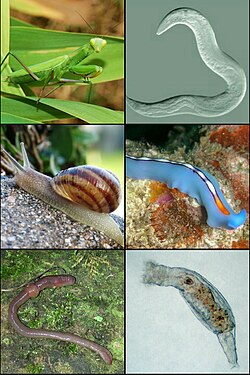
ArthropodMolluscaAnnelidNematodeFlatwormRotifer
Scientific classification Edit this classification
Kingdom: Animalia
Subkingdom: Eumetazoa
Clade: ParaHoxozoa
Clade: Bilateria
Clade: Nephrozoa
Clade: Protostomia
Grobben, 1908
Subgroups

Protostomia (/ˌprtəˈstmi.ə/) is the clade of animals once thought to be characterized by the formation of the organism's mouth before its anus during embryonic development. This nature has since been discovered to be extremely variable among Protostomia's members, although the reverse is typically true of its sister clade, Deuterostomia.[1][2] Well-known examples of protostomes are arthropods, molluscs, annelids, flatworms and nematodes. They are also called schizocoelomates since schizocoely typically occurs in them.

Together with the Deuterostomia and Xenacoelomorpha, these form the clade Bilateria, animals with bilateral symmetry, anteroposterior axis and three germ layers.[3]

Protostomy

[edit]

In animals at least as complex as earthworms, the first phase in gut development involves the embryo forming a dent on one side (the blastopore) which deepens to become its digestive tube (the archenteron). In the sister-clade, the deuterostomes (lit.'second-mouth'), the original dent becomes the anus while the gut eventually tunnels through to make another opening, which forms the mouth. The protostomes (from Greek πρωτο- prōto- 'first' + στόμα stóma 'mouth') were so named because it was once believed that in all cases the embryological dent formed the mouth while the anus was formed later, at the opening made by the other end of the gut.[4][1] It is now known that the fate of the blastopore among protostomes is extremely variable; while the evolutionary distinction between deuterostomes and protostomes remains valid, the descriptive accuracy of the name protostome is disputable.[1]

Protostome and deuterostome embryos differ in several other ways. Secondary body cavities (coeloms) generally form by schizocoely, where the coelom forms out of a solid mass of embryonic tissue splitting away from the rest, instead of by enterocoelic pouching, where the coelom would otherwise form out of in-folded gut walls.[5]

Evolution

[edit]

The common ancestor of protostomes and deuterostomes was evidently a worm-like aquatic animal of the Ediacaran. The two clades diverged over 600 million years ago. Protostomes evolved into over a million species alive today, compared to ca. 73,000 deuterostome species.[6]

Protostomes are divided into the Ecdysozoa (e.g. arthropods, nematodes) and the Spiralia (e.g. molluscs, annelids, platyhelminths, and rotifers). A modern consensus phylogenetic tree for the protostomes is shown below.[7][8][9][10][11][excessive citations] The timing of clades radiating into newer clades is given in mya (millions of years ago); less certain placements are indicated with dashed lines.[12]

Bilateria

See also

[edit]

References

[edit]
[edit]
Revisions and contributorsEdit on WikipediaRead on Wikipedia
from Grokipedia
Protostomes, or members of the Protostomia, are one of the two primary lineages of bilaterian animals, distinguished by their embryonic development in which the blastopore—the first opening formed during —develops into the , with the forming secondarily. This contrasts with deuterostomes, where the blastopore becomes the . Protostomes encompass a diverse array of , including the majority of animal species, and are characterized by developmental traits such as spiral cleavage and schizocoelous formation in spiralian lineages. The clade Protostomia is subdivided into two major groups based on molecular and morphological evidence: and . Lophotrochozoans within , which include phyla such as (e.g., snails, octopuses, and clams), Annelida (e.g., earthworms and leeches), and smaller groups like Brachiopoda and , often feature a trochophore stage or a lophophore feeding structure as defining traits. In contrast, ecdysozoans, comprising phyla like Arthropoda (e.g., , spiders, and crustaceans) and Nematoda (roundworms), are united by the synapomorphy of , or molting of an external to allow growth. Together, these subgroups represent an that has led to protostomes occupying nearly every on , from marine depths to terrestrial soils, with arthropods alone accounting for over 80% of all known animal . Phylogenetically, Protostomia forms a monophyletic group within the , sister to Deuterostomia, with their divergence estimated to have occurred over 550 million years ago during the Ediacaran-Cambrian transition, driven by innovations in developmental genetics and complexity. This split underscores fundamental differences in gene regulatory networks, particularly in and specification, which have profound implications for and morphological diversity across protostome lineages.

Definition and Characteristics

Definition

Protostomia is a monophyletic within the , representing one of the two major lineages of bilaterian animals and encompassing the vast majority of described animal . This includes over 1.2 million known , primarily from phyla such as Arthropoda (insects, crustaceans, and arachnids), (snails, clams, and octopuses), Annelida (segmented worms), and Nematoda (roundworms). These groups exhibit and triploblastic organization, distinguishing them from non-bilaterian animals like cnidarians and sponges. The phylogenetic definition of Protostomia positions it as the to Deuterostomia, with the of these s from a common bilaterian ancestor occurring approximately 565 million years ago in the late period. This split marks a key event in metazoan evolution, leading to the radiation of diverse body plans within Protostomia. Historically, Protostomia was defined by morphological developmental traits, but molecular phylogenetic analyses revealed significant variability in these features across the , prompting a redefinition based on shared ancestry. Under this modern framework, Protostomia includes all extant animals descending from the last common ancestor of its living members, as supported by genomic and data.

Key Traits

Protostomes represent a highly diverse of bilaterian animals, comprising approximately 80-90% of all described animal , largely owing to the extraordinary success of phyla such as Arthropoda and . This diversity underscores their adaptability across terrestrial, freshwater, and marine environments, with shared traits that have evolved convergently in some lineages to support varied ecological roles. Key morphological and developmental features distinguish protostomes, though exceptions arise due to evolutionary modifications in certain groups. The defining embryonic feature is protostomy, in which the blastopore—the first opening formed during —develops into the mouth, with the anus forming secondarily. Subgroups such as exhibit spiral, determinate cleavage, in which early embryonic divisions occur in a spiral arrangement relative to the previous cell layer, fixing cell fates early and leading to a highly organized . This pattern contrasts with radial cleavage and contributes to the precise partitioning of tissues in those protostome embryos. Another feature in such groups is schizocoelous formation, where the arises by the splitting of solid mesodermal masses into a fluid-filled that cushions organs and facilitates movement. However, not all protostomes conform to this; acoelomate groups, such as flatworms in the phylum Platyhelminthes, lack a true and instead rely on a solid for structural support, reflecting evolutionary simplifications in body plan. Protostomes typically exhibit a solid ventral nerve cord, formed by the fusion of longitudinal nerve tracts along the ventral surface, which integrates sensory and motor functions. Accompanying this is often a dorsal blood vessel that serves as the primary conduit for circulation, pumping hemolymph or blood anteriorly in groups like annelids and arthropods. Variability in nerve cord orientation occurs in some lineages, such as mollusks where circumesophageal rings connect ventral cords to dorsal ganglia, highlighting convergent adaptations to complex behaviors. These traits collectively enable the functional efficiency seen in protostome body plans, despite phylogenetic divergences.

Embryonic Development

Protostomy

Protostomy is the defining embryonic developmental process in protostomes, characterized by the formation of the (stoma) from the blastopore, the initial opening that arises during as cells invaginate to form the . This first embryonic opening, located at the vegetal pole, directly gives rise to the oral opening, while the develops later from a secondary posterior invagination or outpocketing of the . This sequence establishes the anterior-posterior gut orientation early in development, contrasting with the indeterminate cleavage patterns often seen in deuterostomes. In contrast to deuterostomy, where the blastopore becomes the anus and the mouth forms secondarily from a different region of the , protostomy is prominently observed in classic lophotrochozoan protostomes such as and mollusks. For instance, in the Owenia fusiformis, the blastopore directly develops into the larval , with involving asymmetric expression of patterning genes around this site. Similarly, mollusks like Ilyanassa obsoleta exhibit spiral cleavage leading to protostomy, where the blastopore lips contribute to the . These examples highlight how protostomy facilitates rapid gut formation aligned with the organism's anterior end. The molecular underpinnings of protostomy involve conserved signaling pathways that direct blastopore lip fates and axial patterning. Wnt/β-catenin signaling stabilizes at the vegetal pole to promote endomesoderm specification and site determination, while BMP signaling gradients establish dorsoventral polarity, influencing which blastopore regions form oral structures. These pathways, including interactions with FGF and , ensure the blastopore's oral fate by coordinating cell ingression and tissue reorganization during early embryogenesis. However, protostomy is not universally strict across all protostomes, revealing significant variability that challenges its use as a rigid defining trait. In ecdysozoans like arthropods, blastopore fates can be mixed or inverted; for example, in some crustaceans, the blastopore may form the (deuterostomy-like), while in pycnogonids it aligns with classic protostomy, and in others, it closes without directly contributing to either opening (amphistomy). This diversity, also noted in priapulids such as Priapulus caudatus where deuterostomic patterns predominate, suggests evolutionary lability in blastopore utilization driven by shifts in signaling timing and spatial decoupling of mouth and formation.

Cleavage and Gastrulation

In spiralians, a major subgroup of protostomes, early embryonic development features spiral cleavage, where cell divisions occur at oblique angles relative to the embryo's polar axis, resulting in a helical arrangement of blastomeres that spiral around the central axis. This pattern arises from successive quartets of micromeres that are offset clockwise or counterclockwise from their underlying macromeres, creating a distinctive stereotypic layout conserved across spiralian clades. Spiral cleavage is typically determinate, meaning that the developmental fates of individual blastomeres are fixed early during these divisions through the partitioning of cytoplasmic determinants, limiting the embryo's regulative capacity compared to indeterminate cleavage patterns. In contrast, ecdysozoans exhibit diverse cleavage patterns; for example, nematodes undergo asynchronous holoblastic cleavage, while many arthropods display superficial cleavage where divisions occur within a syncytial blastoderm. in protostomes follows this cleavage stage and involves coordinated cellular rearrangements to establish the three primary germ layers—, , and —primarily through mechanisms such as , emboly, and . In , an epithelial sheet of ectodermal cells from the animal pole expands over the vegetal region to envelop deeper layers; emboly entails the inward migration of cells toward the interior; and invagination features the folding of cell sheets to form pockets that internalize presumptive and .00054-7) The blastopore, the initial opening formed during these movements, emerges at the vegetal pole and serves as the site for germ layer formation. A representative example occurs in mollusks such as the slipper snail , where the quadrant stage establishes four macromeres (A–D) at the vegetal pole after the initial cleavages, with subsequent micromeres from the second and third quartets contributing specifically to ectodermal structures and mesodermal precursors. Here, micromeres (e.g., 2a–2d and 3a–3d) form ciliary bands and the mouth region, while macromeres (e.g., 4A–4D) give rise to endomesodermal tissues that are internalized via of the micromere cap during . This process highlights the precise lineage restrictions imposed by determinate spiral cleavage, ensuring targeted tissue contributions from early blastomeres.

Coelom Formation

In protostomes, the typically forms through , a process in which solid masses of mesodermal tissue, established during embryogenesis, undergo and splitting to create the . This occurs after , when mesenchymal cells migrate between the and to form mesodermal blocks that subsequently hollow out internally. The resulting is a true fully lined by mesodermal on both sides, providing structural support and space for organ development. The in many protostomes, particularly spiralians, originates from specific blastomeres such as the 4d cell, which proliferates to generate the mesodermal tissue involved in formation. This contrasts with deuterostomes, where formation proceeds via enterocoely, involving the outgrowth of mesodermal pouches from the . While characterizes eucoelomate protostomes like annelids and mollusks, variations exist across s; some protostomes are acoelomate, lacking a entirely and filling the space between and with solid , as seen in platyhelminths (flatworms). Others, such as nematodes in the , are pseudocoelomate, possessing a not fully lined by but instead bounded by on the outer side and internally. These deviations reflect evolutionary adaptations but do not alter the defining schizocoelous pattern in coelomate lineages.

Comparison to Deuterostomes

Developmental Contrasts

One of the primary distinctions in embryonic development between protostomes and deuterostomes lies in the pattern of cleavage following fertilization. In protostomes, cleavage is typically spiral and determinate, where daughter cells divide at oblique angles, resulting in a staggered arrangement of blastomeres, and the fate of each cell is fixed early in development. In contrast, deuterostomes exhibit radial and indeterminate cleavage, with cells dividing parallel or to the polar axis, forming tiers of aligned blastomeres, and early blastomeres retaining totipotent potential to develop into complete organisms if separated. A defining feature during is the fate of the blastopore, the initial opening formed in the . Protostomes develop the from the blastopore site (protostomy), while the forms secondarily from a later . Deuterostomes, however, form the at the blastopore (deuterostomy), with the arising from a separate anterior opening. This difference reflects divergent morphogenetic processes, though some exceptions, such as variable blastopore fates in certain protostomes, highlight evolutionary flexibility. Coelom formation further underscores these developmental contrasts. Protostomes employ , where solid mesodermal masses split internally to create the . Deuterostomes utilize enterocoely, in which mesodermal pouches bud off from the (primitive gut) and expand to form the . These modes influence architecture and organ positioning in adult forms. The develops along opposing axes in the two clades. Protostomes form a solid ventral cord through and fusion of ectodermal cells beneath the gut. Deuterostomes, conversely, generate a hollow dorsal tube via folding above the gut, establishing an inverted dorsoventral orientation relative to protostomes. At the molecular level, differences in patterns, particularly involving Hox and NKL genes, reveal clade-specific regulatory networks. Protostomes generally maintain a single, compact Hox cluster with 8-10 genes exhibiting colinearity for anterior-posterior patterning, without the duplications seen in deuterostomes. Deuterostomes, especially vertebrates, possess multiple Hox clusters (up to four or more) resulting from whole-genome duplications, leading to expanded paralogous groups and more complex regulatory interactions. Similarly, NKL subclass genes (part of the NK cluster) display protostome-specific expression in segment polarity and mesodermal structures, such as in onychophorans where genes like and Lbx pattern somatic muscles and cords in a manner distinct from the mediolateral neural patterning conserved in deuterostomes. These patterns suggest independent evolutionary recruitment of NKL genes in protostomes for arthropod-like segmentation.

Classification Implications

The classification of protostomes originated in the late , rooted in comparative embryology that emphasized key developmental processes. Austrian embryologist Berthold Hatschek introduced the group Zygoneura in 1888 to encompass bilaterian animals sharing and determinate cleavage patterns, laying foundational distinctions from other metazoans. In 1908, Karl Grobben formalized the term "Protostomia" for this assemblage, highlighting protostomy—the development of the mouth from the blastopore—as the defining feature, alongside , where the arises through mesodermal splitting rather than evagination. These embryological criteria, however, encountered significant challenges that questioned the coherence of Protostomia as a natural group. Exceptions in developmental patterns, such as deuterostomy-like anus formation from the blastopore in certain protostomes including priapulids, undermined the strict between protostomes and deuterostomes, suggesting potential and prompting debates over whether shared traits reflected homology or convergence. Advances in molecular have decisively addressed these historical uncertainties, affirming the of Protostomia. Early studies using 18S rRNA sequences in the clustered major protostome phyla together, while phylogenomic analyses incorporating hundreds of genes from diverse taxa have provided robust statistical support, revealing that observed developmental variability stems from evolutionary modifications rather than instability. Within this monophyletic framework, protostome developmental traits remain pivotal for delimiting internal superphyla, influencing modern . Ecdysozoa is unified by —the molting of an external —a synapomorphy absent in other protostomes and tied to adaptations for growth in arthropods, nematodes, and allies. In contrast, is characterized by spiral cleavage, a highly conserved early embryonic pattern involving oblique cell divisions, which distinguishes clades like annelids and mollusks and underscores the role of in subclade resolution.

Evolutionary History

Origins and Divergence

The protostomes are believed to have originated from a common bilaterian ancestor known as the Urbilaterian, a hypothetical worm-like creature that lived approximately 550–600 million years ago during the Ediacaran-Cambrian transition. This ancestor represented the last common progenitor of all bilaterians, possessing bilateral symmetry, a , and foundational genetic networks for development that were later modified in descendant lineages. The Urbilaterian likely resembled simple acoelomorph flatworms in morphology, with a basic and segmented or unsegmented body structure adapted to early marine environments. The divergence of protostomes from deuterostomes occurred through evolutionary changes in embryonic development, particularly in blastopore fate and body axis formation, marking the split into the two major bilaterian clades approximately 550–600 million years ago. In this event, alterations in signaling pathways—such as those involving Nodal and other morphogens—shifted the developmental trajectory, leading protostomes to form the from the blastopore while deuterostomes formed the , alongside differences in cleavage patterns and axis orientation. These modifications in and axis specification are thought to have arisen from regulatory tweaks in shared ancestral networks, enabling adaptive diversification without wholesale genetic overhaul. Following the divergence, protostomes underwent an explosive radiation during the period (approximately 541–485 million years ago), rapidly occupying diverse ecological niches such as predation, grazing, and burrowing that were unavailable to the predominantly sessile biota. analyses support this timeline, with estimates for the protostome-deuterostome split ranging from approximately 550 to over 700 million years ago based on calibrated phylogenetic reconstructions, though recent studies suggest a consensus around 600–700 million years ago. Evidence for the shared bilaterian heritage includes conserved genes like Pax6, which regulates across protostomes and deuterostomes, indicating that visual structures originated in the Urbilaterian.

Fossil Record

The fossil record of protostomes begins in the Period, with potential early traces dating to approximately 575 million years ago (mya) in the Ediacaran biota. Organisms such as Dickinsonia costata, an oval-shaped, quilted-bodied up to 1.4 meters long, represent some of the earliest known macroscopic animals, confirmed as metazoans through lipid biomarkers like cholesterol derivatives extracted from organically preserved specimens. While its precise phylogenetic position remains debated, Dickinsonia exhibits bilaterian-like symmetry and has been hypothesized as a possible early member of the within protostomes based on its and growth patterns. Similarly, Spriggina floundersi, a segmented up to 7 centimeters long with a distinct anterior "head" structure, was originally interpreted as a —a protostome group—and later proposed as a stem-group , highlighting the transitional nature of Ediacaran bilaterians. These fossils suggest that protostome-like body plans, including segmentation and directed locomotion, were emerging by the late , though direct evidence is sparse due to limited mineralization. The , around 541–520 mya, marks a dramatic diversification of protostomes, revealed through exceptional preservations like the (~508 mya). Anomalocaridids, such as canadensis, large predatory arthropod-like forms up to 1 meter long with grasping appendages and compound eyes, are key examples of early ecdysozoans, representing stem-group arthropods within protostomes. Their fossils demonstrate advanced sensory and locomotor capabilities, underscoring the rapid evolution of complex bilaterian ecosystems. corrugata, a small, armored worm-like organism covered in scales and spines, provides evidence for early spiralian protostomes; its radula-like mouthparts and growth series indicate a stem-group molluscan affinity, bridging simple forms to more derived lophotrochozoans. These specimens, alongside similar assemblages from Chengjiang (~518 mya), illustrate the sudden appearance of diverse protostome phyla, including arthropods, annelids, and mollusks, during this period. By the Period (~485–444 mya), protostome diversification is evident in the record, which documents burrowing and grazing behaviors attributable to annelids and mollusks. Ichnofossils such as Helminthopsis and Planolites, simple horizontal burrows, are linked to polychaete annelids, indicating active sediment reworking and infaunal lifestyles that expanded marine benthic communities. Similarly, scratch traces like Muzilichnus and radula-like grazing marks on shells suggest early molluscan activity, with forms such as primitive gastropods leaving diagnostic furrows on substrates. This proliferation of traces reflects ecological radiation into deeper infaunal tiers and harder substrates, contrasting with the body fossil scarcity of soft-bodied protostomes. Significant gaps persist in the protostome fossil record, particularly for soft-bodied forms before the , due to taphonomic biases favoring mineralized or trace preservation. Molecular divergence estimates help bridge these gaps, indicating that protostome lineages originated in the (~580–560 mya), with the oldest definitive protostome body s predating those of deuterostomes by about 20 million years. Such data from clock analyses complement the sparse paleontological evidence, suggesting a pre- phase of cryptic for these clades.

Major Clades

Ecdysozoa

is a major clade within the protostomes, encompassing approximately eight phyla unified by the process of , or molting of a or during development and growth. This clade was first proposed based on phylogenetic analyses of 18S sequences, which demonstrated a monophyletic grouping of molting animals including arthropods, nematodes, and several other phyla, suggesting that ecdysis evolved once in their common ancestor. With over one million described species, represents the most species-rich lineage in the kingdom, accounting for roughly 80% of all known animal diversity primarily due to the immense success of the arthropods. The major phyla within include Arthropoda, which comprises insects, crustaceans, spiders, and myriapods and alone harbors over one million described species; Nematoda, the roundworms with about 28,000 described species but estimated totals far higher; , the velvet worms; and Tardigrada, the water bears. Other notable phyla are (horsehair worms), , , and , many of which exhibit worm-like body plans. These groups display significant morphological diversity, from the segmented, appendage-bearing bodies of arthropods, tardigrades, and onychophorans to the unsegmented, elongate forms of nematodes and scalidophorans. Shared traits among ecdysozoans include anamorphic development, where post-embryonic growth occurs through a series of molts that add body segments or structures, contrasting with the epimorphic development seen in other protostomes. Additionally, some lineages, particularly within the cycloneuralians (such as nematodes and scalidophorans), feature specialized mouthparts adapted for introvert or proboscis-based feeding. Phylogenetically, is divided into subclades like , which unites Arthropoda, , and Tardigrada based on shared segmentation and lobopodial appendages, while nematodes and allies form an early-branching group often positioned as sister to or within a broader cycloneuralian assemblage. This internal structure highlights the clade's evolutionary depth, with molecular data strongly supporting its despite ongoing debates on precise interphylum relationships. Ecdysozoans dominate diverse ecological niches, particularly terrestrial habitats where arthropods thrive as pollinators, decomposers, and predators, and parasitic roles filled prominently by nematodes, which infect , animals, and humans. Their adaptability to extreme environments, from deep-sea sediments to arid soils, underscores the clade's ecological success and pivotal role in and functioning.

Spiralia

Spiralia constitutes a major of protostome animals, encompassing a diverse array of united by characteristic spiral cleavage during early embryonic development, where cell divisions occur in a helical pattern around the embryo's axis. This includes approximately 11 of the 25 extant bilaterian phyla and represents one of the three primary lineages of bilaterian animals, alongside and Deuterostomia. Spiral cleavage is a synapomorphy observed in many members, though it has been secondarily lost or modified in some lineages, and it contrasts with the radial cleavage typical of deuterostomes. The major subgroups within Spiralia, as suggested by phylogenomic analyses using hundreds of orthologous genes, include Gnathifera as an early-diverging branch, with subsequent diversification into groups such as those comprising platyhelminths and gastrotrichs (sometimes termed Rouphozoa), and , though internal relationships remain subject to debate. Gnathifera comprises rotifers, gnathostomulids, micrognathozoans, and chaetognaths (arrow worms), which share complex jaw-like structures and often microscopic body plans. Groups including platyhelminths (flatworms) and gastrotrichs are characterized by acoelomate or pseudocoelomate organization and direct development in many cases. , the largest subgroup, encompasses mollusks, annelids, brachiopods, phoronids, bryozoans, nemerteans, and entoprocts, many of which feature lophophore feeding structures or trochophore-like larvae with ciliary bands for locomotion and feeding. Recent phylogenomic analyses, including those using 402 orthologs across 90 taxa (2015) and larger datasets, have provided insights but the internal relationships within , including the of traditional , remain subject to debate. Shared traits among spiralians extend beyond to include prominent ciliary bands in larvae or adults for feeding and movement, as seen in the prototroch of trochophore larvae prevalent in . These larvae facilitate a planktonic dispersal phase in marine environments, though direct development predominates in freshwater and terrestrial forms. Phylogenomic studies have resolved distinctions between cycloneuralan-like groups (now placed outside in ) and lophotrochozoans, confirming 's within Protostomia. Evolutionarily, likely originated around 500 million years ago in the early , exhibiting high morphological diversity from acoelomate flatworms to coelomate annelids and shelled mollusks, reflecting adaptive radiations across habitats. This clade is basal to the ecdysozoan lineage within protostomes, with spiralians differing from ecdysozoans primarily in lacking (molting) while sharing protostomous mouth formation. Spiralians dominate marine and freshwater ecosystems, with key ecological roles such as annelids (e.g., earthworms) in and nutrient cycling, mollusks in benthic communities, and platyhelminths as parasites influencing host dynamics. Encompassing hundreds of thousands of species—driven largely by the diversity of mollusks and annelids—the clade's ecological impact underscores its evolutionary success, from microscopic meiofauna to large-bodied forms like squids. This morphological and habitat versatility highlights Spiralia's central position in protostome evolution, with ongoing genomic research revealing conserved developmental genes underlying their varied body plans.

References

Add your contribution
Related Hubs
User Avatar
No comments yet.