Hubbry Logo
PulleyPulleyMain
Open search
Pulley
Community hub
Pulley
logo
8 pages, 0 posts
0 subscribers
Be the first to start a discussion here.
Pulley
Pulley
from Wikipedia
Pulley
Pulleys on a ship. In this context, pulleys are normally known as blocks
ClassificationSimple machine
IndustryConstruction, transportation
Wheels1
Axles1
Sheave without a rope
Pulleys & cables were used by the past in rail transport, to move points and change signal color

A pulley is a wheel on an axle or shaft enabling a taut cable or belt passing over the wheel to move and change direction, or transfer power between itself and a shaft.

A pulley may have a groove or grooves between flanges around its circumference to locate the cable or belt. The drive element of a pulley system can be a rope, cable, belt, or chain.

History

[edit]

The earliest evidence of pulleys dates back to Ancient Egypt in the Twelfth Dynasty (1991–1802 BC)[1] and Mesopotamia in the early 2nd millennium BC.[2] In Roman Egypt, Hero of Alexandria (c. 10–70 AD) identified the pulley as one of six simple machines used to lift weights.[3] Pulleys are assembled to form a block and tackle in order to provide mechanical advantage to apply large forces. Pulleys are also assembled as part of belt and chain drives in order to transmit power from one rotating shaft to another.[4][5] Plutarch's Parallel Lives recounts a scene where Archimedes proved the effectiveness of compound pulleys and the block-and-tackle system by using one to pull a fully laden ship towards him as if it was gliding through water.[6]

Block and tackle

[edit]
Various ways of rigging a tackle[7]

A block is a set of pulleys (wheels) assembled so that each pulley rotates independently from every other pulley. Two blocks with a rope attached to one of the blocks and threaded through the two sets of pulleys form a block and tackle.[8][9]

A block and tackle is assembled so one block is attached to the fixed mounting point and the other is attached to the moving load. The ideal mechanical advantage of the block and tackle is equal to the number of sections of the rope that support the moving block.

In the diagram on the right, the ideal mechanical advantage of each of the block and tackle assemblies[7] shown is as follows:

  • Gun tackle: 2
  • Luff tackle: 3
  • Double tackle: 4
  • Gyn tackle: 5
  • Threefold purchase: 6

Rope and pulley systems

[edit]
Pulley in oil derrick
A hoist using the compound pulley system yielding an advantage of 4. The single fixed pulley is installed on the hoist. The two movable pulleys (joined) are attached to the hook. One end of the rope is attached to the crane frame, another to the winch.

A rope and pulley system—that is, a block and tackle—is characterised by the use of a single continuous rope to transmit a tension force around one or more pulleys to lift or move a load—the rope may be a light line or a strong cable. This system is included in the list of simple machines identified by Renaissance scientists.[10][11]

If the rope and pulley system does not dissipate or store energy, then its mechanical advantage is the number of parts of the rope that act on the load. This can be shown as follows.

Consider the set of pulleys that form the moving block and the parts of the rope that support this block. If there are p of these parts of the rope supporting the load W, then a force balance on the moving block shows that the tension in each of the parts of the rope must be W/p. This means the input force on the rope is T=W/p. Thus, the block and tackle reduces the input force by the factor p.

Method of operation

[edit]

The simplest theory of operation for a pulley system assumes that the pulleys and lines are weightless and that there is no energy loss due to friction. It is also assumed that the lines do not stretch.

In equilibrium, the forces on the moving block must sum to zero. In addition the tension in the rope must be the same for each of its parts. This means that the two parts of the rope supporting the moving block must each support half the load.

These are different types of pulley systems:

  • Fixed: A fixed pulley has an axle mounted in bearings attached to a supporting structure. A fixed pulley changes the direction of the force on a rope or belt that moves along its circumference. Mechanical advantage is gained by combining a fixed pulley with a movable pulley or another fixed pulley of a different diameter.
  • Movable: A movable pulley has an axle in a movable block. A single movable pulley is supported by two parts of the same rope and has a mechanical advantage of two.
  • Compound: A combination of fixed and movable pulleys forms a block and tackle. A block and tackle can have several pulleys mounted on the fixed and moving axles, further increasing the mechanical advantage.

The mechanical advantage of the gun tackle can be increased by interchanging the fixed and moving blocks so the rope is attached to the moving block and the rope is pulled in the direction of the lifted load. In this case the block and tackle is said to be "rove to advantage."[12] Diagram 3 shows that now three rope parts support the load W which means the tension in the rope is W/3. Thus, the mechanical advantage is three.

By adding a pulley to the fixed block of a gun tackle the direction of the pulling force is reversed though the mechanical advantage remains the same, Diagram 3a. This is an example of the Luff tackle.

Free body diagrams

[edit]

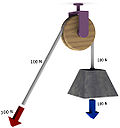
The mechanical advantage of a pulley system can be analysed using free body diagrams which balance the tension force in the rope with the force of gravity on the load. In an ideal system, the massless and frictionless pulleys do not dissipate energy and allow for a change of direction of a rope that does not stretch or wear. In this case, a force balance on a free body that includes the load, W, and n supporting sections of a rope with tension T, yields:

The ratio of the load to the input tension force is the mechanical advantage MA of the pulley system,[13]
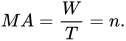
Thus, the mechanical advantage of the system is equal to the number of sections of rope supporting the load.

Belt and pulley systems

[edit]
Flat belt on a crowned belt pulley
Belt and pulley system
Cone pulley driven from above by a line shaft

A belt and pulley system is characterized by two or more pulleys in common to a belt. This allows for mechanical power, torque, and speed to be transmitted across axles. If the pulleys are of differing diameters, a mechanical advantage is realized.

A belt drive is analogous to that of a chain drive; however, a belt sheave may be smooth (devoid of discrete interlocking members as would be found on a chain sprocket, spur gear, or timing belt) so that the mechanical advantage is approximately given by the ratio of the pitch diameter of the sheaves only, not fixed exactly by the ratio of teeth as with gears and sprockets.

In the case of a drum-style pulley, without a groove or flanges, the pulley often is slightly convex to keep the flat belt centered. It is referred to as a 'crowned' pulley. Though once widely used on factory line shafts, this type of pulley is still found driving the rotating brush in upright vacuum cleaners, in belt sanders and bandsaws.[14] Agricultural tractors built up to the early 1950s generally had a belt pulley for a flat belt (which is what Belt Pulley magazine was named after). It has been replaced by other mechanisms with more flexibility in methods of use, such as power take-off and hydraulics.

Just as the diameters of gears (and, correspondingly, their number of teeth) determine a gear ratio and thus the speed increases or reductions and the mechanical advantage that they can deliver, the diameters of pulleys determine those same factors. Cone pulleys and step pulleys (which operate on the same principle, although the names tend to be applied to flat belt versions and V-belt versions, respectively) are a way to provide multiple drive ratios in a belt-and-pulley system that can be shifted as needed, just as a transmission provides this function with a gear train that can be shifted. V-belt step pulleys are the most common way that drill presses deliver a range of spindle speeds.

With belts and pulleys, friction is one of the most important forces. Some uses for belts and pulleys involve peculiar angles (leading to bad belt tracking and possibly slipping the belt off the pulley) or low belt-tension environments, causing unnecessary slippage of the belt and hence extra wear to the belt. To solve this, pulleys are sometimes lagged. Lagging is the term used to describe the application of a coating, cover or wearing surface with various textured patterns which is sometimes applied to pulley shells. Lagging is often applied in order to extend the life of the shell by providing a replaceable wearing surface or to improve the friction between the belt and the pulley. Notably drive pulleys are often rubber lagged (coated with a rubber friction layer) for exactly this reason.[15] Applying powdered rosin to the belt may increase the friction temporarily, but may shorten the life of the belt.[16]

See also

[edit]
  • Block (sailing) – Sailing term; single or multiple pulley
  • Conveyor pulley
  • Deadeye – Item used in rigging of sailing ships
  • Differential pulley – Self-balancing mechanical lifting hoist
  • Eccentric (mechanism) – Circular disk rigidly fixed to a rotating axle with its center offset from that of the axle
  • Hoist – Device used for lifting or lowering a load
  • Portsmouth Block Mills – Building in Portsmouth, Hampshire, England
  • Reel – Device used to store elongated and flexible objects
  • Slickline – Single strand wire which is used to run tools into wellbore
  • V-belt – Method of connecting two rotating shafts or pulleys
  • Wireline (cabling) – Technology used in oil and gas wells

References

[edit]
[edit]
Revisions and contributorsEdit on WikipediaRead on Wikipedia
from Grokipedia
A pulley is a simple machine consisting of a wheel mounted on an axle, featuring a grooved rim designed to hold and guide a rope, cable, chain, or belt along its circumference. It is one of the six classical simple machines identified by ancient Greek philosophers. It operates by supporting the movement and redirecting the tension in the flexible element, enabling the lifting of heavy loads, transmission of rotational power, and alteration of the direction of an applied force with reduced effort compared to direct pulling. Pulleys are categorized into three primary types based on their configuration and mechanical advantage: fixed pulleys, which are anchored in place and primarily change force direction without amplifying it (mechanical advantage of 1); movable pulleys, which attach to the load and move with it to halve the required input force (mechanical advantage of 2); and compound pulleys (or block-and-tackle systems), which combine fixed and movable pulleys to achieve higher mechanical advantages, often multiplying force several times for complex lifting tasks. The origins of the pulley trace back to ancient civilizations, with the earliest known examples appearing in during (circa 2686–2181 BCE), where stone artifacts with grooves from sites like suggest use for lifting heavy loads in , though their interpretation as true pulleys remains debated among scholars. Greek polymath advanced the technology in the 3rd century BCE by developing the compound pulley and describing its principles in works like On the Equilibrium of Planes, enabling more efficient heavy lifting for military and engineering purposes. In contemporary applications, pulleys form integral parts of mechanical systems worldwide, including cranes and hoists for , conveyor belts in , timing belts in engines, and mechanisms, where they optimize distribution, reduce , and enhance and efficiency in load handling. Modern designs often incorporate materials like , , or composites and may include bearings to minimize loss, reflecting ongoing innovations in .

Fundamentals

Definition and Components

A pulley is a consisting of a mounted on an or shaft, designed to support the movement of and change the direction of a cable, , belt, or other flexible tension member. It is one of the six classical s, alongside the , , , , and , which operate on basic mechanical principles to transform input forces. The grooved rim of the , known as the sheave, guides the tension member while allowing it to slide or rotate with minimal . The primary components of a pulley include the sheave, which is the rotating with a circumferential groove; the or shaft that supports the sheave and enables its ; the frame or block, a structural that secures the and mounts the pulley to a fixed point or load; and the tension member, such as a , wire cable, or belt, that transmits through the . These elements work together to facilitate redirection or amplification, with the block often enclosing one or more sheaves in compound arrangements. Pulleys are classified into three basic types based on their configuration and function: fixed, movable, and compound. A fixed pulley remains stationary, attached to a support structure, and serves mainly to alter the direction of the pulling force without providing . In contrast, a movable pulley is attached to the load itself and moves along with it, doubling the effective force applied by the tension member to achieve . A compound pulley integrates multiple fixed and movable pulleys into a single system, multiplying the beyond that of a single movable pulley. The word "pulley" derives from the Middle English "puly" or "poley," borrowed from "poulie" or "polie," which in turn stems from "polea" or "polidia," likely a form of the Greek "pólos" meaning axis or pivot. This reflects the device's core function around a rotating axis. Unlike , which transfer power through interlocking teeth for direct mechanical engagement, pulleys rely on frictional tension in a flexible member to transmit motion and force between separated components.

Mechanical Advantage Basics

Mechanical advantage in pulley systems refers to the ratio of the output (load) to the input (effort), quantifying how the system amplifies to lift or move loads more easily. In an ideal single fixed pulley, where the pulley is attached to a and the rope passes over it, the ideal (IMA) is 1, as the tension in the remains the same on both sides, providing no amplification but allowing a change in the direction of the applied . Conversely, a single movable pulley, attached to the load and supporting it via the looped through it, yields an IMA of 2, since the load is supported by two segments of , each carrying equal tension, effectively halving the required input . For more complex pulley systems, the IMA is generally equal to the number of strands supporting the load, assuming ideal conditions. These ideal models rely on key assumptions: negligible in the pulleys and along the , massless pulleys and ropes to avoid additional inertial effects, and inextensible ropes that do not stretch under load. Under these conditions, the velocity —the of the distance moved by the effort to the distance moved by the load—equals the IMA, reflecting without losses. For instance, in an ideal movable pulley setup lifting a 100 N load, the input force required is 50 N, as the two supporting segments each bear half the load. This foundational principle underscores the force-multiplying capability of pulleys in simple configurations. The ideal IMA\text{IMA} for a single fixed pulley is given by: IMA=1\text{IMA} = 1 For a single movable pulley: IMA=2\text{IMA} = 2 In general, for pulley systems: IMA=n\text{IMA} = n where nn is the number of supporting rope strands.

History

Ancient and Classical Origins

The earliest archaeological evidence for the use of pulleys appears in during the Middle Kingdom, around 2000 BCE, where depictions and artifacts suggest their application in for lifting heavy stones. Two basalt artifacts, discovered by Selim Hassan in the 1930s at the Pyramid City at and dating to the , have been reinterpreted as early pulley mechanisms for hoisting materials in pyramid building. A 2025 analysis by Steven Tasker reinterprets these as functional pulleys, potentially the earliest known examples worldwide. In , parallel developments emerged by approximately 1500 BCE, with textual records from Sumerian sources describing rope-and-pulley systems for hoisting water and loads in and . These innovations facilitated early urban projects, such as ziggurats, by allowing efficient lifting without advanced . Similarly, in ancient during the Western (c. 200 BCE), bamboo-based pulley systems were employed for drawing water from wells, integrating flexible poles and ropes to manage depths up to several meters, as evidenced in pottery models and texts on hydraulic works. During the classical Greek period, the pulley gained theoretical and practical refinement. , in the pseudo-Aristotelian Mechanical Problems (4th century BCE), described pulleys as devices that multiply force by distributing weight across multiple ropes, enabling the lifting of heavy loads with reduced effort, as seen in examples of compound setups where additional pulleys amplify intuitively. (c. 287–212 BCE) advanced this further by inventing compound pulley systems, which combined multiple wheels to achieve greater leverage, and integrated them with his screw pump for enhanced water-lifting applications in and . A famous , recounted by , illustrates using such pulleys in Syracuse to single-handedly launch a large ship that required hundreds of men, demonstrating the device's potential to rival manpower. In the Roman era, detailed pulley applications in (1st century BCE), particularly in Book 10, where he explains hoisting machines with multiple pulleys for cranes used in aqueduct and temple construction, allowing precise elevation of massive stones. He also notes their use in theaters for scenery lifts via trapdoors and counterweights, enhancing dramatic effects in public venues. These classical contributions underscored the pulley's cultural significance, enabling monumental feats like the Egyptian pyramids—where early systems aided stone placement without engines—and Roman aqueducts, which spanned valleys using pulley-assisted quarrying and assembly to transport water over hundreds of kilometers.

Modern Developments

During the , advanced pulley designs through detailed sketches in his codices, including and systems for hoisting and , as well as early mechanisms that complemented rope-based pulleys. These innovations, documented in works like the Codex Madrid I, emphasized efficient load distribution and motion control, influencing subsequent engineering applications. In the 17th and 18th centuries, theoretical advancements in mechanics by figures such as Robert Hooke and Christiaan Huygens laid groundwork for understanding pulley dynamics within broader principles of motion and elasticity, though their direct contributions focused on related areas like springs and rational mechanics. Concurrently, block and tackle systems became integral to naval rigging by the early 1600s, enabling sailors to manage heavy sails and cannons on warships through multiple sheaves and ropes for mechanical advantage. These configurations, often handmade from wood, were standardized in shipbuilding practices by the late 17th century, enhancing maritime efficiency. The marked a pivotal shift with the integration of power into pulley systems, particularly in factories. James Watt's improved engines, patented in the , drove rotary motion via belts and pulleys, powering textile mills and enabling scalable production; by 1789, such engines were installed in cotton mills like those in , standardizing for machinery. This transformed rope-and-pulley setups from manual to automated operations, boosting output in industries like . In the 19th and early 20th centuries, material innovations enhanced pulley load capacities, notably Wilhelm Albert's 1834 invention of twisted , which replaced ropes in hoists and increased durability for heavy lifting. Safety advancements followed, exemplified by Otis's 1854 safety brake for elevators, which integrated with pulley-driven cables to prevent falls if ropes failed, establishing standards that influenced building codes and urban infrastructure post-1850s. This era also saw a transition from to belt systems, with early 19th-century belts evolving from rope drives to transmit power more reliably in machinery, reducing slippage and enabling continuous operation in factories.

Rope and Pulley Systems

Block and Tackle Configurations

A block and tackle is a mechanical system comprising multiple pulleys grouped into fixed and movable blocks, interconnected by a rope reeved through their sheaves to multiply the applied force for lifting heavy loads. The core components consist of the upper fixed block, which is anchored to a stationary support like a ceiling beam or crane arm; the lower movable block, secured directly to the load; and the rope, often endless or with ends for pulling and securing, that threads through the grooved sheaves within each block to guide and distribute tension. Basic configurations vary by the number of sheaves and reeving patterns to achieve different levels of . The single whip setup features one fixed block and one movable block, each with a single sheave, where is attached to the fixed block, passes down to the movable block, around its sheave, and up to the pulling point, yielding an ideal (IMA) of 2. In contrast, the double whip configuration incorporates two sheaves per block, with reeved to create four supporting strands under the load, providing an IMA of 4 for more demanding lifts. Gin tackle variants typically pair a double block (two sheaves) with a triple block (three sheaves), reeved in patterns that produce an IMA ranging from 3 to 6, depending on whether the end of is fixed to the upper or lower block. These configurations provide significantly higher IMA than simple fixed or movable pulleys alone, enabling efficient handling of substantial weights in scenarios such as elevating on ships or positioning materials in cranes. systems build upon basic pulley principles by integrating multiple units into structured blocks for enhanced force multiplication without requiring excessive pulling effort. Historically, such systems were standardized during the in maritime applications for hoisting masts and , with innovations like the facilitating of wooden pulley blocks for the Royal Navy's fleet.

Method of Operation

In rope and pulley systems, known as , the operational sequence begins with the rope being reeved, or threaded, through the sheaves (grooved wheels) of the pulleys mounted in the upper fixed block and the lower movable block attached to the load. When force is applied to the free end of the rope, tension is created and distributed evenly across all supporting strands between the blocks, causing the movable block to rise and lift the load. This process assumes ideal conditions with no or slippage, allowing the system to function smoothly as the rope travels over the sheaves. Fixed pulleys in the upper block primarily redirect the direction of the applied —for instance, enabling a downward pull by the operator to produce an upward lift of the load—while movable pulleys in the lower block contribute to by effectively halving the required per supporting strand compared to a single fixed pulley setup. In a typical configuration with multiple pulleys, this combination allows the load to be elevated progressively as the rope is pulled, with the direction change facilitating ergonomic operation from ground level. Pulling methods vary by load size and context; for lighter loads, hand-hauling involves manual pulling of the rope end, while heavier applications employ mechanical aids such as winches, which wind the rope onto a , or capstans, rotating drums that grip and haul the rope through friction. The speed at which the rope is pulled determines the load's ascent rate, where the load's ascent rate equals the rope speed divided by the system's ideal (the number of supporting strands). Safety considerations emphasize even distribution of the load across all strands to prevent uneven tension that could cause slippage or ; this is particularly critical in staged applications, such as lifting heavy , where systems are often operated in incremental stages to maintain control. For example, in a system with four supporting strands, pulling 10 meters of results in the load being lifted 2.5 meters, illustrating the distance trade-off inherent in the operation.

Free Body Diagrams and Calculations

In the ideal case of a frictionless pulley system, free body diagrams (FBDs) illustrate the forces acting on each component, with the tension TT being uniform throughout all segments of the due to the inextensible nature of the and the assumption of massless, frictionless pulleys. For a simple movable pulley supporting a load WW, the FBD depicts two upward tension vectors TT acting on the pulley and a downward weight vector WW representing the load; in static equilibrium, the vector sum yields 2TW=02T - W = 0, so T=W/2T = W/2. This relation derives directly from Newton's second law applied to the pulley, where the is zero (F=ma=0\sum F = ma = 0) for equilibrium, balancing the tensions against the load. Real-world rope pulley systems deviate from ideality due to , requiring consideration of in FBDs and calculations. The actual mechanical advantage (AMA) is given by AMA=loadeffort=IMA×η\text{AMA} = \frac{\text{load}}{\text{effort}} = \text{IMA} \times \eta, where IMA is the ideal mechanical advantage (number of supporting segments) and η\eta is the system . η\eta accounts for energy losses primarily from bearing at the and bending over the sheave, typically ranging from 70% to 90% for systems depending on pulley quality and load. For instance, a system with IMA = 4 and η=80%\eta = 80\% yields AMA = 3.2, meaning the effort force is about 31% higher than the ideal W/4W/4 due to frictional losses. A simplified model for per-pulley incorporates as η=1μθ\eta = 1 - \mu \theta, where μ\mu is the coefficient of (e.g., between and sheave or and bearing) and θ\theta is the wrap in radians; overall system is the product of individual pulley efficiencies. For multi-block systems like , advanced FBDs reveal differential tensions across rope segments when is included, as each sheave introduces losses that reduce tension downstream. In such diagrams, upward and downward tensions on fixed and movable blocks differ slightly, with vectors adjusted for frictional components tangential to the sheave; for example, the tension supporting the load may be marginally higher than the effort-side tension to overcome cumulative drag. Under dynamic loads, FBDs must incorporate the pulley's and rotational , adding a downward weight mgmg on the pulley body and torque equations τ=Iα\tau = I \alpha (where II is the moment of inertia and α\alpha is ) to account for acceleration effects, ensuring Newton's second law is applied translationally and rotationally.

Belt and Pulley Systems

Principles of Operation

Belt and pulley systems transmit rotational power between shafts using a continuous loop of flexible that wraps around two or more pulleys, with motion and transferred from the driver pulley—powered by an external source—to the driven pulley through surface or positive meshing in toothed configurations. This setup enables efficient over varying distances without direct mechanical contact between shafts, differing from linear rope-based systems that focus on directional redirection for lifting. The belt's continuous motion ensures steady , with developed proportionally to the tension differential across the belt spans. The speed relationship between pulleys follows the inverse proportion of their diameters, such that the angular speed of the driven pulley ω2\omega_2 equals the driver pulley's speed ω1\omega_1 multiplied by the ratio of driver diameter d1d_1 to driven diameter d2d_2: ω2=ω1d1d2\omega_2 = \omega_1 \frac{d_1}{d_2}. Under ideal no-slip conditions, mechanical power remains conserved, expressed as P=τ1ω1=τ2ω2P = \tau_1 \omega_1 = \tau_2 \omega_2, where τ\tau denotes and ω\omega ; this conservation highlights the system's efficiency in converting input rotation to output at adjusted speeds and torques. Tension in the belt varies dynamically during operation, with the tight side maintaining higher tension T1T_1 to pull the driven pulley and the slack side exhibiting lower tension T2T_2 as it returns to the driver. The effective driving force arises from this difference, yielding τ=(T1T2)r\tau = (T_1 - T_2) r on each pulley, where rr is the pulley radius; this net tangential force sustains rotational motion against load resistance. To prevent slippage, which would degrade transmission efficiency, the belt relies on frictional adhesion governed by the coefficient of μ\mu between belt and pulley surfaces. The limiting tension ratio before gross slip occurs is quantified by Euler's formula: T1T2=eμϕ\frac{T_1}{T_2} = e^{\mu \phi}, where ϕ\phi is the contact or wrap angle in radians; this exponential relation emerges from integrating the differential equilibrium of infinitesimal belt elements, balancing normal , , and tension changes along the arc. Operational configurations adapt the belt layout to shaft geometry and desired rotation direction. In an open belt drive, the belt connects parallel shafts without crossing, causing both pulleys to rotate in the same direction while minimizing wear through straight-line spans. A crossed belt drive introduces a full twist in the belt for parallel shafts, reversing the driven pulley's rotation but increasing internal rubbing and potential fatigue. Quarter-twist variants, featuring a 90-degree belt twist, accommodate non-parallel or perpendicular shafts, enabling flexible layouts in compact machinery while maintaining torque transfer principles.

Types of Belts and Pulleys

Belt drives have evolved significantly since the , when flat belts made from or hide were predominant for low-speed in early industrial machinery. These materials provided basic flexibility and but were limited by stretching and degradation. Post-1940s advancements introduced synthetic polymers, leading to rubber-based composites that enhanced durability, reduced elongation, and improved heat resistance, enabling higher performance in modern applications. Common belt types include flat belts, V-belts, timing belts, and serpentine belts, each designed for specific operational needs in power transmission. Flat belts, typically constructed from layered leather, fabric, or early rubber composites, traditionally operate on low-speed drives up to about 10-15 m/s and rely on broad surface contact for friction-based power transfer, though modern flat belts can achieve 80-100 m/s. Their simplicity suits legacy systems, but they require precise alignment to prevent slippage. V-belts feature a trapezoidal, wedge-shaped cross-section that wedges into pulley grooves, providing higher grip and efficiency for moderate to high-power applications; made from rubber reinforced with fabric or cords, they exhibit low elongation (typically under 2%) and good heat resistance up to 80°C, supporting speeds up to 50 m/s. Timing belts, also known as synchronous belts, incorporate teeth along their length for positive engagement, ensuring no-slip operation in precision drives; composed of rubber with fiberglass or steel cords, they minimize backlash and handle high torque with excellent resistance to temperatures from -30°C to 100°C. Serpentine belts, or multi-ribbed belts, combine flat profiles with longitudinal V-shaped ribs for driving multiple accessories simultaneously; fabricated from durable rubber-fabric composites, they offer flexibility and reduced bending stress, ideal for compact layouts in automotive and machinery systems. Cogged variants of V-belts and others feature notches on the inner surface to increase flexibility, reduce heat buildup during flexing, and enhance performance in high-torque scenarios. Pulley designs are tailored to match belt profiles for optimal contact and longevity. Flat-faced pulleys, often made of or for durability, accommodate flat belts and provide even distribution. For V-belts, sheaved or grooved pulleys with angles of 34° to 40°—per ANSI/RMA IP-20 standards—secure the belt's wedging action, with groove depth and width varying by belt section (e.g., shallower for smaller diameters to maintain tension). Timing belts pair with sprocket-like pulleys featuring matching toothed profiles to precisely, preventing relative motion and supporting high-precision timing. Serpentine belts use multi-groove pulleys with 6 to 12 ribs, typically crowned for self-centering. Idler pulleys, plain or grooved depending on the belt type, serve as non-driven components for tensioning and routing, often with bearings to minimize and . Pulley materials prioritize strength and low deformation, with preferred for high-speed or heavy-load conditions due to superior resistance. Selection of belts and pulleys hinges on , operational speed, and environmental factors to ensure efficiency and service life. determines belt cross-section and quantity, with V-belts handling up to 500 kW in multi-belt setups based on and service factors (e.g., 1.2–1.4 for variable loads). Speed influences choice, as flat belts suit low velocities while V-belts excel up to 50 m/s, and timing belts maintain synchrony at high RPMs. Environmental considerations include resistance (e.g., EPDM compounds for >100°C exposure), chemical/oil resistance for industrial settings, and minimal elongation (<1.5% under load) to avoid retensioning; cogged designs are favored for pulsating or high- environments to mitigate slippage. Matching pulley to belt type—minimum typically 5-15 times belt thickness (or per standards like 63 mm for 3V section)—prevents excessive flexing and generation.

Applications and Innovations

Traditional and Industrial Uses

Pulleys have played a pivotal role in , particularly through cranes and hoists employing systems to elevate heavy materials during the erection of . In the 1930s of the , derricks and hoists utilizing pulley arrangements lifted steel beams and other components to unprecedented heights, enabling the rapid assembly of the 102-story structure. These systems reduced the force required for lifting by distributing loads across multiple ropes, a principle rooted in but scaled for industrial demands. In maritime applications, rope pulleys formed the backbone of sail rigging and cargo handling on historical sailing ships. Tackle systems, consisting of ropes rove through pulley blocks, facilitated the adjustment of yards and sails as well as the hoisting of heavy cargo such as bales and casks, as exemplified by the extensive cordage on vessels like the Cutty Sark, which featured 11 miles of rope integrated with pulleys. Boat falls, another pulley-based setup, allowed for the controlled lowering and raising of ship's boats, enhancing operational efficiency at sea. Early steamships also incorporated belt drives connected to pulleys to power auxiliary equipment like pumps, drawing from 19th-century industrial practices where steam engines transmitted motion via leather belts to maintain vessel functionality. Manufacturing in the relied heavily on belt and pulley systems to distribute power from central engines to machinery such as lathes and mills. Line shafts suspended overhead connected to individual machines via belts looped over pulleys, enabling synchronized operation in factories and workshops. This setup, prevalent during the , allowed for efficient without individual motors, powering mills and tools alike. Rope pulley elevators further supported operations, using hand-operated pull-rope systems to transport goods vertically in multi-story storage facilities. Agricultural practices historically employed pulleys for tasks like drawing from wells and handling hay in balers. Simple fixed pulleys at wellheads redirected rope force to lift buckets, a method dating back centuries and essential for in rural settings. In hay operations, pulley systems integrated into barn carriers and trolleys hoisted loads from wagons to lofts, with devices like the Louden hay pulley facilitating the movement of bales in early 20th-century farms. Belt-driven conveyor systems with pulleys also emerged for handling, transporting harvested crops efficiently in mills and storage facilities. Everyday applications of pulleys include simple fixed types in window blinds, where pulling a cord raises or lowers slats via a pulley mechanism mounted at the top. Flagpoles utilize fixed pulleys to hoist flags, changing the direction of pull for ease of use. Garage doors often incorporate counterweight ropes over pulleys to balance the panel's weight, allowing smooth manual operation. Pulley systems demonstrate versatility in load handling, from household scales of around 1 kg in simple fixed setups like blinds to over 100 tons in industrial cranes equipped with multi-pulley blocks. This range underscores their adaptability across traditional and industrial contexts, where mechanical advantage scales with configuration complexity.

Contemporary Engineering Advances

In the realm of , pulley systems have evolved with the integration of sensors and regenerative technologies, particularly in vertical transportation. Smart elevators employ sensor-equipped pulleys and drives that monitor load, speed, and position in real-time, enabling and optimized operation. Regenerative drives in these systems recapture braking energy and feed it back to the building's power grid, achieving energy savings of up to 30-35% compared to traditional setups. In , compound pulley configurations enhance precision and in arm mechanisms; cable-driven robotic arms utilize tendon-like pulley systems for lightweight, flexible motion transmission, allowing backdrivability and reduced in tasks such as assembly or manipulation. Advancements in materials have focused on durability and weight reduction for high-performance applications. Carbon fiber composite pulleys offer superior strength-to-weight ratios, making them ideal for lightweight unmanned aerial vehicles (drones) where minimizing mass improves flight efficiency and payload capacity. In renewable energy, self-lubricating bearings integrated into pulley assemblies for wind turbine yaw and rotor systems eliminate the need for frequent maintenance, reducing downtime and operational costs in harsh offshore environments by providing low-friction, corrosion-resistant performance. The automotive sector has seen pulley innovations tailored to and efficiency. Serpentine belt systems in internal combustion and hybrid vehicles incorporate automatic tensioners to maintain optimal belt tension under varying loads from accessories like alternators and pumps, ensuring reliable power transfer without slippage. Continuously variable transmissions (CVTs) rely on pulley variators—conical sheaves that adjust diameter via hydraulic or —to enable seamless, gearless shifting, improving economy by 5-10% in hybrid and conventional powertrains. In , cable-pulley mechanisms remain critical for flight control actuation, with refined designs in modern using lightweight alloys and composites for flap deployment, allowing precise aerodynamic adjustments during . For , the Canadarm2 on the incorporates pulley-like tensioners in its cable-driven joints to manage microgravity maneuvers, supporting tasks like module assembly with minimal energy input. Sustainability efforts emphasize eco-friendly materials and energy-optimizing designs. Recyclable synthetic belts, often made from elastomers, replace traditional rubber in pulley systems, reducing environmental impact through easier end-of-life processing while maintaining tensile strength. Pulley-based actuators in solar trackers dynamically adjust panel angles to follow the sun's path, boosting capture by up to 25% in photovoltaic arrays. A key milestone since the 2010s is the adoption of 3D-printed custom pulleys, enabling of complex geometries for applications, from bespoke drone components to prototypes, with materials like or carbon-filled filaments ensuring functional durability. As of 2025, industrial pulley systems are increasingly incorporating (IoT) sensors for real-time monitoring and , enhancing reliability in conveyor and lifting operations.

References

Add your contribution
Related Hubs
User Avatar
No comments yet.