Hubbry Logo
Abraham–Lorentz forceAbraham–Lorentz forceMain
Open search
Abraham–Lorentz force
Community hub
Abraham–Lorentz force
logo
7 pages, 0 posts
0 subscribers
Be the first to start a discussion here.
Abraham–Lorentz force
from Wikipedia

In the physics of electromagnetism, the Abraham–Lorentz force (also known as the Lorentz–Abraham force) is the reaction force on an accelerating charged particle caused by the particle emitting electromagnetic radiation by self-interaction. It is also called the radiation reaction force, the radiation damping force,[1] or the self-force.[2] It is named after the physicists Max Abraham and Hendrik Lorentz.

The formula, although predating the theory of special relativity, was initially calculated for non-relativistic velocity approximations. It was extended to arbitrary velocities by Max Abraham and was shown to be physically consistent by George Adolphus Schott. The non-relativistic form is called Lorentz self-force while the relativistic version is called the Lorentz–Dirac force or collectively known as Abraham–Lorentz–Dirac force.[3] The equations are in the domain of classical physics, not quantum physics, and therefore may not be valid at distances of roughly the Compton wavelength or below.[4] There are, however, two analogs of the formula that are both fully quantum and relativistic: one is called the "Abraham–Lorentz–Dirac–Langevin equation",[5] the other is the self-force on a moving mirror.[6]

The force is proportional to the square of the object's charge, multiplied by the jerk that it is experiencing. (Jerk is the rate of change of acceleration.) The force points in the direction of the jerk. For example, in a cyclotron, where the jerk points opposite to the velocity, the radiation reaction is directed opposite to the velocity of the particle, providing a braking action. The Abraham–Lorentz force is the source of the radiation resistance of a radio antenna radiating radio waves.

There are pathological solutions of the Abraham–Lorentz–Dirac equation in which a particle accelerates in advance of the application of a force, so-called pre-acceleration solutions. Since this would represent an effect occurring before its cause (retrocausality), some theories have speculated that the equation allows signals to travel backward in time, thus challenging the physical principle of causality. One resolution of this problem was discussed by Arthur D. Yaghjian[7] and was further discussed by Fritz Rohrlich[4] and Rodrigo Medina.[8] Furthermore, some authors argue that a radiation reaction force is unnecessary, introducing a corresponding stress-energy tensor that naturally conserves energy and momentum in Minkowski space and other suitable spacetimes.[9]

Definition and description

[edit]

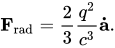
The Lorentz self-force derived for non-relativistic velocity approximation , is given in SI units by: or in Gaussian units by where is the force, is the derivative of acceleration, or the third derivative of displacement, also called jerk, μ0 is the magnetic constant, ε0 is the electric constant, c is the speed of light in free space, and q is the electric charge of the particle.


Physically, an accelerating charge emits radiation (according to the Larmor formula), which carries momentum away from the charge. Since momentum is conserved, the charge is pushed in the direction opposite the direction of the emitted radiation. In fact the formula above for radiation force can be derived from the Larmor formula, as shown below.

The Abraham–Lorentz force, a generalization of Lorentz self-force for arbitrary velocities is given by:[10][11]

Where is the Lorentz factor associated with , the velocity of particle. The formula is consistent with special relativity and reduces to Lorentz's self-force expression for low velocity limit.

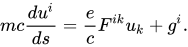
The covariant form of radiation reaction deduced by Dirac for arbitrary shape of elementary charges is found to be:[12][13]

History

[edit]

The first calculation of electromagnetic radiation energy due to current was given by George Francis FitzGerald in 1883, in which radiation resistance appears.[14] However, dipole antenna experiments by Heinrich Hertz made a bigger impact and gathered commentary by Poincaré on the amortissement or damping of the oscillator due to the emission of radiation.[15][16][17] Qualitative discussions surrounding damping effects of radiation emitted by accelerating charges was sparked by Henri Poincaré in 1891.[18][19] In 1892, Hendrik Lorentz derived the self-interaction force of charges for low velocities but did not relate it to radiation losses.[20] Suggestion of a relationship between radiation energy loss and self-force was first made by Max Planck.[21] Planck's concept of the damping force, which did not assume any particular shape for elementary charged particles, was applied by Max Abraham to find the radiation resistance of an antenna in 1898, which remains the most practical application of the phenomenon.[22]

In the early 1900s, Abraham formulated a generalization of the Lorentz self-force to arbitrary velocities, the physical consistency of which was later shown by George Adolphus Schott.[10][23][24] Schott was able to derive the Abraham equation and attributed "acceleration energy" to be the source of energy of the electromagnetic radiation. Originally submitted as an essay for the 1908 Adams Prize, he won the competition and had the essay published as a book in 1912. The relationship between self-force and radiation reaction became well-established at this point.[25] Wolfgang Pauli first obtained the covariant form of the radiation reaction[26][27] and in 1938, Paul Dirac found that the equation of motion of charged particles, without assuming the shape of the particle, contained Abraham's formula within reasonable approximations. The equations derived by Dirac are considered exact within the limits of classical theory.[12]

Background

[edit]

In classical electrodynamics, problems are typically divided into two classes:

  1. Problems in which the charge and current sources of fields are specified and the fields are calculated, and
  2. The reverse situation, problems in which the fields are specified and the motion of particles are calculated.

In some fields of physics, such as plasma physics and the calculation of transport coefficients (conductivity, diffusivity, etc.), the fields generated by the sources and the motion of the sources are solved self-consistently. In such cases, however, the motion of a selected source is calculated in response to fields generated by all other sources. Rarely is the motion of a particle (source) due to the fields generated by that same particle calculated. The reason for this is twofold:

  1. Neglect of the "self-fields" usually leads to answers that are accurate enough for many applications, and
  2. Inclusion of self-fields leads to problems in physics such as renormalization, some of which are still unsolved, that relate to the very nature of matter and energy.

These conceptual problems created by self-fields are highlighted in a standard graduate text. [Jackson]

The difficulties presented by this problem touch one of the most fundamental aspects of physics, the nature of the elementary particle. Although partial solutions, workable within limited areas, can be given, the basic problem remains unsolved. One might hope that the transition from classical to quantum-mechanical treatments would remove the difficulties. While there is still hope that this may eventually occur, the present quantum-mechanical discussions are beset with even more elaborate troubles than the classical ones. It is one of the triumphs of comparatively recent years (~ 1948–1950) that the concepts of Lorentz covariance and gauge invariance were exploited sufficiently cleverly to circumvent these difficulties in quantum electrodynamics and so allow the calculation of very small radiative effects to extremely high precision, in full agreement with experiment. From a fundamental point of view, however, the difficulties remain.

The Abraham–Lorentz force is the result of the most fundamental calculation of the effect of self-generated fields. It arises from the observation that accelerating charges emit radiation. The Abraham–Lorentz force is the average force that an accelerating charged particle feels in the recoil from the emission of radiation. The introduction of quantum effects leads one to quantum electrodynamics. The self-fields in quantum electrodynamics generate a finite number of infinities in the calculations that can be removed by the process of renormalization. This has led to a theory that is able to make the most accurate predictions that humans have made to date. (See precision tests of QED.) The renormalization process fails, however, when applied to the gravitational force. The infinities in that case are infinite in number, which causes the failure of renormalization. Therefore, general relativity has an unsolved self-field problem. String theory and loop quantum gravity are current attempts to resolve this problem, formally called the problem of radiation reaction or the problem of self-force.

Derivation

[edit]

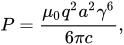
The simplest derivation for the self-force is found for periodic motion from the Larmor formula for the power radiated from a point charge that moves with velocity much lower than that of speed of light:
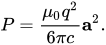
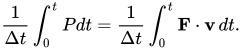
If we assume the motion of a charged particle is periodic, then the average work done on the particle by the Abraham–Lorentz force is the negative of the Larmor power integrated over one period from to :

The above expression can be integrated by parts. If we assume that there is periodic motion, the boundary term in the integral by parts disappears:

Clearly, we can identify the Lorentz self-force equation which is applicable to slow moving particles as: A more rigorous derivation, which does not require periodic motion, was found using an effective field theory formulation.[28][29]
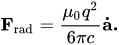
A generalized equation for arbitrary velocities was formulated by Max Abraham, which is found to be consistent with special relativity. An alternative derivation, making use of theory of relativity which was well established at that time, was found by Dirac without any assumption of the shape of the charged particle.[3]

Signals from the future

[edit]

Below is an illustration of how a classical analysis can lead to surprising results. The classical theory can be seen to challenge standard pictures of causality, thus signaling either a breakdown or a need for extension of the theory. In this case the extension is to quantum mechanics and its relativistic counterpart quantum field theory. See the quote from Rohrlich[4] in the introduction concerning "the importance of obeying the validity limits of a physical theory".

For a particle in an external force , we have where

This equation can be integrated once to obtain

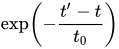
The integral extends from the present to infinitely far in the future. Thus future values of the force affect the acceleration of the particle in the present. The future values are weighted by the factor which falls off rapidly for times greater than in the future. Therefore, signals from an interval approximately into the future affect the acceleration in the present. For an electron, this time is approximately sec, which is the time it takes for a light wave to travel across the "size" of an electron, the classical electron radius. One way to define this "size" is as follows: it is (up to some constant factor) the distance such that two electrons placed at rest at a distance apart and allowed to fly apart, would have sufficient energy to reach half the speed of light. In other words, it forms the length (or time, or energy) scale where something as light as an electron would be fully relativistic. It is worth noting that this expression does not involve the Planck constant at all, so although it indicates something is wrong at this length scale, it does not directly relate to quantum uncertainty, or to the frequency–energy relation of a photon. Although it is common in quantum mechanics to treat as a "classical limit", some[who?] speculate that even the classical theory needs renormalization, no matter how the Planck constant would be fixed.
Abraham–Lorentz–Dirac force

[edit]

To find the relativistic generalization, Dirac renormalized the mass in the equation of motion with the Abraham–Lorentz force in 1938. This renormalized equation of motion is called the Abraham–Lorentz–Dirac equation of motion.[12][30]

Definition

[edit]

The expression derived by Dirac is given in signature (− + + +) by[12][13]

With Liénard's relativistic generalization of Larmor's formula in the co-moving frame, one can show this to be a valid force by manipulating the time average equation for power:
Paradoxes

[edit]

Pre-acceleration

[edit]

Similar to the non-relativistic case, there are pathological solutions using the Abraham–Lorentz–Dirac equation that anticipate a change in the external force and according to which the particle accelerates in advance of the application of a force, so-called preacceleration solutions. One resolution of this problem was discussed by Yaghjian,[7] and is further discussed by Rohrlich[4] and Medina.[8]

Runaway solutions

[edit]

Runaway solutions are solutions to ALD equations that suggest the force on objects will increase exponentially over time. They are considered unphysical.

Hyperbolic motion

[edit]

The ALD equations are known to be zero for constant acceleration or hyperbolic motion in Minkowski spacetime diagram. The subject of whether in such condition electromagnetic radiation exists was matter of debate until Fritz Rohrlich resolved the problem by showing that hyperbolically moving charges do emit radiation. Subsequently, the issue is discussed in context of energy conservation and equivalence principle which is classically resolved by considering "acceleration energy" or Schott energy.

Self-interactions

[edit]

However the antidamping mechanism resulting from the Abraham–Lorentz force can be compensated by other nonlinear terms, which are frequently disregarded in the expansions of the retarded Liénard–Wiechert potential.[4]

Landau–Lifshitz radiation damping force

[edit]

The Abraham–Lorentz–Dirac force leads to some pathological solutions. In order to avoid this, Lev Landau and Evgeny Lifshitz came with the following formula for radiation damping force, which is valid when the radiation damping force is small compared with the Lorentz force in some frame of reference (assuming it exists),[31]

so that the equation of motion of the charge in an external field can be written as

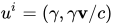
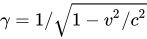
Here is the four-velocity of the particle, is the Lorentz factor and is the three-dimensional velocity vector. The three-dimensional Landau–Lifshitz radiation damping force can be written as
where is the total derivative.

Experimental observations

[edit]

While the Abraham–Lorentz force is largely neglected for many experimental considerations, it gains importance for plasmonic excitations in larger nanoparticles due to large local field enhancements. Radiation damping acts as a limiting factor for the plasmonic excitations in surface-enhanced Raman scattering.[32] The damping force was shown to broaden surface plasmon resonances in gold nanoparticles, nanorods and clusters.[33][34][35]

The effects of radiation damping on nuclear magnetic resonance were also observed by Nicolaas Bloembergen and Robert Pound, who reported its dominance over spin–spin and spin–lattice relaxation mechanisms for certain cases.[36]

The Abraham–Lorentz force has been observed in the semiclassical regime in experiments which involve the scattering of a relativistic beam of electrons with a high intensity laser.[37][38] In the experiments, a supersonic jet of helium gas is intercepted by a high-intensity (1018–1020 W/cm2) laser. The laser ionizes the helium gas and accelerates the electrons via what is known as the "laser-wakefield" effect. A second high-intensity laser beam is then propagated counter to this accelerated electron beam. In a small number of cases, inverse-Compton scattering occurs between the photons and the electron beam, and the spectra of the scattered electrons and photons are measured. The photon spectra are then compared with spectra calculated from Monte Carlo simulations that use either the QED or classical LL equations of motion.

Collective effects

[edit]

The effects of radiation reaction are often considered within the framework of single-particle dynamics. However, interesting phenomena arise when a collection of charged particles is subjected to strong electromagnetic fields, such as in a plasma. In such scenarios, the collective behavior of the plasma can significantly modify its properties due to radiation reaction effects. Theoretical studies have shown that in environments with strong magnetic fields, like those found around pulsars and magnetars, radiation reaction cooling can alter the collective dynamics of the plasma. This modification can lead to instabilities within the plasma.[39][40][41] Specifically, in the high magnetic fields typical of these astrophysical objects, the momentum distribution of particles is bunched and becomes anisotropic due to radiation reaction forces, potentially driving plasma instabilities and affecting overall plasma behavior. Among these instabilities, the firehose instability[39] can arise due to the anisotropic pressure, and electron cyclotron maser due to population inversion in the rings.[42]


Radiation Reaction without the Abraham-Lorentz force

[edit]

An alternate mechanism for radiation reaction on a point charge accelerated by an external force, is that the charge's increase in energy is diminished by the energy carried away by electromagnetic radiation.[43] This reduces the particle's acceleration without an additional force, and the paradoxes it causes are not there.


See also

[edit]

References

[edit]

Further reading

[edit]
[edit]
Revisions and contributorsEdit on WikipediaRead on Wikipedia
from Grokipedia
The Abraham–Lorentz force is the self-force experienced by an accelerating as a recoil effect from the it emits, also referred to as the radiation reaction force or radiation damping force. It arises from the particle's interaction with its own and accounts for the and lost through . In classical electrodynamics, this force modifies the particle's equation of motion, leading to damping of oscillatory or accelerated trajectories. Named after physicists Max Abraham and , who independently derived its non-relativistic form in the early 1900s, the force is fundamentally tied to the for radiated power, P=μ0q2a26πcP = \frac{\mu_0 q^2 a^2}{6\pi c}, where qq is the particle's charge, aa its magnitude, cc the , and μ0\mu_0 the . By equating the work done by the reaction force to this power loss, the non-relativistic Abraham–Lorentz force emerges as FAL=μ0q26πca˙\mathbf{F}_{AL} = \frac{\mu_0 q^2}{6\pi c} \dot{\mathbf{a}}, where a˙\dot{\mathbf{a}} denotes the time derivative of the (jerk). This results in the equation of motion ma=Fext+FALm \mathbf{a} = \mathbf{F}_{\rm ext} + \mathbf{F}_{AL}, with mm the particle and Fext\mathbf{F}_{\rm ext} the external force. The relativistic extension, known as the Abraham–Lorentz–Dirac force, incorporates four-acceleration and is given in covariant form within the Lorentz–Abraham–Dirac equation, addressing motions near the speed of light. Despite its foundational role in describing self-interaction in electrodynamics, the force is notorious for mathematical pathologies, including runaway solutions (unbounded acceleration after external forces cease) and pre-acceleration (motion beginning before the external force is applied), which challenge causality and stability. These issues have prompted approximations, such as the Landau–Lifshitz equation, which replaces the problematic jerk term with derivatives of the external force to ensure physical behavior in practical applications like particle accelerators. The concept remains central to bridging classical and quantum electrodynamics, influencing studies of radiation reaction in high-energy physics.

Introduction and Fundamentals

Definition

The Abraham–Lorentz force, also known as the radiation reaction force, is a self-force acting on a non-relativistic due to its own , arising from the interaction with the it radiates. In classical electrodynamics, it is mathematically expressed in SI units as FAL=μ0q26πcv¨,\mathbf{F}_{AL} = \frac{\mu_0 q^2}{6\pi c} \ddot{\mathbf{v}}, where μ0\mu_0 is the , qq is the charge of the particle, cc is the in , v\mathbf{v} is the of the particle, and the double dot denotes the second time derivative (jerk). This force was first formulated by Max Abraham in 1903 and independently derived by shortly thereafter. Conceptually, the Abraham–Lorentz force represents the back-reaction on the accelerating charge from the it emits, as predicted by the for radiated power. This self-interaction leads to a effect that opposes the change in , effectively accounting for the lost to radiation in the particle's dynamics. In terms of units, the Abraham–Lorentz force has dimensions of force, measured in newtons (kg·m/s²) in SI units, consistent with its role within the framework of classical electrodynamics where it supplements the standard from external fields. The enters of motion for the as an additional term, modifying Newton's second to [m]˙(/page/MDot)v=Fext+FAL[m \dot](/page/M-Dot){\mathbf{v}} = \mathbf{F}_{\rm ext} + \mathbf{F}_{AL}, where mm is the of the particle and Fext\mathbf{F}_{\rm ext} represents external forces. This inclusion ensures that the radiative loss is properly incorporated into the particle's .

Physical Interpretation

The Abraham–Lorentz can be physically interpreted as the negative rate of change of the electromagnetic stored in the electromagnetic field generated by the accelerating charge, ensuring overall conservation in the system. This arises because the accelerating charge produces that carries away from the field, exerting a back-reaction on the particle itself, expressed as FAL=dpfielddt\mathbf{F}_{AL} = -\frac{d\mathbf{p}_{\text{field}}}{dt}. This force connects directly to the energy lost through , as quantified by the for the power radiated by a non-relativistic accelerating charge: P=μ0q2a26πcP = \frac{\mu_0 q^2 a^2}{6\pi c}, where qq is the charge, a=v˙a = |\dot{\mathbf{v}}| is the magnitude of the , μ0\mu_0 is the , and cc is the . The resulting force acts like a frictional damping mechanism, opposing the motion and dissipating the particle's into electromagnetic waves, thereby reducing the net power available for acceleration. Unlike conventional , which depends on , the Abraham–Lorentz force is proportional to , or the time of (v¨\ddot{\mathbf{v}}), reflecting the dynamic adjustment of the self-field to changes in the charge's motion rather than steady-state drag. This dependence highlights its origin in the transient process, where the force emerges from the field's response to rapid variations in . Qualitatively, the force leads to damping of oscillatory or periodic motions in charged particles, gradually slowing their trajectories as energy is radiated away; for instance, in from charges in circular orbits, it manifests as a reduction in beam intensity over time due to this energy loss.

Historical Context

Early Concepts of Radiation Reaction

The discovery of the in 1897 by J. J. Thomson marked a pivotal moment in , raising fundamental questions about the stability of charged particles during acceleration. Thomson's experiments with demonstrated that these rays consisted of negatively charged corpuscles much smaller than atoms, implying that electrons could orbit or move in ways that might lead to continuous emission. This prompted early inquiries into how such particles could remain stable without spiraling into atomic nuclei due to energy loss via radiation. Building on these ideas, Thomson's earlier 1881 work laid groundwork for understanding the self-interaction of charged particles. In his analysis of the electromagnetic fields produced by moving electrified bodies, Thomson introduced the concept of , arising from the of the surrounding a charged sphere. He calculated this mass as proportional to the charge squared divided by the radius times the squared, suggesting that part of a particle's could be electromagnetic in origin. This perspective highlighted potential reactive effects on accelerating charges, though Thomson did not yet address radiation reaction explicitly. By 1900, conceptual challenges intensified with point-charge models, which predicted infinite self-energy due to the divergence of the electrostatic field at the charge's location. This infinity posed problems for the stability and dynamics of electrons, as the unbounded self-interaction could imply catastrophic instability under acceleration. Precursors to the Abraham–Lorentz force emerged in discussions of these issues, emphasizing the need for a back-reaction mechanism to account for energy carried away by radiation. , in his 1900 examination of Lorentz's electron theory, recognized a reaction force akin to the four-current's self-interaction, advocating for radiation damping to ensure electron stability and prevent perpetual energy loss in oscillatory motion. Poincaré's insights underscored the necessity of such damping for consistent electrodynamics, where accelerating charges would otherwise radiate uncontrollably. These early ideas were supported by tools like the , derived in 1897, which quantified the power radiated by an accelerating non-relativistic charge and illustrated the scale of energy loss motivating self-force considerations.

Formulation by Abraham and Lorentz

In the early 1900s, Max Abraham and independently developed formulations for the self-force acting on an accelerating charged particle, now known as the Abraham–Lorentz force, to address the stability of electrons in electromagnetic fields. Both researchers sought to reconcile classical electrodynamics with the observed behavior of charged particles, building on earlier ideas of radiation damping without fully resolving the underlying paradoxes. Max Abraham introduced his version in his 1903 paper "Prinzipien der Dynamik des Elektrons," published in . In this work, Abraham analyzed the dynamics of an as a rigid charged , initially considering a velocity-dependent self-force that arose from the interaction of the particle with its own . He evolved this to an acceleration-based term, recognizing it as a reaction to the energy lost via , which helped explain the of oscillatory motions in electrons. Independently, presented his formulation in 1904 within the article "Weiterbildung der Maxwellschen Theorie. Elektronentheorie," part of the Encyklopädie der Mathematischen Wissenschaften. Lorentz derived the self-force from considerations of the momentum carried by the surrounding the accelerating charge, explicitly obtaining the jerk term 23e2c3v¨\frac{2}{3} \frac{e^2}{c^3} \ddot{\mathbf{v}} (in cgs units), where ee is the charge, cc is the , and v¨\ddot{\mathbf{v}} is the time of . This term represented the back-reaction force opposing rapid changes in the particle's acceleration, aimed at stabilizing the model against runaway disintegration in accelerating fields. The formulations by Abraham and Lorentz were initially received as a necessary correction to Newton's second law for charged particles, providing a mechanism for losses without contradicting . Their non-relativistic expressions were recognized as equivalent, both yielding the same leading-order effect for low velocities, which facilitated their adoption in early despite ongoing debates about the electron's structure.

Theoretical Foundations

Larmor Radiation Formula

The Larmor radiation formula provides the total power radiated by a non-relativistic point charge undergoing , serving as a for understanding electromagnetic loss in classical electrodynamics. Derived in the late , it quantifies the energy carried away by electromagnetic waves generated due to the time-varying of the accelerating charge. This radiation arises from the acceleration-induced changes in the charge's , which propagate outward as transverse waves. The derivation begins by considering the fields produced by a point charge qq with acceleration a\mathbf{a} in the non-relativistic limit, where the velocity vcv \ll c (). In the instantaneous of the charge, the radiated in the far zone (at rλr \gg \lambda, where λ\lambda is the ) is approximately Eθq4πϵ0c2sinθra\mathbf{E}_\theta \approx -\frac{q}{4\pi \epsilon_0 c^2} \frac{\sin\theta}{r} a, with θ\theta the angle between the vector and the ; the corresponding is Bϕ1cEθ\mathbf{B}_\phi \approx \frac{1}{c} E_\theta. The , representing the energy flux, is then S=1μ0E×B\mathbf{S} = \frac{1}{\mu_0} \mathbf{E} \times \mathbf{B}, yielding a radial component Srq2a2sin2θ16π2ϵ0c3r2S_r \approx \frac{q^2 a^2 \sin^2\theta}{16\pi^2 \epsilon_0 c^3 r^2}. To obtain the total power, integrate the flux over a of rr: P=Srr2dΩ=μ0q2a26πcP = \oint S_r \, r^2 d\Omega = \frac{\mu_0 q^2 a^2}{6\pi c}, where the angular sin2θdΩ=8π3\int \sin^2\theta \, d\Omega = \frac{8\pi}{3} accounts for the sin2θ\sin^2\theta dependence. This assumes a point-like charge with no external fields distorting the isotropic in the non-relativistic regime. Key assumptions underlying the formula include the non-relativistic approximation (vcv \ll c), ensuring retardation effects are negligible except in the far field, and treatment of the charge as an ideal point source without internal structure or higher multipole contributions dominating. The physical basis lies in the acceleration causing a time-dependent dipole moment p=qr(t)\mathbf{p} = q \mathbf{r}(t), whose second time derivative p¨qa\ddot{\mathbf{p}} \propto q \mathbf{a} sources the radiating fields via Maxwell's equations. For an oscillating charge, such as in atomic models, this leads to continuous energy dissipation proportional to a2a^2. In applications, the enables calculation of total radiated over a motion as ΔE=Pdt=μ0q26πca2dt\Delta E = \int P \, dt = \frac{\mu_0 q^2}{6\pi c} \int a^2 \, dt, highlighting the loss that necessitates a back-reaction on the charge to conserve in accelerated systems. This deficit motivates the inclusion of radiation reaction terms in , linking radiation power directly to self- effects.

Energy Conservation in Accelerating Charges

In classical electrodynamics, an accelerating radiates electromagnetic according to the , leading to a total radiated of Pdt\int P \, dt, where PP is the instantaneous power. Without a radiation reaction , the equation of motion mv˙=Fextm \dot{\mathbf{v}} = \mathbf{F}_{\text{ext}} implies that the work done by the external entirely converts to kinetic , failing to account for the radiated loss and thus violating . Similarly, the electromagnetic fields associated with the accelerating charge carry , creating an imbalance in the total system . For slowly moving charges, the field can be approximated as pfield23q2c2v˙\mathbf{p}_{\text{field}} \approx \frac{2}{3} \frac{q^2}{c^2} \dot{\mathbf{v}}, necessitating a back-reaction on the particle to restore conservation. This radiation reaction ensures that the total of the particle plus fields remains consistent with the external applied. Max Abraham introduced the concept of a in relativistic electrodynamics to incorporate both mechanical and electromagnetic contributions, ensuring the of the equations under Lorentz transformations. This framework addresses the energy-momentum conservation challenges in accelerating systems by treating the radiation reaction as part of a unified structure. Later, emphasized the importance of such conservation in the fully relativistic context, deriving equations that balance radiated energy and momentum losses.

Derivation

Non-Relativistic Derivation

The non-relativistic Abraham–Lorentz force arises from the self-interaction of an accelerating with its own , computed using the law applied to the retarded fields produced by the particle itself. This approach treats the particle as a point charge and calculates the net force by integrating F=q(E+v×B)\mathbf{F} = q (\mathbf{E} + \mathbf{v} \times \mathbf{B}) over the self-generated fields, where the fields are evaluated at positions and times retarded by the light-travel time from the particle's past trajectory. The derivation relies on the Liénard–Wiechert potentials for the fields in the non-relativistic limit vcv \ll c, expanding them in a around the retarded time to isolate the radiation reaction contribution. Key assumptions include treating the charge as point-like (with regularization via a small extended model like a dumbbell to avoid singularities), neglecting any absorption or re-emission of the field by the particle, and ignoring quasi-static (near-zone) field contributions that would otherwise dominate but symmetrize to zero net force. In this limit, the magnetic field term v×B\mathbf{v} \times \mathbf{B} is of higher order in v/cv/c and can be neglected compared to the electric field term, simplifying the force to approximately qEselfq \mathbf{E}_{\text{self}}. The electric field is expanded as E(r,t)=n=0(1)nn!(Rc)nnE0tn\mathbf{E}(\mathbf{r}, t) = \sum_{n=0}^{\infty} \frac{(-1)^n}{n!} \left( \frac{R}{c} \right)^n \frac{\partial^n \mathbf{E}_0}{\partial t^n}, where E0\mathbf{E}_0 is the instantaneous field and RR is the distance from the retarded position; the n=0n=0 (Coulomb) and n=1n=1 (linear acceleration) terms integrate to zero due to symmetry over the charge distribution, leaving the n=2n=2 term as the leading radiation reaction effect. This term is proportional to the rate of change of the acceleration (jerk, v...\dddot{\mathbf{v}}), stemming from the asymmetric radiation field that carries momentum away from the particle. Performing the integration and retaining only the radiation term yields the self-force F=23q24πϵ0c3v...\mathbf{F} = \frac{2}{3} \frac{q^2}{4\pi \epsilon_0 c^3} \dddot{\mathbf{v}} in SI units, where the coefficient derives from the angular integration of the field's momentum flux, consistent with the for radiated power. This expression can be rewritten as F=mτv...\mathbf{F} = m \tau \dddot{\mathbf{v}}, with the characteristic time τ=μ0q26πmc\tau = \frac{\mu_0 q^2}{6\pi m c}, which quantifies the scale of damping relative to the particle's inertial response. The result aligns with the foundational equation of the Abraham–Lorentz force, confirming the due to emitted in the non-relativistic regime.

Relativistic Extension

The relativistic extension of the Abraham–Lorentz force addresses the limitations of the non-relativistic formulation by incorporating , transforming the three-dimensional vector expression into a form that remains invariant under Lorentz transformations. This generalization employs the τ\tau along the particle's worldline and the aμ=duμdτa^\mu = \frac{du^\mu}{d\tau}, where uμu^\mu is the satisfying uμuμ=c2u^\mu u_\mu = c^2. The resulting self-force acts as the rate of change of the mechanical due to the particle's own . The derivation begins with the relativistic electromagnetic fields generated by the accelerating charge, computed using the Liénard–Wiechert potentials, which account for retardation effects in the scalar and vector potentials. The self-force is obtained by evaluating these fields at the particle's position, excluding the singular contribution, and integrating the density over an infinitesimal worldtube around the trajectory. This yields the four-vector self-force Fμ=μ0q26πc(a˙μaνaνuμc2),F^\mu = \frac{\mu_0 q^2}{6\pi c} \left( \dot{a}^\mu - a^\nu a_\nu \frac{u^\mu}{c^2} \right), where the dot denotes differentiation with respect to (a˙μ=daμdτ\dot{a}^\mu = \frac{da^\mu}{d\tau}) and summation over repeated indices is implied in with (+,,,)(+,-,-,-). A key challenge in this formulation is ensuring the self-force is orthogonal to the , Fμuμ=0F^\mu u_\mu = 0, which follows from the structure of the electromagnetic energy-momentum conservation and implies that the radiation reaction does not alter the particle's rest mass. This orthogonality is verified by contracting the expression with uμu^\mu, leveraging the relations uμaμ=0u^\mu a_\mu = 0 and its proper-time derivative uμa˙μ+aμaμ=0u^\mu \dot{a}_\mu + a^\mu a_\mu = 0. Historically, Max Abraham attempted this relativistic generalization in using early forms of the Liénard–Wiechert fields, but his expression included inconsistencies in the handling of higher-order terms. refined these efforts in subsequent works, correcting aspects of the velocity-dependent damping, yet the full covariant and consistent derivation awaited Paul Dirac's 1938 analysis, which resolved issues and established the equation's invariance. In the non-relativistic limit as v0v \to 0, the four-vector form reduces to the original Abraham–Lorentz force F=μ0q26πca˙\mathbf{F} = \frac{\mu_0 q^2}{6\pi c} \dot{\mathbf{a}}, where a=dv/dt\mathbf{a} = d\mathbf{v}/dt is the three-acceleration.

The Abraham–Lorentz–Dirac Force

Definition and Equation

The Abraham–Lorentz–Dirac (ALD) force represents the relativistic radiation reaction force acting on a due to its own emitted , incorporated into the covariant equation of motion for the particle. In , the equation of motion is given by maμ=Fextμ+2q23c3(a˙μ+1c2(aνaν)uμ),m a^\mu = F_{\mathrm{ext}}^\mu + \frac{2 q^2}{3 c^3} \left( \dot{a}^\mu + \frac{1}{c^2} (a^\nu a_\nu) u^\mu \right), where mm is the particle's rest mass, aμa^\mu is its four-acceleration, a˙μ=daμ/dτ\dot{a}^\mu = da^\mu/d\tau is the four-jerk (with τ\tau the proper time), uμu^\mu is the four-velocity, qq is the particle's charge, cc is the speed of light, and FextμF_{\mathrm{ext}}^\mu is the external four-force (typically the Lorentz force from external fields). This formulation is expressed in Gaussian cgs units, where the factor 2q23c3\frac{2 q^2}{3 c^3} ensures the equation's Lorentz covariance under the Minkowski metric. The ALD self-force term decomposes into two distinct components: the Schott term 2q23c3a˙μ\frac{2 q^2}{3 c^3} \dot{a}^\mu, which depends on the jerk and accounts for the reversible energy-momentum exchange between the particle and its near , and the radiation term 2q23c5(aνaν)uμ\frac{2 q^2}{3 c^5} (a^\nu a_\nu) u^\mu, equivalently expressed as 2q2a23c5uμ-\frac{2 q^2 a^2}{3 c^5} u^\mu with a2=aνaν>0a^2 = -a^\nu a_\nu > 0 (in the metric signature ++---), capturing the irreversible power loss due to as per the relativistic generalization of the Larmor formula. In this equation, the total four-force on the particle is the sum of the external four-force and the ALD self-force, providing a complete relativistic description of the dynamics for an accelerating point charge while preserving four-momentum conservation when integrated over the system's electromagnetic fields.

Key Differences from Non-Relativistic Version

The Abraham–Lorentz–Dirac (ALD) force represents the relativistic generalization of the non-relativistic Abraham–Lorentz (AL) force, reducing to the latter in the limit where the particle velocity vcv \ll c. In this non-relativistic regime, the ALD equation simplifies to FAL=2e23c3a˙\mathbf{F}_{AL} = \frac{2 e^2}{3 c^3} \dot{\mathbf{a}}, where a\mathbf{a} is the and the overdot denotes the derivative with respect to τ\tau, capturing the radiation reaction as a damping force proportional to the jerk a˙\dot{\mathbf{a}}. However, even in this limit, the full ALD formulation retains a velocity-dependent radiation term that is negligible but absent in the original AL expression, arising from relativistic corrections that become prominent at higher speeds. A key relativistic feature of the ALD force is the additional term 2e23c3aνaνc2uμ\frac{2 e^2}{3 c^3} \frac{a^\nu a_\nu}{c^2} u^\mu, where uμu^\mu is the four-velocity and aνa^\nu is the four-acceleration, which accounts for the enhanced power radiated by the accelerating charge according to the relativistic Larmor formula. This term ensures that the radiation reaction aligns with the total radiated power Pγ6a2P \propto \gamma^6 a^2 in the ultra-relativistic limit (γ1\gamma \gg 1) for acceleration perpendicular to the velocity, where γ=(1v2/c2)1/2\gamma = (1 - v^2/c^2)^{-1/2} is the Lorentz factor, reflecting the dramatic increase in radiation due to relativistic beaming and time dilation effects. In contrast, the non-relativistic AL force only approximates the Larmor power P=2e2a23c3P = \frac{2 e^2 a^2}{3 c^3} without such velocity amplification. The ALD force also incorporates an orthogonality condition, Γμuμ=0\Gamma^\mu u_\mu = 0, where Γμ\Gamma^\mu is the , ensuring that the radiation reaction does not alter the particle's rest mass or introduce spurious dilation effects. This covariant structure contrasts with naive relativistic extensions of the AL force, which might violate four-momentum conservation by allowing components parallel to uμu^\mu. Consequently, the ALD formulation achieves superior energy-momentum balance in , as the work done by the radiation reaction force, combined with the "Schott energy" term 2e23c3av\frac{2 e^2}{3 c^3} \mathbf{a} \cdot \mathbf{v}, exactly matches the radiated energy loss, resolving inconsistencies present in the non-relativistic case. However, this refinement exacerbates acausality issues, such as pre-acceleration, where the particle begins accelerating before the external field arrives, a problem less apparent in the slower, non-relativistic AL dynamics.

Paradoxes

Pre-Acceleration Effect

The pre-acceleration effect in the Abraham–Lorentz force arises from the presence of the jerk term v¨\ddot{\mathbf{v}} in the radiation reaction force FAL=mτv¨\mathbf{F}_{AL} = m \tau \ddot{\mathbf{v}}, where τ=2e23mc3\tau = \frac{2 e^2}{3 m c^3} is the characteristic . This term leads to solutions of the equation of motion where the particle's begins to change before the application of an external force, anticipating the field by a duration on the order of τ1023\tau \approx 10^{-23} s for an . This acausal behavior was first identified by Dirac as a significant flaw in the classical radiation reaction model. In his analysis, Dirac noted that the equation of motion "has the defect that it leads to a pre-acceleration of the ," where "the electron begins to move before the force is applied." A clear mathematical illustration occurs when considering a sudden application of a constant external force FextF_{\text{ext}} at t=0t = 0, modeled via the simplified one-dimensional equation v˙=Fextm+τv¨\dot{v} = \frac{F_{\text{ext}}}{m} + \tau \ddot{v}. The general solution involves an integral over future force values, yielding acausal transients: for Fext/m=f0θ(t)F_{\text{ext}}/m = f_0 \theta(t) (where θ(t)\theta(t) is the ), the velocity exhibits an exponential rise v(t)et/τv(t) \propto e^{t/\tau} for t<0t < 0, building up before the force turns on and violating causality.

Runaway Solutions

Runaway solutions emerge in the Abraham–Lorentz equation when considering the homogeneous case without external forces, where the equation simplifies to mv˙=2q23c3v¨m \dot{\mathbf{v}} = \frac{2 q^2}{3 c^3} \ddot{\mathbf{v}}. The general solution for the velocity takes the form v(t)=v0+Aiet/τi\mathbf{v}(t) = \mathbf{v}_0 + \sum A_i e^{t / \tau_i}, featuring terms with exponential growth that cause the particle's acceleration and velocity to increase unboundedly over time. Here, the characteristic time scale τ=2q23mc3\tau = \frac{2 q^2}{3 m c^3} is extremely small, on the order of 102310^{-23} seconds for an electron, amplifying the rapid onset of this instability. These runaway behaviors are physically absurd because they imply that the particle gains infinite kinetic energy without any external input, directly violating energy conservation principles in classical electrodynamics. The solutions' dependence on initial conditions is particularly problematic; even minuscule deviations in the initial jerk v˙(0)\dot{\mathbf{v}}(0) can trigger exponential growth, potentially leading to unphysical superluminal speeds within the short τ\tau timescale. Such sensitivity renders the solutions incompatible with observed particle dynamics, where no such spontaneous acceleration occurs. In the relativistic extension provided by the Abraham–Lorentz–Dirac equation, Dirac observed that these runaway solutions persist, manifesting as hyperbolic trajectories where velocity approaches the speed of light exponentially with proper time. He noted that while constant-velocity solutions are physically realizable, the presence of runaways complicates the interpretation, suggesting the need for careful selection of boundary conditions to exclude them, though this does not fully resolve the underlying issues.

Hyperbolic Motion Case

Hyperbolic motion represents a charged particle subject to constant proper acceleration α\alpha, a scenario fundamental to relativistic electrodynamics. The trajectory in Minkowski spacetime is given by x=c2αcosh(ατc),ct=cαsinh(ατc),x = \frac{c^2}{\alpha} \cosh\left( \frac{\alpha \tau}{c} \right), \quad ct = \frac{c}{\alpha} \sinh\left( \frac{\alpha \tau}{c} \right), where τ\tau is the proper time, cc is the , and the motion is hyperbolic with respect to the inertial coordinates (t,x)(t, x). This path corresponds to uniform proper acceleration, often analyzed in to model accelerated observers. In this configuration, the Abraham–Lorentz–Dirac (ALD) force vanishes identically, as the third derivative of the four-velocity is zero for constant proper acceleration. However, the Larmor formula predicts continuous radiation of electromagnetic energy at a rate P=23q2α2c3P = \frac{2}{3} \frac{q^2 \alpha^2}{c^3} (relativistically adjusted), creating an apparent paradox: the particle loses energy to radiation, yet experiences no opposing self-force to account for it in the equation of motion. The general solutions to the ALD equation, being third-order differential equations, inherently include unphysical runaway terms where the particle's velocity grows exponentially without external input, even when attempting to enforce this ostensibly stable trajectory. Achieving the exact hyperbolic path requires meticulously tuned initial conditions that suppress these runaways, typically involving pre-acceleration—where the particle begins accelerating prior to the application of any external force—over a characteristic timescale τ06.3×1024\tau_0 \approx 6.3 \times 10^{-24} s for an electron. The energy balance is maintained through the Schott term in the ALD force, which represents the rate of change of the acceleration-dependent electromagnetic field energy near the particle. For hyperbolic motion, the Schott energy US=23q2c3avγ2U_S = -\frac{2}{3} \frac{q^2}{c^3} \mathbf{a} \cdot \mathbf{v} \gamma^2 (in the non-relativistic limit, extended relativistically) decreases over time, exactly compensating for the radiated energy without altering the mechanical motion. In bounded variants, such as hyperbolic oscillators where the particle follows hyperbolic segments between turning points, the Schott energy oscillates with the motion, leading to periodic exchanges between field and particle energy. Despite this, the total radiation reaction fails to fully balance the radiated power in finite-time implementations without ad hoc interventions, such as truncating pre-acceleration effects or invoking finite particle size to regularize the equations. This case underscores deep paradoxes in the ALD formalism, particularly in Rindler coordinates where the accelerated frame perceives a thermal bath via the Unruh effect, balancing emission and absorption to yield zero net radiation reaction. Such issues are central to relativity thought experiments, including tests of the equivalence principle, as they reveal frame-dependent interpretations of radiation and causality violations inherent to point-particle models.

Resolutions and Alternatives

Self-Force Approaches

Self-force approaches seek to reformulate the interaction of a charged particle with its own electromagnetic field to address the paradoxes arising in the standard Abraham–Lorentz–Dirac equation, such as runaway solutions and pre-acceleration, by focusing on the self-force without explicit reliance on radiation reaction terms. One early method involves renormalization of the self-energy, as proposed by Dirac in 1938. In this approach, the infinite electromagnetic self-energy of a point charge is absorbed into the particle's bare mass, yielding a finite observed mass through the relation m=m0+δmm = m_0 + \delta m, where m0m_0 is the bare mechanical mass and δm\delta m accounts for the divergent field energy. However, while this resolves the energy divergence, it does not eliminate the dynamical paradoxes like acausal behavior in the equation of motion. A related strategy employs a spatial cutoff to regularize the self-field integration, akin to Wilsonian renormalization in quantum field theory. Rohrlich, in his 1965 analysis, advocated integrating the particle's own field only from distances r>τcr > \tau c, where τ=2e23mc3\tau = \frac{2 e^2}{3 m c^3} is the characteristic radiation time scale and cc is the . This exclusion of the near-field region, within the light-travel distance corresponding to τ\tau, removes the singular contributions that lead to acausality, ensuring the self-force depends solely on past and present field configurations. Non-local formulations further extend this by incorporating memory effects from the particle's history. In the 1990s, Ford and O'Connell developed a causal non-local model where the self-force is expressed as an over the particle's past , specifically Fself(t)=2e23c3ta˙(t)e(tt)/τdtτ\mathbf{F}_\text{self}(t) = \frac{2 e^2}{3 c^3} \int_{-\infty}^t \dot{\mathbf{a}}(t') e^{-(t - t') / \tau} \frac{dt'}{\tau}, avoiding any dependence on future states and thereby eliminating runaway solutions and pre-acceleration. This approach treats the radiation reaction as a dissipative effect arising from the retarded interaction with previously emitted fields. These self-force methods preserve by ensuring the force at any instant depends only on prior or current states, offering a physically motivated resolution to the paradoxes at the cost of introducing non-locality, which departs from the instantaneous nature of the standard .

Landau–Lifshitz Approximation

The Landau–Lifshitz approximation addresses the practical challenges of incorporating radiation reaction into the relativistic motion of a by providing a paradox-free alternative to the Abraham–Lorentz–Dirac (ALD) , valid in the regime of weak external fields. This approximation is derived through a perturbative expansion of the ALD under the condition that the external force satisfies Fextmc/τF_{\text{ext}} \ll m c / \tau, where τ=2q2/(3mc3)\tau = 2 q^2 / (3 m c^3) is the characteristic radiation reaction timescale and mm is the particle . In this limit, the problematic third-order term a˙μ\dot{a}^\mu (jerk) in the ALD is iteratively replaced by expressions involving the external FextμνF_{\text{ext}}^{\mu\nu} and its first , reducing the equation to a second-order form that remains solvable without introducing unphysical behaviors. The resulting Landau–Lifshitz equation in covariant 4-vector notation is mu˙μ=eFμνuν+2e23m(uνw˙μuμw˙νuν),m \dot{u}^\mu = e F^{\mu\nu} u_\nu + \frac{2 e^2}{3 m} \left( u_\nu \dot{w}^\mu - u^\mu \dot{w}_\nu u^\nu \right), where uμu^\mu is the 4-velocity, u˙μ\dot{u}^\mu its proper-time derivative, ee the particle charge (q in general notation), FμνF^{\mu\nu} the tensor, and w˙μ=em(uλλFμνuν+emFμνFνλuλ)\dot{w}^\mu = \frac{e}{m} \left( u^\lambda \partial_\lambda F^{\mu\nu} u_\nu + \frac{e}{m} F^{\mu\nu} F_{\nu\lambda} u^\lambda \right) (in units where c = 1). The first additional term accounts for the rate of change of the external field along the particle , while the second captures the leading relativistic correction from the interaction of the external field with the particle's velocity. This form emerges directly from the iterative substitution in the ALD framework, ensuring consistency with the while truncating higher-order terms. Key advantages of the Landau–Lifshitz equation include the elimination of runaway solutions, where particles accelerate indefinitely without external input, and pre-acceleration effects, where motion anticipates applied s—issues inherent to the full ALD equation. By construction, it preserves and locality up to corrections of order v2/c2v^2/c^2, making it suitable for scenarios where the radiation reaction is small compared to the external but non-negligible for energy loss calculations. These properties arise from the perturbative approach, which effectively regularizes the self- without invoking non-local or quantum modifications. Originally formulated in the 1940s by Lev Landau and Evgeny Lifshitz as part of their treatment of classical electrodynamics, the approximation draws conceptual roots from quantum electrodynamic renormalization techniques to handle infinities in self-energy. It finds extensive use in plasma physics for modeling energy dissipation in high-intensity laser-particle interactions and in accelerator beam dynamics to predict radiation damping in storage rings. For instance, numerical implementations of this equation have been employed to simulate electron trajectories in counterpropagating laser pulses, accurately capturing radiation losses without pathological artifacts.

Experimental Evidence

Laboratory Observations

In the late 2010s, experiments involving the collision of ultrarelativistic beams—generated via laser-wakefield acceleration with energies exceeding 500 MeV—with intense laser pulses provided the first direct evidence of radiation reaction effects. These all-optical setups demonstrated measured energy losses and gamma-ray spectra aligning with predictions from the Landau-Lifshitz approximation to within approximately 8-15%, confirming the damping role of the radiation reaction force in extreme electromagnetic fields. Such observations validated classical models for ultrarelativistic s under high intensities (a_0 ≈ 4). Channeling experiments with GeV-scale particles in have offered controlled tests of radiation reaction damping. Investigations building on earlier proposals, such as those exploring deflection and energy loss in bent , culminated in a 2020 experiment at using 50 GeV positrons traversing aligned crystals. The emitted radiation spectra exhibited shifts consistent with classical radiation reaction as described by the Landau-Lifshitz equation, agreeing with theoretical predictions to within 10% and providing a quantitative validation of the self-force effects. Despite these advances, laboratory observations remain largely in the classical regime, where quantum effects like photon emission dominate at laser intensities exceeding 10^{24} W/cm², limiting full tests of the Abraham-Lorentz-Dirac as of 2025. Current experiments achieve partial confirmation via approximations such as Landau-Lifshitz, while issues like runaway solutions and pre-acceleration in the full formulation remain untested directly. Proposed precision measurements, including at facilities like SLAC's FACET-II, aim to probe these effects further in the coming years.

Astrophysical Implications

In pulsar magnetospheres, the Abraham–Lorentz force manifests as radiation reaction damping, which significantly limits the acceleration of electrons in the strong magnetic fields surrounding rapidly rotating neutron stars. This damping reduces the maximum Lorentz factors of electrons to approximately 10810^8 to 10910^9, preventing unbounded acceleration and imposing a natural cutoff on the energy spectrum of emitted radiation. Such effects are evident in observations of pulsar wind nebulae like the , where the emission spectra exhibit cutoffs consistent with radiation reaction limits, as modeled in early theories and refined with the Lorentz-Dirac equation. For cosmic ray electrons propagating through interstellar magnetic fields, the Abraham–Lorentz force accounts for the dominant energy losses via , aligning with observed spectra that show a steepening at high energies due to this damping mechanism. Fermi Large Area Telescope (LAT) measurements from 7 GeV to 1 TeV reveal an electron spectrum shaped by these losses, where the radiation reaction force balances acceleration, producing a cutoff around several TeV that matches theoretical predictions without invoking additional processes. In the environs of black holes, the Abraham–Lorentz force influences dynamics in magnetized accretion disks, where radiation reaction can stabilize otherwise unstable circular orbits by counteracting loss. For electrons orbiting a Schwarzschild in a uniform , the repulsive configuration of the leads to damped oscillations that settle into stable equilibria, with decay times on the order of 10410^4 seconds near supermassive black holes like Sgr A*. This stabilization may regulate particle injection into jets and contribute to the observed quiescence in low-luminosity accretion flows.

Advanced Applications

Collective Radiation Effects

In dense media such as plasmas, the Abraham–Lorentz self-force on an individual is significantly modified by the collective response of the surrounding particles, which screens the particle's and reduces the effective reaction τ\tau. This screening effect arises from the self-consistent interaction between the accelerating charge and the plasma's polarization, altering the propagation and back-reaction of the emitted . Seminal work on the electrodynamics of inhomogeneous plasmas demonstrates how this modification suppresses the long-range components of the self-field, effectively diminishing the magnitude of the compared to conditions. In bunched particle systems, such as relativistic beams, collective radiation effects manifest as coherent emission, leading to that amplifies the overall rate beyond single-particle predictions. For instance, in free-electron lasers (FELs), the synchronized motion of NN electrons within a bunch results in radiation power scaling as N2N^2 times the incoherent single-particle value, enhancing energy extraction and beam deceleration through constructive interference of the fields. This collective enhancement of the Abraham–Lorentz-like is a key driver of FEL performance, where the shared wakefields from the bunch amplify the self-force effects across the ensemble. Anisotropic distributions in multi-particle plasmas, often arising from collective runaway acceleration, can trigger Weibel-like instabilities, where transverse magnetic fluctuations grow due to the interplay of velocity anisotropies and self-generated fields. These instabilities, analogous to the classical Weibel mode but influenced by radiation reaction, lead to filamentation and energy redistribution in the beam or plasma. Particle-in-cell simulations incorporating classical radiation damping show that these collective runaways are partially mitigated by the enhanced damping, preventing unbounded growth in realistic scenarios. Practical examples of these effects appear in high-energy colliders like the (LHC), where coherent (CSR) from bunches induces emittance growth through collective self-fields. These observations highlight the role of collective Abraham–Lorentz mechanisms in limiting beam stability in accelerator environments. The Landau–Lifshitz approximation, when adapted for particle ensembles, provides a perturbative framework for incorporating these collective damping effects without the pathologies of the full Abraham–Lorentz equation.

Modern Formulations Beyond Abraham-Lorentz

In (QED), the radiation reaction force on a arises stochastically from processes such as nonlinear , where the particle undergoes random emissions that alter its . This quantum description, developed by Ritus in , treats the self-interaction as an average over probabilistic emission events, naturally recovering the classical radiation reaction in the limit of low quantum parameter χ1\chi \ll 1, while avoiding the acausal runaway solutions of the Abraham-Lorentz formula through inherent quantum fluctuations. Extensions via simulations in the have demonstrated that these stochastic effects lead to realistic energy damping and in intense fields, with no emergence of unphysical instabilities even at high intensities where χ1\chi \sim 1. Effective field theory (EFT) provides another framework for reformulating radiation reaction by integrating out high-frequency modes along the particle's worldline, yielding a non-local action that encodes the self-force in a causal, unitary manner. Galley's approach uses this worldline EFT to derive the dissipative effects without introducing pre-acceleration artifacts, treating the particle as a point-like source coupled to an effective Lagrangian that resums infinite-order corrections from QED loops. This non-local formulation ensures consistency across scales, bridging classical and quantum regimes by absorbing ultraviolet divergences into , and has been applied to both electromagnetic and gravitational self-forces. The Unruh-DeWitt detector model offers an operational analog for studying radiation reaction in uniformly accelerated frames, such as hyperbolic motion, by modeling the particle as a two-level quantum system interacting with the vacuum field. In this setup, the accelerated detector perceives a thermal bath due to the , leading to excitation rates that align with QED predictions and resolve classical paradoxes like infinite energy loss, as the stochastic absorption-emission balance prevents runaway behaviors. Papers from the have extended this to finite-duration accelerations, showing that the T=a/(2π)T = a / (2\pi), where aa is the , governs without violating . Advances in 2025, including real-time lattice scalar QED simulations of effects in strong-field processes, have explored quantum mechanisms by computing particle trajectories in regimes, demonstrating self-force contributions up to field strengths where classical models fail. These numerical results support the and EFT approaches in high-field QED.

References

Add your contribution
Related Hubs
User Avatar
No comments yet.