Hubbry Logo
Campus radioCampus radioMain
Open search
Campus radio
Community hub
Campus radio
logo
8 pages, 0 posts
0 subscribers
Be the first to start a discussion here.
Campus radio
Campus radio
from Wikipedia

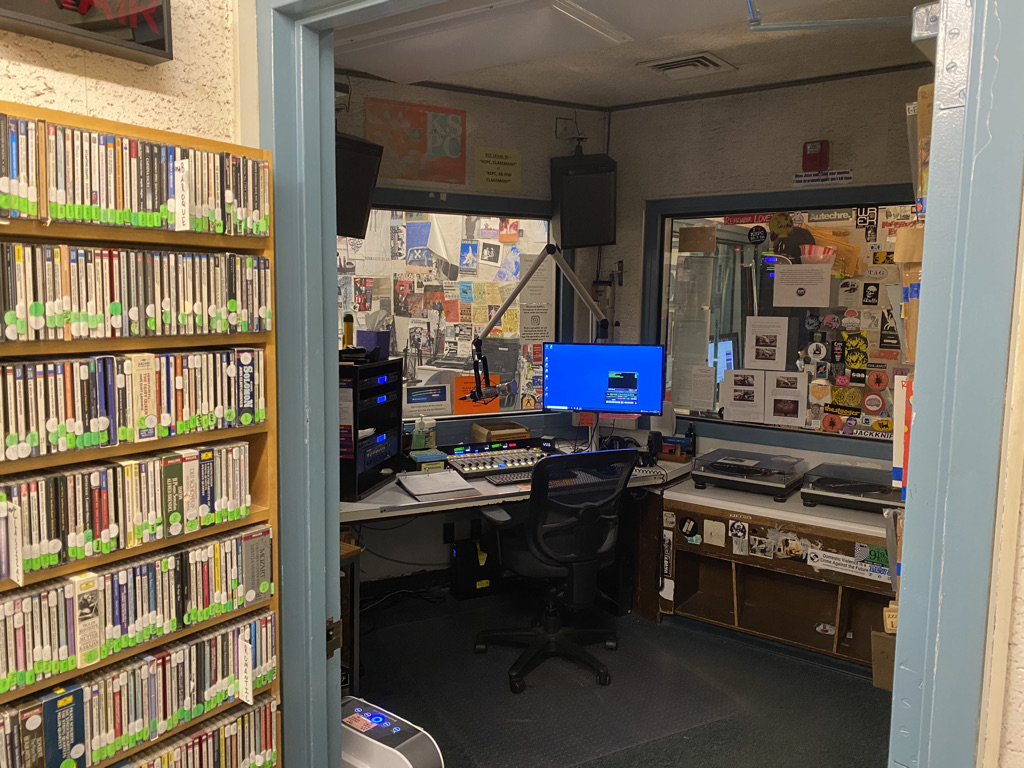
Recording booth at KSPC, a college radio station in Claremont, California

Campus radio (also known as college radio, university radio or student radio) is a type of radio station that is run by the students of a college, university or other educational institution. Programming may be exclusively created or produced by students, or may include program contributions from the local community in which the radio station is based. Sometimes campus radio stations are operated for the purpose of training professional radio personnel, sometimes with the aim of broadcasting educational programming, while other radio stations exist to provide alternative to commercial broadcasting or government broadcasters.

Campus radio stations are generally licensed and regulated by national governments, and have very different characteristics from one country to the next. One commonality between many radio stations regardless of their physical location is a willingness—or, in some countries, even a licensing requirement—to broadcast musical selections that are not categorized as commercial hits. Because of this, campus radio has come to be associated with emerging musical trends, including genres such as punk and new wave, alternative rock, indie rock, underground metal and hip hop, long before those genres become part of the musical mainstream. Campus radio stations also often provide airplay and promotional exposure to new and emerging local artists.

Many campus radio stations carry a variety of programming including news (often local), sports (often relating to the campus), and spoken word programming as well as general music. Often the radio format is best described as a freeform, with much creativity and individualism among the disc jockeys and show hosts. Some of these radio stations have gained critical acclaim for their programming and are considered by the community in which they are embedded to be an essential media outlet.

Transmission

[edit]

While the term campus radio implies full-power AM or FM transmission, a significant number of stations transmit with low-power broadcasting, closed circuit, and carrier current systems, in some cases to on-campus listeners only. Many universities and college stations today also broadcast via the internet, either as an additional outlet for their licensed stations or in lieu of obtaining a government-issued license. In addition, college programming is distributed through local cable television systems on cable FM or on the second audio programs of TV radio stations.

Campus radio around the world

[edit]

Argentina

[edit]

The first (and one of the most popular) campus radio in Argentina's history is LR11 Radio Universidad Nacional de La Plata, which belongs to the Universidad Nacional de La Plata. It was inaugurated on 5 April 1924 as an element of scientific dissemination and university extension, and it is the first university radio station in the world.[1]

The most famous campus/college radio in the country, FM Radio Universidad ("University Radio"), is an Argentine radio station based in the city of Rosario, belonging to the National University of Rosario (UNR). It was created in 1994, and it has a strong focus on programs covering national/international news and current political topics of discussion, as well as AOR musical segments. The station transmits on 103.3 MHz.[2]

Australia

[edit]

Student radio stations generally operate under a community broadcasting licence. Some services, such as 87.8 UCFM Canberra, operate under a narrowcast license, while others broadcast exclusively online.

Australia also once had two radio stations that were operated by universities and dedicated to delivery of course content:[3]

Austria

[edit]
  • Radio Radieschen 91.3 - a campus radio station running a 24/7 program by students of FHWien.
  • Radio Campus - a campus radio station run by students of the University of Vienna.

Bangladesh

[edit]

BU RADiO is the first campus radio station of the University of Barishal in Barishal, Bangladesh.[7] It was founded on 19 May 2019 by a group of students and alumni of the university.[citation needed]

BUET Radio is the first campus radio in Bangladesh among the engineering universities.[8] It was established on 30 October 2015 and is run by the students of the institution.[citation needed]

BRUR Campus Radio is the Campus Online Radio of Begum Rokeya University, Rangpur.[citation needed]

KUET RADIO is a university-based radio station in Khulna University of Engineering & Technology, established in 2016. This station broadcasts campus-based programs and public notices of the administration.[citation needed]

SUSTcast is the campus radio station made for Shahjalal University of Science and Technology.[9][10] It is the first-ever AI-based online campus radio among universities in Bangladesh.[11] SUSTcast, a joint project of RoboSUST, Dept. of CSE, and Team Meow is open for all the students and teachers of Shahjalal University of Science and Technology. Different organizations and teacher-students from the university can perform on this platform regularly.[citation needed]

UAPIANS RADIO is an online-based Radio which is organized by the Students of the University of Asia Pacific.[citation needed]

Belgium

[edit]

Brazil

[edit]

In Brazil, most campus radios operate under an educational radio license, granted by the Ministry of Communications and the National Telecommunications Agency. In Brazil, educational radios are prohibited from broadcast commercial advertising on its programming, except in the form of cultural support. According to the Brazilian Association of Radio and Television Broadcasters (ABERT), in April 2013, Brazil had 466 educational radios.[14]

Brunei Darussalam

[edit]

UBD FM is the first university-based radio station in Brunei Darussalam. The student-run organization operates under the Educational and Technology Center of the Universiti Brunei Darussalam and was established in 2008.

Canada

[edit]

In Canada, radio stations are regulated by the Canadian Radio-television and Telecommunications Commission (CRTC), which provides that "a campus radio station is a radio station owned or controlled by a not-for-profit organization associated with a post-secondary educational institution".[15] The CRTC distinguishes two types of campus radio: instructional (for training of professional broadcasters) and community-based campus (programming provided by volunteers who are not training to be professionals). The community-based radio format is the predominant one, colloquially known as "campus-community radio." In recent years, some community-based campus radio stations, including CFFF-FM in Peterborough and CJMQ-FM in Sherbrooke, have in fact had their CRTC licenses formally reclassified from campus radio to community radio.[16][17]

Campus radio stations broadcasting at full power are assigned a permanent frequency and call letters and, aside from a requirement not to compete directly with commercial radio stations, are full players in the Canadian broadcasting spectrum. Campus radio stations in Canada are more commonly associated with universities than with colleges, although some colleges also have licensed campus radio stations. As well, some institutions maintain unlicensed campus radio operations which broadcast only by closed circuit, cable FM or Internet streaming. Also see United States section for more general information.

Canada's oldest community-based campus radio station is CFRC at Queen's University in Kingston, which has been on the air since 1923; it began as a commercial radio station and a Canadian Broadcasting Corporation affiliate but became the country's first university-owned station in 1942 and fully transitioned to a campus radio station in 1957. CJRT-FM, a campus radio station of the instructional type, has been on air since 1949.

The CRTC places responsibilities upon campus radio stations in Canada through the use of conditions of license that radio stations must follow in order to keep broadcasting. Campus radio stations, for example, are expected to be leaders in the Canadian content system which mandates a minimum number of Canadian musical selections throughout the day. The minimum Canadian content required for a campus station is 35%.[18] Individual programs have their own requirements which depend on a particular program's content category.[19] Generally, for popular music programs (pop, rock, dance, country-oriented, acoustic, and easy listening), hosts must play a minimum of 35% Canadian content. Programs featuring Special Interest Music (concert, folk-oriented, world, blues, jazz, non-classic religious, and experimental) must have at least 12% Canadian content.[19] In early 2005, Humber College's radio station CKHC-FM became the first broadcast radio station in Canada to air 100% Canadian content. Other requirements generally made of campus radio stations include quotas of non-hit, folk, and ethnic musical selections as well as spoken word programming.

Most campus radio stations in Canada are members of the National Campus and Community Radio Association.

On 23 January 2012, the CRTC announced it would be eliminating instructional radio stations.[20]

Denmark

[edit]

There are five student radio stations in Denmark related to the largest universities in Denmark. Only the town of Roskilde has a university and no permanent radio, but every year the five existing student radio stations work together in producing 10 days of radio on the Roskilde festival. The project is a cooperation between all the student radios organized by the cooperation organization called DDS and could be considered a temporary radio station.

The five student radio stations in Denmark are listed below with the city they relate to in Denmark.

All the radios broadcast radio in local frequencies on FM in their related city. XFM actually has two departments one in Copenhagen and one in Lyngby and is the only radio who has two broadcast licenses.

The only one of the radio stations which broadcasts radio directly on campus is Aalborg student radio. As many of the American student radio Aalborg has speaker directly on the university where they can broadcast radio to the students cad Campus Rdio AAU.

France

[edit]

Radio Campus France is a national, non-profit radio broadcasting network grouping 22 public college radio stations located in the largest French cities. Acting as an umbrellas for college radio in French public Universities, it proves that there is strength in numbers, and that music, technology and education are natural bedfellows. Not just a collection of disparate elements, Radio Campus is a vocal leader in the areas of digital broadcasting, keeping tabs on the development of terrestrial radio, as well as developing new network interfaces for radio stations across the nation to share content. With a broad music program, the playlist is powered by the passion of fans, and heralds a modern way for groups to interact in the social web. Whether through their support of regular residency shows from the likes of Beats In Space, or Warp Records, or broadcasting live from Gilles Peterson's Worldwide Festival in Sete, it is the love of the music which connects the listeners, and that makes Radio Campus a unique and special group indeed.

The Radio Campus France radio stations include:

The Confédération des radios de grandes écoles is the national non-profit network unifying 46 internet radios in the Grandes Ecoles, higher education establishments outside the main framework of the French university system, specialised schools spread in more than twenty cities: schools of business, engineering or political science for example. The CRGE represents more than 150 000 students and do reports in the main French international events like the Cannes Films Festival, the Monaco Grand Prix or the Paris Games Week. They have interviewed many CEOs like Xavier Niel, CEO of Free, or politicians, like the new French President François Hollande. They also have links with other campus radios and campus radios network in the world.

The CRGE members are for the Business Schools:

The CRGE Engineering Schools radios includes:

The other member Grandes Ecoles radios are:

Germany

[edit]

Greece

[edit]

PolyteXneio FM is the National Technical University of Athens Students' Radio Station. It is an open student project; its character is strictly non-profit and participation is free for any student of the NTUA.

Guatemala

[edit]
  • Radio Universidad[21]

Hungary

[edit]

Iceland

[edit]
  • Seyðisfjörður Community Radio is an experimental radio station run from the art school LungA School, Seyðisfjörður.[22]

India

[edit]

Community groups in India, and non-governmental organisations (NGOs) have been campaigning for permission to set up community radio (CR) radio stations since the late 1990s.

News, as of November 2006, has it that the India cabinet decided to grant permission to non-profit organizations and educational institutions to set up community radio stations. The cabinet decision will allow civil society and voluntary organizations, state agriculture universities and institutions, Krishi Vigyan Kendras or agricultural science centers, registered societies and autonomous boards, and public trusts registered under Societies Act to start community radio stations. Broadcast Engineering Consultants of India is a government-owned corporation that helps setup of Community FM radio stations in India.

Ravi Shankar Prasad, the then Minister for Information and Broadcasting in the government, told India's upper house of parliament the Rajya Sabha on 22 December 2003, that four organizations including Jammu University and Kashmir University were found ineligible for grant of license as per the laid down guidelines. The minister also ruled out any review of the policy despite limited response to the non-commercial, low-powered FM radio scheme which former information and broadcasting minister Sushma Swaraj had said would "revolutionize" radio broadcast in the country.

Radio enthusiast Alokesh Gupta saying: "The announcement of the Government was to have seen 1000 radio stations by December 2003. Instead administrative wrangling came in the way of implementing the project as colleges spent time running around for licenses and approval from four ministries — Home Affairs, Communications & Information & Broadcasting — as they took their time processing applications."

On 2 February 2004, Anna University in Chennai unveiled the country's first campus radio station, Anna FM. Radio Ujjas in Kutch (in the western state of Gujarat) is one such CR and gets its funding from the United Nations Development Programme (UNDP) and the Central Government. Similarly, a community-based radio programme titled Panchayat Vani (People's Voice) was recently broadcast on All India Radio (AIR), Darbhanga, Bihar. The campus radio station Gyanvaani has also been licensed.

Sam Higginbottom University of Agriculture, Technology and Sciences established a community radio station, Radio Adan (90.4 MHz) in 2008, which brings together experts, students, farmers, and local population, through various popular programmes, focussing on agriculture, education, employment, women empowerment, child marriage, health and culture.[23]

Pune University is the first university in the state of Maharashtra to have an FM radio station. The University of Pune's FM Radio inaugurated on 1 May 2005, has been named as Vidyavani. It covers a wide range of subjects, focusing specifically on the requirements of students of various departments and affiliated colleges. It reaches an area around the campus within eight-km radius.

Unsuccessful attempts have been also made to start CR without obtaining any permission. The small village of Orvakal in Kurnool district of Andhra Pradesh (South India) launched "Mana Radio" (Our Radio) in November 2002. This project run under the aegis of the Society for Elimination of Rural Poverty used a tiny transmitter that covered a radius of half a kilometer to enable rural women members of self-help groups. Four months later, officials from the Central Government brought in police to seize the equipment and declared the broadcasts illegal.

The Government policy to permit educational institutions to have their own FM Channels at low-frequency levels emerged in mid-December 2002, as a result of years of campaigning by activists and a strongly worded Supreme Court judgment directing the opening up of the airwaves.

A unique experiment in using media technologies, especially radio, for development and empowerment of marginalized, rural communities is the community radio initiative "Chalo Ho Gaon Mein" a programme that is broadcast once a week on AIR Daltonganj in the Palamu district of Jharkhand, eastern India. This radio programme is supported by the National Foundation for India and produced by Community representatives, of Alternative for India Development (AID), a non-governmental organization. School of Communication of Manipal also has its own campus radio.

Ravenshaw Radio 90.4 MHz is Odisha state's first campus community radio station (CRS) of Ravenshaw University in Cuttack, Odisha. It started broadcasting in April 2011.

According to the terms of the campus broad license, a number of aspects are disallowed from broadcasts. This includes anything that offends good taste or decency, contains criticism of friendly countries, contains an attack on religion, contains anything obscene, defamatory, false, and suggestive innuendos and half-truths, likely to encourage or incite violence, contains anything affecting the integrity of the nation, criticizes, maligns or slanders any individual in person, encourages superstition or blind belief, denigrates women, denigrates children, or presents or depicts or suggests as desirable the misuse of drugs, alcohol, narcotics, and tobacco.

Indonesia

[edit]

Radio Syiar FM, Universitas Islam Negeri (UIN) Alauddin, Makassar, South Sulawesi, Indonesia.

Is a campus (student) community base radio broadcasting system, originally it has a function as an engineering laboratory to train students in broadcast engineering skills, which are currently being sought to turn into a radio commercial for the students also can improve their skills in terms of broadcast management and broadcast business

Ireland

[edit]

Belfield FM, University College Dublin.

Belfield FM is University College Dublin's student radio station. The station began broadcasting in 1990. It was initially run as a part of the UCD Students' Union, under the remit of the entertainments office, before becoming an independent entity within the Students' Union. Belfield FM disaffiliated with the SU at the end of the 2011/2012 college year, and is now run independently within the UCD Societies Council framework. The station forms part of UCD's 'Student Media Network', along with The University Observer and The College Tribune. The station is run by volunteer staff and contributors, and broadcasts on week-days as well as hosting a coterie of Podcasts on their Mixcloud account. The station has won multiple accolades from the National Student Media Awards, and has an annual 24-hour charity broadcast that has raised funds in aid of organisations such as the Dublin Rape Crisis Centre and the Peter McVerry Trust.

Israel

[edit]

Campus radio also exists in Israel, where several colleges, universities, and high schools have successful programs. One of the most famous is Kol HaCampus (Voice of the Campus/Campus Voice), broadcast out of Tel Aviv on 106 MHz. More information can be found with the Israeli Broadcasting Authority. Another college radio station is the Hebrew University's[24] in Jerusalem, broadcasting mostly indie and alternative music. In 2011 the Technion has joined these universities with a new campus radio station, Radio 1m. In 2017 the students of Sede Boquer Campus of the Ben Gurion University established SB Campus Radio, which function as a podcast network.

Italy

[edit]

Malaysia

[edit]

Mexico

[edit]

New Zealand

[edit]

Nigeria

[edit]

Norway

[edit]

Pakistan

[edit]

Poland

[edit]

Portugal

[edit]

In Portugal, there are several college and university radio stations continuously broadcasting programs. Rádio Universidade de Coimbra and Rádio Universidade Marão, founded in 1986, are the oldest university student radio stations in the country still in operation. There are also many online-only radio sites belonging to higher education institutions.

Portugal's major college and university radio stations include:

Puerto Rico

[edit]

Romania

[edit]

Russia

[edit]
  • STUD FM, Moscow State Educational Complex, Moscow

Singapore

[edit]

There is one student radio station for each of the three universities in Singapore, namely Singapore Management University, National University of Singapore and Nanyang Technological University. Some polytechnics have their own student radio stations, namely Singapore Polytechnic, Ngee Ann Polytechnic and Temasek Polytechnic.

Slovenia

[edit]

Radio Študent – founded by University of Ljubljana

Sweden

[edit]

Student radio has been broadcast in Sweden since the beginning of 1980. Among the first, and still active stations were Studentradion 98,9 in Uppsala and Radio AF in Lund. It is common among the older student radio stations to broadcast both on FM and the web.

Studentradion i Sverige is a cooperation organization for the student radio stations in Sweden, they have 13 member stations.

South Africa

[edit]

Switzerland

[edit]

Fréquence banane is the student radio of the University of Lausanne (UNIL) and the Swiss Federal Institute of Technology in Lausanne (EPFL), in Lausanne (Lausanne campus). It exists since 1993 and is broadcasting on the internet and CATV network on FM 94.55 MHz in Lausanne and region. In the past Fréquence banane has broadcast with former Radio Acidule from 1992 to 1996 and then had its independent FM transmitter operating on 92.4 MHz from 1998 to 2005. In 2005, Swiss frequency regulation authority (BAKOM) decided to end the low power FM licence.[47]

Radio Radius is an uprising campus radio in Zürich on ETHZ and UNIZH campus. It's broadcasting on the Internet only. Radius is trying to get a permanent licence to broadcast on FM but it is very hard in Zurich. Right now Radius is negotiating with BAKOM.[48]

Tunisia

[edit]

Radio Campus Tunis [49] is a non-profit Student radio station powered by Disk Red Association. Founded in 2014 and broadcasting on the Internet since 21 June 2016, the radio can be listened from 6.00 a.m. to 4.00 a.m on www.radiocampustunis.radiostream321.com . Managed by volunteers (mainly students), this radio focuses on emerging local music and student-related matters.

Turkey

[edit]

United Kingdom

[edit]

In the United Kingdom, campus radio is generally referred to as 'student radio'.

Founded in 1960, the University of Hertfordshire's Campus Radio Hatfield (now Crush Radio) was the UK's first student radio station, though it was a pirate radio station.[50] This was followed by the first legal station, Radio Heslington (now University Radio York) in 1967, Swansea University's Action Radio (now Xtreme Radio) in 1968, Stirling University's University Radio Airthrey (now Air3 Radio) from 1970, University of Essex's University Radio Essex in 1971, and Loughborough University's Loughborough Campus Radio in 1973.

Some student radio stations operate on the FM waveband for short periods at a time under the Restricted Service Licence scheme, while others choose to broadcast full-time on the AM waveband using an LPAM license. There are only five UK student radio stations permitted to broadcast all year on LPFM. These are Xpression FM (Exeter), Radio Roseland (Truro, Cornwall), Storm FM (Bangor), Bailrigg FM (Lancaster) and 1386 HCR (Halesowen College).[citation needed] None of these licenses provides for a reception area greater than four kilometres from the point of transmission. To counteract these license restrictions and, in the case of AM broadcasts, poor quality audio, many radio stations simulcast on the Internet.

The UK Student Radio Association works on behalf of more than fifty UK-based member radio stations to further their development, encourage and facilitate communication between member radio stations and links to the commercial radio industry, and lobby for the membership's interests on both a regional and national level. The association organises and hosts the annual Student Radio Awards in conjunction with BBC Radio 1.

United States

[edit]

College radio (as it is generally known in the United States) became commonplace in the 1960s when the Federal Communications Commission (FCC) began issuing class D licenses for ten-watt radio stations to further the development of the then new FM band. Some colleges had already been broadcasting for decades on the AM band, often originating in physics experiments in the early 20th century.

One of the first college radio stations in the country is WRUC from Union College in Schenectady, New York. Its first experimental audio broadcasts under the call sign 2YU were in 1916.[51] Regular programing for the public under call sign 2ADD began in 1920.[52][53] WHUS, (the UConn HUSkies), the radio station of the University of Connecticut went on the air as WABL, a 100-watt AM radio station, in 1922 with two 103-foot (31 m) steel towers serving as the radio station's antennae. In 1925 power increased to 500-watts and the call letters changed to WCAC (Connecticut Agricultural College, at that time the name of the university). Rollins College in Winter Park, Florida started WDBO (Way Down By Orlando) in 1924. WDBO was given away by Rollins College in 1926. College radio returned to Rollins College when the FM radio station, WPRK began broadcasting on 10 December 1952.

Most of the FM radio stations received higher-class licenses than ten watts, typically a few hundred watts. A few got several kilowatts, and a small handful got licenses in the range of tens of thousands, sometimes reaching up to maximum-power 100-kilowatt outlets. WRAS 88.5 FM and WREK 91.1 FM in Atlanta are the most powerful college radio stations, operating at 100,000 watts. WDAV 89.9 FM in Davidson, North Carolina also operates at 100,000 watts, although the Davidson College administration now controls this station instead of students. Still, due to strict class D regulations, some radio stations were prohibited from a wattage upgrade for possible signal interference with adjacent radio stations, such as KWUR 90.3 FM interfering with KWMU 90.7 FM in St. Louis, Missouri. KTUH 90.3 FM in Honolulu, Hawaii has had many increases in its wattage since they started broadcasting at 10 watts as a Non-commercial educational FM radio station in 1969. In 1984 KTUH received permission from the board of regents to increase to 100 watts of power. More recently, in 2001, KTUH began transmitting at 3000 watts of power. KTUH is heard on an island wide frequency in Honolulu, Hawaii from 90.1 FM, as well as online at KTUH.ORG and on digital cable channel 866.

The earliest college radio stations carried news, intercollegiate sports, and music along with educational shows and sometimes distance learning courses. In the latter portion of the 20th century, many U.S. radio stations played what came to be known as "college rock" (later known as alternative rock), a type of rock music that had not yet hit the mainstream. Most radio stations have now diversified, with many following a very commercial-like music rotation during the weekdays, and having specialty shows on evenings and weekends. A few radio stations still employ a freeform programming.

College radio stations are typically considered to be public radio radio stations in the way that they are funded by donation and grants, but as a radio format the term "Public radio" generally refers to classical music, jazz, and news. A more accurate term is community radio, as most staff are volunteers, although many radio stations limit staff to current or recent students instead of anyone from the local community.

By the late 1970s, FM had taken off, and competition for channels for new radio stations was intensifying. The National Association of Broadcasters (NAB) and the newly founded National Public Radio (NPR) convinced the FCC that local low-power radio stations were somehow detrimental to broadcasting,[citation needed] and class D licenses were no longer issued for applications made after 1979, except for broadcast translators to repeat NAB and NPR members' radio stations.[citation needed] Making matters worse for the college stations, they were demoted to secondary status, meaning that they could be forced to downgrade or go silent if a full-power station chose to upgrade or to relocate closer to the college station.

Many radio stations were forced to upgrade their facilities at considerable expense. Many other radio stations were eventually forced off the air, because they could not afford the upgrades at all, or not in time to avoid being locked in by other expanding radio stations. There have also been instances where college radio stations have been forced off the air either temporarily or permanently by the school's administration.[54]

Many college radio stations in the U.S. also carry syndicated programming, such as that of National Public Radio and affiliated regional networks. Some radio stations have had student programming taken off the air by the administration in favor of other uses, such as WWGC and KTXT.[citation needed] The original WGST was the subject of an involuntary takeover which saw the state's board of regents sell the radio station as "surplus" property.[citation needed]

A few radio stations have been added to the airwaves as the result of LPFM licensing in the U.S. One example of a Campus Radio station licensed as an LPFM [citation needed] is WIUX-LP of Indiana University, which is able to cover the entire city with its LPFM signal and is competitive in listenership numbers to nearby higher-powered commercial radio stations. Another example of this is WDSW-LP at Delta State University in Cleveland, Mississippi. WDSW-LP fully covers its community with a AAA/roots driven format unserved by other local broadcasters.[citation needed]

A number of campus radio stations in the US are available using alternate means such as streaming audio over the internet. Though continuing to broadcast traditionally over the air at 88.5FM, William Penn University's station KWPU in Oskaloosa, IA streams using RadioBOSS. Other such examples are WPTS-FM at the University of Pittsburgh, WJHU at Johns Hopkins University, and KUTU at Utah Tech University. Some stations use both traditional and internet radio platforms, such as Loyola University Chicago's WLUW, Lewis University's WLRA, University of Michigan's WCBN and Embry–Riddle Aeronautical University's WIKD-LP. Michigan State University's WDBM, University of Minnesota's KUOM, University of Wisconsin–Madison's WSUM, Elizabethtown College's WWEC, and Davidson College's WALT 1610 all broadcast via online streaming internet radio.

Uruguay

[edit]

In 2006, the University of the Republic from Uruguay got the permits to host its own radio in the frequency 89.1 FM, which is controlled by its own team and students.[55]

See also

[edit]

References

[edit]

Further reading

[edit]
Revisions and contributorsEdit on WikipediaRead on Wikipedia
from Grokipedia
Campus radio refers to non-commercial radio stations operated by colleges and universities, primarily managed and programmed by students, that emphasize educational content, alternative music, and local community engagement within restricted broadcast areas. These stations typically hold Federal Communications Commission (FCC) non-commercial educational licenses, enabling low-power frequency modulation (FM) or amplitude modulation (AM) transmissions designed for instructional purposes rather than advertising revenue. Originating in the early 20th century, the first documented college radio efforts involved experimental broadcasts as early as 1916 at Union College in New York, with subsequent stations like WLAC at North Carolina State University launching in 1922. Campus radio achieved prominence in the 1980s and 1990s for breaking independent and alternative artists, fostering music scenes that commercial radio ignored and contributing to cultural shifts in popular music consumption. Defining characteristics include volunteer-driven operations, eclectic playlists free from playlist restrictions, and hands-on training in broadcasting, though stations often contend with financial instability, prompting sales to public broadcasters or shutdowns amid declining institutional support.

History

Early development (1920s–1940s)

The earliest experiments in campus radio emerged in the post-World War I era, as students and faculty at American universities leveraged nascent radio technology for educational and experimental broadcasting. At Union College in Schenectady, New York, students initiated experimental transmissions as early as 1916 via what became WRUC, marking one of the initial student-involved efforts in wireless communication on a college campus. These activities often involved amateur setups using vacuum tubes and antennas, driven by hobbyist interest among engineering students rather than formal programming. Similar student-led tinkering occurred at Haverford College in the 1920s, where undergraduates constructed transmitters for intra-campus signals, reflecting a pattern of informal, hands-on innovation amid radio's commercial infancy. By 1921, universities secured the first licenses for educational broadcast stations, shifting from pure experimentation to structured airwave use focused on non-commercial content like agricultural advice, home economics lectures, and distance learning for rural audiences. Leading institutions included the University of Wisconsin (WHA), Ohio State University (WOSU), Iowa State University (WOI), University of Iowa, and University of Illinois, which anchored the movement by integrating radio into extension services inspired by progressive educators like John Dewey. Student participation varied but was evident in operations, scriptwriting, and on-air roles, though oversight remained faculty-dominated to align with institutional missions. The Association of College and University Broadcasting Stations (ACUBS), formed in 1925 and later evolving into the National Association of Educational Broadcasters (NAEB), coordinated these efforts, enabling program sharing and advocacy for spectrum access. The 1930s brought expansion followed by contraction due to regulatory pressures. By 1934, approximately 200 educational stations operated nationwide, many university-affiliated and incorporating student announcers and content creators amid growing programming diversity. However, the Federal Communications Act of 1934 prioritized commercial interests, reallocating frequencies and forcing nearly all non-commercial stations off the air; by 1935, only 38 survived, with NAEB membership plummeting to 20. Surviving outlets, such as those at the anchor universities, persisted through appeals and limited-power operations, while students increasingly turned to carrier-current systems—wired broadcasts limited to campus dormitories—to evade broadcast licensing. Examples include early setups at Williams College in the early 1940s and the Brown Network (precursor to WBRU), founded by students David Borst and George Abraham around 1939 as the nation's first fully student-operated station. World War II further constrained development, with equipment shortages and military priorities curtailing transmissions, though some stations contributed to wartime morale and training broadcasts. Post-1934 adaptations laid groundwork for postwar revival, emphasizing low-power, non-broadcast models that preserved student agency amid regulatory hostility toward non-commercial entities. By the late 1940s, these foundations influenced the FCC's 1948 introduction of Class D licenses for 10-watt educational FM stations, but the era's core legacy remained the pioneering integration of radio into campus life despite spectrum scarcity.

Expansion and technological shifts (1950s–1970s)

Following World War II, surging college enrollments under the GI Bill and the FCC's 1948 introduction of Class D licenses for 10-watt non-commercial educational FM stations spurred significant expansion of campus radio. These licenses, aimed at promoting FM adoption amid commercial radio's shift toward television, enabled many universities to launch or upgrade student-operated outlets with improved signal quality over prior carrier-current or low-power AM systems. By the mid-1950s, college radio stations numbered over 200, doubling from roughly 100 in 1948. The 1960s accelerated growth through regulatory and infrastructural advances, including the FCC's 1962 allocation of the 88-92 MHz band exclusively for non-commercial FM use, which prioritized educational broadcasters. This period saw over 300 college stations operational by 1967, many transitioning to FM for broader campus reach and reduced interference. Technological adoption included stereo broadcasting, first implemented by a college station at Princeton University in 1962, enabling richer audio for music and spoken-word programming; by 1970, stereo had become standard at numerous outlets, particularly in urban areas like Philadelphia. In the 1970s, expansion continued amid portable transistor radios' popularity, which boosted youth listenership and encouraged experimental formats like progressive rock playlists on carrier-current setups—wired systems distributing signals via campus power lines, often at 1-10 watts effective radiated power. These stations, numbering in the hundreds alongside licensed FM operations, totaled over 400 college outlets by 1975, fostering music industry ties by premiering independent records before commercial airplay. Carrier-current technology, while limited to on-campus audiences, allowed low-cost experimentation with automation via tape cartridges and turntables, bridging analog constraints until fuller FM upgrades.

Peak influence and regulatory changes (1980s–2000s)

During the 1980s and 1990s, college radio stations reached the height of their cultural influence by championing alternative rock, indie, and punk music overlooked by commercial broadcasters focused on mainstream top-40 formats. Stations provided crucial early exposure to artists such as R.E.M., the Pixies, Nirvana, U2, and Talking Heads, fostering a vibrant underground scene that propelled these acts toward mainstream success and helped define the "college rock" genre. This era saw college radio act as a primary tastemaker, particularly in regions like Boston where stations nurtured punk and alternative movements amid limited commercial airplay options. The peak aligned with broader shifts in the music industry, including the rise of grunge and alternative rock in the early 1990s, when college playlists directly influenced national trends before major labels began targeting stations for promotion. However, this influence waned by the late 1990s as commercial consolidation and emerging digital platforms eroded the stations' unique role in music discovery. Regulatory developments during this period primarily affected commercial radio through FCC deregulation, such as the 1981 broadcast deregulation order and the 1987 repeal of the Fairness Doctrine, which relaxed programming requirements and spurred station ownership consolidation under the 1996 Telecommunications Act. Noncommercial educational (NCE) stations, including many college operations limited to low-power Class D licenses (typically 10 watts), faced fewer direct changes but benefited indirectly from a growing pool of over 1,500 such FM outlets by the early 1990s. A pivotal shift occurred in January 2000 when the FCC established the Low Power FM (LPFM) service, authorizing noncommercial educational entities—including colleges—to operate stations up to 100 watts for hyper-local programming, aiming to enhance community voices amid commercial dominance. This expansion faced immediate constraints from congressional mandates requiring stringent third-adjacent channel interference protections, which curtailed eligible frequencies and limited LPFM's rollout to about 1,000 stations nationwide by the mid-2000s. Despite these hurdles, LPFM enabled dozens of new or upgraded college stations, sustaining their niche amid digital disruptions.

Adaptation to digital media (2010s–present)

In the 2010s, campus radio stations faced declining over-the-air listenership among students and young adults, who increasingly consumed audio via smartphones and apps, prompting widespread adoption of online streaming to maintain relevance and expand audiences beyond campus boundaries. By mid-decade, platforms like TuneIn and iHeartRadio aggregated streams from numerous student-run stations, enabling global access; for instance, iHeartRadio incorporated over a dozen U.S. college stations from 11 states in January 2012. This shift aligned with broader trends, as online audio consumption among Americans aged 12 and older nearly doubled from 27% in 2010 to 53% in 2015, driven by mobile devices. Podcasting and on-demand content further augmented traditional broadcasts, allowing stations to archive shows and attract niche listeners uninterested in live schedules. Stations such as KSPC at Pomona College integrated podcasts alongside live streams by the 2010s, supporting diverse programming like specialty music and talk segments. Aggregator sites like campus.fm emerged around 2022 to curate streams from dozens of U.S. college stations, including WXYC at UNC Chapel Hill and KALX at UC Berkeley, facilitating discovery without traditional radio tuners. Case studies from international campus stations, such as those in the Philippines, illustrate similar convergence: entities like DZUP at the University of the Philippines utilized social media, podcasts, and mobile apps to create auxiliary content, enhancing engagement and adapting organizational workflows to digital tools. Challenges persisted, particularly around copyright compliance for music streaming, which mandated royalty payments to organizations like SoundExchange—burdensome for underfunded student operations. Incidents of accidental streaming of unlicensed material highlighted enforcement risks, as seen in operational lapses at reviving campus stations. Despite closures of some traditional FM outlets amid these pressures, the era yielded net growth in campus radio formats, with online and hybrid models proliferating; analyses indicate more student-led audio outlets by decade's end than previously, buoyed by low-barrier digital entry. Into the present, integration with social media for promotion and listener interaction continues, sustaining non-commercial programming's role in music discovery and campus discourse amid streaming dominance.

Characteristics

Organizational structure and student roles

Campus radio stations are predominantly student-led entities embedded within their host universities or colleges, operating as extracurricular clubs or departments with a flattened hierarchy that emphasizes volunteer participation and rotational leadership. A typical structure includes a student-elected or appointed station manager responsible for overall operations, budgeting, and coordination with university administration; this role often rotates annually to foster broad involvement. Supporting positions encompass a program director who schedules shows and enforces formatting guidelines, a music director who curates playlists and handles record acquisitions, and specialized directors for news, sports, or production as needed. Student roles extend beyond management to hands-on execution, with volunteers serving as disc jockeys (DJs) who host free-form programs, often selecting music and content autonomously within FCC guidelines on indecency and obscenity. Production staff, including aspiring engineers, manage technical aspects like live mixing and archiving, while promotional teams handle event coordination and social media outreach. Senior students frequently mentor newcomers through apprenticeships lasting a semester or year, building skills in communication, audio engineering, and audience engagement. Faculty advisors or university media boards provide non-voting oversight to ensure compliance with licensing, ethical standards, and institutional policies, mitigating risks from student autonomy without dictating content. This balance allows stations to function as training labs, where participants—typically numbering from dozens to hundreds per station—gain practical experience equivalent to entry-level professional roles, though turnover is high due to graduation cycles.

Non-commercial and educational focus

Campus radio stations operate predominantly as non-commercial entities, eschewing profit motives to emphasize public service and institutional goals. In the United States, the Federal Communications Commission (FCC) licenses many such stations as noncommercial educational (NCE) broadcasters, requiring ownership by nonprofit educational organizations and a demonstrated educational purpose for spectrum use. These stations are barred from transmitting for-profit commercial advertisements, though limited underwriting acknowledgments—disclosing donor support without promotional language—are allowed to maintain financial viability. This regulatory framework, rooted in the Communications Act of 1934 and subsequent amendments, reserves certain frequencies for NCE operations to promote access to information and cultural programming over market-driven content. Funding models for student-run campus radio rely on non-advertising sources, including university allocations, student fees, philanthropic grants, and occasional fundraising events. For instance, grants from organizations like the College Radio Foundation support equipment upgrades and operations for eligible stations facing budgetary shortfalls. This structure insulates stations from commercial pressures, enabling experimentation with niche genres and viewpoints that commercial outlets often avoid due to advertiser sensitivities. A 2023 survey of affiliated public radio stations indicated that institutional contributions average under 15% of budgets, with the remainder from diverse non-commercial streams, underscoring reliance on sustained educational sponsorship. The educational mandate drives campus radio's core activities, serving as a practical laboratory for media training and skill development. Students gain experiential learning in broadcasting, content creation, and technical operations, often through mentorship by peers or faculty, enhancing competencies in communication and audio production. Stations extend academic discourse by airing lectures, debates, and specialized programs that reinforce coursework in journalism, musicology, and cultural studies, thereby bridging theoretical instruction with real-world application. This focus aligns with FCC requirements for NCE stations to prioritize instructional content, fostering institutional community ties and preparing participants for professional media roles without commercial constraints.

Programming styles and content diversity

Campus radio programming is characterized by a freeform format, in which student disc jockeys exercise broad discretion over content selection, often resulting in eclectic and unpredictable broadcasts unbound by commercial constraints. This approach prioritizes artistic expression and listener discovery over standardized playlists, enabling stations to feature niche genres such as experimental electronic, underground hip hop, indie rock, and world music that rarely receive mainstream airplay. For instance, the University of Michigan's WCBN-FM, broadcasting since 1979, maintains a freeform schedule where DJs curate shows spanning jazz improvisation to punk rock sets, reflecting individual tastes rather than algorithmic curation. Content diversity manifests in a blend of music-centric blocks and non-musical segments, including talk shows on academic topics, interviews with faculty or local performers, campus news updates, and live play-by-play coverage of university athletic events. Stations like WJRH at William & Mary, one of the few remaining fully student-managed freeform outlets, allocate time slots for public affairs discussions, literary readings, and comedy sketches, which draw from the broadcasters' educational backgrounds and personal curiosities. UNC-Chapel Hill's WXYC, operational since 1977, exemplifies this by hosting specialty programs that explore folk traditions alongside contemporary electronic compositions, often incorporating live sessions with emerging artists. This structural flexibility arises from the non-commercial ethos of campus radio, where FCC regulations in the U.S. permit low-power operations focused on educational purposes, minimizing advertiser influence and encouraging experimental formats. Consequently, programming diversity not only amplifies underrepresented voices and genres but also trains students in content creation, with shows adapting to seasonal events like semester-end retrospectives or cultural festivals. Such variety distinguishes campus stations from homogenized commercial broadcasting, though it can lead to inconsistent listenership due to the absence of predictable scheduling.

Technical aspects

Transmission technologies

Campus radio stations primarily utilize low-power transmission methods suited to their limited coverage areas and non-commercial educational status. Carrier current systems, which inject an amplitude modulation (AM) signal directly into campus electrical wiring, have been a foundational technology since the early 20th century, enabling distribution within dormitories and buildings without federal licensing requirements for operations under 250 microvolts per meter at the campus boundary. This wired approach, exemplified by stations like Williams College's WMS operational from 1940 to 1949, confined signals to on-campus reception via standard AM radios plugged into outlets, avoiding interference with off-campus broadcasts. Transitioning from carrier current, many campus stations adopted over-the-air low-power FM (LPFM) broadcasting following Federal Communications Commission (FCC) authorizations in the United States, which permit noncommercial educational entities to operate at effective radiated powers up to 100 watts with antenna heights limited to 30 meters. LPFM licenses, prioritized for community and educational groups, enable coverage radii of approximately 3.5 to 5.6 kilometers depending on terrain and power, as seen in stations like WREK at Georgia Tech broadcasting at 100 watts on 91.1 FM since the 1980s with upgrades supporting 24/7 operations. These systems require FCC construction permits and adherence to interference protections for full-power stations, contrasting with carrier current's license-free status. In parallel with terrestrial broadcasting, internet streaming has become a dominant transmission mode for campus radio, allowing global accessibility without geographic or licensing constraints tied to radio spectrum. Platforms enable real-time audio delivery via protocols like HTTP Live Streaming (HLS), with stations such as WKCR at Columbia University providing 24/7 online feeds alongside their 89.9 FM signal. This digital method, adopted widely since the 1990s broadband expansion, bypasses FCC broadcast rules but necessitates compliance with digital performance rights royalties through organizations like SoundExchange for webcasting. Hybrid operations combining LPFM or carrier current with streaming predominate, enhancing reach while preserving on-campus immediacy.

Equipment requirements and signal limitations

Campus radio stations operating via over-the-air transmission typically require studio equipment such as audio consoles for mixing live and pre-recorded content, dynamic or condenser microphones for on-air talent, closed-back headphones for monitoring without bleed, and computers running broadcast automation software to schedule and play programming. Transmission setups demand FCC-certified low-power FM (LPFM) exciters or transmitters, coaxial cabling for signal delivery to antennas, and directional or omnidirectional antennas mounted at heights compliant with height-above-average-terrain (HAAT) limits, often on campus buildings to minimize interference. Stations must also incorporate Emergency Alert System (EAS) decoders capable of receiving national and local alerts, as mandated for all broadcast licensees. Equipment for non-broadcast formats, such as carrier-current systems using campus wiring or internet streaming, simplifies to audio processors and servers without RF hardware, though these lack traditional signal propagation. All gear must meet FCC Part 73 standards for non-commercial educational stations, including modulation limits to prevent over-deviation and filters to suppress spurious emissions. Signal limitations stem primarily from regulatory power caps designed to protect full-power stations from interference; LPFM licensees are restricted to a maximum effective radiated power (ERP) of 100 watts at 30 meters HAAT, yielding a typical service contour radius of 5.6 kilometers (3.5 miles) under ideal conditions, though terrain, foliage, and urban obstacles often reduce effective coverage to campus vicinities. Carrier-current operations, common pre-LPFM era, confine signals to building electrical systems with negligible off-campus reach due to inherent attenuation. Unlicensed Part 15 devices, occasionally used by student stations, face even stricter field strength limits equivalent to milliwatts, restricting range to under 200 feet. These constraints ensure local focus but challenge stations seeking broader audiences, prompting many to supplement with online streaming.

Regulations and licensing

Framework in the United States

In the United States, campus radio stations that broadcast over the air are regulated by the Federal Communications Commission (FCC) under the Communications Act of 1934, as amended, primarily as noncommercial educational (NCE) FM stations governed by 47 CFR Part 73, Subpart D. These stations must be licensed to nonprofit educational organizations, such as colleges or universities, with applicants demonstrating that the station will primarily advance the licensee's educational objectives through instructional programming, community outreach, or student training. Full-power NCE FM stations can operate in classes A through C (with effective radiated power up to 100 kilowatts in Class C), while lower-power options include legacy Class D stations limited to 10 watts and secondary status, subject to displacement by higher-priority users. A significant portion of campus stations utilize Low Power FM (LPFM) licenses, established by FCC rules in 2000 and expanded via the Local Community Radio Act of 2010, which opened additional filing windows. LPFM eligibility extends to non-profit educational entities, including universities, with maximum effective radiated power of 100 watts and a typical service contour radius of 3.5 miles, ensuring localized coverage without interfering with full-power stations. Applications require FCC Form 318 during designated windows, followed by a construction permit and proof of operational viability; commercial operation is prohibited, and stations must avoid third-adjacent channel interference. Licensing emphasizes localism, with point system preferences for applicants demonstrating community ties and technical feasibility. NCE stations, including those on campuses, are barred from airing paid commercial announcements promoting profit-making enterprises, though limited underwriting acknowledgments are permitted if they avoid qualitative claims of praise or inducement to buy. Licensees must maintain a public inspection file with quarterly issues/programs lists, children's programming records (if applicable), and political advertising documentation, with non-compliance risking fines up to $43,280 per violation as of 2023. Stations are required to operate a minimum of 12 hours daily to retain exclusive use of their frequency, or face mandatory time-sharing with other applicants. Many campus outlets bypass FCC broadcast licensing via carrier current systems, which transmit signals over campus electrical wiring under Part 15 rules without over-the-air radiation exceeding field strength limits of 15 microvolts per meter at 30 meters. These unlicensed operations, common before widespread FM adoption, confine coverage to dormitories and buildings, avoiding spectrum allocation but limiting reach beyond the campus infrastructure. Online streaming by campus stations, while not subject to FCC broadcast rules, requires compliance with digital performance royalties through organizations like SoundExchange for non-interactive webcasting.

International variations and challenges

In Australia, campus radio stations are regulated under the broader community broadcasting framework by the Australian Communications and Media Authority (ACMA), which issues licenses typically lasting five years and emphasizes local content, volunteer participation, and non-commercial operations; as of 2009, only five dedicated campus stations existed alongside hundreds of community outlets. In Canada, the Canadian Radio-television and Telecommunications Commission (CRTC) categorizes campus radio as a distinct non-commercial type, requiring licenses that mandate 10-12% Canadian content for musical selections and prioritize student training and diverse programming, with over 50 such stations licensed by the early 2010s. India's Community Radio Policy, administered by the Ministry of Information and Broadcasting with input from the Telecom Regulatory Authority of India (TRAI), allows educational institutions to obtain low-power licenses (up to 100 watts effective radiated power) for campus stations, resulting in approximately 500 operational community radio stations—including many university-based—by 2024, though applications involve rigorous scrutiny of community needs and content plans. European regulations exhibit significant national variations, often integrating campus radio into community or public service models with shorter license terms and stricter social impact requirements. In the United Kingdom, Ofcom awards community radio licenses for up to five years, mandating "social gain" such as education or representation of underrepresented groups, but many of the roughly 80 student-led stations rely on short-term Restricted Service Licences (28 days) or online streaming to circumvent competitive full-spectrum allocations. Germany's federal structure delegates licensing to state media authorities, granting three-year permits to about 22 campus stations with caps on commercial elements and emphasis on cultural programming. France's Superior Council of Audiovisual (CSA) issues five-year authorizations to non-commercial community stations, including campus affiliates, limiting advertising to under 20% of airtime and tying approvals to diversity criteria. In African contexts, such as Botswana, proposed frameworks treat campus radio as non-commercial educational services eligible for class licenses with simplified applications for tertiary institutions, drawing comparisons to South Africa's 11 licensed campus stations under ICASA oversight. Licensing challenges internationally stem from spectrum scarcity, bureaucratic delays, and uneven enforcement, often exacerbating inequalities between developed and developing regions. In spectrum-constrained markets like the UK and Australia, competitive application processes favor established groups, forcing campus stations toward digital alternatives or temporary broadcasts, with approval timelines extending up to two years post-award. Developing countries face additional hurdles, including high compliance costs, political interference, and weak regulatory infrastructure; for example, Ghanaian campus stations struggle with sustainability due to policy gaps that blur non-commercial mandates with revenue pressures, leading to underfunding and operational instability. In India, while policy expansions since 2006 have enabled growth, stations encounter delays from multi-stage clearances involving security vetting and content pre-approvals, limiting broadcast range and innovation. Across regions, reliance on volunteer labor and donations—without consistent core funding, unlike some European public models—heightens vulnerability to administrative changes or economic shifts, with volunteer turnover cited as a persistent operational barrier. These issues underscore a global tension between fostering educational media and enforcing national broadcasting priorities, often resulting in fewer viable campus outlets than in the US.

Cultural and industry impact

Contributions to music discovery and artist launches

Campus radio stations have played a pivotal role in music discovery by prioritizing independent and alternative genres overlooked by commercial outlets dominated by mainstream hits. In the 1980s, as Top 40 formats constrained airplay, student-run stations provided early exposure to emerging artists, fostering grassroots momentum through DJ-curated playlists unbound by corporate playlists. This non-commercial ethos enabled stations to break records that later achieved commercial success, with empirical data from the era showing college radio accounting for significant initial spins of indie releases. Notable artist launches trace directly to campus radio airplay. R.E.M., originating from the University of Georgia's Athens scene, gained national traction in 1983 via heavy rotation on stations like WREK in Atlanta and KEXP precursors, predating major label deals and propelling their debut album Murmur to cult status. Similarly, Nirvana's 1991 album Nevermind received crucial early plays on stations such as WOBC at Oberlin College and KVRX at the University of Texas, amplifying grunge's underground appeal before MTV crossover. Pixies and The Replacements also benefited from consistent college spins in the late 1980s, building fanbases through word-of-mouth among students and influencing subsequent alternative rock waves. These cases illustrate causal pathways where limited-wattage broadcasts created verifiable listener data and label interest, absent in payola-influenced commercial spheres. In contemporary contexts, campus radio sustains discovery for self-released independents, targeting demographics receptive to non-viral promotion. As of 2024, stations like those affiliated with the College Music Journal continue adding unsigned tracks, with promotion guides noting over 800 U.S. college outlets open to indie submissions, yielding measurable chart impacts via tools like BDS Airplay Monitoring. Unlike algorithm-driven streaming, this human-selected curation privileges artistic merit over virality, though its reach remains niche due to low power limits—typically under 100 watts—limiting it to campus proximities unless syndicated online. Empirical studies affirm its efficacy in niche launches, with historical precedents underscoring its irreplaceable function in democratizing access amid industry consolidation.

Role in fostering free speech and diverse viewpoints

Campus radio stations, typically managed by students with minimal administrative oversight, enable the broadcast of unfiltered content that commercial outlets often avoid due to market constraints. This structure allows for free-form programming where disc jockeys (DJs) select music, host discussions, and air perspectives ranging from experimental art to social commentary, fostering an environment less beholden to advertiser demands or corporate editorial standards. Stations like WXBC at Bard College explicitly operate as uncensored platforms, delivering 16 hours of daily original content during the academic term to connect diverse campus voices through shared radio experiences. By prioritizing student autonomy, these outlets amplify underrepresented or niche viewpoints, including public policy debates, protest coverage, and personal narratives on issues like housing or injustice, which may not align with dominant media narratives. For example, Aggie Radio 92.3 FM at Utah State University features nearly 60 weekly live shows where DJs interview campus club representatives and share authentic opinions via music and talk segments, as demonstrated during its October 3, 2025, College Radio Day broadcast of six hours with 12 DJs and nine guests. This approach positions campus radio as a "free speech speakeasy," providing raw expression amid institutional settings where broader speech restrictions can prevail, though still subject to federal indecency rules. Such programming counters the homogenization of viewpoints in streaming algorithms and national media, offering localized diversity that includes alternative political or cultural takes curated by young broadcasters. While campus environments may exhibit ideological leanings—often left-leaning per surveys of higher education—student radio's decentralized model inherently invites contestation, as seen in efforts to host conservative talk despite occasional pushback, thereby contributing to a fuller spectrum of discourse.

Controversies and criticisms

Political biases and ideological imbalances

Campus radio stations, largely managed by students at universities where liberal-leaning ideologies prevail among both faculty and undergraduates, often reflect this imbalance in their programming and content selection. Surveys of U.S. college freshmen indicate high levels of political polarization, with self-identified liberals comprising a majority in many institutions, particularly in the humanities and social sciences, which shapes student media outputs toward progressive themes such as social justice advocacy and criticism of conservative policies. This skew manifests in campus radio through disproportionate airtime for left-leaning music genres, activist interviews, and commentary, while conservative or dissenting views receive limited or no platform, attributable to peer dynamics and institutional culture rather than explicit policy. A notable example occurred in December 2017 at the University of Minnesota Morris, where the student-hosted "Deplorable Radio" program—named in reference to Hillary Clinton's 2016 campaign remark and featuring conservative discussions—was indefinitely suspended from the campus station KUOM following complaints about its content, despite no violations of broadcast rules. Station managers cited concerns over "hate speech" and community standards, though the show's hosts argued it represented marginalized right-leaning student voices amid a campus environment where progressive events dominate. This case illustrates broader patterns of exclusion, as conservative student media initiatives face scrutiny or deplatforming more frequently than their counterparts, driven by administrative deference to prevailing ideological norms. Efforts to address such imbalances, including calls for viewpoint diversity in student media governance, have yielded limited results, with public radio affiliates—sometimes overlapping with campus operations—showing listener demographics skewed heavily Democratic (87% in Pew surveys), reinforcing content alignment with left-of-center audiences. Critics from organizations advocating free expression argue that this homogeneity undermines campus radio's potential as a forum for robust debate, prioritizing conformity over empirical pluralism, though station defenders maintain selections stem from voluntary student participation rather than coercion. Empirical content analyses of student media remain scarce, but anecdotal evidence from multiple institutions points to systemic underrepresentation of conservative programming, exacerbating echo chambers in university broadcasting.

Administrative interventions and funding disputes

In recent years, university administrations have intervened in campus radio operations through budget cuts and structural overhauls, often citing financial pressures or operational concerns, which have sparked disputes over student autonomy and resource allocation. For instance, at the University of Chicago, the Program Coordinating Council reduced funding for student-run WHPK from $57,000 to $20,600 in 2023, attributing the decision to alleged mismanagement of pandemic-era funds and unreported budget rollovers, limiting support to basic operations and eliminating allocations for equipment, events, and publications. Students contested the cut, warning of risks to university-owned equipment and compliance with FCC broadcasting requirements, and gathered support from hundreds of petitioners for an appeal. More abrupt interventions have involved direct takeovers of station facilities. At Cleveland State University, on October 3, 2025, administrators replaced the student- and community-operated WCSB 89.3 FM with Ideastream Public Media's JazzNEO programming, escorting students out via campus police and vacating the studios without prior stakeholder consultation. University president Laura Bloomberg described the move as a "mutual decision" to foster a "promising partnership" leveraging a $1 million donation for jazz initiatives and offering student internships, though critics highlighted the loss of a 50-year legacy and hands-on FCC-licensed broadcasting experience for participants. The action prompted protests involving over 250 individuals and discussions among station members to establish an independent nonprofit, amid $143,000 in remaining funds. Funding disputes have also manifested in the sale or leasing of broadcast assets, prioritizing university finances over student programming. Administrations at Rice University sold KTRU's FM frequency to the University of Houston for $9.5 million in 2010, Vanderbilt University transferred WRVU's license to Nashville Public Radio for $3.5 million in 2011, and the University of San Francisco divested KUSF to the Classical Public Radio Network for $3.75 million that same year, often without advance notice to station leadership, prompting "Save [Station]" campaigns and shifts to online-only formats. Similarly, Georgia State University leased 14 hours of daily airtime on WRAS-FM to Georgia Public Broadcasting starting in 2014 for initial payments exceeding $150,000 biennially, curtailing student access and eliciting backlash over diminished control. These transactions reflect broader tensions, where student DJs and managers have accused officials of undervaluing the educational and expressive roles of campus radio in favor of revenue generation.

Censorship, obscenity, and regulatory enforcement

In the United States, campus radio stations, typically licensed by the Federal Communications Commission (FCC) as non-commercial educational facilities, are subject to federal prohibitions on broadcasting obscene material at any time and indecent or profane content during the 6 a.m. to 10 p.m. "safe harbor" window, when children are likely to be in the audience. Obscenity is defined under the Miller v. California (1973) test as material lacking serious literary, artistic, political, or scientific value that appeals to prurient interest and depicts sexual conduct in a patently offensive way; indecency involves similar depictions without the obscenity threshold but remains unprotected during restricted hours. The Supreme Court's 1978 decision in FCC v. Pacifica Foundation upheld the FCC's authority to regulate indecent broadcasts, stemming from a New York public radio station's airing of George Carlin's "Filthy Words" monologue, establishing that contextual factors like repetition and audience vulnerability justify enforcement even absent obscenity. Enforcement against campus stations has included fines for profanity and explicit content, often resulting in financial strain on underfunded student operations. In 1998, the FCC imposed a $4,200 fine on a New York university station for broadcasting the rap song "Cop Killer" by Body Count, which contained lyrics explicitly describing anal intercourse, deeming it indecent during daytime hours. More recent actions include a $6,500 forfeiture against a college-owned station in 2012 for similar violations, part of a pattern where the FCC has issued penalties totaling thousands against student-run outlets, prompting concerns over disproportionate impact relative to commercial broadcasters. The Student Press Law Center has advocated for leniency, arguing that such fines compel preemptive self-censorship, with stations adopting editorial policies that err toward caution to avoid liabilities exceeding annual budgets. Regulatory extends to fleeting expletives and , as clarified in FCC guidance post-2004 incident, though stations' live, volunteer-driven formats heighten . Critics, including free speech advocates, contend that disproportionately burdens non-commercial educational licensees like radio, which prioritize experimental programming over profit-driven caution, potentially chilling diverse artistic expression without clear . Internationally, regulations vary: Canada's CRTC permits broader indecency under standards, with fewer documented -specific enforcements, while European nations under the emphasize proportionality, resulting in rare prosecutions for low-power broadcasters absent to . In contrast, stricter Asian jurisdictions like impose comprehensive content controls on all radio, including outlets, prioritizing state over alone.

Global presence

North America

Campus radio in operates predominantly in the United States and , where student-run stations at colleges and universities broadcast non-commercial content focused on educational, cultural, and alternative programming. These stations often serve campus communities but extend to local audiences via low-power FM licenses, emphasizing discovery, , and diverse not prioritized by commercial broadcasters. In the United States, college radio traces its origins to experimental broadcasts in the early , with in , initiating transmissions as WRL in and formalizing as WRUC by 1920. The (FCC) formalized support in by introducing Class D non-commercial educational licenses for low-power stations, broader ; by , over such stations existed. These stations are licensed exclusively to nonprofit educational institutions under 47 CFR § 73.503, requiring primary use for instructional purposes and prohibiting traditional commercial , though limited acknowledgments are permitted. The FCC enforces operational rules, including content standards against indecency, with many stations leveraging low-power FM (LPFM) allocations authorized in to reach off-campus . In Canada, campus radio emerged in 1922 as an engineering experiment at Queen's University in Kingston, Ontario, marking the continent's earliest sustained effort. The Canadian Radio-television and Telecommunications Commission (CRTC) regulates these under the Campus and Community Radio Policy, first outlined in 1978 and revised in 2010 to unify guidelines for campus and community stations, mandating at least 10% local programming and prioritizing underrepresented groups, independent music, and non-commercial content. Approximately 200 campus and community stations operate nationwide, with over 120 affiliated with the National Campus and Community Radio Association (NCRA), which advocates for funding and policy stability. Experimental community licenses began in the early 1970s, evolving into a sector distinct from commercial radio by emphasizing volunteer-driven, culturally diverse broadcasts. Recent CRTC updates, such as 20-year license terms for campus stations announced in 2025, aim to reduce administrative burdens while preserving mandate adherence.

Europe

Campus radio in Europe has historically developed within national broadcasting frameworks that emphasize public service and commercial stations, often limiting student-led initiatives to closed-circuit, web-based, or low-power FM operations due to spectrum scarcity and regulatory hurdles. Early examples emerged in the mid-20th century, particularly in Eastern Europe; in Poland, the first student stations broadcast as closed-circuit services in university hostels starting in the early 1950s, focusing on internal campus audiences. Similarly, in Slovakia, student radio originated in the 1970s within university dormitories, evolving into a cultural heritage element amid state-controlled media environments. By the late 1960s, Western and Southern Europe saw growth tied to student activism, exemplified by Radio Študent in Ljubljana, Slovenia, which began broadcasting on May 9, 1969, from a basement studio as part of the 1968 pan-European movements, emphasizing alternative voices and independent programming. In Western Europe, associations and networks have sustained operations despite fragmentation. The United Kingdom hosts over 60 student radio stations represented by the Student Radio Association, a volunteer body founded to facilitate development, training, and industry connections for university-linked broadcasters, many of which operate online or via restricted service licenses. Germany features several university-affiliated stations, such as Campusradio Jena broadcasting on 103.4 MHz since the early 2000s with programming on local music and campus events, CampusFM at the University of Duisburg-Essen, and Campusradio Karlsruhe, which produces content on research and student life. France's Radio Campus France network, established as IASTAR in the 1980s and formalized later, coordinates 27 FM and web radios across universities, promoting associative models with a focus on cultural diversity; notable members include Radio Campus Paris, which started as an internet station in 1998 before securing shared FM frequencies. Other examples include VU Campusradio at Vrije Universiteit Amsterdam in the Netherlands, producing podcasts and broadcasts for students and alumni, and Sound Bricks at Anglo-American University in Prague, Czech Republic, streaming globally since its student inception. Regulatory and operational challenges persist, shaped by EU and national policies that favor established public and commercial broadcasters, restricting low-power licenses and funding for niche operators. Student stations grapple with high turnover due to graduating volunteers, limited budgets, and competition from digital streaming, often relying on associative structures without institutional integration—particularly in France, where universities prioritize teaching over campus facilities, leading to decentralized, web-heavy models. Academic analyses highlight internal cultural tensions between creative freedom and organizational structure, with stations balancing tight norms for reliability against loose ones for innovation, amid declining listener retention in a podcast-dominated landscape. Despite these, European campus radio maintains a role in fostering local music discovery and student media training, often as community extensions rather than standalone FM entities.

Asia and Oceania

In Asia, campus radio remains underdeveloped and often integrated with community broadcasting frameworks, constrained by regulatory limits on frequency allocation, content commercialization, and operational independence. India's policy shift in late 2006 enabled educational institutions to establish campus stations with a restricted transmission radius of 10-15 kilometers, primarily for non-commercial educational purposes. Delhi University's DUCR 90.4 MHz, launched in 2007 and located within the university stadium, exemplifies this model by delivering student-produced content on academics, culture, and local issues to the Delhi community. Jadavpur University's Radio JU, the inaugural community radio in Eastern India, similarly emphasizes student-led discussions on regional topics while adhering to nonprofit mandates. Further east, dedicated university stations are limited; Japan lacks widespread campus radio infrastructure, with student involvement channeled through specialized programs like College Radio Japan, a long-running show on FM North Wave that curates emerging music via weekly charts independent of commercial sales metrics. In Southeast Asia, sustainability challenges persist for stations in Malaysia and Indonesia, including funding shortages and competition from state media, though they serve as platforms for youth expression in public universities. Oceania features more established networks, particularly in Australia and New Zealand, where student stations operate with greater autonomy and focus on music discovery and alternative viewpoints. Australia's 2MCE, affiliated with Charles Sturt University since the 1980s, broadcasts across regional areas like Bathurst and Orange, offering diverse programs on Wiradjuri Country. UCFM 87.8, the University of Canberra's outlet, supports student training in arts and design through local and international music programming. In New Zealand, 95bFM at the University of Auckland has aired since 1969, pioneering independent broadcasting with an emphasis on emerging artists and campus events. The Student Radio Network connects outlets like Radio One 91FM (University of Otago), RDU 98.5FM (University of Canterbury), Static 88.1FM (Auckland University of Technology), Radio Control 99.4FM (Massey University), and RadioActive.FM (Victoria University of Wellington, operational since 1977), fostering collaborative promotion of local talent amid digital streaming pressures.

Africa and Latin America

In Africa, campus radio stations proliferated following the liberalization of airwaves in the 1990s, often blending student-led programming with community outreach and educational mandates. South Africa hosts numerous examples, including Tuks FM 107.2 at the University of Pretoria, which operates as an award-winning campus station emphasizing student involvement and diverse content. Similarly, UCT Radio 104.5 FM at the University of Cape Town functions as a campus-community broadcaster, serving students and surrounding areas with music, talk shows, and cultural programming run primarily by undergraduates. Kovsie FM at the University of the Free State, established in 1978, initially broadcast from the campus cafeteria and continues to reflect student perspectives on local issues. In West Africa, Ghana's Radio Univers 105.7 FM at the University of Ghana launched on March 2, 1995, as the country's first authorized campus-community station, prioritizing educational broadcasts, journalism training, and content in local languages to bridge university and public audiences. Nigerian stations like Kanem FM at the University of Maiduguri integrate campus radio into mass communication curricula, providing hands-on experience in reporting and production since the early 2000s. These outlets face persistent funding constraints and infrastructural limitations but enable empirical skill-building in broadcasting amid limited commercial alternatives. In Latin America, university radio stations trace roots to mid-20th-century educational experiments, evolving into networks of over 350 outlets that prioritize non-commercial, culturally relevant content across countries like Mexico, Brazil, Colombia, and Ecuador. Mexico's UNAM Radio, affiliated with the National Autonomous University of Mexico, broadcasts educational and artistic programs, supporting academic outreach since its formalization in the late 20th century. In Brazil, Rádio USP at the University of São Paulo delivers public-interest programming, including scientific discussions and regional music, as part of a broader ecosystem of university stations fostering intellectual discourse. Colombia's Javeriana Estéreo at Pontificia Universidad Javeriana exemplifies student-driven operations, with independent schedules emphasizing journalism training and social commentary, often navigating regulatory pressures to maintain autonomy. Historically, these stations contributed to rural literacy via "radio schools" in the Andes, such as those initiated by Colombian priest José Joaquín Salcedo Guarín in 1947 in Sutatenza, which used airwaves for basic education and community integration before expanding to formal university models. Despite challenges like spectrum allocation disputes, they sustain causal roles in preserving indigenous languages and countering commercial media dominance through verifiable local impact metrics, such as listener engagement in development programs.

References

Add your contribution
Related Hubs
User Avatar
No comments yet.