Hubbry Logo
Radom GhettoRadom GhettoMain
Open search
Radom Ghetto
Community hub
Radom Ghetto
logo
8 pages, 0 posts
0 subscribers
Be the first to start a discussion here.
Radom Ghetto
Radom Ghetto
from Wikipedia

The Radom Ghetto
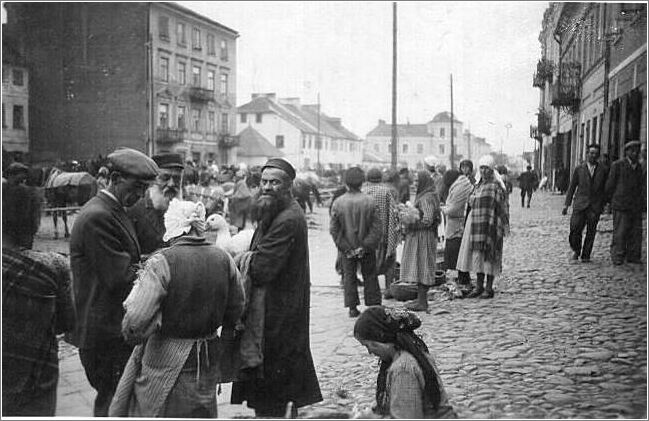
Street in the Radom Ghetto, c. 1940–1941
Location of Radom Ghetto in World War II,
west of Majdanek concentration camp
Radom Ghetto is located in Poland
Radom Ghetto
Radom Ghetto
Location of Radom in Poland today
LocationRadom, German-occupied Poland
51°14′N 21°06′E / 51.24°N 21.10°E / 51.24; 21.10
Incident typeImprisonment, mass shooting, forced labor, starvation, deportations to death camps
PerpetratorsSS, Order Police battalions
Victims33,000 Jews

The Radom Ghetto was a Nazi ghetto set up in March 1941 in the city of Radom during the Nazi occupation of Poland, for the purpose of persecution and exploitation of Polish Jews. It was closed off from the outside officially in April 1941.[1] A year and a half later, the liquidation of the ghetto began in August 1942, and ended in July 1944, with approximately 30,000–32,000 victims (men, women and children) deported aboard Holocaust trains to their deaths at the Treblinka extermination camp.[2]

Background

[edit]

In the invasion of Poland, the city of Radom was overrun by the German forces on 8 September 1939. The total population was 81,000 at that time of which 25,000 were Jewish.[3] On 30 November 1939 the SS-Gruppenführer Fritz Katzmann from Selbstschutz who led the murder operations earlier in Wrocław,[4] and in Katowice,[5] was appointed the SS and Police Leader (SSPF) of occupied Radom. His arrival was followed by wanton violence and plunder for personal gain. Katzmann ordered the execution of Jewish leaders right away.[5] Before the creation of a ghetto, many Jews were pressed into forced labor. One of their first tasks on German orders was to rebuild the prewar Polish Łucznik Arms Factory damaged in the attack, to meet the German military needs. The factory served as the major local Nazi employer throughout the war.[3]

The Germans forced the Jewish community to pay contributions, and seized their valuables and businesses.[3] Nevertheless, the precious metal holdings were already depleted because the Radom Jews – especially the Jewish women from "Wizo" – made massive donations to Polish air-force fund for months before the invasion. Even the least fortunate Jews purchased air-defense bonds with pride until May 1939.[6]

Soon after the invasion, around September–October 1939, the SS conducted surprise raids on synagogues. The worshipers were dragged out and put into labour commandos. The Radom Synagogue was desecrated by the Nazis and its furnishings destroyed. To instill fear, the Jewish city councilor Jojna (Yona) Zylberberg was marched with a stone over his head and beaten by the SS soldiers.[3] His wife died in an accident at home only months earlier by falling out of a window when she tried to hang sheers, leaving her two children behind.[7] Around December 1939 – January 1940 the Judenrat was established to serve as an intermediary organization between the German command and the local Jewish community. One thousand men were sent to labour camps of the Lublin reservation in the summer of 1940. In December, the German Governor-General Hans Frank stationing in Kraków ordered the expulsion of 10,000 Jews from the city. Only 1,840 were deported due to technical difficulties. In the spring of 1941 there were about 32,000 Jews in Radom.[3] Katzmann remained there until Operation Barbarossa.[5]

Ghetto history

[edit]

The city of Radom received Jews expelled from other locations in Poland including the Jewish inmates of the Kraków Ghetto because Kraków – according to the wishes of Gauleiter Hans Frank – was to become the "racially cleanest" city of the General Government territory to serve as its German capital. The Governor-General Frank issued an order to create Radom ghetto in March 1941. A week earlier the Jewish Ghetto Police was formed by the new Nazi administration to aid with the relocations.[3] The Jews were given ten days in which to vacate their prewar homes and settle within the ghetto zone along with their families. The area was split in two like in many other Polish cities. The ghetto gates were closed from the outside on 7 April 1941.[3] About 33,000 Polish Jews were gathered there; 27,000 at the main ghetto, and about 5,000 at a smaller ghetto in the suburb. Most of the ghetto area was not walled; the barriers were formed by the buildings themselves and the exits were managed by Jewish and Polish police. The "large ghetto" was set up at Wałowa street in central Śródmieście District and the "small ghetto" at the Glinice District.[3]

Jewish men with armbands in the Radom Ghetto, March 1941

As with many other ghettos across occupied Poland, starvation was not uncommon. The German-allotted rations for a person in the ghetto were 100 grams (3.5 oz) of bread per day. Nonetheless, the conditions in the Radom Ghetto were on average better than in many other contemporary ghettos in Nazi-occupied Europe.[3]

In the first months of 1942 the Germans carried out several actions, arresting or summarily executing various leaders of the Jewish community. The Germans began to liquidate the Radom Ghetto in earnest, starting in August 1942 as part of Operation Reinhard. The first large deportation emptied the smaller Glinice ghetto.[3] The Germans were aided by the Polish Blue Police units,[8] and "Hiwis".[9] By the end of August approximately 2,000 Jews remained in Radom.[3] The deported Jews were sent to extermination camps (primarily Treblinka and Auschwitz). The remnants of the Radom ghetto were turned into a temporary labor camp. The last Radom Jews were evicted in June 1944, when on June 26 the last inhabitants were deported to Auschwitz.[3] Only a few hundred Jews from Radom survived the war.

1941 Radom issued Jewish ID card from the German occupation of Poland

Escape and rescue

[edit]

Among the Polish rescuers of Jews, the most prominent role belonged to Dr. Jerzy Borysowicz [pl],[10] director of the mental hospital in Radom located at Warszawska Street. The facility was spared by the Nazis only because the former church building could not be turned into any war-related purpose. The Jews, including children, were receiving daily help from Borysowicz as well as his medical staff in total secrecy.[10] The most dramatic was the rescue of people suffering in the ghetto from the typhoid fever. Borysowicz treated Mordechai Anielewicz, leader of the Jewish Combat Organization instrumental in engineering the Warsaw Ghetto Uprising. Most of his patients however, did not survive the Holocaust.[10] Anielewicz died in the Uprising.[11] Borysowicz was awarded the title of Righteous among the Nations posthumously, in 1984, four years after his death on 5 June 1980.[10]

Among those Poles who were murdered by the Nazis for saving Jews was 60-years-old Adam Rafałowicz living in Radom, shot on 18 September 1942 for rendering help to a Jew;[12] There were more such murders in the Radom county. A group of villagers from around Ciepielów near Radom including Piotr Skoczylas and his eight-year-old daughter Leokadia were burned alive by a police battalion on 6 December 1942 for sheltering Jews.[13] On the same day, another barn full of people was set on fire in nearby Rekówka, and 33 Poles saving Jews were burned alive including the families of Obuchiewicz, Kowalski, and 14 Kosiors.[13] Roman Jan Szafranski, age 64, living in Radom with his wife Jadwiga, were caught sheltering a Jewish girl, Anna Kerc (born in 1937); the girl was killed, he was sent to Gross-Rosen concentration camp where he perished. His wife was sent to Ravensbruck but survived.[14]

See also

[edit]

Notes

[edit]

Further reading

[edit]
[edit]
Revisions and contributorsEdit on WikipediaRead on Wikipedia
from Grokipedia

The Radom Ghetto was a pair of enclosures in the Polish city of under Nazi German occupation, created in March 1941 to segregate and subjugate the local population of approximately 32,000 individuals, who faced enforced isolation, rampant disease, malnutrition, and compulsory labor amid deliberate resource scarcity.
The smaller ghetto at Glinice, holding several thousand Jews, underwent on August 5, 1942, via deportations mainly to the Treblinka death camp, followed shortly by the larger Walowa Street ghetto's destruction from August 16–18, which dispatched around 20,000 remaining inhabitants to extermination sites including Treblinka and Auschwitz.
Survivors were funneled into a forced that endured until late 1944, when it too was dismantled, leaving 's prewar community effectively annihilated through systematic killing operations integral to the broader Nazi genocide.

Pre-Ghetto Context

Jewish Population and Community in Interwar

In the interwar period, formed a substantial part of 's , reflecting the city's historical as a commercial and industrial center in the Kielce Voivodeship of the Second Polish Republic. The 1921 Polish census recorded 24,465 in , accounting for 39.7% of the total of 61,599. By 1931, comprised approximately 30-32% of residents, amid urban growth and economic changes that diluted the relative share despite absolute increases to around 25,000 individuals. This demographic remained stable into the late 1930s, with over 30,000 by 1939, constituting about one-third of the city's inhabitants and underscoring their integral presence in local society. Economically, Jews dominated key sectors, leveraging Radom's position as a hub for leather processing and small-scale . Around 58% of derived their livelihood from crafts and services, including ownership of 60-75% of tanneries, nearly all operations, and 90% of small workshops as of 1926-1929; 18% worked as laborers, 12% in , and 2.5% in liberal professions. They controlled 60-70% of wholesale and retail trade outlets, operated 18 Jewish-owned banks and financial institutions by 1933-1934, and owned 1,177 enterprises in 1921, employing 1,702 Jewish workers—73% of the local workforce in Jewish firms. Prominent trades included , tailoring, furriery, and dealings in , , , iron, and food products, fostering a vibrant but interdependent with the Polish majority. The Jewish community maintained a rich religious and cultural fabric, though assimilation was limited and often superficial. Religious life centered on the main at Podwalcza and Bożnicza Streets, supplemented by 12 private prayer houses, with active Chasidic and influences. included a Jewish middle school and 45 cheders, while cultural output featured 18 and Hebrew newspapers and magazines. Politically, Radom emerged as a Zionist stronghold by , alongside orthodox Aguda groups and socialist Bund elements; between 1932 and 1939, approximately 5,000 Jews emigrated to and another 5,000 to the and elsewhere, driven by economic pressures and rising . This diversity reflected broader tensions in interwar , where Jewish economic prominence occasionally fueled local resentments, though Radom's community emphasized self-reliance and communal institutions.

German Invasion and Initial Occupation Policies

The German commenced on September 1, 1939, with bombings targeting 's airport and several buildings in the city from the outset. Following the fall of nearby on September 5, German forces occupied unopposed on September 8, entering the city's empty streets, seizing government buildings, and raising swastika flags over key sites. This rapid advance was part of the broader Battle of (September 8–9), which encircled and defeated significant Polish Army units in the vicinity, facilitating control over central . Initial occupation under imposed immediate hardships on the population, including requisitions of homes and heavy collective fines, such as a demand for 2 million zlotys from the . Anti- violence erupted promptly, with German soldiers and auxiliaries conducting beatings, forcibly cutting beards, and rounding up for labor tasks starting in September. On in October 1939, synagogues were desecrated, and faced public humiliations, including forced carrying of stones or other degrading acts. By October 1939, systematic measures formalized persecution: all were ordered to register, and a (Jewish Council) of 50 members was established to administer compliance, later reduced to 24 under chairmanship of Joseph Diamond from December. The created an Arbeitsamt (labor office) to supply forced laborers, dispatching 100 to 1,400 daily for tasks under German oversight, amid ongoing manhunts in the streets. were also restricted from certain streets and public areas, marking the onset of segregation policies that preceded ghettoization. 's incorporation into the General Government on October 12, 1939, as the seat of Distrikt Radom under civilian governor Karl Schmidt intensified these controls, aligning with broader Nazi aims of exploitation and isolation of .

Establishment of the Ghetto

Anti-Jewish Decrees and Segregation Orders

Following the German occupation of on 8, 1939, Nazi authorities immediately imposed punitive measures on the Jewish population, including arbitrary arrests, beatings, and forced labor detachments organized by SS units. By late , a temporary was established under military command to facilitate compliance with German demands, such as collecting ransoms and supplying goods to occupation forces. In October 1939, decrees mandated the registration of all and set daily forced labor quotas, initially requiring 80–100 workers per day, which escalated over time and targeted Jewish men for menial tasks under brutal supervision. By December 1939, a permanent 24-member , headed by Josef Diamant, was ordered into existence by the to enforce these policies, including housing allocations for incoming Jewish deportees from areas like the Warthegau. Early 1940 saw further economic isolation through rationing systems that allotted only half the food provisions given to non-Jews, exacerbating shortages and dependency on black-market networks. Segregation intensified with targeted expulsions and property seizures: in April 1940, 18 Jewish community leaders were executed in a political action; by July 1940, all Jewish-owned property was confiscated and transferred to German control; and in 1940, approximately 2,000–2,269 young were deported to labor camps near for fortification projects. A December 1940 compelled the eviction of around 2,000 vulnerable (the elderly, ill, and poor) to rural counties like Busko and Opatów, selected by the to alleviate urban overcrowding. The culminating segregation order came on March 29, 1941, when Distrikt Governor Dr. Karl Lasch decreed the concentration of 's approximately 32,000 into two separate ghettos—one in the central Jewish quarter (housing about 27,000) and a smaller one in the Glinice suburb (about 5,000)—with a relocation deadline of April 7, 1941. On that date, the ghettos were sealed, with borders marked by signs warning of contagious diseases and prohibiting entry, effectively isolating from the rest of the and non-Jews. These measures, enforced by and local police, built on prior restrictions to systematically segregate, impoverish, and control the Jewish populace under the Nazi administration of Distrikt .

Physical Creation and Division into Two Ghettos

On March 29, 1941, the German authorities in the District, under Governor Dr. Karl Lasch, issued an order requiring the city's approximately 32,000 to 35,000 , including refugees from surrounding areas, to relocate within ten days to two designated zones, marking the initial phase of ghettoization. The , the Nazi-imposed Jewish council, was tasked with assigning living quarters in these overcrowded slum areas, while Polish residents were evacuated from the zones to facilitate the concentration. By , 1941, both areas were sealed as closed ghettos, prohibiting free movement and confining residents under guard. The s were not enclosed by newly constructed walls or extensive barbed-wire fences but relied on existing perimeter buildings to define boundaries, with access controlled through guarded gates. The large , located in the city center near the traditional Jewish quarter, encompassed streets such as Wałowa, Szwarlikowska, Esterki, Brudna, and others up to Plac Stare Miasto, housing around 25,000 to 27,000 ; it featured 13 guarded entry points marked with signs warning of contagious diseases and prohibiting entry. The small , situated in the Glinice several miles distant, covered streets including Graniczna, Błotna, Wrześniowskiego, and Dąbrowskiego, initially confining about 5,000 to 8,000 , primarily those deemed less productive or without work assignments. This division into a central large and a peripheral small one facilitated German administrative control and labor segregation, with the large retaining key Jewish institutions like the hospital, while the small 's remote location exacerbated isolation and later enabled its earlier . Exits from both required special passes, and unsupervised departures were initially tolerated but soon strictly enforced, enforcing the physical separation from the non-Jewish population. The relocation process involved of Jewish properties outside the boundaries, contributing to severe as families were squeezed into inadequate housing without additional infrastructure improvements.

Ghetto Governance and Control

Nazi Administrative Structure

The operated under the administrative framework of the , a Nazi colonial entity established in occupied excluding annexed territories, with Distrikt Radom formed on October 26, 1939, encompassing the city and surrounding areas. Civilian governance at the district level reported to Governor-General in , while local implementation in fell to the Stadthauptmann (city administrator), Dr. Karl Lasch, a and SA member who held the position during the ghetto's establishment. Lasch directly ordered the ghettos' creation on March 29, 1941, mandating the segregation of approximately 30,000 into two enclosed districts by April 7, with barriers enforced to prevent unauthorized movement. This structure prioritized economic exploitation and containment, with Lasch's office coordinating initial resettlements, property confiscations, and basic policing through auxiliary Ukrainian and Polish forces under German oversight. Parallel to civilian administration, the maintained control via the Höhere SS- und Polizeiführer (HSSPF) , with Distrikt Radom's SS und Polizeiführer Friedrich Katzmann directing security from 1939 to 1941, succeeded by others amid escalating extermination policies. Enforcement involved the (Sipo) and (SD), who conducted roundups, issued identification documents like the 1941 Jewish ID cards mandatory for ghetto residents, and suppressed resistance through executions and deportations. Labor deployment, critical to the ghetto's function until 1942, was managed by district employment offices under the Zentralverwaltung für Arbeit, assigning Jews to German firms for munitions and construction, yielding economic output estimated at millions of Reichsmarks while enforcing quotas that spared temporary "productive" workers from immediate liquidation. By mid-1942, coordination shifted toward Operation Reinhardt, with Globocnik's apparatus overriding local civilian input for mass deportations to extermination camps like Treblinka, reducing Lasch's role before his removal for corruption and execution in Auschwitz on June 1, 1942. This dual civilian- hierarchy ensured systematic isolation and exploitation, with records from the Kreishauptmann offices documenting petitions, deaths, and administrative decrees that facilitated the ghetto's operations until its .

Role of the Judenrat and Internal Jewish Authorities

The in was established by German occupation authorities in December 1939, shortly after the city's capture in September of that year, comprising 24 members tasked with administering Jewish communal affairs under strict Nazi oversight. Joseph Diamond was appointed as the Älteste der Juden (Elder of the Jews), succeeding an initial committee led by Jacob Goldberg that had formed in the immediate aftermath of the to handle early requisitions and registrations. The council's mandate included executing German orders, such as collecting fines, taxes, and forced contributions from the Jewish population, which numbered around 25,000–30,000 at the time, while also managing internal services to maintain minimal order and prevent outright collapse. Key functions of the Judenrat encompassed operating the Jewish employment office (Arbeitsamt) for labor , the housing bureau (Wohnungsamt) for ghetto allocations after March 1941, food distribution amid severe shortages, and rudimentary health initiatives to combat epidemics like . It issued permits for essential activities, mediated disputes, and coordinated welfare efforts, though these were perpetually undermined by resource scarcity and escalating demands for quotas of workers and valuables. The council exerted significant influence over daily Jewish life, often prioritizing compliance to preserve a semblance of , but this positioned it as an intermediary enforcing policies that accelerated exploitation and isolation. Complementing the Judenrat was the Jewish Order Service (Jüdischer Ordnungsdienst), or internal Jewish police, also mandated by the Germans and operational from late 1939 onward, with roughly 100 personnel in the larger ghetto and 40 in the smaller Glinice section after the ghettos' enclosure in April 1941. Under commander Joachim Geiger, officers wore blue-red caps emblazoned with the and armbands, initially drawing from respected young community members to patrol boundaries, enforce curfews, and suppress or unrest. Over time, however, the force faced accusations of corruption and selective collaboration with agents, including extortion and favoritism in labor exemptions, reflecting the coercive dynamics that eroded internal trust. In specific interventions, the Judenrat negotiated the partial release of Jews from forced labor camps in 1940 and attempted to alter deportation lists during smaller roundups in December 1940, aiming to shield productive workers or families. Yet, as Nazi extermination policies crystallized, the council's role shifted toward facilitating assemblies for the major Aktion of , which deported over 20,000 Jews to Treblinka, with surviving members and police subsequently targeted for elimination themselves. This compelled cooperation, while enabling some short-term mitigations, ultimately served German aims of orderly , highlighting the untenable position of Jewish authorities caught between imperatives and moral imperatives under total subjugation.

Socioeconomic Conditions

Overcrowding, Housing, and Infrastructure

The Radom was divided into two distinct areas upon its establishment in late March 1941, with relocation orders issued on March 29 requiring to move within 10 days into designated districts. The larger ghetto, centered around Wałowa Street and adjacent areas in the traditional Jewish quarter, housed approximately 25,000 , while the smaller ghetto in the Glinice suburb contained about 8,000. This confinement of roughly 33,000 individuals—swollen to 35,000 by influxes of refugees from surrounding regions—into pre-existing urban without expansion or new construction resulted in extreme . Housing conditions were characterized by severe , with families and unrelated individuals forced to share minimal living spaces in dilapidated buildings. In the larger , up to 15 people occupied a single room, while eyewitness accounts describe eight individuals crammed into small rooms along Wałowa Street. Evictions from better accommodations exacerbated the shortage, compelling many to subsist in one small room per family, as reported in survivor testimonies from . The smaller offered slightly less density but remained harsh, with residents often preferring the larger one for access to communal institutions despite the congestion. Infrastructure was rudimentary and inadequate, lacking basic sanitary facilities and contributing to rapid deterioration of living standards. Ghetto streets became crowded, noisy, dirty, and malodorous due to insufficient and provisions, fostering conditions ripe for disease outbreaks such as . Even medical facilities reflected the strain, with the hospital for contagious diseases accommodating 150 patients using only one bathtub and often 2–4 individuals per bed. Borders were demarcated by buildings rather than fences, secured by 13 guarded gates in the larger , but no enhancements to , , or heating were implemented, leaving residents vulnerable to epidemics amid the enforced isolation sealed on April 7, 1941.

Food Rationing, Disease, and Mortality Rates

In the Radom Ghetto, established in April 1941, Jewish residents received food rations approximately half those allotted to Poles, which were themselves severely restricted under German occupation policies, resulting in widespread malnutrition and acute hunger. Official bread allocations dwindled to as little as 70 grams per day per ration card by mid-1941, while black market prices for a full loaf reached 25 zlotys, far beyond the means of most inhabitants who resorted to selling personal possessions for sustenance. To mitigate starvation, the Judenrat operated soup kitchens distributing around 4,000 meals daily, supplemented by additional facilities providing free soup and child-focused aid, though these efforts could not prevent famine-like conditions exacerbated by overcrowding and economic isolation. Diseases proliferated due to , poor , and dense living quarters, with emerging as the primary epidemic threat by late 1941. The ghetto's , led by Dr. Szenderowicz, implemented delousing and drives, but the Contagious Diseases became severely overcrowded, with patients sharing beds and filling corridors. By autumn 1942, had hospitalized 3,000 to 4,000 individuals, with many additional cases treated at home to evade German scrutiny, and related outbreaks of recorded 300 cases as of April 18, 1942, carrying a roughly 50% fatality rate among . These epidemics claimed lives including medical staff such as nurses Hannah Rutman and Bronka Kellerwurm, and Dr. Minsky, amid broader health collapse from exhaustion and exposure. Mortality rates soared from combined effects of and infectious diseases, though precise figures are incomplete due to underreporting and destruction of records; thousands perished indirectly before major deportations in 1942. alone contributed to numerous unreported home deaths among the 4,000 treated patients by fall 1942, while hospital overcrowding and Nazi selections—such as the execution of 50-59 patients in —further elevated fatalities. Overall, these conditions reflected deliberate German policies of deprivation, with hunger and illness serving as precursors to systematic extermination campaigns.

Forced Labor and Exploitation

Labor Assignment Systems

The labor assignment system in the Radom Ghetto operated under direct German oversight, with the Judenrat's internal labor department—known as the Arbeitsamt or Abteilung Arbeit—serving as the primary mechanism for registering, selecting, and dispatching Jewish forced laborers to meet quotas imposed by Nazi authorities. Established shortly after the ghetto's creation on April 7, 1941, this department registered skilled craftsmen and able-bodied individuals, compiling for daily or weekly work (Kommandos) demanded by the German district labor office and SS economic enterprises. The Arbeitsamt grew into the Judenrat's most influential branch, as assignment to labor provided temporary exemptions from roundups and deportations, incentivizing internal favoritism, , and to secure "protected" positions. German firms, including armaments manufacturers like and , requisitioned workers through the district Arbeitsamt, which coordinated with the to fill demands for factory production, munitions assembly, road building, and sanitation tasks. Laborers, often numbering in the thousands daily, assembled at ghetto gates for headcounts and escort to sites, where they received minimal rations in exchange for 10-12 hour shifts under brutal supervision by SS guards and Ukrainian auxiliaries. Skilled artisans, such as tailors and metalworkers, were prioritized for ghetto-based workshops to support the , while unskilled workers faced random selections via house-to-house raids if quotas lagged. The 's department maintained records of assignments, issuing labor cards or badges to verify status, though these offered no absolute safeguard against arbitrary seizures. Women, initially underrepresented in pre-ghetto forced labor, were systematically incorporated post-April , comprising significant portions of , repair, and munitions details, as German demands escalated for cheap wartime output. The often struggled to meet quotas—sometimes falling short by hundreds—leading to punitive German reprisals, such as public executions or accelerated deportations, and internal measures like press-ganging non-workers. Requests for worker releases, such as for family emergencies, were funneled through the 's labor office to the German administration, but approvals were rare and contingent on replacements. This quota-driven system prioritized economic exploitation over ghetto demographics, temporarily preserving laborers deemed productive while exposing the elderly, children, and unemployed to elimination actions, particularly intensifying in early ahead of major Aktionen.

Industrial Output and German Economic Benefits

Jewish forced laborers in the Radom Ghetto were directed into armament production and ancillary industries to support the German . Key facilities included the Vistula Arms Factory (Fabryka Broni "Łucznik") and plants, where inmates manufactured guns, Radom VIS pistols, and bicycles for military use. By 1943, the Radom district contained five of the eight principal military factories in the General Government, channeling Jewish labor into munitions and equipment vital for frontline operations. Smaller workshops supplemented this output, encompassing tanneries, iron foundries, lumber mills, and production of furniture, shoes, enamelware, and bricks—many leveraging pre-war Jewish-owned enterprises. After establishment in April 1941, workers commuted to external sites for operations, supply depots, and tasks such as road and bridge construction, due to limited space within the confined areas housing 27,000 in the main and 5,000 in the smaller Glinice section. Possession of work cards became a safeguard during the August 1942 deportations, prioritizing laborers deemed productive. These operations yielded direct economic advantages for German authorities and firms, as Jewish labor costs undercut those of Polish workers, facilitating expanded output amid resource shortages post-Operation Barbarossa in and intensified armament demands in 1942–1943. The SS and private enterprises profited by diverting production to personal requisitions alongside war needs, sustaining while minimizing expenditures on non-essential upkeep for the workforce. In , the Szkolna camp consolidated 3,367 Jewish inmates for focused industrial tasks—the sole such concentration camp in —until its evacuation to Auschwitz in summer , underscoring the regime's prioritization of exploitable output over immediate extermination when labor shortages loomed.

Deportation Campaigns

The August 1942 Aktionen

The August 1942 Aktionen in the Radom Ghetto marked the onset of systematic mass deportations to the , resulting in the removal of approximately 25,000 to 30,000 Jews from the city over several days. These operations, conducted by units, personnel, Ukrainian auxiliaries, and Polish , with assistance from the Jewish police in roundups, targeted both the small Glinice Ghetto and the larger main ghetto. Selections prioritized individuals with valid work permits for exemption, while the elderly, children, sick, and those without documentation were prioritized for deportation or immediate execution. The Aktion in the small Glinice Ghetto commenced on August 4, 1942, when forces surrounded the area and ordered residents to assemble for "resettlement." Jewish police conducted inspections of work documents, leading to the of around 4,000 from Glinice and an additional 2,000 from the main on August 5; these trains departed for Treblinka, where victims were gassed upon arrival. Approximately 60 were shot during resistance or hiding attempts, and around 600 children and elderly were murdered on site, with survivors holding permits—numbering about 1,000—transferred to the main . The main phase targeted the large ghetto on August 16-17, 1942, beginning with the 's sealing by police forces and the installation of spotlights for roundups starting at midnight on August 16. Jews were driven to assembly points such as the and the Merywil station, where selections occurred; around 1,800 with work cards were temporarily spared and relocated to the remnants of the small , while the rest—approximately 20,000—were loaded onto freight trains for Treblinka. Local killings claimed about 1,000 to 1,500 lives, including 50 patients executed in their beds and others shot for non-compliance, with bodies buried in mass graves such as Pentz’ Garden; incidents included family suicides and executions at workplaces like the Gelka factory. Survivor accounts describe the chaos, with Jewish police sometimes accepting bribes for exemptions, though many perished alongside victims; one rare returnee from Treblinka, Nathan Berkovich, reported the camp's lethal conditions. These Aktionen reduced the ghetto population to a residual labor force, setting the stage for further exploitations until final liquidation.

Subsequent Roundups and Transfers to Camps

After the major deportations of mid-August , which removed approximately 20,000 from the larger Radom Ghetto to Treblinka, the site was converted into a forced housing about 2,000 remaining selected for their utility in armaments production and other war-related tasks. These inmates faced ongoing selections, with German authorities conducting sporadic roundups to eliminate those deemed unproductive, such as the elderly, ill, or children hidden among the workers. One documented subsequent action involved the of roughly 800 from the to the Szydłowiec area, likely for temporary labor before further transfers or there. Additional roundups in late 1942 and 1943 targeted small groups, sending them to extermination facilities like Treblinka or concentration camps including Auschwitz, where arrivals were often gassed upon selection or assigned to forced labor under lethal conditions. Survivor accounts indicate these operations involved SS personnel, Ukrainian auxiliaries, and local police, who surrounded at dawn, conducted brutal searches, and loaded victims onto trains amid shootings of resisters. By November 1943, intensified selections reduced the camp population further, with transports of about 1,000 Jews dispatched directly to Auschwitz-Birkenau. Conditions in the interim deteriorated with and , prompting Germans to cull the weak periodically to maintain output quotas. The final major roundup occurred in , as Soviet forces neared, liquidating the camp by evacuating survivors—numbering around 1,000—to Auschwitz via rail, where most perished in gas chambers or from exhaustion. A smaller subset was redirected to subcamps like those affiliated with Majdanek or , though precise figures remain elusive due to incomplete Nazi records.

Resistance and Survival Efforts

Underground Activities and Cultural Persistence

In the Radom Ghetto, several groups operated clandestinely, including affiliations with Labor Zionists, , Communists, and youth movements such as Akiba and , which organized secret meetings, disseminated illegal publications, and maintained a hidden library. These groups engaged in limited , such as producing defective armaments and furniture in factories on Szkolna Street and at Armbruster’s workshop, to undermine German war efforts. Couriers from external networks, including Franka Kirschenbaum and Joseph Kaplan dispatched from in 1942, facilitated communication and resource smuggling into the ghetto. Attempts at organized armed resistance emerged in 1942 following reports of mass deportations from eastern ghettos, with plans for an uprising thwarted by insufficient weapons, internal disbelief in total extermination, and fears of against remaining inmates. After the major deportations of August 1942, partisan units formed in the surrounding forests, including one led by Berish Ackerman comprising about 100 fighters, of whom 46 were killed in combat, and groups under Abraham Konsker that persisted until 1945. A smaller cell of 30 members, organized by the Bornstein brothers (Zalman, Leib, and Yonah), established contact with the Polish Underground to acquire firearms and sought to join partisans in the Świętokrzyskie forests, though many participants were subsequently killed by Germans. Food was a pervasive underground activity essential for survival, conducted primarily by children who risked execution to procure provisions from outside the walls, though detection often resulted in lethal reprisals. During the August 1942 deportations, hundreds of affiliated with resistance groups escaped the enclosures, with some fleeing to forests or later participating in the 1944 Polish Uprising; individual escapes, such as that of Sam Gutstat in 1943 using forged documents, enabled temporary evasion but frequently ended in betrayal or recapture. Cultural persistence manifested through clandestine and religious observance, defying Nazi prohibitions on Jewish learning and practice. Teachers Isser Lipshitz and Jacob Hechtman conducted illegal schooling at personal risk until their execution by Germans. Underground yeshivas operated secretly, alongside religious services and for children, preserving communal identity amid starvation and isolation. In November 1941, engineers and technicians in the small ghetto initiated vocational training courses in metalwork and mechanics for Jewish teenagers, while separate clandestine programs served kindergarten-aged children to maintain developmental continuity.

Escapes, Hiding, and Individual Resistance

During the major deportation Aktion of August 16–17, 1942, which targeted the large Radom Ghetto and resulted in approximately 20,000 Jews being sent to Treblinka, hundreds escaped into nearby forests by fleeing during the roundups or jumping from transport vehicles and trains. Many who hid in cellars, attics, and basements within the ghetto during these operations were eventually discovered and killed, though around 300 men evaded capture by remaining at workplaces or in hiding and were temporarily transferred to the small ghetto. In subsequent actions, such as the January 13, 1943, deportation and the " " on March 21, 1943, small numbers succeeded in jumping from trucks or s returning to the ghetto, with survivors including individuals like Nathan Berkovich, who escaped a Treblinka-bound by removing bars alongside 49 others from various ghettos. Efforts to hide outside the ghetto intensified after the 1942 liquidations, with some Jews obtaining forged Aryan documents or seeking shelter among non-Jewish Poles on the "Aryan side." In 1943, Sam Gutstat and five companions escaped using such papers, though Gutstat was the sole survivor after betrayal; other families reached relative safety, including eventual passage to Palestine via forged passports. A group of Jewish youth organized post-August 1942 to flee to forests, but many such escapees faced lethal encounters with Polish partisans, who robbed or killed them, as occurred with a large group near Radom and Berish Ackerman's unit of about 100 young men, where 46 died in ambush and survivors were executed by an A.K. detachment. After ghetto liquidation, a small number persisted in hiding or as forced laborers in German armaments factories, underscoring the high mortality from exposure, denunciation, and reprisals under the German decree punishing aid to Jews with death. Individual resistance manifested in acts defying German control, such as Moshe Goldberg's smuggling of firearms from an warehouse to support guerrilla fighters, and Mirka Liebeskind's endurance of torture in 1943 without betraying comrades, inspiring continued defiance before her death. and Joseph Malarski chose in 1942 to avoid interrogation, while others like Glatt faced execution in April 1942 under policies. These solitary efforts, often uncoordinated due to weapon shortages and internal divisions, contrasted with failed organized uprisings but preserved agency amid systemic extermination.

External Relations and Aid

Interactions with Non-Jewish Poles

Non-Jewish Poles interacted with Radom Ghetto inhabitants mainly through clandestine networks that supplied essential food and goods amid deliberate German-imposed rations of approximately 184 calories per day for compared to 699 for Poles. These operations involved Polish and Jewish smugglers breaching ghetto fences or using bribes with guards, often for payment, enabling limited economic exchange but exposing participants to by German forces. In , such smuggling persisted from the ghetto's sealing in April 1941 until its campaigns in 1942, sustaining a where Poles traded potatoes, bread, and milk for Jewish valuables like clothing or jewelry. Individual Polish aid efforts included smuggling foodstuffs and letters into the ghetto, as in the case of a local named Wołomski who facilitated these transfers and attempted to extract 14 in an unsuccessful rescue bid. The underground Council for Aid to (), operational from late 1942, extended limited support to in ghettos and camps near , coordinating hiding places and false documents despite the organization's primary focus on . Survivor testimonies record isolated instances of Poles sheltering escaped in attics or factories, such as Polish workers smuggling individuals out during labor details, though these acts were exceptional and demanded extraordinary risk given German penalties of death for aiding . Conversely, the Polish Blue Police, numbering around 2,000 in the district, collaborated with German authorities by patrolling boundaries, enforcing curfews, and participating in roundups, including the major Aktion that deported over 20,000 to Treblinka. This auxiliary force, drawn from pre-war Polish officers, often prioritized and received incentives like access to confiscated Jewish property, contributing to isolation. Broader interactions reflected mixed motives: while some Poles derived economic benefit from , others engaged in or denunciations for rewards, amid pervasive pre-occupation and fear of collective reprisals against Polish communities. Overall, active rescue remained marginal in , with most Poles maintaining distance due to survival imperatives under occupation, as evidenced by the low number of documented from the area relative to Poland's total of over 7,000.

Limited Underground Support Networks

While the , including the (), maintained operations in the region throughout the occupation, its assistance to inmates of the Radom Ghetto remained sporadic and uncoordinated, prioritizing against German infrastructure over systematic rescue efforts due to the severe penalties for aiding , which included collective punishments against Polish communities. Individual acts of food, medicine, or intelligence across ghetto boundaries occurred, but these were not linked to a robust network; for instance, local Poles occasionally provided false documents or temporary shelter to escapees, though such aid exposed helpers to immediate execution or . The Council for Aid to Jews (), formed in December 1942 under the Polish underground, extended limited operations to the area after the ghetto's partial liquidation in August 1942, focusing primarily on nearby forced labor camps such as Pionki and Skarżysko-Kamienna rather than the ghetto itself. couriers from transmitted small amounts of money, forged papers, and messages to Jewish workers in these camps, with families like the Sarneckis delivering supplies under cover of visits, but records indicate no large-scale infiltration or evacuation from the Radom Ghetto proper before its clearance. This reflected broader constraints: 's resources were stretched thin across occupied , and 's proximity to German administrative centers heightened surveillance, limiting organized interventions to support for a few dozen individuals at most. Post-deportation escapes from the saw minimal integration into Polish partisan units; while some Jewish fighters joined nationalist groups like the Narodowe Siły Zbrojne () in surrounding forests, these alliances were tactical and short-lived, often dissolving under mutual suspicions or German counteroperations. recognizes a handful of Radom-area Poles as for individual rescues, such as Marianna Kopyt, who sheltered three Jews smuggled out of the , but these efforts lacked the scale or coordination of underground networks in larger centers like . Harsh German reprisals, including the execution of entire villages for harboring Jews, further deterred systematic aid, as documented in regional resistance reports emphasizing survival over expansive humanitarian operations.

Liquidation and End of the Ghetto

Final Clearance Operations in 1944

Following the major deportations of August 1942, which reduced the Jewish population to remnants spared for forced labor, approximately 3,000 survivors were confined to two primary labor camps within the city: one on Szkolna Street housing around 2,000 men employed at the former Polish armaments factory (operated by ), and another on Szwarlikowska Street with about 1,000 women working in munitions workshops. These camps, initially established as extensions, functioned under brutal conditions with SS oversight, including the Szkolna site formally designated as a Majdanek by January 1944, where prisoners produced parts and amid starvation rations, disease, and arbitrary executions. As the advanced toward the district in mid-1944, German authorities initiated the final clearance of these labor installations to prevent prisoner liberation and repurpose manpower elsewhere. On July 26, 1944, the Szkolna Street camp was liquidated, with its approximately 2,000 inmates—primarily skilled Jewish laborers—marched under guard to rail transport points and deported to Auschwitz-Birkenau. Upon arrival, many underwent selections: the able-bodied were registered for transfer to other camps, including a documented transport of 2,187 individuals routed onward to the Vaihingen subcamp of Dachau for further exploitation in armaments production, while others deemed unfit were gassed immediately. The Szwarlikowska camp's inmates, numbering around 1,000 women, faced similar evacuation around the same period, integrated into the Szkolna clearance or separately transported to Auschwitz, where selections mirrored those at Szkolna, dispatching survivors to sites like Plaszow or directly to extermination. These operations marked the effective end of organized Jewish forced labor in Radom, with guards employing shootings to quell escapes during assembly and marches; survivor accounts detail summary executions of stragglers and the weak along evacuation routes. By late July 1944, the camps stood empty, their clearance aligning with broader efforts to dismantle labor sites in the General Government amid retreating lines, though isolated in hiding or partisan groups persisted in the vicinity until Soviet forces entered on January 16, 1945. Of the evacuated prisoners, mortality rates exceeded 50 percent en route or upon arrival due to , lack of provisions, and selections, underscoring the Germans' prioritization of denying labor to advancing Allies over prisoner welfare.

Fate of Remaining Inmates

In July 1944, as Soviet forces approached the region, German authorities initiated the evacuation of the remaining Jewish forced laborers confined in the Szkolna Street armaments camp, the vestige of the ghetto used primarily for production. Approximately 2,200 inmates were deported by train to Auschwitz-Birkenau starting around July 27. Upon arrival, SS physicians conducted selections: unfit individuals, including the elderly and ill, were sent directly to the gas chambers, while able-bodied workers faced further allocation. A contingent of about 2,187 laborers from this transport was temporarily held at Auschwitz before transfer in early to the subcamp of Dachau, where they endured severe conditions including starvation, disease, and forced labor on underground tunnels; most perished there by war's end, with survival rates below 10 percent based on postwar records. Smaller groups from were redirected to other sites, such as the Płaszów camp near or the Sandomierz labor camp, where inmates faced similar selections, executions, and exploitation until those facilities' own liquidations later in 1944. Transports were marked by chaos, with reports of shootings of stragglers and escapes into nearby forests, though successful evasion was rare amid intensified SS patrols. By late , the dispersal of Radom's remnants contributed to the broader collapse of Distrikt Radom's labor network, with survivors subjected to death marches from evacuated camps as the front line shifted. Overall, fewer than 200 Jews from the Szkolna group are documented as having lived through liberation in , primarily those in western subcamps overtaken by Allied forces. Postwar testimonies highlight the systematic nature of these final clearances, aimed at preventing any Jewish presence during the German retreat.

Post-Liberation Aftermath

Soviet Liberation and Initial Chaos

The Red Army's captured Radom on January 16, 1945, during the , driving out the remaining German forces and formally ending Nazi control over the city. By this point, the Radom Ghetto had been fully liquidated through deportations and clearances between 1942 and November 1944, leaving no organized Jewish community intact; surviving Jews numbered only in the low hundreds, comprising those who had emerged from local hiding spots, returned from forced labor camps, or survived death marches amid the retreating German columns. These individuals faced immediate disorientation in a city scarred by years of exploitation, bombardment, and demographic upheaval, with infrastructure collapsed and food supplies critically depleted. The initial Soviet occupation unleashed widespread disorder, as units systematically looted homes, factories, and stockpiles for food, fuel, and valuables to sustain their advance, exacerbating famine and displacement among the civilian population. detachments swiftly moved to suppress Polish nationalist elements, arresting hundreds of Armia Krajowa members and other underground fighters who had provided intelligence on German positions during the war, often deporting them to Soviet labor camps without trial. This purge created an atmosphere of fear and reprisal, with public executions and roundups targeting suspected collaborators or anti-communists, while unchecked soldier misconduct—including rapes and arbitrary violence—further destabilized daily life. For Jewish survivors, the liberation offered provisional relief but no security; a February 6, 1945, documented their presence in , prompting the formation of a local Jewish committee affiliated with the emerging of Polish to distribute aid, register claims, and facilitate from the USSR. Efforts to reclaim pre-war properties, however, encountered fierce resistance from Polish residents who had occupied abandoned Jewish homes and businesses since the ghetto's establishment, leading to evictions denied, physical confrontations, and social ostracism rooted in wartime resentments and rumors of Jewish-Soviet collaboration. Historians note that survivors were often treated as spectral outsiders—"ghost citizens"—in a society unwilling to acknowledge their return or restore their assets, compounding the trauma of re-entry into a hostile order. Despite nominal Soviet protection for as a persecuted group, underlying antisemitic undercurrents persisted, foreshadowing broader patterns of violence in .

Survivor Repatriation and Post-War Challenges

Following the Soviet Red Army's capture of on January 17, 1945, Jewish survivors—primarily those who had been deported to concentration camps, forced labor sites, or evacuated eastward—began repatriating to the city from Soviet territories and western displaced persons camps. By , approximately 281 had returned or reappeared in Radom, with the number peaking at around 959 by summer as additional repatriates transited through or settled temporarily. Survivors confronted immediate and profound obstacles to reintegration. Pre-war residences were typically occupied by non-Jewish Poles who had appropriated them during the German occupation and resisted eviction, while looted property offered little prospect of recovery amid postwar and inadequate legal mechanisms. A 1946 communist nationalization decree further complicated restitution by seizing industrial and communal assets without regard for prior Jewish ownership. Socially, returnees experienced exclusion and hostility from the Polish majority, including antisemitic leaflets decrying their presence, routine theft, and physical attacks; at least four Jewish returnees were murdered in during this period, with perpetrators facing minimal accountability from provisional authorities. A provisional Jewish committee emerged in to coordinate , register survivors, and advocate for basic needs, drawing on limited resources from international Jewish organizations. However, the committee operated in a climate of indifference and latent pre-war , intensified by Polish resentments over wartime property shifts and rumors of Jewish-Soviet collaboration. This environment fostered isolation, with survivors often labeled "ghost citizens"—physically returned but denied full societal participation or empathy. Faced with unrelenting insecurity, economic privation, and sporadic violence mirroring broader postwar anti-Jewish incidents in , the majority of Radom's survivors opted for emigration. Many relocated to displaced persons camps before departing for (later ) or the , facilitated by Zionist networks and Allied programs. The local Jewish population contracted sharply to 111 by late 1946 and roughly 30 by 1950, with the community's final public act being the 1950 unveiling of a modest to victims.

Historical Assessment

Demographic Impacts and Casualty Figures

Prior to the German occupation, Radom's Jewish numbered approximately 30,000, comprising about one-third of the city's total residents. Following the establishment of two separate ghettos in 1941—one larger in the old quarter housing around 27,000 and a smaller one with several thousand—the confined faced immediate , with densities exceeding 20 persons per room in many cases. Mortality within the ghettos arose from multiple causes, including due to rations limited to about 100 grams of bread daily per person, rampant diseases such as amid unsanitary conditions, and sporadic executions by German forces. Thousands perished from these factors between 1941 and mid-1942, reducing the population before major deportations; precise in-ghetto death tolls are estimated in the low thousands, though documentation is incomplete due to chaotic record-keeping. The primary demographic collapse occurred during the 1942 liquidations: the smaller ghetto was cleared on August 5, deporting its remaining inhabitants primarily to , followed by the larger ghetto's deportation of approximately 20,000 Jews between August 16 and 17, where most were gassed upon arrival. A residual group of about 2,000-3,000 skilled laborers was retained in camps within the ghetto area until July 1944, when they were deported to Majdanek and Auschwitz, with the vast majority killed there. Overall casualty figures indicate that around 28,000 Jews from perished in , representing nearly the entire pre-war community, with survivors numbering fewer than 2,000, many of whom had escaped earlier or endured camps. This near-total eradication reflected the systematic Nazi policy of ghettoization followed by extermination, with minimal evasion due to the ghetto's isolation and limited external aid. Post-war, the Jewish demographic presence in Radom was effectively eliminated, contributing to the broader loss of over 90% of Polish Jewry.

Scholarly Debates on Ghetto Functions and Responses

Historians debate the multifaceted functions of the Radom Ghetto within Nazi administrative and genocidal policies in Distrikt Radom. Established on March 29, 1941, by Governor Dr. Karl Lasch, the ghetto primarily isolated approximately 27,000 Jews from the non-Jewish population, facilitating surveillance and control while enabling economic exploitation through forced labor in local industries, including armaments production. Scholars such as those analyzing labor patterns argue that this function prioritized short-term contributions to the German war economy, with Jewish workers producing munitions and textiles under brutal conditions, which temporarily spared able-bodied inmates from immediate deportation. In contrast, intentionalist interpretations emphasize the ghetto's role as a staging area for systematic extermination, aligning with the broader evolution from segregation to the Final Solution, where labor served merely as an interim measure before clearance operations in 1942 and 1944. A key contention revolves around the interplay between ideological imperatives and pragmatic needs in Distrikt , where ghettos like persisted longer than in eastern districts due to industrial demands, yet still saw partial liquidations by mid-1942, deporting over 20,000 Jews to Treblinka. Functionalist historians, drawing on administrative records, highlight how initial policies under Governor Lasch focused on self-sustaining s via internal production to minimize German costs, evolving into deliberate starvation and disease as war priorities shifted. This view is supported by evidence of ghetto decrees enforcing boundaries without immediate mass killings, contrasting with revisionist claims of uniform extermination intent from , though empirical data from —such as the ghetto's division into large and small sections for labor allocation—underscore adaptive rather than rigidly premeditated functions. Regarding Jewish responses, scholarly discourse centers on the Judenrat's strategies of compliance versus resistance, with figures like council head Abraham Weiss issuing work permits to exempt laborers, ostensibly to preserve community remnants amid selections. Isaiah Trunk's analysis of Judenräte posits such actions as a moral dilemma, where in deportations bought time for some but facilitated Nazi efficiency, a pattern evident in Radom's 1942 Aktion where council members aided in compiling lists for Treblinka transports. Critics, however, argue this overstates agency, attributing limited organized resistance—such as sporadic smuggling or escapes—to the ghetto's small size, dense policing, and absence of unified armed groups, unlike ; survivor testimonies describe passive endurance through illegal bartering and underground mutual aid rather than confrontation. Debates also address non-Jewish responses' impact on ghetto dynamics, with some historians noting minimal Polish underground penetration due to German reprisal fears, though isolated smuggling networks existed; this is contrasted against claims of broader indifference, grounded in archival evidence of enforcement by local Blue Police. Overall, these interpretations reject romanticized narratives of widespread defiance, emphasizing causal factors like resource scarcity and surveillance that constrained alternatives, while affirming labor's role in modulating but not averting genocide.

References

Add your contribution
Related Hubs
User Avatar
No comments yet.