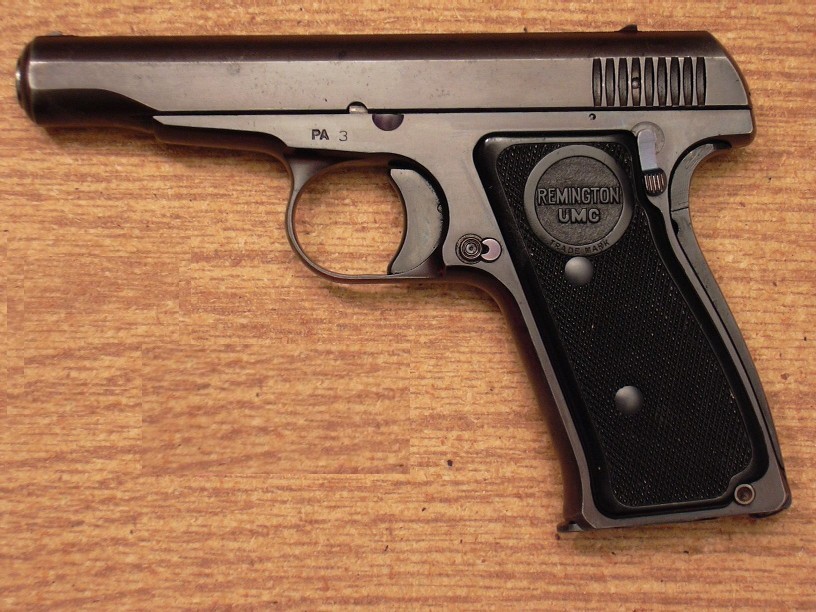

Remington Model 51
View on WikipediaThe Remington Model 51 is a small pocket pistol designed by John Pedersen and manufactured by Remington Arms in the early 20th century for the American civilian market. Remington manufactured approximately 65,000 Model 51 pistols in .32 ACP and .380 ACP calibers from 1918 to 1926, though small numbers were assembled into the mid-1930s.
Key Information


Designer John Pedersen
[edit]John Pedersen designed or was instrumental in the design of many firearms for the Remington Arms Company. He had worked in concert with John Browning to design the Remington Model 17 shotgun which served as the basis for the Remington Model 31, Ithaca 37, Browning BPS, and Mossberg 500. He designed the Pedersen device that converted the M1903 Springfield into an autoloading pistol-caliber longarm. Pedersen later worked for the US Army and provided competition to John Garand building an autoloading rifle to fire a full-power rifle cartridge. His design used innovative wax lubricated cases and a toggle-bolt system much like that of the Luger pistol but eventually lost out to the M1 Garand.
Development and production
[edit]The Model 51 was made in .380 ACP and later in .32 ACP caliber, it was marketed as a pocket pistol. While the European market embraced small-caliber pocket pistols, the American market favored revolvers at the time. The complex trigger and safety mechanisms made the handgun more expensive than the Browning-designed competition, and the Model 51 was not much smaller. Furthermore, Remington was a company known for their long arms; their handguns had previously been limited to revolvers less common compared to Colt in terms of sales. The Remington Model 51 also had only limited commercial success as it was priced around US$15.75 (in 1920, California minimum wage was US$0.33 per hour[1]).
There is an urban legend that the stock market crash of 1929 killed production of the Remington Model 51, since people could no longer afford to buy handguns, especially one costing significantly more than other guns in its market niche, however this is untrue. The Model 51 was produced from 1918 to 1926. Production ended on December 12, 1926 (though large numbers of guns, already produced, were sold in 1927, and small numbers, put together from parts already on hand in the factory, continued to be assembled and sold until 1934). By Black Friday (October 25, 1929), the Remington Model 51 had been out of production for almost three years.[2]
An advantage of Pedersen's design is that it allows for a lighter slide than a straight blowback operated pistol, and hence an overall lighter short arm, with the hesitation lock contributing to less felt recoil for this intuitive pointing pistol. General George S. Patton owned a Remington 51 and was thought to favor the pistol.[3] Despite critical praise, no government or private agency is known to have adopted the Model 51 for use. An anchor proof marking on some pistols has led to the mistaken belief that they were US Navy pistols bolstered by the fact that the Navy did indeed recommend a .45-caliber version for adoption. Some examples are seen today with inventory numbers, however their provenance is not well known and understood to have numbered one, two or six. Subsequently, the Navy ran extensive tests on the M53 and concluded it was “...a simple, rugged and entirely dependable weapon, which should be suitable in every respect for a service pistol.”[4][5]
In the 1970s and 1980s, inventor Ross Rudd designed and prototyped a .45 ACP caliber pistol based on the Pedersen layout but with an inclined surface in place of the locking surface. This served to delay the opening of the breech rather than locking it. The pistol was planned for manufacture but was never produced.[6] The Italian firm Benelli produced limited numbers of B76, B80, and B82 pistols similar to the Rudd pistol; however, they utilized an inertial locking system[7][circular reference][8]
The Remington R51 is a redesigned Model 51 initially released in February 2014[9] before supply and recall issues by Remington, believed to be built by Para Ordnance, a company recently acquired by the Freedom Group.
Variants
[edit].45cal. Model 53
[edit]Despite its shortcomings, the design was recommended for adoption by the Navy Board during the First World War as the scaled-up .45 caliber Remington Model 53. Testing of the prototype against production M1911 showed the Remington design to be more reliable.[10] Remington demanded a large advance payment to tool up for the gun, but negotiations were cut short by America's entrance into World War I. Available factories were tooled to produce the M1911 so investment in ramping-up production for another pistol did not make sense. Production of the 1911 kept pace with wartime demands and Remington itself was eventually contracted to produce the Colt weapon.
Because of a lower bore axis, lighter slide, and locked breech, the Remington 53 boasted much less felt recoil than the M1911. This fact was attested to by noted firearms expert Julian Hatcher.[11] The Remington pistol was also more accurate, lighter, and had fewer moving parts than the 1911. Despite its advantages over the M1911, there was too little civilian market to support a large-bore pistol at that time, a military contract was now unlikely, and the M1911 already had a firm foothold. Remington abandoned the larger pistol and focused on the Model 51.[12]
9mm Model R51
[edit]In 2014, Remington announced a redesigned Model 51 in 9mm Luger caliber called the R51.[13]
See also
[edit]Notes
[edit]- ^ History of California Minimum Wage
- ^ NRA Museums: Remington Model 51 Semi Automatic Pistol.[1]
- ^ Ayoob (August 2003). "Handguns of the Generals." Guns Magazine.
- ^ The Remington Model 51 by Ed Buffaloe
- ^ The Remington Model 51 Remington M53 Forgotten Weapon
- ^ Malloy (1994). "Ross Rudd's Singular Pistol". Gun Digest 1994: 156–160.
- ^ Benelli B76
- ^ Archived at Ghostarchive and the Wayback Machine: "Benelli B76 Family: Italian Inertial Locking Autopistols". YouTube.
- ^ New Remington R51
- ^ Walker. (October 1969) "M-53." The Gun Report.
- ^ Hatcher, Julian. (1947). Hatcher's Notebook. The Military Service Press Company. ISBN 0-8117-0795-4
- ^ Walker. (October 1969) "M-53." The Gun Report.
- ^ Remington Announces New R51 Pistol, retrieved 2014-01-02
References
[edit]- Stern (September 1965). "American Rifleman."
- Karr, Charles. (1969). Remington Handguns. Bonanza Books. ISBN 1-111-83223-4
- Mathews, J. Howard. (1962) Firearms Identification, Volume 1. University of Wisconsin Press. ISBN 0-398-00784-5
External links
[edit]
| Lever delayed |  | |
|---|---|---|
| Roller delayed | ||
| Gas delayed | ||
| Hesitation locked | ||
| Flywheel delayed | ||
| Radial delayed | ||
| Screw/Turnbolt delayed | ||
| Toggle delayed | ||
| Vector delayed | ||
Remington Model 51
View on GrokipediaDevelopment
Designer John Pedersen
John Douglas Pedersen (May 21, 1881–May 23, 1951) was an American firearms designer born in Grand Island, Nebraska, to Danish immigrant parents who settled in Wyoming.[6] In 1907, he joined Remington Arms Company as a consulting engineer, where he quickly established himself as a prolific innovator in firearm mechanisms, contributing to numerous successful designs including rifles, shotguns, and pistols over his three-decade tenure.[7] Pedersen's expertise stemmed from his self-taught engineering skills and hands-on approach, earning him over 60 U.S. patents and recognition from contemporaries like John Moses Browning as one of the foremost gun designers of his era.[8] Pedersen began work on the Remington Model 51 in 1913, envisioning a compact, reliable semi-automatic pocket pistol suitable for civilian self-defense.[9] He filed the foundational patent application on July 30, 1915, which was granted as U.S. Patent 1,348,733 on August 3, 1920, covering the core design elements of the pistol.[9][10] During World War I, Pedersen's motivation extended to potential military applications, leading him to adapt the design into the .45 ACP-chambered Model 53 in 1917 for evaluation as a compact sidearm, though no production contract materialized amid the war's demands on Remington's facilities.[3] Following the Armistice of November 11, 1918, Pedersen played a pivotal role in Remington's pivot from wartime rifle and ammunition production to commercial firearms, overseeing the refinement and launch of the Model 51 for civilian markets starting in September 1919.[9] This transition capitalized on Pedersen's pre-war prototypes, with the pistol entering full production and incorporating subsequent patents—such as those filed between 1921 and 1926 for ergonomic and functional enhancements—to meet post-war demand for personal protection handguns.[3] Over the next seven years, 64,796 units were manufactured before discontinuation in 1927, reflecting Pedersen's influence in adapting military-derived innovations for peacetime use.[9]Historical Context and Production
Following the Armistice of November 11, 1918, which ended World War I, Remington Arms transitioned its manufacturing efforts from military contracts—primarily the production of 545,541 U.S. Rifle, Caliber .30, Model of 1917 Enfield rifles (of the total ~2.2 million across all manufacturers) at its Ilion, New York facility—to civilian firearms as wartime demand evaporated.[11] This shift allowed Remington to repurpose machinery previously dedicated to military output for new consumer products, including semi-automatic pistols designed for personal defense.[9] The Remington Model 51 was first announced in late 1918 as part of this postwar pivot, with full-scale production beginning in September 1919 at the Ilion plant.[12] Initially chambered exclusively in .380 ACP, the pistol entered the civilian market at a retail price of $36.30, positioning it as a premium option for concealed carry among law-abiding citizens seeking reliable self-defense tools.[13] In August 1921, a .32 ACP variant was introduced to broaden appeal, though it represented a smaller portion of output.[12] Over its production run from 1919 to 1927, Remington manufactured 64,796 Model 51 pistols, with 54,518 chambered in .380 ACP and 10,278 in .32 ACP.[13] Despite promotional efforts highlighting its ergonomic "self-aiming" design, the model's intricate hesitation-lock mechanism drove up production costs, making it less competitive against simpler, lower-priced alternatives like the Colt Pocket Model 1903.[12] These economic pressures, compounded by a saturated pocket pistol market, led to discontinuation on August 18, 1926, after which remaining parts were assembled sporadically into the early 1930s.[13]Design and Features
Operating Mechanism
The Remington Model 51 utilizes a delayed blowback system, often termed a hesitation lock, invented by John Pedersen, which incorporates a skeletonized floating breechblock housed within the slide. This breechblock initially moves rearward with the slide upon recoil but is delayed in unlocking by an impinging shoulder or cam surface against the frame, ensuring that chamber pressure drops to a safe level before full extraction occurs—typically after the slide travels approximately 0.083 inches and the breechblock lifts or tilts to disengage.[3][14][1] In operation, the pistol functions in single-action mode with an internal hammer that strikes a firing pin mounted in the breechblock to detonate the cartridge primer. Recoil from the fixed-barrel design drives the slide and breechblock rearward together for a short distance (about 2 mm for the bolt head), at which point the breechblock hesitates while the slide continues (up to 5 mm), allowing gas pressure to equalize; the extractor then removes the spent case, which is ejected through the port, and the recoil spring returns the slide forward to strip and chamber a fresh round from the detachable box magazine. The system supports .32 ACP or .380 ACP calibers, with magazine capacities of 8 rounds for the former and 7 for the latter.[3][14][1][15] For user safety, particularly in a pocket carry pistol, the Model 51 integrates a grip safety on the backstrap that locks the sear, disconnector, and slide unless depressed by the shooter's hand, visually indicating when the hammer is cocked. A manual thumb safety on the left frame side further secures the action by blocking the grip safety and hammer when applied, while a magazine safety prevents firing if the magazine is removed. These features collectively enhance safe handling without compromising accessibility.[3][16][15] The delayed blowback design offers advantages over simple blowback systems, including reduced felt recoil through momentum transfer via the floating breechblock, enabling a lighter slide mass for improved control and accuracy during rapid fire. However, the precision machining of the breechblock's angled abutments, slide recesses, and cam interfaces—angled below the friction threshold to ensure reliable delayed unlocking—resulted in elevated manufacturing costs and complexity.[3][14][1] Field disassembly for cleaning requires no tools: first, unload and remove the magazine to engage the magazine safety; cock the slide fully to align a half-moon cutout in the barrel extension with the retaining pin; withdraw the pin, allowing the barrel, breechblock, and slide to be removed as a unit; then separate the barrel and breechblock by tilting the latter upward, with the firing pin and spring detaching freely. Reassembly follows in reverse.[3][15][16]Physical Specifications
The Remington Model 51 pistol measures 6.6 inches in overall length, with a barrel length of 3.5 inches, a height of 4.1 inches, and a width of approximately 0.9 inches, making it notably compact for its era.[17][2] Its unloaded weight is 21 ounces, contributing to its lightweight profile suitable for everyday carry.[1][17] The pistol was primarily chambered in .380 ACP with a magazine capacity of 7 rounds plus one in the chamber, while the .32 ACP variant offered 8 rounds plus one, requiring an adjusted recoil spring for the smaller caliber.[1] It features a blued steel frame and slide for durability and corrosion resistance, paired with checkered black plastic grips that provide a secure hold without adding bulk.[2] Sights consist of a fixed blade front and square-notch rear, optimized for close-range accuracy, while controls include a heel-mounted magazine release, a grip safety, and a thumb-operated manual safety, but no slide lock for simplicity in operation.[1][2] Ergonomically, the Model 51 emphasizes concealed carry with its slim, snag-free design featuring rounded edges, a natural-pointing grip angle, and a low bore axis to reduce muzzle flip during firing.[2][4] This configuration, enabled by its delayed blowback mechanism, balances portability and controllability.[1]| Specification | .380 ACP Variant | .32 ACP Variant |
|---|---|---|
| Magazine Capacity | 7 rounds | 8 rounds |
| Overall Length | 6.6 inches | 6.6 inches |
| Barrel Length | 3.5 inches | 3.5 inches |
| Weight (Unloaded) | 21 ounces | 21 ounces |