Hubbry Logo
search
logo
1828804

Rhizophora mangle

logo
Community Hub0 Subscribers
Read side by side
from Wikipedia

Red mangrove
1796 Plate by Johannes Zorn
Scientific classification Edit this classification
Kingdom: Plantae
Clade: Tracheophytes
Clade: Angiosperms
Clade: Eudicots
Clade: Rosids
Order: Malpighiales
Family: Rhizophoraceae
Genus: Rhizophora
Species:
R. mangle
Binomial name
Rhizophora mangle
Synonyms[2]
  • Bruguiera decangulata Griff.
  • Rhizophora americana Nutt.
Rhizophora mangle - MHNT

Rhizophora mangle, also known as the red mangrove,[1] is a salt-tolerant, small-to-medium sized evergreen tree restricted to coastal, estuarine ecosystems along the southern portions of North America, the Caribbean as well as Central America and tropical West Africa.[3] Its viviparous "seeds", in actuality called propagules, become fully mature plants before dropping off the parent tree.[4] These are dispersed by water until eventually embedding in the shallows.

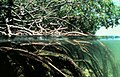
Rhizophora mangle grows on aerial prop roots, which arch above the water level, giving stands of this tree the characteristic "mangrove" appearance. It is a valuable plant in Florida, Louisiana, and Texas coastal ecosystems. The name refers to the red colour on the inner part of its roots when halved, so it does not display any red colour in its regular appearance. In its native habitat it is threatened by invasive species such as the Brazilian pepper tree (Schinus terebinthifolia). The red mangrove itself is considered an invasive species in some locations, such as Hawaii, where it forms dense, monospecific thickets.[5] R. mangle thickets, however, provide nesting and hunting habitat for a diverse array of organisms, including fish, birds, and crocodiles.

Description

[edit]

Red mangroves are easily distinguishable through their unique prop roots system and viviparous seeds. The prop roots of a red mangrove suspend it over the water, thereby giving it extra support and protection. They also help the tree to combat hypoxia by allowing it a direct intake of oxygen through its root structure.

A mangrove can reach up to 80 ft (24 m) in height in ideal conditions, but it is commonly found at a more modest 20 ft (6.1 m). Its bark is thick and a grey-brown color. Mangrove leaves are 1–2 in (2.5–5.1 cm) wide and 3–5 in (7.6–12.7 cm) long, with smooth margins and an elliptical shape. They are a darker shade of green on the tops than on the bottoms. The tree produces yellow flowers in the spring.

Reproduction

[edit]

As a viviparous plant, R. mangle creates a propagule that is in reality a living tree. Though resembling an elongated seed pod, the fully grown propagule on the mangrove is capable of rooting and producing a new tree. The trees are hermaphrodites, capable of self or wind pollination. The tree undergoes no dormant stage as a seed, but rather progresses to a live plant before leaving its parent tree. A mangrove propagule may float in brackish water for over a year before rooting.

Distribution and habitat

[edit]

Red mangroves are found in subtropical and tropical areas in both hemispheres, extending to near 28°N to S latitude. They thrive on coastlines in brackish water and in swampy salt marshes. Because they are well adapted to salt water, they thrive where many other plants fail and create their own ecosystems, the mangals. Red mangroves are often found near white mangroves (Laguncularia racemosa), black mangroves (Avicennia germinans), and buttonwood (Conocarpus erectus) though often more seaward than the other species. Through stabilization of their surroundings, mangroves create a community for other plants and animals (such as mangrove crabs). Though rooted in soil, mangrove roots are often submerged in water for several hours or on a permanent basis. The roots are usually sunk in a sand or clay base, which allows for some protection from the waves.

Ecology

[edit]

Specimens of Moesziomyces aphidis have been collected from water samples and on Rhizophora mangle leaves along the Perequê-Áçu River, in mangroves located in São Paulo State, Brazil.[6]

Uses

[edit]

In the Casamance region in southern Senegal, halved roots of R. mangle are commonly used to create roof and ceiling structures, as well as for production of firewood and charcoal.[citation needed]

[edit]

See also

[edit]

References

[edit]
[edit]
Revisions and contributorsEdit on WikipediaRead on Wikipedia
from Grokipedia
Rhizophora mangle, commonly known as the red mangrove, is a salt-tolerant evergreen tree in the family Rhizophoraceae, characterized by its distinctive arching prop roots that emerge from the trunk and lower branches to anchor in soft, muddy intertidal substrates.[1] It typically grows to heights of 5–20 meters (up to 30 meters in optimal conditions), with medium-dark green, elliptic-oblong leaves measuring 4–15 cm long and 1–5 cm wide, thick and leathery in texture, and pale yellow flowers that develop into viviparous propagules—elongated seedlings up to 25–40 cm long that germinate while still attached to the parent tree.[2] Native to tropical and subtropical coastal regions of the Atlantic, including the southern United States (from Florida to Texas), the Caribbean, Central and South America, and West Africa, and introduced to parts of the Indo-Pacific, it forms dense stands in the outermost fringes of mangrove forests where salinity and tidal flooding are highest.[1] Ecologically, R. mangle plays a foundational role in mangrove ecosystems by stabilizing shorelines against erosion, trapping sediments to build land, and providing critical habitat as a nursery for juvenile fish, crustaceans, and birds such as the roseate spoonbill.[1] Its prop roots create a complex aerial network that oxygenates the waterlogged soil through lenticels on the roots, while the tree's ability to exclude salt from its tissues enables survival in hypersaline environments up to at least 60 parts per thousand salinity.[2][3] Propagules are highly dispersible, floating for over a year and capable of long-distance travel via ocean currents, which contributes to the species' pantropical distribution despite limited natural spread beyond the Americas and West Africa.[2] Flowering occurs year-round in tropical areas, pollinated primarily by insects, with peak propagule production in the wet season.[1] Beyond its ecological significance, R. mangle holds cultural and economic value, with its durable reddish wood historically used for construction, boat-building, and charcoal production in coastal communities, while the bark yields tannins for leather processing and traditional medicines to treat ailments like ulcers and infections.[1] In modern conservation, as of 2025 it is integral to "living shoreline" projects that mitigate storm surges and sea-level rise, sequestering significant amounts of carbon, though populations face threats from climate change, habitat loss, and invasive species.[1] As the most seaward and salt-tolerant of the "true mangroves," it defines the structure of many coastal wetlands, underscoring its importance in biodiversity hotspots.[2]

Taxonomy and etymology

Classification

_Rhizophora mangle is classified within the kingdom Plantae, phylum Tracheophyta, class Magnoliopsida, order Malpighiales, family Rhizophoraceae, genus Rhizophora, and species R. mangle.[4] This placement situates it among the flowering plants, specifically the eudicots, with Rhizophoraceae comprising about 16 genera and over 100 species of tropical trees and shrubs.[4] Phylogenetically, R. mangle belongs to the true mangroves clade, a monophyletic group within Rhizophoraceae characterized by adaptations to intertidal saline environments.[5] It forms part of the Atlantic-East Pacific (AEP) lineage of the genus Rhizophora, which diverged from the Indo-West Pacific (IWP) lineages approximately 47.6 million years ago during the early Eocene.[5] Within the AEP clade, R. mangle is closely related to R. racemosa and R. samoensis, sharing a common ancestor that evolved from ancient tropical forebears along the Tethys Seaway in the Cretaceous, with subsequent adaptations enabling survival in coastal saline habitats through buoyant propagules and vivipary.[5] Historical synonyms include Bruguiera decangulata and Rhizophora americana, both now considered heterotypic synonyms of R. mangle. Bruguiera decangulata, described by Griffith in 1854, was initially placed in the genus Bruguiera due to superficial floral similarities with single-flowered species in that genus, but reclassification to Rhizophora occurred upon recognition of its Rhizophora-like viviparous hypocotyl and overall morphology aligning with R. mangle.[6][7] Rhizophora americana, named by Nuttall in 1842, was proposed for American populations but subsumed under R. mangle because Linnaeus's 1753 description has nomenclatural priority under the International Code of Nomenclature for algae, fungi, and plants, and genetic and morphological evidence confirms conspecificity.[6][8]

Nomenclature

Rhizophora mangle was first formally described under the binomial nomenclature by Carl Linnaeus in the first edition of Species Plantarum in 1753, where it appears on page 443 of volume 1.[9] The species is assigned the authority "L." to denote Linnaeus as the author.[8] The type locality specified by Linnaeus includes the Caribbean (West Indies) and, erroneously, Malabar in India, though the species is native to the Americas.[9] The genus name Rhizophora originates from the Greek words rhiza (ῥίζα), meaning "root," and phorein (φορεῖν), meaning "to bear," alluding to the plant's characteristic prop roots.[10] The specific epithet mangle derives from the Spanish term mangle, which refers to mangrove trees and likely stems from Taino or other indigenous Caribbean languages via colonial Spanish usage.[11][12] Common names for Rhizophora mangle include "red mangrove" in English, reflecting the reddish hue of certain parts of the plant, and "mangle rojo" in Spanish-speaking regions of the Americas.[1] In West Africa, it is sometimes referred to as "African mangrove" among English speakers.[13]

Description

Morphology

Rhizophora mangle is an evergreen tree or shrub that typically attains a height of 6–7 m, although individuals can reach up to 25 m in optimal conditions. The plant exhibits a distinctive growth form with arching branches that contribute to its sprawling canopy, and its bark is grey-brown, thick, and often ridged or scaly, with reddish wood beneath the outer layer. The stems are supported by an extensive root system and feature swollen nodes, while the overall architecture allows the tree to thrive in dynamic coastal environments.[14][1] The root system of R. mangle is characterized by numerous aerial prop roots, also known as stilt roots or rhizophores, which emerge directly from the trunk and larger branches. These roots arch downward, often spanning 2–4.5 m in length, and anchor into the soft, anaerobic mud of intertidal zones, providing mechanical stability against wave action and substrate instability. The prop roots are reddish in color, particularly noticeable on freshly exposed surfaces, and they form a dense network that elevates the main stem above the water level.[14][15][16] The leaves of R. mangle are arranged oppositely on the branches and are elliptical in shape, measuring 6–12 cm in length and 2.2–6 cm in width. They are thick and leathery in texture, with a glossy dark green upper surface and a paler green lower surface dotted with black punctations from salt-excreting glands. These glands enable the excretion of excess salts, and the leaves persist for 1–2 years before shedding. Stipules are lanceolate and leave characteristic ring scars upon abscission.[14][17][18] The reproductive structures include small flowers, approximately 2 cm in diameter, that occur in pairs or clusters of 2–4 within leaf axils. The flowers feature pale yellow, leathery sepals that are lanceolate and 12 mm long, along with creamy white, woolly petals that are narrowly lanceolate and 6–10 mm long. These give way to viviparous propagules, which are elongated, cigar- or pencil-shaped hypocotyls developing from the fruit while still attached to the parent tree. Mature propagules reach 12–25 cm in length and 1.2 cm in diameter, with a sharply pointed apex, and they are buoyant for dispersal.[14][17]

Physiological adaptations

Rhizophora mangle exhibits remarkable salt tolerance as a facultative halophyte, primarily through ultrafiltration mechanisms in its roots that exclude approximately 90-95% of salts from entering the vascular system, preventing toxic accumulation in tissues.[17] This process involves selective ion transport at the root endodermis, favoring uptake of water and essential ions like potassium over sodium and chloride.[19] Additionally, vivipary plays a key role in mitigating salinity stress for seedlings; by germinating while still attached to the parent tree, propagules avoid direct exposure to high-salinity sediments during early development, allowing establishment in less stressful conditions.[20] While the species lacks prominent salt-excreting glands like those in Avicennia, minor salt extrusion can occur through lenticels on leaves and limited activity at leaf base structures, though this is secondary to root exclusion.[21] To cope with anaerobic conditions in waterlogged coastal sediments, R. mangle relies on specialized adaptations for oxygen acquisition and transport. Lenticular pores, or lenticels, densely cover the prop roots above the sediment surface, facilitating atmospheric oxygen uptake during low tides when roots are exposed.[22] This oxygen is then transported to submerged roots via an extensive network of aerenchyma tissue—spongy, air-filled parenchyma cells that form continuous channels from aerial structures through the stem and into underground roots, supporting aerobic respiration in oxygen-deficient soils.[23] Nutrient uptake in R. mangle is highly efficient despite the nutrient-poor, anoxic nature of mangrove sediments, particularly for limiting elements like nitrogen and phosphorus. The plant forms associations with arbuscular mycorrhizal fungi, which enhance absorption of these nutrients by extending the root system's reach into sediment and improving ion transport under saline, low-oxygen conditions.[24] These symbiotic interactions allow R. mangle to maintain growth in environments where inorganic nitrogen (primarily ammonium) and phosphorus availability is constrained by tidal flushing and anaerobic decomposition.[25] As a true halophyte, R. mangle demonstrates broad salinity tolerance, surviving in waters up to 90 parts per thousand (ppt), though prolonged exposure to such extremes limits growth and reproduction.[17] Optimal growth occurs at moderate salinities of 10-45 ppt, where photosynthetic rates, biomass accumulation, and propagule production are maximized, reflecting an adaptive balance between osmotic regulation and resource allocation.[26] These traits collectively enable the species to thrive in dynamic intertidal zones, with physiological plasticity allowing adjustments in ion compartmentalization and water use efficiency across salinity gradients.

Distribution and habitat

Geographic distribution

Rhizophora mangle, commonly known as the red mangrove, is native to the tropical and subtropical regions of the Americas, spanning from southern Florida in the United States southward along both the Atlantic and Pacific coasts to Brazil, as well as the Caribbean islands. In Africa, its native distribution extends along the West African coast from Senegal to Angola. The species' latitudinal limits are generally confined to between approximately 30°N and 28°S, though recent climate-driven expansion has pushed the northern limit beyond 30°N, with individuals now established in Georgia, USA, as of 2025.[27][26] Beyond its native range, R. mangle has been introduced to various Pacific islands and Indo-Pacific regions through human activities, including Hawaii where propagules from Florida were planted in 1902 to stabilize eroding coastlines. Introductions have also occurred in Micronesia, such as on Pohnpei, often via intentional transport for coastal protection or accidental dispersal. In some non-native areas like Hawaii, R. mangle has become invasive, rapidly colonizing estuarine habitats and altering local ecosystems.[28][29][30] The historical spread of R. mangle has involved both natural and anthropogenic mechanisms. Naturally, its buoyant propagules facilitate long-distance dispersal via ocean currents, contributing to connectivity across its native Atlantic and eastern Pacific ranges. Human-assisted introductions, particularly in the 20th century, accelerated its expansion outside the native range, with plantings aimed at erosion control in vulnerable coastal zones.[31][32] Globally, mangrove forests, many dominated by R. mangle, cover approximately 147,000 km² (as of 2022), underscoring the species' significant role in coastal ecosystems. Major stands include the expansive mangrove forests of the Everglades in Florida, USA, representing the largest contiguous protected mangrove area in the Western Hemisphere at over 1,400 km², and the Niger Delta in Nigeria, Africa's largest mangrove system spanning about 8,000 km² where R. mangle is a key component.[33][34][35]

Habitat preferences

Rhizophora mangle, commonly known as the red mangrove, functions as a pioneer species in the seaward intertidal fringes of mangrove forests, where it establishes dense monospecific stands ahead of other mangrove species such as Avicennia germinans. This zonation pattern positions R. mangle in the most seaward zones, exposed to regular tidal inundation, while species like Laguncularia racemosa occupy inland positions with reduced flooding. In regions such as the Caribbean, this seaward dominance allows R. mangle to colonize open coastlines before transitioning to mixed stands further inland.[17][26][2] The species thrives on soft, muddy or sandy sediments in brackish estuaries and low-energy coastlines, where fine-textured alluvium or silt-clay substrates support root establishment. It tolerates frequent tidal flooding in intertidal zones with ranges typically up to 2-3 meters, as well as anaerobic, low-oxygen soils characteristic of waterlogged environments. These conditions are prevalent in tidal creek banks and fringe lagoons, promoting sediment accretion and habitat stability.[17][26][36] R. mangle is adapted to tropical and subtropical climates with mean annual temperatures of 20-30°C and annual rainfall ranging from 1,000 to 2,500 mm, though it can occur in areas up to 10,000 mm with well-distributed precipitation. It exhibits sensitivity to frost, with temperatures below 0°C causing damage and prolonged exposure to -6°C for several hours proving lethal. The species favors protected bays and river mouths, where salinity gradients span 5-50 ppt, enabling growth across brackish to hypersaline conditions.[29][36][17][37]

Ecology

Ecosystem services

Rhizophora mangle provides significant coastal protection through its prop roots, which trap sediments and stabilize shorelines, thereby reducing erosion by 50-70% in vulnerable areas. These roots also buffer against storm surges by dissipating wave energy, with stands over 500 meters wide capable of reducing incoming wave energy by up to 75%, mitigating flood risks and protecting adjacent ecosystems and infrastructure.[38][39] As a key component of blue carbon ecosystems, R. mangle facilitates substantial carbon sequestration, with ecosystem stocks averaging around 950 Mg C/ha, soils and sediments storing the majority (up to ~700 Mg C/ha in organic-rich layers that accumulate over time). The annual sequestration rate averages approximately 1.7 Mg C/ha/year, driven by high primary productivity and efficient burial of organic matter, contributing to long-term atmospheric CO2 mitigation.[40] R. mangle improves water quality by filtering pollutants and excess nutrients through its root systems, which adsorb and uptake contaminants like heavy metals, nitrates, and phosphates, enhancing water clarity in coastal zones. This filtration process boosts overall ecosystem productivity, supporting substantial fisheries yields estimated at 100–1,000 kg of fish and invertebrates per ha annually via improved habitat conditions and food web dynamics.[41][42] Research from the 2010s–2020s underscores R. mangle's role in climate resilience, demonstrating that mangrove stands mitigate sea-level rise through vertical sediment accretion rates of 1–10 mm/year (as measured across sites from 1999–2024), allowing surface elevation to keep pace with rising waters in many settings. These findings highlight the species' adaptive capacity in dynamic coastal environments, informed by field measurements across tropical regions.[43]

Biotic interactions

Rhizophora mangle forests serve as critical nursery habitats for a diverse array of fauna, particularly juvenile fish species that seek refuge among the prop roots. These structures provide shelter from predators and access to food resources, supporting over 200 fish species in the root zones of mangrove ecosystems. Notable examples include snappers (Lutjanidae) and tarpon (Megalops atlanticus), which utilize the shaded, oxygen-rich waters for early development stages.[28] Additionally, the canopy and branches offer nesting sites for birds such as herons (Ardeidae), which build rookeries in the dense foliage for protection and proximity to foraging areas in adjacent wetlands. Invertebrates, including crabs and snails, thrive in the intertidal root systems, contributing to nutrient cycling through burrowing and detritus processing.[44][17] Symbiotic relationships play a key role in the nutrient dynamics of R. mangle, particularly in nutrient-poor coastal sediments. Nitrogen-fixing bacteria, such as diazotrophs from genera like Azotobacter and Desulfovibrio, colonize the rhizosphere and sediments, converting atmospheric N₂ into bioavailable forms that enhance mangrove growth and productivity. This process is vital in anoxic, sulfur-rich environments where traditional nitrogen sources are limited.[45] Complementing this, arbuscular mycorrhizal fungi (AMF) form associations with some mangrove species in less saline conditions, though less common in salt-tolerant true mangroves like R. mangle, facilitating phosphorus and other micronutrient uptake from low-fertility soils and improving overall plant resilience. These co-symbioses between fungi and diazotrophs amplify nitrogen fixation efficiency, supporting mangrove establishment in challenging habitats.[46] Herbivory exerts significant pressure on R. mangle, with large herbivores like the West Indian manatee (Trichechus manatus) browsing on leaves and shoots, consuming up to several kilograms per individual daily in mangrove stands. Sesarmid crabs (e.g., Aratus pisonii) also defoliate foliage, with feeding rates that can remove 10-20% of leaf biomass in high-density populations. Wood-boring pests, such as the mangrove borer beetle (Poecilips rhizophorae), infest stems and roots, causing structural damage and mortality in saplings. Furthermore, invasive species like Brazilian pepper (Schinus terebinthifolia) compete aggressively at mangrove edges, outcompeting R. mangle seedlings through allelopathy and resource dominance, leading to displacement of native stands in Florida coastal areas.[47][48][49][50] Pollination in R. mangle is primarily anemophilous, relying on wind for self-pollination within flowers, though visits by bees (Apidae) can facilitate occasional cross-pollination and enhance genetic diversity. Seed predation, particularly by crabs, significantly impacts propagule recruitment, with sesarmid species consuming 20-50% of dispersed propagules in tropical mangrove forests, thereby limiting seedling establishment rates. This predation varies by habitat density but underscores crabs' role as key regulators of R. mangle population dynamics.[17][51] Salinity gradients in Rhizophora mangle habitats act as an environmental filter influencing macroinvertebrate communities. For epibionts on prop roots (such as snails like Littoraria spp., barnacles, oysters, crabs, and hydroids), patterns vary: in coastal lagoons, abundance, biomass, and species richness can increase toward less saline areas or during periods of reduced salinity (e.g., inlet closure). However, seasonal low salinity from rainfall often negatively impacts abundance of marine-adapted gastropods. Along broader gradients, salinity contributes to community composition, with stable high marine salinities (25-35+ ppt) supporting specialized epibiont assemblages, while fluctuations lead to shifts favoring tolerant species. Benthic macroinvertebrates (e.g., polychaetes, crustaceans, molluscs in sediments) show distribution linked to salinity variations, with fringe zones (higher salinity) differing from basin or estuarine areas. Fluctuations or extremes often reduce diversity, favoring euryhaline species, while indirect effects via sediment conditions and food availability further shape communities. These patterns highlight salinity's role in filtering species by osmotic tolerance, with confounding factors like temperature, hydrodynamics, and habitat structure. Overall, gradients drive changes in abundance and diversity, with extremes typically lowering metrics by excluding sensitive taxa.

Reproduction

Sexual reproduction

Rhizophora mangle exhibits continuous flowering throughout the year in tropical regions, with peaks typically occurring during the wet season, such as spring or early summer depending on local climate. This phenology supports ongoing reproduction in stable intertidal environments. The hermaphroditic flowers feature four leathery, pale yellow sepals, four white to pale yellow petals with a cottony texture, and twelve stamens arranged in two whorls, facilitating both self- and cross-pollination within the inflorescences that bear two to four flowers.[36][14][52] Pollination in R. mangle is primarily anemophilous, relying on wind dispersal of lightweight pollen, though the species is fully self-compatible, allowing for autogamous fertilization. Occasional entomophilous pollination occurs via insects such as bees that collect pollen from the exposed stamens, contributing to limited cross-pollination in ambophilous systems. This mixed strategy enhances reproductive assurance in dense mangrove stands where wind currents are consistent but insect visitors are infrequent.[53][54] Following fertilization, R. mangle displays lecithotrophic vivipary, where the single ovule develops into a mature propagule while still attached to the parent tree, nourished primarily by stored reserves in the endosperm. This process takes approximately 9 to 12 months from pollination to propagule maturity, resulting in elongated, viviparous seedlings up to 25 cm long that germinate directly on the parent with success rates of 80-90%. The high on-tree germination rate minimizes exposure to anaerobic sediments and ensures propagules are physiologically primed for establishment.[36][55][56] Genetic studies reveal moderate to high outcrossing rates in R. mangle, typically ranging from 70% to 92%, indicating a mixed mating system despite self-compatibility. However, limited pollen flow, often confined to within-estuary distances due to the species' architecture and wind patterns, contributes to regional genetic structure and reduced variability at larger scales. This pattern underscores the role of localized reproduction in maintaining population resilience amid environmental pressures.[57][58][59]

Propagule dispersal

Mature propagules of Rhizophora mangle, resulting from viviparous development on the parent tree, are elongated, cigar-shaped structures typically 20–30 cm long and 1–2 cm wide, comprising a hypocotyl and paired cotyledons.[60] Their buoyancy arises from air trapped within the hypocotyl, allowing them to float horizontally or vertically on the water surface without immediate waterlogging.[28] This adaptation supports extended viability, with propagules capable of floating for up to a year while remaining metabolically active and capable of traveling hundreds of kilometers, with some projections estimating up to 302 days.[60] Dispersal primarily occurs via hydrochory, with ocean currents serving as the dominant vector; for instance, the Gulf Stream facilitates transoceanic transport across the Atlantic, enabling genetic connectivity over vast distances.[61] Tides and nearshore flows further influence short-range movement, often stranding propagules on intertidal mudflats or coastal sediments where conditions favor establishment. Wind can modulate trajectories during flotation, but currents remain the key mechanism for long-distance spread.[62] Once stranded, propagules quickly initiate establishment by developing adventitious roots from the hypocotyl tip, typically within 1–2 weeks if embedded in soft substrate.[36] Survival rates range from 50–70% under optimal conditions, such as salinities below 40 ppt, where the plant's ultrafiltration mechanism excludes excess salts; higher salinities reduce viability by stressing the emerging seedling.[17] Propagules exhibit low tolerance to desiccation, with mortality exceeding 50% after one week of exposure to air, underscoring the need for prompt tidal inundation or moist sediments post-stranding.[60] A 2023 study in Brazil reported high seedling recruitment rates but mortality influenced by local conditions, highlighting variability in establishment success.[63] Recent studies from the 2020s highlight climate change impacts on dispersal dynamics, with projected increases in sea surface temperatures and salinity alterations reducing seawater density and potentially shortening flotation times for R. mangle propagules, thereby limiting long-distance travel.[64]

Uses and conservation

Human uses

Rhizophora mangle has been utilized by humans for various traditional purposes, particularly its durable wood for construction and boat-building in regions such as the Caribbean and West Africa. The timber is valued for its resistance to rot and insects, making it suitable for poles, pilings, and marine applications like shipbuilding and canoe construction. In coastal communities, it serves as a key material for building houses, fences, and fishing gear. Additionally, the wood is a preferred source for firewood and charcoal production due to its high energy yield and low smoke output, contributing significantly to energy needs in areas like Senegal's Sine-Saloum Delta, where mangroves supply a substantial portion of household fuel.[26][65][66][67][68] The bark of R. mangle is rich in tannins, which have been employed in traditional medicine across Caribbean and Latin American communities for treating ailments such as diarrhea, dysentery, wounds, and skin infections due to their astringent and antibacterial properties. Extracts from the bark and leaves exhibit antiseptic effects and have been used topically for boils, fungal infections, and bruises, as well as internally for fevers and angina. In folk practices, the plant's compounds also aid in wound healing and reducing inflammation.[69][1][70][71] In modern applications, R. mangle supports eco-tourism through mangrove boardwalks and bird-watching sites in protected areas, enhancing local economies while promoting conservation awareness. Its tannins continue to be extracted for leather tanning and dyeing in industrial processes. Research into bark and leaf extracts reveals potential pharmaceutical uses, including anti-inflammatory and antioxidant compounds that could inform new treatments for infections and oxidative stress-related conditions. Restoration projects frequently incorporate R. mangle planting to rehabilitate degraded coastlines, as seen in initiatives in Florida, Mexico, and Senegal.[72][73][74][75] Economically, R. mangle mangroves indirectly bolster fisheries by providing nursery habitats for juvenile fish and shellfish, with an estimated median annual value of US $37,500 per hectare of mangrove fringe in regions like the Gulf of California, depending on regional productivity and market prices. In some tropical regions, integrated mangrove-aquaculture systems combine R. mangle cultivation with shrimp farming, improving water quality and yields while reducing environmental impacts, as practiced along the Caribbean coast of Colombia.[76][77]

Conservation status and threats

Rhizophora mangle is classified as Least Concern on the IUCN Red List (assessed 2007), with a decreasing population trend reflecting an estimated 17% decline in mangrove areas within its range since 1980, despite its wide distribution across tropical and subtropical coasts, though ongoing monitoring highlights vulnerabilities in specific locales where conversion to agriculture and urban development has reduced suitable habitats.[78][79] Major threats to R. mangle include habitat loss primarily driven by aquaculture, particularly shrimp farming, a major driver contributing to about 27% of global mangrove loss from 2000 to 2020 (FAO 2023), amid an overall global mangrove area decrease of approximately 21.6% from 1985 to 2020.[80][81][82][83] Pollution from heavy metals, such as iron, copper, zinc, and cadmium, poses another risk, as these contaminants bioaccumulate in the plant's tissues, potentially impairing growth and reproduction in contaminated estuaries.[84] Climate change exacerbates these pressures, with sea-level rise outpacing sediment accretion in many sites, leading to submergence and dieback; for instance, relative sea-level rise rates exceeding 6 mm per year have been shown to hinder sustained accretion in vulnerable mangrove forests.[85] As an invasive species in non-native regions like Hawaii and Pacific islands, R. mangle outcompetes indigenous plants by forming dense stands that alter coastal ecosystems and reduce biodiversity, necessitating active management through mechanical removal and herbicide application.[86] Removal efforts in Hawaii have incurred substantial costs, with projects such as the eradication of approximately 20 acres in one wetland area totaling around $2.5 million, underscoring the economic burden of controlling its spread.[87] Conservation measures for R. mangle include protection within designated areas like Everglades National Park, where comprehensive restoration initiatives under the Comprehensive Everglades Restoration Plan aim to restore hydrologic flows and preserve mangrove habitats.[88] Restoration planting programs have successfully deployed over 500,000 propagules in Florida sites from 2009 to 2012, enhancing forest recovery in degraded areas.[89] Recent studies in the 2020s have demonstrated the species' resilience to hurricanes, showing rapid recovery of canopy cover and sediment stabilization post-disturbance in the Everglades, informing adaptive management strategies. As of 2025, approximately 42% of the world's mangroves are under some form of protection, reflecting expanded global conservation efforts.[90][91]

References

User Avatar
No comments yet.