


Community hub
Recent from talks
Contribute something
Nothing was collected or created yet.
University of Rhode Island
View on Wikipedia
The University of Rhode Island (URI) is a public land-grant research university with its main campus in Kingston, Rhode Island, United States. It serves as the state's flagship public research institution and land-grant university of Rhode Island. The university is classified among "R1: Doctoral Universities – Very high research activity".[4] As of 2019, URI enrolled 14,653 undergraduate students, 1,982 graduate students, and 1,339 non-degree students, making it the largest university in the state.[5][6]
Key Information


Its main campus is located in the village of Kingston in southern Rhode Island. Satellite campuses include the Rhode Island Nursing Education Center in Providence's Jewelry District, the Narragansett Bay Campus in Narragansett, and the W. Alton Jones Campus in West Greenwich, which closed in June of 2020 due to the coronavirus pandemic.[7] The university offers bachelor's degrees, master's degrees, and doctoral degrees in 80 undergraduate and 49 graduate areas of study through nine academic schools and colleges. Another college, University College for Academic Success, serves primarily as an advising college for all incoming undergraduates and follows them through their first two years of enrollment at URI.
History
[edit]The University of Rhode Island was first chartered as the Rhode Island State Agricultural School, associated with the state agricultural experiment station, in 1888. The site of the school was originally the Oliver Watson Farm in Kingston, whose original farmhouse is now a small museum. In 1892, the school was reorganized as the Rhode Island College of Agriculture and Mechanic Arts.[8] That year, it extended courses of study from two years to four years; URI reckons 1892 as its founding date. The first class had only seventeen students, each completing their course of study in two years. In 1909, the school's name was again changed to Rhode Island State College as the school's programs were expanded beyond its original agricultural education mandate.
The college graduated its first African American student, Harvey Robert Turner, in 1914. Turner majored in civil engineering, competed on the college's football and track teams, and received a Bachelor of Science degree. He went on to teach at Prairie View A&M University, where he also served as treasurer.[9][10]
In 1951 the school was given its current title through an act of the General Assembly following the addition of the College of Arts and Sciences and the offering of doctoral degrees. The Board of Governors for Higher Education, appointed by the governor, became the governing body of the university in 1981 during the presidency of Frank Newman (1974–1983). The Board of Governors was replaced by the Rhode Island Board of Education in 2013,[11] and by a 17-member Board of Trustees in 2019.
In 2013 the faculty adopted an open-access policy to make its scholarship publicly accessible online.[12]
Presidents
[edit]Twelve individuals have served as president, and three others have served as acting president of the University of Rhode Island. Marc B. Parlange is the current president, having served since August 2021.[13]
Main campus
[edit]URI's main campus is located in northern South Kingstown,[14] and most of the university property is in the Kingston census-designated place.[15]
The campus is accessed via Rhode Island Route 138 from either the west (Interstate 95) or east (United States Route 1). The campus was mostly farmland when it was purchased by the state in 1888, and still includes the c. 1796 Oliver Watson Farmhouse. The early buildings of the campus are set around its main quadrangle, and were built out of locally quarried granite. The campus master plan was developed by the noted landscape architects Olmsted, Olmsted & Eliot in the 1890s. The central portion of the campus, where most of its pre-1950 buildings are located,[16] was listed on the National Register of Historic Places in 2017.
Main Campus Gallery
[edit]-
![East Hall (1909)[17] and Washburn Hall (1921)](//upload.wikimedia.org/wikipedia/commons/thumb/4/4e/URI_East_Hall_and_Washburn_Hall.jpg/250px-URI_East_Hall_and_Washburn_Hall.jpg) East Hall (1909)[17] and Washburn Hall (1921)
East Hall (1909)[17] and Washburn Hall (1921) -
 Lippitt Hall, named for Governor Charles W. Lippitt, was originally a drill hall and armory (1897)
 -
 Green Hall, named for Theodore F. Green (1937)
 -
 Robert L. Carothers Library and Learning Commons (built 1965, renovated 1991)
 -
 Memorial Student Union
 -
 Multicultural Center (1998)
 -
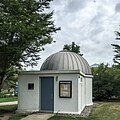 Planetarium
 -
 The Chester H. Kirk Center for Advanced Technology (1995)
 -
 New URI Engineering Stairway to Excellence (2019)
 -
 New URI Engineering Building (2021)
![East Hall (1909)[17] and Washburn Hall (1921)](https://en.wikipedia.org/wiki/File:URI_East_Hall_and_Washburn_Hall.jpg)


Satellite Campuses
[edit]W. Alton Jones Campus
[edit]The W. Alton Jones Campus is one of three satellite campuses of the University of Rhode Island and is located in West Greenwich, Rhode Island. At 2309-acres (9.34 km2) it is the largest satellite campus of the University of Rhode Island and consists of an Environmental Education Center, a business conference center, a working farm and the Nettie Marie Jones Nature Preserve.[18][19]
The land was donated to the University of Rhode Island by Nettie Marie Jones, widow of businessman W. Alton Jones.[18][20] The addition of the property tripled the size of the University's landholdings and gave it the unique position of possessing more land than any of the other New England state universities.[21]
The property is a part of the coastal forest and wildlife corridor that spans from Washington, D.C., to Maine.[22] The property also is a link between the 2,200-acre (8.90 km2) Tillinghast Pond Management Area in West Greenwich and the 14,000-acre (56.66 km2) Arcadia Management Area in West Greenwich and three other towns.[22]
The campus closed in June, 2020 and an online petition urging former URI president Dr. David M. Dooley and former governor Gina Raimondo to reopen the camp and education programs has collected more than 6,900 signatures.[22]
History
[edit]In 1954 W. Alton Jones, president of CITGO, bought the property for hunting and fishing vacations. He was a close friend of United States President Dwight D. Eisenhower, who visited the property four times for fishing, hunting and skeet shooting.[19][23] On March 1, 1962, W. Alton Jones died in a plane crash while on his way to Los Angeles to meet Eisenhower for a fishing trip.[24] His widow, Nettie Marie Jones, donated the property to the University of Rhode Island and included everything that remained on the property, from the buildings, to the farm animals and equipment - was included in the gift.[21]
Environmental Education Center
[edit]In 1965 a Youth Science Center (now called the Environmental Education Center or EEC) was constructed with much of the funding provided by the W. Alton Jones Foundation.[21] Governor John Chafee celebrated the opening of the Environmental Education Center at a dedication ceremony with a speech. 50 years later, his son Governor Lincoln Chafee celebrated the 50th anniversary of the W. Alton Jones campus at a rededication ceremony also with a speech.[20][25]
The Environmental Education Center hosted an average of 1900 campers each summer and 70 different school groups from the New England region during the academic school year.[26]
Whispering Pines Conference Center
[edit]The Whispering Pines Conference Center hosted conferences, retreats and team-building programs. It consisted of 32 guest rooms and four conference rooms.[26]
The center’s client list ranged from small businesses, to teachers’ unions and big banks.[27]
Pop Culture
[edit]In 2005 the W. Alton Jones campus was the base of the movie Hard Luck, featuring Wesley Snipes, Cybill Shepard, and Mario Van Peebles. The movie intertwines stories involving a drug dealer trying to go straight, and a housewife trying to hide a sadistic secret.[28]
Closing
[edit]In June of 2020 the University of Rhode Island closed the Environmental Education Center and Whispering Pines Conference Center, citing financial hardships dating back several years. [2]
Academics
[edit]| Academic rankings | |
|---|---|
| National | |
| Forbes[29] | 315 |
| U.S. News & World Report[30] | 151 |
| Washington Monthly[31] | 174 |
| WSJ/College Pulse[32] | 76 |
| Global | |
| THE[33] | 601–800 |
| U.S. News & World Report[34] | 749 |
URI is accredited by the New England Commission of Higher Education.[35] The student-faculty ratio at University of Rhode Island is 16:1, and the school has 43.1% of its classes with fewer than 20 students. The most popular majors at University of Rhode Island include: Registered Nursing/Registered Nurse; Psychology, General; Speech Communication and Rhetoric; Kinesiology and Exercise Science; and Health-Related Knowledge and Skills, Other. The average freshman retention rate, an indicator of student satisfaction, is 84%.[36]
Rankings
[edit]U.S. News & World Report ranks URI tied for 152nd overall among 436 "national universities" and tied for 81st out of 225 "top public schools" in 2024.[37]
- 31st in ''Pharmacy (tie)" in 2024[38]
- 47th in "Best Library and Information Studies Program (tie)" in 2024[38]
- 48th in ''Best Nursing School: Master's (tie)'' in 2024[38]
- 70th in ''Earth Sciences (tie)'' in 2024[38]
- 66th in ''Best Nursing School: Doctor of Nursing Practice (tie)'' in 2024[38]
- 101st in ''Clinical Psychology (tie)'' in 2024[38]
- 106th in "Physical Therapy (tie)" in 2024[38]
- 108th in "English (tie)" in 2024[38]
- 78th in "Speech-Language Pathology (tie)" in 2024[38]
- 148th in ''Computer Sciences (tie)'' in 2024[38]
- 130th in "Best Education Schools (tie)" in 2024[38]
- 150th in "Chemistry (tie)" in 2024[38]
- 144th in "Mathematics (tie)" in 2024[38]
- 111st in "Psychology (tie)" in 2024[38]
- 139th in ''Best Undergraduate Engineering Program'' in 2024.[36]
- 144th in ''Biological Sciences (tie)'' in 2024[38]
- 152nd in "Physics (tie)" in 2024[38]
- 135th in "Best Engineering Schools" in 2024[38]
Academic Ranking of World Universities ranks URI for 51-75 globally for ''Oceanography'' in 2023.[39]
Admissions
[edit]The average incoming freshman at the Kingston campus for 2025 had a GPA of 3.76 and an equivalent SAT score of 1265 (on a 1600 scale, with ACT scores converted accordingly).[40]
Student clubs
[edit]| Race and ethnicity | Total | ||
|---|---|---|---|
| White | 74% | ||
| Hispanic | 11% | ||
| Black | 5% | ||
| Two or more races | 4% | ||
| Asian | 3% | ||
| Unknown | 2% | ||
| International student | 1% | ||
| Economic diversity | |||
| Low-income[a] | 23% | ||
| Affluent[b] | 77% | ||
URI has 21 club sports teams, including crew, equestrian, field hockey, gymnastics, ice hockey, lacrosse, pickleball, rugby, sailing, soccer, swimming & diving, tennis, ultimate, volleyball, and wrestling.[42] These teams travel and compete against other intercollegiate programs in the country. URI also has 20+ intramural sports, including volleyball, badminton, dodgeball, and soccer. The intramural sports allow students to compete in tournaments and games with other students on campus.[43]
URI also has over 300 student organizations and clubs.[44] The university's student newspaper, The Good Five Cent Cigar, was founded in 1971.[45] It is also home to several Greek-lettered organizations.[46]
Athletics
[edit]

The University of Rhode Island competes in 16 intercollegiate sports.[47] The university is a member of the Atlantic 10 Conference and the Coastal Athletic Association in the NCAA Division I Football Championship Subdivision.
The Rhode Island Rams men's basketball competes in the Atlantic 10 Conference, and has appeared in the NCAA "March Madness" Tournament a total of 10 times since its first appearance in 1961. Two of these ten appearances occurred during the 2017 and 2018 seasons.[48][49]
Athletic facilities include the Ryan Center, Keaney Gymnasium, Meade Stadium, Mackal Field House, Tootell Aquatic Center, Bradford R. Boss Arena, URI Soccer Complex, Bill Beck Field, and URI Softball Complex.

Off campus living
[edit]While 5600 students live in the 25 on campus residence halls, thousands more opt to commute from the surrounding area.[50] Narragansett, an abutting town to Kingston, is made up of hundreds of summer vacation homes which are rented to students for the academic year.
Notable alumni
[edit]Notable University of Rhode Island alumni in politics and government include Lieutenant General (retired) Michael Flynn (B.Sc. 1981),[51] 38th mayor of Providence Jorge Elorza (B.Sc. 1998),[52] and governors of Rhode Island Lincoln Almond (B.Sc. 1959) and J. Joseph Garrahy (1953).
Notable graduates in journalism and media include CNN correspondent John King (B.A. 1985),[53] CNN anchor Christiane Amanpour (B.A. 1983), and CBS correspondent Vladimir Duthiers (B.A. 1991).
Among URI's alumni in the arts and entertainment are actors J. T. Walsh, Peter Frechette (B.F.A.), Amanda Clayton, and Andrew Burnap (recipient of the 2020 Tony Award- Best Actor in a Play, The Inheritance.)
Notable graduates in business and finance include billionaire Ben Navarro (B.Sc. 1984); former president of American Airlines, Robert Crandall (1960); and former CEO of CVS, Thomas Ryan (1975).

First magician to win America's Got Talent Mat Franco (2010).
-
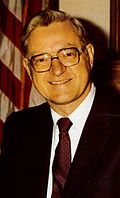 Governor of Rhode Island J. Joseph Garrahy '59
 -
 Sports radio personality Angelo Cataldi '72
 -

-
 CNN anchor Christiane Amanpour '83
 -
 38th mayor of Providence Jorge Elorza '98
 -
 Basketball star Lamar Odom
(did not graduate)


.jpg)
.jpg)
.jpg)

Notable faculty
[edit]- Robert Ballard, undersea archaeologist and discoverer of the wreck of the Titanic
- Yehuda Hayuth, Israeli professor of geography, and President of the University of Haifa
- Natalie Kampen
- Joëlle Rollo-Koster
- Andrea Rusnock
- Dana Shugar, first department head of Women´s studies major
- Melvin Stern
- Robert Weisbord
- Robert E. Will
See also
[edit]

- URI Botanical Gardens
- Joint Degrees in law at Roger Williams University School of Law
Notes
[edit]- ^ The percentage of students who received an income-based federal Pell grant intended for low-income students.
- ^ The percentage of students who are a part of the American middle class at the bare minimum.
References
[edit]- ^ As of June 30, 2024. U.S. and Canadian Institutions Listed by Fiscal Year 2021 Endowment Market Value and Change in Endowment Market Value from FY20 to FY21 (Report). National Association of College and University Business Officers and TIAA. 2022. Retrieved June 5, 2023.
- ^ a b c "Final Enrollment Reports" (PDF). University of Rhode Island. Archived from the original (PDF) on November 27, 2022. Retrieved July 2, 2019.
- ^ "Brand Colors". September 1, 2016. Retrieved November 28, 2023.
- ^ "University of Rhode Island". Carnegie Classification of Institutions of Higher Learning. American Council on Education. Retrieved February 14, 2025.
- ^ "Facts". uri.edu.
- ^ "The Integrated Postsecondary Education Data System (IPEDS)". U.S. Department of Education National Center for Education Statistics. Retrieved August 30, 2017.
- ^ Kuffner, Alex. "URI closing W. Alton Jones campus; summer camps canceled". The Providence Journal. Retrieved August 8, 2024.
- ^ Rice, M.A., S. Rodrigues and K. Venturini. "Philosophical & Institutional Innovations of Kenyon Leech Butterfield and the Rhode Island Contributions to the Development of Land Grant and Sea Grant Extension". Century Beyond the Campus: Past, Present, and Future of Extension A Research Symposium to Mark the 100th Anniversary of the Smith-Lever Act September 24–25, 2014, West Virginia University. Waterfront Place Hotel, Morgantown, West Virginia, USA. Sep. 2014. Retrieved April 11, 2017.
{{cite web}}: CS1 maint: multiple names: authors list (link) - ^ Slater, Robert Bruce (1996). "The First Black Graduates of the Nation's 50 Flagship State Universities". The Journal of Blacks in Higher Education (13): 83. doi:10.2307/2963173. ISSN 1077-3711. JSTOR 2963173.
- ^ The Granite Yearbook. Vol. 17. Kingston: University of Rhode Island. 1913. p. 27.
- ^ Associated Press (March 11, 2013). "New RI Board of Ed meets for first time". Archived from the original on August 18, 2013. Retrieved August 18, 2013.
- ^ "University of Rhode Island". ROARMAP: Registry of Open Access Repository Mandates and Policies. UK: University of Southampton. December 15, 2014. Retrieved July 24, 2018.
- ^ "University of Rhode Island history and timeline". University of Rhode Island. Archived from the original on January 30, 2013. Retrieved May 5, 2012.
- ^ "2020 CENSUS - CENSUS BLOCK MAP: South Kingstown town, RI" (PDF). U.S. Census Bureau. pp. 1-2 (PDF pp. 2-3/7). Retrieved July 2, 2023.
Univ of Rhode Island
- ^ "2020 CENSUS - CENSUS BLOCK MAP: Kingston CDP, RI" (PDF). U.S. Census Bureau. Retrieved July 2, 2023.
Univ of Rhode Island
- ^ "Draft NRHP nomination for University of Rhode Island Historic District" (PDF). Rhode Island Preservation. Archived from the original (PDF) on November 16, 2017. Retrieved November 15, 2017.
- ^ "East Hall Turns 100". University of Rhode Island. January 7, 2010. Retrieved August 18, 2016.
The 100th anniversary of the official opening of East Hall on October 15, 1909, was celebrated on October 15, 2009
- ^ a b "A campus with stories to tell". Retrieved August 13, 2024.
- ^ a b "Big Moments in the Woods". April 2, 2012. Retrieved August 15, 2024.
- ^ a b "URI commemorates 50th anniversary of W. Alton Jones Campus". Retrieved August 14, 2024.
- ^ a b c McLeish, Todd (2012). Rhode Island's Natural Laboratory. Rhode Island: University of Rhode Island. pp. 23–24, 28. ISBN 978-0-615-65473-7.
- ^ a b c Carini, Frank (June 29, 2020). "Possible Development of URI Nature Campus Creates Worry". ecoRI News. Retrieved August 14, 2024.
- ^ "W. Alton Jones Campus — By the Numbers". April 2, 2012. Retrieved August 15, 2024.
- ^ Jones, W. Alton (March 2, 1962). "W. Alton Jones and Admiral Conolly of L.I.U. Among Victims of Queens Disaster; SKETCHES OF DEAD IN JETLINER CRASH Several Couples and Three Brothers Perish Friend Was Joining Eisenhower". The New York Times. ISSN 0362-4331. Retrieved August 15, 2024.
- ^ "URI's Alton Jones Campus turns 50". www.southcountyri.com. September 23, 2012. Retrieved August 15, 2024.
- ^ a b Bessette, James (June 10, 2020). "URI to close 2 facilities on Alton Jones campus". Providence Business News. Retrieved November 10, 2024.
- ^ Staff, P. B. N. (June 19, 2000). "Whispering Pines far from the office". Providence Business News. Retrieved November 10, 2024.
- ^ Connect, P. B. N. (March 2, 2007). "Movie filmed at URI's Alton Jones campus released on DVD". Providence Business News. Retrieved November 10, 2024.
- ^ "America's Top Colleges 2025". Forbes. September 6, 2025. Retrieved October 3, 2025.
- ^ "2025-2026 Best National Universities Rankings". U.S. News & World Report. September 23, 2025. Retrieved October 3, 2025.
- ^ "2024 National University Rankings". Washington Monthly. August 25, 2024. Retrieved August 29, 2024.
- ^ "2025 Best Colleges in the U.S." The Wall Street Journal/College Pulse. September 4, 2025. Retrieved October 3, 2025.
- ^ "World University Rankings 2025". Times Higher Education. October 9, 2024. Retrieved June 19, 2025.
- ^ "2025-2026 Best Global Universities Rankings". U.S. News & World Report. June 17, 2025. Retrieved June 17, 2025.
- ^ Rhode Island Institutions – NECHE, New England Commission of Higher Education, retrieved May 26, 2021
- ^ a b "A campus with stories to tell". Retrieved August 13, 2024.
- ^ "University of Rhode Island Rankings". U.S. News & World Report. Retrieved October 5, 2024.
- ^ a b c d e f g h i j k l m n o p q Carini, Frank (June 29, 2020). "Possible Development of URI Nature Campus Creates Worry". ecoRI News. Retrieved August 14, 2024.
- ^ "2023 Global Rankings of Academic Subjects". Shanghai Ranking. Retrieved October 5, 2024.
- ^ [1], University of Rhode Island.
- ^ "College Scorecard: University of Rhode Island". College Scorecard. United States Department of Education. Retrieved July 15, 2025.
- ^ "Campus Recreation: Club Sports Teams". uri.edu. University of Rhode Island. Retrieved February 14, 2025.
- ^ "Athletics and Recreation". uri.edu.
- ^ "Student Organizations - University of Rhode Island". studentorg.apps.uri.edu.
- ^ "Women lighting the way for The Good 5-Cent Cigar". today.uri.edu. Retrieved January 12, 2021.
- ^ "Chapters of La Unidad Latina, Lambda Upsilon Lambda Fraternity, Inc". www.columbia.edu. Retrieved August 14, 2022.
- ^ "Athletics and Recreation". University of Rhode Island. Retrieved September 15, 2020.
- ^ "University of Rhode Island - NCAA.com". www.ncaa.com.
- ^ "General - Story Archives". University of Rhode Island. Retrieved September 15, 2020.
- ^ "Facts". Retrieved September 15, 2020.
- ^ Fenton, Josh. "URI Scrambles As General Flynn's Ties to QAnon Come Under Greater Scrutiny". GoLocalProv. Retrieved February 22, 2021.
- ^ Rogerson, Kate (March 23, 2017). "URI Alum: Jorge Elorza, Mayor of Providence | The Good 5 Cent Cigar". Retrieved February 22, 2021.
- ^ "John King, CNN's chief national correspondent, analyzes election results for viewers in front of the "Magic Wall." (Photo courtesy of CNN)". Westerly Sun. December 10, 2020. Retrieved February 22, 2021.
External links
[edit]

| Full members |  | ||||
|---|---|---|---|---|---|
| Associate members | |||||
| Sports |
| ||||
| Related articles | |||||
| |||||
| International | |
|---|---|
| National | |
| Geographic | |
| Other | |
University of Rhode Island
View on GrokipediaThe University of Rhode Island (URI) is a public land-grant and sea-grant research university founded in 1892 as the Rhode Island College of Agriculture and Mechanic Arts in Kingston, Rhode Island.[1][2] It enrolls over 17,000 students across undergraduate and graduate programs, making it the state's largest public institution of higher education.[3] In 2025, URI achieved Carnegie R1 classification for very high research activity, reflecting significant growth in doctoral production and research expenditures.[4] URI's main campus spans 1,248 acres in rural Kingston, with additional facilities including the Narragansett Bay Campus for oceanographic research, emphasizing its sea-grant mission.[5] The university offers more than 80 undergraduate and 50 graduate majors, with particular strengths in oceanography, pharmacy, nursing, and engineering, where programs like the Graduate School of Oceanography and College of Pharmacy rank among the nation's top for specialized training and research output.[6][7][8] As Rhode Island's flagship public university, URI drives economic development through partnerships in marine sciences, health professions, and applied technologies, while its athletics teams, the Rams, compete in the Atlantic 10 Conference.[9][10]
History
Founding and Early Years (1892–1920s)
The Rhode Island College of Agriculture and Mechanic Arts was established on May 19, 1892, by act of the state legislature, reorganizing the prior State Agricultural School that had opened in 1890 on a 140-acre farm in Kingston purchased for $5,000 from Oliver Watson.[1] This renaming aligned with federal funding from the Second Morrill Act, enabling expansion of its two-year programs into four-year degrees in agriculture and mechanics (mechanical engineering).[1] John H. Washburn, previously principal of the agricultural school since 1889, served as the institution's first president from 1892 to 1902, overseeing its initial operations with a focus on practical education for farmers and mechanics.[11] In September 1892, the college admitted its first students, primarily men from rural backgrounds, on the Kingston site that included early structures like Taft Hall (1889, for the Agricultural Experiment Station), South Hall, College Hall, and Ladd Laboratory (completed 1890–1891).[1] The curriculum emphasized applied sciences, with required courses in farm management, animal husbandry, crop production, and engineering principles, supplemented by general studies in English, mathematics, and chemistry to meet land-grant mandates.[1] Enrollment remained modest in the early years, reflecting the institution's vocational orientation; the first graduating class of 17 students received diplomas in 1894, marking Rhode Island's initial cohort of land-grant college alumni after a 1894 agreement with Brown University formalized its status as the state's land-grant institution.[1] A preparatory high school department operated from 1898 to 1908 to address inadequate secondary education in rural areas, while the first master's degree was awarded in 1907.[1] Challenges included a major fire on January 27, 1895, that destroyed College Hall, which was promptly rebuilt and later renamed Davis Hall.[1] Under subsequent presidents Kenyon L. Butterfield (1903–1906), who introduced agricultural extension services to disseminate knowledge to farmers, and Howard Edwards (1906–1930), the college experienced steady growth, including the admission of women in 1909 alongside the new home economics program.[1] That year, the legislature renamed it Rhode Island State College, signaling broader academic ambitions.[1] Infrastructure expanded with Lippitt Hall in 1897 (initially a drill hall and armory) and East Hall in 1909 for dormitories. World War I disrupted operations, with 301 students enlisting and classes suspended from April 1918 to January 1919; a war memorial was dedicated in June 1922 to honor the fallen.[1] By the mid-1920s, enrollment had increased, supported by new facilities like Washburn Hall (1921), though the institution retained its emphasis on agriculture and mechanics amid Rhode Island's industrial economy.[1]Expansion and State College Era (1930s–1950)
Under President Raymond G. Bressler, who assumed office in 1931 following the death of Howard Edwards, Rhode Island State College underwent significant reorganization and physical expansion. In 1932, the institution was restructured into three schools: Engineering, Science and Business, and Agriculture and Home Economics, reflecting a broadening academic scope that included the initiation of an aeronautical engineering program led by Igor Sikorsky and Nicholas Alexander. Enrollment grew steadily, reaching 1,216 students by 1940 amid land acquisitions such as the Asa and Edward Sweet properties in 1934 and portions of Peckham Farm in 1936, which expanded the campus westward.[12][13] New facilities underscored this growth, with the completion of Quinn Hall in 1936 for home economics, the Central Heating Plant, and the Animal Husbandry Facility (Dairy Barn); Eleanor Roosevelt Hall dedicated as a women's dormitory that year; and Green Hall in 1937 housing administration and the library. The Narragansett Marine Laboratory was established in 1936, enhancing research capabilities, while Meade Stadium opened in 1938, named for benefactor John E. Meade. In 1939, the Rhode Island General Assembly created the Board of Trustees of State Colleges to oversee governance. Bressler's tenure ended in 1940, with John Barlow serving as acting president before Carl R. Woodward's installation in 1941.[12] World War II profoundly influenced operations, prompting accelerated programs, a summer term in 1942, and the establishment of the Engineering Experiment Station and Industrial Extension Division; an Army Specialized Training Unit arrived in 1943 to bolster military science. Postwar, the GI Bill drove enrollment surges in 1946, necessitating temporary Quonset hut housing; the college acquired Sherman Farm in 1945 and further Peckham lands in 1944. Academic diversification continued with a nursing degree program in 1945, reorganization of agriculture and home economics into separate schools in 1946, turfgrass studies initiation, and the creation of the School of Arts and Sciences in 1948, authorizing the Bachelor of Arts degree—first awarded in 1949. By 1950, new dormitories Butterfield and Bressler Halls opened to accommodate growth, alongside poultry science advancements in disease research.[12]University Status and Post-War Growth (1951–1990s)
In 1951, the Rhode Island State College was elevated to university status through an act of the Rhode Island General Assembly passed on March 23, renaming it the University of Rhode Island to reflect its broadened academic scope, including the recent establishment of the College of Arts and Sciences and expanded graduate offerings.[1] This transition coincided with the founding of the School of Nursing within the College of Home Economics, marking an early step in diversifying health-related programs.[1] The change aligned with post-World War II demands for higher education expansion, fueled by the G.I. Bill, which had already strained campus housing with temporary Quonset huts to accommodate returning veterans.[1] Post-war growth accelerated in the 1950s, with the dedication of the URI Memorial Union Building honoring students lost in World War II and the opening of the Pastore Chemical Laboratory in 1952, named for U.S. Senator John O. Pastore.[1] By 1957, the College of Pharmacy was established under Dean Heber W. Youngken Jr., and the URI Foundation was created to support fundraising for development.[1] Under President Francis H. Horn, appointed in 1958, the state authorized Ph.D. programs, signaling URI's shift toward research-intensive status; that year also saw the construction of residence halls including Hutchinson, Peck, and Adams, alongside the Hope Dining Hall to address surging student numbers.[1] The 1960s brought further infrastructure and programmatic expansion, including the 1961 establishment of the Graduate School of Oceanography under Dean John A. Knauss, leveraging Rhode Island's coastal position for marine research.[1] New facilities proliferated, such as the Fine Arts Center (Phase I) in 1966 and additional residence halls like Aldrich and Burnside, while the Robert L. Carothers Library opened in 1965 to support growing academic needs.[1] By the 1970s and 1980s, URI solidified its role as the state's flagship public research university, with continued investments in science and engineering facilities amid national trends in higher education growth, though specific enrollment figures reflected broader post-war booms without isolated URI data dominating state reports.[1] Into the 1990s, this era's foundations enabled URI's designation as a Sea Grant College and further program maturation, underpinning its evolution from a state college to a comprehensive land-, sea-, and urban-grant institution.[1]Contemporary Developments (2000–Present)
Under the leadership of President Robert L. Carothers, who served from 1991 to 2009, the University of Rhode Island pursued sustained enrollment growth and capital improvements, including renovations to facilities like Ballentine Hall in 2003, which cost $10.9 million and expanded academic space.[14] [15] Carothers' tenure emphasized strategic planning aligned with the 2000 Kingston Campus Master Plan, which guided infrastructure development and site allocations for new buildings, such as potential expansions near Chafee Hall.[16] David M. Dooley succeeded Carothers as president in 2009, serving until 2021, during which the university advanced research facilities and engineering infrastructure, including the Chester H. Kirk Center enhancements and new constructions like the 2019 Stairway to Excellence and 2021 Engineering Building.[11] Enrollment trends reflected modest growth, with undergraduate numbers rising from approximately 14,362 in the early 2000s to around 15,000 by the mid-2010s, supported by increased applications and state initiatives.[17] Dooley's administration also navigated challenges, such as a 2012 controversy involving faculty Twitter use, where initial restrictions were later clarified in alignment with First Amendment principles.[18] Marc B. Parlange assumed the presidency in 2021, overseeing continued enrollment increases amid regional competition; by fall 2024, first-year applications reached 26,983, up 1,500 from the prior year, with total headcount approaching 17,500 including part-time students.[11] Recent developments include federal scrutiny in 2025 over scholarships alleged to discriminate on race and sex bases, prompting a U.S. Department of Education investigation following complaints by advocacy groups.[19] Infrastructure projects persisted, such as the Ocean Robotics Laboratory, enhancing marine research capabilities.[20] These efforts positioned URI as Rhode Island's largest public university, with total enrollment stabilizing around 84% full-time undergraduates by 2023.[21]Campuses and Facilities
Kingston Main Campus
The Kingston Main Campus of the University of Rhode Island occupies 1,200 acres in the historic village of Kingston, South Kingstown, Rhode Island, about 30 miles south of Providence and near the Atlantic Ocean. This rural setting integrates natural features such as hillsides, wetlands, and wooded areas with academic infrastructure, creating distinct land use zones that enhance the campus's identity within the New England landscape. The proximity to beaches and Narragansett Bay supports marine science programs and recreational access, with a dozen public beaches within short driving distance.[22][23][16] The campus core, centered on a grassy, tree-lined quadrangle, spans approximately 29 acres and forms the University of Rhode Island Historic District, added to the National Register of Historic Places on January 17, 2018, for its late 19th- and early 20th-century architecture. Key contributing structures include Lippitt Hall, built in 1897 as a drill hall and armory, and Green Hall, constructed in 1937 and named for former Rhode Island Governor Theodore F. Green. These buildings exemplify the campus's evolution from an agricultural college to a comprehensive university while preserving architectural heritage amid expansion.[24][13] Contemporary facilities bolster teaching, research, and student services, including the Robert L. Carothers Library and Learning Commons, erected in 1965 and renovated in 1991 to accommodate modern learning needs. The Memorial Student Union functions as the central venue for student gatherings and organizations. A $5.3 billion campus master plan, approved by the URI Board of Trustees on September 29, 2025, outlines renovations over 20 years to facilities like the Memorial Union, Hope Commons dining hall, and Tootell Physical Education Center, aiming to align infrastructure with enrollment demands exceeding 17,000 students primarily based at Kingston.[25][26][27] Facilities Operations oversees maintenance of buildings, utilities, and grounds to support academic missions, addressing challenges in aging systems like steam and electrical distribution through targeted upgrades. The campus layout, bounded by the Town of South Kingstown and adjacent to Kingston Village's commercial services, facilitates pedestrian-friendly access while integrating with surrounding historic and natural elements.[25][28][29]Satellite and Specialized Facilities
The University of Rhode Island maintains two primary satellite campuses beyond its main Kingston location: the Narragansett Bay Campus and the Rhode Island Nursing Education Center in Providence. These facilities support specialized academic programs and research in oceanography and nursing, respectively.[22] The Narragansett Bay Campus, spanning 153 acres and overlooking the West Passage of Narragansett Bay in Narragansett, Rhode Island, houses the Graduate School of Oceanography, ranked among the top five oceanography programs in the United States. Established as a hub for advanced ocean research and education, it features state-of-the-art laboratories for rearing and maintaining marine organisms, the Inner Space Center for telepresence-enabled ocean exploration, and the Marine Ecosystems Research Laboratory with experimental enclosures for ecosystem studies. The campus also includes the Coastal Institute, which offers interactive exhibits on coastal environments and serves as a conference center for ocean science outreach. These facilities enable hands-on graduate training in biological, chemical, geological, and physical oceanography, contributing to global ocean challenges through vessel-based expeditions and data analysis.[22][6][30][31][32] The Rhode Island Nursing Education Center, located at 350 Eddy Street in Providence and opened in August 2017, provides 133,000 square feet of space dedicated to nursing education, simulation training, and biomedical research. This facility serves as a regional center for undergraduate and graduate nursing students from URI and partner institutions, featuring advanced classrooms, a simulation suite for clinical practice, skills laboratories, and offices for health care learning initiatives. It supports baccalaureate, master's, and doctoral programs, emphasizing practical training in a non-hospital setting to address workforce needs in Rhode Island's health sector.[22][33][34]Governance and Administration
Leadership Structure and Presidents
The University of Rhode Island is governed by a Board of Trustees comprising 17 voting members appointed by the Governor of Rhode Island, in consultation with the University President and Board Chair, and confirmed by the Rhode Island Senate; it also includes one non-voting student trustee appointed by the President, one non-voting faculty trustee appointed by the President, and three ex officio members consisting of the University President, the Chair of the Rhode Island Council on Postsecondary Education, and the Chair of the Rhode Island Board of Education.[35] The Board holds ultimate responsibility for appointing and evaluating the President, establishing performance goals for the President and the institution, managing university buildings, employees, and property, approving the operating budget, conferring degrees, and granting faculty tenure.[36][35] The President functions as the chief executive officer, directing academic, administrative, and operational affairs under the Board's oversight.[37] Supporting the President are senior administrators, including the Provost and Executive Vice President for Academic Affairs, who oversees faculty, curriculum, and academic programs; the Vice President for Research and Economic Development, who advances research initiatives and partnerships; and the Vice President for Administration and Finance, who handles budgeting, fiscal policy, and business operations.[36] Twelve individuals have served as President since the institution's founding as Rhode Island College of Agriculture and Mechanic Arts in 1892.[11] The following table enumerates them with tenures and key contributions documented in university records:| President | Tenure | Notable Contributions |
|---|---|---|
| John Hosea Washburn | 1892–1902 | Secured land-grant status from Brown University and established foundational agricultural programs.[11] |
| Kenyon L. Butterfield | 1903–1906 | Emphasized rural sociology and institutional development drawing from prior academic experience.[11] |
| Howard Edwards | 1906–1930 | Longest-serving president; oversaw renaming to Rhode Island State College and significant enrollment growth.[11] |
| Raymond George Bressler | 1931–1940 | Stabilized administration following interim leadership amid economic challenges.[11] |
| Carl R. Woodward | 1941–1958 | Achieved university status in 1951 and expanded infrastructure during post-war expansion.[11] |
| Francis H. Horn | 1958–1967 | Elevated international recognition through academic enhancements and research focus.[11] |
| Werner A. Baum | 1968–1973 | Leveraged federal environmental expertise to advance science programs.[11] |
| Frank Newman | 1974–1983 | Reversed enrollment declines and founded the College of Human Science and Services.[11] |
| Edward D. Eddy | 1983–1991 | Boosted national profile and expanded the Graduate School of Oceanography.[11] |
| Robert L. Carothers | 1991–2009 | Implemented progressive reforms, improving academic reputation and diversity initiatives.[11] |
| David M. Dooley | 2009–2021 | Defined strategic priorities emphasizing research, sustainability, and global engagement.[11] |
| Marc B. Parlange | 2021–present | Prioritizes global collaborations and institutional amplification, succeeding from Monash University leadership.[11][36] |
Financial Operations and State Funding
The University of Rhode Island operates under an activity-based budget model implemented to align resources with strategic priorities, enhance transparency, and incentivize revenue-generating activities such as research grants and auxiliary services. This model allocates revenues directly to units based on performance metrics, including tuition recovery for academic programs and indirect cost recoveries from sponsored projects, while promoting diversification beyond traditional state and tuition dependencies. In fiscal year 2024, total operating revenues reached approximately $522 million, reflecting a 3.57% increase from the prior year, driven primarily by growth in tuition, fees, housing, and sponsored programs.[38] Net tuition and fees constituted the largest revenue source at $350.79 million in FY2024, accounting for about 67% of operating revenues after deductions for scholarships and waivers, with auxiliary enterprises like housing and dining contributing additional stability. Sponsored programs and grants added significant inflows, with federal awards supporting research operations, while state appropriations provided baseline operational funding at roughly $105.4 million for FY2024. The university's endowment, managed separately by the URI Foundation, stood at $237 million as of June 30, 2024, generating income through a 5.05% spending rate applied in the subsequent academic year to support scholarships and programs without direct integration into core operating budgets.[38][39][40] State funding, derived from Rhode Island general revenues, has trended upward modestly amid competing budget priorities, comprising about 20% of URI's operating budget in recent years. For FY2025, the appropriation rose to $110.8 million, a $5.4 million increase over FY2024, supporting core operations and infrastructure like the Biomedical Sciences Building. This was followed by a further $4.5 million increment to $115.3 million in the FY2026 enacted budget, reflecting legislative emphasis on higher education capital investments despite URI's requests for larger expansions, such as a $40.9 million boost proposed in early 2025 to address enrollment-driven costs and inflation. These appropriations, while growing, remain below historical peaks adjusted for inflation, prompting URI to pursue out-of-state tuition growth—projected at $414.4 million in FY2025—and federal grants to offset fiscal pressures.[39][41][42][43]Academics
Colleges, Departments, and Degree Programs
The University of Rhode Island organizes its academic offerings into eight primary colleges and the Graduate School of Oceanography, encompassing departments that deliver over 80 undergraduate majors and approximately 50 graduate degree programs across disciplines in the arts, sciences, engineering, health, business, education, and environmental fields.[44][45] This structure supports bachelor's, master's, doctoral, and professional degrees, as well as certificates and minors, with a total of 259 academic programs available, including online and international options.[46] College of Arts and Sciences provides foundational education in humanities, social sciences, and natural sciences through departments including anthropology, chemistry, English, history, mathematics, philosophy, physics, political science, psychology, and sociology, offering majors such as biology, communication studies, economics, and foreign languages.[44] College of Business focuses on commerce and management, with departments in accountancy, finance, marketing, and supply chain management, granting degrees like the Bachelor of Science in Business Administration and Master of Business Administration.[44] Feinstein College of Education and Professional Studies emphasizes teacher preparation and human development, featuring departments of education, kinesiology, and modern and global languages, with programs including early childhood education and special education certifications.[44] College of Engineering delivers technical training in chemical, civil, electrical, industrial, mechanical, and ocean engineering, alongside computer science and systems engineering, offering accredited bachelor's and graduate degrees with hands-on laboratory components.[44] College of the Environment and Life Sciences addresses biological, environmental, and agricultural sciences via departments such as biological sciences, fisheries, animal and veterinary science, environmental horticulture, and natural resources science, providing majors in animal science, environmental science, nutrition, and landscape architecture.[44][47] College of Health Sciences covers communal health, human development, and therapeutics through departments like communicative disorders, health sciences, and social work, with degrees in exercise science, medical laboratory science, and public health.[44] College of Nursing specializes in clinical nursing education, offering Bachelor of Science, Master of Science, and Doctor of Nursing Practice degrees, including accelerated tracks for registered nurses.[44] College of Pharmacy concentrates on pharmaceutical sciences and clinical pharmacy, conferring the Doctor of Pharmacy as its primary professional degree, supported by research in pharmacology and pharmaceutics.[44] The Graduate School of Oceanography, located at the Narragansett Bay Campus, advances marine and atmospheric studies with departments in oceanography and marine affairs, granting master's and Ph.D. degrees in biological, chemical, physical, and geological oceanography.[44] Departments across these units often collaborate on interdisciplinary programs, such as data science and cybersecurity certificates, ensuring alignment with workforce demands in Rhode Island and beyond.[46]Admissions Statistics and Enrollment Trends
For fall 2024, the University of Rhode Island enrolled approximately 17,000 students, including over 14,300 undergraduates and roughly 2,700 graduate students. Undergraduate enrollment has shown stability over the past decade, averaging about 14,600 students annually with a net increase of around 1,000 undergraduates since the early 2010s, even as statewide postsecondary enrollment in Rhode Island declined by 12.6% over the same period. This resilience reflects targeted recruitment efforts amid competition from community colleges and regional institutions, with total enrollment rising year-over-year in recent cycles.[5][48][49][50] Admissions selectivity has remained moderate, with an acceptance rate of approximately 72% for recent incoming classes. The university received a record 26,900 first-year applications for fall 2024, up from 25,100 the prior year and 22,700 in 2017, indicating growing applicant interest driven by enhanced program offerings in fields like engineering and nursing. Yield rates have supported consistent first-year class sizes of about 3,300 students, comprising 47% in-state residents and 53% out-of-state or international enrollees from 47 U.S. states and 68 countries. Among incoming first-year students, 27% self-identify as students of color.[51][52][53][54]| Metric | Middle 50% Range (Incoming First-Year, Class of 2028) |
|---|---|
| High School GPA | 3.40–4.12 |
| SAT (Evidence-Based Reading and Writing + Math) | 1180–1350 |
| ACT Composite | 27–31 |