


Community hub
Recent from talks
Contribute something
Nothing was collected or created yet.
R-36 (missile)
View on Wikipedia | This article needs additional citations for verification. (September 2022) |
The R-36 (Russian: Р-36) is a family of intercontinental ballistic missiles (ICBMs) and space launch vehicles (Tsyklon) designed by the Soviet Union during the Cold War. The original R-36 was deployed under the GRAU index 8K67 and was given the NATO reporting name SS-9 Scarp. It was able to carry three warheads and was the first Soviet MIRV (multiple independently targetable re-entry vehicle) missile.[4] The later version, the R-36M, also known as RS20, was produced under the GRAU designations 15A14 and 15A18 and was given the NATO reporting name SS-18 Satan. This missile was viewed by certain United States analysts as giving the Soviet Union first strike advantage over the U.S., particularly because of its rapid silo-reload ability, very heavy throw weight and extremely large number of re-entry vehicles. Some versions of the R-36M were deployed with 10 warheads and up to 40 penetration aids and the missile's high throw-weight made it theoretically capable of carrying more warheads or penetration aids. Contemporary U.S. missiles, such as the Minuteman III, carried up to three warheads at most.
Key Information


The R-36 became the base for the Tsyklon launch vehicles family. As of early 2021, Cyclone-4M, the last Tsyklon variant in development, is planned for launch in 2023 from Canso, Nova Scotia.[5]
Some R-36 missiles have been converted into Dnepr medium-lift launch vehicles, capable of putting up to 4,500 kg into orbit.
History
[edit] |

Development of the R-36 was begun by OKB-586 (Yuzhnoye) in Dnepropetrovsk, Ukraine (at the time part of the Soviet Union) in 1962, and built upon the work of the R-16 program. The Chief Designer was Mikhail Yangel. Initial development was of light, heavy, and orbital versions, with flight testing from 1962 through 1966, at which time initial operational capability was achieved. News of the development of the orbital version caused alarm in the West with the possibility that the Soviets would be able to launch a large number of nuclear weapons into orbit where there was no capability to intercept them. Weapons could potentially be left orbiting for an indefinite period. The prospect of orbital nuclear weapons led both sides to agree to a treaty banning the basing of weapons of mass destruction in space.
In 1970, development of a fourth version, capable of delivering multiple warheads, was begun, which was test flown the next year.
Further improvement of the R-36 led to the design of the R-36M, which provided a theoretical first-strike capability—the ability to destroy the United States' LGM-30 Minuteman ICBM silos and launch control centers before they could retaliate. However, neither the Soviet Union nor the Russian Federation have ever publicly delineated the missile's particular role in their arsenal. The initial design of the R-36M called for a single massive 12 Mt warhead to be delivered over a range of 10,600 km. The missile was first tested in 1973 but this test ended in failure. After several delays the R-36M was deployed in December 1975. This design was delivered with a single 18–20 Mt warhead and a range of just over 11,000 km. This new version was given a new codename by NATO: SS-18 Satan.
The R-36M has gone through six separate variants, with the first being phased out by 1984. The final variant designated R-36M-2 "Voevoda" (NATO codename SS-18 mod 6) was deployed in August 1988. This missile could deliver the same 18–20 Mt warhead 16,000 km. Prior variants mainly introduced MIRV (Multiple independent reentry vehicles) warheads. These missiles surpassed their western counterpart, the US LGM-118 Peacekeeper in terms of megatons delivered, range, and survivability, but were inferior in terms of accuracy (CEP).
The control system for this rocket was designed at NPO "Electropribor"[6] (Kharkiv, Ukraine).
Deployment
[edit]
At full deployment, before the fall of the Soviet Union in 1991, 308 R-36M launch silos were operational. After the breakup of the USSR, 204 of these were located on the territory of the Russian Federation and 104 on the territory of newly independent Kazakhstan. In the next few years Russia reduced the number of R-36M launch silos to 154 to conform with the START I treaty. Part of the missiles in Kazakhstan (54 of them) were under the 57th Rocket Division at Zhangiz-Tobe (Solnechnyy), Semipalatinsk Oblast.[7] The other R-36 establishment in Kazakhstan was the 38th Rocket Division at Derzhavinsk, Turgay Oblast.[8] The dismantling of 104 launchers located in Kazakhstan was completed in September 1996.
The START II treaty was to eliminate all R-36M missiles but it did not enter into force and the missiles remained on duty. Russia has steadily decreased the number of operational R-36Ms and as of March 2013, only 55 (all of the 10 MIRV R-36M2 version) remain.
US Air Force National Air and Space Intelligence Center estimates that as of June 2017 about 50 R-36M2 launchers were operationally deployed.[9]
About 40 missiles will have their service lives extended so that they remain in service until about 2020. With the retirement of the 20 megaton R-36M2 warheads, the highest yield weapon in service with any nation is the estimated 5 Mt Chinese Dong Feng 5 (DF-5) ICBM (CSS-4) warhead and the Russian UR-100N 5 Mt rocket.
Elimination / Retirement
[edit]
In the last decade[dubious – discuss] Russian armed forces have been steadily reducing the number of R-36M missiles in service, withdrawing those that age past their designed operational lifetime. As of January 2020, the Strategic Missile Troops had 46 R-36M2s (or RS-20Vs) in active service.[10]
In March 2006 Russia made an agreement with Ukraine that will regulate cooperation between the two countries on maintaining the R-36M2 missiles. It was reported that the cooperation with Ukraine will allow Russia to extend the service life of the R-36M2 missiles by at least ten to 28 years.[11][needs update]
According to Interfax report, two R-36M2 missiles are planned to be dismantled by November 30, 2020. The process is to be carried out in accordance with the New START procedures.[12][needs update]
As of 2018[update] Russia unveiled the intended replacement for the R-36M series, a new heavy ICBM the RS-28 Sarmat,[13] which became operational in September 2023.[14]
Design
[edit]Multiple warheads
[edit]

Missiles of the R-36M family have never been deployed with more than ten warheads, but given their large throw-weight (8.8 tonnes as specified in START), they have the capacity to carry considerably more detonation power. Among the projects that the Soviet Union considered in the mid-1970s was that of a 15A17 missile—a follow-on to the R-36MUTTKh (15A18).[15] The missile would have had an even greater throw-weight—9.5 tonnes—and would be able to carry a very large number of warheads. Five different versions of the missile were considered. Three of these versions would carry regular warheads — 38 × 250 kt yield, 24 × 500 kt yield, or 15–17 × 1 Mt yield. Two modifications were supposed to carry guided warheads ("upravlyaemaya golovnaya chast") — 28 × 250 kt or 19 × 500 kt.[15] However, none of these upgraded models were ever developed. The SALT II Treaty, signed in 1979, prohibited increasing the number of warheads ICBMs could carry. Equally, from a strategic point of view, concentrating so many warheads on silo-based missiles was not seen as desirable, since it would have made a large proportion of the USSR's warheads vulnerable to a counterforce strike.
The operational deployment of the R-36M consisted of the R-36MUTTKh, which carried ten 500 kt warheads, and its follow-on, the R-36M2 (15A18M), which carried ten 800 kt warheads (single-warhead versions with either 8.3 Mt or 20 Mt warhead also existed at some point). To partially circumvent the treaty, the missile was equipped with 40 decoys to utilize the capacity left unused due to the 10-warhead limitation.[16] These decoys would appear as warheads to any defensive system, making each missile as hard to intercept as 50 single warheads, rendering potential anti-ballistic defense ineffective.
Silo hardness
[edit]A US military estimate circa 1994 said "SS-18 silos have since been assessed to be much harder than 7,000 psi (48 MPa)".[17]
Variants
[edit]R-36 (SS-9)
[edit]R-36
[edit]The R-36 is a two-stage rocket powered by a liquid bipropellant, with UDMH as fuel and nitrogen tetroxide as an oxidizer. It carries one of two types of re-entry vehicles (RVs) developed especially for this missile:[citation needed]
- Single nuclear warhead of 20 megatons TNT (NATO codename SS-9 Mod 1).[18]
- Single nuclear warhead of 8.3 megatons TNT (NATO codename SS-9 Mod 2).[18]
The first launch of an R-36 took place on September 28, 1963, and ended ignominiously when the missile lost thrust one second after liftoff and fell back onto the pad, causing a fire.[19] This debacle led to program director V.P. Petrov being fired and replaced by V.N. Soloviev.[citation needed] LC-67/1 was repaired and the next test took place successfully on December 3. Subsequent testing went better, however, LC-80/1 had to be rebuilt following another launch accident on January 13, 1965. Two months later, an R-36 caught fire during propellant loading on LC-67/1 and exploded, putting the pad out of commission for nine months.[20] During test launch #17 (October 10, 1964), the warhead was retrieved with a parachute. Flight tests of the rocket were completed by May 20, 1968, and on November 19 of the same year it entered service.[20] The first (and only) regiment with 18 launchers was deployed on August 25, 1969.[citation needed] A total of 139 8K67s flew between 1963 and 1975 with 16 failures.[citation needed]
The Tsyklon series of civilian space launchers from Ukraine is based on the R-36orb (8К69) or R-36-O (capital O for Orbital) design.[21] The R-36-O launched many orbital satellites (like Kosmos 160, SATCAT 2806, on 17 May 1967) in the 1960s and 1970s as part of the FOBS weapons program.
R-36M (SS-18 Mod 1)
[edit]Variant of the R-36M carrying a single large reentry vehicle, with a warhead yield of 18-25 Mt, a distance of about 11,000 kilometres (6,000 nmi). In January 1971, cold-launch tests began during which the mortar launch was perfected. The actual flight tests for the missile began on 21 February 1973, though some sources suggest that testing began in October 1972. The testing phase of the R-36M with various different types of warheads was finished in October 1975 and on 30 December 1975 deployment began (though some Western sources suggest that an initial operational capability was reached in early 1975). A total of 56 were deployed by 1977, though all were replaced by R-36MUTTKh missiles by 1984. These high-yield weapons were assessed in the West as possibly developed to attack American Minuteman ICBM launch control centers.[citation needed]
R-36M (SS-18 Mod 2)
[edit]Variant of the R-36M with a post-boost vehicle and up to eight reentry vehicles, each with a warhead yield estimated at between 0.5 and 1.5 Mt, with a range capability of about 10,200 kilometres (5,500 nmi). The MIRVs were placed in pairs, and a post boost vehicle with a command structure and a propulsion system were contained in the nose cone of the R-36M. The flight tests of this variant began in September 1973 (though some Western sources suggest that the initial flight test occurred in August 1973), with IOC in 1975. Approximately 132 were deployed by 1978, but the post-boost vehicle design was seriously flawed, and all missiles were replaced by R-36MUTTKh by 1983.[citation needed]
R-36MUTTKh (SS-18 Mod 3)
[edit]Variant of the R-36MUTTKh with a single large reentry vehicle that was an improved version of the R-36M. On 16 August 1976, a few months after the R-36M entered service, the development of an improved modification of the R-36M (15A14) was approved. This missile subsequently received the designation R-36MUTTKh (15A18) and was developed by KB Yuzhnoye (OKB-586) through December 1976. The R-36MUTTKh was capable of carrying two different nose cones. On 29 November 1979, deployment of the improved R-36M with a single reentry vehicle carrying an 18–25 Mt warhead began. This variant is no longer in service.[22]
R-36MUTTKh (SS-18 Mod 4)
[edit]Variant of the R-36MUTTKh with multiple warheads. It was probably designed to attack and destroy ICBMs and other hardened targets in the US. Its increasing accuracy made it possible to reduce the yield of the warheads and allowed an increase in the number of warheads from 8 to 10. According to some Western estimates, evidence suggested that it may be capable of carrying as many as 14 RVs (this may reflect observation of the deployment of countermeasures intended to overcome a ballistic missile defense, or to confuse American attack characterization systems). The flight-design tests of the R-36MUTTKh began on 31 October 1977 and in November 1979 the flight tests of the MIRVed missile were completed. The first three regiments were put on alert on 18 September 1979. During 1980 a total of 120 missiles were deployed, replacing the last remaining R-36 missiles. In 1982–1983 the remaining R-36M missiles were also replaced with the new R-36MUTTKh and the total number of deployed missiles reached the maximum 308 ceiling established in the SALT-1 treaty. The R-36MUTTKh force had the estimated capability to destroy 65 to 80 percent of US ICBM silos using two nuclear warheads against each. Even after this type of attack, it was estimated that more than 1000 R-36MUTTKh warheads would be available for further strikes against targets in the US. After 2009, the R-36MUTTKh were all eliminated in favor of the newer R-36M2.[citation needed]
R-36M2 Voevoda (SS-18 Mod 5)
[edit]This newer, more accurate version placed in converted silos allowed the R-36M family to remain the bulwark of the SRF's hard-target-kill capability. The R-36M2 carries 10 MIRVs, each having a nearly twice the yield of the R-36MUTTKh warheads according to Western estimates (approximately 750 kt to 1 Mt), though Russian sources suggest a yield of 550–750 kt each. The increase in the R-36M2's warhead yield, along with improved accuracy, would, under the START treaty, help allow the Russians to maintain their hard-target-kill wartime requirements even with the 50 percent cut in heavy ICBMs the START agreement required. The technical proposals to build a modernized heavy ICBM were made in June 1979. The missile subsequently received the designation R-36M2 Voevoda and the industrial index number 15A18M. The design of the R-36M2 was completed in June 1982. The R-36M2 had a series of new engineering features. The engine of the second stage is completely built into the fuel tank (earlier this was only used on SLBMs) and the design of the transport-launching canister was altered. Unlike the R-36M, the 10 warheads on the post-boost vehicle are located on a special frame in two circles. The flight tests of the R-36M2 equipped with 10 MIRVs began in March 1986 and were completed in March 1988. The first regiment with these missiles was put on alert on 30 July 1988 and was deployed on 11 August 1988. This is the only variant still operational.[23]
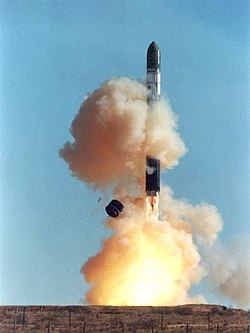
One of the missile's most important features is its storage/basing in a container, inserted in the silo. The container doubles as a mortar barrel – it has a "piston" at its bottom, beneath the missile. The drum-like "piston" is filled with a slow-burning, gas pressure-generating charge that pushes, mortar-like, the missile from the container. Only when several meters above the silo with the now empty container the "piston" is pushed sideways by a small rocket motor to avoid being accelerated towards the silo by the ignition of the missile's main engine. Thus the silo is a) spared the burning-out by the main engine flames, and so b) the empty container could be quickly removed and a new container with missile could be inserted by a ready transporter/erector into the intact silo, allowing for a second salvo before the adversary's warheads arrive. This feature was a deep concern for the US side during the SALT/START negotiations, as it gave Soviet Union the possibility to strike US targets again after the first missile exchange was concluded.[citation needed]
R-36M2 Voevoda (SS-18 Mod 6)
[edit]The flight tests of the R-36M2 missile carrying a single warhead with a yield of 20 Mt were completed in September 1989 and deployment began in August 1991. Ten missiles were deployed. One intended use of these large warheads was high altitude detonation to incapacitate electronics and communications through a very large electromagnetic pulse, however, the most likely use would be against missile launch control centers as the stated purpose for which the R-36MUTTKh warheads were designed. These missiles were all decommissioned by late 2009.[citation needed]
Derivatives
[edit]A proposal has been advanced to modify Voyevoda R-36M2 Satan heavy ICBMs to destroy incoming asteroids of up to 100 m, similar to the Chelyabinsk asteroid.[24]
| System: | R-36M | R-36M | R-36MUTTKh | R-36MUTTKh | R-36M2 | R-36M2 |
|---|---|---|---|---|---|---|
| Treaty-designation: | RS-20A | RS-20A1 | RS-20A2 | RS-20B | RS-20B | RS-20V |
| GRAU-designation: | 15A14 | 15A14 | 15A14 | 15A18 | 15A18 | 15A18M |
| NATO-designation: | SS-18 Satan Mod 1 | SS-18 Satan Mod 2 | SS-18 Satan Mod 3 | SS-18 Satan Mod 4 | SS-18 Satan Mod 5 | SS-18 Satan Mod 6 |
| Deployment: | 1974–1983 | 1976–1980 | 1976–1986 | 1979–2005 | 1988–Present | 1991–2009 |
| Maximum deployed number: | 148 | 10 | 30 | 278 | 104 | 58 |
| Length: | 32600 mm | 32600 mm | 32600 mm | 36300 mm | 36300 mm | 34300 mm |
| Diameter: | 3000 mm | 3000 mm | 3000 mm | 3000 mm | 3000 mm | 3000 mm |
| Launch weight: | 209,600 kg | 209,600 kg | 210,000 kg | 211,100 kg | 211,100 kg | 211,100 kg |
| Number of warheads: | 1 | 8 | 1 | 10 | 10 | 1 |
| Warhead yield: | 20 Mt | 0.5-1.3 Mt | 25 Mt | 0.55 Mt | 1 Mt | 20 Mt |
| Range: | 11,200 km | 10,200 km | 16,000 km | 16,000 km | 11,000 km | 16,000 km |
| CEP: | 1000 m | 1000 m | 1000 m | 920 m | 500 m | 500 m |
Operators
[edit]
The Strategic Missile Troops are the only operator of the R-36. As of January 2020, 46 silo-based missiles are deployed at:[10]
- 13th Red Banner Rocket Division at Yasny, Orenburg Oblast
- 62nd Rocket Division at Uzhur, Krasnoyarsk Krai
Former operators
[edit]
See also
[edit]References
[edit]- ^ a b Krebs, Gunter D. "R-36 (SS-9, Scarp) ICBM". Retrieved 25 July 2022.
- ^ "NPO Energomash list of engines". NPO Energomash. Archived from the original on 7 November 2014.
- ^ a b c Krebs, Gunter D. "R-36M Voivode (SS-18, Satan) ICBM". Retrieved 25 July 2022.
- ^ Helms, Richard; Hood, William (2004). A Look Over My Shoulder: A Life in the Central Intelligence Agency. Random House Publishing. p. 385. ISBN 0-8129-7108-6.
- ^ Willick, Frances (12 May 2021). "Canso spaceport secures $10.5M, aims for first launch next year". CBC News. Retrieved 14 May 2021.
- ^ "Krivonosov, Khartron: Computers for rocket guidance systems". Retrieved 14 November 2014.
- ^ "57th Missile Division". Ww2.dk. Retrieved 26 September 2011.
- ^ "38th Missile Division". Ww2.dk. Retrieved 26 September 2011.
- ^ "Ballistic and Cruise Missile Threat". Defense Intelligence Ballistic Missile Analysis Committee. 2017.
- ^ a b "Strategic Rocket Forces – Russian strategic nuclear forces". Retrieved 7 January 2020.
- ^ Podvig, Pavel (24 January 2008). "Russia and Ukraine will maintain R-36M2 missiles – Blog – Russian strategic nuclear forces". Russian Strategic Nuclear Forces. Retrieved 20 November 2015.
- ^ Россия утилизирует в 2020 году две межконтинентальные ракеты "Воевода" [Russia to dispose of two "Voevoda" intercontinental missiles in 2020]. Interfax (in Russian). 3 January 2020. Retrieved 3 January 2020.
- ^ В обойме – «Сармат», «Кинжал», «Авангард»... [In the (weapon) magazine - "Sarmat", "Kinzhal", "Avangard"...]. redstar.ru. 12 March 2018. Archived from the original on 12 March 2018.
- ^ "Russia puts advanced Sarmat nuclear missile system on 'combat duty'". Aljazeera. September 2023.
- ^ a b Multiple (as in "up to 38") warheads – Blog – Russian strategic nuclear forces
- ^ "Moscow extends life of 144 cold war ballistic missiles". The Guardian. London. 20 August 2002. Retrieved 24 October 2006.
- ^ "9.3.1.2.1 (S) SSPK Against 52L7". Joint DOD/DOE Trident Mk4/Mk5 Reentry Body Alternate Warhead Phase 2 Feasibility Study Report (U) (Report). United States Department of Defense and Department of Energy. January 1994.
When the W88/Mk5 was developed, this was the assessed VNTK of the hardest Soviet silos. Although those SS-18 silos have since been assessed to be much harder than 7000 psi, the SPETWG considers 52L7 to be a significant figure of effectiveness for this system because of the history of its use.
- ^ a b c "Nuclear Notebook: U.S. and Soviet/Russian intercontinental ballistic missiles, 1959–2008". Retrieved 14 November 2014.
- ^ Konyukhov, Stanislav Nikolaevich. Призваны временем - От противостояния к международному сотрудничеству. ЧАСТЬ I, Глава 3: В условиях конкурентной борьбы (1965–1971) [Called by time – From confrontation to international cooperation. Part I, Chapter 3: A competitive environment (1965–1971)] (in Russian). АРТ-Пресс (ART-Press). p. 400. ISBN 966-7985-82-2.
- ^ a b "R-36". astronautix.com. Retrieved 25 September 2022.
- ^ "CYCLONE-2". yuzhnoye.com. Archived from the original on 4 November 2019.
- ^ "R-36M family". RussianSpaceWeb.com. Retrieved 20 November 2015.
- ^ "Russian nuclear weapons, 2024". Bulletin of the Atomic Scientists. Retrieved 2024-11-16.
- ^ SpaceDaily, "Russian scientist: Soviet-era missiles can destroy asteroids", 23 June 2013
- ^ "R-36M / SS-18 SATAN". FAS. Retrieved 20 November 2015.
- ^ "Pavel Podvig: The Window of Vulnerability That Wasn't: Soviet Military Buildup in the 1970s--A Research Note. International Security, Summer 2008, Vol. 33, No. 1: 118–138". Retrieved 14 November 2014.
- Podvig, Pavel (January 30, 2004). Russian Strategic Nuclear Forces. Cambridge, MA: The MIT Press.
External links
[edit]
R-36 (missile)
View on GrokipediaDevelopment and History
Origins and Initial Design
The R-36 intercontinental ballistic missile originated from a Soviet Ministry of Defense decree issued on April 16, 1962, initiating development of a new heavy-class ICBM to enhance strategic nuclear capabilities amid escalating Cold War tensions.[1] Designed by Mikhail Yangel's Yuzhnoye Design Bureau (OKB-586) in Dnepropetrovsk, Ukraine, the project leveraged prior experience with the R-16 missile, incorporating a similar first-stage engine configuration adapted for greater payload capacity.[6] The initial concept emphasized a silo-launched, two-stage liquid-propellant system capable of delivering a massive single warhead, estimated at up to 20 megatons, to penetrate hardened U.S. targets and counter emerging American ICBM defenses.[1][6] Early design priorities focused on achieving intercontinental range exceeding 10,000 kilometers while maximizing throw-weight, with the missile's diameter expanded to 3 meters to accommodate larger fuel tanks and a more powerful RD-251 engine cluster in the first stage.[2] This represented a shift from lighter Soviet ICBMs like the R-16, aiming to match or surpass U.S. Titan II capabilities in destructive potential.[6] Development incorporated countermeasures such as the 'List' penetration aid system, first tested in a July 1965 launch, to evade anticipated anti-ballistic missile intercepts.[2] Flight-design testing commenced on September 28, 1963, from the Tyuratam launch site, validating core aerodynamic and propulsion parameters despite initial propulsion reliability concerns inherited from R-16 programs.[6] By 1966, the R-36 (NATO designation SS-9 Mod 1 Scarp) achieved initial operational readiness in hardened silos, marking the Soviet Union's first deployment of a super-heavy ICBM optimized for single-warhead strikes.[1] Subsequent modifications would introduce multiple independently targetable reentry vehicle (MIRV) configurations, but the foundational design prioritized overwhelming firepower over precision.Testing Phase and Early Challenges
The flight testing of the R-36 (8K67) intercontinental ballistic missile commenced on 28 September 1963 at the Tyuratam (Baikonur) launch site, marking the initial attempt from a purpose-built silo 41.5 meters deep.[6][2] The inaugural launch failed immediately, achieving zero apogee, as did subsequent early attempts on 13 December 1963 and 25 January 1964.[2] Initial tests revealed significant reliability issues, with seven failures recorded in the first ten launches, reflecting challenges in stabilizing the missile's liquid-fueled stages using unsymmetrical dimethylhydrazine and nitrogen tetroxide propellants.[7] A critical incident occurred on 5 March 1965, when a second-stage propellant leak triggered a fire inside the silo, highlighting vulnerabilities in hypergolic propellant containment and silo pressurization during cold-launch sequences.[2] The overall test program extended through 29 March 1966 for primary flight trials, involving dozens of launches that achieved an in-flight failure rate slightly above 15 percent—higher than the preceding SS-7 Saddler program's benchmark and necessitating prolonged validation of silo-hardened deployment.[8][2] Early guidance relied on a hybrid inertial system augmented by radio commands to compensate for inertial inaccuracies, but this supplemental method was discontinued by late 1965 owing to its susceptibility to jamming and limited precision over intercontinental ranges.[8] These setbacks delayed operational readiness, as engineers addressed structural stresses on the missile's isolated silo design and integrated penetration aids against emerging anti-ballistic missile threats, ultimately requiring over 130 trial launches across variants to refine performance before deployment authorization in 1967.[2]Deployment during the Cold War
The R-36 (8K67, NATO: SS-9 Scarp) achieved initial operational capability in late 1966, with the first regiment placed on alert on 5 November 1966 at the Uzhur missile field in Krasnoyarsk Krai.[6][2] Formally accepted into service on 21 July 1967, the missile was deployed exclusively in hardened underground silos to enhance survivability against preemptive strikes.[2] Deployment expanded rapidly during the late 1960s as part of the Soviet Strategic Rocket Forces' buildup to counter U.S. Minuteman and Titan II ICBMs, with silos constructed at multiple sites including Dombarovsky in Orenburg Oblast, Kartaly in Chelyabinsk Oblast, Aleysk in Altai Krai, Derzhavinsk (Imeni Gastello) in Kazakhstan, and Zhangiz-Tobe in Kazakhstan.[6][2] By 1970, the Soviet Union had deployed a peak of approximately 260 R-36 missiles across these bases, supported by the construction of 308 silos between 1965 and 1973.[2] Early deployments focused on Mod 1 and Mod 2 variants, each carrying a single reentry vehicle with a yield of up to 25 megatons, emphasizing high throw-weight for assured destruction capabilities.[6] The Mod 4 variant, introduced operationally on 26 October 1970, featured three multiple reentry vehicles (MRVs) for improved targeting flexibility, though it lacked full independent targeting.[6] A Mod 3 fractional orbital bombardment system (FOBS) variant was also tested and deployed in limited numbers for global reach without overflight warnings, aligning with Soviet efforts to circumvent U.S. early warning systems.[6] Throughout the 1970s, the R-36 formed a cornerstone of Soviet land-based strategic deterrence, with around 300 missiles operational in silos by the mid-decade, capable of delivering massive payloads against U.S. and NATO targets.[8] Regiments typically consisted of 10-16 silos each, distributed to disperse risk and complicate enemy countermeasures.[2] Deployment peaked amid U.S.-Soviet arms race tensions, including responses to American MIRV developments, but began phasing out by 1975 as the more advanced R-36M (SS-18) entered service, with full retirement of SS-9s completed by 1978-1979.[6][2] This transition reflected Soviet prioritization of MIRV technology and silo hardening improvements for second-strike reliability.[6]Technical Design
Propulsion and Structural Features
The R-36 (8K67), designated SS-9 Scarp by NATO, featured a two-stage liquid-propellant propulsion system utilizing storable hypergolic propellants: nitrogen tetroxide (N₂O₄) as the oxidizer and unsymmetrical dimethylhydrazine (UDMH) as the fuel.[6][2] This combination allowed for indefinite storage and rapid ignition without pre-launch fueling, enhancing operational readiness in silo-based deployments.[6] The first stage propulsion comprised the RD-251 engine, developed by OKB-456 under V.P. Glushko, consisting of three open-cycle main engines each with two combustion chambers, supplemented by a four-chambered steering engine for attitude control.[6] The second stage employed the RD-252 two-chamber main engine, highly unified with first-stage components for production efficiency, paired with RD-69M four-chamber vernier engines.[7] These engines delivered a total boost thrust enabling intercontinental range, with the first stage alone providing approximately 940 kN of cruise thrust.[2] Structurally, the R-36 adopted a tandem two-stage design with a first-stage diameter of 3.0 meters, propellant mass of 118.9 metric tons, and dry mass of 6.4 metric tons, optimizing for maximum payload capacity among early heavy ICBMs.[1] The cylindrical body integrated reinforced fuel tanks, intertank skirts, and propulsion shrouds to withstand launch stresses and silo confinement, prioritizing throw-weight over maneuverability.[6] Silo-hardened for direct ignition launch, the missile's robust aluminum-lithium alloy construction supported its role as a high-yield strategic deterrent, though early models lacked the containerized storage of later variants.[8]Warhead and MIRV Systems
The R-36 missile family utilized a range of nuclear warhead configurations, prioritizing high-yield single warheads in early variants for countervalue targeting, with later models incorporating multiple independently targetable reentry vehicles (MIRVs) to enhance counterforce capabilities against hardened targets. Initial deployments of the R-36 (8K67, SS-9 Scarp) featured single warheads: Mod 1 with an estimated yield of 10 megatons (Mt), Mod 2 with 18-25 Mt, and Mod 3 introducing a MIRV option with three warheads each yielding approximately 5 Mt, supported by decoys for penetration aid.[9][6] These designs emphasized massive explosive power over multiplicity, with warhead weights reaching up to 5,727-6,565 kg for heavy variants, enabling ranges exceeding 10,000 km.[1] Subsequent R-36M (SS-18) variants expanded MIRV integration via the 15F143U post-boost vehicle, which included dedicated propulsion and command systems to dispense multiple reentry vehicles (RVs). Early R-36M models (Mods 1-3) retained single-warhead options, such as a heavy monobloc of 20 Mt (15F141) or light monobloc of 8 Mt (15B86), both silo-deployable with yields optimized for city-level destruction.[10][11] Mod 4 (R-36UTTh) introduced at least 10 MIRVs, each with yields around 0.5-1 Mt, designed for precision strikes on ICBM silos and command centers, achieving circular error probable (CEP) accuracies of 0.65 km.[5][12] The R-36M2 Voevoda (SS-18 Mod 5-6) refined MIRV deployment to 10 warheads per missile, with individual yields increased to approximately 0.75-1 Mt—nearly double those of Mod 4—for improved hard-target kill probability, while maintaining a total throw-weight of about 8.8 tons.[13][14] This configuration included penetration aids like decoys and chaff, dispensed from the nose cone's MIRV platform, which used paired warhead arrangement and independent targeting logic to counter ballistic missile defenses.[15] Across variants, warhead reliability was enhanced through liquid-propellant upper stages enabling precise RV separation, though operational yields were often limited by treaty constraints post-START I, capping MIRV counts at 10 per missile.[16]Silo Hardening and Launch Mechanisms
The silos for the initial R-36 (SS-9 Scarp) were engineered to withstand overpressures of 500 psi from a 1-megaton nuclear detonation, providing significant protection against blast effects.[6] These structures measured 41.5 meters in depth and 8.3 meters in diameter, with an interior bore of 4.64 meters, and were hardened to resist up to 20 atmospheres of overpressure.[2] For the R-36M (SS-18 Satan) variants, deployment occurred in modified OS-67 silos originally designed for the earlier R-36, which were heavily reinforced for enhanced survivability.[15] These silos had dimensions of 39 meters in depth and 5.9 meters in diameter, with the missile housed in a transport-launch canister (ampoule) suspended within the silo to facilitate rapid response and reduce vulnerability.[17] Approximately 20 new super-hardened silos were constructed specifically for certain R-36M deployments, offering superior resistance to nuclear and conventional threats compared to standard ICBM silos of the era.[18] The R-36M utilized a cold launch mechanism to minimize silo damage during liftoff. In this system, the missile was ejected from its canister in the silo by high-pressure gas generated from pyrotechnic charges or dedicated gas generators, reaching an altitude of several tens of meters before the first-stage liquid-fueled engines ignited in the atmosphere.[17] This "soft launch" approach avoided direct exposure of the silo interior to the corrosive and erosive effects of hot exhaust plumes, enabling silo reusability after launch and improving overall system reliability under combat conditions.[4] Later modifications, such as those in the R-36M2 (SS-18 Mod 5/6), incorporated further enhancements to silo and missile protection against nuclear effects, including improved shielding and potentially active defense elements like the Mozyr system for intercepting incoming warheads.[3][19]Variants and Modifications
R-36 (SS-9 Mods)
The R-36, designated 8K67 by the GRAU index and known to NATO as the SS-9 Scarp, represented the Soviet Union's initial heavy intercontinental ballistic missile (ICBM) series, featuring storable liquid propellants and silo-based deployment. Developed by the Yuzhnoye Design Bureau under a decree dated May 12, 1962, the missile underwent flight testing from 1963 to 1970, culminating in initial operational capability for Mods 1 and 2 in 1966 and Mod 4 in 1970.[6][7] A total of 146 launches were conducted across all modifications, with the first regiment achieving operational status on November 5, 1966, at the Uzhur site.[7] The system emphasized massive throw-weight, enabling high-yield warheads or early multiple reentry vehicle (MRV) configurations, and was deployed in hardened silos withstand 500 psi overpressure, with a reaction time of 3-5 minutes.[6] The SS-9 series included four primary modifications, differing in reentry vehicle configurations, payloads, and ranges to fulfill diverse strategic roles. Mod 1 featured a single reentry vehicle (RV) with a yield estimated at 5 megatons (MT) by Russian sources or 12-18 MT by Western assessments, achieving a range of 10,200 km with a 5,825 kg payload; the missile measured 32.2 meters in length and weighed 183.9 metric tons at launch.[6] Mod 2, a heavier single-warhead variant (8K67 heavy), carried a 20 MT warhead (or 18-25 MT per Western estimates) but sacrificed range to 10,200 km for the increased payload of up to 5,825 kg, with similar dimensions to Mod 1 but potentially adjusted for optimization.[6][7] Mod 3 introduced a fractional orbital bombardment system (FOBS) capability, combining the SS-9's first and second stages with an upper stage for depressed-trajectory or orbital delivery, yielding 5 MT (Russian) or 1-3 MT (Western) over a 40,000 km range, though with a lighter 1,700 kg payload and extended length of 32.6-34.5 meters.[6] This variant, sometimes designated 8K69, allowed circumvention of early warning systems by approaching from unexpected trajectories but was limited in deployment due to treaty considerations and technical complexities. Mod 4 (8K67P) marked the SS-9's progression toward multiple independently targetable reentry vehicles (MIRV), equipping three MRVs each with 2-3.5 MT yields, a total payload of 6 metric tons, and a range of 10,200-12,000 km, retaining the 32.2-meter length and 183.9-ton launch weight of earlier mods.[6][7][6]| Variant | Warhead Configuration | Yield (MT) | Range (km) | Payload (kg) | Length (m) | Launch Weight (t) |
|---|---|---|---|---|---|---|
| Mod 1 | Single RV | 5 (Rus)/12-18 (West) | 10,200 | 5,825 | 32.2 | 183.9 |
| Mod 2 | Single RV (heavy) | 10-20 (Rus)/18-25 (West) | 10,200-15,200 | 3,950-5,825 | 31.7-32.2 | 179-183.9 |
| Mod 3 | FOBS single | 5 (Rus)/1-3 (West) | 40,000 | 1,700 | 32.6-34.5 | 180 |
| Mod 4 | 3 MRV | 2-3.5 each | 10,200-12,000 | 6,000 | 32.2 | 183.9 |
R-36M (SS-18 Mods 1-4)
![R-36M SS-18 'Satan'][float-right] The R-36M, designated SS-18 Mods 1-4 by NATO, represented the initial production series of the Soviet Union's heaviest intercontinental ballistic missile (ICBM), developed to enhance strategic deterrence through superior throw-weight and targeting flexibility compared to its predecessor, the R-36 (SS-9). Approved for development on September 2, 1969, by the Soviet Ministry of Defense, these variants featured a two-stage liquid-propellant design with a length of approximately 36.6 meters, a diameter of 3.0 meters, and a launch weight of around 191,000 kg, enabling silo-based deployment in hardened launchers.[5][3] Flight testing for Mod 1 commenced in February 1973, with the testing phase for various warhead configurations concluding in October 1975, leading to initial operational capability (IOC) declarations starting in December 1975.[5] SS-18 Mod 1 (R-36M, 15A14) was configured with a single high-yield warhead of 18-25 megatons (Mt), a payload of 7.2 tons, and a range of 11,200 km, optimized for countervalue strikes against large area targets such as command centers.[5] Mod 2 introduced multiple independently targetable reentry vehicles (MIRVs) with up to eight warheads each yielding 0.5-1.5 Mt, though its post-boost vehicle design exhibited flaws that prompted early phase-out by 1983; its range varied from 9,250-10,200 km with a similar 7.2-8.8 ton payload.[5][3] These early MIRV attempts achieved a circular error probable (CEP) of about 1,000 meters, reflecting the technological challenges of the era.[3] Subsequent improvements yielded Mod 3, an enhanced single-warhead variant with a 24-25 Mt yield and extended range of 16,000 km, entering service in November 1979 after testing from October 1977, primarily to address accuracy and reliability gaps in prior models.[5] Mod 4 (R-36MUTTH) marked a significant advancement with 10 MIRVs each at 0.55 Mt, an 8.8-ton payload, range of 11,500-16,000 km, and improved CEP of 920 meters, enabling hard-target counterforce potential against U.S. Minuteman silos—estimated to neutralize 65-80% in a salvo.[5][3] Deployment peaked at 308 Mod 4 missiles by 1982-1983, with all Mods 1-4 utilizing converted SS-9 silos and cold-launch mechanisms for survivability.[5] By the mid-1980s, Mods 1-3 were largely retired in favor of Mod 4 and later iterations, amid U.S. concerns over a "window of vulnerability" for American ICBMs that influenced debates on systems like the MX Peacekeeper.[5]| Variant | IOC Date | Warheads | Yield (Mt) | Range (km) | Payload (t) | CEP (m) |
|---|---|---|---|---|---|---|
| Mod 1 | Dec 1975 | 1 | 18-25 | 11,200 | 7.2 | ~1,000 |
| Mod 2 | 1975 | 8 MIRV | 0.5-1.5 | 9,250-10,200 | 7.2-8.8 | ~1,000 |
| Mod 3 | Nov 1979 | 1 | 24-25 | 16,000 | 7.2-8.8 | ~1,000 |
| Mod 4 | Dec 1979 | 10 MIRV | 0.55 | 11,500-16,000 | 8.8 | 920 |
R-36M2 Voevoda (SS-18 Mods 5-6)
The R-36M2 Voevoda, NATO-designated SS-18 Mods 5 and 6, is an upgraded variant of the R-36M intercontinental ballistic missile, designed as a response to anticipated U.S. ballistic missile defense systems.[13] Development began in the late 1970s, with the tactical-technical specification issued in July 1979 for a fourth-generation heavy ICBM to replace earlier R-36M models and overcome prospective U.S. defenses.[20] The missile's design was finalized in June 1982, incorporating innovations such as a second-stage liquid-propellant engine with multiple fixed nozzles for improved thrust vector control and a solid-propellant third stage for post-boost maneuvers.[13] Flight testing concluded successfully, leading to the first regiment achieving alert status on July 30, 1988, and full deployment on August 11, 1988.[17] Key enhancements over prior R-36M variants included superior accuracy with a circular error probable (CEP) of 0.5-1 km, penetration aids to evade missile defenses, and warheads engineered for high resistance to nuclear effects and individual targeting capabilities.[13] The Mod 5 configuration was optimized for a single warhead of 20 megatons yield, achieving a maximum range of 16,000 km, while the Mod 6 supported multiple independently targetable reentry vehicles (MIRVs) with up to 10 warheads of 750 kilotons each, reducing range to 11,000 km under MIRV load.[3] Overall specifications encompass a launch weight of 211.1 metric tons, length of 34.3 meters, and first-stage thrust of 7,257 kN from a liquid-fueled engine.[21] These features enabled a throw-weight of approximately 8.8 tons, prioritizing overwhelming payload delivery.[21] The Voevoda retained silo-based deployment in hardened launchers, with the 15P018M system emphasizing survivability through rapid fueling and launch readiness.[22] By 1998, 58 R-36M2 missiles were operational within Russia's Strategic Rocket Forces, forming a core of the silo-based leg of the nuclear triad.[22] Mod 6 remained the primary operational configuration into the 21st century, underscoring its role in maintaining heavy ICBM capabilities amid arms control constraints.[3]Strategic Role and Capabilities
Deterrence Doctrine and Throw-Weight Advantages
The R-36 missile series formed a cornerstone of Soviet nuclear deterrence strategy during the Cold War, emphasizing a survivable second-strike capability to enforce mutual assured destruction (MAD). By deploying heavy silo-based ICBMs capable of delivering overwhelming retaliatory strikes, the Soviet Union aimed to deter aggression through the credible threat of devastating countervalue attacks on population centers and infrastructure, compensating for perceived vulnerabilities in conventional forces.[23] This approach prioritized quantitative superiority in megatonnage and warhead numbers over precision, with the R-36's design enabling rapid reload and high readiness to ensure a portion of the arsenal survived a U.S. first strike.[4] A key element of this doctrine was the R-36's exceptional throw-weight, which ranged from approximately 5,800 kg in early R-36M variants to 8,800 kg in the R-36M2 (SS-18 Mods 5-6), far exceeding contemporary U.S. ICBMs such as the Minuteman III's 1,150 kg payload.[5] [3] This capacity permitted flexible configurations, including up to 10 MIRVs with yields of 500-750 kt each or a single massive warhead exceeding 20 Mt, allowing the missile to either saturate defenses with multiple independently targetable reentry vehicles (MIRVs) and penetration aids or concentrate destructive power on hardened targets.[4] [5] The throw-weight advantage enhanced deterrence by complicating enemy countermeasures; the payload's size supported extensive decoy deployment and countermeasures, increasing the probability of successful penetration against emerging ballistic missile defenses like the U.S. Safeguard system, which was limited to sparse coverage.[3] In doctrinal terms, this translated to a "minimum acceptable damage" threshold for retaliation, where even a fraction of surviving R-36s could inflict unacceptable losses, reinforcing Soviet negotiating leverage in arms control talks such as SALT II, where the missile's capabilities were factored into limits on MIRVed heavy ICBMs.[23] Analysts noted that the SS-18's payload superiority positioned it as the most destructive single ICBM, amplifying psychological deterrence through sheer destructive potential.[24]Comparative Analysis with Western ICBMs
The R-36 missile family, particularly the R-36M2 Voevoda variant, exhibits substantial differences from Western ICBMs like the U.S. LGM-30G Minuteman III and the retired LGM-118A Peacekeeper, primarily in payload capacity and design priorities. Soviet engineers emphasized maximizing throw-weight to enable heavy warhead loads or extensive penetration aids, aligning with a deterrence strategy focused on assured destruction of countervalue targets through overkill. In contrast, U.S. systems favored solid-propellant designs for faster silo launch readiness and enhanced accuracy suited to counterforce missions against hardened silos, though at the cost of reduced payload mass.[25][14] Key specifications highlight these disparities. The R-36M2 achieves a throw-weight of 8,800 kg, supporting up to 10 MIRVs with individual yields of 550 kt, and a maximum range of 16,000 km under light payload configurations.[20][5] The Minuteman III, by comparison, has a throw-weight of 1,150 kg, originally accommodating three MIRVs of 300-340 kt each (de-MIRVed to single warheads post-START treaties), with a range of 13,000 km.[26][27] The Peacekeeper offered closer parity with 3,950 kg throw-weight and 10 MIRVs of 300 kt each, but its range dropped to 9,600 km under full load, and it was decommissioned in 2005 due to treaty limits and maintenance costs.[25][28]| Missile | Throw-Weight (kg) | Max MIRVs (Yield per Warhead) | Range (km, max payload) | CEP (m) | Propulsion |
|---|---|---|---|---|---|
| R-36M2 | 8,800 | 10 (550 kt) | 11,000-16,000 | 260 | Liquid |
| Minuteman III | 1,150 | 3 (300-340 kt) | 13,000 | 110-220 | Solid |
| Peacekeeper | 3,950 | 10 (300 kt) | 9,600 | 100 | Solid |
Counterforce and Countervalue Potential
The R-36M series, particularly later modifications like the SS-18 Mod 4 and Mod 6, demonstrated substantial counterforce potential through its combination of high throw-weight—approximately 8,800 kg—and improved accuracy, with a circular error probable (CEP) of around 500 meters for MIRVed configurations.[3][16] This enabled the missile to deploy up to 10 independently targetable reentry vehicles (MIRVs), each with yields of 500-750 kilotons, sufficient to neutralize hardened targets such as U.S. Minuteman ICBM silos.[5] Assessments from the era indicated that a full salvo of SS-18 Mod 4 missiles could destroy 65 to 80 percent of deployed U.S. silo-based ICBMs in a first strike, factoring in the missile's payload capacity for penetration aids and decoys to overwhelm defenses.[5] The liquid-fueled, silo-launched design further supported rapid targeting of military assets, aligning with Soviet emphases on preemptive or retaliatory strikes against enemy nuclear forces, though operational accuracy was constrained by inertial guidance limitations compared to later solid-fuel systems.[29] In countervalue roles, the R-36M's versatility extended to massive single-warhead options, with yields up to 20-25 megatons, optimized for inflicting catastrophic damage on urban-industrial centers and population hubs to ensure mutual assured destruction.[5] The high throw-weight allowed for either MIRV dispersal across multiple cities or a unitary high-yield device, amplifying deterrence by threatening societal collapse rather than isolated military nodes.[16] Soviet strategic doctrine, as reflected in deployments, prioritized such heavy ICBMs for retaliatory countervalue strikes post-exchange, preserving payload for urban targets after absorbing an initial attack, though the missile's dual-use design blurred lines between force-on-force and city-busting missions.[29] This capability persisted into the post-Cold War period for remaining operational units, underscoring the R-36M's role in maintaining a spectrum of nuclear options despite aging guidance systems.[30] Overall, the R-36 family's counterforce edge derived from quantitative superiority in warheads and yield over contemporary Western ICBMs like the Minuteman III, enabling theoretical silo decapitation, while its countervalue potency rested on unmatched single-shot destructive power, though real-world efficacy depended on survivability of silos against counter-counterforce threats.[5][3] Later variants incorporated enhancements for both modes, including up to 40 penetration aids per missile, but treaty-limited deployments curtailed full exploitation of this potential.[16]Operational Deployment
Deployment Timeline and Sites
The initial variant of the R-36, designated 8K67 and known to NATO as SS-9 Scarp, entered deployment with the Soviet Strategic Rocket Forces in 1966, with the first regiment achieving operational status on November 5, 1966.[6] Deployment proceeded rapidly, reaching approximately 170 missiles by the end of 1969, primarily in silo-based configurations across several sites that would later host upgraded variants.[6] Subsequent development led to the R-36M family, beginning with the 15A14 variant (SS-18 Mod 1 and 2), whose first regiment became operational on December 25, 1974, at the Dombarovskiy site.[18] Initial operational capability for the R-36M was achieved in January 1975, with full integration into service by December 1975.[5] Deployment expanded through the late 1970s and 1980s, incorporating variants such as Mod 3 and 4 by 1979-1980, and peaking at 308 silos by 1982-1983, many replacing earlier R-36 installations.[5] The R-36M2 (Mod 5 and 6, Voevoda) entered service in 1988 and 1991, respectively, further enhancing capabilities until the Soviet Union's dissolution in 1991.[5] Deployment sites for the R-36M were concentrated in the Soviet Union, with silos distributed across Russia and Kazakhstan:| Site | Location/Region | Number of Silos | Notes |
|---|---|---|---|
| Aleysk | Altai Krai, Russia | 30 | |
| Derzhavinsk | Kazakhstan | 52 | Dismantled post-1991 |
| Dombarovskiy-3 | Orenburg Oblast, Russia | 64 | First R-36M regiment site |
| Kartaly-6 | Chelyabinsk Oblast, Russia | 46 | |
| Uzhur-4 | Krasnoyarsk Krai, Russia | 64 | |
| Zhangiz-Tobe | Semipalatinsk, Kazakhstan | 52 | Dismantled by 1996 |