Hubbry Logo
Safety harnessSafety harnessMain
Open search
Safety harness
Community hub
Safety harness
logo
8 pages, 0 posts
0 subscribers
Be the first to start a discussion here.
Safety harness
Safety harness
from Wikipedia
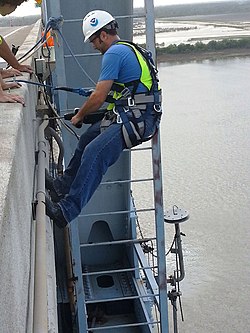
Construction worker wearing a five-point synthetic webbing safety harness, attached at the waist via a lanyard, with a back-up safety line rigged to a loop on the rear of his harness at his shoulders.

A safety harness is a form of protective equipment designed to safeguard the user from injury or death from falling. The core item of a fall arrest system, the harness is usually fabricated from rope, braided wire cable, or synthetic webbing. It is attached securely to a stationary object directly by a locking device or indirectly via a rope, cable, or webbing and one or more locking devices. Some safety harnesses are used in combination with a shock-absorbing lanyard, which is used to regulate deceleration and thereby prevent a serious G-force injury when the end of the rope is reached.

An unrelated use with a materially different arresting mechanism is bungee jumping. Though they share certain similar attributes, a safety harness is not to be confused with a climbing harness used for mountaineering, rock climbing, and climbing gyms. Specialized harnesses for animal rescue or transfer, as from a dock to a vessel, are also made.

Safety harnesses have restraints that prevent the wearer from falling from a height. By wearing the belt or harness the risk of injury from a fall is greatly reduced. The harness allows the user to attach themselves to an object that is stationary, ensuring they will not hit the ground in the event of a possible fall. Falling from high areas is one of the most common causes of injuries in the workplace, so it is very important to make sure you are properly equipped when working up high.

Before safety harnesses were required by OSHA (The Occupational Safety and Health Administration), workers wore body belts to connect to fall protection systems. Workers had the belts fastened around the waist, resulting in the entire force being exerted on the abdomen and often causing significant injury.

OSHA implementing this requirement really made sure the amount of casualties decreased from falling, as well as injuries caused from the old belts they used to wear. Safety harnesses are essential while working in high areas to prevent significant injury or death, and OSHA making these a requirement made everyone understand the importance of safety-harnesses

Standards

[edit]

In North America, safety harnesses designed for protection against falls from heights in industrial and construction activities are covered by performance standards issued by the American National Standards Institute (ANSI) in the United States and by CSA Group (formerly known as the Canadian Standards Association) in Canada. Specifically, the standards issued are ANSI Z359.1,[1] and CSA Z259.10.[2][3] These standards are updated approximately every four to five years. The main purpose of the safety standards is to "act as a standard to drive best-in-class harnesses through rigorous design and test requirements. in addition to having requirements for manufacturers to create an ANSI-approved full body harness." The update to Z359.11 includes revisions and new requirements, including A modified, headfirst, dynamic test procedure, New stretch-out requirements for frontal connections, Alternative fall arrest indicator testing and new label requirements, Allowance for harnesses with integrated energy absorbers, and Changes to labeling requirements. It. requires harness label packs to have pictograms showing the approved usage of different connections and diagrams explaining the difference between deployed and non-deployed visual load indicators. These new standards help give the user a level a confidence, while knowing it has gone through rigorous testing to ensure that what you are using is completely safe and effective.

Design and Components

[edit]

A modern safety harness comprises several key components designed to distribute fall forces and ensure safety:

  • D-Rings: Attachment points typically located at the back (dorsal), front (sternal), or sides of the harness, used to connect lanyards, lifelines, or other fall arrest devices.
  • Straps and Buckles: Made from high-strength synthetic materials, these adjustable elements secure the harness to the user's body to secure a snug fit.
  • Padding: Added to areas like the shoulders, legs, and waist to add comfort during prolonged use.
  • Visual Indicators: Features that deploy or change appearance when the harness has been involved in a fall, signaling the need for inspection or replacement.
  • Labels and Markings: Provide critical information such as size, model, date of manufacture, and compliance with relevant standards.

Types of Safety Harnesses

[edit]

Safety harnesses are designed for specific applications, including:

  • Full-Body Harness: Distributes fall forces across the shoulders, thighs, and pelvis; commonly used in fall arrest systems.
  • Work Positioning Harness: Allows workers to be supported in a specific position, enabling hands-free work at height.
  • Suspension Harness: Designed for tasks that require the user to be suspended for extended periods, such as window washing or rescue operations.
  • Rescue Harness: Equipped with additional features to facilitate the safe retrieval of individuals from confined spaces or hazardous environments.
  • Climbing Harness: Used in recreational activities like rock climbing or bouldering; differs in design and is not typically suitable for industrial fall protection.

Classifications

[edit]

There are four classes of fall protection systems:

  • Class 1 is body belts (single or double D-ring), designed to restrain a person in a hazardous work position, prevent a fall, or arrest it completely within 3 feet (90 cm) (OSHA).
  • Class 2 is chest harnesses, used only with limited fall hazards (including no vertical free fall), or for retrieving persons, as from a tank or bin.
  • Class 3 is full body harnesses, designed to arrest the most severe free falls.
  • Class 4 is suspension belts, independent supports used to suspend a worker, such as boatswain's chairs or raising or lowering harnesses.

Other types

[edit]

Other forms of safety harnesses include seat belts and child safety seats in cars, which are helping passengers be and feel more safe in a car, Over-the-shoulder restraints, which are mainly used on roller coaster at amusement parks, a seat with a full-body harness like ones used by fighter pilots and racing car drivers, as well as diving harnesses, which are used in surface supplied diving by professional divers.

Uses

[edit]

Fall arrest

[edit]
A video on the importance of fall protection in occupational settings

A fall arrest harness is the equipment which safely stops a person already falling.

A window cleaner who can be working up high on buildings need to use harnesses to keep them from falling many stories if they slip. That is the most common safety harness. A theatrical fly crew member will need a harness because they are up above the theater floor and they need to be safe in case they slip as well. Construction workers might need a harness because they could be building on the higher floors and without the harness they could fall to the ground. Crane operators will be at a height that will cause great injury or death if they were to fall off, so they need something to ensure their safety as they are working. A lineman has to climb power lines and they need to be secured in place so they can work on the high voltage lines without moving around. Harnesses are used when sailing to prevent the crew from being thrown overboard in case the seas are rough.

Climbing

[edit]

A climbing harness is a device which allows a climber access to the safety of a rope.

Rock climbers use harnesses to belay each other, this is when they use a rope to connect to one another so if the climber falls they can catch them with the rope instead of falling all the way to the ground.

Guide or support

[edit]

A jackstay harness is a substantial line between two points used to guide or support.

Bungee jumping requires a harness to get the person to bounce back up, without it there would be no way to prevent the jumper from falling straight to the ground. In motorsport harnesses keep the driver secure in the event of a crash, keeping the driver secured in place gives the person more of a chance to leave without injury.

Diving

[edit]

A lifeline harness is a rope connecting the diver to an attendant, usually at the surface.

A professional diver would use a safety harness to keep close to something they are working on underwater, without the harness they could be pulled away from their work by a current.

Aerial stunts

[edit]

Harnesses are used in aerial stunts to hoist actors into the air to simulate flying (sometimes even in stage plays such as Peter Pan) or impact from punches.[4][5] Stunt riggers are in charge of setting up the rigging of such stunts. In this case, the harnesses are typically worn underneath the actor's costume to conceal it. When used in the filming of a movie, the wires or ropes used to hoist the actors are usually digitally removed in post-production.

Inspection

[edit]

Proper inspection of a safety harness is essential for checking if the device remains in safe working condition and compliant with regulatory standards. Harnesses should be inspected before each use (pre-use inspection) and periodically through a formal inspection process, typically every six months, or more frequently depending on usage and environmental exposure.[6]

Pre-use Inspection

[edit]

Before each use, the user must visually and physically inspect the harness for signs of wear, damage, or degradation. Key inspection points include:

  • Webbing: Check for frays, cuts, burns, broken fibers, and chemical damage.
  • Stitching: Look for loose, broken, or pulled stitches, especially around attachment points.
  • Hardware: Inspect D-rings, buckles, and adjusters for deformation, corrosion, sharp edges, or cracks.
  • Labels: Ensure all labels are legible and securely attached, including the date of manufacture and any inspection records.

Formal Periodic Inspection

[edit]

A competent person, as defined by OSHA or relevant regional authority, should conduct formal inspections. These are typically recorded and dated on a safety tag or checklist, and often required at intervals ranging from 3 to 12 months. Factors such as frequency of use, jobsite conditions, and manufacturer recommendations influence the inspection schedule.

Storage and Maintenance

[edit]

Improper storage can lead to premature wear and damage. Safety harnesses should be stored in a clean, dry, and cool environment, away from direct sunlight, chemicals, or sharp objects. Exposure to UV light, excessive heat, oil, or solvents can degrade the harness materials and compromise safety.

Disposal Criteria

[edit]

Harnesses must be removed from service immediately if:

  • They have been involved in a fall arrest.
  • Any damage is detected that could affect performance.
  • The manufacturer’s expiration or service life limit has been reached.
  • Labels or inspection records are missing or illegible.

It is strongly advised to follow manufacturer-specific inspection guidelines in addition to general safety standards. Failure to properly inspect and maintain a harness can lead to catastrophic failure during use.[7][8]

See also

[edit]

References

[edit]
Revisions and contributorsEdit on WikipediaRead on Wikipedia
from Grokipedia
A safety harness, also known as a full-body harness, is a critical piece of consisting of straps that secure around the wearer's thighs, , waist, chest, and shoulders to distribute forces across the body and prevent from falls at height. These harnesses form a key component of personal fall arrest systems, which also include an anchorage point, connectors such as lanyards or self-retracting lifelines, and sometimes deceleration devices to limit the maximum arrest force to 1,800 pounds (8 kN) and the fall distance to no more than 6 feet (1.8 m). Designed to arrest a fall without causing severe , modern full-body harnesses replaced earlier body belts—phased out by OSHA in 1998 due to risks of internal organ —offering superior load distribution and user comfort through padded straps and adjustable fittings. In the United States, OSHA mandates the use of harnesses as part of fall protection in when workers are exposed to falls of 6 feet (1.8 m) or more above lower levels, and in general industry at 4 feet (1.2 m) or more, with additional requirements for proper , fit, and training to ensure effectiveness. Complementing OSHA regulations, the (ANSI)/American Society of Safety Professionals (ASSP) Z359.11-2021 standard establishes rigorous performance, design, testing, and labeling criteria for full-body harnesses, including dynamic drop tests for capacities between 130 and 310 pounds (59–141 kg) and requirements for attachment points to withstand forces up to 5,000 pounds (22 kN). Safety harnesses originated in the early , evolving from rudimentary ropes and belts in the to more advanced designs in the inspired by parachutes, and are now essential across industries including , , utilities, and recreational to mitigate the leading cause of workplace fatalities—falls. Regular inspections for wear, damage, or corrosion are required, typically annually or after any fall, to maintain integrity and compliance.

Introduction and History

Definition and Purpose

A safety harness is a full-body (PPE) consisting of interconnected straps, buckles, and attachment points, such as D-rings, designed to secure around the thighs, , waist, chest, and shoulders to distribute forces across the body, thereby limiting injury. The primary purposes of a safety harness include to stop a fall after it has begun, work positioning to support the user in place for hands-free tasks on vertical surfaces, travel restraint to prevent the user from reaching hazardous edges, and or retrieval to facilitate extraction from elevated positions. These functions integrate the harness with other system components to ensure worker safety in high-risk environments like or at heights. In operation, safety harnesses connect via attachment points to lanyards, shock-absorbing deceleration devices, lifelines, or fixed anchors, arresting falls by limiting the maximum deceleration distance to 3.5 feet (1.07 m) and the arresting force to 1,800 pounds (8 kN) for users in body harnesses, as specified in occupational safety criteria. This deceleration mechanism dissipates energy to halt momentum safely without excessive impact. Safety harnesses are rated for users typically ranging from 130 to 310 pounds (59 to 140 kg), including body weight, , and tools, to accommodate standard work capacities while ensuring system integrity. Full-body designs are preferred over waist-only body belts for because they spread forces across multiple body areas, significantly reducing the risk of spinal compression, internal injuries, and other trauma that concentrated waist loads can cause; body belts are now prohibited for fall arrest in favor of harnesses.

Historical Development

The origins of safety harnesses trace back to the , when rudimentary fall protection devices emerged for high-risk occupations like utility work and . Linemen working on telegraph and early electrical poles relied on sturdy belts equipped with metal hooks or to secure themselves while ascending wooden structures, serving as precursors to modern harnesses. These early belts, often combined with climbing ropes for support, marked the initial shift toward personal systems, though they offered limited protection against full falls and were prone to slippage. By the late , the first modern safety harnesses appeared, constructed from or canvas with basic straps to distribute weight more evenly during elevated tasks. Advancements accelerated in the , particularly during and after , when full-body harness designs were influenced by military equipment. In the 1940s, harnesses—featuring multiple attachment points and to secure the torso and legs—were adapted for industrial use, providing superior compared to waist-only body belts that had dominated since the . This inspiration led to the widespread adoption of full-body systems in and by the 1950s and 1960s, as body belts were recognized for causing severe injuries like spinal compression during falls. Prior to 1970, fall protection was largely unregulated in the United States, contributing to high workplace fatality rates, with approximately 14,000 total occupational deaths recorded that year alone. The establishment of the (OSHA) in 1970 marked a pivotal regulatory turning point, mandating fall protection measures including harnesses for and other industries to reduce these risks. In the and , studies highlighting the dangers of body belts—such as internal organ damage and —drove a full transition to full-body harnesses as the standard, with OSHA and industry groups encouraging their use after engineering analyses confirmed their safer load distribution. The (ANSI) further supported this evolution by issuing its first comprehensive fall protection code, Z359.1, in 1992, which set performance criteria for harnesses and related equipment. Modern milestones reflect ongoing refinements for user comfort and efficacy, informed by incident data. In 2011, the first premium ergonomic safety harness was developed through collaboration among experts, industrial designers, and engineers, incorporating padded straps and adjustable fittings to minimize fatigue during prolonged wear. Into the , innovations such as integrated sensors and lightweight composites have been spurred by persistent fall risks, with U.S. data indicating around 300 fatal falls annually in the sector since 2013, prompting global efforts toward harmonized standards post-2000.

Standards and Regulations

International Standards

The ISO 10333 series establishes core international specifications for personal fall-arrest systems, encompassing , , and related components. ISO 10333-1:2000 outlines requirements for full-body harnesses, including methods, general use instructions, marking, , and guidelines to ensure structural integrity and user safety. It mandates a minimum static strength of 15 kN for attachment points and limits maximum arresting forces to 6 kN during dynamic performance to prevent . Complementary parts, such as ISO 10333-2:2000 for lanyards and energy absorbers and ISO 10333-6:2004 for overall system performance tests, integrate with Part 1 to verify compatibility and effectiveness in arresting falls for users up to 100 kg. In , EN 361:2002 sets requirements for full-body harnesses used in , requiring shoulder straps, thigh loops, and attachment points such as dorsal and frontal D-rings to distribute forces evenly across the body. The standard includes dynamic testing where a 100 kg torso dummy, fitted to the harness and connected via a 2-meter , undergoes two successive drops simulating a 4-meter —once head-up and once head-down—to ensure the user remains within 50 degrees of upright and no attachment fails. This certification, developed by CEN/TC 136, emphasizes ergonomic design and material durability for industrial and construction applications. For and , the UIAA 105 standard governs harness performance, prioritizing low-elongation to minimize pendulum swings and energy transfer during falls, alongside padded leg loops and waistbands for prolonged comfort and circulation. It incorporates drop tests simulating real-world impacts to validate strength, with requirements for adjustable fit and integration with ropes, carabiners, and belay devices under UIAA protocols. Harnesses must achieve at least 15 kN static strength at leg loops and 5 kN at other points, ensuring reliability in dynamic scenarios. Global testing protocols for safety harnesses emphasize standardized drop simulations, such as those in ISO 10333-6 and EN 361 using a 100 kg mass over 4 meters to assess energy absorption and attachment integrity, with elongation limits on typically under 10-12% under load to control deceleration forces. Labeling requirements across ISO, EN, and UIAA mandate clear markings for manufacturer details, model, , manufacture date, maximum user capacity (often 100 kg), compliant standards, and inspection guidelines, including recommendations for retirement after 5-10 years or upon visible damage, though no fixed expiry is enforced.

Regional Regulations

In the United States, the Occupational Safety and Health Administration (OSHA) standard 29 CFR 1926.502 mandates the use of full-body harnesses as part of personal fall arrest systems for construction workers exposed to fall hazards greater than 6 feet, limiting free fall distance to 6 feet and maximum arrest force to 1,800 pounds. Employers must also ensure prompt rescue procedures and self-rescue capabilities, along with training for affected workers. In residential construction, federal OSHA previously allowed exemptions for certain low-slope roof work, but California's Division of Occupational Safety and Health (Cal/OSHA) updated its regulations effective July 1, 2025, to require fall protection, including full-body harnesses, at heights of 6 feet or more for residential framing and roofing activities, aligning more closely with general industry standards. Additionally, OSHA clarifies that workers on scissor lifts do not require personal fall arrest systems, such as harnesses, when the platform is equipped with properly maintained guardrails meeting 29 CFR 1910.29 or 1926.502 standards. Enforcement of fall protection rules remains stringent, with 6,307 violations cited in fiscal year 2024—the highest among all standards—and notable fines including $287,465 against a framing contractor for repeated non-compliance. The /American Society of Safety Professionals (ANSI/ASSP) Z359.11-2021 establishes performance requirements for full-body harnesses in the U.S., specifying a user weight capacity of 130 to 310 pounds (including equipment) and a minimum factor of 2:1 for components. These harnesses must integrate with personal fall arrest systems to limit maximum arrest forces to 1,800 pounds or less when used with compatible lanyards. In the , Regulation (EU) 2016/425 on (PPE), which replaced Directive 89/686/EEC, classifies safety harnesses as Category III PPE requiring to confirm conformity with essential health and safety requirements, including third-party certification by notified bodies for functionality. Post-Brexit, the aligns with similar provisions under the PPE () Regulations 2021, mandating the UKCA mark for harnesses placed on the market to ensure equivalent protection levels. Ongoing updates to harmonized standards under the regulation support for industrial applications. In Canada, the CSA Group standard Z259.10-18 (R2023) outlines requirements for full-body harnesses used in fall protection, emphasizing design, testing, and labeling for user safety in work-at-height scenarios, including bilingual (English/French) labeling to meet national accessibility needs. In Australia and New Zealand, AS/NZS 1891.1:2020 specifies criteria for the materials, manufacture, testing, and marking of full-body harnesses to ensure integrity in industrial fall-arrest systems. In China, GB 6095-2021 governs the design and performance of safety belts and full-body harnesses for operations at height, applying to systems where the combined user and load weight does not exceed 100 kg, with requirements for impact force distribution and static strength testing.

Design and Components

Key Components

A safety harness consists of interconnected straps and webbing designed to secure the body and distribute fall forces across the torso and lower body. The primary straps include shoulder straps that extend over the shoulders to connect to the dorsal attachment point, chest straps that cross the upper torso to stabilize the harness during a fall, leg straps that encircle the thighs to prevent the user from slipping out, and sub-pelvic straps that provide additional support beneath the pelvis for better load distribution. These elements work together to ensure the harness remains in place, transferring impact forces away from vital areas like the neck and spine. Adjustment mechanisms on the straps typically include friction buckles, which use rollers or textured surfaces to secure webbing without slippage, or quick-adjust buckles that allow rapid sizing changes via lever or cam systems. Auto-locking buckles automatically engage to prevent loosening once set, while manual buckles require deliberate action to adjust, offering reliability in high-movement scenarios. These buckles enable customization for individual body types, ensuring the harness fits securely without restricting mobility. Attachment points, usually D-rings made of forged , serve as connection interfaces for equipment and are positioned to optimize safety based on their function. The dorsal D-ring, located at the center of the back between the shoulder blades, acts as the primary point for , positioning the body upright to minimize injury during suspension. Frontal or sternal D-rings, situated at chest level, are intended for operations or ladder , allowing vertical orientation. Hip or lateral D-rings on the sides support work positioning by enabling horizontal tension without full suspension, while ventral D-rings at the lower front facilitate belay or rope access connections. These points must withstand specified loads, such as 5,000 pounds per OSHA requirements, to ensure structural integrity. Padding and ergonomic features enhance user comfort and reduce injury risk during prolonged wear or suspension. Lumbar support at the lower back helps maintain posture and alleviates pressure on the spine, while leg pads along the straps prevent chafing and circulatory issues from tight compression. These elements, often integrated into high-wear areas, promote better force distribution without compromising the harness's compactness. Proper sizing and fit are critical for effective force distribution, with harnesses adjustable along torso and leg lengths to accommodate various body sizes. A key guideline is maintaining a two-finger gap beneath the straps—particularly leg and chest—when properly tensioned, which allows natural movement while ensuring the harness tightens appropriately during a fall to avoid slippage or uneven loading. Ill-fitting harnesses can concentrate forces on unsupported areas, increasing injury potential. The harness integrates with external systems through its attachment points, where lanyards or self-retracting lifelines (SRLs) connect via compatible hooks or carabiners to absorb and dissipate fall energy. This linkage ensures the arresting force is limited, typically to 1,800 pounds for body harnesses per OSHA standards, by channeling deceleration through the straps to the body's stronger regions.

Materials and Construction

Safety harnesses are primarily constructed from synthetic materials designed for high tensile strength, flexibility, and durability under load. The most common webbings are and , each offering distinct properties suited to fall protection needs. webbing provides excellent flexibility and impact absorption but exhibits higher stretch—approximately 50% more than —and is more susceptible to moisture absorption, which can reduce its strength when wet. webbing, in contrast, delivers higher inherent strength with lower elongation, making it preferable for applications requiring minimal stretch, and it demonstrates better resistance to chemicals and acids compared to . Standard webbing widths range from 1.75 to 2 inches (44-50 mm), with a minimum tensile breaking strength of 5,000 pounds (22.2 kN) mandated by ANSI/ASSP Z359 standards to ensure reliability during . For specialized environments, advanced materials enhance resistance to extreme conditions. and fibers are incorporated into for heat and chemical resistance, with Nomex/Kevlar blends charring at 425°C (797°F), capable of maintaining structural integrity up to approximately 425°C (797°F) for short exposures, ideal for or scenarios. , an (UHMWPE), offers an exceptional strength-to-weight ratio—up to 15 times that of —allowing for lighter harnesses without compromising load-bearing capacity, and it provides superior abrasion and cut resistance. Hardware components, such as D-rings and buckles, are typically forged from or aluminum alloys to achieve high strength and low weight. These are often zinc-plated or coated for resistance, preventing in humid or chemical-exposed settings and ensuring a minimum static load capacity of 5,000 pounds per ANSI Z359.11. Stitching employs bonded or thread with breaking strengths of 40-50 pounds per strand, applied in double-stitched seams and reinforced with bar tacking—dense patterns over high-stress areas—to distribute loads and achieve joint strengths exceeding 3,500 pounds. Many harnesses feature water-repellent coatings on the webbing to resist dirt, mold, and moisture ingress, enhancing longevity in wet conditions. As of 2025, manufacturing trends emphasize , with increasing adoption of recycled synthetic materials like post-consumer in to reduce environmental impact while meeting strength standards. However, material degradation remains a critical concern; can lose 20-30% of its tensile strength annually from UV exposure due to , accelerating to 60% over 12-36 months in direct , whereas degrades more slowly at up to 30% in the first year. Chemical exposure, such as acids or alkalis, can further weaken fibers— is particularly vulnerable to acids—necessitating storage away from contaminants. Washability guidelines recommend mild and air drying to avoid heat damage, with inspections required to detect early signs of or discoloration.

Types and Classifications

Standard Types

Standard safety harnesses are categorized primarily by their intended function in fall protection systems, with full-body fall arrest harnesses serving as the universal type for general use. Classifications vary by standard; under ANSI/ASSP Z359.11-2021, full-body harnesses are designed for users weighing 130 to 310 pounds (59 to 140 kg) and must undergo rigorous testing for static strength, dynamic performance, and labeling to ensure reliability in arresting falls. Under European EN 361, full-body harnesses must arrest falls with forces limited to 6 kN and support static loads of 15 kN. These harnesses feature a dorsal located between the shoulder blades for primary fall arrest attachment, distributing arrest forces across the thighs, pelvis, chest, and shoulders to minimize injury during a fall. They are classified under older ANSI frameworks as Class III harnesses, which provide complete body suspension support for severe free falls, unlike Class I (torso-only belts for restraint) or Class II (partial leg support for positioning). Work positioning harnesses emphasize support at the hips and waist, typically incorporating side D-rings for attachment to lanyards or ropes that allow workers to lean into their tasks without full suspension. These configurations, often using a hip belt integrated with upper body straps, are suited for activities requiring hands-free operation, such as window washing or electrical work on poles, where the system limits to 2 feet or less. OSHA 1910.140 defines work-positioning systems as those using a body harness or belt to support the worker on vertical surfaces, with components capable of withstanding a 4-foot for a 250-pound load. Unlike full arrest models, these prioritize stability over shock absorption, focusing on ergonomic load distribution to prevent fatigue during extended positioning. Retrieval and rescue harnesses are adapted for vertical extraction scenarios, commonly featuring a frontal or sternal at chest level to facilitate upright lifting by hoist systems or rescuers. These guided-type designs ensure the user remains oriented properly during hoisting, reducing the risk of entanglement or further in confined spaces or elevated . ANSI Z359.11-2021 includes requirements for such attachment points, mandating that frontal D-rings support forces up to 5,000 pounds in static tests while maintaining harness integrity. They often combine capabilities with rescue-oriented features, allowing seamless transition from arrest to extraction in protocols. Many standard harnesses incorporate suspension trauma straps, which deploy as integrated relief steps or stirrups to enable the suspended user to stand and relieve pressure on the legs, countering blood pooling that can lead to within minutes of a fall. These straps, typically housed in quick-release pouches on thigh or chest straps, allow periodic weight relief without external aid, prolonging safe suspension time until . OSHA guidelines indirectly support this through requirements for prompt (within 15-30 minutes), while ANSI Z359.11-2021 ensures the straps do not compromise primary harness strength. Sizing variants in standard harnesses accommodate diverse user profiles, with universal models fitting torso sizes from 28 to 52 inches via multiple adjustment points on shoulder, chest, waist, and leg straps. Adjustable designs offer fine-tuning for heights between 4'10" and 6'6" and weights up to 310 pounds, while fixed-size options target specific ranges for specialized fits, all classified under ANSI Z359.1 for capacity and performance. Proper sizing is critical to ensure even force distribution and prevent slippage, with manufacturers providing fit charts based on and inseam measurements.

Specialized and Emerging Types

Specialized safety harnesses are designed for niche environments where standard models fall short, incorporating features tailored to specific hazards and activities. In and , UIAA-certified harnesses emphasize comfort and functionality for extended use, featuring padded leg loops to reduce pressure during prolonged suspension and multiple gear loops for securing equipment like carabiners and devices. These harnesses are engineered to handle dynamic loads from rope work, distributing forces across the body to minimize injury risk in falls or belaying scenarios. For diving and aerial applications, harnesses adapt to water or flight-based demands with enhanced durability against environmental factors. Waterproof variants, often lined with for and , integrate into immersion suits to support operations in cold water, providing attachment points for lifting harnesses while maintaining watertight seals. Aerial stunt harnesses, commonly used in , feature multiple quick-release buckles—such as AustriAlpin systems—for rapid detachment, with attachment points on the back, chest, sides, neck, and legs to enable controlled flying or jerk effects without compromising performer safety. Industrial specialized harnesses address high-risk workplace conditions, prioritizing protection against unique threats like electrical hazards or entry protocols. Arc-flash rated models comply with standards, utilizing flame-retardant (FR) materials such as / webbing to withstand thermal exposure up to 40 cal/cm² without melting or ignition, essential for electrical maintenance tasks. For confined space entry, variants incorporate RFID tags for automated tracking and , enabling real-time compliance monitoring and inspection logging to prevent unauthorized or overdue use in hazardous enclosures. Emerging smart harnesses leverage IoT integration to enhance proactive safety, embedding sensors for real-time monitoring of and environmental risks. These systems detect falls through accelerometers and data, while tracking via integrated wearables to alert supervisors via mobile apps if anomalies like or irregular rhythms occur, reducing response times in isolated work settings. harness, recognized in 2025 for its ergonomic advancements, features elements like closed-cell foam pads, elastic shoulder straps, and quick-fit buckles for improved comfort and universal sizing, though full IoT models build on this with AI-driven alerts for predictive hazard avoidance. Twiceme technology, updated through 2025 partnerships, embeds NFC chips in harnesses like the Guardian B7-Comfort to store and share vital information—such as medical history and emergency contacts—scannable by rescuers' smartphones during incidents. By 2025, innovations in harness design focus on , , and to meet evolving regulatory and user demands. Ergonomic features, such as the FT-One Fit system's hip adjustments, allow precise customization for varied body types and layers, minimizing chafing during long shifts. LED compliance indicators on smart variants provide visual feedback on fit status or currency, flashing to signal issues like loose straps and integrating with apps for auditory alerts in low-light conditions. Additionally, biodegradable components from sustainable materials are gaining traction, with derived from recycled polymers to reduce environmental impact while maintaining strength ratings equivalent to traditional .

Applications

Fall Arrest and Protection

A personal fall arrest system integrates a full-body safety harness with a , self-retracting lifeline (SRL), or similar connector and a secure anchorage to a worker's fall before impact with a lower surface. The harness attaches at the dorsal , typically located between the blades, to distribute forces evenly across the body, while the or SRL limits distance and absorbs energy. Anchorage points serve as the fixed connection, ensuring the entire system remains stable during . Deceleration distance in a fall arrest system accounts for the total vertical space needed to safely stop the fall, calculated as the sum of distance (e.g., length), deceleration distance (limited to 3.5 feet by OSHA), harness elongation, the worker's height from to feet, and a safety margin of at least 2 feet. For instance, a standard 6-foot setup requires a minimum clearance of about 18 feet below the working level to avoid ground contact, emphasizing the need for precise height assessments before use. Arrest forces exerted on the worker must not exceed 1,800 pounds when using a full-body harness, as specified by ANSI/ASSE Z359.1 and adopted in OSHA standards, to minimize injury risk to the and extremities. Energy absorbers, integrated into shock-absorbing lanyards or as separate components, play a critical role by extending under load to dissipate gradually, reducing peak forces from potentially lethal levels to survivable thresholds. Setup protocols prioritize anchorage integrity, requiring static strength of at least 5,000 pounds per attached worker or design approval by a qualified to withstand dynamic fall loads without failure. Swing fall hazards arise when the anchorage is offset horizontally from the fall path, causing the worker to into walls, equipment, or edges, amplifying potential; mitigation involves positioning anchorages directly overhead, limiting horizontal distance to 30 degrees or less from the work area, or employing guided-type fall arresters on horizontal lifelines. Essential training covers proper donning and doffing techniques to ensure a secure fit without twists in straps, along with pre-fall checks for frays, , or malfunctioning components in the harness, connectors, and lifelines. OSHA mandates comprehensive instruction on system limitations, recognition, and procedures to enable safe operation. As of 2025 updates to fall protection guidelines, emphasis has increased on rapid protocols, targeting response within 4 minutes post-fall to avert , which can lead to unconsciousness and organ failure from prolonged immobility in the harness. When implemented correctly, fall arrest systems are effective at arresting falls and limiting injury severity, though common errors like improper harness fit or attachment to insufficient anchorages undermine this protection and contribute to a significant portion of preventable incidents.

Climbing and Mountaineering

In and , safety harnesses serve as the primary interface between the climber and system, enabling secure , rappelling, and while supporting prolonged suspension in vertical terrain. These harnesses are engineered for dynamic performance, integrating with ropes and belay devices to manage forces during leader falls or controlled descents. Unlike static industrial models, climbing harnesses prioritize and ergonomic padding to facilitate mobility on rock, ice, and mixed routes. During belay and rappelling, the ventral attachment point—typically a sewn belay loop—provides the main connection for , where the leader clips the rope through quickdraws before a potential fall. This loop is load-rated to UIAA standards, enduring static tests up to 15 kN and dynamic simulations that replicate fall impacts. Dynamic harnesses, when used with UIAA-certified dynamic ropes, effectively absorb and limit peak forces to 5-10 kN in typical scenarios, distributing across the waist and leg loops to minimize injury to the climber's body. In , where progress relies on placing protective gear like cams and nuts, harnesses include robust gear loops—often four or more rigid or semi-rigid ones—designed to hold tools and slings without deforming under load. These loops facilitate organized for efficient access during upward progression on big walls. Positioning modes, such as integrated haul loops rated for 15 kN or attachment points for belts, allow climbers to shift into rests, redistributing body weight to reduce fatigue and enable recovery during multi-hour hauls. For and , harnesses feature adjustable leg loops compatible with crampons and heavy boots, ensuring a secure fit over layered cold-weather without restricting movement. Enhanced in the waistbelt and leg loops, often using breathable or inserts, provides insulation and pressure distribution to counteract extreme low temperatures, thereby reducing the risk of from prolonged suspension or localized compression in sub-zero conditions. Key safety protocols revolve around UIAA fall factor ratings, which quantify fall severity from 0.25 (low-risk, fully extended) to 2.0 (maximum, fully slack), informing techniques to keep factors below 1.0 through proper management and protection placement. Partner checks are mandatory, involving verbal confirmation and physical inspection of harness fit, buckle security, and tie-in knots like the figure-8 follow-through, which must leave at least 6 inches of tail for redundancy. These practices, standardized by UIAA guidelines, ensure system integrity before every ascent. Incident data from 2025 highlights trends in accidents, including the role of in .

Industrial and Specialized Uses

In and roofing applications, safety harnesses serve primarily for work positioning during edge work, where workers are at risk of falls from unprotected sides or openings. These harnesses, often used as positioning devices, connect to anchors or lanyards to restrict movement and limit potential falls to no more than 2 feet, complementing guardrail systems in scenarios where fall protection is mandated at heights of 6 feet (1.8 m) or more above lower levels. For roofing specifically, full-body harnesses are required when working 6 feet or higher, integrating with other barriers to prevent falls that account for a significant portion of injuries. For roof fall restraint, a full-body harness that is OSHA/ANSI-compliant with a dorsal (back) D-ring for tie-off is required; comfortable models with padding are recommended for extended roof work. In operations, such as entry into storage tanks or vessels, full-body safety harnesses are essential for retrieval during emergencies, typically featuring a dorsal attachment point connected to a retrieval line and system for vertical extraction without requiring entrant . These setups comply with OSHA standards mandating non-entry capabilities for permit-required s, where enable controlled hoisting from depths up to 50 feet or more using . To address heat stress—a common in enclosed environments with limited airflow—harnesses are deployed alongside forced-air ventilation systems that maintain safe atmospheric conditions during entry. For commercial and public safety diving, specialized buoyancy-compensated harnesses incorporate integrated or compatible buoyancy control devices to maintain neutral buoyancy underwater, allowing divers to perform tasks without excessive effort. These models, such as the OMS Public Safety Harness or Dive Rite Deluxe Harness, feature quick-release buckles and snaps for rapid detachment during underwater rescues or entanglement scenarios, ensuring compatibility with surface-supplied breathing apparatus and recovery vests. Lifting points on these harnesses facilitate hoist extraction from water, supporting operations in marine environments where traditional mobility is challenged by equipment weight. Aerial stunts and utilize lightweight, multi-point safety harnesses designed for wire work, distributing loads across the and legs to support dynamic movements while minimizing bulk for performer comfort. These harnesses integrate with systems, including cables and pulleys, to enable controlled falls and flights in Hollywood productions, where personal capabilities ensure deceleration within safe limits. Standard equipment includes revolving buckles for quick adjustments and attachment points compatible with stunt-specific lanyards. Among other specialized applications, lineman climbing employs pole straps attached to full-body harnesses for positioning during ascent and maintenance on utility poles, restricting falls and providing stability as required by OSHA for electrical work. In work, technicians use dedicated harnesses with anti-sway features, such as twin-leg lanyards and adjustable positioning belts, to reduce pendulum motion during climbs on towers and nacelles. Emerging trends in 2025, including drone-assisted inspections, are projected to decrease harness dependency in and maintenance by enabling remote structural assessments, with the U.S. market for such drone services reaching $478 million and reducing worker height exposure by up to 70%.

Inspection and Maintenance

Pre-Use Inspections

Pre-use inspections of safety harnesses are essential quick assessments performed by the user to detect visible defects that could compromise performance during or restraint activities. According to OSHA regulations, personal fall protection systems, including harnesses, must be inspected before initial use during each workshift for signs of , , , and other deterioration that may require removal from service. These inspections focus on immediate readiness and should be conducted daily or prior to each shift, with any identified issues prompting the harness to be tagged as "do not use" and escalated to a competent person for formal evaluation. Visual checks form the core of pre-use inspections, beginning with the and straps. Users should examine the entire length for cuts, tears, abrasions, fraying, broken or pulled fibers, burns, melting, excessive stretching, discoloration, , or chemical residue, bending the material into a U-shape to reveal hidden damage; any such defects necessitate immediate removal from service. Stitching must be inspected for pulled, missing, or cut threads, particularly in high-stress areas like sub-pelvic straps, along with hard or shiny spots indicating exposure. Hardware components, including buckles, D-rings, and grommets, require scrutiny for cracks, deformation, distortion, rough or sharp edges, , , or unauthorized modifications; buckles should allow free overlap, with rollers turning smoothly, bars remaining straight, and springs functioning properly. Labeling review ensures compliance and . All tags must be present, legible, and include the manufacturer's name, model, date of manufacture, , capacity rating (typically 130-310 lbs or 59-140 kg per ANSI/ASSP Z359.11), and any limitations or warnings; harnesses exceeding an adopted policy—often an industry standard of 5 years from manufacture if undamaged—must be retired. Fit verification confirms the harness will perform as intended without restricting movement or causing . The harness should fit snugly but comfortably, with straps allowing 2-3 fingers of space between the strap and when tightened to prevent ride-up during a fall; straps must be even and vertical, the chest strap positioned at mid-chest level, and the dorsal centered between the shoulder blades. Functional tests involve hands-on verification to ensure operational integrity. Users should tug firmly on all attachments and connections to check for secure seating, confirm that buckles lock without sticking, gates on snap hooks open, close, and lock properly, and swivels rotate freely; impact indicators must remain intact and unactivated, with no evidence of prior falls. For compliance, especially in regulated environments, users may document these pre-use inspections in logs, noting the date, inspector, and condition.

Formal Inspections and Maintenance

Formal inspections of safety harnesses involve periodic evaluations conducted by a competent to ensure structural integrity and compliance with regulatory standards. According to OSHA standard 1910.140, personal fall protection systems must be inspected by a competent or qualified before initial use each workshift and immediately after any impact loading, with defective components removed from service. ANSI/ASSE Z359.1 further requires additional inspections by a competent other than the user at intervals of no more than one year, though some manufacturer guidelines and OSHA interpretations recommend intervals of 6 to 12 months depending on usage intensity. Post-fall or event-based inspections are mandatory, as systems subjected to a fall must be evaluated by a competent before to confirm they meet strength requirements, such as knots in lanyards maintaining a minimum 5,000-pound breaking strength. These inspections employ visual, tactile, and functional methods to assess components without causing damage. Inspectors bend segments into an inverted "U" shape over 6 to 8 inches to reveal hidden cuts, abrasions, or broken fibers, while hardware is tested by ensuring buckles, D-rings, and gates operate smoothly and lock securely without distortion, cracks, or . Non-destructive techniques, such as manual manipulation for undue stretching or hardness indicating UV degradation, are prioritized over , which is not routinely applied to harnesses due to potential harm. Harnesses showing signs of chemical exposure, like discoloration from acids or shiny spots from heat damage, must be rejected if limits are exceeded, as these compromise material strength. Rejection criteria focus on integrity thresholds to prevent failure. Stitching is deemed unacceptable if pulled, missing, cut, or showing heat damage, with no tolerance for loose threads that could reduce load distribution. Hardware gates that fail to lock or exhibit sharp edges are immediate disqualifiers, and webbing must be free of fraying, burns, mildew, or brittleness from environmental exposure. Tags must remain legible, displaying the model, manufacture date, manufacturer name, and limitations; illegible or expired tags necessitate retirement. Maintenance procedures emphasize preservation of materials post-inspection. involves a mild solution with water, applied via or hand scrubbing, followed by thorough rinsing and wiping dry to avoid residue buildup. Solvents, bleach, or harsh chemicals are prohibited, as they degrade or . Drying occurs by hanging in a shaded, well-ventilated area away from direct sunlight or heat sources to prevent further UV or thermal damage. Record-keeping is essential for traceability, with formal logs maintained for at least three years after equipment retirement, documenting dates, findings, and inspector details to support compliance audits. As of 2025, advancements include digital applications for streamlined logging, such as mobile software that uses barcodes to track inspections, generate reports, and ensure regulatory adherence in real-time. training now incorporates smart harness sensors, which embed IoT devices to monitor , detect improper fit, or alert to fall risks, integrating with proactive safety systems for enhanced oversight.

Storage and Disposal

Safety harnesses require careful storage to prevent degradation of their synthetic webbing, stitching, and hardware components, ensuring they remain effective when needed. Recommended conditions include a clean, dry environment free from exposure to direct , light, sources, chemical fumes, and corrosive substances, as these can accelerate material breakdown. Storage areas should maintain temperatures between 0°C and 25°C (32°F and 77°F) and relative below 80% to minimize risks of , brittleness, or weakening of or fibers. Harnesses should be hung freely or laid flat in breathable storage bags to promote air circulation and avoid pressure points that could cause creases or stress on the ; tight coiling or stacking should be avoided. Additionally, keep away from batteries or potential leak sources to prevent chemical contamination. Even during periods of non-use, routine is necessary to preserve harness condition. Manufacturers recommend annual visual audits in storage, examining for early signs of aging such as fading date labels, material discoloration, or increased stiffness in the , which could indicate UV or oxidative damage over time. Prior to repacking or redeployment, clean the harness with mild and if needed, then air-dry thoroughly away from heat sources before returning to storage. Disposal decisions prioritize safety and environmental responsibility, with harnesses retired immediately following any fall arrest incident, as impact forces can cause invisible internal despite external appearances. is also required if inspections reveal exceeding thresholds, such as burns, cuts, chemical exposure affecting more than 10% of the surface area, or significant stretching in load-bearing sections. A common service life limit is five years from initial use for textile-based harnesses, though manufacturers like extend this to up to 10 years from manufacture if unused and properly stored, provided no obsolescence signs like brittle or illegible labeling appear. For end-of-life handling, render the harness unusable by cutting the webbing and removing key components like buckles to prevent unauthorized reuse, then dispose of synthetic materials through recycling programs for nylon and polyester where available, or via controlled incineration to avoid environmental release of microplastics. Metal hardware should be separated for metal recycling to reduce landfill contributions, aligning with broader 2025 sustainability practices for personal protective equipment that emphasize circular economy principles over landfilling.

References

Add your contribution
Related Hubs
User Avatar
No comments yet.