Hubbry Logo
Said MusaSaid MusaMain
Open search
Said Musa
Community hub
Said Musa
logo
8 pages, 0 posts
0 subscribers
Be the first to start a discussion here.
Said Musa
Said Musa
from Wikipedia

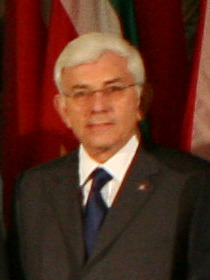
Said Wilbert Musa (/sɑːˈd ˈmsɑː/ , born 19 March 1944) is a Belizean lawyer and politician. He was the third prime minister of Belize from 28 August 1998 to 8 February 2008.[1]

Key Information

Early life and education

[edit]

Said Wilbert Musa was born in 1944 in San Ignacio in the Cayo District of what was then British Honduras. He was the fourth of eight children by Aurora Musa, née Gibbs, and Hamid Musa, a Palestinian immigrant from Al-Bireh. Hamid Musa was also involved in politics, running for the British Honduras Legislative Assembly as a National Party candidate in the 1957 general elections.[2][3]

As a boy, Musa attended Saint Andrew's Primary School in San Ignacio. He then attended high school at St Michael's College in Belize City and later St John's College Sixth Form. While living in Belize City, Said Musa aided his parents by selling tamales and other Belizean delicacies. After completing secondary school he then studied law at the University of Manchester in England, receiving an Honours Degree in Law in 1966, and then qualified as a barrister at Gray's Inn. He returned to Belize the following year, serving as crown counsel and then going into private practice. Said Musa has significantly contributed to law in Belize by representing thousands of underprivileged and poor individuals who come into contact with the law.

Political career

[edit]

Musa first came to notoriety in the late 1960s when he co-founded the Ad Hoc Committee for the Truth About Vietnam with Assad Shoman to protest the Vietnam War in British Honduras. On 1 January 1969 the group protested a showing of the American film The Green Berets in Belize City, which it characterized as pro-war propaganda.[4]

Musa joined the People's United Party (PUP) under George Cadle Price in 1970. He soon became a leader of the party's socialist wing in 1974. He ran for the Belize House of Representatives for the first time in 1974 in the eastern Belize City-based Fort George constituency, but was narrowly defeated by United Democratic Party and Opposition Leader Dean Lindo by 46 votes. Musa was appointed to the Belize Senate for the ensuing term, until 1979.[5]

Musa was successful in the next general election, held in 1979, winning the Fort George seat and defeating Lindo by a margin of 71 votes.[6] Musa served as Attorney General and Minister for Economic Development in the 1979–1984 Price-led government. Musa also served on the committee that wrote the 1981 Constitution of Belize.

Musa defended Belize's large national debt, mostly incurred in the 1980s, by saying Keynesian economics was being used: "The economy was in a deep recession, the country was broke (due to hurricanes) therefore it had to get the private sector moving again. The country started a major expansionary program ... to pay for the program we took on a lot of debt."[7]

In the 1984 election, Musa was defeated for re-election by Lindo, losing by a margin of 57 votes this time. He regained the Fort George seat in the 1989 election, defeating Lindo again by 449 votes. He has won the Fort George constituency in every election since.[6] Under Price, Musa was Minister of Foreign Affairs and Education from 1989 to 1993.

As of July 2016 Musa has contested 10 consecutive general elections in Fort George and has continuously served as his party's standard bearer in the same constituency for over 40 years, longer than anyone else in Belizean history. (Price was a standard bearer for 49 years, but in three different constituencies). He also trails only Price and Philip Goldson in total time served in the Belize House. Musa is the only current Area Representative to serve in the Belize House before the country's full independence from Great Britain in September 1981.

Leader of the People's United Party and Prime Minister of Belize

[edit]

Musa was elected and took over leadership of the PUP upon Price's retirement from party leadership in 1996, defeating Price's longtime lieutenant Florencio Marin in the leadership election in 1996.[8] Musa then led the PUP to landslide election victories in 1998 and 2003.

Musa led Belize to significant growth over his near-decade long term in office, but his popularity declined during his last years in office due in part to increasing public perception of corruption among his Cabinet and within his party.[9][10] He was also accused of abandoning his previous socialist stances in favour of neoliberal policies as prime minister.[11]

Outside of Belize Musa chaired several regional organisations, including CARICOM and the Central American Integration System (SICA).

Musa again led the PUP in the election held on 7 February 2008, but the PUP suffered a severe defeat at the hands of the UDP, led by Dean Barrow winning only six out of 31 seats.[12] Musa himself was re-elected in the Fort George constituency.[6][13] UDP leader Dean Barrow succeeded Musa and was sworn in as 4th prime minister of Belize by Governor-General of Belize, Colville Young on 8 February 2008.[12]

Post-leadership

[edit]

On the day of the 2008 election, Musa stated it would be his last election as PUP leader.[6][14] After the PUP's defeat, he congratulated Barrow. He considered the opposition's focus on allegations of corruption and negativity from the media to be primary factors in the defeat.[14]

On 13 February 2008, Musa announced that he was stepping down as party leader[6][15] so that the PUP could "renew itself from the top."[15] The PUP held a convention on 30 March 2008 to select his successor, and Johnny Briceño was elected as PUP leader against Francis Fonseca.[16]

A leadership election was held in October 2011 again where, Francis Fonseca defeated Briceno. Briceño was replaced by Francis Fonseca in October 2011. Five months later the Fonseca-led PUP suffered a narrow defeat to the UDP, winning 14 of 31 seats in the Belize House of Representatives. Musa was comfortably re-elected in his Fort George constituency and remains the senior member and shadow Senior Minister of the PUP caucus and in the Shadow Cabinet which was formed first in 2012 and then again in 2015. The current Shadow Cabinet of Francis Fonseca will be dissolved before the Next Belizean general election which is scheduled for 13 February 2020.

2015 and beyond

[edit]

In 2015 the 71-year-old Musa was the subject of rumours of possible retirement from public life due to health concerns and a perceived negative impact on future PUP electoral prospects nationwide. However, Musa dismissed the rumours and stated his retirement from the Belize House was not imminent. In March 2015 Musa told Tropical Vision Limited that he would "more than likely" run for an eighth and final term in the 2015 election, which he won.[17][18]

Although eligible to stand in an 11th consecutive general election, Musa stood down at the 2020 Belizean general election. The PUP nominated his son Henry Charles Usher to stand in his place in Fort George Constituency. He won the seat in the election.

Family

[edit]

Musa is married to Joan Musa.[19] His son, Yasser Musa, is an artist, teacher, poet and entertainer in Belize and headed its arts council, the National Institute of Culture and History (NICH) under the PUP administration in addition to serving as chief of public relations for the PUP. Another son, Kareem, recently returned to Belize with a law degree and has taken on a number of prominent cases recently.

In what was considered an upset, Kareem Musa defeated Belize City mayor and UDP nominee Darrell Bradley for the House seat in the Caribbean Shores constituency in the November 2015 election, becoming the first Belizean area representative to simultaneously serve with his father.[20]

Musa and his wife Joan also have three other sons, Mark Musa (a doctor), Said Musa Jr and David Musa. He also has seven children outside his marriage.[citation needed]

See also

[edit]

References

[edit]
Revisions and contributorsEdit on WikipediaRead on Wikipedia
from Grokipedia

Said Wilbert Musa (born 19 March 1944) is a Belizean and who served as the third of from 28 August 1998 to 8 February 2008. As leader of the (PUP), he guided the party to its first consecutive electoral victory since Belize's independence in 1981, securing a 22-seat majority in the 29-seat in 2003.
Musa's early career included contributions to Belize's transition to independence, where he served as and helped draft the country's . During his premiership, Belize experienced average annual GDP growth of 6.7 percent over the initial five years, despite impacts from multiple hurricanes, while maintaining institutions such as a free press and independent . His government emphasized addressing public needs for , , and , alongside transparency initiatives to counter claims, including international oversight proposals. However, the latter part of his tenure faced economic slowdowns and scrutiny over decisions like contracts and rising public debt. Musa retired from electoral politics in 2020 after decades in , including terms as a senator and elected representative, and in 2025, archives of his records were digitized and a biography published to preserve his legacy.

Early life

Childhood and family background

Said Wilbert Musa was born on March 19, 1944, in San Ignacio, , (then ). He was the fourth of eight children born to Hamid Musa, a merchant of Palestinian descent who immigrated to , and Aurora Musa (née Gibbs), a local Belizean. The Musa family resided in San Ignacio, where Said grew up in a modest household amid the rural setting of western during the late 1940s. Hamid Musa engaged in local commerce and showed early political interest by running for office, influencing the family's environment, though the household remained humble with limited resources. As a young boy, Musa recalled formative experiences in San Ignacio, including outdoor activities and community life that shaped his early years before pursuing . The family's Palestinian heritage on the paternal side connected them to broader immigrant networks in , though daily life centered on local agrarian and trade pursuits.

Education

Said Musa completed his primary education at St. Andrew's Primary School in . He continued his secondary schooling at St. Michael's College in before advancing to the sixth form at St. John's College. Musa then pursued legal studies abroad, graduating with an in law from the in 1966. The following year, in 1967, he was called to the bar at in . Upon completing his qualifications, Musa returned to later that year to commence his legal career.

Professional beginnings

Musa earned an honours degree in law from the in 1966, followed by training at the Council of Legal Education and admission as a at in 1967. After returning to , he was appointed Circuit Magistrate in 1968 and subsequently served as Crown Counsel in the Office of the in 1969. He enrolled as an attorney-at-law in on February 4, 1970, marking his entry into private practice that year. Musa co-founded the firm Musa & Balderamos, where he practiced as senior partner, and was elevated to in September 1980.

Initial political involvement

Said Musa entered politics in the mid-1970s by joining the (PUP), 's then-dominant political organization advocating for and social reforms under British colonial rule. In 1974, he contested his first election for the in the Fort George constituency, a district encompassing eastern urban areas, but lost narrowly to the incumbent United Democratic Party candidate. Despite the defeat, PUP leader and Premier George Price appointed Musa as a senator in the , serving from 1974 to 1979 and gaining experience in legislative debates on and . During this senatorial term, Musa aligned with the PUP's more progressive, socialist-leaning faction, contributing to internal party discussions on and anti-colonial strategies amid Belize's push for full . His legal informed early for constitutional advancements, positioning him as an emerging voice in opposition to Guatemala's territorial claims over . This initial phase marked Musa's transition from private legal practice to , building networks within the PUP that would propel his later electoral successes.

Rise in politics

Role in independence and early PUP positions

Musa joined the (PUP) in the early 1970s under leader , aligning with the party's push for amid ongoing colonial rule. He quickly emerged as a key figure in the PUP's socialist wing, advocating for progressive economic reforms and policies to counter British influence and Guatemala's territorial claims. In 1974, Musa ran unsuccessfully for the Fort George constituency in the elections but was subsequently appointed to the by Price, serving until 1979 and using the platform to champion independence. To bolster the independence movement, Musa invested in Amandala newspaper in 1977, partnering with its publishers to amplify advocacy for sovereignty against Guatemalan threats and British hesitancy, though he did not found the publication. His efforts contributed to mobilizing public support during critical negotiations, including the 1979 PUP election victory that solidified the path to self-rule. achieved independence on September 21, 1981, following the Heads of Agreement process and UN resolutions affirming . Musa played a direct role in the final independence phase, participating in discussions with the British Foreign Office on constitutional terms and serving on the committee that drafted Belize's 1981 Independence Constitution, which established a parliamentary democracy with protections for civil liberties and land rights. Within the PUP, he voted in favor of pursuing full independence during internal deliberations, aligning with the center-left faction alongside Assad Shoman against more cautious voices. Following the 1979 elections, where he secured the Fort George seat, Musa assumed early governmental roles in the pre- and post-independence PUP administration, including Minister of and later and Minister of from 1979 to 1984. These positions focused on implementing socialist-oriented policies such as expanded public and to foster national development amid fiscal constraints. His tenure emphasized reducing foreign dependency, though later critiques from within the left noted deviations toward market-oriented adjustments by the .

Path to party leadership

Musa joined the (PUP) in the early 1970s, emerging as a prominent figure in its socialist wing alongside , the party's longtime leader. He first contested the Fort George constituency in the 1974 general election, securing victory and entering the as the PUP held opposition status following its 1974 defeat. Throughout the 1970s and 1980s, Musa contributed to the party's push for Belizean independence, achieved in 1981, and built his profile through legal advocacy and party organizing, including roles in challenging British colonial policies. Following the PUP's return to power in the 1989 general election, Musa was appointed Minister of Foreign Affairs and Education, serving until the party's 1993 electoral loss to the United Democratic Party (UDP). In this capacity, he handled diplomatic negotiations, including aspects of the territorial dispute, and advanced educational reforms, solidifying his stature as a capable administrator within 's administration. As , then in his late 70s, faced internal pressures amid repeated electoral challenges and health concerns, discussions of succession intensified, with Musa advocating for a shift toward pragmatic economic policies while retaining core PUP commitments to . In October 1996, announced his resignation as PUP leader after four decades at the helm, triggering a convention. At the party's convention in on November 10, 1996, Musa challenged and defeated Florencio Marin, Price's deputy and preferred successor, by a margin of 358 votes to 214. This victory, supported by younger party members and those favoring modernization, positioned Musa to lead the PUP into the 1998 general election, where the party secured a triumph with 26 of 29 seats.

Premiership (1998–2008)

Election and initial agenda

In the general election held on 27 August 1998, the (PUP), led by Said Musa, secured a , winning 26 of the 29 seats in the with 50,330 votes, representing 59.4% of the popular vote. The ruling United Democratic Party (UDP) was reduced to 3 seats, garnering 33,237 votes or 39.2%. Musa was sworn in as on 28 August 1998, marking the PUP's return to power after five years in opposition. Musa's campaign emphasized an anti-tax, pro-jobs platform aimed at economic recovery from the preceding UDP administration's policies. Upon taking office, his initial agenda included commitments to ratify international treaties on ' and , alongside domestic reforms such as establishing a to expand access to care. Early actions also focused on curbing the discretionary powers of cabinet ministers to enhance . In 1999, Musa commissioned a Political Commission to review electoral and governance structures, reflecting priorities for institutional strengthening.

Economic policies and debt management

Upon assuming office in 1998, Said Musa's administration implemented expansionary fiscal policies, emphasizing public investments in and social programs to stimulate and development. These measures contributed to real GDP expansion, with growth reaching approximately 4% in 2006 amid efforts to address fiscal challenges. However, the approach resulted in a sharp rise in public debt, increasing from 41% of GDP in 1998 to 93% by 2004, driven by sustained deficits and borrowing for development projects. By the mid-2000s, Belize's had become unsustainable, prompting Musa's government to publicly acknowledge the issue in August 2006 after initiating negotiations earlier. The administration restructured nearly all commercial , consolidating around BZ$550 million (approximately $275 million) into a single "superbond" issued in February 2007, backed by the full faith and credit of the government and secured against future revenues like VAT. This exchange extended maturities to 2029 but incorporated higher interest rates, leading to projections that total repayments would exceed the original principal—estimated by critics at up to three times the restructured amount due to compounded coupons and fees. Debt management efforts included achieving a primary fiscal surplus in some years, as highlighted in 2006 presentations, alongside measures like increased VAT collection to service obligations. Public debt reached BZ$2.2 billion by December 2006, surpassing 90% of GDP, with 98.1% of eligible obligations restructured to avert default. Opposition figures argued the terms imposed undue long-term burdens, including controversial guarantees without full cabinet consultation, exacerbating fiscal vulnerabilities exposed by hurricanes and global pressures. Despite these steps, the restructuring deferred rather than resolved underlying spending pressures, contributing to ongoing debates over fiscal .

Social reforms and infrastructure

During Said Musa's premiership, the government prioritized expanding access to essential social services, including and , as part of a broader commitment to human development. In 2002, Belize joined regional efforts by launching the National Council for Human and Social Development (COHSOD), aimed at coordinating policies for , , , and social welfare across states. By 2006, official assessments noted significantly greater public access to and compared to prior decades, alongside increased home ownership opportunities and job availability. Infrastructure development focused on connectivity and utilities, with funds from the 2006 Superbond allocated to nationwide projects including improvements, , expansion, and enhancements. Key initiatives included the of the Silver Creek Bridge on the Hummingbird Highway, funded by a $2.8 million grant agreement signed on June 24, 2005, to improve rural access. The Chalillo Dam on the Macal River, proposed in 1999, advanced during this period to support hydroelectric power generation and energy reliability. These efforts contributed to modern linking remote villages to urban centers, alongside near-universal access to clean and stable by the mid-2000s.

Foreign policy, including Guatemala dispute

During his premiership, Said Musa's foreign policy emphasized Belize's sovereignty amid the persistent Guatemalan territorial claim, while fostering economic ties with key partners and deepening regional integration. Belize maintained close relations with the , its primary trading partner accounting for over 50% of exports and imports, and received annual aid exceeding $2 million for development initiatives. Diplomatic bonds with remained steadfast, with Musa visiting multiple times and affirming nearly a decade of by January 1999, including technical and financial assistance that supported infrastructure and agriculture. Ties with the persisted through membership, providing security guarantees until full Belizean defense self-sufficiency. Regionally, Belize actively participated in CARICOM and the (OAS), assuming the (SICA) presidency in July 2003 to promote trade and environmental . The Guatemala dispute dominated Musa's external agenda, rooted in Guatemala's claim—based on an unratified 1859 treaty—to roughly half of Belize's territory south of the Sibun River, a contention Belize rejected citing prescriptive title from colonial treaties dating to 1783 and post-independence recognition by over 100 nations. Tensions escalated after a February 24, 2000, border incident involving Guatemalan farmers, prompting renewed OAS mediation. On November 8, 2000, Belize and Guatemala signed a under OAS auspices, establishing a Line of Adjacency for joint and to prevent clashes, without conceding ; the pact expired August 31, 2001, but laid groundwork for dialogue. Musa's administration pursued diplomatic resolution, with Belize offering Guatemala facilitated Atlantic access in exchange for reciprocal Pacific access, signaling good faith while defending territorial integrity. The OAS facilitation process, launched September 2000 with appointed mediators, concluded September 16, 2002, yielding proposals for maritime delineation and security cooperation that Guatemala partially rejected as inequitable. By 2005, amid stalled progress, Musa advocated referring the matter to the (ICJ) if Guatemala remained intransigent, a stance that influenced subsequent bilateral commitments in to hold ICJ referenda—finalized just before his term ended—marking incremental advancement toward judicial settlement without immediate resolution. These efforts prioritized and multilateral oversight, averting military confrontation while upholding Belize's claim to full .

Controversies and criticisms

Passport sales and fiscal decisions

During Said Musa's premiership, a significant arose in July 2002 over irregularities in the and Service, including the unauthorized sale and issuance of , residency permits, and possibly birth certificates to non-citizens, with practices reportedly ongoing for up to a decade prior. Musa responded by appointing an independent Commission of Inquiry, prompted by preliminary police investigations into allegations of improprieties and within the department. The implicated high-level officials, leading to the of Home Affairs Minister Maxwell Samuels, who oversaw , and subsequent administrative probes ordered directly by Musa. Legal proceedings followed, including trials against individuals like Jabbour Affif for involvement in fraudulent dealings, though cases faced repeated delays; the affair was cited by international observers as emblematic of governmental risks during Musa's tenure. Prior to assuming office in 1998, Musa had pledged as leader to subject any future passport sales to a , reflecting public concerns over programs used by previous administrations to generate revenue. However, the 2002 exposures highlighted lapses in oversight rather than formalized sales, eroding trust and contributing to perceptions of lax enforcement under his government; Musa later affirmed commitment to justice in handling related files but faced criticism for inadequate preventive measures. On fiscal matters, Musa's administration pursued aggressive , culminating in the 2006 issuance of a US$500 million "superbond" to consolidate external commercial debts into a single instrument maturing in 2029 (later extended amid renegotiations). This move, executed amid rising borrowing needs for and social programs, locked in step-up interest rates—initially around 4.25% but escalating to 6%—which opponents decried as fiscally imprudent, arguing it imposed unsustainable amortization burdens on future budgets and prioritized short-term liquidity over long-term solvency. Musa defended the bond as essential for averting default and nationwide developments, including roads, , utilities, and alleviation, asserting it enabled "growth " despite inherited fiscal strains from prior non-repaid private loans absorbed by the state. Critics, including subsequent governments, attributed part of Belize's post-2008 debt vulnerabilities to these decisions, with the superbond's payments—reaching annually by —straining revenues and necessitating multiple renegotiations; nonetheless, proponents noted it stabilized finances temporarily amid global pressures. Broader fiscal policies under Musa, such as expanded public guarantees for development loans and increased spending on social investments, amplified debt-to-GDP ratios, drawing rebukes for insufficient austerity amid revenue shortfalls.

Allegations of corruption and governance failures

Musa's administration encountered significant allegations of , particularly involving the Development Finance Corporation (DFC), where between 1998 and 2004, improper loans totaling millions were reportedly issued to political allies and family members, leading to substantial losses for the state-owned institution. Critics, including opposition figures, highlighted these as emblematic of , with audits revealing non-performing loans exceeding $20 million BZ dollars that strained public finances without adequate recovery mechanisms. Although Musa defended the DFC's operations as necessary for development lending, the scandal contributed to internal PUP dissent and public distrust, exemplified by the 2004 G-7 rebellion among party members demanding fiscal reforms. In 2009, Musa himself faced criminal charges of theft related to the alleged misuse of US$10 million in public funds during his tenure, though he was acquitted by a Belizean , with the judge ruling insufficient evidence of intent. Separate reports emerged of involving Musa's family, including a 2020 U.S. alleging a $200,000 bribe facilitated by his son Kareem Musa in connection with government contracts, as documented by the U.S. Ambassador to Belize; these claims, while unproven in , fueled perceptions of . Governance critiques extended to the 2006 superbond restructuring, under which Musa consolidated Belize's commercial debt into a $450 million instrument with high interest rates, ultimately costing taxpayers an estimated 1.5 billion BZ dollars over time due to escalating payments and lack of transparency in fund allocation. Defenders argued the bond enabled infrastructure investments, but opponents cited it as a primary cause of fiscal unsustainability, with annual debt servicing consuming over 20% of GDP by 2008. These issues culminated in governance failures manifesting as and electoral defeat; by 2008, Belize's public debt had ballooned to 100% of GDP, exacerbated by unreformed spending and scandals that eroded investor confidence. The PUP's landslide loss in the February 2008 general elections—securing only 6 of 31 seats—was widely attributed to voter backlash against perceived mismanagement, with Musa conceding that internal divisions and public dissatisfaction over debt and graft played key roles. Post-tenure evaluations, including from international observers, noted systemic weaknesses in oversight, such as inadequate enforcement, which allowed scandals like irregularities and social security loan guarantees to persist without full . Despite acquittals in personal cases, the cumulative effect tarnished Musa's legacy, with local analyses linking these failures to delayed recoveries in and fiscal health under subsequent administrations.

Policy shifts from socialism to neoliberalism

During his tenure as Prime Minister from 1998 to 2008, Said Musa implemented economic policies that marked a continuation and intensification of neoliberal reforms initiated by the (PUP) in the , diverging from the party's earlier socialist-leaning platforms under George Price, which emphasized and . In response to balance-of-payments crises and IMF conditionalities dating back to the early , the PUP had already begun adopting market-oriented adjustments, but Musa's administration accelerated fiscal discipline, , and efforts to attract foreign amid growing public debt exceeding 100% of GDP by the mid-2000s. These measures included short- and medium-term monetary tightening and public expenditure controls to stabilize the economy, reflecting a pragmatic embrace of neoliberal prescriptions over interventionist state-led growth. Key examples included the of state assets, such as the Port Authority, which was dredged at a cost of approximately $44 million before being sold for $40 million in a bid to reduce fiscal burdens and promote efficiency. In , Musa's government licensed private competitors like Intelco to challenge the dominant Belize Telecommunications Ltd. (BTL), then under private ownership, aiming to foster despite ensuing disputes over service quality and monopoly remnants. Debt management epitomized this shift: by 2006–2007, the administration restructured 98.1% of commercial through a "superbond" consolidating $554 million into a single tradable instrument, extending maturities and lowering immediate repayment pressures while aligning with international creditor demands for sustainability. These policies prioritized export promotion in sectors like and , alongside to rein in deficits that had ballooned due to spending, contrasting with the PUP's anticolonial emphasis on redistributive . Critics, particularly from left-leaning perspectives within Belize, argued that Musa's approach abandoned the PUP's foundational socialist ideology in favor of neoliberalism influenced by global institutions like the IMF and G7 frameworks, enabling elite capture of gains from growth while exacerbating inequality. However, proponents viewed the reforms as necessary adaptations to post-Cold War economic realities and Belize's small open-economy constraints, yielding average GDP growth of around 4% annually during much of the period despite vulnerabilities to external shocks. This policy orientation persisted beyond ideological debates, embedding market liberalization in Belize's development strategy.

Post-premiership activities

Opposition leadership and 2012 election

Following the People's United Party's (PUP) landslide defeat in the February 7, 2008 —where it won only 6 of 31 seats in the —Said Musa briefly served as from February 8 to March 30, 2008. During this interim period, Musa retained his parliamentary seat in the Fort George constituency, one of the PUP's few victories against the United Democratic Party (UDP)'s sweep of 25 seats. He publicly accepted responsibility for the loss, attributing it to voter dissatisfaction with economic policies and governance issues under his prior premiership, while congratulating UDP leader on the victory. On February 14, 2008, Musa announced his resignation as PUP party leader, stating that the party needed to "renew itself from the top" to rebuild credibility and address internal divisions exposed by the election. This paved the way for a leadership convention on March 30, 2008, at which John Briceño was elected as the new PUP leader and succeeded Musa as , with Briceño sworn in on April 2, 2008. Musa continued as a backbench opposition MP for Fort George, contributing to parliamentary debates on fiscal policy and the territorial dispute, though his influence waned amid PUP infighting and Briceño's tenure, which ended with Briceño's resignation in 2011 over personal scandals, leading to Francis Fonseca's installation as interim party leader. In the lead-up to the March 7, 2012 general election, Musa supported the PUP's campaign efforts as a figure, focusing on the Barrow government's handling of public debt and . The PUP, under Fonseca, improved its performance by winning 13 seats compared to 2008, but the UDP retained power with 19 seats. Musa sought re-election in Fort George, securing 1,202 votes (37.89% of valid votes cast), but lost to UDP incumbent Mark Anthony King, who received 1,544 votes (49.19%). This defeat ended Musa's 36-year parliamentary career, after which he transitioned to advisory roles within the PUP outside formal elected office.

Later party roles and retirement

Following the 2012 general election, Musa continued to serve as the (PUP) standard bearer and Member of the for the Fort George constituency, a role he had held since winning his first term in 1979 across ten successive elections. He maintained this position without assuming formal party leadership roles beyond constituency representation, amid speculation in 2015 about potential retirement due to health issues and his age of 71, though he did not step down at that time. In May 2020, Musa suffered a , from which he was still recovering by . On September 8, 2020, at age 76, he formally announced his retirement from electoral politics after more than 40 years of service, notifying PUP leader of his decision to step aside as Fort George standard bearer and allow younger candidates to contest the upcoming November 2020 general election. The PUP acknowledged his contributions, including his tenure as from 1996 to 2011 and his long parliamentary career, marking the end of an era for the veteran politician.

Legacy

Achievements and contributions

During his tenure as a key figure in Belize's transition to independence, Said Musa assisted in drafting the country's 1981 Independence Constitution, which established the framework for post-colonial governance. He also represented Belize in international bodies, including the (CARICOM), contributing to regional cooperation on economic and political matters. As from August 1998 to February 2008, Musa became the first leader since to secure two consecutive terms, reflecting sustained public support for his administration's priorities. His government pursued ambitious economic expansion alongside social development, including investments in such as the refitting of ports in to bolster the sector's growth. Additionally, policies aimed at reducing costs through increased and were implemented, enhancing for consumers. Musa's administration emphasized infrastructure modernization, constructing new roads and connectivity projects that linked remote villages to major towns and cities, thereby improving national integration and access to services. In 1999, he proposed the Chalillo Dam on the Macal River to address energy needs and support development, a project that advanced hydroelectric capacity despite environmental debates. Politically, he launched the Political Commission in 1999 to review and recommend improvements to electoral and governance processes, fostering democratic enhancements. These efforts were credited with maintaining a robust democratic environment where public expression remained unimpeded.

Long-term impacts and evaluations

The fiscal expansion under Musa's premiership, including subsidized credit and public investments, facilitated average annual GDP growth of approximately 4% from 1998 to 2008, though growth of around 30% masked underlying volatility and stagnation in certain sectors. However, this came at the cost of unsustainable debt accumulation, with public rising from 39% of GDP in 1998 to 93% by 2004 and over 100% by 2006, necessitating a "superbond" that deferred but prolonged repayment obligations into subsequent decades, constraining fiscal space for development and contributing to recurrent budget pressures. Long-term evaluations attribute this debt trajectory to inadequate ex-ante assessments of investment fiscal impacts and reliance on commercial borrowing, exacerbating vulnerabilities to external shocks like hurricanes and price fluctuations. Infrastructure initiatives, such as the rehabilitation of the Southern Highway following Hurricane Keith in 2000, enhanced regional connectivity and tourism access, yielding enduring benefits for in southern districts despite initial delays from competing priorities like housing programs. In , Musa's policies as former minister and expanded access and funding—allocating 25% more to the sector in key budgets—and are evaluated positively for revolutionizing the system through reforms that improved enrollment and , as recounted by political contemporaries in 2025 assessments. Social investments in and alleviation similarly broadened coverage, though health sector reforms faced hurdles that limited scalability. Overall scholarly and institutional evaluations portray a mixed legacy: short-term stimulus via public spending spurred visible progress in and connectivity, yet the resultant twin deficits (fiscal deficit reaching 9.2% of GDP by 2002/03) and regional poverty increases (e.g., 15-18 percentage points in from 1993-2002) underscored failures in equitable, sustainable growth, with debt servicing absorbing up to 84% of current revenues by 2002 and perpetuating structural dependencies. Critics, including economic analyses, argue that the shift toward growth-oriented borrowing without corresponding revenue buoyancy (tax buoyancy falling to 0.33 in the ) prioritized immediate outputs over long-term resilience, leaving with widened disparities and limited policy maneuverability post-2008. Proponents counter that foundational investments in and provided a platform for later diversification, though empirical data on persistence tempers claims of transformative equity.

Personal life

Family and relationships

Said Musa married Joan Pearson while studying law at the University of Manchester in England during the mid-1960s. The couple returned to Belize in 1967, where they established their family. Musa and Joan have multiple sons, including Yasser Musa, an artist, poet, teacher, and former head of the National Institute of Culture and History's arts division in Belize. Another son, Kareem Musa, serves as a member of the Belize House of Representatives for the People's United Party (PUP). Musa has additional children from relationships outside his marriage to Joan, including Henry Charles Usher, who has held roles such as PUP chairman for the Fort George constituency and succeeded Musa politically in that area following his retirement.

Health and recent endeavors

In May 2020, Musa, then aged 76, was admitted to Belize Medical Associates after exhibiting symptoms of a mild . members reported steady improvement in his condition by early June, with ongoing monitoring by medical staff. In July 2020, he traveled overseas for specialized surgery related to the stroke, after which he continued recovery without further publicized health complications. Musa turned 81 on March 19, 2025, marking the occasion with the launch of his Now Watch Me Watch Yourself, which documents his political career and contributions to 's development, alongside an archival project aimed at preserving his documents and legacy for public access. In October 2025, Musa joined former leaders, including of and Baldwin Spencer of , in issuing a joint statement urging de-escalation amid rising U.S.- tensions over regional waters, offering mediation to promote peaceful dialogue and avert military confrontation. This reflected his continued engagement in regional post-retirement.

References

Add your contribution
Related Hubs
User Avatar
No comments yet.