Hubbry Logo
Nikephoros I of ConstantinopleNikephoros I of ConstantinopleMain
Open search
Nikephoros I of Constantinople
Community hub
Nikephoros I of Constantinople
logo
8 pages, 0 posts
0 subscribers
Be the first to start a discussion here.
Nikephoros I of Constantinople
from Wikipedia

Key Information


Nicephorus I of Constantinople
Ecumenical Patriarch of Constantinople
Installed12 April 806
Term ended13 March 815
PredecessorTarasios of Constantinople
SuccessorTheodotus I of Constantinople
Personal details
Bornc. 758
Died(828-04-05)5 April 828
DenominationChalcedonian Christianity

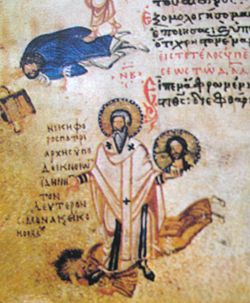
Nikephoros I (Greek: Νικηφόρος; c. 758 – 5 April 828) was a Byzantine writer and Ecumenical Patriarch of Constantinople from 12 April 806 to 13 March 815.[1][2]

Life

[edit]

He was born in Constantinople as the son of Theodore and Eudokia, of a strictly Orthodox family, which had suffered from the earlier Iconoclasm. His father Theodore, one of the secretaries of Emperor Constantine V, had been scourged and banished to Nicaea for his zealous support of Iconodules,[3] and the son inherited the religious convictions of the father.

While still young Nicephorus was brought to the court, where he became an imperial secretary and entered the service of the Empire. Under Empress Irene of Athens he took part in the synod of 787 of Nicaea as imperial commissioner. He then withdrew to one of the cloisters that he had founded on the Thracian Bosporus. There he devoted himself to ascetic practices and to the study both of secular learning, as grammar, mathematics, and philosophy, and the Scriptures. Around 802 he was recalled and appointed director of the largest hospital for the destitute in Constantinople.[3]

After the death of the Patriarch Tarasios of Constantinople, there was great division among the clergy and higher court officials as to the choice of his successor. Although still a layman, Nicephorus was chosen patriarch by the wish of the emperor (Easter, 12 April 806). The uncanonical choice met with opposition from the strictly clerical party of the Stoudites,[3] and this opposition intensified into an open break when Nicephorus I, in other respects a very rigid moralist, showed himself compliant to the will of the emperor by reinstating the excommunicated priest Joseph.

After vain theological disputes, in December 814, there followed personal insults. Nicephorus I at first replied to his removal from his office by excommunication, but at last, under Emperor Leo V the Armenian was obliged to yield to force, and was taken to one of the cloisters he had founded, Tou Agathou, and later to that called Tou Hagiou Theodorou. From there he carried on a literary polemic for the cause of the iconodules against the synod of 815. On the occasion of the change of emperors, in 820, he was put forward as a candidate for the patriarchate and at least obtained the promise of toleration.

He died at the monastery of Saint Theodore (Hagiou Theodorou), revered as a confessor.[4] His remains were solemnly brought back to Constantinople by Methodios I of Constantinople on 13 March 847 and interred in the Church of the Holy Apostles, where they were annually the object of imperial devotion. His feast is celebrated on this day both in the Greek and Roman Churches; the Greeks also observe 2 June as the day of his death.

Works

[edit]

Compared with Theodore the Studite, Nicephorus I appears as a friend of conciliation, learned in patristics, more inclined to take the defensive than the offensive, and possessed of a comparatively chaste, simple style. He was mild in his ecclesiastical and monastical rules and non-partisan in his historical treatment of the period from 602 to 769 (Historia syntomos, breviarium). He used the chronicle of Trajan the Patrician but deliberately chose not to name the source so as to connect himself to the historical tradition of Theophylact Simocatta.[5][6] The Short History is thematically focused around the matter of the offices of emperor and patriarch.[7] Nicephorus I attempted to salvage the reputation of the patriarchate by criticising iconoclast patriarchs for submitting to the emperor, not for being iconoclasts.[8] Emperor Heraclius was the ideal emperor in Nicephorus I's scheme because of how he worked alongside patriarch Sergius I of Constantinople, but also how Sergius I helped to defend Constantinople from the Avars in 626 as well as the patriarch's ability to discipline the emperor for his marriage to his niece Martina. Heraclius failure to heed the Egyptian patriarch's advice is what ultimately brought about the Arab conquest of Egypt.[9]

His tables of universal history, Chronography or Chronographikon Syntomon, in passages extended and continued, were in great favor with the Byzantines, and were also circulated outside the Empire in the Latin version of Anastasius Bibliothecarius, and also in Slavonic translation. The Chronography offered a universal history from the time of Adam and Eve to his own time. To it he appended a canon catalog (which does not include the Book of Revelation of John of Patmos). The catalog of the accepted books of the Old and New Testaments is followed by the antilegomena (including Revelation) and the apocrypha. Next to each book is the count of its lines, his Stichometry of Nicephorus, to which we can compare our accepted texts and judge how much has been added or omitted. This is especially useful for apocrypha for which only fragmentary texts have survived.

The principal works of Nicephorus I are three writings referring to iconoclasm:

  • Apologeticus minor, probably composed before 814, an explanatory work for laymen concerning the tradition and the first phase of the iconoclastic movement;
  • Apologeticus major with the three Antirrhetici against Mamonas-Constantine Kopronymos, a complete dogmatics of the belief in images, with an exhaustive discussion and refutation of all objections made in opposing writings, as well as those drawn from the works of the Church Fathers;
  • The third of these larger works is a refutation of the iconoclastic synod of 815 (ed. Serruys, Paris, 1904).

Nicephorus I follows in the path of John of Damascus. His merit is the thoroughness with which he traced the literary and traditional proofs, and his detailed refutations are serviceable for the knowledge they afford of important texts adduced by his opponents and in part drawn from the older church literature.

Notes and references

[edit]
[edit]
Revisions and contributorsEdit on WikipediaRead on Wikipedia
from Grokipedia

Nikephoros I (c. 758 – June 2, 828) was from April 12, 806, to March 13, 815, a Byzantine theologian, , and who rose from secular administration to leadership amid the second wave of . Born in to an Orthodox family persecuted under the first iconoclastic regime, he served as an imperial secretary and represented Empress Irene at the Second Council of Nicaea in 787, which restored icon veneration.
Elevated to the patriarchate by Emperor despite his lay status, he initially faced criticism from monastic leaders like for decisions such as reinstating a , but later reconciled with them under Emperor Michael I. His tenure culminated in resolute opposition to Emperor Leo V's revival of iconoclastic policies in 815, refusing to convene a endorsing the destruction of religious images and thereby incurring deposition by iconophile bishops and exile to a monastery on the . From exile, Nikephoros continued producing treatises refuting , including the Antirrhetici and an Apology, while his Breviarium (Short History) provided a critical of Byzantine history from 602 to 769, preserving accounts of imperial and ecclesiastical events. Venerated as a in Orthodox and Catholic traditions for his defense of doctrinal orthodoxy, his relics were later translated to , underscoring his enduring legacy as a pillar against imperial interference in .

Early Life and Background

Origins and Education

Nikephoros was born around 758 in , during the iconoclastic reign of Emperor (741–775). His father, Theodore, held the position of imperial secretary in the emperor's administration but faced persecution for upholding icon veneration; he was scourged and exiled to alongside other iconophiles. Theodore's role connected the family to the Byzantine bureaucratic elite, though their iconodule stance exposed them to the risks of imperial disfavor amid the ongoing iconoclastic policies that targeted religious dissenters from 726 onward. Nikephoros's mother, , exemplified piety and adherence to orthodox traditions, likely influencing his early religious outlook in a household resilient against state-enforced . Raised in this environment of familial and devotion, he received a comprehensive education typical of Constantinople's upper strata, encompassing , classical Greek , , and introductory patristic . This formation occurred in the shadow of the First Iconoclasm's aftermath, fostering an early appreciation for icons as devotional aids grounded in ' writings rather than idolatrous objects.

Secular Career under Irene

Prior to his ecclesiastical elevation, Nikephoros served as a high-ranking lay dignitary in the Byzantine imperial court during the reign of Empress Irene (797–802). In this capacity, he acted as one of three imperial commissioners representing Irene at the Second Council of Nicaea in 787, where he endorsed the council's decrees affirming the —but not —of sacred icons as consistent with orthodox , thereby contributing to the restoration of iconophile practices following the iconoclastic policies of prior emperors. Nikephoros's administrative expertise extended to ecclesiastical affairs through his appointment as synkellos (a close aide and advisor) to Tarasius (784–806), a role he assumed amid the iconophile resurgence under Irene's regime. As synkellos, he assisted in overseeing church administration, including the management of ecclesiastical finances and estates, which had been disrupted by decades of iconoclastic confiscations and required meticulous reconciliation to restore orthodox control over properties. His proficiency in these fiscal and governance matters, demonstrated in navigating the post-iconoclastic recovery, fostered confidence among the clergy loyal to the restored veneration of images. This secular experience under Irene highlighted Nikephoros's acumen in blending lay bureaucratic efficiency with fidelity to iconophile doctrine, positioning him as a trusted figure in the empire's efforts to stabilize religious institutions after the persecutions. His roles underscored a pragmatic approach to reintegrating church assets, prioritizing empirical restitution over ideological excess, which aligned with the causal need to rebuild authority on verifiable legal and traditional grounds.

Rise to Patriarchate

Election in 806

Following the death of Patriarch Tarasios on February 25, 806, Emperor Nicephorus I prioritized selecting a successor capable of unifying the church hierarchy amid lingering divisions from the iconoclastic era and the recent overthrow of Empress Irene in 802, which had disrupted ecclesiastical stability. The emperor, seeking to consolidate imperial authority over religious affairs without alienating iconophile factions, favored candidates untainted by prior doctrinal wavering, such as Tarasios's own accommodations during the Second Council of Nicaea in 787. Nikephoros, a lay aristocrat with prior service as asekrētis (imperial secretary) and syncellus (church administrator under Tarasios), emerged as the preferred choice due to his demonstrated in venerating icons, administrative acumen honed in secular and ecclesiastical roles, and absence of entanglement in earlier compromises that had fueled monastic discontent. Though still a layman—a status that provoked resistance from rigorist monks insisting on canonical sequences—the bishops ultimately reached consensus under imperial pressure, reflecting Byzantine custom permitting swift clerical for exceptionally qualified individuals in times of need. Consecrated on Easter Sunday, April 12, 806, after rapid reception of monastic vows, , and priesthood, Nikephoros assumed the with explicit commitments to preserve icon veneration as affirmed at II and to resist excessive state encroachment on church autonomy, signaling the emperor's intent for a balanced restoration rather than radical overhaul. This elevation, while uncanonical by strict standards, underscored the intertwining of imperial and episcopal selection processes, with the emperor's endorsement overriding clerical objections to ensure a pliable yet doctrinally sound leader.

Initial Reforms and Administration

Nikephoros I, drawing on his prior experience as a lay official in the imperial court, prioritized efficient governance of affairs upon assuming the on April 12, 806. He directed church treasury resources toward charitable support for the needy, reflecting a commitment to fiscal stewardship over accumulation. This approach aimed to counteract potential abuses in lingering from the disruptions of earlier iconoclastic policies, including the seizure and redistribution of monastic assets under emperors like . In reorganizing clergy appointments, Nikephoros enforced stricter standards to curb , ensuring selections based on and competence rather than favoritism or political influence. He also amassed a collection of books to foster education in patristic texts and orthodox doctrine, promoting doctrinal consistency among the without delving into partisan controversies. Relations with Emperor (r. 811–813) remained functional, marked by the patriarch's role in crowning the new ruler on July 2, 811, after extracting a written pledge to uphold the faith and safeguard and from interference. Nikephoros refrained from direct political meddling, concentrating instead on internal order amid the emperor's generally supportive stance toward the church.

Theological Stance and Icon Veneration

Defense of Icons Pre-815

Prior to the intensification of the Second Iconoclasm under Emperor Leo V, Patriarch Nikephoros I articulated a defense of icon veneration grounded in the Christological implications of the Incarnation. He maintained that the assumption of human flesh by the divine Logos rendered Christ depictable, thereby affirming the reality of his dual nature—fully divine and fully human—against iconoclastic reductions that risked implying a docetic or monophysite denial of tangible humanity. Icons, in this view, served as visible testimonies to the historical event of the Incarnation, enabling believers to contemplate the mystery of the hypostatic union without conflating the image with the divine essence itself. Nikephoros drew upon the patristic tradition, particularly the such as Basil the Great, to delineate a clear distinction between timētikē proskynēsis (venerative honor) accorded to icons and latreia (adoration) due solely to God. Basil's principle that "the honor paid to the image passes to its prototype" provided a foundational argument, privileging the empirical continuity of ecclesiastical practice over speculative prohibitions against material representations. This approach underscored the icons' role within the liturgical and devotional life of the Church, rooted in apostolic and conciliar tradition as affirmed at the Second Council of Nicaea in 787, which Nikephoros upheld as . In engagements with court figures amid rising iconoclastic pressures from 813 onward, Nikephoros emphasized the causal and testimonial function of icons as historical artifacts rather than talismanic objects endowed with autonomous efficacy. He argued that rejecting icons undermined the evidential basis for Christian doctrine, severing the faithful from the sensory encounter with salvation history that the Incarnation itself inaugurated. These positions, expressed in synodal contexts and personal exhortations, reflected a commitment to tradition as empirically validated through centuries of usage, countering abstract theological objections with appeals to lived ecclesial experience.

Engagement with Iconophile Tradition

Nikephoros I aligned his defense of icons with the foundational arguments of , particularly by expanding on the Damascene's emphasis on icons as symbolic bridges to the divine prototype, while integrating Aristotelian concepts of representation to counter iconoclastic assertions that material images inevitably led to . He extended these treatises by meticulously compiling patristic testimonies, such as those from Basil the Great, to demonstrate the distinction between (proskynesis) directed toward the prototype and the relative honor given to the image itself, thereby refuting iconoclastic claims that equated icon with emperor worship or divine confusion. Drawing from the Seventh Ecumenical Council (Nicaea II) of 787, Nikephoros incorporated its canonical definitions affirming icons as orthodox expressions of Christ's , using them to underscore the continuity of iconophile practice against the earlier iconoclastic synod of Hieria in 754. He critiqued the first wave of under Leo III (initiated around 726) by highlighting its deviation from established tradition, attributing its origins to non-theological factors including imperial overreach rather than doctrinal purity. Nikephoros balanced the spiritual significance of icons with their material role, portraying them as essential pedagogical instruments that conveyed scriptural narratives to the largely illiterate populace through visual clarity and enduring impression, superior to verbal instruction in and retention. This approach was grounded in verifiable historical precedents from early Christian usage, evidenced by ' approvals and liturgical customs, ensuring icons served as verifiable links to without promoting superstition.

The Second Iconoclastic Controversy

Revival under Leo V

Leo V, an Armenian officer who ascended the Byzantine throne in July 813 following the defeat of Michael I at the against the , drew on his military background and prior sympathies for —evident from his under for suspected iconoclastic leanings—to initiate a revival of the policy. Influenced by the army's support and viewing recent defeats, including the 811 disaster at under and the 813 Versinikia loss, as signs of divine disfavor linked to veneration, Leo aimed to unify the empire religiously and militarily against Bulgar incursions. He modeled his approach on Leo III, removing the of Christ from the Chalke Gate and convening discussions with priests, monks, and clergy to prepare the ground for suppression. In 814, Leo issued edicts mandating the removal of icons from public places and churches, seeking patriarchal endorsement to legitimize the shift. Patriarch Nikephoros I, however, refused compliance, arguing that such actions contravened scriptural precedents against image destruction and the canons of the Seventh Ecumenical Council of 787, which had affirmed icon veneration. Nikephoros emphasized the church's autonomy in doctrinal matters, resisting imperial pressure that echoed caesaropapist overreach seen in earlier reigns, where forced uniformity had provoked monastic and clerical opposition without resolving underlying military vulnerabilities. Initial negotiations between Leo and Nikephoros, involving synodal consultations, collapsed due to the emperor's insistence on the patriarch's unconditional submission to the iconoclastic decree, prioritizing state control over ecclesiastical consensus. This standoff highlighted the practical tensions of reviving a policy tied to past Isaurian successes but fraught with risks of internal division, as Leo's military-backed regime sought to impose it amid ongoing Bulgar raids that had claimed thousands in prior campaigns.

The Council of 815 and Deposition

The Council of 815 was convened by Emperor in January 815 at the in , marking the revival of after the restoration of icons under Empress Irene and the Second Council of Nicaea in 787. Under imperial pressure, a of predominantly iconoclast bishops, numbering around 300 but lacking delegates from the other Eastern patriarchates or , gathered to overturn prior iconophile decisions. The proceedings emphasized selective excerpts from patristic writings—known as florilegia—to argue against the of icons, portraying them as "spurious" representations unfit for and reinstating the iconoclastic bans decreed at the Council of Hiereia in 754. Patriarch Nikephoros I, a staunch defender of icons, was summoned and refused to recant his adherence to Nicaea II or condemn icon veneration, leading to his formal deposition on March 13, 815. In his place, Leo V installed Theodotus I Cassiteras, a lay syncellus and iconoclast sympathizer previously excommunicated under prior iconophile regimes, who then presided over the council's sessions. The synod's horos (definition) explicitly anathematized Nicaea II as heretical, dismissing its iconophile doctrines as influenced by "womanly simplicity" under Irene, while praising Leo V as a "second Noah" for purging idolatry—decisions achieved not through theological deliberation but through coercion, as many bishops had previously sworn oaths against reconvening on icons without ecumenical consent. The deposition reflected stark power dynamics: Leo V, advised by iconoclast courtiers like John the Grammarian, leveraged military and administrative authority to enforce compliance, bypassing the broader representation required for legitimacy in Byzantine conciliar tradition. Nikephoros's unyielding stance—rooted in appeals to patristic consensus and scriptural precedent—precipitated his immediate to a , stripping the of its iconophile leadership and enabling the installation of Theodotus to propagate the revived policy. This synod's narrow composition and enforced outcomes underscored a departure from empirical theological consensus, prioritizing imperial directive over representative deliberation.

Key Arguments Against Iconoclasm

Nikephoros maintained that veneration of icons involved relative honor (timetikē proskynēsis), whereby the respect accorded the image passes entirely to its —the depicted—thus distinguishing it from idolatrous of the material form itself. This principle, rooted in the patristic tradition, refuted iconoclast accusations of essence confusion by emphasizing that icons function as referential symbols, not divine essences, preserving the ontological separation between creator and creation. Theologically, Nikephoros grounded icon legitimacy in , arguing that the circumscribed the divine in visible, human flesh subject to tangible experiences like hunger, thirst, and fatigue, rendering Christ depictable without compromising divinity. Iconoclast reliance on image bans, such as Exodus 20:4, failed to account for this redemptive shift, where the once-invisible God assumed a form amenable to representation, fulfilling rather than abrogating law through revelation. Iconoclast proponents, including Emperor , countered that any icon risked equating the uncircumscribable divine with delimited matter, inviting and violating the Decalogue's absolute prohibition on crafted images, while ostensibly simplifying amid fiscal pressures from endless wars. Yet causally, exacerbated instability, as seen in the 742 rebellion of Artavasdos, who seized power by championing against 's regime, highlighting how suppression alienated monastic networks and popular piety central to Byzantine cohesion. Empirically, icon bolstered imperial unity and resilience, evidenced by the empire's recovery under iconophile rulers like Irene after decades of iconoclastic territorial losses to and , whereas 's purported purification yielded division without eradicating extraneous rituals.

Exile and Later Years

Banishment to Chalcedon

Following his deposition at the in March 815, Nikephoros I was initially exiled to the island of Proikonnesos in the , where he was confined under military guard to prevent any resumption of ecclesiastical authority. Around 816, he was transferred to a monastic retreat near on the Asiatic shore of the , specifically to the Monastery of St. Theodore, which he had previously founded; this relocation maintained his isolation while subjecting him to ongoing harassment by iconoclastic imperial agents. The conditions of his banishment were severe, involving constant surveillance, deprivation of official correspondence, and prohibitions on liturgical or administrative acts, yet Nikephoros steadfastly refused offers of recall conditioned on his silence or compromise regarding icon veneration, viewing such terms as tantamount to . Despite the restrictions, Nikephoros sustained clandestine communication with fellow iconophile leaders, including the monk Theodore Studites, who was similarly exiled during the reign of Leo V (r. 813–820) and later under (r. 820–829); these exchanges helped coordinate moral and intellectual resistance among monastic networks opposed to the revived iconoclastic policies. His unyielding posture positioned him as a symbolic anchor for the underground iconophile faction, encouraging perseverance amid imperial that affected hundreds of clergy and across the empire. The rigors of , compounded by voluntary ascetic practices and inadequate provisions, led to a progressive decline in Nikephoros's health; by his late sixties, the cumulative effects of isolation and privation manifested in physical frailty. He died on June 2, 828, at approximately 70 years of age, still in confinement at the of St. Theodore near , without recanting his defense of icons.

Continued Writings in Exile

During his banishment following the Council of 815, Nikephoros composed the Apologeticus maior, the Apologeticus minor, and the three Antirrhetics, systematic refutations targeting the iconoclast horos (decree) and the patristic florilegium marshaled by the council to defend the destruction of sacred images. These works, drafted between roughly 815 and 820 amid physical isolation and imperial suppression, sustained iconophile arguments through close scriptural and patristic , underscoring his resolve to counter intellectually even without institutional authority. Nikephoros's output from exile modeled the confessor's vocation, prioritizing doctrinal fidelity over personal restoration; he rebuffed entreaties from Emperor Leo V (r. 813–820) to recant and similarly declined compromise offers from (r. 820–829), who sought partial reconciliation with iconodules but retained iconoclastic leanings. This steadfastness, evident in his refusal to communicate or yield on practices, reinforced the iconophile network's morale, as allies disseminated his manuscripts covertly to evade confiscation. He persisted until his on June 2, 828, at a near Prokonnesos, leaving an uncompromised witness to amid ongoing .

Literary Works

Historical Writings

Nikephoros's principal historical work, known as the Short History (Brevarium or Historia syntomos), chronicles Byzantine events from the accession of Emperor in 602 to the death of in 769, spanning the rise of Arab invasions, internal theological strife, and imperial responses to external threats. Composed likely in the late eighth century before his patriarchate, the text draws on now-lost contemporary sources, including eyewitness accounts of military campaigns and ecclesiastical events, providing a compressed that prioritizes causal sequences of political and religious decisions over exhaustive . Through selective emphasis in its —such as portraying iconoclastic policies under emperors like Leo III and as disruptions to traditional piety—Nikephoros implicitly bolsters the case for icon veneration by linking doctrinal unity to societal resilience against defeats, reflecting a first-principles view that fractured beliefs undermine martial and imperial cohesion. The Brevarium's strengths lie in its empirical details, offering verifiable accounts of Arab-Byzantine wars, such as specific sieges and truces under and later rulers, and the mechanics of iconoclastic persecutions, including forced oaths and icon destruction under , which align with corroborative evidence from non-Greek sources like Syriac chronicles. These elements provide historians with rare granular data on seventh- and eighth-century Asia Minor and the , including interactions with and Avars, filling gaps left by the later chronicle of Theophanes Confessor. However, its value is tempered by evident biases stemming from Nikephoros's iconophile Orthodox perspective, which systematically downplays imperial rationales for —such as perceived military expediency amid defeats—and attributes losses primarily to theological deviance rather than logistical or strategic factors, potentially overstating causation from religious policy alone. As a source, the Short History excels in reconstructing lost intermediate histories but requires cross-verification to mitigate its slant, which prioritizes patriarchal over balanced imperial justification; for instance, it critiques iconoclast patriarchs for yielding to emperors without equally scrutinizing iconophile concessions in earlier eras. This Orthodox framing, while rooted in the author's direct experience of the era's controversies, introduces selectivity that historians must weigh against empirical alignments, such as dated battle outcomes, to discern underlying causal realities like how enforced religious might have strained rather than unified Byzantine forces during prolonged wars. Overall, the work remains indispensable for its preservation of otherwise inaccessible details, though its narrative subtly advances a pro-icon agenda through interpretive emphasis on piety's role in averting or exacerbating empirical setbacks.

Antirrhetics and Apologetics

Nikephoros's Antirrhetici comprise three books systematically refuting iconoclastic positions, primarily those derived from Emperor Constantine V's earlier arguments and the florilegia compiled for the Council of 815. These texts dissect the iconoclasts' selective patristic quotations, which were marshaled to equate with , by restoring fuller contexts from the to demonstrate that such passages targeted pagan images or misapplications rather than Christian honoring Christ's humanity. In doing so, Nikephoros preserves key excerpts of the 815 council's (horos) and supporting , enabling a point-by-point that underscores the relational—rather than substantive—bond between icon and prototype. Employing Aristotelian categories, Nikephoros distinguishes the painted form (graphē) of an from any purported circumscription (perigraphē) of the divine nature, arguing that directs honor to the hypostatic via likeness and , not material essence. He counters the iconoclastic insistence on between image and original by highlighting icons' typological function, akin to shadows fulfilled in Christ, and invokes scriptural evidence such as Christ's post-resurrection visibility (John 20:26) to affirm depictability without compromising divinity. The works' logical syllogisms, including ten proofs elevating icons over mere symbols like the , further dismantle claims of . The Apologeticus major and Apologeticus minor extend these refutations into affirmative , systematically defending icons through scriptural typology and incarnational realism. Nikephoros cites precedents, such as the divine mandate to fabricate cherubim for the Ark (Exodus 25:18–22), as sanctioned prototypes for sacred imagery in cultic settings, prefiguring Christian practice without violating the on graven images. Central to his case is the tangible reality of the (John 1:14), wherein the Word's assumption of circumscribed humanity renders Christ historically depictable, distinguishing true icons from idols by their reference to the deified flesh rather than essence alone. These treatises' exhaustive patristic apparatus and meta-analysis of opposing syllogisms supplied iconophiles with superior argumentative depth, informing the rebuttals that secured Orthodoxy's victory in 843 by exposing iconoclastic distortions while bolstering comprehensive textual fidelity.

Legacy and Historical Assessment

Canonization and Veneration

Nikephoros I was formally recognized as a saint and confessor in the Eastern Orthodox Church after the Synod of Constantinople in 843 restored the veneration of icons, honoring his steadfast opposition to iconoclasm during his patriarchate and exile. His title of "Confessor" reflects his endurance of persecution and deposition by Emperor Leo V without renouncing his defense of Orthodox iconoduly against imperial decree. The primary feast day for Saint Nikephoros is June 2, commemorating his death in 828 and his exemplary life of and doctrinal . An additional commemoration occurs on March 13, marking the translation of his relics in 846 under Patriarch Methodius I, when they were exhumed from the island of Prokonnesos, found incorrupt and emitting a sweet fragrance, and solemnly transferred to the in for public . Veneration of Saint Nikephoros emphasizes his role as a against state-imposed , serving as a model of resistance to secular overreach in doctrinal matters. His relics, initially enshrined in , were dispersed following the city's fall to the Ottomans in , with fragments reportedly preserved in various Orthodox sites, though their current locations remain uncertain. In Orthodox liturgical tradition, Saint Nikephoros is invoked during the Synaxarion readings for the Triumph of on the first Sunday of , which annually reaffirms the 843 restoration of icons and commemorates confessors like him who upheld the Church's teachings amid imperial iconoclastic persecution.

Scholarly Evaluation and Influence

Nikephoros's Short History (also known as the Breviarium or Historia syntomos), covering events from 602 to 769, remains a cornerstone in modern of eighth-century , offering unique eyewitness-level details on imperial politics, ecclesiastical conflicts, and external threats like Arab invasions and Bulgar incursions not paralleled in other chronicles. Scholars value its concise Atticizing style and selective emphasis on causal chains, such as linking iconoclastic policies to administrative disruptions and military setbacks, which provide empirical grounding for assessing the era's internal divisions. Recent analyses, including examinations of its final chapters, demonstrate Nikephoros's deliberate restructuring of source material—beyond mere compilation—to foreground Orthodox perspectives, revealing his in narrating patriarchal depositions and executions as iconoclastic excesses. In theological , Nikephoros's anti-iconoclastic treatises, such as the Refutatio et Eversio, advanced Christological arguments by integrating Aristotelian logic to defend as rooted in the Incarnation's circumscribability, influencing subsequent Orthodox and contributing to the doctrinal framework that underpinned the Triumph of in 843. His meta-level refutations exposed inconsistencies in iconoclast reasoning, emphasizing empirical distinctions between and , which scholars credit with bolstering iconophile resilience against state-imposed policies. This intellectual rigor is seen as pivotal in preserving liturgical and artistic traditions amid persecution, with his works cited in later synodal defenses that formalized use. Critics, however, highlight potential hagiographic tendencies in Nikephoros's narratives, where manipulation of sources advances an iconophile agenda, as evidenced by alterations to accounts of early eighth-century events to amplify orthodox suffering and imperial culpability. Politically, some evaluations note that his unyielding opposition to Leo V's iconoclastic revival from 815 exacerbated ecclesiastical-military tensions, arguably delaying administrative stabilization in a period of Arab and Bulgar pressures, though this is weighed against the long-term vindication of his stance post-843. Overall, Nikephoros's influence endures in for debunking reductive secular interpretations of , underscoring its religious dimensions as a driver of societal and institutional costs, including monastic confiscations and doctrinal schisms that reverberated into the ninth century. His corpus shapes ongoing debates on memory-making in late eighth-century , where iconoclastic episodes forced selective historical reconstruction to affirm Orthodox continuity.

References

Add your contribution
Related Hubs
User Avatar
No comments yet.