Hubbry Logo
PliskaPliskaMain
Open search
Pliska
Community hub
Pliska
logo
8 pages, 0 posts
0 subscribers
Be the first to start a discussion here.
Pliska
Pliska
from Wikipedia

Pliska (Bulgarian: Плиска [ˈpliskɐ], Old Bulgarian: Пльсковъ, romanized: Plĭskovŭ) was the first capital of the First Bulgarian Empire during the Middle Ages and is now a small town in Shumen Province, on the Ludogorie plateau of the Danubian Plain, 20 km northeast of the provincial capital, Shumen.

Key Information

Pliska was the first capital of Bulgaria. According to legend, it was founded by Asparuh of Bulgaria in the late 7th century; this legend is archaeologically unsubstantiated.[1] The site was originally an encampment, with the first tent-shaped buildings at Pliska of uncertain date.[1] No evidence exists of a settlement before the 9th century, and claims that the site dates from Late Antiquity have been contested.[2]

By the early 9th century, Pliska was surrounded by a defensive wall and 2,300 hectares (5,700 acres) of land was further enclosed by an outer earthwork with stone revetment 21 kilometres (13 miles) long.[1] After the Byzantine army sacked and burned Pliska in 811, led by the emperor Nikephoros I (r. 802–811), Pliska was rebuilt by Omurtag (r. 814–831), who used spolia from nearby Roman buildings and employing late Roman-inspired rectilinear and basilica plans in the architecture of his new ashlar palace, which descended from Late Antique prototypes like Diocletian's Palace at Split, Croatia.[1] When Boris I (r. 852–889) converted to Christianity in 864, the religious buildings of Pliska were adapted for Christian use and it was after this point that the Great Basilica was constructed, together with a monastery which was attached to it.[1] The monastery was home to the disciples of Saints Cyril and Methodius.[1]

After the tsar Simeon I founded his new capital at Preslav, Pliska was slowly abandoned. Pliska (Medieval Greek: Πλίσκοβα, romanizedPlískova) was captured at the turn of the 2nd millennium by Theodorokanos and Nikephoros Xiphias, during the campaigns of the emperor Basil the Bulgar-Slayer (r. 960–1025), which ended the First Bulgarian Empire.[1]

History

[edit]

Prior to 681

[edit]
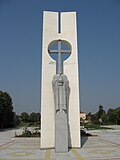
Monument of Khan Asparuh

In 680 CE, Bulgars crossed the Danube and invaded lands now part of modern-day Bulgaria, which was at that time largely inhabited by Slavic farmers.[3] The Bulgar army was led by Asparuh, who according to Byzantine chroniclers was one of the five sons of Kubrat, the Onogur chief who revolted against his Avar rulers and succeeded in uniting the various Bulgar groups living north of the Black Sea.[4] When Asparukh and his warriors entered the region south of the Danube, the Byzantine Emperor Constantine IV was upset and led an army to prevent the Bulgars from remaining there. The Byzantine expedition against the Bulgars ended disastrously and after defeating the imperial forces, Asparukh forced the nearby Slavic tribes to pay tribute to him, while leaving their tribal organization intact. As a result of this defeat, the empire was forced to sign a treaty recognizing the Bulgar state in 681. Despite the area having been for some time under the de facto control of various Slavic tribes, the emperors of Byzantium had kept up the fiction that the area was still imperial, as up to 681 no true state had replaced imperial rule. This was the first time that the Byzantine empire officially acknowledged another state in the Balkans.[4]

681-893

[edit]

Pliska was the capital of the First Bulgarian Empire between 681 and 893 AD. According to a Bulgarian chronicle, it was founded by Khan Asparuh. At its greatest extent, it had an area of 21.8 km2 (8.4 sq mi) and was surrounded by earthen ramparts.[5] A smaller stone fortification was built inside these ramparts and this contained a palace and buildings belonging to the aristocracy.

While Pliska experienced nearly a century of growth following its selection as the capital of the new Bulgarian state, this was not a peaceful era. The Bulgars and Byzantine Empire were in an almost constant state of war during the eighth century and into the early ninth.[6] Emperor Constantine V oversaw nine campaigns against the Bulgars between 741 and 775, and Emperor Nikephoros I's campaign in 811 resulted in the burning of the royal residence in Pliska.[7] In this last instance the emperor led a massive army to Pliska in retaliation for the Bulgarian capture of Sardika and massacre of its garrison that occurred in an earlier set of hostilities.[8] The Bulgarian leader Krum was not prepared to face the emperor's army and thus abandoned Pliska and the Byzantines plundered the palace and town there and burned it to the ground as it was largely at this time made of wood. Soon after, the invaders were driven out by Khan Krum (see Battle of Pliska).[9]

Later in the ninth century, during the reign of Boris I, the pagan temples in Pliska likely began to be converted to Christian churches.[10] In 886, Boris founded the Pliska Literary School which was moved to Preslav when Boris later relocated the capital. When Boris fell seriously ill and retired to a monastery, his son Vladimir succeeded him and attempted to reestablish paganism. During this period (889–93) the large stone basilica at Pliska built under Boris was heavily damaged. Boris left his monastery to overthrow his son, and after succeeding, relocated the capital to the nearby town of Preslav which seems to have been a centre of Christianity in the state.[10] Following this Pliska's relevance in Bulgar governance steadily declined until the Bulgarian state was destroyed by the Byzantine general turned emperor (when he murdered the previous emperor Nikephoros Phokas) John Tzimiskes. He defeated the Kyivan Rus' forces that had occupied Bulgaria and annexed the Bulgarian lands all the way to the Danube, ending the rule of the first Bulgarian state in these territories.[11] During this Rus' and Byzantine war over Bulgaria, Pliska was destroyed between 969 and 972 and was not rebuilt.

Archaeology of Pliska

[edit]
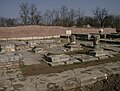
Ruins of the early medieval city of Pliska, the first Bulgarian capital

The construction of an earthen rampart was started shortly after the Bulgars settled in the Pliska plain (it has been suggested that these embankments may not have been built all at once),[12] and the territory inside of this is known as the Outer Town, which consisted of multiple groupings of modest cottages with space in between for flocks of livestock and horses.[13] This seemingly unusual layout may have been chosen as the Bulgars had been nomadic prior to building their capital at Pliska, and when they began to cooperate with the local Slavs (which formed a strong majority of the new state's population) a mixed pastoral and agricultural economy developed. The Inner Town, which was likely built later in the settlement's existence, consisted of a palace, basilica and aristocratic buildings inside a stone fortification.[14] The Inner Town was surrounded by the Outer Town which was in turn surrounded by the earthen rampart.

Overall, far less is known about the layout and contents of Pliska prior to the conversion to Christianity than afterwards. No stone buildings have been dated with certainty from before the Bulgars converted to Christianity in 864/5,[15] and many wooden buildings (which were initially presumed to have come from the pagan era) also appear to have been built later on. It's not clear which buildings were built in the decades immediately after 681. When the earthen rampart was built, Pliska had a very low population. Dimitrov's map based on the 1989 to 1991 dredging works in the Outer Town suggests that there were no more than six to twelve hamlet sized settlements there, while there might have been thirty or so by the tenth century.[15]

Pliska fortress plan

There is however still no plausible explanation for why the earthen rampart and ditch built around Pliska encircled such a large area.[16] A few areas appear to have been inhabited by people who provided services or took part in craft production for the palace centre, and agriculture clearly took place within the earthen rampart around the Outer Town. There was clearly a fair amount of open ground inside the earthen rampart. Henning concludes that the settlement was initially built for military and strategic reasons, and could not really be considered a typical city (with all of the associated trade, production, and population) until the period after Bulgaria converted to Christianity in 864/5.[17] Most of the stone architecture in Pliska was built between this conversion and eventual Byzantine conquest of the city in 971. The buildings from this era show a clear Byzantine influence in their design and function. For example, a 4 kilometre-long canal fed a large brick cistern that moved water from the Kriva river to the Inner Town via ceramic pipes. This cistern had attached rooms containing private baths.[18]

Only certain parts of the archaeological site of the city have been properly investigated. One of the most thoroughly researched is the Asar-dere area just to the west of the stone fortification surrounding the Inner Town. Four clay-made furnaces have been discovered in this area, suggesting that Pliska possessed a specialized pottery making capabilities and an urban economy at some point during its development.[14]

Initially, such finds were interpreted to show that early on the settlement relied upon pastoral and agricultural activities, and later developed sophisticated craft techniques. This interpretation was further supported by the relatively late dating of the first occurrences of glazed ceramic ware found in Pliska. At the very earliest these came from the late ninth century, though some certainly dated from the tenth and eleventh centuries as well.

However, more recent investigation of the Asar-dere area has shown that the area contained a large waste disposal site alongside multiple hearths and kilns all dating from the earliest occupation phase. The content of the waste shows that ceramics were produced early in the settlement's history. Other finds from this first phase of occupation (from the eighth until the beginning of the ninth century) include those connected with iron processing, such as slag, charcoal, ash, and pig iron. Fragments and solid droplets of glass suggest glassmaking are also found from this same period.[19] These types of finds are not extant in this area in the tenth and eleventh centuries, when it was instead occupied by numerous small and primitive grubenhaus dwellings. According to Henning;

“It was not the case that a predominantly agricultural style of living opened the way to a stepwise growth in craft activities, but rather a situation of fully developed and highly specialized artisan production was followed later by a process of broad ruralization”.[20]

Scholarly disputes

[edit]

Some scholars, such as Georgiev and Kirilov, have proposed that Pliska was not in fact the capital of Bulgaria during this period at all. Georgiev suggests that Pliska was only a seasonal residence with small timber buildings at least until the middle of the eighth century. Kirilov offers the explanation that like the Ottonian kings, the Bulgar rulers were itinerant, and travelled between multiple different residences.[21] Additionally, prior to some more recent finds in the Asar-dere area of the archaeological site, it was believed that the craft activities attested by Milčev showed that site did not become a true large town until the later ninth or early tenth century, however Henning shows that this may have occurred in reverse order.[20] Ceramic fragments on the floors of many of the pit-houses suggested (based on their depth in the soil) at first that the pottery was made and those houses were occupied in the later occupation period of the settlement. Excavation of the pit-house designated "grubenhaus No. 8" however precipitated a sharp conceptual turn amongst many researchers towards the belief that the pit-houses may largely have been built much earlier, and this suggests that the famous Great Basilica may have been built after rather than before the majority of the pit-houses, meaning it may not have been built in AD 864 as long supposed, but instead as late as the later tenth century.[22]

Modern Pliska

[edit]
Orthodox Church in Pliska

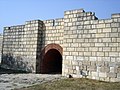
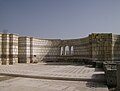
The ruins of the city of Pliska lie 3 km north of the modern village of Pliska. The site of the city is currently a National Archaeological Reserve. Ruins of the Great and the Small Palace, the strong stone fortifications and the Great Basilica (c. 875), used both as a royal church and as a national patriarchal cathedral, can be seen in the reserve.

Under Ottoman rule, the village known as Pliska since 1947 was instead called Aboba (Ağa Baba in Ottoman times),[23] a name which it kept until 1925, when the name was changed to Pliskov, a variant of the current name. The settlement has a population of 1,124 and is located 146 m above sea level in Shumen Province at the south end of the Ludogorie plateau. It is approximately 400 km northeast of Sofia, at 43°22′N 27°7′E / 43.367°N 27.117°E / 43.367; 27.117.

[edit]

Notes

[edit]

References

[edit]
[edit]
Revisions and contributorsEdit on WikipediaRead on Wikipedia
from Grokipedia
Pliska is the archaeological remains of the first capital of the , founded circa 681 CE by Khan Asparuh after the Proto-Bulgars' settlement south of the River and the subsequent with . It served as the empire's political, administrative, and symbolic center until 893 CE, when I relocated the capital to Preslav amid efforts to strengthen Christian and Slavic cultural influences. The site spans approximately 23 square kilometers, encompassing an inner fortified with a royal palace complex, an outer town with artisan quarters and residences, and monumental structures like the Great Basilica, which postdates the city's initial pagan foundations and marks the Christianization under Khan Boris I in the late . Archaeological evidence from excavations initiated in 1899 reveals a progression from wooden proto-urban settlements to stone architecture, including ramparts, gates, and devtashlars associated with Bulgar pagan rituals, underscoring Pliska's role in consolidating nomadic Bulgar power into a sedentary state apparatus. As a national archaeological reserve, Pliska provides empirical insights into the 's territorial expansion, economic base in agriculture and trade, and interactions with Byzantine and Slavic elements, free from later nationalist reinterpretations that overemphasize ethnic continuity.

Geography and Site Layout

Location and Topography

Pliska occupies a site in , northeastern , at coordinates 43°22′N 27°07′E, approximately 20 kilometers northeast of the city of . The location lies within the Plateau, a region forming part of the broader eastern Danubian Plain characterized by undulating lowlands. This plateau extends across northeastern , with surface elevations generally ranging from 200 meters in the north to 300 meters in the south, transitioning into the adjacent Dobruja Plateau eastward. The features predominantly flat to gently rolling , which supported the expansive layout of the ancient settlement spanning over 20 square kilometers. Low hills encircle the plateau, offering natural vantage points and barriers that enhanced strategic defensibility while the open plains permitted large-scale construction and agricultural exploitation. The site's position provided access to river systems, including the Kamchiya River basin to the east, whose tributaries contributed to , , and transport corridors toward the . Proximity to the (ancient Haemus), approximately 30-40 kilometers south, moderated local climate patterns, fostering fertile soils suitable for grain production essential to sustaining a central administrative hub. The lies about 80 kilometers eastward, influencing regional humidity and trade viability through fluvial connections, while the flat expanses facilitated overland military movements across the tableland.

Urban Structure: Inner and Outer Towns

The Inner Town of Pliska constituted the fortified , occupying roughly 49 hectares and protected by a incorporating . This central enclosure functioned as the administrative and residential core for the ruling , evidencing a deliberate to concentrate power and defense under Bulgar khanal . Archaeological mapping delineates its compact, rectangular perimeter, distinct from the expansive surrounding areas, with excavations revealing organized spatial divisions for key functions. Encircling this core, the Outer Town spanned approximately 22 square kilometers, bounded by an earthen rampart, ditch, and irregular trapezoidal fortifications. This peripheral zone accommodated broader urban activities, including residential quarters, artisanal workshops, and agricultural fields, as identified through geophysical surveys and surface . The layout featured defined sectors for production and habitation, with rectangular enclosures—known as sujuks—serving as secured compounds for and storage, adaptations from nomadic practices integrated into sedentary urbanism. Such zoning reflects centralized planning, enabling efficient and in the early medieval context. Integrated prospection data indicate semi-regular alignments in the Outer Town's streets and parcels, suggesting a grid-influenced organization imposed by state directive rather than . This structured expanse, vastly larger than contemporary European settlements, underscores Pliska's role as a proto-urban tailored to the socio-economic needs of a conquering Bulgar transitioning to imperial governance.

Historical Foundations

Pre-681 Settlements and Influences

Archaeological rescue excavations within the modern town of Pliska have revealed Late remains, including a partially preserved and fragmented handmade storage vessels made from rough clay featuring garland-like decorations and loop handles, dated to circa 1300 BC. These artifacts, recovered 1.5 meters below the surface by a team led by Assist. Prof. Yanko Dimitrov from the Office of Bulgaria's National Institute and Museum of , point to localized human activity tied to the early phases of Ancient . Stratigraphic evidence from the same digs also includes features, such as a wooden and a utilizing sooty river stones, potentially associated with Slavic settlers arriving in the during the 6th century AD. Despite these traces of intermittent occupation, no comprehensive urban or fortified structures predating 681 AD have been documented at the site through geophysical surveys or extensive trenching, indicating the absence of a dominant settlement center in the Thracian, Roman, or immediate pre-Bulgar periods. Pottery sherds and tools from layers suggest continuity in basic resource exploitation, such as local clay sourcing for ceramics, but without evidence of large-scale organization or . The site's topographic advantages on the plateau, including proximity to small rivers for water and nearby forests for timber, likely contributed to its selection by proto-Bulgar migrants under Khan Asparuh in 681 AD, building on prior patterns of sporadic habitation rather than displacing an established . Slavic groups, present in northeastern from the mid-6th century, may have further familiarized the area through seasonal or semi-permanent camps, influencing the strategic choice of Pliska as a power base amid migrations from the Pontic steppes.

Establishment as Capital (681–800)

In 681, following the Bulgarian victory over Byzantine forces at the , Khan Asparuh established the south of the River, securing Byzantine recognition through a with Emperor that fixed the along the river. The chronicler , a primary Byzantine source, records Asparuh's forces subduing local Slavic tribes and asserting sovereignty, though his account reflects imperial bias portraying the as barbarian aggressors disrupting Roman order. This migration from the Pontic steppes, driven by pressures from Khazar expansions disintegrating , necessitated a fixed power base to consolidate control over heterogeneous Bulgar elites, Slavic subjects, and extracted tribute from conquered territories. Pliska was selected as the initial seat of power due to its position on the plateau, an open plain northeast of modern that facilitated nomadic operations while offering natural defensibility through surrounding low hills and access to water sources for sustaining large encampments. The site's intersection with trade routes and suitability for husbandry supported economic viability, enabling Asparuh to project authority over a vast area spanning from the to the without overextending steppe mobility. This pragmatic choice marked a causal shift from transient alliances to sedentary , prioritizing administrative oversight of collection and military mobilization amid ongoing Byzantine threats. Early Pliska encompassed a sprawling inner of approximately 23 square kilometers enclosed by wooden palisades and earthen ramparts, reflecting the ' initial adaptation of nomadic encampment tactics to permanent settlement. These rudimentary fortifications, erected in the late , symbolized the transition toward centralized governance, with the khan's residence serving as a focal point for assemblies and . Evidence of administrative functions appears in Proto-Bulgarian inscriptions, such as those in the distinctive script found at the site, which likely recorded commemorative or titulary decrees by the ruling clan, underscoring among the warrior aristocracy for legitimizing authority. By the late , incremental stone reinforcements began supplementing wood and earth, indicating growing stability and investment in durability as the empire extracted surplus from Slavic labor and Byzantine payments.

Political and Military Significance

Reigns of Key Rulers: Krum and Omurtag

ascended to the throne in 803 and ruled until his death in 814, implementing policies of territorial expansion that doubled the size of the Bulgarian state through conquests extending from the middle southward toward and northwest into regions previously under Avar influence. His governance emphasized legal reforms, including the first codified laws applicable across Bulgarian territories, which centralized authority and integrated Slavic elements into the administration while maintaining Bulgar dominance. These measures, drawn from pragmatic adaptation to multi-ethnic realities rather than ideological impositions, enabled sustained military mobilization from Pliska, the political core, where coordinated campaigns that secured tribute and resources vital for state cohesion. Byzantine chroniclers, such as , record that following the 811 confrontation, had the skull of Emperor Nicephorus I encased in silver and used as a drinking vessel—a motif echoing warrior customs symbolizing victory over foes, though its literal occurrence remains unverified beyond adversarial accounts prone to exaggeration for propagandistic effect. The tangible outcomes, however, include verifiable advances: Bulgarian forces under captured key Thracian fortresses like in 809 and repelled Byzantine incursions, yielding territorial control corroborated by later diplomatic recognitions and the influx of captives resettled to bolster labor in Pliska's environs. Omurtag succeeded in 814 and reigned until approximately 831, shifting focus from relentless expansion to consolidation by negotiating a 30-year with in 815, ratified in , which demarcated borders along the frontier and exchanged captives, thereby averting immediate threats and freeing resources for infrastructure. This accord, pragmatic in securing stability amid internal succession challenges, reflected causal priorities of over ideological conquest, as Omurtag prioritized fortifying Pliska and peripheral sites against potential incursions. Under Omurtag, extensive building initiatives transformed Pliska into a more fortified administrative hub, including the erection of stone palaces, granaries, and boundary markers inscribed with multilingual texts asserting territorial claims—evidenced by surviving fragments that detail land allocations and feats like systems for . These programs, funded by from pacified neighbors and agricultural yields from the fertile plains surrounding the capital, supported a likely numbering in the tens of thousands, sustained through coerced labor from resettled Byzantine whose technical skills influenced techniques without immediate pressures. Omurtag's diplomacy extended to alliances with the , facilitating trade in furs, slaves, and grains via routes, which underpinned economic resilience and deterred Byzantine during his tenure.

Battle of Pliska (811)

In 811, Byzantine Emperor launched a major offensive against the , leading a large estimated at 60,000–80,000 troops drawn from across the empire's themes. The campaign aimed to subdue Khan Krum's forces after years of border skirmishes, including the Bulgarian siege of Serdica in 809. Nikephoros advanced rapidly through the Balkan passes, reaching Pliska—the Bulgarian capital—by late July, where his forces sacked the city, plundering its palaces and administrative centers before setting it ablaze. This initial success reflected Byzantine logistical superiority and the element of surprise, as Krum's main was absent, engaged elsewhere; however, the destruction was temporary, with Pliska's stone fortifications limiting long-term damage. As Nikephoros prepared to withdraw laden with spoils, regrouped his forces, including and mobilized reserves, and positioned them to exploit the rugged terrain of the eastern . On July 26, 811, the Byzantines entered the narrow Vărbitsa Pass, where Bulgarian ambushers—leveraging superior mobility on horseback and knowledge of local defiles—blocked exits, unleashed volleys of arrows, and launched coordinated night assaults. , a contemporary Byzantine chronicler, describes the resulting carnage: the imperial army was trapped, with most soldiers slaughtered or drowned in a nearby river swollen by rains, and Nikephoros himself killed, his skull later fashioned into a drinking vessel by as a . Only a fraction escaped under co-emperor , who was gravely wounded; Byzantine casualties approached total annihilation of the field army, far exceeding losses in prior engagements due to the confined pass negating advantages. The victory stemmed primarily from geographical causation—the pass's bottlenecks amplified Bulgarian over Byzantine overconfidence or numerical disparity alone, as evidenced by prior failed invasions where open terrain favored heavy formations. Krum's rapid mobilization of non-combatants for further enabled sustained pressure, debunking narratives of mere Byzantine in favor of adaptive Bulgar warfare suited to steppe-derived mobility. In the immediate aftermath, Bulgaria regained territorial buffers in and Macedonia, deterring further Byzantine incursions for a generation and enhancing Krum's prestige, though it did not precipitate empire-wide conquest due to internal Byzantine succession crises and Bulgarian logistical limits beyond the Haemus range. This event marked the first imperial death in battle since 378 AD, underscoring the strategic perils of overextension into contested highlands.

Architectural and Monumental Features

Palaces and Administrative Centers

The palace complex in Pliska's functioned as the core administrative and residential hub for the Bulgarian khans, enclosed within a rectangular approximately 52 meters long and featuring specialized structures for . The Grand Palace, the best-preserved elite building, incorporated a that served as the seat of khanal decision-making, underscoring centralized authority over the empire's expanding territories. Early constructions relied on wood, but the sack of Pliska in 811 AD prompted a shift to durable under Khan Omurtag (r. 814–831), with the new Throne Palace erected directly over the ruins of Khan Krum's earlier stone predecessor from the late . This rectangular layout, comprising inscribed inner and outer rectangles, included courtyards and auxiliary chambers that facilitated bureaucratic operations. Associated facilities, such as equipped with systems, integrated Roman-Byzantine engineering traditions into the administrative ensemble, providing amenities that supported prolonged elite assemblies and daily governance. These features, absent in initial wooden phases, highlighted post-811 enhancements in to project imperial power and efficiency. Excavated remains reveal no extensive mosaics in the palaces themselves, but the strategic placement and monumental scale of these centers—encompassing over 50 hectares in the —evidenced a deliberate for administrative control, with artifacts like official imprints suggesting regulated economic and diplomatic functions tied to khanal oversight.

Religious Buildings and Basilicas

Archaeological evidence from Pliska reveals a transition in religious architecture from pre-Christian Bulgar structures to monumental Christian following the state's adoption of Christianity in 864–865 under Boris I. Early wooden buildings, some circular and dated to the late 7th to early 9th centuries, are interpreted as sites for pagan rituals, possibly linked to Tengriist practices among the nomadic Bulgar elite; these included foundations near the Small Palace and other areas within the inner town, with features like surrounding sidewalks suggesting communal use. Such structures reflect indigenous traditions rather than immediate Byzantine imposition, with limited evidence of syncretic during the initial phases of conversion, as pagan sites appear distinct from later Christian foundations. The Great Basilica, situated in the outer town, exemplifies the post-conversion sacred building program, constructed between 866 and 875 with white limestone quadrae quarried near Kyulevcha, forming a three-aisled structure measuring 102.5 meters long and 30 meters wide—surpassing the length of Constantinople's at the time. This cathedral, potentially dedicated to St. Sofia, included an , , and adjacent monastery complex with a for producing texts, indicating its role in disseminating the new faith to Slavic populations. Architectural elements, such as the basilical plan, suggest influences from eastern Roman prototypes, likely facilitated by Byzantine masons or knowledge transfer amid ongoing conflicts and diplomacy, though direct evidence of in construction remains circumstantial from broader historical contexts of prisoner exchanges. Excavations have uncovered altar bases and fragmentary frescoes within the Great Basilica, attesting to its liturgical functions and decorative program typical of early Orthodox churches, with possible motifs blending local and imperial styles. Smaller basilicas or chapel-like structures may have existed elsewhere in Pliska, but the Great Basilica dominated as the era's largest Christian edifice in the region, underscoring state-sponsored over lingering pagan elements. Destruction layers from the 10th century, including burn marks and structural collapse around 969–971 during Rus' incursions, mark initial decline phases, though the ruins endured until Ottoman razing in the 14th–15th centuries, when stones were repurposed for later constructions. This sequence highlights pragmatic continuity in site use amid political shifts, rather than abrupt erasure of pre-Christian heritage.

Fortifications, Sujuks, and Underground Networks

Pliska's inner was fortified by massive stone walls measuring 2.5 to 2.6 meters in thickness and rising to an estimated of 10 to 12 meters, constructed from large slabs to provide robust defense against assaults. These walls enclosed a trapezoidal area, reinforced at corners and along sides by trapezoidal or pentagonal towers, with positioned for controlled access, including a main southern entrance flanked by defensive structures. The outer town relied on wooden palisades for perimeter defense, creating layered enclosures that supported logistical needs such as and animal holding areas essential for sustaining a during prolonged threats. A distinctive feature of Pliska's defensive infrastructure was an extensive network of secret underground passages, designed for emergency evasion and secure internal movement of supplies or personnel. These tunnels, categorized into those serving as escape routes and others for storage or transport, extended up to 300 meters in length and reached heights of about 2.2 meters, with some segments uniquely built of wood for structural adaptation. Key passages linked the inner palace complexes to the surrounding fortifications and religious sites, such as the , facilitating covert operations amid the site's expansive layout. The fortifications' emphasized endurance through sheer mass and on the open , complemented by broad ditches exceeding 2 meters in width that enhanced barriers and potentially aided drainage for operational resilience. This configuration prioritized causal defensive utility, leveraging material durability and subterranean connectivity to mitigate vulnerabilities in an otherwise exposed .

Archaeological Investigations

Early Excavations (20th Century)

The initial systematic archaeological work at Pliska in the early was led by Czech-Bulgarian scholar Karel Škorpil, who, under the auspices of the Russian Archaeological Institute and with support from Fyodor Uspenskij, excavated portions of the Throne Palace and the Large Basilica starting in 1900. These efforts employed targeted probing and manual labor from local workers to expose monumental structures, confirming the site's identification as the First Bulgarian Empire's capital through inscriptions and architectural features, though emphasized national heritage affirmation over comprehensive stratigraphic . In the interwar decades (), Bulgarian archaeologists including Krustyo Miyatev and Petur Karasimeonov advanced digs using exploratory trenching, uncovering elements like a presumed "Krum's ," pagan temples, baths, and an underground passage beneath palace foundations; these methods prioritized high-profile discoveries but often lacked rigorous recording, reflecting a nationalist focus on linking the site to Bulgar rulers amid post-independence identity-building. Post-1945 excavations, influenced by Soviet archaeological paradigms emphasizing large-scale, methodical surveys, shifted toward systematic trenching and broader exposure of the outer town, revealing clusters of churches, residential buildings, workshops, and semi-dugout settlements along features like the Assar-dere stream; this approach, despite resource constraints in communist , provided empirical data on , countering earlier underestimations of the site's scale. By the 1970s–1980s, coordinated wide-area campaigns under teams including Stamen Mikhailov employed extended trenching and multi-site probing across the palace center, environs, and fortress perimeter, delineating wooden precursors to stone edifices and extensive peripheral zones; these efforts resolved prior interpretive disputes on Pliska's metropolitan character by quantifying built-up areas through measurable exposures, prioritizing data-driven mapping over symbolic monumentalism.

Major Discoveries and Artifacts

One of the most notable artifacts from Pliska is the bronze , a seven-pointed star-shaped object approximately 38 mm in diameter, discovered during excavations in 1961 within the site's early medieval layers. Inscribed with 13 proto-Bulgar signs resembling runic script, it is cataloged as item 38 in the comprehensive inventory of finds from Pliska and dated to the 7th–9th centuries AD based on associated and material . Its authenticity is affirmed by the excavation amid contemporaneous wooden and stone structures, distinguishing it from unprovenanced items prone to debates. Ceramic discoveries include substantial quantities of early medieval yellow ware pottery, a fine, wheel-thrown type with a distinctive slip, unearthed across residential and administrative contexts. This ware, prevalent from the 8th–9th centuries, features forms like jugs and , with analyses indicating local clay sources tempered with steppe-influenced techniques, potentially linked to Bulgar or Avar traditions. Imported fragments, numbering in the hundreds from satellite settlements, point to Mediterranean trade networks, with handles stamped in Byzantine styles dated to the 8th–10th centuries via typological comparison. Among personal and administrative items, lead seals and jewelry, including fibulae and pendants with geometric motifs, have been recovered from and fills, totaling over 200 small finds from a single rampart excavation alone. These artifacts, assayed to 8th–9th century alloys via metallographic studies, bear impressions suggesting administrative use and ornamental styles blending nomadic and Byzantine elements, verified through associations in dated destruction layers. Proto-Bulgar pagan idols, such as figures from the 8th–9th centuries, further attest to pre-Christian practices, preserved in museum collections from post-1971 digs. Wall decorations from the palace complex include fragmented frescoes depicting geometric patterns and possible figural scenes, preserved within 9th-century stone rebuilds and analyzed for pigments matching regional Byzantine palettes. Basilica-related finds are sparser, with no extensive mosaics confirmed, though cross-inscribed stones and revetments from the Great Basilica's 865–875 AD phase indicate elite Christian adaptation, corroborated by epigraphic . All major artifacts undergo contextual verification, with radiocarbon and aligning them to Pliska's imperial peak, refuting unsubstantiated authenticity challenges.

Recent Geophysical and Fieldwork Advances (2000–Present)

Since 2000, integrated geophysical prospection has significantly advanced the understanding of Pliska's urban layout through non-invasive methods. Magnetic surveys using motorized Fluxgate magnetometers and (GPR) with a four-channel 250 MHz array covered approximately 27.4 hectares of magnetometry and 19.8 hectares of GPR, primarily in the , revealing extensive unexcavated structures including streets, buildings, and suburbs beyond previously known limits. These surveys, conducted in collaboration with Bulgarian and Austrian teams, confirmed a complex grid-like organization extending into peripheral areas, supporting evidence of Pliska's metropolitan scale without large-scale excavation. Fieldwork in the and has yielded targeted artifact discoveries illuminating contexts. In , excavations in an residential building within the Inner uncovered a 9th-century lead seal depicting the Virgin Mary holding a mature-appearing Christ, an atypical diverging from standard Byzantine representations of the period. This find, associated with high-status occupation layers, provides direct evidence of localized Christian devotional practices in Pliska's administrative core during the empire's formative phase. Stratigraphic analysis of underground passageways has refined chronologies of Pliska's foundational infrastructure. Recent studies of these sujuks—secret tunnels integral to the site's earliest horizons—employ detailed layering to date their construction to the late , contemporaneous with the Bulgar settlement's , rather than later phases. Complementary fieldwork has extended site occupation backward through evidence; excavations in revealed pottery vessels from circa 1300 BCE in domestic contexts, indicating pre-medieval settlement continuity via stratigraphic superposition. These advances underscore Pliska's long-term habitability, with geophysical data integrating stratigraphic profiles to map subsurface extensions without disturbing upper medieval layers.

Scholarly Debates and Controversies

Disputes on Capital Status and Urban Scale

Some scholars, including Veselin Georgiev and Ventsislav Kirilov, have contested Pliska's designation as the singular capital of early , positing a decentralized power structure among Bulgar tribes with multiple centers of authority rather than a fixed urban seat. Georgiev, in particular, argued that the initial capital role until the mid- to late eighth century belonged to the region around of Aboba (modern Aboba/Pliska overlap), suggesting Pliska emerged later as a secondary or contested site amid fluid tribal alliances rather than a premeditated imperial hub. This view draws on the absence of early literary references distinguishing Pliska sharply from surrounding settlements and the semi-nomadic Bulgar heritage, implying khanal authority operated through mobile assemblies rather than permanent infrastructure. Counterarguments emphasize inscriptional and contemporary accounts affirming Pliska's central role. Proto-Bulgarian stone inscriptions, such as those from the century referencing khanal residences and assemblies, locate administrative and ceremonial functions explicitly at Pliska, while Byzantine sources like describe it as the khan's stronghold during military campaigns, including the 811 ambush of Emperor Nicephorus I. Archaeological evidence of monumental constructions—palaces, basilicas, and fortifications—clustered in the inner citadel further supports a concentrated power base, undermining notions of pure by demonstrating in fixed, symbolic atypical of transient camps. Debates on Pliska's urban scale center on its expansive footprint versus functional , questioning whether it constituted a true or an oversized fortified camp. Excavations and surveys delineate the outer town's enclosed area at approximately 23 square kilometers, ringed by earthen ramparts and moats totaling over 20 kilometers, dwarfing contemporary Western capitals like (under 1 square kilometer for its palace complex) in territorial extent but potentially lagging in due to dispersed, low-rise wooden structures suited to a warrior elite. Henning has probed this threshold, asking how large an early medieval settlement must be to merit ", noting Pliska's vastness evoked nomadic enclosures more than compact Roman-style urbes, with estimates suggesting a core of several thousand amid sparse peripheral zones. Recent geophysical prospections, however, resolve much of this ambiguity by revealing high-density anomalies—grids of buildings, roads, and sujuk fortifications—indicating planned urbanism rather than ad hoc camping, with magnetic and data from 2016–2018 uncovering over 50 hectares of structured inner zones incompatible with transient occupation. Compared empirically to , Pliska's larger scale accommodated a semi-sedentary society transitioning from traditions, evidenced by reservoirs, workshops, and elite mausolea supporting sustained governance, though population metrics remain elusive without direct skeletal or textual tallies. These findings tilt toward validating Pliska's metropolitan character, prioritizing causal markers of permanence like over subjective density norms derived from Latin analogs.

Chronological and Interpretive Challenges

Disputes persist regarding the precise chronology of Pliska's 8th-century monuments, with archaeological evidence from sherds and seals indicating initial phases tied to the Bulgar khans' arrival around 680 AD, yet interpretations vary on whether these structures reflect pagan or transitional Christian elements. Early rectangular buildings and enclosures, dated via associated coarse wheel-turned akin to nomadic wares, have been interpreted by some scholars as pagan sites, drawing parallels to pre-Christian temples in the Danubian region featuring sacrifices and idol placements. However, and lead seals bearing Bulgar rulers' names, such as those of Tervel (circa 715–721 AD), suggest administrative rather than exclusively functions, challenging agenda-driven narratives that overemphasize pagan continuity to assert ethnic purity over empirical layering. Radiocarbon dating and archaeomagnetic analyses of associated features, such as dome ovens in the palace complex yielding dates around the mid-8th century, provide firmer anchors but reveal interpretive tensions: some Bulgarian archaeologists, influenced by nationalistic frameworks minimizing foreign elements, date wooden precursors earlier to align with Thracian substrates, while cross-regional comparisons favor dendrochronological calibration from Pontic timbers supporting Bulgar-led founding. These methods debunk overly speculative extensions, confirming that major stone monuments postdate initial wooden phases by decades, with transitions evident only after Khan Boris I's in 864 AD. The sujuks, or underground passages radiating from the inner , pose acute interpretive challenges, with their spanning the 8th–9th centuries based on tunnel fills containing 8th-century coins and , yet debates center on utility versus symbolism. Early theories posited esoteric or sacrificial roles, linked to Turkic shamanistic practices, but recent excavations (post-2000) uncovering tool marks, drainage features, and connections to granaries favor practical purposes like supply storage and during sieges, as evidenced by unadorned construction and absence of votive deposits. Geophysical surveys further clarify their non-cultic layout, countering romanticized readings that prioritize mythic continuity over causal engineering needs in a . Cultural influences at Pliska reflect layered debates grounded in artifacts and , pitting Bulgar-Turkic nomadic motifs—such as seals and equestrian iconography echoing Pontic art—against Slavic-Thracian substrates evident in later pottery and toponyms. Onomastic evidence from early inscriptions shows Turkic titles persisting into the , while artifact assemblages, including Iranian-style belt buckles, underscore initial Bulgar dominance, assimilated via Slavic linguistic shift post-9th century without erasing Turkic material signatures. Scholarly biases in post-communist Bulgarian academia often downplay Turkic roots to emphasize Slavic continuity, yet and affirm a hybrid causality: Bulgar elites imposed Turkic administrative forms on Slavic-majority populations, with Thracian holdovers minimal per absence of pre-7th-century continuity in site .

Debates on Cultural and Ethnic Influences

Archaeological evidence from Pliska reveals a layered ethnic composition, with a Proto-Bulgar elite of Turkic origin exerting political dominance over a predominantly Slavic population base. Excavations of graves near Centre, including individual inhumations with weapons and horse gear, suggest steppe nomadic influences linked to the , comprising an estimated 29% of burials in northeastern Bulgarian necropolises during the 7th-9th centuries. Toponyms like Pliska itself, derived from Slavic roots meaning "swamp" or "pool," alongside widespread Slavic-style pottery and settlement patterns, indicate that formed the demographic majority, facilitating rapid of the Bulgar by the . Genetic analyses of early medieval Balkan populations corroborate this , showing a sharp decline in steppe-related ancestry to 0-3% after 700 CE, contrasted with 30-60% Eastern European (Slavic-associated) input from 6th-10th century migrations. This minimal Central Asian genetic legacy implies the Proto-Bulgars constituted a small warrior aristocracy that integrated into the local Slavic-Thracian substrate without substantial demographic replacement, rejecting narratives of a purely nomadic or overwhelmingly Turkic society. Anthropological studies further highlight mixed influences, with some elite practices like artificial deformation tracing to Iranian-Sarmatian substrates rather than pure Turkic origins, underscoring the Proto-Bulgars' own pre-migration heterogeneity. Cultural debates emphasize syncretism over monopoly, with Proto-Bulgar administrative structures—evident in Pliska's early wooden palaces and sujuk fortifications—adapting to Slavic agrarian lifestyles and Byzantine imports. While architecture later incorporated Byzantine elements, such as stone basilicas built with prisoner labor post-865 CE, indigenous modifications like localized motifs in ceramics and the persistence of pagan Tangra worship among elites reflect causal adaptations rather than wholesale adoption. Scholars like Rasho Rashev argue against oversimplified "nomad" or "Slavic-only" models, citing the elite's Turkic onomastics and calendar systems alongside the state's swift Christianization and Slavicization as evidence of pragmatic fusion for state-building. This multi-ethnic dynamic, prioritized by empirical burial and DNA data over ideological claims, shaped Pliska as a hybrid power center until its decline.

Decline, Legacy, and Modern Context

Abandonment and Transition to Preslav (893 Onward)

In 893, Tsar Simeon I relocated the capital of the from Pliska to Preslav, a decision enacted through the Council of Preslav, which also deposed his brother and affirmed Christianity's dominance by expelling Byzantine clergy in favor of Slavic liturgy. This shift symbolized a deliberate rupture from Pliska's pagan Bulgar foundations, established under Khan Asparuh, toward a Christianized state identity integrating Bulgar and Slavic elements to project imperial prestige akin to . Preslav's selection reflected Simeon's vision for a culturally elevated center, with monumental architecture and literary underscoring Bulgaria's aspirations during its under his rule from 893 to 927. Pliska's earlier exposure to military vulnerabilities, notably the 811 Byzantine sack that highlighted its inadequate fortifications for prolonged sieges, had already underscored the need for adaptation, though the 893 move was primarily ideological rather than a response to immediate catastrophe. Geophysical prospections and excavations indicate partial continuity of settlement at Pliska into the , with evidence of economic and religious functions persisting post-relocation, including defensive enhancements like earthen ramparts erected amid Magyar incursions around 895, which repelled through alliances with the . Regional pressures, including potential fires and seismic events in the late documented in Byzantine chronicles, likely accelerated infrastructural decline, but organized depopulation aligned with the capital's transfer rather than wholesale destruction. The site's marginalization culminated after the Byzantine conquest in 971–1018, leading to progressive ruination intensified under Ottoman administration from the .

Cultural and National Significance

Pliska embodies the founding of Bulgarian statehood in 681, when Khan Asparuh established the south of the , symbolizing autonomy from Byzantine dominance through its role as the initial political nucleus integrating Bulgar elites with Slavic populations. This shaped medieval Bulgarian identity by centering authority in a fortified complex that projected khanal power, countering pressures for amid ongoing conflicts with until the late 9th century. The site's transition under Boris I, who adopted in 864 and oversaw the erection of the Great Basilica—spanning approximately 100 by 60 meters and among Europe's largest early Christian structures—marked a strategic pivot incorporating Byzantine liturgical elements while retaining distinct Bulgar governance, thereby influencing narratives of national resilience and synthesis in Bulgarian historiography. Key artifacts, including the Pliska Rosette—a 38 mm bronze piece with seven points unearthed in the 1960s and linked to Proto-Bulgarian solar symbolism or the clan's dynastic insignia—are preserved in institutions like the Pliska Archaeological Museum, bolstering claims of indigenous Bulgar continuity in , though such emphases in national occasionally amplify the site's prototypical urbanity beyond evidence of its elite-focused, semi-nomadic layout. Pliska's configuration parallels other polities, such as Avar ring enclosures documented in 8th-century Frankish campaigns, reflecting shared causal mechanisms of centralized, fortified derived from migratory confederations rather than organic urban evolution.

Preservation Efforts and Contemporary Site Management

The Pliska National Historical and Architectural Reserve, encompassing the ruins of the ancient capital, is maintained by the Shumen Regional Museum of , which oversees conservation and public access as one of Bulgaria's 100 national tourist priorities. Preservation initiatives have focused on stabilizing key structures, including the Great Basilica, where archaeological excavations preceded restoration work beginning in November 2015 after completion of fieldwork on November 10. The Bulgarian government allocated BGN 500,000 (approximately EUR 255,000) in May 2015 specifically for excavations and restorations across five sites in Pliska, highlighting state prioritization of the site's structural integrity. Additional funding commitments followed, with Boiko Borissov pledging further resources in July 2016 to support ongoing basilica restoration efforts. Contemporary management grapples with funding constraints amid competing archaeological priorities, as over 200 research projects annually vie for limited allocations, often resulting in incremental rather than comprehensive interventions. While visitor numbers reached nearly 50,000 in 2015, primarily international tourists, site administrators balance enhanced infrastructure—such as improved pathways and interpretive signage—with risks of over-restoration, which critics have labeled as potentially inauthentic reconstructions that could compromise archaeological authenticity. funds totaling around 90 million euros have supported broader Bulgarian heritage restorations, but application to Pliska has sparked debate over long-term site preservation versus aesthetic enhancement. Geophysical surveys, though primarily conducted earlier, inform protective measures against and unauthorized development, with emphasizing non-invasive monitoring to safeguard subsurface features amid increasing visitor traffic in the . Public access remains controlled to mitigate , prioritizing empirical conservation over expansive commercialization.

References

Add your contribution
Related Hubs
User Avatar
No comments yet.